

Creative Arts
Unit IV, Lesson 16Printmaking, Stamps & the Label Station
Professor Cogbranch Timberclank
Master Artisan, Head of House Occidens
The Creative Arts Workshop • School of Evershade
Professor's Introduction

Bench set, scholars. Last lesson you made color. Today you make it repeat.
Printing did not begin with a press, or with paper, or with books. It began with a seal: a small carved stone that a Mesopotamian merchant rolled across wet clay five thousand years ago, and found his mark standing there in relief, the same mark he could make a hundred times without carving it twice. Every stamp you cut in this lesson, every label that comes off the station we build today, descends from that rolled stone. Printing is seal craft that learned to walk.
You will work at two levels of the same idea. First, a stamp of foam or eraser, cut with scissors and a blunt knife, printed ten times in a row until your hand learns what even pressure means. Then, for those working at Level Two, a first taste of the linocut, the twentieth century's gift to printmakers, under the strictest tool rules this unit has. Between the two runs the real business of the day: a label station, stocked and ordered, where this school's jars, specimens, bookmarks, and Gazette pages get clean, legible, repeatable names.
A label is a small promise. It says the jar holds what it claims, the specimen is what it claims, and the maker stands behind both. We make promises carefully here.
PROFESSOR COGBRANCH TIMBERCLANK
Creative Arts Workshop
Master Artisan, Head of House Occidens
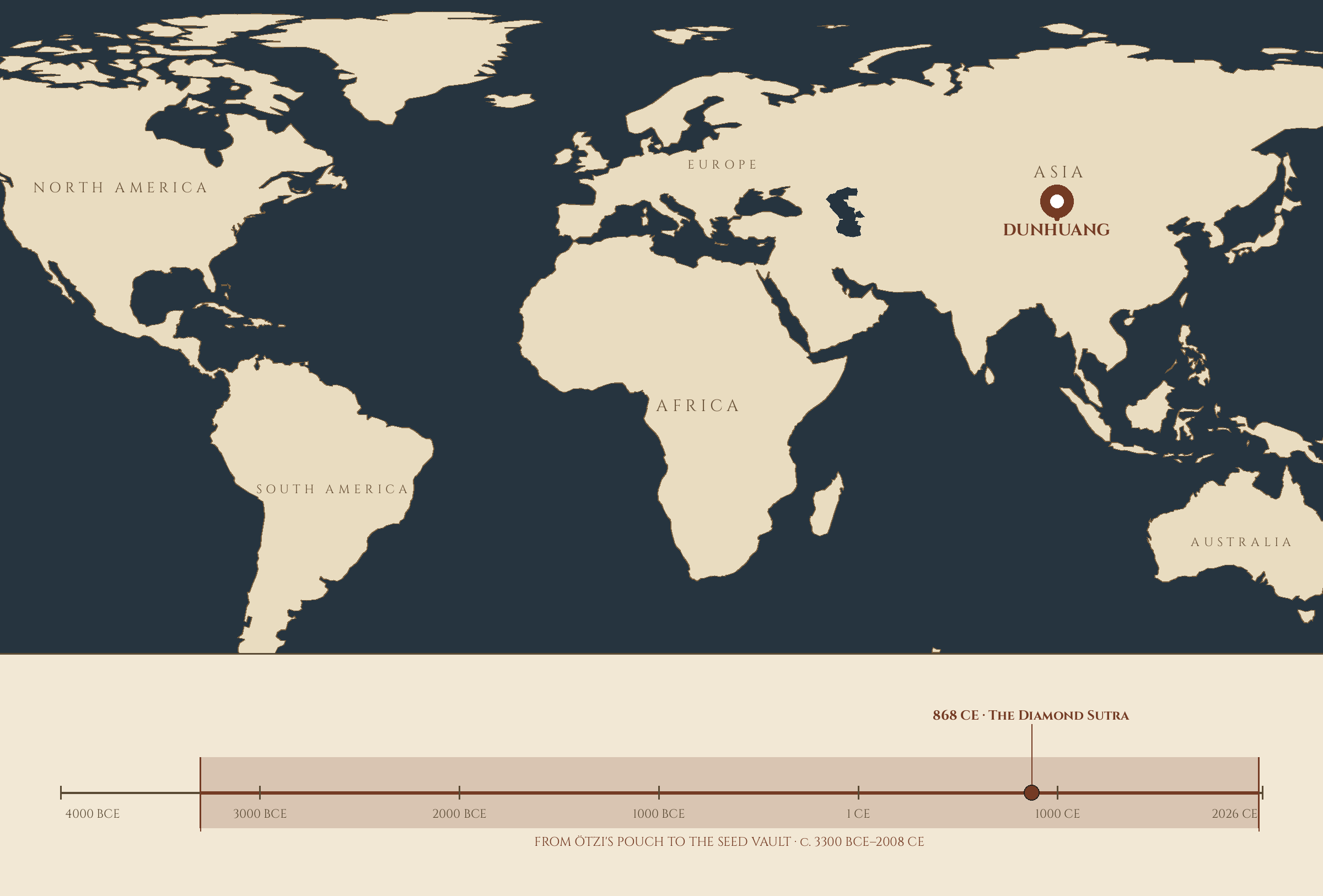
Where and when: Dunhuang, China — 868 CE, the Diamond Sutra.
Lesson Objectives
By the end of this lesson, students should be able to:
- Explain how printing descends from seal craft, from cylinder seals rolled on clay to woodblock printing.
- Describe the Diamond Sutra of 868 CE and say why its date matters in the history of the printed book.
- Cut a simple foam or eraser stamp and print a run of ten impressions that match.
- Diagnose a bad impression (too much ink, too little, uneven pressure, slipped block) and correct it.
- Work a linocut tool safely at Level Two: cut away from the body, bench hook in use, tool counted and parked.
- Set up and run a label station: stamp, ink, labels, and drying space, producing legible labels for jars and specimens.
Your Assignment Packet
This lesson's assignments live in its packet: the Lexicon Handout (every term, course terms marked ◆), the Assignment Manual, and the Reflection Questions. Download the packet before you begin and keep it beside you as you read — work from it as each subject is taught, or take the assignments as homework afterward.
From a Rolled Stone to a Printed Book
The ancestor of every printed page is a seal, and the grandest of the early seals is the cylinder. In Mesopotamia, from the late fourth millennium BCE onward, officials and merchants carried small cylinders of stone, carved in reverse with figures, animals, and inscriptions by specialist seal-cutters. Rolled over the wet clay of a tablet, a jar stopper, or the clay envelope around a contract, the cylinder left its design standing in relief, unbroken from edge to edge. The impression said whose goods these were, whose authority stood behind the document, and whether the seal had been broken since. A surviving Akkadian seal of about 2250 to 2150 BCE, carved in albite with a hero wrestling a water buffalo, can still be rolled today to produce the same impression it made four thousand years ago; the Metropolitan Museum has filmed exactly that. The tool outlasts the hand. That is the whole idea of printing, present at the start.
The stamp seal is the cylinder's flat cousin, and it traveled everywhere: Indus merchants pressed square stamp seals, Egyptian officials pressed scarabs, and much later, Chinese scholars pressed carved seals into red paste to sign paintings and documents, a practice alive today. The principle never changes. Carve once, in reverse. Impress many times. Trust the mark because only one matrix makes it.
Printing on paper grew from this root in China, where woodblock printing matured over centuries: a page of text and image carved in reverse on a wooden block, inked, and pressed to paper, one block per page. Its most famous early survivor is the Diamond Sutra, a Buddhist scripture printed in 868 CE and now held by the British Library. It is the world's earliest dated complete printed book: seven sheets printed from carved blocks and pasted together into a scroll over five meters long, with an illustrated frontispiece of real sophistication and a colophon recording that a man named Wang Jie commissioned it for free distribution in honor of his parents. Nobody carves a five-meter scroll as an experiment. By 868 the craft was already old, confident, and producing work meant to travel.
Europe took up woodcut in the late medieval centuries and raised relief printing to high art, and the family kept growing. Relief printing is printing from a raised surface: the parts that stand up take the ink and make the mark, and the parts cut away stay blank. In the nineteenth century linoleum was invented as a floor covering, and in the twentieth, artists discovered that this soft, grain-free material cut like butter compared to wood and took ink beautifully. The Tate's account of the linocut puts it plainly: the lino block, a thin layer of linoleum mounted on wood, can be cut in any direction because it has no grain, and its slightly textured surface accepts ink evenly. Picasso and Matisse both worked in linocut. A material made for kitchen floors became a fine-art medium within a working lifetime, which should encourage anyone holding a foam stamp today.
Europe's woodcut artists proved how far the relief principle could go. By about 1500, Albrecht Dürer and his workshop were cutting blocks of extraordinary fineness, and a printed image could travel in a book or as a loose sheet across the whole continent, identical in every copy. That is the moment the seal's old promise changes its meaning. The unique impression had said this one object is authorized. The printed run said something new: every one of these copies is the same, and sameness itself became a kind of trust.
The label belongs to this history too, and it is not the poor relation. The apothecary's jar label, the herbalist's specimen label, the museum's accession tag: each is a small printed promise that an object is what it says it is. Potions scholars met label craft in their own laboratory in Unit I, and Fernfoot's specimens are named with the same care. Today the workshop builds the station where such labels get made: stamp and ink in order, label stock squared, a drying rack that is not the floor, and the discipline to print the run before the jars are waiting.
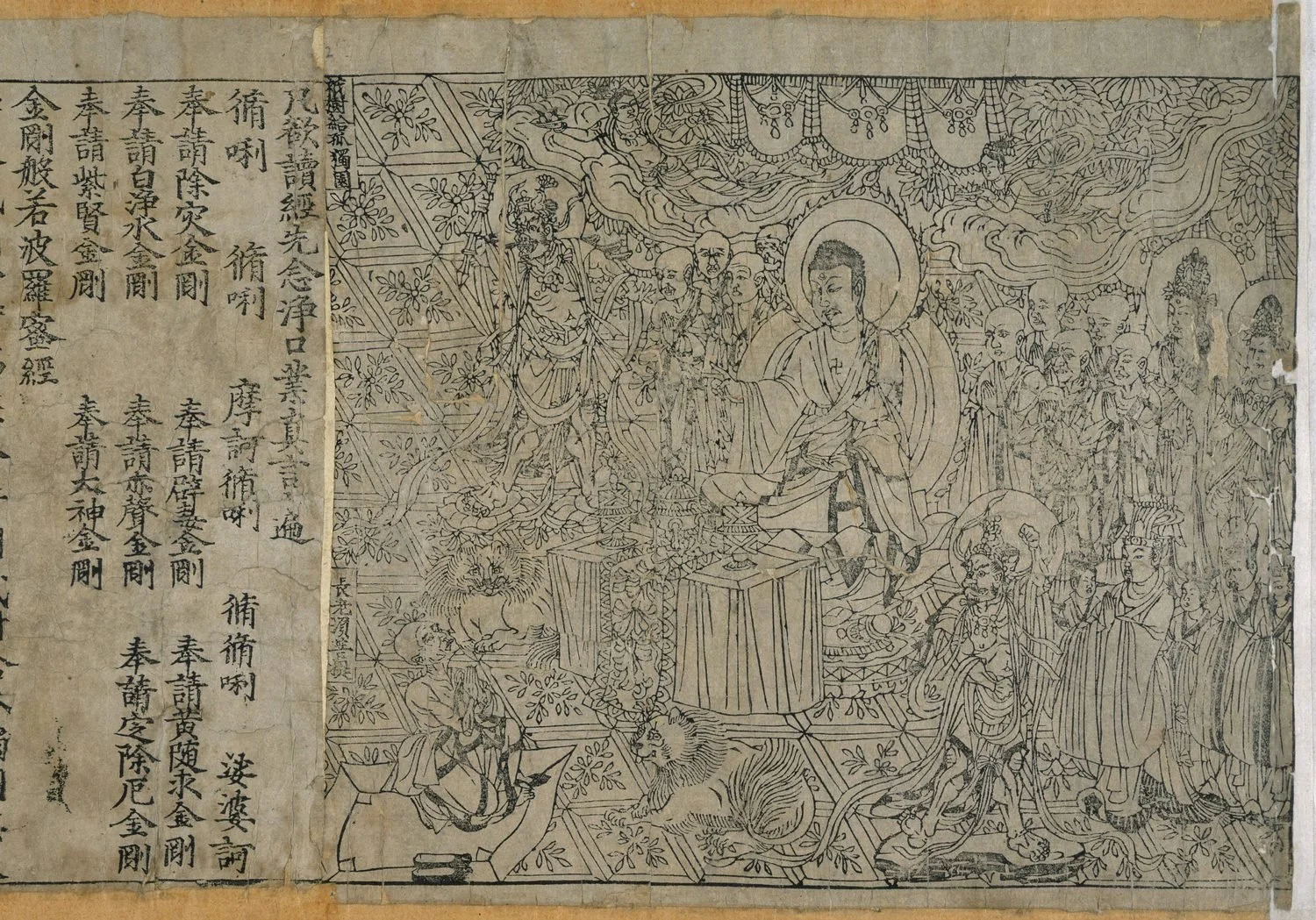
The frontispiece of the Diamond Sutra (868 CE), the world's earliest dated complete printed book — a woodblock-printed image of the Buddha teaching, with the printed text.
British Library (Or.8210/P.2). Public domain, via Wikimedia Commons.
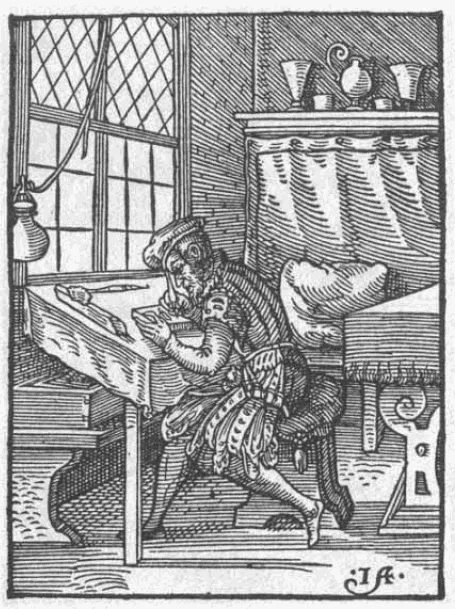
A woodblock cutter (Formschneider) carving a printing block at his bench, 1568 woodcut.
Woodcut from the Ständebuch (Book of Trades), Frankfurt, 1568. Public domain, via Wikimedia Commons.
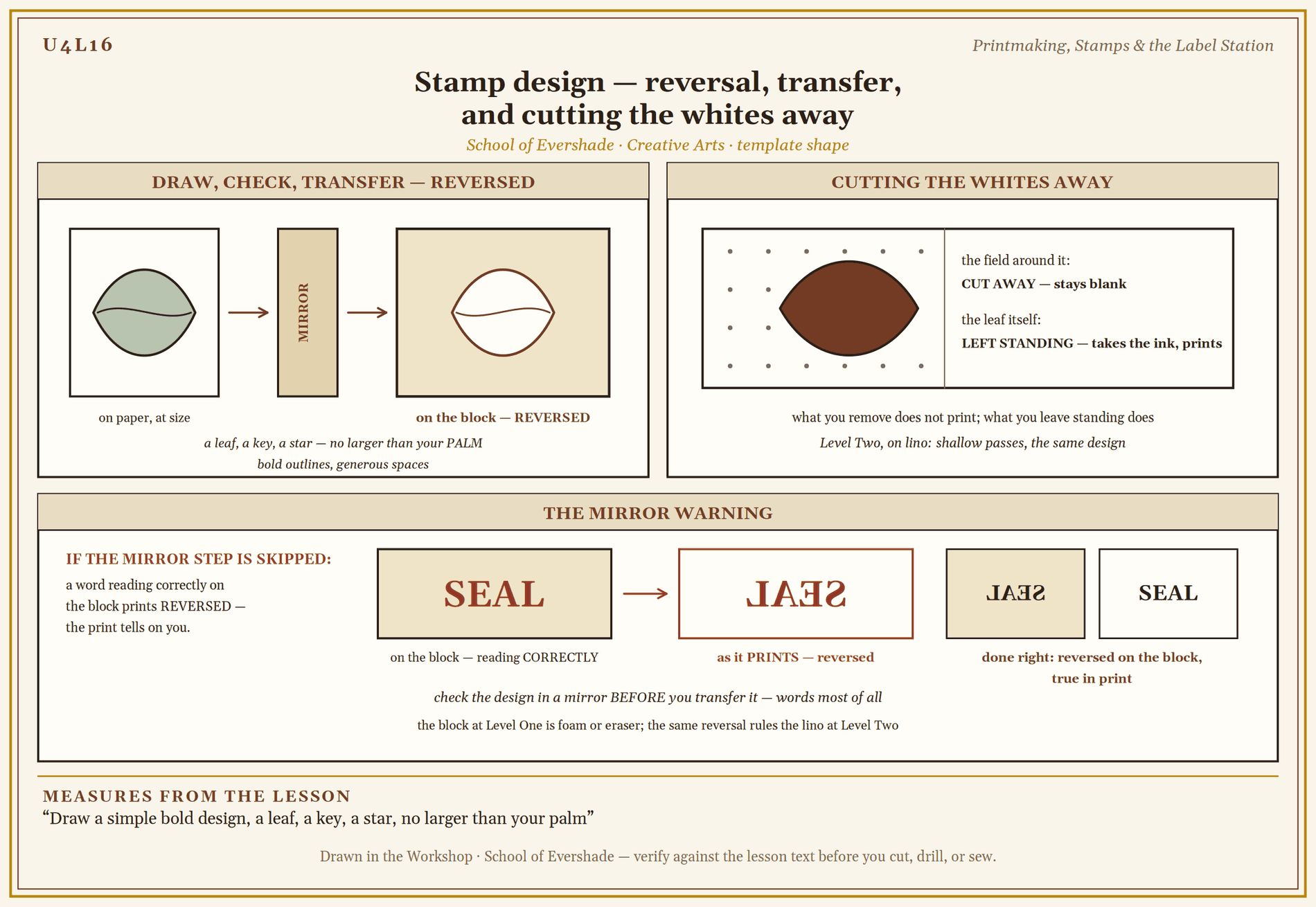
Stamp design — reversal, transfer, and cutting the whites away
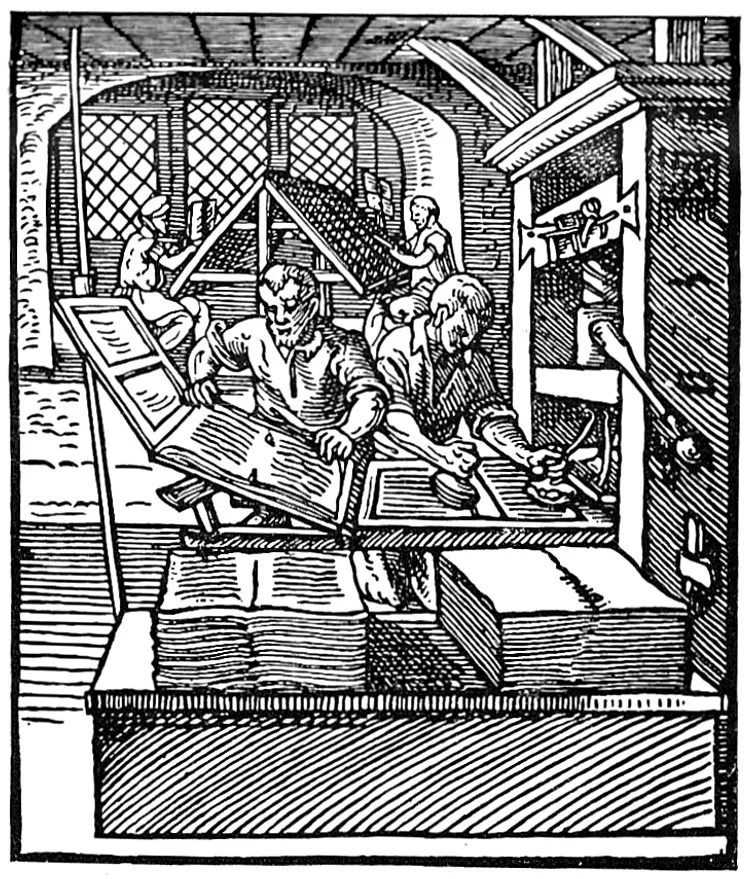
A printer's workshop, 1568 woodcut (the Buchdrucker of the Ständebuch) — the common press mid-impression, type cases and printed sheets around the bench.
Woodcut from the Ständebuch (Book of Trades), Frankfurt, 1568. Public domain, via Wikimedia Commons.
A Sealed Note from Professor Timberclank
The lino tool is a small chisel with opinions, scholars, and it is the sharpest thing this unit owns. Its rules are short and they are final.
The block sits in the bench hook, always. A bench hook is a flat board with a lip at each end, one lip hooked over the bench edge and the other stopping the work, so the holding hand never has to sit in front of the blade. The hook takes the push, not your other hand. Your holding hand stays behind the cutting edge, every cut, every time, and the tool travels away from your body, never toward it, never across a palm. A tool not cutting is parked in its tray, edge turned in, counted like the needles of Unit III.
And if the block slips, or the tool jumps, or a cut goes where it was not invited: we stop. We make it safe. Then we begin again. Foam and eraser forgive a beginner. Lino teaches the same lessons with higher stakes, which is why it waits at Level Two, behind the bench hook, until your hands have earned it.
PROFESSOR COGBRANCH TIMBERCLANK
Creative Arts Workshop
Master Artisan, Head of House Occidens
Technique: Cutting and Printing a Clean Run
Design backward. Everything in relief prints in mirror image. Words most of all. Draw your design on paper, check it in a mirror, and transfer it to the block reversed, or your label will read correctly only to the fish. Simple shapes print best: bold outlines, generous spaces, no whiskers.
Cut the whites away. What you remove does not print; what you leave standing does. With foam, scissors do most of the work and a craft knife only trims. With an eraser, shallow cuts suffice. With lino at Level Two, the bench hook holds the block, the gouge pushes away from you, and shallow passes beat deep ones: you can always cut more away, and you cannot put any back.
Ink thin. Squeeze out a pea of ink and roll it with the brayer until it makes a faint, even hiss and looks like velvet. Roll that film onto the block in several directions. A stamped image with filled-in middles is wearing too much ink; a gray, starving image has too little or was pressed too lightly.
Print with the whole hand. Lay the paper or label on the inked block, or the block on the paper, and press evenly across the whole back with palm and fingertips, or burnish with the back of a spoon. Peel from one corner, steadily. Rocking the block prints doubles; haste prints ghosts.
Judge and adjust. Lay the impressions in a row. The first two or three are the tool warming up and the ink settling; the run counts from the first one you would sign. Adjust one thing at a time: pressure, ink, or paper. Ten matching impressions is the standard of this bench, and it is harder and more satisfying than it sounds.
Run the station. Labels are printed in batches before they are needed: design squared, stock cut, ink rolled, impressions racked to dry in order. The station is cleaned and reset at the end of every session, ink closed, brayer washed, stamps stored face up where nothing can bruise them. A station left ready is a gift to the next scholar, who is often yourself.
Practice Practical: Ten Matching Impressions
This drill is checked for an even ink film, consistent pressure, and a run you would sign.
- Design and reverse. Draw a simple bold design, a leaf, a key, a star, no larger than your palm. Check it in a mirror. Transfer it to your foam or eraser block, reversed.
- Cut the block. Trim the outline with scissors; cut away the parts that must stay blank. Keep edges clean and spaces generous. Ink will find every ragged corner you leave.
- Roll the ink. Roll a pea of ink on the tray until it films evenly and hisses faintly. Roll the film onto the block in several directions, light and even.
- Print the warm-ups. Print three test impressions on scrap. Read them honestly: filled middles mean too much ink, gray patches mean too little or light pressure, doubles mean the block moved.
- Adjust one thing. Change exactly one variable, ink, pressure, or paper, and print three more. Compare the rows. This is the scientific method at bench scale, and it is how printmakers think.
- Print the run. Print ten impressions on label stock, racking each to dry in order. The run passes when the last seven match closely enough that you cannot sort them by quality at a glance.
- Reset the station. Wash the brayer and block as their inks require, close the ink, store stamps face up, and leave the station ready. Sign the best impression. It goes in your workbook as the standard your Lesson 17 matrices will be judged against.
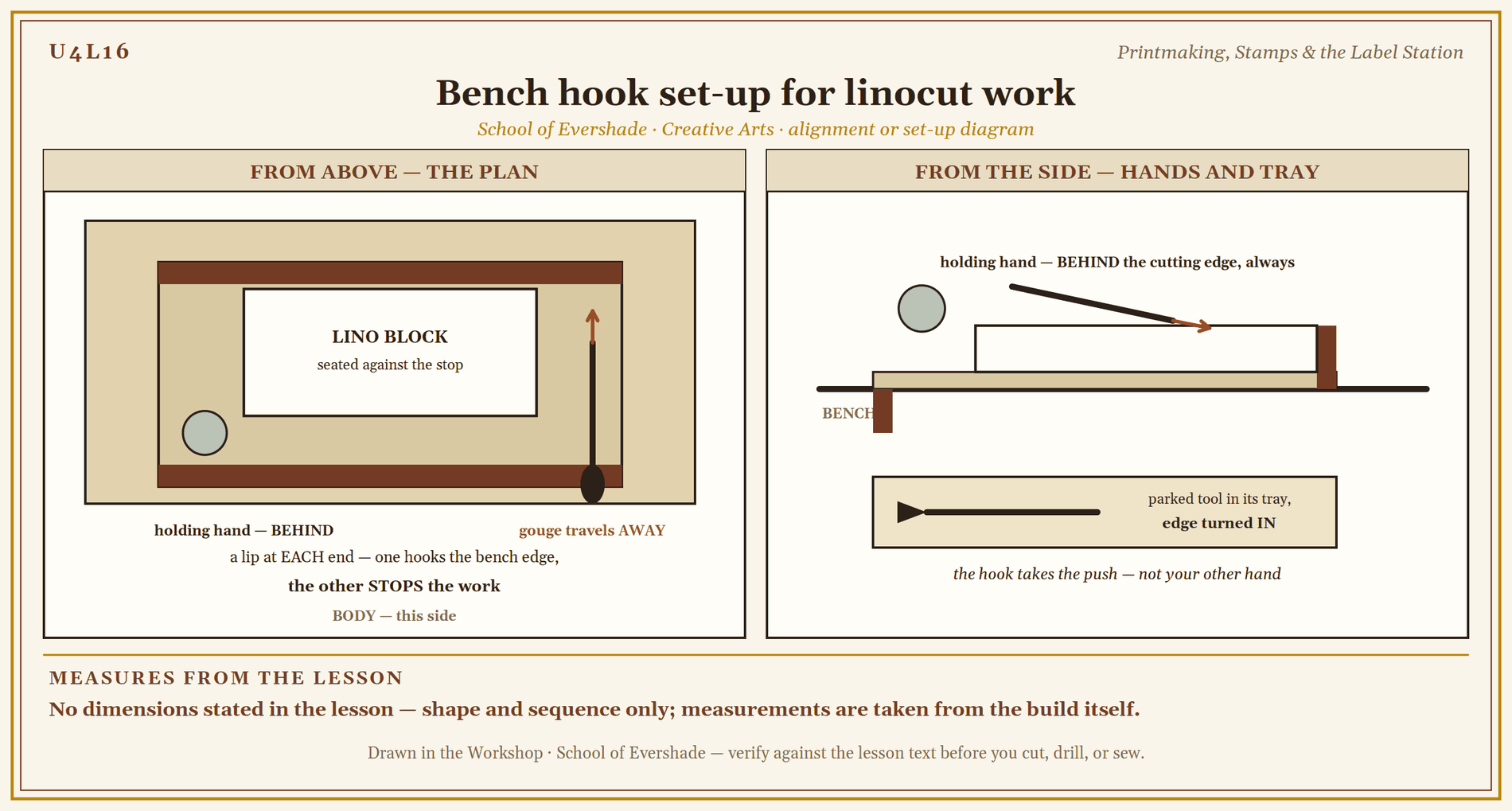
Bench hook set-up for linocut work
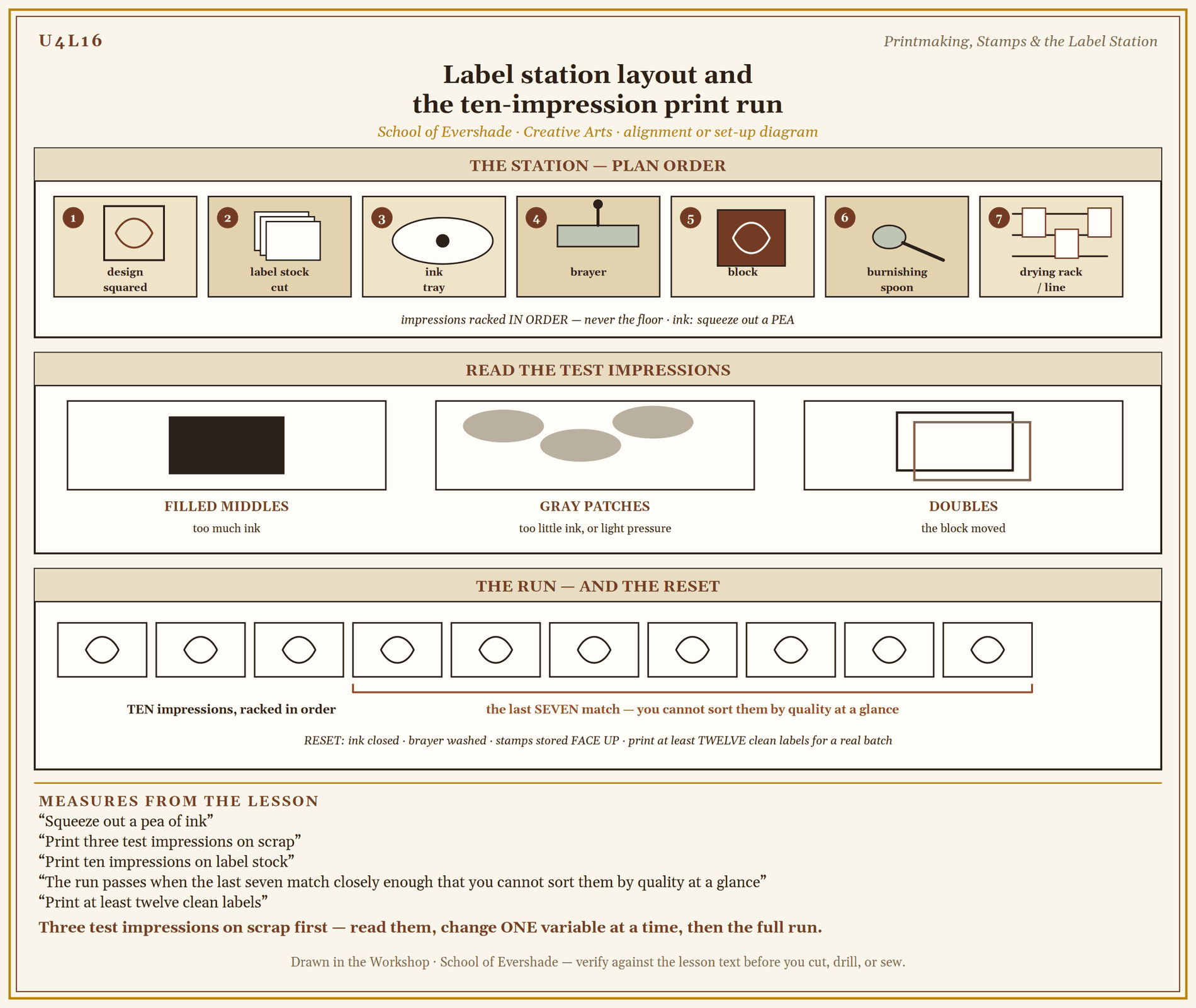
Label station layout and the ten-impression print run
Assignment Manual
Assignment key: ✎ written work · ⚒ hands-on practical · ◐ both
Assignment I ⚒ — Ten Matching Impressions
Complete the Practice Practical in this lesson: a foam or eraser stamp designed, reversed, and cut, three judged test impressions, and a final run of ten on label stock with the last seven matching. At Level Two, a lino version of the same design may be cut under the bench-hook rules and printed beside the foam run for comparison.
Assignment II ✎ — From Seal to Sutra
Write a short history of relief printing's long childhood: the cylinder seal rolled on Mesopotamian clay, the stamp seals of the Indus and Egypt, Chinese woodblock printing, and the Diamond Sutra of 868 CE. End with the colophon: what Wang Jie had made, and for whom, and what the existence of that scroll proves about the age of the craft that made it.
Assignment III ◐ — Man the Label Station
Produce a real batch of labels for a real need: a set of jar labels for the Potions laboratory's stores, specimen labels for Herbology, or a masthead or notice graphic for the Gazette. Print at least twelve clean labels, mount or apply one finished example, and write half a page on your station: how you laid it out, what went wrong in the early impressions, and what you changed. The batch and the account are both assessed.
Materials
Level One (household)
- Craft foam sheets or large soft erasers for stamp blocks
- Scissors and a pencil for drawing and transferring designs
- A water-based stamp pad or washable block-printing ink, with a small brayer or foam roller
- A flat tray or tile for rolling out ink
- Label stock: card offcuts, adhesive labels, or plain paper and glue
- The back of a spoon for burnishing, scrap paper for tests, a drying line or rack
Level Two (historical)
Everything in Level One, plus:
- A lino block (linoleum mounted on wood) and a set of lino gouges with a bench hook
- Oil-based or water-washable relief ink for a denser, more permanent impression
- One woodblock-style exercise: a plank of soft wood and a single bold design, cut as the Diamond Sutra's carvers cut, to feel where the craft stood for a thousand years
- A hand press if the workshop has one, or a baren (the flat disc used to burnish Japanese woodblock prints) for even pressure
Both levels print the same run of labels. Level Two cuts its matrices in the materials printing grew up with, under the sealed note's discipline.
Reflection Questions
Answer the following questions in your workbook.
- A cylinder seal could be rolled four thousand years after its carving and still make its mark. What does a tool that outlasts its maker ask of the person who makes it?
- Which of your ten impressions finally matched, and what single adjustment got you there? Why did changing one thing at a time matter?
- Wang Jie had his scroll printed for free distribution. What changes when a text is made to be given away in hundreds, rather than copied once by hand?
- A label is called a small promise in this lesson. Describe a label you have trusted, in a shop or a kitchen, and what made it trustworthy or not.
- The bench hook exists so a hand never holds the work in front of a blade. Name another rule in this course that looks like fussiness and is actually this same idea in different clothes.
Professor's Review
A mark that repeats, scholars, and repeats true. That is no small thing to have earned.
Your stamp prints ten impressions you would sign, and you can read a bad one like a sentence and say what ails it. You know the line your craft descends from: a rolled stone in Mesopotamia, a five-meter scroll in a Chinese cave, a floor covering that became an artist's block in your own century. And the label station stands reset and ready, which the whole school will quietly thank you for.
Next lesson the stamp becomes a seal in earnest. We cut matrices in reverse, melt wax under discipline, and build the wax tablet, the notebook Rome ran an empire on. Bring your best impression from today. Your seal will be judged against the standard your own hand set.
PROFESSOR COGBRANCH TIMBERCLANK
Creative Arts Workshop
Master Artisan, Head of House Occidens
Further Reading & Sources
Smarthistory. "Cylinder Seal with a Modern Impression." An Akkadian serpentine seal of about 2250 to 2150 BCE, with the impression it still makes: the carve-once, impress-many principle at the root of all printing.
International Dunhuang Programme, British Library. "The Diamond Sutra." The British Library on its own treasure: the earliest dated printed book in the world, made in 868 CE, found in a sealed cave at Dunhuang among tens of thousands of scrolls.
Tate. "Linocut." The Tate's art-terms entry on the twentieth century's relief medium: linoleum's floor-covering origins, its grain-free cutting, and why its surface takes ink so evenly.
Student-friendly starting points for exploring this lesson's world. All links verified October 2026.
- Smithsonian Magazine. "Five Things to Know About the Diamond Sutra, the World's Oldest Dated Printed Book." Wang Jie's commission, the 868 date, the sealed cave, and the scroll's journey to the British Library, told briskly and well.
- The Metropolitan Museum of Art. "Mesopotamia, 8000–2000 B.C." Heilbrunn Timeline of Art History. The long Mesopotamian timeline, including the moment stamp seals give way to cylinder seals and the repertoire of seal designs widens.
Submit your work for this lesson using the form below.
CONTINUE IN THE CREATIVE ARTS WORKSHOP
← Previous · Lesson 15: Pigments, Paints & Color Charts Next · Lesson 17: Seal Matrices & Waxwork →
Unit IV · Pigment, Print & Seals Creative Arts Workshop · All 39 Lessons
Bookstore Shelf The Library · Creative Arts Shelf Course Supplies
The rest of Unit IV: Lesson 15 · Pigments, Paints & Color Charts · Lesson 17 · Seal Matrices & Waxwork