Creative Arts
Unit IV, Lesson 17Seal Matrices & Waxwork
Professor Cogbranch Timberclank
Master Artisan, Head of House Occidens
The Creative Arts Workshop • School of Evershade
Professor's Introduction

Bench set, scholars. Last lesson your stamp learned to repeat. Today it learns to mean something.
A stamp says this was printed here. A seal says this is mine, I stand behind it, and it has not been tampered with since my hand left it. That is a larger claim, and for most of recorded history it was made with two tools you will handle today: a matrix, a small block of stone, metal, or wood carved in reverse, and a cake of wax to receive it. Kings authenticated laws with it. Merchants closed bales with it. Ordinary farmers, in the great centuries of the seal, authenticated their land sales with it, because a seal was a signature for a world where most signatures could not be written.
You will design and cut a simple matrix of your own, pull its impressions in wax until they read clean, and learn what a seal can and cannot promise. Then, as this unit's closing build, you will make the seal's old companion: a wax tablet and stylus, the reusable notebook that Rome wrote its drafts, its sums, and its school exercises on, and that clerks were still using for accounts a thousand years later. The stylus is the tablet's pen: a rod of metal, bone, or wood with a point at one end for writing in the wax and a flat, wedge-shaped end for smoothing the wax flat again — one tool, two ends, to write and to unwrite.
Work small and work in reverse. The seal rewards both.
PROFESSOR COGBRANCH TIMBERCLANK
Creative Arts Workshop
Master Artisan, Head of House Occidens

Lesson Objectives
By the end of this lesson, students should be able to:
- Trace the seal's history across three traditions: Indus stamp seals, Mesopotamian cylinder seals, and Egyptian scarabs.
- Explain how a medieval matrix was made and used, and how a wax seal authenticated a document and showed tampering.
- Design a simple seal device and cut it in reverse, checking the design with test impressions.
- Melt and pour sealing wax under heat discipline, and pull a clean, fully read impression.
- Build a framed wax tablet and a two-ended stylus, write on the tablet, and smooth it clean for reuse.
- Explain the color-marking idea: how wax color itself carried meaning about whose seal, and what kind of document, it was.
Your Assignment Packet
This lesson's assignments live in its packet: the Lexicon Handout (every term, course terms marked ◆), the Assignment Manual, and the Reflection Questions. Download the packet before you begin and keep it beside you as you read — work from it as each subject is taught, or take the assignments as homework afterward.
Three Rivers of Seals, and a Tablet
The first river runs through the Indus valley. In the planned cities of Mohenjo-daro and Harappa, in the centuries around 2600 to 1900 BCE, merchants and officials used small square stamp seals, most carved from steatite, a soft stone that hardens in firing. Each seal carries an animal, a unicorn-like beast most often, and a short line of signs in the Indus script, which remains undeciphered to this day. Thousands of these seals survive, along with the clay sealings they once stamped, and the standard reading of them is that they marked ownership and authority in trade: this bale, this jar, this store-room is accounted for. Whoever they belonged to, they were made in enormous numbers by specialist carvers, which means the seal was not a royal toy in the Indus cities. It was ordinary commercial equipment, four and a half thousand years ago.
The second river is Mesopotamia, where, as Lesson 16 told, the cylinder seal reigned: rolled, continuous, in use for three thousand years to sign tablets and seal the clay around contracts and doors. Egypt contributes the third river, the scarab: a small seal carved as a beetle, its flat underside engraved with names, titles, or protective signs, pierced so it could be worn on a cord or set in a ring. Scarabs served double duty as seals and as amulets, which is a useful reminder that in the ancient world the practical and the hopeful were rarely kept in separate drawers.
The medieval West took the seal and built a legal world on it. The instrument was the matrix, a die hand-engraved in reverse, often by goldsmiths and silversmiths, in copper alloy, gilt, or silver, with a handle of metal or wood, or else small enough to be a signet ring. Pressed into soft wax attached to the document by a parchment tag, a tongue cut from the document's own foot, or a plaited cord, it authenticated the deed: the impression was, in law, the person. The conservators of the St George's Chapel archives, who care for some two thousand medieval seals, note that England's earliest documents authenticated by attached seals are the writs of Edward the Confessor, in the eleventh century, and that from the twelfth and thirteenth centuries the use of personal seals spread until virtually no landholder, down to tenant farmers, was without one. Wax color itself began to carry information: most early seals are colored beeswax, and in later medieval practice particular colors attached themselves to particular offices and kinds of business, an early filing system you could read across a room.
Because the matrix was the authority, its custody was a serious matter. Matrices were kept under guard, and when a great seal's owner died, the matrix was formally broken or defaced in a witnessed act, precisely so that no document could ever be sealed in the dead person's name again. The custom survives in echoes: the pope's signet, the Ring of the Fisherman, is still ceremonially defaced on a pope's death. A broken matrix was not vandalism. It was the honest closing of an account, the medieval equivalent of canceling a key.
The seal's power was never magic. It was three plain facts working together: only one matrix made that impression, the wax hardened around the document's fastening, and the hardened wax was brittle enough that opening the document broke it in a way no forger could quietly mend. Authority, identity, and tamper evidence, in a lump of wax.
Beside the seal, quietly, ran its companion technology: writing in wax meant to be erased. The Roman diptych, two wax-filled boards hinged together, was the ancient world's notebook. Schoolchildren practiced letters on it, merchants kept the day's figures on it, and London's mud has given some of it back to us: over four hundred wooden tablets from the Bloomberg site in the City of London, the largest collection of Roman waxed tablets found in Britain, recording the business of Londinium in its first decades after about 50 CE, down to one tablet bearing the alphabet, quite possibly a school exercise. The wax itself has perished, but eager writers pressed through to the wood, and their words can still be read. A stylus from Roman London in the University of Canterbury's collection shows the tool whole: fine ridges at the pointed end for grip, and a wedge-shaped flat at the other end for erasing, by warming and smoothing the wax flat again. Medieval clerks kept the technology alive for accounts and drafts long after parchment was common, because a tablet costs nothing to reuse. You will build one today, and you will find that your mistakes on it are mercifully temporary.
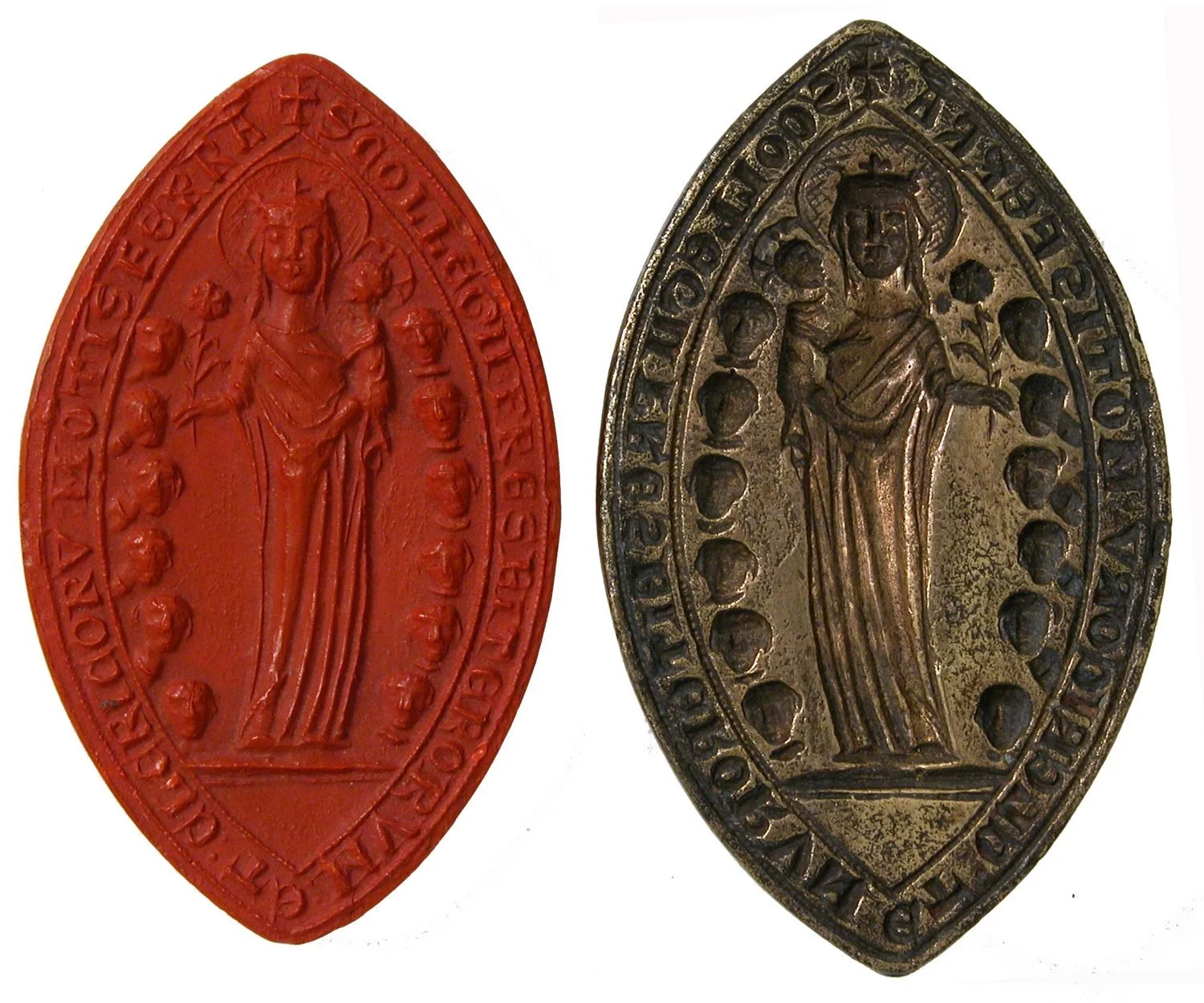
A French 15th-century bronze seal matrix photographed together with its own wax impression — tool and result in a single object record.
The Metropolitan Museum of Art (Object 60.55.82a, b), Open Access (CC0).
Seal matrix — design, double reversal, and intaglio cutting
Pouring and pressing a wax seal
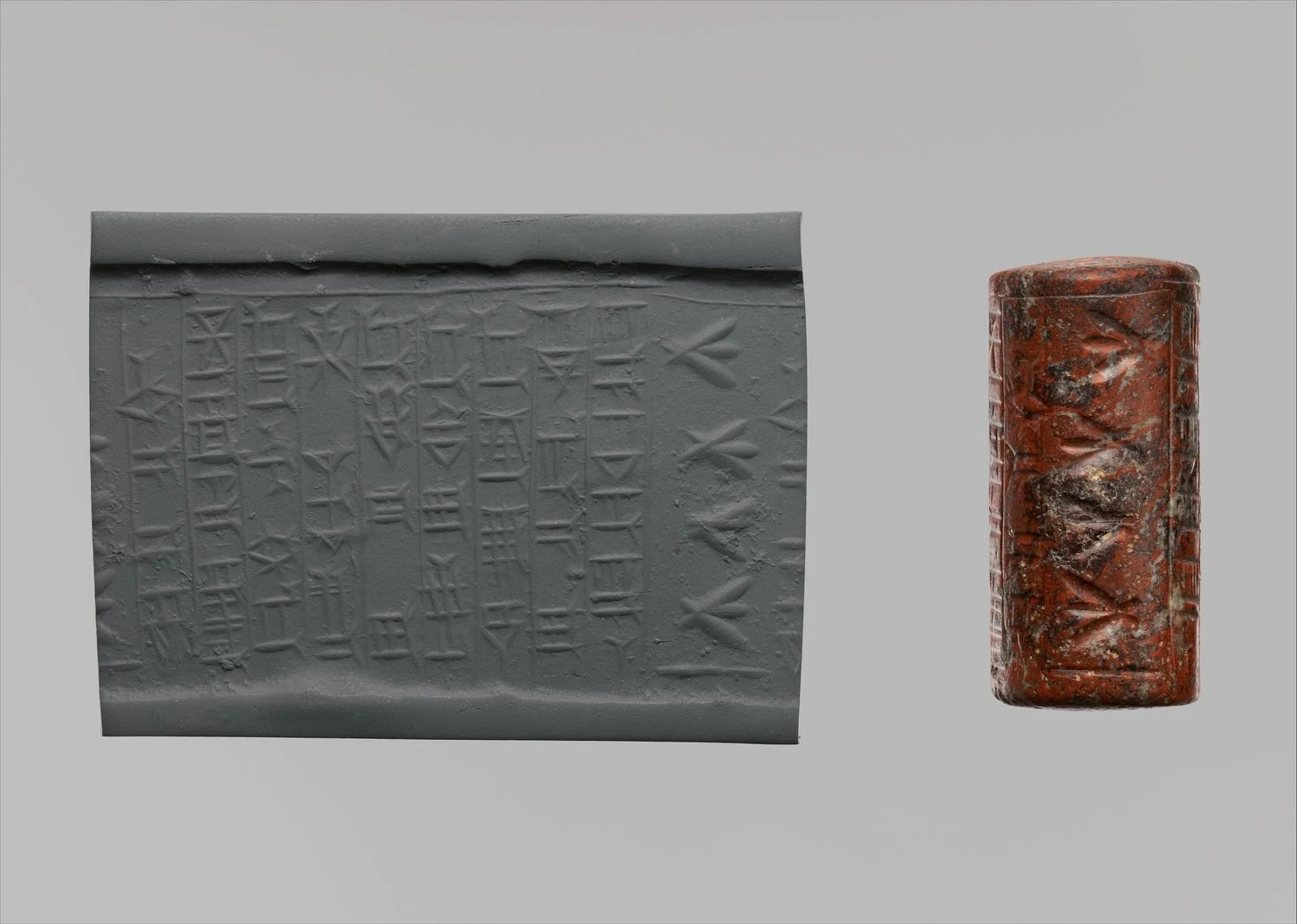
A Kassite cylinder seal of jasper, Mesopotamia, ca. 16th–12th century BCE (4.1 cm high) — the small carved cylinder that was rolled across wet clay to leave a continuous design.
The Metropolitan Museum of Art (Object 1985.357.25), Open Access (CC0).
A Sealed Note from Professor Timberclank
Three rules ride on this lesson, scholars, and they ride together.
First, wax is melted, and melted wax is a burn that arrives quietly. The pot is small, the heat is low, the work is an adult's or done with one at the bench, and water never goes near hot wax. Lesson 5 taught the boundaries for heat and wax in this workshop. They all apply here, at full strength.
Second, a matrix is a key. Yours is a practice key to a practice lock, but treat it as the real thing is treated: it is never lent casually, never left in the wax, and its impressions are never made on anything you do not mean. A seal pressed in jest on the wrong document teaches the hand the wrong lesson.
Third, check the reverse before you cut, and check it again in clay before wax is wasted. Every seal-cutter who ever lived has carved one letter forward and met it backward in the impression. The test impression is not a step to skip when you feel confident. It is the step that confidence is made of.
PROFESSOR COGBRANCH TIMBERCLANK
Creative Arts Workshop
Master Artisan, Head of House Occidens
Technique: Cutting the Matrix and Pulling the Seal
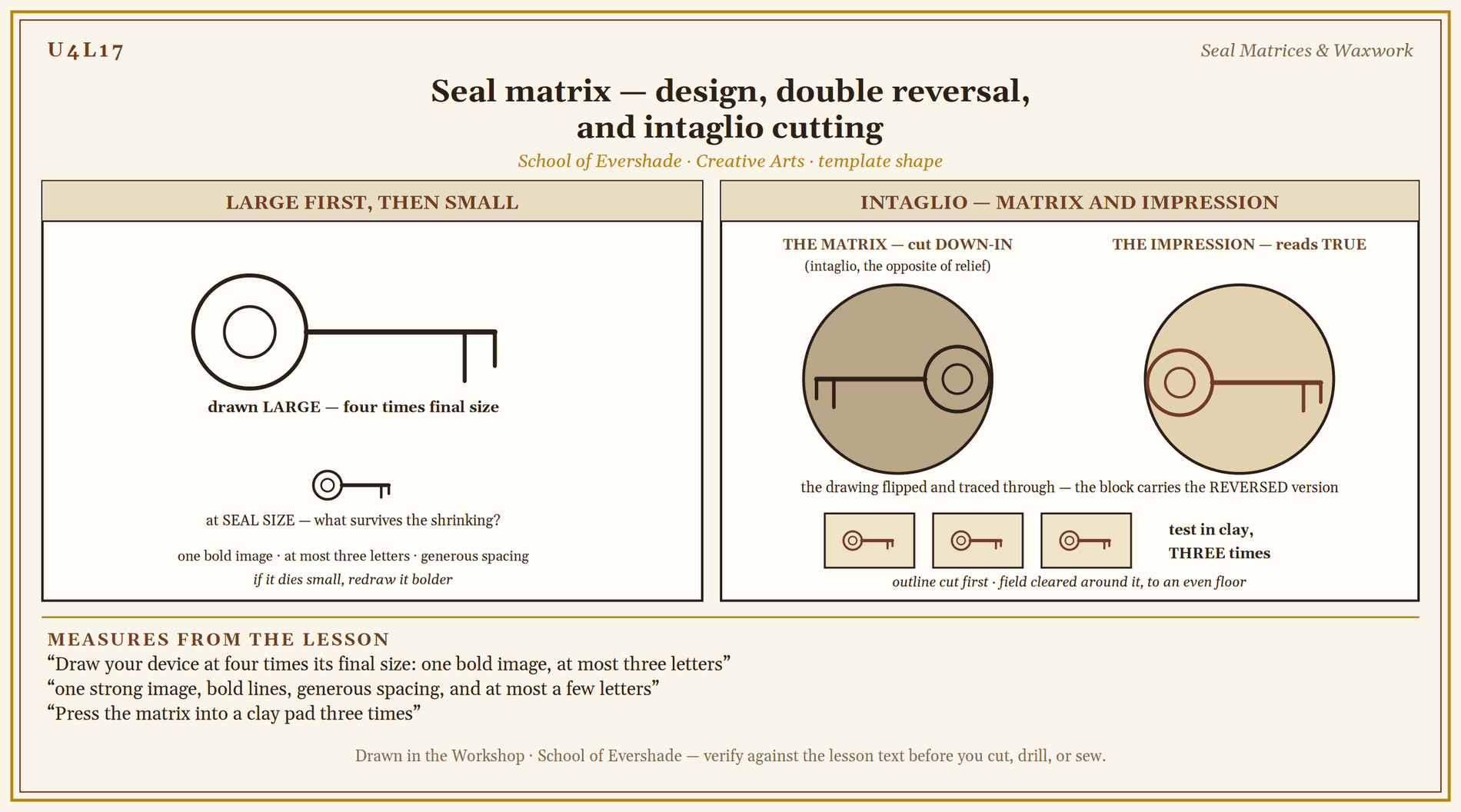
Design for the wax. A seal device must read at small size in a soft material: one strong image, bold lines, generous spacing, and at most a few letters. Fine detail drowns in wax. Look at what survived: an animal, a tool, a star, a monogram. Choose one thing that is yours and draw it large first, then shrink the drawing, and see what survives the shrinking. What survives is your design.
Reverse it twice over. The matrix is cut as a mirror image, and cut down into the surface. A design cut into a surface in this way is intaglio, the opposite of relief. Draw the design on the block, then flip the drawing and trace it through, so the block carries the reversed version. Say it aloud before cutting: the wax will read it right because I cut it wrong. Every cutter says it. Every cutter has once forgotten it.
Cut shallow and clean. In eraser, cork, or soft wood, work with the gouge or craft knife under Unit IV's discipline: block secured, cuts away from the body, holding hand behind the edge. Keep the floor of the cut even; a ragged floor prints a ragged field. Cut the outline first, then clear the field around it, checking depth against a test impression as you go.
Test in clay or plasticine first. Press the matrix into a soft clay pad and read the impression before any wax is melted. Every fault is visible here at no cost: a letter reversed, a line too thin, a corner too shallow. Correct the matrix, not your expectations.
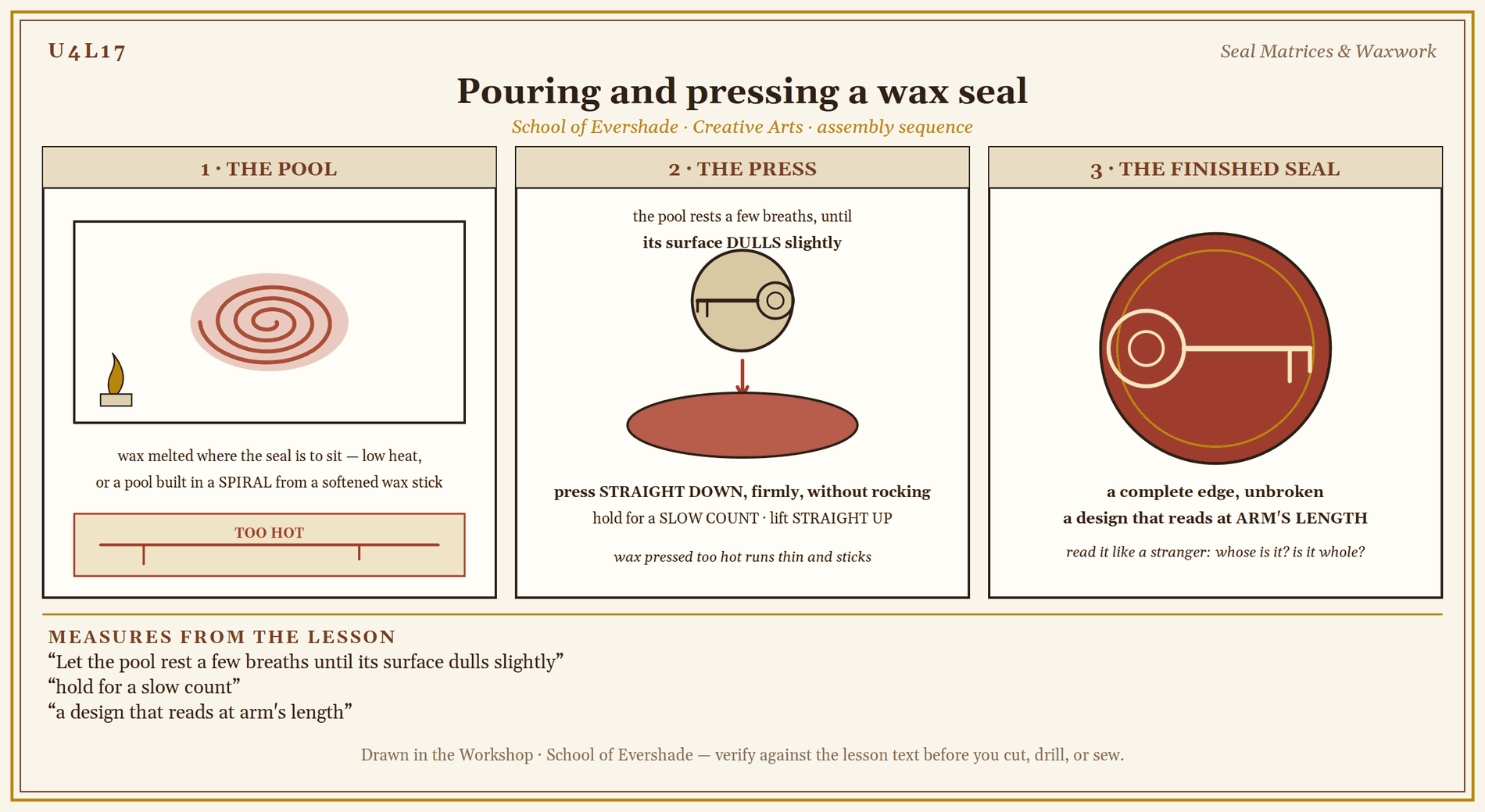
Pour and press the seal. Melt a small pool of sealing wax where the seal is to sit, or soften the end of a wax stick and build the pool in a spiral, under the heat rules of the sealed note. Sealing wax is a wax compound that melts at low heat and hardens quickly into a brittle seal. Let the pool rest a few breaths until its surface dulls slightly; wax pressed too hot runs thin and sticks to the matrix. Press the matrix straight down, firmly, without rocking, hold for a slow count, and lift straight up. A clean seal has a complete edge, a design that reads at arm's length, and no fingerprints but the maker's mark where it belongs.
Read your own seal like a stranger. Check it as a recipient would: Whose is it? Is it whole? Has it been broken and mended? That three-part reading is what you are learning to produce, and one day, perhaps, to trust.
Practice Practical: Test Seals and a Wax Tablet
This drill is checked for a design that reads in reverse, clean test impressions before wax, and a tablet that writes and erases properly.
- Design and reverse. Draw your device at four times its final size: one bold image, at most three letters. Flip the drawing, trace it through onto your practice block, and say the cutter's sentence aloud: the wax reads right because I cut it wrong.
- Cut the practice matrix. Secure the block. Cut the outline, then clear the field, shallow and even. Keep the holding hand behind every cut.
- Pull clay tests. Press the matrix into a clay pad three times. Read each impression like a stranger: what reads, what drowns, what is reversed. Correct the matrix and test again until the impression is whole.
- Frame the tablet. Lay your two boards side by side. Mark a shallow recess on each inner face, or build a low frame of thin strips around each face's edge. Hinge the boards with string or ribbon so they close face to face.
- Fill the tablet. With an adult at the bench and the heat rules in force, melt the tablet wax, pour a thin, even layer into each recess, and smooth it with a warm flat tool. Let it cool fully. A tablet's wax should be thin: it is a writing skin, not a candle.
- Make the stylus. Shape your dowel or rod: a point at one end, a flat wedge at the other. Write your name and the date on the tablet. Then warm the flat end in your hands, smooth the writing away, and write again. The tablet passes when the second writing is as legible as the first.
- Pull the true seal. Melt a wax pool on a card, rest it until the surface dulls, press your corrected matrix straight down, hold, and lift straight up. Mount the best seal beside your best stamp impression from Lesson 16 in your workbook. The pair is this unit's evidence, and Unit V will expect your hands to remember both.
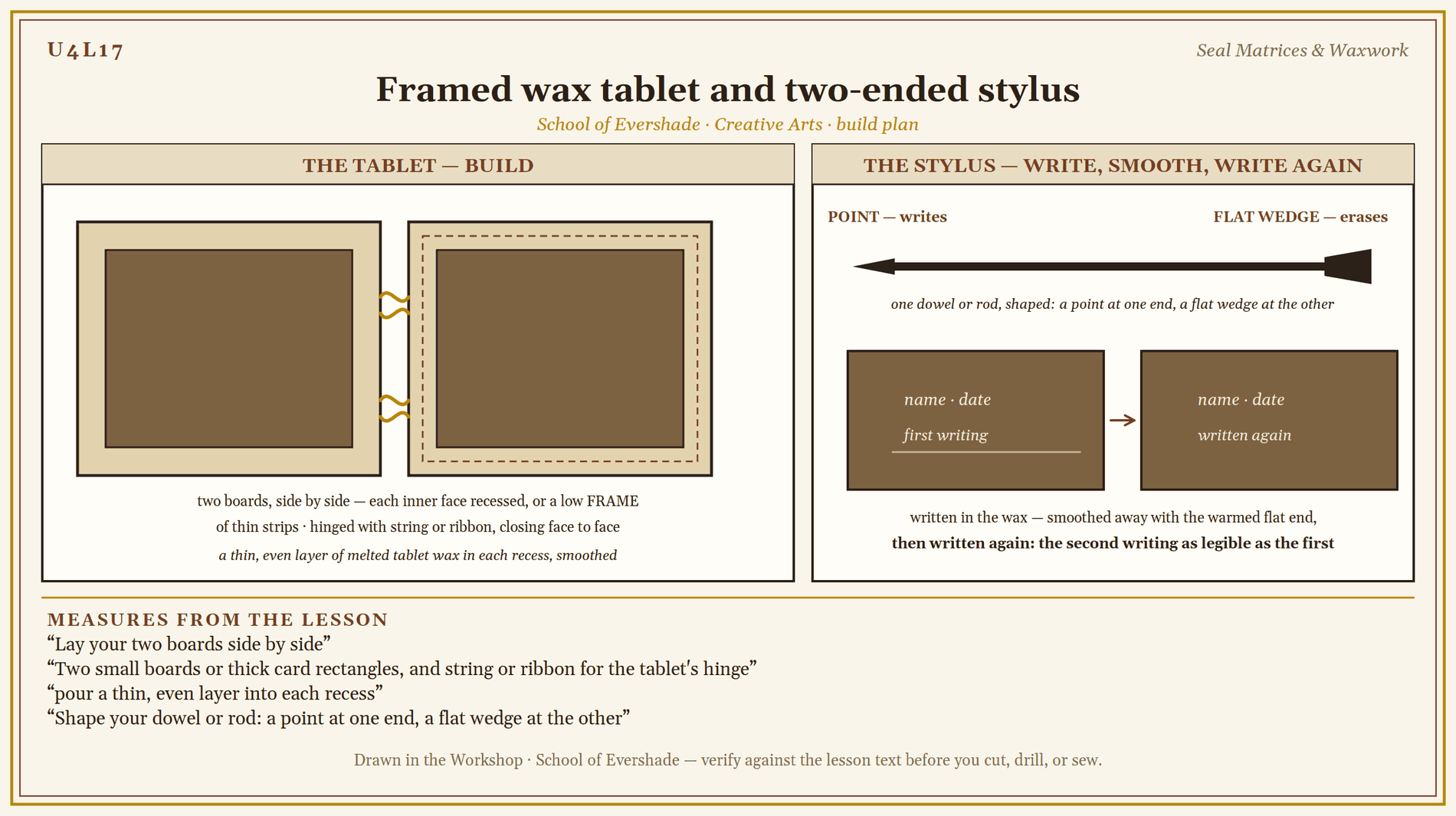
Framed wax tablet and two-ended stylus
Assignment Manual
Assignment key: ✎ written work · ⚒ hands-on practical · ◐ both
Assignment I ⚒ — Test Seals and a Wax Tablet
Complete the Practice Practical in this lesson: a practice matrix designed, reversed, and cut; clay test impressions pulled and corrected; a framed wax tablet built, written on, smoothed, and written on again; and one true wax seal pulled clean and mounted beside your Lesson 16 impression.
Assignment II ✎ — Keys, Colors, and Broken Wax
Write a short account of how a wax seal actually secured a medieval document: the matrix as personal property, the ways seals were attached, what wax color could say, and why brittle wax was a security feature rather than a flaw. Use the St George's Chapel archives account from the sources, and end with the death of a great seal: why a dead ruler's matrix was destroyed, and what that tells you about where the seal's power really lived.
Assignment III ◐ — A Seal of Your Own, Properly Cut
Design and cut a lasting matrix at Level Two, or a second, finer practice matrix at Level One: a device for yourself, your house, or your workbook, with a written key explaining every element of the design and why it will still read at seal size. Pull three impressions, choose the best, and present matrix, key, and impression together. The explanation is part of the work: a seal no one can read is a picture, not a signature.
Materials
Level One (household)
- A large eraser, a cork, or a raw potato for the practice matrix, and a craft knife or small gouge
- Modeling clay or plasticine for test impressions
- Sealing wax sticks or a jar of wax beads, with a sealing-wax spoon or old teaspoon and a tealight or low heat source, adult present
- Two small boards or thick card rectangles, and string or ribbon for the tablet's hinge
- Beeswax or paraffin wax for the tablet's writing surface, and a chopstick, bone folder, or wooden dowel for a stylus
- Scrap paper and card for test seals, a small dish of water kept away from the wax pot
Level Two (historical)
Everything in Level One, plus:
- A block of pearwood, boxwood substitute, or a soft metal blank (lead-free pewter) for a lasting matrix, cut with gravers under supervision
- True sealing wax of the resinous kind, for a harder, more brittle seal in the later medieval manner
- Wooden boards for a proper diptych, with a chisel or router to sink the wax recess, and a metal stylus with a flat eraser end, made or bought in the Roman pattern
- Darkened wax for the tablet, tinted as the Romans tinted theirs, so the stylus lines show pale against it
Both levels cut a matrix and build a tablet. Level Two cuts its matrix to keep, in the materials the seal-owning centuries used.
Reflection Questions
Answer the following questions in your workbook.
- The Indus script on the stamp seals has never been deciphered, yet the seals still tell us a great deal. What can a tool say about its makers when its words cannot be read?
- A medieval seal's power came from three plain facts working together. Which of the three do you think mattered most, and why?
- What did the test impressions in clay save you from, in wax, in time, or in pride? Be specific about one fault they caught.
- The wax tablet forgives every mistake by smoothing it away. When is a forgiving writing surface the right tool, and when do you want the unforgiving kind?
- Your matrix, treated honestly, is a key. What responsibilities come with owning a thing that other people are expected to trust?
Professor's Review
A signature you cut yourself, scholars, and a notebook that forgives. A fair day's work by any century's reckoning.
Your matrix reads in the wax the way you meant it to, which means your hands have learned to think in reverse, and your tablet has been written on, smoothed, and written on again, which means you own the oldest reusable page in the school. Unit IV is complete: color ground at the stone, print pulled at the station, and a seal that says whose work this is and stands behind the saying.
Put your matrix away dry, wrapped, and where you can find it. It is wanted again: the Winter Special seals letters with the matrices cut in this room, and Potions will ask after your seal craft when jars need closing with authority. Next unit we go outdoors and into the earth, to garden tools and clay. Wash the wax off your hands. It will not be the last time.
PROFESSOR COGBRANCH TIMBERCLANK
Creative Arts Workshop
Master Artisan, Head of House Occidens
Further Reading & Sources
College of St George, Windsor. "Conservator's Eye View: Wax Seals." A conservator among two thousand medieval seals: how seals were attached by tag, tongue, and cord, how the hand-engraved matrix was its owner's personal property, and how personal seals spread to nearly every landholder.
iResearchNet, Anthropology. "Mohenjo Daro." The great Indus city and its small square stamp seals of steatite, described as the civilization's greatest small-scale accomplishment, bearing the principal examples of the still-undeciphered Indus script.
Archaeology Magazine. "London's Earliest Writing." The Bloomberg tablets: more than four hundred Roman waxed tablets from Londinium's first decades, including legal records, correspondence, and an alphabet tablet that may be a school exercise.
Student-friendly starting points for exploring this lesson's world. All links verified October 2026.
- Smarthistory. "Cylinder Seal with a Modern Impression." The Mesopotamian branch of the family, an Akkadian seal rolled four thousand years after its carving: the matrix principle at its oldest and most durable.
- University of Canterbury. "Iron Stylus." One Roman stylus from the Thames, shown whole: gripped point at one end, wedge-shaped eraser at the other, and the wax tablet it wrote on.
Submit your work for this lesson using the form below.
THE UNIT IV QUIZ
CREATIVE ARTS WORKSHOP · UNIT IV: PIGMENT, PRINT & SEALS
This quiz covers all 3 lessons of Unit IV — Pigment, Print & Seals. Complete it from memory, in one sitting if you can, before consulting your lesson notes — it is a measure of what has stayed with you, not of what you can look up.
The quiz has two parts. Part I gathers the lesson questions, grouped by the lesson they came from. Part II is a vocabulary matching exercise drawn from the unit’s lessons. When you have finished, score it honestly, note the result in your workbook, and revisit any lesson whose questions went wrong before you move on.
CONTINUE IN THE CREATIVE ARTS WORKSHOP
← Previous · Lesson 16: Printmaking, Stamps & the Label Station Next · Lesson 18: Outdoor & Garden Tools: Handling, Cleaning & Care →
Unit IV · Pigment, Print & Seals Creative Arts Workshop · All 39 Lessons
Bookstore Shelf The Library · Creative Arts Shelf Course Supplies
The rest of Unit IV: Lesson 15 · Pigments, Paints & Color Charts · Lesson 16 · Printmaking, Stamps & the Label Station
From the Workshop Shelf
The printed companions to this lesson, from Professor Timberclank’s shelf in the shop.