RUNES & ANCIENT WRITING
Unit I · Lesson 2THE UNILITERAL SOUND-SIGNS
Egyptian Hieroglyphs: Eight Pictures That Spell Sounds
Professor Thistleloom Webblethorn
Epigrapher • Runes & Ancient Writing
Head of House Septentrio • School of Evershade
Professor's Introduction
Come closer, scholars. I hope your wedges have dried.
Last lesson, we watched writing invent itself in Mesopotamia: tokens pressed into clay, pictures pressed into wedges, wedges pressed into tablets. Five shapes. Infinite combinations. A system of magnificent efficiency.
Today we cross the desert, and I must warn you: the Egyptians looked at all of that elegant simplification and declined it.
Where Mesopotamian scribes spent a century stripping pictures down to wedges, Egyptian scribes spent three and a half millennia drawing birds and snakes and water, and they never stopped.
Their writing remained pictures from its first appearance around 3200 BCE to its last known inscription, a priest's graffito at Philae, in AD 394.
That is over 3,500 years of continuous use, longer than any other writing system in human history.
I tell you this because it is beautiful, and because it poses our course question in a new form. Last lesson we asked: what can we leave out and still be understood?
The Egyptians answered: almost nothing. They kept the pictures. And yet they built one of the most sophisticated writing systems ever devised, capable of recording poetry, tax records, love songs, and medical texts with equal precision.
Today you will learn eight signs. Eight small pictures. With them, you will be able to spell any word in the ancient Egyptian language, or at least its consonantal skeleton.
Eight signs, and the beginning of literacy in the most beautiful script ever devised.
Look closely, scholars. The Egyptians are waiting, and they do not press. They draw.
PROFESSOR THISTLELOOM WEBBLETHORN
Runes & Ancient Writing
Epigrapher, Head of House Septentrio
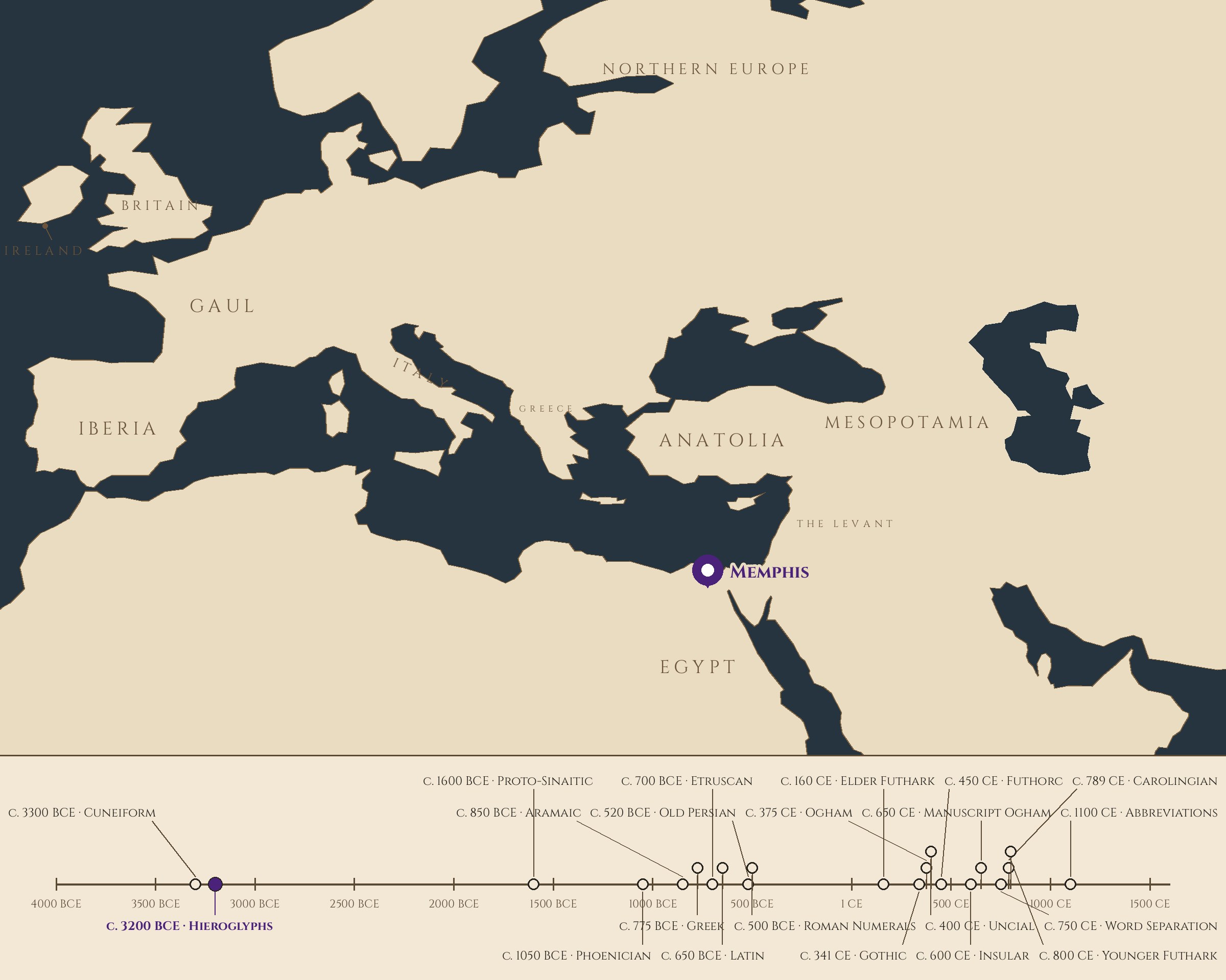
Where and when: Egypt, in the Nile valley, where scribes drew these signs for some 3,500 years, from about 3200 BCE to AD 394. The pin is this lesson. The line beneath the map is our road: every stop a writing system, every lesson a pin.
Lesson Objectives
By the end of this lesson, students should be able to:
- Explain the three jobs a hieroglyph can perform: logogram, phonogram, and determinative.
- Define hieroglyph, uniliteral, phonogram, determinative, transliteration, cartouche, papyrus, and the Rebus Principle.
- Read the eight uniliteral sound-signs and give each one's sound value.
- Explain the Rebus Principle and how it created sound-signs from pictures.
- Determine reading direction in any hieroglyphic inscription.
- Explain what a cartouche is and why royal names appear inside one.
- Describe how the Rosetta Stone enabled the decipherment of hieroglyphs.
- Write their own name using uniliteral signs (transliteration).
Reading this lesson: ★ marks the passages to remember. They return on the unit quiz and the class test. Check in questions ask the material back as you go; answer them in your workbook when you meet them.
Working this lesson: Your assignment packet is the first download on this page. Work in it as the lesson moves along, answering each assignment as its subject is taught — or read the lesson through for your notes and take the assignments as homework afterward. Both are proper ways to sit this class. Signposts in the reading tell you where each assignment belongs. Written answers are short answers in your own words; a few honest lines are worth more than a filled page.
Your Assignment Packet
This lesson's assignments live in its packet: the Lexicon Handout (every term, course terms marked ◆), Materials, Guided Practice, the Assignment Manual with its answer key for self-checking, the Reflection Questions, and the Workbook Checklist. Download the packet before you begin and keep it beside you as you read.
The Signs That Refused Wedges
In our last lesson, we watched Mesopotamian scribes spend roughly a century transforming drawn pictures into pressed wedges. Speed won. Clarity won. The picture disappeared into abstraction.
Egypt took the opposite path, and held it for three and a half millennia.
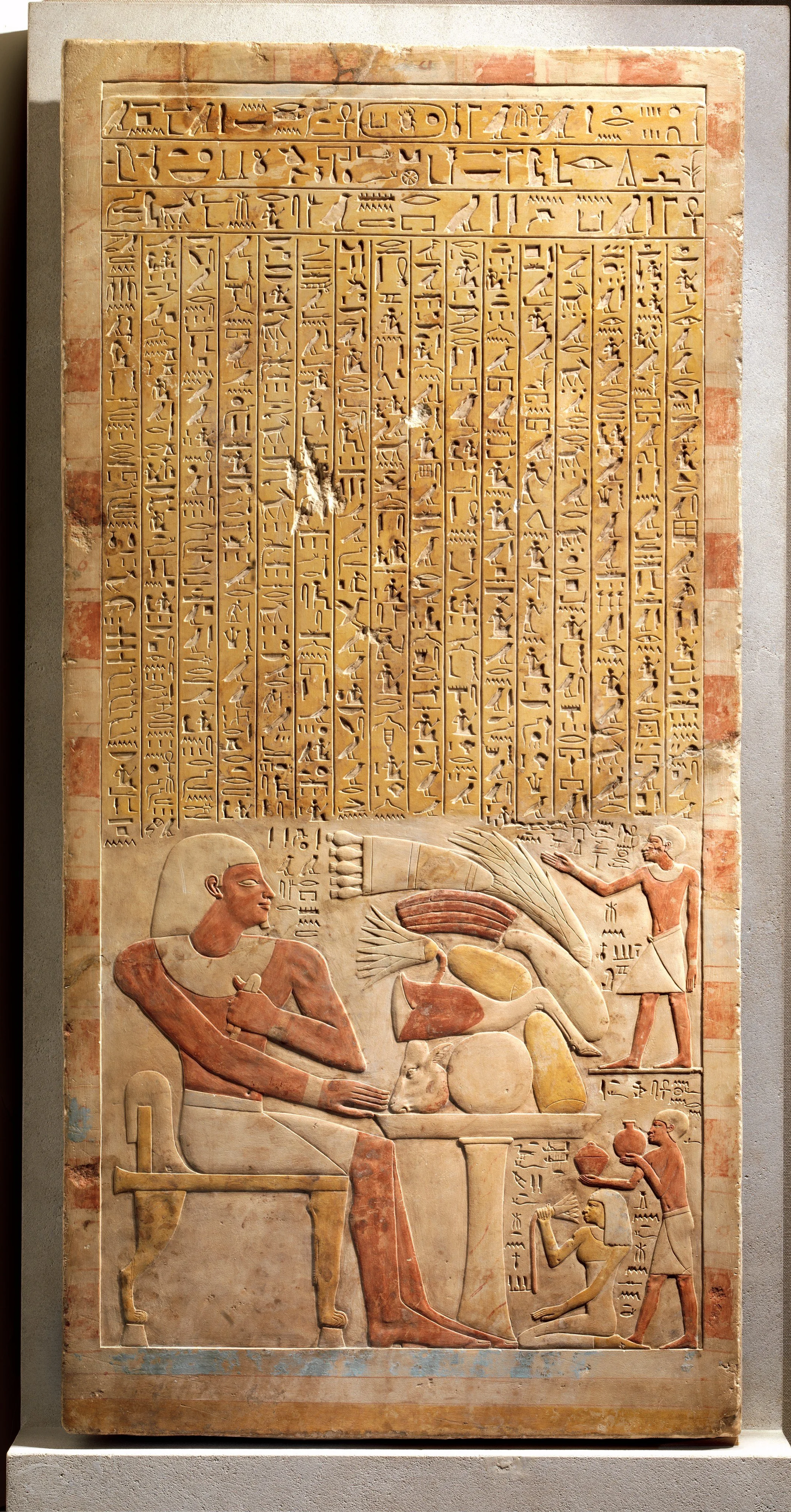
Historical example. A carved inscription that has outlived its makers by nearly four thousand years: the stela of the steward Mentuwoser, its face covered in columns of sunk-relief hieroglyphs, the steward himself seated below at his offering table. This is the writing that refused wedges — pictures, carved in stone, with their paint still on them.
Stela of the Steward Mentuwoser, Middle Kingdom, Dynasty 12, ca. 1944 BCE. The Metropolitan Museum of Art, New York (12.184). Public domain, The Met Open Access.
The earliest Egyptian hieroglyphs, the picture-signs of the Egyptian writing system, appear around 3200 BCE, roughly contemporary with proto-cuneiform. But where Mesopotamian signs shed their pictorial origins within a few centuries, Egyptian signs never did.
A scribe carving a temple wall in 30 BCE drew the same owl, the same water ripple, the same folded cloth that a scribe had drawn three thousand years earlier. The pictures persisted. They were the point.
This was not conservatism for its own sake. Egyptian writing served a civilization that believed images carried power.
A carved owl was not merely a convenient shape for the sound m. It was an owl, present in the inscription, participating in the text's meaning.
Temple walls were not documents. They were environments, saturated with divine presence through every carved figure. To reduce the owl to a wedge would have been to drain something essential from the writing.
And yet, and this is what makes Egyptian writing so remarkable, the Egyptians built a fully functional phonetic system out of these pictures. They did not merely draw words. They spelled them.
★ The last known hieroglyphic inscription is a priest's graffito at the temple of Philae, dated to AD 394. By then, Egypt had been under Roman rule for over four centuries, Christianity was spreading through the Nile valley, and the old temples were closing.
A priest named Nesmeterakhem carved his devotion into the temple wall in the ancient script, perhaps knowing he might be among the last to do so.
After him, the knowledge of reading hieroglyphs faded within a few generations. For nearly 1,400 years, no one on earth could read them.
They waited in silence until 1822. But that is a story for later in this lesson.
❦ In your workbook: record why Egypt kept its pictures in your own way — copy, sketch, or note what matters.
Three Jobs for Every Sign
Here is the essential thing to understand about hieroglyphs, the thing that unlocks the entire system: every sign can perform up to three different jobs, depending on where it appears and what surrounds it.
First, a sign can be a logogram. It stands for a whole word, the way the numeral "7" stands for "seven." The picture of the sun (a circle with a dot) can simply mean "sun" or "day." The picture of an ankh can mean "life." In this role, the sign's meaning comes from what it depicts.
Second, a sign can be a phonogram. It stands for a sound, regardless of what it pictures. The owl sign does not mean "owl" in this role. It means the sound m. The mouth sign does not mean "mouth." It means the sound r. The scribe has borrowed the picture for its pronunciation and left its meaning behind. Phonograms are sorted by how many sounds they carry: a uniliteral carries one sound, a biliteral two, a triliteral three. This is the Rebus Principle at work, and we will examine it closely below.
★ Third, a sign can be a determinative. It stands at the end of a word, is not pronounced at all, and exists only to clarify meaning. Egyptian writing did not record vowels, so many different words looked identical when spelled with phonograms alone. The determinative resolves the ambiguity by showing the reader which category of meaning the word belongs to. A word spelled p-r followed by a house determinative means something architectural. The same p-r followed by a walking-legs determinative means "to go out." The sounds are the same. The determinative tells you which word you are reading.
Most inscriptions mix all three jobs freely. A single line of hieroglyphs might contain logograms, phonograms, and determinatives working together, and the skilled reader moves between these roles without conscious effort, the way you move between the different sounds of the letter "c" in English without thinking about it.
This is why hieroglyphs look complex and are complex, and also why they are learnable. The complexity is systematic. Once you understand the three jobs, every inscription becomes a puzzle with rules instead of a wall of pictures.
Check in: A sign in an inscription can be doing one of three jobs. Name all three, and say which one is never pronounced.
❦ In your workbook: record the three jobs every sign can do in your own way — copy, sketch, or note what matters.
The Rebus Principle
How does a picture become a sound? The answer is one of the most elegant mechanisms in the history of writing, and it has a delightful name: the Rebus Principle.
A rebus is a puzzle that uses pictures to represent sounds. If I showed you a picture of a bee followed by a picture of a leaf, and told you to read the sounds rather than the meanings, you would arrive at "bee-leaf": belief. The pictures have been emptied of their meaning and filled with their pronunciation instead.
★ Egyptian scribes did exactly this, systematically, over centuries. They took logograms (pictures meaning words) and began using them for the sounds of those words in other contexts. The mouth sign, which as a logogram means "mouth," comes to represent the sound r, because the Egyptian word for mouth was pronounced something like ro. The water ripple, logogram for "water," becomes the sound n, from the Egyptian word for water. The picture stays the same. Its job changes entirely.
This is how a pictographic system grows a phonetic one from within. No one sat down and invented sound-signs from nothing. They emerged gradually, as scribes noticed that the pictures they were already drawing could do double duty. The owl you drew to mean "owl" could also spell the m in an entirely unrelated word. Over time, certain pictures became standardized in their phonetic roles, used again and again for the same sounds, until they functioned as a working set of sound-signs.
The eight signs you will learn in this lesson are the product of this process. Each began as a picture with meaning. Each became, through the Rebus Principle, a sign for a sound. Together they form the core of Egyptian phonetic spelling, and they are your first step into reading real inscriptions.
Check in: The owl sign does not always mean "owl." How did it come to stand for the sound m instead?
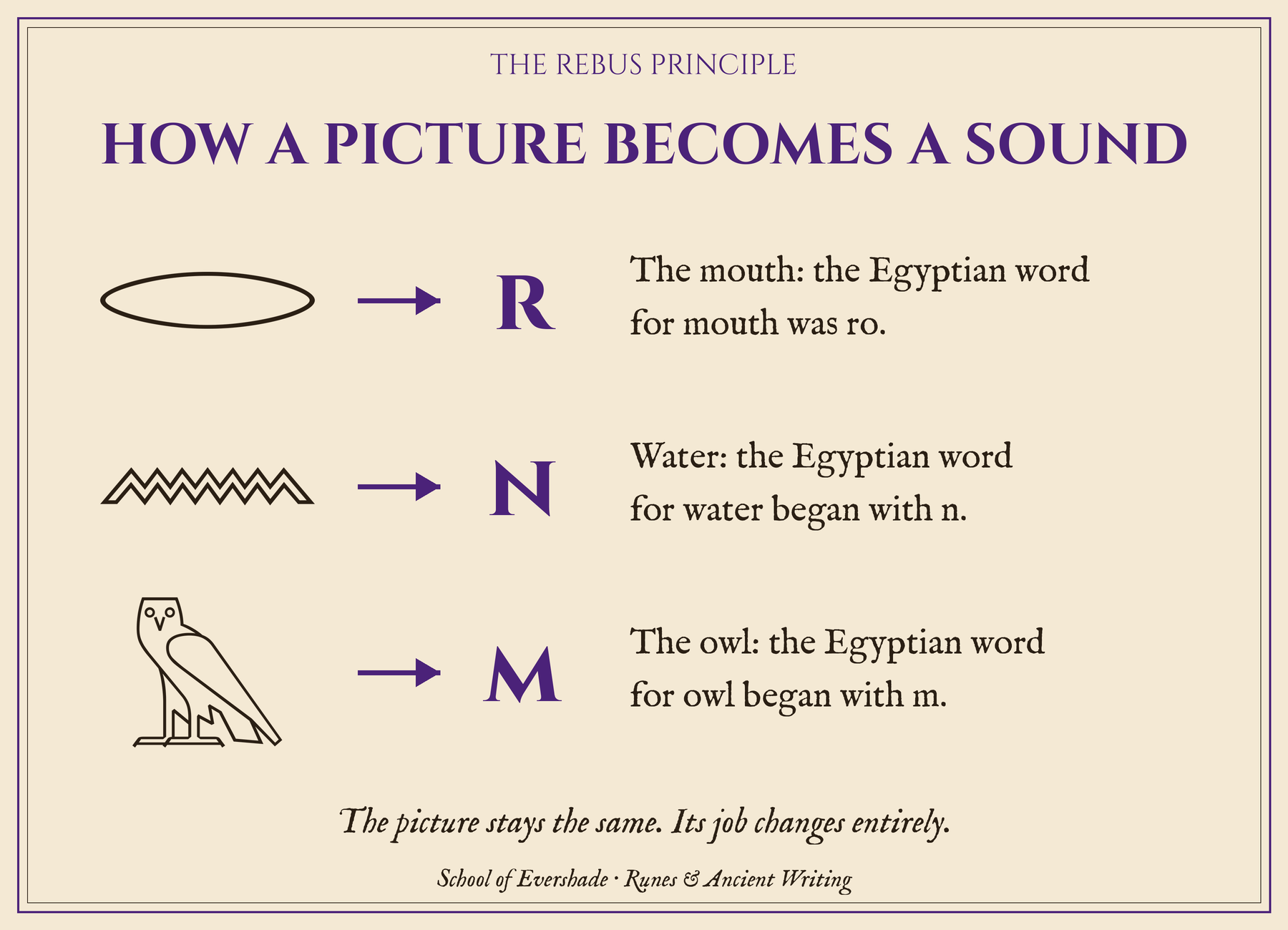
The Rebus Principle at work: the mouth lends r, the water lends n, the owl lends m. The picture is emptied of its meaning and filled with its pronunciation.
Built for Evershade.
❦ In your workbook: record how a picture becomes a sound-sign in your own way — copy, sketch, or note what matters.
Professor Webblethorn
Pause here, scholars, and look at what has happened.
In our last lesson, the Mesopotamians answered our course question by leaving things out: the token, then the picture, then the curves, until only the wedge remained. What can we leave out and still be understood? Their answer was: almost everything.
The Egyptians answered the same question differently. They left out almost nothing. They kept every bird, every snake, every ripple of water. And yet, through the Rebus Principle, they found a way to make those pictures spell sounds, building a phonetic system inside a pictographic one without sacrificing a single feather.
Two civilizations. The same question. Opposite answers. Both correct.
I have spent many quiet hours among temple inscriptions, tracing these signs with my eyes, and I will tell you what I have learned: there is no single path from pictures to writing. There are as many paths as there are peoples who needed to write. Our course follows the one that leads to the alphabet, but I want you to admire the ones that led elsewhere. They are no less ingenious for arriving at different destinations.
Keep the question beside you. It is the silk thread running through every lesson: nearly invisible, holding everything together.
Now, to the eight signs themselves. Learn them well. They are small, but they unlock a civilization.
PROFESSOR THISTLELOOM WEBBLETHORN
Runes & Ancient Writing
Epigrapher, Head of House Septentrio
Eight Signs That Spell Anything
★ Egyptian writing contains hundreds of signs, but its phonetic backbone is a set of 24 uniliterals: signs that each represent a single consonant sound. This lesson teaches eight of them, chosen as the most common and most useful for beginning transliteration.
★ Egyptian did not write vowels. This means the uniliterals form what scholars call a consonantal skeleton: the bones of a word without its flesh.
The reader supplied the vowels from knowledge of the language, the way you can read "bldng" as "building" without the vowels being written. It looks strange at first. It becomes natural with practice.
Here are your eight signs. For each, I give the picture, its Gardiner catalogue number (the standard reference system, named for the Egyptologist Alan Gardiner), its sound value in transliteration (the representation of a writing system's signs using the conventions of another writing system, typically the Latin alphabet: transliteration records the values of signs, their sounds or readings, not their appearance, and Egyptologists transliterate hieroglyphs into Latin letters so the texts can be discussed, indexed, and studied without reproducing every picture), and the English approximation.
1. The Egyptian vulture 𓄿 (Gardiner G1). Sound value: 3, called aleph. This is a glottal stop: the catch in your throat between the two syllables of "uh-oh." The vulture was chosen through the Rebus Principle from the Egyptian word for the bird. It is the most common uniliteral in the language, appearing in countless words.
2. The mouth 𓂋 (Gardiner D21). Sound value: r. A simple, elegant sign: the outline of a human mouth seen from the side. Through the Rebus Principle, the word for mouth gave its initial sound to the sign. You will see this sign everywhere. It is among the most frequent characters in all of Egyptian writing.
3. The ripple of water 𓈖 (Gardiner N35). Sound value: n. A single zigzag line representing water's surface. The Egyptian word for water began with n, and so the ripple became the n sign. Water signs appear in stacked rows when scribes need the plural or want to fill space symmetrically. A single ripple is n.
4. The reed mat 𓊪 (Gardiner Q3). Sound value: p. A woven mat seen from above, rendered as a rectangle with internal divisions. The Egyptian word for this mat began with p. Do not confuse it with the similar-looking reed leaf, which is a different sign with a different value.
5. The horned viper 𓆑 (Gardiner I9). Sound value: f. A serpent with distinctive horns above its eyes, drawn in profile. The Egyptian word for this snake began with f. It is one of the most visually striking uniliterals, and scribes clearly enjoyed drawing it.
6. The owl 𓅓 (Gardiner G17). Sound value: m. A barn owl perched upright, drawn with the careful attention Egyptian artists gave to birds. The word for owl began with m. When you see this solemn bird in an inscription, read m and move on. It is watching you learn.
7. The bread loaf 𓏏 (Gardiner X1). Sound value: t. A small semicircular loaf, one of the simplest signs in the repertoire. Bread was the staple of Egyptian life, and its sign became one of the commonest phonograms. The feminine ending -t, which appears on countless Egyptian nouns, is written with this humble loaf.
8. The folded cloth 𓋴 (Gardiner S29). Sound value: s. A piece of linen folded into a distinctive shape, rendered as a rectangle with a folded corner. The Egyptian word for this cloth began with s. It often appears doubled (ss) in words where the sound is emphasized.
Eight pictures. Eight consonants: 3, r, n, p, f, m, t, s. With these alone, transliterated into Latin letters, you can begin to sound out real Egyptian words. In the Guided Practice below, you will write your own name.
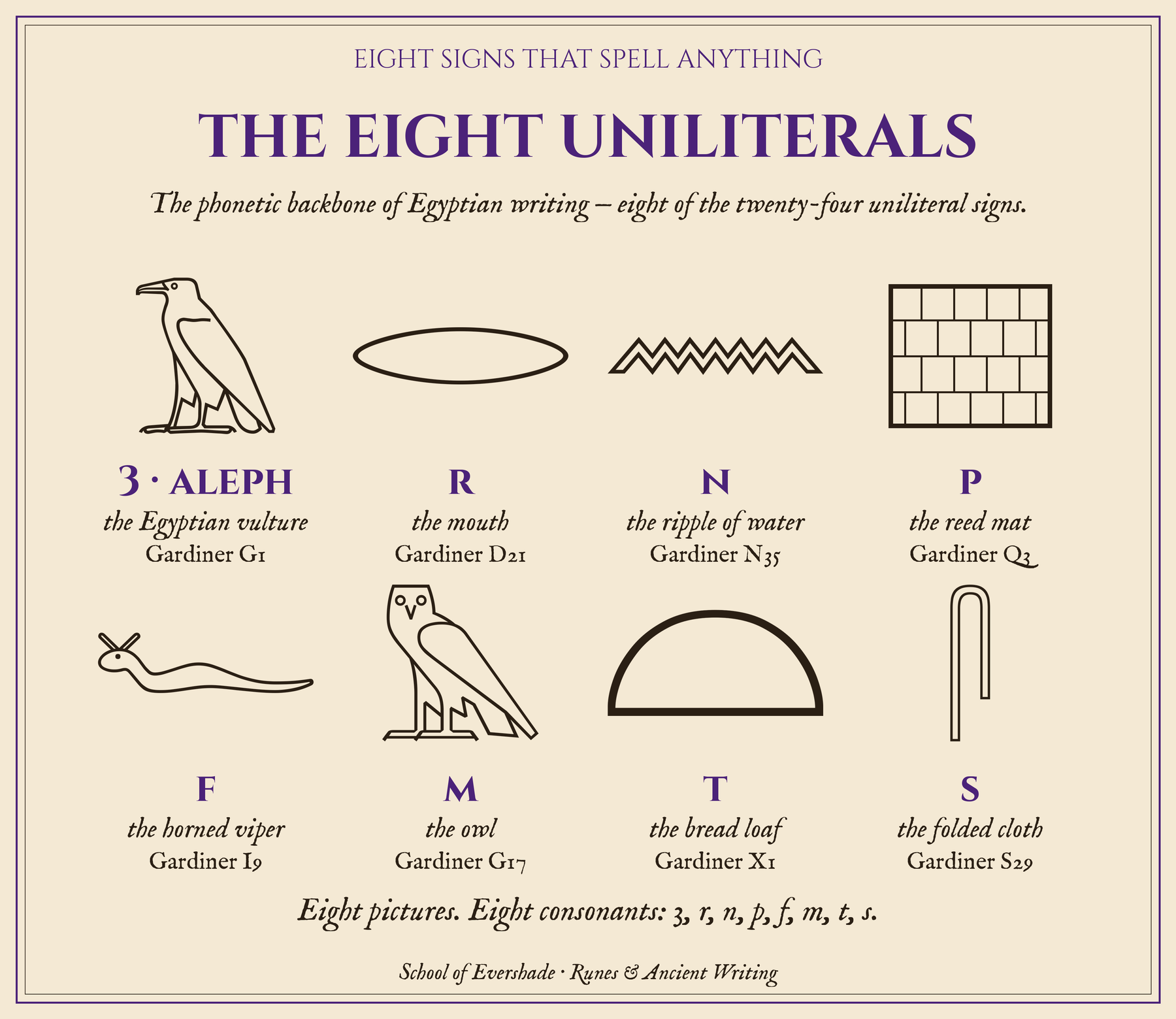
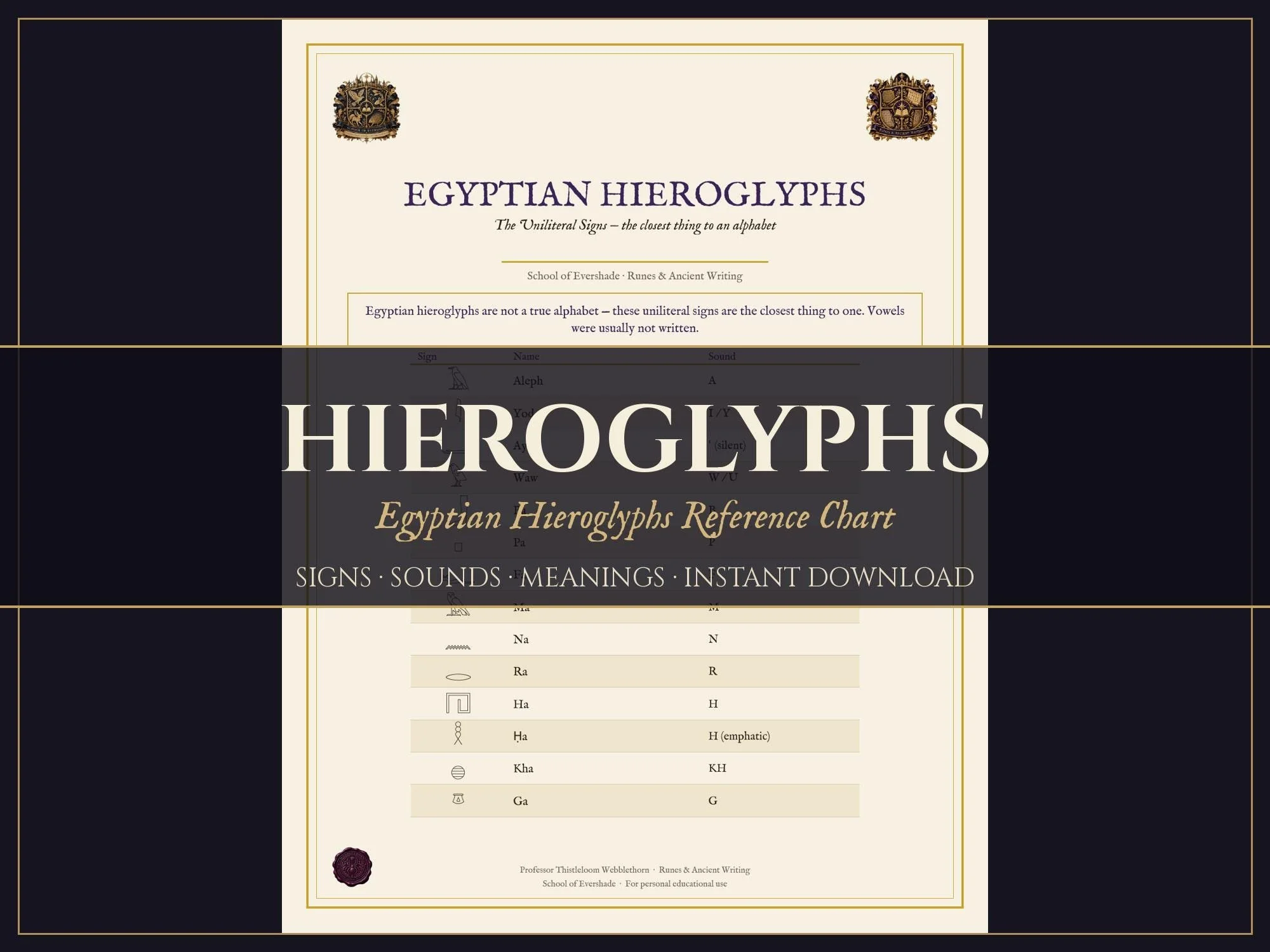
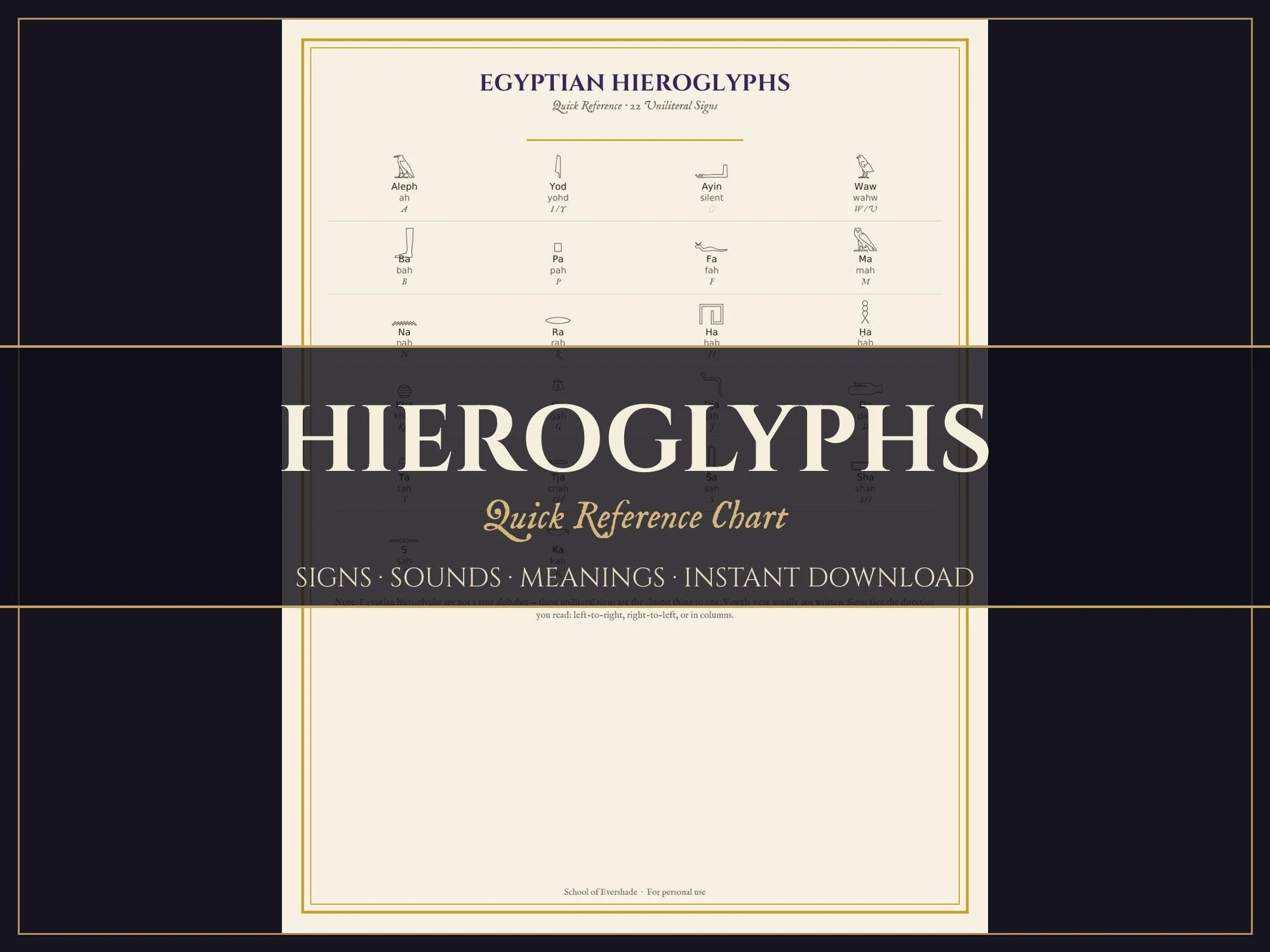
The eight uniliterals: eight pictures, eight consonants. Keep this chart beside you — Guided Practice and the assignments all build on it.
Built for Evershade.
❦ In your workbook: record the eight uniliteral signs in your own way — copy, sketch, or note what matters.
In your packet: Assignment I — The Sign Chart ⚒ begins here. Work it now, or mark the place and take it as homework — your choice.
Which Way Do the Faces Look
You have probably noticed that hieroglyphs are full of living creatures: birds, snakes, people, animals. These figures are not decoration. They are your compass.
Read toward the faces. This is the single rule of Egyptian reading direction, and it never fails. If the birds, people, and animals face left, you read the inscription from left to right, starting at the left. If they face right, you read from right to left, starting at the right. The figures look toward the beginning of the line, as if watching you approach the text.
This means Egyptian could be written in either direction, and scribes chose based on aesthetics, symmetry, or the layout of the wall.
A temple doorway might have inscriptions on both sides, each reading outward from the center, the figures on each side facing away from each other like guards. Tomb walls were often arranged so the text reads toward the deceased's image, the signs gazing at the person they commemorate.
Hieroglyphs could also be arranged in vertical columns rather than horizontal lines. The rule still holds: the figures face the beginning, whether that beginning is at the top of a column or the left of a row. Read toward the faces, and you will never be lost.
There is something deeply humane about this system. The writing looks back at its reader. It acknowledges you before you begin.
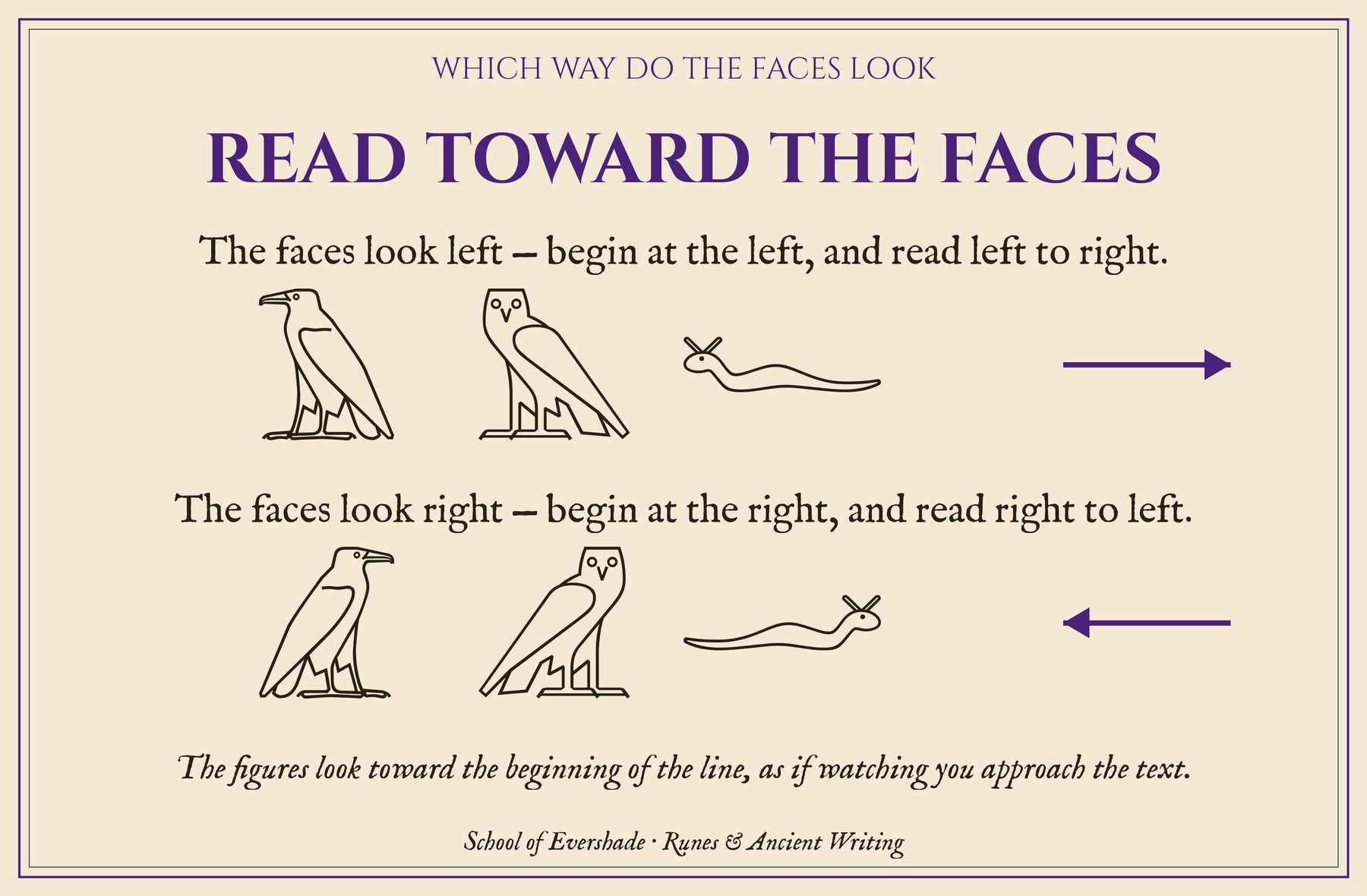
Read toward the faces. The same three signs in both directions: the figures always look toward the beginning of the line.
Built for Evershade.
❦ In your workbook: record reading toward the faces in your own way — copy, sketch, or note what matters.
Names in Rope Loops
★ Among the most recognizable features of Egyptian inscriptions is the cartouche: an oval loop, drawn as a rope with its ends tied at the base, enclosing a group of signs.
The cartouche always contains a royal name. When you see one, you are looking at the name of a king or queen, set apart from the surrounding text by this protective ring. The rope's symbolism is deliberate: it encircles the royal identity, safeguarding it, marking it as set apart from ordinary words.
For the student of decipherment, cartouches were the key that unlocked everything. When scholars in the early 19th century set out to crack hieroglyphs, they reasoned that the signs inside cartouches must be names, and that royal names from the Greek historical record (Ptolemy, Cleopatra) might appear in inscriptions from the Ptolemaic period.
By matching the Greek names to the signs in the cartouches, they began to assign sound values to individual hieroglyphs. The rope loop told them where to look.
You will draw your own cartouche in the assignments below. It will not contain a royal name (unless your name is Ptolemy), but the exercise will teach your hand what Egyptian scribes knew: that some words deserve a circle drawn around them.
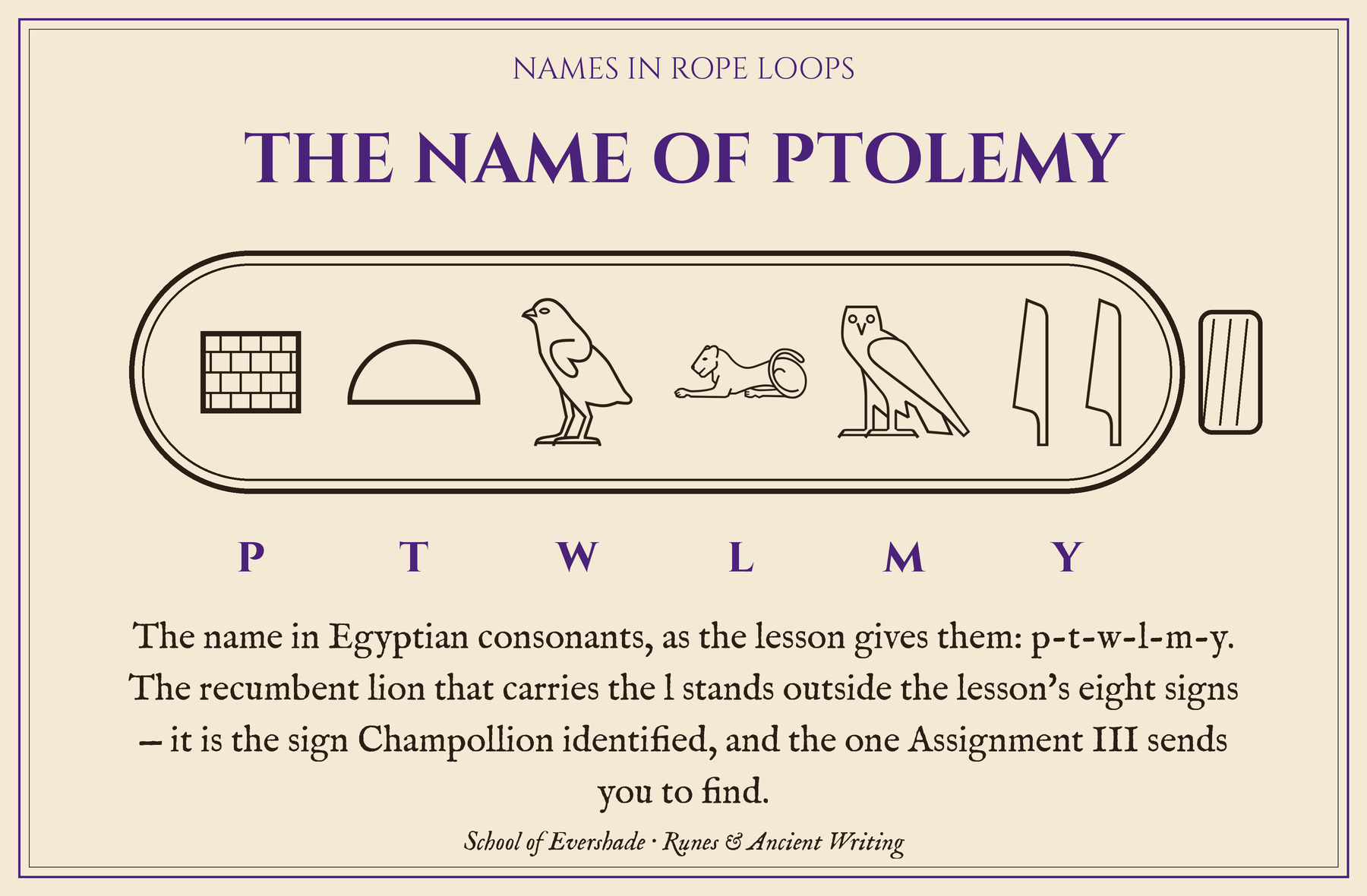
Ptolemy's name inside its rope loop: p-t-w-l-m-y. The cartouches were the decipherers' key — the loop told them where a royal name must be.
Built for Evershade.
❦ In your workbook: record the cartouche and the name it guards in your own way — copy, sketch, or note what matters.
In your packet: Assignment III — The Cartouche Investigation ◐ begins here. Work it now, or mark the place and take it as homework — your choice.
Paper Made of River
Not all Egyptian writing was carved in stone. The daily business of the kingdom: letters, accounts, literary tales, medical prescriptions, was written in ink on papyrus.
Papyrus is made from the stem of the papyrus plant, which grew abundantly in the marshes of the Nile Delta. Craftsmen cut the stem into strips, laid them in two crossed layers, pressed them together, and dried the resulting sheet.
The plant's natural sap acted as adhesive. The result was a flexible, durable writing surface, pale and slightly textured, that took ink beautifully.
Egyptian scribes wrote with reed brushes, using black ink for most text and red ink for headings, important names, and the beginnings of sections.
(A scribe's palette, with its cakes of black and red pigment, was such a standard possession that the hieroglyph for "scribe" shows the palette itself.) They wrote in a cursive script called hieratic, a flowing shorthand derived from hieroglyphs, much faster than carving pictures in stone.
Papyrus is organic, and organic things decay. It rots in moisture, crumbles with handling, and is devoured by insects.
The papyri that survive to the present day come overwhelmingly from two kinds of places: sealed tombs, where the dead were buried with texts for the afterlife, and desert caches, where the extreme dryness of the Egyptian desert preserved what the Nile valley's humidity would have destroyed. Every papyrus you see in a museum is a survivor of extraordinary luck.

A Note from the Headmaster
A word from your Headmaster, who approves of being well prepared for eternity. The tombs whose walls you are learning to read were stocked for the afterlife, and along with the texts the Egyptians packed games: four senet boards were buried with Tutankhamun, and tomb paintings show players leaning over the board, mid-throw. We play it in the Games Room by the scholars' best reconstruction — nobody wrote the rules down, because everybody knew them.
There is a parallel here to our last lesson worth noting. Just as Mesopotamian tablets survived through the accident of fire, Egyptian papyri survived through the accident of dryness. In both cases, what we study is not a fair sample of what existed. It is what the climate, and chance, allowed to remain.

Historical example. Writing on river paper: a funerary papyrus painted for Nauny, a chantress of Amun — a procession of gods in paint, each named in hieroglyphs above its head. Sheets like this survived only where tombs and desert dryness protected them; this one was buried with her.
Funerary Papyrus of Nauny, Third Intermediate Period, Dynasty 21, ca. 1051–1002 BCE. The Metropolitan Museum of Art, New York (30.3.32). Public domain, The Met Open Access.
❦ In your workbook: record papyrus, and why so little of it survives in your own way — copy, sketch, or note what matters.
In your packet: Assignment IV — Papyrus and Preservation ◐ begins here. Work it now, or mark the place and take it as homework — your choice.
The Stone That Unlocked It All
For nearly 1,400 years, no living person could read hieroglyphs. The script that had recorded 3,500 years of Egyptian civilization was silent. Scholars guessed at meanings. Some guesses were fanciful. None could be verified.
The silence broke because of a stone.
In 1799, French soldiers in Napoleon's Egyptian expedition uncovered a large granodiorite slab near the town of Rosetta. The Rosetta Stone carries a single decree, issued in 196 BCE, inscribed three times: in hieroglyphs, in Demotic (the everyday Egyptian script of the period), and in ancient Greek.
Scholars could read the Greek. If the three texts said the same thing, the known script could unlock the unknown ones.
★ The breakthrough came in 1822, through the work of Jean-François Champollion. Building on the cartouche insight (the oval loops must contain royal names) and comparing the Greek text's "Ptolemy" and "Cleopatra" against the signs in the cartouches, Champollion assigned sound values to individual hieroglyphs.
Then came his famous leap: he realized the signs were not purely symbolic but substantially phonetic, spelling out sounds the way the Greek text spelled words.
The story holds that he burst into his brother's office crying "Je tiens mon affaire!" (I've got it!) before collapsing. Whether or not the fainting is legend, the decipherment was real.
Champollion's work did for Egyptian what the Behistun inscription would do for cuneiform a generation later (you will meet Behistun in our next lesson): it turned silent pictures into readable text. Every Egyptologist working today, every museum label you have ever read beside a mummy case, stands on the foundation Champollion laid in 1822.
Check in: What made the Rosetta Stone a key, and why did the cartouches matter to using it?
There is a pattern in our course worth noticing. Writing systems are invented once, by the peoples who need them. They are deciphered twice: once by their creators, and once, millennia later, by scholars holding a bilingual key. The Rosetta Stone was Egypt's key. Remember it. Keys like this will appear again.
❦ In your workbook: record how the Rosetta Stone unlocked the script in your own way — copy, sketch, or note what matters.
Guided Practice — The Scribe's Hand
Before the assignments, train your eye and hand. An Egyptologist's first skills are recognition and copying: seeing each sign clearly enough to reproduce it.
Exercise A — Copying the Eight Signs
- On paper, draw each of the eight uniliteral signs three times: the vulture, the mouth, the water ripple, the reed mat, the horned viper, the owl, the bread loaf, the folded cloth.
- Label each with its Gardiner number and sound value.
- Compare your copies. Egyptian scribes valued consistency and elegance. Which sign was hardest to draw recognizably? Which came most naturally?
You do not need to draw beautifully. You need to draw recognizably. A scribe's owl does not need to be art. It needs to be unmistakably an owl and not a vulture.
❦ Workbook path: working in your workbook? Copy the eight signs there instead, one sign to a row, each drawn three times across the row with its Gardiner number and sound value beneath. That page becomes your personal sign list for the whole course.
Exercise B — Reading Direction
Examine the following principle: figures face the beginning of the text.
- Draw a row of three signs (owl, mouth, water ripple) with all figures facing left. Which direction would an Egyptian scribe read this row?
- Draw the same three signs with all figures facing right. Now which direction?
- Draw a vertical column of the same signs, figures facing left. Where does the reader begin?
Answer in complete sentences. The rule is simple, but applying it deliberately builds the habit.
Exercise C — Transliteration: Your Name
Using the eight uniliteral signs, transliterate your name into hieroglyphs as closely as the sound values allow.
- Write your name in Latin letters. Identify each consonant sound.
- Match each consonant to the nearest uniliteral sign. (Not every English sound has an Egyptian equivalent. Approximate gracefully: English b has no uniliteral here, so choose the closest available sign and note the substitution.)
- Draw the resulting sequence of signs. Arrange them for visual balance, as a scribe would: signs can be stacked or grouped to fill space pleasingly, not merely lined up left to right.
- Draw a cartouche around your name, whether or not you are royalty.
Note where the system strains. Which sounds in your name had no good Egyptian equivalent? What does that tell you about the difference between the two languages' sound inventories?
Your keepsake: your name inside its rope loop is this lesson's keepsake piece. Draw it once more, carefully, on its own page, and keep it. You have written your name the way kings wrote theirs.
❦ Workbook path: work the whole exercise on one workbook page: your name's consonants listed, the signs matched beneath them, substitutions noted, and the finished cartouche drawn large at the foot of the page.
In your packet: Assignment II — Transliteration Practice ⚒ begins here. Work it now, or mark the place and take it as homework — your choice.
Assignment Manual
Assignment key: ✎ written work · ⚒ hands-on practical · ◐ both · ★ will be on the test · ❦ workbook path
Written answers in this manual are short answers in your own words — a few honest lines, not a filled page.
Assignment I — The Sign Chart ⚒ ★
Objective: Demonstrate control of the eight uniliteral signs.
Instructions:
- On a fresh sheet, divide your page into eight boxes (two rows of four).
- In each box, draw one uniliteral sign as carefully as you can: vulture, mouth, water ripple, reed mat, horned viper, owl, bread loaf, folded cloth.
- Label each with its Gardiner number, its transliterated sound value, and the English name of the pictured object.
- Below the chart, write one sentence per sign explaining the Rebus Principle connection: what the picture depicts, and how its sound value derives from the Egyptian word for that object (where known).
❦ Workbook path: make the chart across two facing workbook pages instead of a loose sheet: eight boxes, the same labels, and the same Rebus sentence under each sign.
To submit: Photograph or scan your chart. Clarity and correct labeling matter more than artistic skill.
Assignment II — Transliteration Practice ⚒ ★
Objective: Use uniliteral signs to spell real words.
Part A. Transliterate the following English words into hieroglyphic spelling using the eight uniliteral signs. (Use consonants only, as Egyptian scribes did. Approximate where English sounds have no direct equivalent and note each substitution.)
- moon
- sun
- tomb
- flour
- palm
Part B. For each word, write two sentences: first, the sequence of signs you chose and why; second, what the exercise reveals about the difference between English and Egyptian sound inventories.
Part C. The Egyptian word for "scribe" was pronounced something like sesh. Using your eight signs, how would you spell it? What does your answer suggest about the flexibility of the uniliteral system?
❦ Workbook path: work the whole assignment in your workbook: one word to a line, the signs drawn large above the line and your two sentences beneath it.
Assignment III — The Cartouche Investigation ◐ ★
Objective: Understand why cartouches mattered to decipherment.
Instructions:
- Research (using the References below): find an image of the Rosetta Stone. Locate the cartouches in the hieroglyphic section.
- The cartouches on the Rosetta Stone contain the name Ptolemy. Using the lesson's sign values and the References, identify which signs in the cartouche correspond to which sounds in "Ptolemy" (P-T-O-L-M-Y, rendered in Egyptian consonants as approximately p-t-w-l-m-y).
- Draw the cartouche yourself, enclosing the signs for Ptolemy's name. Note: Egyptian had no l uniliteral in our set of eight. Research which sign Champollion identified for l and include it, citing your source.
- Write a half-page response: why were cartouches the key to decipherment? What did the rope loop tell scholars that the rest of the inscription could not?
❦ Workbook path: draw Ptolemy's cartouche on a full workbook page, the signs labelled with their sounds, and write your half-page response beneath the drawing.
Assignment IV — Papyrus and Preservation ◐ ★
Objective: Connect writing materials to the archaeological record.
Instructions:
- Research (using the References below): compare the survival of Mesopotamian clay tablets (Lesson 1) with Egyptian papyri. What destroyed each material? What preserved each?
- Write a one-page comparison: if a future archaeologist excavated our civilization, which of our writing materials would survive 3,000 years, and which would vanish? Consider paper, stone, digital storage, and at least one other material.
- What does the uneven survival of ancient texts mean for our understanding of the past? Refer to both the "accidental kiln" (Lesson 1) and the desert caches (this lesson) in your answer.
Materials
Required (Level One — household items)
- Paper: plain white paper or a sketchbook. Egyptian scribes prized smooth surfaces; any clean paper works for sign practice.
- Pencils: one standard pencil for drafting, one fine-tipped pen or marker for final sign drawings.
- A ruler: for dividing practice sheets into boxes and drawing cartouche ovals.
- A printout of the eight signs: use the lesson's sign descriptions as your reference, or print the eight-signs chart from the course materials.
Suggested (Level Two — historically closer materials)
- Papyrus paper: real papyrus sheets are available from art suppliers and provide the authentic texture Egyptian scribes wrote on.
- A reed pen: cut from bamboo or river reed, following the same principle as the Mesopotamian stylus but shaped for ink rather than impression.
- Black and red ink or paint: Egyptian scribes used black for body text and red for headings and emphasis. Try both and observe how the color changes your relationship to the text.
- A brush: Egyptian scribes wrote with reed brushes rather than pens for hieratic script. A small watercolor brush approximates the tool.
Neither level requires
Purchased kits, specialty tools, or any material you cannot find locally or order inexpensively. The core lesson (drawing signs, transliterating, understanding the system) is fully achievable with paper and pencil.
Reflection Questions
Answer the following in your workbook.
- Why did Egyptian hieroglyphs remain pictorial for 3,500 years while cuneiform became abstract wedges within centuries? What does this suggest about the relationship between a culture's values and its writing?
- Explain the three jobs a hieroglyph can perform. Give an example of each, using signs from this lesson where possible.
- What is the Rebus Principle? How does it explain the origin of phonetic signs from pictures?
- Why did Egyptian writing not record vowels? How did determinatives compensate for the resulting ambiguity?
- How does the rule "read toward the faces" work? Why is it more reliable than assuming a fixed writing direction?
- What was the Rosetta Stone, and why was it the key to decipherment? What role did cartouches play?
- The lesson asks: "what can we leave out and still be understood?" The Egyptians left out almost nothing, yet built a fully phonetic system. How does their answer differ from the Mesopotamian one, and what does that tell you about the question itself?
Workbook Checklist — Lesson 2
In my workbook I have:
- ☐ explained the three jobs a hieroglyph can do (logogram, phonogram, determinative)
- ☐ drawn the eight uniliteral signs and written each one's sound value
- ☐ explained the Rebus Principle: how a picture becomes a sound-sign
- ☐ read an inscription's direction from the way its figures face
- ☐ drawn a cartouche and explained why royal names sit inside one
- ☐ told the story of the Rosetta Stone and Champollion's decipherment
- ☐ written my own name in uniliteral signs
☐ Lesson completed Date: ____________ Signature: ____________
Professor's Review
And so our second lesson closes among the temple walls, where birds and snakes have spelled sounds for three and a half millennia.
You can now explain the three jobs of a hieroglyph, describe the Rebus Principle, read eight sound-signs and give their values, determine reading direction in any inscription, explain what a cartouche is and why it mattered to decipherment, and tell the story of the stone that broke a 1,400-year silence.
Keep your sign chart beside your wedge chart. You now hold the beginnings of two writing systems, and you can already see how differently they answer the same question.
Mesopotamia stripped pictures down to wedges. Egypt kept every feather and made the feathers spell. Both are writing. Neither is the only way.
Next, we travel to the cliffs of Behistun in Persia, where a king carved his victories in three languages on a rock face a hundred meters above the road, and where a different stone, and a different scholar, would unlock a different script. The pattern continues: every script in our course was silenced by time, and every one was given back by a key.
Practice your signs, scholars. Draw the owl until you can draw it from memory. There is a particular pleasure in a sign you know by hand, not just by eye. I have drawn thousands in my years, and the pleasure has not diminished.
PROFESSOR THISTLELOOM WEBBLETHORN
Runes & Ancient Writing
Epigrapher, Head of House Septentrio
Cross-Class Connections
The reed brush and ink techniques introduced in this lesson connect directly with Scrollwork, where Professor Nocturne teaches quill preparation and ink-making. The Egyptian scribe's brush and the medieval scribe's quill are answers to the same question (how does the tool shape the mark?), separated by three thousand years.
Students studying both classes should compare this lesson with Scrollwork Unit I.
The relationship between image and meaning in hieroglyphs parallels Creative Arts, which will explore visual symbolism. Egyptian temple walls, saturated with meaningful images, are among humanity's great achievements in visual communication.
The 3,500-year continuity of hieroglyphic writing will reappear in Runes Unit IV, when we examine how runic inscriptions maintained their forms across centuries of carving. Long-lived scripts share strategies for stability, and Egypt is the longest-lived of them all.
In Other Classrooms
Scrollwork · Unit I, Lesson 2 — Reed Pens & Feather Quills
Your Egyptian scribes trusted the reed brush; mine trusted the feather. Come to the Library and study the pen itself: why writing cultures kept different instruments instead of one best pen, and how a quill is built, from barrel to slit. The tool shapes the mark, in Thebes and in the scriptorium alike.
The desert is only our second stop.
References & Further Reading
The British Museum. "Hieroglyphs: unlocking ancient Egypt." Exhibition site with the decipherment timeline, including the AD 394 Philae graffito as the last known inscription and the ~3200 BCE origins. https://www.britishmuseum.org/exhibitions/hieroglyphs-unlocking-ancient-egypt
The British Museum. Collection online. Searchable collection including the Rosetta Stone and thousands of hieroglyphic inscriptions, papyri, and ostraca. https://www.britishmuseum.org/collection
The Metropolitan Museum of Art. Heilbrunn Timeline — "Writing in Ancient Egypt." Museum essays on hieroglyphic, hieratic, and demotic scripts, with collection objects. https://www.metmuseum.org/toah/hd/wrtg/hd_wrtg.htm
Wikipedia. "Egyptian hieroglyphs." Comprehensive overview: the script's history, structure, decipherment, and the role of determinatives. https://en.wikipedia.org/wiki/Egyptian_hieroglyphs
Wikipedia. "Egyptian uniliteral signs." The full 24-sign uniliteral inventory with Gardiner numbers and sound values, the source for this lesson's eight signs. https://en.wikipedia.org/wiki/Egyptian_uniliteral_signs
Wikipedia. "Rosetta Stone." The stone's discovery, its three texts, and the decipherment narrative through Champollion. https://en.wikipedia.org/wiki/Rosetta_Stone
Wikipedia. "Papyrus." Manufacture, use, and preservation of papyrus as a writing surface. https://en.wikipedia.org/wiki/Papyrus
Gardiner, Alan. Egyptian Grammar. 3rd ed. Oxford: Griffith Institute, 1957. The standard sign list and reference grammar. The Gardiner numbers used in this lesson (G1, D21, N35, Q3, I9, G17, X1, S29) come from this catalogue.
Browse the Runes shelf in the school Library for readable editions of these works.
You have learned the single-sound signs. The Bench writes with them — your name in the signs of Egypt, each one named, and the vowels Egyptian left unwritten honestly listed.
Open the BenchPROFESSOR THISTLELOOM WEBBLETHORN · RUNES CLASSROOM
Submit your work for this lesson using the form below.
CONTINUE IN RUNES & ANCIENT WRITING
← Previous · Lesson 1: Mesopotamian Cuneiform Next · Lesson 3: Old Persian Cuneiform: A New Script in Ancient Robes →
Unit I · The First Foundations Runes & Ancient Writing Classroom · All 21 Lessons
The rest of Unit I: Lesson 1 · Mesopotamian Cuneiform · Lesson 3 · Old Persian Cuneiform
From the Runes Shelf
The printed companions to this lesson, from Professor Webblethorn’s shelf in the shop.