RUNES & ANCIENT WRITING
Unit I · Lesson 3THE ENGINEERED ILLUSION
Old Persian Cuneiform: A New Script in Ancient Robes
Professor Thistleloom Webblethorn
Epigrapher • Runes & Ancient Writing
Head of House Septentrio • School of Evershade
Professor's Introduction

The stones keep their secrets — for now. I hope your owls are drying.
Mesopotamia stripped its pictures down to wedges in the name of speed. Egypt refused, and kept every feather in the name of beauty.
Today I will show you something stranger than either: a writing system that is neither ancient nor evolved, but designed. Deliberately invented, all at once, by a king's scholars, to look like something it is not.
Old Persian cuneiform wears the wedge shapes of Mesopotamia the way a young courtier wears his grandfather's robes: to borrow their authority. The signs press into clay (or carve into rock) in the familiar wedge clusters. But count them, and the illusion dissolves.
Where Mesopotamian cuneiform sprawls across six hundred signs, Old Persian manages its entire language with thirty-six.
Where Mesopotamian scribes trained for years, an Old Persian inscription can be sounded out by a careful beginner in an afternoon.
This is the only writing system in our course that was engineered rather than grown. Every other script you will study emerged gradually, shaped by centuries of hands. This one was drawn up, approved, and deployed, the way one commissions a building.
Our course question takes a new shape today. We have been asking: what can we leave out and still be understood?
The Persians asked the inverse: what must we keep to be believed? Their answer was the wedge itself. Keep the shape of antiquity, and the words inside can be anything, even something brand new.
Look closely, scholars. I am about to show you a forgery so magnificent that it became real.
PROFESSOR THISTLELOOM WEBBLETHORN
Runes & Ancient Writing
Epigrapher, Head of House Septentrio
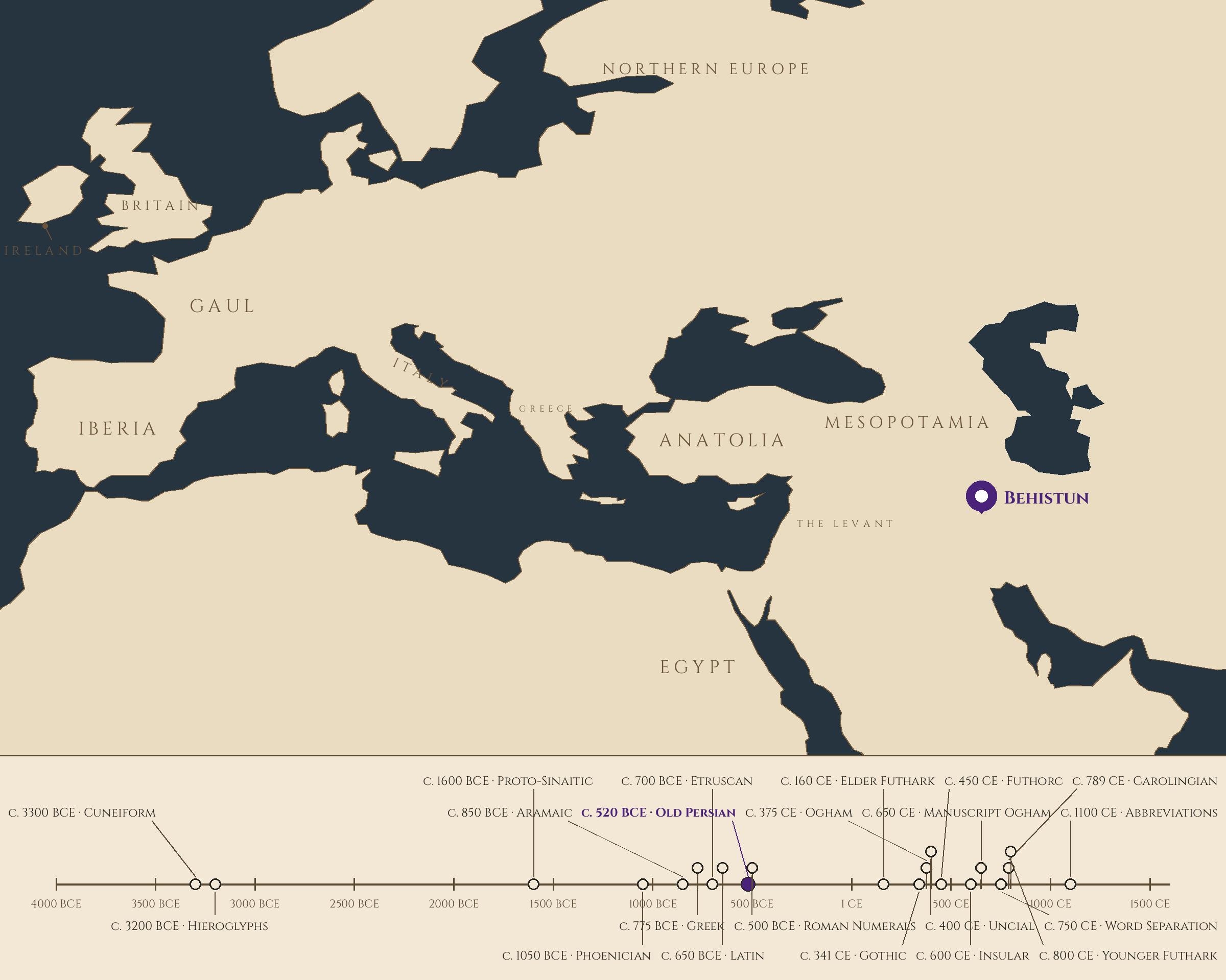
Where and when: Persia, beneath the Behistun cliff in the Zagros Mountains, about 520 BCE, where a king carved his story in three languages a hundred meters above the road. The pin is this lesson. The line beneath the map is our road: every stop a writing system, every lesson a pin.
Lesson Objectives
By the end of this lesson, students should be able to:
- Explain why Old Persian cuneiform is called an "engineered" writing system.
- Define Old Persian cuneiform, syllabary, word divider, trilingual, Behistun Inscription, and Achaemenid Empire.
- Describe the sign inventory: 36 phonetic signs, 8 logograms, three independent vowels, and the Ca syllable structure.
- Read the six lesson signs and the word divider, and give each one's value.
- Explain how Old Persian differs from Mesopotamian cuneiform despite their visual similarity.
- Describe the Behistun inscription: its location, its three languages, and its purpose.
- Tell the story of decipherment through Grotefend and Rawlinson.
- Explain the "engineered illusion": why a new script was dressed in ancient shapes.
Reading this lesson: ★ marks the passages to remember. They return on the unit quiz and the class test. Check in questions ask the material back as you go; answer them in your workbook when you meet them.
Working this lesson: Your assignment packet is the first download on this page. Work in it as the lesson moves along, answering each assignment as its subject is taught — or read the lesson through for your notes and take the assignments as homework afterward. Both are proper ways to sit this class. Signposts in the reading tell you where each assignment belongs. Written answers are short answers in your own words; a few honest lines are worth more than a filled page.
Your Assignment Packet
This lesson's assignments live in its packet: the Lexicon Handout (every term, course terms marked ◆), Materials, Guided Practice, the Assignment Manual with its answer key for self-checking, the Reflection Questions, and the Workbook Checklist. Download the packet before you begin and keep it beside you as you read.
The Newest Old Script
Every writing system we have studied so far grew the way languages grow: gradually, unevenly, shaped by thousands of hands over centuries. Mesopotamian cuneiform spent centuries turning pictures into wedges. Egyptian hieroglyphs accumulated their hundreds of signs across millennia.
Old Persian cuneiform did not grow. It was built.
★ Sometime in the sixth century BCE, scholars in the court of the Achaemenid Empire (the Persian empire founded by Cyrus the Great around 550 BCE) sat down and designed a writing system for the Old Persian language.
We do not know their names. We do not know exactly when, though the earliest securely attested inscriptions belong to the reign of Darius I (522 to 486 BCE), and scholars still debate whether the script was created under Darius or his predecessor Cyrus the Great.
★ What we know is the result: a clean, compact, rational system of 36 phonetic signs and 8 logograms, written left to right, with a mark between every word.
Thirty-six signs. Consider what that number means against everything you have learned. Mesopotamian cuneiform required hundreds of signs and years of scribal training. Egyptian hieroglyphs numbered in the hundreds, with 24 uniliterals as merely the phonetic core.
Old Persian's 36 signs cover the entire language. A student can learn the full inventory in a week.
And yet the signs are wedges. Pressed, angular, clustered in the unmistakable visual language of Mesopotamian cuneiform, a tradition already two and a half millennia old when Darius carved his mountain.
The Persians could have invented any shapes at all. They chose wedges.
Why? Because wedges meant writing in the ancient Near East the way columns mean temple in the classical world. They carried the weight of antiquity, of administration, of civilization itself.
A new empire, barely two generations old, announcing itself in a brand-new script would have looked provisional, experimental, untested.
The same words in wedge shapes looked eternal.
★ This is the engineered illusion of our lesson's title: a modern system in antique dress. Whether every visual choice was consciously intended to invoke antiquity cannot always be known with certainty.
But the effect is undeniable. Old Persian cuneiform looks like the culmination of three thousand years of scribal tradition. It is, in fact, barely older than the young Roman Republic, and two thousand years younger than the pyramids it resembles.
There is something I find deeply moving about this, and I will tell you what it is. Every other script in our course was shaped by necessity: by the pressure of accounting, by the demands of religion, by the slow grinding of daily use.
Old Persian was shaped by intention. Someone decided what it should be. That has never happened before in our story, and it will not happen again until much later. For one brief moment, writing was not discovered or evolved. It was authored.
Check in: What is the evidence that Old Persian was designed rather than grown? Give two pieces of it.
❦ In your workbook: record how Old Persian was designed, not grown in your own way — copy, sketch, or note what matters.
Thirty-Six Signs and a Divider
Let us examine what the designers built, because its elegance rewards close attention.
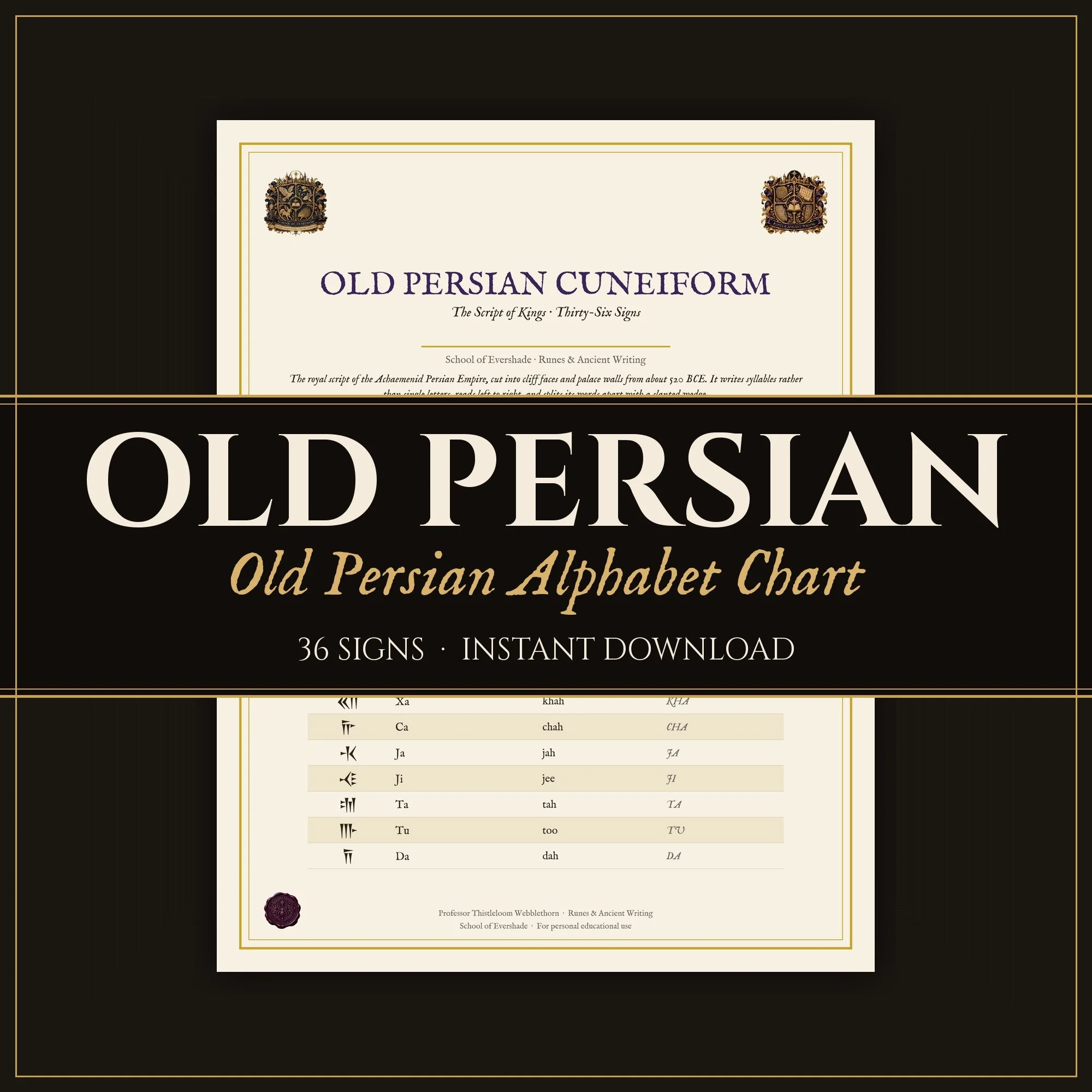
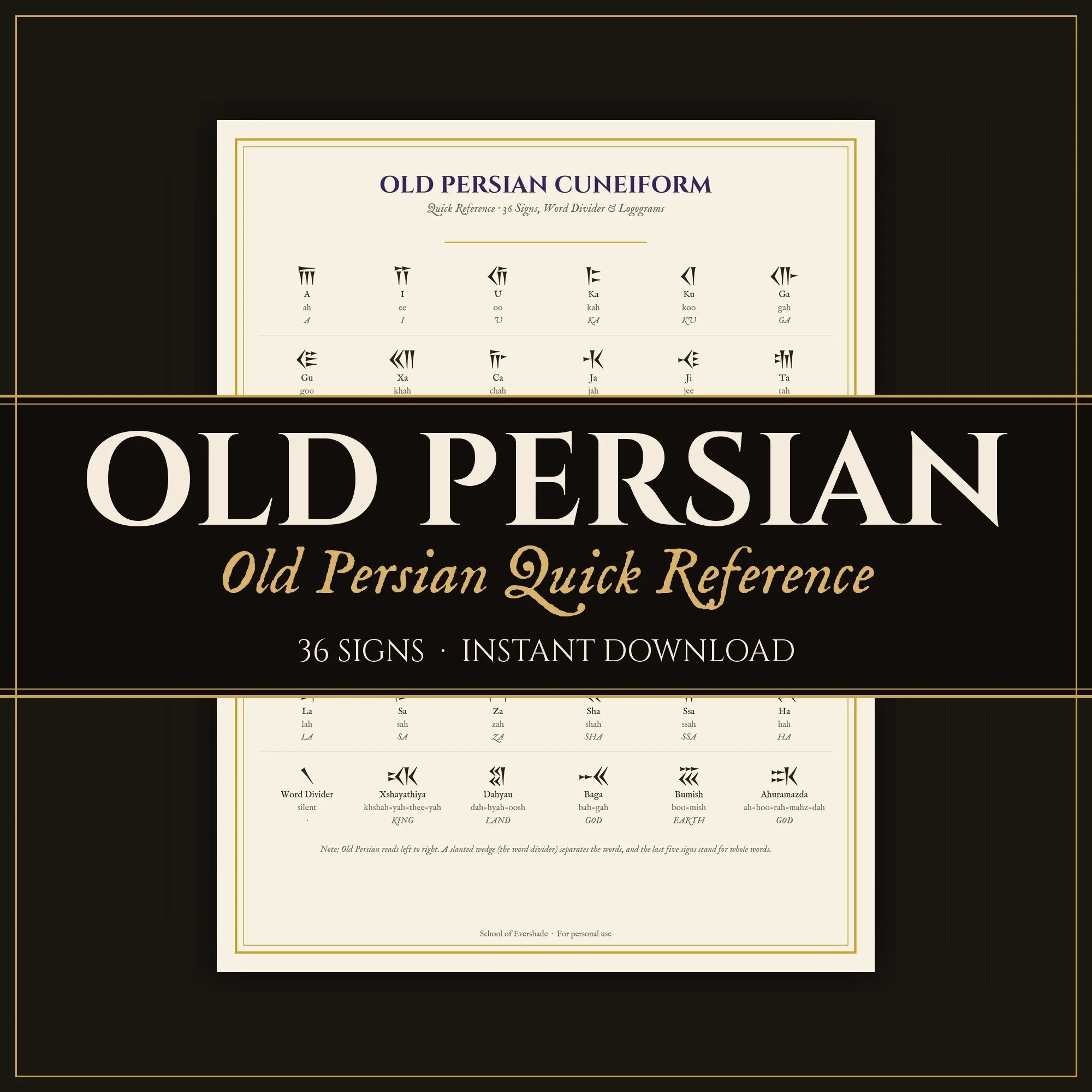
The system's 36 phonetic signs fall into a clear pattern. Three signs stand alone as independent vowels: a 𐎠, i 𐎡, u 𐎢. Every other phonetic sign represents a consonant followed by the vowel a: ka 𐎣, ra 𐎼, sa 𐎿, and so on through the consonant inventory. For a few consonants, the designers added special signs for the i and u variants as well, but the a series is the backbone.
To write a syllable like ki, a scribe would typically write ka followed by i, letting the reader understand the intended vowel from context.
★ Scholars call this arrangement a semi-alphabetic syllabary (a writing system in which each sign stands for a syllable, as ka, ra, and sa do here): more systematic than the sprawling sign lists of Mesopotamia, less purely alphabetic than the 22 letters the Phoenicians were using to the west (you will meet them in Lesson 5).
It sits between two worlds, and that in-between quality is characteristic of the whole script: simple enough to learn quickly, structured enough to record a royal language with precision.
Then there are the 8 logograms: whole-word signs reserved for a small set of essential concepts. King. God. Earth. A handful of others, mostly the vocabulary of royal power and divine authority. In a system of 36 phonetic signs, 8 logograms are ornaments, not infrastructure. They mark the words too important to spell out.
And then, the detail I love most: the word divider 𐏐.
★ Old Persian places this small diagonal wedge between every word. No other cuneiform tradition did this. Mesopotamian scribes ran words together and trusted the trained reader to find the boundaries. Egyptian scribes did the same.
The Persian designers looked at three thousand years of undivided text and added whitespace, in effect, two and a half millennia before the printing press made it standard.
For you, the student, the divider is a kindness across the centuries. When you look at an Old Persian inscription, you can see where each word begins and ends. The script wants to be read. That, as much as anything, marks it as designed rather than grown: it was built with a reader in mind.
The script runs left to right, the same direction as the Mesopotamian cuneiform it visually echoes. Six signs will be your starting set in this lesson: the three vowels a, i, u, and the syllables ka, ra, sa, plus the word divider.
With these, you will transliterate real Old Persian words in the Guided Practice below.
Check in: What does the word divider give a reader that Mesopotamian and Egyptian texts never gave theirs, and why does its presence suggest a designed system?
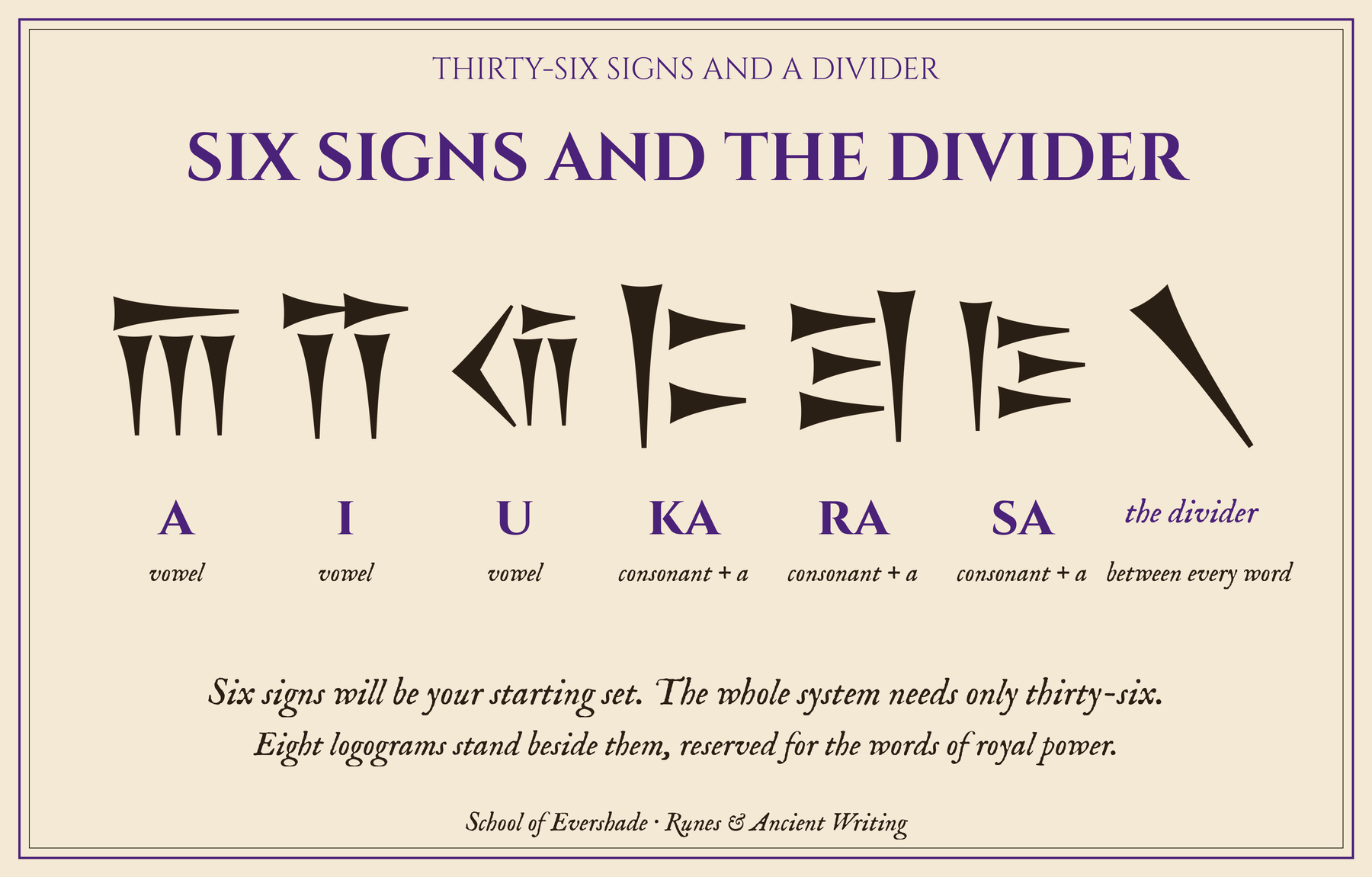
Your starting set: the three independent vowels, three consonant-and-a syllables, and the word divider — seven boxes, exactly as Assignment I will ask you to draw them.
Built for Evershade.
❦ In your workbook: record the thirty-six signs and the word divider in your own way — copy, sketch, or note what matters.
In your packet: Assignment I — The Sign Chart ⚒ begins here. Work it now, or mark the place and take it as homework — your choice.
Professor Webblethorn
Pause here, scholars, and consider what you have just learned.
In our first lesson, the Mesopotamians answered our course question by subtraction: what can we leave out and still be understood? The token, then the picture, then the curve, until only the wedge remained.
In our second lesson, the Egyptians refused the question entirely. They left out almost nothing and built a phonetic system inside their pictures anyway.
The Persians asked the question backward. They did not ask what could be left out. They asked what must be kept. And their answer was: the shape of the past itself. Keep the wedge, and you may discard everything else: the hundreds of signs, the years of training, the entire scribal tradition. The wedge alone carries the authority. The rest can be new.
I have spent long hours before the Behistun cliff in my studies, though only ever in photographs and squeezes, never in person. Even at that remove, the illusion holds. It looks ancient. It looks inevitable. It looks like the product of three thousand years.
It is the work of a committee.
There is no judgment in that observation, only wonder. Every script we study was made by human minds solving human problems. The Persians simply solved theirs faster, and with unusual self-awareness about what writing is for. They understood that a script does not only record words. It performs authority. And they built a performance of antiquity so convincing that it took modern scholars to see through it.
Keep the question beside you. It is the silk thread running through every lesson: nearly invisible, holding everything together.
Now, to the mountain itself.
PROFESSOR THISTLELOOM WEBBLETHORN
Runes & Ancient Writing
Epigrapher, Head of House Septentrio
The King's Mountain
In the Zagros Mountains of western Iran, in what is now Kermanshah Province, a limestone cliff rises above an ancient road. The road was once part of the royal highway connecting the great cities of the Persian Empire. Travelers, merchants, armies, and messengers passed beneath the cliff for centuries.
Approximately 100 meters above that road, carved into the living rock, is the Behistun inscription.
King Darius I commissioned it around 520 BCE, early in his reign. He had seized the throne under contested circumstances: the previous king was dead, rivals claimed the crown, and the empire trembled.
Darius needed to do what every new king in a precarious position must do. He needed to tell his story, in a form no one could ignore or erase.
★ The inscription is enormous and trilingual (presented in three languages). The same text appears three times: in Old Persian, in Elamite, and in Babylonian. It recounts Darius's rise to power, his victories over nine rival claimants across the empire, and his assertion that his rule is legitimate, divinely sanctioned, and unchallengeable.
Above the text, a carved relief shows Darius with his foot on a defeated rival, facing nine bound captives, beneath the winged symbol of Ahura Mazda, the great god.
Here is the detail that has occupied scholars for generations: the inscription sits 100 meters above the road. From the ground, the text is unreadable. The signs are too small, the cliff too high, the angle too steep. No traveler passing below could have read a word of it.
So who was it for?
This is the question I want you to hold, because it has no single answer, and the ambiguity is the point. Perhaps it was for the gods, who could read at any distance. Perhaps it was for future kings, who would bring ladders or scaffolding.
Perhaps, and this is the interpretation I find most compelling, it was for no human reader at all: the existence of the inscription was the message. A king who can carve his victories into a mountain does not need you to read them. The mountain itself is the argument.
Consider what this means for our understanding of writing. We tend to assume that writing exists to be read. Behistun suggests otherwise, or at least suggests that reading is only one of writing's jobs.
Writing also declares. It occupies space. It says: someone with power was here, and power arranged these signs, and the signs will outlast us all.
The trilingual format served a practical imperial purpose as well. The Achaemenid Empire contained peoples speaking dozens of languages.
Old Persian was the language of the ruling elite. Elamite had been the administrative language of the region for centuries. Babylonian (a dialect of Akkadian, written in Mesopotamian cuneiform) was the great literary and scholarly language of Mesopotamia. By carving his account in all three, Darius spoke to the Persians, the Elamites, and the Babylonians alike, and he did so in each people's own prestigious written tradition.
It was this trilingualism, this imperial courtesy, that would undo the script's silence two thousand years later. But that is the next section's story.
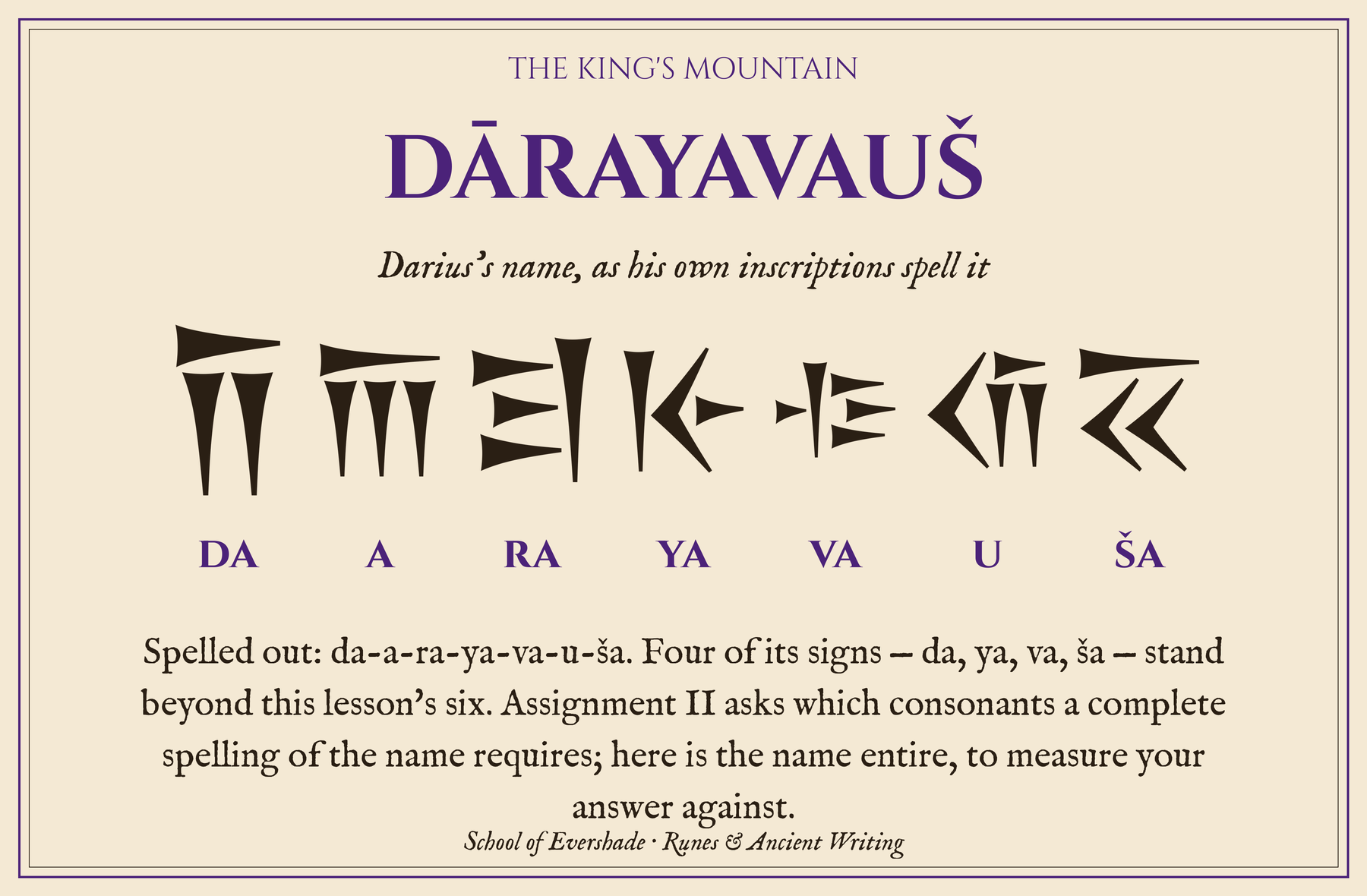
Dārayavauš — the king's name in his own script: da-a-ra-ya-va-u-ša. Four signs here stand beyond the lesson's six; the name is the measure of how far the full thirty-six can go.
Built for Evershade.
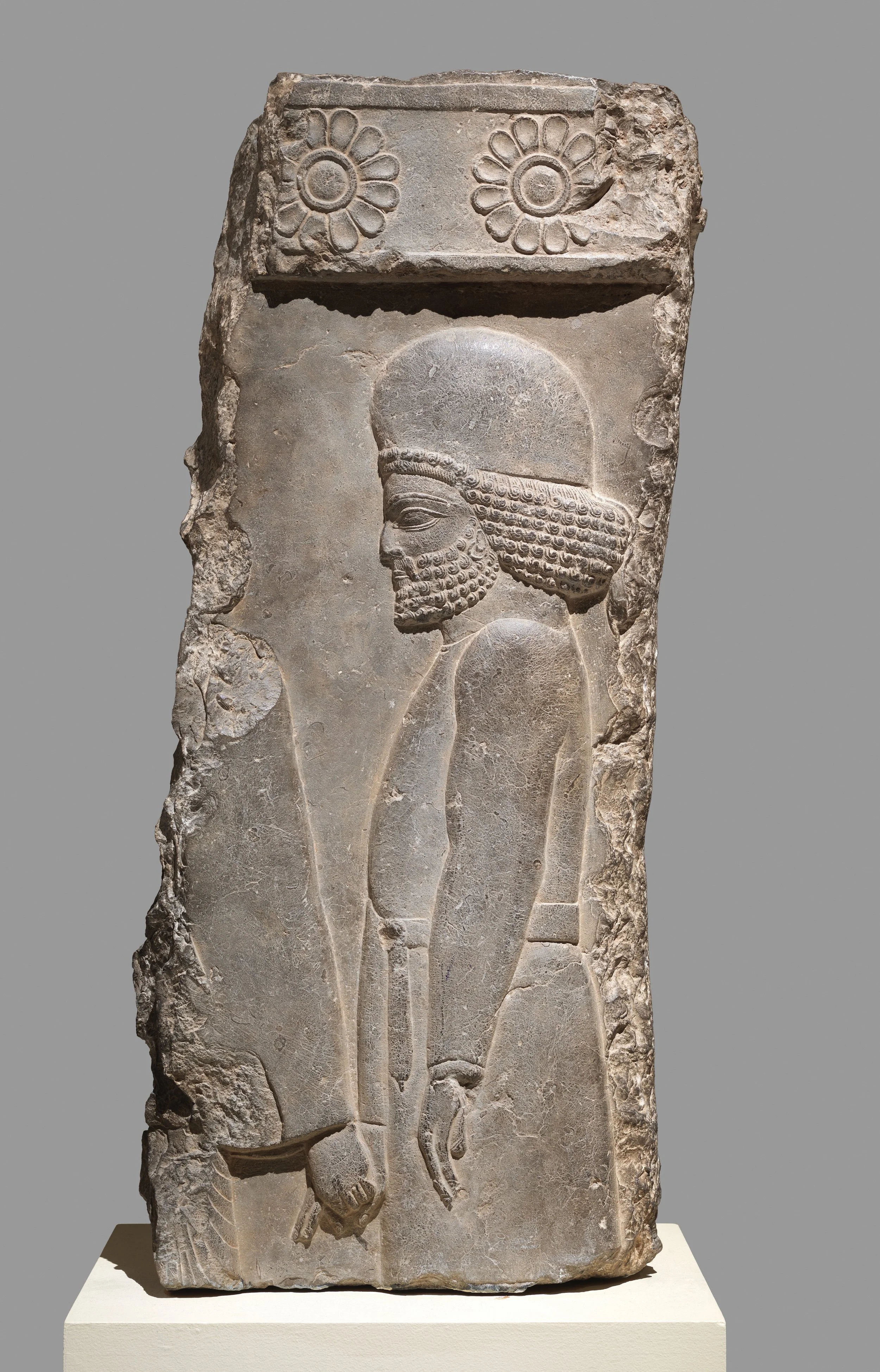
Historical example. A figure in a procession, carved in limestone in the Achaemenid court style — the same carving tradition that cut Darius's relief into the Behistun cliff: curled beard, rosette band, calm profile. Writing declared the king's power in words; reliefs like this declared it in faces.
Relief: figure in a procession, Achaemenid, ca. 405–359 BCE. The Metropolitan Museum of Art, New York (39.133). Public domain, The Met Open Access.
❦ In your workbook: record the inscription carved too high to read in your own way — copy, sketch, or note what matters.
The Key in Three Languages
You will remember from our last lesson that Egyptian hieroglyphs were silenced for nearly 1,400 years until the Rosetta Stone gave scholars a bilingual key: known Greek unlocking unknown hieroglyphs. I told you then to remember the pattern, that keys like this would appear again.
Here is the next key.
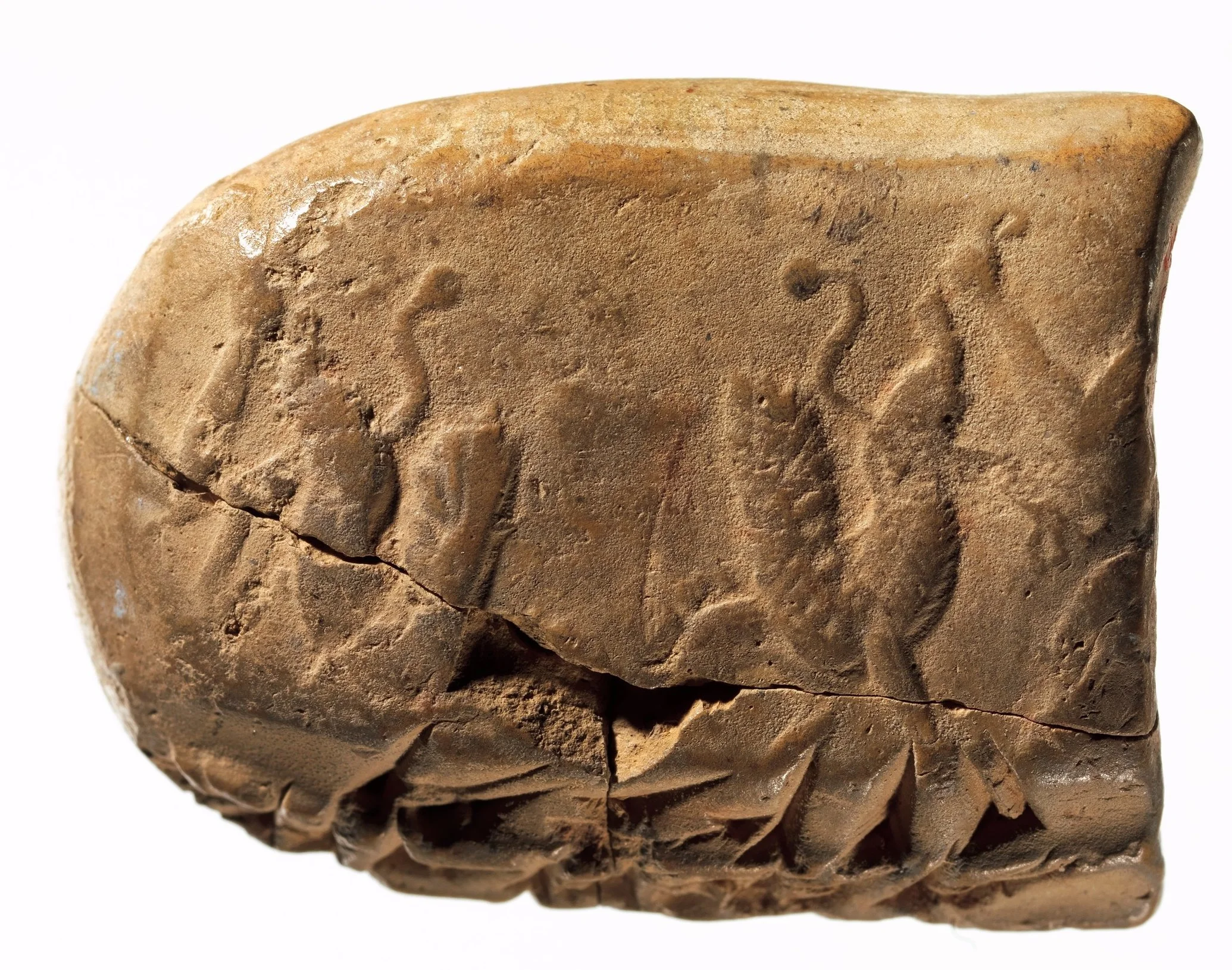
Historical example. The middle language of the key: a clay tablet written in Achaemenid Elamite, about 500 BCE — an administrative document of Darius's own empire, sealed with its owner's seal and wedge-written along its lower edge. Once Old Persian was read, documents in Elamite gave scholars what they needed for Behistun's second version.
Cuneiform tablet impressed with seals: administrative document inscribed in Achaemenid Elamite, ca. 500 BCE. The Metropolitan Museum of Art, New York (36.30.62). Public domain, The Met Open Access.
By the early 19th century, European scholars knew that the strange wedge-shaped inscriptions on Persian monuments must be writing, but no one could read them. The signs looked like Mesopotamian cuneiform, which was itself still undeciphered.
It was a locked room inside a locked house.
The first crack came around 1802, from a German schoolteacher named Georg Friedrich Grotefend. Working from copies of inscriptions at Persepolis, Grotefend made a brilliant guess. He noticed that certain sign groups repeated at the beginnings of inscriptions, and he reasoned, as the decipherers of Egyptian had reasoned about cartouches, that these must be royal names and titles.
If a recurring formula read "X, great king, king of kings, son of Y," then the names X and Y could be matched against the Persian kings known from Greek historical sources.
Working backward from the expected names, Grotefend identified the sound values of roughly ten signs. He had no knowledge of the Old Persian language itself. He worked from pure pattern, and pattern was enough to begin.
The decisive work belonged to Henry Creswicke Rawlinson, a British army officer stationed in Persia. Beginning in 1835, Rawlinson set out to copy the Behistun inscription, and I want you to picture what that undertaking required.
★ The text sits 100 meters above the ground on a sheer cliff face. Rawlinson climbed. He dangled from ropes. He made papier-mâché squeezes of the signs, pressing wet paper into the carved wedges and peeling it away to carry the impressions down the mountain.
Over several seasons, through 1847, he assembled a complete copy of all three versions of the text.
With the full trilingual before him, Rawlinson could do what Grotefend had only begun. The Old Persian section, being the simplest of the three scripts, yielded first.
By 1838 he had deciphered its essential structure; by the mid-1840s, with his complete copy, the decipherment was secure. And once Old Persian was readable, its text served as the known language against which scholars attacked the Elamite and Babylonian versions, which in turn became keys to their own vast literatures.
There is a symmetry here I want you to see. In Egypt, the key was a stone carrying three scripts, and it unlocked hieroglyphs.
In Persia, the key was a mountain carrying three languages, and it unlocked Old Persian, which unlocked Elamite, which helped unlock Babylonian, which opened the entire cuneiform world of Mesopotamia.
Keys open keys open keys. This is how the ancient world has been giving itself back to us: not all at once, but in a chain, each decipherment making the next one possible.
Rawlinson lived to see the field he founded transform our knowledge of the ancient Near East. Grotefend, the schoolteacher, is remembered as the man who guessed correctly. Both of them, like Champollion before them, did the same essential thing: they looked at marks no living person could read, refused to accept the silence, and listened until the marks spoke.
Check in: Grotefend worked from copies at a desk; Rawlinson worked from ropes on a cliff. What did each man contribute that the other could not?
❦ In your workbook: record how three languages became one key in your own way — copy, sketch, or note what matters.
In your packet: Assignment III — The Behistun Investigation ◐ begins here. Work it now, or mark the place and take it as homework — your choice.
Guided Practice — The Engineer's Hand
Before the assignments, train your eye and hand. Old Persian's gift to the student is its simplicity: with few signs and visible word boundaries, you can begin reading real inscriptions quickly.
Exercise A — Drawing the Six Signs
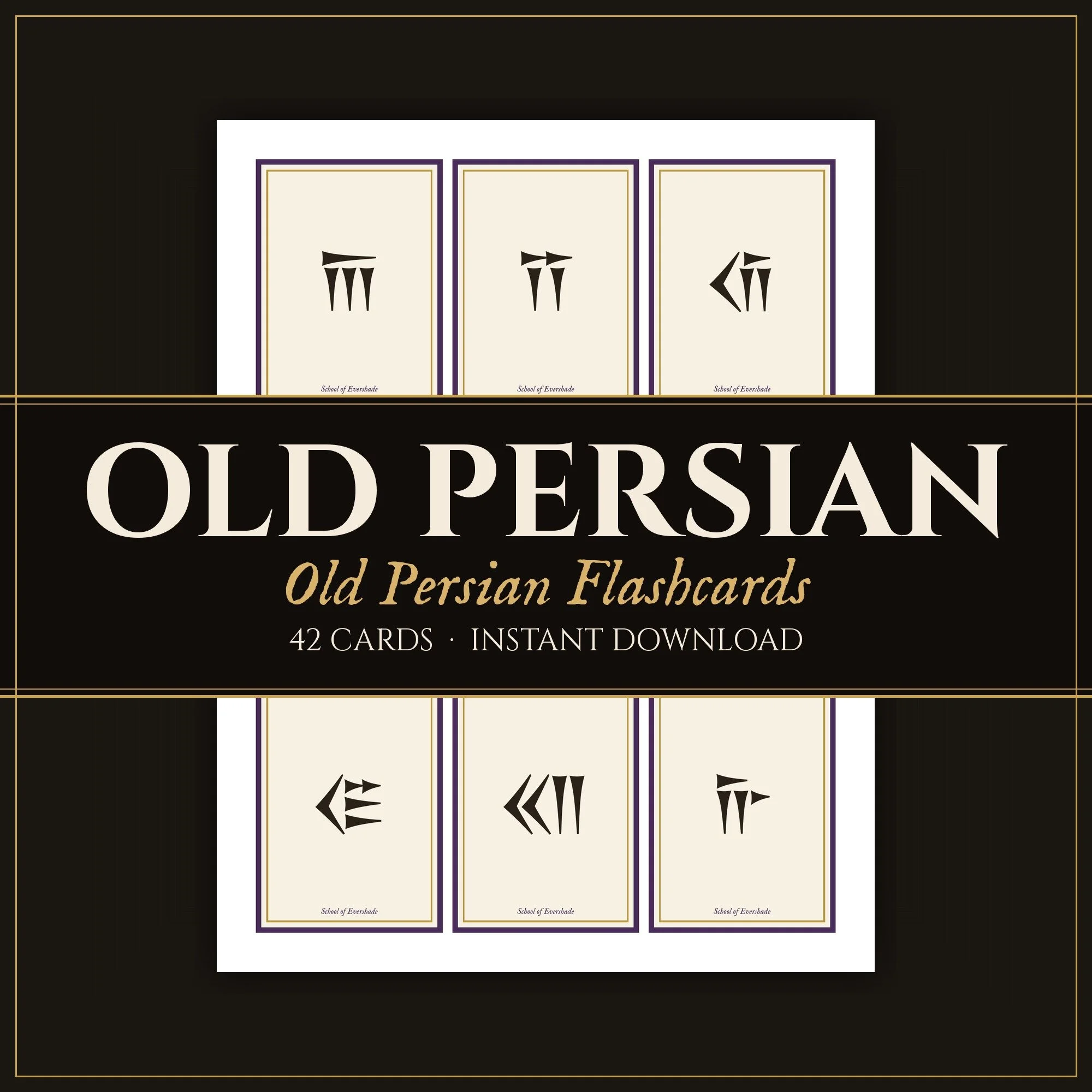
- On paper, draw each of the six lesson signs three times: a 𐎠, i 𐎡, u 𐎢, ka 𐎣, ra 𐎼, sa 𐎿.
- Label each with its transliterated value.
- Draw the word divider 𐏐 five times. Notice how small it is, and how completely it changes the readability of a line.
- Compare your copies. Old Persian signs are geometric and regular by design. Which sign was hardest to draw consistently?
A note on the shapes: you will notice these signs look simpler, more open, than Mesopotamian wedges. That is the engineered quality made visible. The designers kept the wedge aesthetic but stripped away the dense clustering. Fewer wedges per sign, more air between them. It is cuneiform with room to breathe.
❦ Workbook path: working in your workbook? Draw the six signs and the divider there, three copies of each down the page, every copy labelled with its value. Keep the page: it is your Old Persian sign list for the rest of the unit.
Exercise B — The Divider's Difference
- Write the following sequence of transliterated syllables as a continuous string, with no dividers: a-ra-sa-ka-i-u.
- Now write the same sequence with the word divider between each syllable group: a 𐏐 ra 𐏐 sa 𐏐 ka 𐏐 i 𐏐 u.
- Show both versions to someone nearby (or imagine doing so). Which is easier to parse? By how much?
- Write two sentences on what this exercise suggests about why no Mesopotamian scribe ever invented the divider, and why the Persian designers did.
This is a small exercise with a large point. You have just felt, in your own hand, the difference between a grown system and a designed one.
Exercise C — Transliteration: A Royal Name
The Old Persian word for "king" is xšāyaθiya. We do not have all its signs in our set of six, but we can approximate its opening.
- Using the lesson's sign values, write the signs for ša (approximate with sa 𐎿 and note the substitution), followed by a 𐎠.
- Add the word divider 𐏐, then write ka 𐎣 followed by ra 𐎼.
- You have now written a recognizable fragment of a royal title. How does it feel to write a king's word with six signs you learned this morning?
- Research question (for the assignments): the full royal formula "X, great king, king of kings" appears at Behistun. Which of its words could you now partially spell, and which remain beyond our six signs?
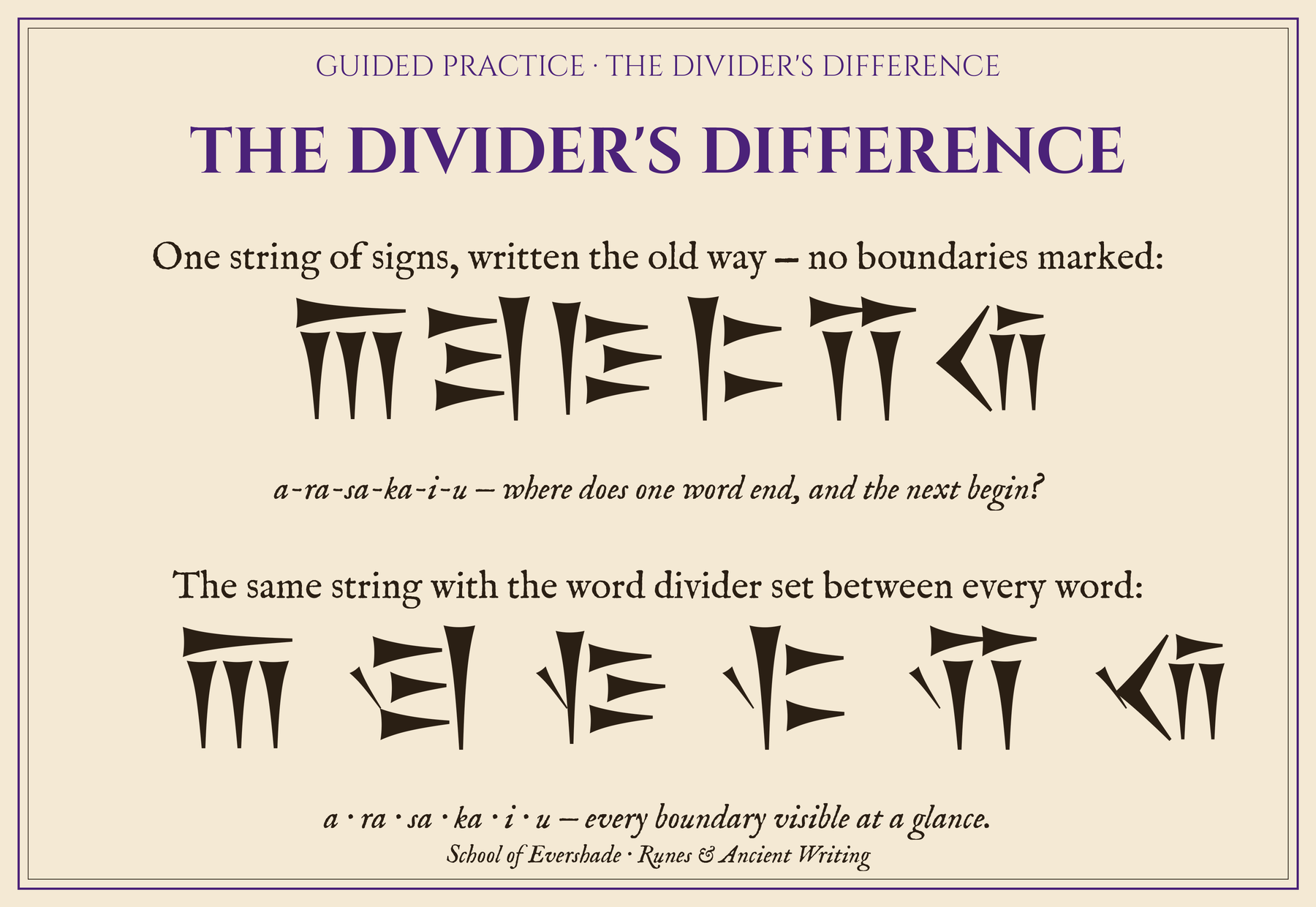
The divider's difference, from Guided Practice Exercise B: one string of signs, hard to read as words until the Persian divider gives every word its boundary.
Built for Evershade.
In your packet: Assignment II — Transliteration Practice ⚒ begins here. Work it now, or mark the place and take it as homework — your choice.
In your packet: Assignment IV — The Illusion Essay ✎ begins here. Work it now, or mark the place and take it as homework — your choice.
Assignment Manual
Assignment key: ✎ written work · ⚒ hands-on practical · ◐ both · ★ will be on the test · ❦ workbook path
Written answers in this manual are short answers in your own words — a few honest lines, not a filled page.
Assignment I — The Sign Chart ⚒ ★
Objective: Demonstrate control of the six lesson signs and the word divider.
Instructions:
- On a fresh sheet, divide your page into seven boxes.
- In each box, draw one sign as carefully as you can: a 𐎠, i 𐎡, u 𐎢, ka 𐎣, ra 𐎼, sa 𐎿, and the word divider 𐏐.
- Label each with its transliterated value and a one-line description of its visual form (e.g., "three vertical wedges under a horizontal").
- Below the chart, write one paragraph comparing the visual density of these signs with Mesopotamian cuneiform signs from Lesson 1. Which system looks more complex? Which is actually more complex to learn, and why?
Your keepsake: this chart is your key to every Old Persian inscription in this course. Keep it with your wedge chart and your eight hieroglyphs: three scripts, three charts, one growing key-ring.
❦ Workbook path: make the chart across a full workbook page instead: seven boxes, the same labels and descriptions, and your comparison paragraph beneath it.
To submit: Photograph or scan your chart. Clarity and correct labeling matter more than artistic skill.
Assignment II — Transliteration Practice ⚒ ★
Objective: Use Old Persian signs to spell real words.
Part A. Transliterate the following into Old Persian signs, using the six lesson signs and the word divider. (Approximate where the full historical spelling requires signs beyond our set, and note each substitution.)
- a-ra (a fragment meaning "noble" in compound names)
- sa-ka (the name of a people, the Saka)
- ka-ra (a fragment of words relating to "army" and "people")
Part B. For each, write two sentences: first, the sequence of signs you chose and why; second, what the word divider contributes to readability in each case.
Part C. Darius's name in Old Persian is Dārayavauš. Using your knowledge of the Ca syllable structure from the lesson, explain in three to four sentences why our six signs are insufficient to spell it fully, and what additional signs (which consonants?) a complete spelling would require.
❦ Workbook path: work the whole assignment in your workbook: one fragment to a line, the signs drawn large above the line, the divider placed, and your sentences beneath.
Assignment III — The Behistun Investigation ◐ ★
Objective: Understand the inscription's physical reality and its role in decipherment.
Instructions:
- Research (using the References below): find a photograph of the Behistun cliff. Note the height of the inscription above the road and the scale of the carved relief.
- The inscription's Old Persian text was the first of the three versions to be deciphered. Using the lesson and the References, explain in a half page why the simplest script yielded first, and how its decipherment then served as a key to the Elamite and Babylonian versions.
- Rawlinson copied the inscription by climbing the cliff and making papier-mâché squeezes. Write a half-page response: what does his method tell you about the state of epigraphy in the 1830s? What would a modern team do differently?
- Return to the lesson's question: who was the inscription for, given that no one on the road below could read it? Take a position and defend it in three to four sentences.
Assignment IV — The Illusion Essay ✎ ★
Objective: Connect the lesson's central concept to the course through-line.
Instructions:
Write a one-page essay addressing the following:
The Persians kept the wedge shapes of Mesopotamian cuneiform while discarding nearly everything else: the hundreds of signs, the years of training, the scribal tradition. Our course question asks what can be left out and still be understood. The Persian designers seem to have asked the inverse: what must be kept to be believed?
In your essay, consider: is the "engineered illusion" a fair description, or does it understate the designers' achievement? Is there an honest difference between borrowing a visual language and faking antiquity? And what does Behistun's unreadable height suggest about whether the script's audience was readers at all?
Cite at least two specific details from the lesson in your argument.
Materials
Required (Level One — household items)
- Paper: plain white paper or a sketchbook, for sign practice and transliteration exercises.
- Pencils: one standard pencil for drafting, one fine-tipped pen or marker for final sign drawings.
- A ruler: for dividing practice sheets into boxes.
- A printout of the six signs: use the lesson's sign descriptions as your reference, or print the sign chart from your assignment packet.
Suggested (Level Two — historically closer materials)
- A plaster or clay slab: Old Persian was carved in stone, not pressed in wet clay. Pressing the signs into a firm plaster slab with a pointed tool approximates the carved quality better than soft clay does. Compare the experience with Lesson 1's clay pressing.
- A metal point or awl: closer to the chisels that cut Behistun's signs into limestone than a reed stylus is.
- A rock or stone tile: for the ambitious, a flat piece of soft stone (sandstone or limestone) and a nail can reproduce the monumental experience at small scale. Work outdoors; wear eye protection.
Neither level requires
Purchased kits, specialty tools, or any material you cannot find locally or order inexpensively. The core lesson (drawing signs, transliterating, understanding the system) is fully achievable with paper and pencil.
Reflection Questions
Answer the following in your workbook.
- Why is Old Persian cuneiform called "engineered" rather than "evolved"? What evidence supports the design hypothesis?
- How does Old Persian's sign inventory (36 phonetic signs) compare with Mesopotamian cuneiform's and Egyptian hieroglyphs'? What does the difference suggest about each system's priorities?
- Explain the Ca syllable structure. Why is Old Persian called a semi-alphabetic syllabary rather than a true alphabet?
- What is the word divider, and why is its presence significant? Why did no earlier cuneiform tradition develop one?
- Describe the Behistun inscription: where is it, what does it say, and in which three languages? Why was the trilingual format essential to decipherment?
- How did Grotefend's and Rawlinson's approaches to decipherment differ? What did each contribute?
- The lesson asks what must be kept to be believed, inverting our course question. Apply this inversion to Behistun itself: what did Darius keep, what did he invent, and who was meant to believe it?
Workbook Checklist — Lesson 3
In my workbook I have:
- ☐ explained why Old Persian cuneiform is called engineered, not evolved
- ☐ described the sign inventory: 36 phonetic signs, 8 logograms, three independent vowels, and the Ca syllable pattern
- ☐ drawn the six lesson signs and the word divider and written each one's value
- ☐ explained how Old Persian differs from Mesopotamian cuneiform despite the shared wedges
- ☐ described Behistun: the cliff, the three languages, and Darius's purpose
- ☐ told how Grotefend guessed and Rawlinson climbed their way to decipherment
- ☐ explained the engineered illusion: a new script in ancient dress
☐ Lesson completed Date: ____________ Signature: ____________
Professor's Review
And so our third lesson closes on a cliff face in Persia, a hundred meters above a road no traveler could read from.
You can now explain why Old Persian cuneiform was designed rather than grown, describe its 36 signs and its word divider, read six signs and give their values, tell the story of Behistun and its three languages, recount the decipherments of Grotefend and Rawlinson, and explain the engineered illusion: a new script in the robes of antiquity.
Keep your sign chart beside your wedge chart and your eight hieroglyphs. You now hold the beginnings of three writing systems, and you can see the pattern forming. Mesopotamia subtracted until only wedges remained. Egypt kept everything and made the pictures spell. Persia kept the look of antiquity and rebuilt everything underneath.
Three answers to the same question. Or rather, three answers to two questions: what can be left out, and what must be kept. Hold both. You will need them.
Next, we travel to the turquoise mines of Sinai, where Semitic-speaking workers looked at Egyptian hieroglyphs and had an idea so radical that every alphabet you have ever used descends from it. They did not borrow the pictures. They stole the principle, and left the pictures behind entirely.
I have told you that I admire the paths that led elsewhere. Sinai is where our path begins. Practice your signs, scholars, and come ready. The alphabet is about to be born, and I have been waiting the better part of a year to show it to you.
PROFESSOR THISTLELOOM WEBBLETHORN
Runes & Ancient Writing
Epigrapher, Head of House Septentrio
Cross-Class Connections
The stone-carving techniques behind monumental inscriptions like Behistun connect directly with Creative Arts, which will explore carving and incising. The Persian mason's chisel and the Mesopotamian scribe's stylus are answers to the same question (how does the tool shape the mark?), worked in opposite materials.
The relationship between imperial power and writing systems parallels Scrollwork, where Professor Nocturne examines how medieval scriptoria served institutional authority.
Darius carving his legitimacy into a cliff and a monastery standardizing its book hand are expressions of the same impulse: writing as an instrument of power, separated by two thousand years.
The decipherment chain (Grotefend to Rawlinson to the cuneiform world) will reappear throughout Runes, as each subsequent script's unlocking depends on the keys cut by earlier ones. Students should trace this chain deliberately: Rosetta to Champollion (Lesson 2), Behistun to Rawlinson (this lesson), and whatever comes next.
In Other Classrooms
Creative Arts · Unit VII, Lesson 27 — First Cuts: Carving Safely

A hard point against a hard surface, and no second chances: that is carving, whether the stone is a Persian cliff or a practice block on my bench. In the Workshop we take first cuts safely, in soap and basswood before soft stone, layout always before the blade. Come and learn the craft behind the inscriptions you are reading about.
The mountain is only our third stop.
References & Further Reading
The British Museum. Collection online. Searchable collection including Old Persian inscriptions and Achaemenid artifacts. https://www.britishmuseum.org/collection
UNESCO World Heritage Centre. "Behistun." The inscription's World Heritage listing, with description of the monument, its location, and its historical significance. https://whc.unesco.org/en/list/1222
The Metropolitan Museum of Art. Heilbrunn Timeline — "The Achaemenid Persian Empire." Museum essays on the empire, its art, and its inscriptions, with collection objects. https://www.metmuseum.org/toah/hd/acha/hd_acha.htm
Wikipedia. "Behistun Inscription." Comprehensive overview: the trilingual text, Darius's reign, the cliff's physical description, and the decipherment narrative. https://en.wikipedia.org/wiki/Behistun_Inscription
Wikipedia. "Old Persian cuneiform." The sign inventory, the Ca syllable structure, the word divider, and the script's designed character. https://en.wikipedia.org/wiki/Old_Persian_cuneiform
Wikipedia. "Darius I." Darius's reign (522 to 486 BCE), his rise to power, and the empire at its height. https://en.wikipedia.org/wiki/Darius_I
Wikipedia. "Henry Rawlinson." Rawlinson's career, the Behistun copying expeditions (1835 to 1847), and the decipherment. https://en.wikipedia.org/wiki/Henry_Rawlinson
Schmitt, Rüdiger. The Bisitun Inscriptions of Darius the Great: Old Persian Text. London: Corpus Inscriptionum Iranicarum, 1991. The standard scholarly edition of the Old Persian text. For the deeply curious.
Browse the Runes shelf in the school Library for readable editions of these works.
THE UNIT I QUIZ
RUNES & ANCIENT WRITING · UNIT I: THE FIRST FOUNDATIONS · LESSONS 1–3
Unit I is complete: three foundations laid, from the first wedges pressed into clay to a script engineered by royal decree. This quiz gathers the whole unit, all three lessons, into one sitting. Take it from memory first, before you look back at your notes, because it measures what has stayed with you. If you completed the assignments marked ★ in your lesson packets, you have already practiced most of what it asks.
The quiz packet is a single download. Part I gathers questions from every lesson in the unit, Part II matches the unit's vocabulary, and the answer key waits at the back for self-checking. When you have finished, score it honestly, note the result in your workbook, and revisit any lesson whose questions went wrong before you move on to Unit II.
Submit your work for this lesson using the form below.
CONTINUE IN RUNES & ANCIENT WRITING
← Previous · Lesson 2: Egyptian Hieroglyphs: Eight Pictures That Spell Sounds Next · Lesson 4: Proto-Sinaitic: Where the Alphabet Was Born →
Unit I · The First Foundations Runes & Ancient Writing Classroom · All 21 Lessons
The rest of Unit I: Lesson 1 · Mesopotamian Cuneiform · Lesson 2 · Egyptian Hieroglyphs
From the Runes Shelf
The printed companions to this lesson, from Professor Webblethorn’s shelf in the shop.