RUNES & ANCIENT WRITING
Unit I · Lesson 1THE STRUCTURAL WEDGE
Mesopotamian Cuneiform
Professor Thistleloom Webblethorn
Epigrapher • Runes & Ancient Writing
Head of House Septentrio • School of Evershade
Professor's Introduction
Welcome, seekers of old marks. I am Professor Thistleloom Webblethorn, and this is Runes & Ancient Writing.
You have enrolled, I suspect, expecting runes. Carved stones. Viking ships. Perhaps a hammer or two.
You will get them. In Unit IV. I promise: some things are worth waiting for.
We begin instead five thousand years before the Vikings, in a river valley where no one had yet invented the alphabet, the book, or, strictly speaking, writing itself. We begin with accountants.
I know. It sounds unremarkable. That is precisely what makes it wonderful.
Every alphabet you have ever used, the letters on this page included, descends from a chain of inventions that starts with Sumerian merchants — speakers of Sumerian, the language of the earliest cuneiform tablets, spoken in southern Mesopotamia, a language isolate related to no known language family, whose sign readings (AN, KI, É) this lesson teaches — pressing shaped clay tokens into wet clay to track sheep.
If you want to understand runes, you must first understand why a wedge pressed into clay was one of the most consequential technologies in human history.
Our course is a chronological journey. We will follow writing from its birth in Mesopotamia through Egypt, the Levant, the Mediterranean, and the northern carvers, until we arrive at the manuscript hands of medieval Europe. Each unit builds on the last. Each writing system solves a problem the previous one created.
Today: the wedge. The stylus. The clay. And the world's first information technology.
Look closely at everything we study this year. It is all pressed, carved, or written, and it all starts here, in the last place you would think to look.
PROFESSOR THISTLELOOM WEBBLETHORN
Runes & Ancient Writing
Epigrapher, Head of House Septentrio
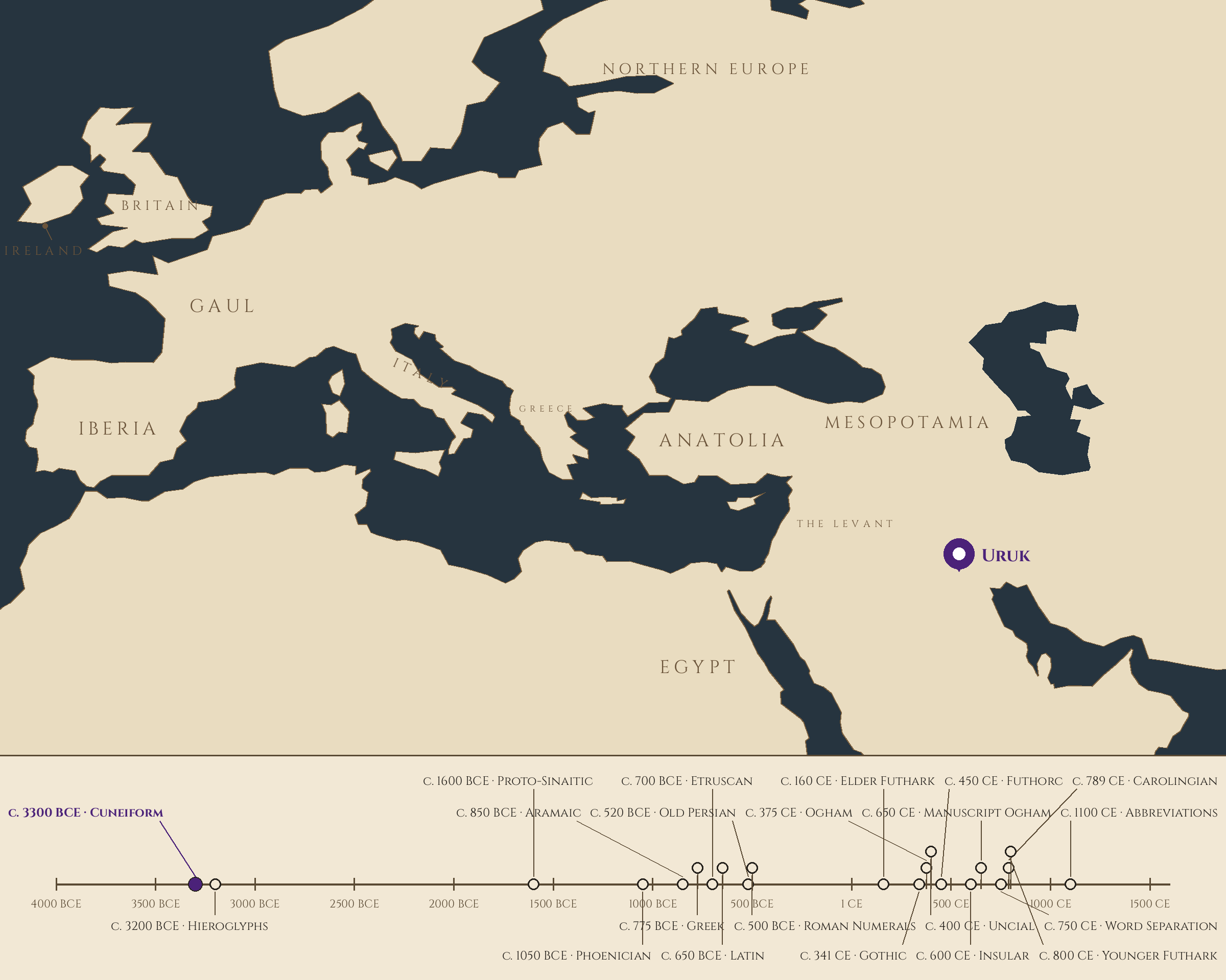
Where and when: Uruk, in southern Mesopotamia, about 5,400 years ago. The pin is this lesson. The line beneath the map is our road: every stop a writing system, every lesson a pin.
Lesson Objectives
By the end of this lesson, students should be able to:
- Explain why writing was invented for accounting before literature.
- Describe the token-and-bulla system and its proposed relationship to proto-cuneiform.
- Identify the five basic wedge forms of cuneiform.
- Explain the difference between drawing signs and pressing wedges, and why the technique changed.
- Define cuneiform, logogram, pictograph, stylus, bulla, and Winkelhaken.
- Read the Sumerian signs AN, KI, and É and explain what each represents.
- Press the basic wedge forms into clay using a stylus.
- Explain why so many clay tablets survived to the present day.
Reading this lesson: ★ marks the passages to remember. They return on the unit quiz and the class test. Check in questions ask the material back as you go; answer them in your workbook when you meet them.
Working this lesson: Your assignment packet is the first download on this page. Work in it as the lesson moves along, answering each assignment as its subject is taught — or read the lesson through for your notes and take the assignments as homework afterward. Both are proper ways to sit this class. Signposts in the reading tell you where each assignment belongs. Written answers are short answers in your own words; a few honest lines are worth more than a filled page.
Your Assignment Packet
This lesson's assignments live in its packet: the Lexicon Handout (every term, course terms marked ◆), Materials, Guided Practice, the Assignment Manual with its answer key for self-checking, the Reflection Questions, and the Workbook Checklist. Download the packet before you begin and keep it beside you as you read.
Before There Was Writing, There Was Counting
More than five thousand years ago, in the river plains between the Tigris and the Euphrates, the cities of Sumer faced a problem that had nothing to do with poetry.
They had too much to count.
Uruk, the largest of these cities, a walled metropolis of tens of thousands of people, ran on grain, livestock, labor, textiles, and beer.
Temple storehouses received goods from across the region. Administrators needed to know, precisely: how many sheep arrived, how many jars of oil left, how many workers were owed rations.
Memory was not sufficient. Neither was trust.
So for thousands of years before anyone wrote a word, the people of the ancient Near East counted with their hands full of clay.
They used tokens: small clay objects, each shaped to represent a commodity. A cone for a measure of grain. A sphere for a jar of oil. A tetrahedron for a unit of labor. An ovoid with markings for a particular animal. Archaeologists have recovered these tokens from sites across the region, some dating back as far as 8000 BCE, five thousand years before the first tablet.
Tokens worked. But they had a weakness: they could be lost, miscounted, or tampered with.
A shipment of thirty sheep represented by thirty clay tokens was only as honest as the person carrying them.
★ The solution was the bulla: a hollow ball of clay into which the tokens for a single transaction were sealed. Before closing it, the sender pressed each token's shape into the wet outer surface, leaving a visible record of the contents.
The bulla was then often rolled with a cylinder seal marking the sender's identity.
If anyone opened the envelope, the seal broke. If the count was disputed, the bulla could be broken open and the tokens inside compared against the impressions outside.
Stop and consider what the bulla represents. The impressions on its surface are signs that stand for the tokens inside. They are two-dimensional marks carrying the same information as three-dimensional objects.
The tokens are still in there, but strictly speaking, you no longer need them. The marks alone tell you everything.
According to a widely taught theory proposed by the scholar Denise Schmandt-Besserat, this is the moment writing begins.
Someone realized the tokens themselves were unnecessary. Instead of sealing tokens inside clay and impressing their shapes on the outside, you could simply flatten wet clay into a tablet and press the shapes directly into its surface and leave the tokens out entirely.
Not all scholars agree on every detail of this reconstruction, and the precise meaning of some tokens remains debated.
★ But the core insight stands regardless: writing was invented for accounting, not literature. The first texts are not poems or prayers. They are receipts.
Check in: In your own words, why did the impressions on the bulla's surface matter more than the tokens sealed inside it?
❦ In your workbook: record the tokens and the bulla in your own way — copy, sketch, or note what matters.
In your packet: Assignment III — The Bulla Reconstruction ◐ begins here. Work it now, or mark the place and take it as homework — your choice.
The First Drawn Signs
The earliest true tablets, what scholars call proto-cuneiform, appear around 3300 BCE, in the archaeological period known as Uruk IV. They are puffy, pillow-shaped tablets, divided into boxes and columns, covered with signs.
And here is something the textbooks sometimes skip. Those first signs were drawn, not pressed.
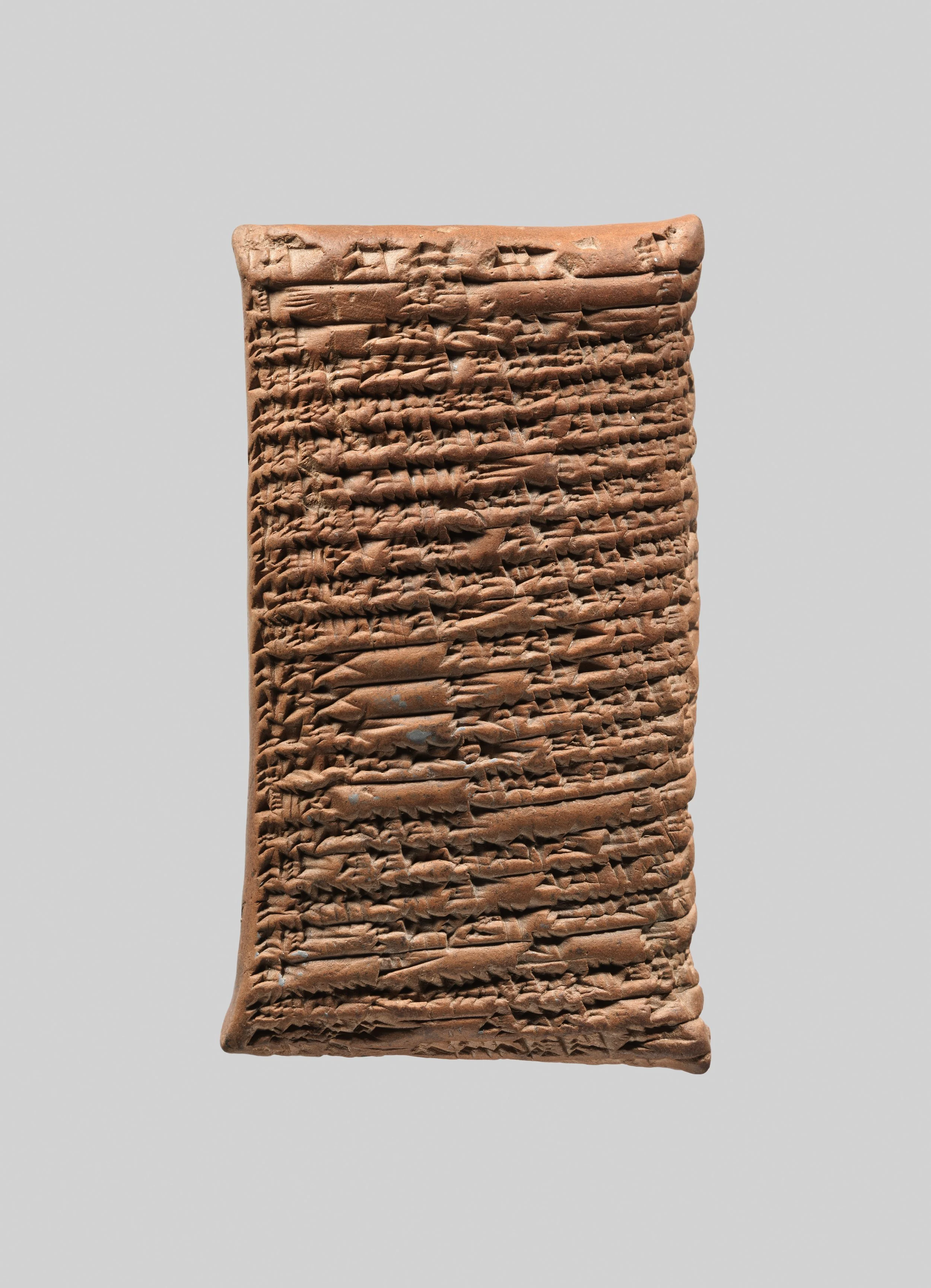
Historical example. The drawn signs, grown up. A private letter in mature cuneiform, written about 1632 BCE — line after line of pressed wedges, nothing drawn at all. This is what the pictographs of Uruk became.
Cuneiform tablet: private letter, Old Babylonian, ca. 1632 BCE. The Metropolitan Museum of Art, New York (86.11.111). Public domain, The Met Open Access.
The earliest scribes used a sharpened reed stylus to draw pictographs on the clay surface: little pictures of the things being counted.
A drawing of a head of grain. A drawing of a jar. A drawing of a sheep. These early signs lack the crisp wedge shapes we associate with cuneiform; they are sketches, incised or drawn into soft clay in vertical columns.
Over roughly a century of experimentation, the technique changed. Scribes discovered that pressing the cut end of the reed into the clay (a quick angled punch rather than a drawn line) was faster, more consistent, and better suited to soft clay.
Drawing distorted easily; a dragged line in wet clay wobbles and smears. A pressed wedge holds its shape.
By the time cuneiform reached its classic form (the Uruk III period, around 3100 BCE), the drawn pictographs had become stylized wedge-clusters.
The picture of a reed had become an arrangement of wedges. The picture of a star had become a pattern of impressions. The signs no longer looked like what they meant, but the scribes who used them knew.
This is worth pausing over, because it corrects a common simplification. Cuneiform was not born as wedges. It became wedges, through a century of scribes choosing speed and clarity over pictures.
❦ In your workbook: record how the first signs were drawn in your own way — copy, sketch, or note what matters.
In your packet: Assignment IV — Tablet Rotation Investigation ✎ begins here. Work it now, or mark the place and take it as homework — your choice.
Professor Webblethorn
Come closer to the web a moment, scholars.
You have just watched writing invent itself, twice. First when someone pressed a token into a bulla and realized the impression was enough. Then when someone stopped drawing pictures and started pressing wedges, and realized the wedge was enough.
Notice what is left behind each time: first the token, then the picture. What remains is always simpler, faster, and more abstract than what came before, and yet nothing essential is lost. That is the quiet miracle I want you to see.
This pattern will follow us all year. The Phoenicians will leave behind most of Egyptian writing's complexity. The Greeks will leave behind the Phoenician silence on vowels. The carvers of the north will leave behind every curve that stone cannot hold.
Every writing system you will study is an answer to a single question: what can we leave out and still be understood?
Keep that question beside you. It is the silk thread running through every lesson: nearly invisible, holding everything together.
Now, to the wedges themselves.
PROFESSOR THISTLELOOM WEBBLETHORN
Runes & Ancient Writing
Epigrapher, Head of House Septentrio
The Five Wedges
★ All of cuneiform (hundreds of signs, thousands of years, millions of tablets) is built from five basic impressions. Learn these, and you can begin to read the architecture of any sign.
Each wedge is made by pressing the rectangular cut end of the reed stylus into wet clay at a specific angle:
- The vertical wedge: pressed straight down with the stylus held upright. The most common element in the script.
- The horizontal wedge: pressed with the stylus turned ninety degrees, producing a wedge that lies on its side.
- The downward diagonal: pressed at an angle, sloping from upper right to lower left.
- The upward diagonal: pressed at the opposing angle, sloping from lower right to upper left.
- The Winkelhaken: the "corner hook." A single small press of the stylus corner, producing a tiny tailless wedge. German Assyriologists gave it this name, and it has stuck for over a century, a reminder that the modern study of cuneiform was substantially built by German scholars. The Winkelhaken is also catalogued as an independent sign.
The word cuneiform itself comes from the Latin cuneus, meaning "wedge." Nineteenth-century scholars named the script for its most distinctive visual feature: everything is wedges.
A single sign may combine many wedges. The sign for "star" layers them into a radiating pattern. The sign for "to go" stacks them into marching rows.
But every sign, from the simplest to the most elaborate, decomposes into these five pressed shapes.
There is something quietly beautiful about this. Five impressions, combined and recombined into hundreds of signs across thousands of years.
I have spent long mornings watching dew catch in the threads of my web, and I can tell you: the pleasure of a small set of elements arranged into endless patterns never grows old.
Check in: How many basic impressions is all of cuneiform built from? Name them without looking back.
❦ In your workbook: record the five wedges in your own way — copy, sketch, or note what matters.
Not an Alphabet
This must be said clearly, because it is the single most common misunderstanding about cuneiform:
★ Cuneiform is not an alphabet.
An alphabet assigns one sign to one sound. Cuneiform does something far more complicated. Its signs are a mixture of two types:
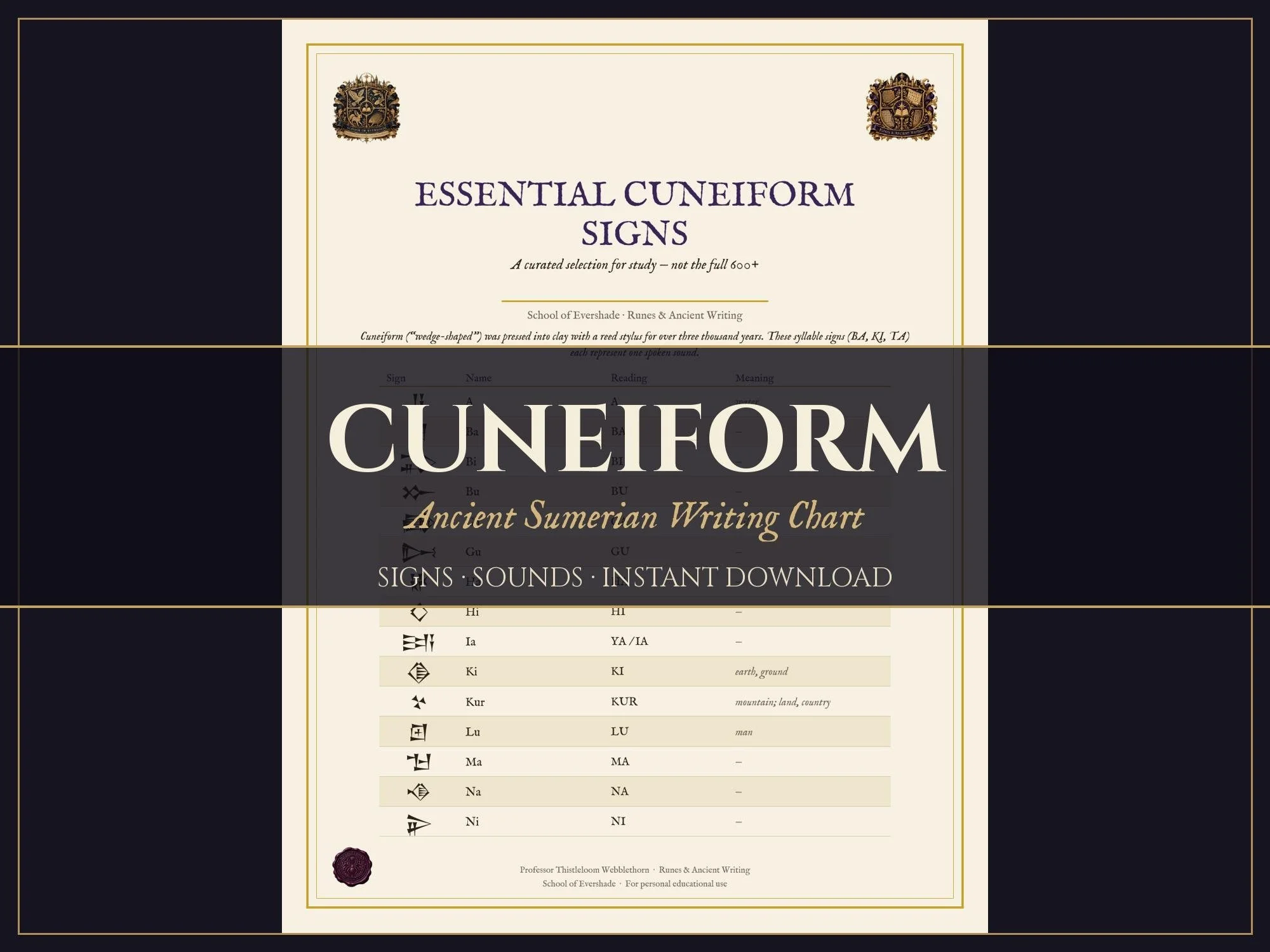
- Logograms: signs that stand for whole words. The sign 𒀭 (AN) means "sky" or "deity" as a complete word, the way the numeral "7" means "seven" without spelling it out.
- Syllabic signs: signs that stand for syllables. A sign might represent the sound ba, or kur, or anna, and scribes combined these to spell out words phonetically.
A scribe might write a word with a logogram, or spell it syllable by syllable, or mix both approaches in a single line. The system used hundreds of distinct signs, some estimates run above six hundred in the mature periods.
This is why cuneiform took years to learn, why scribes formed a specialized professional class, and why the invention of the alphabet (twenty-odd signs, one per sound) would later feel like a revolution.
Keep that in mind when we reach Unit II. The alphabet did not appear because someone had a clever idea in isolation. It appeared because cuneiform and hieroglyphs were magnificent, and exhausting.
Check in: If a friend called cuneiform "the Mesopotamian alphabet," what two kinds of signs would you tell them it mixes instead?
❦ In your workbook: record how this system mixes its signs in your own way — copy, sketch, or note what matters.
Reading Real Signs
Theory is necessary. But epigraphy, the study of inscriptions, is a practical discipline. Let us read.
★ Three signs. Each is among the most common in the entire cuneiform corpus. Each began as a pictograph and became a wedge-cluster. Learn these three and you will recognize them on real tablets for the rest of your studies.
AN 𒀭: "sky," "heaven," "deity." In its earliest pictographic form, this sign was a star: a radiating shape drawn on the clay. As the wedge technique took over, the star became an arrangement of wedges, but the meaning held. When you see AN before a name on a tablet, it marks that name as divine: the sign of a god.
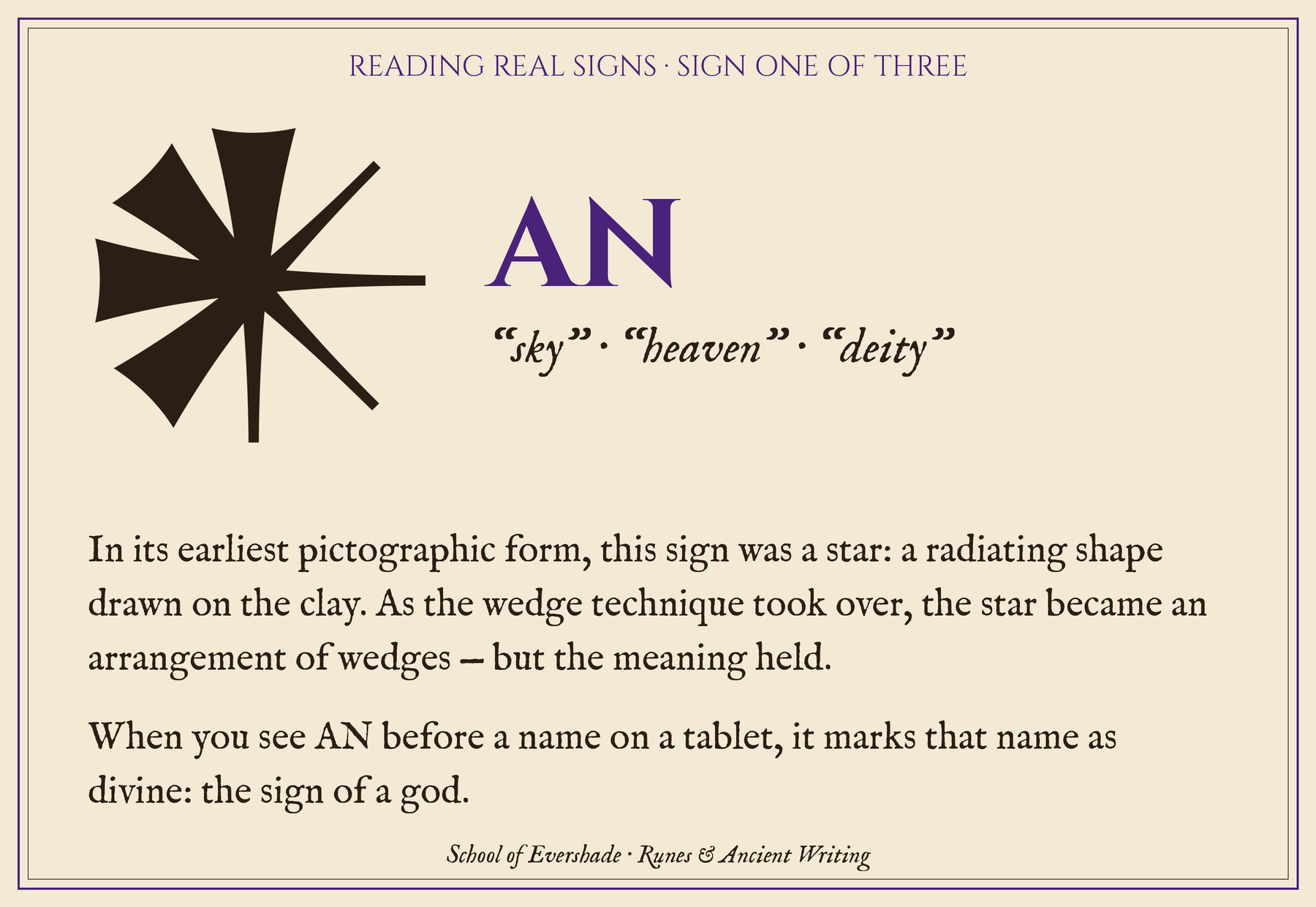
AN — “sky,” “heaven,” “deity.” First a star, drawn; then a star built of wedges.
Built for Evershade.
KI 𒆠: "earth," "land," "ground." The counterpart to AN in every sense: as AN is above, KI is below. Scribes combined KI with other signs to build compounds: KI plus a place-name gives you a city; KI plus a crop-sign gives you a field. Context tells the reader which. (A note of precision: KI alone means earth or place. The underworld is KUR, or the compound KI.GAL, "great earth," a distinction the scribes observed and so shall we.)
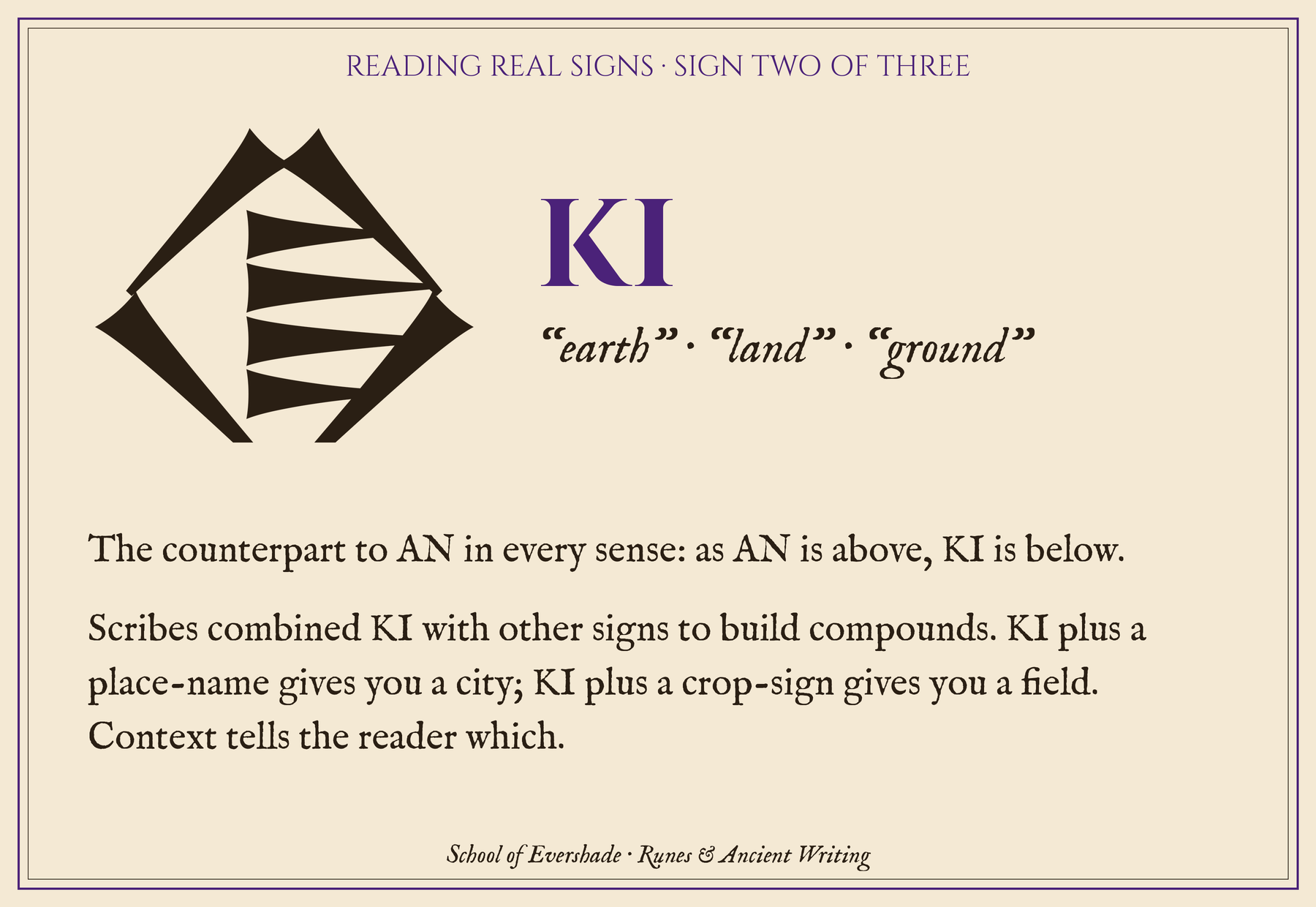
KI — “earth,” “land,” “ground.” As AN is above, KI is below.
Built for Evershade.
É 𒂍: "house," "building," "temple." The earliest form of this sign is a building seen from above: a floor plan, with walls and a doorway, drawn in clay. Few signs show the pictographic origin as clearly. When the sign for "temple" is literally a little floor plan, you are looking at writing before it forgot it was drawing.
These three signs also demonstrate something essential about how cuneiform works: the same sign can carry related meanings (sky/heaven/deity), and signs combine to make new meanings (KI + place = city).
The system is productive: a finite set of signs generating an unbounded set of expressions.
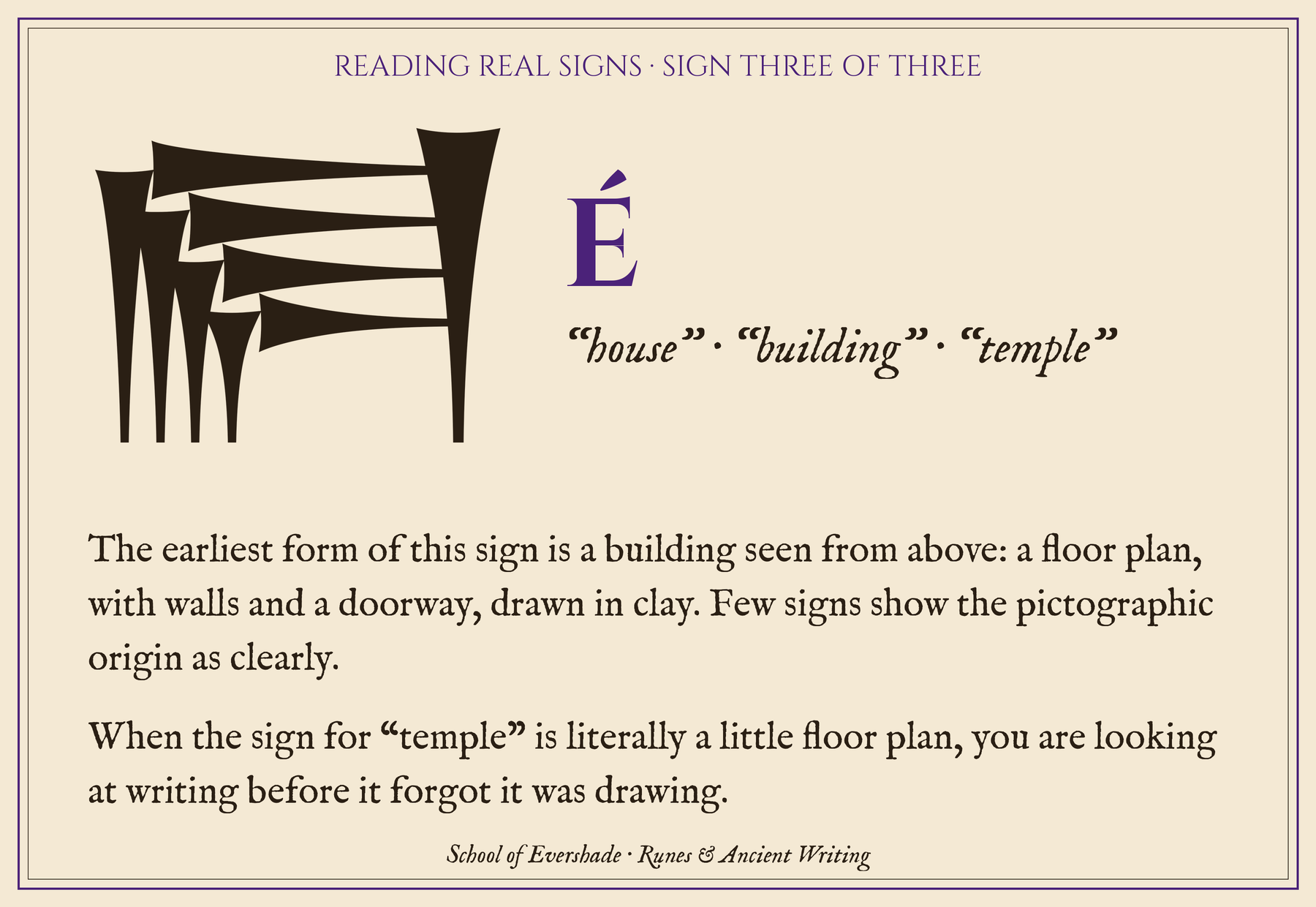
É — “house,” “building,” “temple.” A floor plan that became a sign.
Built for Evershade.
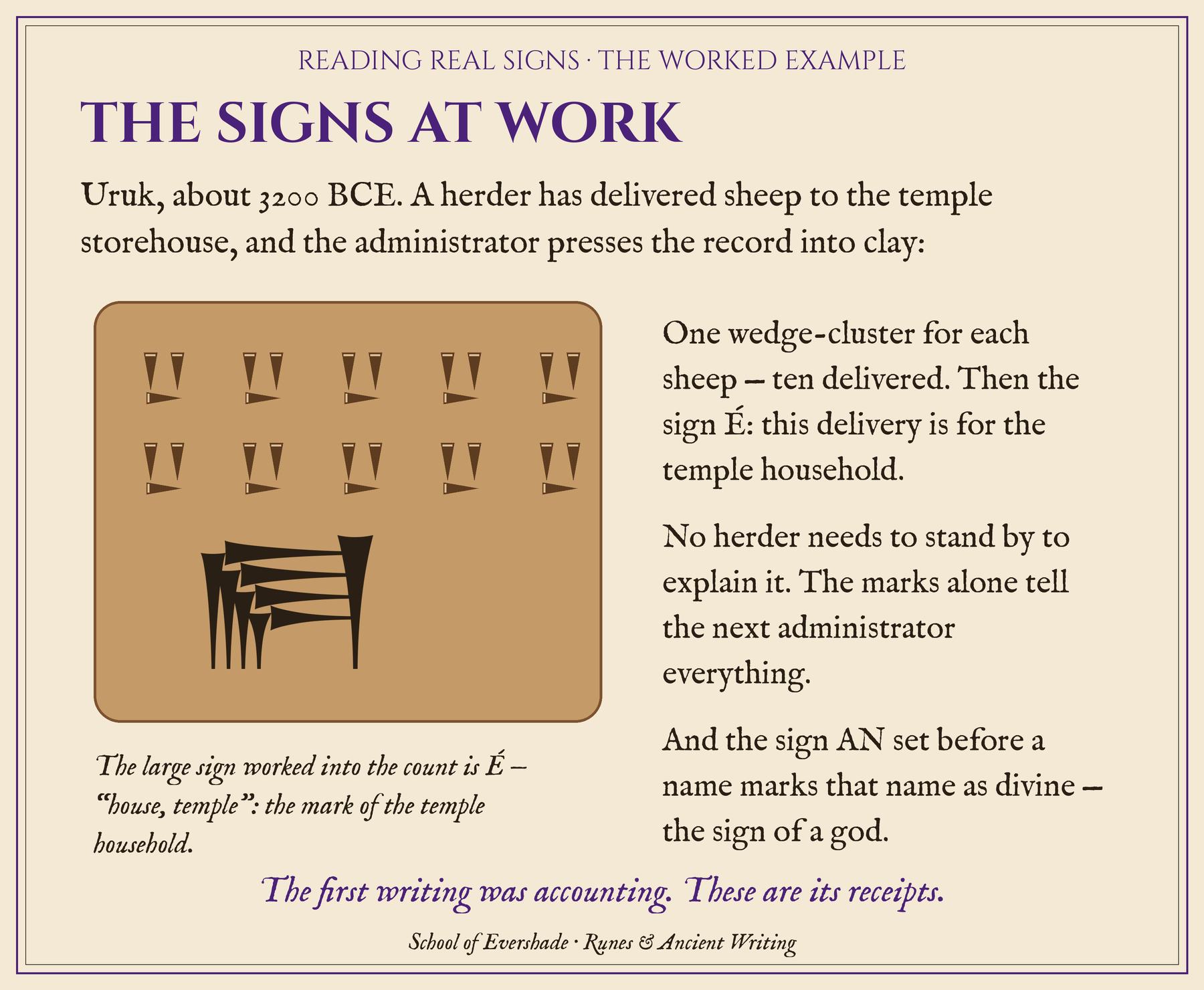
The worked example: ten sheep, one temple — a receipt pressed in clay, the same record Guided Practice will ask you to press yourself.
Built for Evershade.
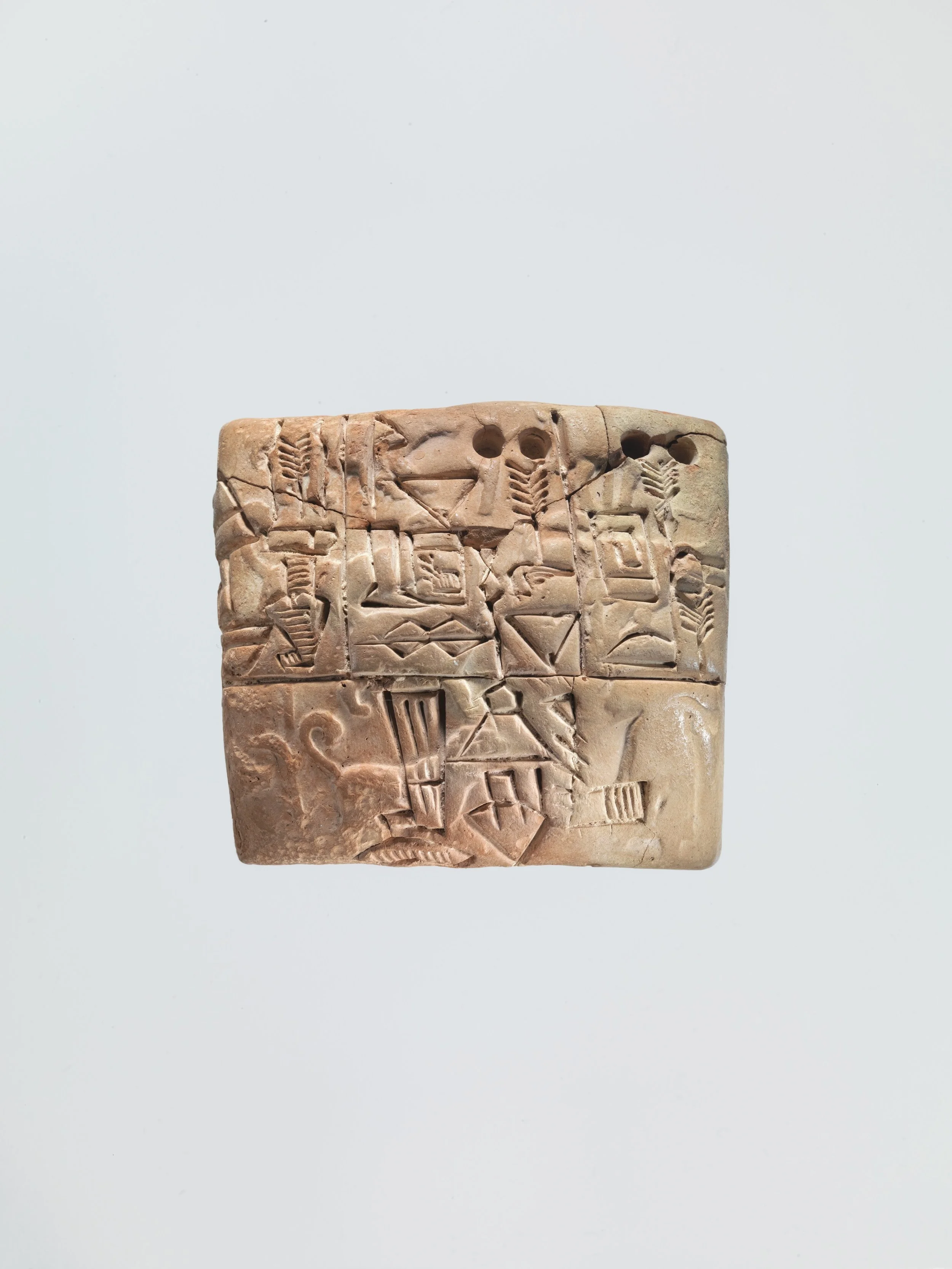
Historical example. A real proto-cuneiform tablet: an administrative account of a barley distribution, pressed and drawn some five thousand years ago. Its face is divided into boxes of signs, and a cylinder seal was rolled across it — the same world of tokens, seals, and temple accounts you have just read about. It survived. The next section explains why.
Proto-Cuneiform tablet with seal impressions: administrative account of barley distribution, Sumerian, ca. 3100–2900 BCE. The Metropolitan Museum of Art, New York (1988.433.1). Public domain, The Met Open Access.
❦ In your workbook: record the three signs AN, KI, and É in your own way — copy, sketch, or note what matters.
In your packet: Assignment II — Sign Identification Drill ⚒ begins here. Work it now, or mark the place and take it as homework — your choice.
Why the Tablets Survived
You may have wondered: if these tablets are just dried mud, why do we have hundreds of thousands of them?
The honest answer has two parts, and the first is less romantic than you might expect.
Unfired clay tablets are fragile. A dried-but-unfired tablet left in damp soil softens; one dropped on a stone floor shatters.
The Mesopotamians knew this. Unfired tablets could even be soaked in water and recycled into fresh clay for new tablets. Nothing about an ordinary tablet was built to last five millennia.
★ What saved them was catastrophe.
When Mesopotamian cities burned (in wars, in accidents, in the sackings that punctuate the region's history), the tablets stored in palaces and temples were accidentally fired in the blaze.
A building fire reaches temperatures comparable to a potter's kiln. Tablets caught in the collapse baked hard, permanently, exactly like pottery. The buildings fell; the tablets hardened.
This is why the archaeological record is lumpy. We have enormous archives from cities that burned (and whose tablets fired), and almost nothing from cities that declined quietly (whose tablets crumbled back into mud).
The surviving corpus, roughly half a million tablets and fragments, is a map of ancient disasters as much as ancient administration.
There is a lesson in this for the epigrapher. What survives is not a fair sample of what existed. Every archive we study is an accident of fire.
Remember that when a tablet tells you something confidently. It is telling you what one burned building contained.
❦ In your workbook: record why the tablets survived in your own way — copy, sketch, or note what matters.
Guided Practice — The Wedge Press
Before the assignments, train your hand. A scribe's first skill was not reading. It was making a clean impression.
Workshop Note: The clay work behind these tablets — preparing, wedging, and pressing clay — is taught in Creative Arts Lesson 19, 'Clay I: Pinch, Coil & Slab.'
First, Your Stylus — In Steps
A wedge is only as good as the end of the stylus that stamps it. Before you press anything, get that end right:
- Pick up your stylus and look at the end you will press with.
- That end must be flat and square, like the end of a ruler, not pointed like a pencil. The flat end is the stamp; its shape becomes the wedge's shape.
- If the end is pointed or round, ask an adult to trim it straight across, a little at a time, until the end is a small flat square about as wide as your thumbnail (8–10 mm).
- Hold the stylus upright, flat end down, the way you would hold a stamp.
- Press straight down into the clay, then lift straight up. Never drag: a dragged stylus draws a line, and a line is not a wedge.
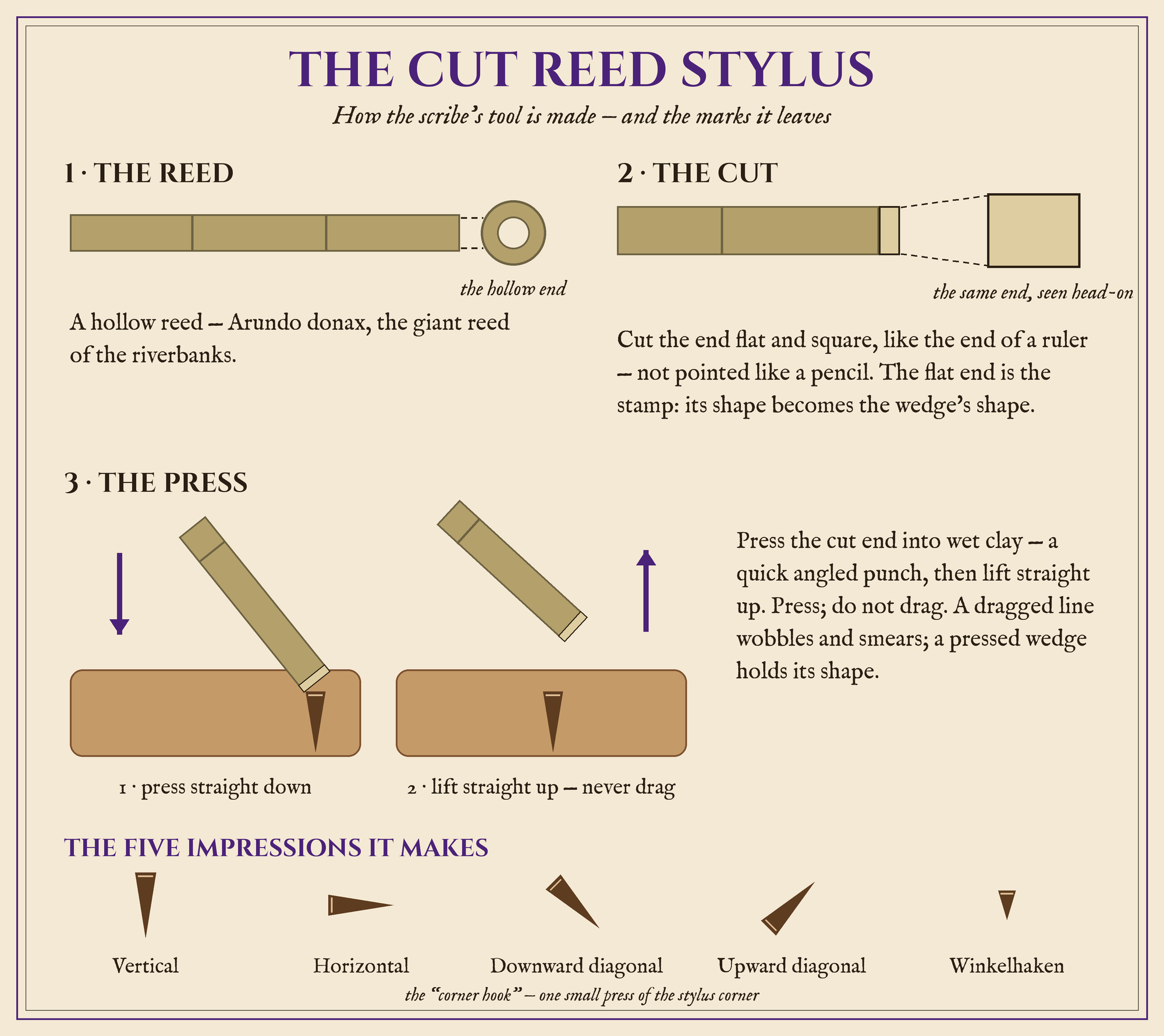
The scribe's tool, step by step: the hollow reed, the square cut, the press — and the five impressions every cuneiform sign is built from.
Built for Evershade.
Exercise A — Pressing the Five Wedges
- Prepare your clay surface (see Materials below). It should be smooth, flat, and slightly damp, not wet.
- Hold your stylus upright and press straight down. Lift cleanly. You should see a vertical wedge with a deep head tapering to a fine tail.
- Rotate the stylus ninety degrees and press again for the horizontal wedge.
- Angle the stylus for each of the two diagonals.
- For the Winkelhaken, press only the corner of the stylus: a single small punch.
- Repeat each wedge at least ten times. Compare your impressions. Which angle gives the cleanest head? Which lifts without dragging?
Do not drag the stylus. If your wedges have smeared tails, you are drawing, not pressing. Lift straight up after each impression.
❦ Workbook path: working on paper instead? Draw five rows in your workbook and fill each row with ten careful drawings of one wedge form. Give every wedge a wide, deep head and a fine tail, and label each row with the angle that makes it.
Exercise B — Reading Practice
Copy the following signs onto paper, then label each with its meaning:
- 𒀭: ?
- 𒆠: ?
- 𒂍: ?
Then answer: which of these three signs most clearly shows its pictographic origin, and why?
Exercise C — The Accounting Tablet
You are a temple administrator in Uruk, circa 3200 BCE. A herder has delivered sheep to the temple storehouse. Using your clay and stylus:
- Press one wedge-cluster per sheep delivered (agree on a number with your instructor or choose ten).
- Add the sign É to indicate the delivery is for the temple household.
- Examine your tablet. Without the herder present, could another administrator read it? What information is missing that a modern receipt would include?
Record your observations.
❦ Workbook path: draw your tablet instead: ten wedge-clusters in a neat grid, the sign É beside them, and beneath the drawing, list what a modern receipt would add that yours leaves out.
In your packet: Assignment I — The Wedge Chart ⚒ begins here. Work it now, or mark the place and take it as homework — your choice.
Assignment Manual
Assignment key: ✎ written work · ⚒ hands-on practical · ◐ both · ★ will be on the test · ❦ workbook path
Written answers in this manual are short answers in your own words — a few honest lines, not a filled page.
Assignment I — The Wedge Chart ⚒ ★
Objective: Demonstrate control of the five basic wedge forms.
Instructions:
- Prepare a fresh clay surface at least 10 cm square.
- Divide it lightly into five rows (score the divisions with your stylus; do not cut through).
- Label each row by pressing the row number as a simple wedge-count (one wedge for row one, two for row two, and so on).
- Fill each row with ten clean impressions of one wedge form: vertical, horizontal, downward diagonal, upward diagonal, Winkelhaken.
- Allow the tablet to dry completely.
Your keepsake: this dried chart is the first piece of your scribe's portfolio. Keep it. Every script this year builds on the hand you trained today.
❦ Workbook path: make the chart on a full workbook page instead: five labelled rows, ten drawn wedges in each, and the same one-paragraph description beneath it.
To submit: Photograph your tablet in raking light (light from the side; this makes the impressions visible) and submit the photo with a one-paragraph description of which wedge was hardest to make cleanly and why.
Assignment II — Sign Identification Drill ⚒ ★
Objective: Recognize the three lesson signs and explain their meanings.
Part A. Match each sign to its meaning. (Answers at the end of this packet.)
| Sign | Meaning |
|---|---|
| 𒀭 | a. earth, land, ground |
| 𒆠 | b. house, building, temple |
| 𒂍 | c. sky, heaven, deity |
Part B. For each sign, write two sentences: one explaining what the sign means, and one explaining what its earliest pictographic form depicted.
Part C. The sign KI appears in compounds meaning "city" and "field." Using what you learned about logograms, explain in three to four sentences how a single sign can carry multiple related meanings, and why context, not the sign alone, determines the reading.
Assignment III — The Bulla Reconstruction ◐ ★
Objective: Understand the token-to-tablet transition by recreating it.
Instructions:
- Form six small clay tokens: three cones (grain measures) and three spheres (jars of oil).
- Enclose them in a clay bulla (a hollow ball; form it around the tokens and seal it).
- Before the bulla dries, press each token's shape into its outer surface.
- Once dry, break open the bulla and compare the tokens inside with the impressions outside.
- Now flatten a fresh piece of clay into a tablet and press the same six token-shapes directly into its surface, no tokens enclosed.
❦ Workbook path: draw the whole sequence on one workbook page: your six tokens, the sealed bulla with its impressions, the opened bulla, and the flattened tablet. Label what changed at each step, then write the response below from your drawings.
Written response (one page): At which step did the tokens become unnecessary? What information, if any, was lost when the three-dimensional tokens were replaced by two-dimensional impressions? What was gained?
Assignment IV — Tablet Rotation Investigation ✎
Objective: Observe why writing direction standardized over time.
Instructions:
- Research (using the References below): in the earliest tablets, signs were arranged in vertical columns and read top-to-bottom. By approximately 2800 BCE, tablets had rotated ninety degrees and were read left-to-right in horizontal lines.
- Press a short sequence of wedges into clay in a vertical column. Then rotate your tablet ninety degrees and press the same sequence horizontally.
- Write a half-page response: which orientation felt more natural for your hand? Why might scribes have settled on the rotated orientation as the sign repertoire grew more complex?
Materials
Required (Level One — household items)
- Air-dry clay or modeling dough: one palm-sized lump per exercise. Air-dry clay holds impressions better; modeling dough works and is reusable.
- A stylus: a chopstick, the blunt end of a pencil, or a dowel rod approximately 8–10 mm in diameter. For wedge practice, the end should be cut flat and square, not pointed.
- A flat work surface: a cutting board, tile, or baking sheet.
- A rolling pin or smooth bottle: to flatten the clay evenly.
- Paper and pencil: for the reading exercises and written responses.
- A lamp or directional light: for photographing tablets in raking light.
Suggested (Level Two — historically closer materials)
- Natural earthenware clay: closer to Mesopotamian river clay in texture and behavior.
- A cut reed stylus: Arundo donax (giant reed) or bamboo, cut to produce a rectangular cross-section at the writing end. This is the historically accurate implement; the square-cut end is what produces true wedge shapes rather than round dots.
- A canvas cloth: to keep the clay at working dampness between exercises.
Neither level requires
Purchased kits, specialty tools, or any material you cannot find locally or order inexpensively. The core lesson (pressing wedges, reading signs, understanding the system) is fully achievable with modeling dough and a chopstick.
Reflection Questions
Answer the following in your workbook.
- Why was writing invented for accounting rather than literature? What does this tell us about the relationship between cities and writing?
- Explain the proposed connection between tokens, bullae, and the first tablets. Why do scholars hedge this theory, and what is the responsible way to present it?
- What is the technical difference between drawing a sign and pressing a wedge? Why did pressing replace drawing?
- Why is cuneiform not an alphabet? What two types of signs does it combine?
- How did the accidental firing of tablets shape the archaeological record? What does this mean for how we interpret surviving archives?
- Choose one of the three lesson signs (AN, KI, É). Trace its path from pictograph to wedge-cluster in three to four sentences.
- The lesson asks: "what can we leave out and still be understood?" Apply this question to the token-to-tablet transition.
Workbook Checklist — Lesson 1
In my workbook I have:
- ☐ explained why writing began with accounting, not literature
- ☐ described the token-and-bulla system, and how it may have led to the first tablets
- ☐ pressed the five wedge forms (vertical, horizontal, downward diagonal, upward diagonal, Winkelhaken)
- ☐ explained the difference between drawing a sign and pressing a wedge, and why pressing won
- ☐ recorded the signs AN, KI, and É with their meanings and their earliest pictures
- ☐ explained why so many tablets survived, and why the survivors are not a fair sample
☐ Lesson completed Date: ____________ Signature: ____________
Professor's Review
And so our first lesson closes where writing begins: with a wedge pressed into clay.
You can now explain why accountants invented writing, how five pressed shapes built a script that lasted three thousand years, why cuneiform is not an alphabet, and why the tablets we study are survivors of ancient fires.
Keep your wedge chart. You will need the muscle memory, and more importantly, you will need the idea. Every system we study this year is a variation on what you did today: someone found a faster, simpler way to leave a mark that another person could read.
Next, we cross the desert to Egypt, where the signs refused to become wedges, where scribes drew birds and snakes and water for three and a half millennia, and where a different answer to the same question produced the most beautiful writing system ever devised.
I have seen beautiful things in my years among the inscriptions, scholars. Egypt is among the most beautiful. Practice your wedges, and come ready to look closely.
PROFESSOR THISTLELOOM WEBBLETHORN
Runes & Ancient Writing
Epigrapher, Head of House Septentrio
Cross-Class Connections
The clay-working skills introduced in this lesson connect directly with Creative Arts, which will return to hand-building techniques and material preparation.
The relationship between writing surface, tool, and hand studied here parallels Scrollwork Unit I Lesson 1 (/sw-u1-l1), where Professor Nocturne examines the scribe's desk as a working system. The Mesopotamian scribe's tablet and the medieval scribe's parchment are answers to the same question (what does this material demand of the hand?), separated by four thousand years.
Students studying both classes should compare the two lessons directly.
The token-and-bulla accounting system will reappear in Runes Unit II, when we examine how Phoenician merchants adapted writing to the needs of trade, the same need that created it.
In Other Classrooms
Scrollwork · Unit I, Lesson 1 — The Scriptorium Desk
Before the wedge, the desk. In the Scrollwork Library we begin where every scribe begins: the workspace itself, its angle, its light, its tools laid in their order. Come and arrange a scribe's desk the way history arranged it, and you will feel why Professor Webblethorn's clay-workers and my parchment-workers are answering the same question with the same hands.
Creative Arts · Unit V, Lesson 19 — Clay I: Pinch, Coil & Slab

Clay remembers every hand that touches it, scholars, and it forgives most of them. In the Workshop we prepare clay properly: wedged, pressed, and built by pinch, coil, and slab. Come and learn the material under your fingers before you press a single wedge into it, and your tablets will thank you for the patience.
The wedge is only our beginning.
References & Further Reading
Encyclopaedia Britannica. "Cuneiform." General reference on the development, structure, and decipherment of cuneiform writing. https://www.britannica.com/topic/cuneiform
Wikipedia. "Cuneiform." Detailed overview including the proto-cuneiform stages, the drawn-to-pressed transition, and the sign repertoire. https://en.wikipedia.org/wiki/Cuneiform
Wikipedia. "Proto-cuneiform." The earliest tablets (Uruk IV, c. 3300 BCE), the token-to-tablet sequence, and the scholarly debate around Schmandt-Besserat's reconstruction. https://en.wikipedia.org/wiki/Proto-cuneiform
Wikipedia. "Clay tablet." Tablet manufacture, the sun-drying versus firing distinction, and the role of accidental firing in preservation. https://en.wikipedia.org/wiki/Clay_tablet
The Metropolitan Museum of Art. Heilbrunn Timeline of Art History — "Writing." Museum essays on the origins of writing, with collection objects including tokens, bullae, and early tablets. https://www.metmuseum.org/toah/hd/wrtg/hd_wrtg.htm
The British Museum. Collection online. Searchable collection including proto-cuneiform tablets from Uruk and cuneiform tablets from across Mesopotamian history. An essential destination for seeing real tablets. https://www.britishmuseum.org/collection
CDLI: Cuneiform Digital Library Initiative (Oxford). The scholarly database of cuneiform texts: photographs and transliterations of hundreds of thousands of tablets. For the deeply curious. https://cdli.ox.ac.uk
Schmandt-Besserat, Denise. Before Writing, Volume I: From Counting to Cuneiform. University of Texas Press, 1992. The full presentation of the token-to-writing theory. Read critically, and note where later scholars have pushed back.
Browse the Runes shelf in the school Library for readable editions of these works.
Submit your work for this lesson using the form below.
CONTINUE IN RUNES & ANCIENT WRITING
Next · Lesson 2: Egyptian Hieroglyphs: Eight Pictures That Spell Sounds →
Unit I · The First Foundations Runes & Ancient Writing Classroom · All 21 Lessons
The rest of Unit I: Lesson 2 · Egyptian Hieroglyphs · Lesson 3 · Old Persian Cuneiform
From the Runes Shelf
The printed companions to this lesson, from Professor Webblethorn’s shelf in the shop.