SCROLLWORK
Unit I · Lesson 1THE SCRIPTORIUM DESK
Professor Quillberry Nocturne
Master Scribe & Illuminator
The Scrollwork Library • School of Evershade
Professor's Introduction
Come in, scholars, and welcome to the Scrollwork Library. I am Professor Quillberry Nocturne, and I will be your guide through the history of the written page.
Before you lift a quill — a pen cut from a large feather — in this library, you must learn where the scribe sits.
It seems a humble beginning: a desk, a lamp, a sheet of paper. But every manuscript began with a worker deciding how to arrange the small kingdom of the writing desk. The angle of a board, the position of the page, the placement of tools and the direction of the light all affected the work produced there.
For a scribe copying a manuscript by hand, these were practical decisions. A poorly arranged workspace could strain the body, cast shadows across the page, interrupt the rhythm of writing, or make already difficult work even harder.
The writing desk therefore became part of the craft itself.
In this lesson, we will examine the historical scribe's workspace and the relationship between the desk, page, tools, light, and hand.
Then you will prepare a scriptorium desk of your own — the scriptorium being the room or area, in a monastery or another institution, where manuscripts were copied, produced, or preserved.

A Note from the Headmaster
Welcome to the Scrollwork Library — I'm Squirty, and I keep an eye on how scholars pass the slow hours. In the cloisters of the same monastic world as the desk before you, monks and schoolboys carved nine men's morris boards straight into the stone benches — Gloucester, Canterbury, and Norwich still have them — needing nothing but pebbles and a scratched diagram. Ours is rather more comfortable, and it is set up in the Games Room.
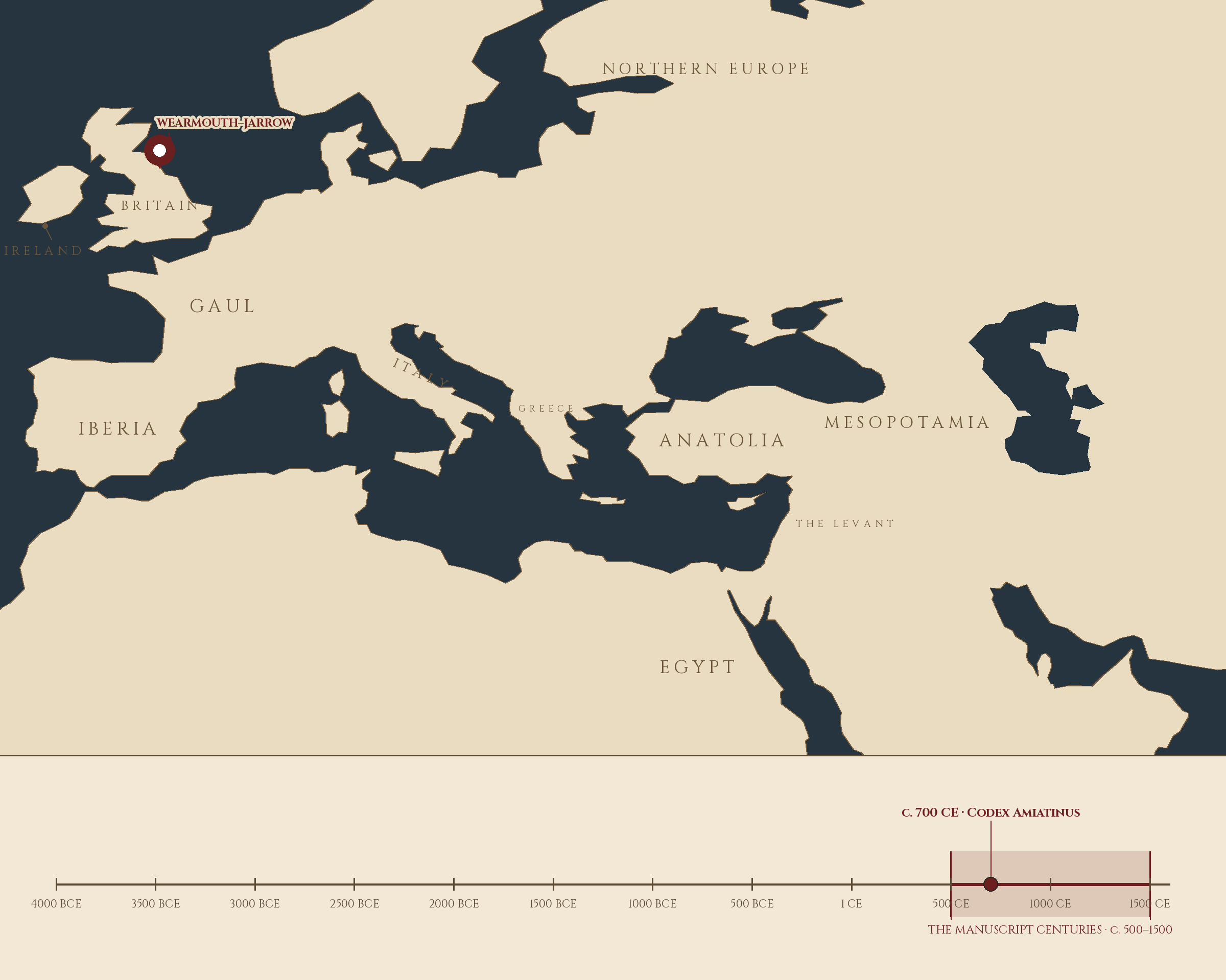
Where and when: Wearmouth–Jarrow, c. 700 CE — Codex Amiatinus. The pin is this lesson. The line beneath the map is our road: every stop a place where writing changed, every lesson a pin.
Lesson Objectives
By the end of this lesson, students should be able to:
- Explain why sloped writing desks became common during the medieval manuscript period.
- Identify the major components of a historical writing workspace.
- Describe how desk angle affects posture and page visibility.
- Analyze the relationship between lighting and the writing surface.
- Construct a manuscript margin grid.
- Organize a functional manuscript workstation.
Reading this lesson: ★ marks the passages to remember. They return on the unit quiz and the class test. Check in questions ask the material back as you go; answer them in your workbook when you meet them.
Working this lesson: Your assignment packet is the first download on this page. Work in it as the lesson moves along, answering each assignment as its subject is taught — or read the lesson through for your notes and take the assignments as homework afterward. Both are proper ways to sit this class. Signposts in the reading tell you where each assignment belongs. Written answers are short answers in your own words; a few honest lines are worth more than a filled page.
Your Assignment Packet
This lesson's assignments live in its packet: the Lexicon Handout (every term, course terms marked ◆), Materials, Guided Practice, the Assignment Manual with its answer key for self-checking, the Reflection Questions, and the Workbook Checklist. Download the packet before you begin and keep it beside you as you read.
The Development of the Writing Workspace
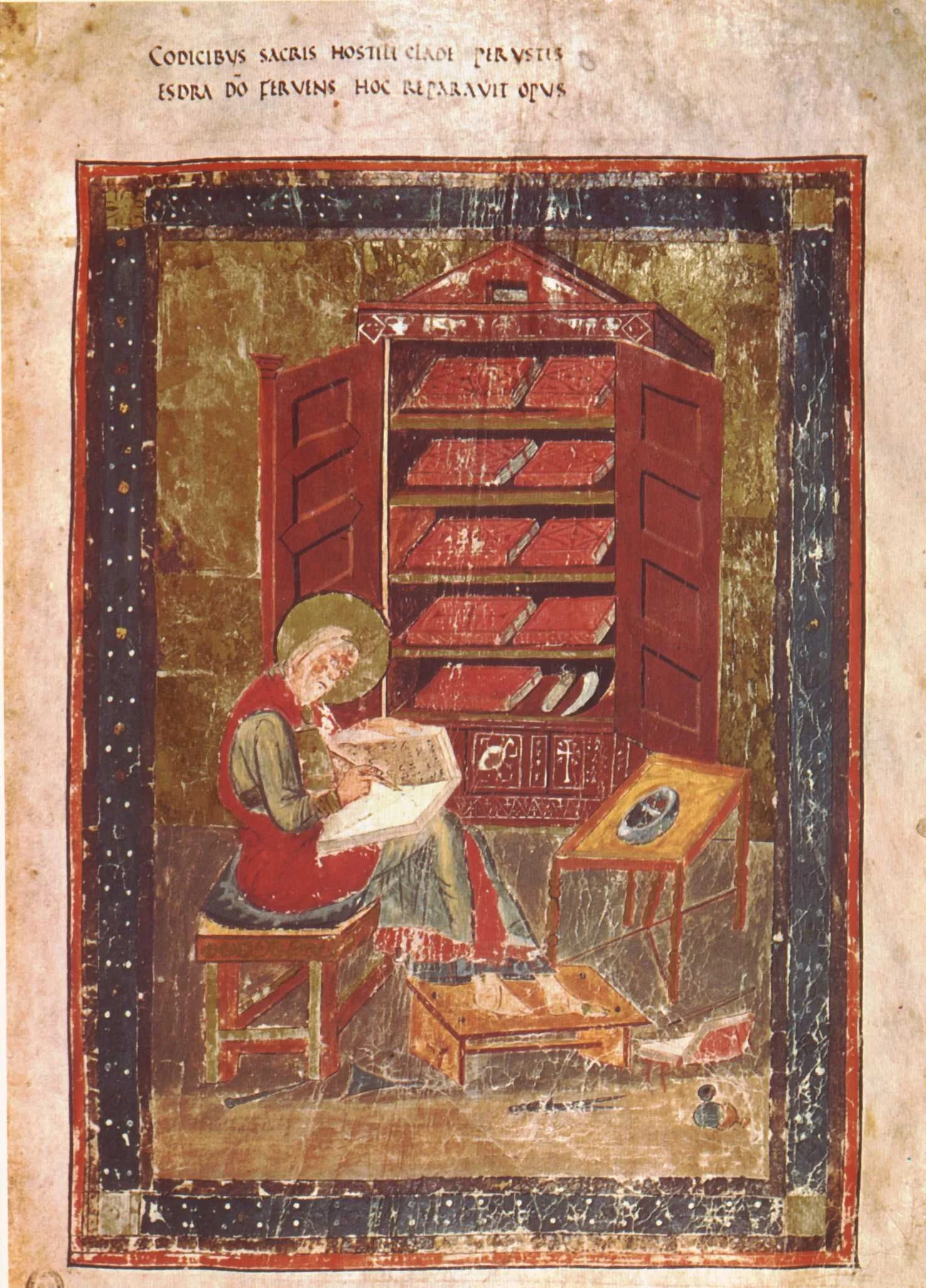
One of the earliest pictures of a scribe at work: Ezra writes on a sloped board, his finished books shelved in the cupboard behind him.
Ezra the scribe, from the Codex Amiatinus (early 8th century), Biblioteca Medicea Laurenziana, Florence. Public domain.
The history of writing is also a history of the surfaces, tools, and spaces people created in order to write.
Ancient scribes did not work in a single universal manner. Their writing environments depended upon the materials they used, the kind of document they were producing, and the traditions of their own place and period.
★ Mesopotamian scribes impressed wedge-shaped marks into clay using a stylus. Egyptian scribes worked with papyrus, a writing material made from strips of the papyrus plant's pith, reed pens cut from hollow reed stems, and palettes that commonly held black and red pigments. In the Greek and Roman worlds, writing might take place on materials including papyrus, wax tablets, and parchment.
As materials changed, writing practices changed with them.
During the late ancient and medieval periods, parchment became increasingly important for manuscript production in Europe. Unlike papyrus, parchment was made from prepared animal skin; its finest grade, vellum, was traditionally calfskin. It was durable, could be written on both sides, and, when properly prepared and preserved, could survive for centuries.
The codex, with pages gathered together in the form of a book, also became increasingly important.
Producing such books was demanding work.
A manuscript page might need to be prepared, ruled, copied, corrected, decorated, illuminated, bound, and preserved. Each stage required its own tools and considerable control.
The writing workspace therefore developed around the needs of the manuscript maker.
❦ In your workbook: record how the writing workspace developed in your own way — copy, sketch, or note what matters.
The Sloped Writing Desk
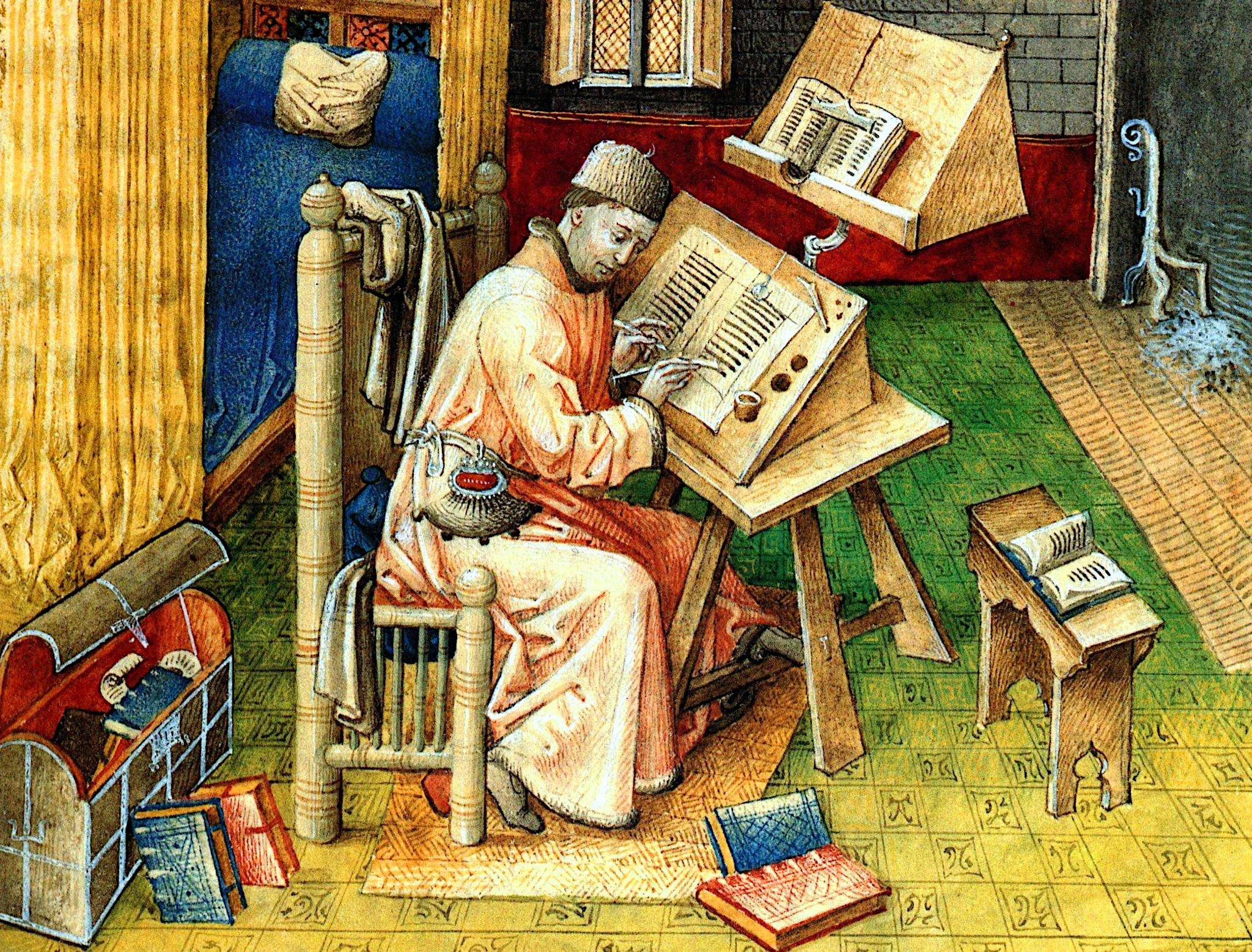
Jean Miélot, a 15th-century copyist, works at a sloped desk, copying from the open book beside him.
Jean Miélot at his desk, miniature from Royal Library of Belgium MS 9278, fol. 10r (15th century). Public domain.
Images and surviving descriptions of medieval manuscript work show scribes using angled writing surfaces.
★ A sloped desk brought the page upward toward the writer's natural field of vision. Instead of bending continually over a flat table, the scribe could work with the manuscript positioned at an angle.
This could make the page easier to see and reduce the amount of forward bending required during long periods of writing.
The angle also helped establish a stable relationship between the writer, writing instrument, and page.
Check in: In your own words, why is a sloped desk kinder to a scribe than a flat table? Name one thing the angle does for the eyes, and one thing it does for the body.
When using a dip pen or quill, the writer must repeatedly control the amount of ink carried to the page. Unlike a modern pen with an internal reservoir, a historical writing instrument required frequent dipping and careful attention to the condition of the nib and ink. The ink itself travels through the nib's narrow slit by capillary action, the movement of liquid through narrow spaces.
The writing surface was therefore not simply a place to put the manuscript.
It was part of the working system.
❦ In your workbook: record the sloped desk and what its angle changes in your own way — copy, sketch, or note what matters.
In your packet: Exercise I — Ergonomic Desk Positioning ⚒ begins here. Work it now, or mark the place and take it as homework — your choice.
The Scribe's Desk
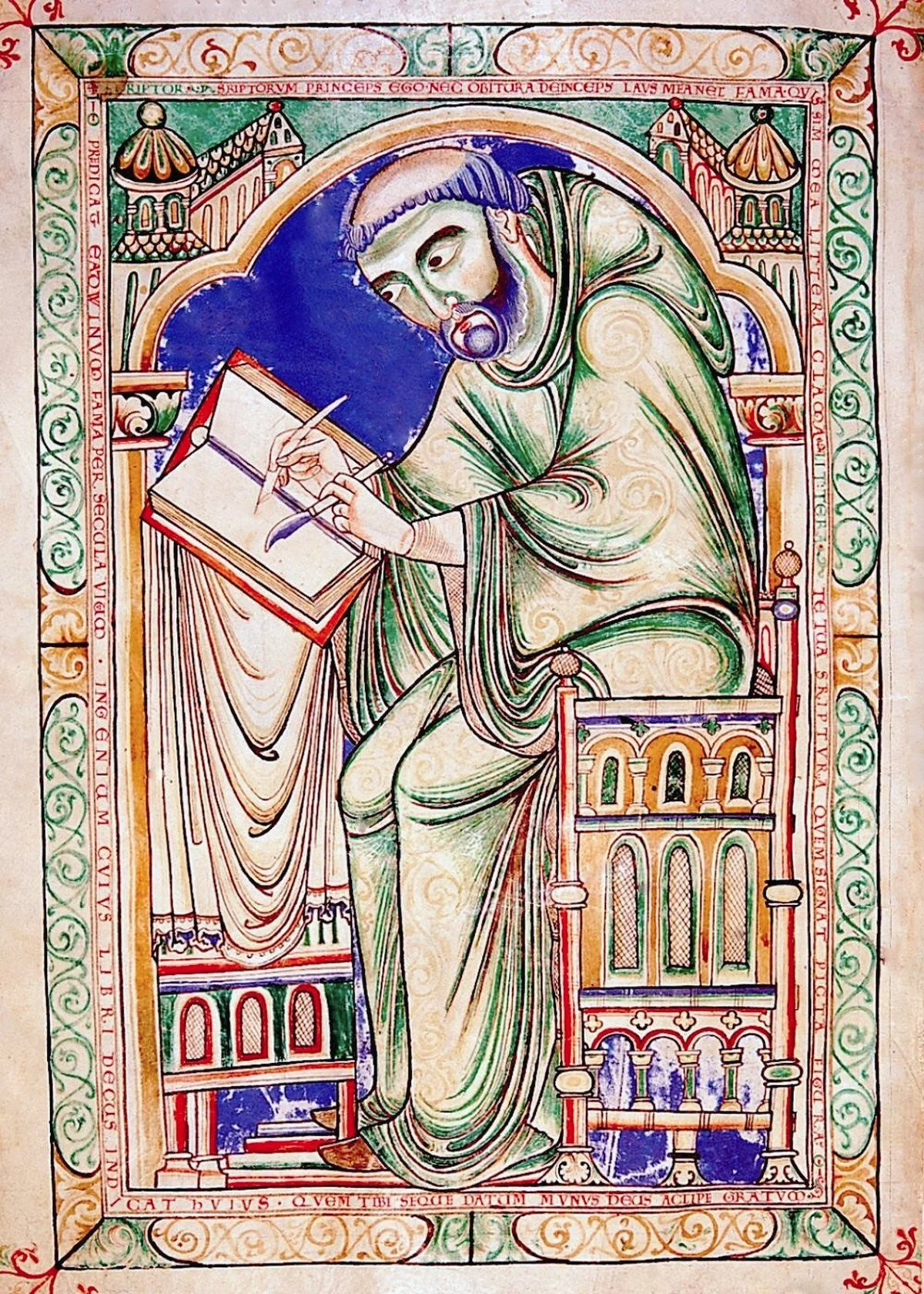
Eadwine of Canterbury holds a pen in one hand and a penknife in the other: the scribe's two essential tools.
Eadwine the scribe, from the Eadwine Psalter (Canterbury, c. 1160s), Trinity College, Cambridge. Public domain.
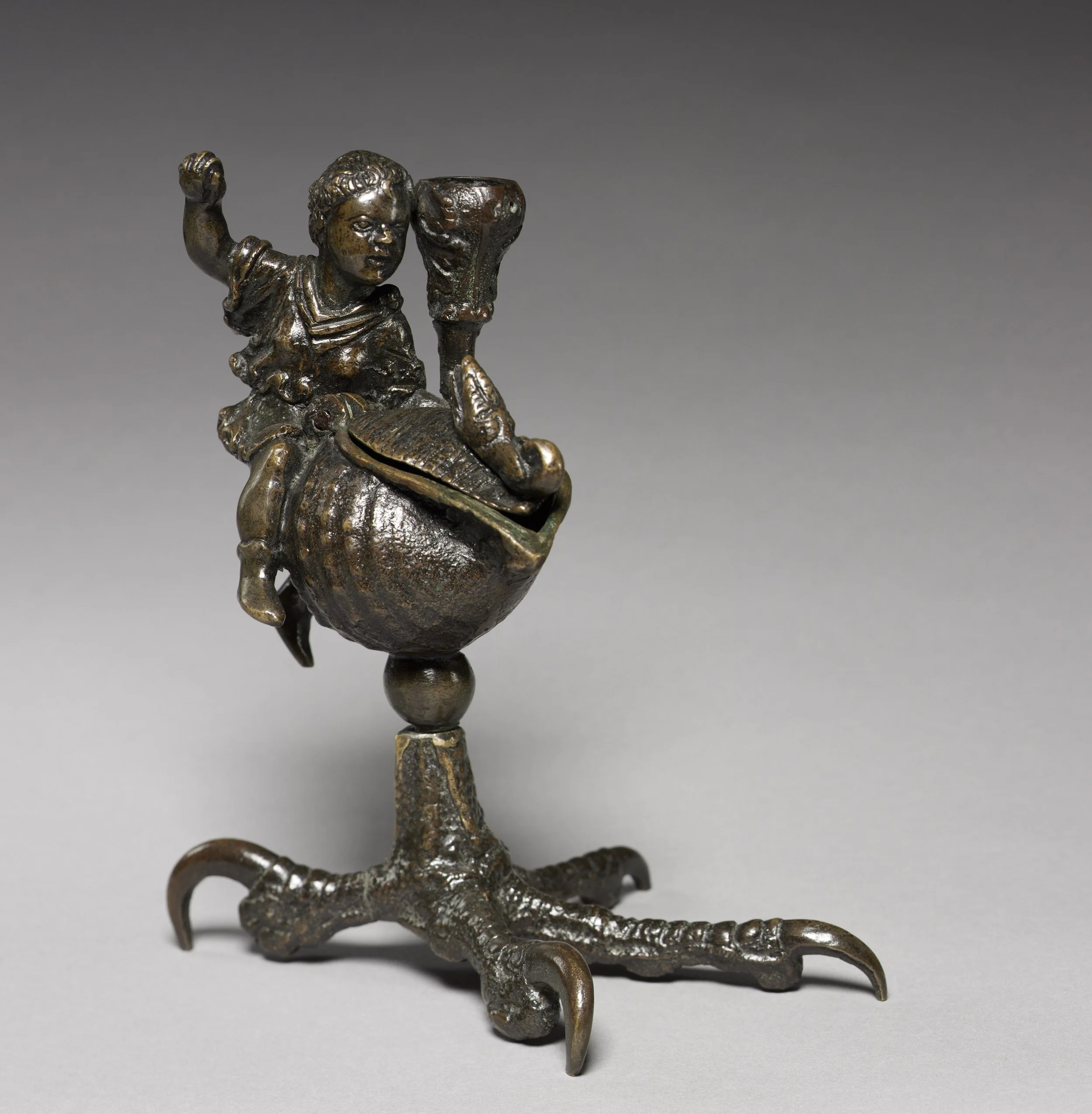
A real desk inkwell that survives: cast bronze, made in Italy around 1510–1520, with a socket beside it for a candle.
Bronze inkwell and candlestick by Severo da Ravenna (Italian, c. 1510–1520), The Cleveland Museum of Art, 1954.798. CC0.
A working manuscript desk might contain a collection of specialized tools.
Depending upon the place, period, and task, these could include writing instruments, ink, knives, straightedges, pigments, prepared parchment, and other materials required for manuscript production.
Fresh ink needed drying, too: blotting sand, a fine absorbent material scattered over the wet line, helped the ink set and reduced smudging.
A knife was particularly useful.
★ It could help prepare or sharpen a writing instrument, but it could also be used during manuscript correction. On parchment, some mistakes could be carefully scraped from the surface and the area prepared for writing again.
Rulers and straightedges helped establish the structure of the page.
Ink needed to remain within reach without being placed where it could easily spill across valuable material.
Writing instruments needed to be accessible.
Prepared sheets needed to remain clean.
The arrangement of the desk therefore affected the rhythm of the work.
For a scribe working through a long text, organization was not merely a matter of tidiness. It was part of efficient manuscript production.
A well-arranged desk allowed the worker to concentrate on the page.
❦ In your workbook: record the scribe's desk and the order of its tools in your own way — copy, sketch, or note what matters.
The Architecture of the Page
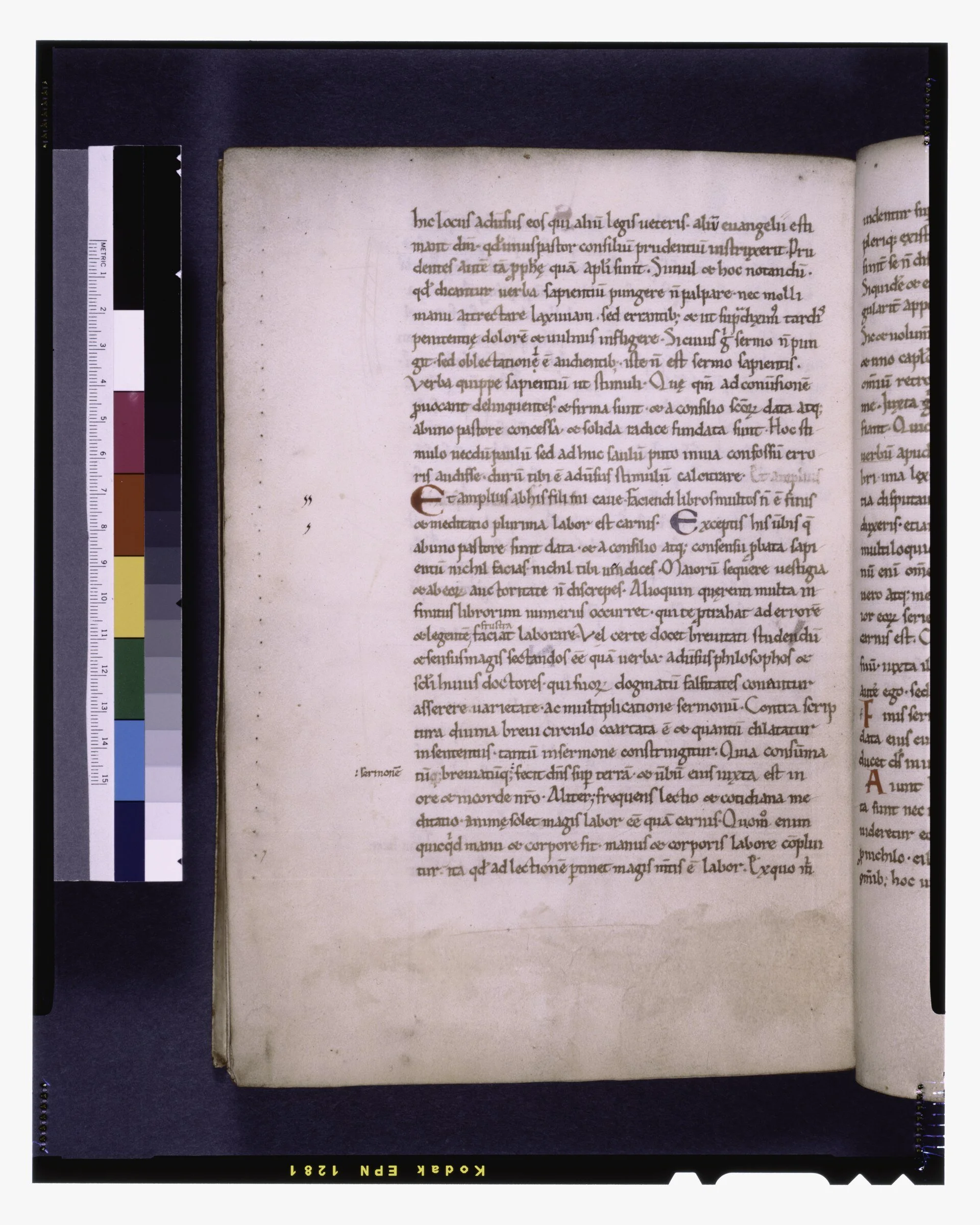
A real medieval page. The scribe planned this layout before writing a word: find the row of prick holes that marked out the lines.
A 12th-century manuscript page with prickings visible. Scan by the New York Public Library. Public domain.
Before a manuscript could be filled with writing, the page itself often needed structure.
★ Medieval manuscript pages frequently show evidence of ruling. Scribes and manuscript makers established margins — the blank space surrounding the written area — and writing lines before the main text was copied.
These boundaries determined where the text would sit.
They also left room for other elements of the manuscript, including decoration, initials, annotations, or later additions.
Margins therefore were not simply unused paper or parchment.
They were part of the architecture of the page.
★ Earlier writing traditions could present very different challenges. Some ancient Greek and Latin texts, for example, were written using scriptura continua, with little or no regular separation between individual words.
Consider what that means for the reader.
THISISMUCHMOREDIFFICULTTOREADTHANTHISIS
Check in: Why does writing without spaces between words lean so heavily on the reader's knowledge of the language?
Without the visual guidance provided by modern spacing and punctuation, the organization of lines and the reader's knowledge of the language became especially important.
The physical arrangement of writing has always influenced the way a text is read.
❦ In your workbook: record the architecture of the page: ruling, margins, and the work the empty space does in your own way — copy, sketch, or note what matters.
In your packet: Exercise III — Constructing the Margin Grid ⚒ begins here. Work it now, or mark the place and take it as homework — your choice.
Lighting & Page Visibility
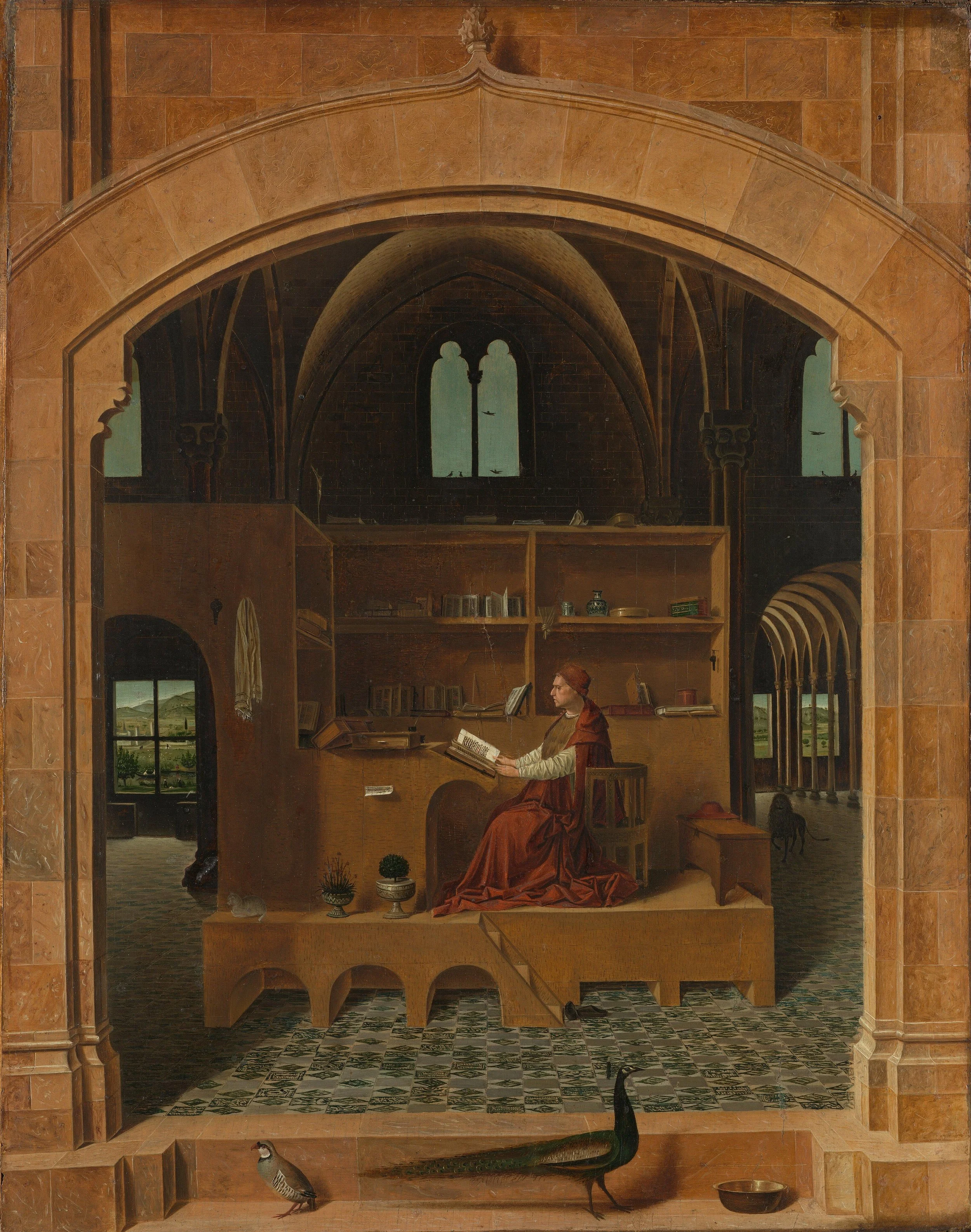
A scholar's study painted around 1475: the desk is raised toward the light, with bookshelves, a lectern, and daylight from tall windows.
Antonello da Messina, Saint Jerome in His Study (c. 1475), The National Gallery, London. Public domain.
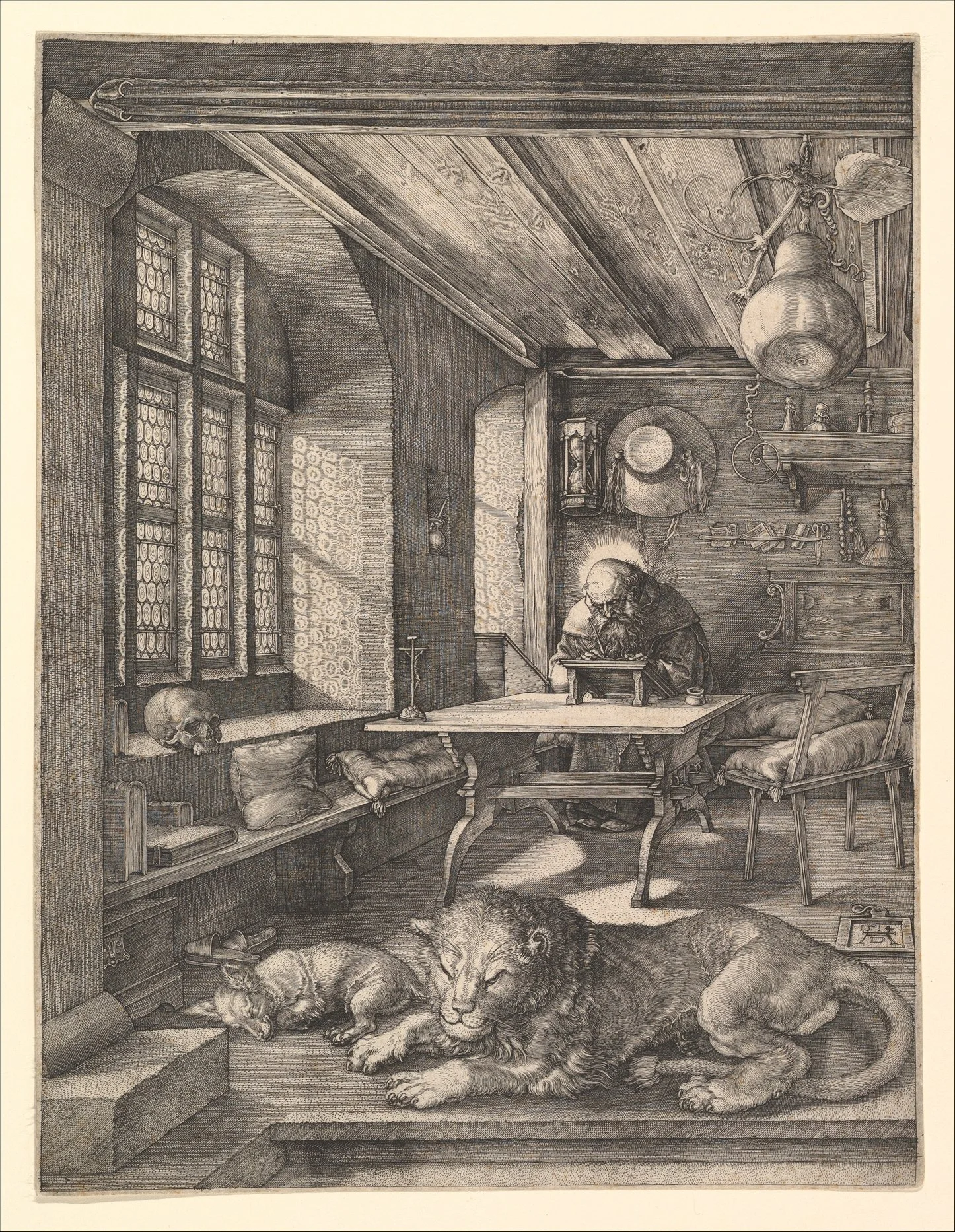
Dürer shows why desk placement mattered: sunlight through the window panes falls in bright patterns across the room while Jerome writes at his desk.
Albrecht Dürer, Saint Jerome in His Study (1514), engraving. The Metropolitan Museum of Art, New York (Fletcher Fund, 1919). Public domain.
Manuscript work required the writer to see small details clearly.
For that reason, daylight was particularly valuable.
Historical scriptoria varied considerably, and we should not imagine every medieval scribe working in an identical room. Surviving descriptions and reconstructions nevertheless show the importance placed upon positioning writing areas where useful natural light was available.
Artificial illumination could also be used, but flame introduced practical problems of its own.
A poorly positioned light source casts the writer's hand across the active line. Glare can obscure the surface. Uneven illumination can make faint ruling or small marks difficult to distinguish.
Check in: The lamp is bright, yet the active line is still hard to see. What besides brightness could be wrong?
Light can also reveal features of the writing material itself.
★ When light strikes a surface from an angle, irregularities become easier to see. On parchment these might include differences in texture, natural markings, or areas where the skin behaves differently beneath the pen.
The position of the page matters as well.
Tilting a writing surface changes the angle at which light reaches the page and the angle from which the writer views it.
Desk angle, posture, light, and page visibility therefore work together.
The manuscript maker must arrange them before the writing begins.
❦ In your workbook: record how light falls on the page: shadow, glare, and angle in your own way — copy, sketch, or note what matters.
In your packet: Exercise II — Lighting & Shadow Mapping ⚒ begins here. Work it now, or mark the place and take it as homework — your choice.
Professor Nocturne
Pause a moment, scholars, and consider what you have learned.
The desk is not merely furniture.
The light is not decoration.
The empty margin is not wasted parchment.
Each is part of the work.
A skilled scribe learns to prepare the conditions of writing before attempting to master the writing itself.
Everything from this point forward is practice.
You will calibrate your desk, map your light, and rule your first margin grid.
Do not hurry this work. The scribes whose manuscripts survive in our libraries worked with materials that required considerable time and labor to prepare. A careless mistake could mean scraping parchment, rewriting a line, or repairing a damaged page.
Your paper may be considerably more forgiving.
The discipline remains useful.
Guided Observation — Examining the Workspace
Before beginning the practical exercises, examine your workspace as a scribe might inspect an unfamiliar desk before trusting it with a commission.
Study:
- the angle of your writing surface
- the visibility of the page
- the direction of the light
- the placement of shadows
- the texture of the paper
- the presence of glare
- your posture while seated
- the position of your writing hand
- the location of your tools
Then consider the following questions:
- Does tilting the page improve visibility?
- Where do shadows fall across the paper?
- Which lighting position creates the clearest writing surface?
- How might poor lighting affect manuscript accuracy?
- Why would organized tool placement matter during a long copying session?
- How might a page become difficult to read if its written area were poorly organized?
Record your observations in your workbook.
Workspace Calibration
Prepare your writing station before beginning the lesson exercises.
1. Position the Writing Surface
Place your writing board or other firm surface securely on a stable table.
If your surface can be tilted, experiment with its angle until the page sits comfortably within your field of vision.
You do not need a historical writing desk to complete this exercise. A secure modern writing surface is sufficient.
2. Arrange the Lighting
Position a lamp or other directional light so that your writing hand does not cast a heavy shadow over the area where you are working.
Natural daylight may also be used.
If you choose to use a candle for atmosphere, it should remain safely away from paper, fabric, ink, and other materials. A modern electric candle can provide the appearance of candlelight without an open flame.
3. Prepare the Paper
Place your sheet of paper on the writing surface.
Secure it if necessary so that it does not move while you work.
4. Organize the Workspace
Arrange your ruler, pencil, writing instruments, ink, and other materials within comfortable reach.
Avoid placing tools where you must continually reach across the active page.
Your desk is now ready.
Materials
Required (Level One — household items)
- A writing board or other firm surface: placed securely on a stable table. You do not need a historical writing desk; a secure modern writing surface is sufficient.
- A lamp or other directional light: positioned so that your writing hand does not cast a heavy shadow over the area where you are working. Natural daylight may also be used. A candle, or a modern electric candle for the appearance of candlelight without an open flame, may be used for atmosphere, kept safely away from paper, fabric, and ink.
- Your workbook: for observations, check-ins, and written answers throughout the lesson.
- Paper: one sheet for the margin grid, and more for notes and written responses.
- A ruler or straightedge: for the margin grid and for establishing the structure of the page.
- A pencil: for marking measurements lightly and for written work.
- Writing instruments and ink: arranged within comfortable reach for the workspace calibration.
Reflection Questions
Answer the following questions in your workbook.
- Why did manuscript workspaces become increasingly specialized?
- How can a sloped writing surface affect visibility and posture?
- Why does the position of a light source matter during manuscript work?
- How do margins improve readability and page organization?
- Why can writing without regular spaces between words be difficult for a reader?
- Which adjustment to your own workspace made the greatest difference?
- What does the organization of a historical scribe's desk tell us about manuscript production as a skilled craft?
Professor's Review
And so our first lesson ends where manuscript work begins: at a prepared desk.
You can now explain why scribes used specialized writing surfaces, how the position of a page affects the writer, why light must be considered before the first mark is made, and why a margin is not simply empty space.
It is architecture.
Keep what you have learned from your workstation exercises.
You will return to these principles throughout your studies in Scrollwork. Ink will be mixed here. Writing instruments will be prepared here. Pages will be ruled, written, decorated, corrected, and eventually gathered into finished work.
A well-kept writing desk becomes a small scriptorium of its own.
Tidy your tools, scholars.
We begin writing next.
PROFESSOR QUILLBERRY NOCTURNE
Scrollwork Library
Master Scribe & Illuminator
Further Reading & Sources
New Catholic Dictionary. "Scriptorium." 1910. Historical reference describing scriptoria and practices associated with monastic manuscript copying. Full text: studylight.org/dictionaries/eng/ncd/s/scriptorium.html
Catholic Encyclopedia. "Scriptorium." Describes the scriptorium's organization, the armarius who supplied scribes with desks, ink, parchment, pens, pen-knives, and pumice-stone, and the rules governing scribal work. Full text: studylight.org/encyclopedias/eng/tce/s/scriptorium.html
Vectree. "Scriptorium." Overview of manuscript production, scribal workspaces, writing surfaces, and the organization of historical scriptoria. vectree.io/pdf/c/scriptorium
Encyclopaedia Britannica. "Desk." Encyclopaedia Britannica, 11th ed., 1911. Discusses the historical development of the desk, including the sloping writing surfaces associated with monastic manuscript work.
The British Library. Medieval Manuscripts Collection and educational resources. Examples of surviving manuscript pages showing ruling, margins, writing, illumination, corrections, and other evidence of manuscript production.
Student-friendly starting points for exploring this lesson's world. All links verified October 2026.
- Smarthistory, "The medieval desk." How scribes managed multiple books at steeply angled desks, with the famous image of Jean Miélot at work. smarthistory.org/the-medieval-desktop
- Smarthistory, "The work of the scribe." Pricking, ruling, and page preparation explained with manuscript details. smarthistory.org/the-work-of-the-scribe
- Smarthistory, "Skins and scraps." What parchment really looks and feels like, including the damage that tells a manuscript's story. smarthistory.org/skins-and-scraps
- Harvard's Geoffrey Chaucer Website, "Features of a Manuscript Page." A guided tour of headings, rubrics, prickings, rulings, and marginalia on one medieval page. chaucer.fas.harvard.edu/features-manuscript-page
- Dartmouth Ancient Books Lab, "Pricking and Ruling." A hands-on explanation of how scribes planned each page before writing. sites.dartmouth.edu/ancientbooks/2016/05/24/pricking-and-ruling
- University of Nottingham, "Laying out the text." Margins, columns, and ruling patterns in medieval books, with manuscript images. nottingham.ac.uk/manuscriptsandspecialcollections/researchguidance/medievalbooks/layingoutthetext.aspx
Browse the Scrollwork shelf in the school Library for readable editions of these works.
Every commission begins where this lesson begins — at a desk properly laid. The Commission Desk, kept in this Library, draws up whole pieces before a pen is dipped: the piece, the ink, the pen, the hand, the page. When your own desk is set as this lesson sets it, bring it a piece to plan.
The Commission DeskPROFESSOR QUILLBERRY NOCTURNE · SCROLLWORK LIBRARY
Submit your work for this lesson using the form below.
CONTINUE IN THE SCROLLWORK LIBRARY
Next · Lesson 2: Reed Pens & Feather Quills →
Unit I — All Four Lessons Scrollwork Library — All 26 Lessons
The rest of Unit I: Lesson 2 · Reed Pens & Feather Quills · Lesson 3 · Writing Surfaces Through History · Lesson 4 · Inkwells, Sand, & Scribal Tools
From the Scrollwork Shelf
The printed companions to this lesson, from Professor Nocturne’s shelf in the shop.