SCROLLWORK
Unit I · Lesson 3WRITING SURFACES THROUGH HISTORY
Professor Quillberry Nocturne
Master Scribe & Illuminator
The Scrollwork Library
Professor's Introduction
To your desks, scholars, and welcome back to the Scrollwork Library.
In our last lesson, you learned that a pen belongs to a hand, a surface, a script, and a tradition. Tonight we turn to the second member of that fellowship: the surface itself.
Every act of writing begins as a negotiation between the instrument and the ground beneath it. Ink behaves differently on every surface it meets: it sinks, it sits, it spreads, it shines. The reed pen you studied last lesson wrote on papyrus for millennia and on parchment for centuries more, though the hand holding it never changed. So the history of writing is, in large part, the history of what people chose to write upon, and why they chose it.
We will study three great families of writing surface: papyrus, parchment, and paper. But I warn you now, as I warned you with the pens: do not mistake this for a story of simple progress, in which each surface defeated the last and the latest one won. Papyrus did not fail. Parchment did not conquer. Paper did not end the argument. Each answered the needs of the traditions that chose it, and each left its mark on the manuscripts it carried.
In this lesson, you will examine how the materials of the page affected the making, use, and survival of manuscripts. Then you will test these surfaces with your own hands.
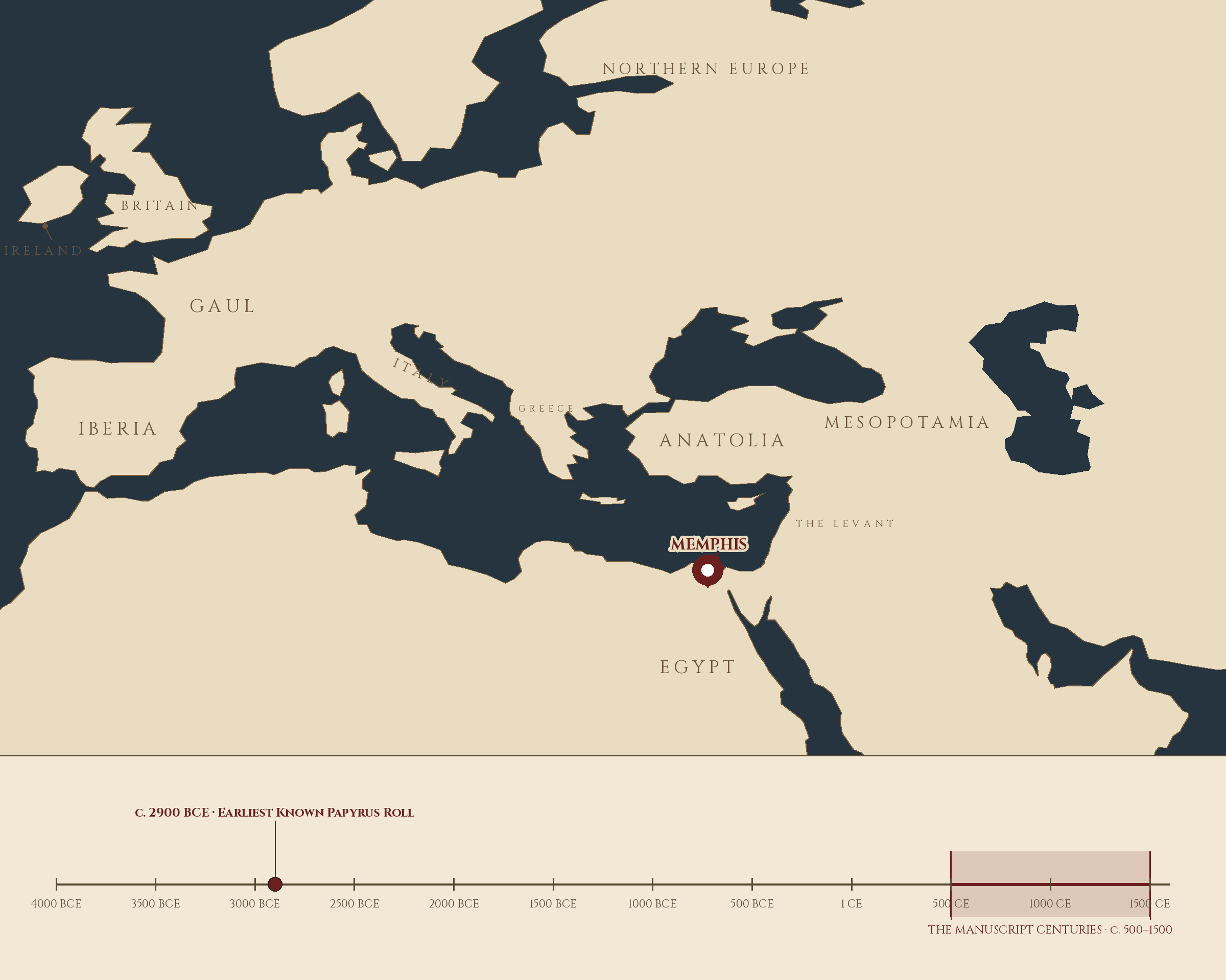
Where and when: Memphis, Nile Delta, c. 2900 BCE — Earliest Known Papyrus Roll. The pin is this lesson. The line beneath the map is our road: every stop a place where writing changed, every lesson a pin.
Lesson Objectives
By the end of this lesson, students should be able to:
- distinguish between papyrus, parchment, vellum, and cotton rag paper
- explain how the materials of the page affected the making, use, and survival of manuscripts
- describe the advantages and limitations of different manuscript materials
- identify the differences between inexpensive wood-pulp paper and high-quality rag paper
- evaluate paper texture, absorbency, and durability through direct observation
- perform basic surface and ink-absorption tests using household materials
Reading this lesson: ★ marks the passages to remember. They return on the unit quiz and the class test. Check in questions ask the material back as you go; answer them in your workbook when you meet them.
Working this lesson: Your assignment packet is the first download on this page. Work in it as the lesson moves along, answering each assignment as its subject is taught — or read the lesson through for your notes and take the assignments as homework afterward. Both are proper ways to sit this class. Signposts in the reading tell you where each assignment belongs. Written answers are short answers in your own words; a few honest lines are worth more than a filled page.
Your Assignment Packet
This lesson's assignments live in its packet: the Lexicon Handout (every term, course terms marked ◆), Materials, Guided Practice, the Assignment Manual with its answer key for self-checking, the Reflection Questions, and the Workbook Checklist. Download the packet before you begin and keep it beside you as you read.
Historical Overview: Three Surfaces, Three Worlds
The development of handwriting was closely connected to the materials used for writing, but the connection is not the simple one students often assume. Texture, absorbency, and durability each set the terms of the negotiation between the scribe's hand and the page, and different writing traditions answered those terms in different ways.
❦ In your workbook: record the three terms of the scribe's negotiation (texture, absorbency, and durability) in your own way — copy, sketch, or note what matters.
Papyrus & the Ancient Writing World
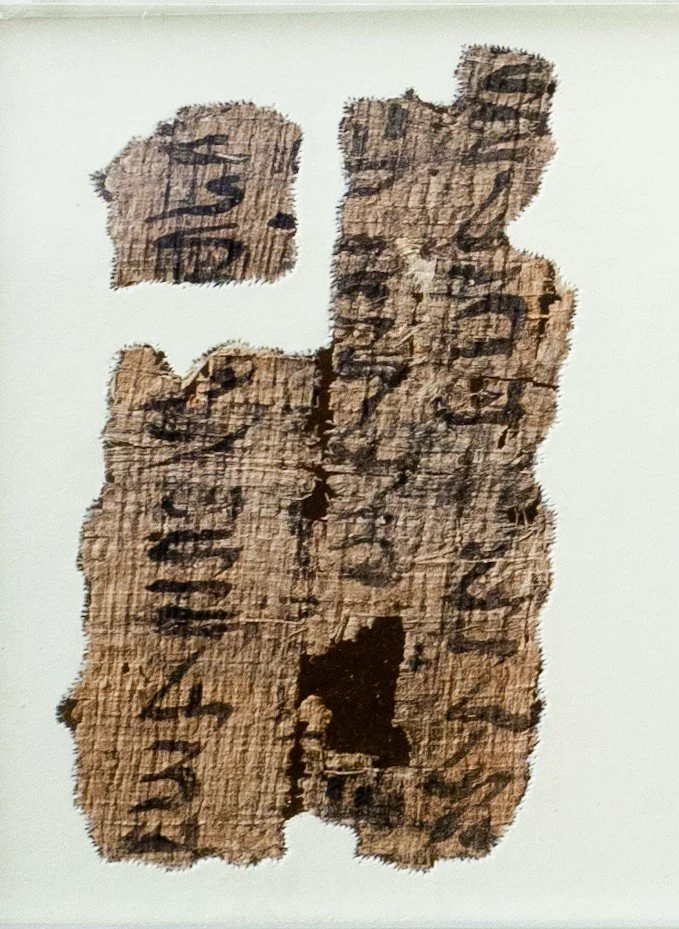
Real papyrus, still holding its ink after some 4,000 years: look closely and you can see the plant-fiber sheet.
Papyrus fragment with hieratic writing (Egyptian, Middle Kingdom, ca. 2030–1640 BCE), The Metropolitan Museum of Art, New York (Rogers Fund, 1927). Public domain.
★ Papyrus was one of the most important writing materials of the ancient Mediterranean world. To make it, craftsmen cut thin strips from the pith, the soft inner tissue, of the papyrus sedge, a plant grown in the marshes of the Nile. The strips were laid in two perpendicular layers, pressed together, and dried under pressure into flat sheets: a laminate of plant tissue, held by its own natural gums. Scribes wrote first on the inner face of the roll, the recto (the outer face is the verso), where the fibers ran horizontally.
Papyrus served its world well, and it served it for a very long time: roughly four thousand years, from ancient Egypt into the medieval period. The earliest known papyrus roll comes from Egypt around 2900 BCE, and papyrus remained in use into the twelfth century CE.
★ But it had honest limitations. Papyrus survives best under dry conditions. In damp environments, organic writing materials are much more vulnerable to deterioration, which is worth remembering every time you admire a papyrus text in a museum. Egypt's dry desert conditions preserved quantities of papyrus that would not have survived elsewhere. You are not looking at a fair sample of what the ancient world wrote. You are looking at what the desert chose to keep.
Check in: A museum case holds a beautiful, intact papyrus text. Why is that not proof that most ancient writing survived this well?
❦ In your workbook: record papyrus in your own way: how it is made, how long it served, and why the desert kept it — copy, sketch, or note what matters.
Parchment & the Medieval Manuscript
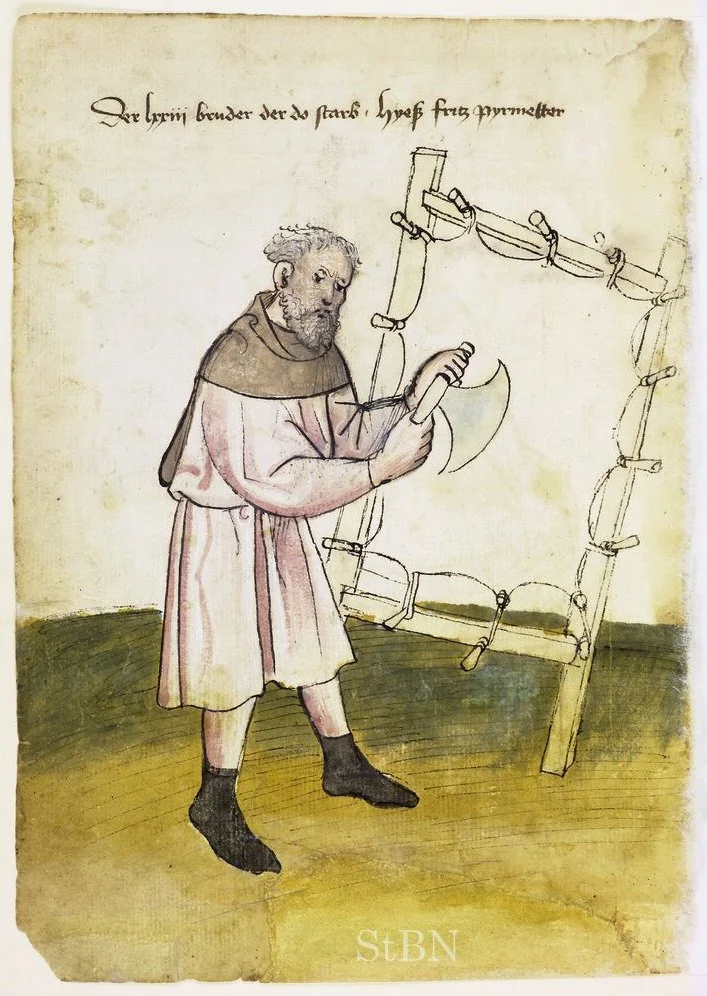
A parchment maker scrapes a stretched skin with the crescent knife called a lunellum, drawn around 1425.
Fritz the parchment maker, from the Mendel House Book (Nuremberg, c. 1425), Stadtbibliothek Nürnberg. Public domain.
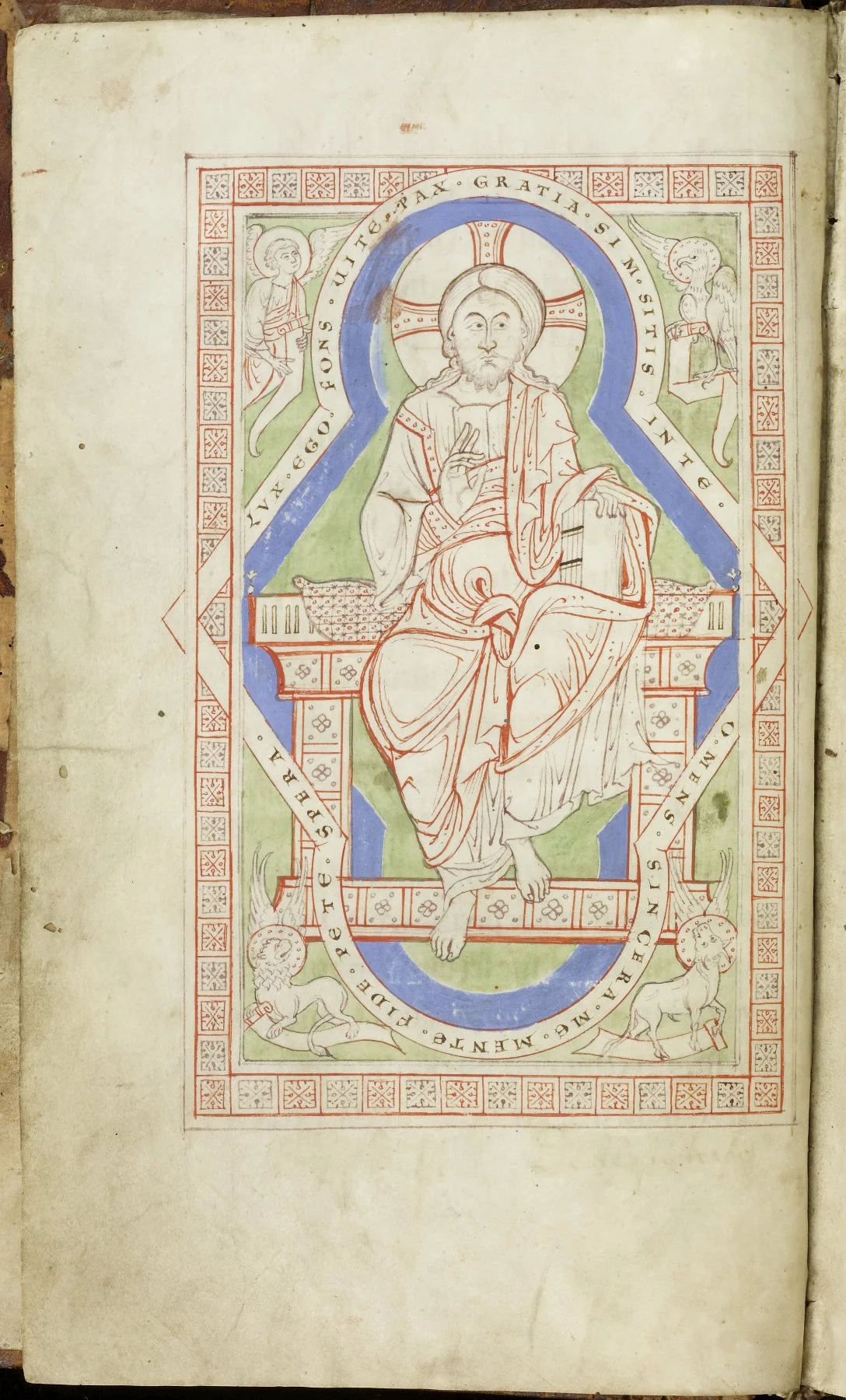
One whole leaf of parchment from a missal of about 1200: the miniature sits on real skin, margins and all.
Leaf from a missal (Austria, c. 1200), The Walters Art Museum, Baltimore (MS W.331). Public domain.
★ As manuscript production expanded across medieval Europe, many scriptoria turned increasingly to parchment and vellum — vellum the finest grade of the prepared skin, traditionally calfskin — writing surfaces prepared from animal hides that had been cleaned, soaked, stretched on a frame, scraped, and dried under tension. The parchment-maker's crescent knife, the lunellum, worked the stretched skin smooth: the hair side cleared of any remaining hair, the flesh side cleared of fat and tissue. It was slow, skilled, expensive work. A single great book could consume hundreds of animal skins. The enormous eighth-century Codex Amiatinus, one complete Latin Bible, has been estimated to have required more than five hundred skins.
★ Parchment became dominant in medieval European manuscript culture for many reasons acting together: the supply of hides, the construction of the codex (the book-form manuscript, which parchment's strength suited well), the writing practices of the scriptoria, the material's durability, the economics of production, and what each region could actually obtain. No single cause, and not the climate alone, explains the change.
What the labor bought was a surface unlike papyrus in nearly every quality that mattered to a European scribe. Parchment had no raised plant ridges; the quill could travel in any direction across the page. And parchment endured. Great numbers of parchment manuscripts survived the centuries, which is why the medieval European archive is, overwhelmingly, a parchment archive. But here again the wise student remembers: survival is not the same as popularity. We study what endured, and we must always ask what did not.
Parchment was never the only answer, even in its great age. It was the answer of traditions whose needs, resources, and circumstances it suited. One choice among several, made inside a whole system of material, script, and tradition.
Check in: Name three causes that worked together to make parchment dominant in medieval Europe. Why does the lesson refuse to name just one?
❦ In your workbook: record parchment in your own way: how a skin becomes a page, and what the labor bought — copy, sketch, or note what matters.
Paper & the Modern Page
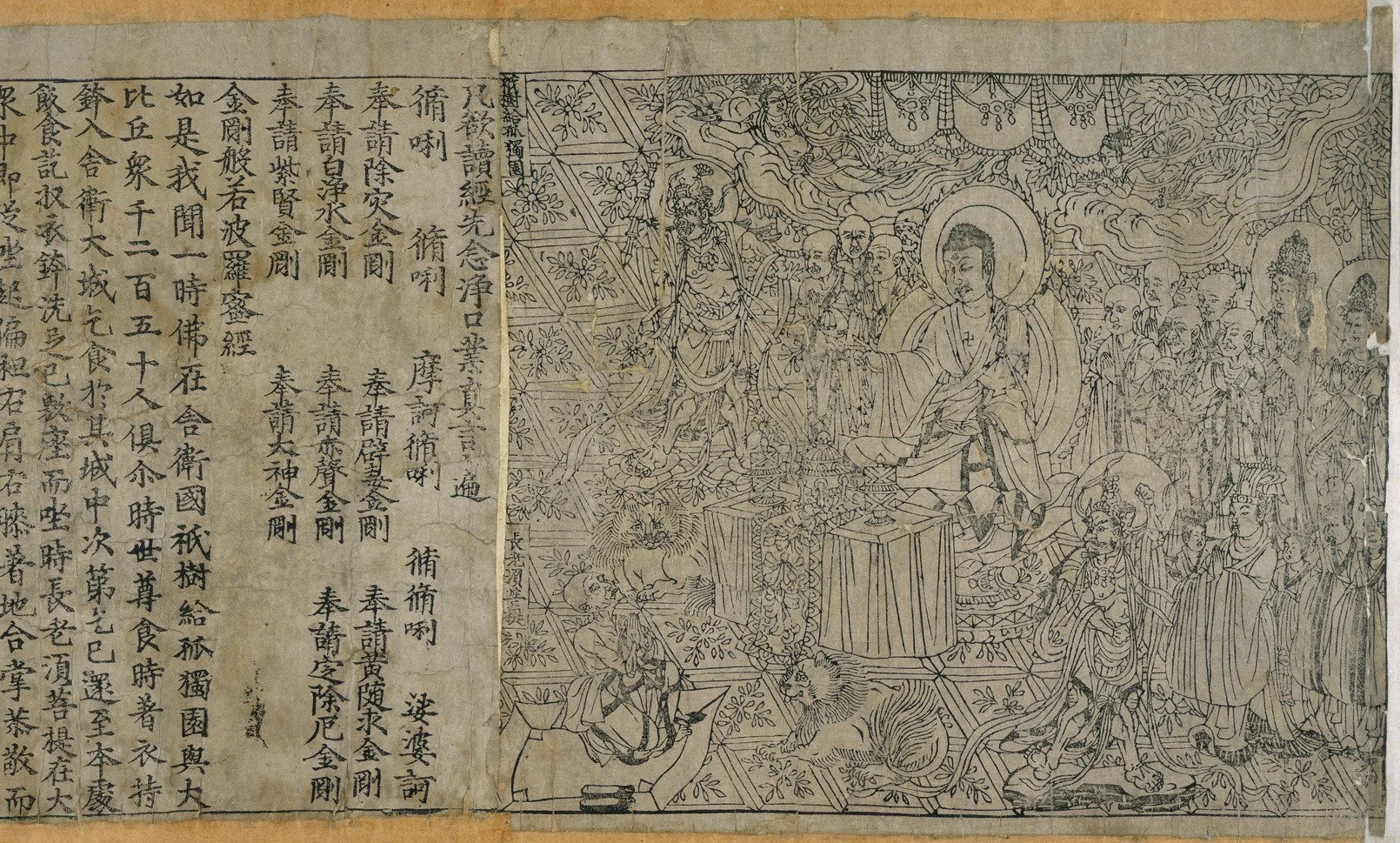
Paper in 868: the Diamond Sutra, printed in China — the oldest dated printed book in the world.
Frontispiece and text of the Diamond Sutra (China, 868 CE), British Library (Or.8210/P.2). CC0.
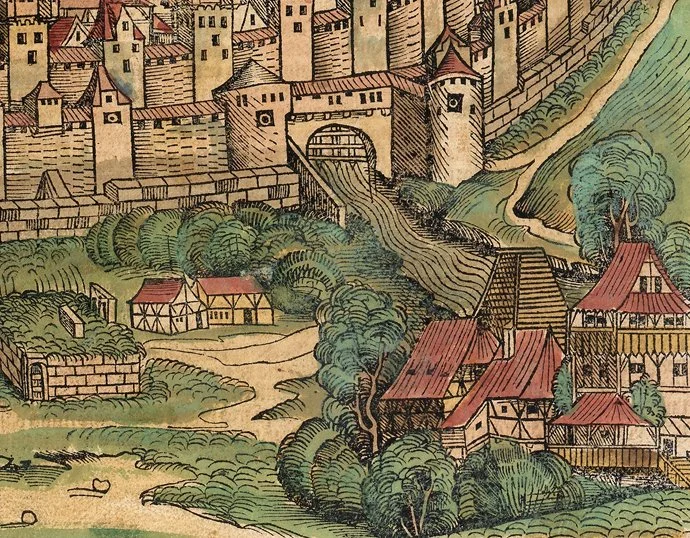
The first European paper mill ever pictured: Stromer's mill outside Nuremberg, in a chronicle of 1493.
Ulman Stromer's paper mill outside Nuremberg, detail from the Nuremberg Chronicle (1493). Public domain.
★ Paper is the youngest of the three surfaces, and the last to reach the scriptoria of Europe. It was invented in China, and it was being produced in Islamic lands by the late eighth century, with its use for Qur'an manuscripts established from the tenth century onward. When it reached Europe, it arrived as the cheap alternative: far less costly than parchment, far easier to make in quantity.
★ The paper most students know today took its modern form in the nineteenth century. Beginning then, inexpensive machine-made papers increasingly used wood pulp instead of rag fiber. Lower-quality wood-pulp papers, particularly those in which lignin, a compound found in wood, was retained and which were manufactured under acidic conditions, can yellow and become brittle as they age. Anyone who has opened a century-old newspaper and watched it flake apart has held this chemistry in their hands. (Not all modern wood-pulp paper shares this fate: chemically purified, lignin-reduced papers can be made to permanence standards. The enemy was never wood itself, but the cheap and acidic way it was sometimes processed.)
Check in: Why can a centuries-old rag-paper book outlast a decades-old newspaper? Name the two things working against the newspaper.
★ High-quality rag paper was never part of that decline. Cotton rag paper provides modern students with a durable, high-quality writing surface: its long cellulose fibers can remain strong for very long periods when the paper is manufactured and stored appropriately. As for paper tooth, the texture that takes ink cleanly and keeps it from feathering beyond the stroke, do not take anyone's word for it, not even mine. You will test it yourself before this lesson ends.
The surface of the page directly affects how ink behaves. You will now prove it to yourself.
❦ In your workbook: record paper in your own way: its journey to Europe, and why cheap paper ages badly — copy, sketch, or note what matters.
In your packet: Exercise III — The Archival Comparison (Optional) ⚒ begins here. Work it now, or mark the place and take it as homework — your choice.
Professor Nocturne
Hold a moment, scholars, and consider what you have learned, and what you have not.
You have not learned the complete history of writing. You have learned from what survived.
Climate, storage, reuse, accident, burial, human choice, and the durability of the material itself have all shaped the evidence that reaches us. Egypt's dry conditions preserved papyrus that might not have survived elsewhere. Parchment manuscripts endured in great numbers. Other texts disappeared entirely.
★ The archive is not a mirror. It is a survivor's account. The wise scholar always asks what did not survive to testify.
Everything from this point forward is practice. You will test the surfaces themselves: how they drink ink, how they hold a line, how they age. Do not hurry. The parchment-makers scraped each skin two and three times over, and their patience is the reason you can still read their work.
Guided Observation: Surface & Fiber Analysis
Before beginning the practical exercises, gather several kinds of paper from around your home or classroom: printer paper, notebook paper, newspaper, a brown paper bag, a paper towel, an envelope. No special purchases are needed; the lesson is complete with whatever you already own.
Examine your paper materials carefully and record your observations, as a scribe would inspect a new skin before trusting it with a commission.
Study:
- surface texture
- flexibility
- thickness
- paper tooth
- light transparency
- absorbency
- fiber structure
Consider the following questions:
- Which paper surface feels smoothest?
- Which material shows the highest paper tooth?
- How does light pass differently through each sheet?
- Which paper appears most absorbent?
- Why might parchment behave differently than papyrus?
- Why would archival stability matter for manuscript preservation?
Record your observations carefully within your workbook.
In your packet: Exercise II — The Manuscript Material Index ◐ begins here. Work it now, or mark the place and take it as homework — your choice.
Demonstration: Paper Absorption & Structure Testing
Follow the steps below carefully to compare the behavior of different writing surfaces. Work with the household papers you gathered; cotton rag paper is welcome if you already own it, but it is not required.
1. Prepare the Samples
Place two or three different household papers side by side on the writing surface: for example, printer paper, newspaper, and a brown paper bag.
2. Observe Surface Texture
Run your fingers gently across each sheet and compare smoothness and paper tooth from one surface to the next.
3. Perform the Ink Drop Test
Place one small drop of ink onto each sheet using an eyedropper or a dip pen; if you have neither, dab on a drop of dark paint with a brush or cotton swab instead — an ordinary ballpoint cannot lay a drop. Allow each drop to dry naturally without touching the surface.
4. Measure Ink Spread
Observe the final shape of each ink spot. Compare:
- edge sharpness
- spreading
- feathering
- absorbency
5. Examine the Paper Fibers
Tear a small scrap from each paper sample and inspect the torn edges closely, using a magnifying lens if available. Observe differences in:
- fiber length
- texture
- structural density
- flexibility
In your packet: Exercise I — Surface Absorption Record ⚒ begins here. Work it now, or mark the place and take it as homework — your choice.
Materials
Required (Level One — household items)
- Assorted household papers: printer paper, notebook paper, newspaper, a brown paper bag, a paper towel, an envelope. Gathered for the Guided Observation; the more variety, the better the comparison. No special purchases are needed.
- Ink or dark paint: for the ink drop test. An eyedropper or a dip pen applies the drops; dark paint can be dabbed on with a brush or cotton swab.
- A workbook: for your observations, the Surface Absorption Record, and the Manuscript Material Index.
- A ruler or straightedge: for measuring the diameter of the ink spots in Exercise I.
- Tape or a glue stick: for attaching your samples in the Manuscript Material Index.
- A magnifying lens: if available, for examining torn paper edges and fiber structure. Not required.
- An old newspaper or a yellowed paperback page: optional, for Exercise III's archival comparison.
- Cotton rag paper: welcome if you already own it, but it is not required.
Reflection Questions
Answer the following questions in your workbook.
- How did the physical structure of papyrus affect the scribe's work?
- What characteristics made parchment useful to medieval European manuscript makers?
- How does paper tooth affect ink behavior?
- Why can high-quality rag paper remain more stable than inexpensive acidic wood-pulp paper?
- Which writing surface appeared most effective during your observations, and why?
Professor's Review
And so our third lesson ends where all manuscript work truly begins: not at the desk, and not with the pen, but with the page itself.
You can now explain how papyrus, parchment, and paper each answered different needs, and how the materials of the page affected the making, use, and survival of manuscripts.
Keep your material index close. In Unit II, you will lay handmade inks upon these surfaces and watch each one answer differently. In Unit IV, you will choose your calligraphy ground with a scribe's judgment. In Unit V, you will prepare a page worthy of gold. And in Unit VI, you will learn how to keep what you have made alive for the centuries. The parchment-maker's patience, taught at last.
Tidy your samples, scholars. Next, we make ink.
PROFESSOR QUILLBERRY NOCTURNE
Scrollwork Library
Master Scribe & Illuminator
Cross-Class Connections
Runes · Lesson 2 — The Unilateral Sound-Signs
My Egyptian scribes wrote on this lesson's first surface: papyrus, strips of stem crossed, pressed, and dried, from the same tombs and desert caches Professor Nocturne describes. Come and meet the sheet in its own country, under the hand that first covered it with signs.
Runes · Lesson 18 — The Celtic Manuscript Tradition
On vellum, my island scribes raised the wedge-topped ascenders this lesson can teach you to read: a quill laid full-width on the skin and lifted as the stroke climbs. A surface shapes a script, and mine is the proof. Come and see the surface become letterforms.
PROFESSOR THISTLELOOM WEBBLETHORN
Runes & Ancient Writing
Creative Arts · Unit II, Lesson 7 — Paper, Card & Board Construction
Professor Nocturne ends with the sheet itself; my workshop begins there. You will follow paper's road from Han-dynasty China westward and learn the grain that rules every fold you will ever make. Judge a paper's tooth at his desk, then come and feel its grain at my bench.
Creative Arts · Unit II, Lesson 8 — Scrolls, Rolls & Cases
For three thousand years the roll was the book. In my workshop you will make papyrus rolls, label them, and build the cases they live in, as scribes housed them before the codex came. Your recto had a home, scholar. Come and build it.
Creative Arts · Unit II, Lesson 11 — Case Binding & Archival Boxes
When Professor Nocturne's acid test has shown you what eats a page, come to my bench and learn the defense: archival board, a case bound to fit, a Solander box built to one book's measure. Preservation is a surface decision, made in advance, and I will teach you to make it.
PROFESSOR COGBRANCH TIMBERCLANK
Creative Arts Workshop
Herbology · Unit I, Lesson 5 — The Historian's Herbarium
My herbals survived the way everything in Professor Nocturne's lesson survived: copied by hand, onto surfaces that lasted. Dioscorides was copied for fifteen centuries. Come to the Greenhouse and ask what carried him all that way; my scholars will answer with this lesson's surfaces.
Herbology · Unit IV, Lesson 29 — Pressing & Preserving Plant Specimens
In my Greenhouse, paper does the keeping: a flower pressed flat between sheets can hold its blue for nearly three hundred years. The papyrus-maker pressed his strips; my scholars press whole plants. Come and learn the same patience from the plant side.
PROFESSOR BERYL FERNFOOT
Herbology Greenhouse • Master Herbalist • Head of House Oriens
Potions · Unit VI, Lesson 48 — Midnight Carbon & Oak Gall Inks
I brew the other half of this lesson. Carbon ink rests upon the surface; oak gall ink bonds into its fibers, and my laboratory studies both from the chemist's side of the bench. Your ink-drop record is my evidence. Bring it, and we will read it together.
Potions · Unit VI, Lesson 50 — Paper Aging & Manuscript Staining
My aging lesson sends its scholars to Professor Nocturne's room by name, because the full account of lignin lives in his Lesson 3 lexicon. He is right, and I do not mind saying so. Learn the fiber here; then come and watch it yellow a newspaper in my laboratory.
PROFESSOR CRIMBLEBREW MUDDLENOOK
Potions Laboratory • Master Apothecary • Head of House Meridies
Celestial Studies · Unit VI, Lesson 30 — The Planisphere & Star Charts
My star wheels turn on volvelles, disks of parchment and paper pinned at the center, and a planisphere drawn about the year 1000 survives still. The sky, too, is read from surfaces. Come to the Observatory and turn one.
PROFESSOR VESPER GLIMMERWICK
Celestial Studies • Astronomer & Celestial Historian
Further Reading & Sources
The Metropolitan Museum of Art. "Papyrus in Ancient Egypt." Heilbrunn Timeline of Art History. Met: Papyrus in Ancient Egypt Papyrus manufacture from pith strips laid in layers and dried under pressure; Egypt's dry desert climate preserving papyrus documents; the earliest known roll (ca. 2900 BCE) and the latest papyri (ca. 1100 CE).
Smarthistory. "Bifolium from the Pink Qur'an." Smarthistory: Bifolium from the Pink Qur'an Paper's journey from its invention in China to the Islamic world and eventually Europe, told through a luxury Qur'an manuscript on dyed paper.
Smarthistory. "Codex Amiatinus." Smarthistory: Codex Amiatinus The earliest complete Latin Bible (8th century): over 1,000 parchment leaves, estimated to have required more than five hundred animal skins: a named measure of parchment's cost.
Library of Congress. "Preserving Your Books: Introduction." Library of Congress: Preserving Your Books Lignin in wood-pulp paper and the acids it produces with age; what "archival" and "lignin-free" mean for paper meant to last.
Library of Congress. "The Deterioration and Preservation of Paper: Some Essential Facts." Library of Congress: The Deterioration and Preservation of Paper Why centuries-old rag paper often outlasts decades-old wood-pulp paper: long vs. short fibers, mechanical pulping that retains lignin, and the acid hydrolysis that follows: the science behind this lesson's newspaper experiment.
Browse the Scrollwork shelf in the school Library for readable editions of these works.
Submit your work for this lesson using the form below.
CONTINUE IN THE SCROLLWORK LIBRARY
← Previous · Lesson 2: Reed Pens & Feather Quills Next · Lesson 4: Inkwells, Sand, & Scribal Tools →
Unit I — All Four Lessons Scrollwork Library — All 26 Lessons
The rest of Unit I: Lesson 1 · The Scriptorium Desk · Lesson 2 · Reed Pens & Feather Quills · Lesson 4 · Inkwells, Sand, & Scribal Tools
From the Scrollwork Shelf
The printed companions to this lesson, from Professor Nocturne’s shelf in the shop.
Scrollwork — Writing Surfaces Through History: Lesson Text (Unit I, Lesson 3)
$4.95
View in the Shop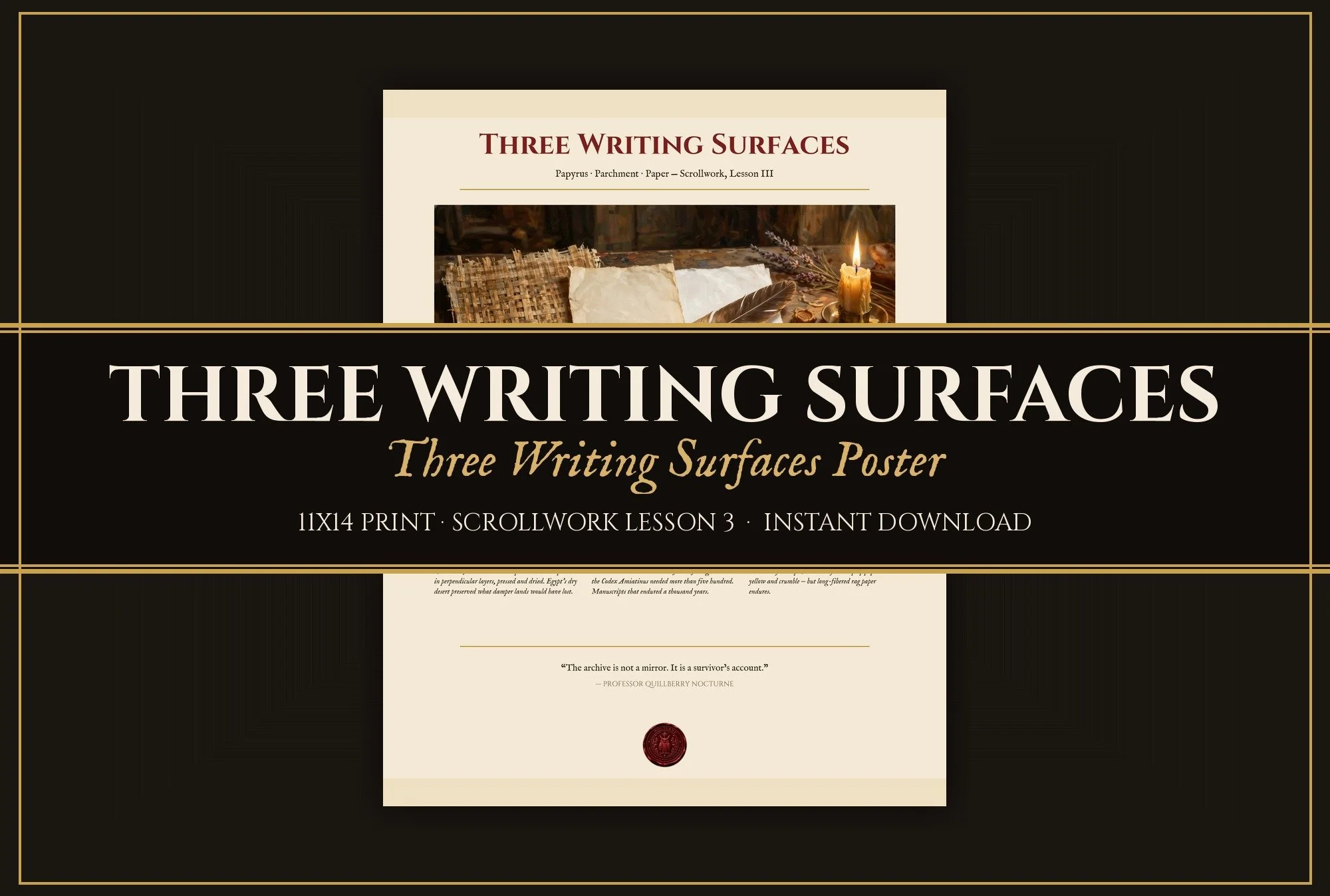
Scrollwork — Three Writing Surfaces Poster: Papyrus, Parchment & Paper (11×14)
$4.95
View in the Shop