SCROLLWORK
Unit I · Lesson 2REED PENS & FEATHER QUILLS
Professor Quillberry Nocturne
Master Scribe & Illuminator
The Scrollwork Library • School of Evershade
Professor's Introduction
Good evening, scholars, and welcome back to the Scrollwork Library.
In our last lesson, you prepared the scribe's desk, the small kingdom where all manuscript work begins. Tonight, we take up the instruments themselves.
For thousands of years, the history of writing was, in large part, the history of the pen in the hand. But it was never the history of a single pen. The reed pen served the ancient Mediterranean world for millennia, and serves some scribal traditions still. The feather quill became a principal instrument of medieval European manuscript culture. Each belonged to a particular combination of hand, surface, script, and tradition.
In this lesson, you will study both instruments, their structure, their strengths, and the choices behind them, and you will learn how a feather barrel is prepared for the quill-making work ahead.
The question before us is not which pen was better. It is why the scribe chose it.
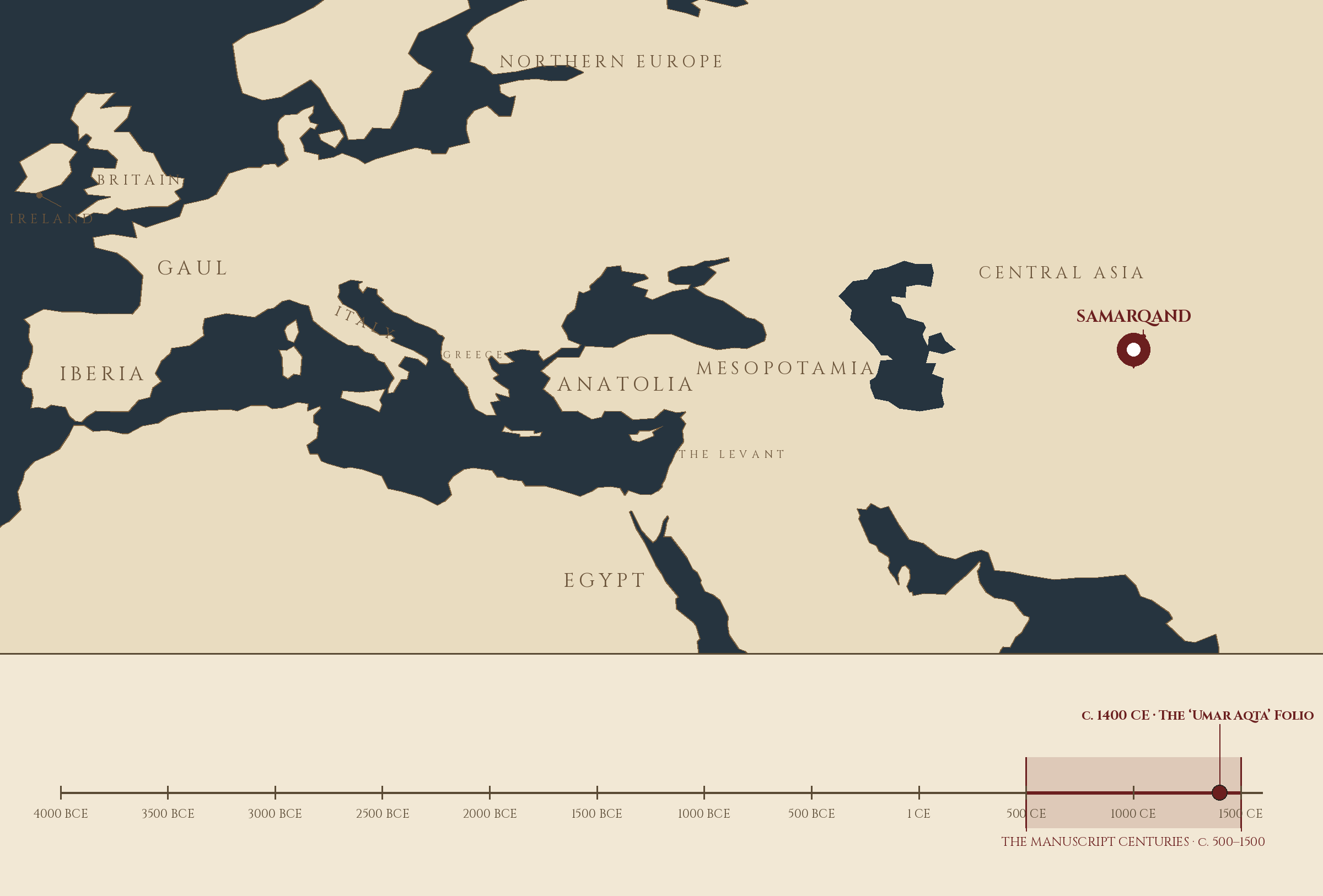
Where and when: Samarqand, c. 1400 CE — The ‘Umar Aqta’ Folio. The pin is this lesson. The line beneath the map is our road: every stop a place where writing changed, every lesson a pin.
Lesson Objectives
By the end of this lesson, students should be able to:
Explain why different writing traditions retained different pens, rather than converging on a single "best" instrument. Identify the major structural components of a feather quill: the barrel, the cut nib, and the central slit. Describe how a nib's width, shape, and angle influence the appearance of a script. Evaluate, through direct observation, how a feather's natural curvature affects writing comfort. * Explain how surface, script, and scribal tradition each influenced the choice of writing tools.
Practical Extension (optional): prepare and inspect a raw feather barrel for future pen construction.
Reading this lesson: passages marked ★ state something you must remember — those ideas return on the unit quiz and the class test, so give them a second read. Exercises marked ★ in the Assignment Manual teach quizzed material, and short answers are always in your own words.
Working this lesson: keep your workbook open beside you. Sections end with a ❦ workbook prompt — do the task when you reach it, or mark the place; the Workbook Checklist at the end gathers everything, with a space to sign the lesson off.
Assignment key: ✎ written work · ⚒ hands-on practical · ◐ both · ★ will be on the test · ❦ workbook path
Your Assignment Packet
This lesson's assignments live in its packet: the Lexicon Handout (every term, course terms marked ◆), Materials, Guided Practice, the Assignment Manual with its answer key for self-checking, the Reflection Questions, and the Workbook Checklist. Download the packet before you begin and keep it beside you as you read.
Signposts in the lesson point into the packet — In your packet: lines tell you the moment an exercise's material is complete, so you can work the exercise then or mark the place for later.
Historical Overview
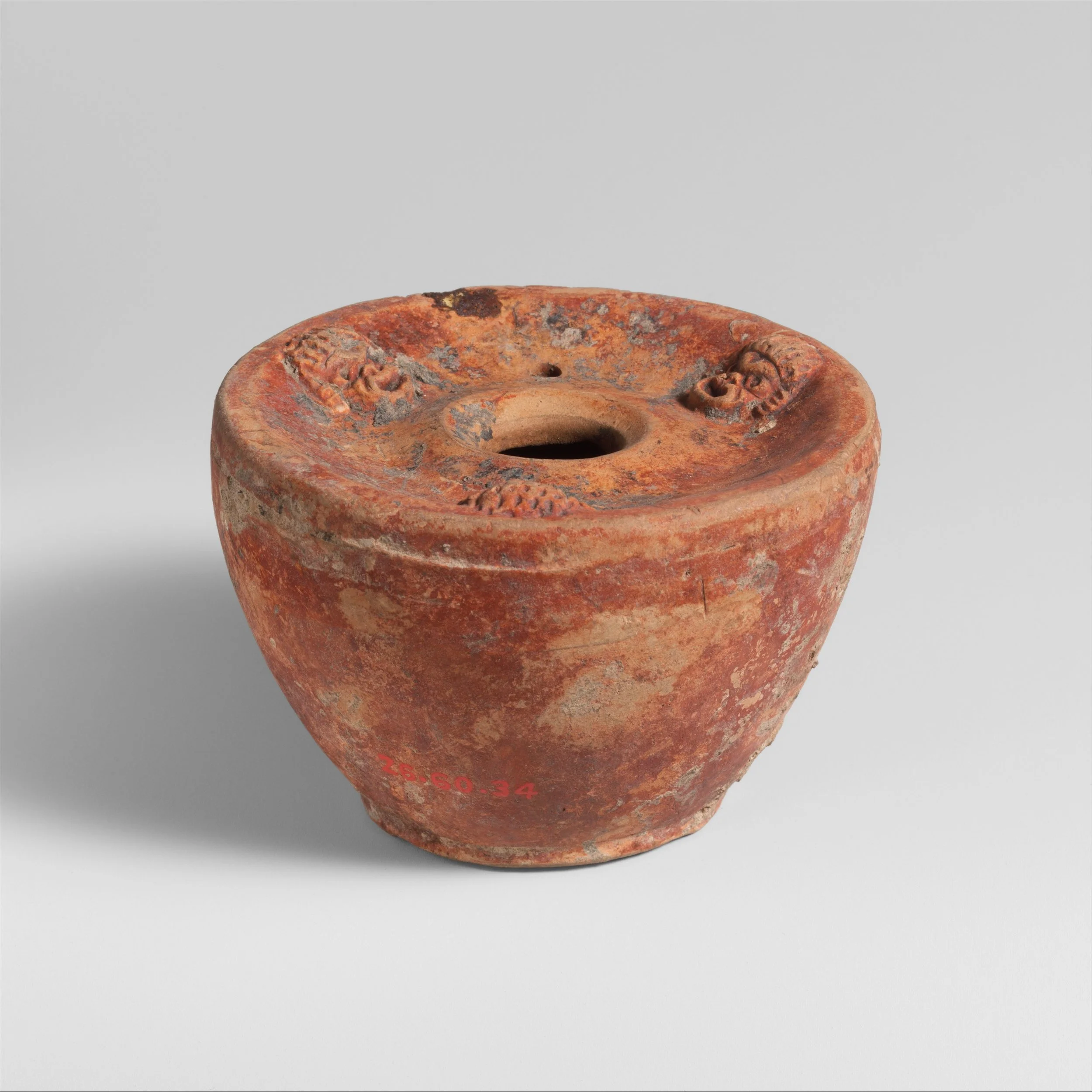
A Roman inkwell that survives: terracotta, with a hole in the top just wide enough for the pen.
Terracotta inkwell and bronze stylus (Roman, 1st–2nd century CE), The Metropolitan Museum of Art, New York (Fletcher Fund, 1926). Public domain.
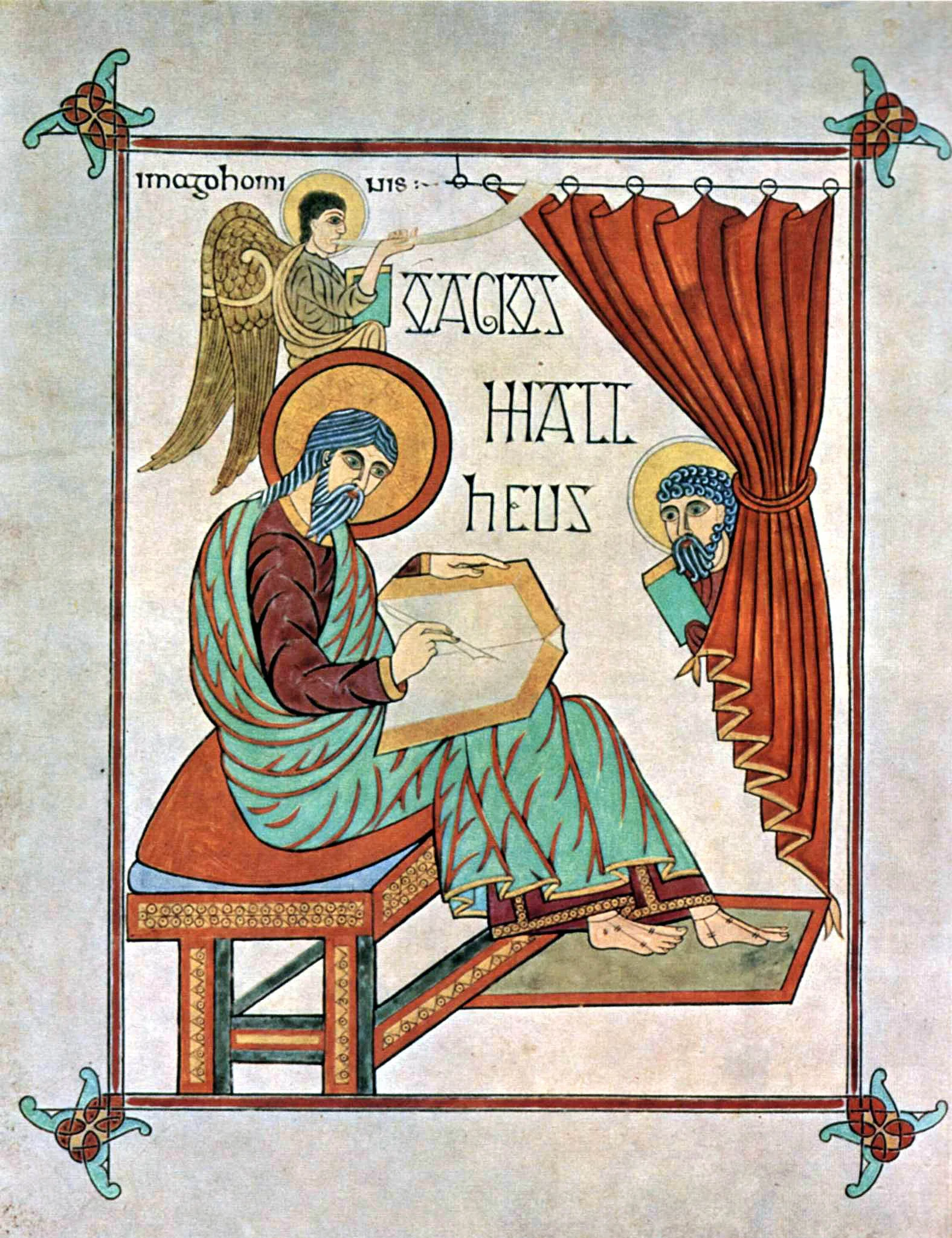
Matthew writes with a pen in a book on a sloped board, in a gospel book made around 700.
St Matthew writing, from the Lindisfarne Gospels (c. 700–720), British Library, London. Public domain.
The development of writing tools was closely connected to geography, climate, and the materials available to different civilizations, but the story is not a simple march from worse tools to better ones.
Ancient Egyptian scribes wrote on papyrus and other surfaces using plant-based writing tools, including rush brushes and reed pens. These tools varied across Egypt's long history, but they shared an important feature: the writer could prepare a readily available plant stem into an effective instrument for applying ink.
One particular development deserves attention: the cut broad nib, a plant stem or reed trimmed to a shaped writing edge. Rather than collapsing every ancient plant pen into a single object, we should understand the broad nib as a specific refinement within a long tradition of plant-based writing tools.
Check in: Why does the lesson insist the broad nib is a specific refinement, rather than just another name for every ancient plant pen?
Reed pens proved extraordinarily long-lived. They wrote on papyrus, on parchment, and on paper, in different traditions across many centuries. Early Qur'an folios of the late 9th to early 10th century, including examples held by the Metropolitan Museum of Art, are parchment manuscripts written with a broad-nibbed reed pen. Islamic manuscript traditions continued to use the reed pen across centuries, and the Met's collection even documents a 14th/15th-century Central Asian calligrapher working with a reed pen.
In medieval Europe, meanwhile, the feather quill became a principal writing instrument of manuscript culture. Scribes used quills made from the feathers of geese and swans, cutting the feather end into a nib with a central slit that allowed ink to reach the point. The quill suited European scribal practices and parchment manuscript production, and it could be cut and recut as the nib wore.
★ Surface mattered, but surface alone did not determine the tool. Reed pens demonstrably wrote on parchment. What mattered was the whole combination: the hand, the surface, the script, and the tradition.
❦ In your workbook: record the whole combination that chose the pen — hand, surface, script, and tradition — in your own way: copy, sketch, or note what matters.
The Reed Pen: An Ancient and Enduring Tool
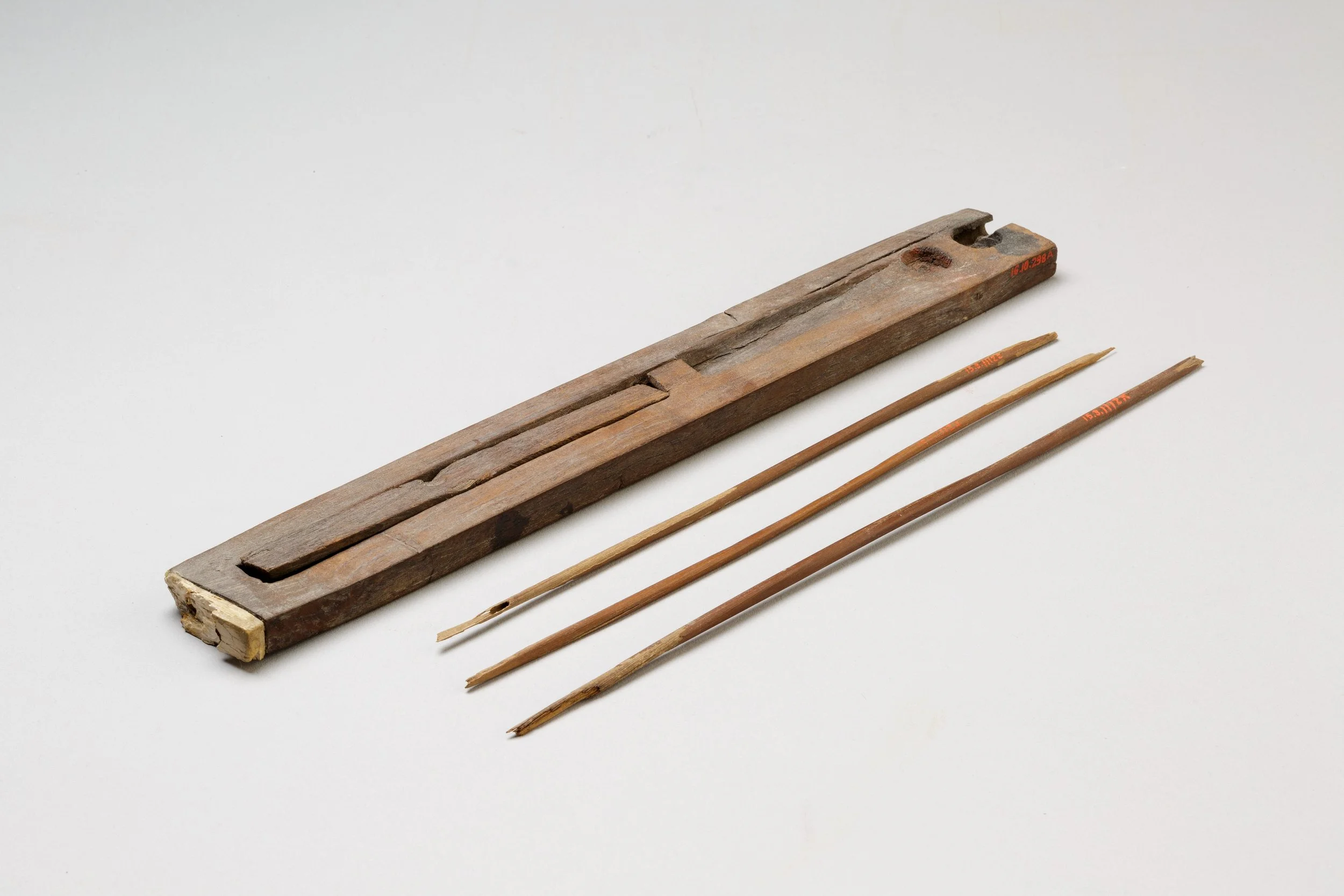
An Egyptian scribe's whole kit in one object: the lidded palette and the reed pens themselves.
Scribal palette with reed pens (Egyptian, ca. 1580–1458 BCE), The Metropolitan Museum of Art, New York (Rogers Fund, 1916). Public domain.
The reed pen was one of the earliest and most successful writing instruments of the ancient world, and it would be a mistake to treat it as a mere stepping-stone to the quill.
Reeds were lightweight, widely available, and could be cut into a variety of nib shapes — a nib being the pen's shaped writing point. A skilled scribe could trim a broad edge for bold strokes or a finer point for smaller writing, and could recut the nib as it wore. This versatility, combined with the ready availability of the raw material, helps explain the reed pen's extraordinary lifespan: its long history stretched across different writing surfaces and traditions, from Egyptian scribal practice to the manuscript and calligraphic traditions of the Islamic world.
Check in: A reed nib wears and must be recut, again and again. Why was that maintenance, rather than a defect, for the traditions that kept the reed?
★ The reed pen did have honest limitations. As a reed nib wore through use, it could be trimmed and reshaped to restore the writing edge. And the reed is, by nature, a rigid instrument: it does not flex the way a feather can. But rigidity is not the same as failure. The broad-nibbed reed pen wrote beautifully on parchment for centuries in the hands of scribes whose traditions had perfected its use. The lesson here is not that the reed was defeated. It is that different traditions asked different things of their pens, and the reed answered brilliantly for those who kept it.
❦ In your workbook: record the reed pen — its strengths, its limits, and why it endured — in your own way: copy, sketch, or note what matters.
The Feather Quill in Medieval Europe
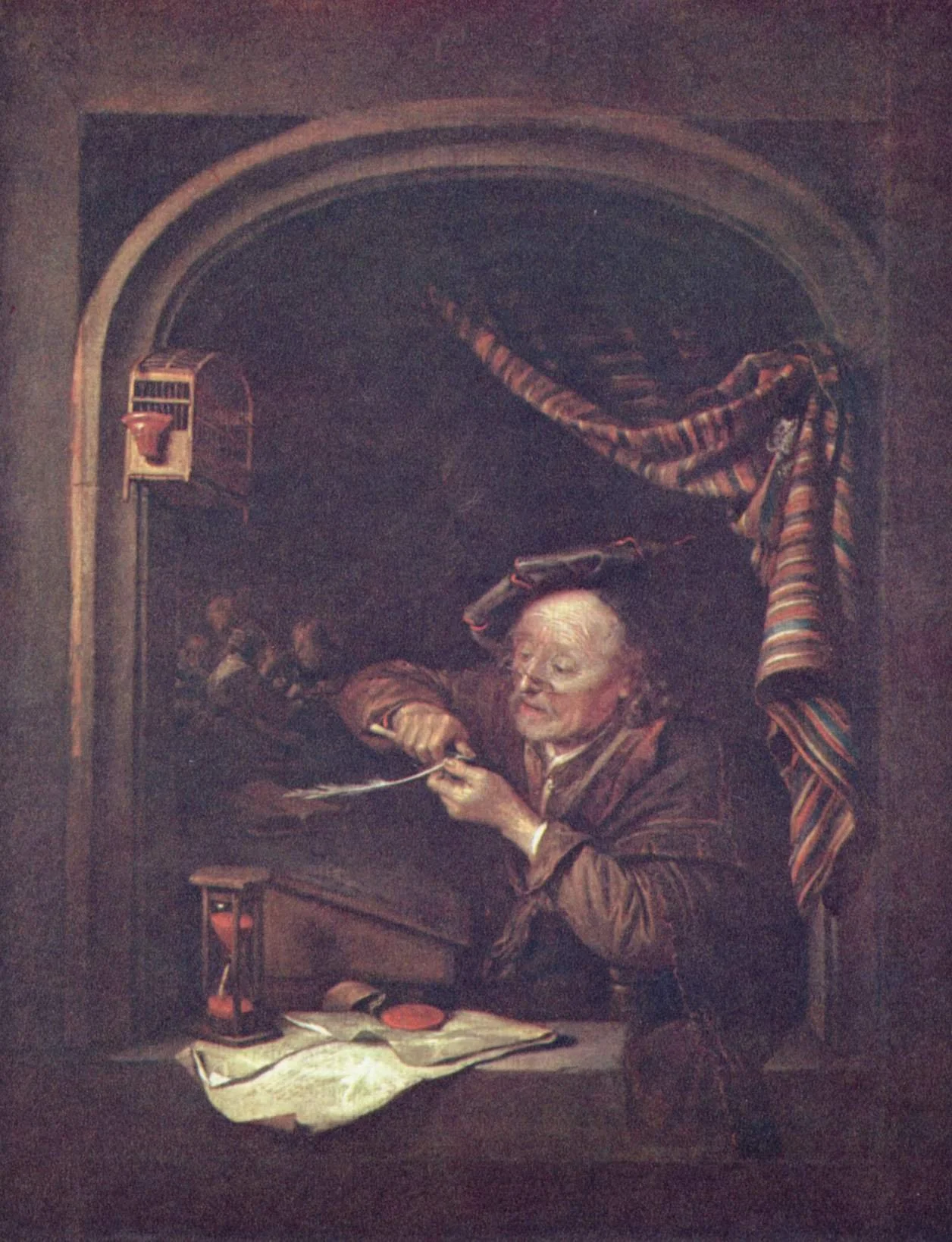
Cutting a quill was a skill in itself: a 17th-century writing master trims the nib with his penknife.
Gerrit Dou, An Old Man Sharpening His Quill (1671). Public domain.
In medieval Europe, the feather quill became a principal writing instrument of manuscript culture.
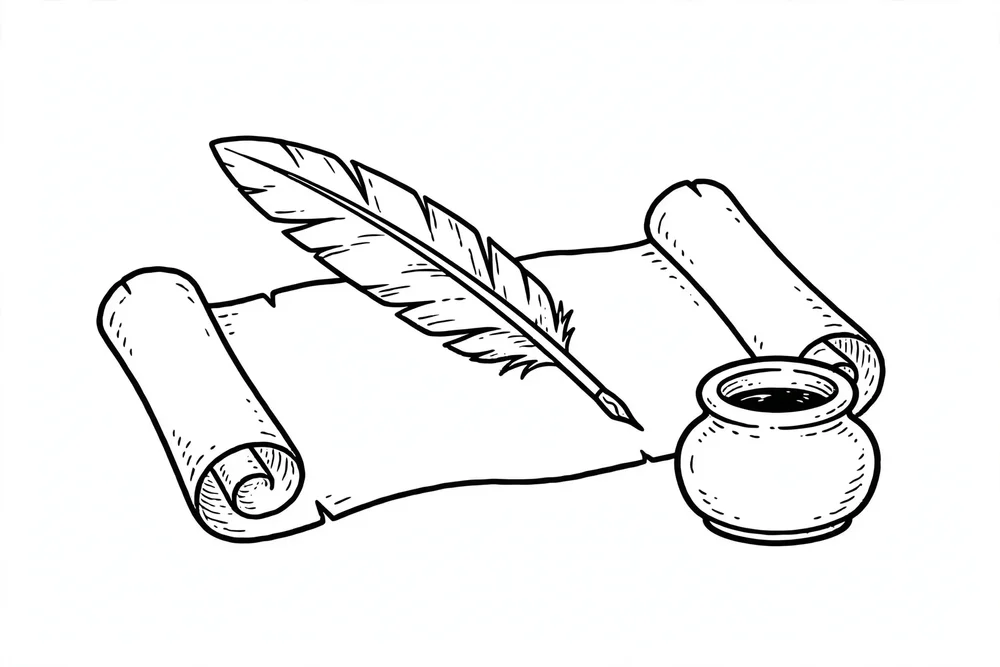
★ Scribes used quills made from the feathers of geese and swans. The feather end was cut into a nib, and a central slit allowed ink to travel down to the writing point. As the nib wore through use, the scribe could cut it back and reshape it; the knife you met in Lesson 1 earned its place at the desk largely through this constant maintenance.
★ Here is something worth understanding precisely, because it will matter when you cut your own quills in Unit III: the width of a historical broad-edged stroke does not depend primarily on pressing harder. The shape and angle of the nib, together with the direction of the stroke, create much of the contrast between thick and thin lines.
Check in: If pressing harder is not what makes a broad-edged stroke thick or thin, what is?
The quill suited European scribal practices and parchment manuscript production. Whether it was "better" than the reed is the wrong question. It was the right pen for the hands, surfaces, scripts, and traditions that chose it.
❦ In your workbook: record the feather quill — where its feathers come from, and how its nib is cut and slit — in your own way: copy, sketch, or note what matters.
In your packet: Exercise II — Broad-Edge Stroke Experiments ⚒ begins here. Work it now, or mark the place and take it as homework — your choice.
Professor Nocturne
Neither instrument belongs to a simple story of old and new.
The reed did not fail when the quill appeared, nor did the quill improve upon every task the reed had performed. Both survived because writing is not one craft practiced in one place.
A pen belongs to a hand, a surface, a script, and a tradition.
The better question, scholars, is not which instrument won.
Ask why the scribe chose it.
Guided Observation — Feather Structure Analysis
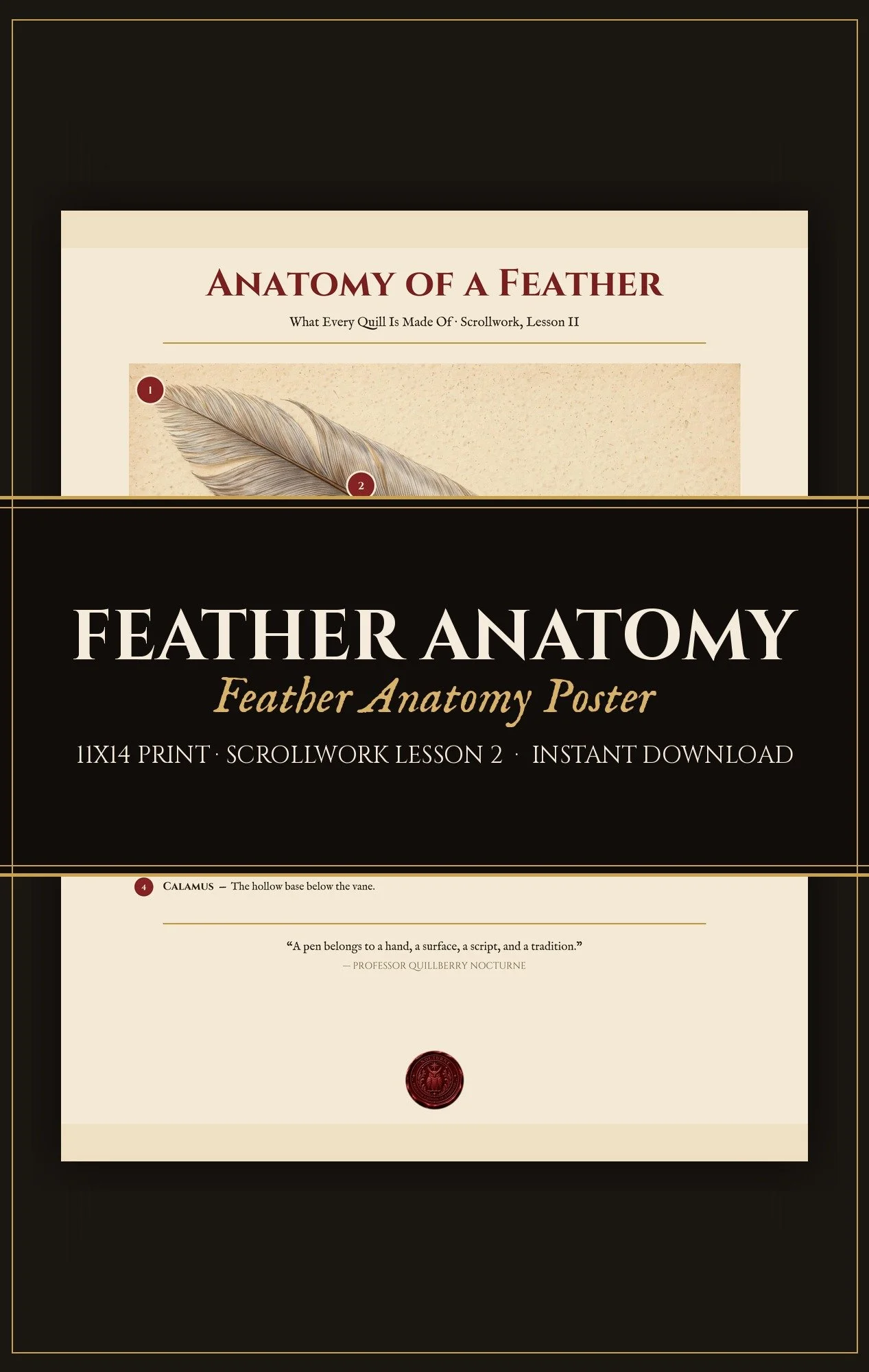
Before beginning the practical exercises, study the structure of a feather, using a real feather if you have one, or the feather anatomy illustration in the downloadable assignment packet if you do not.
Examine the feather's natural curvature — its quill curvature, the bend the shaft takes from the wing — the thickness of its barrel, the feather's hollow central shaft, the texture of the keratin surface, keratin being the protein feathers are made of, the size of the internal chamber, and how the vane, the flat surface of barbs on either side of the shaft, sits relative to a writer's hand and view of the page.
Then consider the following questions:
- Which direction does the feather naturally curve?
- How does the curve sit relative to a normal writing position? Would the vane clear the hand and the view of the page?
- Why might a scribe care about the relationship between nib shape and the appearance of a script?
- How might a rigid pen behave differently on the writing surface than a feather quill?
Record your observations carefully in your workbook.
In your packet: Exercise I — Curvature & Comfort ⚒ begins here. Work it now, or mark the place and take it as homework — your choice.
In your packet: Exercise III (Optional) — Reed & Quill Comparison ⚒ begins here. Work it now, or mark the place and take it as homework — your choice.
In your packet: Practical Extension (Optional) — Preparing a Feather Barrel for Unit III ⚒ begins here. Work it now, or mark the place and take it as homework — your choice.
Practical Extension (Optional): Preparing a Feather Barrel for Unit III
For students who have access to a suitable large feather. This extension is entirely optional; the lesson is complete without it.
A feather kept from this lesson can be prepared, cured, hardened, and shaped into a working quill in Unit III. If you have an appropriate feather and wish to inspect it now:
- Select the feather. Choose a large flight feather, one of the long, stiff feathers of the wing. Test its curve in your writing hand before committing to it.
- Remove the lower barbs — the fine filaments branching from either side of the shaft. Strip the lower feather fibers away from the barrel to create a clean grip surface. Wash your hands after handling any found feather.
- Inspect the barrel and its interior. Hold the feather beneath a light source and examine the hollow calamus, the feather's hollow shaft, and the chamber inside it. Do not insert sharp tools or attempt further preparation. The full quill-preparation instructions, including sourcing, cleaning, sanitation, and tool safety, will be provided in Unit III.
- Store the feather. Keep it somewhere clean and dry until Unit III.
❦ Workbook path: If you have no suitable feather, source one on paper instead: note where a large flight feather could honestly come from — a craft shop, a farm, a feather found on a walk — and what you would check before accepting it. When a real feather comes your way, the inspection itself takes minutes.
Your keepsake: the prepared feather barrel itself, stored clean and dry — in Unit III you will cut it into your own quill.
Materials
No historical tools are required: every core exercise can be completed with ordinary household supplies and the illustrations in this packet.
Required (Level One — household items):
A feather — a large flight feather if you can get one, for the Guided Observation and Exercise I. If you have none, the feather anatomy illustration in this packet serves instead. A pen or pencil — to hold in your normal writing position for Exercise I. A broad-edged tool you already own — a highlighter or chisel-tip marker, for Exercise II. Paper — for the stroke experiments and the dry drags of Exercise III. Your workbook — for the ❦ prompts as you read, and the written work. A lamp or a bright window — a light source to hold the feather against in the Practical Extension's inspection step.
Optional, for Exercise III and the Practical Extension:
A reed pen and a quill or prepared feather — for the direct comparison of Exercise III, if you have them. A large flight feather — for the Practical Extension, if you have access to one.
Keep this list with the lesson. Most of it will serve you again in Unit III, when you cut a quill of your own.
Reflection Questions
Answer the following questions in your workbook.
- Why did different writing traditions retain different pens instead of converging on a single instrument?
- What evidence shows that reed pens were used successfully on parchment?
- How can a nib's width, shape, and angle influence the appearance of a script?
- Why is it more useful to ask "why did the scribe choose it?" than "which pen was better?"
- Which part of the lesson changed your assumptions about historical writing tools, and why?
Professor's Review
And so the instruments are introduced, not as rivals, but as answers.
You can now explain why the reed pen endured for millennia across many traditions, and why the feather quill became a principal instrument of medieval European manuscript culture. You can name the parts of a quill, describe how nib geometry shapes a script, and judge a feather's curve with your own eye rather than by rule alone.
If you prepared a barrel in the Practical Extension, keep it safe. In Unit II you will prepare the inks that will fill it, and in Unit III you will cut, slit, and shape it into a true pen.
The desk is ready. The tools are chosen. Soon, we write.
PROFESSOR QUILLBERRY NOCTURNE
Scrollwork Library
Master Scribe & Illuminator
Cross-Class Connections

Creative Arts · Unit I, Lesson 6 — The Materials Library & First Tool-Making
You have read how a reed pen holds and releases its ink. In my workshop you will cut one: choose the stem, slit the barrel, shape the nib with your own knife, and feel the capillary action Professor Nocturne describes happen in your own hand. Bring his measurements with you. A pen you have made yourself will teach you things no diagram can.
PROFESSOR COGBRANCH TIMBERCLANK
Creative Arts Workshop
Runes · Lesson 1 — The Structural Wedge
Before the reed was a pen, it was my stylus. In my first lesson you will press a cut reed into wet clay and raise the wedge that began cuneiform, five thousand years before the feather was dreamed of. Come and begin where writing begins; Professor Nocturne's pens will make more sense with clay under your nails.
Runes · Lesson 17 — The Need for Speed
The uncial scribes of late antiquity wrote with the calamus, the reed pen, and the thick-and-thin of their letters is the reed's angled edge at work. My lesson tells how speed reshaped the Roman hand. Come and watch your Exercise II walk about in historical dress.
Runes · Lesson 18 — The Celtic Manuscript Tradition
My Insular scribes wrote with goose and swan quills, and their letterforms carry the nib in every stroke. In my classroom you will meet the great island Gospel books and the hands that wrote them. Come and see what the feather pen could do in devoted hands.
Runes · Lesson 19 — The Birth of Lowercase
The Caroline hand's hairlines and shading belong to the feather quill, and my lesson names Professor Nocturne's library outright for the pen craft of those centuries. When you have read how the lowercase alphabet was born, go back to his Unit III and cut the instrument that delivered it. I return the compliment his lesson pays the reed.
PROFESSOR THISTLELOOM WEBBLETHORN
Runes & Ancient Writing

Potions · Unit VI, Lesson 48 — Midnight Carbon & Oak Gall Inks
A pen is only half an instrument; the other half is in my keeping. In my laboratory you will take apart the two inks a nib carries: carbon, which has served writers for more than four thousand years, and iron gall, which darkens on the page as the air touches it. Come and learn what your pen has been holding.
PROFESSOR CRIMBLEBREW MUDDLENOOK
Potions Laboratory • Master Apothecary • Head of House Meridies

Herbology · Unit V, Lesson 36 — The Materia Botanica: Building Your Herbal
Every herbal ever copied was written with a pen like the ones on Professor Nocturne's desk. In my Greenhouse you will build your own herbal, the Materia Botanica, entry by entry, in your own hand. Learn the plant with me; record it with a tool chosen as carefully as the plant was.
PROFESSOR BERYL FERNFOOT
Herbology Greenhouse • Master Herbalist • Head of House Oriens

Celestial Studies · Unit V, Lesson 24 — Babylon: Where the Zodiac Was Born
The oldest sky records we possess were pressed into Babylonian clay, star by star, with reed styli. In my Unit V lesson you will meet Babylon, where the zodiac was born and the heavens were first written down. Judge a tool by the record it leaves; theirs has lasted four thousand years.
PROFESSOR VESPER GLIMMERWICK
Celestial Studies • Astronomer & Celestial Historian
Further Reading & Sources
The Metropolitan Museum of Art. "Folio from a Qur'an Manuscript." Late 9th–early 10th century, probably Syria. Object 30.45. Met: Folio from a Qur'an Manuscript A parchment Qur'an folio that the museum identifies as written in black ink with a broad-nibbed reed pen.
The Metropolitan Museum of Art. "Folio from the Qur'an of ʿUmar Aqtaʿ." Late 14th–early 15th century, Samarqand. Object 18.17.1. Met: Folio from the Qur'an of ʿUmar Aqtaʿ The Met's curatorial commentary identifies the calligrapher's instrument as a reed pen and discusses how it contributed to the sharply controlled forms of the script.
The J. Paul Getty Museum. "Making a Medieval Manuscript, from Raw Materials to Illuminated Masterpiece." Getty: Making a Medieval Manuscript Describes medieval manuscript preparation and scribes' use of goose and swan feather quills.
Encyclopaedia Britannica. "Quill." Britannica: Quill Notes the quill as the principal writing instrument from the 6th century until the mid-19th century; goose feathers the principal source, swan preferred, crow best for fine lines; quills from the left wing favored because the feathers curve outward and away from a right-handed writer; only the five outer wing feathers considered suitable.
Browse the Scrollwork shelf in the school Library for readable editions of these works.
Submit your work for this lesson using the form below.
CONTINUE IN THE SCROLLWORK LIBRARY
← Previous · Lesson 1: The Scriptorium Desk Next · Lesson 3: Writing Surfaces Through History →
Unit I — All Four Lessons Scrollwork Library — All 26 Lessons
The rest of Unit I: Lesson 1 · The Scriptorium Desk · Lesson 3 · Writing Surfaces Through History · Lesson 4 · Inkwells, Sand, & Scribal Tools
From the Scrollwork Shelf
The printed companions to this lesson, from Professor Nocturne’s shelf in the shop.
Scrollwork — Reed Pens & Feather Quills: Complete Lesson Packet (Unit I, Lesson 2)
$6.95
View in the Shop