

Unit I: The Scribe's Workshop
SCROLLWORK LIBRARY · UNIT I OF VIII
Sit down, scholars. Before you lift a quill in this library, you will learn where the scribe sits.
It seems a humble beginning: a desk, a lamp, a sheet of paper. But every manuscript ever made began with a worker deciding how to arrange the small kingdom of the writing desk, and those decisions shaped everything that followed. The angle of a board, the position of the page, the placement of the ink, the direction of the light: these were not matters of taste. They were the difference between a day's clean work and a day's ruined vellum.
This unit builds your foundation. You will learn why writing cultures kept different pens instead of converging on one best instrument. You will learn to read a writing surface by touch, and to know what papyrus, parchment, vellum, and rag paper each ask of the hand. You will meet the small tools of the trade: pounce and the sander, the inkwell and the inkhorn, and the penknife, which served as shaper, eraser, and third hand. By the end, you will have a working scriptorium desk of your own, arranged with intention, and you will understand why the desk was part of the craft itself.
Unit Learning Objectives
By the end of this unit, scholars will be able to:
- Explain why sloped writing desks became common during the medieval manuscript period, and how desk angle affects posture and page visibility.
- Identify the structural parts of a quill and explain why different writing traditions retained different pens.
- Distinguish papyrus, parchment, vellum, and paper by touch and by test, and describe what each surface demands of ink and hand.
- Name the scribe's desk tools (pounce, sander, inkwell, inkhorn, penknife) and explain the job of each.
- Organize a functional manuscript workstation, justifying the position of every tool.
In This Unit
Lesson 1: The Scriptorium Desk
Arrange a scribe's workspace the way history arranged it: desk angle, light, tools, and the margin grid.
Lesson 2: Reed Pens & Feather Quills
Why writing cultures kept different pens instead of one best instrument, and the anatomy of a quill from barrel to slit.
Lesson 3: Writing Surfaces Through History
Papyrus, parchment, vellum, and paper: how the page shaped the manuscript, and how to read a surface by touch and test.
Lesson 4: Inkwells, Sand & Scribal Tools
Pounce and the sander, inkwells and inkhorns, and the penknife's three jobs at the desk.
The Unit I Quiz closes this unit. You will find it, with its download, at the end of Lesson 4: Inkwells, Sand & Scribal Tools.
What Scholars Will Practice and Make
A calibrated workstation with deliberate tool placement. A manuscript margin grid, ruled by hand. Surface and ink-absorption tests on household papers. The habit, which will serve you all course long, of preparing the ground before the pen touches it.
With the desk ready and the tools laid out, the next question is the one every scribe asked before writing a word: what goes in the inkwell? Unit II answers it, one ink at a time.
Study Scrolls
The practice sheets for Scrollwork Unit I, Lesson 4 — Inkwells, Sand & Scribal Tools. Digital PDF, US Letter.
Six printable bookmarks carrying lines from Professor Quillberry Nocturne's Scrollwork lessons, with the Scrollwork crest and emblem on every bookmark. Three US Letter pages, two bookmarks per page (2.5 × 8 inches each), dashed cut guides. Print on cardstock for best results. Digital download; nothing is shipped. A companion to Scrollwork at the School of Evershade.
Practice pages for the broad-edge pen: stroke drills at the nib angles used in the Scrollwork classroom. From Scrollwork, Unit I. Digital PDF, US Letter — print as many practice copies as you need.
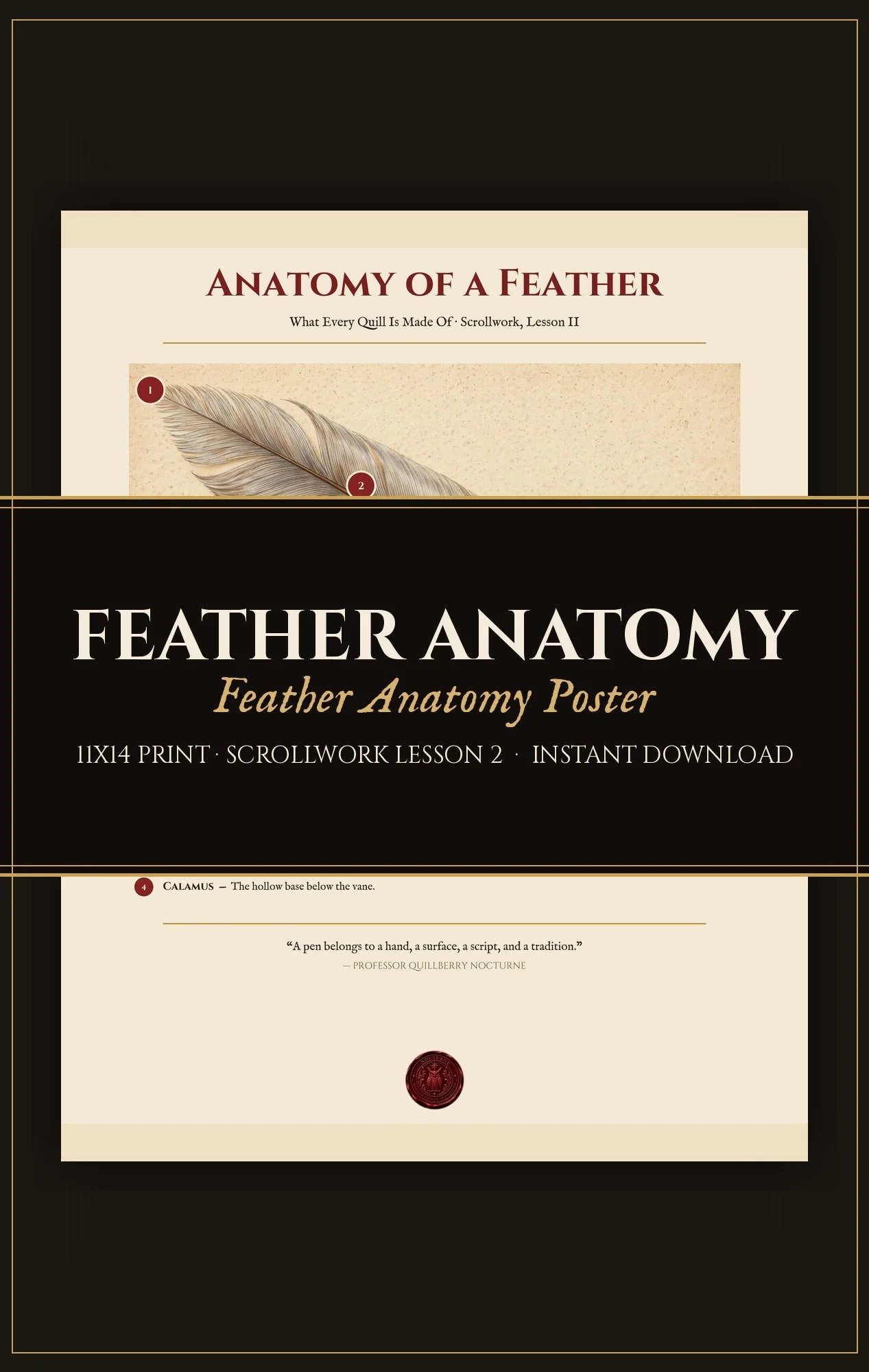
The anatomy of a feather, labeled for quill-makers — the diagram behind Scrollwork's quill lessons. Digital PDF, sized 11×14 for printing.