
RUNES & ANCIENT WRITING
Unit II · Lesson 4THE MISSING LINK
Proto-Sinaitic: Where the Alphabet Was Born
Professor Thistleloom Webblethorn
Epigrapher • Runes & Ancient Writing
Head of House Septentrio • School of Evershade
Professor's Introduction

You return. Good. I hope your wedges have dried and your owls are watching.
What happens to writing when it falls into the hands of people who cannot read it?
Today we come to the hinge of our entire course.
Everything after this lesson descends from what happened in a turquoise mine in the Sinai desert, some thirty-seven centuries ago. Every alphabet of the Mediterranean, Middle Eastern, and European traditions. The letters on this page. The runes we are traveling toward. All of them begin here, with workers who could not read, looking at pictures they could not understand, and having an idea so simple and so radical that it changed the world.
They did not borrow the pictures. They stole the principle, and left the pictures behind entirely.
I have been waiting to show you this since our first morning together. Come closer to the web. This is where the alphabet is born.
PROFESSOR THISTLELOOM WEBBLETHORN
Runes & Ancient Writing
Epigrapher, Head of House Septentrio
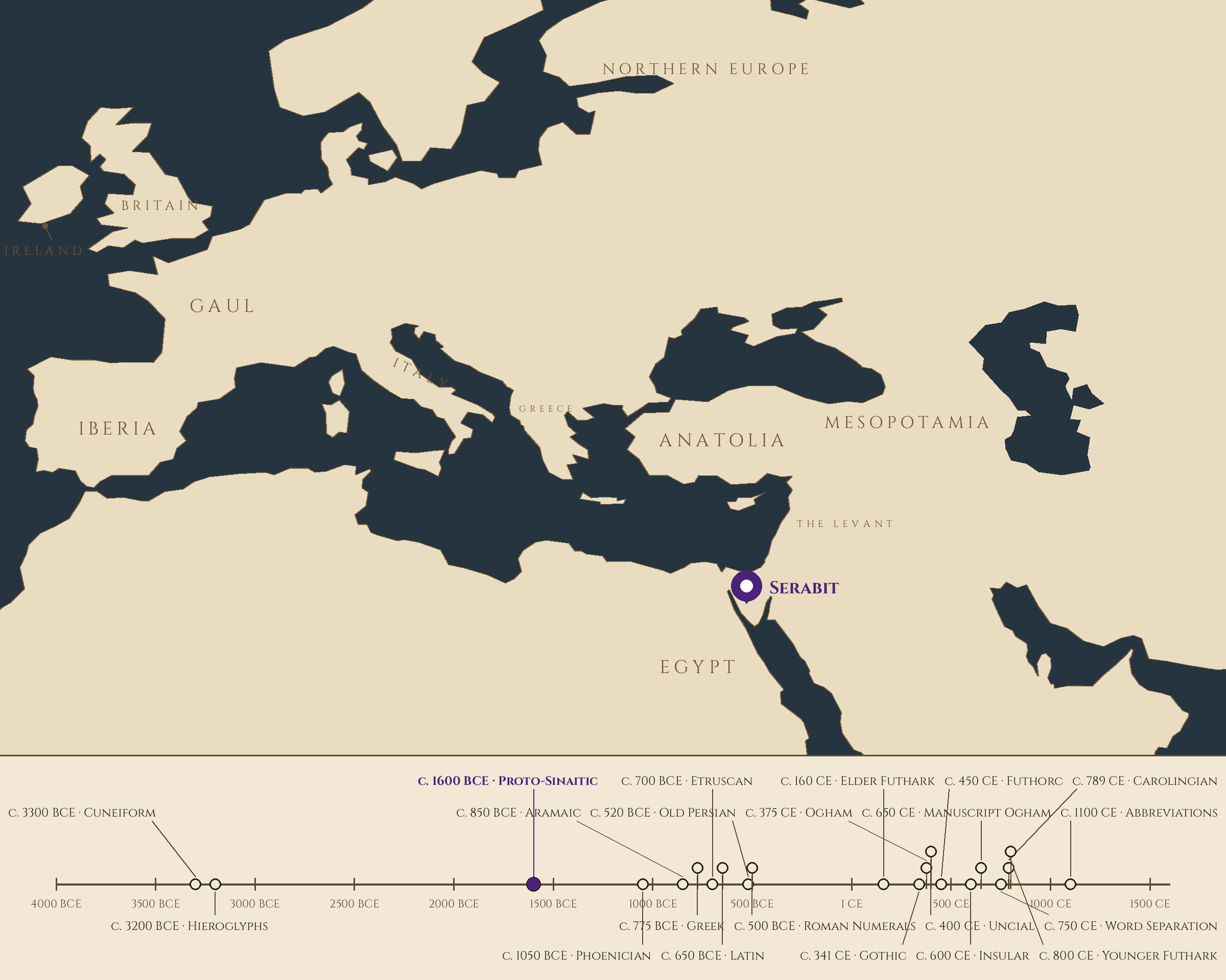
Where and when: Serabit el-Khadim, in the Sinai desert, about 3,700 years ago. The pin is this lesson. The line beneath the map is our road: every stop a writing system, every lesson a pin.
Lesson Objectives
By the end of this lesson, students should be able to:
- Explain what Proto-Sinaitic is and where its inscriptions were found.
- Define Proto-Sinaitic, acrophony, abjad, Semitic languages, Serabit el-Khadim, and Baʿalat.
- Describe how Semitic-speaking workers adapted Egyptian hieroglyphs through acrophony.
- Identify the six lesson letters (Alp, Bet, Mem, Nun, Resh, Taw) and explain each one's pictorial origin.
- Explain the difference between borrowing pictures and borrowing the alphabetic principle.
- Tell the story of Gardiner's 1916 decipherment and the lbʿlt reading.
- Explain why scholars debate the readings and what Wadi el-Hol suggests.
- Apply the course question to the alphabet's invention.
Reading this lesson: ★ marks the passages to remember. They return on the unit quiz and the class test. Check in questions ask the material back as you go; answer them in your workbook when you meet them.
Working this lesson: Your assignment packet is the first download on this page. Work in it as the lesson moves along, answering each assignment as its subject is taught — or read the lesson through for your notes and take the assignments as homework afterward. Both are proper ways to sit this class. Signposts in the reading tell you where each assignment belongs. Written answers are short answers in your own words; a few honest lines are worth more than a filled page.
Your Assignment Packet
This lesson's assignments live in its packet: the Lexicon Handout (every term, course terms marked ◆), Materials, Guided Practice, the Assignment Manual with its answer key for self-checking, the Reflection Questions, and the Workbook Checklist. Download the packet before you begin and keep it beside you as you read.
The Mines of Turquoise
In the southern Sinai Peninsula, among harsh red mountains, lies a site the ancient Egyptians called Serabit el-Khadim. The rock there holds veins of turquoise, the blue-green stone the Egyptians prized for jewelry and inlay.
During the Middle Kingdom, roughly the 20th to 18th centuries BCE, Egyptian expeditions traveled to these mines seasonally, and they did not travel alone.
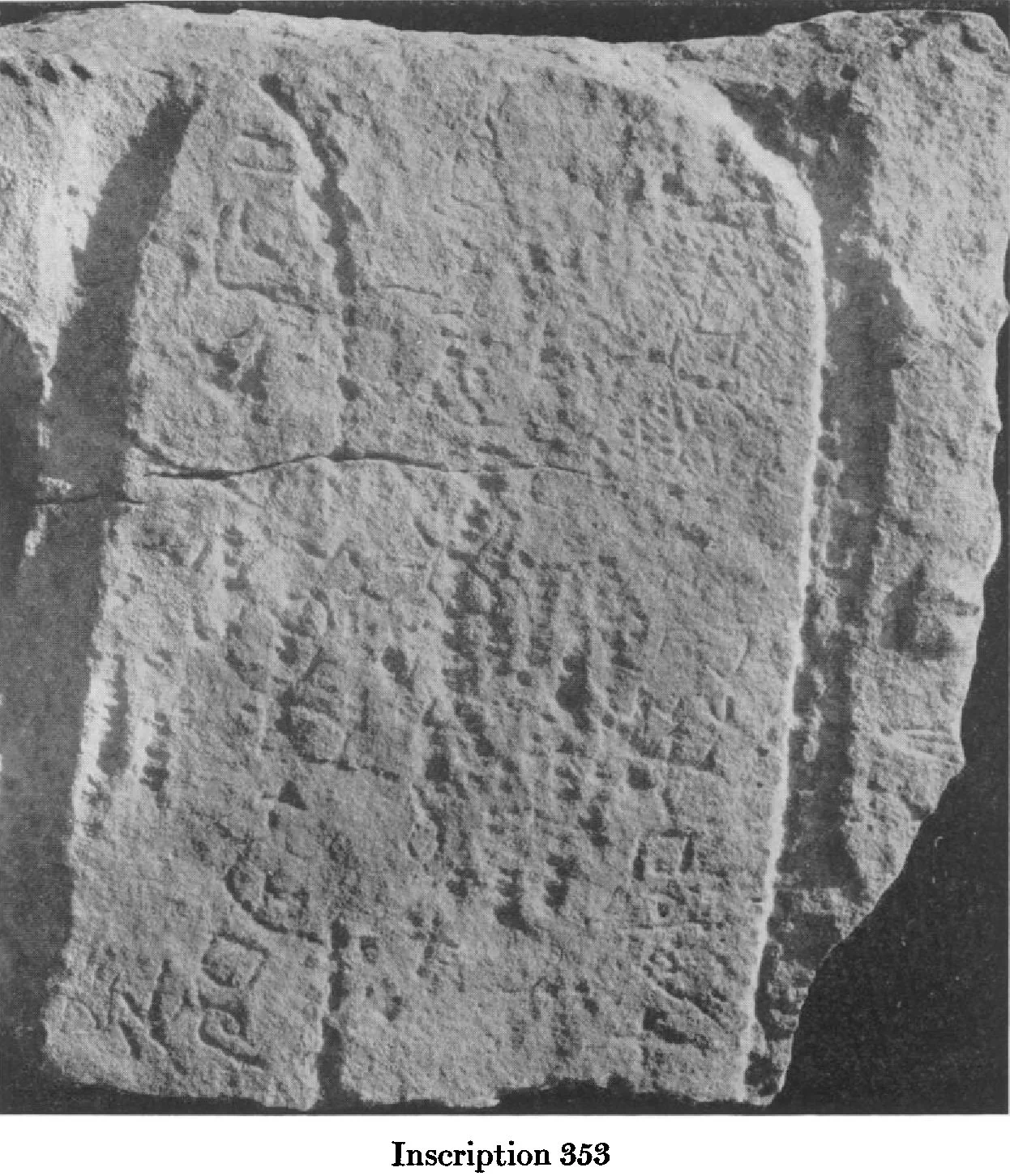
Historical example. A real Sinai inscription, photographed for the first scholarly publication of the Serabit el-Khadim texts: faint picture-signs scratched into the mine rock by the workers themselves — an eye, a house plan, crosses, wavy lines. This is what the alphabet looked like at its birth: crude, personal, and unstandardized.
Proto-Sinaitic inscription 353, Serabit el-Khadim. Photograph by Romain Butin, from the early publication of the Serabit inscriptions. Public domain, via Wikimedia Commons.
★ They brought workers: Semitic-speaking people (speakers of a Semitic language, from the family that includes Phoenician, Hebrew, Aramaic, and Akkadian) from the Levant, the coastal region the Egyptians called Canaan. These workers mined the turquoise, hauled it, and lived in the expedition camps.
★ They were not scribes. By every indication, most of them could not read or write in any script. They were laborers in someone else's enterprise, surrounded by someone else's writing.
Because the Egyptians wrote everywhere they went. The expedition leaders carved commemorative inscriptions in hieroglyphs on the rock faces. A small temple to Hathor, the Egyptian goddess the miners associated with turquoise, rose near the mines, its walls covered in Egyptian text.
The workers lived for months at a time inside a landscape saturated with pictures that meant something to their Egyptian overseers and nothing, or next to nothing, to them.
And then, some of those workers began to carve pictures of their own.
The inscriptions they left — the earliest known alphabetic writing, which scholars call Proto-Sinaitic — are short, crude, and few: a few dozen texts, scratched into rock walls and small stone sphinxes around the site. The signs are recognizably borrowed from Egyptian hieroglyphs.
An ox head. A house plan. A ripple of water. A human head in profile. But they are not Egyptian writing.
The workers took the shapes and did something no one had done before.
Dating these inscriptions precisely is difficult. Most scholars place them in the 17th to 16th centuries BCE, the middle of the second millennium. Some argue for earlier dates, into the 19th or 18th centuries.
The imprecision matters less than the fact: somewhere in this window, in a mining camp in the desert, the alphabet was invented.
★ There is a further wrinkle worth knowing. At Wadi el-Hol, in Upper Egypt, archaeologists found similar early alphabetic inscriptions that some scholars date as early as 1900 to 1800 BCE. If those dates hold, the Sinai mines may not be the alphabet's sole birthplace.
The honest scholarly position is that the invention happened somewhere in this Egyptian-Semitic contact zone, and the details remain open. You will find me returning to that honesty throughout our course. It is a strength, not a weakness, to say what we do not know.
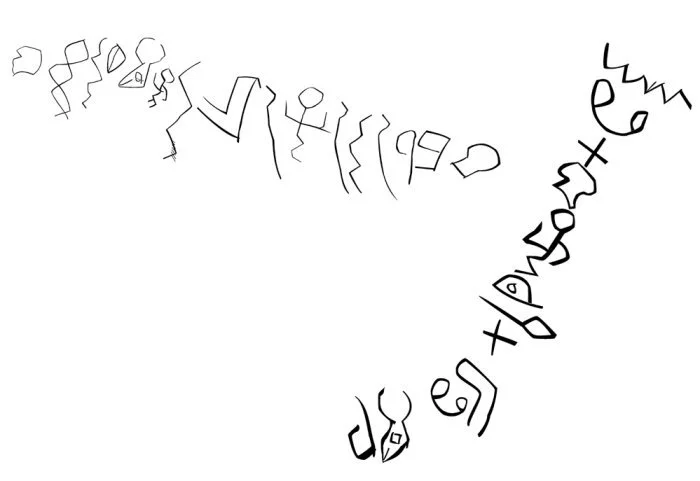
Historical example. The wrinkle, drawn: the two early alphabetic inscriptions from Wadi el-Hol in Upper Egypt, one running down a rock face, one across it. If their early dating holds, the alphabet's birthplace may not be Sinai alone — the lesson's honest uncertainty, in the carvers' own signs.
The Wadi el-Hol inscriptions, Upper Egypt: drawing after the carved originals. Public domain, via Wikimedia Commons.
Check in: Who carved the Proto-Sinaitic inscriptions, and what covered the walls and rock faces all around them at Serabit el-Khadim?
❦ In your workbook: record the turquoise mines of Serabit el-Khadim in your own way — copy, sketch, or note what matters.
The Radical Idea
What the Sinai workers did was not to learn Egyptian writing. It was to misunderstand it productively.
Consider what they saw every day: Egyptian hieroglyphs, pictures that stood for sounds through the Rebus Principle you learned in Lesson 2.
The Egyptian mouth sign meant the sound r because the Egyptian word for mouth began with r. The water ripple meant n because the Egyptian word for water began with n.
Now imagine you are a Canaanite worker. You do not speak Egyptian. But you recognize the pictures: everyone recognizes an ox, a house, water.
And you speak a Semitic language in which the word for ox is ʾalp, the word for house is bet, the word for water is mem (or mayim).
What if the ox picture stood not for the Egyptian sound but for the first sound of your word for ox? What if the house picture stood for the first sound of your word for house?
That is acrophony, and it is the whole invention.
★ The workers took perhaps two dozen Egyptian picture-signs and reassigned each one to the initial consonant of the Semitic name for the depicted object.
Ox head (ʾalp) became the sign for the glottal stop ʾ. House plan (bet) became b. Water ripple (mem) became m. Head in profile (resh, "head") became r. A mark or cross (taw) became t. A snake figure became n — the sign kept the serpent's shape even though the letter name nūn means "fish," a puzzle scholars still discuss.
Notice what has been left out. Everything. The hundreds of Egyptian signs are gone. The logograms are gone. The determinatives are gone. The three-and-a-half millennia of pictorial tradition are gone.
What remains is a handful of pictures, each standing for a single consonant, each chosen by the simplest possible rule: draw the thing, take its first sound.
Our course question has never been answered so completely. What can we leave out and still be understood? The Sinai workers left out the entire Egyptian writing system and kept only the idea that a picture can stand for a sound. Then they rebuilt from that single idea, in their own language, for their own purposes.
They did not borrow the pictures. They stole the principle and left the pictures behind.
There is a thesis about who these inventors were that I want you to know, because it reframes the whole story. The scholar Orly Goldwasser has argued that the alphabet was invented not by scribes but by illiterate miners: people outside the scribal tradition, unburdened by its rules, free to see the pictures fresh.
A trained Egyptian scribe would never have dismantled the system this way. It took outsiders, people the system was not built for, to see that the pictures were optional and the principle was everything.
I find this deeply moving. The most consequential invention in the history of writing was made by people who could not write.
Check in: In one sentence, what is acrophony? Show it working with the ox or the house.
❦ In your workbook: record the idea of acrophony in your own way — copy, sketch, or note what matters.
In your packet: Assignment II — Invent an Alphabet ◐ begins here. Work it now, or mark the place and take it as homework — your choice.
Six Letters That Changed the World
Let us meet the letters themselves, because each one carries its origin story in its shape, and those shapes are still visible in the alphabet you are reading now.
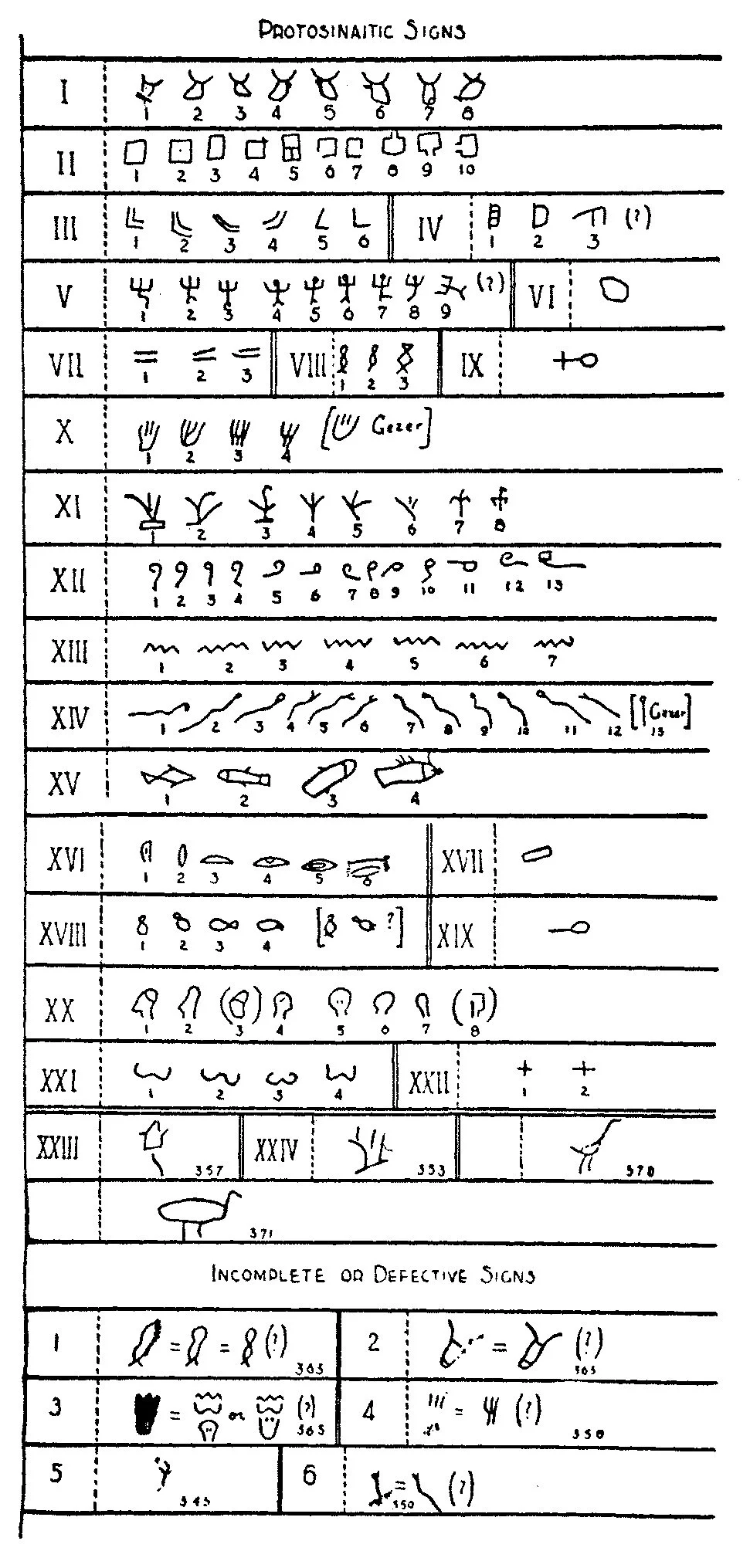
Historical example. One sign, many shapes. Butin's table gathers the carved variants of each Proto-Sinaitic sign side by side: the ox heads of row I, the house plans of row II, the water ripples, the serpents, the heads, the crosses. No standard, no school, no two alike — a fresh invention looks exactly like this.
Table of Proto-Sinaitic signs and their variant forms, from Romain Butin's publication of the Serabit el-Khadim inscriptions. Public domain, via Wikimedia Commons.
★ Alp: the ox. The sign is an ox head, drawn in profile or frontally: horns, ears, muzzle. The Semitic word ʾalp meant ox. By acrophony, the ox head stands for the glottal stop ʾ, the catch in the throat. Turn the ox head on its side, then upside down, and simplify over centuries, and you arrive at our letter A. The horns become the crossbar. Every A you have ever written began as an ox.
★ Bet: the house. The sign is a house plan, a rectangle with an opening: the same kind of floor-plan pictograph you met in Lesson 1 as the Sumerian É. The Semitic word bet meant house (Hebrew bayit is its descendant). By acrophony, the house stands for b. Simplify the plan over centuries and you arrive at our letter B. Every B began as a house.
Mem: the water. The sign is the water ripple, borrowed directly from the Egyptian water sign you learned in Lesson 2. The Semitic word mem (or mayim) meant water. By acrophony, the ripple stands for m. Let the ripple straighten and angle over centuries and you arrive at our letter M. Every M began as water.
★ Nun: the snake. The sign is a serpent figure, though scholars describe the glyph as "presumably from the depiction of a snake." Here is the puzzle: the letter name nūn means "fish" in Semitic, not snake. Why would a snake picture carry a fish name? The honest answer is that we do not fully know. Perhaps the original picture was a fish and the surviving forms drifted. Perhaps the name and the picture have separate histories that converged. The lesson for the student is that letter-origin stories are reconstructions, and reconstructions have seams. By acrophony (on whatever the original association was), the sign stands for n. Simplify over centuries and you arrive at our letter N.
Resh: the head. The sign is a human head in profile. The Semitic word resh (or rōsh) meant head (Hebrew rosh survives). By acrophony, the head stands for r. Round the profile and simplify, and you arrive at our letter R. Every R began as a head.
Taw: the mark. The sign is a simple mark: a cross or X shape. The Semitic word taw meant mark or sign. By acrophony, the mark stands for t. This is the most abstract of our six: the picture is already barely a picture. Simplify the cross and you arrive at our letter T. Every T began as a mark.
Six pictures. Six consonants: ʾ, b, m, n, r, t. No vowels, because Semitic languages build their words from consonantal roots and the reader supplies the vowels (the system is an abjad: it records consonants and leaves most vowels unmarked), the same principle you learned with Egyptian in Lesson 2.
No logograms. No determinatives. No hundreds of signs. Just the first sounds of six familiar things.
From these six, and their companions, the Phoenicians would build a 22-letter alphabet (our next lesson). From Phoenician, the Greeks would take the letters and add vowels.
From Greek, the Romans. Every alphabet of the Mediterranean, Middle Eastern, and European traditions: Greek, Latin, Cyrillic, Hebrew, Arabic among them, carries traces of the Sinai miners' idea.
I want to be precise here, because precision is a form of respect. Not every writing system on earth descends from this moment.
Chinese characters developed independently. Korean Hangul was designed independently in the 15th century. The Brahmic scripts of South Asia may or may not connect through Aramaic; scholars dispute it.
The claim I will make, and no more, is this: the alphabetic tradition that produced the scripts of Europe, the Middle East, and North Africa began in Sinai. That is enough. It is more than enough.
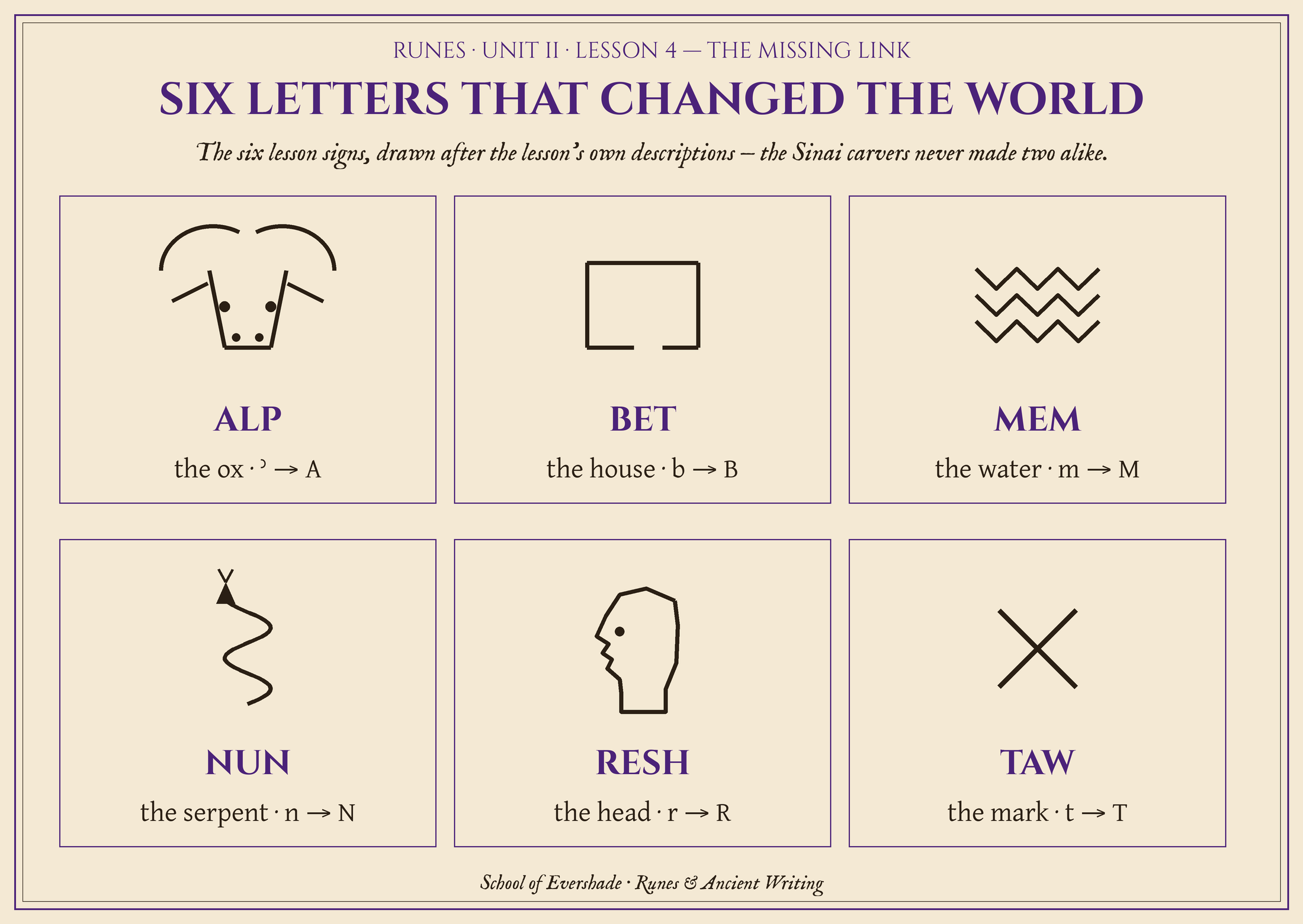
The six lesson letters: Alp the ox, Bet the house, Mem the water, Nun the serpent, Resh the head, Taw the mark — each drawn after the lesson's description, each carrying the first sound of its Semitic name, each on its way to becoming a letter you write every day.
Built for Evershade.
❦ In your workbook: record the six letters and where each one came from in your own way — copy, sketch, or note what matters.
In your packet: Assignment I — The Letter Chart ⚒ begins here. Work it now, or mark the place and take it as homework — your choice.
Professor Webblethorn
Pause here, scholars, and feel the weight of what has just happened.
In our first lesson, the Mesopotamians invented writing by pressing tokens into clay, and the invention belonged to accountants.
In our second, the Egyptians spent three and a half millennia drawing pictures that spelled sounds, and the invention belonged to priests and scribes.
In our third, the Persians designed a script the way one commissions a building, and the invention belonged to a king's scholars.
This one belongs to miners who could not read.
They stood before the most sophisticated writing system on earth, a system that had taken three thousand years to perfect, and they did not try to learn it. They took it apart. They kept the single idea that mattered, that a picture can stand for a sound, and they threw away everything else: the hundreds of signs, the years of training, the divine authority, the beauty. They kept the principle and discarded the pictures, and from that discarding, the alphabet.
I have spent my life among inscriptions, scholars, and I tell you plainly: this is the bravest thing anyone in our course has done. It takes a particular kind of sight to look at something magnificent and see what it does not need.
Keep the question beside you. It is the silk thread running through every lesson: nearly invisible, holding everything together.
Now, to the decipherment. For even this script, the simplest ever devised, was silenced by time, and had to be given back.
PROFESSOR THISTLELOOM WEBBLETHORN
Runes & Ancient Writing
Epigrapher, Head of House Septentrio
Reading the Unreadable
The Proto-Sinaitic inscriptions sat in the desert for over three thousand years, unrecognized and unread. Egyptian archaeologists recorded them. Travelers photographed them. No one knew what they were.
The breakthrough came in 1916, from the British scholar Alan Gardiner. Gardiner noticed something about a recurring group of signs in the inscriptions. The same sequence appeared repeatedly, in contexts that suggested dedication or offering.
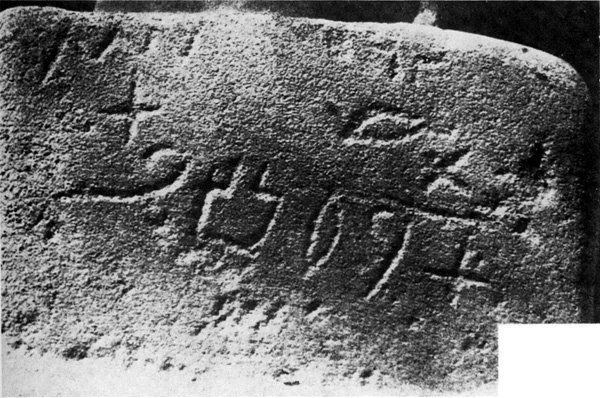
Historical example. The key itself: the weathered stone whose repeated sign-group Gardiner read in 1916 as lbʿlt — “to the Lady.” Among the scratches you can pick out the house, the eye, and the mark. A short, repeated formula did what no long text could: it gave the decipherer something to guess at.
The Serabit inscription bearing the sequence Gardiner read as lbʿlt, “to the Lady.” Early photograph, published before 1931. Public domain, via Wikimedia Commons.
He made the decipherer's classic guess: this must be a name or a formula, the way Champollion had guessed that cartouches held royal names and Grotefend had guessed that repeated formulas held kings' titles.
★ Gardiner read the sequence as lbʿlt: "to the Lady." The l was the dedicatory prefix ("to, for"). The rest spelled bʿlt, "the Lady," a title of the goddess associated with the mining region, the Baʿalat.
If the reading was correct, then the signs' sound values could be derived from the Semitic words, and the values matched the acrophonic principle beautifully.
The ox head was ʾalp. The house was bet. The system unlocked.
Gardiner's reading is widely accepted today, and the acrophonic decipherment it enabled is the foundation of everything we know about the alphabet's birth.
But I must tell you, as I have told you before, where the honest uncertainties lie.
Individual inscriptions remain debated. The corpus is small, the signs are crudely carved and non-standardized, and short texts offer limited context for confirming readings. Scholars disagree about specific words, specific signs, and the precise relationship between the Sinai inscriptions and the later Phoenician alphabet.
The Wadi el-Hol inscriptions in Upper Egypt, possibly older than the Sinai texts, complicate the picture further: if the alphabet was invented more than once, or in more than one place, the Sinai story becomes one chapter rather than the whole book.
This is the current state of knowledge, and it is a healthy one. The broad outline, that Semitic speakers in Egypt's orbit invented alphabetic writing through acrophony in the second millennium BCE, is secure.
The details are alive with debate. When you read scholars disagreeing about a three-thousand-year-old graffito, you are watching the field work as it should. Scholars transliterate Proto-Sinaitic signs using reconstructed Semitic letter names (Alp, Bet, Mem) and their sound values, and because the readings are debated, transliterations in scholarly literature sometimes differ.
There is one more thing the inscriptions tell us, and it is written in their very irregularity. The signs vary wildly from carving to carving. The same letter looks different in different hands. The direction of writing changes: sometimes left to right, sometimes right to left, sometimes top to bottom.
There was no school, no standard, no scribal tradition enforcing consistency. This is exactly what an invention by non-scribes looks like.
A trained tradition produces uniformity. A fresh invention produces variety. The messiness of the Sinai inscriptions is itself evidence for who made them.
Check in: Gardiner's key was one short sequence repeated again and again. What did he read it as, and why was a repeated formula a better key than a longer, more varied text?
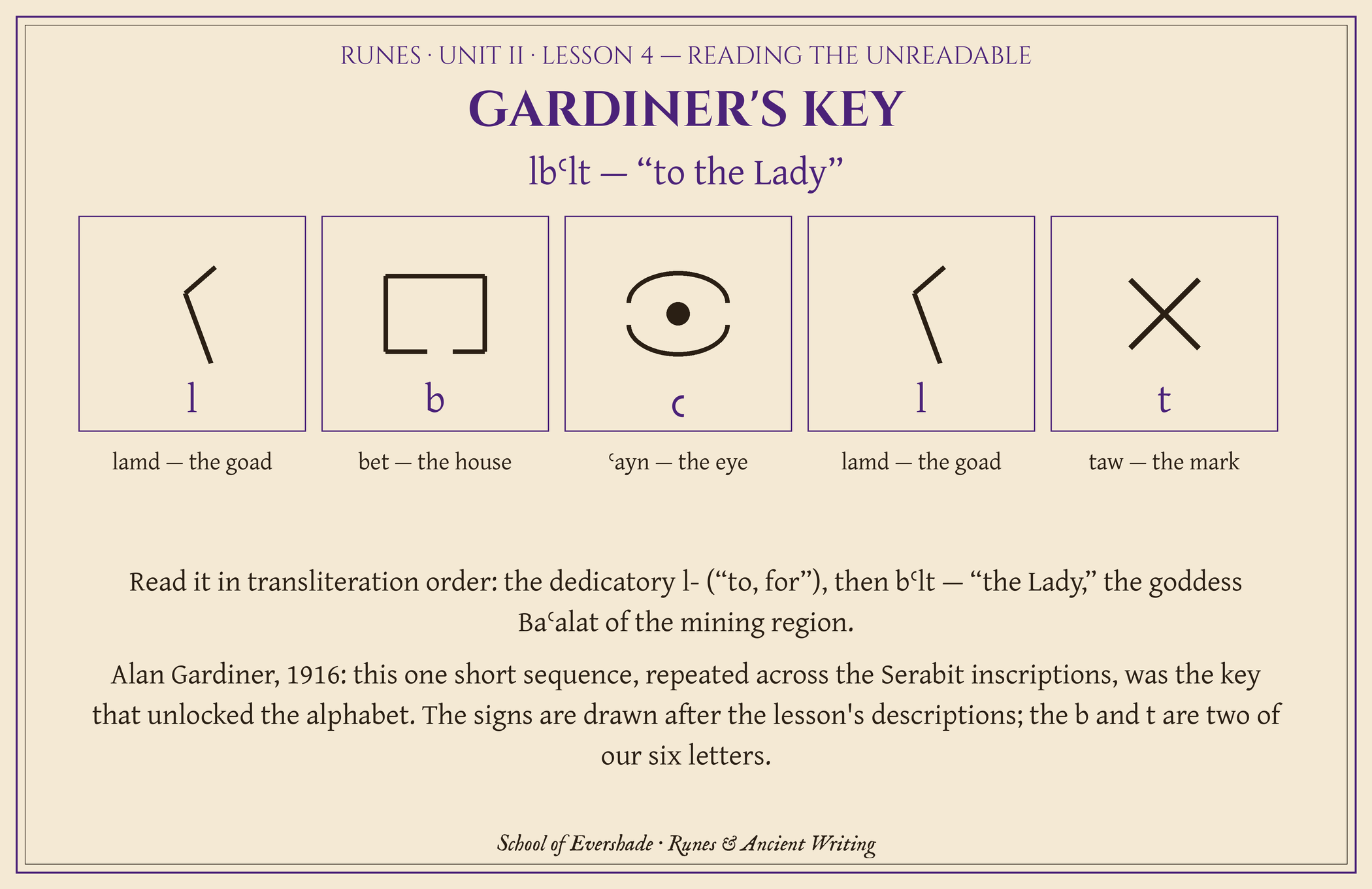
Gardiner's key, sign by sign: lamd the goad, bet the house, ʿayn the eye, lamd again, taw the mark — l-b-ʿ-l-t, “to the Lady.” Two of the five signs are among our six letters; the goad and the eye are the two Exercise C asks you to sketch.
Built for Evershade.
❦ In your workbook: record how the unreadable was read in your own way — copy, sketch, or note what matters.
In your packet: Assignment III — The Baʿalat Investigation ◐ begins here. Work it now, or mark the place and take it as homework — your choice.
Guided Practice — The Miner's Hand
Before the assignments, try the inventor's work yourself. You do not need to be a scribe. That is rather the point.
Exercise A — Drawing the Six Letters
- On paper, draw each of the six lesson letters three times: the ox head (Alp), the house plan (Bet), the water ripple (Mem), the serpent (Nun), the head in profile (Resh), the cross mark (Taw).
- Label each with its sound value (ʾ, b, m, n, r, t).
- Now draw our modern letters A, B, M, N, R, T beside them. Can you see the family resemblance? Which modern letter has drifted farthest from its picture? Which is closest?
- Compare your copies. The Sinai carvers valued nothing like Egyptian elegance. Which letter was hardest to make recognizable with crude tools?
You do not need to carve beautifully. The original inventors certainly did not. You need to feel what they felt: the moment a picture becomes a sound.
❦ Workbook path: make your master set in your workbook instead of on loose paper: one letter to a page, drawn large, with its name, its sound value, and the modern letter it became written beneath. This is the set you will copy from all year.
Exercise B — The Acrophony Game
Acrophony is a game anyone can play, and the best way to understand it is to invent with it.
- Choose six familiar objects and draw a simple picture of each: for example, a sun, a tree, a fish, a hand, a star, a door.
- Take the first sound of each object's English name: s (sun), t (tree), f (fish), h (hand), and so on.
- You have just invented a six-letter alphabet. Write your initials using only your new letters. Where does the system strain? (English needs vowels; your alphabet has none. How did the Sinai workers avoid this problem, and why could they?)
- Write two sentences on what this exercise teaches you about the difference between inventing a system and inheriting one.
This is the closest you will come, in this course, to standing in the miners' place. Notice how little you needed: six pictures, six first sounds, and the willingness to throw away everything else.
Exercise C — Reading lbʿlt
- Using the lesson's letter values, write out the signs for l, b, ʿ, l, t. (You have b and t from the six letters. For l and ʿ, note that these come from letter origins beyond our set: lamd "goad" and ʿayn "eye." Sketch what you think those pictures might have looked like.)
- Assemble the sequence l-b-ʿ-l-t and add the translation "to the Lady" beneath it.
- Write a half page: why was this short dedication the key to decipherment? What made a repeated formula more useful to Gardiner than a longer, more varied text would have been?
In your packet: Assignment IV — The Thief's Essay ✎ begins here. Work it now, or mark the place and take it as homework — your choice.
Assignment Manual
Assignment key: ✎ written work · ⚒ hands-on practical · ◐ both · ★ will be on the test · ❦ workbook path
Written answers in this manual are short answers in your own words — a few honest lines, not a filled page.
Assignment I — The Letter Chart ⚒ ★
Objective: Demonstrate control of the six lesson letters and their origins.
Instructions:
- On a fresh sheet, divide your page into six boxes.
- In each box, draw one letter's proto-form as carefully as you can: ox head (Alp), house plan (Bet), water ripple (Mem), serpent (Nun), head in profile (Resh), cross mark (Taw).
- Label each with its sound value, its Semitic name and meaning, and the modern letter it became.
- Below the chart, write one paragraph tracing a single letter from its Sinai picture to its modern form, describing what changed at each stage you can identify.
Your keepsake: this chart is the first alphabet you have ever made, in the miners' own pictures. Keep it beside your wedge chart. Every letter you write from now on descends from these six.
❦ Workbook path: build the chart across a two-page workbook spread instead of a separate sheet: six boxes, the same careful drawings and labels, and your traced paragraph beneath.
To submit: Photograph or scan your chart. Clarity and correct labeling matter more than artistic skill.
Assignment II — Invent an Alphabet ◐ ★
Objective: Understand acrophony by doing it.
Instructions:
- Choose eight familiar objects and draw a simple, recognizable picture of each.
- Assign each picture the first sound of its English name (this is acrophony in your own language).
- Using only your eight letters, spell five English words. Choose words whose sounds mostly match your letter set.
- Write a one-page reflection: where did your system work well? Where did it break down? What does the breakdown teach you about why the Sinai workers' consonantal system suited a Semitic language better than it would suit English?
❦ Workbook path: keep the whole invention in your workbook: your eight pictures in a grid on one page, your five spelled words beneath them, and the reflection written out in your own hand after them.
To submit: Your eight pictures with their sound values, your five spelled words, and the reflection.
Assignment III — The Baʿalat Investigation ◐ ★
Objective: Understand how decipherment works and where its limits lie.
Instructions:
- Research (using the References below): who was Alan Gardiner, and what did he notice about the recurring lbʿlt sequence?
- The reading "to the Lady" depends on identifying bʿlt as a divine title. Research the goddess Baʿalat and her association with the Serabit el-Khadim region. Write a half page summarizing what is known and what remains uncertain.
- Research the Wadi el-Hol inscriptions. In a half page, explain how their possible earlier dating complicates the Sinai birthplace narrative, and why scholars have not settled the question.
- Write three to four sentences taking a position: does the uncertainty about details weaken the broad claim that the alphabet was invented through acrophony in the second millennium BCE? Why or why not?
Assignment IV — The Thief's Essay ✎ ★
Objective: Connect the lesson's central act to the course through-line.
Instructions:
Write a one-page essay addressing the following:
The lesson describes the Sinai workers as having "stolen the principle and left the pictures behind." Is "stolen" the right word? Consider: the workers lived and labored inside Egyptian culture, surrounded by its writing, yet excluded from its literacy. Was their act theft, reinvention, liberation, or something else entirely? And what does it mean that the most democratic writing system ever devised, the alphabet, was invented by people the existing system was not built for?
Cite at least two specific details from the lesson in your argument.
Materials
Required (Level One — household items)
- Paper: plain white paper or a sketchbook, for letter practice and invention exercises.
- Pencils: one standard pencil for drafting, one fine-tipped pen or marker for final letter drawings.
- A ruler: for dividing practice sheets into boxes.
- A printout of the six letters: use the lesson's descriptions as your reference.
Suggested (Level Two — historically closer materials)
- A soft stone or plaster slab: the Sinai workers carved into rock. A flat piece of sandstone, a plaster tile, or a thick piece of air-dry clay left to firm up approximates the resistance they worked against. Compare carving with Lesson 1's pressing and Lesson 3's stone-carving notes.
- A nail or metal point: closer to the tools that scratched the Sinai inscriptions than a pencil is. Work carefully and supervise young students.
- A rock from outdoors: for the fully committed, any flat-ish stone and a harder stone for scratching reproduce the original experience at its most direct. The results will be crude. That is historically accurate.
Neither level requires
Purchased kits, specialty tools, or any material you cannot find locally or order inexpensively. The core lesson (drawing letters, inventing with acrophony, understanding the system) is fully achievable with paper and pencil.
Reflection Questions
Answer the following in your workbook.
- Who invented the Proto-Sinaitic script, and under what circumstances? Why does Goldwasser's thesis about illiterate miners matter?
- What is acrophony? Explain how it works using two of the six lesson letters as examples.
- How does borrowing a principle differ from borrowing pictures? Why is the distinction central to this lesson?
- Trace one modern letter (A, B, M, N, R, or T) from its Sinai picture through to its current form. What changed, and what survived?
- How did Gardiner decipher Proto-Sinaitic? Why was the recurring lbʿlt sequence the key?
- What do the Wadi el-Hol inscriptions suggest, and why haven't scholars settled the birthplace question?
- The lesson asks what can be left out and still be understood. The Sinai workers left out more than anyone before them. Apply the question to their invention: what did they keep, and was it enough?
Workbook Checklist — Lesson 4
In my workbook I have:
- ☐ explained what Proto-Sinaitic is and where its inscriptions were found
- ☐ written out what Proto-Sinaitic, acrophony, abjad, Semitic languages, Serabit el-Khadim, and Baʿalat mean
- ☐ described how Semitic-speaking workers adapted Egyptian hieroglyphs through acrophony
- ☐ identified the six lesson letters (Alp, Bet, Mem, Nun, Resh, Taw) and explained where each picture came from
- ☐ explained the difference between borrowing pictures and borrowing the alphabetic principle
- ☐ told the story of Gardiner's 1916 decipherment and the lbʿlt reading
- ☐ explained why scholars debate the readings, and what Wadi el-Hol suggests
- ☐ applied the course question to the alphabet's invention
☐ Lesson completed Date: ____________ Signature: ____________
Professor's Review
And so our fourth lesson closes in a turquoise mine in Sinai, where workers who could not read invented the alphabet.
You can now explain what Proto-Sinaitic is and where it was found, describe acrophony and apply it, identify the six lesson letters and trace each to its modern descendant, tell the story of Gardiner's decipherment, explain what remains debated, and articulate why this invention belongs to outsiders.
Keep your letter chart beside your wedge chart, your hieroglyphs, and your Old Persian signs. You now hold the beginnings of four writing systems, and the pattern is unmistakable. Mesopotamia subtracted until only wedges remained. Egypt kept everything. Persia kept the look and rebuilt the rest. Sinai kept one idea and threw away the world.
Four answers. One of them changed everything.
Next, we follow the alphabet out of the desert and onto ships, where Phoenician merchants will take the miners' rough letters, standardize them into twenty-two, and carry them across the Mediterranean to every shore. The alphabet is about to grow up, learn manners, and go to sea.
Practice your letters, scholars. Draw the ox until you can draw it from memory, then turn it upside down and see your own initial looking back at you. There is no pleasure in epigraphy quite like the moment a three-thousand-year-old picture becomes a letter you write every day. I have felt it a thousand times, and it has not diminished.
PROFESSOR THISTLELOOM WEBBLETHORN
Runes & Ancient Writing
Epigrapher, Head of House Septentrio
Cross-Class Connections
The rock-carving techniques of the Sinai inscriptions connect directly with Creative Arts, which will explore carving and incising. The miner's scratched ox head and the Persian mason's chiseled Behistun share the fundamental act: a hard point against a harder surface.
The story of non-elite invention parallels Scrollwork, where Professor Nocturne examines how writing cultures include and exclude. The Sinai miners, locked out of Egyptian literacy, invented their way in. Students studying both classes should consider who writing serves and who it leaves outside, in every period.
The acrophonic principle will reappear throughout Runes, most immediately in Lesson 5, when the Phoenicians standardize these rough signs into a 22-letter alphabet. Students should trace individual letters from their Sinai pictures through Phoenician forms to the Greek and Latin descendants they know.
In Other Classrooms
Creative Arts · Unit VII, Lesson 27 — First Cuts: Carving Safely

A scratched sign is still a cut, and a cut is still a craft. When you are ready to feel how the Sinai miners worked, come to the Workshop: we begin carving safely, soft materials first, the mark laid out before the tool ever touches down. Small signs, scholars, deserve the same care as large ones.
The desert is only our fourth stop, but the alphabet's journey has begun.
References & Further Reading
The British Museum. Collection online. Searchable collection including Sinai inscriptions and early alphabetic artifacts. https://www.britishmuseum.org/collection
The Metropolitan Museum of Art. Heilbrunn Timeline of Art History. Museum essays on the ancient Near East, with collection objects from Sinai and the Levant. https://www.metmuseum.org/toah/hd/wrtg/hd_wrtg.htm
Wikipedia. "Proto-Sinaitic script." Comprehensive overview: the Serabit el-Khadim inscriptions, acrophony, letter origins, Gardiner's decipherment, and current debates. https://en.wikipedia.org/wiki/Proto-Sinaitic_script
Wikipedia. "Phoenician alphabet." The descendant system: 22 letters, Mediterranean spread, and the lineages to Greek, Latin, Hebrew, and Arabic. Essential context for where this lesson leads. https://en.wikipedia.org/wiki/Phoenician_alphabet
Rollston Epigraphy. "The Serabit el-Khadim Inscriptions." Christopher Rollston's detailed discussion of the inscriptions, Gardiner's lbʿlt reading, and debated interpretations. http://www.rollstonepigraphy.com/?m=201008
Wikipedia. "Wadi el-Hol inscriptions." The two early alphabetic inscriptions found by John and Deborah Darnell in Egypt's western desert: discovery, dating to around 1800 BCE, and the scholarly publication (Darnell et al., Annual of the American Schools of Oriental Research 59, 2005). For the deeply curious. https://en.wikipedia.org/wiki/Wadi_el-Hol_inscriptions
Goldwasser, Orly. "How the Alphabet Was Born from Hieroglyphs." Biblical Archaeology Review, 2010. Goldwasser's full presentation of the miner-inventor thesis. https://library.biblicalarchaeology.org/article/how-the-alphabet-was-born-from-hieroglyphs/
Browse the Runes shelf in the school Library for readable editions of these works.
Submit your work for this lesson using the form below.
CONTINUE IN RUNES & ANCIENT WRITING
← Previous · Lesson 3: Old Persian Cuneiform: A New Script in Ancient Robes Next · Lesson 5: Phoenician: How Trade Standardized the Alphabet →
Unit II · The Cradle of the Alphabet Runes & Ancient Writing Classroom · All 21 Lessons
The rest of Unit II: Lesson 5 · Phoenician · Lesson 6 · Aramaic