RUNES & ANCIENT WRITING
Unit II · Lesson 5THE MERCHANT'S ABJAD
Phoenician: How Trade Standardized the Alphabet
Professor Thistleloom Webblethorn
Epigrapher • Runes & Ancient Writing
Head of House Septentrio • School of Evershade
Professor's Introduction

Fair winds, scholars. I hope your ox heads are drying.
Picture a harbor at Byblos: jars of dye and bales of timber going aboard, and twenty-two small signs traveling lighter than any of them.
Today the alphabet grows up, learns manners, and goes to sea.
The Phoenicians did not invent the alphabet. I want you to hold that sentence carefully, because the world will try to take it from you. Popular books say it. Museum labels sometimes say it. It is not true, or rather, it is true only in the way a rumor is true: it has the shape of the truth with the center removed.
The alphabet was invented in Sinai, by the miners you met last lesson. What the Phoenicians did was something nearly as consequential. They took twenty-some rough, irregular, miner-scratched signs and turned them into twenty-two clean, consistent, teachable letters. They standardized the alphabet. And then they put it on ships.
Without the miners, there would be no alphabet. Without the Phoenicians, there would be no alphabets, plural, spreading. The difference matters. Today you will learn why.
Come closer to the web, scholars. We are leaving the desert for the sea.
PROFESSOR THISTLELOOM WEBBLETHORN
Runes & Ancient Writing
Epigrapher, Head of House Septentrio
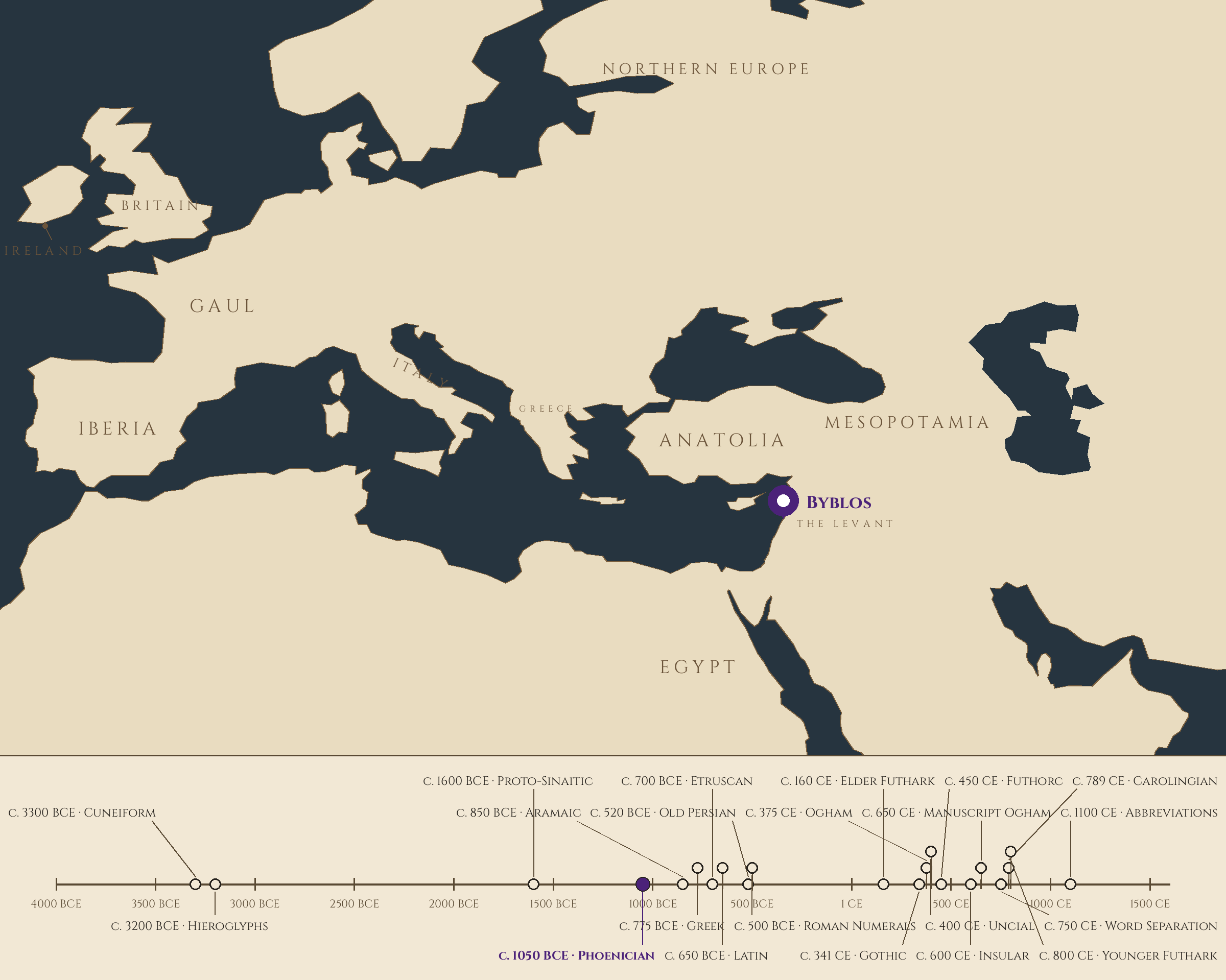
Where and when: Tyre, on the Phoenician coast of the eastern Mediterranean, about 3,100 years ago. The pin is this lesson. The line beneath the map is our road: every stop a writing system, every lesson a pin.
Lesson Objectives
By the end of this lesson, students should be able to:
- Explain who the Phoenicians were and why trade shaped their writing.
- Define Phoenician, ostracon, Tyrian purple, consonantal skeleton, and standardization.
- Describe the 22-letter Phoenician abjad and its right-to-left direction.
- Trace at least six letters from Phoenician through Greek to the modern Latin alphabet.
- Explain how the Greeks adapted the Phoenician abjad by adding vowels.
- Explain why the "Phoenicians invented the alphabet" claim is a myth, and what they actually did.
- Identify common Phoenician writing surfaces and explain the parchment caution.
- Apply the course question to standardization.
Reading this lesson: ★ marks the passages to remember. They return on the unit quiz and the class test. Check in questions ask the material back as you go; answer them in your workbook when you meet them.
Working this lesson: Your assignment packet is the first download on this page. Work in it as the lesson moves along, answering each assignment as its subject is taught — or read the lesson through for your notes and take the assignments as homework afterward. Both are proper ways to sit this class. Signposts in the reading tell you where each assignment belongs. Written answers are short answers in your own words; a few honest lines are worth more than a filled page.
Your Assignment Packet
This lesson's assignments live in its packet: the Lexicon Handout (every term, course terms marked ◆), Materials, Guided Practice, the Assignment Manual with its answer key for self-checking, the Reflection Questions, and the Workbook Checklist. Download the packet before you begin and keep it beside you as you read.
The Merchants of the Sea
The Phoenicians were not an empire. They were a coastline.
Along the eastern Mediterranean, in what is now Lebanon and northern Israel, a string of independent port city-states grew rich on trade: Tyre and Sidon in the south, Byblos in the north, and their neighbors. Each city governed itself.
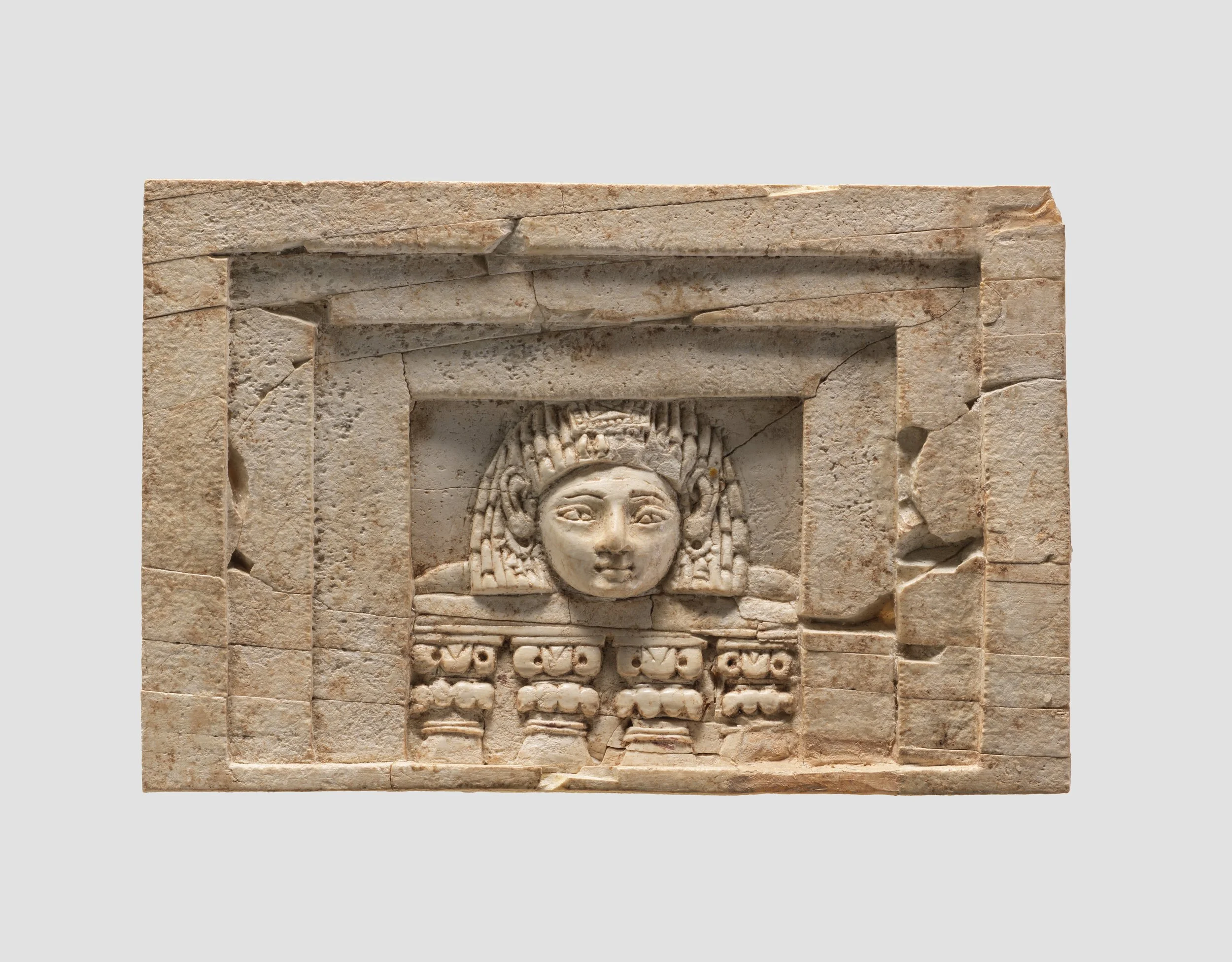
Historical example. The goods that filled the ships: an ivory furniture plaque in the Phoenician style — a woman framed at her window, the famous “woman at the window” of Phoenician carving. Ivory, glass, metalwork, cedar, and purple dye moved on the same ships as the twenty-two letters.
Furniture plaque carved in relief with a “woman at the window,” Phoenician style, ca. 9th–8th century BCE. The Metropolitan Museum of Art, New York (57.80.11). Public domain, The Met Open Access.
What united them was the sea, the ships, and the goods that moved between them: cedarwood from the Lebanese mountains, prized across the ancient world for shipbuilding and temples; glass and metalwork; wine and oil; and above all the purple dye that made Tyre famous, the Tyrian purple extracted at staggering labor from murex snails.
By roughly the early first millennium BCE, Phoenician ships were everywhere the Mediterranean touched: Cyprus, North Africa, Sardinia, Spain. They founded colonies, the most famous being Carthage.
They traded with Egyptians, Greeks, Assyrians, and everyone between. And everywhere they went, they wrote.
This is the context in which the alphabet grew up. The Sinai miners invented it in isolation, scratching on rocks. The Phoenicians needed it for business: cargo manifests, contracts, accounts, correspondence between ports.
A merchant's writing system must be fast to learn, quick to write, and readable by anyone trained in it, at any port. The rough, irregular Sinai signs, varying from carving to carving, would not do. The Phoenicians regularized them.
Dating the transition precisely is difficult, as it always is with the early alphabet. The conventional date for the emergence of the Phoenician alphabet as a distinct, standardized system is around 1050 BCE, the early first millennium.
The script remained in use through the Phoenician cities' long history, into the Hellenistic period and beyond: the conventional end date is around 146 BCE, though Punic (the Carthaginian descendant) survived considerably longer.
★ What matters for our course is not the exact year but the act.
Someone, or some community of someones, looked at the inherited alphabetic signs and decided they should be consistent: same shapes, same order, same direction, every time. That decision is standardization, and it is what turned an invention into an institution.
Check in: The Phoenicians did not invent the alphabet. In one sentence: what did they do to it, and what need drove them to do it?
❦ In your workbook: record the merchants of the sea in your own way — copy, sketch, or note what matters.
Twenty-Two Letters
★ The Phoenician alphabet fixed the inherited signs at twenty-two letters, each standing for a consonant, written from right to left.
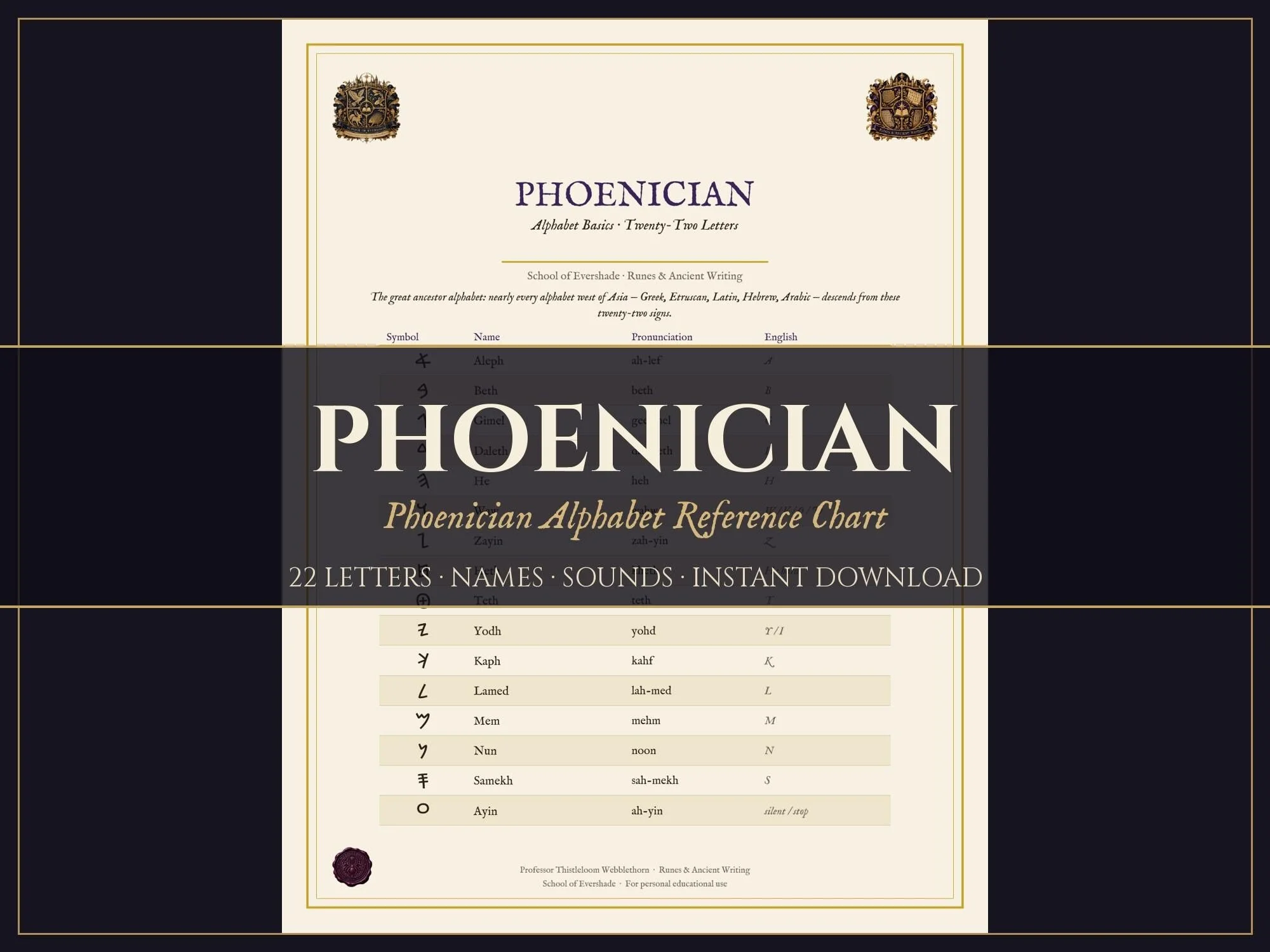
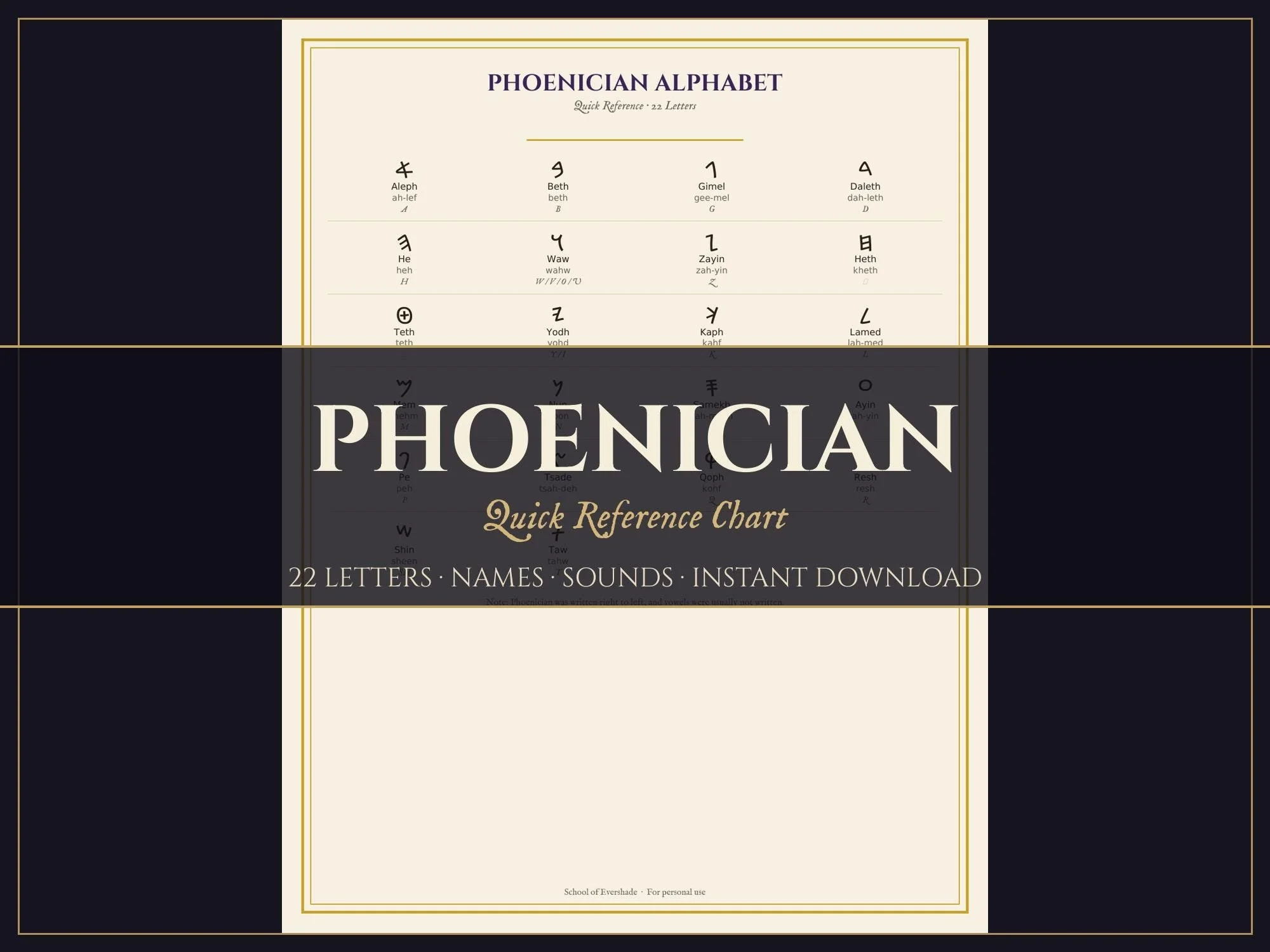
Here they are, with their names, their reconstructed original meanings, and their sound values. Read them slowly. You are looking at the ancestors of the letters on this page.
Aleph (ox): ʾ, the glottal stop. The Sinai ox head, simplified over centuries of copying, until the horns became a crossbar and the head became our A.
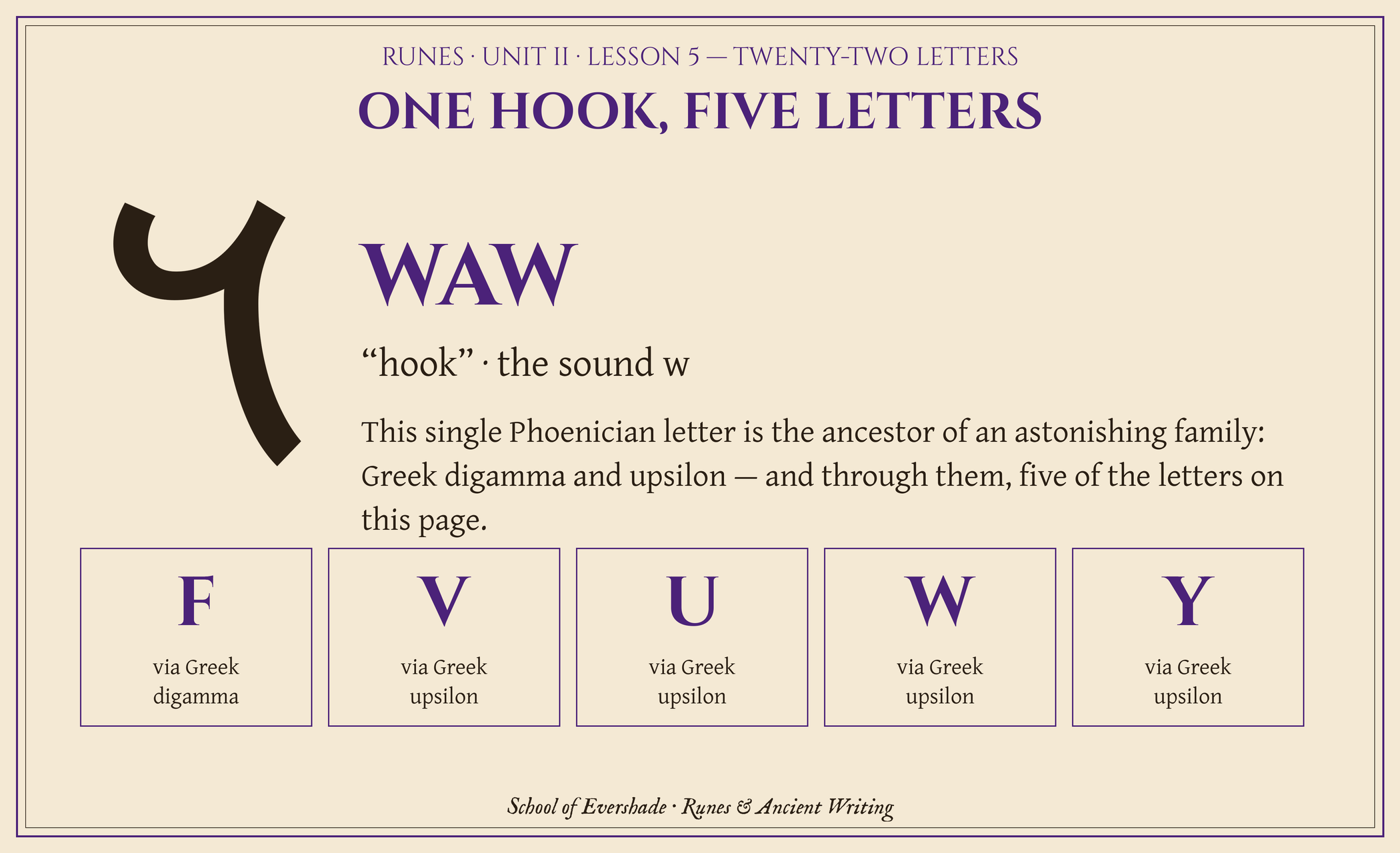
One hook, five letters: Waw, the sixth letter, is the ancestor of Greek digamma and upsilon — and through them of our F, V, U, W, and Y.
Built for Evershade.
Bet (house): b. The house plan, reduced to a shape the Greeks would turn into Beta and we would turn into B.
Gimel (camel, or possibly a throwing stick): g. The ancestor of Greek Gamma and our G.
Dalet (door): d. The ancestor of Delta and D. Note the family resemblance to Bet: related shapes for related sounds, a pattern the alphabet keeps.
He (window, or jubilation): h. A breathy consonant with no clean English equivalent. The Greeks would later repurpose this sign entirely, which is a story for below.
★ Waw (hook): w. This single letter is the ancestor of an astonishing family: Greek digamma and upsilon, and through them our F, V, U, W, and Y. One hook, five modern letters.
Zayin (weapon): z. The ancestor of Zeta and Z.
Het (fence): ḥ, a deep throaty sound (a voiceless pharyngeal fricative) with no English equivalent. The Greeks repurposed it as the vowel Eta. Another transformation story.
Tet (wheel): ṭ, an emphatic t. The ancestor of Greek Theta.
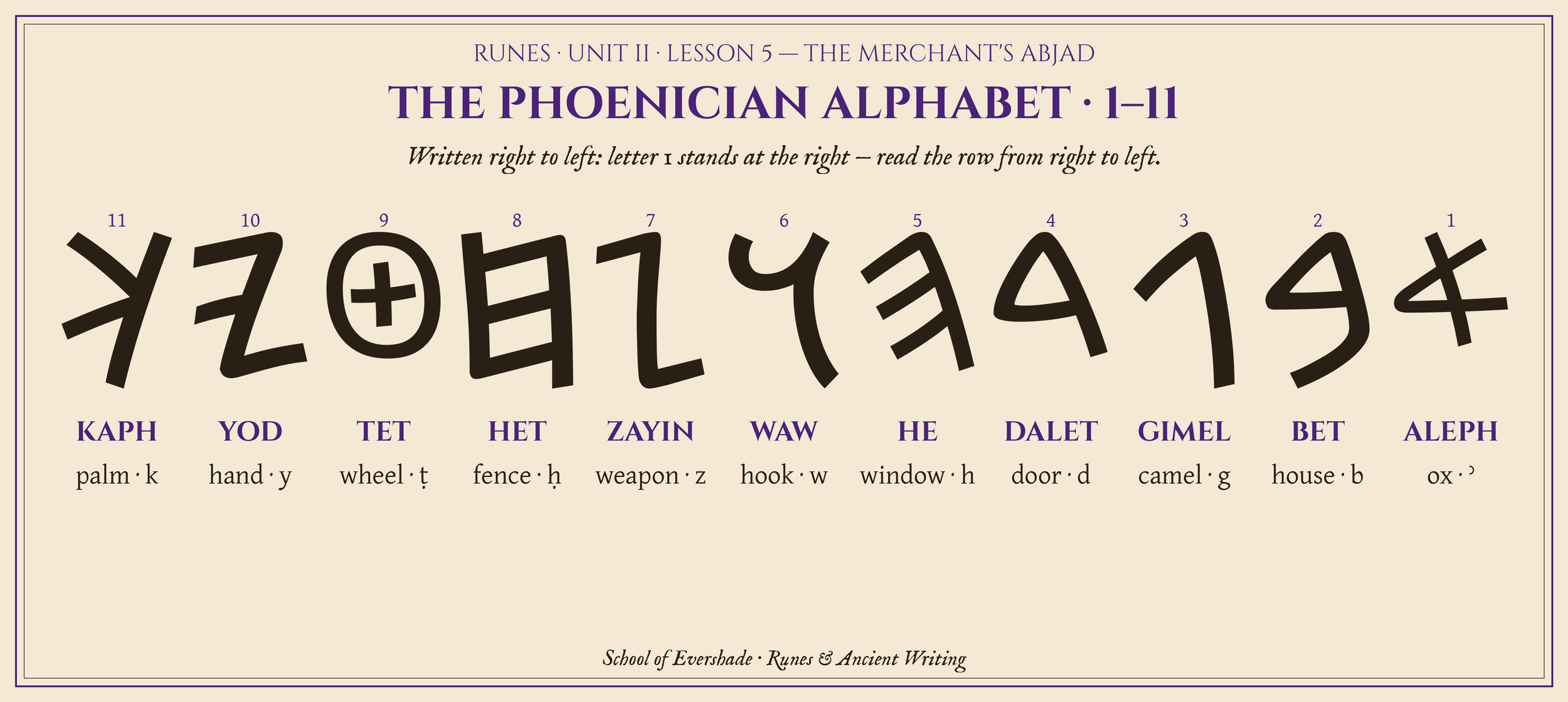
The twenty-two, first half: Aleph to Kaph, each with its name, its picture-meaning, and its sound. Read the row the way a Phoenician would — letter 1 stands at the right, and the row runs right to left.
Built for Evershade.
Yod (hand): y. The ancestor of Iota, and through it our I and J.
Kaph (palm of the hand): k. The ancestor of Kappa and K.
Lamed (goad, a cattle prod): l. The ancestor of Lambda and L.
Mem (water): m. The Sinai ripple, standardized. The ancestor of Mu and M.
Nun (fish): n. Remember the Lesson 4 puzzle: the name means fish, though early forms look serpentine. Standardized now, whatever its origin. The ancestor of Nu and N.
Samekh (support, or fish skeleton): s. The ancestor of Greek Xi.
Ayin (eye): ʿ, a voiced pharyngeal sound with no English equivalent. The Greeks repurposed it as the vowel Omicron.
Pe (mouth): p. The ancestor of Pi and P.
Tsade (hunt, or papyrus plant): ṣ, an emphatic s. Its descendants are complex; it contributed to several later letterforms.
Qoph (monkey, or knot): q, a deep k sound. The ancestor of Greek Koppa and our Q, which survives almost exclusively in the company of U.
Resh (head): r. The ancestor of Rho and R.
Shin (tooth): š (sh). The ancestor of Greek Sigma and our S, through several descendant forms.
Taw (mark): t. The ancestor of Tau and T.
Twenty-two consonants. No vowels. Written right to left, each letter distinct, each in its fixed place in the order. This is the alphabet as an institution: learnable in days rather than years, writable on anything, portable across the sea.
I want you to notice something about the letter names. Aleph still means ox. Bet still means house. Mem still means water.
The acrophonic meanings survived as pure convention, the way we say "A is for apple" without believing the letter depicts fruit. The pictures are gone from the shapes, but their names remember what the pictures were. The alphabet carries its own etymology in its ABCs.
Check in: One Phoenician letter is the ancestor of five modern letters. Which letter, and which five?
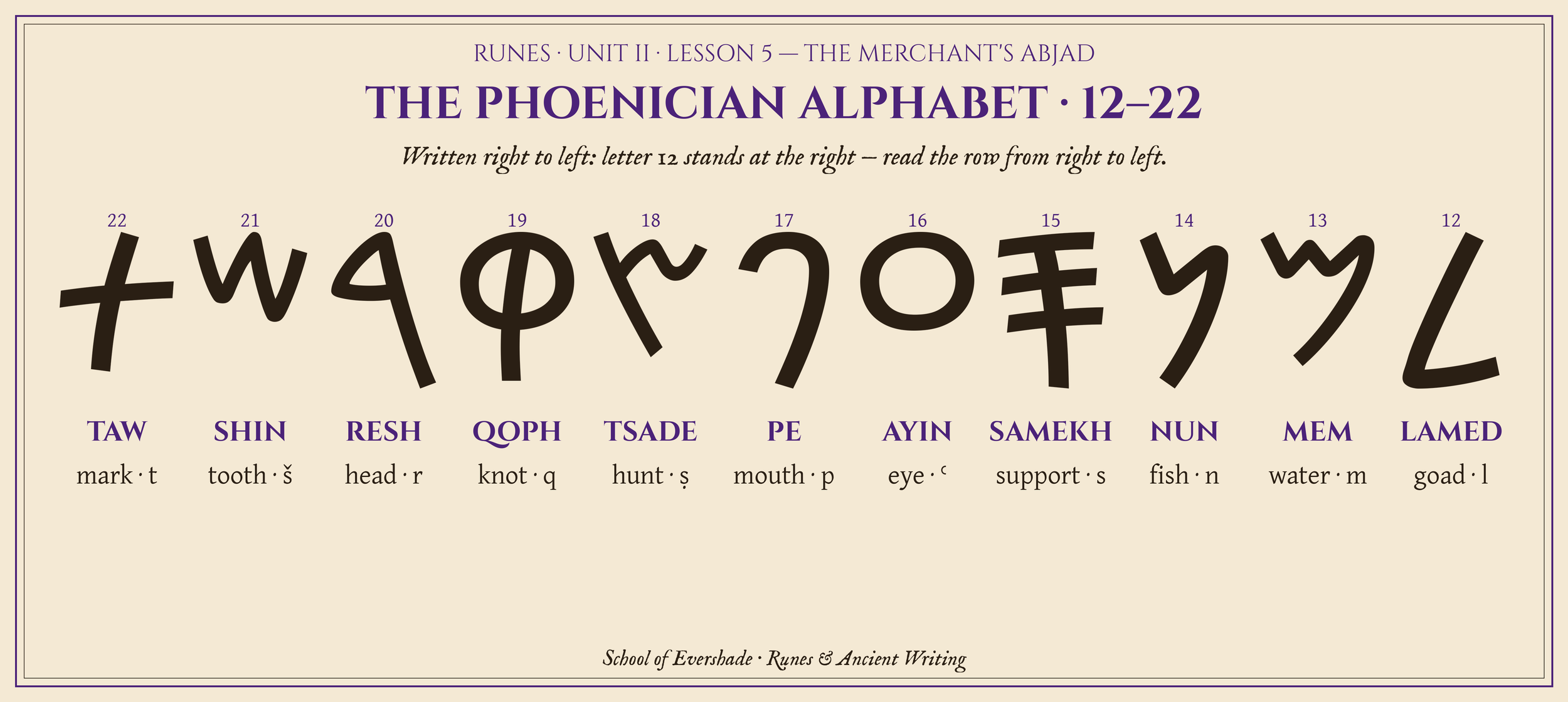
The twenty-two, second half: Lamed to Taw. Twenty-two consonants, no vowels — the reader supplies them, as you supply the vowels in “bldng.”
Built for Evershade.
❦ In your workbook: record the twenty-two letters in your own way — copy, sketch, or note what matters.
In your packet: Assignment I — The Letter Chart ⚒ begins here. Work it now, or mark the place and take it as homework — your choice.
In your packet: Assignment II — Transliteration Practice ⚒ begins here. Work it now, or mark the place and take it as homework — your choice.
From Rough to Regular
Compare, in your mind, the Sinai inscriptions with a Phoenician text. The difference is the whole lesson.
★ The Sinai carvings vary wildly. The same letter looks different in different hands. Writing direction changes: left to right, right to left, top to bottom.
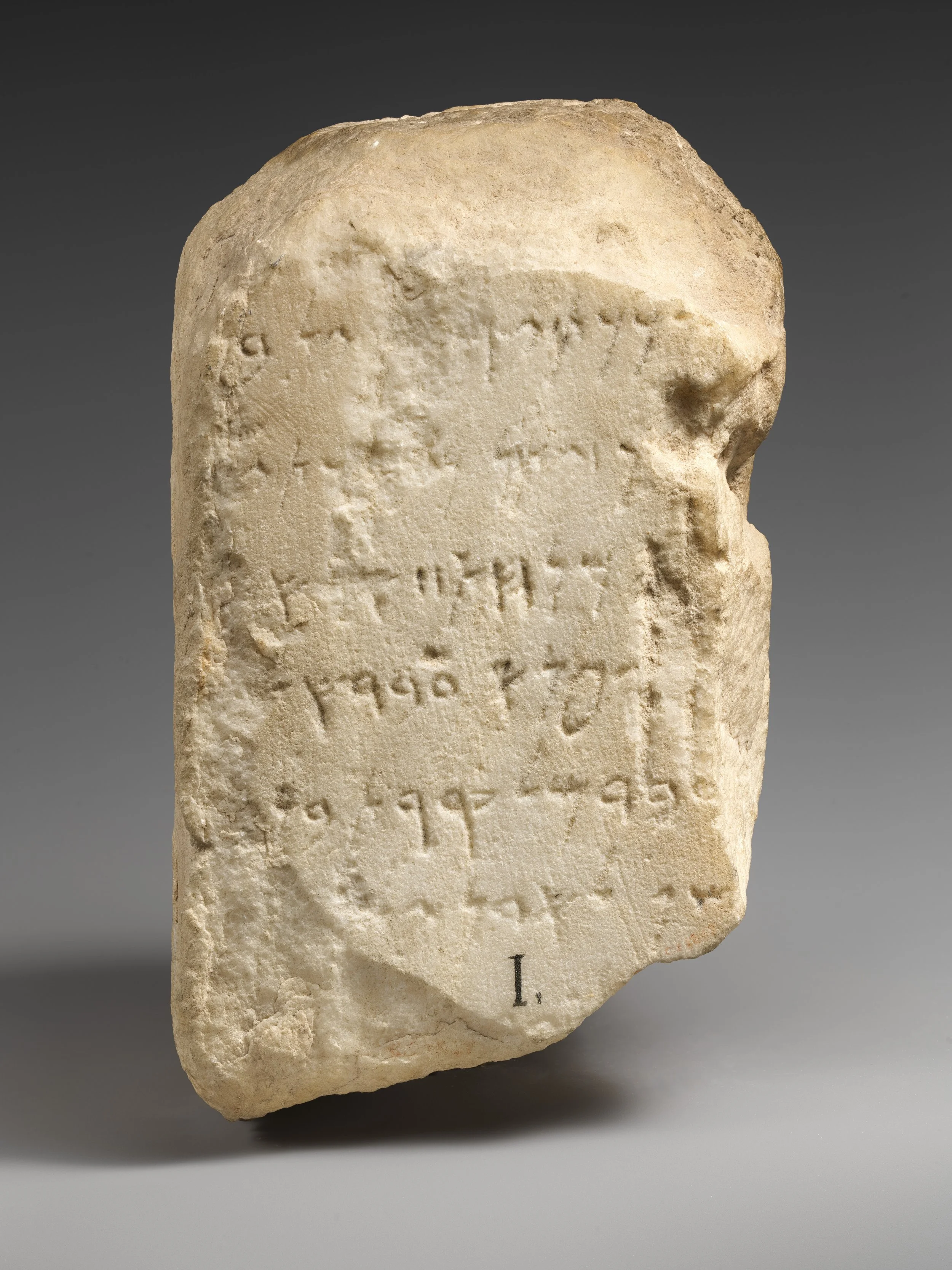
Historical example. The alphabet behaving. Lines of clean, regular Phoenician carved into a marble cippus: the same twenty-two letters, in the same forms, cut the same way by different hands centuries apart. Compare this discipline with the Sinai scratches of Lesson 4 — that difference is standardization.
Marble cippus with Phoenician inscription, ca. 362–312 BCE. The Metropolitan Museum of Art, New York (74.51.2294). Public domain, The Met Open Access.
There was no school, no standard, no authority. This is what writing looks like when it belongs to everyone and no one: vital, irregular, personal.
The Phoenician alphabet is the opposite. Twenty-two letters, fixed forms, fixed order, fixed direction. A merchant in Tyre and a merchant in Carthage, centuries and a sea apart, wrote mutually intelligible script.
That consistency did not happen by accident. It was maintained by use: by the daily business of trade, which punishes illegibility, and by the teaching of the script, which rewards regularity.
This is what standardization means, and I want you to appreciate how rare and precious it is. Most human inventions do not standardize. They remain local, various, personal.
The alphabet standardized because merchants needed it to. Trade is a stern teacher: a cargo manifest that cannot be read at the destination is worthless.
The pressure of commerce did what no king's decree could have done. It made the alphabet reliable.
Our course question takes a new form here. In Sinai, the workers asked what could be left out. The Phoenicians asked a different question: what must be fixed for the system to travel?
Their answer was everything formal: the shapes, the order, the direction. They left the principle untouched and regularized the practice. The alphabet that spread across the Mediterranean was not the miners' rough scratching. It was the merchants' clean, consistent, teachable twenty-two.
There is a quiet irony I want you to hold. The alphabet was invented by outsiders to the scribal tradition, people the system was not built for. It was perfected by merchants, people the scribal tradition would have considered beneath notice. Kings and priests get the monuments. But the alphabet belongs to the workers and the traders.
❦ In your workbook: record the move from rough to regular in your own way — copy, sketch, or note what matters.
In your packet: Assignment III — The Standardization Investigation ◐ begins here. Work it now, or mark the place and take it as homework — your choice.
The Letters Grow Up
The Phoenician alphabet did not stay Phoenician. Put a useful tool on ships, and it goes everywhere ships go.
The most consequential borrowing was the Greek one. Around the 8th century BCE, Greeks in contact with Phoenician traders adopted the alphabet, and they did something the Phoenicians had never needed to do: they added vowels.
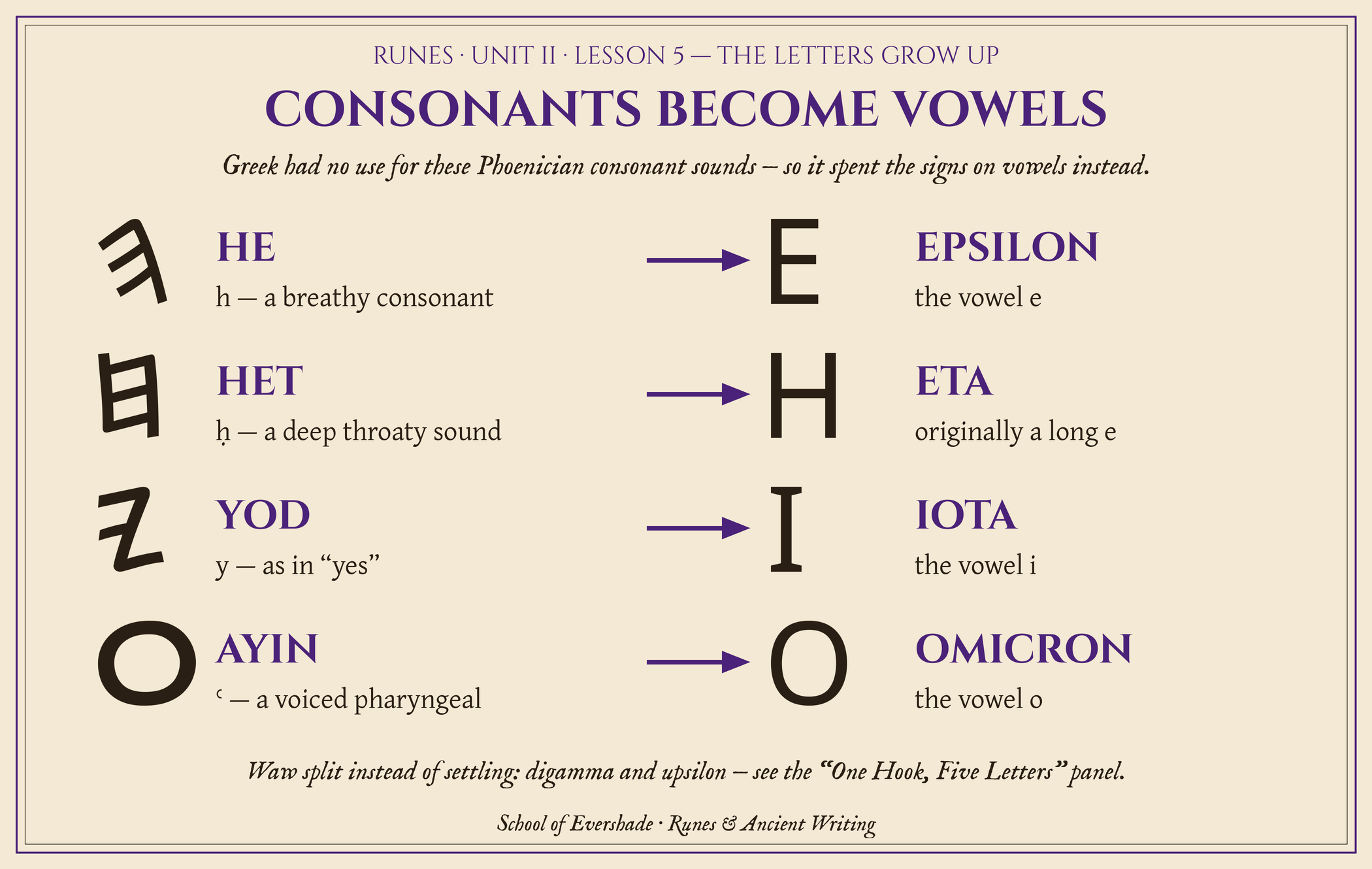
The Greek transformation: four Phoenician consonants Greek had no use for — he, het, yod, and ayin — spent again as the vowels epsilon, eta, iota, and omicron. With this, the abjad became the first true alphabet.
Built for Evershade.
This was not a small change. Semitic languages are built from consonantal roots — a word's consonantal skeleton, its consonants alone, carries its identity — so an abjad suits them: the reader's knowledge of the language fills in the vowels.
Greek is not built that way. Greek needs its vowels written, or words become unreadable. So the Greeks took Phoenician consonant signs for sounds Greek did not use and repurposed them.
The transformations are worth knowing, because they show the alphabet adapting to a new language's needs:
★ The Phoenician he (h, a breathy consonant) became Greek Epsilon, the vowel e. The het (ḥ, the deep throaty sound) became Eta, originally a long e.
The yod (y) became Iota, the vowel i. The ayin (ʿ, the pharyngeal) became Omicron, the vowel o. The waw (w) split into several descendants: digamma (later lost), and upsilon, which gave rise to our U, V, W, and Y.
With vowels added, the abjad became the first true alphabet: a script in which consonants and vowels alike have their own signs. Every alphabet you have used descends from this Greek transformation of the Phoenician inheritance.
From Greek, the letters traveled onward. The Etruscans borrowed the Greek alphabet and passed it to the Romans, who shaped it into the Latin alphabet you are reading now. Greek letters, adapted by Slavic scholars in Bulgaria, became the Cyrillic script.
Meanwhile, the Aramaic branch of the Phoenician family (Aramaic itself descended from Phoenician through regional development) gave rise to the Hebrew and Arabic scripts. Aleph became Alpha became A. Bet became Beta became B. The chain is unbroken from Sinai to this page.
★ I must add the honest boundary, the one I taught you in Lesson 4. Not every writing system descends from this lineage. Chinese characters developed independently. Korean Hangul was deliberately designed in the 15th century.
The Brahmic scripts of South Asia may connect through Aramaic, but scholars dispute it. The claim stands, and only this far: the alphabetic tradition of the Mediterranean, Middle Eastern, and European worlds began with the Sinai miners and was carried outward by Phoenician ships.
Check in: The Greeks repurposed consonant signs their language did not need as vowels. Name two Phoenician letters that became Greek vowels, and the vowels they became.
❦ In your workbook: record how the letters grew up in your own way — copy, sketch, or note what matters.
What They Wrote On
An alphabet is only as portable as its materials. The Phoenicians wrote on what the ancient Mediterranean provided.
Papyrus was the prestige surface, imported from Egypt. The city of Byblos was so associated with the papyrus trade that its name may survive in our word Bible (via Greek byblos, "book," and biblia). Papyrus took ink well and was light enough for correspondence, but it was expensive and perishable.
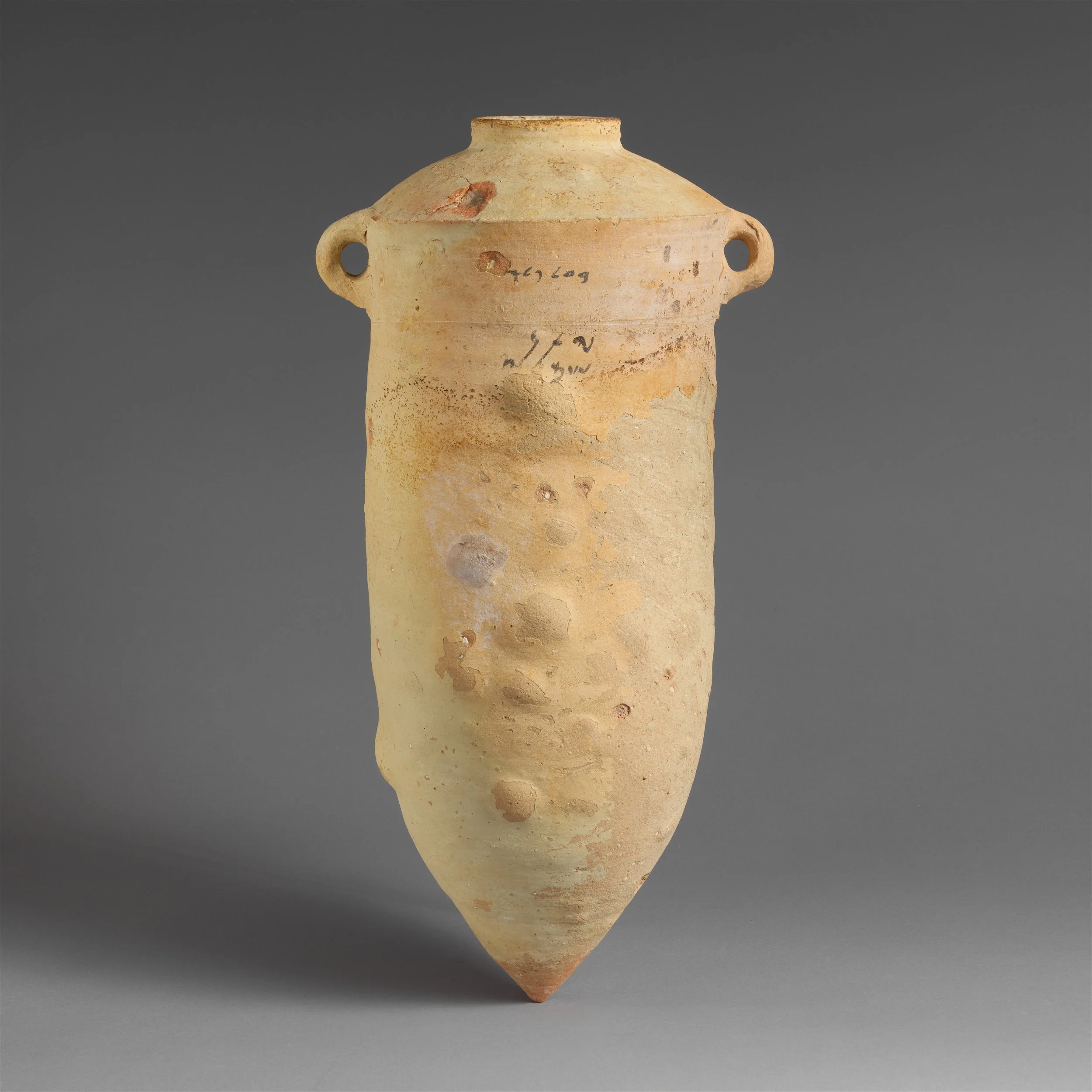
Historical example. Writing that traveled: a terracotta transport amphora with a short Phoenician inscription inked on its shoulder — a working label on a working vessel of the sea trade. Papyrus for letters, potsherds for notes, clay and stone and metal besides: the alphabet went wherever a surface offered.
Terracotta amphora with Phoenician inscription, 6th–5th century BCE. The Metropolitan Museum of Art, New York (74.51.2300). Public domain, The Met Open Access.
Ostraca, broken pottery fragments, were the everyday surface: free, abundant, durable. A merchant could jot an account on a potsherd and it would survive millennia in dry soil. Thousands of ostraca survive, preserving the informal writing, the quick notes and school exercises, that formal inscriptions omit.
Wooden boards, sometimes coated with wax, served for temporary records. Stone carried the monumental inscriptions. Metal, occasionally, for special dedications.
A note of scholarly caution, which I owe you as your epigrapher. Some accounts list parchment among Phoenician writing surfaces. Animal skin was certainly used for writing in the ancient Near East, and leather documents existed.
But parchment as a developed, processed writing surface is more securely associated with later periods (the name itself connects to Pergamon, centuries after the Phoenician alphabet's emergence). When you see "parchment" in a list of Phoenician materials, read it as a loose term for prepared animal skin, or set it aside.
Precision about materials is a form of respect for the people who used them.
The deeper point is portability. Clay tablets are heavy and fragile. Papyrus is light.
Ostraca are free. An alphabet that can be scratched on a potsherd with a nail is an alphabet that travels in a sailor's pocket. The Phoenicians' materials matched their mission: writing that moved.
❦ In your workbook: record what the Phoenicians wrote on in your own way — copy, sketch, or note what matters.
Professor Webblethorn
Pause here, scholars, and consider what the merchants did.
The miners invented the alphabet by throwing things away: the hundreds of signs, the divine authority, the years of training. They kept one principle and discarded the world.
The merchants did the opposite. They kept everything the miners had made and threw away the irregularity. They fixed the shapes. They fixed the order. They fixed the direction. They made the alphabet behave.
Two acts of leaving-out, mirror images. The miners left out the system and kept the idea. The merchants left out the variation and kept the system. Between them, invention and institution. Between them, the alphabet.
Our course question follows us to sea, as it follows us everywhere. What can we leave out and still be understood? The Phoenician answer: everything irregular. Keep the twenty-two. Teach them the same way, everywhere, every time. And then the alphabet can travel farther than any ship.
Keep the question beside you. It is the silk thread running through every lesson: nearly invisible, holding everything together.
Now, to the letters themselves. Learn their names. They remember the pictures.
PROFESSOR THISTLELOOM WEBBLETHORN
Runes & Ancient Writing
Epigrapher, Head of House Septentrio
Guided Practice — The Merchant's Hand
Before the assignments, train your eye the way a Phoenician apprentice would: by copying, comparing, and tracing descent.
Exercise A — Drawing the Twenty-Two
- On paper, draw the 22 Phoenician letterforms as carefully as you can, using the lesson's descriptions. (For Phoenician letterforms, consult the References: the Phoenician script chart shows the standardized shapes.)
- Label each with its name, sound value, and original meaning (ox, house, camel, and so on).
- Beside each, write its Greek descendant where one exists (Alpha, Beta, Gamma...). Mark the letters the Greeks repurposed as vowels.
- Which letters changed least between Phoenician and Greek? Which changed most? What does the difference suggest about which sounds the two languages shared?
You are doing, in an afternoon, what took the Mediterranean three centuries. Notice how the exercise feels: the copying is mechanical, but the comparison is where understanding lives.
❦ Workbook path: make your master set in your workbook: the twenty-two letters across two facing pages, each drawn and labelled with its name, sound, and meaning. This is the chart you will copy from when the Greeks take these letters up.
Exercise B — Right to Left
- Write your name in Phoenician letters (using the lesson's values, approximating where needed), arranged right to left.
- Now write the same name left to right, as a Greek scribe would have after the borrowing.
- Write a few sentences on the experience. Did the direction change how you thought about the letters? Why might a trading culture have settled on right to left, and what does it cost to change?
Direction feels arbitrary until you try to change it. Then you feel how deep the habit goes.
Exercise C — The Vowel Problem
- Write three English sentences using only consonants (remove all vowels, as a Phoenician scribe would). Example: "Th qck brwn fx jmps vr th lzy dg."
- Give your devoweled sentences to someone else (or set them aside and return later). How much can be recovered? Where does it break down?
- Now write the same sentences in a Semitic-style root pattern if you can imagine one. Why does the abjad suit Semitic languages better than English? What did the Greeks understand that made vowels necessary?
This exercise teaches, in your own hand, why the Greek adaptation was not decoration but necessity.
In your packet: Assignment IV — The Myth Essay ✎ begins here. Work it now, or mark the place and take it as homework — your choice.
Assignment Manual
Assignment key: ✎ written work · ⚒ hands-on practical · ◐ both · ★ will be on the test · ❦ workbook path
Written answers in this manual are short answers in your own words — a few honest lines, not a filled page.
Assignment I — The Letter Chart ⚒ ★
Objective: Demonstrate control of the 22 Phoenician letters and their descent.
Instructions:
- On a fresh sheet, create a four-column chart: Phoenician letter (drawn), name and meaning, sound value, Greek/Latin descendant.
- Complete all 22 rows. For letters the Greeks repurposed as vowels, note the original Phoenician consonant value and the Greek vowel it became.
- Below the chart, write one paragraph on the single most surprising descendant chain (for example, one hook becoming five modern letters) and explain how it happened.
Your keepsake: this chart is the alphabet grown up: twenty-two letters that crossed the sea and became every alphabet you will ever use. Keep it beside your Sinai chart. The family resemblance between the two is the whole story of this unit.
❦ Workbook path: build the chart in your workbook instead: four columns across a two-page spread, all twenty-two rows, with the vowel-repurposed letters marked and your paragraph beneath.
To submit: Photograph or scan your chart. Accuracy of the chains matters more than artistic skill.
Assignment II — Transliteration Practice ⚒ ★
Objective: Read and write Phoenician letter sequences.
Instructions:
Part A. The Phoenician word for "king" was mlk (mem-lamed-kaph). Write it in Phoenician letters, right to left. Then write the Phoenician word for "house," bt (bet-taw). What do you notice about how much information the consonants alone carry?
Part B. Transliterate the following Phoenician letter sequence into Latin letters: 𐤔𐤃 (shin-dalet). Using the lesson's values, what sounds do these represent? (This sequence appears in the lesson's source exercises.)
Part C. Choose an English word of at least six letters. Write it first in full, then as a Phoenician-style consonantal skeleton (vowels removed). Write three to four sentences on what was lost and what survived, and what that tells you about English versus Semitic word structure.
❦ Workbook path: do the whole practice in your workbook: mlk and bt written large and right to left at the top of the page, the transliteration worked beneath them, and your skeleton word with its sentences following.
Assignment III — The Standardization Investigation ◐ ★
Objective: Understand what standardization changed and why it mattered.
Instructions:
- Research (using the References below): compare images of Proto-Sinaitic inscriptions with images of Phoenician inscriptions. Describe in a half page the visible differences in consistency, regularity, and professionalism.
- The lesson argues that trade pressure drove standardization. Write a half page either defending or challenging this claim: could a king's decree or a temple school have standardized the alphabet instead? What evidence would you look for?
- Consider a modern analogy: the QWERTY keyboard, standard paper sizes, or internet protocols. Write a half page comparing one modern standardization to the Phoenician case. What forces maintain the modern standard, and do they resemble ancient trade pressure?
Assignment IV — The Myth Essay ✎ ★
Objective: Engage critically with the "Phoenicians invented the alphabet" claim.
Instructions:
Write a one-page essay addressing the following:
Popular accounts frequently credit the Phoenicians with inventing the alphabet. Using this lesson and Lesson 4, explain why this is inaccurate, what the Phoenicians actually did, and why the distinction between invention and standardization matters. Consider: does the myth persist because it is simpler, because it flatters a particular narrative, or for another reason? What is lost when invention and standardization are confused?
Cite at least two specific details from the lessons in your argument.
Materials
Required (Level One — household items)
- Paper: plain white paper or a sketchbook, for letter practice and chart work.
- Pencils: one standard pencil for drafting, one fine-tipped pen or marker for final letterforms.
- A ruler: for chart columns and dividing practice sheets.
- A printout of the Phoenician alphabet: use the References below for a standard 22-letter chart.
Suggested (Level Two — historically closer materials)
- Papyrus paper: the prestige surface of Phoenician correspondence, available from art suppliers.
- A reed pen and ink: closer to the merchant's toolkit than a modern pen. Black ink for body text, as Phoenician scribes used.
- A potsherd or tile fragment: any broken, flat piece of ceramic approximates an ostracon. Write an account or note on it with ink and consider how the surface shapes the writing.
- Leather or heavy animal skin: if you wish to test the "parchment" question yourself, prepared leather approximates what ancient Near Eastern scribes actually used. Note the difference from modern parchment paper.
Neither level requires
Purchased kits, specialty tools, or any material you cannot find locally or order inexpensively. The core lesson (drawing letters, tracing descent, understanding standardization) is fully achievable with paper and pencil.
Reflection Questions
Answer the following in your workbook.
- Who were the Phoenicians, and why did trade shape their writing system? Name the three great port cities.
- What is the difference between inventing the alphabet and standardizing it? Why does the distinction matter?
- Trace one letter from its Sinai picture through Phoenician to its modern form (choose any of the 22). What changed at each stage?
- How did the Greeks transform the Phoenician abjad, and why was the transformation necessary for Greek?
- What is an ostracon, and why do ostraca matter to our understanding of ancient everyday life?
- The lesson urges caution about "parchment" as a Phoenician writing surface. What is the concern, and what should we say instead?
- The lesson asks what can be left out and still be understood. The Phoenicians left out irregularity. Apply the question to standardization: what did they keep, and was it enough?
Workbook Checklist — Lesson 5
In my workbook I have:
- ☐ explained who the Phoenicians were and why trade shaped their writing
- ☐ written out what Phoenician, ostracon, Tyrian purple, consonantal skeleton, and standardization mean
- ☐ described the 22-letter Phoenician abjad and its right-to-left direction
- ☐ traced at least six letters from Phoenician through Greek to the modern Latin alphabet
- ☐ explained how the Greeks adapted the Phoenician abjad by adding vowels
- ☐ explained why the "Phoenicians invented the alphabet" claim is a myth, and what they actually did
- ☐ identified common Phoenician writing surfaces and explained the parchment caution
- ☐ applied the course question to standardization
☐ Lesson completed Date: ____________ Signature: ____________
Professor's Review
And so our fifth lesson closes at sea, where merchants carrying twenty-two letters changed the world without inventing anything.
You can now explain who the Phoenicians were and why trade shaped their script, describe the 22-letter abjad, trace letters from Phoenician through Greek to the modern alphabet, explain the Greek vowel innovation and why it was necessary, dismantle the "Phoenicians invented the alphabet" myth with precision, and name the materials they wrote on with appropriate caution.
Keep your letter chart beside your wedge chart, your hieroglyphs, your Old Persian signs, and your Sinai letters. You now hold the beginnings of five writing systems. The pattern deepens with every lesson. Mesopotamia subtracted until only wedges remained. Egypt kept everything. Persia kept the look and rebuilt the rest. Sinai kept one idea and threw away the world. Phoenicia kept the idea, fixed the forms, and taught it to everyone.
Five answers. The last one is why you are reading this in an alphabet at all.
Next, we leave the Semitic world behind and cross to the Aegean, where the Greeks took the Phoenician letters and did something no one had done before: they wrote the vowels down. The abjad is about to become an alphabet, and the consequences will reach every classroom, every book, every screen you have ever used.
Practice your letters, scholars. Write them right to left until the direction feels natural, then write your name and watch a three-thousand-year-old system spell a person you know. I have watched students do this for years, and the wonder has not diminished. It is, I think, the closest any of us come to shaking hands with the miners.
PROFESSOR THISTLELOOM WEBBLETHORN
Runes & Ancient Writing
Epigrapher, Head of House Septentrio
Cross-Class Connections
The trade networks that carried the Phoenician alphabet connect directly with Scrollwork, where Professor Nocturne examines how materials (papyrus, ink, parchment) moved along the same routes as the scripts written on them. The Byblos papyrus trade and the medieval parchment economy are chapters in one story: the material infrastructure of writing.
The standardization process parallels Creative Arts, which will explore how craft traditions stabilize forms. The Phoenician letterforms, fixed by commercial use, are an early case of design standardization driven by practical need rather than aesthetic theory.
The Greek adaptation of the alphabet will be central to Runes Unit III, when we examine how the Greeks repurposed consonant signs as vowels. Students should keep their Phoenician letter charts: Unit III begins where this lesson ends.
In Other Classrooms
Scrollwork · Unit I, Lesson 3 — Writing Surfaces Through History
The alphabet traveled on ships, but it traveled on surfaces, too. In the Library we follow papyrus, parchment, and paper across the centuries and learn to read a surface by touch and test. Come and hold the other half of Professor Webblethorn's trade routes: the materials the letters rode on.
The sea is only our fifth stop, but the alphabet is already traveling.
References & Further Reading
The British Museum. Collection online. Searchable collection including Phoenician inscriptions, ivories, and trade goods from Tyre, Sidon, and Byblos. https://www.britishmuseum.org/collection
The Metropolitan Museum of Art. Heilbrunn Timeline of Art History — "The Phoenicians." Museum essays on Phoenician trade, art, and expansion across the Mediterranean. https://www.metmuseum.org/toah/hd/phoe/hd_phoe.htm
Wikipedia. "Phoenician alphabet." Comprehensive overview: the 22 letters, their names and values, the Greek adaptation, and descendant scripts. https://en.wikipedia.org/wiki/Phoenician_alphabet
Wikipedia. "Phoenician script." Technical details: letterforms, direction, the script's period (c. 1050–146 BCE), and the disputed Brahmic connection. https://en.wikipedia.org/wiki/Phoenician_script
Wikipedia. "Tyrian purple." The murex dye industry: production, labor, and the luxury trade. https://en.wikipedia.org/wiki/Tyrian_purple
Wikipedia. "History of the alphabet." The full lineage from Proto-Sinaitic through Phoenician, Greek, and beyond, with the standard scholarly caveats. https://en.wikipedia.org/wiki/History_of_the_alphabet
Daniels, Peter T. "The Study of Writing Systems." In The World's Writing Systems (Oxford, 1996). The source of the term abjad and the standard typology of writing systems.
Markoe, Glenn E. Phoenicians. University of California Press, 2000. The standard English-language introduction to Phoenician history, trade, and culture.
Browse the Runes shelf in the school Library for readable editions of these works.
Twenty-two letters, right to left, and no vowels written — as the merchants wrote. The Bench keeps their rule and renders the consonants of your name.
Open the BenchPROFESSOR THISTLELOOM WEBBLETHORN · RUNES CLASSROOM
Submit your work for this lesson using the form below.
CONTINUE IN RUNES & ANCIENT WRITING
← Previous · Lesson 4: Proto-Sinaitic: Where the Alphabet Was Born Next · Lesson 6: Aramaic: How the Alphabet Learned to Run an Empire →
Unit II · The Cradle of the Alphabet Runes & Ancient Writing Classroom · All 21 Lessons
The rest of Unit II: Lesson 4 · Proto-Sinaitic · Lesson 6 · Aramaic
From the Runes Shelf
The printed companions to this lesson, from Professor Webblethorn’s shelf in the shop.