RUNES & ANCIENT WRITING
Unit II · Lesson 6THE IMPERIAL HIGHWAY
Aramaic: How the Alphabet Learned to Run an Empire
Professor Thistleloom Webblethorn
Epigrapher • Runes & Ancient Writing
Head of House Septentrio • School of Evershade
Professor's Introduction

Attend, and I shall show you. I hope your twenty-two letters are drying.
The Phoenician letters were built for merchants — quick, tidy forms, made to travel.
Today the alphabet goes to work.
Not for merchants this time, though merchants still use it. Not for kings carving monuments, though kings still commission those. Today the alphabet becomes something it has never been before: the working language of the largest empire the world has yet seen, written daily by thousands of scribes who never met each other, in provinces stretching from the Nile to the mountains of Central Asia.
The language is Aramaic. The script is a daughter of Phoenician, twenty-two consonants, right to left.
And its story is the story of what happens when a writing system stops belonging to a people and starts belonging to an administration.
Come closer to the web, scholars. We are leaving the sea for the road.
PROFESSOR THISTLELOOM WEBBLETHORN
Runes & Ancient Writing
Epigrapher, Head of House Septentrio
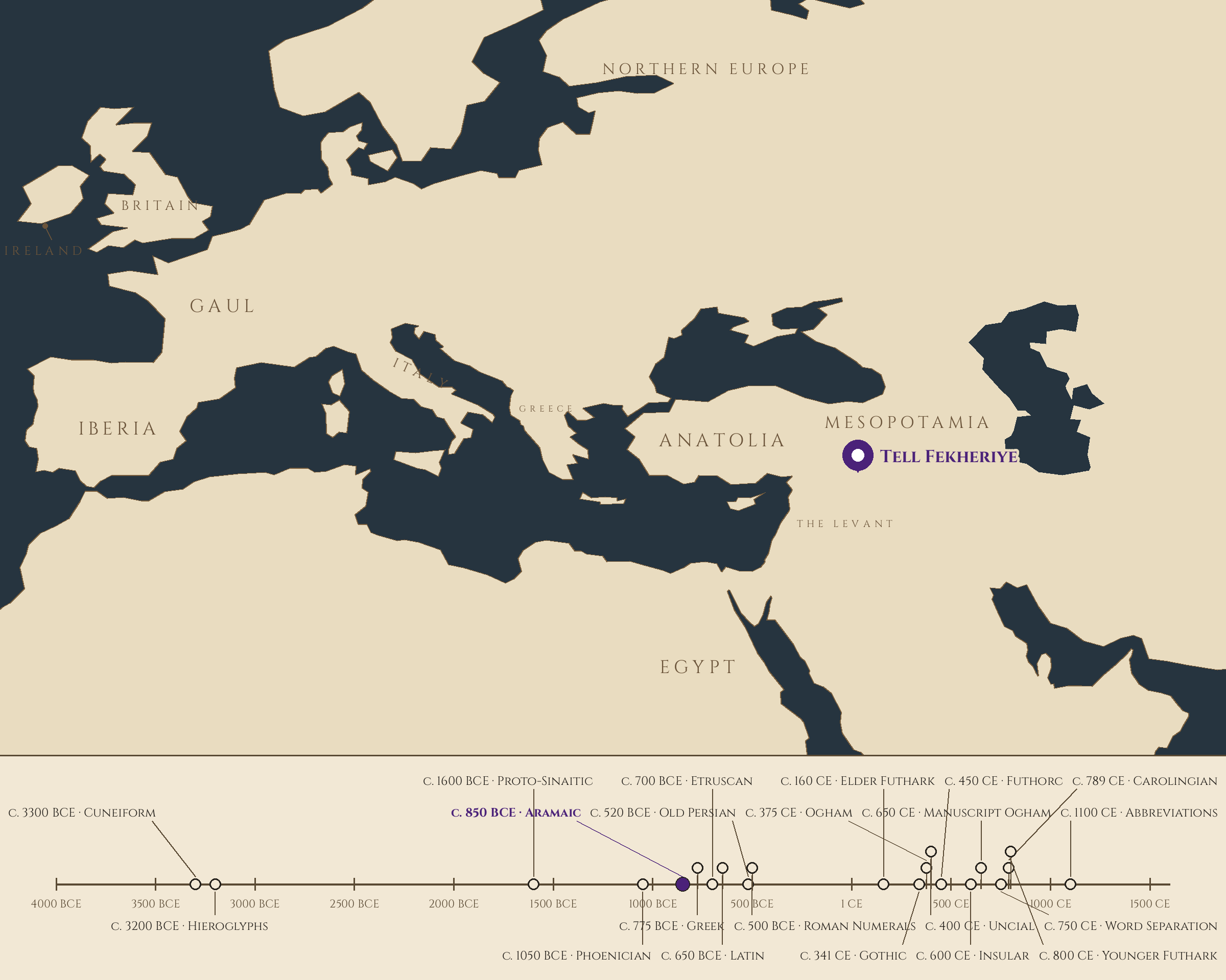
Where and when: Elephantine, an island in the Nile at Aswan, about 2,500 years ago. The pin is this lesson. The line beneath the map is our road: every stop a writing system, every lesson a pin.
Lesson Objectives
By the end of this lesson, students should be able to:
- Explain who spoke Aramaic and how it became an imperial administrative language.
- Define Aramaic, Imperial Aramaic, lingua franca, Elephantine, and scriptio continua.
- Describe how Aramaic letterforms differ from Phoenician ones, and why.
- Explain why the Achaemenid Empire kept Aramaic rather than inventing its own administrative script.
- Identify the tools and materials of Aramaic scribes, with appropriate precision.
- Describe what the Elephantine papyri reveal about daily life under the empire.
- Trace Aramaic's descendants: Hebrew, Syriac, Nabataean, Arabic, and beyond.
- Apply the course question to the needs of imperial administration.
Reading this lesson: ★ marks the passages to remember. They return on the unit quiz and the class test. Check in questions ask the material back as you go; answer them in your workbook when you meet them.
Working this lesson: Your assignment packet is the first download on this page. Work in it as the lesson moves along, answering each assignment as its subject is taught — or read the lesson through for your notes and take the assignments as homework afterward. Both are proper ways to sit this class. Signposts in the reading tell you where each assignment belongs. Written answers are short answers in your own words; a few honest lines are worth more than a filled page.
Your Assignment Packet
This lesson's assignments live in its packet: the Lexicon Handout (every term, course terms marked ◆), Materials, Guided Practice, the Assignment Manual with its answer key for self-checking, the Reflection Questions, and the Workbook Checklist. Download the packet before you begin and keep it beside you as you read.
The Language That Followed the Army
Aramaic began as the language of the Aramaeans, Semitic-speaking peoples who settled across Syria and northern Mesopotamia in the early first millennium BCE.
It was one regional tongue among many, written in a script borrowed from the Phoenician alphabet, in inscriptions that look, to the untrained eye, nearly identical to Phoenician ones.
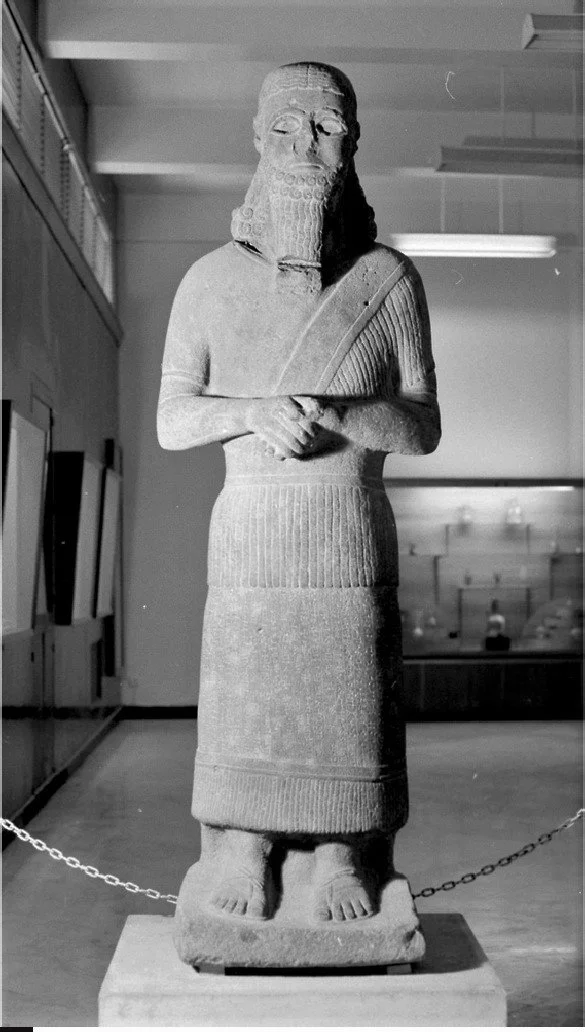
Historical example. The statue of Hadad-yith'i, a local king of northern Syria: the earliest known Aramaic inscription runs on its skirt, with the same text in Assyrian Akkadian beside it. Around 850 BCE, the alphabet was already doing official work in two languages at once.
Statue of Hadad-yith'i, from Tell Fekheriye, Syria, c. 850 BCE. Photograph CC0, via Wikimedia Commons.
The earliest known Aramaic inscription stands on the skirt of a basalt statue. The statue depicts Hadad-yith'i, a local king, and was found at Tell Fekheriye in northern Syria. It carries two texts: one in the Assyrian dialect of Akkadian, one in Aramaic.
The statue is generally dated to around 850 BCE. The Aramaic text is the oldest we have, and it already shows a working alphabet in confident use.
What happened next was not a literary flowering. It was conquest, and then administration.
The Neo-Assyrian Empire, rising to dominance in the 9th through 7th centuries BCE, absorbed Aramaean territories and with them the Aramaean language. Aramaic proved useful: it was written in a simple 22-letter alphabet, far easier to learn than the hundreds of signs of Akkadian cuneiform, and it was already spoken across a wide region.
Assyrian administrators began using Aramaic alongside Akkadian for practical correspondence. The language of the conquered became a tool of the conquerors.
The Neo-Babylonian Empire inherited this bilingual administration. And when the Achaemenid Persians conquered Babylon in 539 BCE and built the largest empire the world had yet seen, they did what pragmatic rulers do: they kept what worked.
This is the point I want you to hold carefully, because it corrects a common simplification. Accounts sometimes say the Persians adopted Aramaic because it was so effective, as if effectiveness alone explains imperial decisions. The fuller story is continuity.
★ Aramaic was already the administrative language of the two empires before them. The Achaemenids inherited an existing apparatus, scribes and conventions and all, and saw no reason to replace it.
They were pragmatists, not reformers, in this as in much else.
★ The result was Imperial Aramaic: a standardized administrative language, written in consistent letterforms, used in every satrapy (a province governed by a satrap, the provincial governor who reported to the king, whose bureaucracy conducted official business in Imperial Aramaic, which is why the language's documents appear across such a vast territory) from Egypt to Central Asia. A scribe trained in Damascus could read a document filed in Babylon.
That had never been true of cuneiform, which varied by city and century. It was true of Aramaic, because the empire needed it to be.
Check in: The Achaemenid Persians conquered an empire that already ran on Aramaic. In one sentence, why did they keep it instead of imposing a script of their own?
❦ In your workbook: record how Aramaic followed the army in your own way — copy, sketch, or note what matters.
The Imperial Hand
To understand Aramaic's letterforms, you must understand its tools, because the tools shaped the letters.
Phoenician inscriptions were often carved: in stone, in metal, in materials that reward straight lines and punish curves.
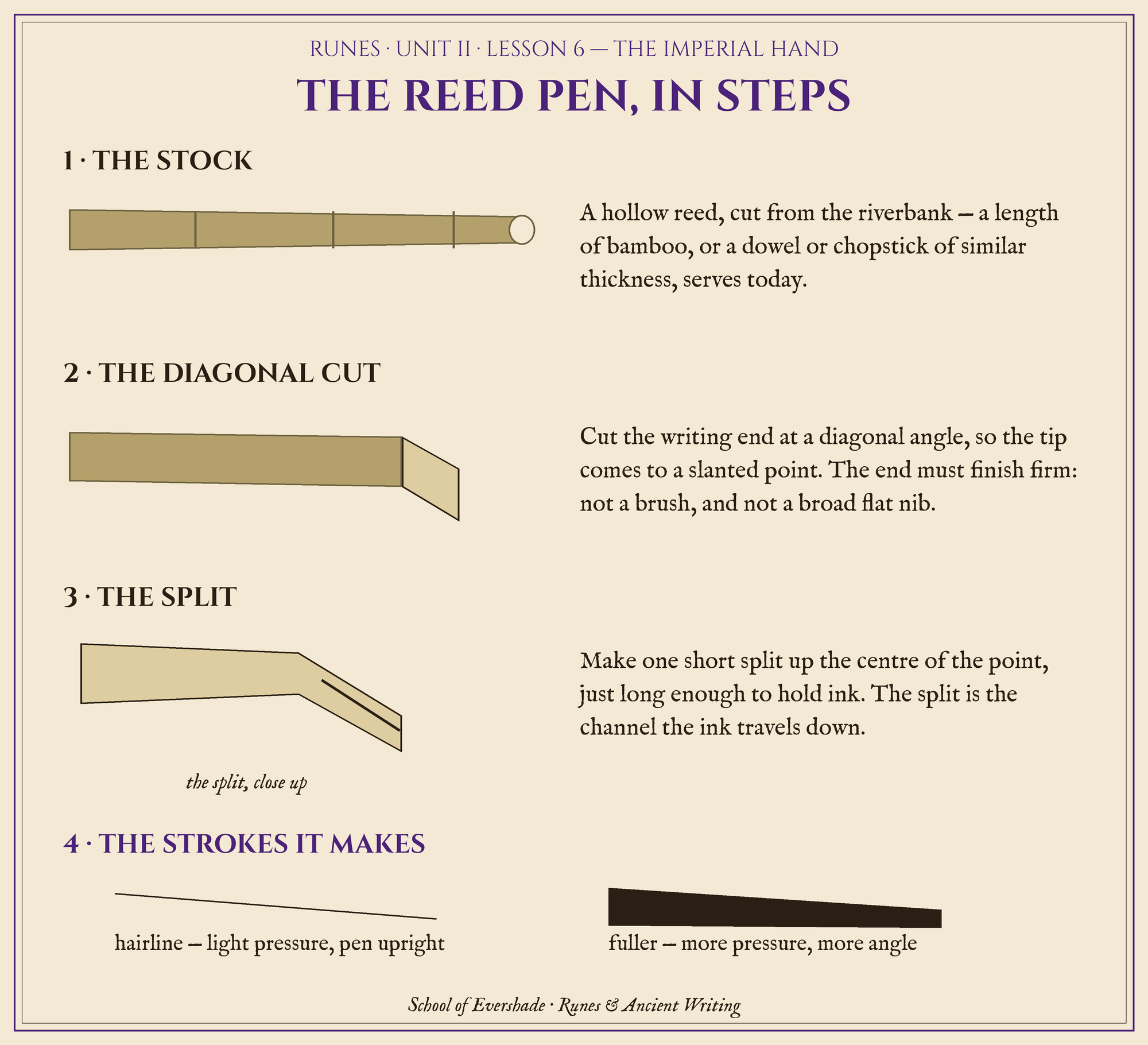
The tool that reshaped the alphabet, in steps: a hollow reed, the diagonal cut to a firm point, the short split that holds the ink, and the two strokes the point can make. Guided Practice walks you through the same cut.
Built for Evershade.
Aramaic, as an administrative language, was overwhelmingly written in ink, and ink changes everything.
★ The Aramaic scribe's pen was a reed, cut to a firm point. Not a brush: the brush belongs to the Egyptian scribal tradition, a different world of rush pens and flowing strokes. Not a broad-edged nib in the modern calligrapher's sense: that is a later technology with its own vocabulary.
The ancient Near Eastern scribe took a hollow reed, cut it diagonally, and split the point just enough to hold ink.
The result was a firm, responsive point that could make both hairline strokes and fuller ones, depending on pressure and angle.
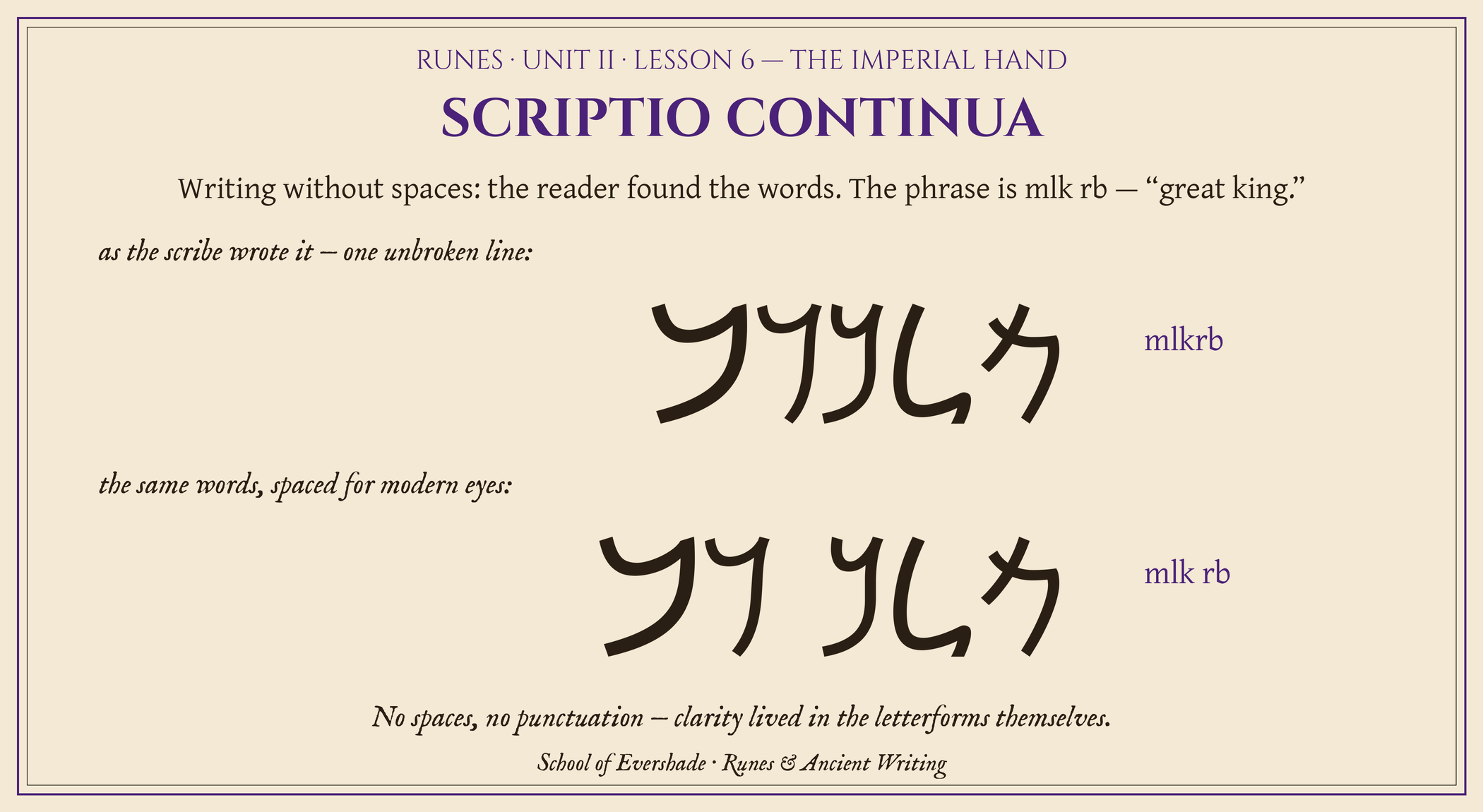
mlk rb — “great king” — as the scribe wrote it, one unbroken line, and again spaced for modern eyes. In scriptio continua the reader, not the writer, finds the words; clarity lived in the letterforms themselves.
Built for Evershade.
★ With this pen, on papyrus or leather, the scribe wrote quickly. Administrative writing is always in a hurry: there are taxes to record, orders to copy, correspondence to answer. Speed reshapes letterforms.
Straight Phoenician strokes became fluid Aramaic curves. Angular junctions softened. Letters that had stood apart began to flow toward one another, though never quite joining. The alphabet learned to run.
This is why Aramaic letterforms look so different from their Phoenician ancestors despite sharing the same 22 names and the same order. Compare them side by side and you can see the family resemblance, the way you can see a grandparent's face in a grandchild's.
But the grandchild has been somewhere. The letters have been somewhere: thousands of documents, written fast, in ink, by working scribes.
★ One more precision, and I insist on it because the textbooks sometimes blur it. Aramaic texts did not separate words with spaces. Like most ancient scripts, Aramaic was written in scriptio continua, unbroken lines of letters running right to left.
What helped the reader was not spacing but shape: Aramaic letterforms kept clear, open forms that remained distinguishable even packed shoulder to shoulder. The scribe's clarity lived in the letters themselves, not in the gaps between them.
Check in: One tool reshaped these letters. What was it, how was its point made, and what did writing quickly do to the Phoenician forms?
❦ In your workbook: record the reed pen and the imperial hand in your own way — copy, sketch, or note what matters.
In your packet: Assignment II — Transliteration Practice ⚒ begins here. Work it now, or mark the place and take it as homework — your choice.
Twenty-Two Letters, Again
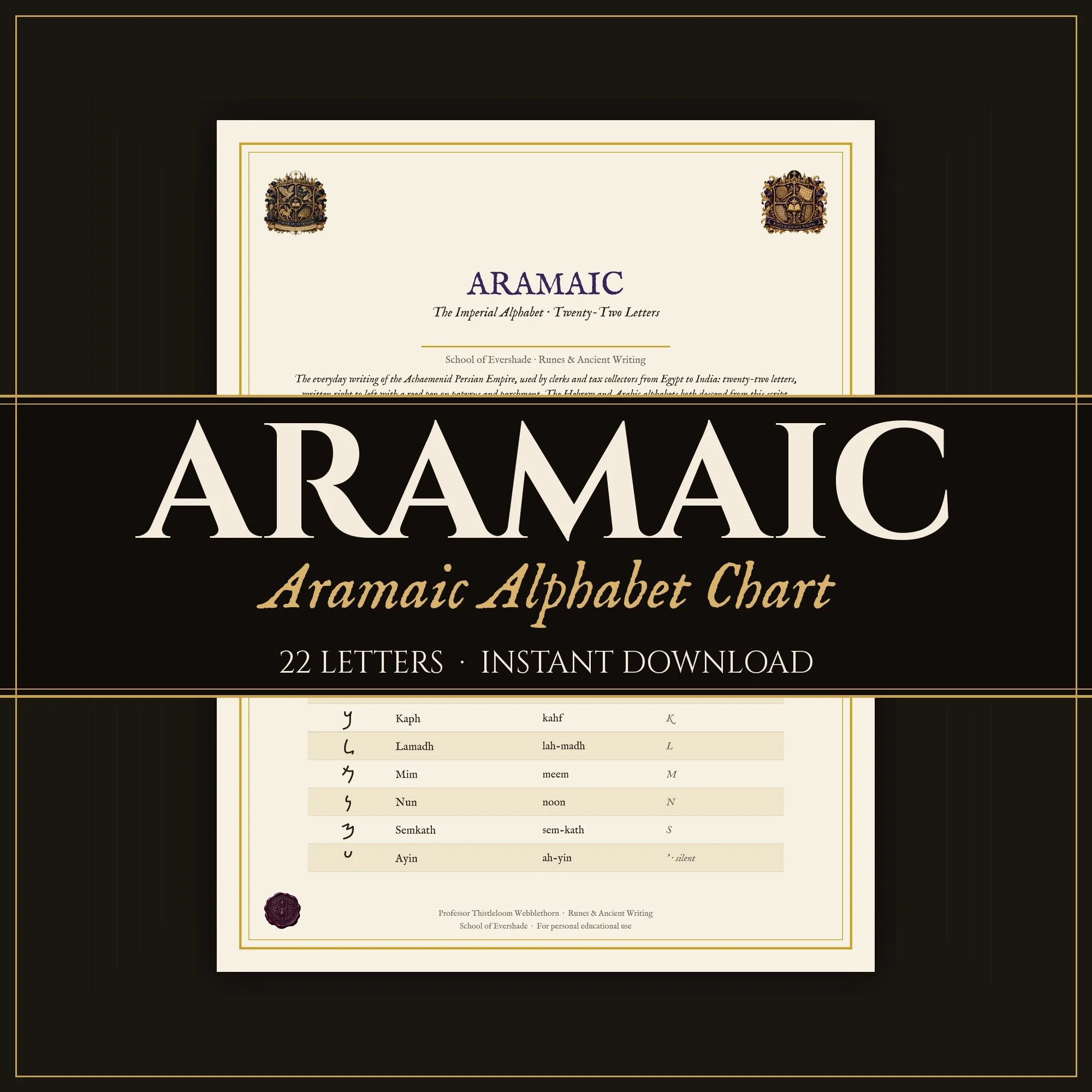
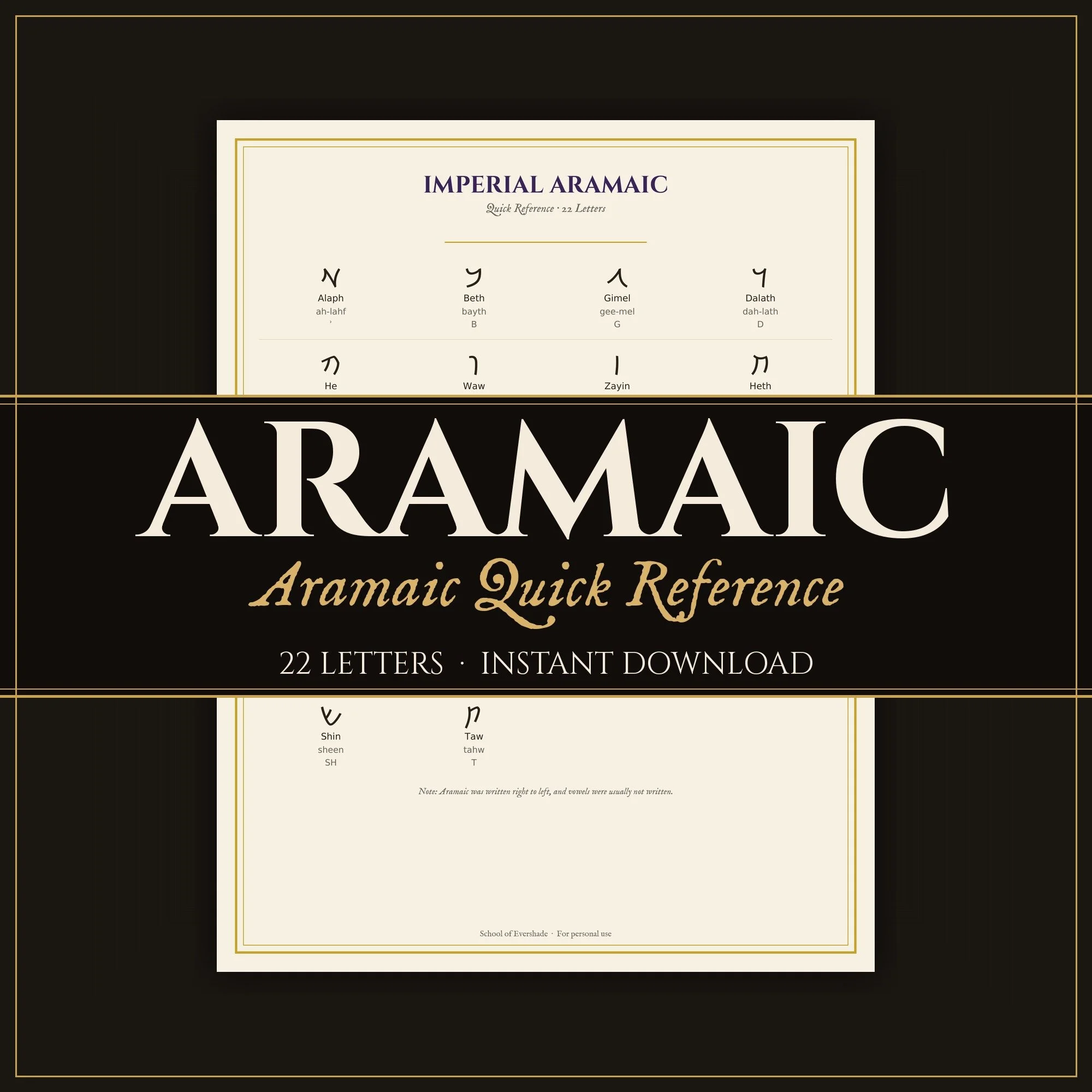
The Aramaic alphabet kept the Phoenician inheritance intact: twenty-two consonants, the same names, the same order, written right to left. But every letter had been redrawn by the reed pen. Here are the letters with their Aramaic names, sound values, and notes on what changed.
Aleph (ox): ʾ, the glottal stop. The Phoenician ox head had already simplified beyond recognition; in Aramaic hands it became a flowing diagonal stroke with a small crossbar, written in a single quick motion.
Beth (house): b. The house plan opened up. Where Phoenician Beth was angular and closed, Aramaic Beth developed an open, rounded form, the pen lifting less often.
Gimel (camel): g. The Phoenician form resembled a bent line; Aramaic Gimel grew a distinctive curved neck, one of the letters most visibly transformed by cursive writing.
Daleth (door): d. In Aramaic, Daleth and Resh began the long process of resembling each other, a similarity that would persist into Hebrew and cause generations of students to confuse them. Context, as always, disambiguates.
He (window): h, a glottal sound, like the h in English "hat." The Phoenician form was a simple frame; Aramaic He opened and loosened, the pen moving faster through familiar shapes.
Waw (hook): w. The hook straightened and simplified. Remember from Lesson 5 the astonishing family this letter would produce in Greek hands; in Aramaic it stayed modest, a simple vertical stroke with a small head.
Zayin (weapon): z. A straight vertical stroke, little changed in essence, though the pen gave it a slight natural slant that the chisel never had.
Het (fence): ḥ, the deep throaty sound. Aramaic Het kept its enclosed form longer than most letters, the fence still visible in the architecture of the sign.
Tet (wheel): ṭ, the emphatic t. The wheel became a circle with internal marks, drawn quickly, the pen barely lifting.
Yod (hand): y. Perhaps the most reduced letter in the alphabet: in Aramaic hands, Yod shrank to a small stroke, sometimes barely more than a tick. Scribes wrote it fast because they wrote it constantly.
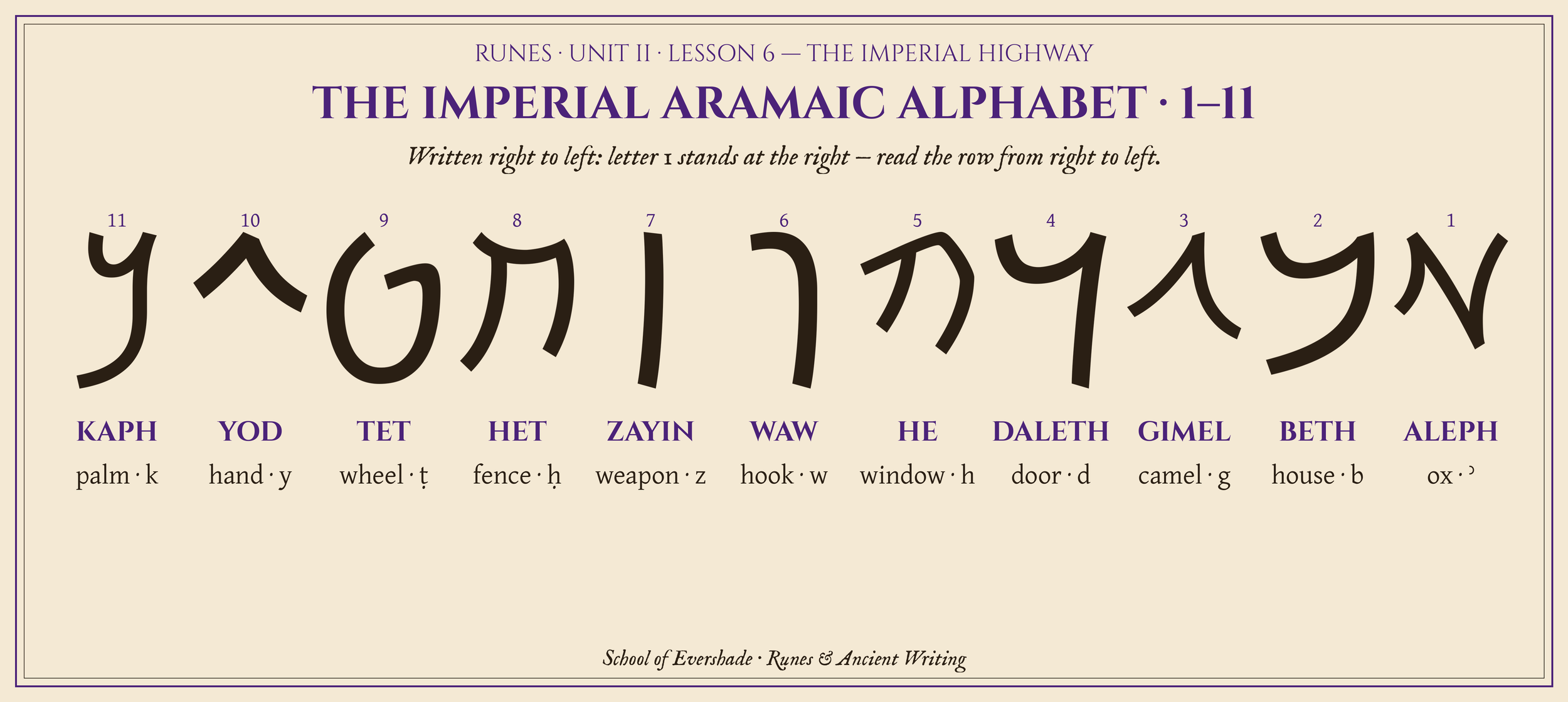
The same twenty-two, first half: Aleph to Kaph, redrawn by the reed pen. The names and order are Phoenician; the flowing shapes are the empire's. Read from the right.
Built for Evershade.
Kaph (palm): k. The palm opened. Aramaic Kaph developed the curved, cupped form that Hebrew readers will recognize immediately.
Lamed (goad): l. The tallest letter in the alphabet, and it stayed tall. Aramaic Lamed kept its ascending stroke, the goad still rising above the line.
Mem (water): m. The water ripple, which had survived since Sinai, became in Aramaic a flowing, wavelike form, the pen's natural motion suiting the water's own.
Nun (fish): n. The Lesson 4 puzzle resolved into convention: whatever the original picture, Aramaic Nun was now a simple vertical stroke with a small base, standardized and unremarkable, which is exactly what an administrative script needs.
Samekh (support): s. A rounded, enclosed form, the pen circling back on itself. One of the letters where the ink technique shows most clearly: no carver would choose this shape, but a pen makes it naturally.
Ayin (eye): ʿ, the voiced pharyngeal. Aramaic Ayin kept a rounded, eye-like openness longer than many letters, though simplified.
Pe (mouth): p. The mouth became a curved stroke with a small interior mark, quick to write, easy to distinguish.
Tsade (hunt): ṣ, the emphatic s. Aramaic Tsade developed a distinctive form with a vertical element that set it apart from the other sibilants.
Qoph (knot): q, the deep k. The circle-and-tail form persisted, the pen rendering in one flowing motion what the chisel had built in strokes.
Resh (head): r. See Daleth above: the two letters grew toward each other in Aramaic, and students have confused them ever since. The resemblance is a fact of the script's history, not a failure of the student.
Shin (tooth): š (sh). The tooth's three branches became three quick strokes, the pen flicking rather than carving.
Taw (mark): t. The final letter, a simple cross or mark, as befits a sign whose name means "mark." In Aramaic it stayed simple, the alphabet ending as plainly as it began.
Twenty-two letters. The same names your Phoenician merchants used, the same order, the same direction.
But every one redrawn by the reed pen, in ink, in haste, thousands of times a day, across an empire.
That is what administration does to an alphabet: it teaches it to run.
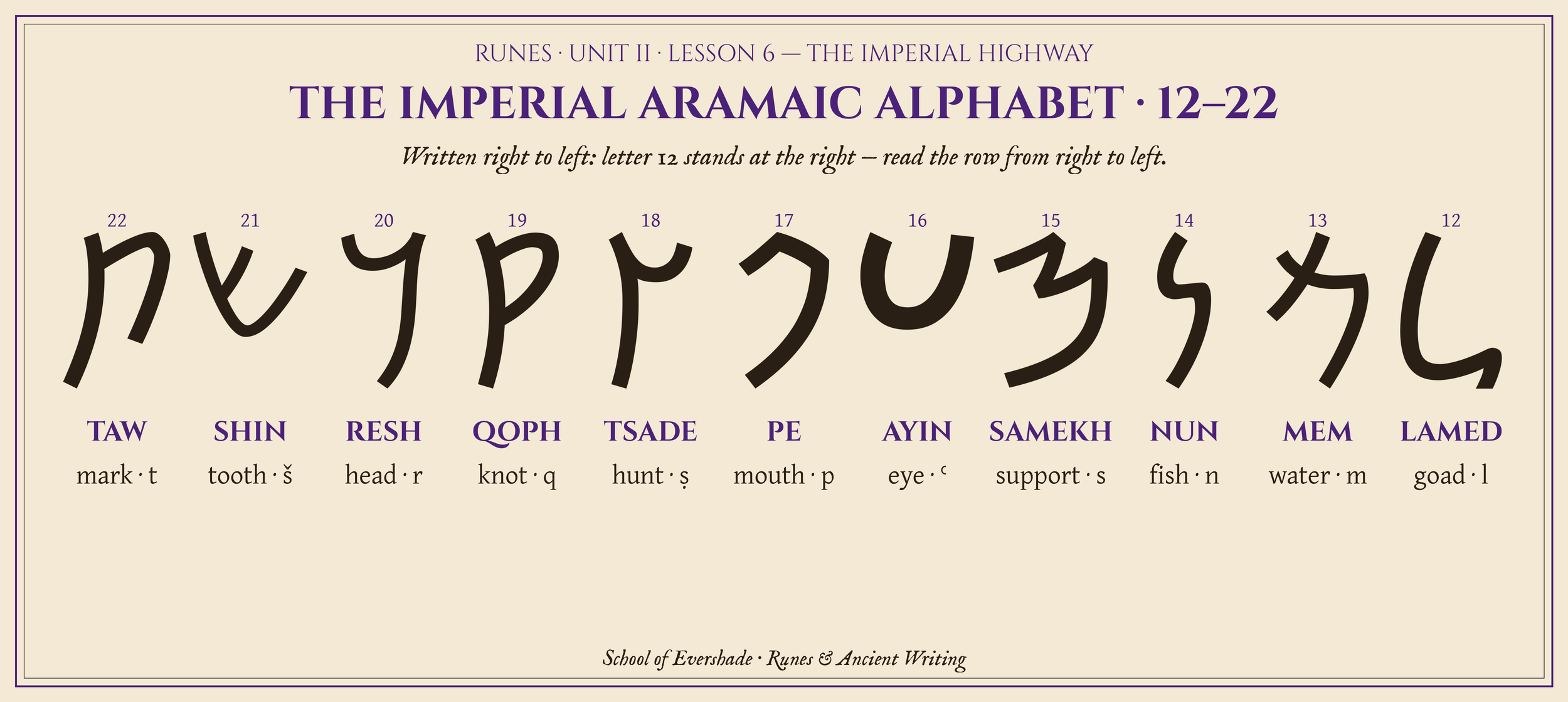
The same twenty-two, second half: Lamed to Taw. Lay this chart beside Lesson 5's and the pen's work is plain: angles softened, strokes quickened, every letter taught to run.
Built for Evershade.
❦ In your workbook: record the twenty-two letters, again in your own way — copy, sketch, or note what matters.
In your packet: Assignment I — The Letter Chart ⚒ begins here. Work it now, or mark the place and take it as homework — your choice.
Voices on Papyrus
I have told you about empires and administrations. Now I want you to meet the people.
On Elephantine, an island in the Nile at Aswan, in southern Egypt, the Persians stationed a garrison. The soldiers were Jews, serving the empire as frontier troops, and they brought their families.
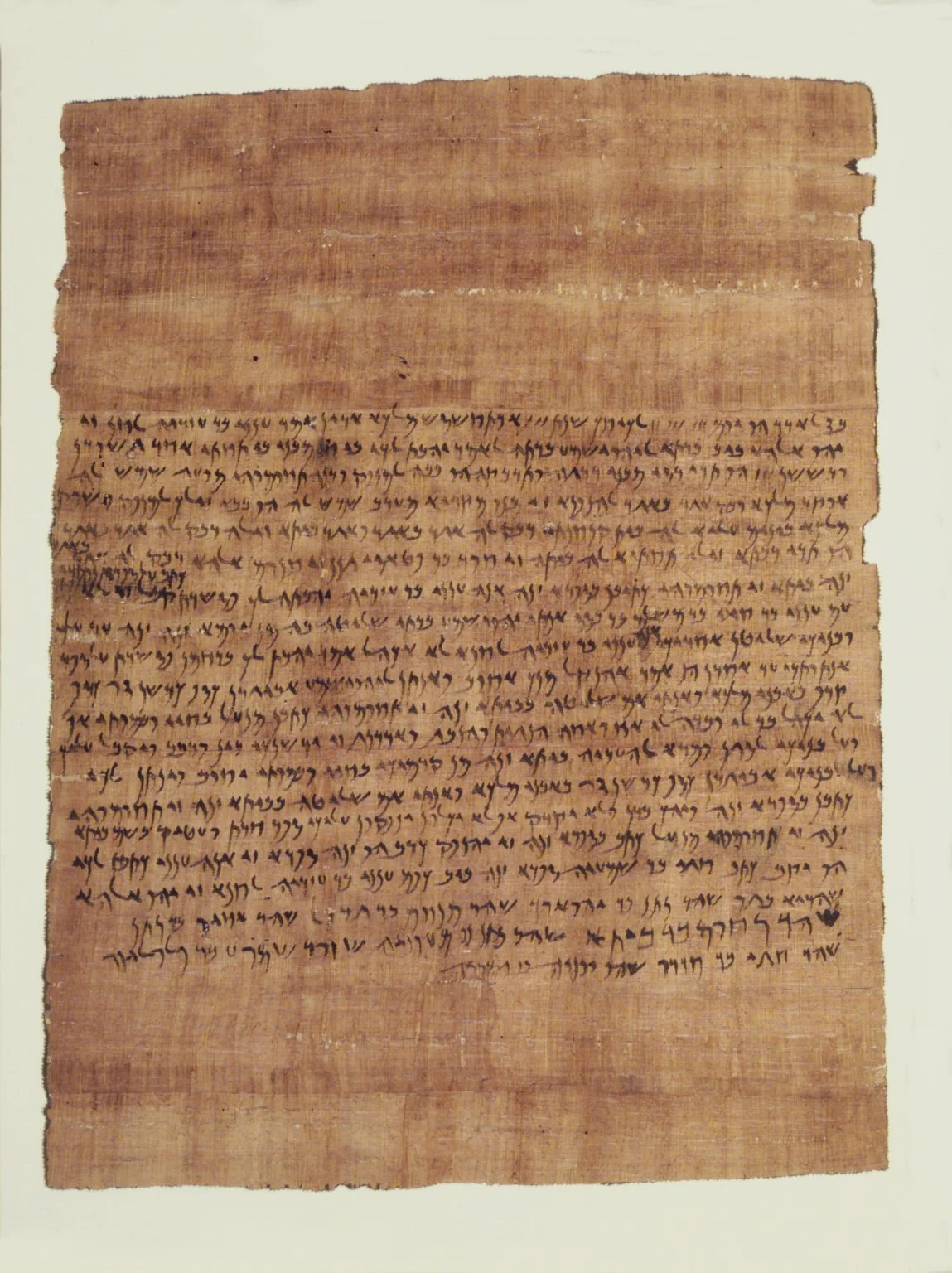
Historical example. A real Elephantine document, in the community's own hand: on March 10, 402 BCE, Ananiah — the same Ananiah whose marriage contract you met in this section — gives a house to Yehoishema. A family's property, settled in Imperial Aramaic on papyrus, and preserved by the dry Egyptian soil.
“Ananiah Gives Yehoishema a House,” Elephantine, March 10, 402 BCE. Papyrus, ink. Brooklyn Museum (47.218.88). No restrictions (CC0), via Wikimedia Commons.
They built houses. They married, divorced, bought property, lent money, freed slaves, and quarreled with their neighbors.
And because they lived under Persian administration, they conducted their legal and personal business in Aramaic, on papyrus.
★ The dry soil of Upper Egypt preserved what the damp of the Delta would have destroyed. Some two hundred Aramaic papyri survive from this community, dating from 495 to 399 BCE.
★ They are not royal inscriptions. They are the paperwork of ordinary life, and that is what makes them precious.
Read them, and you hear voices. A woman named Mibtahiah buys and sells property across decades of documents; her archive traces a life in contracts. A man named Ananiah marries, and the marriage contract survives, with its clauses and witnesses.
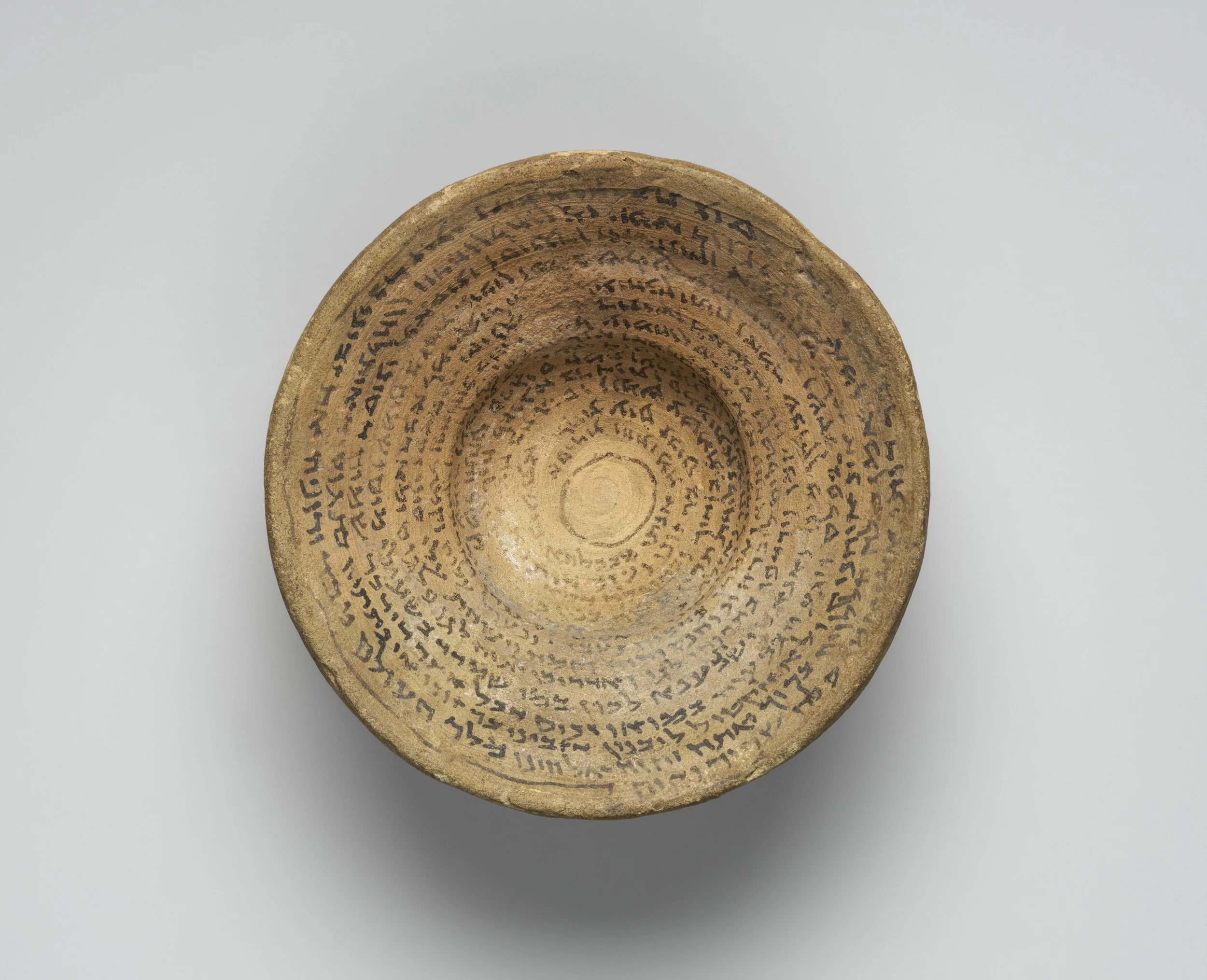
Historical example. A thousand years after Elephantine, Aramaic was still the ink of ordinary households: the text inside this bowl spirals inward in a later Aramaic hand — a protective inscription written for a home, in the language the empire taught the whole region to write.
Incantation bowl with Aramaic inscription, ca. 5th–6th century CE. The Metropolitan Museum of Art, New York (86.11.259). Public domain, The Met Open Access.
The community writes to Jerusalem for guidance on observing Passover. And in 410 BCE, when local priests of the Egyptian god Khnum destroy the community's temple, the leaders write a petition to the Persian governor of Judah, begging permission to rebuild.
The draft survives, with corrections still visible in the text: you can see the scribe thinking.
This is Imperial Aramaic not as an imperial instrument but as a human one. The same standardized language that carried tax orders across the empire also carried a widow's property deed, a marriage contract, a desperate letter about a burned temple.
The empire needed Aramaic to govern. The people of Elephantine needed it to live.
Check in: The Elephantine papyri are not royal inscriptions. Name two kinds of documents the community left behind, and say what each one shows about their lives.
When you study the letterforms in this lesson, remember that they were shaped by hands like these: not monumental carvers working for kings, but working scribes writing fast, in ink, because someone needed a contract by tomorrow.
❦ In your workbook: record the voices on papyrus in your own way — copy, sketch, or note what matters.
In your packet: Assignment III — The Elephantine Investigation ◐ begins here. Work it now, or mark the place and take it as homework — your choice.
Professor Webblethorn
Pause here, scholars, and consider what has changed.
The miners invented the alphabet by throwing things away. The merchants standardized it by fixing its forms. And now the scribes have done something quieter and just as consequential: they have taught it to move fast.
Look at the letters. Really look. The Phoenician forms are carved things, deliberate, each stroke placed. The Aramaic forms are written things, fluid, each stroke hurried. The difference is the difference between a monument and a memorandum. Between writing that announces and writing that works.
Our course question takes its imperial form here. In Sinai, the workers asked what could be left out. In Phoenicia, the merchants asked what must be fixed to travel. Here, in the provinces of the empire, the scribes asked a third question: what can be simplified and still be read? Their answer was the curves, the speed, the flow. They left out the rigidity. They kept the clarity. And the alphabet learned to keep up with an empire.
Keep the question beside you. It is the silk thread running through every lesson: nearly invisible, holding everything together.
Now, to the voices themselves. Read the Elephantine letters slowly. They are the reason the rest matters.
PROFESSOR THISTLELOOM WEBBLETHORN
Runes & Ancient Writing
Epigrapher, Head of House Septentrio
Guided Practice — The Scribe's Hand
Before the assignments, train your hand the way an Aramaic scribe would: quickly, in ink, with attention to flow.
Exercise A — Drawing the Twenty-Two
- On paper, draw the 22 Aramaic letterforms as described in the lesson, working quickly and without lifting your pen more than necessary. (For reference letterforms, consult the References: the Imperial Aramaic script chart shows the standardized shapes.)
- Label each with its Aramaic name and sound value.
- Beside each, sketch its Phoenician ancestor as described in Lesson 5. Mark the letters that changed most in the transition from carving to ink.
- Which letters changed least? Which changed most? What does the pattern suggest about which shapes suit the pen and which suited the chisel?
Speed matters here in a way it did not for the carved scripts. Try writing the same letter ten times fast. Watch it simplify itself. You are repeating, in minutes, what took the scribes generations.
❦ Workbook path: make your master set in your workbook: the twenty-two letters across two facing pages, each with its Phoenician ancestor sketched beside it and the most-changed letters marked. This is the set you will copy from when we trace where these letters went.
Exercise B — Continuous Script
- Write the following Aramaic phrase in transliteration, without spaces between words, as a scribe would: mlk rb (great king).
- Now write it with modern word spacing: mlk rb. Compare the two. How much harder is the unspaced version to parse? What features of the letters help you find the boundary?
- Write your name in transliterated Aramaic letters, first without spaces, then with. Reflect in two to three sentences on what scriptio continua demands of the reader.
This exercise teaches, in your own hand, why Aramaic letterforms needed their clarity. In unbroken text, every letter must carry its own weight.
First, Your Reed Pen — In Steps
The Imperial Hand told you what the pen is. Here is how to make one:
- Choose your stock: a hollow reed, a length of bamboo, or a dowel or chopstick of similar thickness.
- Look at the end you will write with. It must finish as a firm point: not a brush, and not a broad flat nib.
- Ask an adult to cut that end at a diagonal angle, so the tip comes to a slanted point.
- With the adult's help, make one short split up the center of the point, just long enough to hold ink. The split is the channel the ink travels down.
- Dip the tip and test it on scrap paper: light pressure with the pen upright for hairline strokes; more pressure and more angle for fuller ones.
Exercise C — The Reed Pen
- Make a reed pen: take a dowel, chopstick, or actual reed. Cut one end at a diagonal angle. If using a real reed, split the tip slightly with a knife (ask an adult for help with cutting).
- Dip in ink or thinned paint. Practice making both hairline strokes (light pressure, pen upright) and fuller strokes (more pressure, pen angled).
- Copy five Aramaic letterforms with your pen. Compare them to the same letters drawn with a regular pen or pencil. What does the reed pen change about the shapes?
You are holding the tool that reshaped the alphabet. Notice how it wants to move.
❦ Workbook path: no reed to cut today? Draw the pen instead: the diagonal cut and the split tip, labelled, at the top of a workbook page. Beneath it, draw five letterforms twice each: once stiffly, as a pen that cannot flow would make them, and once with the reed's curve and speed.
Workshop Note: Making the pen itself is Workshop work — see Creative Arts Lesson 6, 'The Materials Library & First Tool-Making,' for the reed, and Lesson 3, 'Cutting, Scoring & Clamping,' for the knife cut.
In your packet: Assignment IV — The Descendant Essay ✎ begins here. Work it now, or mark the place and take it as homework — your choice.
Assignment Manual
Assignment key: ✎ written work · ⚒ hands-on practical · ◐ both · ★ will be on the test · ❦ workbook path
Written answers in this manual are short answers in your own words — a few honest lines, not a filled page.
Assignment I — The Letter Chart ⚒ ★
Objective: Demonstrate control of the 22 Aramaic letters and their Phoenician ancestry.
Instructions:
- On a fresh sheet, create a four-column chart: Aramaic letter (drawn), Aramaic name and sound value, Phoenician ancestor (drawn or described), note on what changed.
- Complete all 22 rows. For each letter, describe in a phrase how the reed pen reshaped the carved Phoenician form.
- Below the chart, write one paragraph on the single most transformed letter and explain what about the pen caused the change.
Your keepsake: this chart is the alphabet at work: the same twenty-two letters you met on Phoenician ships, taught to run an empire. Keep it beside your Phoenician chart. The two together are a before-and-after portrait of the pen.
❦ Workbook path: build the chart in your workbook instead: four columns across a two-page spread, all twenty-two rows, and your paragraph on the most transformed letter beneath.
To submit: Photograph or scan your chart. Attention to the differences matters more than artistic skill.
Assignment II — Transliteration Practice ⚒ ★
Objective: Read and write Aramaic letter sequences in continuous script.
Part A. The Aramaic word for "king" was mlk (mem-lamed-kaph). Write it in a flowing hand, right to left, without lifting your pen between letters more than necessary. Then write the Aramaic word for "house," byt (beth-yod-taw). Compare your two renderings: which letters flowed together most naturally?
Part B. Write the phrase brk zy ("blessed be," a common Aramaic formula) first with word spacing, then in scriptio continua without spacing. Write three to four sentences on which version was harder to read back, and what features helped or hindered parsing.
Part C. Choose an English word of at least eight letters. Write it as a consonantal skeleton in Aramaic-style letters, first spaced, then unspaced. Reflect on what scriptio continua reveals about the relationship between reader and text: how much work does the reader do that the writer does not?
❦ Workbook path: do the whole practice in your workbook: mlk and byt in a flowing hand at the top of the page, brk zy spaced and then unspaced beneath, and your skeleton word with its reflection following.
Assignment III — The Elephantine Investigation ◐ ★
Objective: Understand Imperial Aramaic as a lived language.
Instructions:
- Research (using the References below): the Elephantine papyri. Identify three specific documents (for example, the Passover letter of 419 BCE, the temple destruction petition of 407 BCE, or a marriage contract) and summarize each in two to three sentences.
- Choose one document and write a half page imagining the human situation behind it: who wrote it, why, and what was at stake? Base your imagining strictly on what the documents and this lesson establish. Mark clearly where documented fact ends and your imagining begins.
- The lesson argues that the same language served both empire and ordinary life. Write a half page on whether this is surprising: would you expect an imperial administrative language to also be the language of marriage contracts and personal letters? Why or why not?
Assignment IV — The Descendant Essay ✎ ★
Objective: Trace Aramaic's legacy into the modern world.
Instructions:
Write a one-page essay addressing the following:
Aramaic gave rise to the Hebrew square script, to Syriac, to Nabataean and through it to Arabic, and contributed to writing systems across Asia. Choose two of these descendant traditions and trace the path from Imperial Aramaic to the modern script, naming at least one specific way the letterforms changed at each major transition. Then consider: when you write in English, you use a script descended from Phoenician through Greek. When a Hebrew or Arabic speaker writes, they use a script descended from Phoenician through Aramaic. What does it mean that the same 22 letters took two different roads and arrived at the modern world through both?
Cite at least two specific details from the lessons in your argument.
Materials
Required (Level One — household items)
- Paper: plain white paper or a sketchbook, for letter practice and chart work.
- Pens: one standard pen for drafting, one fine-tipped marker for final letterforms. A brush pen, if available, approximates the reed pen's variable line better than a ballpoint.
- Ink or thinned paint: black, for reed pen practice. Washable ink is fine.
- A ruler: for chart columns and dividing practice sheets.
- A printout of the Aramaic alphabet: use the References below for a standard Imperial Aramaic chart.
- A dowel, chopstick, or reed, and a craft knife (adult use only): the stock and cutting tool for making your reed pen in Guided Practice Exercise C, following the steps given there. Washable ink for the pen is listed above.
Suggested (Level Two — historically closer materials)
- Papyrus paper: the prestige surface of Aramaic administration, available from art suppliers. The Elephantine documents were written on papyrus.
- A reed pen: cut from bamboo or river reed, following the ancient method: diagonal cut, slight split at the tip. This is the historically accurate implement; the difference from a modern pen is immediately visible in the letterforms.
- Leather or heavy animal skin: the Bactrian documents were written on leather. Prepared leather approximates the surface. (Note: this is leather, not parchment in the later technical sense.)
- A wooden board: Aramaic was also written on wood. Any smooth, flat piece of wood with ink gives the feel of the less formal administrative writing.
Neither level requires
Purchased kits, specialty tools, or any material you cannot find locally or order inexpensively. The core lesson (drawing letters, understanding the imperial system, reading about Elephantine) is fully achievable with paper and pen.
Reflection Questions
Answer the following in your workbook.
- How did Aramaic become an imperial administrative language? Name the empires involved, in order, and explain why each kept it.
- Why is it more accurate to say the Achaemenids "inherited" Aramaic than that they "adopted" it? What does the distinction reveal about how empires work?
- How did the reed pen reshape Aramaic letterforms compared to their Phoenician ancestors? Name two specific changes and explain what about the pen caused them.
- What is scriptio continua, and how did Aramaic scribes compensate for the absence of word spaces?
- What do the Elephantine papyri reveal about daily life under the Persian Empire? Name two specific types of documents and what each shows.
- Trace the path from Imperial Aramaic to two modern scripts. What changed at each transition?
- The lesson asks what can be left out and still be understood. The Aramaic scribes left out rigidity. Apply the question to speed: what did they keep, and was it enough?
Workbook Checklist — Lesson 6
In my workbook I have:
- ☐ explained who spoke Aramaic and how it became an imperial administrative language
- ☐ written out what Aramaic, Imperial Aramaic, lingua franca, Elephantine, and scriptio continua mean
- ☐ described how Aramaic letterforms differ from Phoenician ones, and why
- ☐ explained why the Achaemenid Empire kept Aramaic rather than inventing its own administrative script
- ☐ identified the tools and materials of Aramaic scribes, with appropriate precision
- ☐ described what the Elephantine papyri reveal about daily life under the empire
- ☐ traced Aramaic's descendants: Hebrew, Syriac, Nabataean, Arabic, and beyond
- ☐ applied the course question to the needs of imperial administration
☐ Lesson completed Date: ____________ Signature: ____________
Professor's Review
And so our sixth lesson closes on the road, where couriers carried the same twenty-two letters from the Nile to the mountains of Central Asia.
You can now explain how Aramaic rose through conquest and continuity to become the ancient Near East's lingua franca, describe how the reed pen reshaped its letterforms, explain why the Achaemenids inherited rather than invented their administrative language, identify the tools and materials of Aramaic scribes with precision, describe what the Elephantine papyri reveal about ordinary life, and trace Aramaic's descendants into the modern world.
Keep your Aramaic chart beside your Phoenician one. Lay them side by side and look at what the pen did. The same twenty-two names, the same order, the same direction, and yet a different alphabet: faster, more fluid, built for the daily business of empire rather than the carved permanence of monuments.
Next, we cross to the Aegean, where the Greeks took the Phoenician letters and did what no Semitic scribe had needed to do: they wrote the vowels down. The abjad is about to become an alphabet in the full sense, and nothing about writing will ever be the same.
Practice your letters, scholars. Write them fast, as the scribes did, and feel how the pen wants to move. I have watched alphabets change in my years among the inscriptions, and the change is always the same: the tool teaches the hand, and the hand teaches the letters. Listen to the pen. It knows things.
PROFESSOR THISTLELOOM WEBBLETHORN
Runes & Ancient Writing
Epigrapher, Head of House Septentrio
Cross-Class Connections
The reed pen and ink techniques in this lesson connect directly with Scrollwork, where Professor Nocturne teaches quill preparation and ink-making. The Aramaic scribe's cut reed and the medieval scribe's cut quill are the same technology separated by two millennia: a hollow shaft, cut at an angle, split to hold ink. Students studying both classes should compare the two lessons' materials sections directly.
The Elephantine community's daily paperwork parallels Herbology, where Professor Fernfoot's plant records and remedy preparations (historical only, never prescriptive) similarly document ordinary life through practical documents rather than monuments.
The imperial postal road and its courier system will reappear in Runes Unit III, when we examine how writing traveled in the ancient world. The Aramaic documents carried along the Royal Road are the ancestors, in function if not in form, of every administrative letter that followed.
In Other Classrooms
Scrollwork · Unit I, Lesson 2 — Reed Pens & Feather Quills
A reed cut at an angle, split to hold the ink: your Aramaic scribes knew this instrument, and so did mine. Come to the Library and study the reed pen and the feather quill side by side, their anatomy, their keeping, their temperaments. Two thousand years apart, and the hand learns the same lessons from both.
Herbology · Unit V, Lesson 36 — The Materia Botanica, Building Your Herbal

Paperwork is a kind of gardening, scholars: ordinary days, carefully kept, grow into a record worth reading. In the Greenhouse we build the school's herbal, plant by plant and entry by entry, the same honest paperwork your Elephantine families kept for their marriages and their houses. Come and see how a record book is grown.
The road runs on, and so do we.
References & Further Reading
The British Museum. Collection online. Searchable collection including Aramaic inscriptions and Achaemenid administrative artifacts. https://www.britishmuseum.org/collection
The Metropolitan Museum of Art. Heilbrunn Timeline of Art History, "The Achaemenid Persian Empire." Museum essays on the empire's administration, art, and the Royal Road. https://www.metmuseum.org/toah/hd/acha/hd_acha.htm
Wikipedia. "Aramaic." Comprehensive overview: the language's history, dialects, and script development from Phoenician through Imperial Aramaic. https://en.wikipedia.org/wiki/Aramaic
Wikipedia. "Imperial Aramaic language." The standardized administrative language: its use across the Achaemenid Empire, the Elephantine papyri, and the Bactrian documents. https://en.wikipedia.org/wiki/Imperial_Aramaic_language
Wikipedia. "Elephantine papyri." The Jewish garrison community's documents: the archives, the temple destruction, and daily life in Aramaic. https://en.wikipedia.org/wiki/Elephantine_papyri
Wikipedia. "Tell Fekheriye bilingual inscription." The earliest known Aramaic inscription, c. 850 BCE, in Aramaic and Akkadian. https://en.wikipedia.org/wiki/Tell_Fekherya_bilingual_inscription
Folmer, Margaretha. "Aramaic as Lingua Franca." In A Companion to Ancient Near Eastern Languages (2020). The scholarly source for Achaemenid pragmatic continuity in adopting Aramaic. https://research.vu.nl/ws/files/359045657/2020_Folmer_Aramaic_as_Lingua_Franca_PROOF.pdf
Browse the Runes shelf in the school Library for readable editions of these works.
THE UNIT II QUIZ
RUNES & ANCIENT WRITING · UNIT II: THE CRADLE OF THE ALPHABET · LESSONS 4–6
Unit II is complete: the alphabet has been stolen in the Sinai mines, standardized on Phoenician ships, and taught to run an empire's paperwork. This quiz gathers the whole unit, all three lessons, into one sitting. Take it from memory first, before you look back at your notes, because it measures what has stayed with you. If you completed the assignments marked ★ in your lesson packets, you have already practiced most of what it asks.
The quiz packet is a single download. Part I gathers questions from every lesson in the unit, Part II matches the unit's vocabulary, and the answer key waits at the back for self-checking. When you have finished, score it honestly, note the result in your workbook, and revisit any lesson whose questions went wrong before you move on to Unit III.
The empire's everyday script stands on the Bench: right to left, its vowels left for the reader, exactly as its clerks wrote from Egypt to India.
Open the BenchPROFESSOR THISTLELOOM WEBBLETHORN · RUNES CLASSROOM
Submit your work for this lesson using the form below.
CONTINUE IN RUNES & ANCIENT WRITING
← Previous · Lesson 5: Phoenician: How Trade Standardized the Alphabet Next · Lesson 7: Ancient Greek: How the Alphabet Found Its Voice →
Unit II · The Cradle of the Alphabet Runes & Ancient Writing Classroom · All 21 Lessons
The rest of Unit II: Lesson 4 · Proto-Sinaitic · Lesson 5 · Phoenician
From the Runes Shelf
The printed companions to this lesson, from Professor Webblethorn’s shelf in the shop.