RUNES & ANCIENT WRITING
Unit III · Lesson 7THE INVENTION OF VOWELS
Ancient Greek: How the Alphabet Found Its Voice
Professor Thistleloom Webblethorn
Epigrapher • Runes & Ancient Writing
Head of House Septentrio • School of Evershade
Professor's Introduction

Ah, scholars — there you are. I hope your reed pens are clean.
The Phoenician abjad wrote the consonantal skeleton, and trusted the reader to supply the flesh.
Today the alphabet learns to sing.
We cross the Aegean to Greece, where traders carried the Phoenician letters home and did something no one had ever done: they wrote the vowels down. It sounds like a small change. It was the single most consequential change in the alphabet's history, and every letter you are reading right now descends from it.
Come closer to the web, scholars. The abjad (a script that writes consonants only) is about to become an alphabet in the full sense of the word, and I want you to be here when it happens.
PROFESSOR THISTLELOOM WEBBLETHORN
Runes & Ancient Writing
Epigrapher, Head of House Septentrio
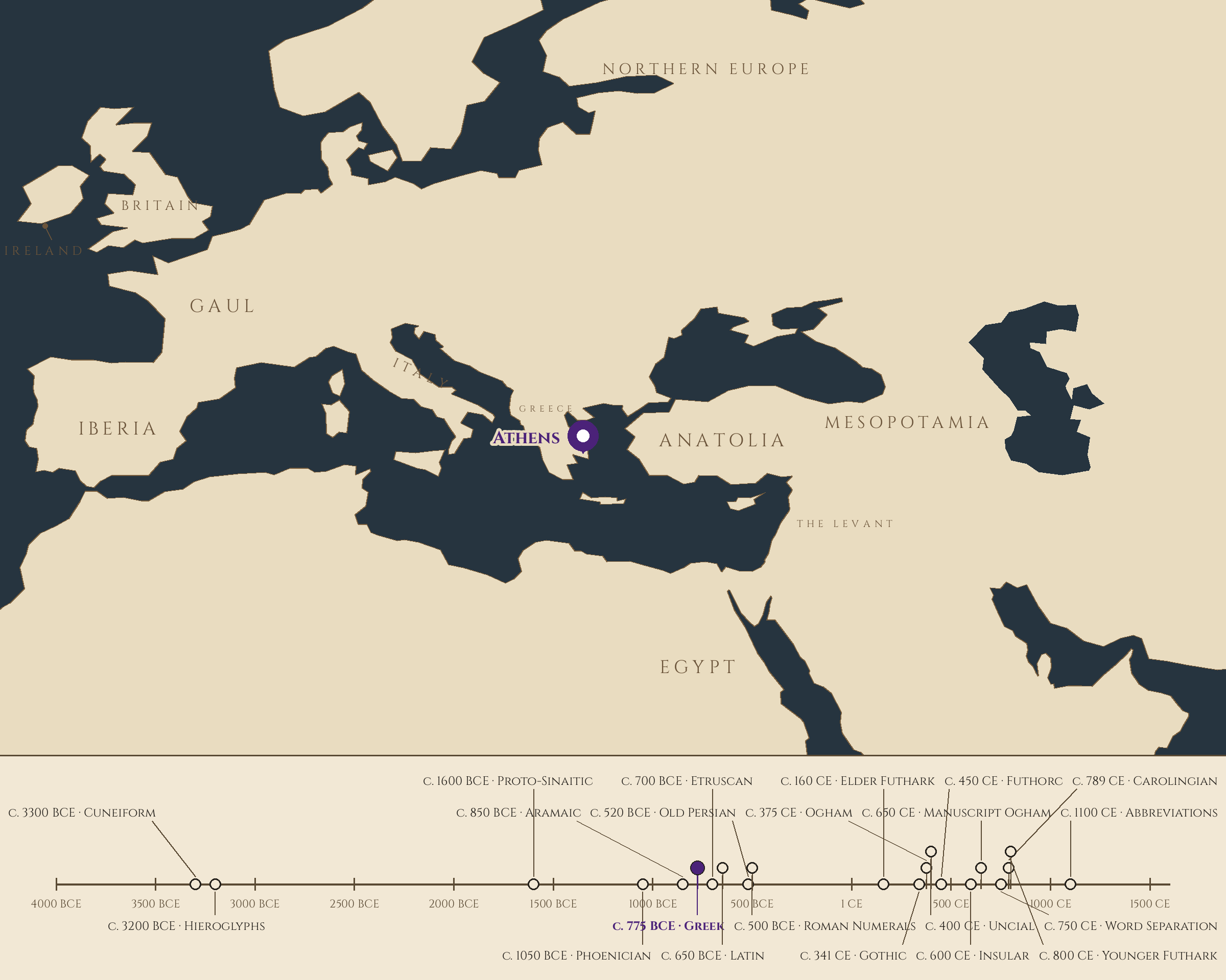
Where and when: the Aegean coast of Greece, about 2,800 years ago. The pin is this lesson. The line beneath the map is our road: every stop a writing system, every lesson a pin.
Lesson Objectives
By the end of this lesson, students should be able to:
- Explain when and how the Greeks adopted the Phoenician alphabet.
- Define Greek alphabet, boustrophedon, digamma, epichoric, matres lectionis, and Ionic alphabet.
- Describe the vowel repurposing, letter by letter, and explain why Greek needed vowels when Semitic languages did not.
- Explain boustrophedon writing and the path from directional experiments to left-to-right standardization.
- Identify the 24 classical Greek letters, their sounds, and their Phoenician ancestors.
- Trace the Greek alphabet's descendants: Latin, Cyrillic, and beyond.
- Apply the course question in its inverted form: what must be added to be understood?
Reading this lesson: ★ marks the passages to remember. They return on the unit quiz and the class test. Check in questions ask the material back as you go; answer them in your workbook when you meet them.
Working this lesson: Your assignment packet is the first download on this page. Work in it as the lesson moves along, answering each assignment as its subject is taught — or read the lesson through for your notes and take the assignments as homework afterward. Both are proper ways to sit this class. Signposts in the reading tell you where each assignment belongs. Written answers are short answers in your own words; a few honest lines are worth more than a filled page.
Your Assignment Packet
This lesson's assignments live in its packet: the Lexicon Handout (every term, course terms marked ◆), Materials, Guided Practice, the Assignment Manual with its answer key for self-checking, the Reflection Questions, and the Workbook Checklist. Download the packet before you begin and keep it beside you as you read.
The Borrowers of the Aegean
Let me correct a misconception at the door, because it is the most common one students bring to this lesson.
The Greeks did not invent the alphabet. They borrowed it, the way a musician borrows an instrument and then plays music no one had imagined on it.
The invention happened in Sinai, among the miners of Lesson 4. The standardization happened in Phoenicia, among the merchants of Lesson 5. What happened in Greece was adaptation: the most brilliant act of borrowing in the history of writing.
★ The borrowers were Euboean traders. Euboea is the long island off Greece's eastern coast, and its sailors were among the earliest Greeks to push westward across the Mediterranean. Around the 8th century BCE, roughly 775 BCE by the standard reckoning, they were trading with Phoenicians, and somewhere in that contact, on a dock or a deck or in a counting house, the alphabet changed hands.
We know it traveled west because the earliest Greek alphabetic inscriptions appear in the west. On the island of Pithekoussai (modern Ischia, off the coast of Italy), the first Greek overseas settlement, archaeologists found a drinking cup inscribed with a playful verse: "I am the cup of Nestor, good to drink from." This is Nestor's Cup, dated to around 740 to 720 BCE, and it is one of the oldest pieces of Greek writing in existence.
A drinking cup, not a monument. The alphabet arrived in Greece the way it arrived everywhere: in the hands of ordinary people, doing ordinary things.
The earliest known Greek inscription of all comes from Athens itself: the Dipylon oinochoe, a wine jug dated to around 740 BCE, scratched with a line announcing itself as a dancing prize.
Read that again and notice what it tells you. Within a generation of the alphabet's arrival, Greeks were scratching verses onto pottery.
They took to it immediately, the way dry timber takes a spark.
What they took was the complete Phoenician package: 22 letters, the same names, the same order, the same right-to-left direction. The earliest Greek inscriptions are nearly indistinguishable from Phoenician ones to the untrained eye.
But the Greeks had a problem the Phoenicians never had, and solving it changed everything.
❦ In your workbook: record how the letters crossed the Aegean in your own way — copy, sketch, or note what matters.
In your packet: Assignment III — The Cup Investigation ◐ begins here. Work it now, or mark the place and take it as homework — your choice.
Why Greek Needed Vowels
To understand the vowel revolution, you must understand why Semitic languages could live without written vowels and Greek could not. The answer lies in how the two language families build meaning.
Semitic languages build words from consonantal roots. In Lesson 4 you met this system: the root k-t-b carries the idea of "writing," and the vowels draped around it tell you the grammar (kataba, "he wrote"; kitab, "book"; katib, "writer"). The consonants are the skeleton and the meaning; the vowels are clothing the reader supplies from knowledge of the language.
A reader who knows the language can reconstruct the vowels reliably, which is why the abjad worked for three thousand years.
Greek is an Indo-European language, and Indo-European builds meaning differently. In Greek, changing the vowel can change the word entirely, the way it does in English. Consider sing, sang, sung: the same three consonants, three different meanings, and the vowels do all the work.
Strip the vowels and write "sng," and no reader can recover which one you meant. Greek is full of such pairs. The grammar runs on vowel changes the way Semitic grammar runs on consonantal roots.
A consonantal skeleton was therefore not enough for Greek. The Phoenician abjad, perfect for Phoenician, was a garment that did not fit the Greek body. So the Greeks did what adapters do: they altered the borrowed thing until it fit.
The solution was hiding in plain sight. Phoenician had consonants that Greek did not need. The glottal stop of aleph had no role in Greek phonology. The h of he, the y of yod, the voiced pharyngeal of ayin, the w of waw: these were sounds Greek either lacked or could spare.
One by one, the Greeks took these surplus consonants and reassigned them as vowels.
★ Aleph, the ox, became alpha, the vowel a. He, the window, became epsilon, the vowel e (its name means "bare e," distinguishing it from the long vowels to come). Yod, the hand, became iota, the vowel i. Ayin, the eye, became omicron, the vowel o ("small o"). Waw, the hook, became upsilon, the vowel u, while also surviving as the consonant digamma for the /w/ sound Greek still used.
★ Five letters reborn. And with them, for the first time, a major alphabetic writing system could represent both consonants and vowels consistently, each with its own symbol.
I add the word "major" and the word "consistently" with deliberate care, because scholars will ask about Ugaritic. The Ugaritic scribes of the Late Bronze Age sometimes used consonant letters as vowel hints, a technique called matres lectionis.
But they did so occasionally and unsystematically. The Greeks made vowel writing complete and regular: every vowel, every time, its own letter.
That is the difference between a hint and a system, and it is why this lesson stands where it does in our story.
Check in: Name the five Phoenician consonants that became Greek vowels. For each one, what sound did it give up, and what vowel did it become?
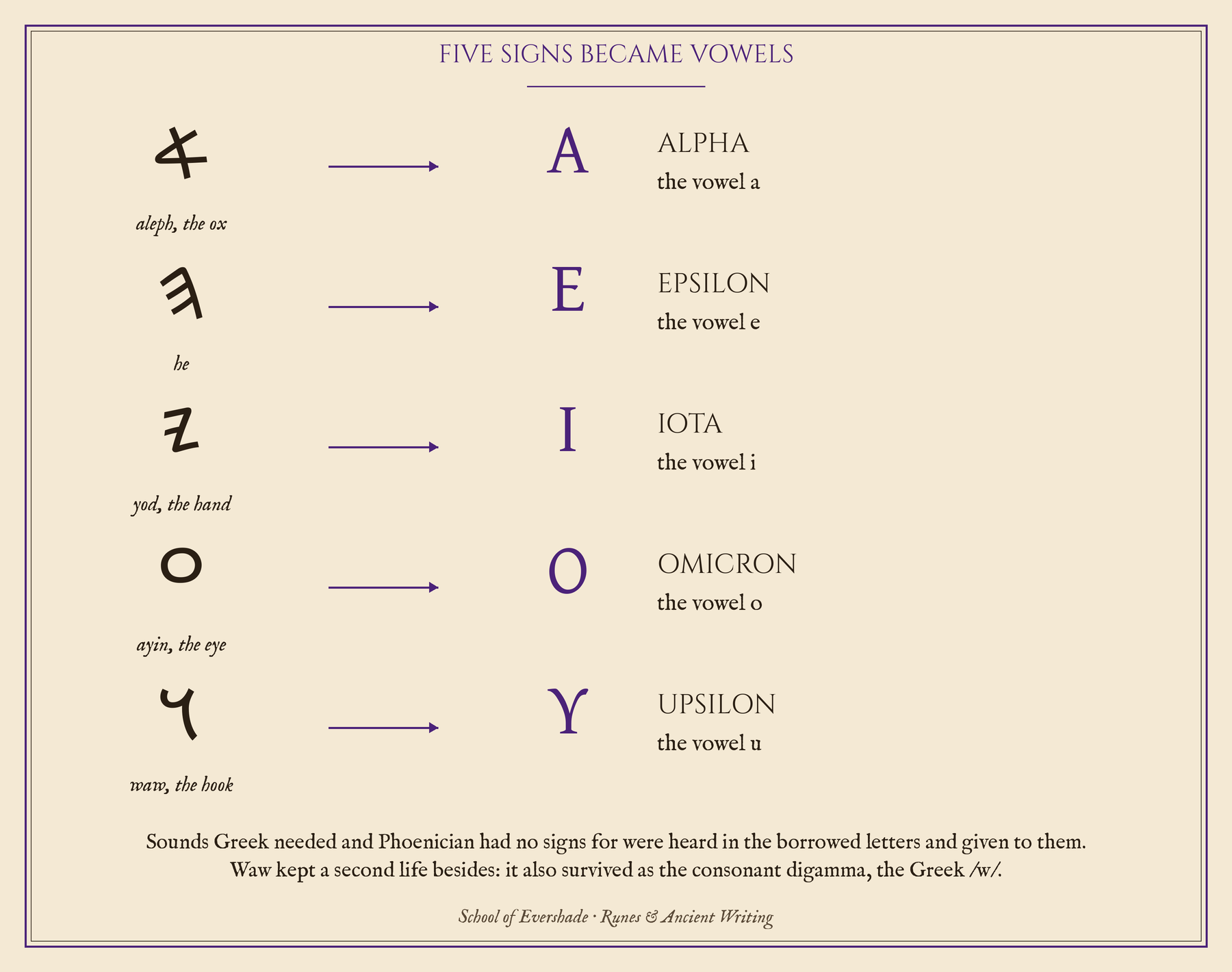
The invention itself: five Phoenician consonant signs, heard afresh. Aleph, he, yod, ayin, and waw became alpha, epsilon, iota, omicron, and upsilon — the first true vowel letters in history.
Built for Evershade.
❦ In your workbook: record why Greek needed vowels in your own way — copy, sketch, or note what matters.
Professor Webblethorn
Pause here, scholars, and turn the course question inside out.
Every lesson until now has asked what can be left out. The miners left out the pictures. The merchants left out the variation. The scribes left out the rigidity. And each time, the alphabet survived the subtraction.
The Greeks asked the opposite question: what must be put in? They tried the borrowed abjad and found it insufficient, not because it was poorly made but because it was made for another language's mouth. So they added what could not be left out. They put the vowels in, and the alphabet became something it had never been.
Hold both questions together from here on. "What can we leave out and still be understood?" And now, beside it: "What must we add?" The rest of our story is the tension between those two questions, and every script we meet will answer them differently.
Keep the silk thread in your hand. It has just doubled back on itself, which is what threads do when the weaving gets interesting.
PROFESSOR THISTLELOOM WEBBLETHORN
Runes & Ancient Writing
Epigrapher, Head of House Septentrio
As the Ox Turns
The Greeks did not only change what the letters represented. They experimented with everything about how writing worked, including which way it went.
The earliest Greek inscriptions run right to left, like their Phoenician models. But before long, Greek writers began experimenting. Some lines run left to right. Some inscriptions alternate: the first line runs right to left, the next left to right, the next right to left again, with the letters themselves mirrored on the reversed lines so they always face the direction of writing.
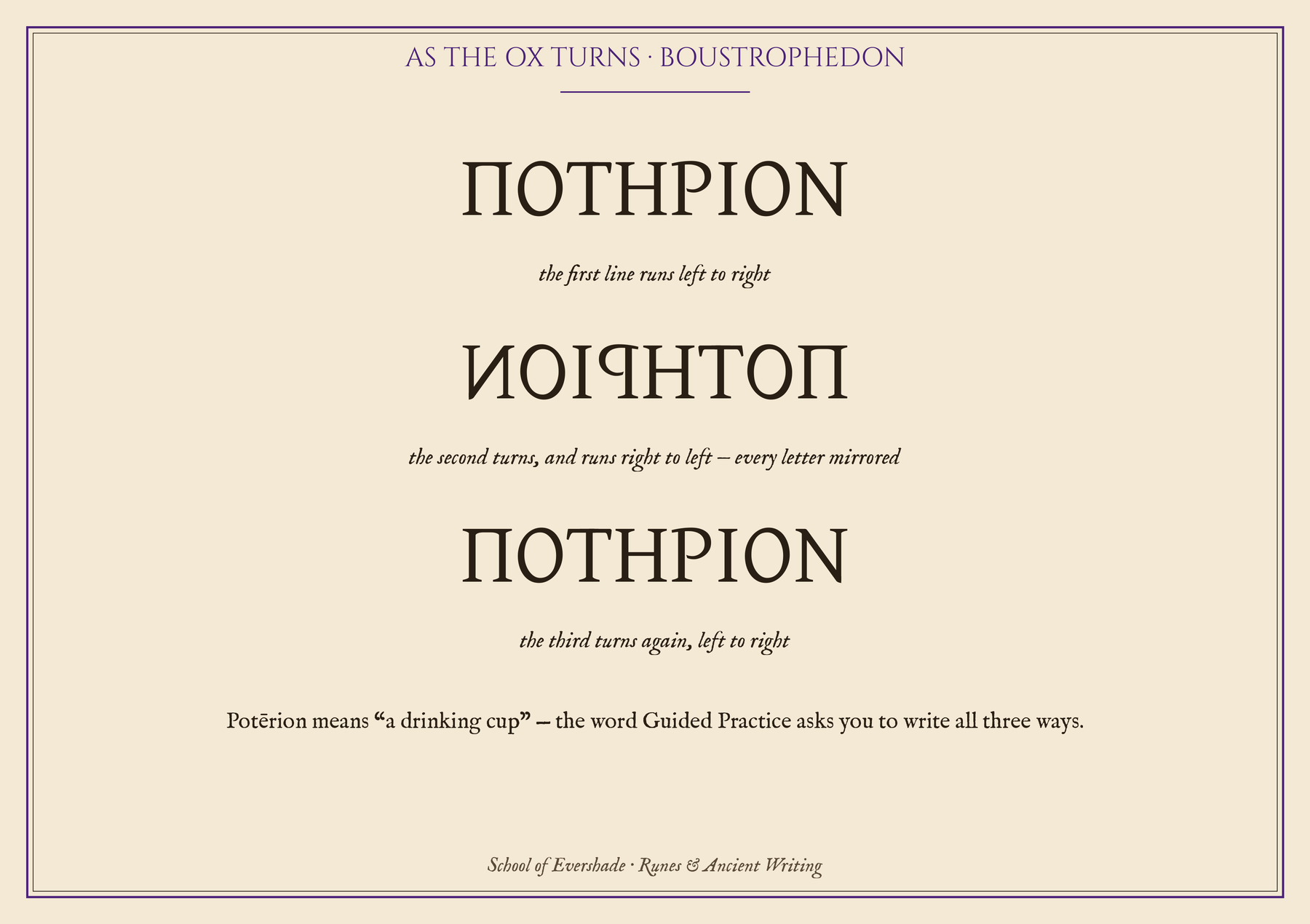
Writing as the ox turns: the line runs one way, turns, and runs back with every letter mirrored — the way a plow crosses a field. Later Greek would settle into left-to-right only.
Built for Evershade.
★ This is boustrophedon, "as the ox turns," named for the path of an ox plowing a field: down one furrow, turn, back up the next.
Say the word aloud and you can feel the agricultural metaphor the Greeks reached for. Writing, for them, was new enough to need metaphors from farming.
The ox turns at the field's edge; the reader's eye turns at the line's edge. No lifting, no wasted motion, no searching for the start of the next line.
It is practical, and it is beautiful, and if you have never tried reading boustrophedon, I recommend the exercise below. Your eye learns the turn quickly, and then every modern page feels oddly inefficient.
The directional experiments were part of a larger pattern: before standardization, every Greek region wrote its own way. Scholars call these the epichoric alphabets, the "local" alphabets. Attica had one, Corinth had another, Euboea another, Ionia another.
Letterforms varied. Some regions kept letters others dropped. Some wrote right to left, some boustrophedon, some left to right.
The Greek world was a laboratory of alphabets, and it stayed that way for three centuries.
Standardization came from the east, and it came by decree. The Ionic alphabet, the epichoric alphabet of the Greek cities on Asia Minor's coast, had the fullest toolkit: it distinguished long and short vowels (eta and omega for the long e and o, alongside epsilon and omicron for the short ones) and it had the complete set of added consonants.
★ In 403 BCE, under the archon Eucleides, Athens officially adopted the Ionic alphabet for all public documents.
What Athens did, the Greek world followed. Within a few generations, the epichoric alphabets were gone, replaced by a single standard: 24 letters, written left to right.
That standard is the classical Greek alphabet. It is the alphabet of Plato and Euclid, of the New Testament, of mathematics and science down to the present day.
When you see π in a geometry textbook or Δ in an equation, you are looking at letters standardized by an Athenian decree twenty-four centuries ago.
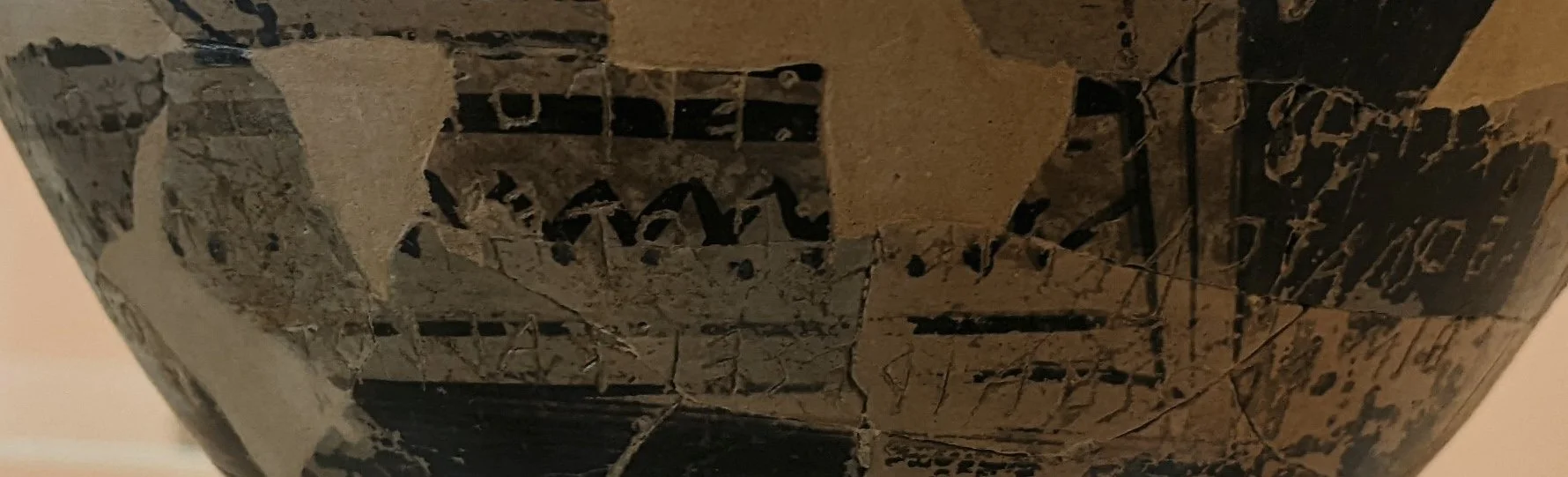
Historical example. The words on Nestor's Cup, scratched after firing into the clay of a drinking cup from Pithekoussai, about 740–720 BCE — among the earliest Greek writing anywhere. The cup survives in fragments, as the close view shows: “I am the cup of Nestor, good to drink from.”
Nestor's Cup (kotyle), Pithekoussai (Ischia), ca. 740–720 BCE; inscription detail. Photograph by Shonagon, Wikimedia Commons. CC0.
Check in: What is boustrophedon named for, and what ended the age of the epichoric alphabets? Give the year, and the alphabet Athens adopted.
❦ In your workbook: record the ox-turn writing and the local alphabets in your own way — copy, sketch, or note what matters.
Twenty-Four Letters
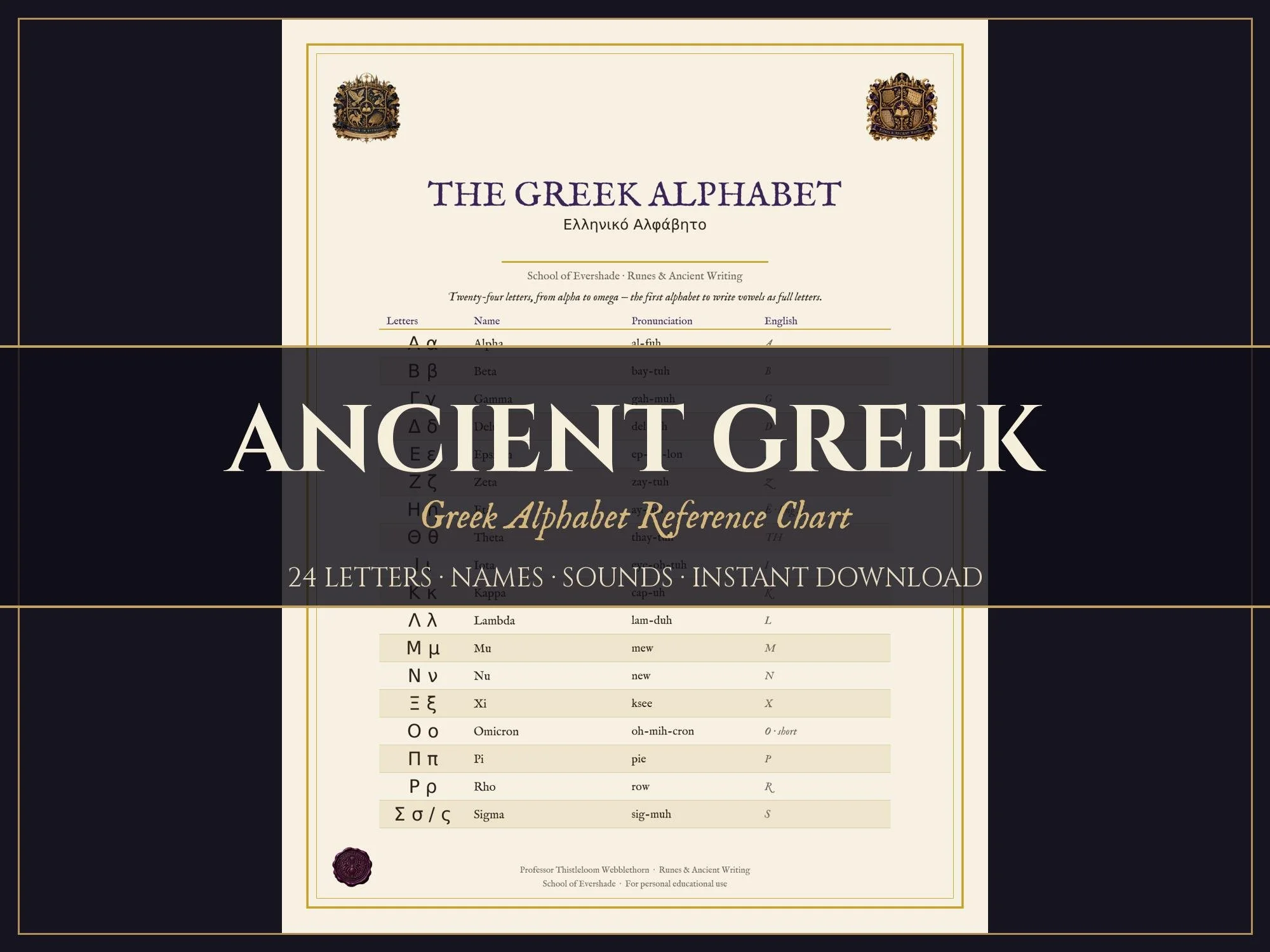
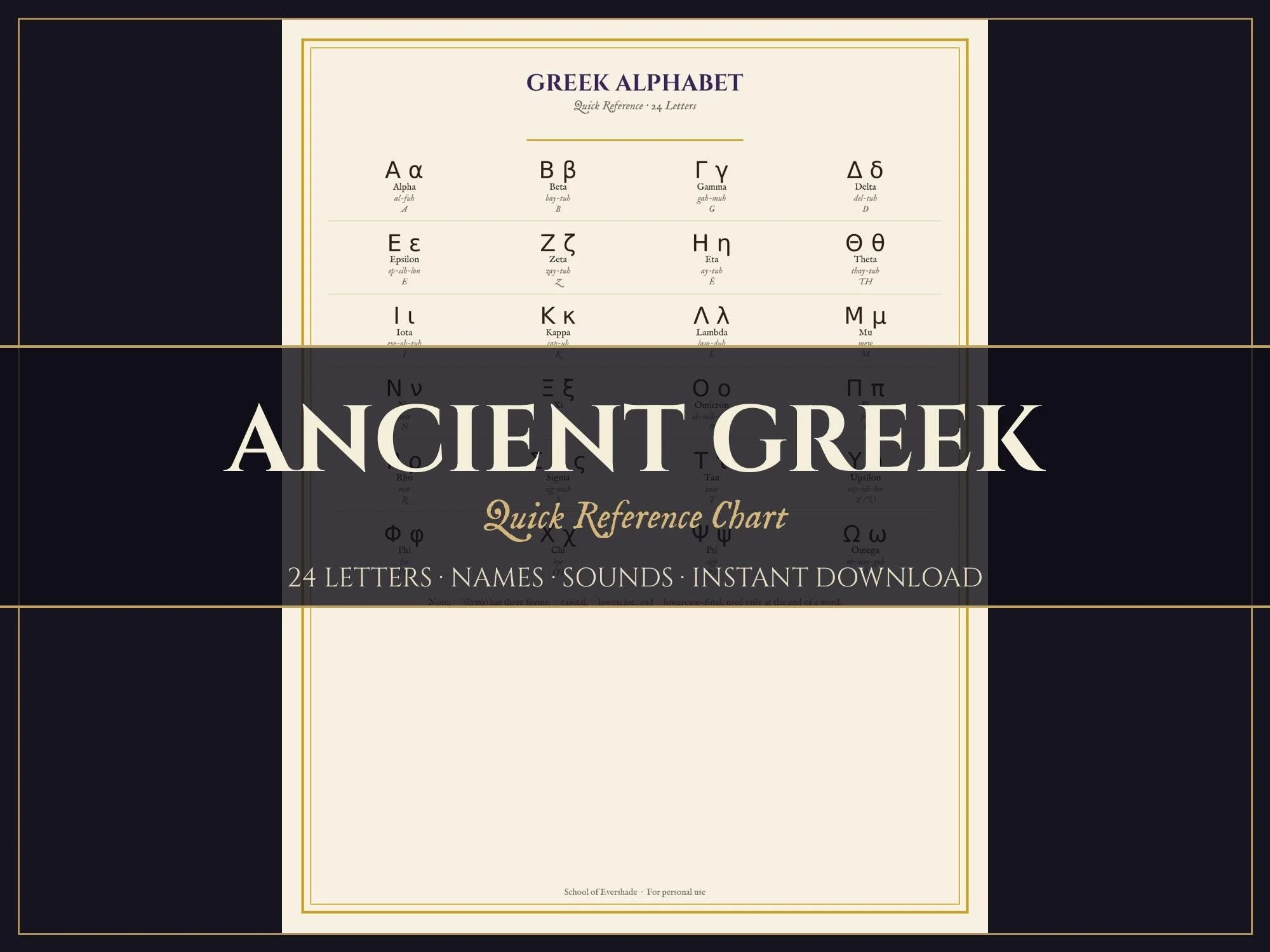
Here is the classical Greek alphabet — the 24-letter alphabet adapted from the Phoenician script, the first major system to write consonants and vowels with separate signs — in full, each letter with its name, its sound in the classical period, and its Phoenician ancestor.
Read it as a family history: nineteen of the letters are Phoenician children, repurposed and renamed; five are Greek inventions, added for sounds the borrowed alphabet could not write.
Alpha (Α α): a, as in "father." From Phoenician aleph, the glottal stop reborn as a vowel. The first letter of the alphabet, and half of the word "alphabet" itself.
Beta (Β β): b. From Phoenician beth. The second half of "alphabet." Say alpha-beta quickly and you hear the Phoenician aleph-beth underneath, three thousand years deep.
Gamma (Γ γ): g, always hard, as in "go." From Phoenician gimel. The curved Phoenician form straightened into the angular Greek gamma.
Delta (Δ δ): d. From Phoenician daleth. The triangular capital delta is one of the most recognizable Greek letters, and it survives in mathematics as the symbol of change.
Epsilon (Ε ε): e, short, as in "pet." From Phoenician he. Its name means "bare e," distinguishing it from eta, the long e. A consonant became a vowel, and no one looked back.
Zeta (Ζ ζ): probably pronounced zd, as in "wisdom" run together, in Classical Athens. From Phoenician zayin. Scholars reconstruct the [zd] pronunciation from metrical and comparative evidence; the modern "z" sound came later.
Eta (Η η): long e, as in "obey" without the glide. From Phoenician het. This letter had a career: it began as the h sound (the "former H-sound" of the old inscriptions), then became the long e vowel in the Ionic standard. In regions that kept the h, a variant form called heta did the consonant's work.
Theta (Θ θ): tʰ, an aspirated t (a t followed by a puff of air), not the modern "th" fricative. From Phoenician tet, one of the emphatic consonants Greek did not need. The circle with the crossbar may be the most beautiful letter in the alphabet; it survives in mathematics as the symbol for angles.
Iota (Ι ι): i, as in "machine." From Phoenician yod. The smallest letter, and the source of the English phrase "not one iota," meaning not the smallest amount.
Kappa (Κ κ): k. From Phoenician kaph. Straightforward, stable, and the ancestor of the Latin K.
Lambda (Λ λ): l. From Phoenician lamed. The inverted-V capital is distinctive; in physics it denotes wavelength, in the ancient world it marked Spartan shields.
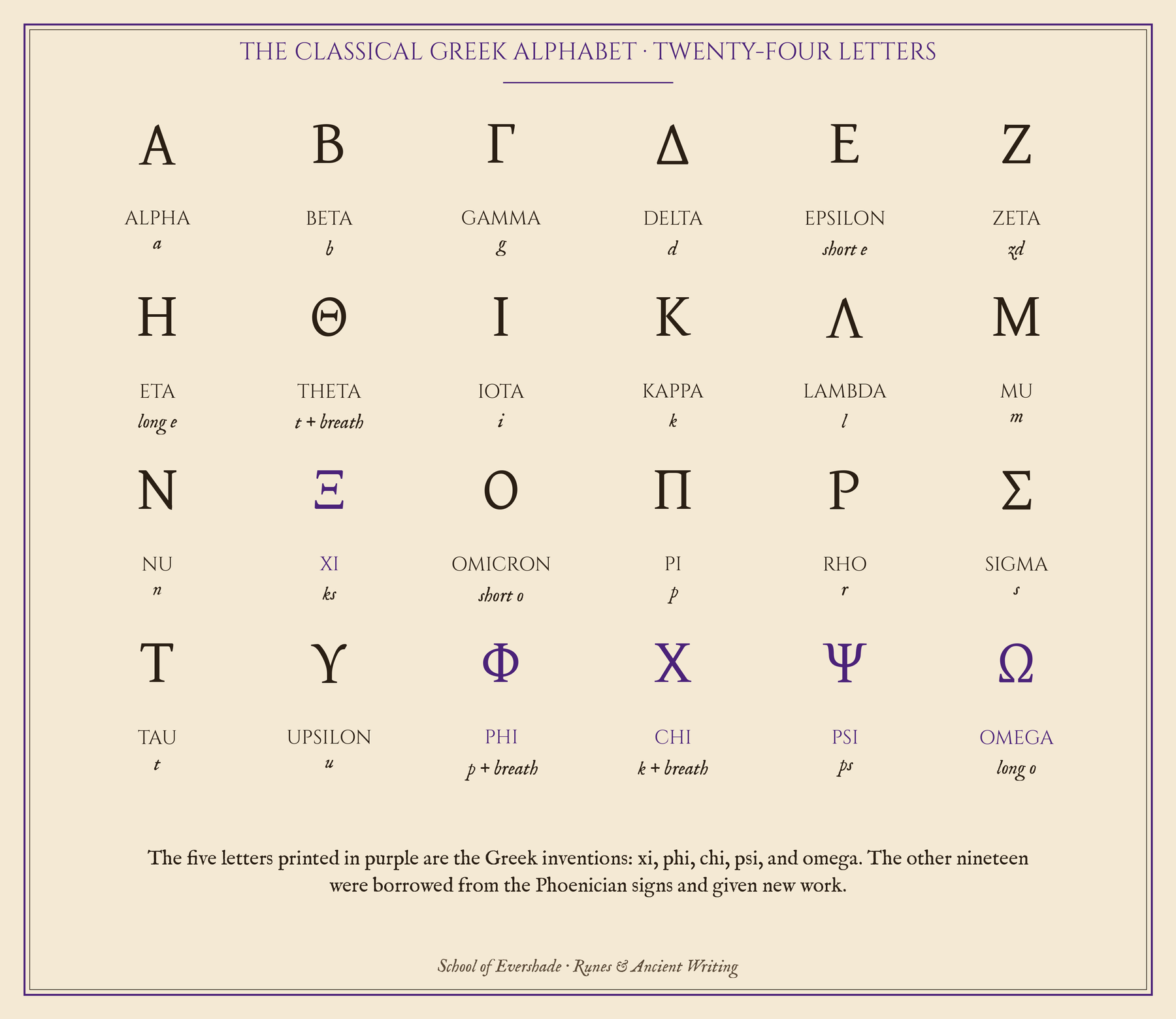
The classical twenty-four, in the order Greek schoolchildren still learn them. The five letters in purple are the ones Greece invented; the rest were borrowed and given new work.
Built for Evershade.
Mu (Μ μ): m. From Phoenician mem, the water ripple, now fully abstracted into the symmetrical Greek form.
Nu (Ν ν): n. From Phoenician nun. The Lesson 4 puzzle is now three lessons behind us: the fish has become a plain vertical diagonal, and no one remembers it was ever a fish.
Xi (Ξ ξ): ks, as in "axe." A Greek invention, added for a consonant cluster Phoenician wrote with two letters. Its position in the alphabet (between nu and omicron) marks it as an insertion into the inherited order.
Omicron (Ο ο): o, short, as in "pot." From Phoenician ayin, the voiced pharyngeal reborn as a vowel. Its name means "small o," distinguishing it from omega.
Pi (Π π): p. From Phoenician pe. The gateway-shaped capital is unmistakable, and the letter's mathematical fame (the ratio of circumference to diameter) has carried it further than any other Greek letter.
Rho (Ρ ρ): r, trilled. From Phoenician resh. The ancestor of the Latin R, though the Greek form looks like a Latin P, a resemblance that has confused students for centuries.
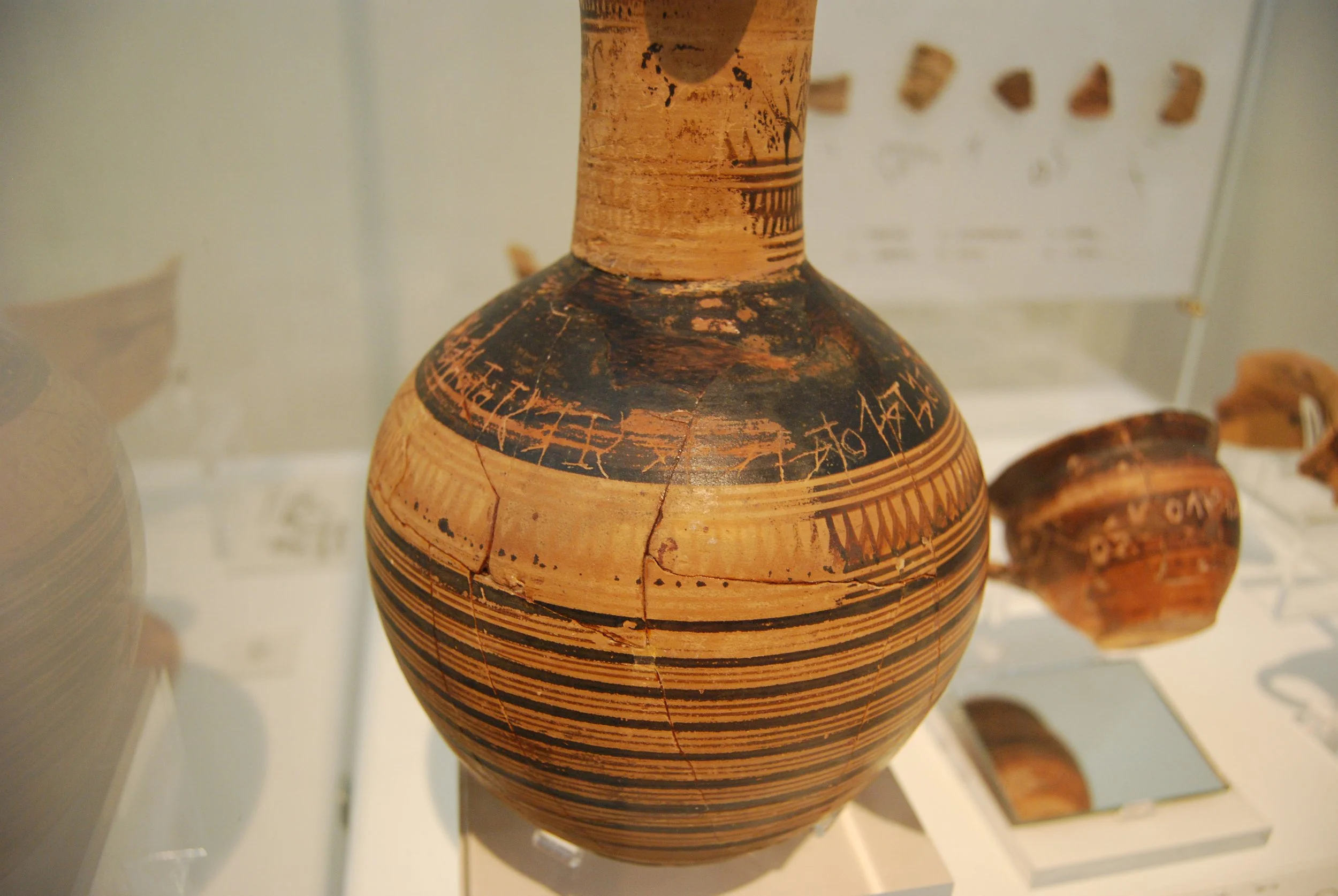
Historical example. The Dipylon oinochoe, Athens, about 740 BCE: the letters scratched around its shoulder — a prize promised to the dancer who “dances most friskily” — are among the earliest Greek sentences we have. The jug stands today in the National Archaeological Museum, Athens.
Dipylon oinochoe, Athens, ca. 740 BCE. Photograph by Durutomo, Wikimedia Commons. Public domain.
Sigma (Σ σ): s. From Phoenician shin. Note the repurposing: Phoenician shin was the sh sound, but Greek had no sh, so the letter became the plain s. The lunate (crescent-shaped) variant appears in later inscriptions.
Tau (Τ τ): t. From Phoenician taw, the mark. The last of the inherited letters in the original order, simple and unchanged in essence.
Upsilon (Υ υ): u, as in "rule" (in the classical period; it later fronted toward the French u). From Phoenician waw. Its name means "bare u," matching epsilon's "bare e." Remember from Lesson 5 the astonishing family this letter founded: upsilon is the ancestor of the Latin U, V, W, and Y.
Phi (Φ φ): pʰ, an aspirated p (not the modern "f" sound). A Greek invention, added for a sound Phoenician lacked. The circle bisected by a vertical line is one of the alphabet's most elegant forms.
Chi (Χ χ): kʰ, an aspirated k (not the later "ch" or fricative). A Greek invention. Do not confuse it with the Latin X, though they look identical; they are different letters with different histories.
Psi (Ψ ψ): ps, as in "lapse." A Greek invention, added for another consonant cluster. Its trident shape is distinctive and unmistakable.
Omega (Ω ω): long o, as in "awe." A Greek invention, and the last letter added, which is why it stands at the alphabet's end. Its name means "great o," distinguishing it from omicron, the "small o." The alphabet that began with the ox now ends with the great O, and the phrase "alpha and omega," meaning the beginning and the end, comes from these two letters.
Three archaic letters deserve a farewell. Digamma (Ϝ), the /w/ consonant, survived in some dialects but died in Ionic-Attic, living on only as the numeral 6; it is the ancestor of the Latin F. Koppa (Ϙ), from Phoenician qoph, marked the k sound before back vowels, then died, surviving as the numeral 90 and the ancestor of the Latin Q. San, from Phoenician tsade, was an alternative s that lost to sigma and vanished. The alphabet kept what it needed and buried the rest, which is the whole course question in miniature.
★ Twenty-four letters. Nineteen borrowed and reborn, five invented outright. The first alphabet in the full sense: every consonant and every vowel with its own sign, written left to right, standardized by decree.
From here, the letters travel to Italy, where the Etruscans will borrow them next, and the story continues.
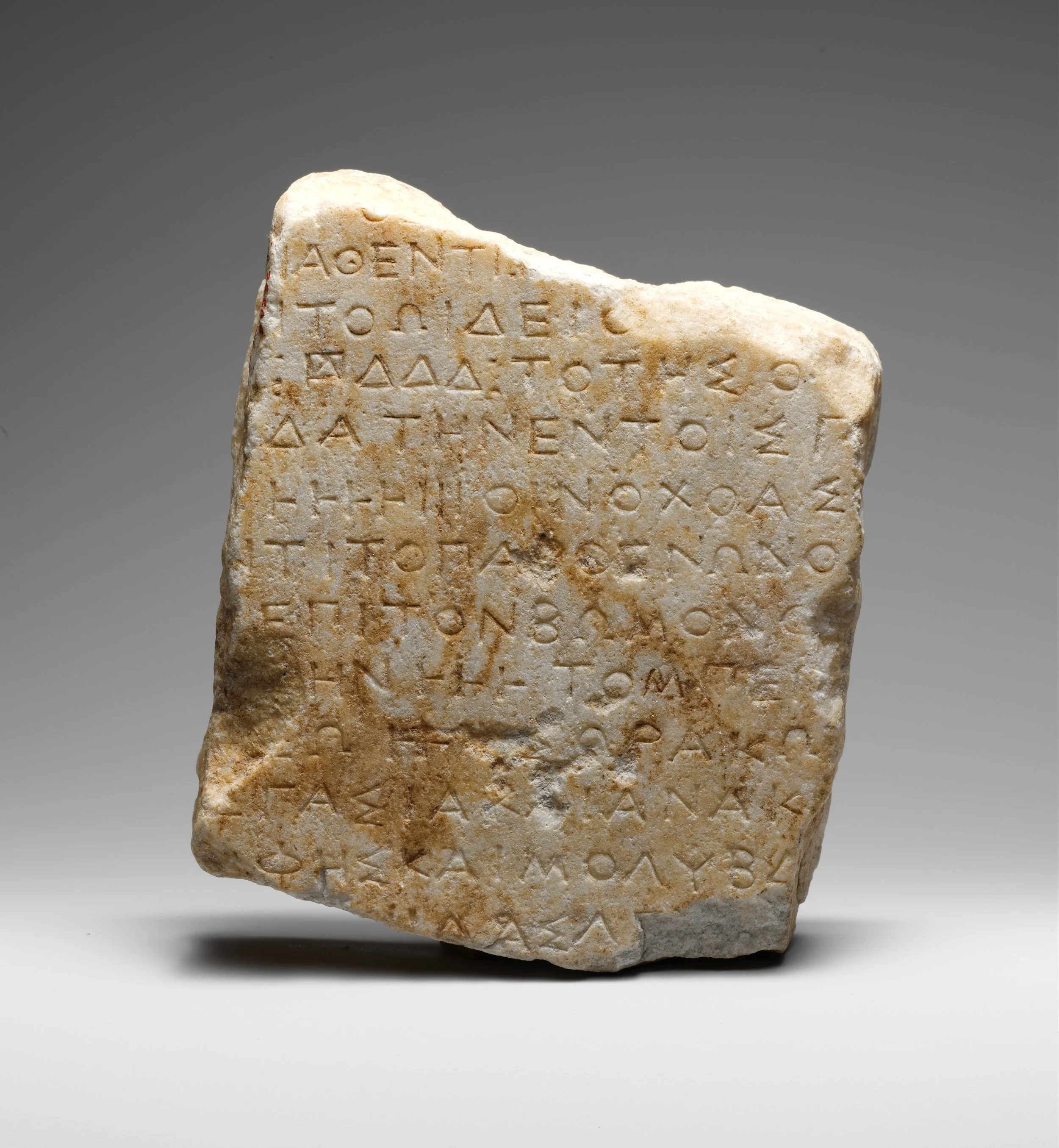
Historical example. The alphabet standardized: Greek letters cut in marble in Athens in the first half of the 4th century BCE, a generation after Athens adopted the Ionic alphabet for official use in 403 BCE — the twenty-four letters, set in stone.
Fragmentary marble inscription, Greek, Attic, 1st half of the 4th century BCE. The Metropolitan Museum of Art, New York (26.60.6). Public domain, The Met Open Access.
Check in: Of the 24 classical letters, how many were borrowed and how many invented? Name the five inventions.
❦ In your workbook: record the twenty-four letters and their ancestors in your own way — copy, sketch, or note what matters.
In your packet: Assignment II — Transliteration Practice ⚒ begins here. Work it now, or mark the place and take it as homework — your choice.
Guided Practice — The Singer's Hand
Before the assignments, train your hand the way a Greek writer would: with attention to the vowels, and to direction.
Exercise A — Drawing the Twenty-Four
- On paper, draw the 24 classical Greek capitals as described in the lesson. Work slowly; these are inscriptional forms, carved rather than cursive.
- Label each with its Greek name and sound value.
- Beside each, note its Phoenician ancestor (for the 19 inherited letters) or mark it as a Greek invention (for xi, phi, chi, psi, omega).
- Circle the five repurposed vowels. For each, write the Phoenician consonant it used to be. Look at what the Greeks saw: five spare consonants, five missing vowels, a perfect fit.
❦ Workbook path: make this a permanent workbook page instead of loose paper: rule a grid in your workbook and draw the twenty-four there, so the alphabet stands at the front of your Greek work for the rest of the unit.
Exercise B — As the Ox Turns
- Write the Greek word for "cup," potērion, in capitals (ΠΟΤΗΡΙΟΝ), left to right.
- On the next line, write it again, but right to left, mirroring each letter so it faces the direction of writing (boustrophedon).
- Write a third line left to right again. Read all three lines in sequence, turning at each line's end like the ox.
- In two to three sentences, describe what boustrophedon felt like: did your eye find the next line more easily, or less? What did the mirrored letters do to your reading speed?
This exercise teaches, in your own hand, why direction was worth three centuries of experimentation.
Exercise C — The Vowel Test
- Write the English sentence "The quick brown fox jumps" as a consonantal skeleton, leaving out all vowels: "Th qck brwn fx jmps." Read it back. How much can you recover?
- Now write it with vowels but no consonants: "e ui o o u." Read it back. How much can you recover?
- Write two to three sentences on what this reveals: for English, as for Greek, which omission is survivable and which is fatal? What does that tell you about why the Greeks needed what the Phoenicians did not?
You have just repeated, in minutes, the experiment the Greeks ran across generations.
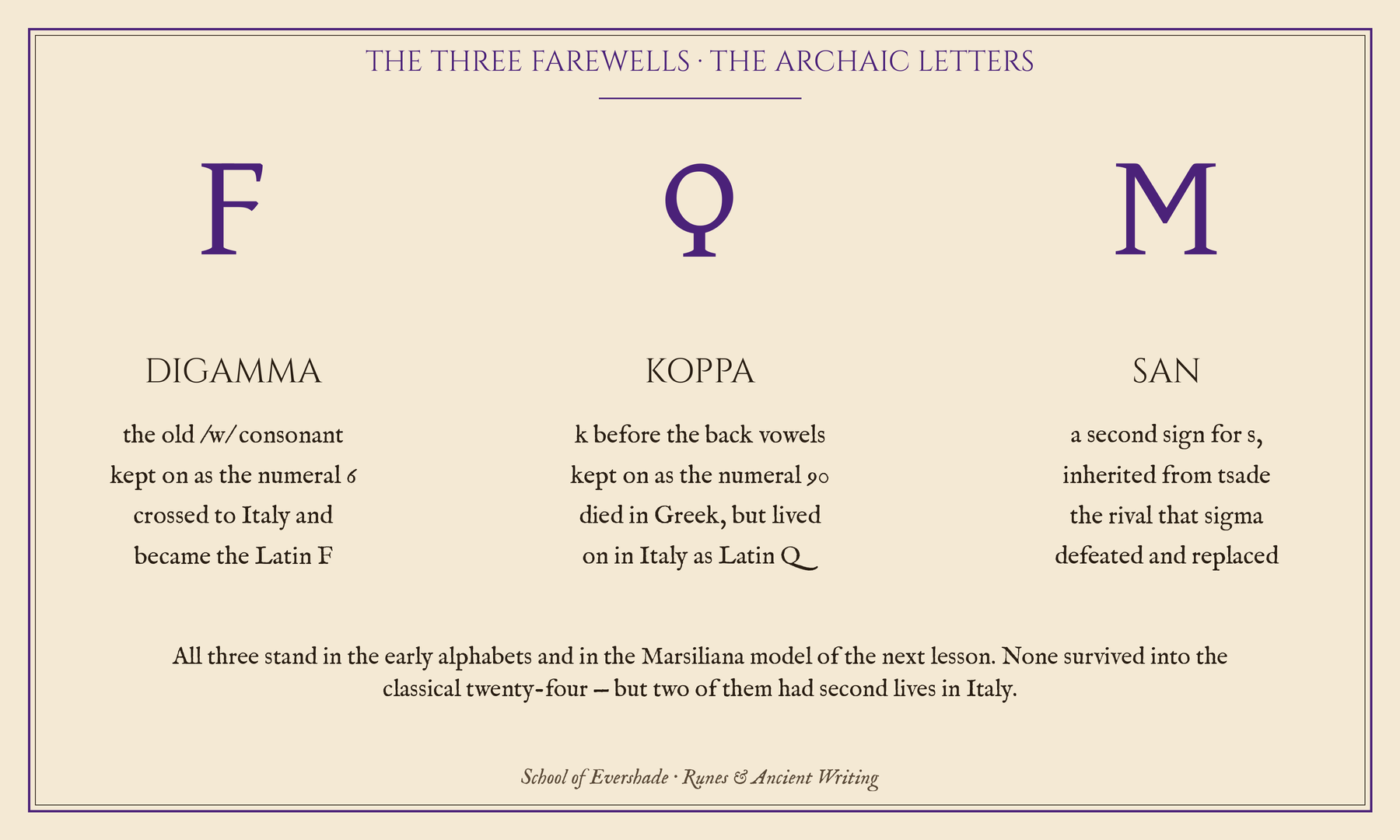
The three farewells of Guided Practice: digamma, koppa, and san. All three faded from Greek — but read their footnotes. Two of them were not finished traveling.
Built for Evershade.
In your packet: Assignment I — The Letter Chart ⚒ begins here. Work it now, or mark the place and take it as homework — your choice.
In your packet: Assignment IV — The Descendant Essay ✎ begins here. Work it now, or mark the place and take it as homework — your choice.
Assignment Manual
Assignment key: ✎ written work · ⚒ hands-on practical · ◐ both · ★ will be on the test · ❦ workbook path
Written answers in this manual are short answers in your own words — a few honest lines, not a filled page.
Assignment I — The Letter Chart ⚒
Objective: Demonstrate control of the 24 Greek letters, their sounds, and their ancestry.
Instructions:
- On a fresh sheet, create a four-column chart: Greek letter (drawn), Greek name and sound value, Phoenician ancestor or "Greek invention," note on what changed.
- Complete all 24 rows. For the five repurposed vowels, describe the consonant-to-vowel transformation in a phrase.
- Below the chart, write one paragraph on the single most surprising repurposing and explain why the Greeks could spare that particular consonant.
Your keepsake: keep this chart beside your Phoenician and Aramaic charts in your scribe's portfolio. It is the page where the alphabet learned to sing.
❦ Workbook path: build the chart across two facing workbook pages instead of a loose sheet: the five repurposed vowels first, each marked with the consonant it used to be.
To submit: Photograph or scan your chart. Accuracy of the ancestry matters more than artistic skill.
Assignment II — Transliteration Practice ⚒
Objective: Read and write Greek letter sequences.
Part A. Write your name in Greek capitals, transliterating sound by sound (for example, "KALI" becomes ΚΑΛΙ). If your name contains sounds Greek lacked (such as sh or English j), note how you handled them and why.
Part B. Transliterate the following Greek words into the Latin alphabet: ΠΟΤΗΡΙΟΝ (cup), ΑΛΦΑΒΗΤΟΣ (alphabet), ΒΟΥΣΤΡΟΦΗΔΟΝ (boustrophedon). Then write each one back into Greek capitals from your transliteration. What did the round trip teach you about the reliability of transliteration?
Part C. The inscription on Nestor's Cup reads, in part, "I am the cup of Nestor." Write this sentence in Greek capitals as a boustrophedon pair: first line left to right, second line right to left with mirrored letters. Reflect in two to three sentences on how direction changes the physical experience of writing.
Assignment III — The Cup Investigation ◐
Objective: Understand the alphabet's arrival through its earliest artifacts.
Instructions:
- Research (using the References below): Nestor's Cup from Pithekoussai and the Dipylon oinochoe from Athens. For each, record the date, the place of discovery, the object type, and what the inscription says.
- Both are drinking vessels, not monuments. Write a half page on what this suggests about who was writing in the earliest days of the Greek alphabet and what they used it for. Base your argument strictly on the objects and this lesson.
- The lesson claims the Greeks borrowed rather than invented the alphabet. Choose the single strongest piece of evidence for borrowing (from the lesson or your research) and write a half page defending the claim against an imagined skeptic who insists the Greeks invented it independently.
Assignment IV — The Descendant Essay ✎
Objective: Trace the Greek alphabet's legacy into the modern world.
Instructions:
Write a one-page essay addressing the following:
The Greek alphabet is the structural ancestor of both the Latin alphabet (through Etruscan, the subject of our next lesson) and the Cyrillic alphabet (through later Greek missionary scripts). Choose one of these two descendant paths and trace it: name at least three specific letters and describe how each changed in form or sound value along the way. Then consider the lesson's central claim: that writing the vowels down was the single most consequential change in the alphabet's history. Do you agree? Use at least two specific details from the lessons to support your position.
Cite the lessons where your details come from.
Materials
Required (Level One — household items)
- Paper: plain white paper or a sketchbook, for letter practice and chart work.
- Pens: one standard pen for drafting, one fine-tipped marker for final letterforms. Greek capitals are inscriptional forms; a marker with a firm tip approximates the carved stroke.
- A ruler: for chart columns and for practicing the straight strokes of letters like gamma, delta, and tau.
- A printout of the Greek alphabet: use the References below for a standard chart of the 24 classical capitals.
Suggested (Level Two — historically closer materials)
- Papyrus paper: Greek literary culture was a papyrus culture. Writing Greek capitals on papyrus with a reed pen approximates the ancient experience.
- A reed pen: cut from bamboo or river reed, as in Lesson 6. The Greeks wrote with reed pens on papyrus; the combination is historically accurate for the classical period.
- A pottery shard or unglazed tile: the earliest Greek inscriptions were scratched on pottery. An ostracon (see Lesson 5) and a sharp stylus give the feel of Nestor's Cup and the Dipylon jug.
- A flat brush and dark paint: for the inscriptional experience. Greek stone inscriptions were laid out in paint before carving; brushing the letters first approximates the mason's method.
Neither level requires
Purchased kits, specialty tools, or any material you cannot find locally or order inexpensively. The core lesson (drawing letters, understanding the vowel innovation, practicing boustrophedon) is fully achievable with paper and pen.
Reflection Questions
Answer the following in your workbook.
- When and how did the Greeks adopt the Phoenician alphabet? Name the traders, the approximate date, and the evidence.
- Why did Greek need written vowels when Semitic languages did not? Use the sing/sang/sung analogy in your answer.
- Name the five Phoenician consonants repurposed as Greek vowels, and give each letter's new name and sound.
- What is boustrophedon, and what does its name reveal about how the Greeks thought of writing?
- What were the epichoric alphabets, and what ended them? Give the date and the decree.
- Name the five Greek-invented letters and the sounds each was added to write.
- The course question asks what can be left out and still be understood. The Greeks inverted it. State their inverted question and explain why their language demanded it.
Workbook Checklist — Lesson 7
In my workbook I have:
- ☐ explained when and how the Greeks adopted the Phoenician alphabet
- ☐ defined Greek alphabet, boustrophedon, digamma, epichoric, matres lectionis, and Ionic alphabet
- ☐ traced the vowel repurposing letter by letter, and explained why Greek needed vowels when Semitic languages did not
- ☐ explained boustrophedon and the path from directional experiments to left-to-right standardization
- ☐ identified the 24 classical Greek letters, with their sounds and their Phoenician ancestors
- ☐ traced the Greek alphabet's descendants: Latin, Cyrillic, and beyond
- ☐ answered the inverted course question: what must be added to be understood
☐ Lesson completed Date: ____________ Signature: ____________
Professor's Review
And so our seventh lesson closes in the Aegean, where borrowers became makers and the alphabet found its voice.
You can now explain how Euboean traders carried the Phoenician letters to Greece around the 8th century BCE, describe the vowel repurposing letter by letter and explain why Greek needed what Semitic did not, explain boustrophedon and the three centuries of directional experiment, identify all 24 classical letters with their sounds and ancestors, and trace the Greek alphabet forward to Latin and Cyrillic.
Keep your Greek chart beside your Phoenician one, as you kept Aramaic beside Phoenician.
Lay all three side by side now and look at the family. The Phoenician letters stand carved and consonantal. The Aramaic letters flow, hurried by the reed pen. And the Greek letters: five of them have changed their nature entirely, consonants become vowels, the alphabet completed.
Next, we cross to Italy, where Greek colonists carried these letters to a people who would reshape them again: the Etruscans. The alphabet is traveling west, and it is about to dress itself in a new language's clothes.
Practice your letters, scholars. Write them in both directions, as the early Greeks did, and feel the ox turn beneath your hand.
I have watched alphabets cross seas in my years among the inscriptions, and they always arrive changed by the voyage. The sea teaches, too.
PROFESSOR THISTLELOOM WEBBLETHORN
Runes & Ancient Writing
Epigrapher, Head of House Septentrio
Cross-Class Connections
The Greek inscriptional capitals in this lesson connect directly with Scrollwork, where Professor Nocturne teaches the Roman capitals descended from these forms through Etruscan and Latin. Students studying both classes should compare the Greek letterforms here with the Roman monumental capitals to come: the family resemblance across a thousand years is unmistakable.
The boustrophedon experiments parallel Creative Arts spatial reasoning: writing that turns like a plow is writing that thinks in space, not just in sequence. Students who build and make will recognize the pattern.
The standardization decree of 403 BCE will reappear later in this unit, in Lesson 9, when we examine how political power shapes writing systems. The Athenian adoption of the Ionic alphabet is our first clear case of a government choosing a script by law, and it will not be the last.
In Other Classrooms
Scrollwork · Unit IV, Lesson 14 — Roman Capitals
The Greek letters you are studying have descendants, and I teach them. In the Library we take up the Roman capitals: twenty-three letters in their square-and-circle geometry, drawn with the brush and finished with the chisel. Come and meet the grandchildren of your Greek alphabet, and bring your eye for letterforms with you.
The sea carries the letters west, and so do we.
References & Further Reading
The British Museum. Collection online. Searchable collection including early Greek inscriptions, the Nestor's Cup context, and classical epigraphy. https://www.britishmuseum.org/collection
The Metropolitan Museum of Art. Heilbrunn Timeline of Art History, "The Greek Alphabet." Museum essays on the alphabet's adoption and early Greek writing. https://www.metmuseum.org/toah/hd/gral/hd_gral.htm
Packard Humanities Institute. Searchable Greek Inscriptions. The major online database of published Greek inscriptions, with texts and translations. https://epigraphy.packhum.org
Wikipedia. "Greek alphabet." Comprehensive overview: history, the 24 letters, archaic variants, and descendants. https://en.wikipedia.org/wiki/Greek_alphabet
Wikipedia. "Nestor's Cup." The Pithekoussai drinking cup, c. 740 to 720 BCE, among the earliest Greek alphabetic inscriptions. https://en.wikipedia.org/wiki/Nestor%27s_Cup
Wikipedia. "Dipylon inscription." The earliest known Greek alphabetic inscription, on a wine jug from Athens, c. 740 BCE. https://en.wikipedia.org/wiki/Dipylon_inscription
Wikipedia. "Boustrophedon." The ox-turn writing style: examples, etymology, and history. https://en.wikipedia.org/wiki/Boustrophedon
Wikipedia. "History of the Greek alphabet." Epichoric variants, the Eucleidean reform of 403 BCE, and standardization. https://en.wikipedia.org/wiki/History_of_the_Greek_alphabet
Browse the Runes shelf in the school Library for readable editions of these works.
The first true alphabet awaits at the Bench. Write your name in Greek letters — theta, phi, and the final sigma all in their places.
Open the BenchPROFESSOR THISTLELOOM WEBBLETHORN · RUNES CLASSROOM
Submit your work for this lesson using the form below.
CONTINUE IN RUNES & ANCIENT WRITING
← Previous · Lesson 6: Aramaic: How the Alphabet Learned to Run an Empire Next · Lesson 8: Etruscan: The Alphabet in a New Mouth →
Unit III · The Mediterranean Masters Runes & Ancient Writing Classroom · All 21 Lessons
The rest of Unit III: Lesson 8 · Etruscan · Lesson 9 · Classical Latin · Lesson 10 · Roman Numerals
From the Runes Shelf
The printed companions to this lesson, from Professor Webblethorn’s shelf in the shop.