RUNES & ANCIENT WRITING
Unit III · Lesson 8THE HIDDEN INTERMEDIARY
Etruscan: The Alphabet in a New Mouth
Professor Thistleloom Webblethorn
Epigrapher • Runes & Ancient Writing
Head of House Septentrio • School of Evershade
Professor's Introduction

The mirror is polished, scholars. I hope your Greek charts are still beside you.
Hold the Greek alphabet up to a different mouth, scholars, and listen for it: which of its letters suddenly have no work to do?
Today the alphabet crosses to Italy, where it meets a language with no use for half its letters.
The Etruscans took the Greek alphabet, held it up to their own mouths, and cut away everything that did not fit. No voiced stops (consonants sounded with the vocal cords vibrating: b, d, g), so no B, no D. Four vowels instead of seven, so no O. What survived was leaner, harder, and entirely their own. And then, through a twist no one could have planned, this pruned alphabet became the ancestor of the script you are reading right now.
Come closer to the web, scholars. Today we learn what an alphabet looks like in a mirror.
PROFESSOR THISTLELOOM WEBBLETHORN
Runes & Ancient Writing
Epigrapher, Head of House Septentrio
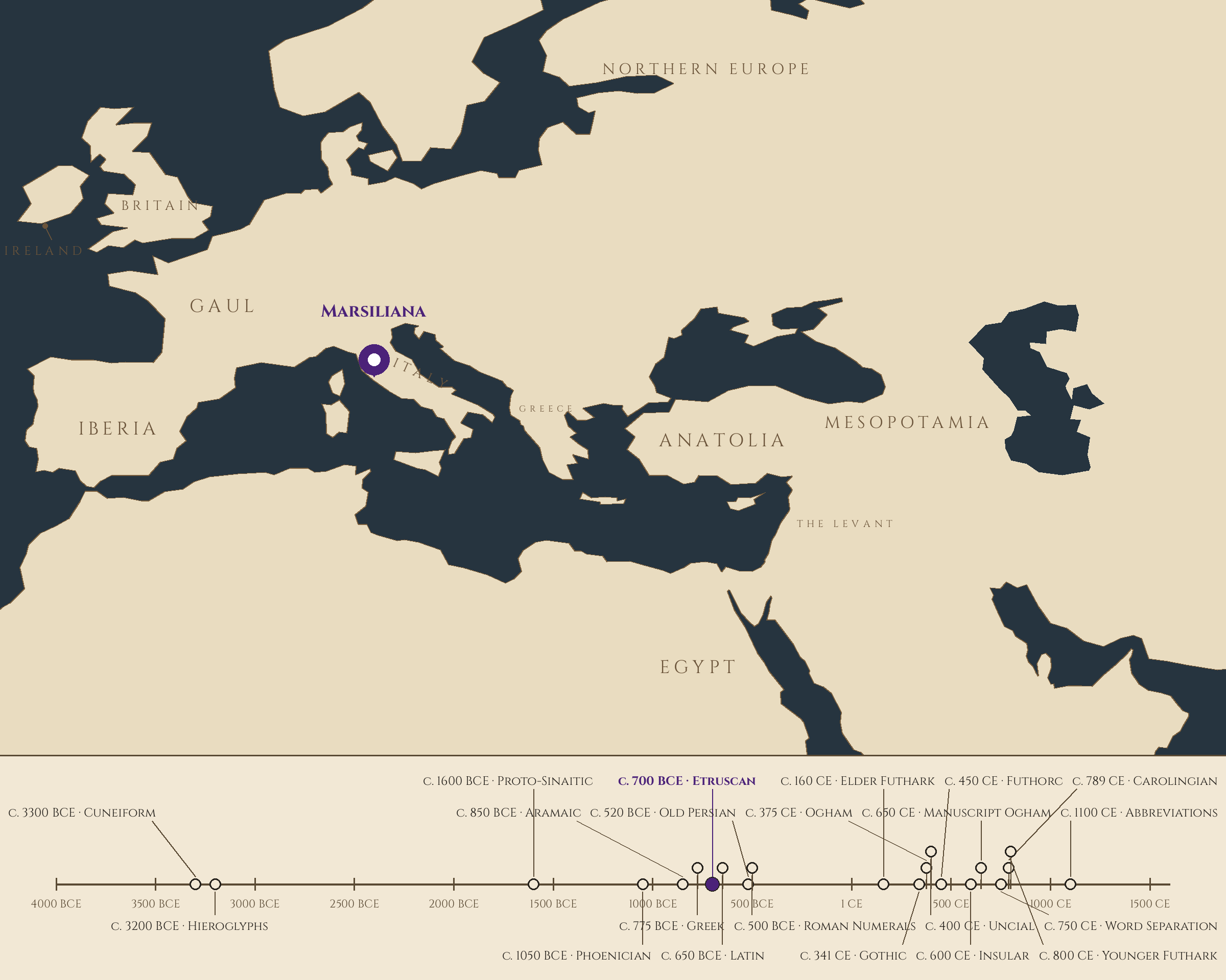
Where and when: Etruria, in the Italy of about 2,700 years ago. The pin is this lesson. The line beneath the map is our road: every stop a writing system, every lesson a pin.
Lesson Objectives
By the end of this lesson, students should be able to:
- Explain when and how the Etruscans adopted the Greek alphabet.
- Define Etruscan alphabet, abecedarium, Etruria, voiced stop, dead letter, sibilant, affricate, Liber Linteus, and Pyrgi Tablets.
- Describe the Marsiliana tablet and explain why its 26 letters include letters the Etruscans never used.
- Explain why B, D, and O fell out of use, and describe the Etruscan vowel and consonant inventory.
- Identify the new letter F (the 8-shaped sign) and explain how the Etruscans wrote the /f/ sound before it existed.
- Describe Etruscan writing direction and the development of word separation.
- Name the major Etruscan writing surfaces and explain why so much Etruscan writing is lost.
- Correct the "undeciphered" misconception: explain the difference between reading Etruscan and understanding it.
- Apply the course question directly: what did the Etruscans leave out, and what did they have to add?
Reading this lesson: ★ marks the passages to remember. They return on the unit quiz and the class test. Check in questions ask the material back as you go; answer them in your workbook when you meet them.
Working this lesson: Your assignment packet is the first download on this page. Work in it as the lesson moves along, answering each assignment as its subject is taught — or read the lesson through for your notes and take the assignments as homework afterward. Both are proper ways to sit this class. Signposts in the reading tell you where each assignment belongs. Written answers are short answers in your own words; a few honest lines are worth more than a filled page.
Your Assignment Packet
This lesson's assignments live in its packet: the Lexicon Handout (every term, course terms marked ◆), Materials, Guided Practice, the Assignment Manual with its answer key for self-checking, the Reflection Questions, and the Workbook Checklist. Download the packet before you begin and keep it beside you as you read.
The Borrowers from the West
Let me begin with a correction, because this lesson's misconception is one of the most persistent in all of ancient history.
"Etruscan is undeciphered." You will hear this stated as fact, in classrooms and documentaries and confident dinner conversation. It is wrong, and the way it is wrong matters.
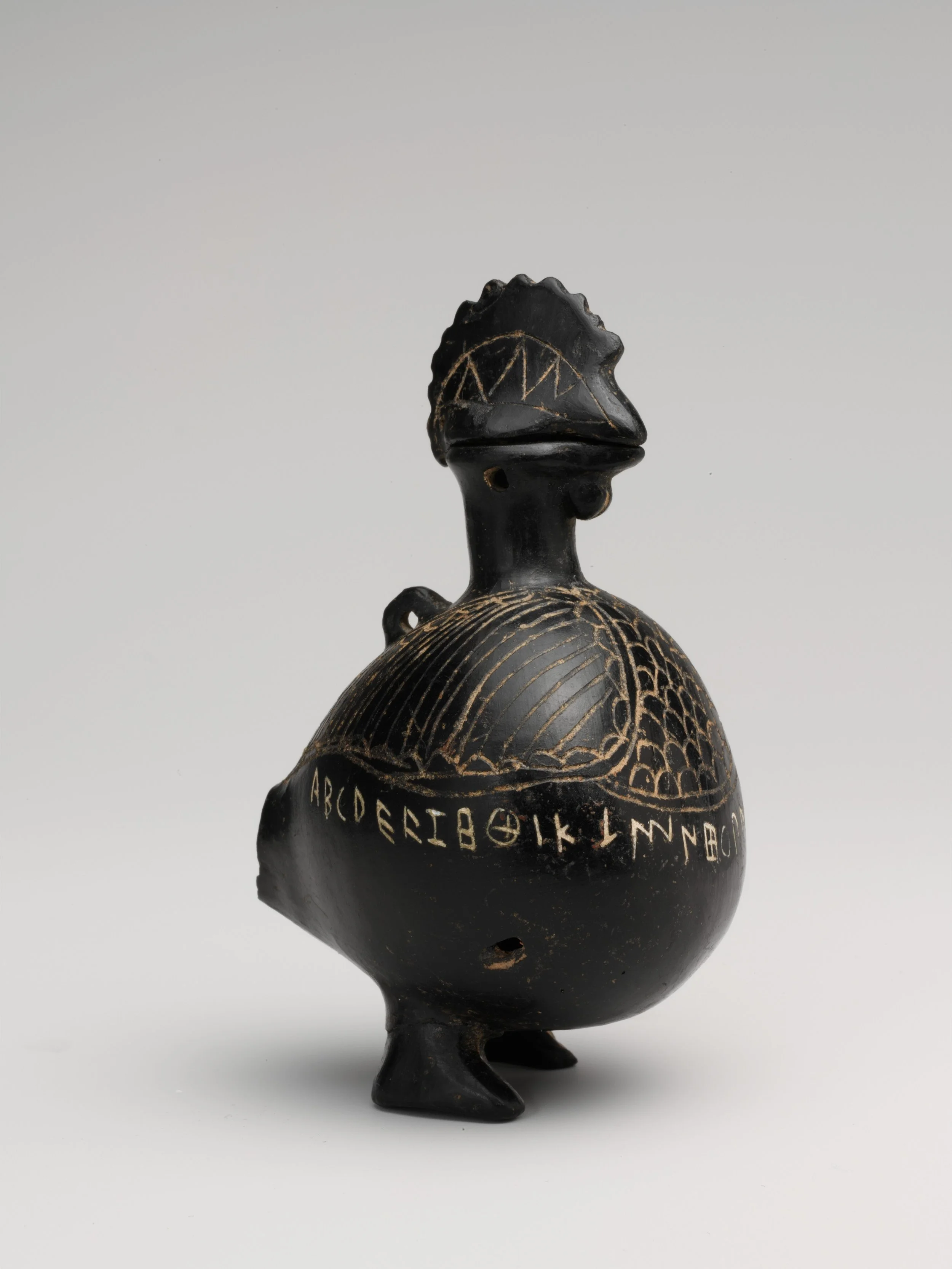
Historical example. The lesson's own witness, in the Metropolitan Museum: a small bucchero vase in the shape of a cockerel, about 650–600 BCE, wearing the alphabet around its belly like a belt. It may have been an inkwell — the alphabet arriving as a tool, in the hands of people who made things.
Terracotta vase in the shape of a cockerel, Etruscan, ca. 650–600 BCE. The Metropolitan Museum of Art, New York (24.97.21a, b). Public domain, The Met Open Access.
★ We can read Etruscan. The alphabet is Greek-derived, the sound values are secure, and a trained epigrapher can read an Etruscan inscription aloud with confidence. What we cannot always do is understand it. Etruscan is a language isolate, related to no living tongue, and while we know the sounds and the grammar's rough shape, large stretches of vocabulary remain guesswork. Imagine being handed a phone book in a language you have never studied, printed in the Latin alphabet.
You could pronounce every name perfectly and understand none of them.
That is the position of Etruscan scholarship: the reading is secure, the meaning is partial, and the distinction between the two is the whole story.

Historical example. The cockerel's alphabet unrolled: the twenty-six letters incised around the belly, in model order — the same sequence as the Marsiliana tablet, scratched by a potter's hand.
Terracotta vase in the shape of a cockerel, Etruscan, ca. 650–600 BCE (inscription detail, unrolled). The Metropolitan Museum of Art, New York (24.97.21a, b). Public domain, The Met Open Access.
With that cleared away, we can meet the borrowers.
The Etruscans borrowed their alphabet the way the Greeks had borrowed theirs: from traders, on the coast, in the ordinary course of commerce.
★ The donors this time were the Euboean Greeks, the same island sailors of Lesson 7, now settled in colonies on Italy's southern coast: Pithekoussai on its island, and Cumae on the mainland of Campania. The Etruscans (the Rasenna, as they called themselves; the Greeks called them the Tyrrhenians, a name the Tyrrhenian Sea still carries, and the Romans called them the Etrusci, from which our word "Etruscan" comes) were their northern neighbors, a wealthy civilization of city-states centered on modern Tuscany — Etruria, a league of independent city-states (Caere, Tarquinia, Vulci, Veii, and others) sharing a language, religion, and artistic culture, with influence extending north into the Po Valley and south into Campania, and at their height, roughly the 7th through 5th centuries BCE, the dominant civilization of the Italian peninsula — and around the 7th century BCE the alphabet traveled north along the trade routes.
★ We can date the borrowing with unusual precision because of a single object. At Marsiliana d'Albegna, near Grosseto in Tuscany, archaeologists recovered the ivory frame of a wax tablet, 8.5 centimeters by 5.1, inscribed around its edge with an abecedarium: the alphabet in order, 26 letters, corresponding to the Euboean Greek forms of about 700 BCE. The tablet still had its wax. Someone's practice letters, perhaps, pressed into the surface two thousand seven hundred years ago.
The frame lists digamma, san, and qoppa, but not omega, which the Greeks had not yet added. It is the earliest known Etruscan alphabet — the script the Etruscans adapted from Euboean Greek around the 7th century BCE — and it is also a small portrait of a moment: the borrowed thing, still complete, before the borrowing language began to take it apart.
There is a second witness worth knowing, because it shows who was doing the borrowing. In the Metropolitan Museum of Art in New York stands a small bucchero terracotta vase in the shape of a cockerel, dated to about 650 to 600 BCE, with the 26 letters incised around its belly. It may have been an inkwell. Picture it: a potter's whimsy, a rooster-shaped ink pot, wearing the alphabet like a belt.
The alphabet had arrived in Etruria not as a monument but as a tool, in the hands of people who made things.
A Language Without Voices
Now the pruning begins, and it begins with the mouth.
★ Etruscan phonology was simpler than Greek in some ways and more demanding in others. It had four vowels: a, e, i, u. No long-short distinctions like the Greek eta and omega. No o at all.

Historical example. The Marsiliana abecedarium unrolled in a published facsimile drawing: the twenty-six letters of the ivory tablet frame, reading right to left. The tablet itself, its wax still in place when found, is kept in Florence.
Abecedarium of the Marsiliana d'Albegna ivory tablet, c. 700 BCE; published facsimile drawing. Wikimedia Commons. Public domain.
And, crucially, no voiced stops: no b, no d, no g. Where an Indo-European speaker hears three distinct sounds in pat, bat, and the space between them, the Etruscan ear heard only the voiceless ones.
★ Lay the 26-letter model alphabet against that phonology and the dead letters announce themselves. B stood for a sound that did not exist. D stood for a sound that did not exist. O stood for a vowel that did not exist. The Etruscans kept them in the abecedarium, the way you might keep a dead key on a copied key ring, but they almost never used them in actual inscriptions.
They are the alphabet's fossils, and they are some of the most eloquent evidence we have for how borrowing works: the borrowers take everything, then keep only what fits.
The consonant the Etruscans did need, everywhere, was /k/. And here the story takes a delightful turn into the logic of letter names. In southern Etruria, scribes used three different letters for the /k/ sound, in three different positions: C before E and I, K before A, and Q before U.
Why? Because of what the letters were called. Kappa begins with /ka/, so K went before A. Qoppa begins with /ko/, and Etruscan had no /o/, so Q took the nearest vowel and went before U. And C, the letter inherited from Greek gamma, was borrowed under its older name gamma or gemma, so it went before E and I.
The convention is not phonetic. It is alphabetical etiquette, letters seated at the table according to their names.
Northern Etruria ignored all of this and used K everywhere, which tells you something about regional character that the inscriptions otherwise keep quiet.
This is the course question answered in the negative with a craftsman's precision. What can we leave out and still be understood? The Etruscans left out the voiced stops, the letter O, and eventually the letterforms their neighbors had standardized. What they kept was exactly what the language required, no more, and the alphabet was the better for the tailoring.
Check in: Why did B, D, and O become dead letters? Name the sound each one stood for that Etruscan did not have.
❦ In your workbook: record the sounds Etruscan had no use for in your own way — copy, sketch, or note what matters.
❦ In your workbook: record how the alphabet crossed to Italy in your own way — copy, sketch, or note what matters.
Twenty-Six Letters, Twenty Used
The pruning was not finished in a generation. The archaic alphabet stayed close to the 26-letter model for about a century, the direction of writing still free, the dead letters still listed out of habit or pedagogy.
Then, from the 6th century BCE onward, the alphabet began to evolve in earnest, adjusting to the phonology of the language as spoken.
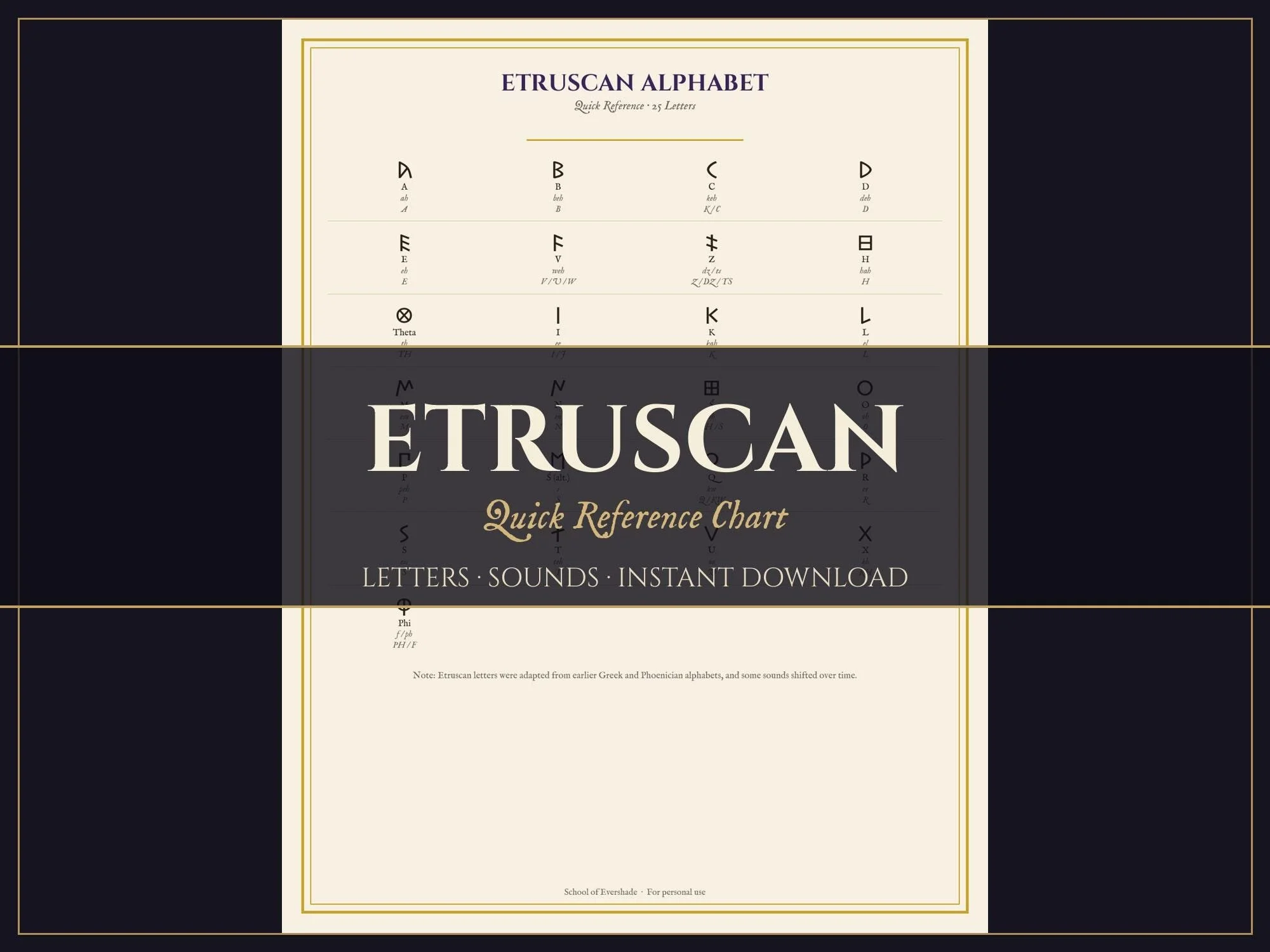
★ Letters for nonexistent sounds dropped away. By about 400 BCE, all of Etruria was using the classical Etruscan alphabet of 20 letters, written predominantly from right to left: A C E V Z H TH I K L M N P Ś Q R S T U F.
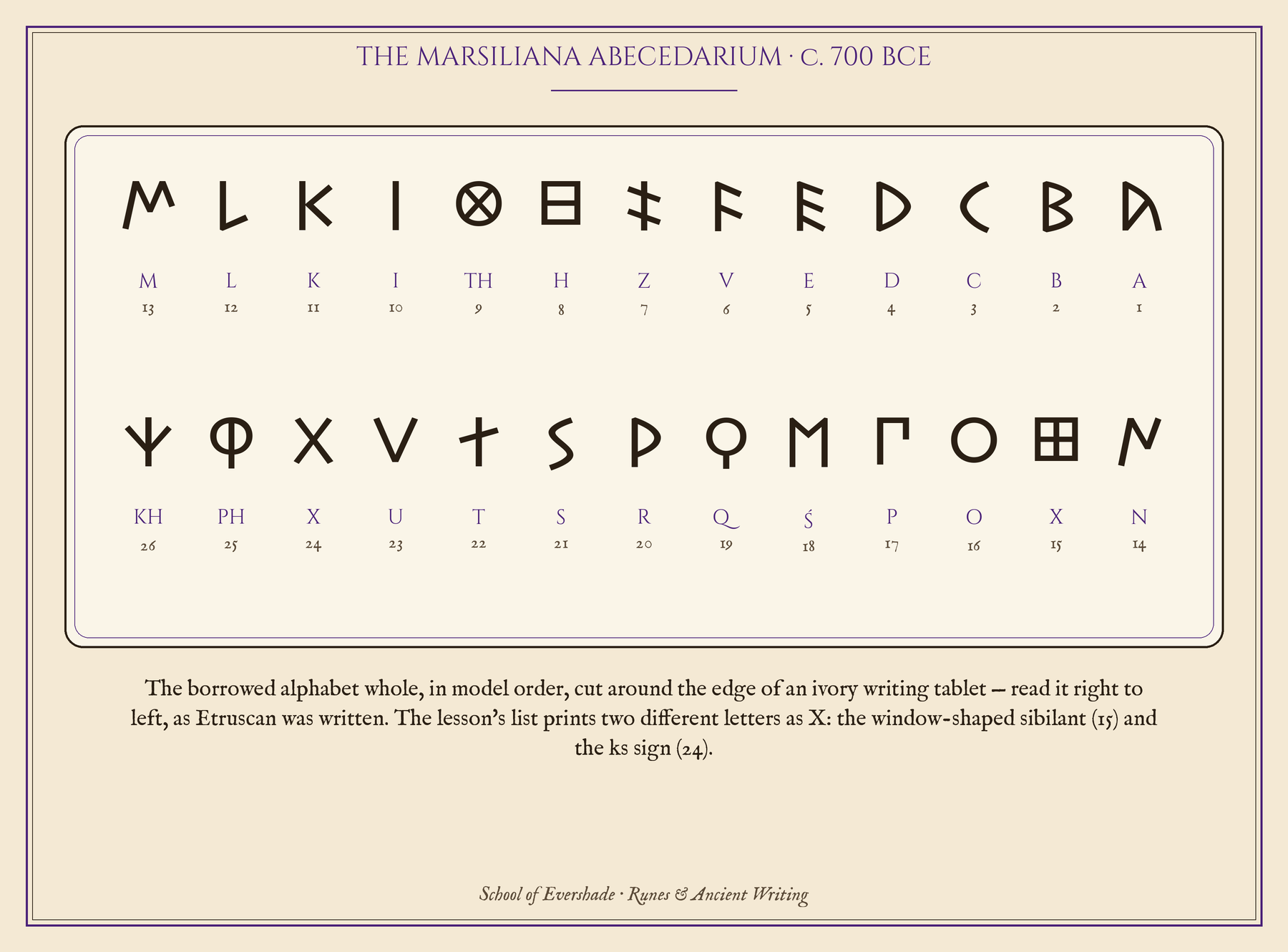
The twenty-six-letter model set, typeset letter for letter in the Etruscan forms: the alphabet the borrowers received, whole, before Etruscan mouths began to prune it.
Built for Evershade.
Twenty letters where twenty-six had been. The model alphabet survived in abecedaria, but the working alphabet was leaner, and it stayed lean for the rest of Etruscan history.
Notice what this means for how we read the evidence. An abecedarium is not a description of the working alphabet. It is a teaching tool, and teaching tools preserve the past.
The Marsiliana tablet lists B, D, and O because the teacher was teaching the alphabet as received, not the alphabet as used. When you see an abecedarium, scholars advise, ask which century it is teaching. The letters on the frame and the letters on the page are two different alphabets, and the distance between them is the history of the language.
The Etruscans also refined their sibilants (the hissing consonants: s, sh, z, ts), and two letters deserve their corrected values here. The letter Z, zeta, did not buzz like an English z.
The standard reconstruction gives it the affricate [ts] (a consonant that begins as a stop and releases as a fricative, like the ts in "cats" or the ch in "church"), the sound at the start of "tsunami" or the end of "cats." And the letter Ś, transliterated ś and sometimes called san, represented the "sh" sound, a sibilant Greek sigma could not cover. Etruscan heard more hisses than Greek did, and the alphabet kept the letters that could hiss properly.
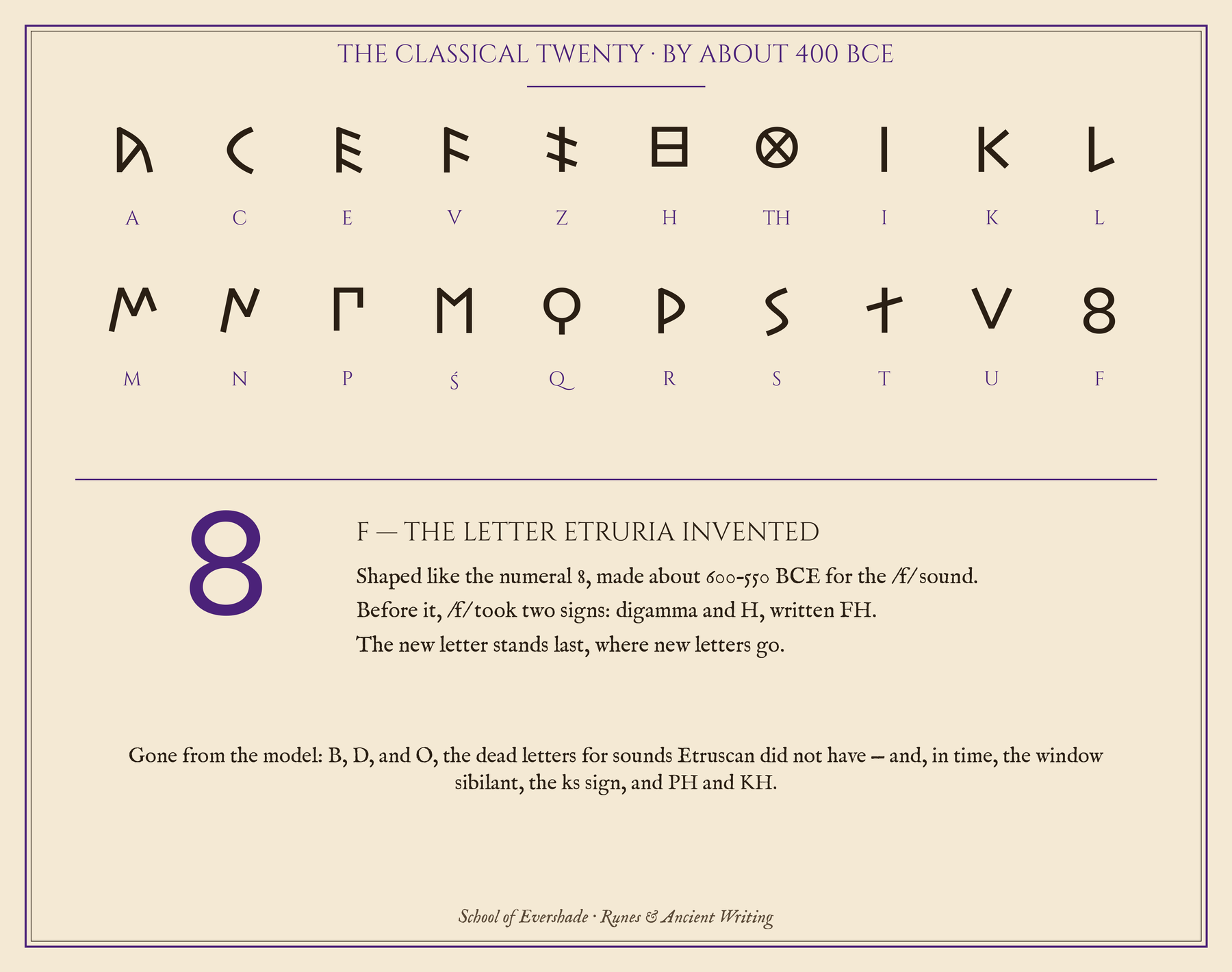
What the pruning left: the classical twenty letters of about 400 BCE, and below, the one letter Etruria invented for itself — the 8-shaped F.
Built for Evershade.
❦ In your workbook: record how twenty-six letters became twenty in your own way — copy, sketch, or note what matters.
Professor Webblethorn
Pause here, scholars, and hold the course question up to the light. "What can we leave out and still be understood?" The miners left out the pictures. The merchants left out the variation. The Greeks added what could not be left out. And the Etruscans did something quieter and just as radical: they took the complete Greek alphabet and threw a third of it away. Not out of ignorance. Out of accuracy. A letter for a sound you do not have is not a letter; it is clutter. The Etruscans understood that an alphabet is not a treasure to be hoarded but a tool to be fitted, and they fitted theirs with a craftsman's unsentimental hand. But notice the other movement, because it is coming. The Etruscans also added. Their language had a sound the Greek alphabet could not write, and rather than do without, they invented. Subtraction and addition, the two motions of every alphabet we have met. Keep them both in your hand now. The silk thread is about to cross to Rome, and Rome will do both at once.
PROFESSOR THISTLELOOM WEBBLETHORN
Runes & Ancient Writing
Epigrapher, Head of House Septentrio
The Eighth Letter
Every alphabet we have studied has had to face a sound it could not write. The Greeks faced the vowels and repurposed five consonants. The Etruscans faced the sound /f/, and they did something no borrower before them had done: they invented a letter from nothing.
The Greek alphabet had no /f/. The Etruscan language did. For the first century of Etruscan writing, scribes made do with a digraph: they wrote the /f/ sound as FH or VH, the digamma-letter plus the h, two letters doing the work of one sound.
It worked, the way all compromises work, and it was clumsy, the way all compromises are.
★ Then, around 600 to 550 BCE, a new sign appears: F, shaped like the numeral 8, with the sound value /f/. It was added at the end of the alphabet, the way late additions always are, after the inherited order.
It may have been an altered B or H, or a creation from nothing; one early inscription suggests it may even have been invented by speakers of a neighboring Sabellian language and borrowed by the Etruscans, which would make it the rare letter that traveled sideways before traveling on.
Whatever its origin, it worked. The digraph faded. The alphabet had twenty letters and could write every sound the language owned.
This is the answer to the inverted question the Greeks taught us to ask. What must be added to be understood? Exactly one letter, shaped like an 8, for a sound the borrowers could not do without.
Check in: Before the 8-shaped F existed, how did Etruscan scribes write the /f/ sound, and about when did the new letter appear?
❦ In your workbook: record the letter invented for the /f/ sound in your own way — copy, sketch, or note what matters.
Right to Left, With a Turn
★ The Etruscans wrote predominantly from right to left, which means that to a Greek reader, an Etruscan inscription looked like its own mirror image. The letters face the wrong way. The lines run the wrong direction. The whole text is the Greek alphabet seen in a looking glass, and the lesson's title is not a metaphor so much as a description.
In the earliest period the direction was still free, and some archaic inscriptions use boustrophedon, the ox-turn writing of Lesson 7. An example found at Cerveteri even runs left to right.
But the experiments ended sooner in Etruria than they had in Greece. Right to left became the standard, and it stayed the standard for six centuries.
★ The words, too, found their separators. In the earliest inscriptions the words run together in continuous script, the way Aramaic did. From the 6th century BCE onward, scribes began separating words, and sometimes syllables, with a dot or a colon.
A small change, and a humane one. The reader's eye had been doing the parsing alone; now the writer helped.
Practice writing your own name right to left in the exercise below, and notice what happens to your hand. The motion is unfamiliar, the letters face backward, and the page feels like a mirror.
You are feeling, in your own wrist, what every Etruscan scribe felt: the alphabet, turned around.
❦ In your workbook: record writing right to left, and the first word-separators in your own way — copy, sketch, or note what matters.
In your packet: Assignment II — Transliteration Practice ⚒ begins here. Work it now, or mark the place and take it as homework — your choice.
Gold, Bronze, and Linen
If you want to understand what the Etruscans wrote on, begin with what survived, and then grieve for what did not.
What survived is the durable: bronze mirrors, engraved on the back with figures from mythology, the names of gods and heroes inscribed beside them. Tomb walls, painted and carved. Pottery, scratched and incised. Stone, cut for the dead. The great majority of surviving Etruscan inscriptions, some ninety percent, are funerary: names of the dead, names of their families, brief claims of ownership ("I belong to Larth").
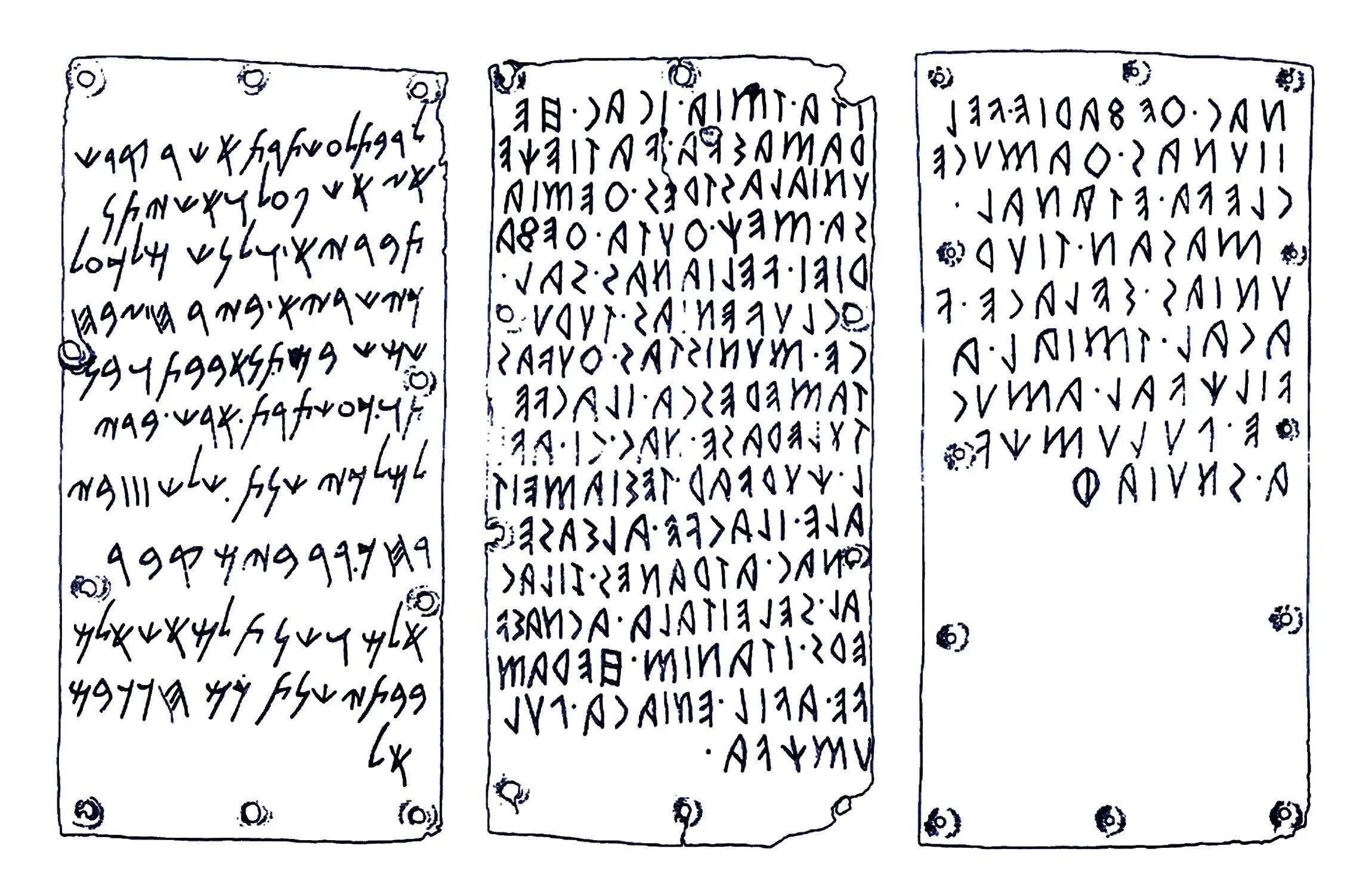
Historical example. The Pyrgi tablets in published facsimile: three sheets of gold, about 500 BCE — one in Phoenician (left), two in Etruscan — recording Thefarie Velianas's dedication to the goddess Uni. The bilingual is Etruscan studies' closest thing to a Rosetta Stone. The tablets are kept in the Villa Giulia, Rome.
The Pyrgi tablets, Pyrgi (Santa Severa), ca. 500 BCE; published facsimile drawing. Wikimedia Commons. Public domain.
The Etruscans wrote about the living on materials that perished, and about the dead on materials that endured, and the accident of survival has given us a literature of tombs.
Two survivals deserve their names in full, because they are the anchors of the field.
★ The Pyrgi Tablets are three sheets of gold, discovered in 1964 at Pyrgi on the Tyrrhenian coast, the port of the Etruscan city of Caere. They date to about 500 BCE. Two are inscribed in Etruscan, sixteen lines and thirty-seven words; the third is inscribed in Phoenician. Together they record a temple dedication by Thefarie Velianas, ruler of Caere, to the goddess Uni, whom the Phoenician text identifies with Astarte.
Gold does not decay, and the tablets are now held in the National Etruscan Museum at the Villa Giulia in Rome. Because the Phoenician is understood and the Etruscan is only partially so, the tablets let scholars triangulate: names, titles, and ritual phrases in the known language illuminate the same in the unknown one.
They are the closest thing Etruscan studies has to a Rosetta Stone, and like the Rosetta Stone of Lesson 2, they are a bilingual accident that became a scholarly treasure.
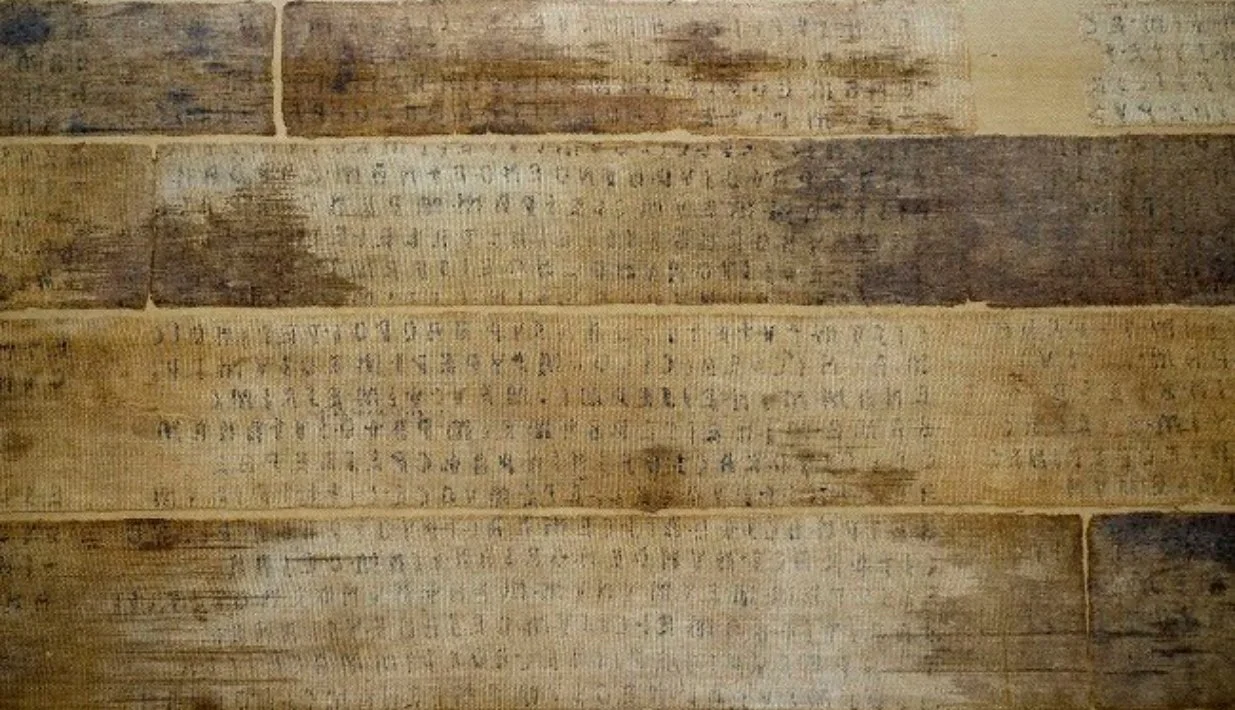
Historical example. The Liber Linteus — the “linen book”: some 1,200 words of Etruscan ritual text on cloth, the longest Etruscan text we have. It survives because the linen was cut up to wrap a mummy in Egypt; it rests today in Zagreb.
Liber Linteus (the Zagreb linen book), 3rd–2nd century BCE. Archaeological Museum, Zagreb. Wikimedia Commons. Public domain.
★ The Liber Linteus, the Linen Book, is the longest surviving Etruscan text: roughly 1,200 words in twelve columns, written in black ink with red ruling lines on a linen cloth some 340 centimeters long. It appears to be a ritual calendar, a priest's handbook of dates, deities, and prescribed offerings.
It survived because it was cut into strips and reused as mummy wrapping in Egypt, where the dry tombs preserved what Etruria's damp soil would have rotted.
A Croatian collector named Mihael Baric bought the mummy in Egypt in the 1840s; it reached the museum in Zagreb in the 1860s; and in 1891 a scholar named Jacob Krall recognized that the "Egyptian" writing on the bandages was Etruscan. The woman it wrapped was buried in a book she could not read, in a language no one had spoken for centuries. A funerary papyrus found with her names an Egyptian woman, Nesi-hensu — though that papyrus appears to be about a century younger than the mummy itself, so her name is probable, not certain.
The book is dated to around the third or second century BCE, and it is the only linen book to survive from the ancient world.
And now the grief. The Etruscan scholar Jean MacIntosh Turfa has noted that the Etruscans "tended to use perishable media like linen cloth books or wax tablets." Linen rots. Wax melts and is reused. Wood decays. The overwhelming bulk of Etruscan writing, the letters and accounts and literature of daily life, was written on materials that did not survive the centuries.
We have the tombs because the tombs were stone. We must imagine the rest, and imagine it as vast.
This is worth sitting with. Every alphabet we have studied has a survival bias, and the Etruscan bias is among the starkest: we know their dead better than their living, because only the dead wrote in stone.
Check in: Why do we know the Etruscans' dead better than their living? Name the two survivals that anchor the field, and where each one rests today.
❦ In your workbook: record what the Etruscans wrote on, and what survived in your own way — copy, sketch, or note what matters.
In your packet: Assignment III — The Pyrgi Investigation ◐ begins here. Work it now, or mark the place and take it as homework — your choice.
The Bridge
The Etruscans did not know they were building a bridge. They were writing their own language, for their own purposes, in their own pruned alphabet. But the city growing to their south was watching, and borrowing, the way borrowers always do.
Rome adopted the Etruscan alphabet in the 7th century BCE, taking the working script, not the 26-letter model.
The transmission is visible in the letters themselves. Etruscan C, the letter the Etruscans had repurposed for /k/, became Roman C. The Etruscan digamma-letter V, which the Etruscans pronounced /w/, traveled to Rome and, through the old FH digraph for /f/, became the Roman F: same shape, shifted value, the way letters shift when they change languages.
Twenty-one of the archaic letters made the crossing in the early centuries. The rest of the story, the Roman reshaping, the invention of G, the serifs and the monuments, belongs to our next lesson.
For now, stand on the bridge and look both ways. Behind you, the long road from Sinai: miners, merchants, scribes, Greeks, each leaving out what could be left out and adding what could not.
Ahead, Rome, which will take this pruned, mirrored, practical alphabet and carve it into the foundation of the Western world. The Etruscans stand in the middle, mostly forgotten, holding the alphabet up to a mirror and handing the reflection to Rome.
They left out what they did not need. They added what they could not do without. And the alphabet survived both operations, as it always has, as it always will.
❦ In your workbook: record how the alphabet crossed the bridge to Rome in your own way — copy, sketch, or note what matters.
Guided Practice — The Mirror Hand
Before the assignments, train your hand the way an Etruscan scribe would: right to left, with attention to what is missing.
Exercise A — Drawing the Twenty-Six
- On paper, draw the 26 letters of the Marsiliana abecedarium in order: A B C D E V Z H TH I K L M N X O P Ś Q R S T U X PH KH. (Use the transliterations; draw each in a simple inscriptional capital form.)
- Mark the dead letters: cross out B, D, and O lightly, and label each with the reason it died ("no /b/ in Etruscan," "no /d/," "no /o/").
- Circle the 20 letters of the classical alphabet. Note which seven fell away between the model and the working script — and that F was added, for a net loss of six.
- Add the F (8-shaped) at the end, outside the inherited order, and label it "added c. 600-550 BCE for /f/."
❦ Workbook path: make this a permanent workbook page instead of loose paper: draw the twenty-six in your workbook with the dead letters shaded, so the model alphabet and the working alphabet stand side by side in your own hand.
Exercise B — Right to Left
- Write your name in simple capitals, left to right, as normal.
- Below it, write your name again, right to left, reversing each letter so it faces the direction of writing. Use a mirror to check your work: hold it at the end of the line and read the reflection.
- Write the Etruscan word mi ("I am") right to left. Then write Rasenna, the Etruscans' name for themselves, right to left with mirrored letters.
- In two to three sentences, describe what the mirror showed you: did the reversed text look wrong, or did it start to look natural? What does that tell you about how arbitrary "correct" direction is?
Exercise C — The Subtraction
- Write out the 24-letter Greek alphabet from Lesson 7.
- Cross out every letter Etruscan had no use for: B, D, O, and the other casualties of the classical reduction (the xi, phi, and psi letters, and X in its Greek value). Mark each with the reason.
- Below the survivors, write the one letter the Etruscans added (F for /f/) and the digraph it replaced (FH).
- In a short paragraph, answer the course question for this lesson: what did the Etruscans leave out, what did they add, and was the result sufficient? Base your answer on the phonology, not on opinion.
You have just performed, in minutes, the editorial operation the Etruscans performed across three centuries.
In your packet: Assignment I — The Letter Chart ⚒ begins here. Work it now, or mark the place and take it as homework — your choice.
In your packet: Assignment IV — The Pruning Essay ✎ begins here. Work it now, or mark the place and take it as homework — your choice.
Assignment Manual
Assignment key: ✎ written work · ⚒ hands-on practical · ◐ both · ★ will be on the test · ❦ workbook path
Written answers in this manual are short answers in your own words — a few honest lines, not a filled page.
Assignment I — The Letter Chart ⚒ ★
Objective: Demonstrate control of the Etruscan letters, their sound values, and their history.
Instructions:
- On a fresh sheet, create a five-column chart: letter (drawn), transliteration, sound value, Greek ancestor, status (working letter or dead letter, with reason).
- Complete all 26 rows of the Marsiliana model alphabet. For B, D, and O, explain in the status column why each died.
- Below the chart, add the F as a 27th entry: draw it, give its sound value /f/, and explain what it replaced and approximately when.
- Write one paragraph on the single most interesting survival or casualty and explain what it reveals about the relationship between a language's sounds and its alphabet.
Your keepsake: keep this chart beside your Greek one in your scribe's portfolio: the alphabet in a mirror, pruned to fit a new mouth.
❦ Workbook path: build the chart across two facing workbook pages instead of a loose sheet: dead letters shaded, and the 8-shaped F added below the line, where it joined the alphabet three centuries late.
To submit: Photograph or scan your chart. Accuracy of the sound values and the dead-letter reasons matters more than artistic skill.
Assignment II — Transliteration Practice ⚒ ★
Objective: Read and write Etruscan words right to left.
Part A. Write the following Etruscan words in simple capitals, right to left, with each letter mirrored to face the direction of writing: mi ("I am"), uni (the goddess Uni), tin (the god Tin), rasenna (the Etruscans' name for themselves). Check your work with a mirror.
Part B. The Etruscan word suthina means "for the tomb" or "funerary" and appears on countless objects. Write it right to left, then write it left to right in normal orientation. In two to three sentences, reflect on which version felt more "correct" and why, given that neither direction is natural law.
Part C. Choose an English word of at least six letters containing no B, D, or O (to honor Etruscan phonology). Write it as the Etruscans would have: right to left, mirrored letters, no B/D/O. What did the constraint force you to notice about English spelling?
Assignment III — The Pyrgi Investigation ◐ ★
Objective: Understand how bilingual texts illuminate partially understood languages.
Instructions:
- Research (using the References below): the Pyrgi Tablets. For each of the three tablets, record the material, the language, the approximate date, and what the text records. Note where the tablets are held today.
- In Lesson 2, the Rosetta Stone let scholars use known Greek to unlock unknown hieroglyphs. Write a half page comparing the two cases: how is the Pyrgi situation similar to the Rosetta Stone, and how is it different? (Consider: how well each unknown language was already readable, what kind of text each preserves, and how much each bilingual actually unlocked.)
- The tablets record a dedication to Uni/Astarte by a ruler named Thefarie Velianas. Write a half page on what the choice of a bilingual dedication suggests about the world of 500 BCE: who was meant to read each version, and what does the pairing say about Etruscan relations with the Phoenician-speaking Mediterranean?
Assignment IV — The Pruning Essay ✎ ★
Objective: Apply the course question to the Etruscan editorial operation.
Instructions:
Write a one-page essay addressing the following:
The Etruscans took a 26-letter alphabet and reduced it to 20 working letters, then added one new letter of their own invention. Choose two specific letters: one they discarded (B, D, O, or another casualty) and the F they added. For each, explain the phonological reason behind the decision. Then consider the lesson's claim that "an alphabet is not a treasure to be hoarded but a tool to be fitted." Do you agree? Use at least two specific details from this lesson and one from an earlier lesson to support your position.
Cite the lessons where your details come from.
Materials
Required (Level One — household items)
- Paper: plain white paper or a sketchbook, for letter practice and chart work.
- Pens: one standard pen for drafting, one fine-tipped marker for final letterforms. Etruscan letters are inscriptional capitals; a firm tip approximates the carved stroke.
- A mirror: any hand mirror or bathroom mirror, for checking right-to-left writing in Exercise B and Assignment II. The mirror is the lesson's most important tool.
- A ruler: for chart columns and for practicing the straight strokes of letters like Z and Ś.
- A printout of the Etruscan alphabet: use the References below for a standard chart of the Marsiliana letters.
Suggested (Level Two — historically closer materials)
- A wax tablet: beeswax poured into a shallow wooden frame, with a wooden or bone stylus. The Marsiliana abecedarium was inscribed on exactly such a tablet's ivory frame. Writing in wax and smoothing it away teaches what "practice letters" meant.
- Linen cloth and ink: a strip of plain linen with black ink approximates the Liber Linteus. Write a short ritual calendar of your own week in Etruscan-style capitals, right to left.
- A reed pen: cut from bamboo or river reed, as in Lessons 6 and 7. The Etruscans wrote in ink on perishable surfaces; the reed pen is the historically accurate implement.
- A pottery shard or unglazed tile: Etruscan potters incised abecedaria on vessels. A shard and a sharp stylus give the feel of the cockerel inkwell.
Neither level requires
Purchased kits, specialty tools, or any material you cannot find locally or order inexpensively. The core lesson (drawing letters, understanding the pruning, practicing right-to-left writing) is fully achievable with paper, pen, and a mirror.
Reflection Questions
Answer the following in your workbook.
- When and how did the Etruscans adopt the alphabet? Name the donors, the approximate date, and the two earliest witnesses.
- What is a dead letter? Name the three dead letters of the Marsiliana abecedarium and explain why each died.
- Why did southern Etruscan scribes use three different letters (C, K, Q) for the /k/ sound? What does the convention reveal?
- What is the 8-shaped F, when was it introduced, and what did it replace?
- Describe Etruscan writing direction and the development of word separation. When did each element change?
- Name the two anchor artifacts of Etruscan epigraphy discussed in this lesson. For each, explain what it is and why it matters.
- The popular claim is that "Etruscan is undeciphered." State the correction precisely: what can scholars do, and what can they not yet do?
- Apply the course question: what did the Etruscans leave out, what did they add, and was the result sufficient?
Workbook Checklist — Lesson 8
In my workbook I have:
- ☐ explained when and how the Etruscans adopted the Greek alphabet
- ☐ defined Etruscan alphabet, abecedarium, Etruria, voiced stop, dead letter, sibilant, affricate, Liber Linteus, and Pyrgi Tablets
- ☐ described the Marsiliana tablet, and explained why its 26 letters include letters the Etruscans never used
- ☐ explained why B, D, and O fell out of use, and described the Etruscan vowel and consonant inventory
- ☐ identified the 8-shaped F, and explained how the Etruscans wrote /f/ before it existed
- ☐ described Etruscan writing direction and the development of word separation
- ☐ named the major Etruscan writing surfaces, and explained why so much Etruscan writing is lost
- ☐ corrected the "undeciphered" misconception: I can state the difference between reading Etruscan and understanding it
- ☐ answered the course question for this lesson: what the Etruscans left out, and what they had to add
☐ Lesson completed Date: ____________ Signature: ____________
Professor's Review
And so our eighth lesson closes in Etruria, where borrowers became editors and the alphabet learned to travel light.
You can now explain how Euboean Greek colonists carried the alphabet to Italy around the 7th century BCE, describe the Marsiliana tablet and the cockerel inkwell that witness the borrowing, explain why B, D, and O died and how the classical alphabet shrank to 20 letters, identify the invented 8-shaped F and the /f/ it was made to write, describe right-to-left writing and the arrival of word separators, name the Pyrgi Tablets and the Liber Linteus and explain why each matters, and correct the "undeciphered" misconception with precision.
Keep your Etruscan chart beside your Greek one, as you kept Greek beside Phoenician and Aramaic.
Lay all four side by side now and look at the family. The Greek letters stand complete and confident. The Etruscan letters face the other way, fewer in number, leaner in form, and one of them, shaped like an 8, exists nowhere else. The alphabet has been pruned, mirrored, and fitted to a new mouth.
Next, we cross to Rome, where the growing city will take this Etruscan inheritance and reshape it for Latin: the invention of G, the serifs on the stone, and the monumental capitals that still stand on buildings today. The bridge the Etruscans built without knowing it is about to carry the heaviest traffic in the alphabet's history.
Practice your letters, scholars. Write them right to left, check them in the mirror, and cross out what your language does not need.
I have watched alphabets shed their dead letters in my years among the inscriptions, and it is never a loss. It is the alphabet, breathing easier.
PROFESSOR THISTLELOOM WEBBLETHORN
Runes & Ancient Writing
Epigrapher, Head of House Septentrio
Cross-Class Connections
The Etruscan-to-Latin transmission in this lesson connects directly with Scrollwork, where Professor Nocturne teaches the Roman monumental capitals. Students studying both classes should trace the letterforms backward: the Roman C, F, and the rest carry Etruscan shapes under their Latin values, and the serifs of Lesson 9 have their own brush-drawn origin story waiting in the next lesson.
The bronze mirrors parallel Creative Arts metalwork and engraving: inscribed mirrors were luxury objects, and the combination of image and text on a functional surface is a masterclass in applied art. Students who build and make will recognize the pattern.
The survival bias of Etruscan evidence, tombs over letters, will reappear in Runes Unit III, when we examine how the accident of preservation shapes the history of writing. What survives is not what was written most; it is what was written on stone.
In Other Classrooms
Scrollwork · Unit IV, Lesson 14 — Roman Capitals
Your Etruscan letters are on their way to Rome, and Rome is my classroom. Come to the Library for the Roman capitals themselves: how the brush drew them, how the chisel fixed them, and how their shapes governed a thousand years of stone. Trace the family resemblance with your own hand on the page.
Creative Arts · Unit VII, Lesson 29 — Foil, Wire & Simple Metalwork

An inscribed mirror is metal taught to speak, and metal is patient stuff if you treat it kindly. In the Workshop we emboss foil in the spirit of inscribed bronze and work wire and simple metal with safe, steady hands. Come and feel how a hard surface takes a letter when the tool is a punch instead of a pen.
The mirror shows the alphabet, and the alphabet shows the way to Rome.
References & Further Reading
Wikipedia. "Etruscan alphabet." Comprehensive overview: origins, the Marsiliana tablet, letter inventory, the 8-shaped F, direction, and transmission to Latin. https://en.wikipedia.org/wiki/Etruscan_alphabet
Wikipedia. "Pyrgi Tablets." The bilingual gold tablets of c. 500 BCE: discovery, contents, and significance for Etruscan studies. https://en.wikipedia.org/wiki/Pyrgi_Tablets
Wikipedia. "Abecedarium." Abecedaria across writing systems, including the Etruscan examples with their dead letters. http://en.wikipedia.org/wiki/Abecedarium
The British Museum. Collection online. Searchable collection including Etruscan mirrors, inscriptions, and bucchero ware. https://www.britishmuseum.org/collection
The Metropolitan Museum of Art. Bucchero collection search. Includes the cockerel-shaped vase with the 26-letter abecedarium, c. 650 to 600 BCE. https://www.metmuseum.org/art/collection/search?sortBy=Relevance&q=Bucchero&searchField=All
Veiled Antiquity. "The Liber Linteus: Etruscan Book on a Mummy." The linen book's discovery, identification by Jacob Krall, and contents. https://veiledantiquity.com/posts/liber-linteus/
W. D. C. de Melo. "The Etruscan alphabet" (PDF). Academic overview of the letter inventory, dead letters, and the three-k convention. http://wolfgang.demelo.de/faliscan/3_alphabet.pdf
Browse the Runes shelf in the school Library for readable editions of these works.
Etruscan runs right to left on the Bench, and its missing G is honestly supplied with C, as the Etruscans themselves supplied it.
Open the BenchPROFESSOR THISTLELOOM WEBBLETHORN · RUNES CLASSROOM
Submit your work for this lesson using the form below.
CONTINUE IN RUNES & ANCIENT WRITING
← Previous · Lesson 7: Ancient Greek: How the Alphabet Found Its Voice Next · Lesson 9: Classical Latin: The Letters That Outlasted an Empire →
Unit III · The Mediterranean Masters Runes & Ancient Writing Classroom · All 21 Lessons
The rest of Unit III: Lesson 7 · Ancient Greek · Lesson 9 · Classical Latin · Lesson 10 · Roman Numerals
From the Runes Shelf
The printed companions to this lesson, from Professor Webblethorn’s shelf in the shop.