
RUNES & ANCIENT WRITING
Unit III · Lesson 9THE ARCHITECTURE OF STONE
Classical Latin: The Letters That Outlasted an Empire
Professor Thistleloom Webblethorn
Epigrapher • Runes & Ancient Writing
Head of House Septentrio • School of Evershade
Professor's Introduction

Rome today, scholars. I hope your hands are steady.
The Etruscans pruned the Greek letters to fit their own tongue, and passed the trimmed row west.
Today the alphabet arrives at the city that will carry it to you. This lesson is about the letters you are reading right now.
I want to begin with something you have looked at ten thousand times without seeing. Look at the feet of the letters on this page. The capital T wears small horizontal feet. The capital E has them at the top, middle, and bottom of its spine. These finishing strokes are called serifs, and almost everyone assumes they are decoration, the typographic equivalent of a curtsy.
They are not decoration. They are fossils. Every serif on this page is the preserved footprint of a brushstroke laid down two thousand years ago, and by the end of this lesson you will never unsee it.
Come closer to the web, scholars. We are going to Rome, and we are going to read the stones.
PROFESSOR THISTLELOOM WEBBLETHORN
Runes & Ancient Writing
Epigrapher, Head of House Septentrio
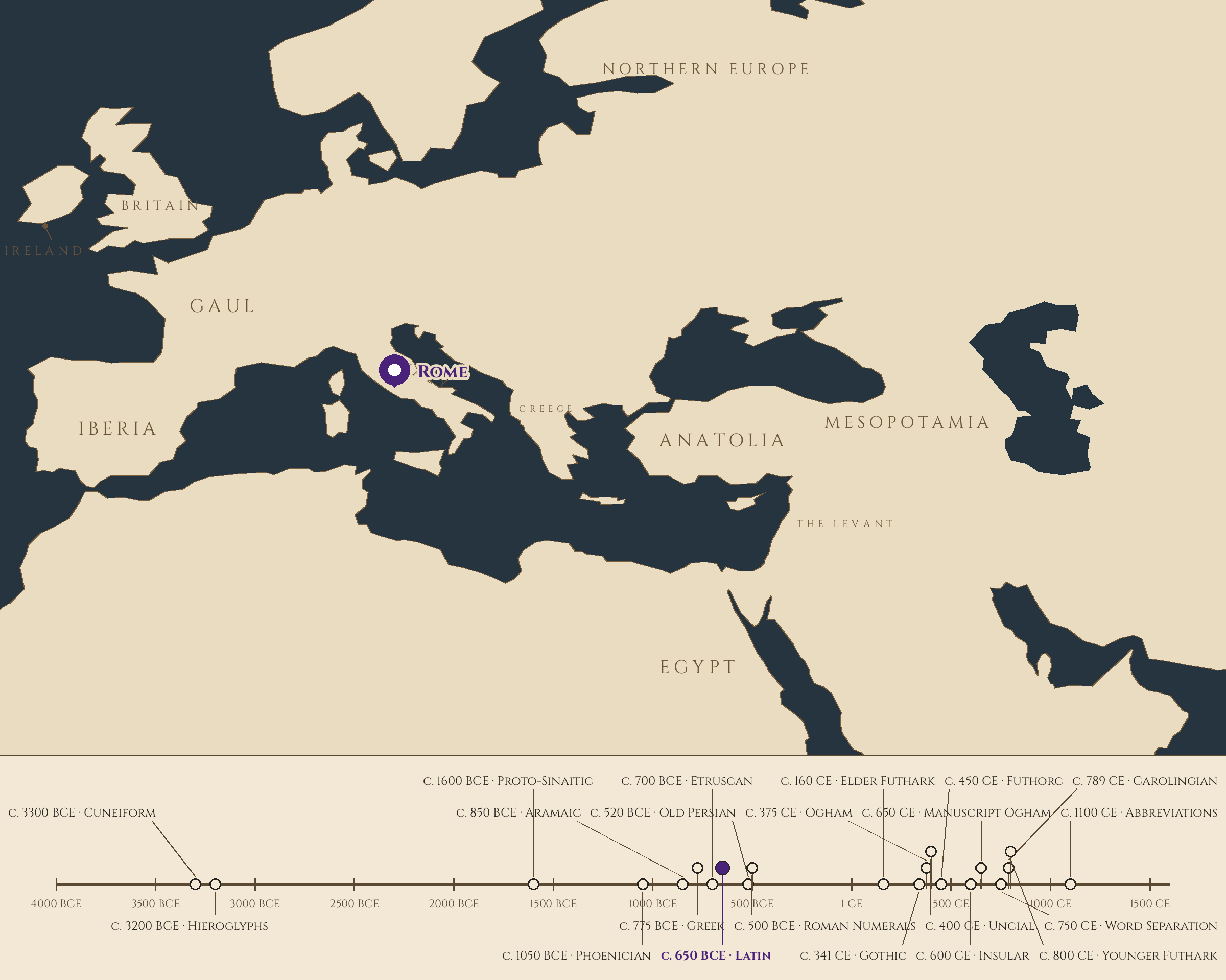
Where and when: Rome, in the Italy of about 2,700 years ago. The pin is this lesson. The line beneath the map is our road: every stop a writing system, every lesson a pin.
Lesson Objectives
By the end of this lesson, students should be able to:
- Explain when and how Rome adopted the alphabet from the Etruscans, and name the object that provides the earliest evidence.
- Define Classical Latin, scriptura monumentalis, serif, interpunct, inscription, epigraphy, and Praeneste fibula.
- Identify the 23 letters of the classical Latin monumental alphabet and explain the double duty of I and V.
- Describe the creation of G in the 3rd century BCE and the 1st-century BCE addition of Y and Z.
- Explain the leading brush-origin theory of the serif and the Renaissance debate over geometric construction.
- Apply the course question to the monumental style: what the Romans left out of their letters, and what they kept.
Reading this lesson: ★ marks the passages to remember. They return on the unit quiz and the class test. Check in questions ask the material back as you go; answer them in your workbook when you meet them.
Working this lesson: Your assignment packet is the first download on this page. Work in it as the lesson moves along, answering each assignment as its subject is taught — or read the lesson through for your notes and take the assignments as homework afterward. Both are proper ways to sit this class. Signposts in the reading tell you where each assignment belongs. Written answers are short answers in your own words; a few honest lines are worth more than a filled page.
Your Assignment Packet
This lesson's assignments live in its packet: the Lexicon Handout (every term, course terms marked ◆), Materials, Guided Practice, the Assignment Manual with its answer key for self-checking, the Reflection Questions, and the Workbook Checklist. Download the packet before you begin and keep it beside you as you read.
The Misconception at the Door
Let me correct a misconception at the door, because it is the one this whole lesson is secretly about.
Serifs are not decoration. I said it in the introduction and I will prove it before we are done, but hold the claim in your mind as we work, because it changes how you see every letter in this lesson.
When students first study Roman inscriptions — texts carved, incised, or painted on durable surfaces such as stone, bronze, or pottery — they assume the little feet and flares were added to make the letters pretty, the way a frame is added to a picture.
The truth runs the other direction: the frame came first, and the picture was carved to match it.
This is Kali's favorite kind of lesson, the kind where you arrive believing one thing and leave believing its opposite, and I promise you the reversal by the final section.
For now, keep your eye on the feet of the letters. We will return to them with a brush in our hands.
❦ In your workbook: record the claim about serifs this lesson sets out to prove in your own way — copy, sketch, or note what matters.
The Seventh-Century Brooch
Rome did not invent its alphabet. Like the Greeks before them, the Romans borrowed, and they borrowed from their neighbors and teachers, the Etruscans of Lesson 8.
The borrowing happened earlier than scholars used to think, and we know it because of a brooch.
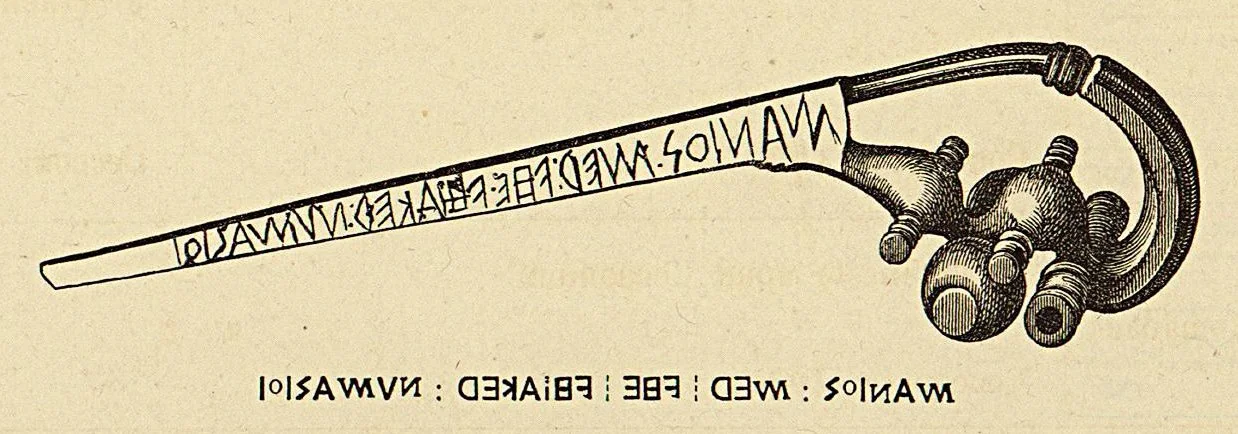
Historical example. The Praeneste fibula as drawn for the Corpus Inscriptionum Latinarum (1887): the gold brooch and its inscription, running right to left along the pin as early Latin was written — MANIOS MED FHEFHAKED NVMASIOI, “Manius made me for Numasius.” The original is kept in Rome.
The Praeneste fibula (7th century BCE), plate from Corpus Inscriptionum Latinarum XIV, ed. H. Dessau, 1887. Wikimedia Commons. Public domain.
★ The Praeneste fibula is a small gold clasp for fastening clothing, of the kind a wealthy person would wear at the shoulder. Around its body runs a scratched inscription in early Latin: "MANIOS MED FHEFHAKED NVMASIOI." Read it as the brooch speaking: "Manius made me for Numasius." A maker's boast and a gift dedication, scratched onto jewelry.
Notice, scholars: the earliest Latin we possess is not a law or a poem. It is a craftsman's signature on a present, the same way the earliest Greek was a verse on a drinking cup.
Alphabets arrive in ordinary hands.
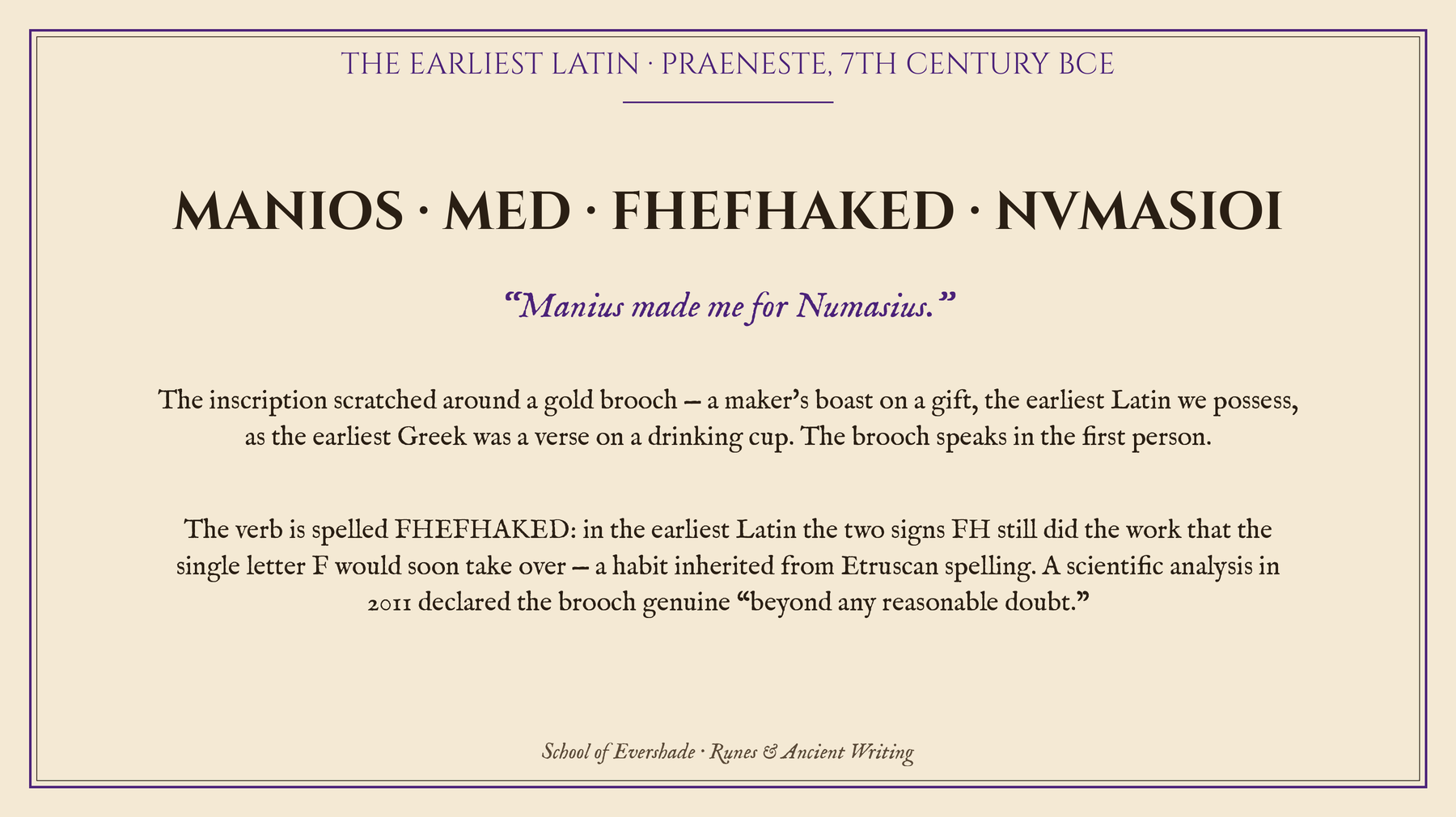
The earliest Latin, set out to read: four words scratched on gold in the 7th century BCE, with the FH spelling that early Latin inherited from Etruscan.
Built for Evershade.
The fibula is dated to the first half of the 7th century BCE. For decades its authenticity was questioned, which is why older accounts place Rome's adoption of the alphabet "around the sixth century BCE," anchored to the next-oldest evidence, the Duenos inscription on a vase.
★ But a 2011 analysis declared the fibula genuine "beyond any reasonable doubt," and the date of Rome's borrowing moved back a full century.
Around the seventh century BCE, the growing city of Rome adopted a modified form of the Etruscan alphabet.
Look at what the inscription itself reveals. "FHEFHAKED" is the verb "made," and it is written with FH where later Latin would write F. The early Latin alphabet was still close to its Etruscan model, still working out which letters it needed.
The alphabet Rome borrowed was a living thing, not a finished product, and the Romans spent the next six centuries finishing it.
That finishing is this lesson's story.
❦ In your workbook: record the brooch that dates Rome's borrowing in your own way — copy, sketch, or note what matters.
In your packet: Assignment III — The Fibula Investigation ◐ begins here. Work it now, or mark the place and take it as homework — your choice.
Twenty-Three Letters
★ Here is the classical Latin monumental alphabet in full — the alphabet of Classical Latin, the standardized literary form of the language used in the late Roman Republic and early Empire (roughly the 1st century BCE through the 1st century CE), the Latin of Cicero, Caesar, and Virgil; and do not confuse the language (Latin) with the script (the Latin alphabet), which went on to write hundreds of other languages long after Rome fell: the 23 letters carved on Rome's stones at the height of the Empire. No J. No U. No W.
Read it as an exercise in economy, because the Romans will ask the course question with unusual discipline: what can we leave out and still be understood?
A (A): a, as in "father." From Etruscan A, from Greek alpha, from Phoenician aleph. The ox has traveled three thousand years to stand at attention on a Roman arch.
B (B): b. From Etruscan B, from Greek beta, from Phoenician beth. Stable across every transmission, barely changed in form.
C (C): k, always hard, as in "cold." From Etruscan C, from Greek gamma. In early Latin, C did double duty for both the k and g sounds, which is why the abbreviation C. stands for Gaius — the letter G had not yet been invented, so C carried the g sound as well, and the abbreviation kept the old spelling ever after. The Romans tolerated the ambiguity for centuries.
D (D): d. From Etruscan D, from Greek delta, from Phoenician daleth. The half-circle on a stem, unchanged in essence.
E (E): e, as in "pet." From Etruscan E, from Greek epsilon, from Phoenician he. The window became a vowel in Greece and stayed one in Rome.
F (F): f. From Etruscan F, from Greek digamma, from Phoenician waw. Remember digamma from Lesson 7, the /w/ consonant that died in Greek? It survived the crossing to Italy and became Rome's F. The letter the Greeks discarded became one of Latin's most common consonants.
★ G (G): g, always hard, as in "go." The Roman invention. In the 3rd century BCE, the Romans grew tired of C's double duty for k and g, and someone, tradition names Spurius Carvilius Ruga, added a small stroke to C to make a new letter. G took the alphabet slot where Z had stood in the early alphabet, Z having fallen out of use because Latin had no z sound. One letter retired, one letter born, and the alphabet kept its shape.
H (H): h. From Etruscan H, from Greek heta. The fence-post letter, straightforward and stable.
★ I (I): i as in "machine," and also y as in "yes." This letter does double duty: it is both the vowel I and the consonant J. The Romans wrote IVLIVS for what we write as "Julius." The separate letter J would not split off until the 16th century. In this lesson, there is no J, and the Romans never missed it.
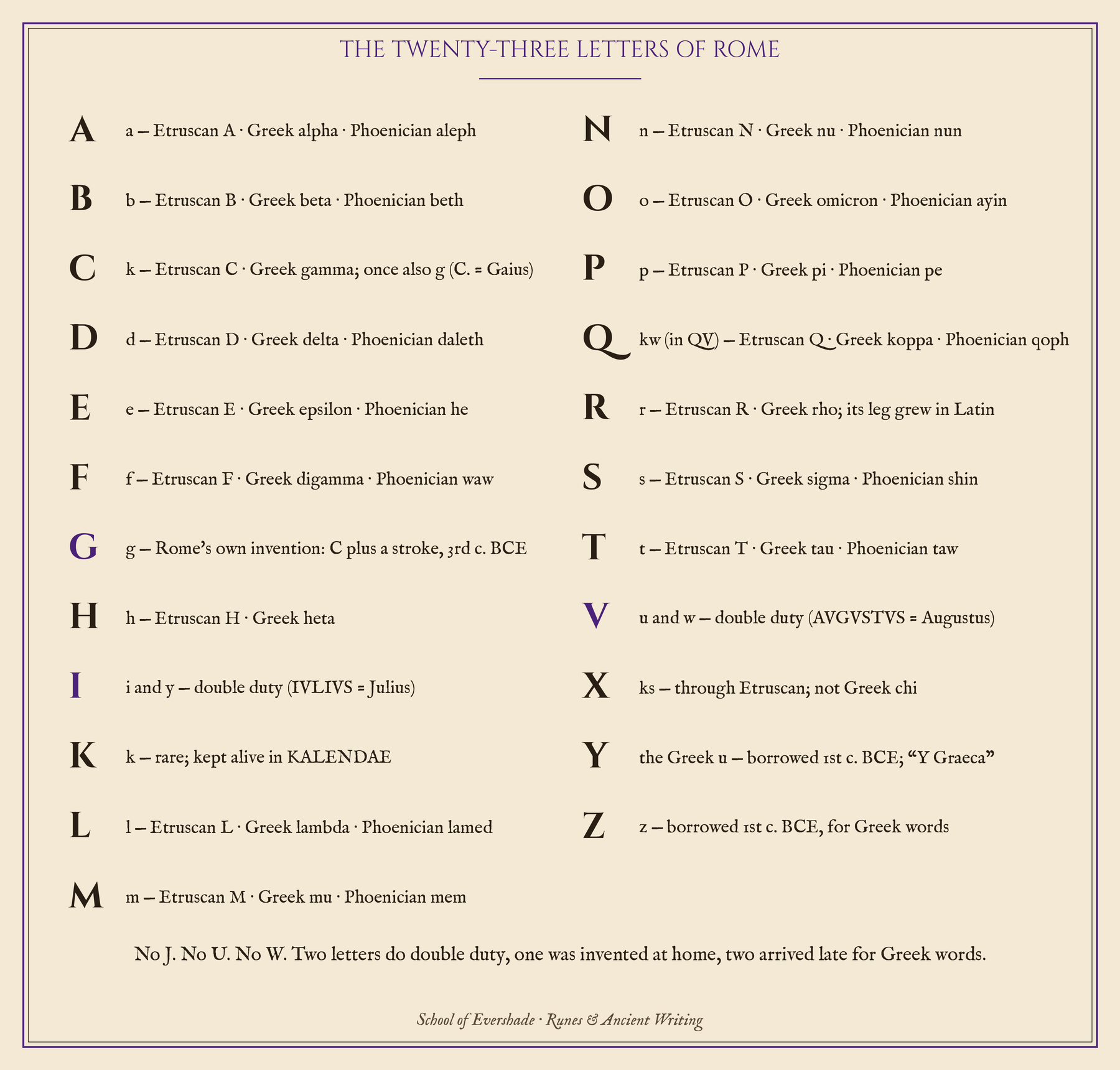
The twenty-three letters of classical Latin, each with its sound and its ancestry — the whole journey of the course in a single chart: Phoenician to Greek to Etruscan to Rome.
Built for Evershade.
❦ In your workbook: record the twenty-three letters and their ancestors in your own way — copy, sketch, or note what matters.
K (K): k. From Etruscan K, from Greek kappa, from Phoenician kaph. Rare in Latin, kept alive in a few ancient spellings like KALENDAE (the calends, the first day of the month, and the ancestor of our word "calendar"). C does nearly all of K's work.
L (L): l. From Etruscan L, from Greek lambda, from Phoenician lamed. The shepherd's crook straightened into a right angle.
M (M): m. From Etruscan M, from Greek mu, from Phoenician mem. The water ripple, fully abstracted.
N (N): n. From Etruscan N, from Greek nu, from Phoenician nun. The fish of Lesson 4 is now five lessons and three alphabets behind us, and no trace of it remains.
O (O): o, as in "pot." From Etruscan O, from Greek omicron, from Phoenician ayin. The eye became a vowel in Greece and Rome kept it.
P (P): p. From Etruscan P, from Greek pi, from Phoenician pe. Note the form: the Etruscan and Latin P kept the curved bowl that the Greek pi had squared off.
Q (Q): k, always before V, as in QV for kw. From Etruscan Q, from Greek koppa, from Phoenician qoph. Koppa died in Greek but survived in Italy, and Latin kept it for exactly one job: the kw sound, always written QV.
R (R): r, trilled. From Etruscan R, from Greek rho, from Phoenician resh. The Latin R grew its leg from the rho's loop, one of the clearest small evolutions in the alphabet's history.
S (S): s. From Etruscan S, from Greek sigma, from Phoenician shin. The sh sound became a plain s in Greece, and Rome inherited the simplification.
T (T): t. From Etruscan T, from Greek tau, from Phoenician taw. The mark, simple and unchanged.
V (V): u as in "rule," and also w as in "water." This letter does double duty: it is both the vowel U and the consonant V. The Romans wrote AVGVSTVS for "Augustus" and VIVVS for "vivus" (alive). The separate letters U and W came much later: U split from V in the early modern period, and W is a medieval invention. In this lesson, there is no U and no W, and the Romans ran an empire without them.
X (X): ks, as in "axe." From Etruscan X. Do not confuse it with Greek chi, though they look identical; the Latin X descends through Etruscan from the Greek ks letter, while chi is a different letter with a different history. Lesson 7's warning stands.
Y (Y): u, the Greek u sound, used only in Greek loanwords. Borrowed directly from Greek upsilon in the 1st century BCE. The Romans called it "Y Graeca," the Greek Y, to distinguish it from their own V. It stands near the alphabet's end as a visible latecomer.
Z (Z): z, used only in Greek loanwords. Borrowed directly from Greek zeta in the 1st century BCE, alongside Y. This was Z's second career: it had stood in the early Latin alphabet, fallen out when Latin lost the need for it, and returned at the very end for foreign words. The alphabet's last two letters are immigrants, and Rome was honest about it.
★ Twenty-three letters. Two doing double duty, one invented at home, two borrowed late for foreign words, one rare survivor from the deep past. It is the most economical alphabet we have met, and it wrote the laws of an empire.
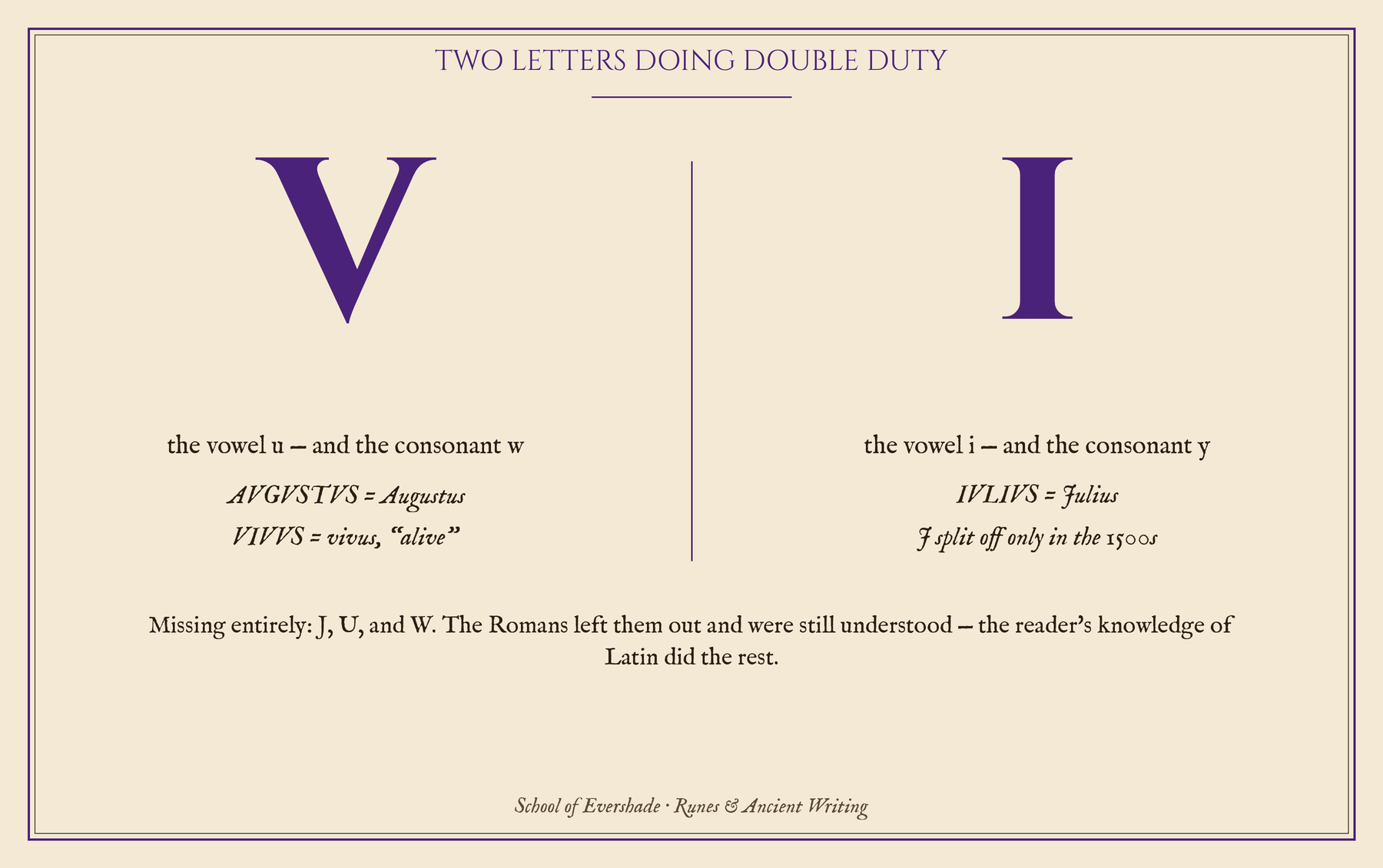
Rome's economy in two letters: V is u and w, I is i and y, and the empire's paperwork never suffered. J, U, and W are later inventions.
Built for Evershade.
❦ In your workbook: record the letters that do double duty in your own way — copy, sketch, or note what matters.
Professor Webblethorn
Pause here, scholars, and look at the thread in your hand.
It began as a token pressed into clay. It became a bird drawn on a tomb wall, a wedge on a cliff, a picture scratched in a mine, a letter stamped on a merchant's jar, a reed-pen stroke on an imperial dispatch, a vowel sung in a Greek harbor, a sign reshaped by Etruscan hands. Now it is cut into stone, and it will outlast the empire that cut it.
Here is what the stone teaches that the clay and the papyrus could not. Clay is hurried. Papyrus is perishable. Stone is patient, and patience has a style: the letters grow formal, the strokes grow even, the hand slows down. The Romans did not invent a single letter in this lesson except G, and G is a stroke added to C. Everything else is refinement, and refinement is a kind of honesty. The alphabet, dressed for eternity, shows you exactly what it is.
Keep the thread. One lesson remains in this unit — the numerals Rome counted with — and beyond it, in our final unit, wait the hands that held the pens after Rome: the scripts of the scriptorium, where the monumental capitals will soften into the letters of books. The stone is about to learn to flow.
PROFESSOR THISTLELOOM WEBBLETHORN
Runes & Ancient Writing
Epigrapher, Head of House Septentrio
The Brush Before the Chisel
Now I will prove what I promised at the door: the serifs are fossils.
★ The leading theory comes from Father Edward Catich, a Catholic priest, calligrapher, and scholar who spent his life studying Roman inscriptions. In The Origin of the Serif (1968), Catich argued from close examination of the inscription on Trajan's Column in Rome, dedicated in 113 CE and the most famous surviving example of scriptura monumentalis (Latin for "monumental writing," the formal capitals carved on Roman monuments), that the letters were not designed on the stone at all. They were painted first, with a flat brush, in the same way a sign painter lays out letters today.
Then the carvers cut the stone following the painted strokes.
Look at what a flat brush does at the end of a stroke. The brush, pressed flat and then lifted, leaves a flared, wedge-shaped terminal: wider than the stroke, with a crisp edge.
When the carver's chisel followed that flare, it cut a flared terminal into the stone. That flare is the serif. Every small foot on every Roman capital is the preserved shape of a brush being lifted.
Catich's theory is, in the scholars' careful phrase, "broadly but not universally accepted." It is the leading explanation, and it has a beautiful economy: it explains the serifs, the subtle swelling and thinning of the strokes, and the grace of the letterforms all at once, from a single cause.
A brush explains what a chisel alone cannot.
And here is the misconception correction, stated plainly. Students arrive thinking serifs are decorative flourishes, added to make letters pretty.
They leave understanding that serifs are the fossilized ends of brushstrokes, and that the "decoration" was never added at all. It was there from the first painted layout, before the chisel ever touched the stone.
★ One more honesty is owed, because the lesson must not replace one oversimplification with another. Since the Renaissance, Roman capitals have been analyzed as geometrically constructed: built from squares, circles, and triangles, with carefully balanced proportions. Felice Feliciano's Alphabetum Romanum (1463) is the first humanistic treatise to construct the Roman capitals geometrically from subdivided squares, and the analysis is elegant and influential.
But there is no evidence that Roman letterers actually used compass-and-square construction, and Catich's thesis holds that the forms were simply drawn with a brush before carving. Scholars debate the question. The geometry may describe the result without describing the method, the way a honeycomb can be described in hexagons without the bees studying geometry.
I give you both accounts because the evidence supports both readings, and a scholar should know where certainty ends.
Consider, finally, the economics that made the monumental style possible. Stone was expensive to quarry, transport, prepare, and carve, and I offer that as reasoning rather than excavation: no one carves casually in a medium that costly.
The formality of scriptura monumentalis is the formality of expense. Every letter had to justify its place on the stone, which is the course question wearing a toga: what can we leave out? The Romans left out haste, and kept everything else.
Check in: In Catich's theory, what was a serif before any chisel touched the stone, and what object did he study to reach that conclusion?
❦ In your workbook: record how the brush made the serif in your own way — copy, sketch, or note what matters.
In your packet: Assignment IV — The Serif Essay ✎ begins here. Work it now, or mark the place and take it as homework — your choice.
Words on Stone
★ The monumental inscriptions have one more feature to learn, and it is the smallest mark in this lesson: the interpunct, the centered dot that separates words. Classical Latin inscriptions did not use word spaces.
Between each word sits a single dot at mid-letter height, and the reader's eye hops from dot to dot the way a later reader's eye will hop from space to space.
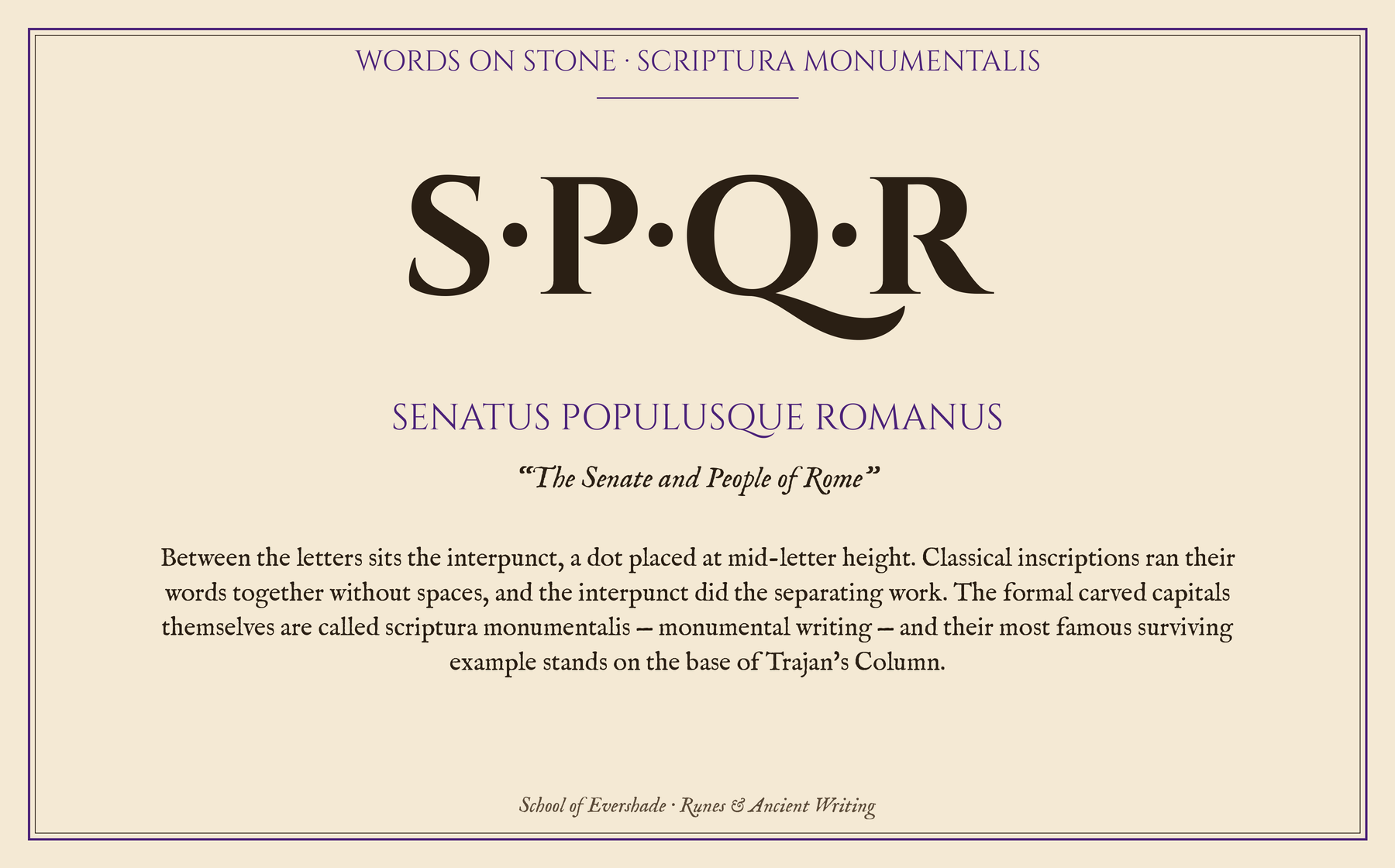
The interpunct at work: four letters and three dots that stood for the whole Roman state, cut on standards, coins, and stone.
Built for Evershade.
★ Read the most famous Latin abbreviation in the world the way a Roman would carve it: S·P·Q·R. Senatus Populusque Romanus. The Senate and People of Rome. Four letters, three interpuncts, and the entire Roman state in a single line.
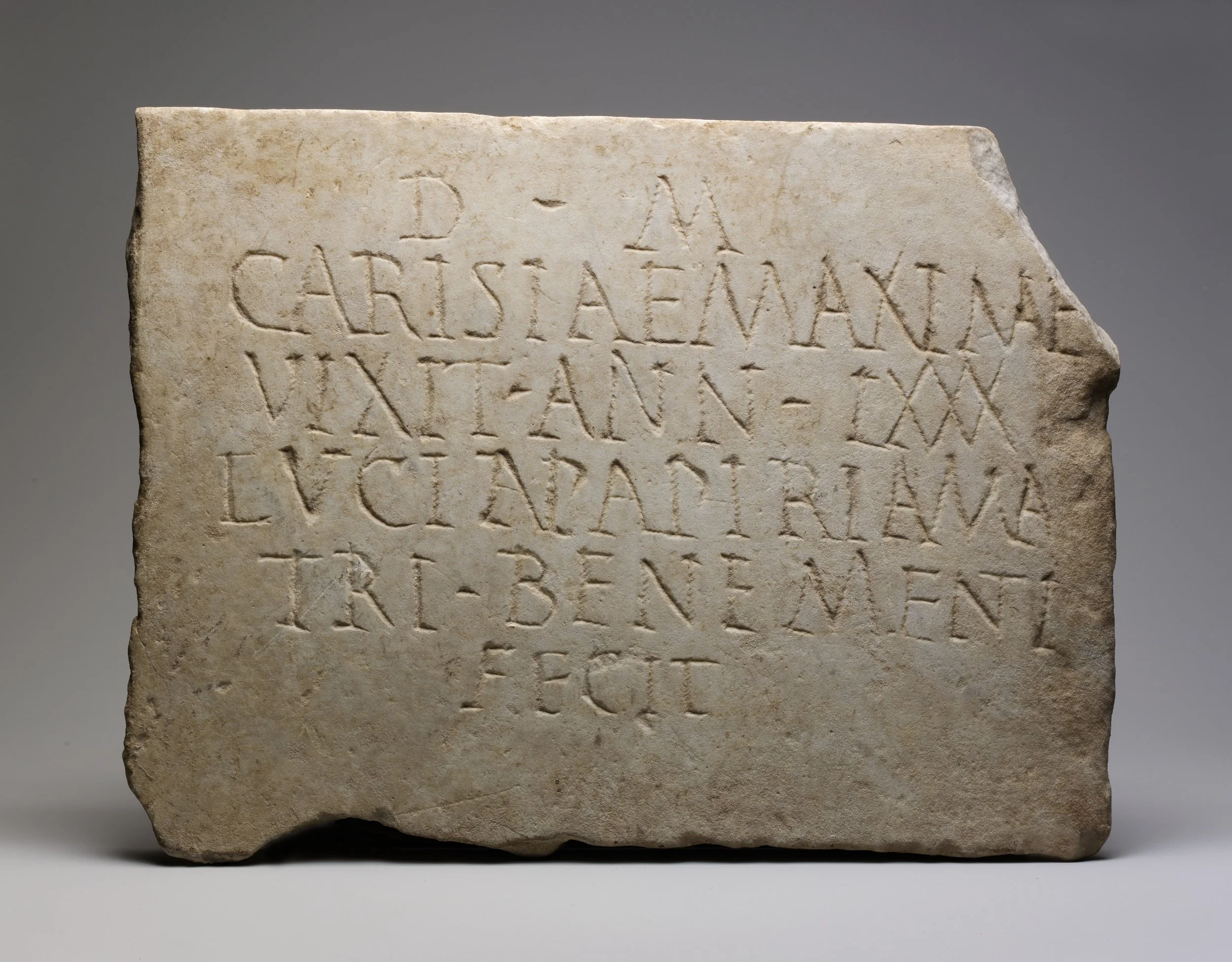
Historical example. Roman capitals as actually carved: a marble funerary inscription of the 2nd–3rd century CE. The V works double duty (VIXIT, LVCIA), and the age is recorded in numerals: VIXIT ANN LXX — “she lived 70 years.”
Marble funerary inscription, Roman, 2nd–3rd century CE. The Metropolitan Museum of Art, New York (X.248.4). Public domain, The Met Open Access.
The interpunct is the barest possible separator, the minimum mark that does the job, and the course question could not ask for a better illustration. What can we leave out? The spaces. Keep the dots.
The direction, by this point in our story, is settled: left to right, the standard the Greeks reached after three centuries of experiment and the Etruscans carried to Italy. The classical inscriptions do not waver. The ox has finished turning.
And the style has a name, verified in the scholars' own vocabulary: scriptura monumentalis, monumental writing, also called capitalis monumentalis.
When you see the phrase in a museum catalog, you will know you are looking at the letters of this lesson: even strokes, flared terminals, interpuncts between the words, and the patience of stone.
Check in: What mark separates words in a classical inscription, and what do the letters S·P·Q·R stand for?
❦ In your workbook: record the interpunct, the smallest mark in the lesson in your own way — copy, sketch, or note what matters.
In your packet: Assignment II — Transliteration Practice ⚒ begins here. Work it now, or mark the place and take it as homework — your choice.
Guided Practice — The Carver's Hand
Before the assignments, train your hand the way a Roman letterer would: with attention to the stroke, and to what the brush leaves behind.
Exercise A — Drawing the Twenty-Three
- On paper, draw the 23 classical Latin capitals as described in the lesson. Use a ruler for the straight strokes; these are inscriptional forms, built for the chisel.
- Label each with its name and sound value.
- Beside each, note its ancestor (through Etruscan, from Greek or Phoenician) or mark it as a Roman invention (G) or a late borrowing (Y, Z).
- Circle the two double-duty letters, I and V. For each, write both of its sounds and one Latin word that uses it in each role (for example, V as vowel in LUNA, V as consonant in VIA).
❦ Workbook path: make this a permanent workbook page instead of loose paper: draw the twenty-three in your workbook with I and V doubled in the margin, each showing both of its jobs.
Exercise B — The Brush Before the Chisel
- With a flat brush (or a marker held flat against the paper), paint a capital T, a capital E, and a capital L in water or diluted ink. Do not draw the serifs deliberately; simply press, pull, and lift the brush at each stroke's end.
- Look at the stroke terminals. Do you see the flare, the widening where the brush lifted? That flare is the ancestor of the serif.
- Now trace over your painted letters with a pen, following the flared terminals exactly. You have just repeated, in minutes, the process Catich reconstructed across two thousand years: brush, then carver.
Exercise C — One Letter, Two Jobs
- Write your name in Roman capitals using period rules: V for both U and W sounds, I for both I and J sounds, no J, no U, no W. (Kali becomes KALI; a name with W will need honest improvisation, and you should note what you did.)
- Write the sentence "The Senate and People of Rome" as S·P·Q·R with interpuncts, then expand it in full capitals: SENATVS POPVLVSQVE ROMANVS.
- Write two to three sentences on what the doubling cost you as a writer and what it cost you as a reader. Which direction was harder, and what does that tell you about who does the work in a writing system?
In your packet: Assignment I — The Letter Chart ⚒ begins here. Work it now, or mark the place and take it as homework — your choice.
Assignment Manual
Assignment key: ✎ written work · ⚒ hands-on practical · ◐ both · ★ will be on the test · ❦ workbook path
Written answers in this manual are short answers in your own words — a few honest lines, not a filled page.
Assignment I — The Letter Chart ⚒ ★
Objective: Demonstrate control of the 23 Latin letters, their sounds, and their ancestry.
Instructions:
- On a fresh sheet, create a four-column chart: Latin letter (drawn), Latin name and sound value, ancestor (through Etruscan, from Greek or Phoenician) or "Roman invention" / "late borrowing," note on what changed.
- Complete all 23 rows. For the double-duty letters I and V, describe both roles. For G, describe the innovation. For Y and Z, explain why they stand at the alphabet's end.
- Below the chart, write one paragraph on the single most economical feature of the Latin alphabet and explain how it answers the course question.
Your keepsake: keep this chart beside your Etruscan one in your scribe's portfolio: the letters you are reading right now, standing at attention.
❦ Workbook path: build the chart across two facing workbook pages instead of a loose sheet: I and V given doubled rows, one for each job the letter does.
To submit: Photograph or scan your chart. Accuracy of the ancestry matters more than artistic skill.
Assignment II — Transliteration Practice ⚒ ★
Objective: Read and write Latin inscriptional sequences.
Part A. Write the following in classical inscriptional style, with interpuncts and period spellings (V for U, I for J): "Gaius Julius Caesar came, saw, conquered" (use the Latin: GAIVS IVLIVS CAESAR VENI VIDI VICI). Check each word against the lesson's rules before you finalize it.
Part B. Expand the following abbreviations into full Latin words and translate them: S·P·Q·R, AVGVSTVS, SENATVS, IMPERIVM. Then write each expansion back into inscriptional capitals with interpuncts where a Roman would place them.
Part C. Choose an English sentence of at least ten words. Rewrite it as a Roman inscription would render it: capitals only, V for U, no J, interpuncts between words, no word spaces. Reflect in two to three sentences on what the inscriptional style gains in formality and loses in readability.
Assignment III — The Fibula Investigation ◐ ★
Objective: Understand the alphabet's arrival through its earliest artifact.
Instructions:
- Research (using the References below): the Praeneste fibula. Record the object's type and material, the inscription's text and translation, the date, and the circumstances of the 2011 authenticity analysis.
- Research the Duenos inscription: the object, the date, and why it was long considered the earliest Latin evidence. Explain in a half page why the fibula's authentication moved Rome's adoption of the alphabet back a full century.
- Both the fibula and the Duenos vase are personal objects, not monuments. Write a half page on what this suggests about who was writing in the earliest days of the Latin alphabet, connecting your argument to the drinking vessels of Lesson 7. Base your claims strictly on the objects and the lessons.
Assignment IV — The Serif Essay ✎ ★
Objective: Defend an account of the serif's origin and confront the geometric-construction debate.
Instructions:
Write a one-page essay addressing the following:
State the misconception most students bring to Roman inscriptions about serifs, then present Father Edward Catich's brush-origin theory: who developed it, what object he studied, and how the theory explains the serif's form. Then present the Renaissance geometric-construction account (Feliciano's Alphabetum Romanum, 1463) and explain why scholars debate whether it describes Roman practice or Renaissance analysis. Take a position: which account better explains the letterforms, and why? Use at least two specific details from the lesson to support your position.
Cite the lesson where your details come from.
Materials
Required (Level One — household items)
- Paper: plain white paper or a sketchbook, for letter practice and chart work.
- Pens: one standard pen for drafting, one firm-tipped marker for final letterforms. Roman capitals are inscriptional forms; a marker with a firm tip approximates the carved stroke.
- A ruler: essential for this lesson. The straight strokes of the monumental capitals demand it.
- A printout of the Roman square capitals: use the References below for a standard chart of the 23 classical capitals.
Suggested (Level Two — historically closer materials)
- A flat paintbrush and ink or paint: for the inscriptional experience. Roman letters were laid out in paint before carving; brushing the letters first approximates the letterer's method and lets you watch serifs form.
- A stone tile or plaster slab: the monumental surface. A smooth, light-colored tile with a dark marker gives the feel of carving without the chisel.
- A reed pen: cut from bamboo or river reed, as in Lesson 6. The Romans wrote cursive Latin with reed pens on papyrus; the combination is historically accurate for everyday writing.
- Papyrus paper: the prestige surface of Roman administration and literature, available from art suppliers.
Neither level requires
Purchased kits, specialty tools, or any material you cannot find locally or order inexpensively. The core lesson (drawing letters, understanding the serif's origin, practicing inscriptional style) is fully achievable with paper and pen.
Reflection Questions
Answer the following in your workbook.
- When did Rome adopt the alphabet from the Etruscans, according to current evidence? Name the object, give the inscription's text and translation, and explain what the 2011 analysis established.
- How many letters stand in the classical Latin monumental alphabet? Name the three modern letters that are missing, and explain what I and V each did double duty for.
- How was the letter G created, and when? Whose alphabet slot did it take, and why was that slot free?
- Why did Y and Z enter the Latin alphabet in the 1st century BCE? Why do they stand at the alphabet's end?
- State the leading theory of the serif's origin. Who developed it, what object did he study, and what does the theory claim?
- What is the Renaissance geometric-construction account of Roman capitals, and why do scholars debate whether it describes Roman practice?
- "What can we leave out and still be understood?" Apply the course question to the monumental style: name three things the Romans left out of their letters, and explain what they kept.
Workbook Checklist — Lesson 9
In my workbook I have:
- ☐ explained when and how Rome adopted the alphabet from the Etruscans, and named the Praeneste fibula as the earliest evidence
- ☐ defined Classical Latin, scriptura monumentalis, serif, interpunct, inscription, epigraphy, and Praeneste fibula
- ☐ identified the 23 letters of the classical Latin monumental alphabet, and explained the double duty of I and V
- ☐ described the creation of G in the 3rd century BCE and the 1st-century BCE addition of Y and Z
- ☐ explained the brush-origin theory of the serif and the Renaissance debate over geometric construction
- ☐ applied the course question to the monumental style: what the Romans left out of their letters, and what they kept
☐ Lesson completed Date: ____________ Signature: ____________
Professor's Review
And so our ninth lesson closes in Rome, where borrowers became carvers and the alphabet learned to outlast its makers.
You can now explain how Rome adopted the Etruscan alphabet around the 7th century BCE and name the golden brooch that proves it, identify all 23 classical letters with their sounds and ancestors, explain the double duty of I and V and the invention of G, describe the late arrival of Y and Z, and tell the true story of the serif: not decoration, but the fossil of a brushstroke.
Keep your Latin chart beside your Etruscan one, as you kept Greek beside Phoenician and Aramaic beside Phoenician.
Lay all four side by side now and look at the family. The Greek letters sing with vowels. The Etruscan letters wear a new language's clothes. And the Latin letters stand carved and formal, twenty-three where twenty-six will one day be, doing more with less than any alphabet we have met.
Next, we do something the Romans did constantly and we rarely think about: we count.
Lesson 10 takes up the Roman numerals, the number system that ran an empire's accounts, legions, and calendars. The letters you learned today are about to do a second job, and the course question will follow them there.
Practice your capitals, scholars. Paint them first, as the Roman letterers did, and watch the serifs appear at the ends of your strokes like footprints.
I have spent long evenings among the inscriptions, and I tell you truly: the stones remember the brush.
PROFESSOR THISTLELOOM WEBBLETHORN
Runes & Ancient Writing
Epigrapher, Head of House Septentrio
Cross-Class Connections
The inscriptional capitals of this lesson connect directly with Scrollwork, where Professor Nocturne teaches the Roman book hands descended from these forms. Students studying both classes should compare the monumental capitals here with the rustic and cursive hands to come: the same 23 letters, softened for the pen, and the family resemblance across centuries is unmistakable.
The Athenian standardization of 403 BCE (Lesson 7) and the Roman monumental standard are our two great cases of political power shaping script, and both will reappear in Runes Unit V, when an emperor's scholars standardize a hand for a continent. Athens chose an alphabet by decree; Rome spread one by empire. The mechanisms differ, and the comparison is worth making.
The brush-before-chisel sequence parallels Creative Arts craft thinking: layout before execution, the soft tool guiding the hard one. Students who build and make will recognize the pattern from their own work.
In Other Classrooms
Scrollwork · Unit IV, Lesson 15 — Uncial Script

Stone capitals are for monuments; books need a softer voice. In the Library we write the uncial: round letters from the broad edge of the pen, the first great book hand of the Latin world. Come after your capitals and learn the hand the scribes actually lived in, page after page.
Creative Arts · Unit VII, Lesson 27 — First Cuts: Carving Safely

Brush before chisel: the Romans laid out in paint what the stone would keep, and so do we. In the Workshop, first cuts are taken safely and in order, the layout always leading the blade. Come and practice the sequence on forgiving material before any stone is asked to remember you.
The stone remembers, and so should we.
References & Further Reading
The British Museum. Collection online. Searchable collection including Latin inscriptions and Roman epigraphy. https://www.britishmuseum.org/collection
The Corinium Museum. "Roman Writing." Museum schools resource glossing scriptura monumentalis and Roman lettering practice. https://coriniummuseum.org/schools/resources/roman-writing/
Wikipedia. "Classical Latin alphabet." The 23-letter alphabet: letter histories, the G innovation, the late addition of Y and Z. https://en.wikipedia.org/wiki/Classical_Latin_alphabet
Wikipedia. "Praeneste fibula." The gold brooch with the earliest known Latin inscription, and the 2011 authenticity analysis. https://en.wikipedia.org/wiki/Praeneste_fibula
Wikipedia. "Serif." The serif's history, including Catich's brush-origin theory. http://en.wikipedia.org/wiki/Serif
Wikipedia. "Roman square capitals." Scriptura monumentalis: the inscriptional style, the Trajan Column, and scholarly debate. https://en.wikipedia.org/wiki/Roman_square_capitals
Wikipedia. "Alphabetum Romanum." Felice Feliciano's 1463 treatise on the geometric construction of Roman capitals. https://en.wikipedia.org/wiki/Alphabetum_Romanum
Wikipedia. "Trajan's Column." The 113 CE monument whose inscription is the model of Roman square capitals. https://en.wikipedia.org/wiki/Trajan%27s_Column
Browse the Runes shelf in the school Library for readable editions of these works.
Carve like Rome. The Bench sets your words in capitals — U as V and J as I — as the stones have them.
Open the BenchPROFESSOR THISTLELOOM WEBBLETHORN · RUNES CLASSROOM
Submit your work for this lesson using the form below.
CONTINUE IN RUNES & ANCIENT WRITING
← Previous · Lesson 8: Etruscan: The Alphabet in a New Mouth Next · Lesson 10: Roman Numerals: How the Letters Learned to Count →
Unit III · The Mediterranean Masters Runes & Ancient Writing Classroom · All 21 Lessons
The rest of Unit III: Lesson 7 · Ancient Greek · Lesson 8 · Etruscan · Lesson 10 · Roman Numerals