
SCROLLWORK
Unit IV · Lesson 15UNCIAL SCRIPT
Professor Quillberry Nocturne
Master Scribe & Illuminator
The Scrollwork Library • School of Evershade
Professor's Introduction
Quietly now, scholars, and welcome to the heart of our fourth unit.
In our twelfth lesson, you learned the discipline of the pen angle. In our thirteenth, you learned the rhythm of spacing. In our fourteenth, you wrote the Roman capitals, the empire's monumental voice. Tonight we take up the hand that carried the book through the centuries after Rome: Uncial, the round hand, the script of the great Bibles.
You already know what Uncial is. Professor Webblethorn has told you its history in Runes, Unit V, Lesson 17: the rounded book hand of the fourth through eighth centuries, written with the broad reed pen, the carrier of the Latin Bible and the classics through late antiquity. I will not repeat her lesson. What I will do tonight is put the pen in your hand and teach you to write it.
Uncial is the broad edge's oldest voice in the book tradition. Its roundness is not decoration. It is geometry: the natural product of a chisel nib held at a low, steady angle, moving in continuous curves. Tonight you will learn the angle, the guidelines, the strokes, and the five letters that make Uncial unmistakable. By the end, you will have written the alphabet in the hand that wrote the ancient books.
Pick up your broad-edge tool. Keep the angle steady. And let the pen teach you what the history only described.
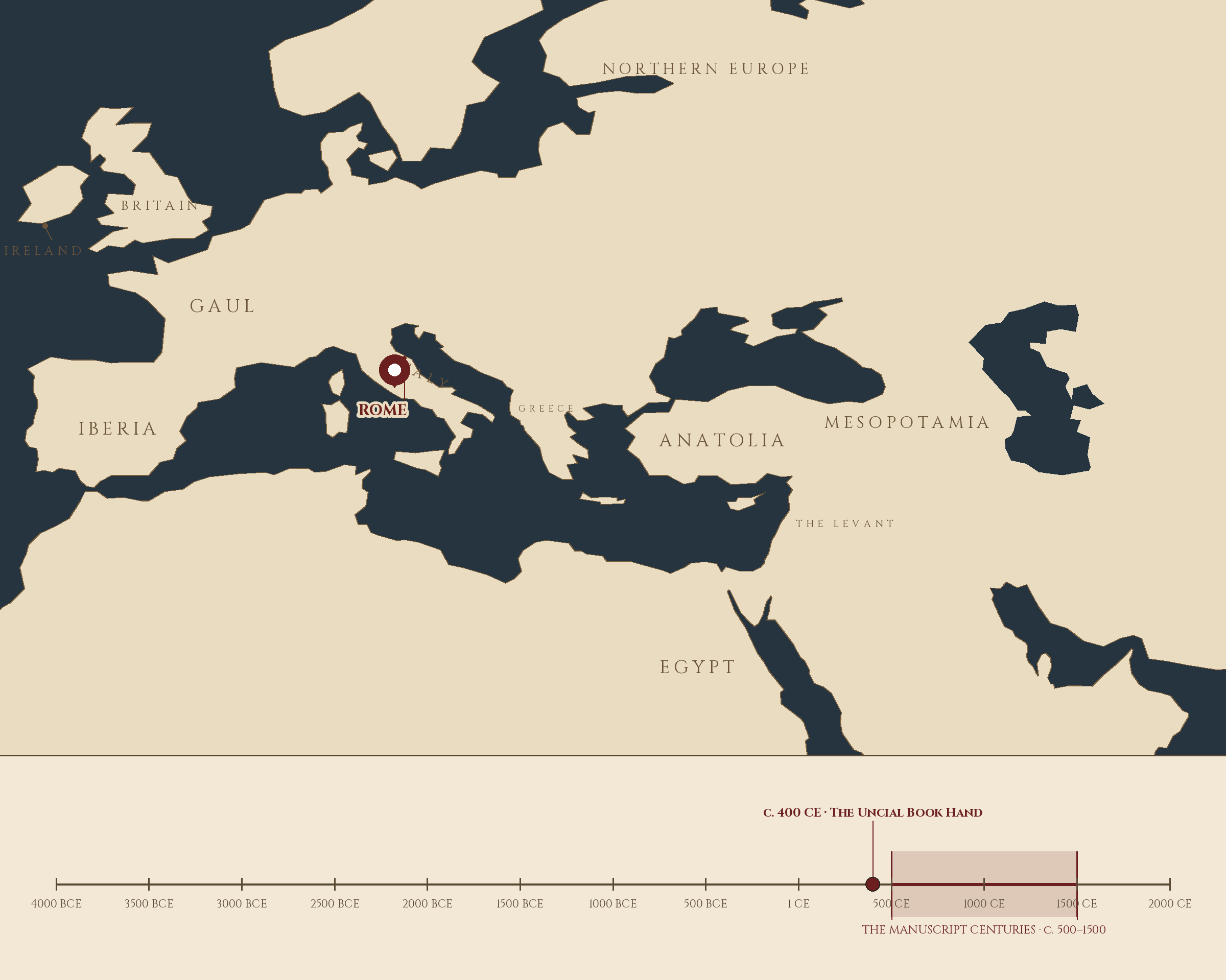
Where and when: Rome, Italy, c. 400 CE — The Uncial Book Hand. The pin is this lesson. The line beneath the map is our road: every stop a place where writing changed, every lesson a pin.
Lesson Objectives
By the end of this lesson, students should be able to:
- Define ascender, descender, x-height, baseline, bowl, stem, counter, minim, and pen lift.
- Explain why Uncial's roundness is a product of broad-edge geometry, not decoration.
- Set Uncial guidelines using the nib-ladder method at four pen widths.
- Hold and maintain the Uncial pen angle (about 20 to 30 degrees) through a passage of writing.
- Write the five distinctive Uncial letters (A, D, E, H, M) with correct ductus.
- Write the complete Uncial alphabet in sequence.
- Evaluate their own letterforms for angle steadiness, roundness, and spacing.
Reading this lesson: ★ marks the passages to remember. They return on the unit quiz and the class test. Check in questions ask the material back as you go; answer them in your workbook when you meet them.
Working this lesson: Your assignment packet is the first download on this page. Work in it as the lesson moves along, answering each assignment as its subject is taught — or read the lesson through for your notes and take the assignments as homework afterward. Both are proper ways to sit this class. Signposts in the reading tell you where each assignment belongs. Written answers are short answers in your own words; a few honest lines are worth more than a filled page.
Your Assignment Packet
This lesson's assignments live in its packet: the Lexicon Handout (every term, course terms marked ◆), Materials, Guided Practice, the Assignment Manual with its answer key for self-checking, the Reflection Questions, and the Workbook Checklist. Download the packet before you begin and keep it beside you as you read.
The Round Hand: What You Are About to Write
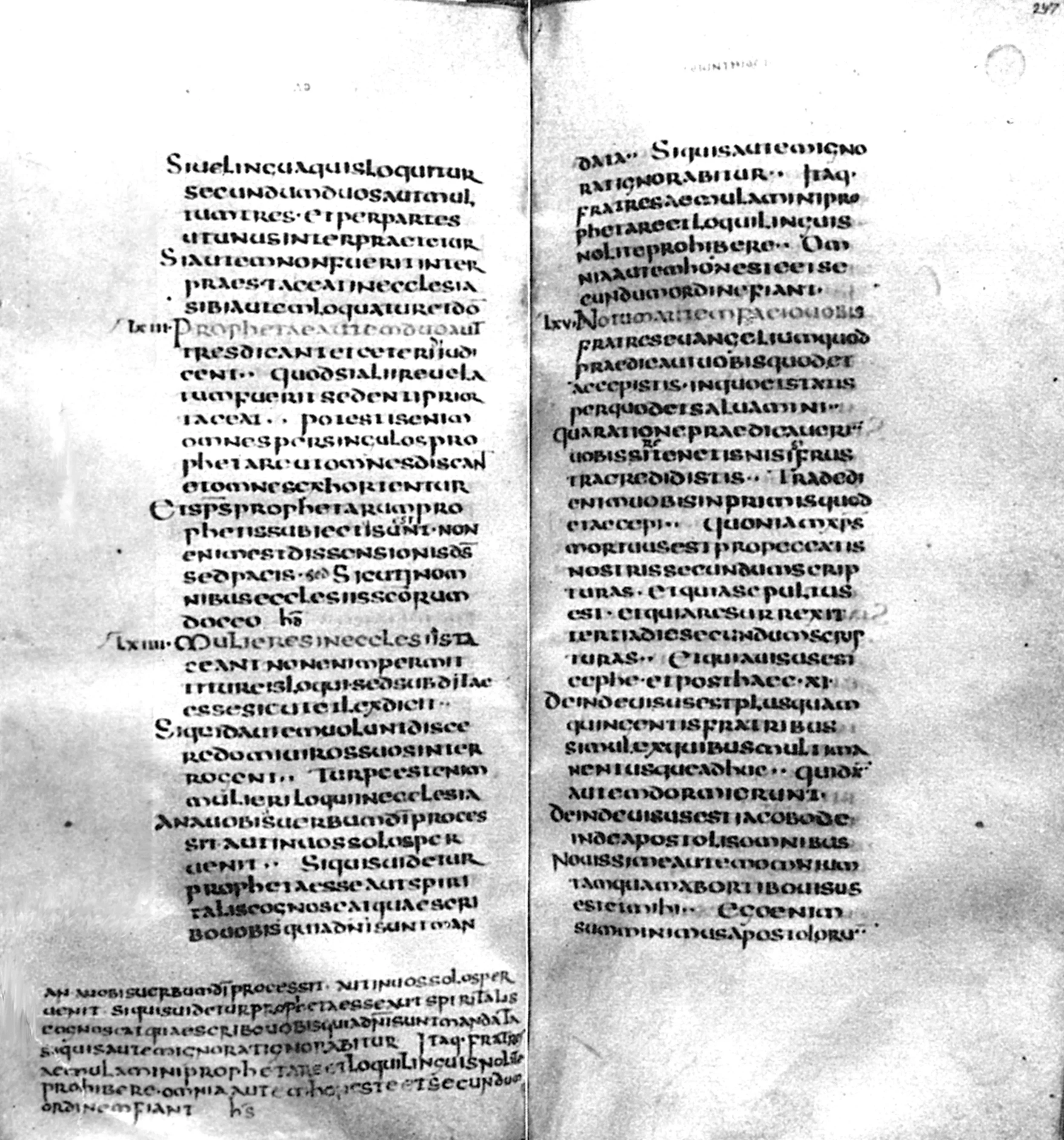
A whole opening in uncial: the Codex Fuldensis (546–547), one of the oldest dated books in the world. Every line sits between the same two lines — no ascenders, no descenders — the round hand at its most serene.
Codex Fuldensis, Fulda, Landesbibliothek, Codex Bonifatianus 1, pp. 296–297. Public domain. Via Wikimedia Commons.

Half-uncial, uncial's smaller working companion: three lines from the Codex Basilicanus. The letters are already slipping their two lines — ascenders rising, descenders dropping — on the way to minuscule.
Codex Basilicanus (Biblioteca Apostolica Vaticana, Archivio di San Pietro D 182), fol. 18r. Public domain. Via Wikimedia Commons.
Uncial is the rounded book hand that carried Latin literature through late antiquity: the script of great Bibles and classical texts from roughly the fourth to the eighth century, written with the broad reed pen, the calamus, by scribes who needed a formal hand faster to write than monumental capitals and more dignified than cursive. Its name was given by scholars in the 1600s, from the Latin for "inch," describing the large letters. The full history, the Christian book context, the coexistence with half-uncial, belongs to Professor Webblethorn's classroom, in Runes, Unit V, Lesson 17, and I send you there for it.
What belongs here is the hand itself.
★ Look at Uncial and the first thing you see is roundness: open, generous curves where the Roman capitals had straight lines and sharp corners. That roundness is not a style choice laid over the letters like paint. It is the inevitable product of the tool. A broad edge held at a low angle, moving in continuous turns, cannot easily make a sharp corner; the nib wants to curve, and the scribe who fights the nib loses. The Uncial scribes did not fight it. They let the pen's nature become the script's character, and four centuries of books are the result.
★ Five letters carry the roundness further than the rest, and they are the signature of the hand. The scholars of Dartmouth's Ancient Books Lab identify them precisely: A, D, E, H, and M. These are the letters that move decisively away from the square capital forms and become curved, and when you can write these five, you can write Uncial, because everything else in the alphabet is a variation on the strokes they teach.
★ A final note before we begin, and it is a matter of honesty. The Uncial of the manuscripts is not one single alphabet. African Uncial is more angular; Italian Uncial flattens the tops of its round letters; French hands add their own decorations; the centuries changed things. What I teach tonight is one clear, consistent Uncial, built for the student's hand: historically grounded, practically teachable, and true to the script's character. Learn this road first. The countryside will still be there when you are ready.
Check in: Uncial's roundness is not decoration laid over the letters. In your own words, what produces it — and what did the scribes do instead of fighting the nib?
❦ In your workbook: record the round hand: what Uncial is, why it is round, and the five letters that sign it in your own way — copy, sketch, or note what matters.
The Tools of the Lesson
You need a broad-edge tool, guidelines, and patience, in that order.
The pen. Level One: a chisel-tip marker, the flat kind sold for calligraphy practice, in a medium width. It is the honest modern stand-in for the reed: a true broad edge, no flex, no apology. Level Two: a broad-edge dip pen with a steel nib, or a quill cut with a straight-across tip as you learned in Lesson 10. The dip pen teaches ink management alongside letterforms; the quill teaches everything. Choose the tool you will actually practice with, because the hand learns by repetition, not by equipment.
★ The guidelines. Uncial is a bilinear majuscule: its letters live between two lines, the baseline below and the waistline above, with the rare ascender or descender stepping modestly outside. The distance between the lines, the x-height, is measured in pen widths, and for Uncial the measure is four. Build a nib ladder: hold your pen with the edge horizontal, parallel to the writing line, and make a vertical stack of four full-width strokes, each climbing directly atop the last. That stack is your x-height. Rule your baseline and waistline that distance apart, and rule generously down the page, because you will fill it.
★ The angle. Hold the broad edge at about 20 to 30 degrees to the writing line: lower, flatter, than the 45 degrees of Italic — the slanted hand whose angle you met in Lesson 11. At this low angle, vertical strokes are nearly full width, horizontals are thin, and curves swell and diminish as they turn through the angle. That is the whole physics of Uncial's roundness. Historical hands varied in their exact angle, and modern teachers differ by a few degrees, but all agree on the principle: low, steady, and unchanging through the passage. The angle is a promise you make to the page. Keep it. It is no accident that Edward Johnston, the revival's great teacher, began his teaching with an Uncial hand.
The ink and paper. Any dark ink and smooth paper will do for practice. The medieval scribes wrote on parchment with carbon and iron-gall inks; you are learning the hand, not the materials, and printer paper with a chisel marker teaches the geometry faithfully.
Check in: Before a single letter is written, what must be set? Name the two lines, the distance between them in pen widths, and the angle at which you will hold the pen.
❦ In your workbook: record your Uncial setup: the nib ladder, the four-width guidelines, and the angle you will hold in your own way — copy, sketch, or note what matters.
In your packet: Exercise I — The Nib Ladder and Guidelines ⚒ begins here. Work it now, or mark the place and take it as homework — your choice.
Professor Nocturne
Not yet, scholars, before you write a single letter, because I am going to tell you the secret of this entire lesson and it is not about letters.
It is about the angle. The student who masters Uncial has mastered one thing: holding the broad edge at a constant angle while the hand moves. Every letter in this script is the angle, expressed through different directions of travel. The roundness, the openness, the calm: all of it is the angle, kept steady.
This is why Uncial is the first book script of our unit and not the last. It is the most honest broad-edge hand, because it hides nothing. In Italic, slant and speed can disguise a wandering angle. In Uncial, there is nowhere to hide. The circle of the O will tell on you. The bowl of the D will tell on you. The page is a mirror, and the angle is what it reflects.
So make the promise before you begin: the angle does not change. Not between letters, not between words, not when the wrist tires. Twenty to thirty degrees, held like a note. The letters will come. The angle comes first.
The Strokes Before the Letters
No scribe begins with the alphabet. The hand must learn the strokes first, the way a musician practices scales before the piece.
The vertical stem. With your angle set, draw a slow vertical line from waistline to baseline. It should be nearly the full width of the nib: thick, confident, straight. Draw ten. They should match each other. If they do not, the angle is wandering, and you have found your first lesson.
The bowl. Draw a circle, or as near a circle as the broad edge allows, starting at the top and moving counterclockwise, keeping the angle constant. Watch what the nib does: the stroke is thick where it travels across the edge, thin where it travels along it. The circle will have its thick strokes at roughly the upper-left and lower-right, its thin strokes at the top and bottom. Draw ten circles. They should be round, even, and the same size. The bowl is the soul of Uncial; everything curved in the script is a bowl or part of one.
The arch. Draw an upside-down U: down the left side, curve over the top, down the right side. This is the skeleton of the H, the M, the N. Keep the two sides parallel and the curve even. Draw ten.
The diagonal. Draw a diagonal from upper left to lower right, then from upper right to lower left. Feel how the thickness changes with direction. These are the bones of the A, the V, the X.
Practice these until they are boring. Boredom is the hand's way of saying it has learned.
❦ In your workbook: record the strokes before the letters: the stem, the bowl, the arch, and the diagonal in your own way — copy, sketch, or note what matters.
The Five Distinctive Letters
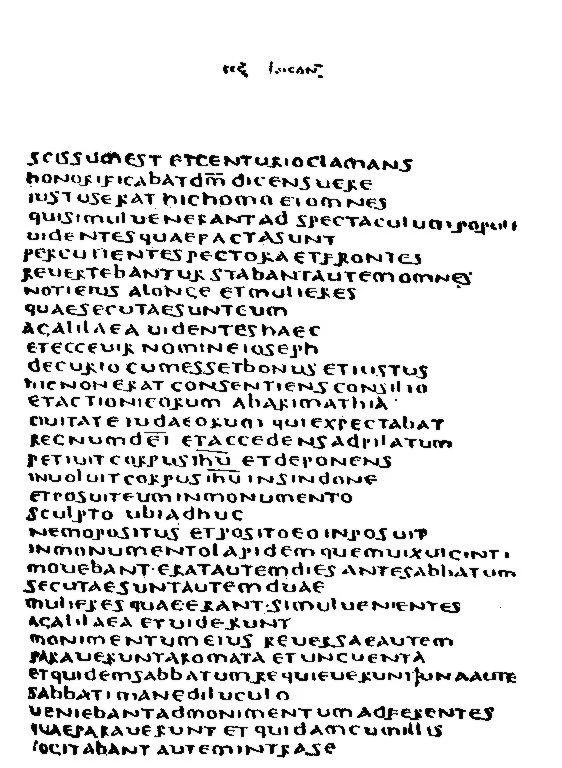
Codex Bezae's Latin page (c. 400) — the Greek–Latin diglot from which so much uncial study begins — in a nineteenth-century facsimile plate. Work through it and mark every A, D, E, H, and M.
Codex Bezae Cantabrigiensis (Cambridge University Library, Nn.2.41), Latin text of Luke 23–24, facsimile plate from The S.S. Teacher's Edition — The Holy Bible (19th century). Public domain. Via Wikimedia Commons.
These are the letters that make Uncial unmistakable. Learn them first, learn them well, and the rest of the alphabet will feel like variations on friends.
A. The Uncial A is built of curves, not the pointed apex of the capital. In the ductus I teach: begin with a stroke like a broad C, opening to the right, from waistline to baseline. Then add the right side as a second curved stroke, meeting the first at the top and finishing at the baseline, with a short horizontal or slightly curved crossbar. Two strokes, one pen lift — one deliberate raising of the pen. The result should look open and round, nothing pointed about it.
★ D. The most beautiful letter in the script, and the best test of your angle. First the bowl: a full, round curve like the O, closed and even. Then the ascender: starting from the top of the bowl, a stem that rises above the waistline and curves gently to the left, like a flag lifting in a small wind. Two strokes. The bowl must be truly round, because the eye compares it to every O on the page, and the ascender must curve, because a straight stem would be a capital's D wearing a disguise.
E. The Uncial E keeps the spine of the capital but rounds it, and its signature is the crossbar: a firm horizontal stroke through the middle, drawn with the edge nearly parallel to the writing line, so it comes out as a clean hairline. Ductus: the curved spine in one stroke, like a large C, then the pen lifts and the crossbar is drawn left to right. The crossbar is the letter's voice. Make it straight, make it confident, and do not let it droop.
H. Two stems joined by an arch: the left stem full height, then the pen lifts, and the right side is drawn as an arch curving over from the top of the left stem and down to the baseline. In some historical hands the H is made in three strokes; in the ductus I teach, two suffice. The arch must be round, not pointed: think of a doorway, not a roof.
M. The letter that teaches minims — the short vertical strokes that are Uncial's building blocks. The Uncial M is a sequence of rounded arches: stem, arch, stem, arch, stem, with the arches curving like small bridges between the verticals. Three or four strokes depending on your ductus; I teach it as stem, then arch to second stem, then arch to third stem. Keep the arches even and the stems parallel. A well-made Uncial M looks like a row of waves, calm and unhurried.
Write each of these letters twenty times before moving on. Not ten. Twenty. The hand learns by repetition, and these five are the foundation of everything that follows.
Check in: Which five letters make Uncial unmistakable? And in the D, which two strokes have opposite duties: the bowl that must stay round, and the stem that must curve?
❦ In your workbook: record the five distinctive letters, A, D, E, H, and M, and how each is built in your own way — copy, sketch, or note what matters.
In your packet: Exercise II — The Five Distinctive Letters ⚒ begins here. Work it now, or mark the place and take it as homework — your choice.
The Full Alphabet
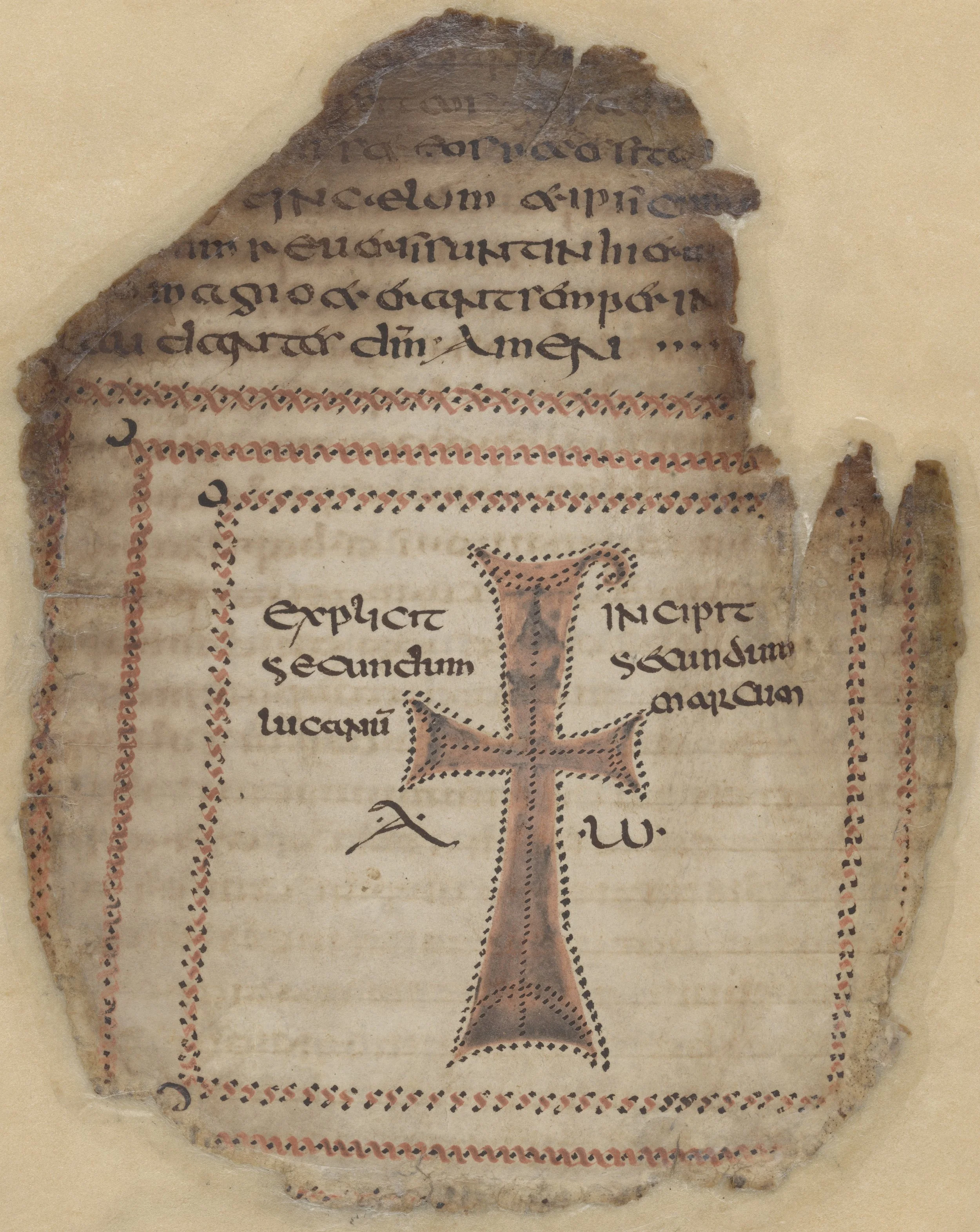
The oldest Irish Gospel book: the Codex Usserianus Primus (c. 600). Between the end of Luke and the beginning of Mark stands a cross of red and black dots — and the writing around it is uncial already turning Irish.
Codex Usserianus Primus, Trinity College Dublin, MS 55, fol. 149v. Public domain. Via Wikimedia Commons.
With the strokes practiced and the five distinctive letters in hand, the remaining letters are applications of what you know.
The round letters: C, G, O, Q. These are bowls and near-bowls. C is an open bowl, drawn counterclockwise like the O but left open on the right. O is the full bowl, your practiced circle. G takes the C and adds a short horizontal stroke at the lower right, sometimes with a small descender in historical hands; keep it modest. Q is the O with a tail: draw the bowl, lift the pen, and add a short diagonal tail below the baseline on the right side.
The stem letters: B, F, I, L, P, R, T. These are built on the vertical stem. B: stem, then two bowls stacked on the right side. F: stem, then two short horizontal arms at top and middle, drawn as hairlines. I: a single stem, sometimes with short hairline serifs top and bottom. L: stem with a foot curving right at the baseline. P: stem with a single bowl at the top. R: P with a leg descending diagonally from the bowl. T: stem with a broad hairline crossbar at the waistline.
The diagonal letters: K, N, V, X, Y, Z. These use the diagonal strokes you practiced. N is two stems joined by a diagonal. V is two diagonals meeting at the baseline. X is two crossing diagonals. K, Y, and Z follow the capital constructions, rounded slightly to match the hand's character.
The remaining: S, U. S is a double curve, drawn in one flowing stroke, top to bottom. U is two stems joined by a bottom curve, like a cup.
Write the full alphabet in order, slowly, five times through. Then write it backwards. The backwards alphabet defeats the hand's habit of rushing through familiar sequences and forces attention onto each letter.
❦ In your workbook: record the full alphabet in its families: the round letters, the stem letters, the diagonals, and S and U in your own way — copy, sketch, or note what matters.
In your packet: Exercise III — The Full Uncial Alphabet ⚒ begins here. Work it now, or mark the place and take it as homework — your choice.
Words and Rhythm
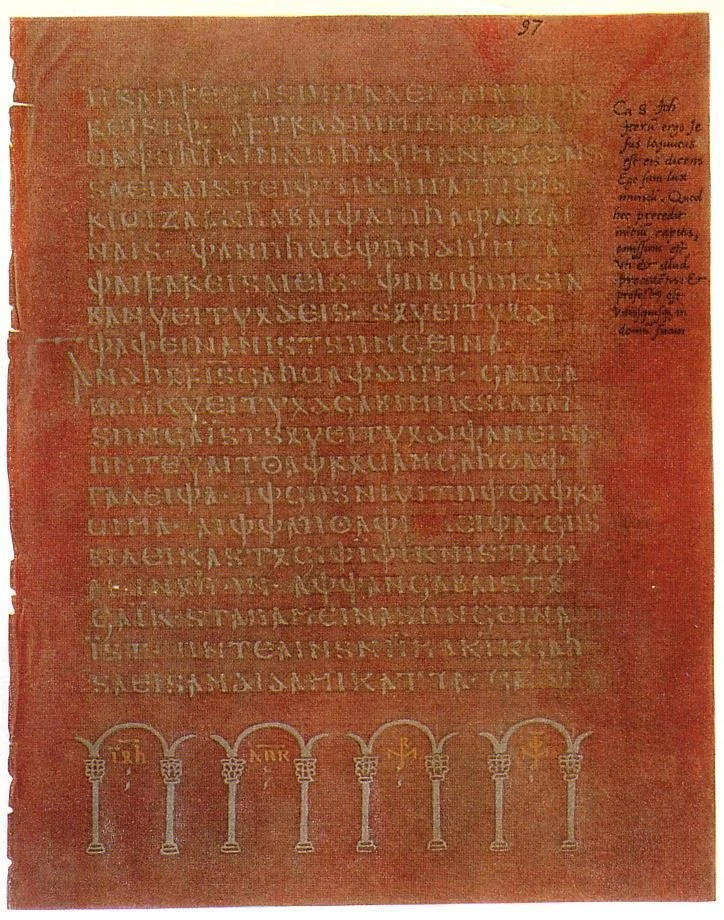
The round hand abroad: the Codex Argenteus (c. 520), written in silver on purple parchment — in Gothic. Uncial letterforms carried more than Latin; any scribe in Europe could read their shapes.
Codex Argenteus, Uppsala University Library, DG 1, fol. 97. Public domain. Via Wikimedia Commons.
★ Letters are the vocabulary; words are the speech. Uncial was historically written in scriptura continua, without spaces between words, as you learned in Runes, Unit V, Lesson 20. For this lesson's practice, use modern word spacing: the goal is the letterforms, and the eye needs the rest between words while it learns. When you are fluent, try a line of scriptura continua, and feel what the ancient reader felt: the text as an unbroken stream, parsed by knowledge rather than by gaps.
Space your letters evenly, with the white space between letters roughly equal to the counter of an O — the white the letter encloses. Space your words with a clear gap, about the width of an N. Keep your baseline true across the line. And keep the angle. Always the angle.
Check in: You practiced with spaces between your words. What did the ancient reader of scriptura continua have to supply that your spaces supply for you?
❦ In your workbook: record words and rhythm: how letters and words are spaced, and the unbroken stream of scriptura continua in your own way — copy, sketch, or note what matters.
Guided Observation: Reading the Roundness
Before the practical exercises, study Uncial as a reader before you write it as a scribe.
Examine, if available, reproductions of Uncial manuscripts: the great Bibles of the fourth and fifth centuries, written in the rounded hand you are learning. Many are digitized and freely viewable through the British Library and the Vatican Library. Look closely at:
- the five distinctive letters (A, D, E, H, M) in actual manuscript hands, and how they differ from the forms I have taught you
- the evenness of the bowls: find the roundest O on the page and the least round, and consider what the difference tells you about the scribe's control
- the pen angle, read backwards from the thick and thin strokes: where are the thickest strokes, and what angle does that imply?
- the spacing between letters and words, and how the page breathes
Consider: does the manuscript hand you are studying match the ductus taught in this lesson? Where does it differ, and what might the difference reveal about the scribe's training or speed? Record your observations in your workbook.
Demonstration: The Uncial Drills
Work with ordinary household materials. A chisel-tip marker and printer paper are sufficient for every drill.
The Angle Drill
Rule a set of guidelines at four pen widths. Set your pen angle at about 25 degrees. Draw a full line of vertical stems, then a full line of bowls, then a full line of arches, without changing the angle. Now examine the page: find any stroke where the thickness betrays a shift in angle, and mark it. Repeat the drill until a full line passes without a mark.
The Five Letters Drill
Write the five distinctive letters, A, D, E, H, M, in sequence, repeating the sequence across the full width of the page. Write slowly enough that each letter receives your full attention. Circle the best example of each letter and the worst. For each worst example, write one sentence diagnosing the fault: angle, roundness, proportion, or spacing.
The Alphabet Drill
Write the complete Uncial alphabet in order, five times through, on ruled guidelines. Then write it backwards once. Compare the first alphabet with the fifth: which letters improved, which resisted, and what does the pattern tell you about where your practice should go next?
The Word Drill
Choose five words of at least six letters each. Write each word five times, attending to the spacing between letters and the steadiness of the angle across the word. Then write a single sentence of at least eight words, the longest continuous Uncial you have yet produced. Read it back as a scribe would: slowly, judging every letter.
In your packet: Exercise IV — The Uncial Page ⚒ begins here. Work it now, or mark the place and take it as homework — your choice.
Materials
Required (Level One — household items)
- Chisel-tip marker: a flat calligraphy marker in a medium width. This is your broad-edge tool: a true chisel, no flex, and the honest modern stand-in for the reed pen.
- Printer paper: smooth and plentiful. You will fill pages in this lesson; do not ration them.
- Ruler and pencil: for ruling guidelines. A pencil line is erasable; a wandering baseline is not.
- Your workbook: for the observation records, diagnoses, and reflection answers.
Suggested (Level Two — historically closer)
- Broad-edge dip pen with steel nib, or a quill cut with a straight-across tip (see Lesson 10): the dip pen teaches ink management alongside letterforms; the quill teaches everything.
- Better paper: smooth layout or marker paper that takes broad-edge strokes without feathering.
- Dark ink: any fountain-pen or calligraphy ink. Iron gall or carbon ink behaves most like the historical materials.
No purchased kits or specialty tools are required. The core lesson (guidelines, the five letters, the alphabet, the page) is fully achievable with a chisel marker and printer paper.
Reflection Questions
Answer the following questions in your workbook.
- Why does Uncial's roundness follow inevitably from the broad edge held at a low angle, and what would happen to the script if the angle were raised to 45 degrees?
- The five distinctive letters (A, D, E, H, M) are the ones that moved furthest from the square capitals. What does their transformation tell you about what the reed pen wanted to do?
- You learned one ductus for each letter, but historical hands varied. What is the value of learning one consistent ductus first, and when should a student begin to study the variations?
- Uncial was written in scriptura continua, without word spaces. How did writing your practice lines with modern spacing change the experience, and what did the trial line of continua teach you?
- Edward Johnston began his teaching with an Uncial hand before developing his foundational hand. What does that sequence suggest about Uncial's place in a scribe's education?
- Where in your alphabet does your angle wander most, and what does that tell you about the relationship between attention and the hand?
Workbook Checklist — Lesson 15
In my workbook I have:
- ☐ explained why Uncial's roundness comes from the broad edge at a low angle, not from decoration
- ☐ set Uncial guidelines by the nib ladder, at four pen widths
- ☐ held the pen angle steady, about 20 to 30 degrees, through a passage of writing
- ☐ written the five distinctive letters — A, D, E, H, and M — with the ductus taught in this lesson
- ☐ written the complete Uncial alphabet in sequence, forwards and backwards
- ☐ judged my own letterforms for angle steadiness, roundness, and spacing, and named the faults I found
☐ Lesson completed Date: ___ Signature: ___
Professor's Review
And so you have written the round hand, scholars, and your pages hold the oldest voice of the book.
Look at what your hand has learned tonight. You set the guidelines by the nib's own measure, four pen widths, the way scribes have measured since the reed. You held the low angle steady, twenty to thirty degrees, and watched it produce roundness from geometry. You wrote the five distinctive letters, the A and D and E and H and M that no other script owns in quite these forms. You wrote the full alphabet, forwards and backwards, and you sustained the hand across a page of continuous text.
This is the foundation of our unit, and I mean that in both senses. The scripts that follow, Insular and its companions, are built on the broad edge's discipline, and the steadiness you learned tonight is the steadiness they will demand. But more than that: you have now felt, in your own hand, why the ancient books look the way they do. The roundness was never a decoration. It was the pen, allowed to be itself.
Keep practicing. The hand learns by repetition, and the alphabet you wrote tonight is only the beginning of the conversation.
PROFESSOR QUILLBERRY NOCTURNE
Scrollwork Library
Master Scribe & Illuminator
Cross-Class Connections
Runes · Lesson 17 — The Need for Speed
My lesson carries the whole history this one sends you to: Roman cursive, the rise of the uncial book hand, and the canonical definitions of uncial, ductus, and majuscule that this lesson's lexicon points to. I will tell you where the hand came from. Tonight you learned what it asks of yours: a low angle, and the patience to keep it.
Runes · Lesson 20 — Spacing & Punctuation
Mine is the canonical account of scriptura continua: the unspaced stream the Uncial scribes wrote, and how readers learned to parse it. Your trial line in Professor Nocturne's lesson is that history under your own pen. Write one line without spaces in my classroom's honor, and you will never take the spaces for granted again.
PROFESSOR THISTLELOOM WEBBLETHORN
Runes & Ancient Writing
Further Reading & Sources
For scholars who want to go deeper into the world of Uncial, these are the places I send my own students first.
Dartmouth Ancient Books Lab. "Uncial / Half-Uncial (Historical Background and How To)." Dartmouth: Uncial and Half-Uncial A university palaeography lab's guide to the script: historical background, the five distinctively rounded letters, and stroke-by-stroke instruction for writing each letter. The clearest free online introduction to Uncial as both history and practice.
*Edward Johnston. Writing & Illuminating & Lettering. London, 1906. (Public domain; widely reprinted.)* The book that revived broad-edge calligraphy in the twentieth century. Johnston began his teaching with an Uncial hand, and his manual's treatment of the broad edge, pen angle, and the pen-width measurement system underlies everything taught in this lesson.
Wikipedia. "Uncial script." Wikipedia: Uncial script The essential reference overview: development, the Greek and Latin traditions, national styles (African, Italian, Insular, French), and the script's descendants. Start here for the big picture, then follow the citations deeper.
Janet Takahashi. "A Beginner's Guide to Uncial Calligraphy." (Video series.) Janet Takahashi: Uncial Calligraphy A working calligrapher's video introduction: tools, the characteristics of the Uncial alphabet, guidelines and body heights, pen angle, and letter classification. Watch after completing this lesson's drills to compare another teacher's approach.
The British Library. Digitised Manuscripts. British Library: Digitised Manuscripts Thousands of manuscripts freely viewable, including Uncial and early medieval books. Use the Guided Observation method from this lesson on real manuscript pages: find the five distinctive letters and read the pen angle from the strokes.
Jeremy Fowler-Lindemulder. "Medieval Lettering: Uncial Hand." (PDF worksheet.) Povera: Uncial Hand Worksheet A printable practice worksheet: the Uncial alphabet on graph paper with ascender and descender guidance, the four-pen-width body height, and the 35-degree pen angle. A useful companion to this lesson's drills. Note: the worksheet rules a 35-degree angle while this lesson works at 20 to 30 degrees — keep your own angle, and use the sheet for its letterforms and practice space.
Browse the Scrollwork shelf in the school Library for readable editions of these works.
Four pen widths, a low and steady angle, and the round calm color that comes of it. The Commission Desk plans pieces in Uncial with exactly these measures. Learn the hand here; then let the Desk lay out the page it deserves.
The Commission DeskPROFESSOR QUILLBERRY NOCTURNE · SCROLLWORK LIBRARY
Submit your work for this lesson using the form below.
CONTINUE IN THE SCROLLWORK LIBRARY
← Previous · Lesson 14: Roman Capitals Next · Lesson 16: Insular & Early Medieval Scripts →
Unit IV — Foundational Calligraphy Scrollwork Library — All 26 Lessons
The rest of Unit IV: Lesson 12 · Pen Angle & Stroke Control · Lesson 13 · Spacing & Rhythm · Lesson 14 · Roman Capitals · Lesson 16 · Insular & Early Medieval Scripts