RUNES & ANCIENT WRITING
Unit III · Lesson 10THE TALLY MATRIX
Roman Numerals: How the Letters Learned to Count
Professor Thistleloom Webblethorn
Epigrapher • Runes & Ancient Writing
Head of House Septentrio • School of Evershade
Professor's Introduction

The counting house opens, scholars. Count your fingers. You have ten, and the Romans counted an empire with seven signs.
Every script you have studied so far writes words — sounds of speech, set down in signs.
Today the letters learn to count.
This is the only lesson in our course where the writing system is not really a writing system at all, or not only one. Roman numerals — the numeral system of ancient Rome, built from seven signs adapted from Etruscan marks — record language's quietest partner: number. And they do it with the strangest toolkit in our whole story. Seven symbols. No zero. No place value — no sign changes its value by standing in a different place. No way to do arithmetic on the page. And yet this system labeled the gates of the Colosseum, dated the monuments of an empire, survived the fall of Rome, and still ticks on your watch face today.
Come closer to the web, scholars. We are about to ask our course question in its sharpest form: what can be left out and still be understood? The Romans left out a great deal. Let us see what it cost them, and what it did not.
PROFESSOR THISTLELOOM WEBBLETHORN
Runes & Ancient Writing
Epigrapher, Head of House Septentrio
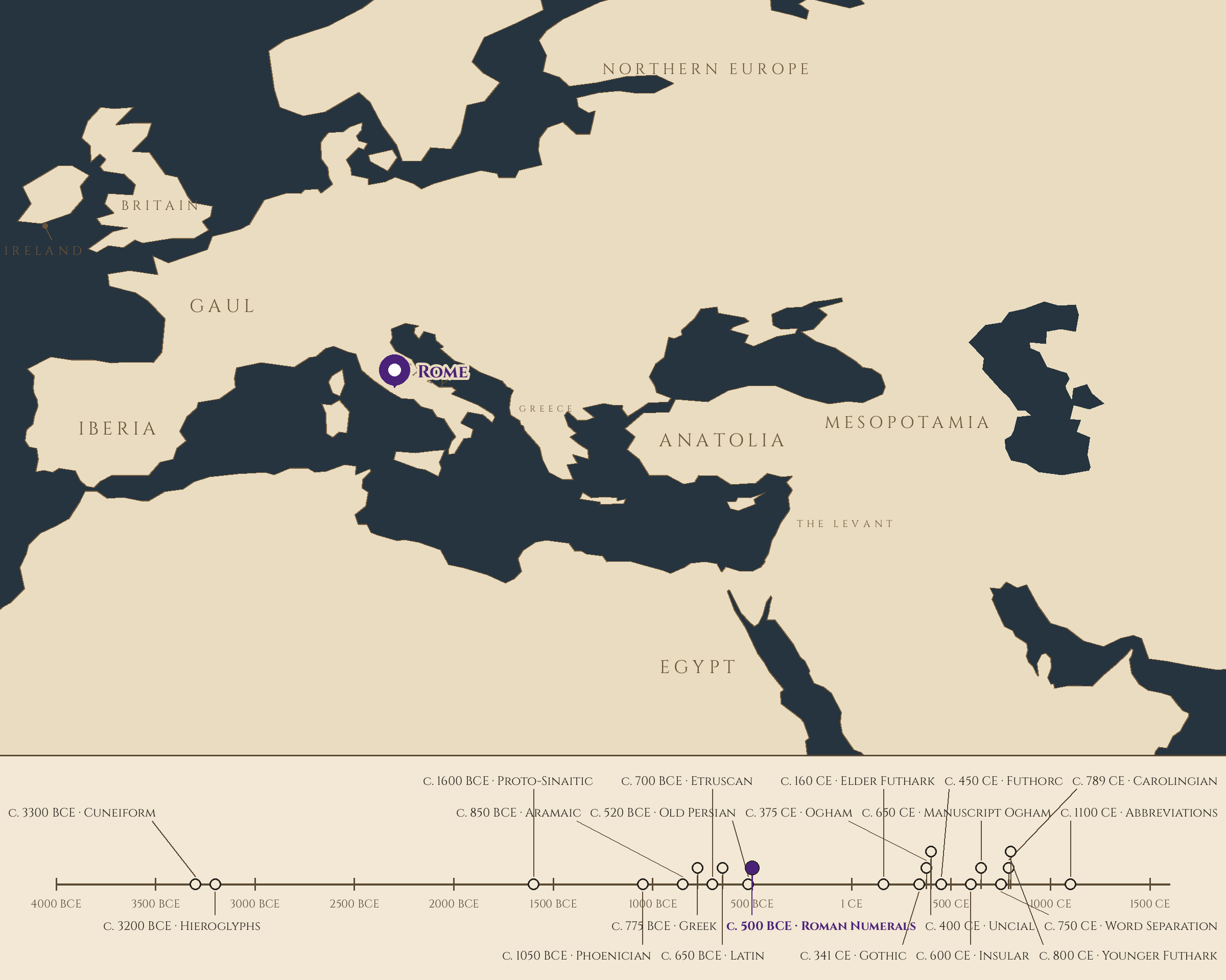
Where and when: Rome and the empire it counted, some two thousand years ago. The pin is this lesson. The line beneath the map is our road: every stop a writing system, every lesson a pin.
Lesson Objectives
By the end of this lesson, students should be able to:
- Define Roman numerals, additive notation, subtractive notation, interpunct, tally, place value, abacus, and uncia.
- Explain the Etruscan origins of the Roman numeral symbols and the tally-stick theory of their shapes.
- Identify the seven basic symbols, their values, and their Latin names.
- Read and write Roman numerals in the modern standardized form.
- Explain the difference between ancient Roman practice (IIII) and the modern subtractive convention (IV), and when the convention standardized.
- Explain what the system leaves out (zero, place value) and how Romans worked around those absences.
- Describe how Romans handled fractions through the uncia system.
- Trace the survival of Roman numerals into the modern world.
- Apply the course question to a system defined by what it omits.
Reading this lesson: ★ marks the passages to remember. They return on the unit quiz and the class test. Check in questions ask the material back as you go; answer them in your workbook when you meet them.
Working this lesson: Your assignment packet is the first download on this page. Work in it as the lesson moves along, answering each assignment as its subject is taught — or read the lesson through for your notes and take the assignments as homework afterward. Both are proper ways to sit this class. Signposts in the reading tell you where each assignment belongs. Written answers are short answers in your own words; a few honest lines are worth more than a filled page.
Your Assignment Packet
This lesson's assignments live in its packet: the Lexicon Handout (every term, course terms marked ◆), Materials, Guided Practice, the Assignment Manual with its answer key for self-checking, the Reflection Questions, and the Workbook Checklist. Download the packet before you begin and keep it beside you as you read.
The Borrowed Count
Let us begin with the correction that rearranges the whole lesson, because the most common story about where Roman numerals come from is only half the story.
The numerals were not invented by the Romans. Like the Latin alphabet itself, they were borrowed from the Etruscans, the people who ruled central Italy before Rome rose.
★ In the mid-first millennium BCE, the Etruscans used their own set of numeral symbols: 𐌠 for 1, 𐌡 for 5, 𐌢 for 10, and further signs for 50, 100, and 1000.
The early Romans took these symbols over, and the first Roman numerals for 1, 10, and 100 were simply the Etruscan ones, unchanged.
So where did the Etruscans get the shapes? Here the ground softens beneath us, and I want you to feel it soften, because this is what honest history feels like.
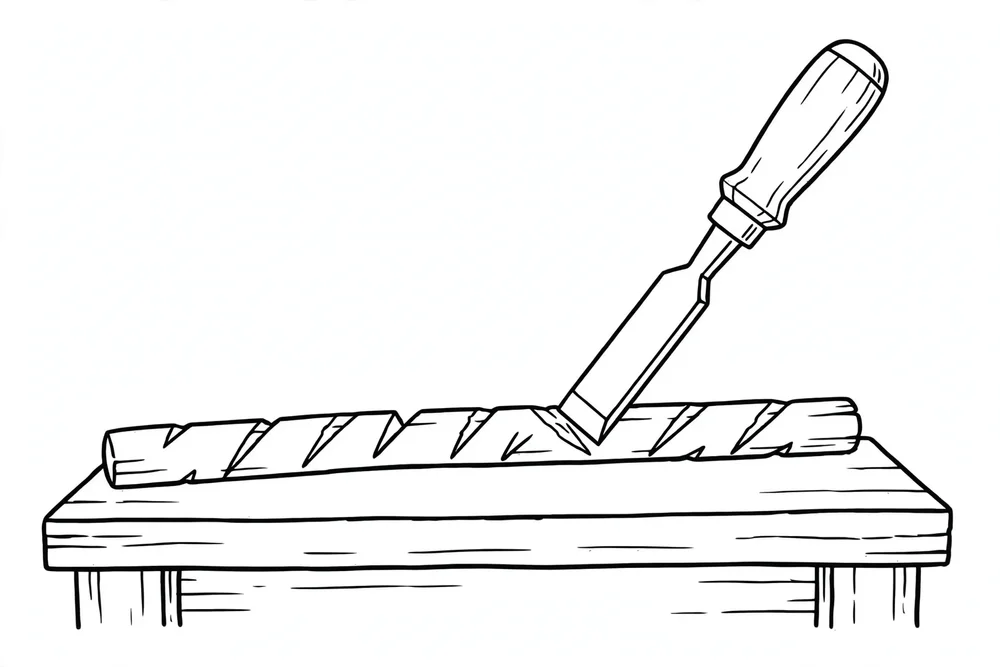
One leading theory, and a strong one, traces the symbols to tally sticks. Imagine a shepherd counting sheep, cutting a notch into a wooden staff for each animal.
Every fifth notch he cuts differently, a doubled or angled cut you can feel in the dark.
Every tenth notch he crosses. Run your thumb down such a stick and the pattern reads itself: IIIIΛIIIIX, four single notches, a marked fifth, four singles, a crossed tenth.
Transfer those marks to writing, and the single notch becomes I, the doubled fifth-notch becomes V (or its Etruscan ancestor 𐌡), the crossed tenth becomes X.
Shepherds in Italy and Dalmatia were still counting on notched sticks in the 1800s, which gives the theory a long, sturdy shadow.
★ But it is a theory, not a settled fact. Other scholars emphasize the Greek connection, noting that the Etruscans adapted their numerals from western Greek models.
What we can say with confidence is this: the shapes are older than Rome, they came through Etruria, and the tally tradition is the best story we have for why they look the way they do. Hold the theory lightly, the way you would hold a tally stick itself: firmly enough to use, loosely enough to feel the grain.
Now the individual symbols, each with its own small history. I tell you these as the current scholarly account, with the hedges left visible.
I is the tally notch, the Etruscan 𐌠, the simplest mark a counting hand can make. It never changed, because there was nothing to improve.
V comes from the Etruscan 𐌡. One elegant proposal, associated with the scholar Paul Kayser, holds that the intermediate symbols were made by halving the base ones: half of X is V, as half of the 100-sign became the 50-sign and half of the 1000-sign became D. You may also hear the folk etymology that V is an open hand, five fingers spread. It is a lovely image, and it may even be true, but scholars treat it as folk etymology: charming, unproven.
X is the Etruscan 𐌢, the crossed tenth notch. Two strokes crossing, ten counted. It, too, barely changed across three thousand years.
L, the 50, has the most traveled history of the small symbols. The Etruscan 𐌣 became an inverted-T shape (ↆ) in early Roman use, visible on a 2nd-century BCE milestone. By the time of Augustus it had flattened further, and Romans began writing it as L, the letter it resembled. The letter did not create the symbol; the symbol drifted until it looked like the letter, and then the letter adopted it.
★ C, the 100, began as the Etruscan 𐌟, passed through forms like Ↄ, and settled as C. It surely helped that C was the first letter of centum, the Latin word for hundred. Whether the resemblance caused the change or merely confirmed it, we cannot say. Either way, the letter and the number shook hands and never let go.
★ D, the 500, most likely came from halving: D is the right half of an old 1000-sign (IↃ, half of CIↃ), another of Kayser's halvings. An older account derives it instead from a boxed or circled V, a form that looked something like Þ, which drifted under the graphic influence of the letter D until it became D. Both paths end at the same letter.
★ M, the 1000, traveled furthest of all: from a circled or boxed X (forms like Ⓧ and ⊕), through Ψ and ↀ, bending through shapes like ∞, until the influence of mille, the Latin word for thousand, pulled it into the letter M.
Notice what this history tells you. These were not letters first. They were marks, notches, boxes, circles: a toolkit for counting that predates its alphabetization. The letters adopted them late, the way an empire adopts a useful province.
When you write MDCLXVI, you are writing tally marks that learned to wear the Latin alphabet as a uniform.
❦ In your workbook: record where the seven signs came from in your own way — copy, sketch, or note what matters.
Seven Signs, One Rule
Here is the system in its classical form, the seven signs with their Latin names. Say the names aloud; the Romans counted in words before they counted in signs, and the words are still beautiful.
★ I (unus), 1. V (quinque), 5. X (decem), 10. L (quinquaginta), 50. C (centum), 100. D (quingenti), 500. M (mille), 1000.
The rule of the system is additive notation — each sign's value added to the total, wherever it stands — and it is almost embarrassingly simple: write the signs from greatest to smallest, left to right, and add them up.
VI is 5 plus 1: 6. XV is 10 plus 5: 15. CLX is 100 plus 50 plus 10: 160. MDCLXVI is 1000 plus 500 plus 100 plus 50 plus 10 plus 5 plus 1: 1666.
Read a Roman number the way you would count coins spilling from a purse: biggest first, down to the smallest, and the total is the sum.
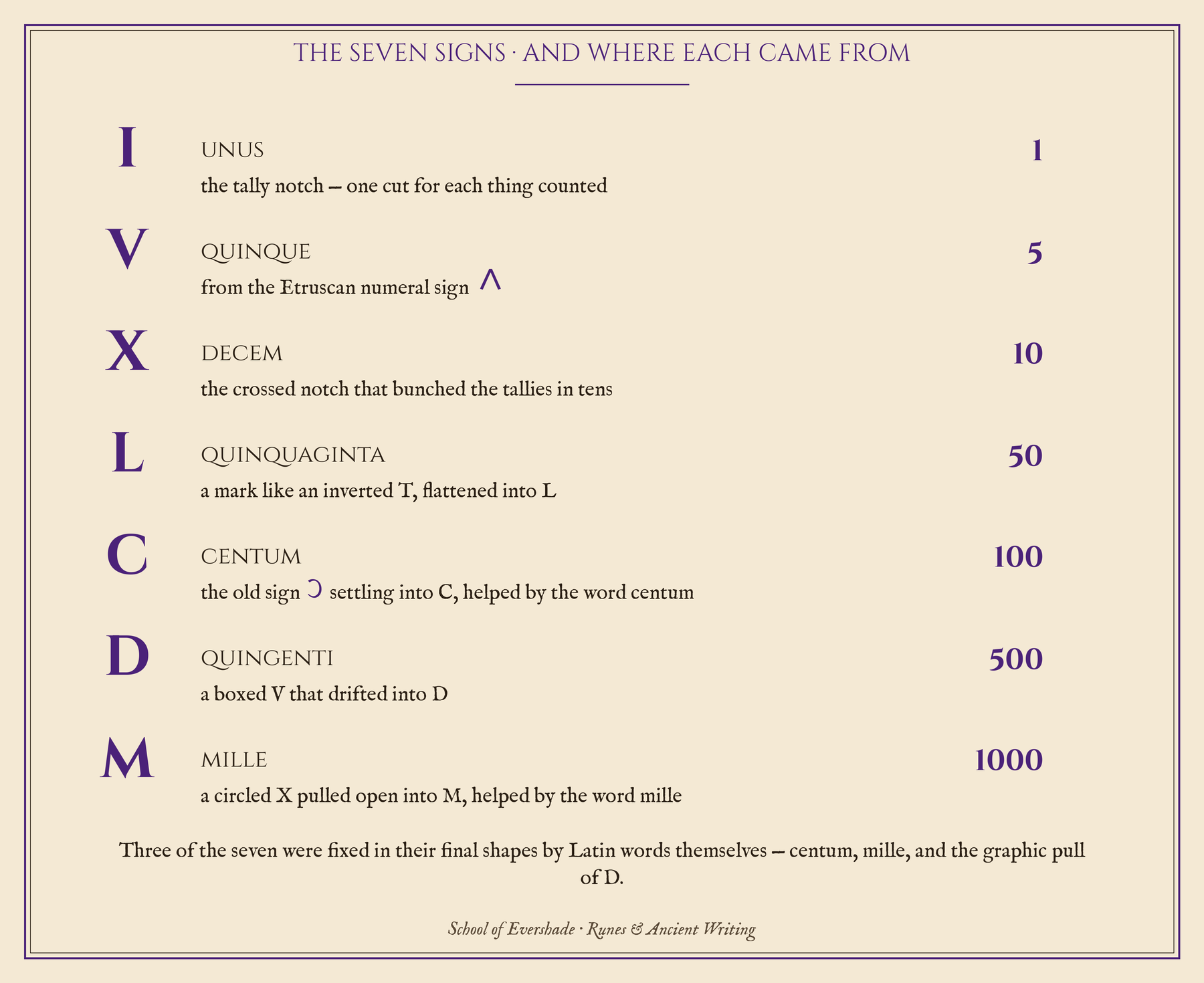
The seven signs of the Roman count, with their Latin names, their values, and the marks each one grew from.
Built for Evershade.
Practice the reading until it feels mechanical, because the Romans meant it to be mechanical.
MMCMXXVI: 1000, 1000, then the pair CM (we will come to pairs shortly), then XX, then VI. Work it slowly: 1000 + 1000 + 900 + 20 + 6 = 2926. XCIX: the pair XC, then the pair IX: 90 + 9 = 99. (One caution on notation: Roman carvers did not use the interpunct to group the parts of long numerals. Modern teachers sometimes borrow it as a reading aid, writing MM·CM·XX·VI, but that is a modern convenience, not ancient practice.)
★ You have just read numbers the way a Roman tax collector read them, and the tax collector would approve of your pace. Speed was never the point. Permanence was.
Check in: Read MDCLXVI as a sum, sign by sign. What is its value, and what is the single rule that produced it?
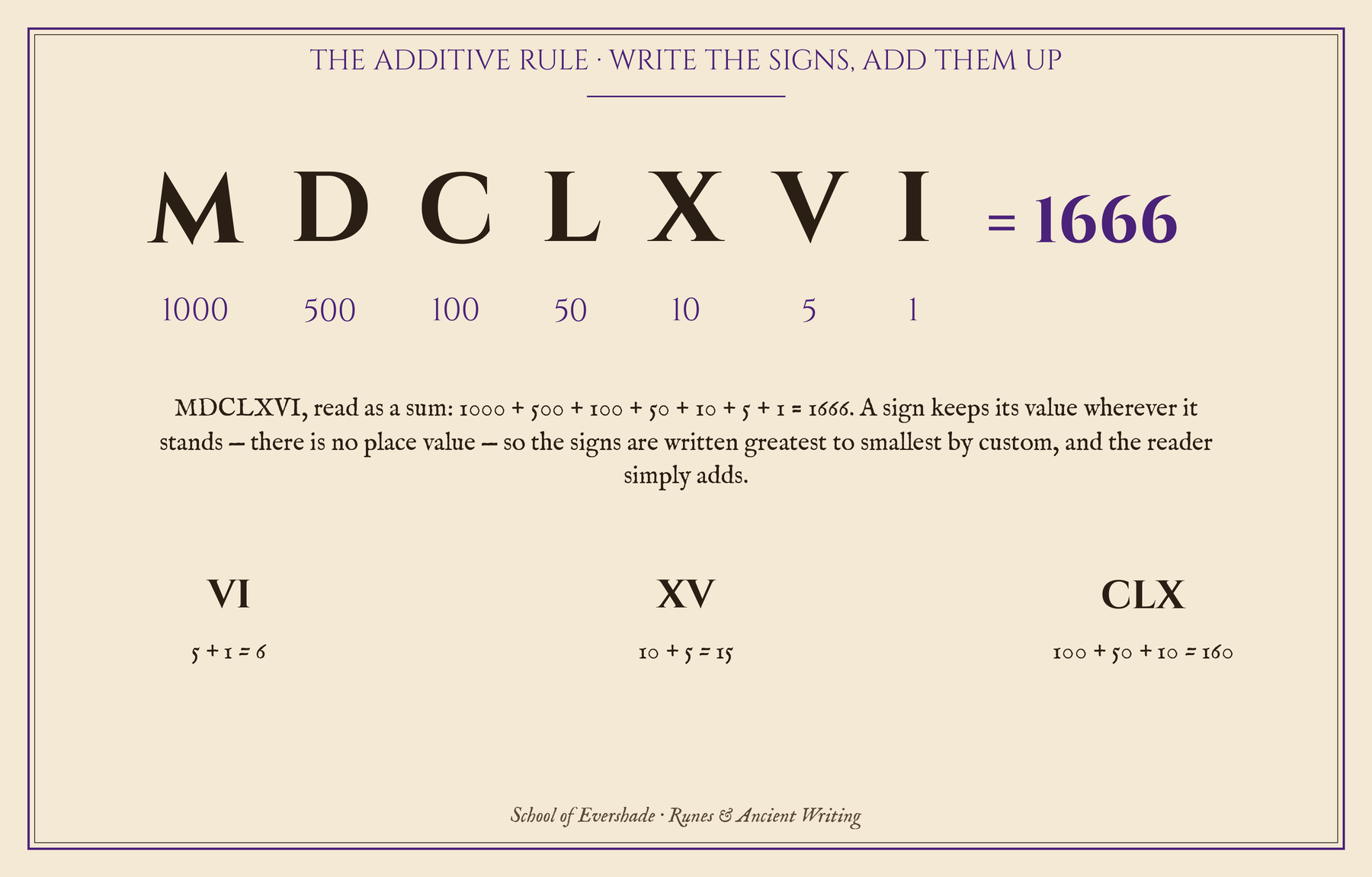
The additive rule at work on the lesson's own example: MDCLXVI is not read by place but by sum — every sign worth the same wherever it stands.
Built for Evershade.
❦ In your workbook: record the seven signs and the one rule in your own way — copy, sketch, or note what matters.
Professor Webblethorn
Scholars, pause here, because I am about to correct the single most common falsehood students bring to this lesson, and I want you watching.
You were taught, as I was, that the Romans wrote 4 as IV. It is in every textbook. It is neat, it is logical, and it is mostly wrong.
The ancient Romans wrote IIII. On monuments, on milestones, on the numbered gates of the Colosseum itself, where gate 44 is carved XLIIII, the four appears as four strokes, plain and unashamed. A study of dated Roman inscriptions found IIII used nearly twice as often as IV. The Romans did not avoid four identical strokes in a row. That rule is a modern textbook convention, invented long after Rome fell.
And here is the loveliest part: the Romans' habit never died. Look at a clock face, any traditional clock face, and find the 4. It reads IIII, not IV, on the great majority of clocks and watches made today. The clockmakers kept the Roman habit for two thousand years, whether they knew it or not. (Big Ben is the famous exception, and exceptions, as you know, are how I check that a rule is real.)
So when you see IIII on a clock, you are looking at a Roman carver's hand reaching across twenty centuries. The textbooks smoothed it into IV. The clocks remembered.
Keep this correction beside you for the rest of the lesson. We are about to meet the subtraction that the textbooks teach, and you will now know exactly what it is: a medieval improvement on a Roman habit, useful, elegant, and younger than the empire by a thousand years.
PROFESSOR THISTLELOOM WEBBLETHORN
Runes & Ancient Writing
Epigrapher, Head of House Septentrio
The Subtraction That Came Late
Now we can tell the true story of IV.
Subtractive notation, the trick of placing a smaller sign before a larger one to subtract it, existed in antiquity. Roman carvers used it now and then, irregularly, the way a busy writer abbreviates: XL for 40 appears on the Colosseum gates even while 44 is XLIIII.
It was a shortcut, not a system. Nobody enforced it, nobody taught it as a rule, and the same carver might use both forms on the same monument.
★ The regularized subtraction you learned in school, the tidy set of six pairs (IV, IX, XL, XC, CD, CM), is a medieval achievement. As the old Roman world became the medieval one, scribes copying manuscripts regularized what the carvers had done casually.
A teaching tradition dates the general adoption of the subtraction rule to the 13th century. By then the empire was eight hundred years gone, and its numerals were being systematized by people who had never seen a Roman tax collector.
The modern rules are worth learning precisely, because they are modern rules and they have edges:
First, only the "one" signs subtract: I, X, and C. The "five" signs (V, L, D) never subtract. You will never see VL or LD in correct modern form.
Second, the subtracted sign must be at least a tenth of the value it is taken from. I can precede V or X, but not L, C, D, or M. X can precede L or C, but not D or M. C can precede D or M.
★ Third, each power of ten is handled separately. This is why 99 is XCIX (XC for the tens, IX for the ones) and never IC. The pair IC breaks the second rule and the third at once; it is the classic student's error, and now you know exactly which rules it breaks.
The medievals added their own habits too. Once lowercase letters existed, numerals went lowercase as well: vi for 6, cxxii for 122.
Scribes sometimes wrote a final j instead of i (vij for 7), a flourish that survived into early modern medical prescriptions. The system kept evolving long after Rome, which is precisely why we must not mistake the modern form for the ancient one.
So here is the honest timeline, and I want you to hold all three layers at once. The Romans invented neither the symbols (borrowed from Etruria) nor the neat subtraction (regularized in the Middle Ages).
What they did was use the borrowed, irregular system to run an empire for half a millennium. The tool was rough. The hands were steady.
Check in: Why is IC not a valid way to write 99? State the two rules it breaks, and write 99 correctly.
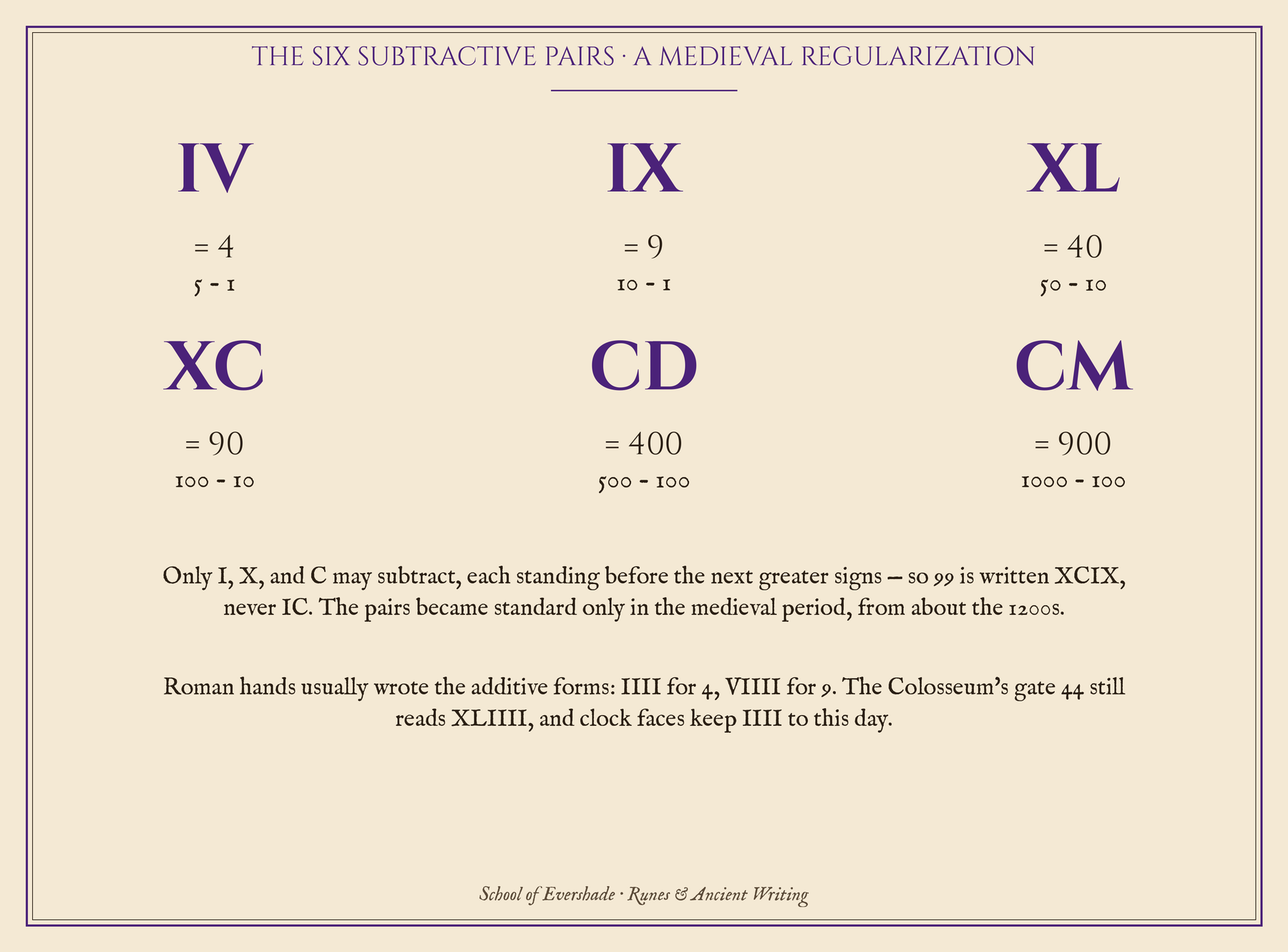
The six subtractive pairs — and the honest label on them: a medieval regularization. The Romans of the Empire usually wrote IIII and VIIII instead.
Built for Evershade.
❦ In your workbook: record the subtraction that came late in your own way — copy, sketch, or note what matters.
In your packet: Assignment II — Reading and Writing Practice ⚒ begins here. Work it now, or mark the place and take it as homework — your choice.
What Zero Cost
Now the course question, asked at full strength: what did the Romans leave out?
★ Two things, and they are large. The system has no zero, and it has no place value. Every sign always means the same amount, wherever it stands. There is no sign for nothing, and no position that multiplies.
Consider what this costs. In our numerals, 505 and 55 differ by a zero holding a place; the zero does silent structural work.
In Roman numerals, there is no silent work. Everything must be said aloud in signs: D for 500, V for 5, and nothing between them but air.
Large numbers become long processions: 1999 in strict ancient additive form is MDCCCCLXXXXVIIII, sixteen signs marching in a row. Even in modern subtractive form it is MCMXCIX, still seven signs for four digits.
And arithmetic, the thing numbers are for, is nearly impossible on the page. Try adding XVII and XXIV in your head using only the signs, and you will feel the system resist.
★ The Romans felt it too, which is why they did not do it. They calculated on the abacus, the counting board with its sliding counters, and used the written numerals the way we use a printed receipt: to record the result, not to find it.
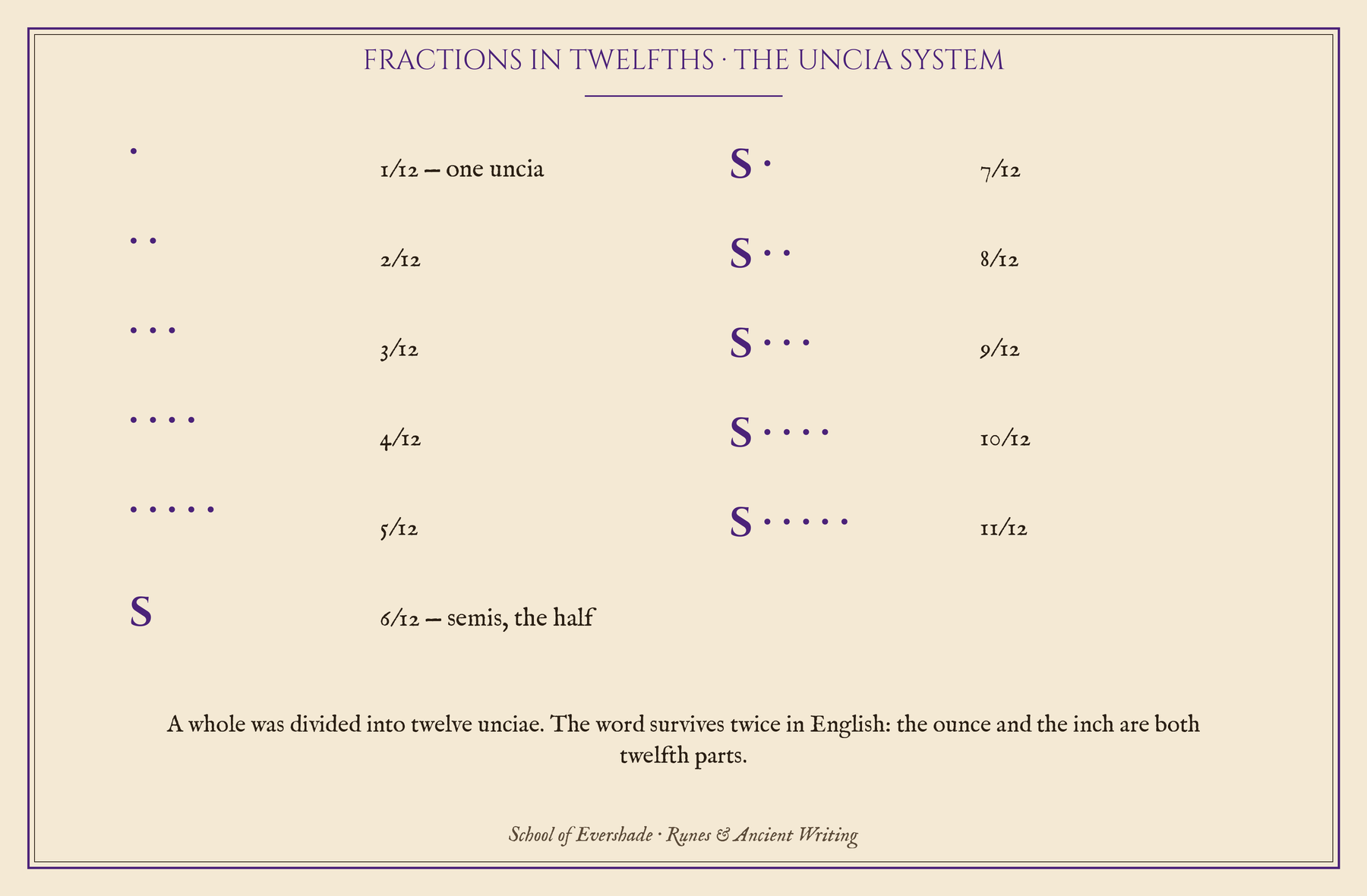
Fractions in twelfths: dots for the unciae, S for the semis. The empire that had no zero could still divide a pound into twelve exact parts — and left us the ounce and the inch.
Built for Evershade.
The division of labor is the whole secret. The board did the thinking; the signs did the remembering.
An empire's accounts ran perfectly well on this arrangement for five hundred years, which tells you something important: a system's weakness only matters if you ask it to do the weak thing. The Romans never asked their numerals to calculate. They asked them to record, to label, to commemorate, and at those tasks the numerals were superb.
★ But before you conclude that the Romans left out everything subtle, let me show you what they kept: fractions. The Romans divided wholes into twelfths, and they had a complete notation for it. A single dot (·) marked one uncia, a twelfth. Two to five dots marked two to five twelfths. The letter S, for semis (half), marked six twelfths. S with dots marked seven through eleven.
This was the language of merchants dividing goods, of cooks measuring, of money changers weighing bronze.
The uncia is the direct ancestor of two English words you use without thinking: the ounce and the inch, both twelfth-part measures. The empire that had no zero could still divide a pound into twelve exact parts and name every one.
So the final accounting of what was left out, stated with the care it deserves: zero and place value were omitted, and written arithmetic with them.
Fractions, order, and record-keeping were kept, and they were enough for everything Rome asked of them. The system was not primitive. It was specialized, the way a chisel is specialized: useless for sawing, perfect for carving.
The question was never whether the numerals could do everything. It was whether they could do what Rome needed. For half a millennium, the answer was yes.
Check in: The system has no zero and no place value. When a Roman actually had to calculate, what did the work, and what were the written signs for?
❦ In your workbook: record what the missing zero cost, and what the Romans kept in your own way — copy, sketch, or note what matters.
In your packet: Assignment IV — The Missing Zero Essay ✎ begins here. Work it now, or mark the place and take it as homework — your choice.
The Survival
Rome fell. The numerals did not.
When the western empire dissolved in the 5th century CE, its numerals passed into the keeping of the institutions that outlived it: the monasteries, the law courts, the church. Monks copying manuscripts used Roman numerals for chapter numbers and dates. Lawyers used them for the numbered clauses of legal documents, a habit that survives in the outlines and statutes of today.
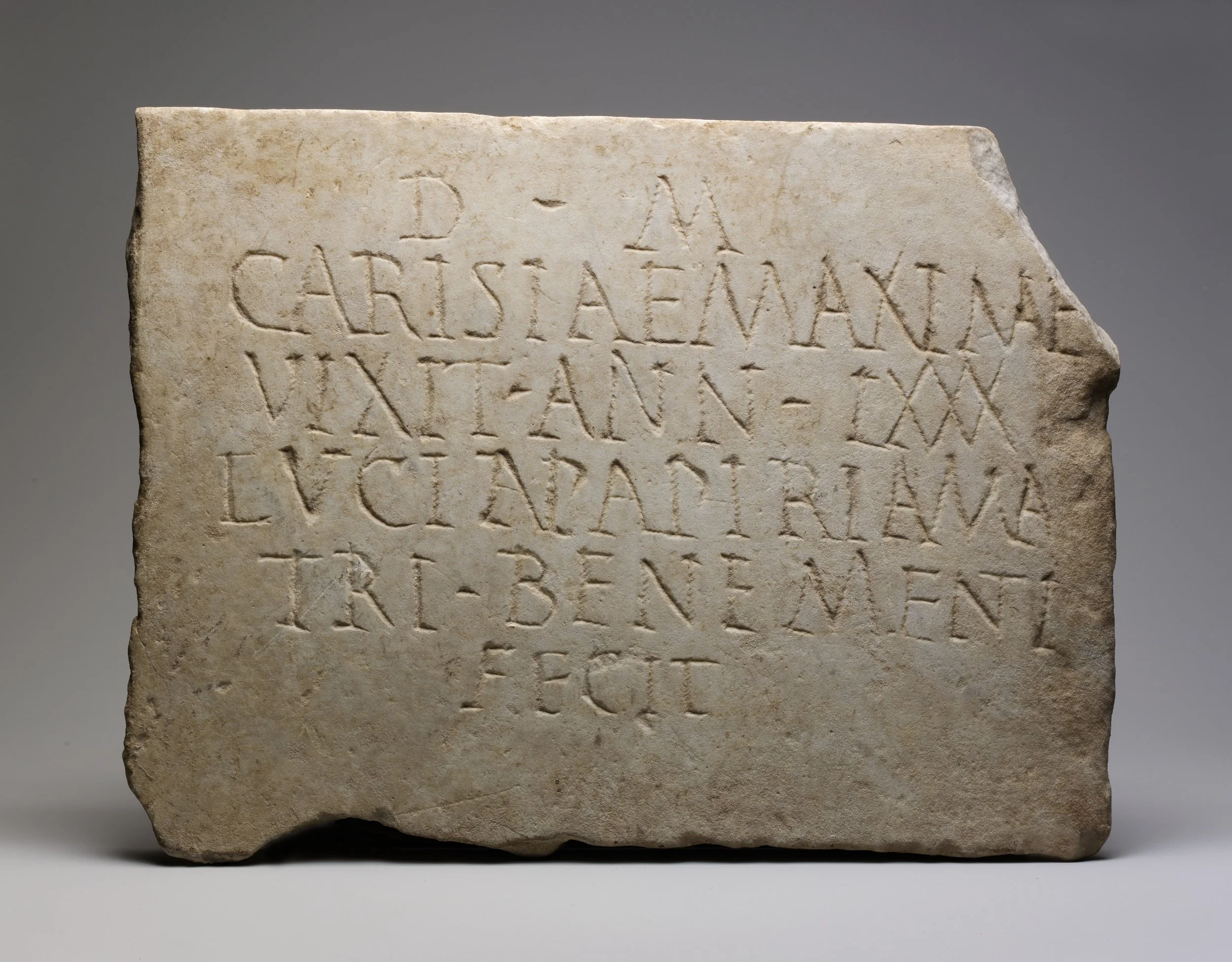
Historical example. Numerals where Rome put them: on stone, to be read for centuries. VIXIT ANN LXX — “she lived 70 years” — carved on a marble funerary inscription of the 2nd–3rd century CE.
Marble funerary inscription, Roman, 2nd–3rd century CE. The Metropolitan Museum of Art, New York (X.248.4). Public domain, The Met Open Access.
The numerals became the handwriting of permanence: whatever a culture wanted to look timeless, it wrote in Roman signs.
★ That is why they are still everywhere, once you learn to see them. Clock faces, where IIII keeps the Roman habit alive on millions of wrists and walls. Book chapters and prefaces, where the front matter of a book is still numbered i, ii, iii, iv, in lowercase medieval style.
Monarchs and popes: Elizabeth II, Louis XIV, Benedict XVI, the numbering of rulers unbroken since Rome. Cornerstones and monuments, where a building's birth year is carved in signs meant to outlast the building. Film credits, where the copyright date still appears in Roman numerals at the end of movies. The Super Bowl, which numbers its games in Roman numerals as a deliberate gesture toward grandeur (this year's game would be LX, for 60).
Each survival has the same logic.
Our everyday numerals are for calculating; the Roman numerals are for declaring. When something must look official, ceremonial, or permanent, we reach for the signs that labeled the Colosseum. The empire ended. Its way of writing importance did not.
And that is where our lesson closes: with seven borrowed signs, no zero, no place value, still at work in the world sixteen centuries after the last Roman tax collector closed his books.
The course question has never had a better answer. What can be left out and still be understood? A great deal, it turns out, if the hands that use the system are steady and the purposes are clear.
❦ In your workbook: record how the seven signs survived in your own way — copy, sketch, or note what matters.
In your packet: Assignment III — The Clock Investigation ◐ begins here. Work it now, or mark the place and take it as homework — your choice.
Guided Practice — The Counter's Hand
Before the assignments, train your hand the way a Roman student would: with the signs themselves, and with the board that did the real work.
Exercise A — Drawing the Seven
- On paper, draw the seven numeral signs as inscriptional capitals: I, V, X, L, C, D, M. Make them large and deliberate, the way a stone carver would.
- Label each with its Latin name (unus, quinque, decem, quinquaginta, centum, quingenti, mille) and its value.
- Beside each, note its origin in a phrase: tally notch (I), Etruscan 𐌡 (V), crossed tenth notch (X), inverted T flattened to L, Ↄ settled to C (helped by centum), halved IↃ settled to D, circled X pulled into M (helped by mille).
- Circle the three signs whose final forms were helped by Latin words (centum, mille, and the graphic pull of D). These are the signs where the alphabet reached back and reshaped the counting marks.
❦ Workbook path: make this a permanent workbook page instead of loose paper: draw the seven in your workbook as the reference page for every numeral exercise that follows.
Exercise B — Reading Drill
Read the following numerals and write their values. Work left to right, greatest to smallest, adding as you go. Then check yourself against the answer key.
- MCMLXXVIII
- DCCCXCIV
- CDXLIV
- MMXXVI
- XCIX
Write each answer as a sum (for example, "M + CM + LXX + VIII = 1000 + 900 + 70 + 8 = 1978") so your method is visible.
Exercise C — The Board and the Signs
- Draw a simple counting board on paper: seven columns labeled I, V, X, L, C, D, M. Place dried beans, coins, or pebbles as counters.
- Represent the number 47 on your board (XXXXVII in ancient additive style, or XLVII in modern style; try both). Then represent 58. Now combine the counters and read the total: what do you get, and which style made the combining easier?
- Write two to three sentences on what this reveals about the Roman division of labor: the board calculates, the signs record. Which half of the partnership does our modern system combine into one?
This exercise teaches, in your own hands, why the absence of place value was a problem the Romans solved with wood and pebbles rather than with better signs.
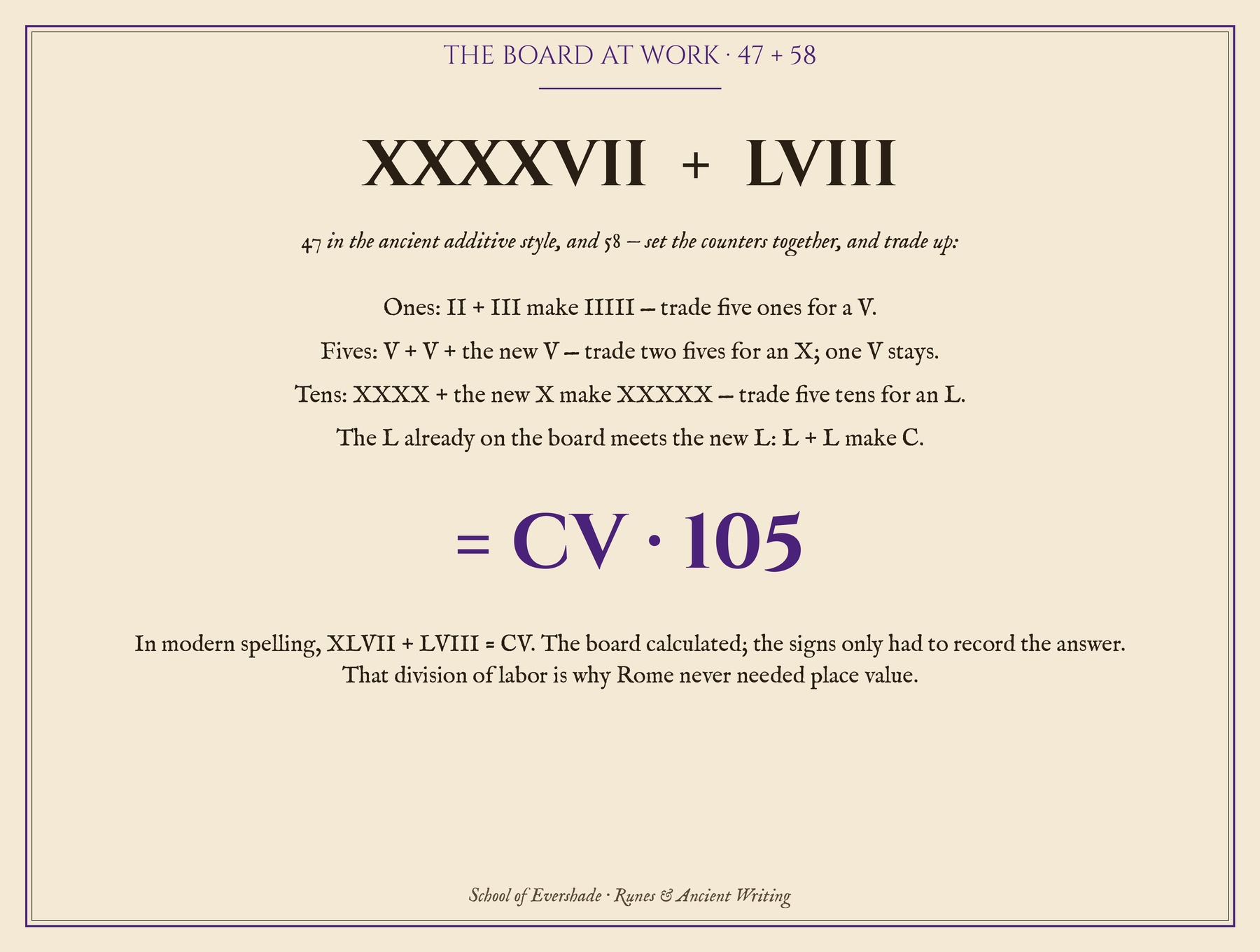
Guided Practice Exercise C, worked on the board: 47 and 58 set together, the counters traded up — ones to a five, fives to a ten, tens to an L — until the board reads CV.
Built for Evershade.
In your packet: Assignment I — The Numeral Chart ⚒ begins here. Work it now, or mark the place and take it as homework — your choice.
Professor Webblethorn
Scholars, pause here, because I am about to correct the single most common falsehood students bring to this lesson, and I want you watching.
You were taught, as I was, that the Romans wrote 4 as IV. It is in every textbook. It is neat, it is logical, and it is mostly wrong.
The ancient Romans wrote IIII. On monuments, on milestones, on the numbered gates of the Colosseum itself, where gate 44 is carved XLIIII, the four appears as four strokes, plain and unashamed. A study of dated Roman inscriptions found IIII used nearly twice as often as IV. The Romans did not avoid four identical strokes in a row. That rule is a modern textbook convention, invented long after Rome fell.
And here is the loveliest part: the Romans' habit never died. Look at a clock face, any traditional clock face, and find the 4. It reads IIII, not IV, on the great majority of clocks and watches made today. The clockmakers kept the Roman habit for two thousand years, whether they knew it or not. (Big Ben is the famous exception, and exceptions, as you know, are how I check that a rule is real.)
So when you see IIII on a clock, you are looking at a Roman carver's hand reaching across twenty centuries. The textbooks smoothed it into IV. The clocks remembered.
Keep this correction beside you for the rest of the lesson. We are about to meet the subtraction that the textbooks teach, and you will now know exactly what it is: a medieval improvement on a Roman habit, useful, elegant, and younger than the empire by a thousand years.
PROFESSOR THISTLELOOM WEBBLETHORN
Runes & Ancient Writing
Epigrapher, Head of House Septentrio
Assignment Manual
Assignment key: ✎ written work · ⚒ hands-on practical · ◐ both · ★ will be on the test · ❦ workbook path
Written answers in this manual are short answers in your own words — a few honest lines, not a filled page.
Assignment I — The Numeral Chart ⚒ ★
Objective: Demonstrate control of the seven numeral signs, their values, names, and origins.
Instructions:
- On a fresh sheet, create a four-column chart: numeral sign (drawn), Latin name and value, Etruscan ancestor or earliest form, note on how it reached its final shape.
- Complete all seven rows. For C, D, and M, explain the role of the Latin words or letterforms in fixing the final shape.
- Below the chart, write one paragraph on the tally-stick theory: what it explains well, and why scholars still call it a theory rather than a fact.
Your keepsake: keep this chart beside your Latin alphabet in your scribe's portfolio: the same seven letters, doing their second job.
❦ Workbook path: build the chart across two facing workbook pages instead of a loose sheet: one row per sign, with its tally ancestry sketched beside it.
To submit: Photograph or scan your chart. Accuracy of the origins matters more than artistic skill.
Assignment II — Reading and Writing Practice ⚒ ★
Objective: Read and write Roman numerals fluently in the modern standardized form, and recognize the ancient additive style.
Part A — Reading. Convert each numeral to its value, showing your addition step by step:
- MCMLXXVIII
- DCCCXCIV
- CDXLIV
- MMXXVI
- XCIX
Part B — Writing. Write each number in modern standardized Roman numerals:
- 1776
- 1492
- 44
- 2024
- 400
- 99
Part C — The ancient hand. The Romans of the Republic would have written these numbers differently. Rewrite each in ancient additive style (using IIII for 4, VIIII for 9, XXXX for 40, LXXXX for 90, CCCC for 400, DCCCC for 900):
- 4
- 9
- 40
- 90
- 400
- 900
Then write three to four sentences comparing the two styles: which is faster to write, which is easier to read back, and why do you think the medievals preferred the subtractive form?
Assignment III — The Clock Investigation ◐ ★
Objective: Observe the survival of Roman numeral habits in the modern world.
Instructions:
- Find three clock or watch faces that use Roman numerals (photographs, shop displays, or your own home). Record how each one writes the 4: IIII or IV.
- Research the two most common explanations for the clock-face IIII: the Roman-habit explanation from this lesson, and the visual-balance explanation (that IIII balances VIII on the opposite side of the dial). Write a half page weighing the two: which does the evidence in this lesson support, and what would you need to check to decide?
- Big Ben's clock face uses IV, not IIII. Write a short paragraph on what an exception proves: does one famous IV weaken the claim that IIII is the traditional form, or strengthen it? Defend your answer.
Assignment IV — The Missing Zero Essay ✎ ★
Objective: Evaluate what a numeral system gains and loses by its omissions.
Instructions:
Write a one-page essay addressing the following:
Roman numerals have no zero and no place value, yet they ran an empire's accounts for five centuries. The Hindu-Arabic numerals we use today have both. First, explain concretely what each omission costs: choose one specific task (such as multiplying two large numbers, or writing a number like 505) and show how the Roman system handles it versus the modern one. Then consider the Roman workaround: the abacus did the calculating while the signs did the recording. Is that division of labor a weakness of the system, or a reasonable engineering choice? Finally, apply the course question: what did the Romans leave out, what did they keep, and was it enough?
Cite at least two specific details from the lessons in your argument.
Materials
Required (Level One — household items)
- Paper: plain white paper or a sketchbook, for numeral practice and chart work.
- Pens: one standard pen for drafting, one fine-tipped marker for final numeral forms. Roman numerals are inscriptional capitals; a firm marker approximates the carved stroke.
- A ruler: for chart columns and for drawing the counting board in Exercise C.
- Counters: dried beans, coins, or pebbles, for the abacus exercise. About thirty small identical objects is plenty.
- A printout of the seven signs: use the References below for a standard chart, or copy the one from this lesson.
Suggested (Level Two — historically closer materials)
- A wax tablet and stylus: Roman schoolboys learned their letters and numbers on wax tablets, smoothing the surface to erase. A wooden frame filled with modeling wax and a pointed stick gives the authentic schoolroom experience.
- Papyrus paper: for the administrative feel. Roman record keepers wrote accounts on papyrus; practicing numerals on it connects the signs to their working context.
- A wooden counting board: a flat board with columns marked I through M, used with pebbles (calculi, the Latin word that gives us "calculate"). This is the closest approximation of the Roman abacus a student can build at home.
- A flat brush and dark paint: Roman stone inscriptions were laid out in paint before carving. Brushing the numerals first approximates the mason's method and teaches the inscriptional letterforms.
Neither level requires
Purchased kits, specialty tools, or any material you cannot find locally or order inexpensively. The core lesson (reading and writing numerals, understanding the system's structure, practicing on the counting board) is fully achievable with paper, pen, and beans.
Reflection Questions
Answer the following in your workbook.
- From which people did the Romans borrow their numeral symbols, and in roughly what period? What is the tally-stick theory of the symbols' shapes, and why is it called a theory?
- Name the seven numeral signs with their Latin names and values. Which three had their final forms influenced by Latin words or letterforms?
- What is the difference between additive and subtractive notation? Give one example of each.
- How did ancient Roman practice differ from the modern textbook convention for writing 4? When was the subtractive convention standardized, and what evidence survives of the ancient habit?
- What are the three modern rules of subtractive notation? Explain why IC is not a valid way to write 99.
- The system has no zero and no place value. What did each omission cost, and how did the Romans work around the absences? What did they keep that modern students might not expect?
- Apply the course question: what did the Roman numerals leave out, what did they keep, and was it enough?
Workbook Checklist — Lesson 10
In my workbook I have:
- ☐ defined additive notation, subtractive notation, tally, place value, abacus, and uncia
- ☐ explained the Etruscan origins of the Roman numeral symbols and the tally-stick theory of their shapes
- ☐ identified the seven basic symbols, with their values and their Latin names
- ☐ read and written Roman numerals in the modern standardized form
- ☐ explained the difference between ancient Roman practice (IIII) and the modern subtractive convention (IV), and when the convention standardized
- ☐ explained what the system leaves out (zero, place value) and how the Romans worked around those absences
- ☐ described how the Romans handled fractions through the uncia system
- ☐ traced the survival of Roman numerals into the modern world
- ☐ applied the course question to a system defined by what it omits
☐ Lesson completed Date: ____________ Signature: ____________
Professor's Review
And so our tenth lesson closes in the counting house, where seven borrowed signs did the work of an empire.
You can now explain how the Romans adapted their numerals from the Etruscans and what the tally-stick theory claims, identify the seven signs with their Latin names and trace each to its earliest form, read and write numerals in the modern standardized system, explain why IIII is the ancient form and IV the medieval regularization, state the rules of subtractive notation and spot its violations, describe what the absence of zero and place value cost and how the abacus and the unciae compensated, and trace the numerals' survival into clocks, chapters, and cornerstones.
Keep your numeral chart beside your Latin alphabet from last lesson. They are the same letters, doing two different jobs: one for language, one for number.
The Romans never invented a separate set of digit signs the way we have. They looked at their alphabet, took seven letters, and said: these will count.
Next, we leave the Mediterranean for the north, where Germanic peoples took the alphabet into the cold and carved it into wood and stone: the runes themselves, the Elder Futhark, the script this whole course is named for.
We have spent nine lessons walking toward the runes. They are finally in sight.
Practice your numerals, scholars. Write the year on your work the Roman way (this year is MMXXVI), and feel how the signs slow you down.
That slowness is not a flaw. It is the texture of permanence, and the Romans chose it on purpose.
I have watched empires count in my years among the inscriptions, and the counting always reveals the counters. Rome counted to last.
PROFESSOR THISTLELOOM WEBBLETHORN
Runes & Ancient Writing
Epigrapher, Head of House Septentrio
Cross-Class Connections
The numeral signs are Latin inscriptional capitals, which connects directly with Scrollwork, where Professor Nocturne teaches the Roman capitals and the mason's craft. Students studying both classes should compare the numeral forms here with the inscriptional alphabet: they are the same letters, cut by the same tools, serving language in one class and number in this one.
The uncia and the duodecimal fractions connect with Potions, where Professor Muddlenook's historical measures descend from Roman weights. The ounce in his recipes is the uncia of this lesson, twelve to the pound, still measuring after two thousand years. Students who weigh ingredients are using a Roman fraction every time.
The counting board connects with Creative Arts, where Professor Timberclank's built objects include tools as well as artworks. The abacus is a machine for thinking, and building one from wood and pebbles is a craft project in the oldest sense: making the thing that makes the work possible.
In Other Classrooms
Scrollwork · Unit IV, Lesson 14 — Roman Capitals

You are counting in capitals this week; I can teach you to write them as the masons did. In the Library the Roman capitals are drawn from their geometry, brush first and chisel after, twenty-three letters in four families of width. Come and cut a few in practice, and your numerals will never look accidental again.
Potions · Unit I, Lesson 6 — Apothecary Weights & Measures

In good order, scholars: the ounce on my bench is the uncia on your counting board, twelve to the pound, and it has kept its value for two thousand years. In the Laboratory we weigh as the apothecaries weighed, in grains, scruples, drams, and ounces, read true on a beam balance. Come and put your Roman fractions to work where they never retired.
Creative Arts · Unit VI, Lesson 24 — Counting Boards & Thinking Tools

A counting board is a machine for thinking, and machines for thinking can be built. In the Workshop we make counting boards and thinking tools from honest materials, measured twice and joined to last. Come and build the board your Roman merchants reckoned on, and reckon on it afterward.
The numbers endure, and so do we.
References & Further Reading
The British Museum. Collection online. Searchable collection including Roman inscriptions, milestones, and everyday objects bearing numerals. https://www.britishmuseum.org/collection
The Metropolitan Museum of Art. Heilbrunn Timeline of Art History, "The Roman Empire." Museum essays on Roman administration, art, and daily life. https://www.metmuseum.org/toah/hd/roman/hd_roman.htm
Wikipedia. "Roman numerals." Comprehensive overview: the seven symbols, Etruscan origins, additive and subtractive notation, and modern survivals. Includes the Colosseum gate evidence and the medieval standardization of subtractive forms. https://en.wikipedia.org/wiki/Roman_numerals
Wikipedia. "Etruscan numerals." The Etruscan symbol set (𐌠, 𐌡, 𐌢, and others) from which the Roman numerals were adapted. https://en.wikipedia.org/wiki/Etruscan_numerals
Wikipedia. "Roman abacus." The counting board the Romans used for arithmetic, including its fractional columns for unciae. https://en.wikipedia.org/wiki/Roman_abacus
Sam Houston State University. "What does IIII mean?" The Roman-Britain inscription study finding IIII preferred over IV, and the clock-face tradition. https://todayatsam.shsu.edu/T@S/2005/WhatIIII.html
The Watch Pages. "Why do clocks and watches use the Roman numeral IIII instead of IV?" The horological tradition of IIII dials and its possible explanations. https://www.thewatchpages.com/why-do-clocks-and-watches-use-the-roman-numeral-iiii-instead-of-iv
Wikipedia. "Ancient Roman units of measurement." The uncia, semis, and the duodecimal fraction system behind Roman weights and coinage. https://en.wikipedia.org/wiki/Ancient_Roman_units_of_measurement
Browse the Runes shelf in the school Library for readable editions of these works.
THE UNIT III QUIZ
RUNES & ANCIENT WRITING · UNIT III: THE MEDITERRANEAN MASTERS · LESSONS 7–10
Unit III is complete: the Greeks have written the vowels down, the Etruscans have remade the letters in their own image, and Rome has carved them into stone and counted an empire with them. This quiz gathers the whole unit, all four lessons, into one sitting. Take it from memory first, before you look back at your notes, because it measures what has stayed with you. If you completed the assignments marked ★ in your lesson packets, you have already practiced most of what it asks.
The quiz packet is a single download. Part I gathers questions from every lesson in the unit, Part II matches the unit's vocabulary, and the answer key waits at the back for self-checking. When you have finished, score it honestly, note the result in your workbook, and revisit any lesson whose questions went wrong before you move on to Unit IV.
Submit your work for this lesson using the form below.
CONTINUE IN RUNES & ANCIENT WRITING
← Previous · Lesson 9: Classical Latin: The Letters That Outlasted an Empire Next · Lesson 11: Elder Futhark: How the Alphabet Learned the Knife →
Unit III · The Mediterranean Masters Runes & Ancient Writing Classroom · All 21 Lessons
The rest of Unit III: Lesson 7 · Ancient Greek · Lesson 8 · Etruscan · Lesson 9 · Classical Latin
From the Runes Shelf
The printed companions to this lesson, from Professor Webblethorn’s shelf in the shop.