

POTIONS
Unit I · Lesson 6APOTHECARY WEIGHTS & MEASURES
Professor Crimblebrew Muddlenook
Master Apothecary • Potions
Head of House Meridies • School of Evershade
Professor's Introduction

Welcome to the bench of honest measure, scholars. You have a laboratory now: zoned, shelved, labeled, and stocked. Next lesson you will learn to grind. But before any blade touches any leaf, we settle something more important, and we settle it first the way apothecaries always have.
In this laboratory, nothing is "a pinch" and nothing is "a handful." Every material is weighed or measured, and every measurement is written down. That is not fussiness. It is the whole craft. A cook who doubles the salt ruins supper. An apothecary who doubles a strong botanical ruins far more than supper. Precision is the respect the materials are owed, and the safety the scholar is owed.
So today we learn the old systems of weight and measure: the grain and the scruple, the dram and the ounce, the two different pounds of England, and the little ladder of liquid measures from the minim to the pint. You will meet the beam balance, learn to tare a scale the way professionals do, and fill the first honest page of your laboratory numbers.
Order matters, scholars. We measure first, and we grind after.
— Professor Crimblebrew Muddlenook, Potions Laboratory • Master Apothecary • Head of House Meridies

Pin: LONDON. Timeline stop: 1809 · THE MINIM STANDARDIZED.
Lesson Objectives
By the end of this lesson, you will be able to:
- Name the five weight units of the apothecaries' system (grain, scruple, dram, ounce, pound) and state how each relates to the next.
- Explain the difference between troy weight and avoirdupois weight, and why apothecaries kept a system of their own.
- Name the four volume units of the apothecaries' system (minim, fluid dram, fluid ounce, pint) and state their relationships.
- Read the old prescription symbols and explain why Roman numerals stand beside them.
- Demonstrate tare weighing on a kitchen scale and describe how a beam balance finds a true weight.
- Convert between apothecaries' units and grams or milliliters using a reference table.
- Record a clean, complete measurement log as an archive entry.
Reading this lesson: ★ marks the passages to remember. They return on the unit quiz and the class test. Check in questions ask the material back as you go; answer them in your workbook when you meet them.
Working this lesson: Your assignment packet is the first download on this page. Work in it as the lesson moves along, answering each exercise as its subject is taught — or read the lesson through for your notes and take the exercises as homework afterward. Both are proper ways to sit this class. Signposts in the reading tell you where each exercise belongs. Written answers are short answers in your own words; a few honest lines are worth more than a filled page.
Your Assignment Packet
This lesson's exercises live in its packet: the Lexicon Handout (every term, course terms marked ◆), Materials, Guided Practice, the Assignment Manual with its answer key for self-checking, the Reflection Questions, and the Workbook Checklist. Download the packet before you begin and keep it beside you as you read.
Safety Briefing
- Nothing measured today is tasted. Rice, salt, water, and oil are laboratory materials today, not food. Measuring is not eating, and this rule has no exceptions.
- Younger scholars work with an adult present. The adult reads this briefing too, and stays for the practical work.
- Keep the balance dry and level. Water and precision instruments are poor company. Wipe up spills at once, and never set a wet vessel on a scale pan.
- Glass with care. If you use a glass measuring vessel, carry it with two hands and set it down gently. A chipped or cracked vessel retires from service.
- Oil on floors is a fall hazard. Wipe drips the moment they happen and keep paper towels within reach.
- No dosages, no medicinal claims. This lesson teaches measurement, not medicine. Every amount in this lesson describes study materials only.
❦ In your workbook: record the safety briefing in your own way — nothing tasted, an adult present, a dry and level balance, glass with care, oil wiped at once — copy, sketch, or note what matters.
Mise en Place
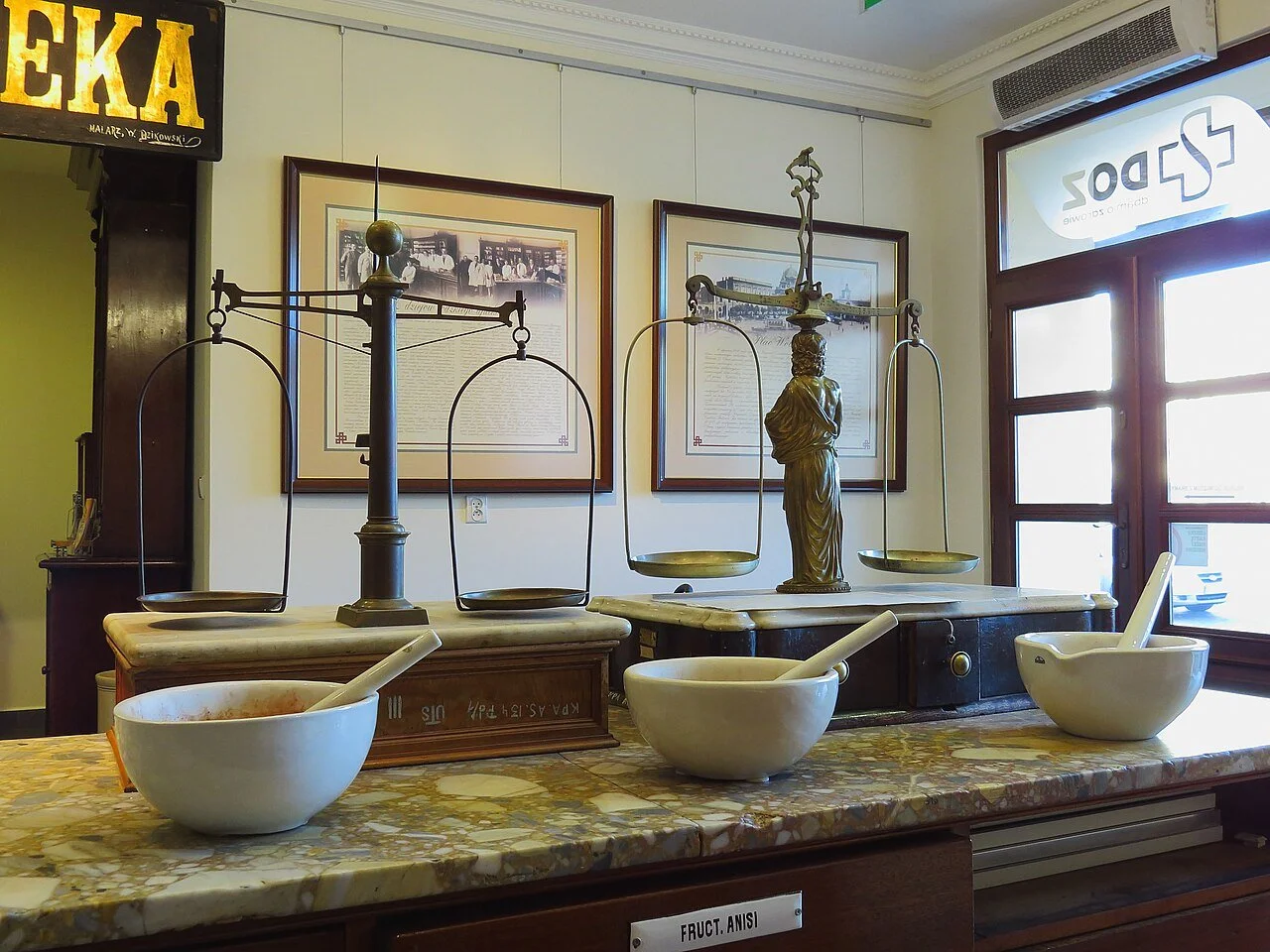
A pharmacy weighing bench as the apothecaries kept it: beam balances at the center, mortars within reach — Museum of Pharmacy, Łódź.
Museum of Pharmacy, Łódź, photograph via Wikimedia Commons. CC0.
Clear the bench completely, then set it the way an apothecary sets a weighing station: scale or balance in the center on a level surface, materials to the left, empty vessels to the right, notebook open below. A weighing bench is a quiet bench. Nothing should wobble, drip, or crowd the scale.
Lay out your dry materials (rice and salt) in their storage jars, your liquids (water and oil) in closed bottles, and four small clean bowls or jars to serve as weighing vessels. Put paper towels where your hand finds them without looking. Open your notebook to a fresh page and rule it into the columns of the measurement log you will find in the Archive Entry section. The habit begins before the first weighing: the page is ready before the material is.
❦ In your workbook: record the weighing station in your own way — scale centered and level, materials left, vessels right, the log page ruled before the first weighing — copy, sketch, or note what matters.
Why Apothecaries Measured Apart
Medieval and early modern England did not have one system of weights. It had several, and each belonged to a trade. Merchants moving wool, grain, and coal weighed their bulky goods in avoirdupois pounds. Goldsmiths and jewelers weighed precious metals in troy weight. And apothecaries, who bought and sold materials that were rare, costly, and powerful in very small amounts, kept a system of their own.
The reason is practical. A merchant's pound is a blunt instrument, fine for sacks and bales. An apothecary buying saffron or camphor, or compounding a powder where a grain too much changes everything, needed finer divisions and smaller steps. So the apothecaries' system took the troy pound as its foundation and divided it downward with exquisite care: into ounces, into drams, into scruples, and at last into grains, the smallest unit of all. The system came down through the Greek physicians Dioscorides and Galen, inheriting the weight ladder of the Romans, and it served European pharmacy for centuries. In Britain and America it remained official until 1971, when both countries completed the change to metric measurement for drugs.
★ We study it for three reasons. First, every old recipe, pharmacopoeia, and herbal you will ever read in this craft speaks this language, and a scholar who cannot read it is locked out of centuries of records. Second, the system teaches the discipline of exact measurement better than any lecture: its small units force care. Third, and most important for today, its logic is the logic of every measurement you will ever make in this laboratory. The units are retired. The habits are not.
Check in: Why was a merchant's pound too blunt an instrument for an apothecary buying saffron or camphor?
❦ In your workbook: record why apothecaries measured apart in your own way — several systems, each belonging to a trade, and the three reasons this course still studies the retired one — copy, sketch, or note what matters.
The Weight Ladder
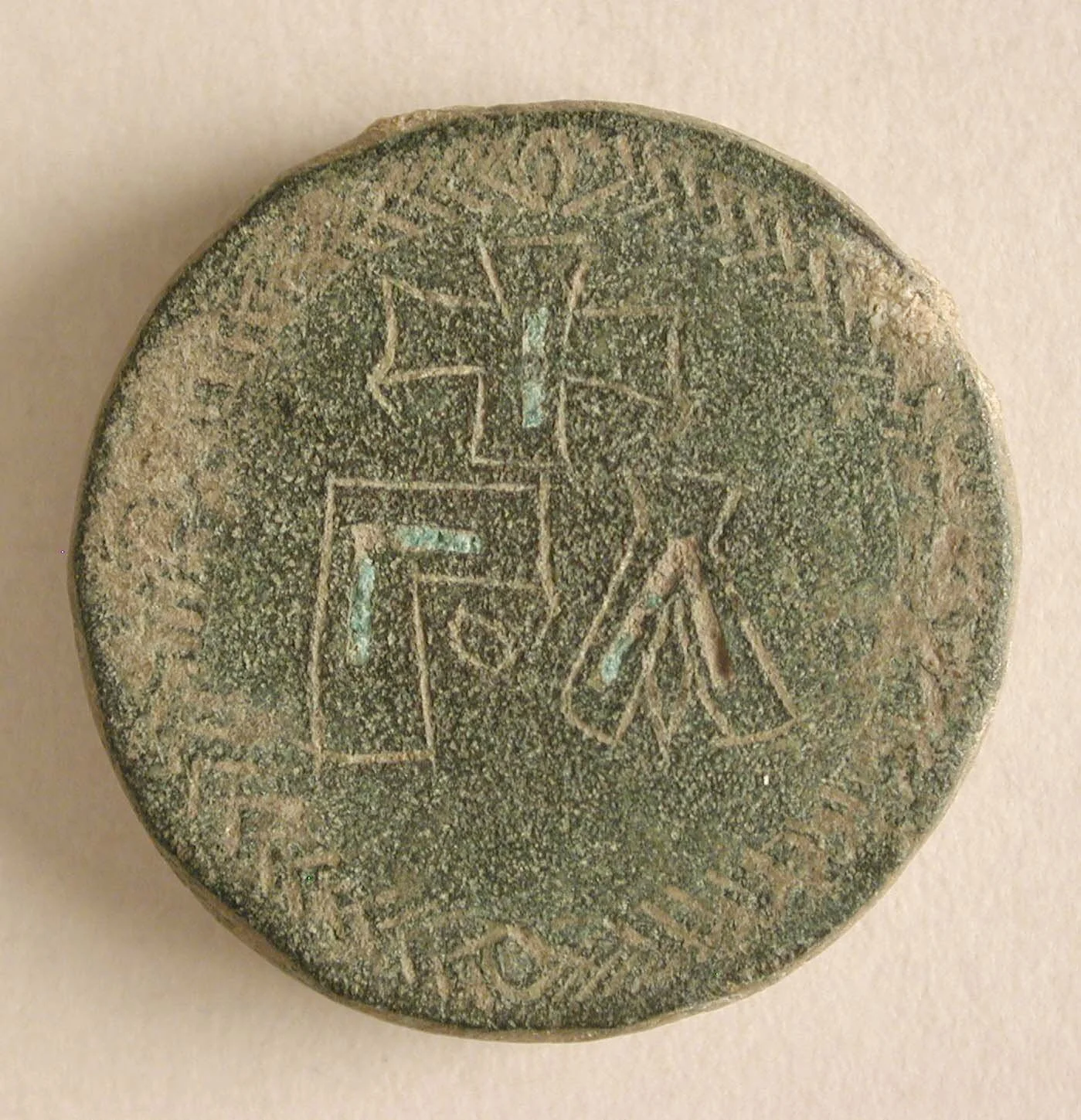
A Byzantine balance weight of one ounce (8th–9th century), its value marked in engraved Greek letters beneath a cross — a known weight, of the kind set against the material in the other pan.
The Metropolitan Museum of Art, object 2002.213.4 ("Three Round Copper-Alloy Balance Weights with Crosses," 8th–9th century; this file photographs one weight of the set). Open Access — public domain (CC0).
Here is the apothecaries' ladder of weight, from smallest to largest. Learn it the way you learned your alphabet, because you will read it for the rest of the course.
| Unit | Symbol | Equals | In grains | About, in metric |
|---|---|---|---|---|
| Grain | gr. | the base unit | 1 | 64.8 mg |
| Scruple | ℈ | 20 grains | 20 | 1.30 g |
| Dram | ʒ | 3 scruples | 60 | 3.89 g |
| Ounce | ℥ | 8 drams | 480 | 31.10 g |
| Pound | ℔ | 12 ounces | 5,760 | 373.24 g |
★ Read the ladder upward and downward until it is automatic: 20 grains to the scruple, 3 scruples to the dram, 8 drams to the ounce, 12 ounces to the pound. Notice what the system never does: it never counts in tens. Twelves, eights, threes, and twenties, the old counting of markets and dozens, run the whole ladder. Your fingers will learn it faster than your head believes.
Check in: How many grains make one dram — and which two ladder steps did you climb to get there?
Each name carries its history. The grain is tradition's own unit: the weight, so the story goes, of a single grain of wheat or barley taken from the middle of the ear. By modern definition it is exactly 64.79891 milligrams, and it is the one unit shared unchanged by all three English weight systems. The scruple takes its name from the Latin scrupulus, a little stone, the sort of pebble that gets in your sandal and will not be ignored. The dram comes from the Greek drachma, which was both a weight and a silver coin. The ounce comes from the Latin uncia, meaning a twelfth part. And the pound comes from the Latin libra, which is why the abbreviation lb and the symbol ℔ still follow it everywhere.
❦ In your workbook: record the weight ladder in your own way — the five units, their symbols, and the 20–3–8–12 climb from grain to pound — copy, sketch, or note what matters.
Two Pounds, Two Worlds
England's two great pounds look like a riddle, and the riddle is worth learning because it teaches you to ask which system a number belongs to before you trust it.
★ The troy pound, the apothecaries' pound, holds 12 ounces and 5,760 grains, about 373 grams. The avoirdupois pound, the merchants' pound, holds 16 ounces and 7,000 grains, about 454 grams. The troy pound is the lighter pound. But the troy ounce, at 480 grains, is heavier than the avoirdupois ounce at 437.5 grains. The heavier ounce belongs to the lighter pound. This is the famous paradox, and it is the whole reason careful people name their system before they quote a weight.
Check in: A pound of gold and a pound of feathers stand on the bench. Which is heavier — and what question did you have to ask before you could answer?
Troy weight took its name, by the traditional account, from the market town of Troyes in Champagne, France, where English merchants traded as early as the ninth century and whose fair weights were respected across Europe. The name is first found in English records in 1390, and troy weights were made official for gold and silver coinage in England in 1527. Honest scholarship adds a caution: a few historians have proposed other origins for the name, including the old market-weighing sense of the word. The Troyes story is the received one, and it is a good one, but it is not the only one ever told.
Avoirdupois comes from the Old French aveir de peis, meaning goods of weight: the system for weighing goods in bulk. Corn, coal, wool, and later everything sold by the shopkeeper's scale. Its dram is a different dram from the apothecaries': the avoirdupois dram is about 27.3 grains, while the apothecaries' dram is 60. Same word, different weight, different trade. This is why the old books are so fussy about naming the system.
So when the old riddle asks which is heavier, a pound of gold or a pound of feathers, the scholar's answer is: it depends on the pound. Gold is weighed troy, feathers avoirdupois, and the pound of feathers is heavier by more than eighty grams. Precision begins with asking the question.
❦ In your workbook: record the two pounds in your own way — 12 ounces against 16, 5,760 grains against 7,000, and the heavier ounce inside the lighter pound — copy, sketch, or note what matters.
The Volume Ladder
Liquids had their own ladder, built on the same pattern. Learn it beside the weight ladder, and keep the two ladders separate in your notes: weight is not volume, and the ounce of one ladder is not the ounce of the other.
| Unit | Symbol | Equals | About, in metric (US) |
|---|---|---|---|
| Minim | min. | the base unit | 0.0616 mL |
| Fluid dram | fl. dr. | 60 minims | 3.70 mL |
| Fluid ounce | fl. oz. | 8 fluid drams | 29.6 mL |
| Pint | pt. | 16 fluid ounces | 473 mL |
★ The minim takes its name from the Latin minimus, the smallest. Before it, the smallest liquid unit was the drop, the gutta, let fall from the lip of a bottle, and no two drops were ever quite the same. The minim standardized the smallest measure at exactly one sixtieth of a fluid dram, and the London Pharmacopoeia of 1809 prescribed measuring it with a graduated glass tube instead of a bottle lip. A fluid scruple of 20 minims also existed, sitting between the minim and the fluid dram the way the weight scruple sits between grain and dram.
One caution travels with this ladder: the pint. The American pint in the table holds 16 fluid ounces. The British Imperial pint held 20 fluid ounces, about 568 milliliters. Same word, different pint, different side of the ocean. Whenever an old recipe names pints, the scholar's first question is which country's pint.
Check in: An old recipe calls for a pint. What must you settle before you pour — and what are the two possible measures?
Your kitchen already speaks a dialect of this ladder. A modern teaspoon holds about 5 milliliters, close to the old fluid dram. A tablespoon holds about 15 milliliters, close to half a fluid ounce. The old units are retired, but their sizes still haunt the drawer.
❦ In your workbook: record the volume ladder in your own way — minim to pint, the fluid scruple between its neighbours, and the caution that travels with the pint — copy, sketch, or note what matters.
In your packet: Exercise I — The Conversion Table ⚒ begins here. Work it now, or mark the place and take it as homework — your choice.
The Signs of the Prescription
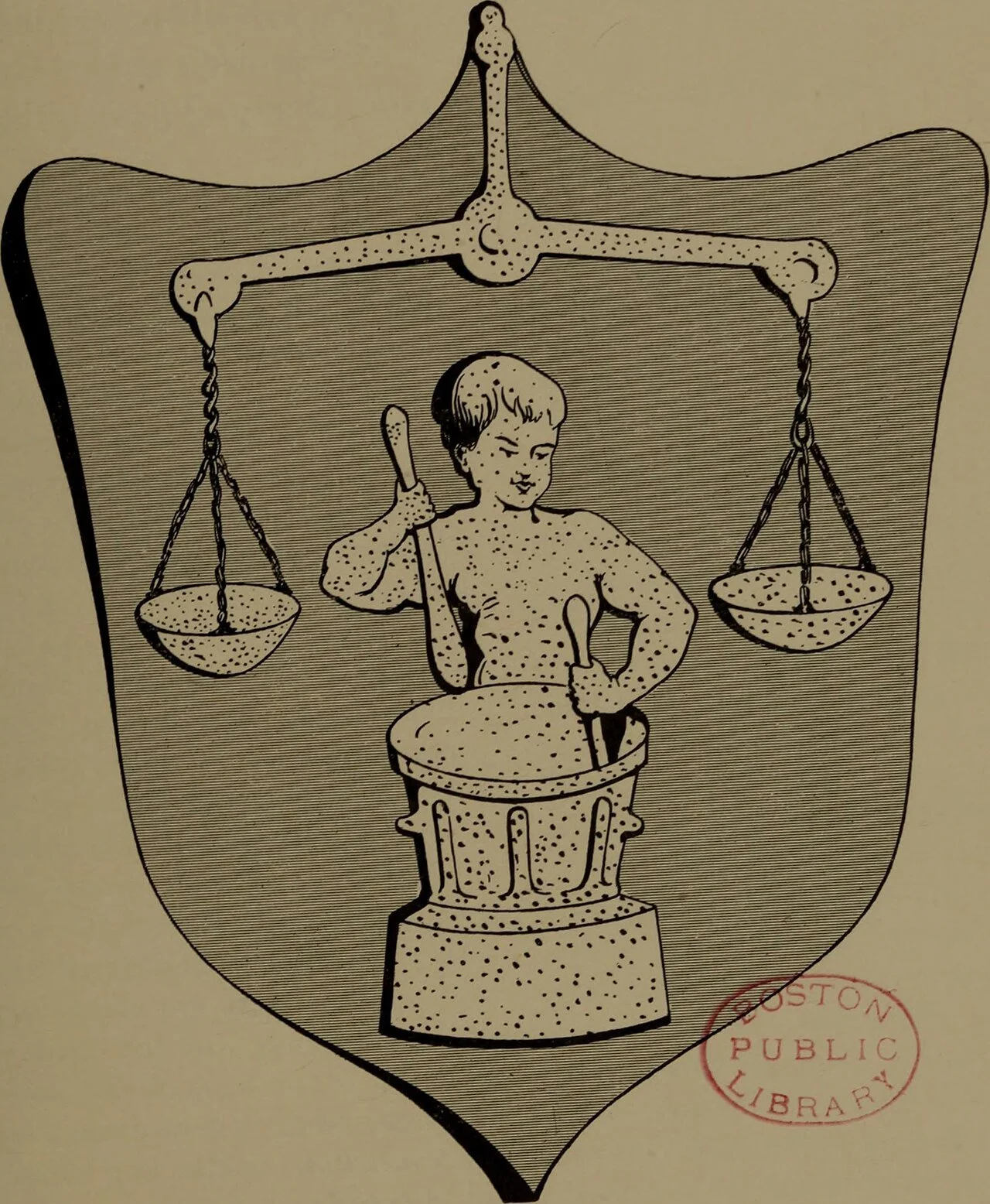
Pharmacy's own emblem — the balance across the top, the mortar below — from a 1905 history of pharmacy in Avignon.
Histoire de la pharmacie à Avignon (1905), via Wikimedia Commons / Internet Archive. No restrictions (public domain).
Old prescriptions were written in Latin, and Latin loves abbreviation. Each weight unit had its sign: grain gr., scruple ℈, dram ʒ, ounce ℥, pound ℔. Beside the sign stood the quantity in Roman numerals: ℥iv meant four ounces, ʒij meant two drams, ℈vj meant six scruples. The letters ss, from the Latin semis, meant half: ʒss was half a dram.
★ The system was elegant. Because only the apothecaries' units were ever written this way, the notation itself declared which weight system was meant. No one confused ℥iv with a merchant's four ounces, because a merchant never wrote ℥ at all.
Check in: Read ʒss aloud as a quantity. What does the ss add to the sign?
Scholars, a word on these signs, because they frighten beginners and they should not. They look like secret code, and in a sense they were: a shorthand shared by every trained apothecary in Europe, so that a prescription written in London could be read in Leiden. Learn them the way you learned your letters, a few at a time, and say each one aloud as you write it. Grain, scruple (an old apothecaries' weight of twenty grains), dram, ounce, pound. In a month they will feel like old friends, and you will read old recipes the way their authors wrote them: quickly, confidently, and exactly.
— Professor Crimblebrew Muddlenook, Potions Laboratory • Master Apothecary • Head of House Meridies
❦ In your workbook: record the signs of the prescription in your own way — the five signs, a quantity in Roman numerals beside each, and what ss means — copy, sketch, or note what matters.
The Beam Balance
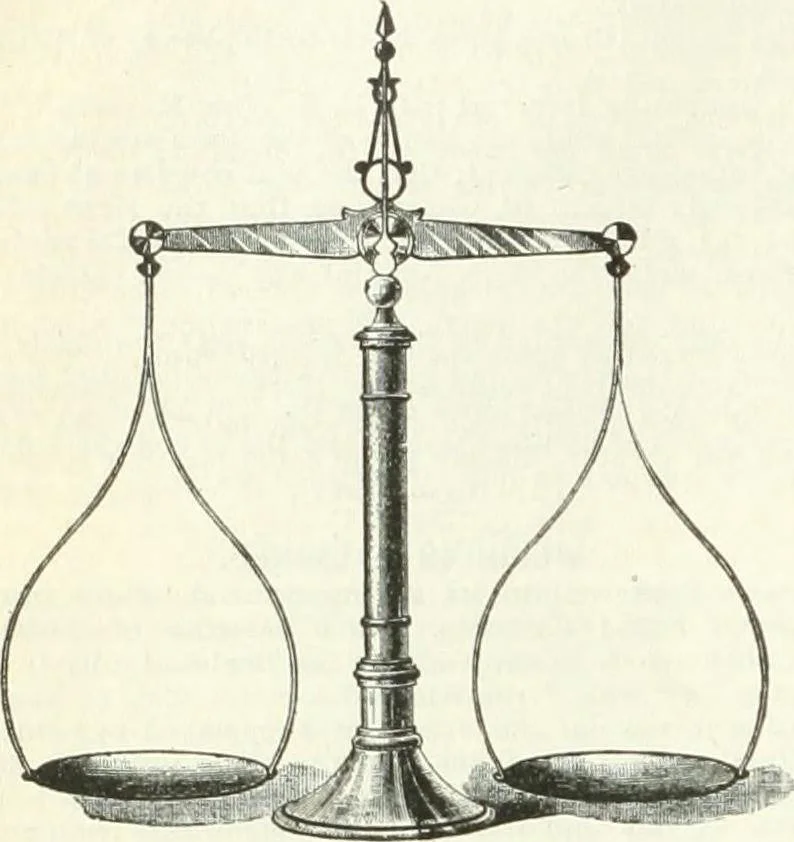
A pharmaceutical balance of the 1880s: beam, pillar, and two hanging pans — the beam balance of the lesson, drawn for The Pharmaceutical Era (1887).
The Pharmaceutical Era (1887), page 689, via Wikimedia Commons. Public domain.
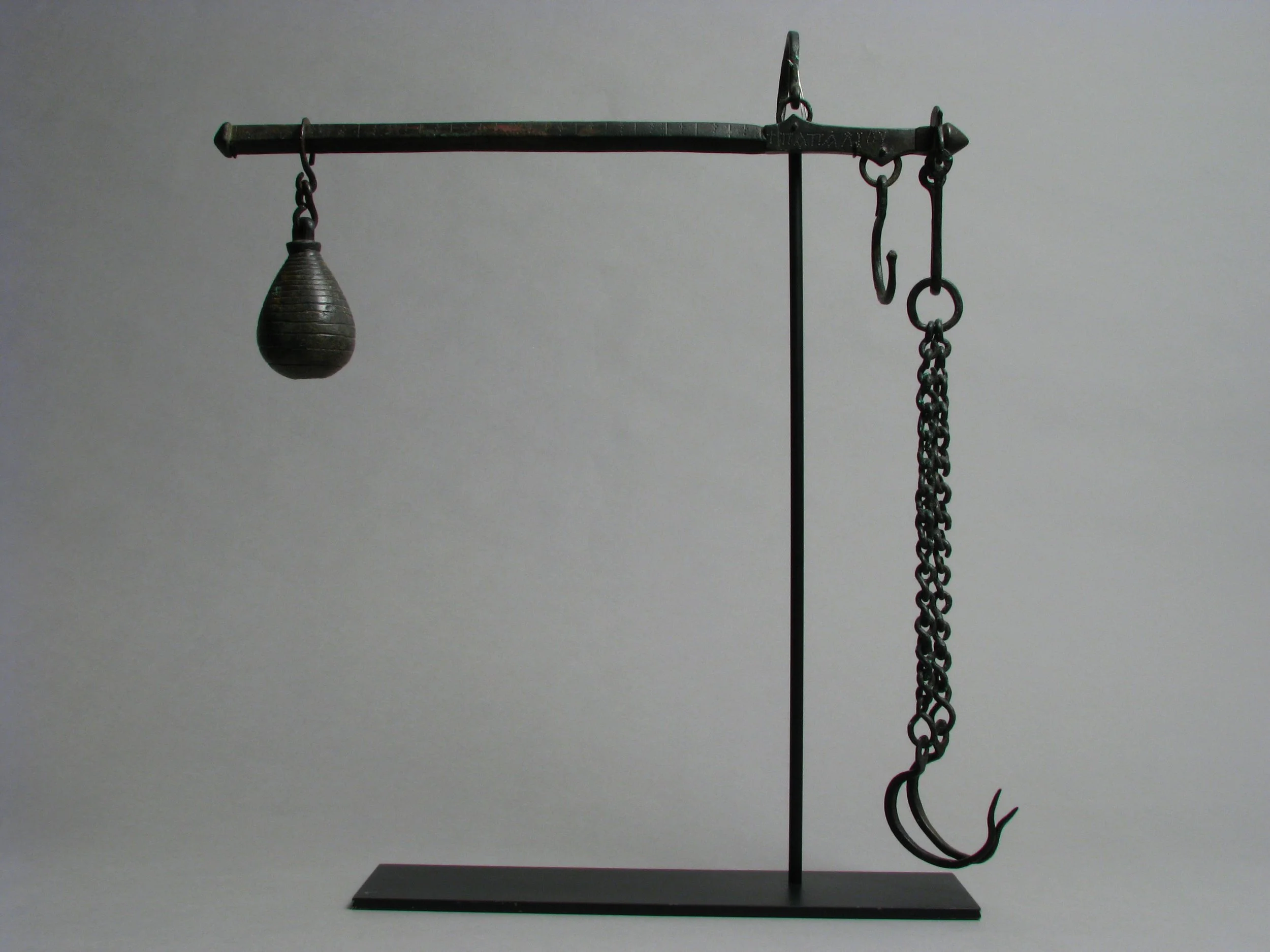
A Byzantine steelyard (5th–7th century), a Roman invention: the load hangs from hooks while a weight slides along the rod until the two balance.
The Metropolitan Museum of Art, object 2008.355a–d ("Steelyard Rod with Weight and Hooks"). Open Access — public domain (CC0).
The beam balance is among the oldest instruments in human history. Equal-arm balances were weighing grain and gold in Egypt and Mesopotamia thousands of years ago, and the principle has never changed, because it never needed to.
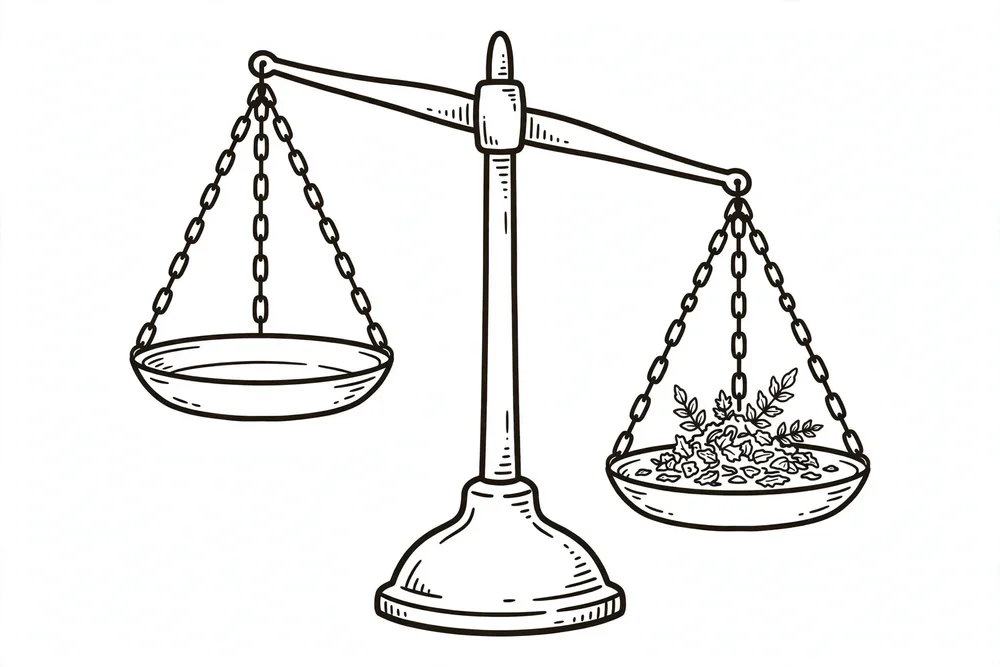
★ It works like this. A straight beam rests on a central pivot, the fulcrum. A pan hangs from each end, at exactly equal distances from the pivot. Place the material in one pan and known weights in the other. When the beam rests level, the two sides are equal, and the known weights tell you the weight of the material. The balance does not measure heaviness directly. It compares, and comparison is honest in a way that springs and dials sometimes are not.
Reading a beam balance is a small ceremony. Set it on a level surface, away from drafts and away from the edge of the bench. Let the beam settle completely; a swinging beam is still thinking. Read the pointer at the center mark. On the later triple-beam balances, small sliding weights called poises ride along notched beams, and you read the weight where each poise rests.
★ And now the most-used word in laboratory weighing: tare. The tare is the weight of the empty container, and taring is the act of accounting for it so that only the contents are weighed. On a beam balance, you counterbalance the empty vessel first. On a digital scale, you set the empty vessel on the pan and press the tare button, and the scale subtracts the vessel and reads zero. Every weighing in this course begins with tare. A scholar who forgets to tare weighs the bowl and calls it rice.
Check in: You forget to tare, and your bowl alone weighs 40 grams. What exactly is wrong with every reading you take in that session?
❦ In your workbook: record the beam balance in your own way — beam, fulcrum, two pans, and the tare that begins every weighing — copy, sketch, or note what matters.
Weighing Dry, Measuring Wet
A word on honesty between mass and weight. Strictly speaking, a scale compares mass, the amount of matter in a thing, while weight is the pull of gravity on that mass. In the laboratory we say "weight" the way apothecaries always have, and we mean what the scale reports. The distinction matters to physicists. For our work, the scale's answer is the answer.
Weighing dry materials. Set the scale on a level surface and let it wake fully. Place your empty bowl on the pan and tare it. Add the material a little at a time; rice pours fast and salt pours faster, so add the last of it in small shakes. Fine dry powders can cling with static on dry days; if the reading will not settle, breathe patience and wait, or wipe the vessel with a barely damp cloth and begin again.
★ Measuring liquids. Use a transparent measuring cup or jug with clear markings, and read it at eye level: crouch until your eyes are level with the surface, not above it. The surface of a liquid curves where it meets the wall of the vessel, a curve called the meniscus. Read the bottom of the curve for water and most thin liquids. Oil makes a flatter, shyer curve; read it the same way, at the bottom.
★ Calibration is how you check that your instrument tells the truth. Weigh something whose weight is known and see what the scale says. A United States nickel weighs exactly 5.000 grams by the mint's specification, which makes a pocketful of nickels a perfectly respectable set of test weights. If your scale reads 5.0 grams for a nickel, your scale is honest. Check before important work, and record the check in your log.
Check in: Your scale reads 4.6 grams for a nickel. Is the scale honest — and what do you write down before you go on?
❦ In your workbook: record weighing dry and measuring wet in your own way — tare before dry goods, the bottom of the meniscus at eye level, and the nickel that tests the scale — copy, sketch, or note what matters.
Procedure: The Measurement Drill
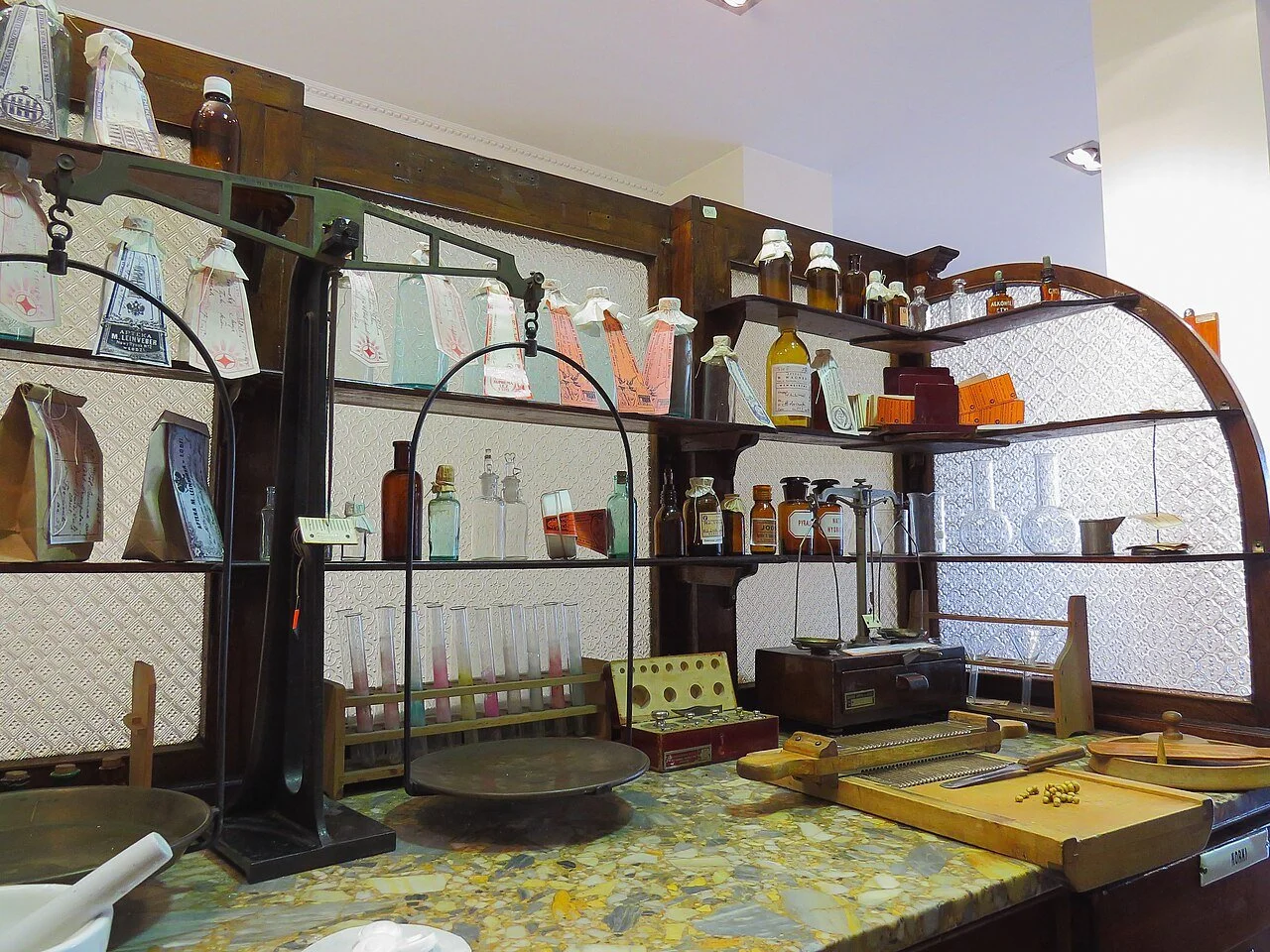
The weighing bench at work: the balance, an open box of fitted weights, and the mortar waiting — Museum of Pharmacy, Łódź.
Museum of Pharmacy, Łódź, photograph via Wikimedia Commons. CC0.
Work slowly and write everything down. The drill is the lesson.
- Prepare the station. Level surface, scale centered, materials left, empty vessels right, notebook open to your ruled log page, paper towels within reach.
- Calibrate. Weigh a nickel. Record the reading. If it reads 5.0 grams, proceed. If it does not, note the difference and proceed anyway; a known error, written down, is data.
- Tare drill, dry. Set an empty bowl on the scale and tare it to zero. Add rice until the scale reads 20 grams. Lift the bowl away, set it back, and read again. Record both readings. Repeat with salt to 10 grams.
- The scoop test. Without the scale, scoop what you judge to be 20 grams of rice into a second bowl. Weigh it. Record your estimate against the truth. Every scholar misjudges at first; the log is where judgment improves.
- Measure water. Pour water into your measuring cup to the 120 milliliter line. Crouch to eye level, find the meniscus, and adjust to the bottom of the curve. Record the volume.
- Measure oil. Pour vegetable oil to the same line in a clean dry cup. Compare the meniscus with water's. Record the volume and one sentence on what differs.
- Conversion drill, on paper. Using the two ladders, convert: 2 drams to grains and to grams; 3 scruples to grains; half a US pint to fluid ounces and to milliliters; 480 minims to fluid drams; 1 apothecaries' ounce to drams and to grains.
- Log and rule off. Enter every reading in your measurement log in the Archive Entry format. Rule a line under the finished page. The page is now an archive.
In your packet: Exercise II — The Weighing Session ⚒ begins here. Work it now, or mark the place and take it as homework — your choice.
❦ In your workbook: record the measurement drill in your own way — the calibration first, the tare drill, the scoop test's honest gap, and the two meniscus readings — copy, sketch, or note what matters.
Guided Observation: Watching the Instruments
Watch the instruments the way you will later watch preparations: closely, and without hurrying them.
Notice how the scale's reading behaves in the seconds after you set a bowl down. It hunts, then settles. That settling is the instrument thinking, and readings taken before it finishes are guesses wearing numbers.
Notice how salt packs and rice does not. The same 20 grams occupies different volumes, which is exactly why the laboratory weighs dry materials instead of scooping them by volume. Volume lies about dry goods. Weight does not.
Notice the meniscus of water against the meniscus of oil. Water climbs the wall of the cup eagerly; oil is more reserved. The curve is physics announcing itself at the edge of the vessel.
Notice your own estimating in the scoop test. Write down how far off you were without embarrassment. The gap between your guess and the scale is the reason the scale exists.
❦ In your workbook: record watching the instruments in your own way — the settling reading, salt against rice, the two curves, and your scoop-test gap — copy, sketch, or note what matters.
Cleanup
The weighing station is restored to order before anything else happens today. Pour the rice and salt back into their jars; they are unharmed and perfectly usable. Wipe every vessel dry, because the next weighing begins with dry vessels. Wash the measuring cups, dry them, and shelve them. Wipe the bench, shake out any stray grains into the waste, and wash your hands. Return the notebook to its shelf only after the log page is complete and ruled off. A laboratory is left ready for the next scholar, even when the next scholar is you.
❦ In your workbook: record the cleanup in your own way — dry vessels, a wiped bench, and a log page ruled off before the notebook is shelved — copy, sketch, or note what matters.
Archive Entry
★ Every weighing in this course ends the same way: written down, in the same format, in the same book. Copy this log faithfully for today's drill, and keep the format for every preparation to come.
| Date | Material | Vessel tare | Gross | Net | Unit | Notes |
|---|
Date is the day of weighing. Material names what was weighed or measured. Vessel tare records the empty container's weight, or "tared to zero" for a digital scale. Gross is the total reading with material included. Net is the material alone: gross minus tare. Unit names the unit used, and from this lesson forward the unit is always named, never assumed. Notes holds everything else worth keeping: calibration checks, spilled and re-weighed attempts, meniscus observations, the scoop test results.
Note this well, scholars: this log is the quietest and most important thing you will make all year. Preparations fade, powders spill, and memory is a poor vessel. Numbers in a ruled book do not fade. Every formula you will ever repeat, every failure you will ever diagnose, every success you will ever teach another scholar begins as lines in a log like this one. Keep it clean, keep it complete, and keep it always. The laboratory remembers what the scholar writes down.
— Professor Crimblebrew Muddlenook, Potions Laboratory • Master Apothecary • Head of House Meridies
In your packet: Exercise III — The Measurement Log ◐ begins here. Work it now, or mark the place and take it as homework — your choice.
❦ In your workbook: record the archive entry in your own way — the seven columns, gross minus tare, and why the unit is always named — copy, sketch, or note what matters.
Materials
Required (Level One — household items)
- Kitchen scale (digital or spring), set on a level surface.
- Measuring cups and spoons, including a transparent cup with clear markings.
- Four small clean bowls or jars to serve as weighing vessels.
- Dry rice and table salt in their storage jars.
- Water and vegetable oil in closed bottles.
- Paper towels, a notebook, a pen, and a ruler for ruling the log page.
- A United States nickel (5.000 g) for the calibration check.
Suggested (Level Two — historically closer)
- A beam balance or a digital jeweler's scale reading to 0.01 g, for those who have one.
- A graduated cylinder or medicine cup marked in milliliters.
- A set of brass or steel calibration weights, or a known coin as in Level One.
Reflection Questions
Answer the following questions in your workbook.
- Why did apothecaries need a weight system of their own instead of using the merchants' avoirdupois weights?
- Explain the ounce-and-pound paradox in your own words: how can the heavier ounce belong to the lighter pound?
- Why does taring matter? Describe exactly what goes wrong in a weighing when the tare is forgotten.
- When should a material be weighed, and when should its volume be measured instead? Give one example of each from the lesson.
- The measurement log is introduced in Lesson 6, before you have made a single preparation. Why does the course ask you to build the archive habit first?
Workbook Checklist — Lesson 6
In my workbook I have:
- ☐ named the five weight units of the apothecaries' system — grain, scruple, dram, ounce, pound — and stated how each relates to the next
- ☐ explained the difference between troy weight and avoirdupois weight, and why apothecaries kept a system of their own
- ☐ named the four volume units — minim, fluid dram, fluid ounce, pint — and stated their relationships
- ☐ read the old prescription symbols and the Roman numerals beside them, including ʒss, half a dram
- ☐ demonstrated tare weighing on a kitchen scale and described how a beam balance finds a true weight
- ☐ converted between apothecaries' units and grams or milliliters using my own conversion table
- ☐ recorded a clean, complete measurement log as an archive entry, with a dated calibration check
☐ Lesson completed Date: ___ Signature: ___
The Professor's Closing Note
The ladders are yours now, scholars: grain to pound, minim to pint, and the honest habits that outlast them both. Keep your conversion table at the front of your book and your log page ruled before the material is — the laboratory remembers what the scholar writes down.
Next lesson we grind, and everything you weighed today will be weighed again before it meets the mortar. Measure first, and grind after. I will see you at the bench.
— Professor Crimblebrew Muddlenook, Potions Laboratory • Master Apothecary • Head of House Meridies
Cross-Class Connections

Runes · Unit III, Lesson 10 — The Tally Matrix
Scholars, the Laboratory borrows my numerals and returns them smelling of rice and oil. Muddlenook's signs — ℥iv, ʒij, ʒss — stand or fall by the numerals beside them, and those are mine to teach properly: how Rome counted without zero and without place value, and how the additive and subtractive forms sit side by side. Come and learn them at the stone, and his prescriptions will read themselves.

Scrollwork · Unit II, Lesson 6 — Oak Gall Ink
In good order, scholars — attend. The ink-maker's recipes are written in the Laboratory's own ounces: Palatino's, of 1540, gives three ounces of crushed galls, two ounces of copperas, one ounce of gum arabic, and the character of the ink turns on those proportions. Bring Muddlenook's honest measure with you when you come to weigh them in the Library; a recipe is only its quantities, honestly kept.
Further Reading & Sources
- Apothecaries' system — Wikipedia: the full tables of weight and volume units, symbols, prescription notation, and the history of the system's abolition.
- Troy weight — Wikipedia: the troy system, its uncertain origin and the Troyes tradition, and its relationship to the apothecaries' divisions.
- Weights — University of Nottingham Manuscripts and Special Collections: avoirdupois, troy, and apothecaries' weight explained with period tables, from a university archive guide.
- Apothecary's balance with steel beam and brass pans — Science Museum Group Collection: a real English apothecary's balance, 1831–1870, with its dram, scruple, and grain weights, photographed and catalogued.
Browse the Potions shelf in the school Library for readable editions of these works.
Submit your work for this lesson using the form below.
CONTINUE IN THE POTIONS LABORATORY
← Previous · Lesson 5: Recipe Journals & Archival Notes Next · Lesson 7: Grinding →
Unit I — Foundations of the Laboratory Potions Laboratory — All 52 Lessons
The rest of Unit I: Lesson 1 · Welcome to the Laboratory · Lesson 2 · Scriptorium & Zoning · Lesson 3 · Vessels & Glasswork · Lesson 4 · Labels & Seals · Lesson 5 · Recipe Journals · Lesson 7 · Grinding · Lesson 8 · Simples Census · Lesson 9 · Hearth Clearance