

POTIONS
Unit I · Lesson 5RECIPE JOURNALS & ARCHIVAL NOTES
Professor Crimblebrew Muddlenook
Master Apothecary • Potions
Head of House Meridies • School of Evershade
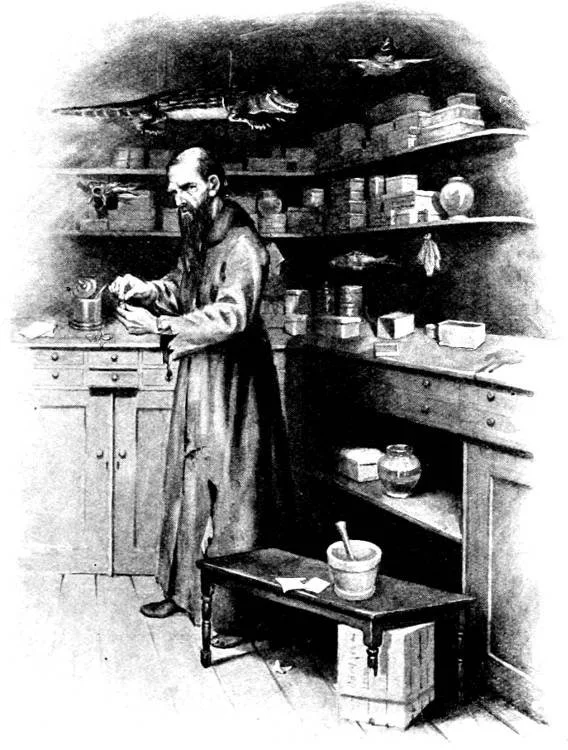
The apothecary in his shop, among the jars and boxes his records had to account for — plate "The Apothecary" from A. C. Wootton's Chronicles of Pharmacy (1910).
A. C. Wootton, Chronicles of Pharmacy, Vol. II (Macmillan, 1910), plate facing p. 81, via Project Gutenberg (eBook 67414). Public domain.
Professor's Introduction

In good order, scholars. Take your seats and open your notebooks, because today we do something the historical apothecary did before almost everything else. We write.
Four lessons have given you a laboratory: a room you understand, a scriptorium corner zoned for paperwork, vessels inventoried and within reach, and labels that tell the truth about every jar. That is a fine beginning. It is also, at the moment, entirely in your heads. Heads are wonderful things, but they are terrible archives. They forget, they flatter, and they rearrange the past to suit the present. The laboratory needs a memory that does none of those things, and that memory is a book.
Every apothecary's shop that lasted more than a season ran on records. The master who could not find a preparation in the archive might as well never have made it. The master who could not tell last year's dried mint from this year's was working blind. So before we grind a single seed or infuse a single leaf, we will build the instrument that makes all the later work possible: the recipe journal, kept daily, kept honestly, and kept in a way that your future self can actually use.
Rule your pages. We begin.
Sealed note from Professor Muddlenook: I have kept a laboratory journal for forty years, and I can still find the entry for the first preparation I ever made alone. It was a failure. The entry is three pages long, because failures need the most writing. Keep that in mind all term.
— Professor Crimblebrew Muddlenook, Potions Laboratory • Master Apothecary • Head of House Meridies
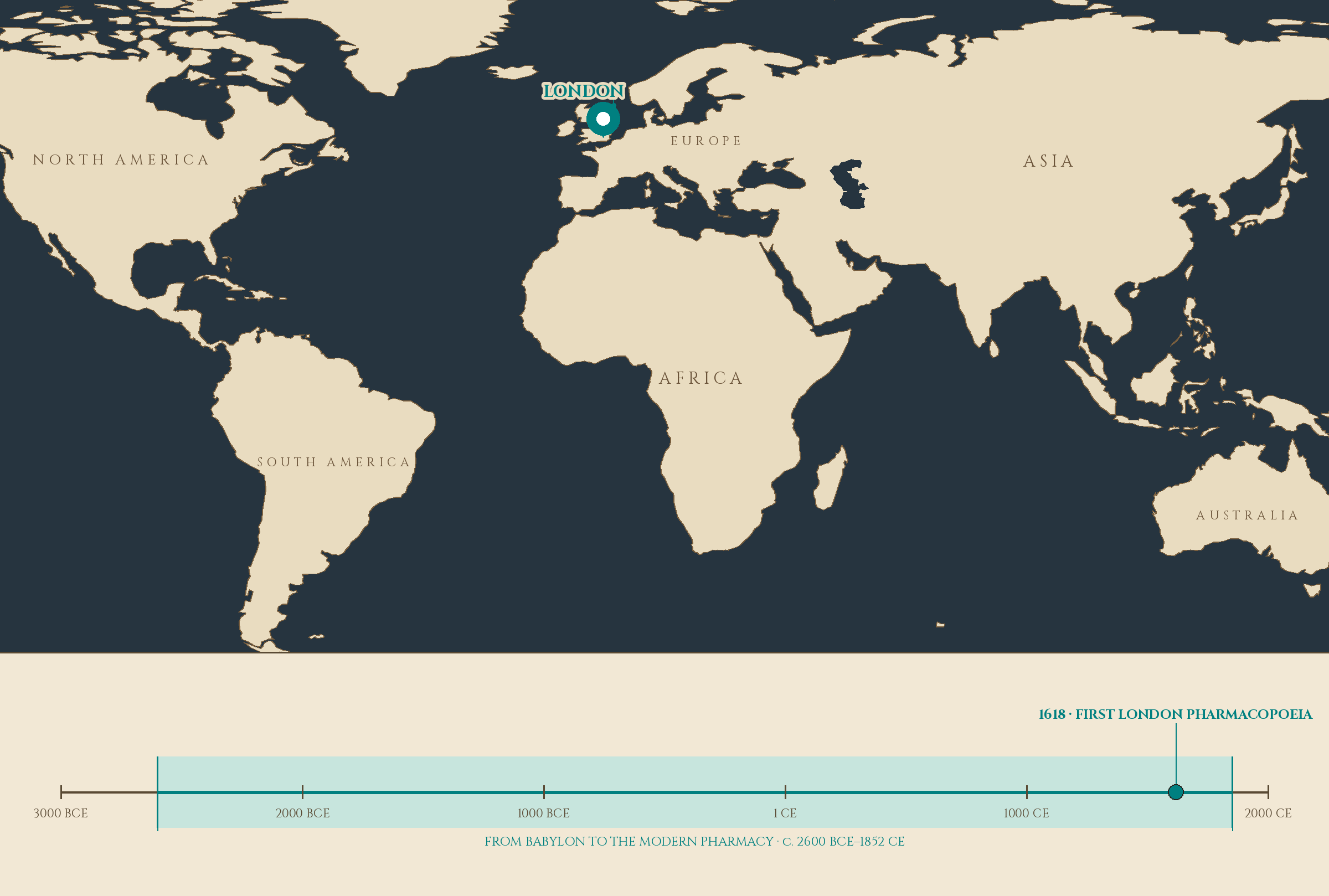
Pin: LONDON. Timeline stop: 1618 · FIRST LONDON PHARMACOPOEIA.
Lesson Objectives
By the end of this lesson, you will be able to:
- Explain why historical apothecaries and householders kept written receipt books, and what the stillroom book tradition was.
- Describe the parts of a complete recipe journal entry: date, title, formula, procedure, observations, results, and failures.
- Set up a working recipe journal with numbered pages, reserved index pages, and a ruled entry template.
- Practice the discipline of writing during the work rather than reconstructing it afterward.
- State the honesty rule of the laboratory archive: never backdate, never invent, and record failures as carefully as successes.
- Choose paper and ink that will keep your archive readable for decades.
Reading this lesson: ★ marks the passages to remember. They return on the unit quiz and the class test. Check in questions ask the material back as you go; answer them in your workbook when you meet them.
Working this lesson: Your assignment packet is the first download on this page. Work in it as the lesson moves along, answering each exercise as its subject is taught — or read the lesson through for your notes and take the exercises as homework afterward. Both are proper ways to sit this class. Signposts in the reading tell you where each exercise belongs. Written answers are short answers in your own words; a few honest lines are worth more than a filled page.
Your Assignment Packet
This lesson's exercises live in its packet: the Lexicon Handout (every term, course terms marked ◆), Materials, Guided Practice, the Assignment Manual with its answer key for self-checking, the Reflection Questions, and the Workbook Checklist. Download the packet before you begin and keep it beside you as you read.
Safety Briefing
This is a desk lesson. There is no heating, no chemistry, and no new preparation today, which means the hazards are not the kind that burn or sting. They are the kind that corrupt, and the laboratory takes them just as seriously.
- ★ Never backdate. An entry is written on the day the work happens, with that day's date. If you forgot yesterday, you write today's entry today and note the gap honestly. A false date is a false record.
- Never invent data. If you did not observe it, you do not write it. "I do not remember the exact color" is a complete and honorable observation. A guessed detail, written confidently, will mislead you for years.
- Never copy another scholar's observations as your own. You may compare journals and learn from each other, but your entry records what your eyes saw and your hands did. Two scholars can watch the same work and notice different things. That is the point.
- Record failures fully. A failed preparation gets the same complete entry as a success: what went wrong, when you noticed, and what you think caused it. The archive is not a trophy shelf. It is a memory.
- Younger scholars should have an adult nearby when handling glass jars or unfamiliar dried materials during the write-up work, exactly as in earlier lessons.
Check in: You forgot to write yesterday's entry, and you remember the work well. What does the honesty rule have you do today — and what must the entry say about the gap?
❦ In your workbook: record the safety briefing in your own way — the honesty rule and its four working parts — copy, sketch, or note what matters.
Mise en Place
Gather the following before you begin. Everything should be on the table before the first page is numbered.
- A notebook that will become your recipe journal (at least 60 pages; a bound notebook is best, since pages cannot fall out and get reordered)
- A ruler and a pencil for ruling pages and the index
- A pen with dark, stable ink for entries (your best everyday pen is fine for now; we discuss permanence later in the lesson)
- Index cards or small slips of paper for drafting the entry template
- The work products of Lessons 1 through 4: your laboratory map and safety notes, your scriptorium zoning plan, your vessel inventory, and your labeled jars
Level Two scholars may begin with a proper blank book with sewn binding, cotton-rag or acid-free paper, and a pen with pigment-based archival ink, the way a working apothecary would invest in the tools of the record itself.
❦ In your workbook: record the mise en place in your own way — what must be on the table before the first page is numbered — copy, sketch, or note what matters.
The Archive as the Laboratory's Memory
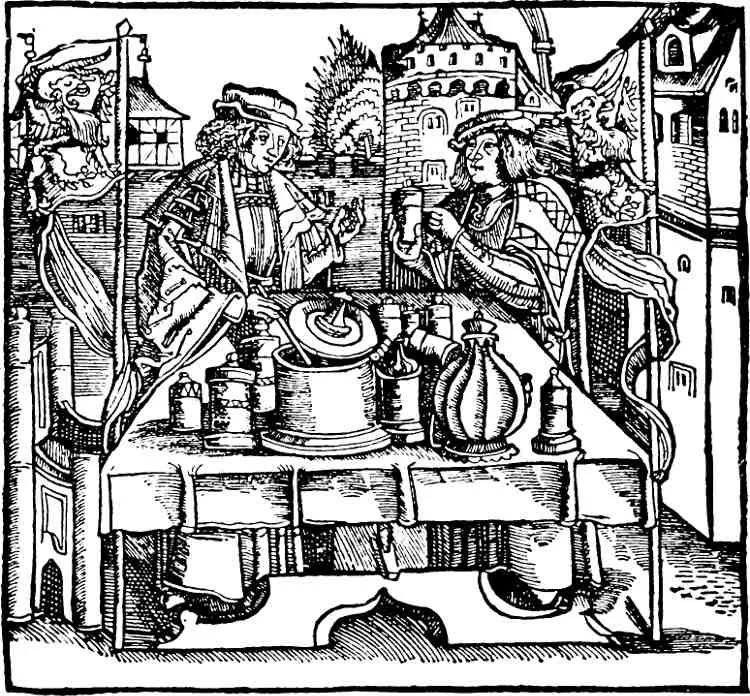
Apothecaries compounding theriaca, the famous compound of the old pharmacopoeias — work whose consistency rested on written formulas. Woodcut reproduced in Wootton's Chronicles of Pharmacy (1910) as "Preparation of Theriaca.
A. C. Wootton, Chronicles of Pharmacy, Vol. II (1910), plate facing p. 45, via Project Gutenberg (eBook 67414). Public domain.

Title page of the Pharmacopœia Londinensis — the book of standard formulas the College of Physicians of London first issued in 1618, so that every apothecary's shop worked to the same recipes.
Reproduced in A. C. Wootton, Chronicles of Pharmacy, Vol. II (1910), plate facing p. 63 ("Title-page of London Pharmacopœia"), via Project Gutenberg (eBook 67414). Public domain.
Long before there were printed textbooks, there were handwritten books of receipts. In early modern England, the women who managed great households kept manuscript receipt books: page after page of formulas for cookery, preserves, distilled waters, and household preparations, often with several hands contributing across generations. The Folger Shakespeare Library in Washington holds over one hundred such manuscript recipe books, dating from about 1550 to about 1800, and the Wellcome Collection in London catalogues well over a thousand recipe books, manuscript and printed alike. These were working documents, stained and annotated, and they were the laboratory notebooks of their day.
In the largest households, much of this work centered on the stillroom: the room where distilled waters, preserves, and confectionery were made. The stillroom book recorded its receipts in the order they were learned or perfected, with notes on whose receipt it was and whether it had been tried. "Mrs. Allen's receipt for quince preserve, proved October" is a complete archival act: a formula, a source, and a verdict.
★ The professional apothecary worked under the same logic at a larger scale. An apothecary's reputation rested on consistency: the preparation had to be the same good preparation every time, and the only way to guarantee that across years, apprentices, and changing suppliers was to write everything down. In 1618, the College of Physicians of London issued the first London Pharmacopoeia, a book of standard formulas meant to hold every apothecary's shop to the same recipes. The message of that book is the message of this lesson: the craft lives in the record as much as in the hands.
This is why the archive comes before the brewing, and why your journal starts now, in Lesson 5, before you have made anything worth recording. The habit must be in place before the work it will preserve. An archive built after the fact is archaeology. An archive built during the work is a laboratory.
❦ In your workbook: record the archive as the laboratory's memory in your own way — the receipt books, the stillroom book, and the 1618 Pharmacopoeia — copy, sketch, or note what matters.
The Receipt and the Recipe Journal
The historical word for what we now call a recipe was receipt, from the Latin recepta, meaning things taken or received: the materials taken to make the preparation. When you see "receipt" in an old book, read it as "recipe," and notice how the old word keeps the emphasis where it belongs, on the materials and the making rather than on the finished dish.
Your recipe journal is the modern descendant of the receipt book, adapted to the laboratory. Every entry follows the same template, because the template is what makes entries comparable across months and years. Here are its parts, in order:
Date. Every entry begins with the full date: day, month, year. No exceptions, no abbreviations you will not understand in five years.
Title. The name of the preparation or the work, in your own clear words. "Mint infusion, first trial" is better than "Experiment 3."
Formula. The materials and their amounts, listed before the procedure begins. This is the receipt proper. Amounts are recorded in the units you actually used, written at the time.
Procedure. Numbered steps describing what you did, in the order you did it. Times are recorded where they matter: when heating began, how long something steeped, when you stopped.
Observations. What you saw, smelled, heard, and felt during the work. Color changes, textures, sounds, the feel of a mixture under the spoon. Observations are recorded during the work, not reconstructed later. This column is the soul of the entry.
Results. What the work produced: the yield, the keeping quality, whether the preparation matched its intention. Results are verdicts, and verdicts are dated.
Failures and deviations. What went wrong, what you changed mid-course, and what you would do differently. If nothing went wrong, write "no deviations." The line must be there every time, so that its absence would be noticed.
★ Seven parts. The same seven, in the same order, every time. Order is not fussiness. Order is what lets you find things.
Check in: Name the seven parts of a complete entry in order — then say which part is called "the soul of the entry," and why.
❦ In your workbook: record the receipt and the recipe journal in your own way — the seven parts in their order — copy, sketch, or note what matters.
The Discipline of Writing During the Work
Here is the hard part of the lesson, and I will not pretend it is easy. The journal is written during the work, not after it.
Memory is a poor scribe. Within an hour, the exact shade of a mixture has blurred. Within a day, the order of two steps has swapped itself. Within a week, you will be entirely certain of details that never happened. Every apothecary who ever reconstructed an entry from memory has produced the same artifact: a confident, detailed, and partly fictional record. The fictional parts are the ones you will rely on later, which is what makes them dangerous.
★ So the procedure column is written as you go. You complete a step, you write the step. You notice a color change, you write it in the observations column with the time. This feels slow at first. It is slow at first. Then it becomes rhythm: do, note, do, note, the way breathing goes in and out without being commanded.
Practical arrangement matters. Keep the journal open on a stand or a clean dry corner of the bench, away from spills. Keep the pen in the same place every time. If your hands are wet or dusty, dry or wipe them before you pick up the pen; a stained page is a lost page. Some scholars keep a pencil for mid-work notes and ink the entry fair afterward, the same day, with the pencil notes beside them. That is honest work, provided the fair copy is made the same day and nothing is "improved" in the copying.
Check in: A scholar inks a fair copy in the evening from pencil notes made during the work, and "improves" two observations while copying. Which part of that is honest work, and which part breaks the rule?
Sealed note from Professor Muddlenook: My bench journal sits on a little wooden stand to the left of my work, always the same spot, and my pen lives in a notch I cut in the stand forty years ago. Apprentices used to laugh at the notch. Then they watched me find my pen without looking, mid-procedure, while holding a hot flask in the other hand, and they stopped laughing. Ritual is not superstition. Ritual is reliability you can touch.
— Professor Crimblebrew Muddlenook, Potions Laboratory • Master Apothecary • Head of House Meridies
❦ In your workbook: record the discipline of writing during the work in your own way — memory the poor scribe, and the do-note rhythm — copy, sketch, or note what matters.
Archival Notes: The Running Log and the Index Habit
Beyond the dated entries, the journal carries two more instruments: the running log and the index.
The running log is the journal's margin of daily life: brief dated lines for things that are not full entries but must not be lost. "October 12: moved the dried mint to the smaller jar; the large one would not seal." "October 14: Mrs. Allen's receipt for quince preserve, copied from the library book, not yet tried." The log catches what falls between entries. Many scholars keep it at the back of the journal, working forward from the last page, so entries and log grow toward each other and meet in the middle.
★ The index is the finding aid. Reserve the first four pages of the journal for it, ruled into two columns: subject on the left, page number on the right. As entries accumulate, add lines: "Mint infusion, first trial: 7." "Vessel inventory: 12." The index is filled in last and consulted first. A journal without an index is a diary. A journal with an index is an archive, because an archive is defined not by what it contains but by whether its contents can be found.
You will notice that this lesson does not teach you the archive systems of Unit II: the Surface Matrix, the specimen records, the portfolio. Those have their own lessons, and they will build directly on the habits you form here. Think of it this way: the journal is where the work happens on paper, and the Unit II archive is where the knowledge distilled from that work is filed for the long term. Today's job is the journal. The filing comes later, and it will be far easier because you kept the journal well.
Check in: What turns a journal from a diary into an archive — and where do the index pages live while they wait to be filled?
❦ In your workbook: record the running log and the index habit in your own way — what each catches, and where each lives — copy, sketch, or note what matters.
Paper, Ink, and Permanence

A book built to last centuries: 17th-century leather binding, stamped and gilded. Your journal's decades begin with choices like these — sound materials, kept cool, dry, and out of the sun.
Bookbinding, 17th century, attributed to Turkey; leather, stamped and gilded; Fletcher Fund, 1975; Object Number 1975.28, The Metropolitan Museum of Art. CC0 (Open Access).
A journal meant to last decades deserves materials chosen for decades. The practical facts are simple.
Paper made from cotton or linen rag, or modern paper manufactured acid-free and lignin-free, keeps its strength for centuries; this is why documents from the 1700s remain readable today. Paper made from untreated wood pulp, the cheap paper of the later 1800s onward, contains lignin that breaks down into acids, yellowing and embrittling the sheet until it crumbles. ★ For your permanent journal, choose acid-free, lignin-free paper. Your practice notes can live on anything.
Ink follows the same logic. The standard European writing ink for centuries was iron gall ink, made from oak galls, and it survives on countless pages, though its acidity can eat into paper over time. Modern pigment-based inks are stable and lightfast. For entries that must last, a pigment-based archival pen is the practical modern choice. Avoid gel inks that smear and cheap ballpoints that fade; test any pen on a scrap page and check it a week later.
Store the finished journal upright on a shelf, away from direct sunlight, damp, and heat. Sunlight fades ink, damp feeds mold, and heat accelerates every kind of decay. A journal on a cool, dry shelf, in a box if you have one, will outlast us all, which is exactly the idea.
Check in: What is the lignin in cheap wood-pulp paper doing over time, and what two paper qualities protect a permanent journal against it?
❦ In your workbook: record paper, ink, and permanence in your own way — rag and acid-free paper, iron gall and pigment inks, and cool dry storage — copy, sketch, or note what matters.
Procedure: Setting Up Your Recipe Journal

Work through these steps in order. Do not skip the ruling; the ruling is the lesson.
- Number every page. In the lower outer corner of each page, write the page number in pencil. Work through the whole notebook now, before any entries exist. A numbered journal cannot silently lose a page.
- Reserve the index. Rule the first four pages into two columns headed "Subject" and "Page." Write "INDEX" at the top of the first page. These pages stay mostly blank for now. That blankness is a promise, not a waste.
- Choose the log's home. Decide whether your running log will live at the back of the journal (working forward from the last page) or in a separate small notebook. Record the decision on the inside front cover with today's date.
- Rule the entry template. On an index card or slip of paper, write out the seven entry headings: Date, Title, Formula, Procedure, Observations, Results, Failures and deviations. Keep this card as a bookmark in the journal. Until the order is in your bones, the card is your memory.
- Make the first entry. Turn to the first unreserved page. Write today's date and the title "Journal established." In the formula column, list the materials of this lesson: the journal itself, the pen, the ruler. In the procedure column, describe setting up the journal, step by step, as you just did it. In observations, note anything you noticed: the paper's texture, a ruling that went crooked. In results, write "Journal ready for entries." In failures and deviations, be honest. Then add the entry to your index.
❦ In your workbook: record setting up your recipe journal in your own way — the five steps, in order — copy, sketch, or note what matters.
In your packet: Exercise I — Setting Up the Journal ⚒ begins here. Work it now, or mark the place and take it as homework — your choice.
Guided Observation: Writing Up Lessons One Through Four
★ Now the journal earns its keep. Using the entry template, write up the work of Lessons 1 through 4 as proper dated journal entries, one entry per lesson.
- Lesson 1, Welcome to the Potions Laboratory: the workspace you chose, the safety rules you adopted, the map or description of your laboratory corner.
- Lesson 2, The Scriptorium and Workspace Zoning: your zoning plan, what lives in each zone, and why.
- Lesson 3, Vessels, Jars, and Blown Glasswork: your vessel inventory, with each vessel's material, size, and intended use.
- Lesson 4, Labels, Wax Seals, and Ingredient Markings: the labeling system you built and the first jars you labeled.
Date each entry with the day you actually did that lesson's work, not today. If you cannot remember the exact day, write the month and year and add the honest note "exact date uncertain, reconstructed from memory." That note is what keeps the entry trustworthy. Work from your notes, sketches, and the labeled jars themselves, not from imagination. Where a detail is lost, the entry says so. A journal with four honest entries is worth more than a journal with forty polished ones.
❦ In your workbook: record writing up Lessons One through Four in your own way — one honest dated entry per lesson — copy, sketch, or note what matters.
In your packet: Exercise II — Writing Up Lessons One Through Four ✎ begins here. Work it now, or mark the place and take it as homework — your choice.
Cleanup
- Return the pen to its place, cap on. An uncapped pen is a future stain.
- Close the journal and shelve it upright, away from the work area. Journals live on shelves, not on benches.
- File the entry-template card as your bookmark at the first blank entry page.
- Gather the Lesson 1 through 4 work products you used for the write-ups and return each to its zone. The journal describes the laboratory; it does not replace putting things away.
- Wipe the bench. A clean bench tomorrow morning is today's last entry, written in actions rather than ink.
❦ In your workbook: record the cleanup in your own way — pen capped, journal shelved upright, card filed, bench wiped — copy, sketch, or note what matters.
Archive Entry
Today's archive entry is the journal itself, and it is already written: the setup entry from the Procedure section, plus the four lesson write-ups from Observation. Before you close the book on this lesson, do three things.
First, check the index. Every entry you made today should have a line: subject on the left, page number on the right. If a line is missing, add it now.
Second, read back the failures and deviations lines of all five entries. If every one of them says "no deviations," ask yourself honestly whether that is true. Beginners who record no failures are usually beginners who are not looking closely enough. There is no penalty for a failure in this laboratory. There is only the penalty for hiding one.
Third, write one running-log line at the back of the journal: today's date, the words "Journal established; Lessons 1 through 4 entered," and your signature or mark. Future you will open this book hundreds of times. Let the first thing the log says be a beginning.
❦ In your workbook: record the archive entry in your own way — the index check, the failures read-back, and the first running-log line — copy, sketch, or note what matters.
In your packet: Exercise III — The Honesty Audit ✎ begins here. Work it now, or mark the place and take it as homework — your choice.
Materials
Required (Level One — household items)
- A notebook of at least 60 pages that will become your recipe journal (bound is best: pages cannot fall out and get reordered).
- Ruler and pencil for numbering pages and ruling the index.
- A pen with dark, stable ink for entries (your best everyday pen is fine to start).
- Index cards or small slips of paper for drafting the entry template.
- The work products of Lessons 1 through 4: your laboratory map and safety notes, your scriptorium zoning plan, your vessel inventory, and your labeled jars.
Suggested (Level Two — historically closer)
- A blank book with sewn binding and cotton-rag or acid-free paper for the permanent journal.
- A pen with pigment-based archival ink for entries that must last decades.
- A bookplate or ownership label for the inside front cover, inscribed and dated in the manner of the historical receipt books.
Reflection Questions
Answer the following questions in your workbook.
- Why did the historical apothecary write during the work rather than after? What is lost in the gap between doing and writing?
- Your recipe journal and the Materia Botanica are both archives. What is the difference between them, and why does the course need both?
- Why is an honest record of a failure more useful to your future self than a polished record of a success?
- The lesson recommends acid-free, lignin-free paper and stable ink for the permanent journal. In your own words, what is the paper actually being protected from?
- The index is filled in last and consulted first. What does that tell you about who the archive is really for?
Workbook Checklist — Lesson 5
In my workbook I have:
- ☐ set up my recipe journal: every page numbered, four index pages reserved and ruled, the running log's home chosen and the decision recorded with today's date on the inside front cover
- ☐ ruled my entry-template card with the seven headings in order — date, title, formula, procedure, observations, results, failures and deviations — and filed it as my bookmark
- ☐ written my first entry, "Journal established," with all seven parts, and added it to the index
- ☐ written up Lessons 1 through 4 as dated entries, each dated with the day the work was actually done, with the honest note wherever a date or detail was uncertain
- ☐ completed the honesty audit: memory-reconstructed lines marked "R", uncertain observations qualified, and at least one failure or deviation recorded in full
- ☐ stated the honesty rule in my own words: dated the same day, never backdated, never invented, and failures recorded as carefully as successes
- ☐ chosen paper and ink for permanence — acid-free, lignin-free paper and a pigment-based archival pen for the permanent journal — or noted the choice for when I upgrade
☐ Lesson completed Date: ___ Signature: ___
The Professor's Closing Note
Sealed note from Professor Muddlenook: Scholars, you now own the most important instrument in this laboratory, and it cost you a notebook and an afternoon. Every preparation you will ever make in this course will pass through these pages first as a plan and afterward as a record. Keep it daily, keep it honestly, and keep it where you can find it. The archive you build this term will still be teaching you years from now. I know, because mine still teaches me.
— Professor Crimblebrew Muddlenook, Potions Laboratory • Master Apothecary • Head of House Meridies
Cross-Class Connections

Herbology · Unit I, Lesson 1 — The Scholar's Familiar
Your grow ledger and Professor Muddlenook's recipe journal are cousins, scholars — both dated, both honest, both written in the moment rather than reconstructed afterward. Come to the Greenhouse, choose your Scholar's Familiar, and open the ledger that will keep its life. The habit you learned at the Laboratory bench will feel entirely at home among the pots.
Scrollwork · Unit VI, Lesson 23 — Archive Labels & Library Systems
A journal with an index is an archive; a shelf of archives wants a catalog. In the Scrollwork Library we build the systems that find things — tituli, shelfmarks, the armarius and his chained libraries — and design a catalog for a collection of your own. Bring your journal's index with you. You have already begun the lesson.
Scrollwork · Unit II, Lesson 6 — Oak Gall Ink
Professor Muddlenook told you iron gall ink survives on countless pages, and that its acidity can eat into them. In my classroom we make that ink, watch it darken after the writing, and learn the trade between permanence and preservation from the page's side. Come and meet the ink your receipt books were written in.

Creative Arts · Unit II, Lesson 11 — Case Binding & Archival Boxes
A journal kept for decades deserves a house built to its measure. In the Workshop we case-bind the bound book and build the archival box that shelters it — the very housing we measure for the recipe journal and the potions journal. Bring your journal's measurements. We build true, and it will outlast us both.
Further Reading & Sources
- Wellcome Collection: "Recipe books" catalogue search — over a thousand recipe books, manuscript and printed, in the Wellcome's catalogue; many digitized.
- FromThePage: Early modern recipe books — a Folger Shakespeare Library and Wellcome Collection collaboration; digitized sixteenth- through eighteenth-century manuscript receipt books with crowdsourced transcriptions.
- Smithsonian Magazine: "Food From the Age of Shakespeare" — the Folger's receipt book collection and the householders who kept them.
- The BMJ: the history of the British Pharmacopoeia — from the 1618 London Pharmacopoeia to the modern standard; why apothecaries needed shared formulas.
- Library of Congress: Preserving Your Books — acid-free, lignin-free, and buffered paper explained; the practical basis for the lesson's permanence advice.
Browse the Potions shelf in the school Library for readable editions of these works.
Submit your work for this lesson using the form below.
CONTINUE IN THE POTIONS LABORATORY
← Previous · Lesson 4: Labels, Wax Seals & Ingredient Markings Next · Lesson 6: Apothecary Weights & Measures →
Unit I — Foundations of the Laboratory Potions Laboratory — All 52 Lessons
The rest of Unit I: Lesson 1 · Welcome to the Laboratory · Lesson 2 · Scriptorium & Zoning · Lesson 3 · Vessels & Glasswork · Lesson 4 · Labels & Seals · Lesson 6 · Weights & Measures · Lesson 7 · Grinding · Lesson 8 · Simples Census · Lesson 9 · Hearth Clearance