

POTIONS
Unit I · Lesson 1WELCOME TO THE POTIONS LABORATORY
Professor Crimblebrew Muddlenook
Master Apothecary • Potions
Head of House Meridies • School of Evershade
Professor's Introduction

Scholars, welcome. I am Professor Crimblebrew Muddlenook, and this laboratory is my charge. I am a toad, I am meticulous, and I keep an orderly bench. If you learn nothing else in this course, learn this: the careful worker finishes the work, and the careless worker finishes nothing. Read every word of this lesson with an adult beside you. We begin properly, or we do not begin at all.
— Professor Crimblebrew Muddlenook, Potions Laboratory • Master Apothecary • Head of House Meridies
In you come, scholars. Step inside, wipe your feet, and leave the door unlatched behind you. The Potions Laboratory is open, and you are expected.
You have chosen the apothecary's craft, which is one of the oldest crafts in the world. Long before there were pharmacies with white coats and printed labels, there were keepers of the storehouse: men and women who gathered plant material, weighed it with care, prepared it by methods passed down and written down, and kept records so exact that another worker could follow them years later. That is what we do here. We make real preparations with real technique. We observe closely. We write everything down.
A word about me, since we will spend a good deal of time together. I am a toad. I move deliberately, I check my measurements twice, and I have strong opinions about unlabeled jars. There is no experiment so urgent that it excuses a sloppy bench. I am a stickler for laboratory safety, and I make no apology for it: every rule in this course exists because someone, somewhere, learned the reason the hard way. But I am also open to experiments. Bring me a careful question and a tidy procedure, and I will hear you out.
This first lesson is an orientation, not a preparation. There is no heating today, no cutting, no mixing. There is reading, there is a covenant to sign, and there is the first entry in an archive you will keep for the whole course. By the end, you will know what the apothecary's craft is, what this course will and will not do, where the six units ahead will take you, and how every lesson in this laboratory is ordered. Scholars who finish this lesson properly are ready for Lesson 2. Scholars who skip ahead will be sent back. I check.
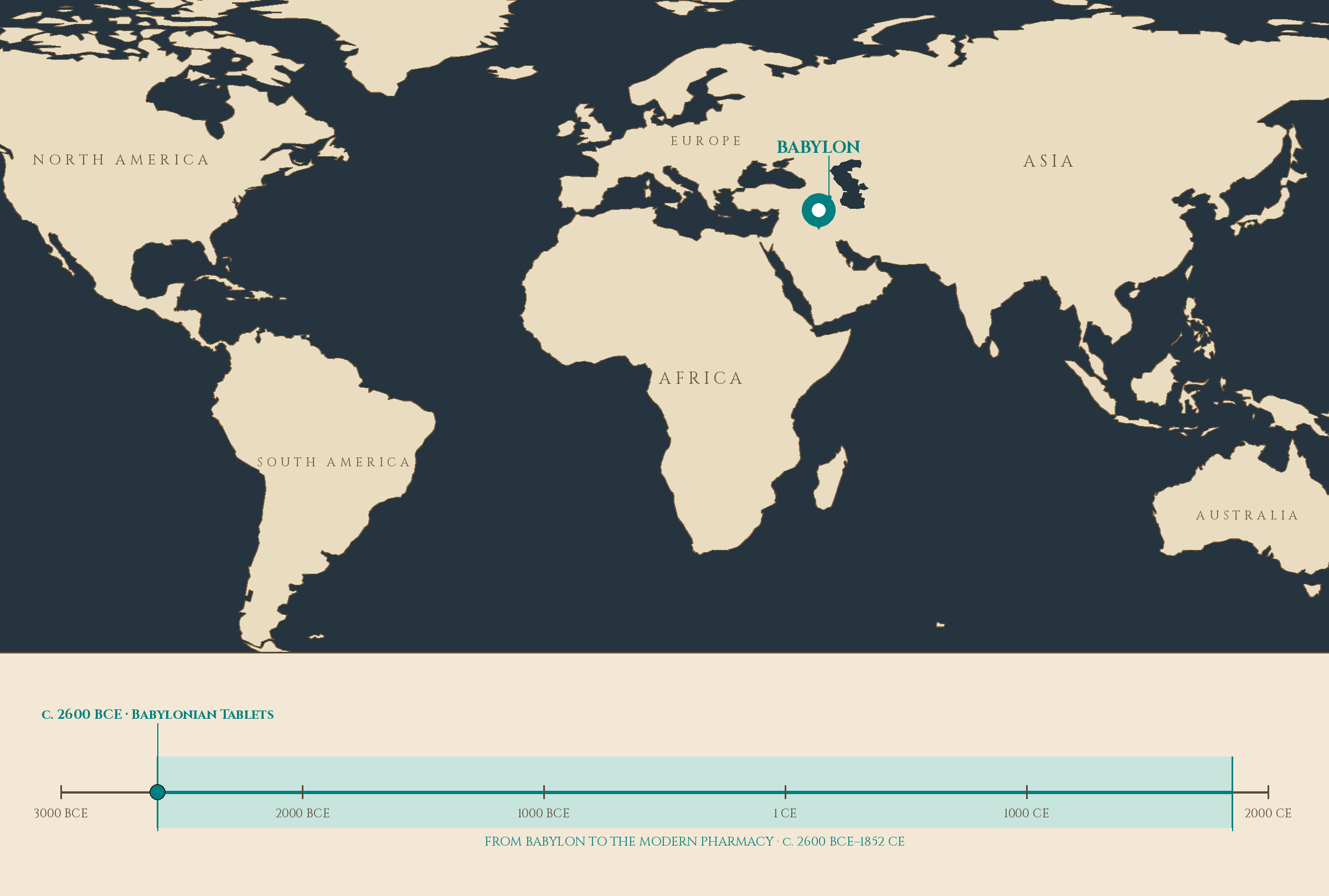
Pin: BABYLON. Timeline stop: c. 2600 BCE · Babylonian Tablets.
Lesson Objectives
By the end of this lesson, you will be able to:
- Explain, in your own words, what the apothecary's craft is and how it connects to the modern pharmacy.
- State the three things this course will never do: make medicinal claims, give dosages, or permit tasting of unidentified materials.
- Recite the Safety Covenant from memory and explain why each rule exists.
- Name the six units of the course and the Master Apothecary capstone, and describe what each unit studies.
- Describe the archive system (journal, worksheets, labels) and the six-stage rhythm of every lesson.
- Complete, sign, and file your first archive entry.
Reading this lesson: ★ marks the passages to remember. They return on the unit quiz and the class test. Check in questions ask the material back as you go; answer them in your workbook when you meet them.
Working this lesson: Your assignment packet is the first download on this page. Work in it as the lesson moves along, answering each exercise as its subject is taught — or read the lesson through for your notes and take the exercises as homework afterward. Both are proper ways to sit this class. Signposts in the reading tell you where each exercise belongs. Written answers are short answers in your own words; a few honest lines are worth more than a filled page.
Your Assignment Packet
This lesson's exercises live in its packet: the Lexicon Handout (every term, course terms marked ◆), Materials, Guided Practice — which carries the signed Safety Covenant page, the archive's first sheet — the Assignment Manual with its answer key for self-checking, the Reflection Questions, and the Workbook Checklist. Download the packet before you begin and keep it beside you as you read.
Safety Briefing
Every lesson in this laboratory opens the same way: with the rules, before the work. Memorize this briefing. It does not change.
★ The Safety Covenant of the Potions Laboratory
Read aloud with an adult. Sign at the bottom. This covenant binds every lesson of the course.
- Nothing in this laboratory is medicine. No lesson makes claims about treating, curing, or preventing any condition. No lesson gives amounts to take, internally or otherwise. Our preparations are for study, craft, and display.
- Never taste, eat, drink, or inhale deeply from any material or preparation unless the lesson explicitly describes it as food-safe AND an adult has confirmed it for this exact batch. If you cannot positively identify a material, it is unidentified, and unidentified materials are never tasted.
- An adult is present for every lesson involving heat, steam, blades, alcohol, smoke, powders, irritants, lye, oils, or waxes. For this lesson, the adult reads the covenant with you and signs beside you.
- Label everything the moment it is made, opened, or moved to a new vessel: contents, date, and lesson number. A preparation without a label is an unidentified material.
- If anything spills on skin or eyes, or anything is swallowed: flush with clean water, tell an adult at once, and call your local poison control center or emergency number if there is any doubt. Never treat an exposure with a home remedy.
- Respect display-only markings. Preparations marked non-consumable or display-only are for looking, not for using on skin or tasting, no matter how pleasant they smell.
Scholar signature: ______________________________ Date: __________
Adult signature: ______________________________ Date: __________
File this signed page as the first sheet of your archive. It is the foundation everything else stands on.
Check in: Rule 3 names a long list of lesson conditions that require an adult present. Which single condition applies to this lesson itself, and what does the adult do here?
❦ In your workbook: record the Safety Covenant in your own way — the six rules, and why the briefing comes before the work — copy, sketch, or note what matters.
In your packet: Exercise I — Sign the Safety Covenant ◐ begins here. Work it now, or mark the place and take it as homework — your choice.
What the Apothecary's Craft Actually Is
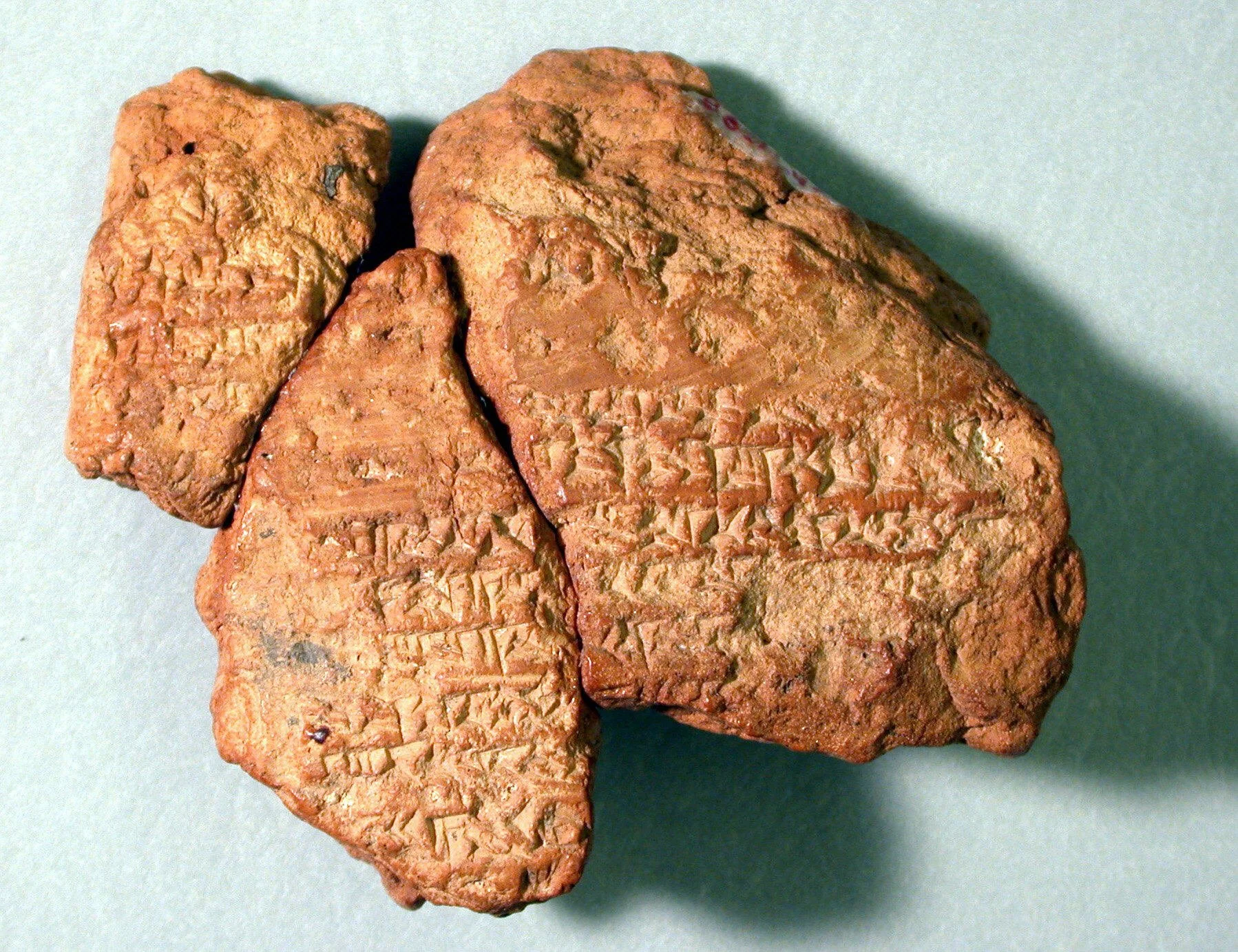
A Babylonian clay tablet recording treatments for ailments of the nose and mouth, Mesopotamia, ca. mid 1st–late 1st millennium BCE. The lesson's written record begins with tablets like this one: symptoms, prescriptions, and directions for compounding, pressed into clay.
The Metropolitan Museum of Art, Open Access (CC0). Object 86.11.474, "Cuneiform tablet: treatments for ailments of the nose and mouth."
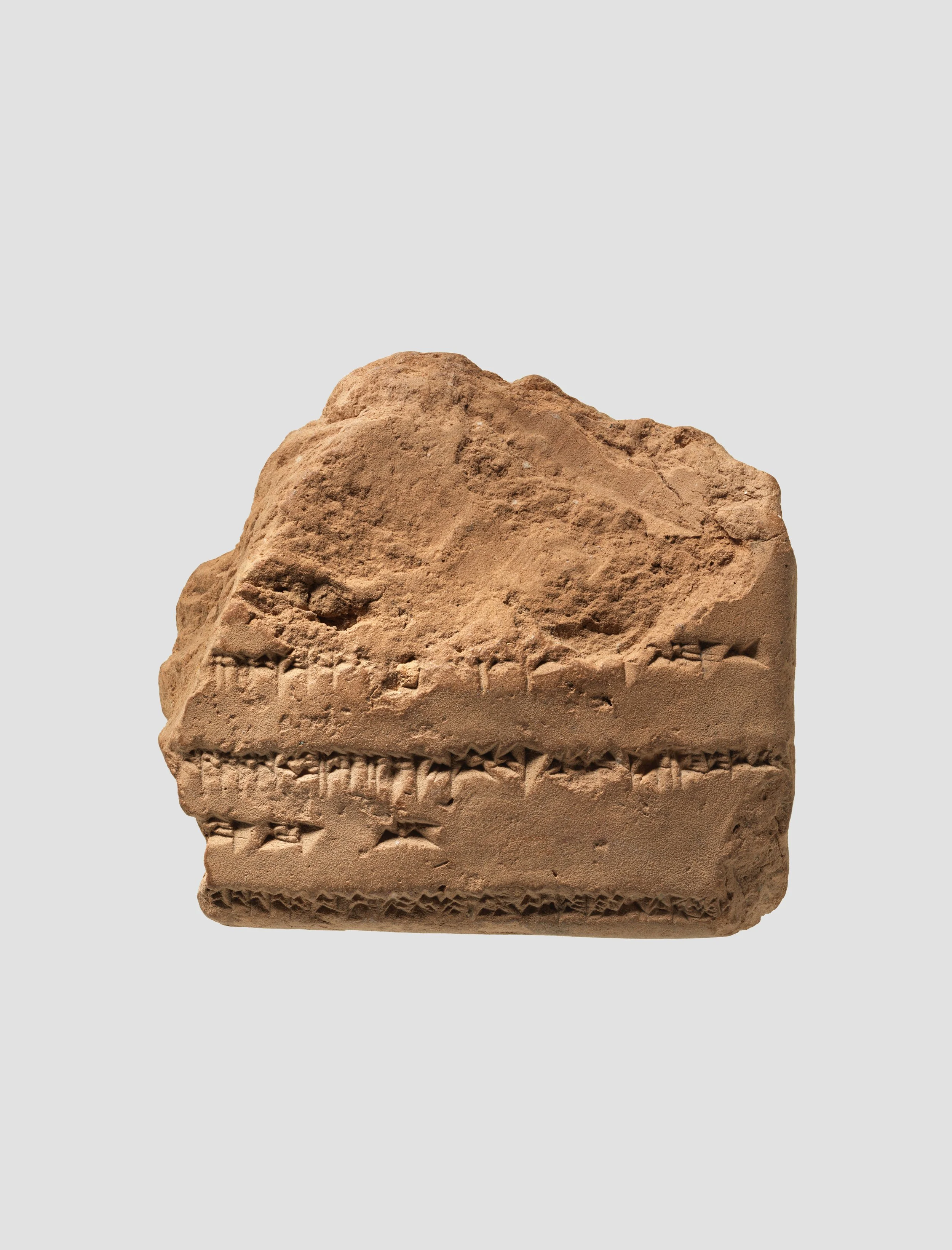
A clay tablet carrying an explanatory commentary on a list of materia medica, Mesopotamia, ca. late 1st millennium BCE. Long before Dioscorides wrote his five volumes, Mesopotamian scholars were already listing medical materials — and writing commentaries on the lists.
The Metropolitan Museum of Art, Open Access (CC0). Object 86.11.109, "Cuneiform tablet: explanatory commentary on a list of materia medica."
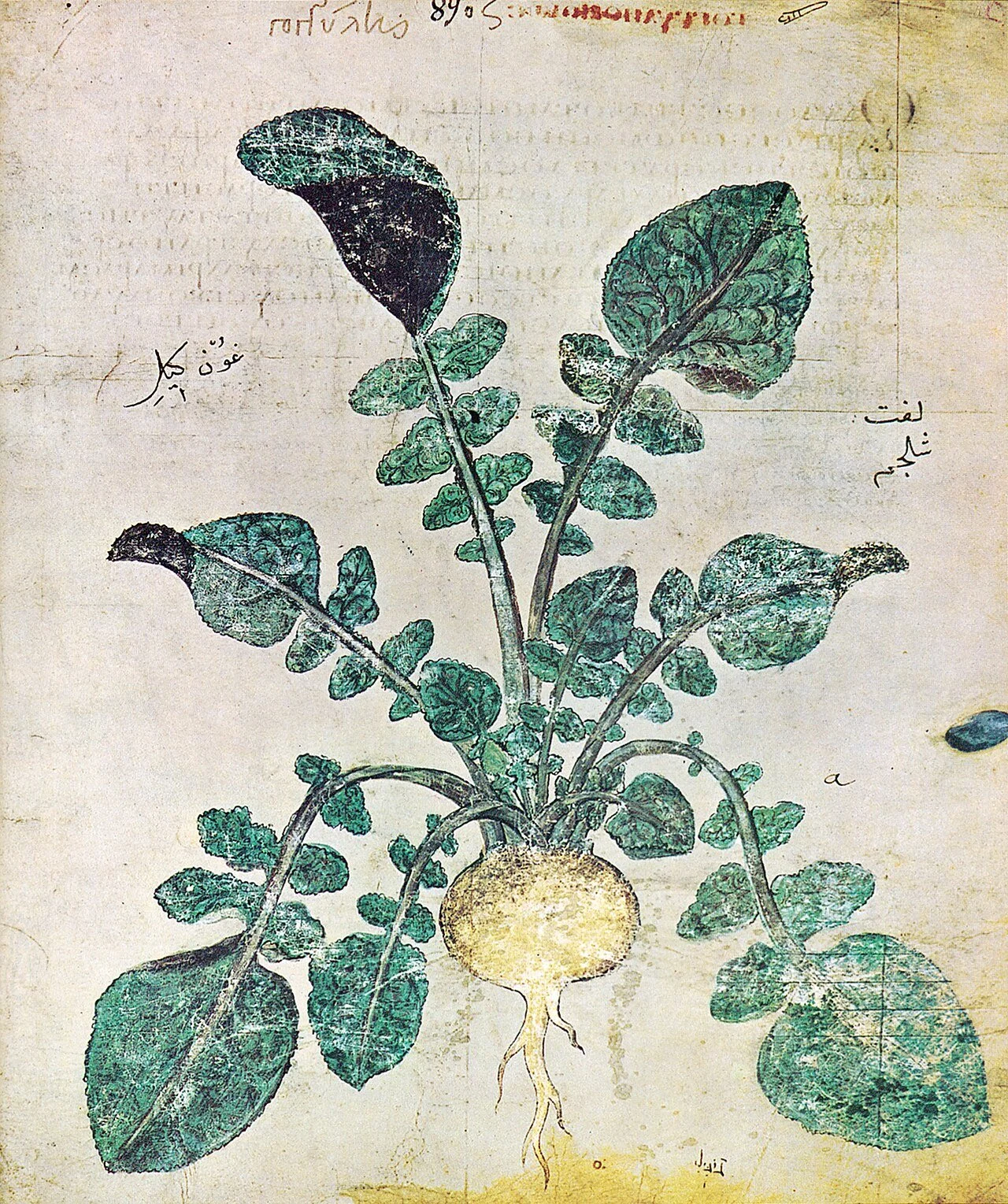
Folio 89r of the Vienna Dioscurides (Constantinople, c. 512 CE): the white turnip, Brassica rapa. This surviving illustrated copy of Dioscorides' De Materia Medica — the foundation of pharmacy texts for more than 1,500 years — was still being annotated by readers centuries later, as the Arabic notes in its margins show.
Public domain (PD-scan of a public-domain original), Wikimedia Commons, "Weiße Rübe (Wiener Dioskurides, 89r).jpg"; manuscript: Österreichische Nationalbibliothek, Codex medicus graecus 1.
The word itself tells the story. "Apothecary" comes from the ancient Greek apothēkē, meaning a storehouse or repository, by way of the Latin apotheca and the medieval Latin apothecarius, the storekeeper. An apothecary was, at root, the keeper of the storehouse: the person who received plant and mineral materials, judged their quality, prepared them by known methods, and dispensed them with care. The shop, the shelves of jars, the careful weighing, the written recipes: all of it follows from keeping a good storehouse.
This is one of the oldest crafts in the world, and its written record runs back thousands of years. Clay tablets from ancient Mesopotamia, including a Sumerian medical tablet from Nippur dating to around 2100 BC, record symptoms, prescriptions, and directions for compounding: among the earliest written evidence of the practice. In Egypt, the Papyrus Ebers, written around 1500 BC, collects more than 800 prescriptions using over 700 different drugs. Between 50 and 70 AD, the Greek physician Pedanius Dioscorides wrote De Materia Medica in five volumes, covering more than 600 plants. His treatise gave us the very term materia medica, the medical material. His book became the foundation of pharmacy texts for more than 1,500 years, studied and built upon by scholars of the Islamic Golden Age, where the first true pharmacies were established in Baghdad in 754 and were state-regulated by the ninth century.
In medieval Europe, the craft took the shape we recognize. Pharmacy-like shops appeared in the 1100s. In 1240, Emperor Frederick II issued a decree formally separating the physician's profession from the apothecary's: the physician would diagnose and prescribe, and the apothecary would prepare and dispense. Geoffrey Chaucer mentioned an apothecary in the Canterbury Tales in the late 1300s, which tells you the figure was familiar enough to need no introduction. In London, the apothecaries earned their own livery company, the Worshipful Society of Apothecaries, founded in 1617 with roots reaching back to the city's trade guilds of the 1100s. That Society still exists today.
The craft kept changing. In the 1800s, pharmacy grew into an independent science; the American Pharmaceutical Association was founded in 1852, and by the end of the century the modern roles had settled into place: the physician diagnoses, the pharmacist dispenses, and the old word "apothecary" narrowed to its modern meaning. In German-speaking countries the word never left: a German pharmacy is still an Apotheke, run by a qualified Apotheker.
Notice what did not change across all those centuries: the weighing, the preparing, the labeling, and the writing down. The apothecaries' long investigation of herbal and chemical ingredients became one of the roots of the modern sciences of chemistry and pharmacology. Apothecaries even kept their own system of weights and measures for small quantities, precise enough for the work. (You will learn a version of it in Lesson 6.) The tools changed. The discipline did not. That discipline is what you are here to learn.
Check in: Across Babylon, Baghdad, London, and the modern pharmacy, what four parts of the work never changed?
One caution, scholars, before we go further. The old books are full of remedies, and some of them sound tempting. We study the methods, not the medicine. The history is real, the technique is real, and the boundary is real too. Read on.
— Professor Crimblebrew Muddlenook, Potions Laboratory • Master Apothecary • Head of House Meridies
❦ In your workbook: record the apothecary's craft in your own way — the storehouse keeper, the long written record, and the discipline that did not change — copy, sketch, or note what matters.
What This Course Will and Will Not Do
Plain dealing now, so there is no confusion later.
This course will:
- Teach you real preparations: infusions, decoctions, syrups, tinctures, infused oils, salves, soaps, sachets, inks, wax seals, and more, made with your own hands.
- Teach you real historical technique: how materials were and are weighed, ground, heated, strained, blended, and stored.
- Teach you the honest history of the craft, with sources you can check.
- Require careful observation and complete written records, every lesson.
- Offer every practical lesson in two levels: Level One with household items only, and Level Two with historically closer materials for scholars who can gather them. Both levels teach the same craft.
★ This course will never:
- Make medicinal claims about any preparation. We do not say a preparation treats, cures, or prevents anything.
- Give dosages or amounts to take. No lesson contains a recipe for internal use measured as a dose.
- Ask you to taste, eat, or drink an unidentified material, or to identify an unknown plant for use.
- Teach the distillation of alcohol. (When we study distillation in Lesson 33, we work with water and steam only.)
- Substitute for medical training, advice, or care of any kind.
If that boundary disappoints you, I understand, and I hold it anyway. The apothecary's craft, as we practice it here, is the craft of preparation, observation, and record. There is a lifetime of honest work inside that boundary. Step inside it with me.
Check in: Name the three never-dos the objectives ask you to be able to state — then find the two further never-dos this list adds beyond them.
❦ In your workbook: record the course boundary in your own way — what this course will do, and what it will never do — copy, sketch, or note what matters.
The Archive System
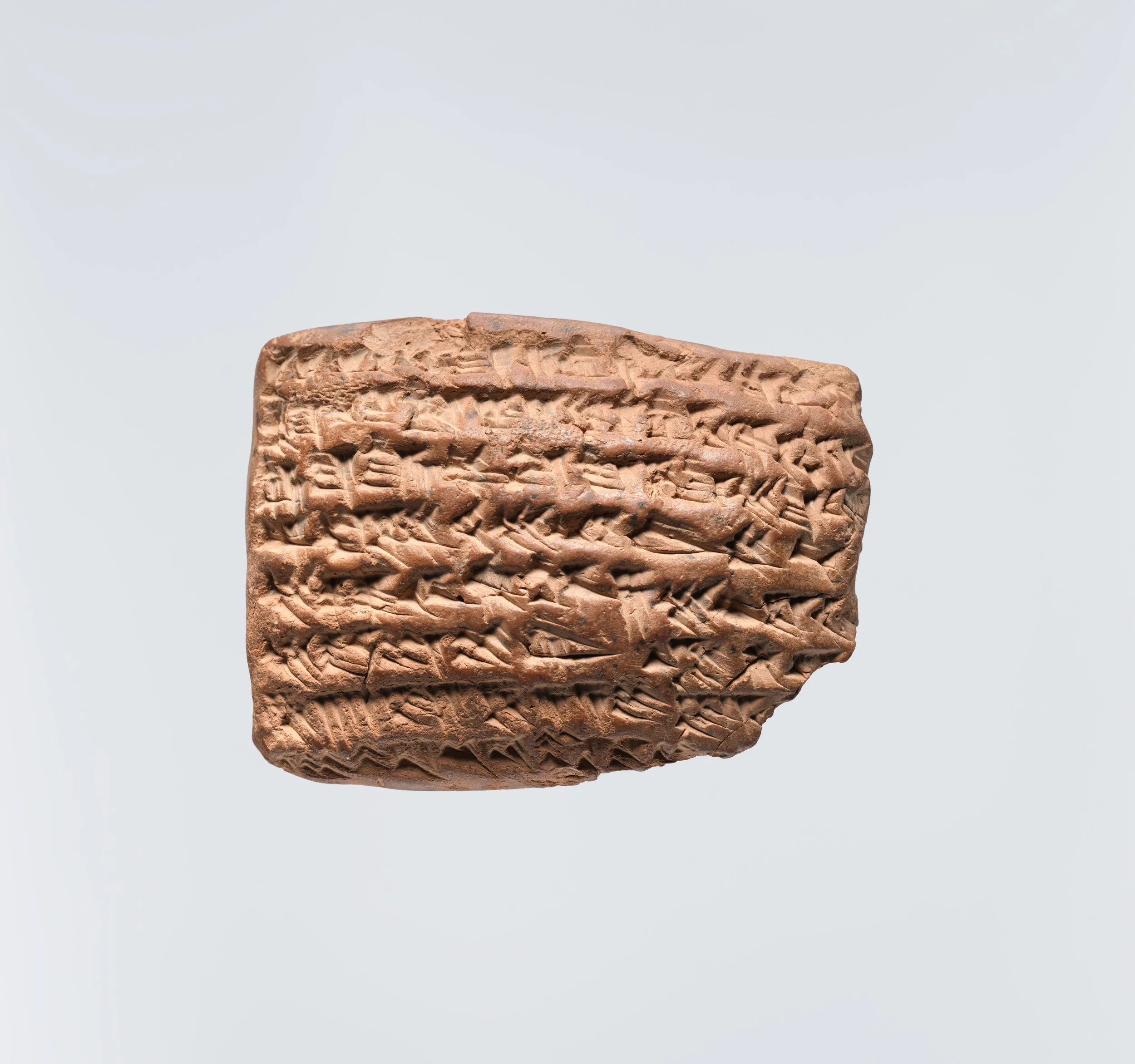
A cuneiform tablet with an incantation to Gula, Babylonian or Achaemenid, ca. mid- to late 1st millennium BCE — probably from Sippar, where it formed part of a large archive of medical texts. An archive is how a craft remembers: these tablets were filed, kept, and read by later workers, exactly as your Recipe Journal will be.
The Metropolitan Museum of Art, Open Access (CC0). Object 86.11.130, "Cuneiform tablet: Gula incantation."
An apothecary without records is just a person with jars. Our archive has three parts, and you will meet all three in every unit.
The Recipe Journal is your running notebook: one bound journal, kept by you, holding the dated entries for every lesson. Observations, measurements, sketches, mistakes, corrections. It is written in your own hand, on the day the work is done, because no one remembers a preparation exactly three months later, and the journal does.
Worksheets and ledgers are the printed pages: quiz sheets, matrices, batch records, and the formal tables some lessons require. They are filed by lesson, in order, behind the journal or in the binder. Loose sheets are lost sheets; file them the same day.
★ Labels are the archive you can read at a glance. Every vessel, packet, and bundle gets labeled the moment it is filled: contents, date, lesson number, and any display-only or non-consumable marking. The label is a promise to your future self, and to any stranger who picks up the jar, that the contents are known.
This system is not decoration. In the capstone, your archive is your evidence. Scholars with complete archives defend with confidence. Scholars without them defend from memory, which is to say, they do not defend at all.
Check in: What three things must every label carry — and what does the covenant call a preparation that has no label?
❦ In your workbook: record the archive system in your own way — the journal, the worksheets and ledgers, and the labels — copy, sketch, or note what matters.
In your packet: Exercise II — Open the Recipe Journal ⚒ begins here. Work it now, or mark the place and take it as homework — your choice.
The Rhythm of Every Lesson
Every lesson in this laboratory follows the same six stages, in the same order. Learn the rhythm now; it will carry you through fifty-two lessons.
- ★ Safety briefing. The rules for this lesson's materials and methods, before anything is touched.
- Mise en place. Every material, tool, and vessel laid out and checked before work begins.
- Procedure. The work itself, step by step, in order.
- Observation. What happened? What did you see, smell, and feel? The lesson is not over when the preparation is done; it is over when it is understood.
- Cleanup. Everything washed, dried, stored, and labeled. The bench is left ready for the next worker, who may be you.
- Archive entry. The dated record, written the same day.
This lesson is adapted to the rhythm: a long safety briefing, a small mise en place, a procedure of reading and signing, observation of your own workspace, a tidy cleanup, and your first archive entry. The shape is the same. Only the scale is smaller.
Check in: A scholar finishes a preparation, washes up, and puts the vessel away unrecorded. Which two stages of the rhythm have been skipped or left incomplete?
❦ In your workbook: record the rhythm of every lesson in your own way — the six stages, in their order — copy, sketch, or note what matters.
Procedure
Work slowly and in order. Your adult partner stays beside you throughout.
Step 1: Read the covenant aloud. Turn back to the Safety Briefing. Read the six rules of the Safety Covenant aloud, one at a time, with your adult. After each rule, say in your own words why it exists. If you cannot explain a rule, ask your adult to explain it, and write their explanation in the margin.
Step 2: Sign and date. Both of you sign and date the covenant page. If you signed in your journal, note the page number here: covenant signed on journal page ____.
Step 3: Prepare the journal. Fix the adhesive label or bookplate to the journal's cover or inside front cover. Write on it: your scholar name, "Potions Laboratory Recipe Journal," and today's date.
Step 4: Write the first archive entry. Turn to the first blank page. Copy the entry frame from the Archive Entry section below, and fill it in completely. Write your intention for the course in full sentences: not "to learn potions," but what you truly hope to be able to do by the capstone. Be specific. Be honest. This page is the first stone of the archive.
Step 5: Read the entry aloud. Read your intention statement aloud to your adult. Then close the journal. Lesson 1's procedure is complete.
❦ In your workbook: record the procedure in your own way — the five steps, in their order — copy, sketch, or note what matters.
Cleanup
There is little to clean today, and we clean it completely anyway. That is the discipline.
- Return pens, labels, and any printed pages to their places.
- Wipe the table.
- Shelve the journal somewhere safe, dry, and consistent: the same shelf, every time, from today forward. An archive that moves around is an archive that gets lost.
- Thank your adult partner. They will be with you for every lesson that needs them, which is most of them.
❦ In your workbook: record the cleanup in your own way — a clean bench and a journal shelved in its one place — copy, sketch, or note what matters.
Guided Observation: Observation and Your First Archive Entry
Before you clean up, observe. This is a laboratory habit, and it starts today.
Look slowly around the table where you worked. Notice five things you did not arrange deliberately: the way the light falls, a shadow, a texture, a small imperfection in the table, the exact color of your pen's ink on the page. Write each observation in the journal as a numbered list under today's entry, in this form: "I notice ___." No observation is too small. The apothecary's eye is trained the same way the apothecary's hand is: by practice, starting now.
Then look at your signed covenant and your labeled journal, side by side. That is what an ordered beginning looks like. Remember the feeling. You will reproduce it fifty-two times.
Copy this frame onto the first page of your Recipe Journal and complete it in full.
Scholar name:
Date:
Lesson: Unit I, Lesson 1: Welcome to the Potions Laboratory
Covenant: Signed and filed. (Note the page or location: _______________.)
My intention for this course:
(Write three or more full sentences. What do you hope to be able to make, know, or do by the capstone? What part of the craft calls to you? What will you do when a preparation fails?)
Observations (five "I notice" lines):
1. 2. 3. 4. 5.
❦ In your workbook: record the guided observation in your own way — five honest "I notice" lines from your own table — copy, sketch, or note what matters.
Materials
Everything in its place, before we begin. For this welcome lesson you will need:
Required (Level One — household items)
- A bound notebook or journal, blank, that will become your Recipe Journal for the course
- A pen and a pencil
- A printed or hand-copied page for the Safety Covenant signatures (or sign directly in the journal)
- An adhesive label or bookplate for the journal's cover
- An adult partner, seated beside you, for the covenant reading
- A clear table and a calm half hour
Suggested (Level Two — historically closer)
- An archival binder with tab dividers, one tab per unit, to house the journal pages, worksheets, and ledgers as the course grows
- Acid-free paper for any pages you will keep for years
- A proper bookplate, pasted inside the journal's front cover, bearing your scholar name and the date
Reflection Questions
Answer the following questions in your workbook.
- Real apothecaries once prepared medicines, but this course refuses to make medicinal claims. Why is that boundary important for a school laboratory?
- Every lesson ends with an archive entry. Why might a written record matter more than memory when you repeat a preparation months later?
- Which of the six units calls to you most, and what do you hope to make in it?
- Why does every lesson begin with a safety briefing instead of going straight to the interesting work?
- The apothecary's craft changed across thousands of years, from Babylonian tablets to the modern pharmacy. What does that long change suggest about the preparations you will learn: are they fixed recipes, or a living tradition?
Workbook Checklist — Lesson 1
In my workbook I have:
- ☐ read the six rules of the Safety Covenant aloud with my adult, explained each rule in my own words, and signed and dated the covenant page beside them
- ☐ filed the signed covenant as the first sheet of my archive (or noted its journal page number in my archive entry)
- ☐ labeled my Recipe Journal with my scholar name, "Potions Laboratory Recipe Journal," and today's date
- ☐ written my first archive entry in full: scholar name, date, lesson, covenant note, an intention of three or more full sentences, and five "I notice" observations
- ☐ copied the six unit titles and the capstone title onto a fresh journal page, with one concrete sentence under each of the seven headings, signed and dated
- ☐ stated the six stages of every lesson's rhythm in order, and the three things this course will never do
☐ Lesson completed Date: ___ Signature: ___
The Professor's Closing Note
Scholars, look at what you have made today. No potion, no preparation, and yet: a signed covenant, a labeled journal, a dated intention, and five honest observations. That is the whole craft in miniature. Everything from here is the same shape, larger. Keep this page clean. You will read it again at the capstone, and I want you to be proud of the scholar who wrote it.
— Professor Crimblebrew Muddlenook, Potions Laboratory • Master Apothecary • Head of House Meridies
Cross-Class Connections

Herbology · Unit V, Lesson 36 — The Materia Botanica: Building Your Herbal
Scholars, every plant you will ever prepare in Professor Muddlenook's laboratory began as a living thing in somebody's care — usually mine. Come to the Greenhouse and build the shared book our two classes keep together: one plant, one entry, my growing notes beside his preparation notes, so the mint you tended is the same mint whose dried leaves you will judge at his bench. One book, two classes, and your own handwriting in it from the first page.
Herbology · Unit I, Lesson 1 — The Scholar's Familiar
His archive and my ledger are the same habit wearing two coats: honest, dated, written the day the work is done. Come and open a grow ledger beside your Recipe Journal — choose one living plant, record where it stands today, and let it teach you the patience his laboratory will assume you already have. A scholar who keeps both books keeps the whole story of a plant, from windowsill to jar.
Scrollwork · Unit I, Lesson 1 — The Scriptorium Desk
Evening, scholars. Professor Muddlenook is right, and I will say it in his hearing: a label no one can read is an unlabeled jar. Come to the Scriptorium and set up the desk where trustworthy records are made — the sloped surface, the ordered page, the margins that hold your corrections — and every archive entry you write afterward will be a small manuscript worth keeping.

Creative Arts · Unit II, Lesson 11 — Case Binding & Archival Boxes
Last bench of the unit, scholars, and the one your Recipe Journal has been waiting for. Professor Muddlenook's journals are cased on this lesson, and his archive boxes are built by these rules: boards cut square, a case built to fit the book it houses, and a box that will outlast everyone in the room. Build the practice corner first, on scrap, as always. Then bring your journal, and we will house it properly.
Further Reading & Sources
- Apothecary — Wikipedia: the full history of the craft, from Babylonian tablets and the Papyrus Ebers through the medieval apothecary shops to the modern pharmacist, with the etymology from the Greek apothēkē.
- History of pharmacy — Wikipedia: Dioscorides and De Materia Medica, the Baghdad pharmacies of 754, Frederick II's decree of 1240, and the 19th-century birth of pharmacy as an independent science.
- The Society of Apothecaries — apothecaries.org: the London livery company founded in 1617, still active today; its own account of the apothecaries' roots in the city's medieval trade guilds.
Browse the Potions shelf in the school Library for readable editions of these works.
Submit your work for this lesson using the form below.
CONTINUE IN THE POTIONS LABORATORY
Next · Lesson 2: The Scriptorium & Workspace Zoning →
Unit I — Foundations of the Laboratory Potions Laboratory — All 52 Lessons
The rest of Unit I: Lesson 2 · Scriptorium & Zoning · Lesson 3 · Vessels & Glasswork · Lesson 4 · Labels & Seals · Lesson 5 · Recipe Journals · Lesson 6 · Weights & Measures · Lesson 7 · Grinding · Lesson 8 · Simples Census · Lesson 9 · Hearth Clearance