

POTIONS
Unit I · Lesson 9HEARTH CLEARANCE
Professor Crimblebrew Muddlenook
Master Apothecary • Potions
Head of House Meridies • School of Evershade
Professor's Introduction

Welcome back, scholars. This is our ninth lesson together, and it is the last of Unit I. Take a look around the laboratory you have built. Nine lessons ago this was an ordinary corner of an ordinary kitchen. Now it is zoned, shelved, labeled, and journaled. It has vessels, a balance of weights, a grinding station, and the beginnings of an archive. It is, by every measure that matters, a working apothecary's laboratory.
And now we do the thing every working apothecary did at the end of every working day. We close the shop.
Closing mattered as much as opening. The historical apothecary who left a fire burning untended, a poison jar unlocked, or a label half written was not merely untidy. He was dangerous, and his whole street knew it. So the end of the day had its own ritual, as fixed as the morning's opening: bank the fire, lock the dangerous stores, check the labels, sweep the zones, and write the night's accounting into the daybook. We are going to learn that ritual today, and you are going to carry it with you for the rest of this course.
After the clearance, we will walk back through all nine foundations of this unit, one by one, so you can see what each of them built. And then I will show you the door into Unit II, where the senses take over and the materials begin to speak.
Aprons on. We close the shop properly, the way it has been done for centuries.
— Professor Crimblebrew Muddlenook, Potions Laboratory • Master Apothecary • Head of House Meridies
Sealed note from Professor Muddlenook: Scholars, I keep the key to my own poison cabinet on a ribbon around my neck, and I have done so for forty years. Not because I distrust my students. Because the ritual of locking it, every single night, is what makes the danger real in my hands instead of merely real in my head. Rituals are how careful people stay careful when they are tired. Tonight you begin yours. — Professor Crimblebrew Muddlenook, Potions Laboratory • Master Apothecary • Head of House Meridies
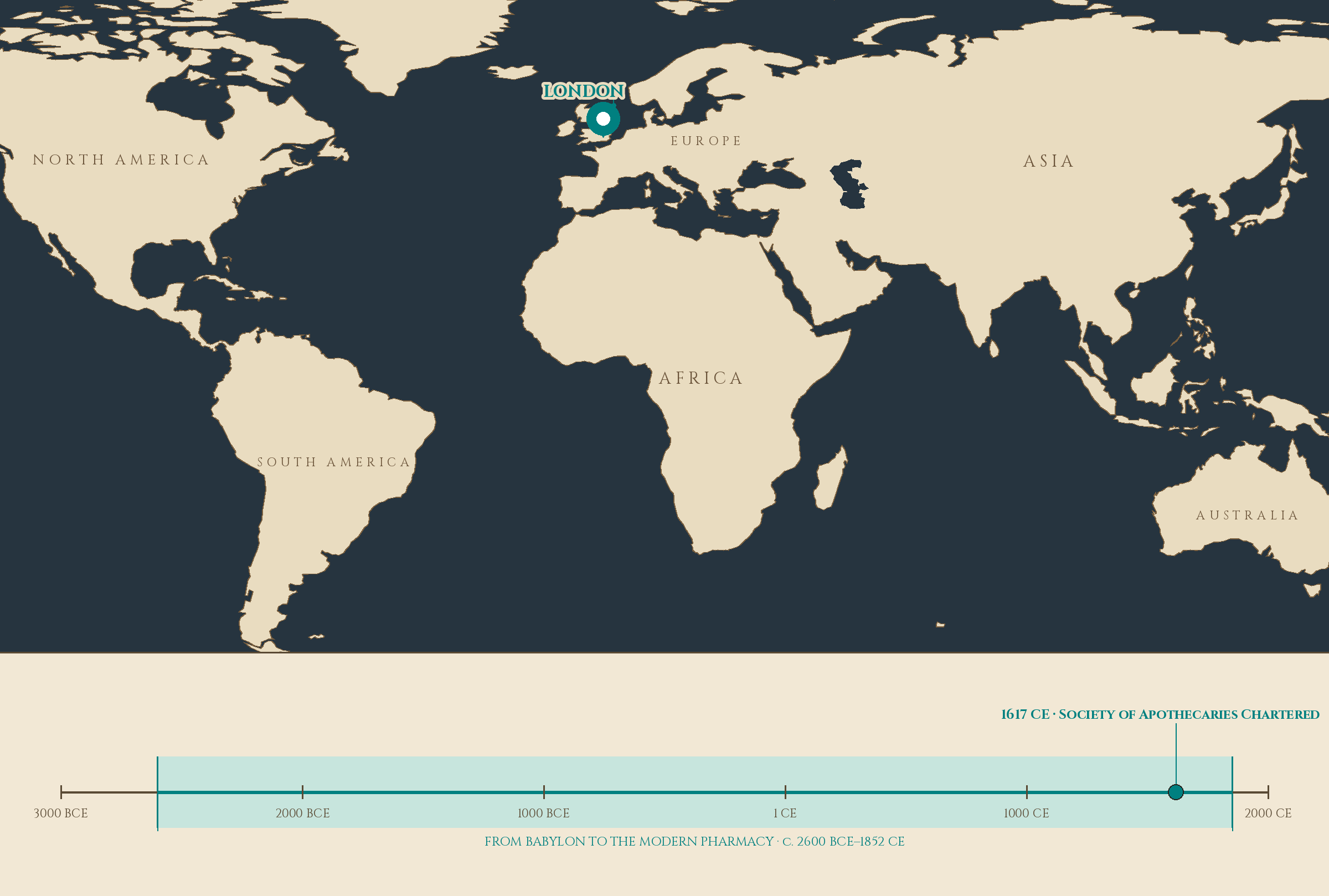
Pin: LONDON. Timeline stop: 1617 CE · Society of Apothecaries Chartered.
Lesson Objectives
By the end of this lesson, you will be able to:
- Define hearth clearance and explain why it is the final step of the laboratory rhythm.
- Perform the complete shutdown procedure: heat sources extinguished and cooled, blades and tools secured, chemicals locked or shelved, labels and seals verified, zones swept, waste sorted, and restocking noted.
- Describe how historical apothecaries closed their shops, including banking the fire and the locked poison cabinet, and connect those practices to modern laboratory clearance.
- Name all nine foundations of Unit I and explain what each one built in your laboratory.
- Use the standing Clearance Checklist correctly and file it in your archive.
- Preview the work of Unit II: the senses and the materials.
Reading this lesson: ★ marks the passages to remember. They return on the unit quiz and the class test. Check in questions ask the material back as you go; answer them in your workbook when you meet them.
Working this lesson: Your assignment packet is the first download on this page. Work in it as the lesson moves along, working each exercise as its subject is taught — or read the lesson through for your notes and take the exercises as homework afterward. Both are proper ways to sit this class. Signposts in the reading tell you where each exercise belongs. Written answers are short answers in your own words; a few honest lines are worth more than a filled page.
Your Assignment Packet
This lesson's exercises live in its packet: the Lexicon Handout (every term, course terms marked ◆), Materials, Guided Practice (the eight-step clearance procedure itself, printed in order so you can work through it at your own bench), the Assignment Manual with its self-check, the Reflection Questions, and the Workbook Checklist. Download the packet before you begin and keep it beside you as you read.
Safety Briefing
This lesson is about safety the way a lock is about a door. The clearance is the safety procedure, so read this briefing as instructions, not background.
- ★ Heat sources. Every heat source in your workspace must be fully extinguished and cool to the touch before you leave it. Candles are snuffed, never blown near papers. Hot plates and burners are switched off and unplugged. Nothing that was hot gets put away while still warm. If you used an open flame at any point, an adult was present, and an adult confirms the shutdown.
- ★ Chemical storage. Every chemical, from washing soda to essential oils, goes back to its designated shelf, sealed and labeled. Nothing stays on the bench overnight. Strong or hazardous materials are kept separate from everything else, ideally in a dedicated box or cabinet, and that box stays closed. Never store any chemical in a food or drink container, no matter how well labeled.
- ★ Blades and tools. Knives, graters, scissors, and any sharp tool are cleaned, dried, and returned to their storage place, edges protected. A blade left on a bench is a blade that finds a hand.
- ★ Waste. Sort waste as you clear: compostable plant material to compost, recyclables to recycling, everything else bagged and binned. Liquids go down the drain only if they are plain water or food-safe infusions; anything else goes into a sealed container in the household trash. Wash your hands when the waste is handled.
- ★ Labels. A clearance is not complete until every open container on your shelves carries a complete, legible label. An unlabeled jar found during clearance gets labeled on the spot or emptied. There is no third option.
- ★ Younger scholars perform the hearth clearance with an adult the first three times, until the checklist is memorized and the habits are set.
Professor's aside: I have one rule in this laboratory that I have never bent. Nobody leaves while a heat source is still warm. Not for supper, not for a visitor, not because the lesson ran long. The fire does not care about your schedule. Cool it, confirm it, and then go.
Check in: An unlabeled jar is found during clearance. What are its only two fates — and why is there no third option?
❦ In your workbook: record the safety briefing in your own way — heat, chemical storage, blades, waste, labels, and the adult rule for younger scholars — copy, sketch, or note what matters.
Mise en Place
Gather the following before you begin. The clearance is done with these tools in hand, not fetched halfway through.
- Your Recipe Journal (Lesson 5), open to a fresh page
- The Clearance Checklist printed or copied into your journal (the full text is in the Procedure section below)
- A pen for the checklist and the journal
- One damp cloth and one dry cloth
- A small brush, or a dustpan and brush, for grinding dust
- A waste bag and access to your compost, recycling, and trash
- Blank labels and a marker, for any label found wanting
- Your shelf or box where chemicals are stored, so returns have somewhere to go
Level Two scholars may add a brass candle snuffer, a dedicated lockable box for strong materials (the modern echo of the poison cabinet), and a small dustpan set kept with the grinding station.
❦ In your workbook: record the mise en place in your own way — what is gathered before the clearance begins, and why nothing is fetched halfway through — copy, sketch, or note what matters.
The Shop at Closing Time
The apothecary's shop was a business before it was a legend.
It had opening hours, regular customers, deliveries to check in, and a daybook in which every sale and every preparation was written down.
The men and women who ran these shops were craftspeople with rent to pay, and their closing routine was a business practice: protect the stock, protect the premises, and write down what happened so tomorrow could begin without confusion.
London's apothecaries organized themselves early.
They broke away from the Grocers' Company and received their own royal charter from James I on 6 December 1617, becoming the Worshipful Society of Apothecaries.
That charter recognized what the apothecaries already knew: their work required specialist skill, and specialist skill required standards.
Standards do not keep themselves. They are kept by daily habits, and the closing of the shop was one of the most important habits of all.
What did closing look like?
The surviving records, daybooks, and shop manuals give us the shape of it, though no single document lays out one universal routine.
The pattern that repeats across centuries is steady: the fire was made safe for the night, dangerous substances were put away under lock, the shelves were checked, and the books were written up.
Each of those steps survives in our modern clearance, and each one has a reason rooted in real risk.
The night's accounting came first in importance if not in order.
Whatever had been used during the day was entered in the daybook: materials consumed, preparations made, stock running low.
An apothecary who did not know what the day had cost could not know what tomorrow required.
Your archive entry at the end of this lesson is the direct descendant of that practice.
Then came the physical securing of the shop, and here the historical record is at its most instructive.
Fire was the great danger of the premodern shop.
Everything in it could burn: the wooden shelves, the paper labels, the dried botanicals, the alcohol-based preparations.
A fire left careless overnight could take the shop, the street, and lives with it.
So the fire was never simply left. It was banked or it was put out, deliberately, every night, by someone who knew fire the way a sailor knows weather.
Dangerous substances received the same deliberate treatment.
Long before modern regulation, careful apothecaries kept their most hazardous materials separate from the ordinary stock and under lock.
★ The principle was later written into law: the Pharmacy Act of 1868 named fifteen poisons, restricted their sale to qualified sellers, and set rules for how such substances were to be labeled and kept.
The locked poison cabinet of the nineteenth-century pharmacy is the direct ancestor of our chemical shelf rules.
The lock was never about distrust. It was about making sure that the most dangerous things in the room could only be reached deliberately, never by accident.
In many towns, the end of the working day had a public sound: the curfew bell, rung in the evening to mark the hour when fires were to be covered and the streets grew quiet.
The word curfew itself comes from the old French for covering the fire.
When you perform your hearth clearance tonight, you are answering a bell that has been ringing for a very long time.
Check in: The closing pattern repeats across centuries in four steps. Name them — and name the one your own archive entry descends from.
❦ In your workbook: record the shop at closing time in your own way — the daybook, the fire, the locked stores, and the curfew bell — copy, sketch, or note what matters.
In your packet: Guided Practice — the eight-step clearance procedure begins here. Work it now, or mark the place and take it as homework — your choice.
Banking the Fire
★ To bank a fire is to put it to sleep without letting it die.
The coals are raked together, covered with a layer of ash, and left to smolder slowly through the night on almost no air.
In the morning, the ash is raked back and the living coals start the day's fire in minutes.
People banked fires for centuries, in hearths and forges and bake ovens, for the simplest of reasons: starting cold every morning wastes fuel, wastes time, and wastes effort.
A banked fire is a favor the evening does for the morning.
Our laboratory works differently, and our version of banking is simpler and stricter.
We do not keep coals alive overnight. We put every heat source fully out and confirm it cold.
The principle is the same, though the method is reversed: the historical apothecary managed fire so it would survive the night safely, and we manage heat so the night is safe from it.
Both are acts of deliberate control over the most dangerous thing in the room.
★ Your heat shutdown, every time, in this order: extinguish the flame or switch off the heat. Remove the vessel from the heat and set it on a heat-safe surface. Unplug the appliance if it has a cord. Wait, and then test with the back of your hand held near, not on, the surface. Only when it is cool to the approach is the heat source cleared. Then, and only then, is it put away.
Professor's aside: I once watched a student put a still-warm saucepan into a cupboard and close the door on it. Nothing caught fire. That is not the point. The point is that she did not know whether it would, and she closed the door anyway. Never close a door on a question. Answer it first. Cool is not a guess. Cool is a fact you check with your hand.
Check in: Banking kept coals alive overnight; our shutdown puts every heat source fully out. What single principle do the two opposite methods share?
❦ In your workbook: record banking the fire in your own way — the historical method, our reversed method, and the heat shutdown in its order — copy, sketch, or note what matters.
The Poison Cabinet and the Chemical Shelf
Every laboratory needs a place where the strong things live.
In the historical pharmacy it was the poison cabinet: a locked cupboard, kept apart from the ordinary stock, holding the substances that could harm in the wrong hands or the wrong amounts.
The 1868 Act made the principle law, but the practice is older than the law.
Careful keepers have always separated the dangerous from the everyday.
Your chemical shelf follows the same principle, scaled to a home laboratory.
Designate one shelf, box, or cabinet as the strong-stores.
Everything that is corrosive, strongly scented, solvent-based, or simply not food goes there.
The strong-stores stay closed when not in use.
★ Nothing in the strong-stores is ever transferred into a food or drink container, and nothing from the strong-stores is ever stored where food is kept.
Labels on strong-stores are checked first during every clearance, because a missing label on a mild material is a nuisance and a missing label on a strong one is a hazard.
Blades live by the same logic.
Knives, graters, scissors, and sharp tools are cleaned, dried, and stored edge-protected in their place after every use.
During clearance you confirm each blade is home. Count them if you must.
An orderly apothecary knows exactly how many blades the laboratory holds.
None of this is about fear. It is about deliberateness.
The locked cabinet does not say the substances inside are evil. It says they deserve your full attention, and the lock guarantees they get it.
Check in: Why are strong-stores labels checked first in every clearance? What does the missing label cost on a mild material, and what on a strong one?
❦ In your workbook: record the poison cabinet and the chemical shelf in your own way — the strong-stores, their two never-rules, and why blades live by the same logic — copy, sketch, or note what matters.
In your packet: Exercise I — Perform the Full Hearth Clearance ⚒ begins here. Work it now, or mark the place and take it as homework — your choice.
Labels, Seals, and the Shelf's Memory
A shelf has a memory, and its memory is made of labels.
Every jar, bottle, box, and bag on your shelves speaks through its label: what it is, when it arrived, what was done to it, where it belongs.
During the working day, that memory gets bruised.
Labels get splashed, smudged, peeled at the corner, or written in a hurry.
Seals loosen. A jar gets opened and closed a dozen times and the wax cracks.
The clearance is when the shelf's memory is repaired.
Walk the shelves slowly, the way the historical apothecary walked the shop at closing.
Read every label.
If one is damaged or incomplete, rewrite it now, while the contents are still fresh in your mind and the material can still be identified with certainty.
Check every seal: lids tight, wax unbroken, corks seated.
★ An open container found at clearance gets sealed or emptied. There is no third option, and there never was.
This is also when you notice what the day cost.
A jar that was full in the morning and is half empty at night has told you something.
Write it down.
That observation becomes tomorrow's restocking note, and the restocking note becomes the archive's memory of what the laboratory consumes.
The shelf remembers through you.
Check in: Why must a damaged label be rewritten during the clearance, and not left for tomorrow morning?
❦ In your workbook: record labels, seals, and the shelf's memory in your own way — how the memory gets bruised, how clearance repairs it, and how a half-empty jar becomes a restocking note — copy, sketch, or note what matters.
The Nine Foundations
Unit I built your laboratory one foundation at a time. Before the clearance, walk them with me, so you can see the whole building.
Lesson 1, Welcome to the Potions Laboratory, gave you the map of the course and the rhythm every lesson follows: safety briefing, mise en place, procedure, observation, cleanup, archive entry. You learned it first because everything else hangs on it.
Lesson 2, The Scriptorium and Workspace Zoning, divided your workspace into zones with purposes: where heat lives, where cutting happens, where the archive sits undisturbed. The clearance walks those zones in order, and it only works because the zones exist.
Lesson 3, Vessels, Jars and Blown Glasswork, stocked your shelves with containers and taught you to know them by material and use. The clearance returns every vessel to its place, clean and dry.
Lesson 4, Labels, Wax Seals and Ingredient Markings, gave your shelves their memory. The clearance reads that memory back and repairs it.
Lesson 5, Recipe Journals and Archival Notes, gave you the archive itself: the journal, the daybook habit, the rule that nothing important lives only in your head. The clearance ends with an archive entry, as every lesson does.
Lesson 6, Apothecary Weights and Measures, gave you the balance and the discipline of measuring. Honest weights are part of an honest archive.
Lesson 7, Grinding, gave you the mortar, the technique, and the dust. The clearance sweeps the grinding station because grinding always leaves its signature behind.
Lesson 8, The Simples Census, counted and recorded your botanical holdings and began your first Materia Botanica entry drafts. The clearance checks the census against the shelves: is everything the archive claims still there?
★ Lesson 9, Hearth Clearance, is the roof on the building. It takes all eight foundations and uses them together, in order, every time you work. A laboratory that is cleared properly after every lesson never drifts into disorder, because disorder is never given a night to settle in.
Sealed note from Professor Muddlenook: Scholars, you have now met the history. What follows is the practice, and the practice is where Unit I pays for itself. Every lesson you have taken so far built one piece of the clearance you are about to perform. The zones tell you where things go. The vessels tell you what is what. The labels speak. The journals remember. The weights keep you honest. The grinding station has its own dust to sweep. The census tells you what the shelves should hold. Clearance is not a new skill stacked on top of eight old ones. It is the eight old ones, used together, in order, the way they were always meant to be used. — Professor Crimblebrew Muddlenook, Potions Laboratory • Master Apothecary • Head of House Meridies
Check in: The clearance "only works because the zones exist." Name two more foundations the clearance cannot perform without, and what each contributes.
❦ In your workbook: record the nine foundations in your own way — one line for what each lesson built, and how the ninth uses them all together — copy, sketch, or note what matters.
In your packet: Exercise II — The Nine Foundations Map ⚒ begins here. Work it now, or mark the place and take it as homework — your choice.
What Comes Next: Unit II
Unit I gave you the laboratory. Unit II fills it with knowledge.
The unit is called the Senses and the Materials, and its work is exactly what the name promises: you will learn to judge botanical and mineral materials the way the historical apothecary did, with trained senses and disciplined records.
You will meet the simples one family at a time: kitchen botanicals, seeds and spices, roots and barks, flowers and leaves.
You will learn to receive dried materials and judge their quality, to tell last year's stock from this year's, to record what your eyes, hands, and nose tell you in the archive.
And through it all, the potions journal you began in Lesson 5 will grow beside you, entry by entry, until it holds a record of every plant the course touches.
★ The clearance checklist you learn today goes with you. Every practical lesson in Units II through VI ends the same way: with the shop closed properly, the shelves speaking clearly, and the archive one entry richer.
That is the rhythm. You know it by heart now.
❦ In your workbook: record what comes next in your own way — what Unit II will teach, and the one instrument of this lesson that travels with you into every unit after it — copy, sketch, or note what matters.
Procedure: The Hearth Clearance
★ Perform the clearance in this order. Read each step aloud as you do it, until the sequence lives in your hands.
- Bank the heat. Extinguish every flame. Switch off every burner and hot plate. Unplug what has a cord. Move vessels to heat-safe surfaces. Wait, then confirm cool with the back of your hand held near the surface. Nothing warm is put away.
- Secure the blades. Clean, dry, and store every knife, grater, scissors, and sharp tool, edges protected. Count them against your known number.
- Secure the chemicals. Return every chemical to the strong-stores or its designated shelf, sealed and labeled. Close the strong-stores. Nothing remains on the bench.
- Walk the labels. Read every label on the shelves. Rewrite any that are damaged or incomplete. Check every seal: lids tight, wax unbroken, corks seated. Seal or empty anything found open.
- Sweep the zones. Go zone by zone, in the order you established in Lesson 2. Return every tool and vessel to its zone. Wipe the work surfaces: damp cloth first, dry cloth after. Brush grinding dust into the dustpan and bin it.
- Audit the waste. Sort everything the session produced: compostable plant matter to compost, recyclables to recycling, the rest bagged for trash. Liquids down the drain only if plain water or food-safe. Wash your hands.
- Note the restocking. In your journal, list anything running low or used up, and anything damaged that needs replacing. This is the night's accounting.
- File the clearance. Copy the completed checklist into your Recipe Journal, sign and date it, and note anything unusual. The clearance is not finished until it is written down.
❦ In your workbook: record the procedure in your own way — the eight steps in their order, and the step your own laboratory makes hardest — copy, sketch, or note what matters.
In your packet: Exercise I — Perform the Full Hearth Clearance ⚒ begins here. Work it now, or mark the place and take it as homework — your choice.
Guided Observation
A clearance is an inspection disguised as a chore. While you work, notice what the laboratory tells you.
Notice which zone collects the most disorder, because that zone is telling you its boundaries need adjusting.
Notice which labels failed, because the pattern of failure tells you whether the problem is splashing, handling, or hurried writing.
Notice what ran out fastest, because consumption is data about your real practice, not your planned practice.
Notice any smell that should not be there, any dampness, any stickiness, any jar that feels lighter than its label claims.
Write the three most interesting observations in your journal beneath the checklist.
Observations made during clearance are often the most honest ones, because the work is done and there is nothing left to prove.
❦ In your workbook: record the guided observation in your own way — what the clearance inspects while it tidies, and the three observations you will write beneath your own checklist — copy, sketch, or note what matters.
Cleanup
The clearance includes the cleanup, but the cleanup deserves its own moment of attention.
Waste sorted during clearance leaves the laboratory tonight: compost to the compost, recycling to the bin, trash bagged and tied.
Cloths are rinsed and hung to dry.
The brush is tapped clean.
Wash your hands last of all, after the waste is handled and before you write in the journal, so the archive stays clean.
If anything spilled during the session, it is dealt with now, not tomorrow.
Sticky is cleaned with hot water and soap. Oily is cleaned with hot water, soap, and patience.
★ Unknown is treated as strong: gloves, ventilation, and no guessing. When in doubt, ask an adult before you clean it.
❦ In your workbook: record the cleanup in your own way — what leaves tonight, the order of the last tasks, and how an unknown spill is treated — copy, sketch, or note what matters.
Archive Entry
Your archive entry for this lesson has two parts.
First, the completed Clearance Checklist, copied into your Recipe Journal, signed and dated, with your three observations beneath it.
This is the first of many: you will file one after every practical lesson in Units II through VI, and they will become a record of your laboratory's whole working life.
Second, the Unit I reflection.
On a fresh page, answer in your own words: which of the nine foundations felt most important to you, and why? Which one still needs practice? What is one thing you will do differently in Unit II because of what Unit I taught you?
There are no wrong answers. There are only honest ones and hurried ones, and you know which the archive deserves.
Sealed note from Professor Muddlenook: In good order, scholars. Unit I is complete, and so is your laboratory. You came to me with a kitchen corner, and you leave this unit with zoned benches, labeled shelves, honest weights, a grinding station, a census, and an archive. More than that, you leave with a rhythm: brief, gather, work, watch, clean, record. That rhythm will carry every lesson from here to the Master Apothecary's capstone. Keep it. Trust it. And when Unit II opens its doors, walk through them with your checklist in your hand. I will be waiting, and the kettle, as always, will be on. — Professor Crimblebrew Muddlenook, Potions Laboratory • Master Apothecary • Head of House Meridies
❦ In your workbook: record the archive entry in your own way — its two parts, and where this first filed checklist will sit in the record of your laboratory's working life — copy, sketch, or note what matters.
In your packet: Exercise III — The Restocking Requisition ◐ begins here. Work it now, or mark the place and take it as homework — your choice.
Materials
Required (Level One — household items)
- Your Recipe Journal (Lesson 5), open to a fresh page
- The Clearance Checklist printed or copied into your journal (the full text is in the Procedure section)
- A pen for the checklist and the journal
- One damp cloth and one dry cloth
- A small brush, or a dustpan and brush, for grinding dust
- A waste bag and access to your compost, recycling, and trash
- Blank labels and a marker, for any label found wanting
- Your shelf or box where chemicals are stored, so returns have somewhere to go
Suggested (Level Two — historically closer)
- Brass candle snuffer
- A dedicated lockable box for strong materials (the modern echo of the poison cabinet)
- A small dustpan set kept with the grinding station
Safety: This lesson is about safety the way a lock is about a door. The clearance is the safety procedure, so read the Safety Briefing at the head of this lesson as instructions, not background. Every heat source must be fully extinguished and cool to the touch before you leave it; every chemical returns to its designated shelf, sealed and labeled; and younger scholars perform the hearth clearance with an adult the first three times, until the checklist is memorized and the habits are set.
Reflection Questions
Answer the following questions in your workbook.
- Why does the clearance come last in the laboratory rhythm instead of being skipped when you are tired?
- Banking the fire kept coals alive overnight; our heat shutdown puts every heat source fully out. What principle do the two practices share despite their opposite methods?
- The 1868 Pharmacy Act named fifteen poisons and restricted their sale to qualified sellers. What principle does the historical poison cabinet share with our chemical shelf rules?
- Which of the nine foundations felt most important to you, and which one still needs practice? What will you do differently in Unit II because of Unit I?
- How does filing a signed clearance checklist change the way you begin your next lesson?
Workbook Checklist — Lesson 9
In my workbook I have:
- ☐ defined hearth clearance and stated why it is the final step of the laboratory rhythm
- ☐ performed the complete shutdown in order — heat extinguished and confirmed cool, blades secured, chemicals shelved or locked, labels and seals verified, zones swept, waste sorted, restocking noted — and filed the signed, dated checklist in my archive
- ☐ described how historical apothecaries closed their shops, including banking the fire and the locked poison cabinet, and connected those practices to my own clearance
- ☐ named all nine foundations of Unit I and what each one built in my laboratory
- ☐ used the standing Clearance Checklist correctly, with my three observations written beneath it
- ☐ previewed the work of Unit II: the senses and the materials
☐ Lesson completed Date: ___ Signature: ___
Professor's Closing Note
You began this unit with a kitchen corner, and you end it by closing a working apothecary's laboratory the way careful keepers have closed theirs for centuries: heat cold and confirmed, blades home, stores locked, labels speaking, waste sorted, and the night's accounting written down before you leave.
That signed checklist in your archive is not homework. It is your bench's certificate — the first of many — and every practical lesson from here to the Master Apothecary's capstone will end with its twin.
Unit II opens its doors when you are ready. Walk through them with your checklist in your hand. I will be waiting, and the kettle, as always, will be on.
— Professor Crimblebrew Muddlenook, Potions Laboratory • Master Apothecary • Head of House Meridies
PROFESSOR CRIMBLEBREW MUDDLENOOK
Potions Laboratory
Master Apothecary
Cross-Class Connections

Herbology · Unit I, Lesson 6 — The Baneful Greenhouse
Walk gently into my greenhouse, scholars, and look closely before you touch. Here the strong things are plants: we learn their faces, we never taste what we cannot name, and we keep the baneful ones labeled and stored away from everything edible. It is your own strong-stores rule, rooted in soil — and the hand that has learned it among leaves will keep it faithfully among jars.

Creative Arts · Unit I, Lesson 5 — Adhesives, Heat, Wax & Glass
Set up, scholars, and clear your bench of paper before we begin. My workshop warms glue pots and pours hot wax under rules I do not bend — some steps adult only, every hot thing accounted for before anyone leaves. It is Muddlenook's hearth discipline at a carpenter's bench. Come and practice it where the heat wears a different apron, and your clearance hand will be the steadier for it.
Further Reading & Sources
- Wellcome Collection: digitized herbals, apothecary manuscripts, and pharmacy history collections.
- Science Museum Group: medical and pharmacy history collections, including apothecary shop fittings.
- The Pharmaceutical Journal: Anniversary of the Pharmacy Act: how the 1868 Act named fifteen poisons and set the rules for their sale and labeling.
- The British Library: Digitised Manuscripts: medieval and early modern manuscripts, including medical and herbal texts.
- Worshipful Society of Apothecaries: Origins: the 1617 charter that made London's apothecaries a company of their own.
Browse the Potions shelf in the school Library for readable editions of these works.
Submit your work for this lesson using the form below.
THE UNIT I QUIZ
POTIONS LABORATORY · UNIT I: FOUNDATIONS OF THE LABORATORY
Unit I is complete: the laboratory built and zoned, vessels chosen and registered, labels and seals learned, the recipe journal opened, weights and measures made honest, the mortar mastered, the simples counted, and the hearth cleared by rule. This quiz gathers the whole unit into one sitting. Take it from memory first, before you look back at your notes, because it measures what has stayed with you. If you completed the work marked ★ in your lesson packets, you have already practiced most of what it asks.
It stands beside this lesson's own hearth clearance — the bench certification of Unit I, in which the nine foundations are used together, in order, as they will be after every practical lesson from here on. The clearance is the unit performed; the quiz is the unit remembered. Two different kinds of proof, both worth having.
The quiz packet is a single download. Part I gathers questions from across the unit, Part II matches the unit's vocabulary, and the answer key waits at the back for self-checking. When you have finished, score it honestly, note the result in your workbook, and revisit any lesson whose questions went wrong before you move on to Unit II.
CONTINUE IN THE POTIONS LABORATORY
← Previous · Lesson 8: The Simples Census Next · Lesson 10: The Surface Matrix Compilation →
Unit I — Foundations of the Laboratory Potions Laboratory — All 52 Lessons
The rest of Unit I: Lesson 1 · Welcome to the Laboratory · Lesson 2 · Scriptorium & Zoning · Lesson 3 · Vessels & Glasswork · Lesson 4 · Labels & Seals · Lesson 5 · Recipe Journals · Lesson 6 · Weights & Measures · Lesson 7 · Grinding · Lesson 8 · Simples Census