

POTIONS
Unit II · Lesson 10THE SURFACE MATRIX COMPILATION
Professor Crimblebrew Muddlenook
Master Apothecary • Potions
Head of House Meridies • School of Evershade
Professor's Introduction

Aprons on, scholars. Mind the step; the floor was mopped this morning and it is still drying in the corners.
Unit I gave you a laboratory: zoned, labeled, and stocked with vessels. Now we begin filling it with knowledge. Before a single leaf is infused or a single root decocted, the historical apothecary did something you may find surprising. He or she sat down, opened a book, and wrote.
The old workshops ran on records. An apothecary who could not find a preparation in the archive might as well not have made it. An apothecary who could not tell last year's dried chamomile from this year's was working blind. So the first great skill of our craft is not brewing. It is keeping.
Today you will build the foundation of the shared Materia Botanica, the reference work that will grow beside you through every remaining lesson of this course, and beside your Herbology studies as well. One book. Two classes. Every plant entered once, and entered properly.
Wipe your quills. We begin.
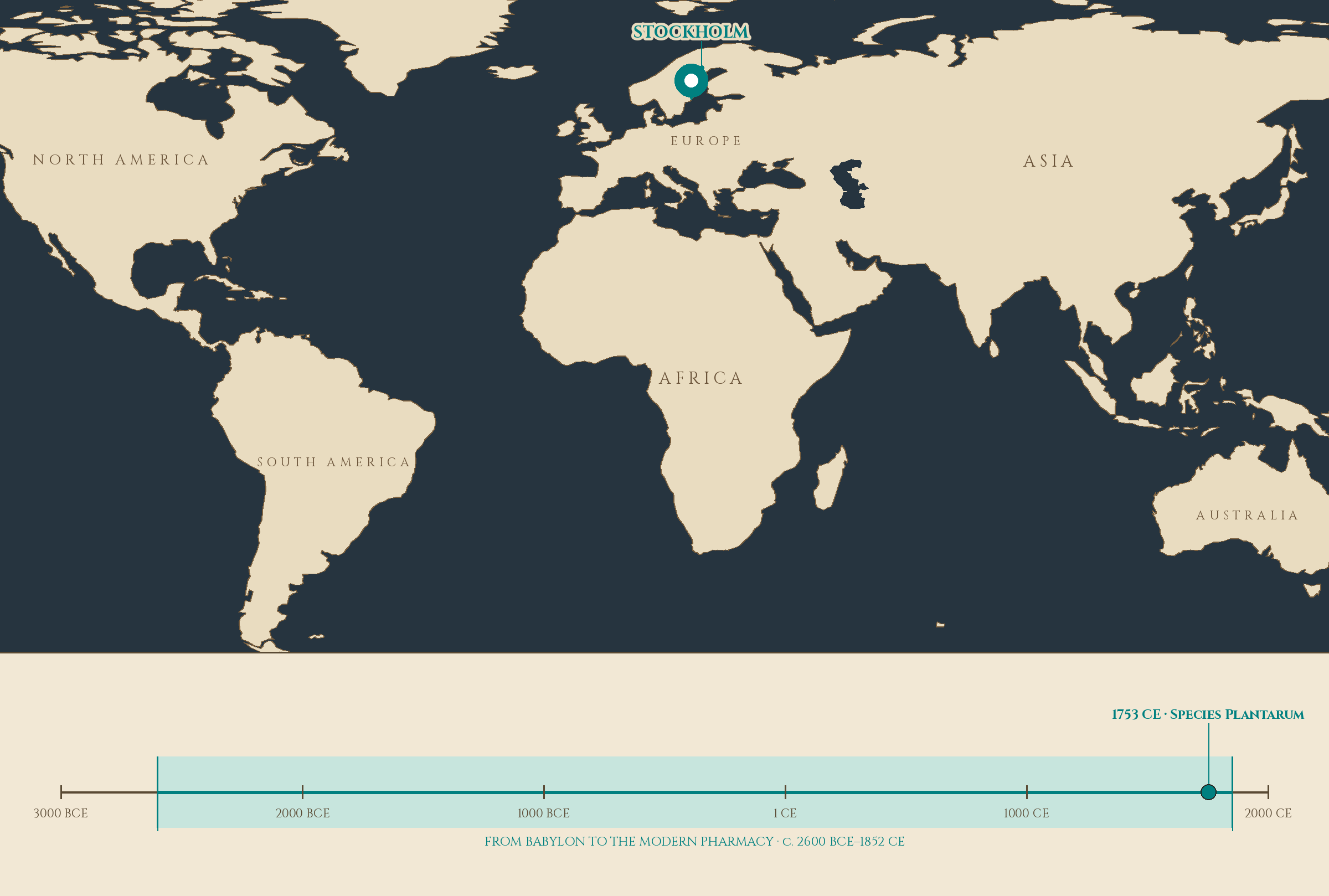
Pin: Stockholm. Timeline stop: 1753 CE · Species Plantarum.
Lesson Objectives
By the end of this lesson, you will be able to:
- Define the historical term simple and explain how simples differ from compounds.
- Describe how apothecaries from Dioscorides to the early modern period organized their botanical knowledge.
- Construct a Surface Matrix: a working grid that turns loose observations into retrievable archive entries.
- Write a complete potions journal entry for a botanical material, with provenance, sensory notes, and a shelf mark.
- Explain why the Materia Botanica is one shared reference for both Herbology and Potions, and how the two classes divide the work.
Reading this lesson: ★ marks the passages to remember. They return on the unit quiz and the class test. Check in questions ask the material back as you go; answer them in your workbook when you meet them.
Working this lesson: Your assignment packet is the first download on this page. Work in it as the lesson moves along, answering each exercise as its subject is taught — or read the lesson through for your notes and take the exercises as homework afterward. Both are proper ways to sit this class. Signposts in the reading tell you where each exercise belongs. Written answers are short answers in your own words; a few honest lines are worth more than a filled page.
Your Assignment Packet
This lesson's exercises live in its packet: the Lexicon Handout (every term, course terms marked ◆), Materials, Guided Practice — the Surface Matrix itself, ruled and ready to fill — the Assignment Manual with its answer key for self-checking, the Reflection Questions, and the Workbook Checklist. Download the packet before you begin and keep it beside you as you read.
Safety Briefing
This is a desk lesson, but the laboratory rules do not take holidays.
- Dust discipline. Even dried kitchen herbs release fine dust when handled. Work in a ventilated area, do not shake bags of dried material near your face, and wash your hands when you finish.
- Skin and nose. Some botanicals irritate skin or provoke sneezing. If a material makes you itch or sneeze, set it aside, note the reaction in your entry (that is useful data), and wash the area with cool water.
- ★ Taste nothing. Archive work is observation work. Nothing enters the mouth during this lesson. Materials on the laboratory table are specimens, not snacks.
- Label as you go. Every container on your table gets a label before it is opened, not after. An unlabeled jar is a failed experiment waiting to happen.
- Younger scholars should have an adult nearby when handling glass jars or unfamiliar dried materials.
Sealed note from Professor Muddlenook: I keep a small bell on my desk, and I ring it whenever a student reaches for an unlabeled jar. The sound is dreadful. You will learn to label first, I promise you.
— Professor Crimblebrew Muddlenook, Potions Laboratory • Master Apothecary • Head of House Meridies
Check in: Which rule in this briefing governs the moment before a container is opened — and what does Professor Muddlenook call an unlabeled jar?
❦ In your workbook: record this lesson's safety briefing in your own way — dust, skin and nose, taste nothing, label as you go — copy, sketch, or note what matters.
What Is a Simple?
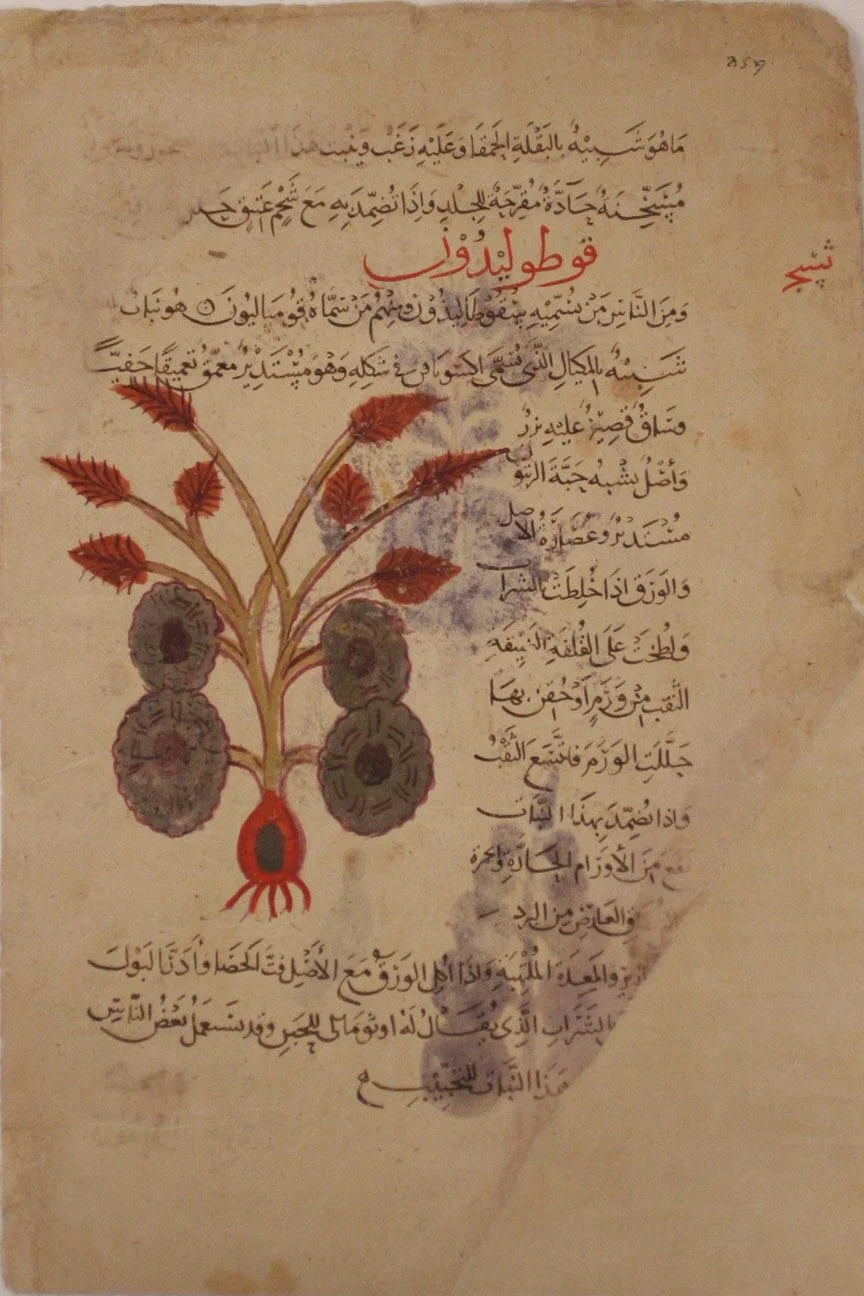
A page from a 13th-century Arabic Dioscorides. Each simple earns the same treatment: the plant painted whole, and its entry written beside it. Your Surface Matrix begins from exactly this — one material, one record, nothing mixed and nothing missing.
The Metropolitan Museum of Art, Open Access (CC0). Object 65.271.2, "Folio from a Materia Medica of Dioscorides," 13th century, opaque watercolor on paper. (A different leaf from the 65.271.1 folio carried in Lesson 11's pack.)
Open any historical herbal and you will meet the word simple within the first pages. ★ In the apothecary's vocabulary, a simple is a single-ingredient botanical: one plant, one part, used alone. Peppermint leaf is a simple. Dried chamomile flowers are a simple. A preparation that combines several simples, by contrast, is a compound.
The word comes from the Latin simplex, meaning single or uncompounded, and it carried a point of professional pride. To know the simples was to know the alphabet of the craft. The great herbals of history are, at heart, dictionaries of simples: each plant described, its appearance recorded, its harvest noted, its storage prescribed. Dioscorides' De Materia Medica, written in the first century of the Common Era, catalogued some six hundred plants and plant-derived substances in just this way, and remained the standard reference of the Western apothecary tradition for over fifteen hundred years. When medieval and early modern apothecaries spoke of their materia medica, the medical matter of their shelves, they meant their collection of simples and the knowledge of how to keep them.
★ This is why the archive comes before the brewing. You cannot compound what you have not first learned to know singly.
Sealed note from Professor Muddlenook: Students always want to skip to the interesting part. There is an old saying in the dispensary trade: the apprentice who will not learn the simples — single-ingredient botanical materials, one plant, one part, used alone — will never learn the compounds either, because the compounds are only simples — single-ingredient botanical materials, one plant, one part, used alone — that have been introduced to one another properly.
— Professor Crimblebrew Muddlenook, Potions Laboratory • Master Apothecary • Head of House Meridies
Check in: Peppermint leaf alone is a simple. What is a preparation that combines peppermint leaf with two other simples called — and what does the word simple itself come from?
❦ In your workbook: record the simple in your own way — one plant, one part, used alone, and the alphabet of the craft — copy, sketch, or note what matters.
The Archive Problem
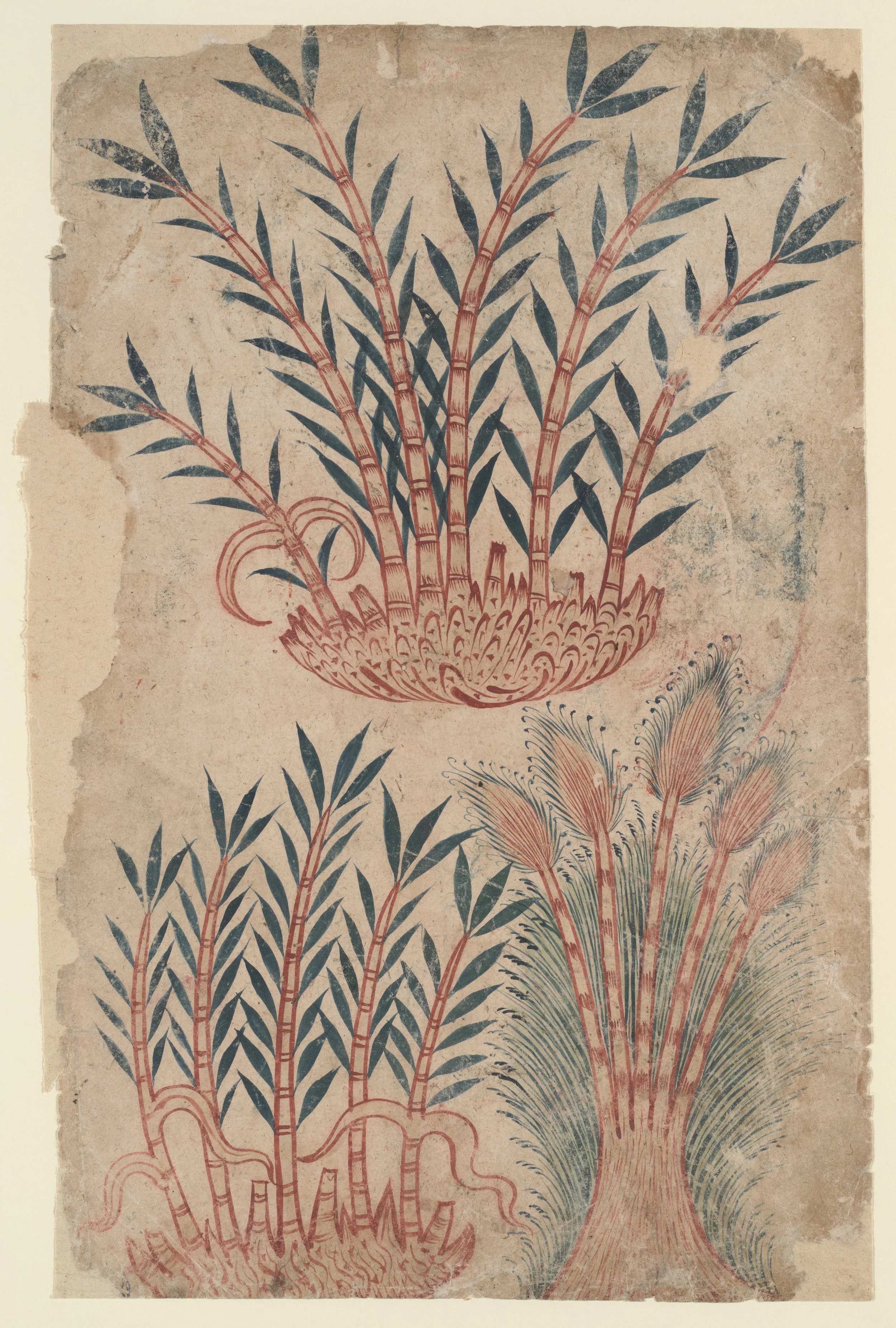
Three kinds of reed, painted side by side so the eye can learn their differences (folio from a De Materia Medica, ca. 1595). Kinds blur together in the memory and in the storeroom alike; set them in columns, and the differences stand up. That is the problem the Surface Matrix exists to solve.
The Metropolitan Museum of Art, Open Access (CC0). Object 2022.197, "'Three Types of Reeds,' Folio from a De Materia Medica," ca. 1595, opaque color on paper.
Imagine you are an apothecary in the year 1600. Your shelves hold two hundred simples. A physician asks for dried betony. Where is it? How old is it? Was it harvested before or after flowering? Is the jar on the third shelf last year's stock or the new delivery?
Without a system, you are lost among your own riches. The historical solution was the archive: every simple recorded, every record retrievable. The great collections solved this in stages across the centuries.
First came the herbal: plants described in a fixed order, often with illustrations, so a reader could find each plant where the book promised it would be. Then came the dispensatory: the workshop's own recipe and inventory book, recording what the shop actually held and how it was kept. By the early modern period, the well-run apothecary shop maintained ledgers of stock, dates of receipt, suppliers, and storage notes, the ancestors of the modern laboratory notebook.
★ The decisive revolution in retrievability arrived in 1753, when Carl Linnaeus published Species Plantarum and gave every plant a two-word Latin name shared across all languages and nations. Before Linnaeus, a plant might be known by a dozen different names in a dozen towns, and no two apothecaries' ledgers agreed. After him, the archive had a universal index key. Your potions journal will use common names for daily work, exactly as the old shops did, but you will record the Latin binomial wherever you can find it, because that is the name that lets your archive speak to every other archive in the world.
Check in: Name the three stages the great collections passed through before Linnaeus — and what single thing did Linnaeus give the archive in 1753?
❦ In your workbook: record the archive problem in your own way — two hundred simples, the herbal, the dispensatory, the ledgers, and the universal index key — copy, sketch, or note what matters.
The Surface Matrix
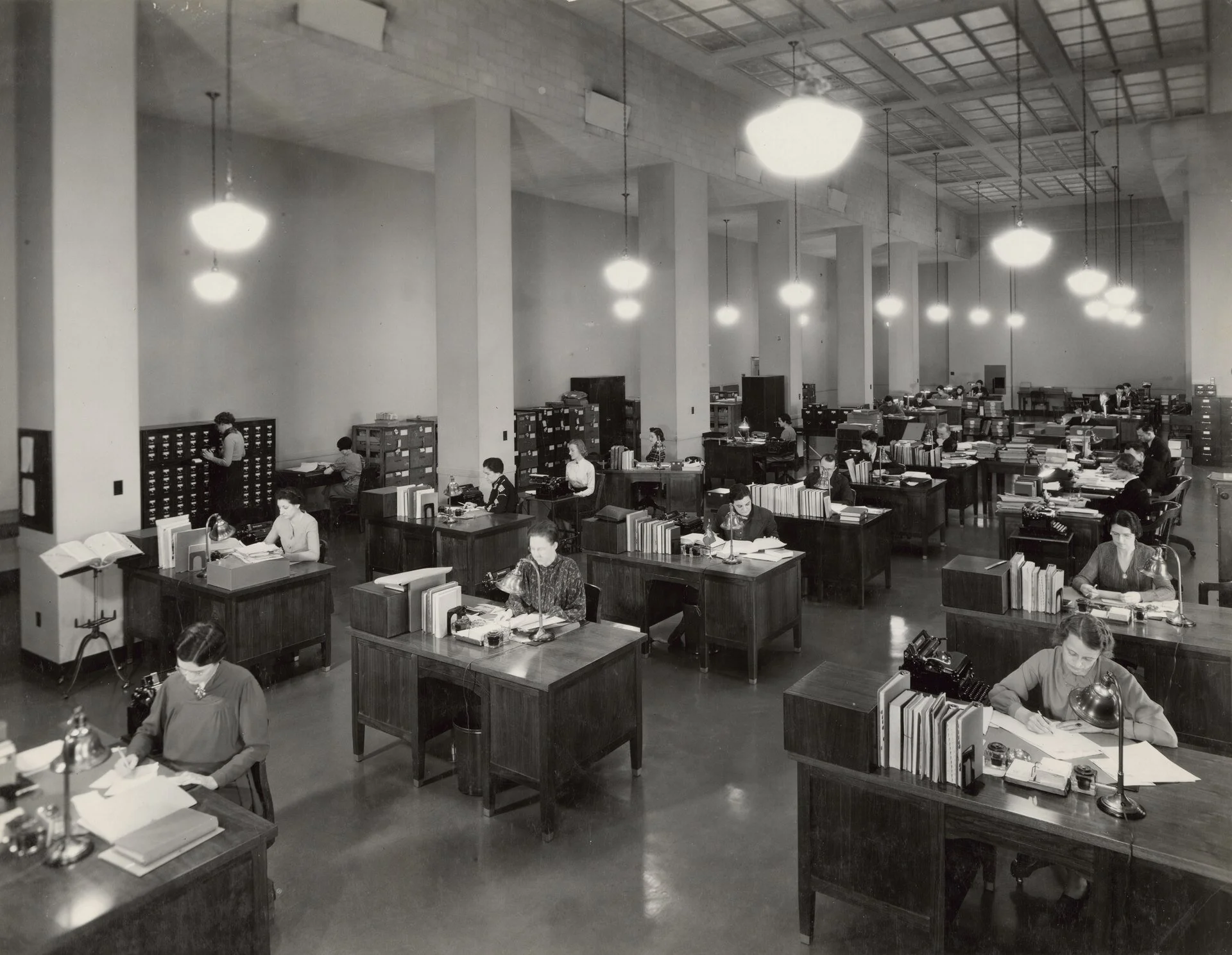
The Division of Classification and Cataloging at work, 1937. An archive is a staff of habits before it is a piece of furniture: every card filed, every drawer labeled, every record retrievable by a stranger. Your Surface Matrix is the same discipline at the scale of one laboratory shelf.
Public domain (work of the United States federal government), U.S. National Archives and Records Administration, NAID 3493233, via Wikimedia Commons, "Photograph of the Division of Classification and Cataloging, 1937.tif" (JPEG preview delivered).
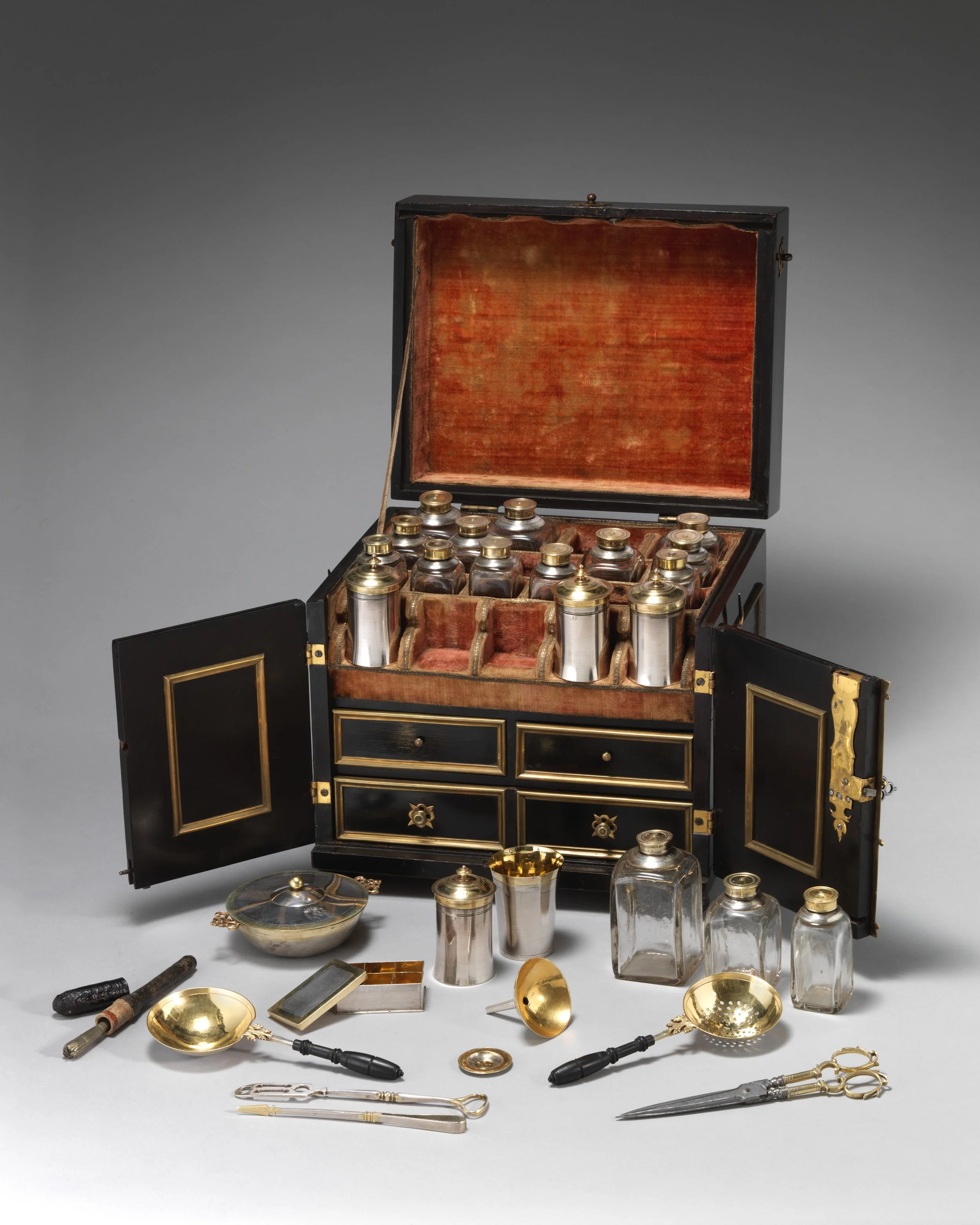
An apothecary cabinet of 1617–18: a matrix you can touch. Every vessel has its fitted compartment, every drawer its contents, and nothing stands where it does not belong. The Surface Matrix does for your records what this cabinet does for its bottles.
The Metropolitan Museum of Art, Open Access (CC0). Object 2019.229.1a–c–.32a, b, "Apothecary Cabinet," 1617–18, ebonized pearwood, ebony, and partially gilded silver, with thirty-two vessels and utensils.
Here is the instrument I promised you. The Surface Matrix is a grid, and it is deliberately unglamorous. Glamorous tools get admired. Unglamorous tools get used.
Draw a table with one row for each simple on your table and the following columns:
| Simple (common name) | Latin binomial (if known) | Plant part | Provenance | Sensory notes | Storage | Shelf mark |
|---|
Each column earns its place:
- Simple (common name): the name you actually use. Precision matters more than poetry.
- Latin binomial: the universal index key. Look it up; do not guess.
- Plant part: leaf, flower, root, seed, bark. Different parts of one plant are different simples and get different rows.
- Provenance: where this material came from and when. "Kitchen cupboard, October 2026" is a perfectly honest provenance. Dishonest provenance is how archives rot.
- Sensory notes: what you observe with eyes, nose, and fingers. Color, fragrance strength, texture, flexibility. This is the beginning of organoleptic method, which Lesson 11 will teach in full.
- Storage: how this material is currently kept, and whether that is adequate.
- ★ Shelf mark: the code that tells future-you exactly where to find it. Your system, your rules, but write the rules down.
Sealed note from Professor Muddlenook: My own shelf marks encode the cupboard, the shelf, and the jar's position, thus: C2-S3-J7. Cupboard two, shelf three, jar seven. It has never failed me in forty years. An archive that cannot locate its own contents is not an archive. It is a rumor.
— Professor Crimblebrew Muddlenook, Potions Laboratory • Master Apothecary • Head of House Meridies
Check in: Which column records where a material came from and when — and which column tells future-you exactly where to find the jar?
❦ In your workbook: record the Surface Matrix in your own way — the seven columns, and why each one earns its place — copy, sketch, or note what matters.
In your packet: Exercise I — Your First Three Entries ✎ begins here. Work it now, or mark the place and take it as homework — your choice.
Procedure: Compiling Your First Entries
Work slowly. Archive work rewards the methodical and punishes the hasty.
- Lay out your materials. One simple per saucer or jar. Label each container now, before anything is opened.
- Draw your matrix. Rule it neatly in pencil in your potions journal. Leave generous space; entries grow.
- Row by row. For each simple, fill every column. If you do not know the Latin binomial, write "to be confirmed" and look it up later. Never invent one.
- Write the sensory notes last for each row, after you have handled the material. Crush a small fragment between your fingers, note the fragrance released, observe the color of the broken surface.
- Assign shelf marks and physically arrange your materials to match them. The matrix describes reality; if the matrix and the shelf disagree, fix the shelf.
- Rule an index page at the front of your potions journal: simple name, page number. Update it every time you add an entry.
❦ In your workbook: record the procedure in your own way — the six steps, in their order, labels first — copy, sketch, or note what matters.
Guided Observation: The Stranger Test
When your matrix is complete, step back and read it as a stranger would. ★ This is the apothecary's test of every record: could someone else find everything from this page alone?
Ask yourself:
- Is every provenance honest and specific?
- Would your shelf marks guide a visitor to the right jar without your help?
- Are any two rows describing what might be the same material under different names?
- Which entry has the thinnest sensory notes, and what does that tell you about your attention?
Write your answers beneath the matrix. An archive that cannot survive its own audit is decoration.
❦ In your workbook: record the stranger test in your own way — the four audit questions, and your honest answers beneath your own matrix — copy, sketch, or note what matters.
In your packet: Exercise II — The Cross-Reference Test ◐ begins here. Work it now, or mark the place and take it as homework — your choice.
Cleanup
- Return each simple to its labeled container. Seal containers against air and light.
- Brush botanical dust from the table into the waste, not onto the floor.
- Wash your hands. Wash any saucers or tools used.
- File your index cards or entry sheets in order. The archive begins its habits today.
❦ In your workbook: record the cleanup in your own way — sealed containers, a brushed table, washed hands, filed sheets — copy, sketch, or note what matters.
Archive Entry
Your potions journal entry for this lesson is the completed Surface Matrix itself, plus the audit answers written beneath it. Date the page. In the margin, note one question the matrix raised that you cannot yet answer. That question is homework for the whole course.
One book, two classes. In Herbology, your entries will grow with cultivation notes: how the plant lives, how it is harvested, when it is at its best. In Potions, your entries will grow with preparation notes: how the harvested material is judged, stored, and transformed. The plant is entered once. The knowledge accumulates from both sides, the way it did in the old shops, where the herbalist's garden and the apothecary's laboratory were two rooms of the same trade.
❦ In your workbook: record the archive entry in your own way — the dated matrix, the audit answers, and the one unanswered question in the margin — copy, sketch, or note what matters.
In your packet: Exercise III — The Shelf Audit ◐ begins here. Work it now, or mark the place and take it as homework — your choice.
Materials
Gather the following before you begin. Everything should be on the table before the first entry is written.
Required (Level One — household items)
- A binder, notebook, or folder that will become your potions journal (wide margins if you can; you will add to these pages for the rest of the course)
- Index cards or small slips of paper (at least a dozen)
- A ruler and a pencil (ink comes later, once entries are final)
- Three to five dried botanical materials from your kitchen: bay leaves, dried mint or oregano, whole cloves, chamomile tea bags, dried lavender, or similar
- Small clean jars, bowls, or saucers to hold each material separately
- Adhesive labels or masking tape and a pen
Suggested (Level Two — historically closer)
Level Two scholars may substitute a proper card-index box with alphabetical dividers, cotton gloves for handling specimens, and glassine envelopes for storing small samples, the way nineteenth-century pharmacognosy collections were kept.
Reflection Questions
Answer the following questions in your workbook.
- Why did historical apothecaries need the concept of the "simple" before they could meaningfully discuss compounds?
- How did Linnaeus's Species Plantarum (1753) change what an apothecary's archive could do?
- Your matrix has a column for provenance. Why is an honest "kitchen cupboard, October 2026" more valuable to the archive than a blank?
- What is the difference between a list and an archive, in your own words?
- The Materia Botanica is shared between Herbology and Potions. Why enter each plant only once instead of keeping a separate herbal for each class?
Workbook Checklist — Lesson 10
In my workbook I have:
- ☐ drawn my Surface Matrix with all seven columns and completed a row for every simple on my table, with no invented Latin binomial
- ☐ written the sensory notes for each row last, after handling the material, and recorded any skin or nose reaction as data
- ☐ assigned a shelf mark to every simple, arranged the materials to match the matrix, and ruled an index page at the front of my potions journal
- ☐ read my completed matrix as a stranger would and written the audit answers beneath it, with the page dated and one unanswered question noted in the margin
- ☐ built a second Surface Matrix for three new simples (Exercise I), audited my own archive by the cross-reference test (Exercise II), and completed the shelf audit with at least two improvements carried out and recorded (Exercise III)
☐ Lesson completed Date: ___ Signature: ___
The Professor's Closing Note
I have kept my potions journal for longer than some of my students have been alive, and I still add entries. The archive is never finished. That is not a flaw in the system. That is the system.
— Professor Crimblebrew Muddlenook, Potions Laboratory • Master Apothecary • Head of House Meridies
Cross-Class Connections

Herbology · Unit V, Lesson 36 — The Materia Botanica: Building Your Herbal
One book, two classes — Professor Muddlenook has told you his half, and here is mine. Come to the Greenhouse and learn how an entry begins: the living plant, its growing, its harvest, written in the same eight fields your laboratory entries will one day sit beside. Enter the plant once, gardeners, and enter it honestly, and both halves of its story will hold. — Fernfoot.
Herbology · Unit I, Lesson 4 — The Binomial Classification Matrix
The two-word name your matrix depends on is learned properly in my greenhouse, scholars. Come and learn how a binomial is built, how it is read, and how it is written, so that when Professor Muddlenook's archive asks you for the universal index key, you can look it up with understanding and never guess. Naming is the first act of knowing. — Fernfoot.
Scrollwork · Unit VI, Lesson 23 — Archive Labels & Library Systems
Evening, scholars. Professor Muddlenook's shelf mark is a small cousin of my shelfmark, and his index is the finding aid my library lives by. Come and learn the titulus, the pressmark, and the catalog — how a scribe found the right book among thousands, and how a record earns the right to be trusted. An archive that cannot be searched is a rumor with good handwriting. — Nocturne.

Creative Arts · Unit II, Lesson 11 — Case Binding & Archival Boxes
Last bench of the unit, scholars, and the one your potions journal has been waiting for. A book this school means to keep for centuries deserves a case built to fit it and a box built to outlast everyone in the room. Professor Fernfoot's great plant record and Professor Muddlenook's journals are both housed by these rules in my workshop. Bring your binder when its pages have grown into a book, and we will house it properly. Build the practice corner first, on scrap, as always.
Further Reading & Sources
- Kew: Plants of the World Online — the modern universal index; look up Latin binomials for your entries here.
- Wellcome Collection — digitized herbals and apothecary manuscripts, including Dioscorides traditions.
- The British Library: Digitised Manuscripts — medieval herbals in their original page order.
- Missouri Botanical Garden — botanical reference collections and plant records.
- The New York Botanical Garden: Mertz Library — historical botanical literature collections.
Browse the Potions shelf in the school Library for readable editions of these works.
Submit your work for this lesson using the form below.
CONTINUE IN THE POTIONS LABORATORY
← Previous · Lesson 9: Hearth Clearance Next · Lesson 11: Mapping the Sensory Profile →
Unit II — Materia Botanica, Delicate Structures Potions Laboratory — All 52 Lessons
The rest of Unit II: Lesson 11 · Sensory Profile · Lesson 12 · Flowers & Petals · Lesson 13 · Seeds & Spices · Lesson 14 · Fragrant Botanicals · Lesson 15 · Receiving & Judging · Lesson 16 · Stability & Storage · Lesson 17 · Consolidating the Journal