

POTIONS
Unit II · Lesson 16INGREDIENT STABILITY & STORAGE BEHAVIOR
Professor Crimblebrew Muddlenook
Master Apothecary • Potions
Head of House Meridies • School of Evershade
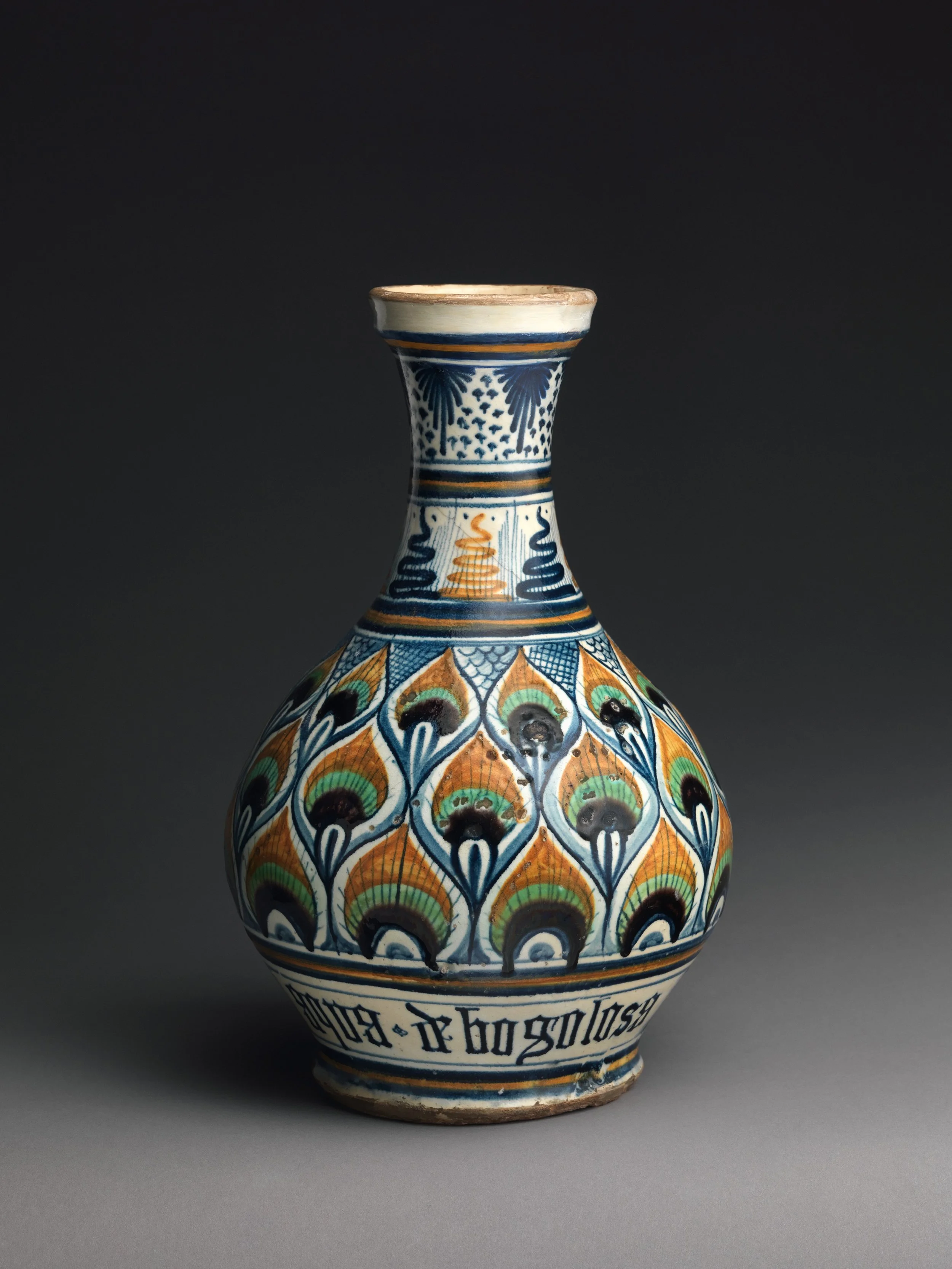
A maiolica pharmacy bottle, ca. 1470–1500. Vessels like this stood in ranks on the historical apothecary's shelves — beautiful, and still subject to the same five thieves this lesson teaches: moisture, heat, light, air, and time.
The Metropolitan Museum of Art, Open Access (CC0). Object 204515, "Pharmacy bottle," ca. 1470–1500, maiolica (tin-glazed earthenware).
Professor's Introduction

Apprentices, Lesson 15 taught you to receive dried botanicals with a judge's eye. Now we ask the harder question: what happens to them after they are shelved?
An apothecary's shelves are not a museum. They are a slow argument with time, and time usually wins unless the apothecary is organized. Every jar you own is changing, right now, whether you are watching or not. Moisture creeps in. Light bleaches. Air steals fragrance molecule by molecule. Heat hurries all of it along.
This lesson is about watching. You will learn to read a jar the way a physician reads a patient: by its color, its smell, its texture, and its history. Then you will audit your own shelves, and you will begin the most boring and most valuable document in this entire course: the shelf-stability log.
Order first. Experiments second. That is how a laboratory survives its keeper.
— Professor Crimblebrew Muddlenook, Potions Laboratory • Master Apothecary • Head of House Meridies

Potions map — the class base map, unmarked for this lesson.
Lesson Objectives
By completing this lesson, you will be able to:
- Name the five forces that degrade stored botanical ingredients: moisture, heat, light, air, and time.
- Explain why whole dried herbs keep their character longer than powdered ones.
- Read the physical signs of storage failure: fading color, lost fragrance, clumping, mold, and insect damage.
- Measure the microclimate of your own storage area across several days.
- Conduct a complete audit of your ingredient storage using Professor Muddlenook's checklist.
- Open a shelf-stability log and record baseline observations for every ingredient you keep.
Reading this lesson: ★ marks the passages to remember. They return on the unit quiz and the class test. Check in questions ask the material back as you go; answer them in your workbook when you meet them.
Working this lesson: Your assignment packet is the first download on this page. Work in it as the lesson moves along, answering each assignment as its subject is taught — or read the lesson through for your notes and take the assignments as homework afterward. Both are proper ways to sit this class. Signposts in the reading tell you where each assignment belongs. Written answers are short answers in your own words; a few honest lines are worth more than a filled page.
Your Assignment Packet
This lesson's assignments live in its packet: the Lexicon Handout (every term, course terms marked ◆), Materials, Guided Practice, the Assignment Manual with its answer key for self-checking, the Reflection Questions, and the Workbook Checklist. Download the packet before you begin and keep it beside you as you read.
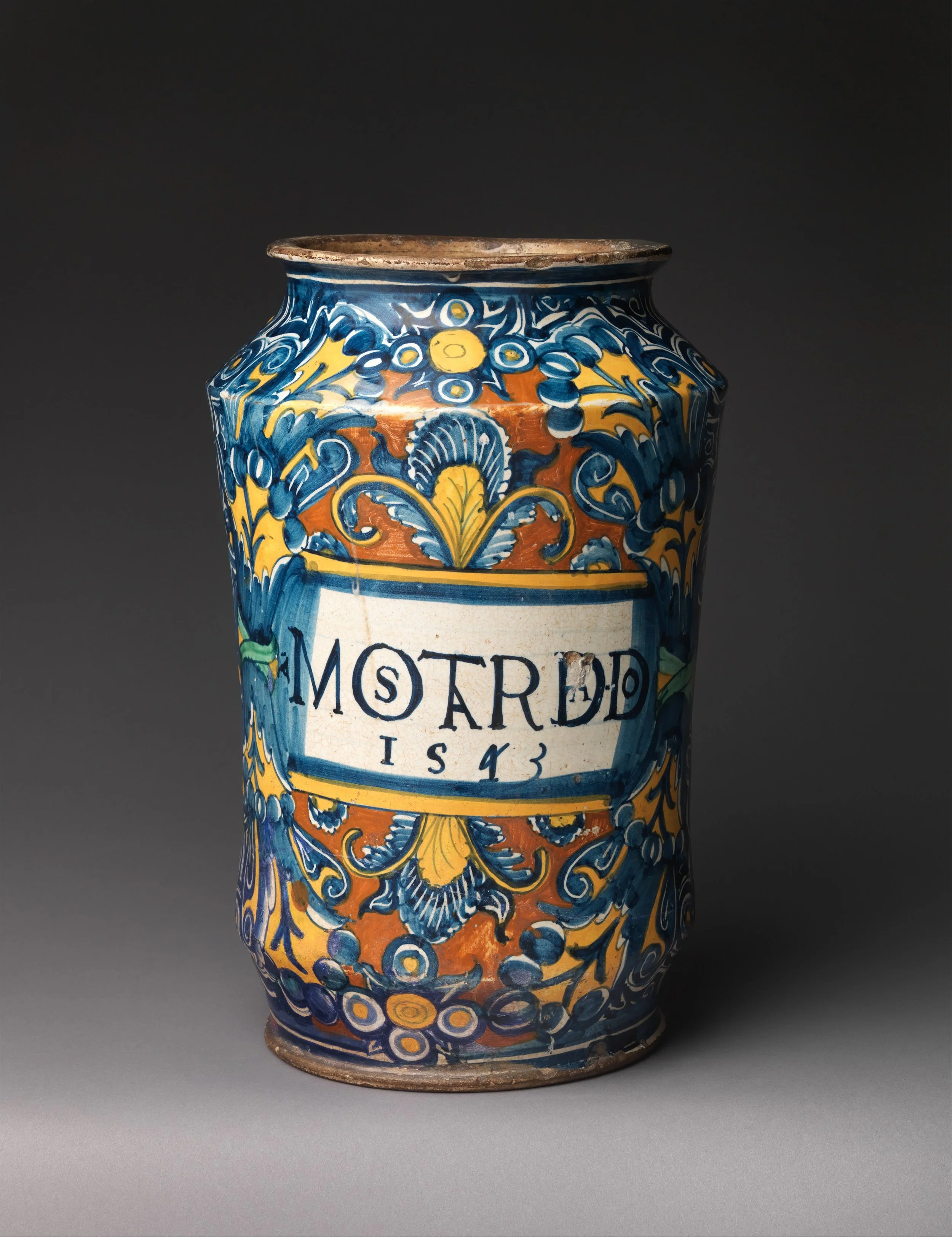
A maiolica storage jar dated 1543, its contents named in a painted label panel on the vessel itself. The label-and-date rule of this lesson is not a modern invention: this jar has carried its name and its year for nearly five centuries.
The Metropolitan Museum of Art, Open Access (CC0). Object 198941, "Storage jar (albarello) for mostarda," dated 1543, maiolica (tin-glazed earthenware).
Safety Briefing
Read this entire section before you open a single jar.
Label everything. Every container in your laboratory must carry the name of its contents and the date it was stored or received. An unlabeled jar is not mysterious. It is a mistake waiting to happen.
Store away from children and pets. Botanical materials belong on high shelves or in locked cupboards, never within reach of small hands or curious animals. Many dried herbs look like harmless potpourri and smell interesting. That is exactly the problem.
Do not taste unidentified botanicals. This lesson asks you to look and smell, never to taste. If you cannot identify a material with certainty from its label, treat it as unknown and set it aside.
Ventilate before you inspect. If you open a jar and suspect mold or mustiness, do not put your nose directly to the opening. Open it in a ventilated area, waft the air gently toward you from a distance, and step back if anything smells wrong.
Discard, do not salvage. Moldy, insect-damaged, or foul-smelling materials go into the refuse, not back on the shelf and never into a preparation. No amount of careful handling restores a spoiled ingredient.
Adult supervision. Any student working with glass jars, high shelves, or large quantities of stored material should have an adult aware of the activity. Heated storage areas, such as attics or rooms with space heaters, deserve extra caution.
No preparation in this lesson is for consumption, and no dosage or medicinal claim appears anywhere in it. We study storage as a science of preservation, nothing more.
Check in: A jar smells musty when you open it. What do the briefing's rules have you do — with the jar, with your nose, and with the material itself?
❦ In your workbook: record the safety briefing in your own way — label everything, store away from children and pets, never taste the unidentified, ventilate and waft, discard do not salvage, and adult supervision — copy, sketch, or note what matters.
Mise en Place
Gather before you begin the audit in the Procedure section:
- Every dried botanical ingredient you currently keep, jars and all
- Paper and pen, or your laboratory journal
- A simple thermometer, if you have one (a household indoor thermometer is fine)
- Small blank labels and a pen for any container missing one
- A refuse bag for anything that fails inspection
- Your potions journal, opened to your ingredient records
Level One uses what you already own. Level Two adds a hygrometer (a small device that measures humidity), silica gel packets saved from packaged goods, and amber glass jars for light-sensitive materials.
❦ In your workbook: record the mise en place in your own way — what must be gathered before the audit begins, at Level One and at Level Two — copy, sketch, or note what matters.
The Five Thieves of Stability
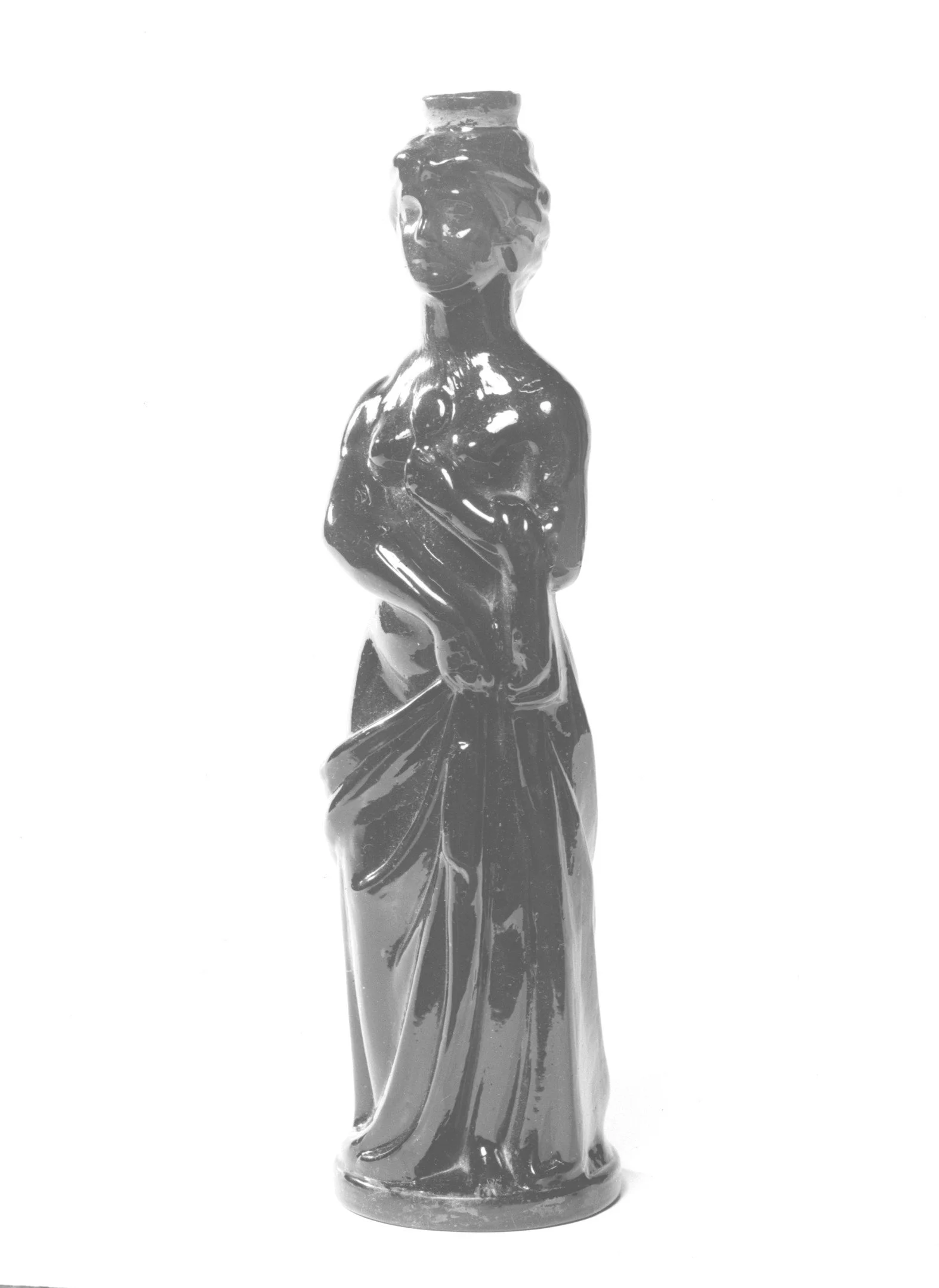
A 19th-century drug bottle of free-blown molded amber glass (photographed here in black and white). Historical apothecaries answered light with colored glass: amber and blue-green bottles admit far less damaging light than clear glass, which is why the tincture shelf of every old pharmacy glows brown and green rather than clear.
The Metropolitan Museum of Art, Open Access (CC0). Object 3457, "Drug Bottle," 19th century, free-blown molded amber glass.
A dried herb on a shelf looks still. It is not. From the moment drying ends, five forces begin dismantling it. The historical apothecaries knew all five by experience, even without the vocabulary of modern chemistry. You will learn both the experience and the vocabulary.
1. Moisture and Humidity
★ Water is the great undoer. A dried botanical that absorbs moisture from the air can soften, clump, darken, and grow mold. This is why Penn State Extension advises storing dried herbs in airtight containers in a cool, dry place, and warns specifically against the stove, the sink, and the windowsill: the three dampest, warmest spots in most kitchens.
Relative humidity is the measure that matters. Air always carries some water vapor, and warm air carries more than cold air. When humid air meets a cooler jar, water can condense on the inside of the lid and drip back onto the contents. This is the same reason Penn State cautions against moving herbs from cold storage into a warm room carelessly: condensation forms, and the herbs drink it.
Your defense is the seal. Airtight containers, jars filled as full as practical to reduce headspace, and desiccant packets for humid climates. Check seals the way Muddlenook checks everything: deliberately, and on a schedule.
2. Heat and Temperature
Heat accelerates nearly every form of decay. Warm storage speeds the evaporation of volatile compounds, hastens color change, and encourages insect activity. This is why the guidance is always "cool" alongside "dry" and "dark." A cupboard far from the oven outlasts a pretty rack above the stove every time.
Cold is not a perfect answer either. Refrigerators are humid places, and every trip in and out of the cold invites condensation. Freezer storage can extend quality for dried herbs, but only in truly airtight, moisture-proof packaging, and only if you let the sealed container return fully to room temperature before opening it. Open a cold jar in warm air and you have manufactured rain inside your own laboratory.
Seasonal shifts matter here. The shelf that was cool and dry in October may sit above a heating vent in January or bake in afternoon sun in July. Stability is not a decision you make once. It is a condition you re-check as the year turns.
3. Light
Light bleaches color and breaks down the compounds that give botanicals their character. The National Center for Home Food Preservation notes that even sun drying, the oldest method of all, is not recommended for herbs because they lose flavor and color in direct sun. The same damage continues on the shelf, only slower.
Historical apothecaries answered with colored glass. Amber and blue-green bottles admit far less damaging light than clear glass, which is why the tincture shelf of every old pharmacy glows brown and green rather than clear. You do not need antique vessels. A dark cupboard does the same work as amber glass, and an amber jar inside a dark cupboard is belt and braces, which Muddlenook approves of.
4. Air and Oxidation
Every time a jar opens, fresh air enters, and the oxygen in that air begins oxidizing the contents. Oxidation dulls fragrance, darkens color, and flattens flavor. ★ Ground and powdered materials oxidize fastest because grinding multiplies the surface area exposed to air. This is the scientific reason behind the old rule to store herbs whole and grind only what you need: Penn State Extension states it plainly, that whole herbs hold their oils and keep their flavor longer than crushed ones.
Headspace is the hidden accomplice. A half-empty jar is half full of air, and that air works on your ingredients between openings. Buy and store in sizes you will actually finish. Decant bulk purchases into smaller working jars and keep the reserve sealed.
5. Time and Seasonal Change
★ Even perfectly stored botanicals fade. Published guidance generally gives dried herbs about one year of good quality in proper storage, with whole spices and sturdy leaves sometimes stretching longer. The honest test is sensory, as Ohio State Extension teaches: rub the herb between your fingers and smell. If the fragrance is gone, the character is gone, whatever the calendar says.
Seasonal change is time's accomplice. Humidity rises and falls with the weather. Daylight lengthens. Heating systems dry winter air and then summer storms soak it. Your laboratory has a microclimate, a small local climate of its own, and it changes through the year. The shelf-stability log you begin in this lesson exists so you can watch those changes instead of being surprised by them.
Check in: Name the five thieves in order — then say which one is controlled not by where you store things, but by how honestly you label and how promptly you replace.
❦ In your workbook: record the five thieves in your own way — moisture, heat, light, air, and time, and the defense against each — copy, sketch, or note what matters.
A Second Note from Professor Muddlenook
You have now met the five thieves. Notice something: four of them are controlled by where and how you store things, and the fifth, time, is controlled by how honestly you label and how promptly you replace.
I have inspected apothecary shelves kept by brilliant formulators whose jars were a disgrace: no dates, loose lids, a sunny windowsill doing slow violence to three years of work. Brilliance in the vessel means nothing if the archive behind it is rotting.
Neatness is not vanity. It is the visible form of respect for your materials. Label the jar. Date the jar. Close the jar. These are small acts, and they are the entire difference between an apothecary and a hoarder.
— Professor Crimblebrew Muddlenook, Potions Laboratory • Master Apothecary • Head of House Meridies
❦ In your workbook: record the second note in your own way — label the jar, date the jar, close the jar — copy, sketch, or note what matters.
Reading the Signs: Storage Diagnostics
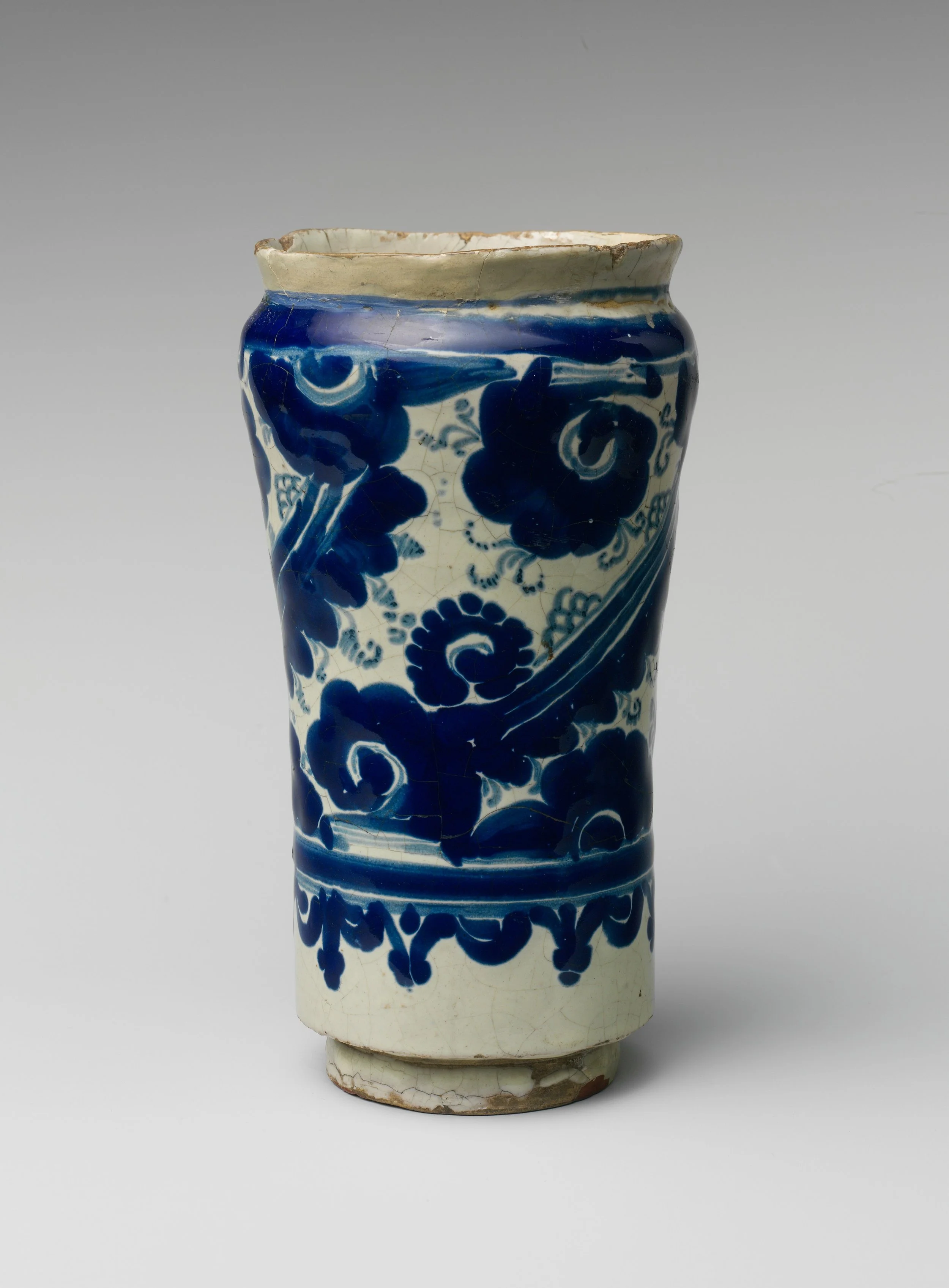
An apothecary jar, ca. 1700, tin-glazed earthenware — its crackled glaze, chipped rim, and worn foot still legible after three centuries. A trained apothecary reads a jar before opening it fully; time writes on vessels as plainly as on their contents.
The Metropolitan Museum of Art, Open Access (CC0). Object 3459, "Apothecary Jar," ca. 1700, tin-glazed earthenware.
A trained apothecary reads a jar before opening it fully. Work through these signs in order, and record what you find.
| Sign | Likely cause | Verdict |
|---|---|---|
| Faded, grayish, or yellowed color | Light exposure, age, oxidation | Quality declined; replace if fragrance is also weak |
| Little or no fragrance when crushed | Volatile compounds evaporated; old stock | Past its useful life; replace |
| Clumping or caking in powders | Moisture absorption | Discard; moisture invites mold and insects |
| Visible mold, white or colored fuzz | Moisture plus time | Discard immediately; do not salvage |
| Tiny holes, webbing, or fine dust | Insect infestation | Discard contents; inspect neighboring jars; clean the shelf |
| Musty or sour smell | Mold or moisture damage | Discard immediately |
| Condensation inside the lid | Temperature swings; poor seal | Dry the lid, check the seal, move to a steadier location |
| Rancid or sharp off-odors in oily materials | Oxidation of fats and oils | Discard |
★ Two rules govern every verdict. First, when in doubt, throw it out. An apothecary who gambles on a suspect ingredient gambles with every preparation it touches. Second, one failed jar is a warning about its neighbors. Inspect the whole shelf, not just the casualty.
Check in: A powder has clumped, and the jar beside it smells musty. What verdict does the table give each one — and what does the second rule require you to inspect next?
❦ In your workbook: record the diagnostics in your own way — the signs, their likely causes, and their verdicts — copy, sketch, or note what matters.
Procedure: The Storage Audit
Work through your own storage exactly as written. Do not skip steps. Muddlenook will know.
Step 1: Inventory. Remove every botanical ingredient from its shelf and set the jars in a row on a clean table. Count them. Write each name in your journal. Any jar without a label gets a temporary label now, with your best identification and today's date, marked "identity uncertain."
Step 2: Inspect. Examine each jar against the diagnostics table above. Look first, then waft gently from a distance, then, only for materials you are certain of, crush a small pinch between your fingers and smell. Record your findings jar by jar.
Step 3: Condemn. Anything moldy, infested, foul-smelling, or unidentifiable goes into the refuse bag. Do not open condemned jars any further than needed for inspection. Seal the bag and remove it from the work area.
Step 4: Relocate. Ask of each surviving jar: is this spot cool, dry, and dark? Move anything stored near the stove, the sink, a sunny window, or a heating vent. High, interior cupboards away from heat sources are the best household option.
Step 5: Reseal. Check every lid. Tighten what is loose. Replace cracked lids and perished seals. If a jar is less than half full, consider moving the contents to a smaller jar to reduce headspace.
Step 6: Date. Every jar gets a storage or inspection date. Write it on the label today, even if you must estimate the original storage date and mark it as an estimate. From this day forward, no jar in your laboratory goes undated.
❦ In your workbook: record the storage audit in your own way — the six steps, in their order — copy, sketch, or note what matters.
In your packet: Assignment II — The Storage Audit ⚒ begins here. Work it now, or mark the place and take it as homework — your choice.
Guided Observation: Mapping Your Microclimate
For the next seven days, record three things about your storage area each evening: the approximate temperature, whether the air feels dry, comfortable, or damp, and any direct sunlight that reaches the shelves during the day. A household thermometer makes this precise; your own senses make it adequate.
At the end of the week, answer in your journal: does my storage area stay cool, dry, and dark through the whole day? Does anything change between morning and evening? What will change here when the season turns? This is microclimate observation, and it is the foundation of every good storage decision you will ever make.
❦ In your workbook: record mapping your microclimate in your own way — seven evenings of temperature, dampness, and sunlight, and the three questions you answer at the week's end — copy, sketch, or note what matters.
Cleanup
Return every surviving jar to its shelf, grouped by type, labels facing outward. Wipe the shelves clean before restocking; dust and spilled powder harbor insects. Take the refuse bag out of the house. Wash your hands thoroughly after handling stored botanicals, especially anything dusty or suspect. Return your journal, thermometer, and labels to their places. A laboratory that ends the day orderly begins the next day ready.
❦ In your workbook: record the cleanup in your own way — jars grouped and facing outward, shelves wiped, refuse out, hands washed — copy, sketch, or note what matters.
Archive Entry: The Shelf-Stability Log
Open a new section in your laboratory journal titled "Shelf-Stability Log." For each ingredient that survived the audit, create an entry with these fields:
- Ingredient name, exactly as labeled
- Form: whole leaf, crushed, powdered, seed, bark, root, other
- Storage date (or your best estimate, marked as such)
- Container: glass jar, tin, bag, other; lid type and condition
- Location: which shelf or cupboard
- Baseline observations: color, fragrance strength (strong, moderate, faint), texture (crisp, flexible, clumped)
- Inspection dates: leave room for at least four future entries, one per season
Each season, revisit every entry: inspect, crush, smell, and record. When fragrance drops to faint and color has clearly faded, mark the ingredient for replacement and note what you learned about its keeping time in your conditions. Within a year, this log becomes a personalized reference no book can give you: the true shelf life of botanicals in your laboratory.
❦ In your workbook: record the shelf-stability log in your own way — its fields, and the seasonal revisit each entry leaves room for — copy, sketch, or note what matters.
In your packet: Assignment III — The Shelf-Stability Log ◐ begins here. Work it now, or mark the place and take it as homework — your choice.
Materials
Everything in its place, before we begin. For this lesson you will need:
Required (Level One — household items)
- Every dried botanical ingredient you currently keep, jars and all
- Paper and pen, or your laboratory journal
- A simple thermometer, if you have one (a household indoor thermometer is fine)
- Small blank labels and a pen for any container missing one
- A refuse bag for anything that fails inspection
- Your potions journal, opened to your ingredient records
Suggested (Level Two — historically closer)
Level Two adds a hygrometer (a small device that measures humidity), silica gel packets saved from packaged goods, and amber glass jars for light-sensitive materials.
Reflection Questions
Answer the following questions in your workbook.
- Four of the five thieves are controlled by where and how you store things. Which thief is not, and what two habits control it instead?
- Why does a half-empty jar work against its own contents, and what two storage habits answer that problem?
- A sealed jar comes out of the freezer into a warm room. Why must it return fully to room temperature before it is opened?
- The lesson calls the shelf-stability log "the most boring and most valuable document in this entire course." What makes a seasonal log worth more, after a year, than any book's general shelf-life table?
- "Neatness is not vanity." In your own words, what is the difference, in this lesson, between an apothecary and a hoarder?
Workbook Checklist — Lesson 16
In my workbook I have:
- ☐ named the five thieves of stability — moisture, heat, light, air, and time — and the defense against each
- ☐ carried out the six-step storage audit in order — inventory, inspect, condemn, relocate, reseal, and date — and recorded each jar's findings
- ☐ applied the diagnostics table and its two rules: when in doubt, throw it out, and one failed jar means inspecting the whole shelf
- ☐ mapped my storage area's microclimate across seven evenings — temperature, dryness or dampness, and direct sunlight — and answered the week's three closing questions
- ☐ opened my shelf-stability log with a baseline entry for every surviving ingredient, leaving room for four seasonal inspections
- ☐ set a calendar reminder for my first seasonal re-inspection, three months from today
☐ Lesson completed Date: ___ Signature: ___
The Professor's Closing Note
You have inventoried, inspected, condemned, relocated, resealed, and dated. Your shelves are now an honest record instead of a hopeful pile. Well done.
The shelf-stability log below is your standing assignment from this day forward. Once a season, you will walk these same steps in miniature: inspect, smell, record, replace. Ingredients will still fade. That is nature. But nothing in your laboratory will ever again fade unnoticed, undated, and unexplained.
An experimenter may be surprised by a result. An apothecary is never surprised by a shelf.
— Professor Crimblebrew Muddlenook, Potions Laboratory • Master Apothecary • Head of House Meridies
Cross-Class Connections

Herbology · Unit IV, Lesson 28 — Drying Herbs the Traditional Way
Welcome to the greenhouse, gardeners. Before a herb can sit on Professor Muddlenook's shelves, someone must dry it properly — and store it properly the moment it is dry. Come and learn hang-drying, screen-drying, and the conditioning step that evens moisture before long-term storage, and you will hand his laboratory jars that were honestly kept from the first day: airtight, labeled, dated, and kept cool and dark, exactly as his audit will ask of them.

Creative Arts · Unit VI, Lesson 26 — Shelves, Boxes & Storage That Lasts
Last bench of the unit, scholars, and the one your jars have been waiting for. In my workshop we build the storage itself — a potion shelf and an herb shelf among it, sized to Professor Muddlenook's jars and glassware, because a shelf built for a collection is built to the collection, and a hidden second row is where forgotten things breed. Build the practice box first, on scrap, as always. Then build the shelf your audit deserves, and label it where the user will see it.
Scrollwork · Unit VI, Lesson 23 — Archive Labels & Library Systems
Evening, scholars. Professor Muddlenook keeps a shelf the way my monks kept a library: a label that identifies, a list that locates, and an inspection that notices loss before it spreads. Come to the Library and design the label-and-catalog system for a collection of your own — tituli, shelfmarks, and the inventory the armarius kept — and your shelf-stability log will read like the archive it already is.
Further Reading & Sources
- Preserving Herbs by Drying — Penn State Extension: drying methods and the full storing-herbs guidance referenced in this lesson (airtight, cool, dry, dark; one-year keeping quality; whole herbs hold oils longer).
- Herbs — National Center for Home Food Preservation: drying and handling guidance, including why sun drying is not recommended for herbs.
- Selecting, Storing, and Using Fresh Herbs — Ohio State University Extension: storage guidance for fresh and dried herbs, including the crush-and-smell freshness test.
- Bristol-Myers Squibb European Apothecary — Smithsonian National Museum of American History: North America's largest collection of historical apothecary vessels, jars, and workshop equipment, 15th–19th century.
- Drying and Storage Influence the Formation of Key Aromatic Constituents in Blue Fenugreek — Peer-reviewed study (MDPI Horticulturae) measuring how volatile compounds decline during months of storage, showing why fragrance fades even in well-kept herbs.
Browse the Potions shelf in the school Library for readable editions of these works.
Submit your work for this lesson using the form below.
CONTINUE IN THE POTIONS LABORATORY
← Previous · Lesson 15: Receiving & Judging Dried Botanicals Next · Lesson 17: Consolidating the Potions Journal →
Unit II — Materia Botanica, Delicate Structures Potions Laboratory — All 52 Lessons
The rest of Unit II: Lesson 10 · Surface Matrix · Lesson 11 · Sensory Profile · Lesson 12 · Flowers & Petals · Lesson 13 · Seeds & Spices · Lesson 14 · Fragrant Botanicals · Lesson 15 · Receiving & Judging · Lesson 17 · Consolidating the Journal