

Unit II: The Apothecary's Senses and Materials
POTIONS LABORATORY · UNIT II OF VI
The laboratory is built. Now we meet the materials, beginning with the ones that forgive the least: flowers, leaves, fragile petals, spices, and aromatics. A root will wait for you. A blossom will not. Delicate structures bruise, fade, shatter, and lose their fragrance while you are deciding what to do with them, which is why this unit teaches speed with gentleness and judgment with evidence.
This is also where your senses go to school. You will learn to observe in order, sight before touch, touch before fragrance, and to write down what you find in words another scholar could trust. And you will begin your contributing work in the shared Materia Botanica, the reference Herbology and Potions tend together, where every plant you meet gets one integrated entry.
Unit Learning Objectives
By the end of this unit, you will be able to:
- Build a Surface Matrix that turns loose observations into retrievable archive entries.
- Carry out organoleptic evaluation in the correct order of senses and write a complete sensory profile.
- Perform a four-point intake inspection on delicate botanical material and grade it prime, acceptable, or rejected, with written reasons.
- Explain where common kitchen spices come from on the plant and why crushing releases fragrance.
- Use the perfumer's vocabulary of top, heart, and base notes to describe a fragrance over time.
- Judge dried botanicals by color, aroma, texture, and labeling, and detect the four faults: moisture, mold, aroma loss, and age.
- Name the five forces that degrade stored ingredients and audit your own storage against the checklist.
- Organize, index, and steward a Materia Botanica archive that another student could navigate in under a minute.
In This Unit
Lesson 10: The Surface Matrix Compilation
Turn loose observations into retrievable archive entries with the working grid called the Surface Matrix.
Lesson 11: Mapping the Sensory Profile
Train the senses in their proper order and build a complete sensory profile of a known botanical.
Lesson 12: Flowers, Leaves & Fragile Petals
Why delicate materials demand faster, gentler handling: the four-point intake inspection.
Lesson 13: Seeds, Spices & Culinary Botanicals
Where kitchen spices come from on the plant, and why a crushed spice smells stronger than a whole one.
Lesson 14: Fragrant Botanicals & Aromatics
The perfumer's vocabulary of top, heart, and base notes, built through controlled bruise tests.
Lesson 15: Receiving & Judging Dried Botanicals
Grade incoming dried materials as prime, acceptable, quarantined, or rejected, with written reasons.
Lesson 16: Ingredient Stability & Storage Behavior
The five forces that degrade stored botanicals, and a full audit of your own storage.
Lesson 17: Consolidating the Potions Journal
Organize, index, and steward the archive you have built across the unit, with a plan for the rest of the course.
The Unit II Quiz closes this unit. You will find it, with its download, at the end of Lesson 17: Consolidating the Potions Journal.
What Scholars Will Practice and Make
By the end of this unit you will have a working Surface Matrix, completed sensory profiles, graded intake ledgers, a fragrance comparison log, an audited storage area, and an organized, indexed Materia Botanica archive with a long-term stewardship plan. Your nose and your notebook will both be sharper than when you arrived.
Delicate structures have taught you judgment. Now the dense ones will teach you force. Unit III takes up roots, bark, resins, oils, waxes, salts, and clays, and the grinding, filtering, and preparation that make them ready for extraction.
PROFESSOR CRIMBLEBREW MUDDLENOOK
Potions Laboratory
Master Apothecary, Head of House Meridies
Shop the Apothecary Cabinet
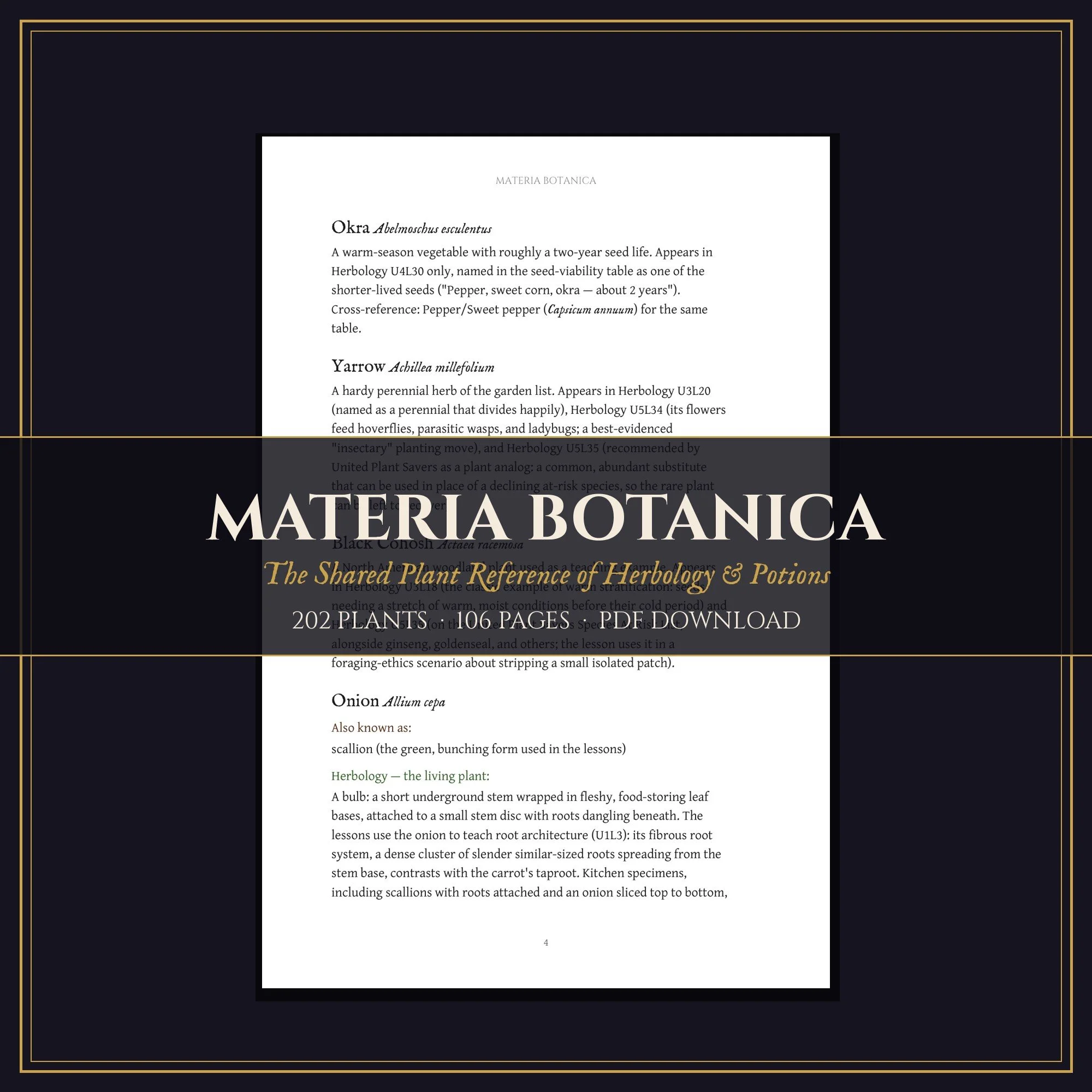
The school's shared plant reference: 202 plants, each with its identifying marks, history, and uses — the same Materia Botanica that Herbology and Potions both work from. 106 pages. Digital PDF.
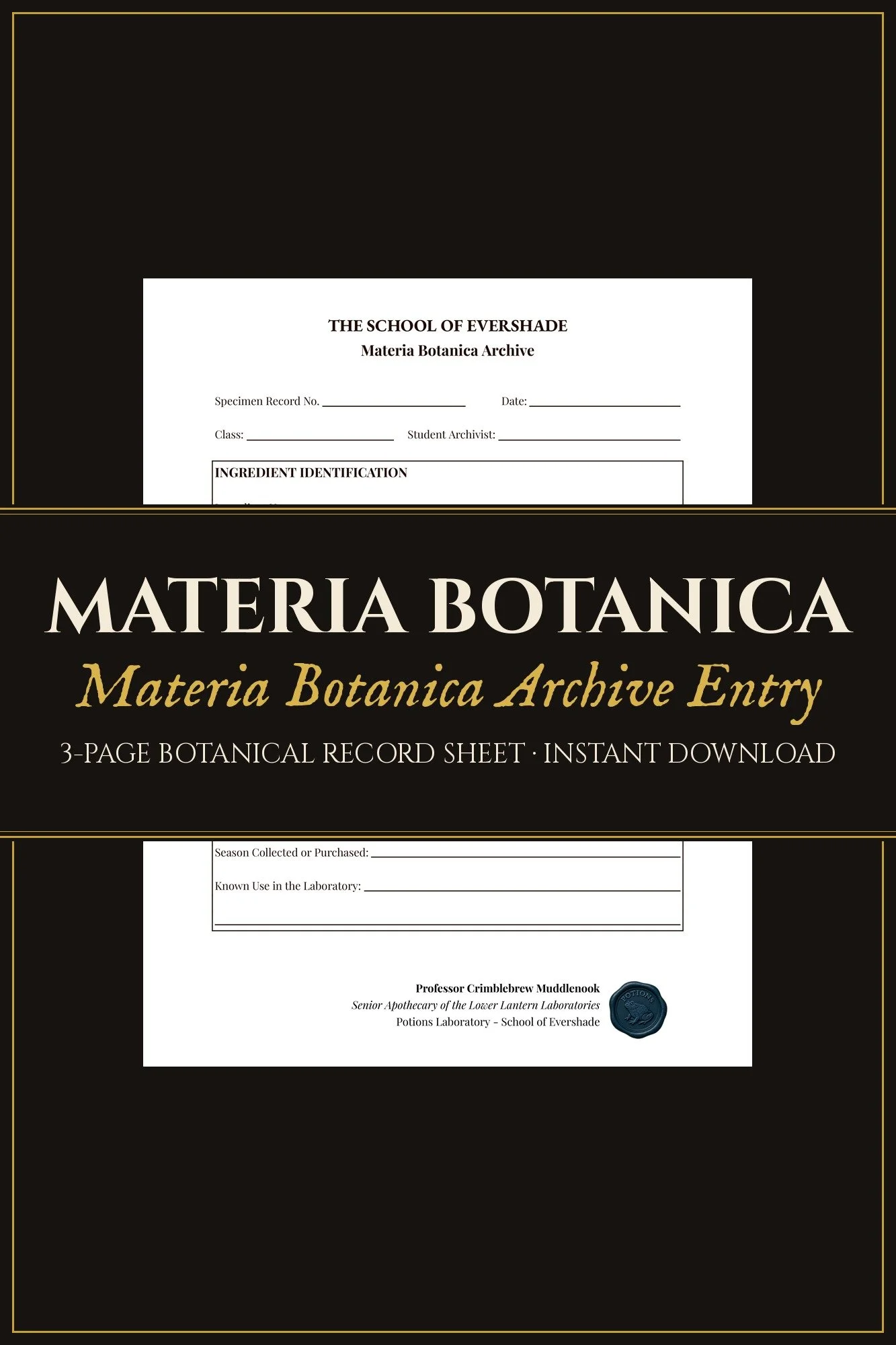
A three-page printable archive entry for recording botanical ingredients, sensory observations, preservation notes, sketch studies, specimen details, and laboratory storage records. Designed for use with the School of Evershade Potions curriculum or as a standalone apothecary-style journaling page.
Includes:
Ingredient Identification page
Sensory Observation page
Preservation and Storage Notes
Sketch or Specimen Area
Laboratory Notes
Archive Shelf and Specimen Code fields