

POTIONS
Unit II · Lesson 11MAPPING THE SENSORY PROFILE
Professor Crimblebrew Muddlenook
Master Apothecary • Potions
Head of House Meridies • School of Evershade
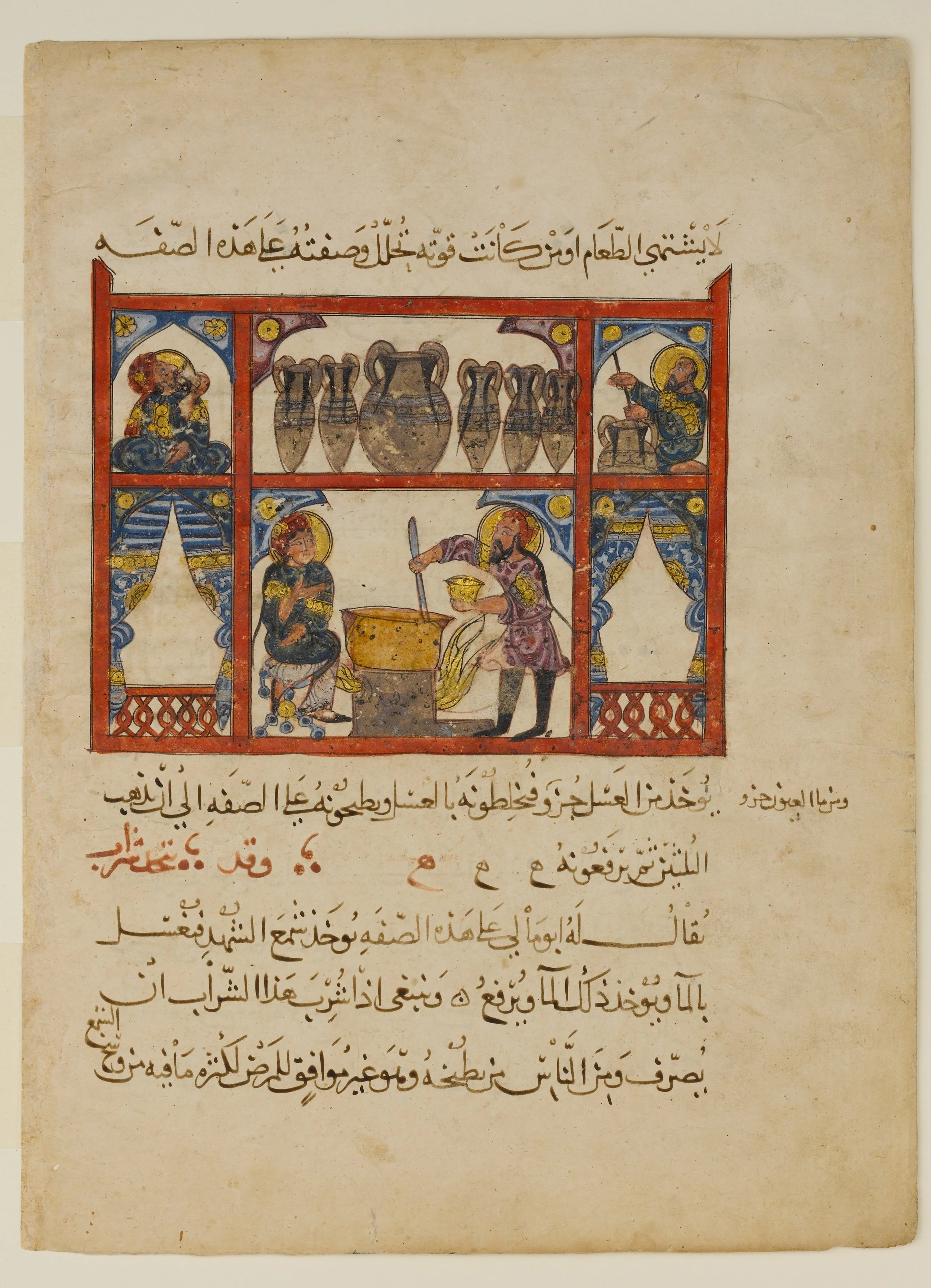
Preparing Medicine from Honey," a folio dated 621 AH / 1224 CE from a dispersed manuscript of an Arabic translation of Dioscorides' De Materia Medica, attributed to Baghdad. The old workshops this lesson studies were real rooms with real benches: vessels in rows, grinding at one side, the work watched and recorded.
The Metropolitan Museum of Art, Open Access (CC0). Object 57.51.21, "'Preparing Medicine from Honey', from a Dispersed Manuscript of an Arabic Translation of De Materia Medica of Dioscorides."
Professor's Introduction

Scholars.
Before there were microscopes, before there were chemical assays, before any laboratory owned a single instrument of brass or glass, the apothecary carried five instruments everywhere, and they have never needed calibrating: the eyes, the nose, the fingers, the ears, and, in former days, the tongue. Every drug that entered the workshop was examined with them. Every fraud was caught by them.
The science has a name, and you will learn it today: organoleptic evaluation, the study of a material with the help of the organs of sense. It is the oldest quality-control system in the world, and it still works, because the senses notice things that no label can tell you.
Today you will learn to use yours the way the old apothecaries did: in order, with discipline, and with everything written down. Precision begins here.
— Professor Crimblebrew Muddlenook, Potions Laboratory • Master Apothecary • Head of House Meridies
Potions map — the class base map, unmarked for this lesson.
Lesson Objectives
By the end of this lesson, you will be able to:
- Define organoleptic evaluation and name the senses it employs.
- Work through the channels of sensory observation in the correct order.
- Build a complete sensory profile of a known botanical material.
- Use the bruise test, the bend test, and the snap test to judge freshness and dryness.
- Read sensory evidence to detect age, poor storage, and adulteration.
- Explain why taste-testing belongs to history, not to your bench.
Reading this lesson: ★ marks the passages to remember. They return on the unit quiz and the class test. Check in questions ask the material back as you go; answer them in your workbook when you meet them.
Working this lesson: Your assignment packet is the first download on this page. Work in it as the lesson moves along, answering each exercise as its subject is taught — or read the lesson through for your notes and take the exercises as homework afterward. Both are proper ways to sit this class. Signposts in the reading tell you where each exercise belongs. Written answers are short answers in your own words; a few honest lines are worth more than a filled page.
Your Assignment Packet
This lesson's exercises live in its packet: the Lexicon Handout (every term, course terms marked ◆), Materials, Guided Practice, the Assignment Manual with its answer key for self-checking, the Reflection Questions, and the Workbook Checklist. Download the packet before you begin and keep it beside you as you read.
Safety Briefing: The Senses Have Rules
The senses are instruments, and instruments have operating rules. Read these before you touch a single leaf.
★ Rule one: never taste an unidentified material. You will learn today that the apothecaries of history tasted the drugs they worked with. They did so only with materials they already knew, in workshops where misidentification could still poison a man. In this laboratory, taste-testing is historical knowledge, not student practice. Your tongue stays out of the work. There are no exceptions to this rule, and I will not entertain arguments about it.
Rule two: smell with care. Never bury your nose in a jar and inhale deeply. Hold the material a handspan from your face and waft the air toward you with your other hand. Some botanicals are strongly pungent, and a deep breath of concentrated dust or fragrance can set you coughing. If a smell gives you a headache, watery eyes, or any irritation, stop, step back, and ventilate the room. Fragrance sensitivities are real, and a careful apothecary respects them.
Rule three: ventilate. Work near an open window or in a room with moving air, especially when handling dusty dried material or anything strongly aromatic.
Rule four: keep the work away from your face. Do not rub your eyes while handling botanicals. Wash your hands when you finish. Whole spices are a choking hazard for very small children, so younger students will work with an adult beside them.
These rules are not here to frighten you. They are here so that your instruments, your senses, stay in good working order for the whole of your career. A careless nose is a dull nose.
The same briefing, in the short form kept at the end of the lesson:
- Never taste an unidentified botanical material. Taste-testing is historical knowledge in this course, never student practice.
- Smell by wafting from a handspan away. Never inhale deeply from a jar of dried material or concentrated fragrance.
- If any smell causes headache, watery eyes, coughing, or skin irritation, stop, ventilate the room, and step away.
- Work in ventilated space when handling dusty dried herbs or strongly aromatic materials.
- Keep botanicals away from your eyes and mouth. Wash your hands when you finish.
- Whole spices are a choking hazard for very small children; younger students work with an adult beside them.
- Label every dish before you begin. An unlabeled material is an unidentified material, and Rule One applies.
Check in: Rule one allows no exceptions. What exactly does it forbid, and how does the lesson classify taste-testing instead?
❦ In your workbook: record the senses' rules in your own way — no tasting, wafting at a handspan, moving air, hands washed, every dish labeled — copy, sketch, or note what matters.
Mise en Place: Assembling Your Sensory Bench
Order matters in everything we do, and it begins with the bench. Clear a clean, dry work surface. Lay down a sheet of white paper; white is the apothecary's background color, because it shows every shade and speck honestly. Set out three small dishes or saucers, your notebook, and a pencil. A pencil, scholars, not a pen: observations get revised, and a laboratory notebook should show its thinking.
Your three study materials should be botanicals you know with certainty. Kitchen spices are ideal: whole cloves, a bay leaf, and a pinch of dried oregano, for example, or a cinnamon stick, dried thyme, and lemon peel. You must know what each one is before you begin. We profile the known in order to learn how to judge the unknown later. Label each dish.
You will also want a small ruler or a coin for scale, and a glass of water for rinsing your fingers between materials so one fragrance does not contaminate the next. Fragrance clings. That is a fact you will use, not a nuisance you will fight.
❦ In your workbook: record the sensory bench in your own way — the white paper, the three labeled dishes, the pencil, and the water glass for rinsing fingers — copy, sketch, or note what matters.
The First Channel: Sight
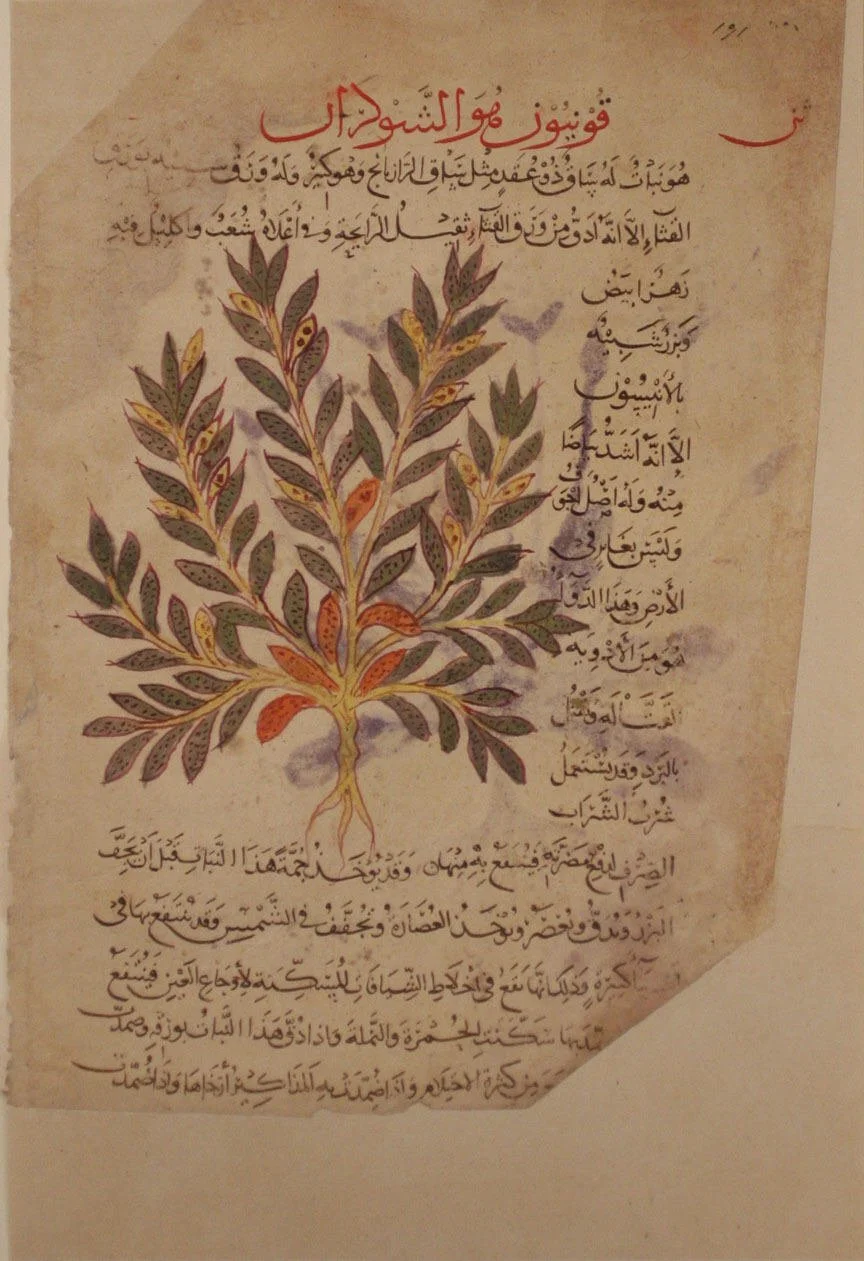
A plant folio from the De Materia Medica of Dioscorides, 13th century, attributed to Iraq. Before a material could be judged, it had to be recognized: the naturalistic plant portraits of the Greek herbals, simplified by Islamic artists, were the sight channel's first reference books.
The Metropolitan Museum of Art, Open Access (CC0). Object 65.271.1, "Folio from the De Materia Medica of Dioscorides."
Sight comes first because it is the least invasive. You can look at a material for an hour without changing it, which is more than can be said for any other sense.
Begin with the whole material, then look closer. The old pharmacognosists, the scientists who made drug evaluation their discipline, divided macroscopic observation into seven headings: shape, size, color, fracture and internal color, odor, and taste, with the sound of fracture noted where it applied. We will follow their order, minus the tasting.
Shape and size. Is the leaf whole or broken? Are the pieces uniform or a mixture of dust and stem? Uniformity speaks of careful handling. A jar that is half powder and half stem has been roughly treated or roughly stored.
Color. Color is one of the most honest witnesses on the shelf. Dried herbs should hold a color close to their fresh state, uniform through the container, with no excessive browning, no bleached patches, and no sign of mold. Here is a fact worth memorizing: the color of some drugs changes when they are dried in sunlight instead of shade. A faded, straw-colored leaf where you expected green tells you the drying was careless, and careless drying costs fragrance. When you judge color, compare against the white paper, in good daylight, never under yellow lamplight, which lies.
Fracture and internal color. Break a piece and look at the broken face. The inside of a good dried root or bark is clean and characteristic; a hollow, dusty, or off-colored interior tells a different story. We will practice the breaking itself under sound, below.
Record everything before you move on. The eye's evidence fades from memory within minutes. Write it down.
Check in: Why does sight come first among the channels — and under what light must color never be judged?
❦ In your workbook: record the sight channel in your own way — shape and size, color against the white paper, and the broken face — copy, sketch, or note what matters.
The Second Channel: Smell
Now the nose, the apothecary's most celebrated instrument. Whole workshops were once judged by the skill of the nose at the door.
Smell in two passes. First, hold the dish at a handspan and waft, as the safety briefing taught you. Record your first impression in plain words. The historical literature gave apothecaries a vocabulary for this, and you may borrow it: aromatic, balsamic, spicy, alliaceous (garlic-like), camphoraceous (camphor-like), terebinthinate (turpentine-like). These are old words, but they are precise, and precision is the point.
★ Second, perform the bruise test. Take one leaf or bud and bruise it gently between your fingers, then smell again. Fresh herbs smell strongly when bruised, because bruising ruptures the tiny structures that hold the plant's volatile oils, releasing them into the air at once. A leaf that smells of nothing until bruised, and then smells of itself, is alive with stored fragrance. A leaf that smells of nothing even after bruising has spent its fragrance, through age, heat, or poor storage.
The nose was also the fraud detector of the old workshop. Clove and exhausted clove, clove that has already given up its oil, can be told apart by odor alone. Different species of mint are distinguished by smell. Spoiled ergot smells rancid and ammoniacal, a warning no eye could give. Your nose is inheriting a long professional tradition. Treat it as the instrument it is.
Check in: A leaf smells of nothing when you waft it, and still smells of nothing after bruising. What has it spent, and by what three routes does the lesson say fragrance is lost?
❦ In your workbook: record the smell channel in your own way — the wafted first pass, the historical vocabulary, and the bruise test — copy, sketch, or note what matters.
The Third Channel: Touch
The fingers confirm what the eyes and nose suggest. Work with clean, dry hands.
Texture. Roll a pinch between finger and thumb. Is it crisp, leathery, papery, woody, gummy? Texture tells you about moisture, and moisture is the great enemy of the stored drug. Here the hand and the ear work together, as you will see.
★ Flexibility: the bend test. Take a stem or a leaf stalk and bend it gently. A properly dried herb is crisp; its stems snap. If the stem bends without breaking, it still holds moisture, and moisture in storage means mold sooner or later. This is the same test the old growers used at the drying rack, and it has never been improved upon: snap means dry, bend means wait.
Do not be rough. The point is diagnosis, not destruction. Bend one piece, not the whole dish.
Check in: A stem bends gently and does not break. What does it still hold, what does that mean in storage, and what is the lesson's two-word verdict?
❦ In your workbook: record the touch channel in your own way — texture between finger and thumb, and the bend test, snap or flex — copy, sketch, or note what matters.
The Fourth Channel: Sound
It surprises students that hearing belongs in this lesson, but the pharmacognosists listed the sound of fracture among their characters, and they were right.
Break a dried stem and listen. A clean snap speaks of thorough drying. A soft, fibrous tear speaks of moisture still inside. Shake a seed head near your ear: dry seeds rattle crisply in their cases. Crush a dried leaf and listen for the papery rustle of a material with nothing left to give but itself.
Sound is the channel beginners neglect and masters trust. Two jars of the same herb, bought a year apart, will tell you their ages in the sounds they make. Train your ear alongside your eye.
Check in: The same herb in two jars, bought a year apart — what will the sounds they make tell you, and what does a soft, fibrous tear speak of?
❦ In your workbook: record the sound channel in your own way — the clean snap, the fibrous tear, the rattle of dry seeds — copy, sketch, or note what matters.
The Fifth Channel: Taste, and Why It Stays in History
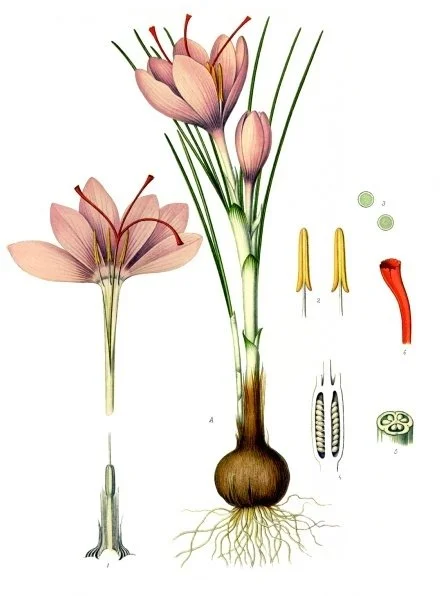
Crocus sativus, the saffron crocus, from Köhler's Medizinal-Pflanzen (plate 194). The spice is the flower's three red stigmas, shown enlarged at the right of the plate — the threads Dioscorides warned were cut with debris and gypsum and coated with grape juice to disguise the fraud.
Public domain, Wikimedia Commons, "Crocus sativus - Köhler–s Medizinal-Pflanzen-194.jpg" (Köhler's Medizinal-Pflanzen, 1887–1914).
We come now to the channel you will study and never use.
The apothecaries of history tasted their drugs. It was a formal part of evaluation, with its own vocabulary. Tastes were classed as sour, salty, sweet, bitter, alkaline, or metallic, and the sensations a drug produced on the tongue had their own terms besides: mucilaginous, oily, astringent (drawing the tissues together), pungent (a warm biting), acrid (unpleasant and irritating), nauseous. Dioscorides himself, whose great work we will meet shortly, judged the quality of saffron by its origin, appearance, color, feel, and smell together, and warned his readers that saffron was routinely adulterated with debris and gypsum to add weight, and even coated with grape juice to disguise the fraud. Frankincense, he cautioned, might be cut with club moss resin. The senses were the laboratory's defense against cheats, and taste was one of the guards.
But the guards took casualties. Tasting unknown materials is how apothecaries were poisoned, and the modern laboratory does not repeat the experiment. In this course, taste is a historical fact you will know about and a practice you will never perform. If a lesson ever seems to invite your tongue near an unidentified substance, that lesson is wrong, and you will tell me so.
Scholars, a note on order before we proceed. Sight, then smell, then touch, then sound. This sequence is not a suggestion. Each step is chosen so that it does not disturb the evidence the next step needs: looking changes nothing, smelling changes little, touching changes the surface, breaking changes the piece. Work out of order and you will contaminate your own results, and then your records will be fiction. The discipline is the method.
— Professor Crimblebrew Muddlenook, Potions Laboratory • Master Apothecary • Head of House Meridies
Check in: Name the six historical taste classes — then give the lesson's ruling on taste in this course, in one sentence.
❦ In your workbook: record the taste channel in your own way — its historical vocabulary, Dioscorides' saffron warnings, and why the channel stays in history — copy, sketch, or note what matters.
The Sixth Observation: Time
There is one more channel, and it is not a sense at all. It is time.
A sensory profile is not complete until you have watched the material change. Leave your bruised leaf on the white paper for an hour and look again: many green herbs darken where they are cut or bruised, as the air works on the wounded tissue. This browning, called oxidation, is the same family of change that darkens ink as it dries on the page, which our colleagues in Scrollwork study in their own lessons. In botanicals it is a clock: rapid, even browning is natural; patchy blackening with a sour or musty smell is decay.
Time also tests your storage. Rub a pinch of a dried herb that has sat in your kitchen for two years between your fingers. If the fragrance rises weakly or not at all, the volatile oils have gone, whatever the jar's label promises. The old rule holds: if there is little aroma, it is time to replenish the stock. Date every jar when you fill it, and your future self will thank your present self.
Check in: Your bruised leaf darkens evenly within the hour, while a second sample blackens in patches and smells sour. Which change is natural, which is decay — and what is the browning called?
❦ In your workbook: record the time channel in your own way — the hour's wait, oxidation's even browning against patchy decay, and the dated jar — copy, sketch, or note what matters.
In your packet: Exercise II — The Fresh Against the Stored ◐ begins here. Work it now, or mark the place and take it as homework — your choice.
Procedure: Building a Sensory Profile
You have the channels. Here is the procedure, step by step. Follow it exactly the first time; improvisation is for scholars who have earned it.
- Prepare the bench. White paper down, three labeled dishes, notebook open, pencil ready, water glass at hand, room ventilated.
- Sight, whole. Examine each material unbroken. Record shape, size, uniformity, and color against the white paper in daylight.
- Sight, broken. Break one small piece of each. Record the fracture: clean snap or fibrous tear, and the color of the broken face.
- Smell, first pass. Waft each dish in turn. Record first impressions using the historical vocabulary where it fits.
- Smell, bruise test. Bruise one piece of each material, wait a breath, smell again. Record the difference. Rinse your fingers between materials.
- Touch. Roll, press, and bend. Record texture and the result of the bend test: snap or flex.
- Sound. Break a stem near your ear. Shake the seeds. Record what you hear.
- Time. Set one bruised piece aside on the paper. Note the time. You will check it in one hour.
- Write the profile. Transfer your notes into a clean Sensory Profile sheet for each material: name, date, source, then your observations channel by channel, then your verdict.
★ Your verdict is a single paragraph answering three questions: Is this material fresh or aged? Was it well dried and well stored? Would you trust it in a preparation? Support every claim with an observation. "The oregano is fresh because the label says so" is not evidence. "The oregano is fresh because it smells strongly after bruising, snaps crisply, and holds a uniform green" is evidence.
Check in: In the procedure's nine steps, where do sight's two passes fall, and what must the verdict paragraph do that a label cannot?
❦ In your workbook: record the procedure in your own way — the nine steps, in their order, from bench to verdict — copy, sketch, or note what matters.
In your packet: Exercise I — The First Sensory Profile ◐ begins here. Work it now, or mark the place and take it as homework — your choice.
Guided Observation: Reading What the Senses Tell You
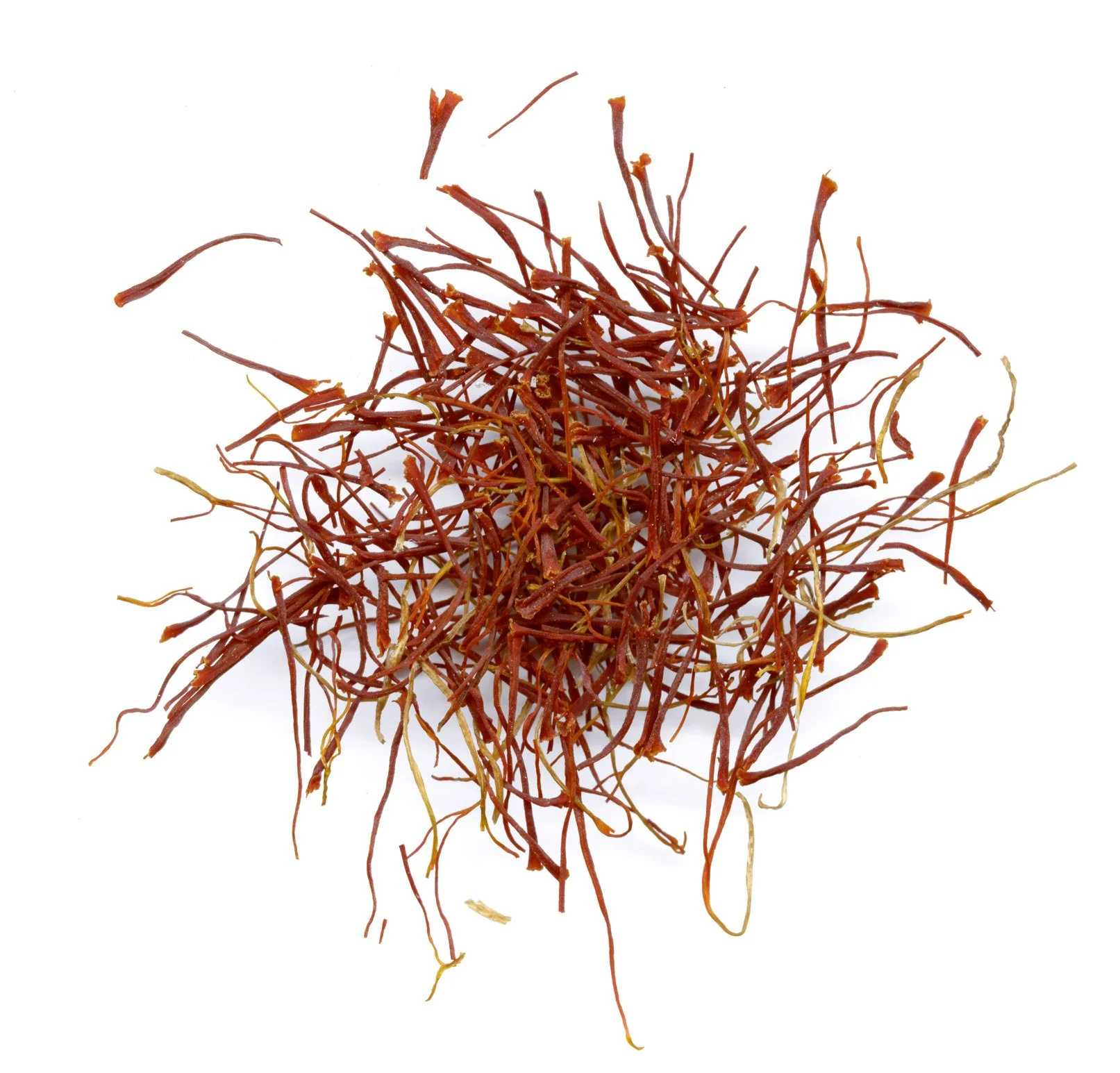
Dried saffron threads on white — the apothecary's examination ground. Genuine saffron carries its color in the threads themselves; Dioscorides caught the gypsum fraud because the feel was wrong and the color sat on the surface instead of living in the threads.
Public domain, Wikimedia Commons, "Iran saffron threads.jpg."
Once you have profiles for several materials, patterns emerge, and patterns are where the real skill lives.
Age announces itself in fragrance. Volatile oils escape a little every day, through every imperfect seal. A material that looks perfect but smells faintly is old, however handsome the jar.
Poor drying announces itself in flexibility and sound. Stems that bend, leaves that tear instead of snapping, seeds that thud instead of rattle: all of these say moisture remains, and moisture says mold is only a matter of time.
Poor storage announces itself in color and smell together. Faded color with weak fragrance says heat and light. A musty, sour, or ammoniacal note says damp has already done its work; such material is not used, it is discarded, and the jar is washed before it touches anything else.
Adulteration, the old enemy, announces itself in inconsistency. Dioscorides caught saffron cut with gypsum because the feel was wrong and the color sat on the surface instead of living in the threads. If one handful of a material behaves differently from the rest of the jar, separate it, profile it alone, and find out why. The cheats of two thousand years ago have modern equivalents, and the defense has not changed: look closely, smell carefully, and trust the evidence over the label.
Check in: A jar's herb looks perfect in every way, but its fragrance is faint. Which pattern is speaking, and through which channel did it announce itself?
❦ In your workbook: record the four patterns in your own way — age in fragrance, poor drying in flexibility and sound, poor storage in color and smell together, adulteration in inconsistency — copy, sketch, or note what matters.
In your packet: Exercise III — The Detective's Shelf ◐ begins here. Work it now, or mark the place and take it as homework — your choice.
Cleanup
Return each material to its labeled jar or dish. Brush the white paper clean into the waste, not onto the floor; a laboratory floor should never show what was worked on the bench. Wash the dishes, dry them fully before they touch any stored botanical, and wash your hands. File your Sensory Profile sheets in your archive in lesson order. Close the notebook. The bench should look as though no one was ever there. That, scholars, is the whole of laboratory housekeeping.
❦ In your workbook: record the cleanup in your own way — materials returned, paper brushed into the waste, dishes washed and dried, sheets filed — copy, sketch, or note what matters.
Archive Entry: The Sensory Profile Sheet
Every material you profile earns a permanent sheet in your potions journal. Rule your page as follows: the material's name and the date across the top; its source (your kitchen shelf, the market, the garden) beneath; then six headed sections, one per channel, in order: Sight, Smell, Touch, Sound, Taste (historical note only: not performed), Time. Close with your verdict paragraph.
File the sheets chronologically behind a divider marked Lesson 11. When you profile the same material again in a later lesson, file the new sheet directly behind the old one. The archive grows by comparison. That is its purpose.
❦ In your workbook: record the profile sheet's ruling in your own way — name and date, source, the six headed sections in order, and the verdict — copy, sketch, or note what matters.
Materials
Everything in its place, before we begin. For this sensory lesson you will need:
Required (Level One — household items)
- Three known botanicals: whole cloves, a bay leaf, and dried oregano make an excellent first set. A cinnamon stick, dried thyme, or lemon peel may substitute.
- Three small dishes or saucers, labeled: one per material. Label before you begin.
- A sheet of white paper: your examination background, showing every shade honestly.
- Notebook and pencil: observations get revised; the notebook should show its thinking.
- A small ruler or a coin: for scale in your records.
- A glass of water: for rinsing your fingers between materials so fragrances do not contaminate one another.
Suggested (Level Two — historically closer)
- Whole spices from an apothecary or spice merchant, kept in labeled glass vials as the old workshops kept them.
- A mortar and pestle: for comparing whole against freshly ground material in the bruise test.
- A hand lens: for close inspection of shape, surface, and fracture faces.
Reflection Questions
Answer the following questions in your workbook.
- Why must sensory observation follow the fixed order of sight, smell, touch, and sound? What goes wrong if you work out of order?
- The bruise test releases fragrance from a leaf. Using what you learned about volatile compounds, explain why a leaf that smells of nothing even after bruising is considered spent.
- Dioscorides warned that saffron was adulterated with gypsum and coated with grape juice. Which sensory channels would expose each of these two frauds, and how?
- A jar of dried thyme looks perfect but its stems bend instead of snapping. What is your diagnosis, and what do you do with the jar?
- The apothecaries of history tasted their drugs as part of evaluation. Give two reasons why this course teaches taste as history rather than practice.
Workbook Checklist — Lesson 11
In my workbook I have:
- ☐ assembled the sensory bench: white paper, three labeled dishes of known botanicals, notebook and pencil, ruler or coin, and a glass of water for rinsing fingers
- ☐ worked the channels in their fixed order — sight, smell, touch, sound, and the hour of time — with taste studied as history only, never performed
- ☐ built a complete Sensory Profile sheet for each of my three materials, each closed with a verdict paragraph answering the three questions and supported by observations
- ☐ profiled the same herb fresh and dried and written the one-page comparison, the first entry of my comparison series
- ☐ profiled one jarred herb blind, written my verdict before learning its true date, and recorded which channel gave the strongest evidence
- ☐ filed my profile sheets chronologically in my potions journal behind the Lesson 11 divider, and stated why taste-testing belongs to history, not to my bench
☐ Lesson completed Date: ___ Signature: ___
The Professor's Closing Note
You have now performed the oldest analytical method in the history of pharmacy, scholars, and you did it with equipment that cost you nothing and cannot be taken from you. Keep your profile sheets. Date them. In a year, profile the same materials again from the same jars, and you will watch time do its work in your own handwriting. That is what an archive is for: not to preserve the past, but to let the present be measured against it.
Order. Observation. Record. Those three words will carry you through every laboratory you ever enter, including this one.
— Professor Crimblebrew Muddlenook, Potions Laboratory • Master Apothecary • Head of House Meridies
Cross-Class Connections

Herbology · Unit IV, Lesson 28 — Drying Herbs the Traditional Way
Welcome, drying scholars. Professor Muddlenook will ask your fingers to judge dryness by the snap, and he is right to trust them — but the snap is earned here first, at the drying rack, where a leaf that crumbles and a stem that breaks cleanly tell you the water has gone and the oils remain. Come and learn the hanging, the screening, the conditioning, and the crispness test in the room where the harvest is actually dried, and your laboratory profiles will rest on herbs that were dried properly in the first place.
Herbology · Unit V, Lesson 36 — The Materia Botanica: Building Your Herbal
Every profile sheet Professor Muddlenook makes you rule — name, date, source, channel by channel, verdict at the close — is a page of the book our two classes keep together. Come to the Greenhouse and build its other half: the growing entry, written from your own plant, in the same fixed fields, so that the herb you tended and the herb you profiled stand as one entry, in one book, in your own hand.
Scrollwork · Unit II, Lesson 6 — Oak Gall Ink
Evening, scholars. Professor Muddlenook borrows my word oxidation for the browning of your bruised leaf, and I am content to lend it — in my library you will watch the same change work on a line of ink, pale when it leaves the pen and black within the day, and keep the log that proves it. Come and see what air does to iron and tannin, and you will understand what it did to your leaf, and why both our classes write the hour beside the observation.
Further Reading & Sources
- De Materia Medica — Dioscorides' text (UPenn PDF library) — the 1888 Thiebault translation; see the saffron and frankincense entries for sensory quality judgments and adulteration warnings.
- De Materia Medica — overview — the five-volume work of Pedanius Dioscorides (50–70 CE), the foundation of European pharmacy for over 1,500 years.
- Dioscorides at the Wellcome Collection — on the physician whose herbal remained the standard reference into the modern era, with the 512 CE Juliana Anicia Codex as the earliest surviving illustrated copy.
- Drying Fall Herbs — Ohio State University Extension — the snap test in practice: stems should snap when bent; bendable stems still hold moisture.
- Judging Home Preserved Foods — Montana State University Extension (PDF) — official judging criteria for dried herbs: color, texture, and fragrance standards.
Browse the Potions shelf in the school Library for readable editions of these works.
Submit your work for this lesson using the form below.
CONTINUE IN THE POTIONS LABORATORY
← Previous · Lesson 10: The Surface Matrix Compilation Next · Lesson 12: Flowers, Leaves & Fragile Petals →
Unit II — Materia Botanica, Delicate Structures Potions Laboratory — All 52 Lessons
The rest of Unit II: Lesson 10 · Surface Matrix · Lesson 12 · Flowers & Petals · Lesson 13 · Seeds & Spices · Lesson 14 · Fragrant Botanicals · Lesson 15 · Receiving & Judging · Lesson 16 · Stability & Storage · Lesson 17 · Consolidating the Journal