

POTIONS
Unit II · Lesson 13SEEDS, SPICES & CULINARY BOTANICALS
Professor Crimblebrew Muddlenook
Master Apothecary • Potions
Head of House Meridies • School of Evershade
Professor's Introduction

Benches clear, notebooks open. Before we begin, a small request: go to your kitchen, open the spice cupboard, and look at it with laboratory eyes. Those little jars are not decorations. Each one is a specimen vial. Each label is an archive entry waiting to be read properly.
For most of history, there was no wall between the grocer and the apothecary. The same merchants sold pepper to cooks and to physicians. The same ships carried cinnamon for the kitchen and for the laboratory. The workshop and the pantry drew from the same shelves. A good apothecary could read a spice the way you will learn to read one today: by its structure, its fragrance, and the story its condition tells.
Today we study seeds, pods, spices, bark fragments, and the aromatic botanicals of the pantry. We will not be cooking. We will be observing. There is a difference, and by the end of this lesson you will feel it in your hands.
Everything in its place, scholars. Let us begin.
— Professor Crimblebrew Muddlenook, Potions Laboratory • Master Apothecary • Head of House Meridies
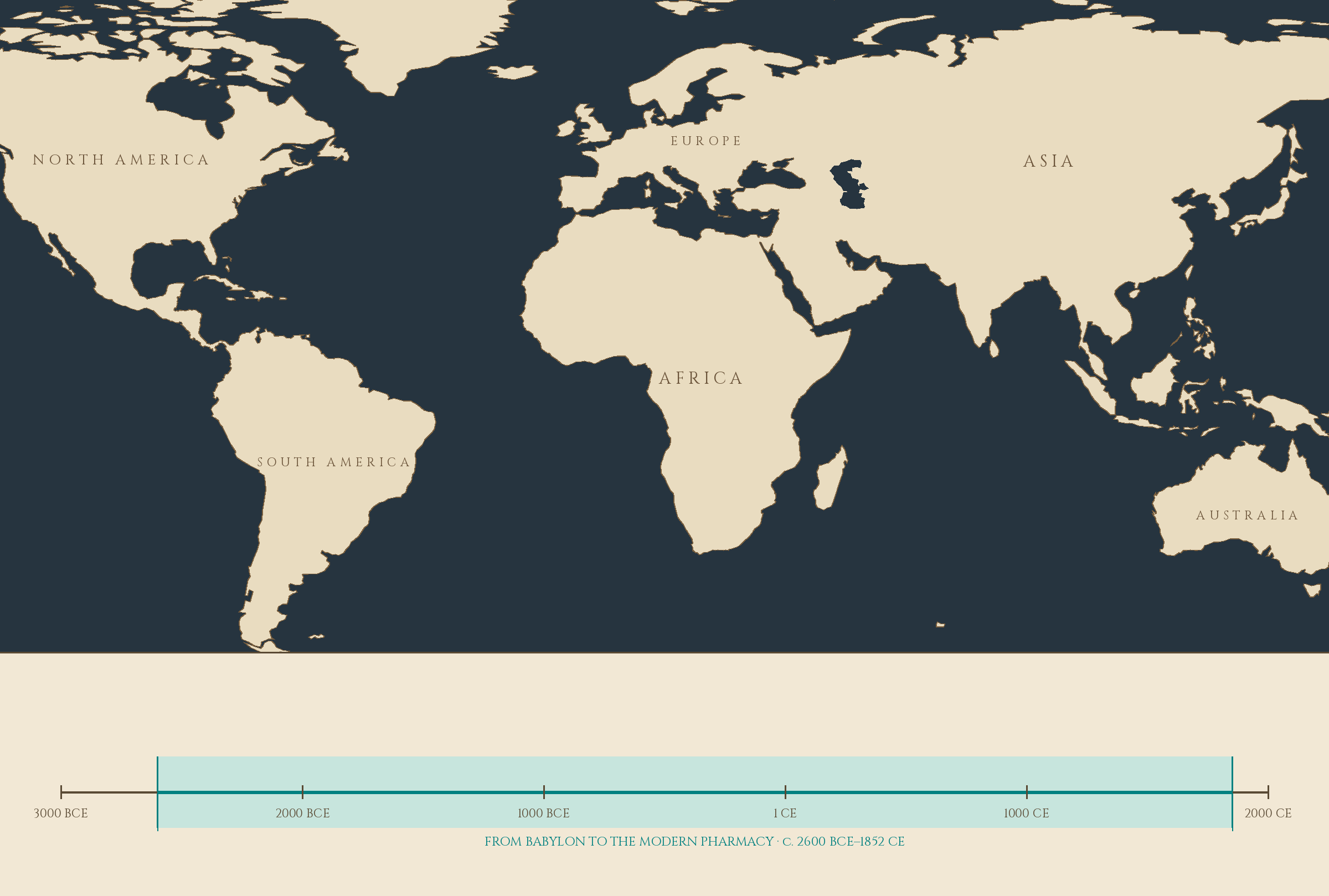
Potions map — the class base map, unmarked for this lesson.
Lesson Objectives
By the end of this lesson, you will be able to:
- Explain why historical apothecaries and grocers drew from the same spice supplies, and what that tells us about the laboratory
- Identify the plant parts used as common kitchen spices: seeds, pods, bark, flower buds, stigmas, and dried fruit
- Demonstrate fragrance activation by crushing or bruising, and explain in your own words why a whole spice smells faint and a crushed one smells strong
- Describe how heat changes spice fragrance, and why whole spices keep their aroma longer than ground ones
- Judge the condition of a dried spice by observation and the sniff test, and explain proper storage
- Complete a formal specimen profile for three kitchen spices and file it in your potions journal
Reading this lesson: ★ marks the passages to remember. They return on the unit quiz and the class test. Check in questions ask the material back as you go; answer them in your workbook when you meet them.
Working this lesson: Your assignment packet is the first download on this page. Work in it as the lesson moves along, answering each exercise as its subject is taught — or read the lesson through for your notes and take the exercises as homework afterward. Both are proper ways to sit this class. Signposts in the reading tell you where each exercise belongs. Written answers are short answers in your own words; a few honest lines are worth more than a filled page.
Your Assignment Packet
This lesson's exercises live in its packet: the Lexicon Handout (every term, course terms marked ◆), Materials, Guided Practice — the six-step specimen profile, worked in full — the Assignment Manual with its answer key for self-checking, the Reflection Questions, and the Workbook Checklist. Download the packet before you begin and keep it beside you as you read.
Safety Briefing
Read this section completely before touching any materials. Professor Muddlenook's first rule of the laboratory is that no procedure begins until the safety briefing is understood.
Dust and airborne particles. Grinding or crushing spices releases fine dust into the air. Pepper dust, mustard seed dust, and chili dust irritate the nose, throat, and eyes. When you crush spices for the exercises in this lesson, work in a ventilated area, keep your face back from the mortar, and do not sniff directly over freshly ground powder. If you sneeze, step away and let the air settle. Students with asthma or respiratory sensitivity should crush spices gently rather than grinding them to fine powder, or ask an adult to do the grinding step.
Skin and eyes. Some spices irritate skin or eyes on contact. Cinnamon and clove contain compounds that can redden sensitive skin. Chili and cayenne can burn the eyes badly if transferred by fingers. Wash your hands thoroughly after handling spices, and do not touch your face until you have done so. Wear an apron or old shirt; turmeric and paprika stain fabric permanently.
Allergy awareness. Spice allergies exist and can be serious. If you have a known food or spice allergy, do not handle that spice; choose a different specimen for your profiles. If you have never handled a spice before and feel unsure, ask an adult first. Never taste or ingest any spice as part of a laboratory exercise unless an adult confirms it is an ordinary culinary spice from your own kitchen.
Heat. One exercise involves gentle warming. Any use of a stove, oven, or dry pan must be done by or with an adult. Heated spices can scorch quickly and produce strong fumes; keep ventilation on and never leave a hot pan unattended.
★ A standing rule for this class. Nothing in the Potions Laboratory is ever presented as medicine, and no lesson will ever give you amounts to take. We study how materials behave, how they were used historically, and how to handle them safely. That is the whole of it, and it is plenty.
Check in: State the standing rule in your own words — then name the four cautions this briefing gives before it: dust, skin and eyes, allergy, and heat, and one instruction from each.
❦ In your workbook: record the safety briefing in your own way — the dust, skin, allergy, and heat cautions, and the standing rule — copy, sketch, or note what matters.
In your packet: Guided Practice — Profiling Three Spices carries this briefing's cautions at the steps where they bite. Work it when you reach the Procedure, or mark the place — your choice.
The Pantry as a Specimen Shelf
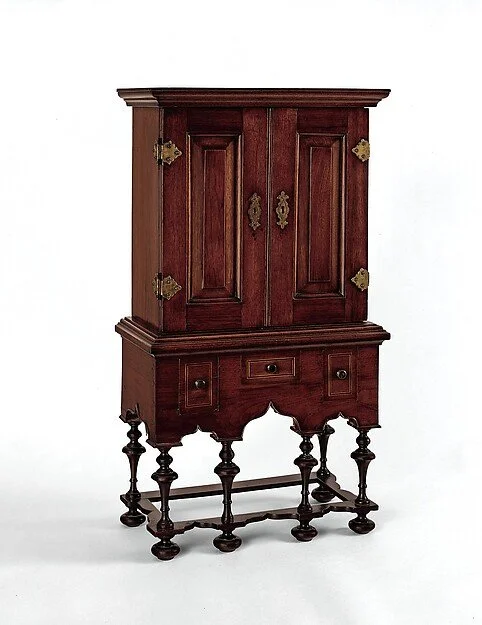
An American spice cabinet, 1700–1730, black walnut. Spices were valuable enough to keep in furniture: a closed, fitted cabinet of small drawers and doors — the pantry shelf as a piece of the storehouse, sealed against air and light.
The Metropolitan Museum of Art, Open Access (CC0). Object 7738, "Spice Cabinet," accession 11.183.
Walk into any historical apothecary workshop, in London or Cairo or Chang'an, and you would find jars of pepper, cinnamon, cloves, and cumin on the shelves beside the medicinal herbs. This was not confusion. For most of history the spice merchant and the apothecary were neighbors, sometimes the same person. The word "grocer" itself comes from the trade in bulk goods, and the great spice ships that crossed the Indian Ocean carried cargoes that fed both kitchens and laboratories. When we study kitchen spices as laboratory specimens, we are not borrowing from cooking. We are returning to the apothecary's own shelf.
★ Look at what a spice actually is, botanically. Black pepper is a dried fruit, picked unripe and dried until it wrinkles. Cloves are dried flower buds, harvested before they can open. Cinnamon is inner bark, peeled from the branches of a tree and dried into quills. Nutmeg is a seed. Cardamom is a seed pod. Saffron is the dried stigma of a crocus flower, three threads per blossom, which is why it has always been costly. Fennel, cumin, and coriander are dried fruits that we casually call seeds. A bay leaf is a whole dried leaf.
This is worth pausing over. Every jar in the spice cupboard is a preserved plant part, dried for storage exactly the way Unit II has taught you to preserve delicate botanicals. The spice trade was, among other things, the largest preservation system in human history: harvest at the right moment, dry thoroughly, pack tightly, ship far, and the fragrance survives the journey. When you open a jar of whole cloves, you are opening a preservation success story centuries in the making.
The apothecary's interest was practical. Spices kept well, which mattered enormously before refrigeration. They were compact and valuable, which made them worth transporting across oceans. And they were powerfully aromatic, which made them useful for the laboratory's work with fragrance, flavor, and preservation. But for our purposes today, their greatest value is as teachers. No other materials demonstrate so clearly how fragrance is stored, released, transformed by heat, and lost to time.
Check in: Name the plant part for each: black pepper, cloves, cinnamon, nutmeg, cardamom, saffron — and say which three kitchen "seeds" are really dried fruits.
❦ In your workbook: record the pantry as a specimen shelf in your own way — the shared grocer-apothecary shelf, and each spice's true plant part — copy, sketch, or note what matters.
In your packet: Exercise I — The Pantry Census ◐ begins here. Work it now, or mark the place and take it as homework — your choice.
Fragrance Activation: The Bruise and Sniff
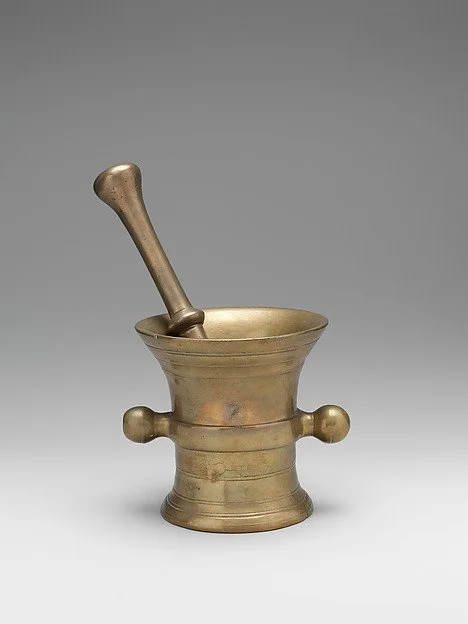
A brass mortar and pestle, second half of the 18th century. Brass and stone mortars are this lesson's Level Two grinding tools — "the traditional apothecary grinding tools" — and crushing in them is how a spice is woken: its volatile oils ruptured out of their compartments all at once.
The Metropolitan Museum of Art, Open Access (CC0). Object 194999, "Mortar and pestle," accession 23.80.16a, b.
Here is the central observation of this lesson, and you will test it yourself within the hour.
A whole clove smells faintly sweet when you hold the jar to your nose. Crush that same clove between your fingers, and the fragrance blooms outward, sharp and unmistakable. Nothing was added. The fragrance was there all along, locked inside.
★ Plants store their aromatic compounds in tiny structures: oil glands on the surface of a leaf, resin ducts in bark, concentrated oils within a seed. In botanical language, these aromatic compounds are called volatile oils, volatile meaning they evaporate readily into the air. While the plant part is whole and intact, the oils sit sealed inside their compartments, and only a little escapes. This is why a jar of whole peppercorns smells mild. Crush the peppercorn, and you rupture thousands of tiny compartments at once. The volatile oils meet the air, and the fragrance activates.
Apothecaries and cooks both knew this without needing the chemistry. The mortar and pestle is one of the oldest tools in both the kitchen and the laboratory precisely because crushing is how you wake a spice up. A recipe that says "freshly ground pepper" is giving a laboratory instruction: activate the volatile oils at the last moment, before they drift away.
★ There is a second half to this observation, and it is about loss. Once those compartments are broken, the volatile oils begin escaping immediately. A ground spice is a spice that has already been activated, and activation cannot be undone. This is why ground spices fade. The fragrance you smell when you first open a jar of ground cinnamon is the last of its volatile oils leaving. Six months later, the jar smells of little more than brown dust. The whole cinnamon stick beside it, unbroken, still holds its fragrance sealed inside.
Order of operations, scholars: the whole spice waits patiently, the crushed spice speaks at once, and the ground spice has already finished speaking. Time your activation accordingly.
Check in: A whole clove smells faint, and a crushed one blooms. Nothing was added — so where was the fragrance before you crushed it, and what did crushing actually do?
❦ In your workbook: record fragrance activation in your own way — the sealed compartments, the rupture, and why activation cannot be undone — copy, sketch, or note what matters.
In your packet: Exercise II — The Activation Comparison ◐ begins here. Work it now, or mark the place and take it as homework — your choice.
Thermal Response: Waking Spices with Heat
Heat is the second great activator, and it works differently from crushing.
When spices are warmed gently in a dry pan, their fragrance changes and intensifies. Cooks in South Asia call this blooming or tempering: whole spices are heated in fat or toasted dry until they darken slightly and release a deep, rounded aroma quite different from the raw spice. The heat drives volatile oils toward the surface and triggers chemical changes that create new aromatic compounds. A cumin seed tastes and smells one way raw, and quite another way toasted. Both are cumin. Heat has rewritten its fragrance profile.
★ Observe this carefully, because it teaches something general about laboratory materials: heat does not simply make things stronger. It transforms them. Some compounds evaporate and are lost. Others form for the first time. This is why the warming exercise in this lesson asks you to compare before and after, not simply to enjoy the aroma. You are watching a material change state, and recording the change is the work.
A caution from your professor: heat is also how spices are ruined. A scorched spice smells bitter and acrid, and no amount of wishing restores it. Gentle heat, constant attention, and removal at the first sign of darkening. The laboratory rewards patience and punishes distraction. This is true of nearly everything we will ever heat together.
Check in: Why is heat described as transformation rather than merely amplification — what is lost, and what forms for the first time?
❦ In your workbook: record thermal response in your own way — blooming, the before-and-after comparison, and the scorched batch that cannot be restored — copy, sketch, or note what matters.
In your packet: Exercise III — The Specimen Profile ◐ takes up the warming test here. Work it now, or mark the place and take it as homework — your choice.
Preservation Stability: Reading the Jar
A spice jar tells you its history if you know how to read it. This section teaches you the inspection an apothecary would perform on any new shipment.
★ The four enemies. Dried spices are damaged by air, light, heat, and moisture. Air carries volatile oils away. Light breaks down color and aroma compounds. Heat accelerates every form of decay. Moisture invites mold and clumping. A jar stored beside the stove suffers all four at once, which is why the spice rack next to the cooker, convenient as it is, is the worst place in the kitchen for spices. Cool, dark, dry, and tightly sealed: that is the whole of spice storage, and it is the whole of botanical preservation generally.
★ Whole keeps longer than ground. From the fragrance activation lesson, you can now derive this rule yourself: intact compartments protect volatile oils, so whole spices remain potent for years while ground spices fade within months. When you buy spices, prefer whole. When you inherit old jars, inspect before trusting.
The sniff test. Open the jar and smell. A potent spice announces itself immediately. A faded spice smells faint, dusty, or of nothing at all. For a more formal test, crush a small amount and smell again: if crushing revives little fragrance, the spice is spent. Color is a second witness. Paprika should be vivid red, turmeric bright gold, dried herbs green rather than gray. Faded color and faded fragrance almost always travel together.
Moisture and mold. If a spice has clumped into a solid cake, absorbed damp, or shows any sign of mold, discard it. Do not attempt to rescue it. An orderly laboratory does not gamble with spoiled materials.
Record your findings the way you would for any specimen. The jar's condition is data.
Check in: Name the four enemies — and give the apothecary's verdict, and the reasoning, for a jar of ground paprika that smells of dust and has gone brownish.
❦ In your workbook: record reading the jar in your own way — the four enemies, the sniff test, color as second witness, and the mold rule — copy, sketch, or note what matters.
In your packet: Exercise I — The Pantry Census ◐ puts the sniff test to work here. Work it now, or mark the place and take it as homework — your choice.
A Note on the Spice Roads
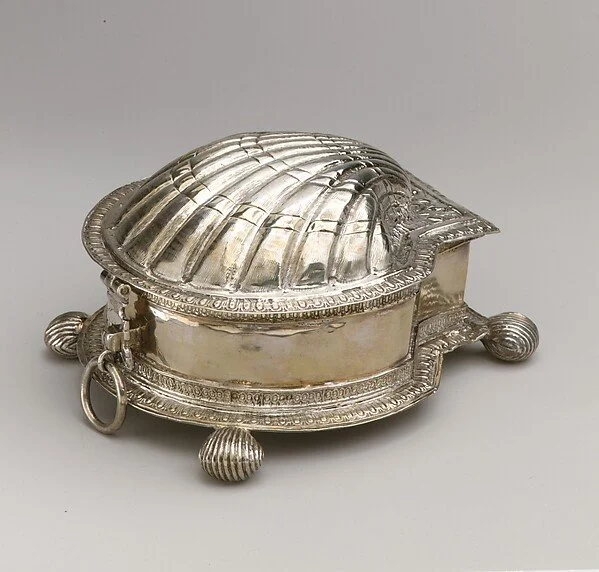
A silver spice box, 1602/3. When the contents had crossed oceans and cost more than the box's own silver, the container said so: spices were stored like treasure because, by weight, they were.
The Metropolitan Museum of Art, Open Access (CC0). Object 205039, "Spice box," accession 68.141.277.
The spices in your cupboard traveled farther, historically, than almost anything else you own. For centuries, pepper, cinnamon, cloves, and nutmeg grew only in specific regions of Asia, and reaching European markets required months of travel by sea and land. Arab, Indian, Chinese, and later Portuguese, Dutch, and English merchants carried them along trade networks that spanned the known world. The cost of that journey is why spices were once worth extraordinary sums, why a rent paid in peppercorns (a "peppercorn rent") became a legal expression for a token payment, and why nations competed, often brutally, for control of the trade.
You do not need to memorize the trade routes. But understand what they meant for the laboratory: the apothecary's shelf was global centuries before the word existed. The mortar on a London workbench might hold pepper from the Malabar Coast, cinnamon from Ceylon, and cloves from the Moluccas, all in a single preparation. When you profile your three spices today, you are handling the end of a very long road, and treating each jar as a specimen honors everyone who carried it.
Check in: Your mortar's three spices might come from three named coasts and islands. Name them — and say what their being on one London bench tells us about the apothecary's shelf.
❦ In your workbook: record the spice roads in your own way — the long journey, the peppercorn rent, and the global shelf — copy, sketch, or note what matters.
The Procedure: Profiling Three Spices
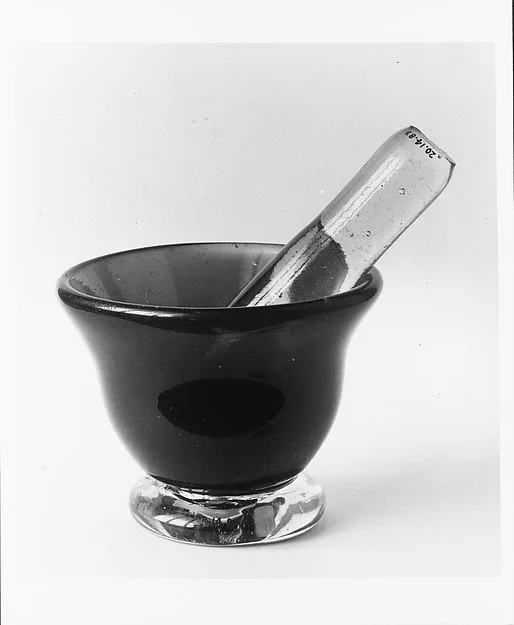
A glass mortar and pestle, American, 1739–80. The apothecary's mortar also came in glass: smooth, non-porous, and wiped clean between grindings — the same discipline this lesson's cleanup asks of your own mortar, so one spice never contaminates the next.
The Metropolitan Museum of Art, Open Access (CC0). Object 5229, "Mortar and Pestle," accession 20.14.8a, b.
You will now profile three kitchen spices as formal laboratory specimens. Choose three whole spices from your mise en place, ideally from different plant parts: for example, black peppercorns (dried fruit), whole cloves (flower buds), and a cinnamon stick (bark). Variety teaches more than repetition.
For each spice, complete the following steps in order, and record each step before moving to the next. Muddlenook's rule: the record is made during the observation, not afterward from memory.
Step 1 — Identification. Record the common name, and the plant part it comes from (seed, fruit, bark, flower bud, leaf, stigma, pod). If the jar has an origin listed, record that too.
Step 2 — Whole observation. Examine the spice uncrushed. Note its size, shape, color, surface texture, and hardness. Smell the open jar from a few inches away and describe the fragrance in your own words. Rate its apparent potency: strong, moderate, or faint.
Step 3 — Activation test. Place one piece in the mortar and crush it firmly. Immediately smell the crushed material (from a slight distance, not directly over the mortar). Describe how the fragrance changed: stronger, sharper, sweeter, different in character? Record the difference between whole and crushed. This is fragrance activation, observed by your own nose.
Step 4 — Warming test (adult required). Place a small amount of a second spice in a dry pan over gentle heat. Watch and smell as it warms, removing it at the first deepening of color or intensifying of aroma. Compare the warmed fragrance to the raw. Record what heat changed. Do not scorch it; if it darkens too far, note the acrid smell as a failed batch and begin again with fresh material.
Step 5 — Storage assessment. Examine the jar the spice came from. Is it airtight? Has it been stored away from heat and light? Apply the sniff test to judge whether the spice is fresh, aging, or spent. Record your verdict and your reasoning.
Step 6 — Archive entry. Transfer your completed profile to your potions journal, one entry per spice. Each entry should contain all five steps above, dated, in your own words. These entries are permanent. Future lessons will ask you to consult them.
Work through one spice completely before beginning the next. The laboratory proceeds in order, one specimen at a time.
Check in: State the six steps in order — and the rule about when the record is made.
❦ In your workbook: record the procedure in your own way — the six steps, in their order, one spice completed before the next begins — copy, sketch, or note what matters.
In your packet: Guided Practice — Profiling Three Spices works this procedure in full, and Exercise III — The Specimen Profile ◐ asks it of a fourth spice. Work them now, or mark the place and take them as homework — your choice.
Cleanup
The procedure is not complete until the laboratory is restored.
- Seal every spice jar tightly and return each to cool, dark storage, away from the stove.
- Empty the mortar completely. Wipe it dry; do not leave spice residue to contaminate the next grinding.
- Wipe all work surfaces with the damp cloth. Turmeric and paprika stain, so attend to those first.
- Wash your hands thoroughly, especially after handling chilies, cinnamon, or cloves.
- Dispose of any scorched material from the warming test. A failed batch is recorded, then discarded.
- Confirm that your archive entries are complete and dated before you leave the table.
A clean laboratory is a safe laboratory, and a safe laboratory is a productive one. This is not fussiness. It is the foundation everything else stands on.
❦ In your workbook: record the cleanup in your own way — jars sealed and stored cool and dark, the mortar wiped dry, hands washed — copy, sketch, or note what matters.
Guided Observation: What the Profiles Teach
When your three profiles are complete, lay them side by side and look for patterns. This comparison is where observation becomes understanding.
You will likely find that the bark (cinnamon) was the hardest and the slowest to release fragrance, while the crushed seed or bud released its aroma immediately. Different plant structures store their volatile oils differently, and the structure predicts the behavior. You will likely find that warming changed each spice in its own way rather than in one uniform direction. Heat transforms; it does not merely amplify.
You may also find that one of your jars is past its prime. This is not a failure of the exercise. It is the exercise working as intended. An apothecary who cannot tell a spent ingredient from a potent one cannot do reliable work. Learning to judge condition by observation is among the most practical skills this course will teach you, and the spice cupboard is the gentlest classroom for it.
Scholars, a final note on method before we close. You have today performed the complete laboratory rhythm on a humble subject: safety briefing, mise en place, procedure, observation, and shortly, cleanup and archive entry. The subject was peppercorns and cloves. The method is the same one you will use for tinctures (alcoholic preparations made by soaking a botanical in spirit), for salves, for everything this course will ever ask of you. Master the rhythm on small things, and the great things will follow in order.
Check in: Lay your three profiles side by side: which structure released its fragrance slowest, and what does the structure of a spice predict about its behavior?
❦ In your workbook: record what the profiles teach in your own way — structure predicting behavior, heat transforming each spice in its own way, and the spent jar as the exercise working — copy, sketch, or note what matters.
Materials
Everything in its place, before we begin. A meticulous laboratory begins with everything gathered before work starts. Assemble the following.
Required (Level One — household items)
- Three to four whole spices from your kitchen (good candidates: black peppercorns, whole cloves, a cinnamon stick, coriander seeds, cumin seeds, cardamom pods, fennel seeds, mustard seeds, a dried bay leaf, a star anise)
- One ground spice for comparison (ground cinnamon, ground cumin, or ground black pepper)
- A mortar and pestle, or a sturdy bowl and the back of a spoon for crushing
- Small dishes or saucers for holding samples
- Your laboratory journal or potions journal pages, and a pencil
- A clean dry pan and stove access for the warming exercise (adult required)
- A damp cloth for wiping surfaces
Suggested (Level Two — historically closer)
- Whole spices bought from a bulk bin or spice merchant rather than pre-ground jars, so you can compare freshness directly
- A brass or stone mortar and pestle, the traditional apothecary grinding tools
- Small glass vials or jars with tight lids for storing your profiled specimens
- Paper labels and a pen for marking each vial with the spice name and the date
Label everything before you begin. An unlabeled jar in a laboratory is a mystery, and mysteries belong in stories, not on shelves.
Reflection Questions
Answer the following questions in your workbook.
- Why did historical apothecaries and grocers draw from the same spice supplies, and what does that tell us about the laboratory?
- A whole clove smells faint in the jar but powerfully fragrant when crushed. Explain what is happening, using the terms volatile oil and fragrance activation.
- Why do whole spices keep their potency far longer than ground spices?
- Describe how gentle heat changes a spice's fragrance, and explain why heat is described as transformation rather than merely amplification.
- You open a jar of ground paprika that smells faintly of dust and looks brownish rather than red. What is your verdict on this spice, and what storage mistakes probably led to its condition?
Workbook Checklist — Lesson 13
In my workbook I have:
- ☐ named the plant part for the kitchen spices: pepper a dried fruit, cloves flower buds, cinnamon inner bark, nutmeg a seed, cardamom a pod, saffron stigmas, and fennel, cumin, and coriander dried fruits called seeds
- ☐ explained fragrance activation: volatile oils sealed in tiny structures, released all at once by crushing, and escaping from that moment on
- ☐ stated why whole spices keep their potency for years while ground spices fade within months
- ☐ described blooming: gentle heat driving volatile oils toward the surface and creating new aromatic compounds — transformation, not merely amplification — and why a scorched spice cannot be restored
- ☐ read a jar by the four enemies (air, light, heat, moisture), the sniff test, and color as second witness, and stated the storage rule: cool, dark, dry, and tightly sealed
- ☐ kept the safety briefing whole: ventilated crushing with face back from the mortar, hands washed before touching my face, no spice handled against a known allergy, adult for every warming, and nothing in this laboratory presented as medicine
- ☐ profiled three kitchen spices through the six steps and filed their archive entries, dated, in my potions journal
☐ Lesson completed Date: ___ Signature: ___
The Professor's Closing Note
Well done, scholars. You have inventoried, activated, warmed, judged, and archived. Three ordinary jars have become three documented specimens, and your potions journal is richer by three entries.
Remember what today taught you in order: fragrance is stored in structures and released by breaking them; heat transforms rather than merely strengthening; whole keeps longer than ground; and the jar itself can be read. These are not facts about spices. They are principles about materials, and you will meet them again in every unit of this course.
File your profiles where you can find them. Keep your jars sealed and your labels legible. And the next time you pass the spice cupboard, give it the small nod of professional respect it has earned.
In good order,
— Professor Crimblebrew Muddlenook, Potions Laboratory • Master Apothecary • Head of House Meridies
Cross-Class Connections

Herbology · Unit IV, Lesson 31 — Culinary Herbs in the Kitchen Garden
Take your time, scholars, and pull up a stool. Professor Muddlenook has shown you the dried end of the kitchen's story — the jar, the crush, the sniff test. Come to the Greenhouse and meet the same materia alive: the ten classic culinary herbs, how to harvest them so they keep producing, and how a harvest is kept fresh or put by for winter. When you reach my cilantro, look closely — its seeds are the very coriander on his specimen shelf. Your kitchen garden and his laboratory cupboard are one shelf, seen from its two ends. — Fernfoot
Herbology · Unit V, Lesson 36 — The Materia Botanica: Building Your Herbal
Scholars, every spice Professor Muddlenook had you profile today ends as an entry in a book our two classes keep together. Come and build that book properly: one plant, one entry, my growing notes beside his preparation notes, so the coriander you met as a living plant in my kitchen garden is the same coriander whose dried fruit you judged at his bench. Bring your three profiles — they already belong in it. — Fernfoot
Further Reading & Sources
- Spice Pages — Gernot Katzer's Spice Dictionary — an extensive botanical reference identifying the plant part, origin, and chemistry of hundreds of spices.
- The Spice Trade — The Metropolitan Museum of Art, Heilbrunn Timeline — a museum essay on how the spice trade shaped history, art, and global exchange.
- Spices and Seasonings — Smithsonian Libraries — historical texts and images from the history of the spice trade and apothecary practice.
- Surprising Stories Behind Your Store Cupboard Staples — Royal Botanic Gardens, Kew — Kew on the spices behind everyday staples: where they come from, how they grow, and the trade that carried them.
- History of the Apothecary — Royal Pharmaceutical Society Museum — background on the apothecary's workshop, its tools, and its historical relationship with the spice and grocery trades.
Browse the Potions shelf in the school Library for readable editions of these works.
Submit your work for this lesson using the form below.
CONTINUE IN THE POTIONS LABORATORY
← Previous · Lesson 12: Flowers, Leaves & Fragile Petals Next · Lesson 14: Fragrant Botanicals & Aromatics →
Unit II — Materia Botanica, Delicate Structures Potions Laboratory — All 52 Lessons
The rest of Unit II: Lesson 10 · Surface Matrix · Lesson 11 · Sensory Profile · Lesson 12 · Flowers & Petals · Lesson 14 · Fragrant Botanicals · Lesson 15 · Receiving & Judging · Lesson 16 · Stability & Storage · Lesson 17 · Consolidating the Journal