

POTIONS
Unit II · Lesson 17CONSOLIDATING THE POTIONS JOURNAL
Professor Crimblebrew Muddlenook
Master Apothecary • Potions
Head of House Meridies • School of Evershade
Professor's Introduction

Sealed with the teal wax of Professor Crimblebrew Muddlenook, Master Apothecary of the Potions Laboratory, Head of House Meridies.
When you entered Unit II, your archive was a shelf of empty jars and good intentions. Look at it now. You have classified simples (single-ingredient botanical materials, one plant, one part, used alone), mapped sensory profiles, handled fragile petals without crushing them, weighed seeds and spices, chased the top notes of fragrant herbs, dried botanicals until they rattled, and watched stored ingredients change with the seasons. That is eight lessons of real laboratory work, and it deserves a real laboratory archive. Today we stop gathering and start consolidating. We review every entry, repair every weak classification, index every specimen, and write the stewardship plan that will carry your potions journal into Unit III and beyond. An archive is not a pile of notes, scholar. It is a memory that outlives the moment. Let us make yours worthy of the shelves.
— Professor Crimblebrew Muddlenook, Potions Laboratory • Master Apothecary • Head of House Meridies
Potions map — the class base map, unmarked for this lesson.
Lesson Objectives
By the end of this lesson, you will be able to:
- Review and refine the classifications of every botanical entry you created in Lessons 10 through 16.
- Organize your potions journal with consistent page order, labeling, and shelf coding.
- Assign every specimen a preservation category and a storage note that another student could follow.
- Build a specimen index that lets you find any entry in under a minute.
- Draft a long-term stewardship plan covering review cycles, relabeling, and storage checks for the rest of the course.
Reading this lesson: ★ marks the passages to remember. They set the archive standard this lesson is assessed by, and they return in the units ahead and at the capstone. This lesson contributes no items to the Unit II Quiz — its assessment is the archive work itself, set out in the Assignment Manual below. Check in questions ask the material back as you go; answer them in your workbook when you meet them.
Working this lesson: Your assignment packet is the first download on this page. Work in it as the lesson moves along, answering each assignment as its subject is taught — or read the lesson through for your notes and take the assignments as homework afterward. Both are proper ways to sit this class. Signposts in the reading tell you where each assignment belongs. Written answers are short answers in your own words; a few honest lines are worth more than a filled page.
Your Assignment Packet
This lesson's assignments live in its packet: the Lexicon Handout (every term, course terms marked ◆), Materials, Guided Practice — the worked archive entry, the Archive Audit Checklist, and the Entry Completeness Checklist, printed in full so you can work through them at your own shelves — the Assignment Manual with its self-check, the Reflection Questions, and the Workbook Checklist. Download the packet before you begin and keep it beside you as you read.
About this lesson's assessment, plainly: this lesson has no quiz, and no quiz items are taken from it for the Unit II Quiz. The archive work itself is the assessment: Assignments I–III in the manual below — the full archive audit, one model specimen record written from scratch, and your signed stewardship plan with its self-assessment rubric — stand beside the Unit II Quiz as the unit's practical layer. The lesson's course-◆ terms do travel to the Unit II Quiz, where they belong to its vocabulary matching.
Safety Briefing
★ Unit II asked you to handle real botanical materials, and the safety habits you practiced are now standing rules for the rest of the course. Keep every specimen labeled; an unlabeled jar is a hazard wearing a disguise. Watch stored botanicals for mold, especially anything still under observation, and discard anything suspicious rather than investigating it with your nose. Treat fragrance work with respect: strong aromatics belong in ventilated spaces, and anyone with fragrance sensitivities or allergies should work at a distance or observe rather than handle. Some botanicals irritate skin or stain hands and surfaces, so wash up after handling and protect your work area. Never taste or consume an unidentified plant, no matter how harmless it looks. These are not new rules. They are the rules you have been practicing for eight lessons. The archive you keep and the habits you keep are the same discipline.
Check in: Which safety habits from this briefing bear directly on consolidation day itself — the labeling, the mold watch, and the rule about investigating a suspicious specimen?
❦ In your workbook: record the safety briefing in your own way — labeled specimens, the mold watch, fragrance at a distance for the sensitive, washed hands, and nothing unidentified ever tasted — copy, sketch, or note what matters.
In your packet: Guided Practice — the two checklists begin here. Work them as you reach them in the reading, or mark the place and take them as homework — your choice.
Why the Archive Matters
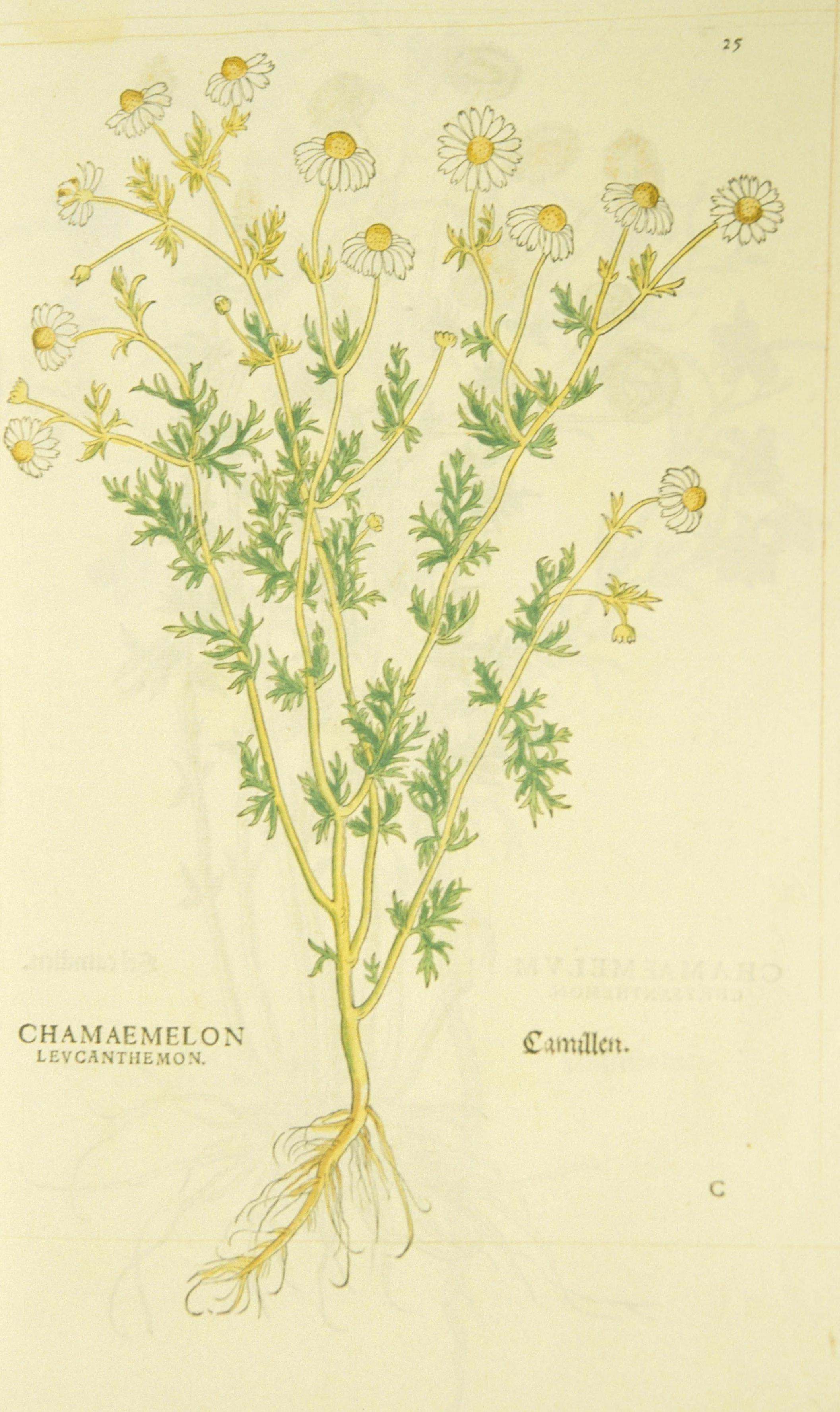
Chamomile, drawn from the living plant for Leonhart Fuchs's De historia stirpium (Basel, 1542) — one of the printed herbals whose entries let a formula recorded in one century be followed in the next. A study portrait of the tradition, not an identification guide.
Leonhart Fuchs, De historia stirpium commentarii insignes (1542), illustrators Heinrich Füllmaurer and Albrecht Meyer, engraver Veit Rudolph Specklin, via Wikimedia Commons (photograph: U.S. National Library of Medicine, History of Medicine, Flickr Commons). No restrictions (public domain).
A preparation can fail for a hundred reasons, and half of them live in the archive. The tincture that darkened because nobody noted the harvest date. The dried flowers that molded because the drying log said "probably dry." The beautiful resin that hardened into a lump because the storage note never mentioned temperature. Historical apothecaries understood this. Their ledgers, herbals, and specimen cabinets were not decorations. They were the working memory of the workshop, the reason a formula recorded in 1640 could still be followed in 1740.
★ Your potions journal is the same kind of memory, and the shared Materia Botanica is its companion. The entries you write here will be consulted again in Unit III when dense materials arrive on the shelves, in Unit IV when extractions begin, and in Unit V when formulations combine everything you have learned. A weak entry now becomes a weak foundation later. A strong entry becomes a tool you will reach for again and again.
There is another reason to take consolidation seriously. Classification is thinking. Every time you decide whether a bruised petal belongs under "Flowers" or under "Fragrant Botanicals," you are practicing the same judgment historical apothecaries used when they argued over whether a plant was a simple or a compound ingredient. The archive does not just store your knowledge. It sharpens it.
Check in: Name the three archive failures the opening paragraph gives — and say which later units will consult the entries you consolidate today.
❦ In your workbook: record why the archive matters in your own way — the working memory of the workshop, the foundation the later units stand on, and classification as thinking — copy, sketch, or note what matters.
The Five Consolidation Tasks
Consolidation is methodical work, and methodical work goes best in order. Work through all five tasks before you begin the assignment packet. Keep your Unit II notes, your jars, and your drying logs beside you. Muddlenook's rule for today: touch every entry. If an entry has not been reviewed by the end of this lesson, it does not exist yet.
Task One: Classification Refinement
Open your archive to the first entry from Lesson 10, when you began classifying simples. Read it the way a stranger would. Is the classification still correct? Many students discover that entries written early in the unit need revision once later lessons add new knowledge. A seed you classified simply as a "culinary botanical" in Lesson 13 may deserve a second tag after Lesson 14 revealed its fragrance behavior. A dried flower from Lesson 15 may need its preservation category corrected after Lesson 16 taught you what stability really means.
Go through every entry and ask three questions. First, is the primary classification accurate? Second, does the entry need a secondary tag that later lessons revealed? Third, is the classification written in the same words you used everywhere else? Consistency matters more than cleverness. "Dried flower" and "desiccated blossom" and "dry petal material" are three names for one thing, and an archive with three names for one thing is an archive that hides its own contents. Pick one term and correct every entry to match.
❦ In your workbook: record Task One in your own way — the three questions asked of every entry, and the one-term rule — copy, sketch, or note what matters.
Task Two: Archive Organization
An archive is a sequence, and the sequence should be obvious to anyone who opens it. Check that your entries follow a consistent order. The recommended order is the order of the lessons: simples and classifications first, then sensory profiles, then flowers and leaves, seeds and spices, fragrant botanicals, drying records, and stability observations. If you filed entries out of order, reorder them now.
Next, check your page headers. Every page should carry the same four facts at the top: the ingredient name, the date the entry was written, the lesson it came from, and the shelf or jar code where the physical specimen lives. These four facts are the minimum an archive needs to be useful. Without the date, you cannot judge stability. Without the shelf code, you cannot find the specimen. Without the lesson number, you cannot trace your own reasoning. Add any missing headers now.
❦ In your workbook: record Task Two in your own way — the lesson order of the entries, and the four headers every page carries — copy, sketch, or note what matters.
Task Three: Specimen Indexing
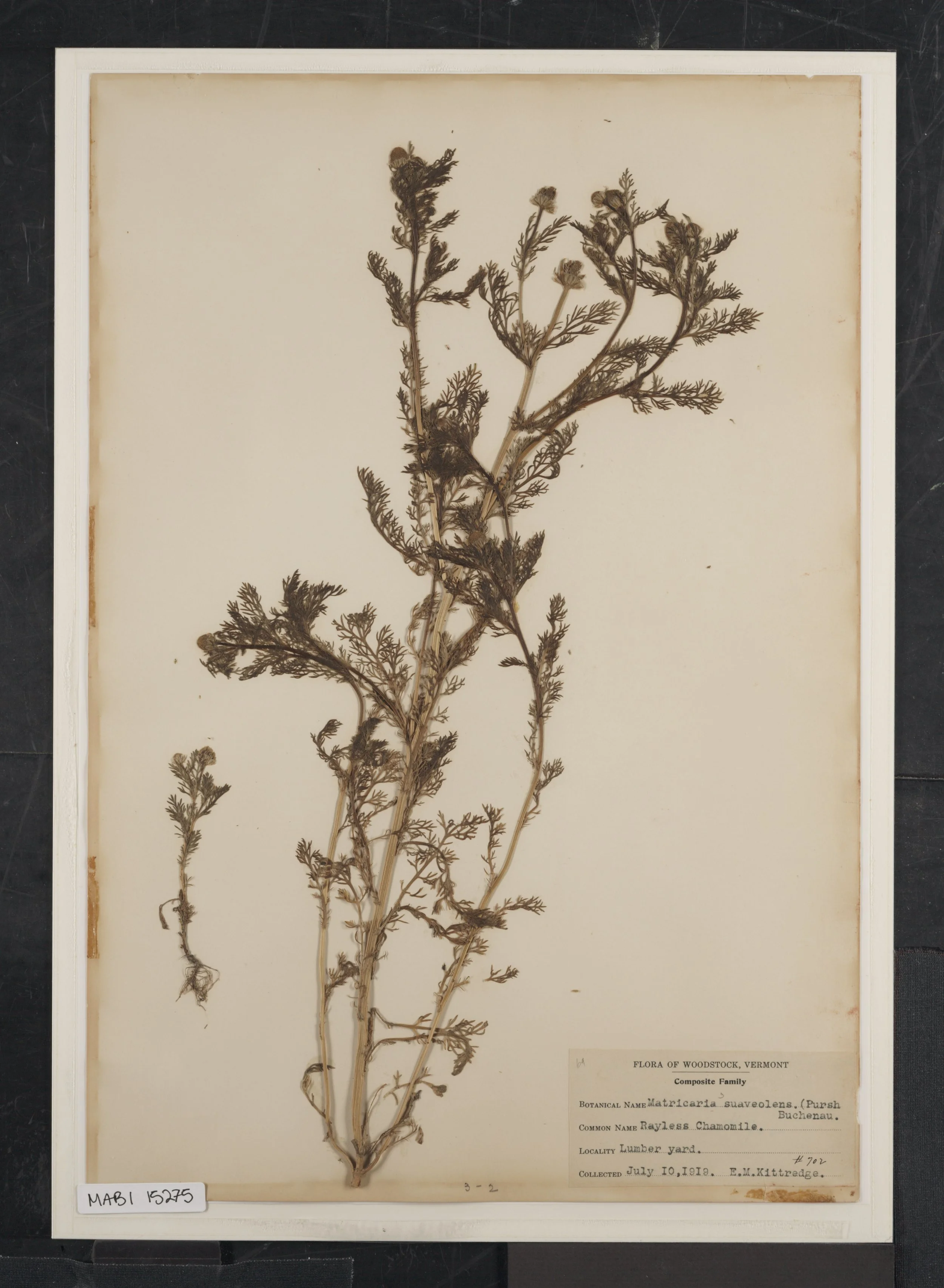
A herbarium sheet done right: the specimen, its botanical and common names, where it was gathered, when, and by whom — the institutional ancestor of your specimen record and its shelf code, still findable more than a century after it was collected. The plant is rayless chamomile, a relative of the lesson's chamomile, kept here as a record-keeping portrait, not an identification guide.
Billings-Kittredge Herbaria (collected by E. H. Kittredge, Woodstock, Vermont, 10 July 1915), photograph U.S. National Park Service / Boston Photo Imaging, via Wikimedia Commons. Public domain.
An index is the map of the archive, and a map is only useful if it is complete. On a fresh page at the front of your archive, list every specimen you hold: common name, classification, preservation category, and the page number where its full entry lives. List them alphabetically by common name. Then list them a second time, grouped by preservation category. Two orderings, one index, and you will be able to find any entry in under a minute whether you are thinking "where is my chamomile" or "which specimens need a drying check this month."
Test your index when it is done. Close your eyes, pick three specimens at random, and time yourself finding each full entry. If any search takes longer than a minute, the index needs repair.
❦ In your workbook: record Task Three in your own way — the two orderings of one index, and the one-minute test — copy, sketch, or note what matters.
Task Four: Preservation Categories
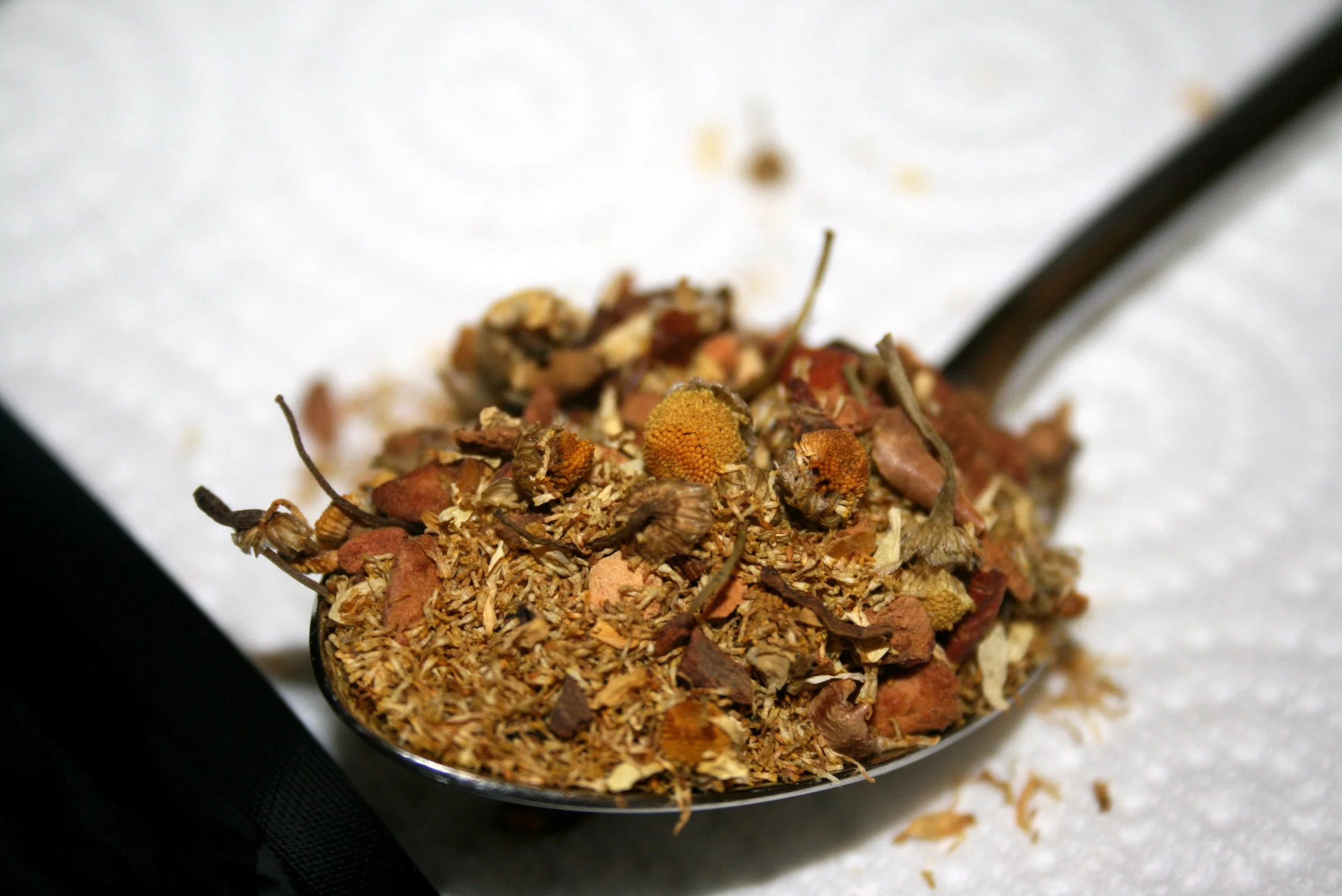
Dried chamomile as it is actually kept and used: loose, fragrant, and fading from the moment the jar opens — the worked entry's Aromatic and Volatile category in a single spoonful. Material like this is stored airtight, checked by scent on the stewardship schedule, and never judged by a picture: the archive's categories are earned by the dryness checks, not by looks.
Loose chamomile tea, photograph by Ehedaya (Wikipedia user), via Wikimedia Commons. Public domain.
★ Every specimen in your archive belongs to exactly one preservation category, and the category must be written on the entry. The four categories for Unit II are: Dry and Stable (fully dried, low mold risk, stored in sealed containers), Dry but Fragile (dried but easily crushed or faded, needing gentle handling and darkness), Aromatic and Volatile (fragrance fading over time, needing airtight storage and regular scent checks), and Under Observation (anything not yet fully dried, anything showing early instability, anything you are still learning about).
Be honest. Students are often tempted to promote specimens to "Dry and Stable" before they have earned it. If a jar of dried petals still feels cool to the touch, it is not dry yet, and cool means moisture, and moisture means mold. Write "Under Observation," schedule a recheck, and let the specimen earn its promotion. An archive that lies to its keeper is worse than no archive at all.
❦ In your workbook: record Task Four in your own way — the four categories, exactly one per specimen, and the cool-means-moisture rule — copy, sketch, or note what matters.
Task Five: Long-Term Stewardship
An archive is not finished when it is organized. It is finished when it has a future. Write a stewardship plan on the last page of your Unit II section. It should name three things: a review cycle, a relabeling rule, and a storage check routine.
The review cycle is simple. Once a month, open the archive, read five random entries, and confirm the specimens match their records. The relabeling rule is equally simple. Any label that is smudged, faded, or ambiguous gets replaced the day you notice it, not the day you get around to it. The storage check routine means walking the shelves once a month with your index in hand: lids sealed, jars upright, nothing in direct sun, nothing near a heat source, and every "Under Observation" specimen examined for the changes you predicted in its entry.
Sign and date your stewardship plan. You are now the keeper of this archive, and keepers sign their work.
Check in: A jar of dried petals feels cool to the touch. What category does it get today, what do you schedule, and what does the archive call a specimen promoted before it has earned it?
❦ In your workbook: record Task Five in your own way — the review cycle, the relabeling rule, the storage check routine, and the keeper's signature — copy, sketch, or note what matters.
In your packet: Assignment I — The Archive Audit ◐ begins here. Work it now, or mark the place and take it as homework — your choice.
Sealed with the teal wax of Professor Crimblebrew Muddlenook, Master Apothecary of the Potions Laboratory, Head of House Meridies.
I once inspected a student's archive and found a jar labeled "smells nice." That was the entire entry. The jar did smell nice. It was also unlabeled as to contents, undated, and stored above a radiator, and by the next month the contents had faded to dust and the student could not remember what they had been. Do not be the student with the nice-smelling mystery jar. Write it down. Date it. Code it. Your future self is counting on you, and your future self is a very busy apothecary.
— Professor Crimblebrew Muddlenook, Potions Laboratory • Master Apothecary • Head of House Meridies
A Complete Archive Entry: The Worked Example
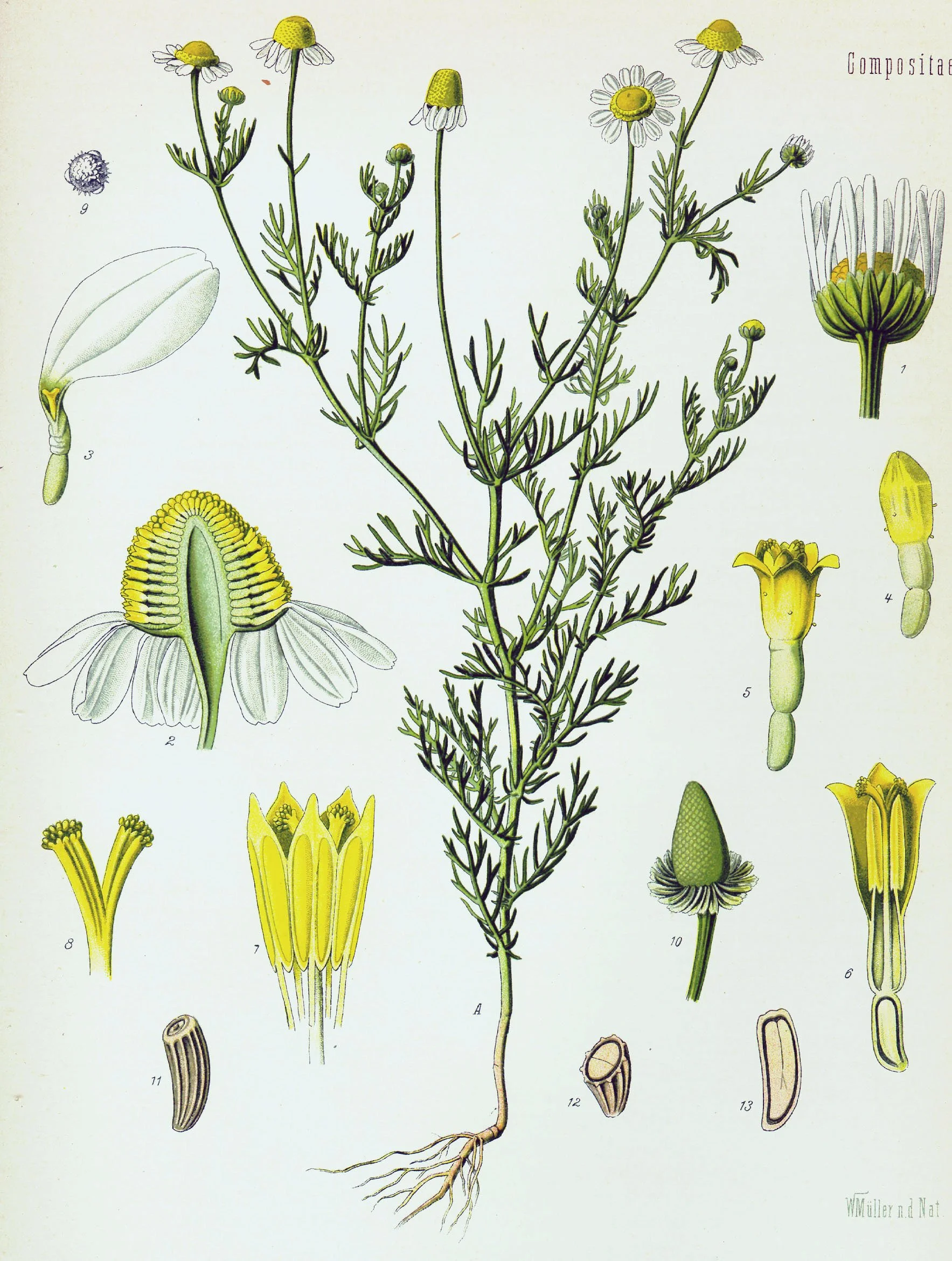
Chamomile (Matricaria chamomilla, plate 91 of Köhler's Medizinal-Pflanzen, where the plant stands under its synonym Matricaria recutita) — the specimen of the lesson's worked entry, drawn dissection by dissection the way a specimen record is written field by field. A study portrait; your entry is written from the jar in your hand, never from a picture.
Franz Eugen Köhler, Köhler's Medizinal-Pflanzen (1887–1914), plate 91 (artist: Walther Otto Müller), via Wikimedia Commons. Public domain.
Below is a complete archive entry for one specimen, written exactly as your entries should look. Study its structure before you write your own. Every field has a purpose, and no field is decoration.
Ingredient: Chamomile flowers, dried (Matricaria chamomilla) Date of entry: 12 October 2026 Lesson of origin: Lesson 15 (Receiving & Judging Dried Botanicals) Shelf code: U2-D-03 (Unit II, Drying shelf, jar 3)
Primary classification: Flowers and fragile petals (Lesson 12) Secondary tags: Fragrant botanical (Lesson 14); dried material (Lesson 15)
Source: Purchased dried from a reputable herb supplier; received loose in a paper bag.
Sensory profile (Lesson 11): Small daisy-like flower heads, roughly the size of a thumbnail. Color: creamy white petals around a domed yellow center; centers have darkened slightly since purchase. Fragrance: sweet, apple-like, strongest when the jar is first opened; fades within a minute of exposure to air. Texture: papery and light; flower heads crumble if pinched firmly. Sound: dried heads rattle softly when the jar is shaken, which indicates good dryness.
Preservation notes (Lesson 15): Received already dried. Confirmed dryness by the rattle test and by crushing one head between the fingers: it powdered cleanly with no cool or damp feeling. Transferred to a clean glass jar with a tight lid on the day of receipt. Stored away from light.
Stability observations (Lesson 16): After three weeks of storage, petal color has faded slightly at the edges nearest the lid, suggesting minor light or air exposure each time the jar is opened. Fragrance remains strong on first opening. No clumping, no off odors, no visible mold. Conclusion: stable, but the lid seal should be checked and the jar kept in a darker position.
Preservation category: Aromatic and Volatile.
Storage note: Keep jar tightly sealed, stored in a dark cupboard. Check fragrance monthly; if the apple-like scent weakens significantly, move the remaining flowers to the front of the shelf for priority use in sachets or observation, and record the change.
Cross-references: See Lesson 14 entry on fragrance layering; see Lesson 16 stability log, page 22.
Notice what the entry does. It tells a stranger exactly what the specimen is, where it came from, what condition it is in, how it has changed, and what should happen next. It references the lessons that produced each observation, so the reasoning can be traced. And it ends with a forward-looking note, because an archive entry is a promise to the future, not just a record of the past.
Check in: The chamomile is stable, dry, and rattle-tested — yet its category is Aromatic and Volatile, not Dry and Stable. What in the entry earns that category instead?
❦ In your workbook: record the worked example in your own way — the field order of a complete entry, and the forward-looking storage note it ends with — copy, sketch, or note what matters.
In your packet: Assignment II — The Model Specimen Record ✎ begins here. Work it now, or mark the place and take it as homework — your choice.
Your Checklists
Use these two checklists as you work. The first audits the whole archive. The second checks a single entry. Do not begin the assignment packet until both checklists are fully satisfied.
Archive Audit Checklist
- Every Unit II entry has been reread since Lesson 16.
- Primary classifications are accurate and use consistent terms throughout.
- Secondary tags have been added wherever later lessons revealed them.
- Entries follow the lesson order: L10, L11, L12, L13, L14, L15, L16.
- Every page carries the four headers: ingredient name, date, lesson of origin, shelf code.
- The specimen index is complete, alphabetical, and duplicated by preservation category.
- Three random specimens can each be found in under one minute.
- Every specimen has exactly one preservation category written on its entry.
- No specimen is marked "Dry and Stable" without passing the dryness checks.
- The stewardship plan is written, signed, and dated.
Entry Completeness Checklist (apply to every entry)
- Ingredient name and shelf code are present and match the jar label.
- Date of entry and lesson of origin are recorded.
- Primary classification uses the archive's standard term.
- Sensory profile covers at least sight, fragrance, and texture.
- Preservation notes describe the drying or receiving process.
- Stability observations note at least one change over time, or state that none was observed.
- Preservation category is assigned honestly.
- Storage note gives instructions another student could follow.
- Cross-references point to related entries or logs by page.
Check in: Run the Entry Completeness Checklist against the worked chamomile entry above, field by field. Does any item fail — and what does the checklist's own closing rule require before the assignment packet begins?
❦ In your workbook: record the two checklists in your own way — ten audit items for the whole archive, nine completeness items for a single entry — copy, sketch, or note what matters.
In your packet: Assignment III — Stewardship Plan and Self-Assessment ◐ begins here. Work it now, or mark the place and take it as homework — your choice.
Guided Observation: Reading Your Archive as a Stranger
This lesson's observation is desk work, done at the shelves with the archive open: you read your own term's records the way a stranger would, and you test whether the archive's map actually leads to its specimens — because an archive that only its keeper can use is a memory, not a record.
Work through it in order.
Read one entry as a stranger. Open your archive to the first entry from Lesson 10, when you began classifying simples. Read it the way a stranger would. Is the classification still correct? Note every place where you, the keeper, had to supply knowledge the page itself does not carry.
Test the index. Test your index when it is done. Close your eyes, pick three specimens at random, and time yourself finding each full entry. If any search takes longer than a minute, the index needs repair.
Walk the shelves with the index. The storage check routine means walking the shelves once a month with your index in hand: lids sealed, jars upright, nothing in direct sun, nothing near a heat source, and every "Under Observation" specimen examined for the changes you predicted in its entry.
Consider:
- What did the stranger's reading find that your keeper's memory had been silently supplying?
- Which of your three timed searches came closest to a minute — and what in the index made it slow?
- Which "Under Observation" specimen has changed most since its entry was written, and does its entry say so yet?
❦ In your workbook: record the guided observation in your own way — the stranger's reading, the three timed searches, and the shelf walk — copy, sketch, or note what matters.
Materials
Everything in its place, before we begin. For this consolidation lesson you will need:
Required (Level One — household items)
- Your Unit II notes, your jars, and your drying logs — the whole of your archive as it stands, Lessons 10 through 16
- The archive itself: your journal, binder, or entry pages, with a fresh page at the front for the specimen index and a last page for the stewardship plan
- A pen and a pencil
- Fresh labels and a marker, for the relabeling rule's same-day replacements
- A timer or clock, for the index test: three random specimens, each found in under a minute
- A clean, clear table and the shelves themselves, walked with the index in hand
Suggested (Level Two — historically closer)
- An archival binder with tab dividers, one tab per unit, to house the archive as it grows into Units III–V
- Acid-free paper for the index page and any entries you will keep for years
- Spare jars, lids, corks, and twine, for any specimen whose storage the audit finds wanting
Reflection Questions
Answer the following questions in your workbook.
- The lesson says an archive that lies to its keeper is worse than no archive at all. Where in consolidation work is the temptation to lie strongest — and what does the lesson set against it?
- Why does the specimen index carry two orderings — alphabetical and by preservation category — instead of one? Name a search each ordering serves.
- The worked chamomile entry is stable and dry, yet it is filed as Aromatic and Volatile. What does that honest category protect that a promotion to Dry and Stable would have lost?
- Why must a relabeling rule promise same-day replacement rather than eventual replacement? What happened to the jar labeled "smells nice" while its keeper waited?
- Your stewardship plan names a review cycle, a relabeling rule, and a storage check routine. Which of the three will matter most when dense materials arrive in Unit III, and why?
Workbook Checklist — Lesson 17
In my workbook I have:
- ☐ reread every Unit II entry since Lesson 16 and corrected every wrong or inconsistent primary classification to the archive's standard term
- ☐ added secondary tags wherever later lessons revealed them, and reordered my entries into lesson order, L10 through L16
- ☐ confirmed every page carries the four headers: ingredient name, date, lesson of origin, shelf code
- ☐ built my specimen index in both orderings — alphabetical by common name, and grouped by preservation category — and found three random specimens each in under one minute
- ☐ assigned every specimen exactly one preservation category, honestly, with no "Dry and Stable" rating that has not passed the dryness checks
- ☐ written one complete model specimen record in all ten template fields, with cross-references
- ☐ written, signed, and dated my stewardship plan: a monthly review cycle, a relabeling rule, and a storage check routine — and scored my consolidation against the rubric, with my strongest task and my task to improve named
☐ Lesson completed Date: ___ Signature: ___
The Professor's Closing Note
Sealed with the teal wax of Professor Crimblebrew Muddlenook, Master Apothecary of the Potions Laboratory, Head of House Meridies.
You began this unit learning to observe a petal. You end it as the keeper of an archive. That is not a small distance. The shelves you have built will hold every extraction (drawing compounds out of a material with a liquid), every formulation, and every experiment the rest of this course asks of you, and they will hold them because you built them carefully, one honest entry at a time. Unit III will bring heavier materials: roots, resins (hardened plant secretions, sticky when fresh, that harden on exposure to air), salts, clays. Your archive is ready for them. I have checked the standards, and the standards are satisfied. Well kept, scholar. Now let us see what you can make.
— Professor Crimblebrew Muddlenook, Potions Laboratory • Master Apothecary • Head of House Meridies
Cross-Class Connections

Herbology · Unit V, Lesson 36 — The Materia Botanica: Building Your Herbal
Come up to the Greenhouse, archive-keepers, and build the other half of the book Professor Muddlenook has just had you consolidate. Here every plant gets one entry in our shared Materia Botanica: my growing notes beside his keeping notes, eight fields in a fixed order, so the plant you tended is the same plant whose dried leaves stand coded on his shelves. Bring the honesty he taught you — cautions written plainly, blanks left honest — and we will write the growing half together.
PROFESSOR BERYL FERNFOOT
Herbology Greenhouse • Master Herbalist • Head of House Oriens
Scrollwork · Unit VI, Lesson 23 — Archive Labels & Library Systems
You have indexed an archive of jars. Now come and index a library. In my Scriptorium we take up the label, the list, and the shelfmark at the scale of whole collections — how the medieval librarians made their memory hold, and why a reference book that cannot be found is a book that does not exist. Your one-minute index test has a thousand-year pedigree, scholars. Come and meet its ancestors.
PROFESSOR QUILLBERRY NOCTURNE
Scrollwork Library

Creative Arts · Unit II, Lesson 11 — Case Binding & Archival Boxes
Your archive is pages today, scholars, and a book tomorrow — if it is housed properly. In my workshop you will learn to case a book to measure and to build the archival box in which a great record rests: boards cut square, a case built to fit the book it houses, a box that will outlast everyone in the room. Build the practice corner first, on scrap, as always. Then bring your potions journal pages when they have grown into a book, and we will house them properly.
PROFESSOR COGBRANCH TIMBERCLANK
Creative Arts Workshop
Further Reading & Sources
- Wellcome Collection: Apothecaries and the history of pharmacy
- Science History Institute: The history of the apothecary
- Royal Botanic Gardens, Kew: Herbarium collections
- The Metropolitan Museum of Art: Heilbrunn Timeline of Art History
- U.S. National Library of Medicine: Digital Collections
- The British Museum: Collection online
Browse the Potions shelf in the school Library for readable editions of these works.
Submit your work for this lesson using the form below.
THE UNIT II QUIZ
POTIONS LABORATORY · UNIT II: MATERIA BOTANICA, DELICATE STRUCTURES
Unit II is complete: the surface matrix compiled, the senses trained channel by channel, delicate structures received and judged, seeds and spices profiled, fragrance read like a text, dried botanicals graded at the bench, and stability watched over time. This quiz gathers the whole unit into one sitting. Take it from memory first, before you look back at your notes, because it measures what has stayed with you. If you completed the work marked ★ in your lesson packets, you have already practiced most of what it asks.
It stands beside this lesson's own consolidation — the Archive Audit, the Model Specimen Record, and the Stewardship Plan of its Assignments — in which the unit's scattered entries become one indexed archive. The consolidation is the unit assembled; the quiz is the unit remembered. Two different kinds of proof, both worth having.
The quiz packet is a single download. Part I gathers questions from across the unit, Part II matches the unit's vocabulary, and the answer key waits at the back for self-checking. When you have finished, score it honestly, note the result in your workbook, and revisit any lesson whose questions went wrong before you move on to Unit III.
CONTINUE IN THE POTIONS LABORATORY
← Previous · Lesson 16: Ingredient Stability & Storage Behavior Next · Lesson 18: Roots, Bark & Resins →
Unit II — Materia Botanica, Delicate Structures Potions Laboratory — All 52 Lessons
The rest of Unit II: Lesson 10 · Surface Matrix · Lesson 11 · Sensory Profile · Lesson 12 · Flowers & Petals · Lesson 13 · Seeds & Spices · Lesson 14 · Fragrant Botanicals · Lesson 15 · Receiving & Judging · Lesson 16 · Stability & Storage