

Unit III: Dense Materials & Preparation
POTIONS LABORATORY · UNIT III OF VI
Petals forgive nothing and roots forgive everything except laziness. Dense materials, roots, bark, resins, oils, waxes, salts, and clays, do not release their character to a quick steep. They must be broken down, sorted, washed, ground to grade, filtered, and prepared with intent, and the preparation, more often than the extraction itself, is what decides whether a preparation succeeds.
This unit is the workshop of the course. You will learn the four grinding motions and the three powder grades, the four mechanics of filtration, and the readiness checklist I require before any extraction begins. You will also assemble your Master Portfolio and your preparation manifest, so that when Unit IV opens the solvent jars, every material on your shelf is ready and every record is findable.
Unit Learning Objectives
By the end of this unit, you will be able to:
- Explain why dense materials demand different handling than delicate ones, and judge roots, bark, and resins by structure and fracture.
- Compare base oils and waxes by viscosity, absorption, and keeping behavior, and match a base to a preparation's purpose.
- Distinguish salts, clays, and earth pigments by grain and behavior, grow salt crystals, and purify a mineral sample by washing, levigation, and decanting.
- Grind with the four motions, produce the three powder grades, and sift and regrind to a uniform powder.
- Separate mixtures by settling, straining, filtering, and clarifying, and explain which mechanic suits which task.
- Prepare ingredients by cutting, crushing, softening, and hydration, and pass Muddlenook's extraction-readiness checklist.
- Assemble a Master Materia Botanica Portfolio, indexed and cross-referenced, that meets the Master Portfolio Standard.
- Audit your full preparation, find every gap, and close it before Unit IV begins.
In This Unit
Lesson 18: Roots, Bark & Resins
Dense materials demand different handling: study roots, bark, and resins by structure, moisture, and fracture.
Lesson 19: Oils, Waxes & Botanical Bases
Compare olive, coconut, and almond oils, and learn why the base medium matters as much as the botanical.
Lesson 20: Salts, Clays & Mineral Materials
Grow salt crystals, wash and levigate clay: the apothecary's oldest refinement system.
Lesson 21: Grinding, Crushing & Botanical Processing
Why particle size controls extraction: the four grinding motions and the three powder grades.
Lesson 22: Filtration & Separation Mechanics
Settling, straining, filtering, clarifying: the hinge of the whole laboratory.
Lesson 23: Preparing Ingredients for Extraction
Cutting, crushing, softening, hydrating, and the extraction-readiness checklist.
Lesson 24: Building the Master Materia Botanica Portfolio
Consolidate every Unit III material into one indexed, cross-referenced portfolio.
Lesson 25: The Preparation Manifest
Audit your whole preparation, find every gap, and close it before Unit IV.
The Unit III Quiz closes this unit. You will find it, with its download, at the end of Lesson 25: The Preparation Manifest.
What Scholars Will Practice and Make
By the end of this unit you will have studied dense specimens to the archive standard, compared base oils by real tests, grown and read salt crystals, ground and graded powders, clarified liquids by four mechanics, and assembled a Master Portfolio and preparation manifest that prove your laboratory ready. Your hands will know the work your head has learned.
Preparation ends here. Extraction begins. Unit IV opens the six great solvent systems, oil, water, glycerin, vinegar, alcohol, and steam, and teaches each one in its turn, with the extraction ledger you will keep for the rest of the course.
PROFESSOR CRIMBLEBREW MUDDLENOOK
Potions Laboratory
Master Apothecary, Head of House Meridies
Shop the Apothecary Cabinet
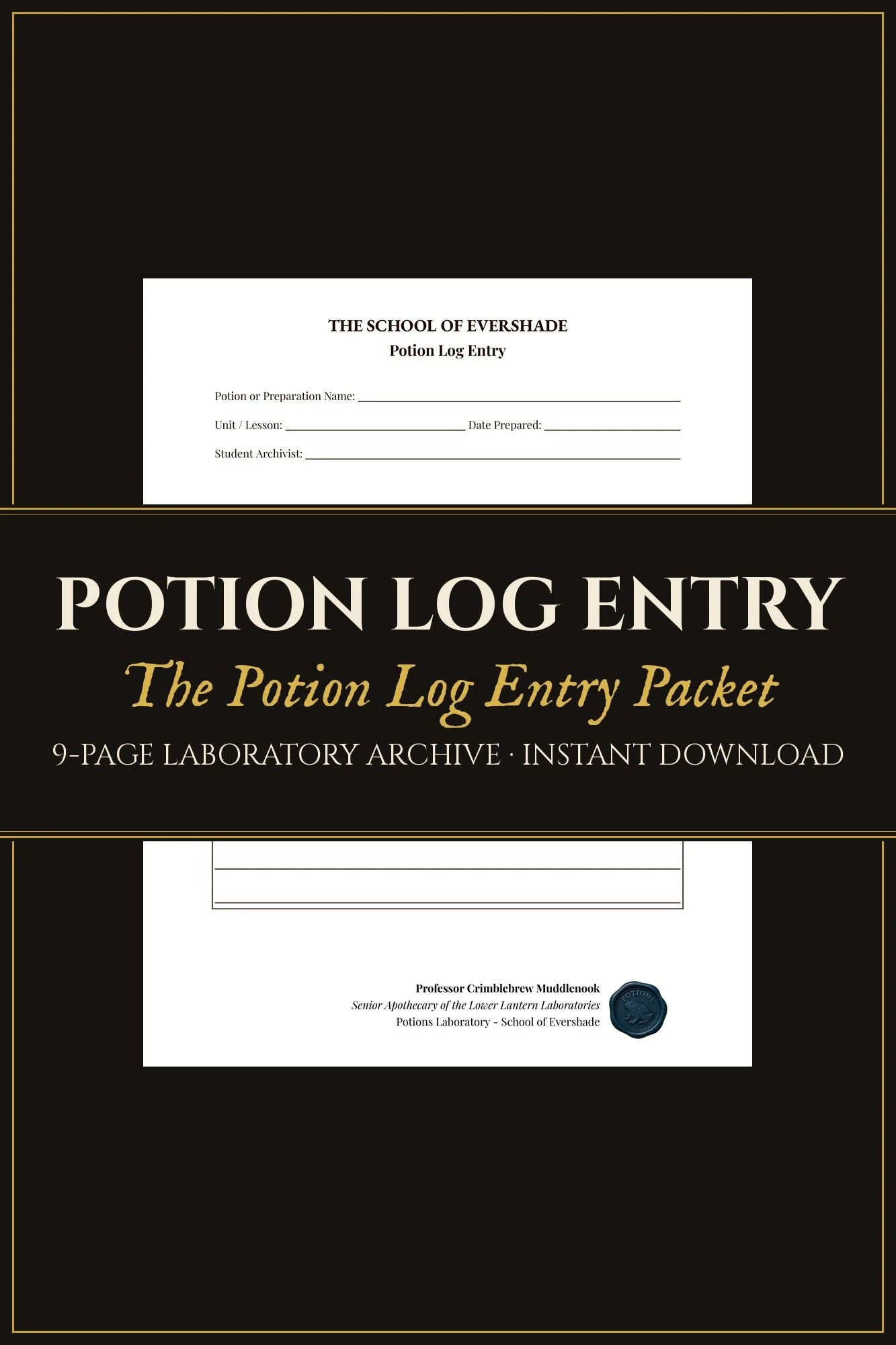
Nine pages of log sheets for the Potions Laboratory archive: record each preparation, its ingredients, and what actually happened. Digital PDF, US Letter.