
POTIONS
Unit III · Lesson 22FILTRATION & SEPARATION MECHANICS
Professor Crimblebrew Muddlenook
Master Apothecary • Potions
Head of House Meridies • School of Evershade
Professor's Introduction

Sealed with the mark of Professor Crimblebrew Muddlenook, Master Apothecary of the Potions Laboratory, Head of House Meridies.
Welcome to the hinge of the whole laboratory, scholars.
Up to this point you have gathered, dried, judged, stored, ground, and refined your materials. Every one of those skills ends the same way: with a mixture that must be separated.
Powder must be lifted from the grinding bowl. Sediment must be drawn out of a liquid. The clear must be parted from the cloudy.
Nothing you will ever brew, steep, strain, or bottle escapes this single demand, which is why Professor Muddlenook insists that filtration be mastered before a single extraction is attempted.
Today you will learn the four mechanics by which apothecaries have separated mixtures for thousands of years: settling, straining, filtering, and clarifying.
You will practice them with nothing more exotic than muddy water, a cloth, a coffee filter, and sand. Do not mistake the simplicity of the materials for simplicity of the lesson.
The same principles that clear your jar today will clarify your tinctures in Unit IV and rescue your failed emulsions in Unit V.
Scholars, a word before you begin. Order is not fussiness. Order is the difference between a laboratory and a mess with shelves. Lay out every vessel, label every jar, and write the date before you pour a single drop. The preparation you organize today is the experiment you can trust tomorrow.
— Professor Crimblebrew Muddlenook, Potions Laboratory • Master Apothecary • Head of House Meridies
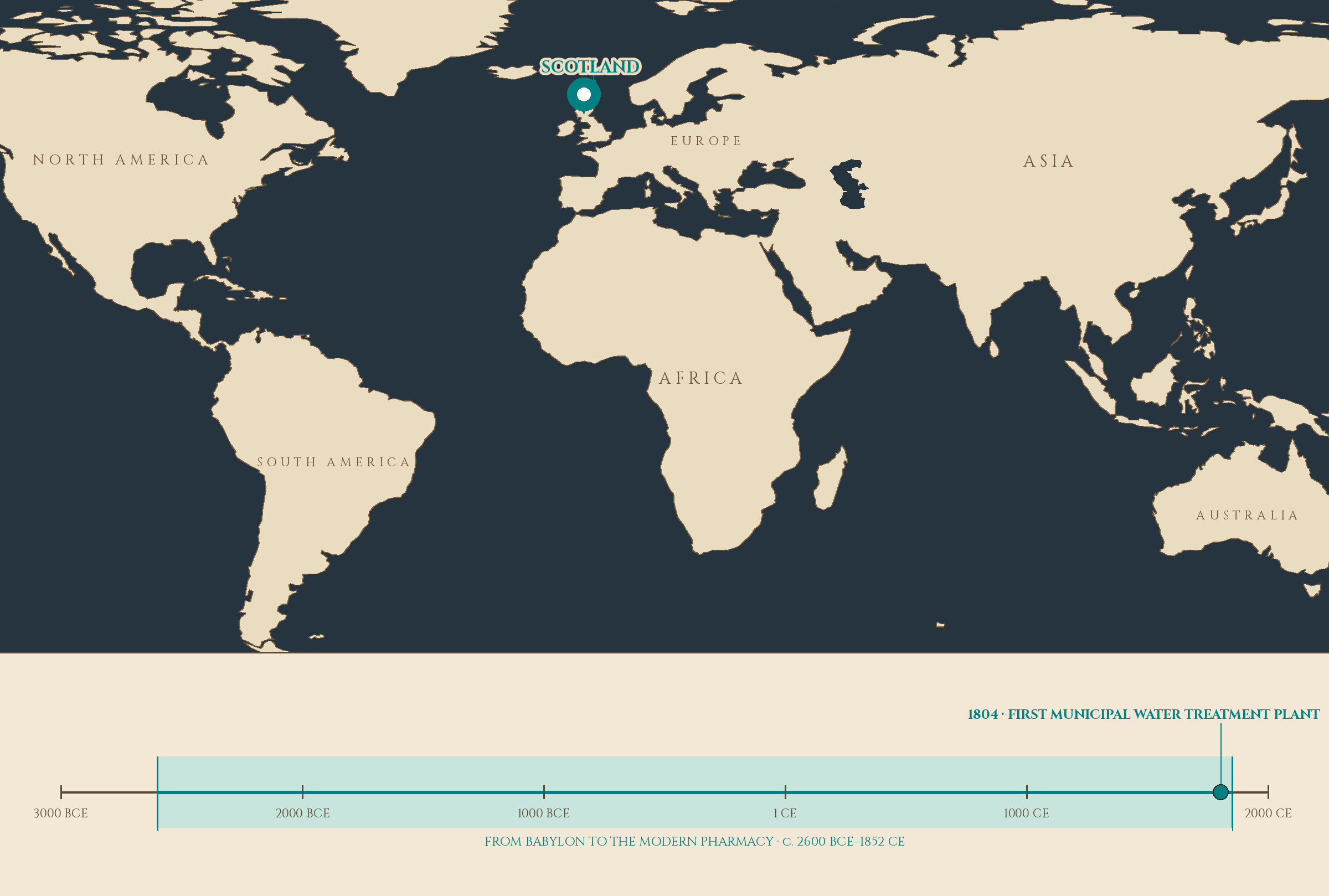
Pin: Scotland. Timeline stop: 1804 · FIRST MUNICIPAL WATER TREATMENT PLANT.
Lesson Objectives
By the end of this lesson, you will be able to:
- Name the four separation mechanics — settling and decanting, straining, filtering, and clarifying — and state which kind of tangle each one suits.
- Explain pore size, and use it to explain why a finer medium gives a clearer filtrate at a slower flow.
- Carry out the Three-Media Filtration Trial — the same muddy water through cloth, paper, and sand — keeping every variable the same except the medium, and record clarity, residue, and flow for each trial.
- Settle a jar of muddy water undisturbed and decant the clear upper liquid without disturbing the sediment.
- State the lesson's safety rules, and record the whole trial on a permanent Filtration Ledger page in your laboratory archive.
Reading this lesson: ★ marks the passages to remember. They return on the unit quiz and the class test. Check in questions ask the material back as you go; answer them in your workbook when you meet them.
Working this lesson: Your assignment packet is the first download on this page. Work in it as the lesson moves along, answering each exercise as its subject is taught — or read the lesson through for your notes and take the exercises as homework afterward. Both are proper ways to sit this class. Signposts in the reading tell you where each exercise belongs. Written answers are short answers in your own words; a few honest lines are worth more than a filled page.
Your Assignment Packet
This lesson's exercises live in its packet: the Lexicon Handout (every term, course terms marked ◆), Materials, Guided Practice, the Assignment Manual with its answer key for self-checking, the Reflection Questions, and the Workbook Checklist. Download the packet before you begin and keep it beside you as you read.
Safety Briefing
Read every line before you touch a vessel.
- Do not taste the muddy water. It is a practice mixture, not a preparation. Nothing in this lesson is for drinking.
- Wash your hands after handling soil, sand, and muddy water.
- Sand dust: rinse your sand before use and avoid breathing the dust. Work near an open window or outdoors if you are sensitive to dust.
- Heat-safe vessels only if you warm any liquid during this lesson. Never pour hot liquid into a thin or cracked container.
- Younger scholars: ask an adult for help carrying full jars and for any step involving warm water.
- Label everything. Three jars of cloudy liquid look identical by tomorrow morning. Muddlenook's rule: an unlabeled jar is a wasted jar.
Check in: A scholar warms a liquid and reaches for the nearest thin glass jar, then leaves all three trial jars unlabeled because "they're easy to tell apart." Which two rules answer those two plans — in the briefing's own words?
❦ In your workbook: record the safety briefing in your own way — nothing tasted, hands washed, sand rinsed and its dust not breathed, heat-safe vessels only, adult help for full jars and warm water, and every jar labeled — copy, sketch, or note what matters.
The Problem of the Mixture
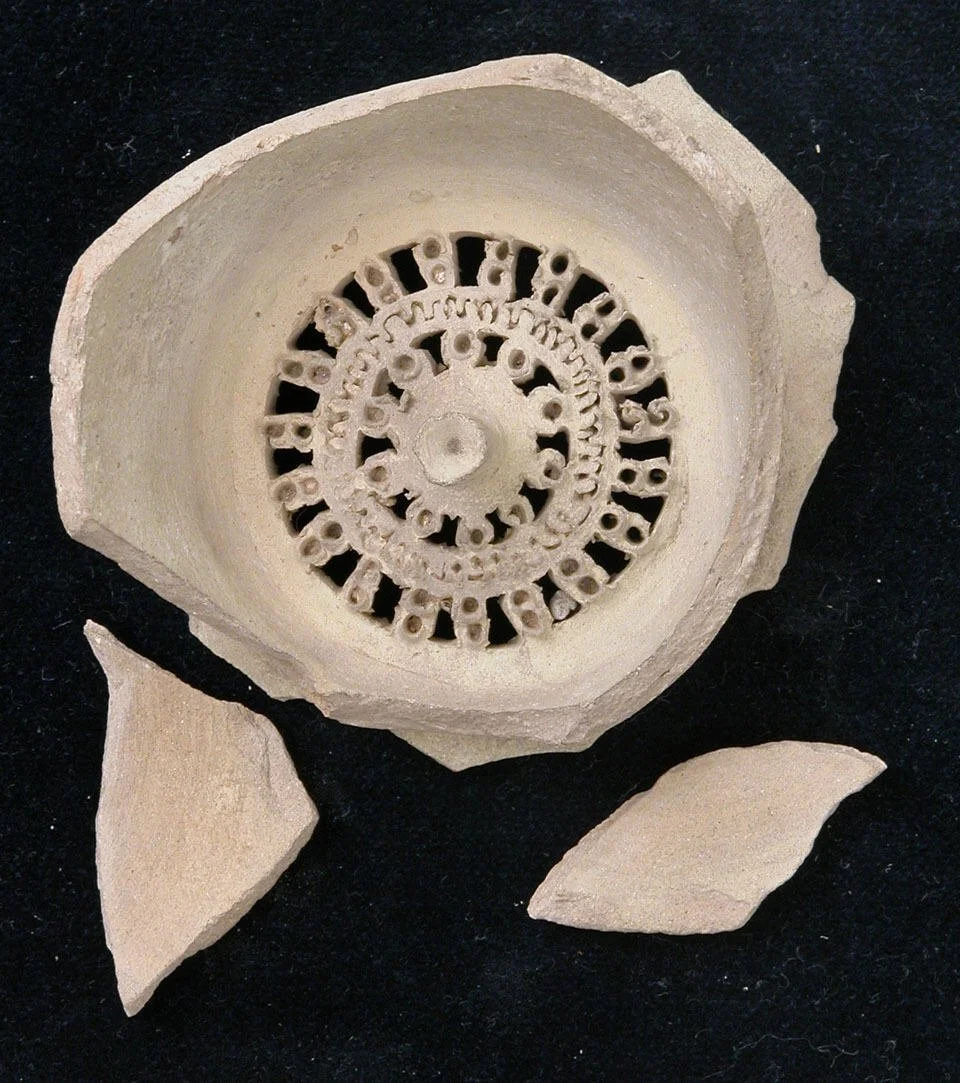
Water filter, Egypt, 10th–12th century: a pottery vessel whose floor is a pierced grille — the water passed, the sediment stayed.
The Metropolitan Museum of Art, Open Access (object 21.173.35).
Nearly everything in the apothecary's world begins as a mixture.
Soil hangs in water. Powder clouds a liquid. Plant fragments drift in an infusion.
A mixture is honest work interrupted: the useful part and the unwanted part, tangled together, waiting for someone patient enough to part them.
★ History's answer to this problem was never one tool but a family of methods, each suited to a different kind of tangle.
When the particles are heavy, let them fall and pour off the clear liquid above; that is settling and decanting.
When the particles are large, catch them in a mesh; that is straining.
When they are fine, force the liquid through a bed of tiny pores; that is filtering.
When the goal is a bright, clear liquid, the whole sequence may be repeated until the eye is satisfied; that is clarifying.
Four mechanics, one goal: the right material in the right place.
Note this well, because I will ask it of you later: separation is never perfect. A filtrate can still carry fine particles, and a residue can still hold trapped liquid. The skilled apothecary does not pretend otherwise. She plans for it, checks for it, and passes the liquid through again when the work demands it.
— Professor Crimblebrew Muddlenook, Potions Laboratory • Master Apothecary • Head of House Meridies
Check in: "Separation is never perfect." What two imperfections does the professor name — and what does the skilled apothecary do about them?
❦ In your workbook: record the problem of the mixture in your own way — the four mechanics and the tangle each one suits, and the rule that separation is never perfect — copy, sketch, or note what matters.
In your packet: Exercise II — The Settling Jar ◐ begins here, in this section's settling and decanting. Work it now, or mark the place and take it as homework — your choice.
A Short History of Straining Things
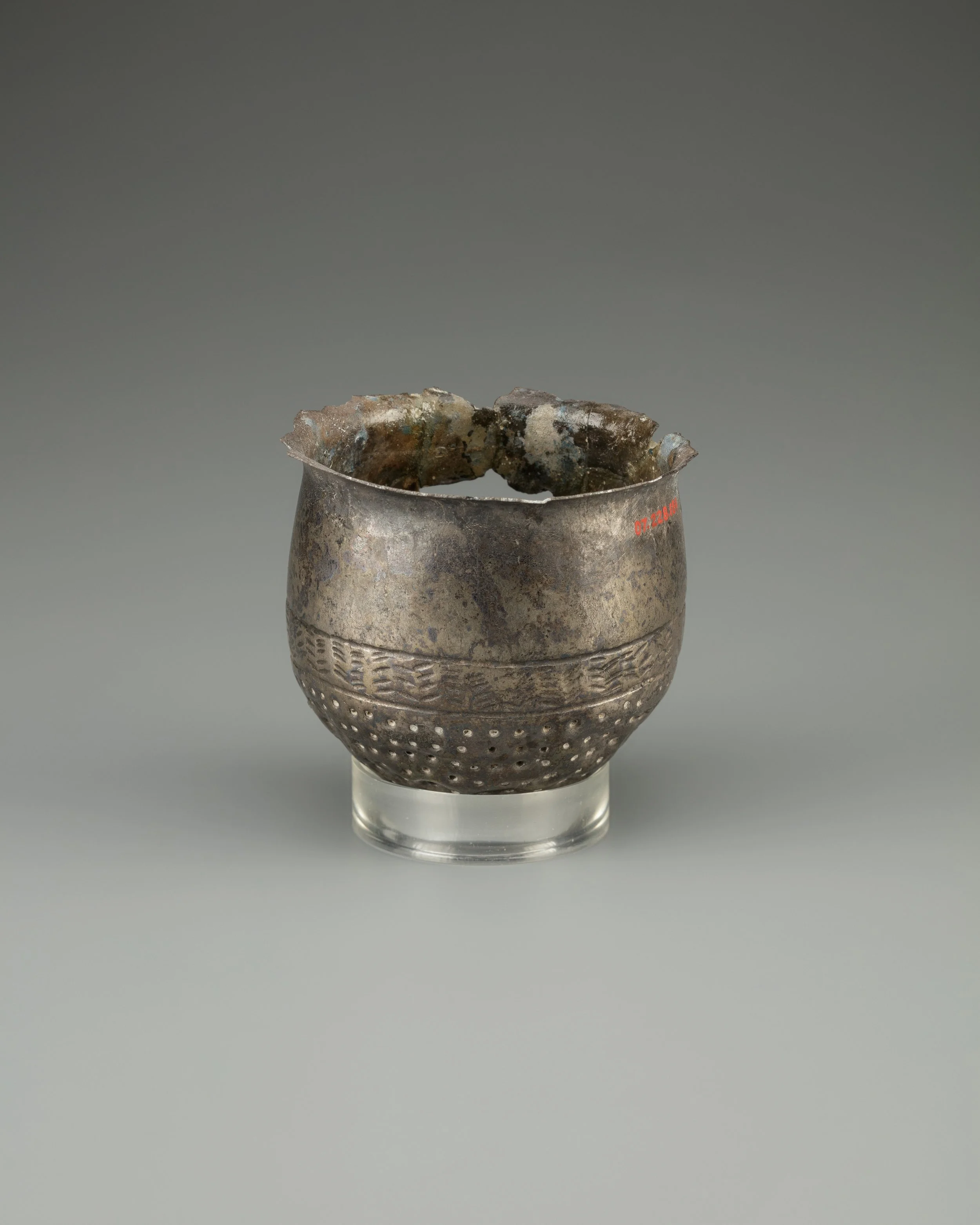
Strainer, silver, Egypt, ca. 1290–1224 BCE. The tiny holes punched in its lower bowl let the liquid pass and held the solids back — the Metropolitan Museum notes it was used for decanting wine.
The Metropolitan Museum of Art, Open Access (object 07.228.184).
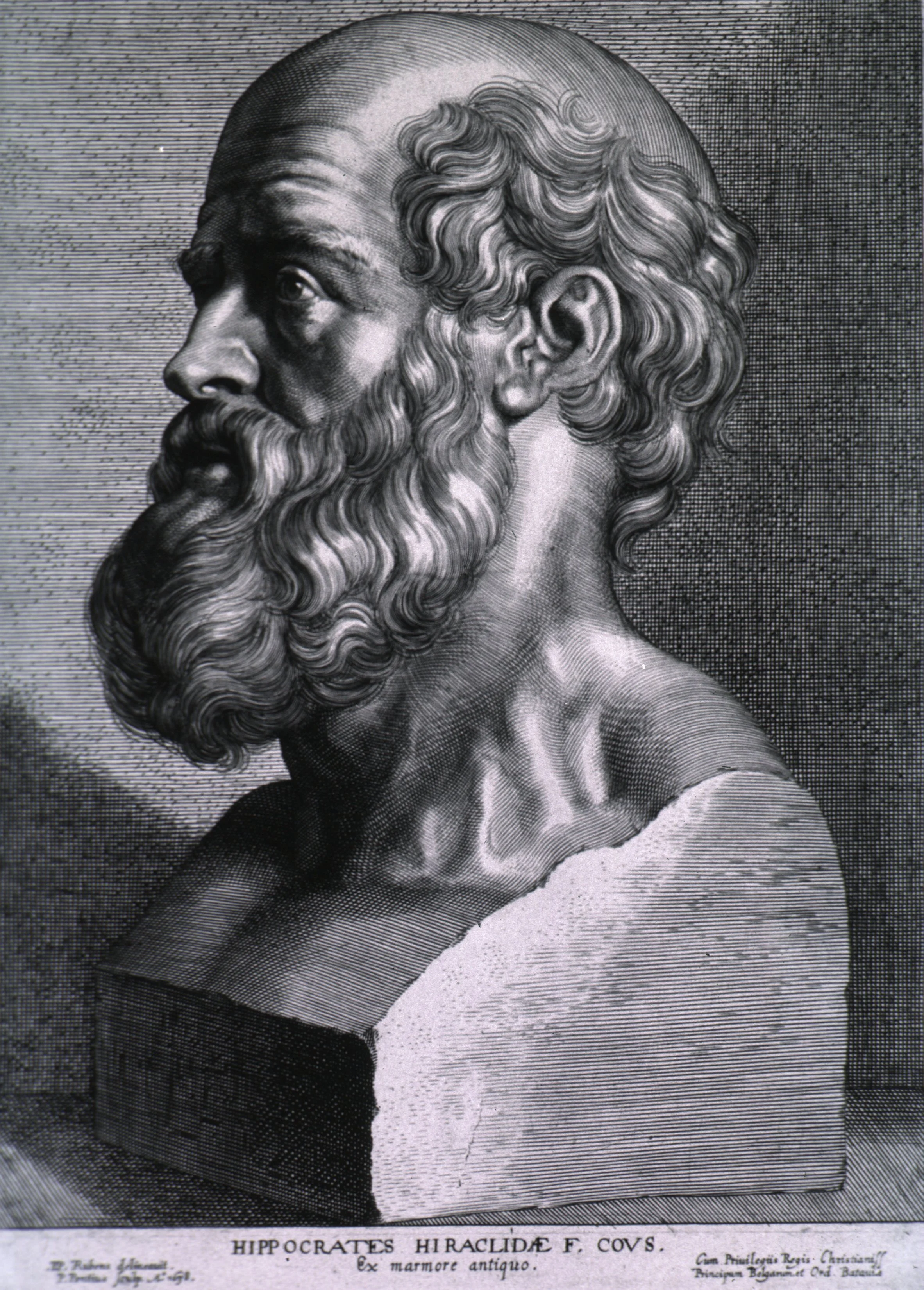
Hippocrates of Kos, engraving after Rubens, from an antique marble. The conical cloth filter bag of Greek medicine — the Hippocratic sleeve — is traditionally attributed to him.
Wikimedia Commons, File:Hippocrates rubens.jpg.
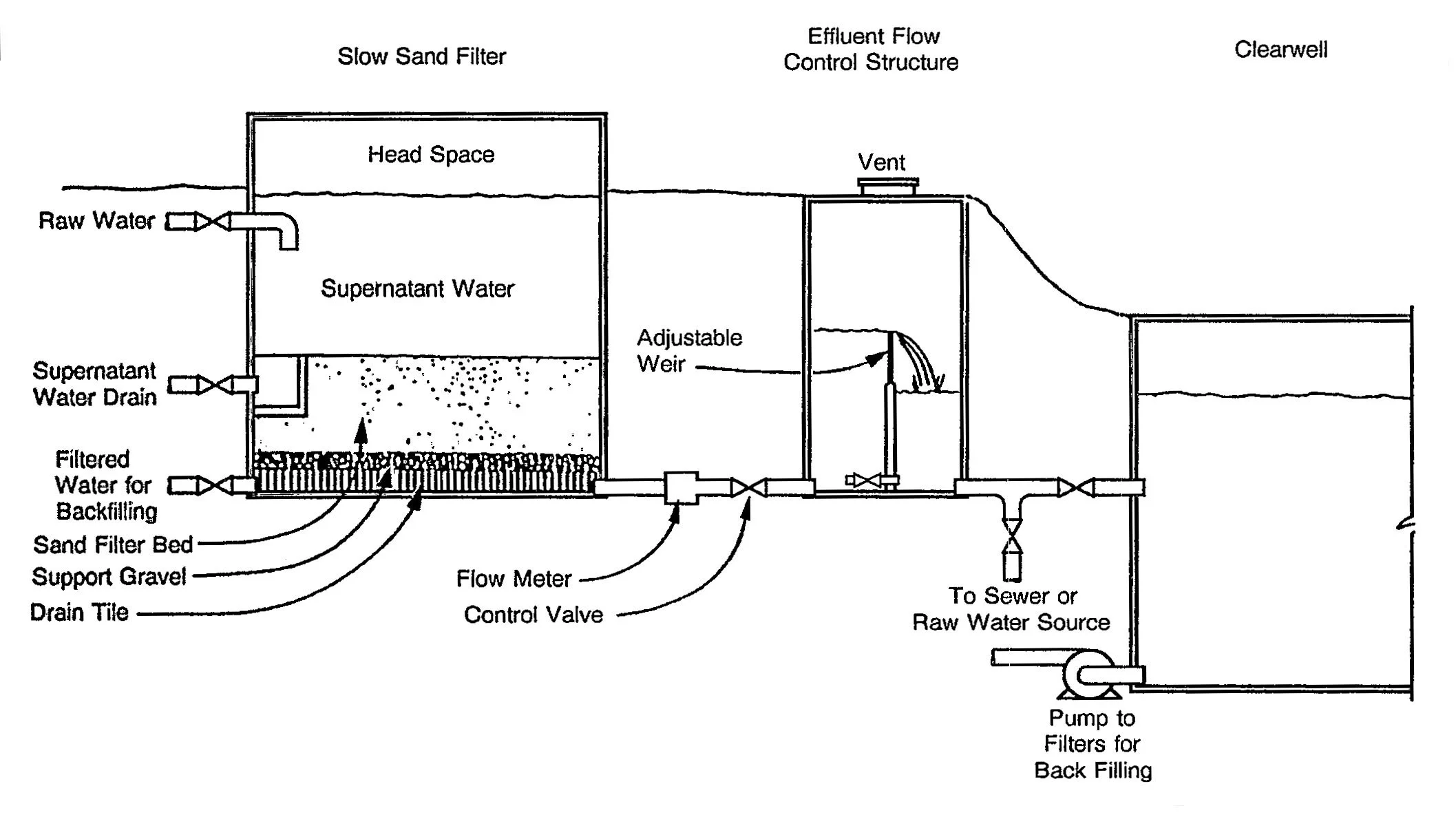
A slow sand filter in cross-section (US Environmental Protection Agency diagram): raw water rests on a bed of sand, sinks slowly through it, and leaves clarified. Your funnel of rinsed sand is this, at bench scale.
US Environmental Protection Agency, via Wikimedia Commons, File:Slow sand filter EPA.jpg.
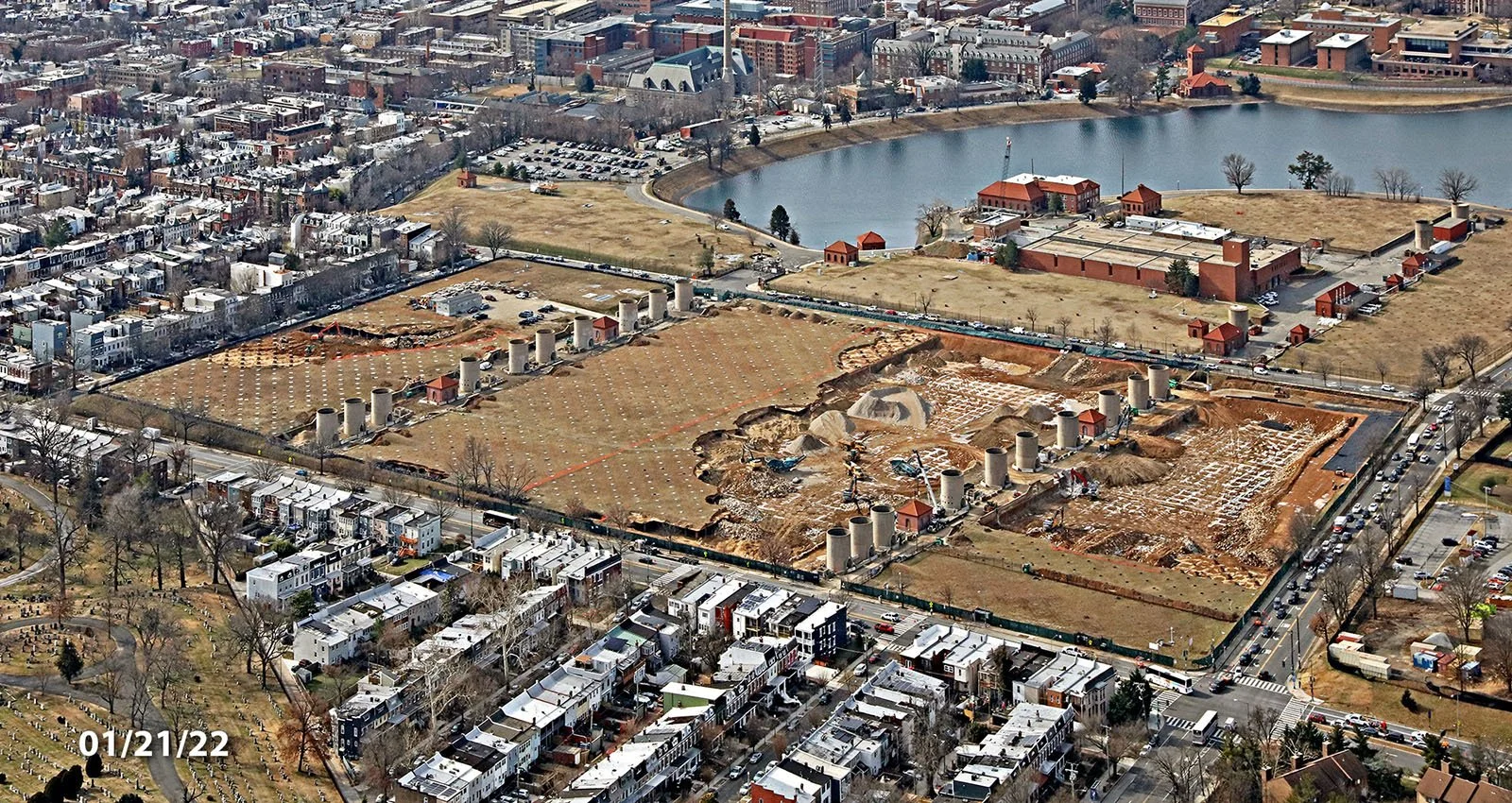
The McMillan Sand Filtration Site in Washington, DC, photographed in 2022 during its redevelopment: a whole field of sand beds that filtered a city's drinking water for most of the twentieth century.
Wikimedia Commons, File:McMillanSandFiltration2293-012122.jpg.
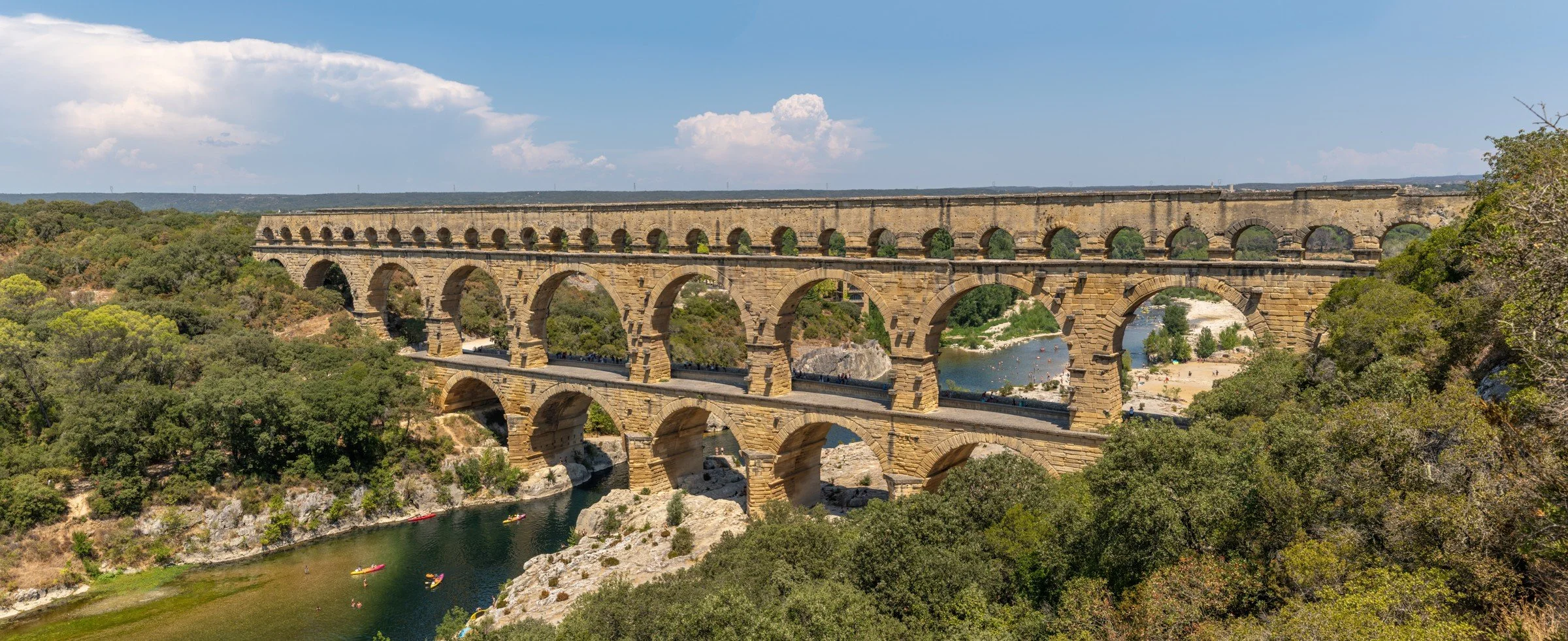
The Pont du Gard, France: a Roman aqueduct bridge. Roman engineers built settling basins into such systems so sediment could fall out of the water before it reached the city — sedimentation at the scale of an empire.
Wikimedia Commons, File:Pont du Gard, France.jpg.
The art of filtration is older than any laboratory.
Early humans scooped holes in sandy riverbanks and watched clear water seep in, filtered by the sand itself; cities later scaled that observation into sand beds that purified whole water supplies.
The Greek physician Hippocrates, who lived in the fifth and fourth centuries BCE, is traditionally credited with a conical cloth bag for straining water, still called the Hippocratic sleeve in old pharmacy texts.
Roman engineers built settling basins into their aqueducts so sediment could fall out of the water before it reached the city.
Medieval apothecaries kept felt strainers and linen cloths among their most-used tools, and the first municipal water treatment plant, built in Scotland in 1804, relied on the same two principles you will practice today: let it settle, then filter it.
The tools have grown fancier. The thinking has not changed.
Check in: The first municipal water treatment plant, built in Scotland in 1804, relied on which two principles — the same two you will practice today?
❦ In your workbook: record the history in your own way — sandy riverbanks and sand beds, the Hippocratic sleeve, Roman settling basins, felt and linen strainers, and Scotland in 1804 — copy, sketch, or note what matters.
Mise en Place
Gather and arrange before you begin.
- A jar of muddy water (two spoonfuls of garden soil stirred into a large jar of water)
- Three clean, clear jars or cups for collecting filtrate
- A square of clean cloth (an old cotton shirt or tea towel)
- A paper coffee filter
- A funnel, or a rubber band to secure cloth and paper over a jar mouth
- Clean sand, rinsed (ordinary play sand is fine)
- A spoon for stirring
- A ruler or measuring strip
- Your laboratory notebook and a pencil
Level Two additions: laboratory filter paper, a glass funnel, a graduated cylinder or measuring beaker, and a stopwatch for timing flow rates.
Check in: Which single item on this list does the trial's fairness depend on most — the one that makes each pour start the same? (Look at step 1 of the procedure before you answer.)
❦ In your workbook: record the mise en place in your own way — the stock mixture, the three labeled receiving jars, the three media, and the Level Two additions — copy, sketch, or note what matters.
The Procedure: The Three-Media Filtration Trial
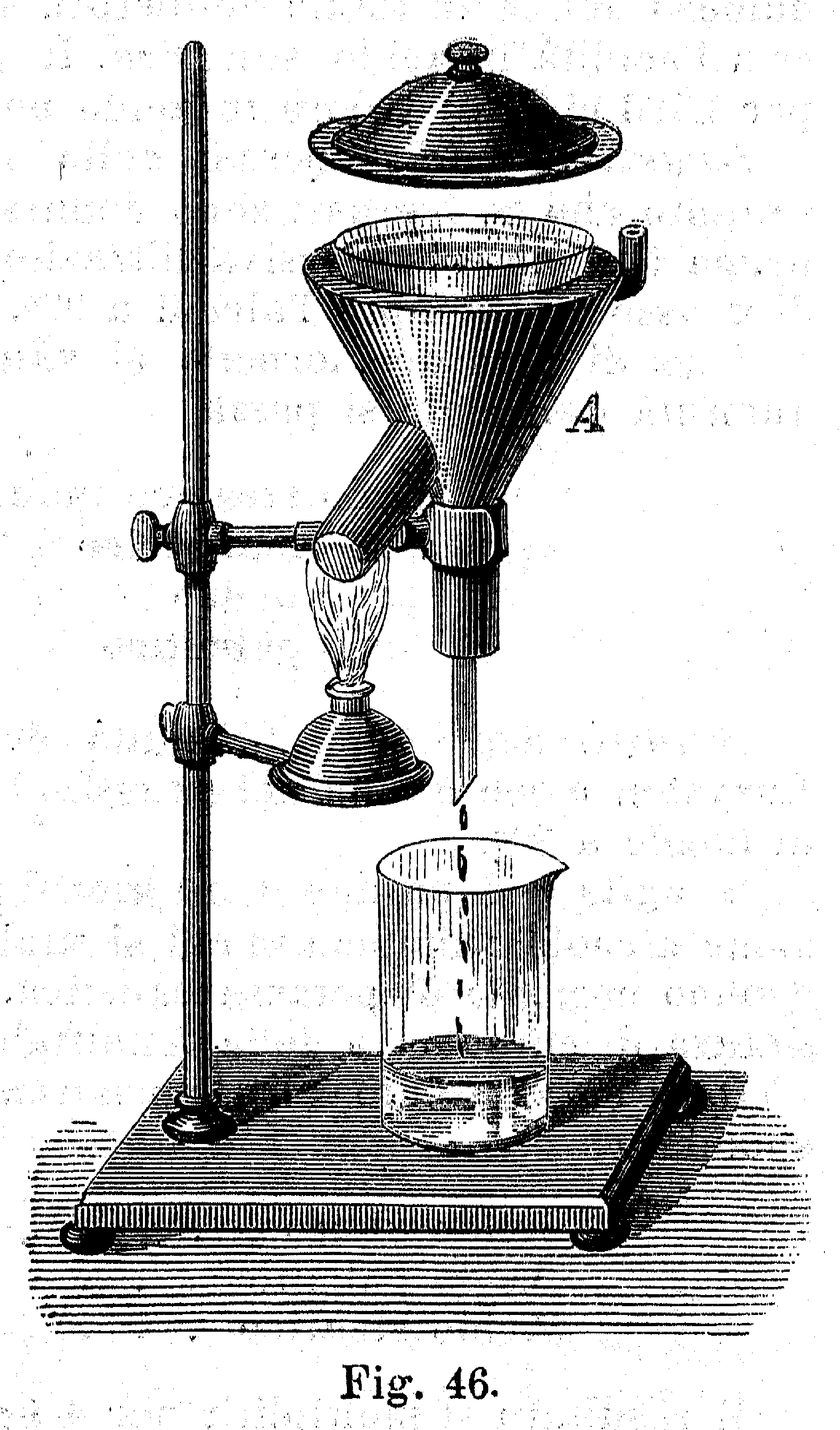
Plantamour's funnel for hot filtration, from Alessandri's 1895 laboratory manual: the jacket keeps the liquid warm while it filters, and the filtrate falls clear into the beaker. Note the lamp — this lesson's safety briefing covers hot liquids for a reason.
Wikimedia Commons, File:Plantamour funnel for hot filtration (Alessandri 1895.46).png.
You will pass the same muddy water through three different media and compare the results. Keep every variable the same except the medium: same mixture, same volume, same pouring height.
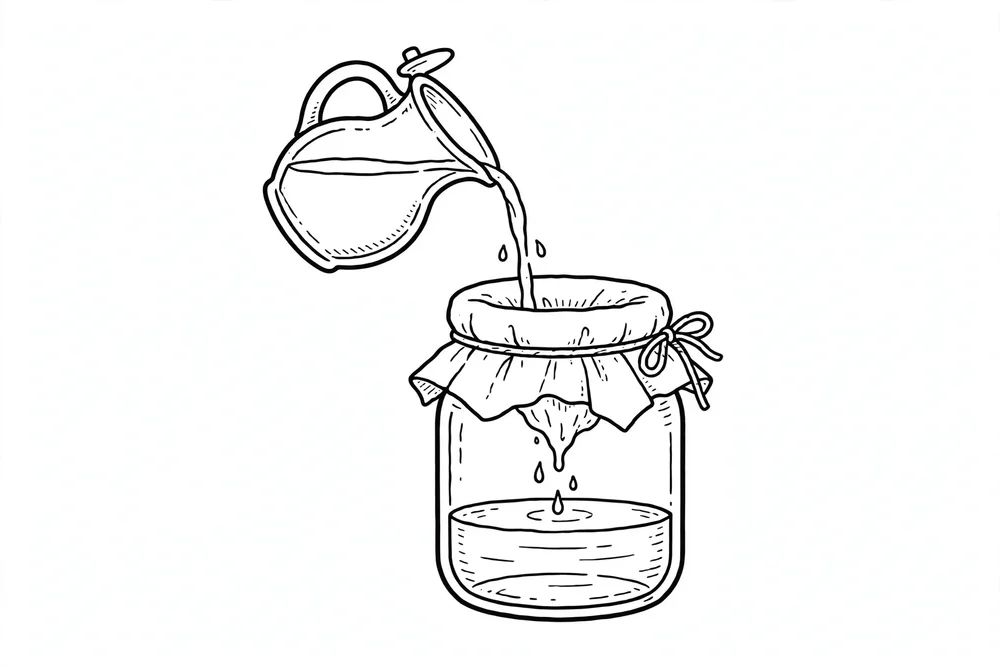
- Prepare the mixture. Stir two spoonfuls of soil into a large jar of water until it is thoroughly cloudy. This is your stock mixture. Stir it again before every pour so each trial starts the same.
- Label three receiving jars: Cloth, Paper, Sand. Write the date and your initials on each label.
- Trial one: cloth. Secure the cloth square over the mouth of the first jar with a rubber band or hold it in the funnel. Pour one cup of the stirred mixture through. Observe and record.
- Trial two: paper. Fit the coffee filter into the funnel over the second jar. Pour one cup of the stirred mixture through. Observe and record. Note the flow rate compared with the cloth.
- Trial three: sand. Pack two inches of rinsed, damp sand into the funnel (a small cloth square at the funnel's throat keeps the sand from washing through). Pour one cup of the stirred mixture through the sand bed into the third jar. Observe and record.
- Rest and compare. Set the three filtrates side by side in good light. Rank them from clearest to cloudiest. Note which medium filtered fastest and which slowest.
- Second pass (optional, recommended). Pour the cloth filtrate through the paper filter. Observe how much clearer it becomes. This is clarification by repeated filtration, and it is exactly how an apothecary polishes a cloudy preparation.
Excellent. You have just performed the three separations every apothecary performs daily. Now ask the question that separates the scholar from the dabbler: why did the results differ? The answer is pore size, and it governs everything from your coffee filter to an industrial filter press. Small pores catch small particles but slow the flow. There is no perfect medium, only the right medium for the task.
— Professor Crimblebrew Muddlenook, Potions Laboratory • Master Apothecary • Head of House Meridies
Check in: Why did the three results differ — and what is the trade every medium makes between clarity and flow?
❦ In your workbook: record the trial in your own way — the seven steps, the three filtrates ranked, the fastest and slowest media, and the second pass — copy, sketch, or note what matters.
In your packet: Exercise I — The Three-Media Filtration Trial ⚒ begins here. Work it now, or mark the place and take it as homework — your choice.
Cleanup and the Archive Entry
Pour the muddy mixtures onto garden soil or into a flowerbed, never into a sink where sediment can clog the drain.
Rinse the jars. Shake the residue from the cloth outdoors. Discard the used paper filter.
Wash your hands and wipe your work surface.
Then open your laboratory archive and create a Filtration Ledger page: date, the three media tested, your clarity rankings, your flow-rate notes, and your one-sentence explanation.
This page is now a permanent reference. When a tincture clouds in Unit IV, you will return to it and know exactly which medium to reach for.
❦ In your workbook: record the cleanup in your own way — mixtures to the garden, never the sink; jars rinsed, cloth shaken outdoors, paper discarded, hands washed — and the five contents of the Filtration Ledger page — copy, sketch, or note what matters.
In your packet: Exercise III — The Filtration Ledger Page ◐ begins here. Work it now, or mark the place and take it as homework — your choice.
Guided Observation: Reading the Three Filtrates
This lesson's observation is bench work, done with the three receiving jars in front of you in good light: you read what each medium did to the same muddy water, and you say why, in one sentence of your own.
Record the following for each trial in your notebook:
- The appearance of the filtrate (clear, slightly cloudy, cloudy) at one hour and at the next day
- The appearance and amount of the residue left on or in the medium
- The relative flow rate (fast, medium, slow)
- Any sediment that settles in the receiving jar overnight
Write one sentence explaining, in your own words, why the sand filtrate differs from the cloth filtrate. If your explanation uses the words "pore size," you have understood the lesson.
❦ In your workbook: record the guided observation in your own way — the four records for each trial, and your one-sentence pore-size explanation — copy, sketch, or note what matters.
Materials
Required (Level One — household items)
- A jar of muddy water (two spoonfuls of garden soil stirred into a large jar of water)
- Three clean, clear jars or cups for collecting filtrate
- A square of clean cloth (an old cotton shirt or tea towel)
- A paper coffee filter
- A funnel, or a rubber band to secure cloth and paper over a jar mouth
- Clean sand, rinsed (ordinary play sand is fine)
- A spoon for stirring
- A ruler or measuring strip
- Your laboratory notebook and a pencil
Suggested (Level Two — historically closer)
- Laboratory filter paper in place of the coffee filter, for a closer look at graded pore sizes.
- A glass funnel.
- A graduated cylinder or measuring beaker for precise volumes.
- A stopwatch: time each filtration and record true flow rates.
Reflection Questions
Answer the following questions in your workbook.
- Why does Professor Muddlenook call filtration "the hinge of the whole laboratory"?
- In your trial, why did the sand filter produce clearer water than the cloth but at a slower flow? Explain using what you learned about pore size.
- Why must a settling jar rest undisturbed before decanting, and what happens if you rush the pour?
- Name one historical example of filtration from the lesson and explain what problem it solved for the people who used it.
- "Separation is never perfect." Why is this an important thing for an apothecary to remember in real laboratory work?
Workbook Checklist — Lesson 22
In my workbook I have:
- ☐ named the four mechanics — settling and decanting, straining, filtering, and clarifying — and the kind of tangle each one suits
- ☐ explained pore size, and why the finest medium gives the clearest filtrate at the slowest flow
- ☐ carried out the Three-Media Filtration Trial with every variable the same except the medium, and recorded clarity rankings, flow rates, and residue for cloth, paper, and sand, plus the second pass
- ☐ settled a jar of muddy water undisturbed, observed it at one hour, six hours, and twenty-four hours, and decanted the clear liquid without disturbing the sediment
- ☐ worked under the safety briefing throughout — nothing tasted, hands washed, sand rinsed, heat-safe vessels only, every jar labeled with date and initials
- ☐ created my permanent Filtration Ledger page: date, the three media, clarity rankings, flow-rate notes, and my one-sentence pore-size explanation
☐ Lesson completed Date: ___ Signature: ___
The Professor's Closing Note
Sealed with the mark of Professor Crimblebrew Muddlenook, Master Apothecary of the Potions Laboratory, Head of House Meridies.
The same principles that clear your jar today will clarify your tinctures in Unit IV and rescue your failed emulsions in Unit V.
This page is now a permanent reference. When a tincture clouds in Unit IV, you will return to it and know exactly which medium to reach for.
— Professor Crimblebrew Muddlenook, Potions Laboratory • Master Apothecary • Head of House Meridies
Cross-Class Connections

Herbology · Unit II, Lesson 8 — The Substrate Profile: Texture & Drainage
Bring your settling jar to the Greenhouse, scholars, and we will fill it with soil. In my jar-settle test we shake soil, water, and one drop of soap until the jar looks like chocolate milk, then we watch the particles settle in order of size — sand within minutes, silt over hours, clay still clouding the water a day later — and measure the layers to name the soil itself. Professor Muddlenook decants to keep the clear liquid; I settle to read what fell. Same jar, same gravity, two honest records.
PROFESSOR BERYL FERNFOOT
Herbology Greenhouse • Master Herbalist • Head of House Oriens

Scrollwork · Unit II, Lesson 6 — Oak Gall Ink
You have strained muddy water through cloth in the Laboratory. Now come and strain ink in the Scriptorium. We combine the iron liquid, strained through cloth, with strong tea and watch it darken; and the ink of the recipe tradition rests overnight and is strained once more before bottling. A scribe's filtrate is judged the way Muddlenook judges yours: by what the cloth kept back, and by the clarity of what passed.
PROFESSOR QUILLBERRY NOCTURNE
Scrollwork Library

Creative Arts · Unit VI, Lesson 25 — Drying Racks, Screens & Bench Furniture
Your cloth strainer works, scholars, and in my workshop you will build its permanent form: a screen of mesh stretched true in its frame, and the sieve — a screen used to separate, seeds from chaff, fine from coarse, among the oldest tools in the house. Build the practice frame first, on scrap, as always. Then you will own the tool the apothecary's bench has borrowed for millennia.
PROFESSOR COGBRANCH TIMBERCLANK
Creative Arts Workshop
Further Reading & Sources
- Filtration | Encyclopaedia Britannica — definition, requirements, and equipment of filtration as a separation process.
- Filtration | Wikipedia — overview of filter media, pore size, filtrate, residue, and blinding.
- Filtrate | Wikipedia — the clarified liquid product of filtration.
- An Artifact of Safe Drinking Water | Archaeology Magazine — a 19th-century household charcoal-and-sand filtering jug, showing domestic filtration in practice.
- History of Water Filtration (PDF) — survey from ancient sand and charcoal methods through the Hippocratic sleeve to modern plants.
Browse the Potions shelf in the school Library for readable editions of these works.
Submit your work for this lesson using the form below.
CONTINUE IN THE POTIONS LABORATORY
← Previous · Lesson 21: Grinding, Crushing & Botanical Processing Next · Lesson 23: Preparing Ingredients for Extraction →
Unit III — Dense Materials & Preparation Potions Laboratory — All 52 Lessons
The rest of Unit III: Lesson 18 · Roots & Bark · Lesson 19 · Oils & Waxes · Lesson 20 · Salts & Clays · Lesson 21 · Grinding & Processing · Lesson 23 · Preparing for Extraction · Lesson 24 · Master Portfolio · Lesson 25 · Preparation Manifest