

POTIONS
Unit III · Lesson 25THE PREPARATION MANIFEST
Professor Crimblebrew Muddlenook
Master Apothecary • Potions
Head of House Meridies • School of Evershade
Professor's Introduction

Sealed with the teal wax of Professor Crimblebrew Muddlenook, Master Apothecary of the Potions Laboratory, Head of House Meridies.
Scholars, eight lessons of preparation stand behind you. Roots have been examined, oils and waxes weighed, salts and clays classified, powders ground to consistency, liquids filtered to clarity, and every material conditioned for the work ahead. Today we do what every careful apothecary did before beginning extraction — drawing compounds out of a material with a liquid — work: we count, we inspect, and we write it all down. The manifest is not paperwork for its own sake. It is the moment your laboratory proves itself ready. Take pride in it, and take your time.
— Professor Crimblebrew Muddlenook, Potions Laboratory • Master Apothecary • Head of House Meridies
Potions map — the class base map, unmarked for this lesson.
Lesson Objectives
By the end of this lesson, you will be able to:
- Conduct a complete inventory audit of every material your laboratory has prepared across Unit III.
- Grade each material for extraction readiness using a consistent standard.
- Build a preparation manifest in the tradition of the historical apothecary stock book.
- Assemble your Master Materia Botanica Portfolio for Unit III.
- Find and correct every gap in your preparation before Unit IV begins.
Reading this lesson: ★ marks the passages to remember. They set the manifest standard this lesson is assessed by, and they return in the units ahead and at the capstone. This lesson contributes no items to the Unit III Quiz — its assessment is the manifest and audit work itself, set out in the Assignment Manual below. Check in questions ask the material back as you go; answer them in your workbook when you meet them.
Working this lesson: Your assignment packet is the first download on this page. Work in it as the lesson moves along, answering each project as its subject is taught — or read the lesson through for your notes and take the projects as homework afterward. Both are proper ways to sit this class. Signposts in the reading tell you where each project belongs. Written answers are short answers in your own words; a few honest lines are worth more than a filled page.
Your Assignment Packet
This lesson's projects live in its packet: the Lexicon Handout (every term, course terms marked ◆), Materials, Guided Practice — the Model Preparation Manifest and the four Audit Checklists, printed in full so you can work through them at your own shelves — the Assignment Manual with its self-check, the Reflection Questions, and the Workbook Checklist. Download the packet before you begin and keep it beside you as you read.
About this lesson's assessment, plainly: this lesson has no quiz, and no quiz items are taken from it for the Unit III Quiz. The manifest work itself is the assessment: Projects I–III in the manual below — the complete preparation manifest, the extraction-readiness audit across all four checklists, and the assembled Master Portfolio with its self-assessment rubric — stand beside the Unit III Quiz as the unit's practical layer. The lesson's course-◆ terms do travel to the Unit III Quiz, where they belong to its vocabulary matching.
Safety Briefing
This lesson's safety spine is its own Safety Audit — Checklist C of the four audit checklists — carried here word for word, because the audit is the briefing: it is spoken at the shelves, with the materials in front of you.
Checklist C: Safety Audit
- Grinding dust: the work area has been cleaned of fine powder residue; dust masks or coverings used during grinding are intact and stored accessibly.
- Ventilation: the workspace has a clear ventilation path for any future heated or alcohol-based work.
- Labels: every preparation is labeled; nothing unidentified remains on the shelves.
- Tools: mortars, sieves, filters, and cutting tools are clean, dry, and stored safely; blades are sheathed or stored out of reach.
- Spill kit: absorbent cloths or paper, a dustpan, and a sealed waste container are on hand.
- Supervision plan: any future work involving heat, alcohol, or lye (Unit V) is flagged now as requiring adult supervision, and the rule is written into the journal.
Rejected materials are discarded safely (never into food waste or drains if they contain anything hazardous; seal and dispose with household waste, or compost only clean plant matter) and recorded as rejected so you do not accidentally reach for them later.
Check in: Which item of the safety audit looks forward — naming work that has not happened yet — and what does it require you to write into the journal now?
❦ In your workbook: record the safety audit in your own way — cleaned grinding dust, the ventilation path, nothing unidentified on the shelves, tools stored safely, the spill kit on hand, and the supervision rule written into the journal — copy, sketch, or note what matters.
In your packet: Guided Practice — the four checklists begin here. Work them as you reach them in the reading, or mark the place and take them as homework — your choice.
What the Manifest Is
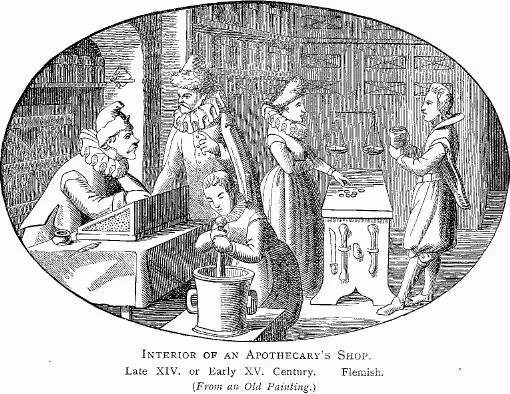
The stock book at work: a Flemish apothecary's shop of the late fourteenth or early fifteenth century, the master writing at his desk, jars ranked on the shelves behind him, a balance on the counter — the world the manifest descends from, where no preparation began until the stock was counted and written down.
Engraving after an old Flemish painting, via Wikimedia Commons. Public domain.
A preparation manifest is a complete written record of every material in your laboratory: what it is, what form it is in, how much you hold, how it was prepared, what condition it is in, and what it is ready for.
Historical apothecaries kept such records under many names. Stock books, inventory ledgers, shop bills, and dispensary catalogues all served the same purpose: no one could prepare medicines, perfumes, or inks from materials they could not find, could not identify, or could not trust.
The great pharmacy ledgers of the early modern period were working documents, not decorations. An apothecary opening a new shop would record every jar on the shelf. An established master would take stock at regular intervals, noting what had been used, what had spoiled, what needed replacing, and what had been prepared since the last accounting.
Some ledgers survive in museum collections today, their pages crowded with lists of roots, gums, oils, and powders, each entry a small proof that someone took the contents of their own shelves seriously.
Your manifest serves the same purpose on a smaller scale. It turns eight lessons of scattered preparation into one organized picture. It tells you exactly what your laboratory holds. And it tells you, honestly, whether each material is ready for the extraction work of Unit IV or whether it needs further attention first.
There is a particular satisfaction in a finished manifest, and I do not apologize for saying so. Order is one of the quiet pleasures of laboratory work.
Check in: What six facts does a preparation manifest record about every material — and what does it tell you honestly about each one?
❦ In your workbook: record what the manifest is in your own way — the complete written record, the stock book tradition behind it, and the honest readiness picture it gives — copy, sketch, or note what matters.
Taking Stock: The Full Inventory Audit
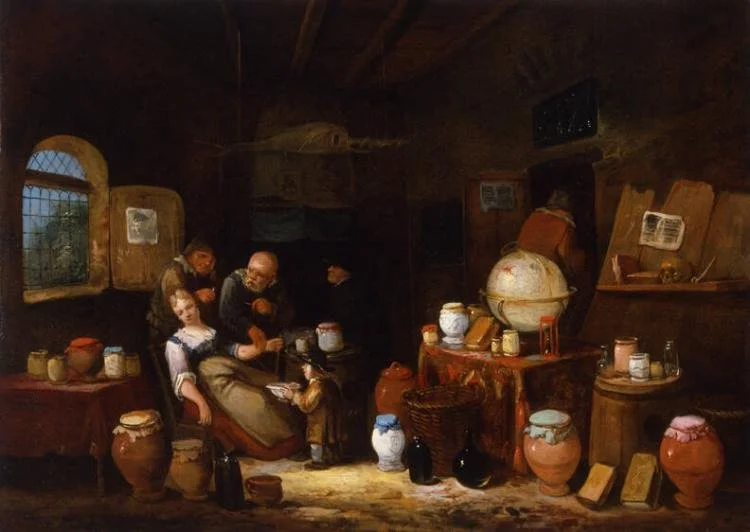
A Dutch apothecary's shop as the nineteenth century pictured the old trade: jars on every surface, floor to shelf. The storage audit exists because stock kept like this — unlabeled, crowded, heavy jars wherever they fit — is stock no manifest can trust. Your shelves, audited, will tell a tidier story.
Dutch apothecary shop interior (1858 print after a seventeenth-century Dutch painting), via Wikimedia Commons. Public domain.
An audit is a systematic inspection. You will go through your materials category by category, exactly as the unit taught them, and record the truth about each one.
Do not guess. Do not write down what you wish were true. Open the jars, look at the powders, check the labels, and write what you see.
Work through the categories in this order:
1. Dense botanicals (Lesson 18). Roots, bark, and resins. For each specimen, record its identity, its form (whole, cut, or powdered), its approximate quantity, and its condition. Roots should be fully dry and hard, with no soft spots. Bark should snap cleanly. Resins should be free of dust and debris.
2. Oils, waxes, and botanical bases (Lesson 19). For each oil, wax, fat, or butter, record its identity, quantity, and condition. Oils should smell clean, not sharp or rancid. Waxes should be free of debris. Note the date each was opened or prepared, because fats and oils have working lives and the manifest is where you track them.
3. Salts, clays, and mineral materials (Lesson 20). For each mineral material, record its identity, grain character, quantity, and storage condition. Salts must be kept dry; note any clumping or moisture uptake. Clays should be sealed against damp. Powders should be labeled with their grind date.
4. Ground and processed materials (Lesson 21). For each powder or crushed material, record the starting material, the grind date, the particle-size grade you assigned, and whether it has been sieved. This is where your grinding observations pay for themselves: a powder with a recorded consistency is a trustworthy powder.
5. Filtered and prepared materials (Lessons 22 and 23). For each filtered liquid, clarified preparation, or conditioned material, record what it is, how it was processed, its clarity or condition, and its storage vessel and date.
If a material does not fit neatly into these categories, record it anyway and note which lesson it came from. The manifest leaves nothing out.
★ An unrecorded material is a material that does not officially exist, and materials that do not officially exist have a way of causing trouble at the worst possible moment.
The audit rewards honesty more than perfection. A manifest that says "this powder is too coarse for tincture — an alcoholic preparation made by soaking a botanical in spirit — work and must be reground" is worth more than a manifest that claims everything is flawless. The first one tells you what to do next. The second one only tells you what you wanted to hear.
Check in: A material does not fit neatly into any of the five categories. What does the lesson require — and what does the audit reward more than perfection?
❦ In your workbook: record taking stock in your own way — the five categories in their order, the truth written from opened jars, and the rule that the manifest leaves nothing out — copy, sketch, or note what matters.
In your packet: Project I — Build Your Preparation Manifest ◐ begins here. Work it now, or mark the place and take it as homework — your choice.
Grading Extraction Readiness
Every material you audited was prepared for a reason. Roots were dried and cut so they could be decocted. Powders were ground so they could be macerated. Oils were selected so they could carry infusions.
The readiness grade is your professional judgment, recorded plainly, about whether each material is fit for the extraction method it is destined for.
★ Use three grades, and use them strictly:
Ready. The material meets the standard for its intended extraction. The powder is ground to the right consistency. The root is dry and properly cut. The oil is fresh and clean. It may proceed to Unit IV work without further preparation.
Needs work. The material is sound but not yet ready. The powder needs regrinding or sieving. The root needs further drying or cutting. The oil needs filtering. Record exactly what work is needed, and schedule it. "Needs work" is not a failure; it is an instruction.
Reject. The material cannot be used. It is moldy, rancid, contaminated, mislabeled beyond recovery, or degraded past usefulness. Rejected materials are discarded safely (never into food waste or drains if they contain anything hazardous; seal and dispose with household waste, or compost only clean plant matter) and recorded as rejected so you do not accidentally reach for them later.
Be particularly strict with anything destined for heated extraction. A powder that is merely acceptable for a cold infusion may be entirely wrong for a decoction, where prolonged simmering punishes every inconsistency.
★ When in doubt, grade down and re-prepare. The extraction cannot rescue a poorly prepared material; it can only reveal it.
Check in: A powder is sound but too coarse for its intended extraction. Which grade does it get — and what two things must the manifest record beside that grade?
❦ In your workbook: record grading readiness in your own way — the three grades used strictly, Needs work as an instruction, and grading down when in doubt — copy, sketch, or note what matters.
The Model Preparation Manifest
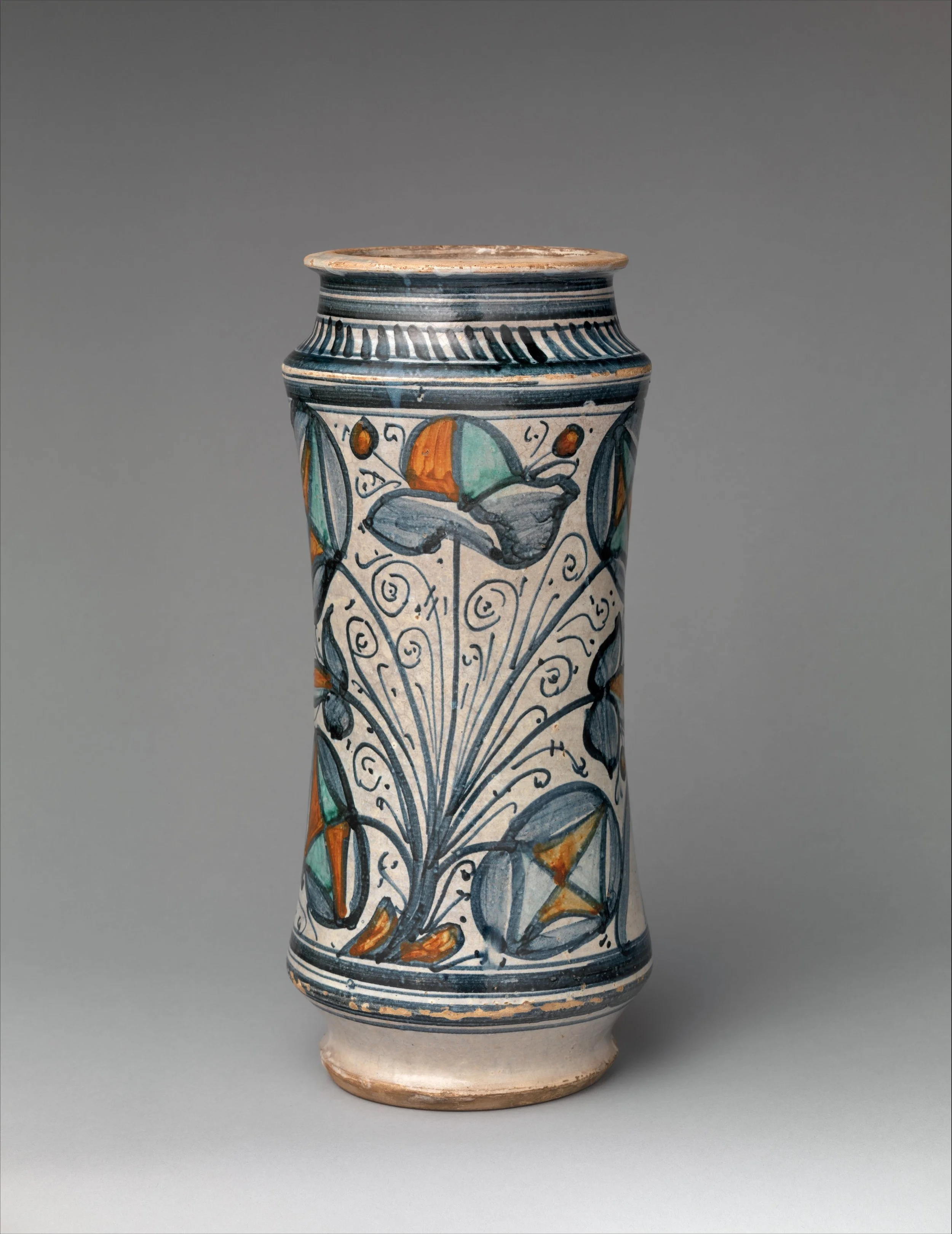
A pharmacy jar of the kind the early modern stock books counted: maiolica painted in blue, green, and orange, its decoration carrying no inscription at all. The jar tells you its form; only the manifest tells you what it holds, how much, and whether it is ready — which is why the record, not the vessel, is the lesson.
Pharmacy jar (albarello), The Metropolitan Museum of Art, via Wikimedia Commons. CC0.
Below is a complete model manifest: the kind of record I expect from a careful scholar. Study its structure before building your own.
Note that every entry carries six pieces of information: identity, form, quantity, preparation state, intended extraction, and readiness grade. Nothing is vague. Vagueness is the enemy of the manifest.
| # | Material | Form | Quantity | Preparation state | Intended extraction | Grade |
|---|---|---|---|---|---|---|
| 1 | Dried burdock root | Cut, 5mm pieces | 60 g | Fully dry, snaps cleanly, cut Jan; stored in sealed glass | Decoction | Ready |
| 2 | Dried orange peel | Strips | 25 g | Dry and aromatic; slight fading at edges | Hydro-infusion | Needs work: use within month, then replace |
| 3 | Sweet almond oil | Liquid | 250 ml | Opened 3 weeks ago; smells clean and sweet | Infused lipid | Ready |
| 4 | Beeswax pellets | Pellets | 100 g | Clean, debris-free; cosmetic grade | Resin fusion / salve base | Ready |
| 5 | Dried chamomile flowers | Whole heads | 40 g | Good color and aroma; stored dark and dry | Hydro-infusion | Ready |
| 6 | Bentonite clay | Fine powder | 200 g | Sealed; slight clumping at jar mouth from humidity | Suspension work | Needs work: discard clumped portion, reseal remainder |
| 7 | Sea salt, coarse | Crystals | 500 g | Dry; stored sealed | Crystalline scrub base | Ready |
| 8 | Dried rosemary leaf | Whole leaf | 30 g | Aroma weak; color faded; over a year old | Infused lipid | Reject: aroma too faint for extraction; replace |
| 9 | Oak galls, whole | Whole | 12 galls | Hard, dense, unbroken | Tincture / ink work | Ready |
| 10 | Lavender buds | Whole buds | 35 g | Strong aroma; good color | Glycerite / sachet | Ready |
| 11 | Powdered turmeric root | Fine powder | 50 g | Ground 2 weeks ago; even consistency, sieved | Tincture | Ready |
| 12 | Apple cider vinegar | Liquid | 500 ml | Unopened; within date | Acetum | Ready |
Read through the model slowly and notice what it does. Entry 6 does not pretend the clumped clay is fine; it prescribes the fix. Entry 8 rejects the old rosemary honestly instead of hoping the extraction will somehow restore a year of lost aroma. Entry 2 sets a deadline. This is what a working manifest looks like: not a boast, but a plan.
Your manifest will have more entries or fewer, depending on what you prepared. It must have the same six columns and the same honesty.
Check in: Entry 8, the year-old rosemary, is graded Reject rather than Needs work. What in its preparation state makes re-preparation impossible — and what does the grade prescribe instead?
❦ In your workbook: record the model manifest in your own way — the six columns every entry carries, and the three entries that teach the honesty: the fix prescribed, the reject recorded, the deadline set — copy, sketch, or note what matters.
In your packet: Project II — The Extraction-Readiness Audit ◐ begins here. Work it now, or mark the place and take it as homework — your choice.
The Audit Checklists
The manifest covers your materials. These four checklists cover everything else. Work through each one completely and record your answers in your laboratory journal.
Checklist A: Inventory Completeness
- Every material from Lessons 18 through 23 is entered in the manifest, with all six columns filled.
- Every entry carries a readiness grade of Ready, Needs work, or Reject. No blanks, no "maybe."
- Every "Needs work" entry has a written plan: what must be done, and by when.
- Every "Reject" entry has been safely discarded and is recorded as rejected.
- Quantities are recorded in real units (grams, milliliters, pieces), not "some" or "a jarful."
Checklist B: Storage Audit
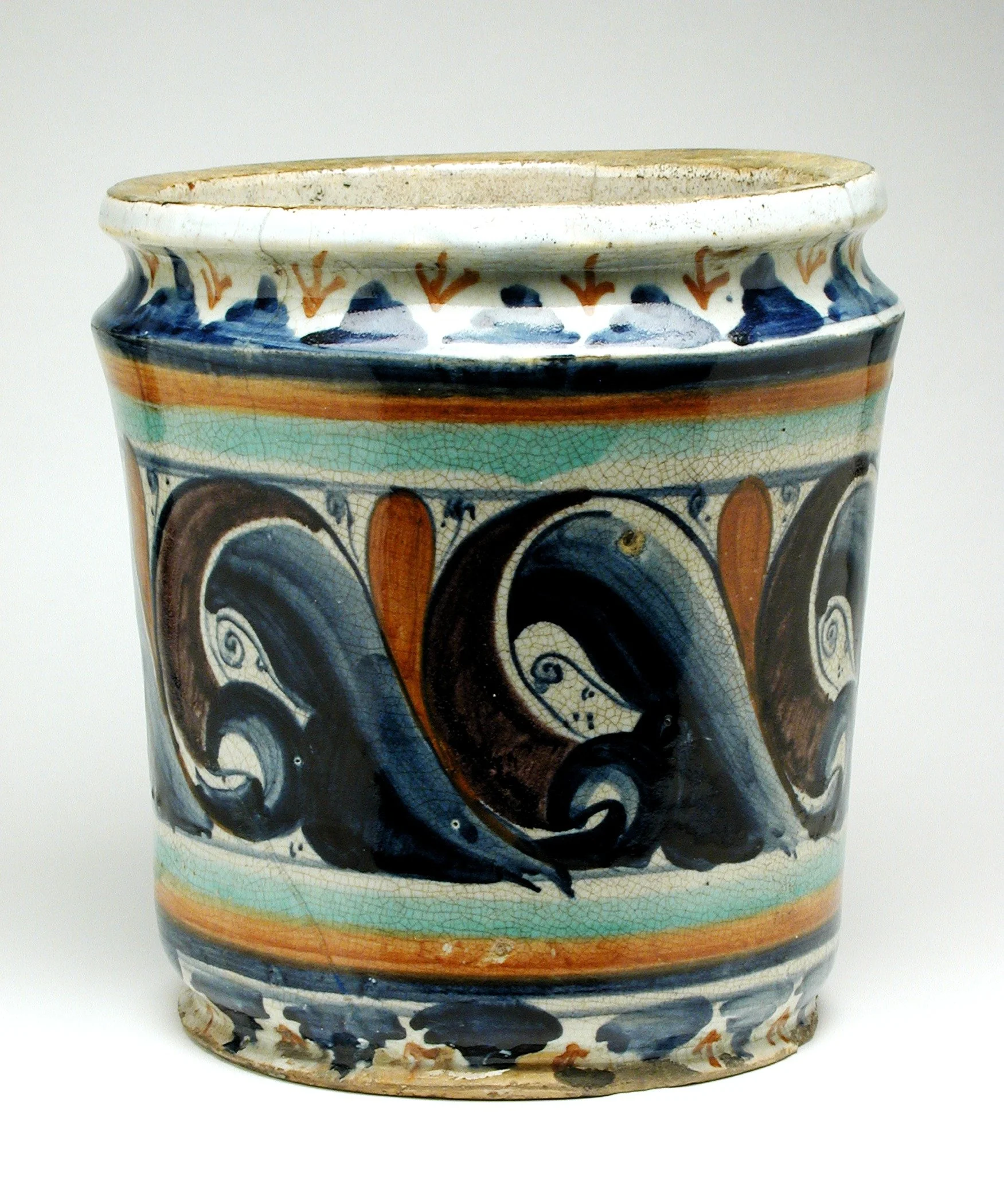
Storage you can see: a wide pharmacy jar whose crackled glaze and painted scrollwork are all on the outside. The audit's questions — what is inside, when was it dated, is it sealed against damp — are exactly the ones no vessel can answer for itself. Labels and the manifest answer them.
Albarello (drug jar), Los Angeles County Museum of Art, via Wikimedia Commons. Public domain.
- Every container is labeled with contents and date. No mystery jars.
- Powders and salts are sealed against moisture. Clumped or damp materials are flagged.
- Oils and fats are checked for rancidity and dated.
- Light-sensitive materials are stored away from direct light.
- Heavy or breakable containers are stored low and stable, not balanced on high shelves.
- Nothing edible-looking is stored where food is kept, and everything non-consumable is marked as such.
Checklist C: Safety Audit
- Grinding dust: the work area has been cleaned of fine powder residue; dust masks or coverings used during grinding are intact and stored accessibly.
- Ventilation: the workspace has a clear ventilation path for any future heated or alcohol-based work.
- Labels: every preparation is labeled; nothing unidentified remains on the shelves.
- Tools: mortars, sieves, filters, and cutting tools are clean, dry, and stored safely; blades are sheathed or stored out of reach.
- Spill kit: absorbent cloths or paper, a dustpan, and a sealed waste container are on hand.
- Supervision plan: any future work involving heat, alcohol, or lye (Unit V) is flagged now as requiring adult supervision, and the rule is written into the journal.
Checklist D: Archive Audit
- Every material in the manifest has a corresponding entry in your potions journal (Lessons 10 and 24).
- Preparation notes from Lessons 21 through 23 are filed: grinding observations, filtration records, conditioning notes.
- Gaps are listed honestly: which archive entries are missing, and what you will do to complete them.
Four checklists, each fully answered, and your laboratory is ready for Unit IV. If any checklist reveals a gap, the gap is the assignment: close it before you move on. The extraction — drawing compounds out of a material with a liquid — sciences will ask a great deal of your materials. Give them materials that deserve the question.
Check in: Checklist A forbids two kinds of quantity. What are they — and what does the lesson say a revealed gap becomes?
❦ In your workbook: record the four checklists in your own way — five completeness items, six storage items, six safety items, three archive items — copy, sketch, or note what matters.
The Self-Assessment Rubric
Grade yourself honestly on each row. A total of 20 or above means your laboratory is ready for Unit IV. A total below 20 means specific rows need work, and the rows themselves tell you which.
| Row | 4: Exemplary | 3: Solid | 2: Developing | 1: Beginning | Score |
|---|---|---|---|---|---|
| Manifest completeness | All materials, six columns, no blanks | All materials, minor gaps in detail | Some materials missing or columns incomplete | Manifest fragmentary or missing | |
| Readiness grading | Every grade justified by observed evidence | Grades given, mostly justified | Grades given but vague or generous | No consistent grading | |
| Storage and labeling | Everything labeled, dated, properly stored | Nearly all labeled and stored well | Several unlabeled or poorly stored items | Storage disorganized | |
| Safety audit | All six safety items verified and recorded | Most verified | Partially verified | Not yet done | |
| Archive linkage | Every material linked to a potions journal entry | Most linked | Some linked | Archive and manifest disconnected |
Record your total and your plan for any row scoring 2 or below. The rubric is not a judgment; it is a map.
Check in: Your total comes to 19, with the safety audit row at 2. What does the lesson say the rows themselves tell you — and what is your plan for that row?
❦ In your workbook: record the rubric in your own way — the five rows, the 20-point readiness line, and a plan for every row at 2 or below — copy, sketch, or note what matters.
In your packet: Project III — Assemble the Master Portfolio ⚒ begins here. Work it now, or mark the place and take it as homework — your choice.
Guided Observation: Reading the Model Manifest as a Working Document
This lesson's observation is desk work, done with the model manifest open: you read a finished manifest the way its keeper will read it in Unit IV, and you test whether its grades are plans rather than boasts — because a manifest that only praises its shelves will fail at the first extraction.
Work through it in order.
Read the three teaching entries. Read through the model slowly and notice what it does. Entry 6 does not pretend the clumped clay is fine; it prescribes the fix. Entry 8 rejects the old rosemary honestly instead of hoping the extraction will somehow restore a year of lost aroma. Entry 2 sets a deadline.
Check the six columns. Note that every entry carries six pieces of information: identity, form, quantity, preparation state, intended extraction, and readiness grade. Nothing is vague.
Test a grade against its evidence. Take any Ready entry and find, in its preparation state, the observed fact that earns the grade — the snap, the clean smell, the sealed storage. Then take a Needs work entry and find the work it schedules.
Consider:
- Which entry's grade would you challenge first, and what would you open, smell, or snap to settle it?
- Entry 2's grade carries a deadline rather than a repair. Why is a deadline the honest plan for fading peel, when regrinding is the honest plan for a coarse powder?
- What single sentence in this lesson would you write at the head of your own manifest?
❦ In your workbook: record the guided observation in your own way — the three teaching entries, the six columns checked, and one grade tested against its evidence — copy, sketch, or note what matters.
Materials
Everything in its place, before we begin. For this manifest lesson you will need:
Required (Level One — household items)
- Your laboratory journal and a pen: the manifest and checklists are written records first.
- Every material prepared in Unit III: gathered in one place for the audit.
- Cleaning supplies: cloths, a dustpan, and a sealed waste container for the safety audit.
- Labels and a marker: for anything the audit finds unlabeled.
- A camera or sketching supplies: to record your shelf layout before and after reorganization.
Suggested (Level Two — historically closer)
- A bound ledger: enter your manifest as a true stock book, in ink, in the apothecary tradition.
- Glass jars with ground-glass or cork stoppers: the historical vessel for audited stock.
- A brass or steel scoop and a balance: for weighing quantities into the manifest in real units.
Safety Notes
- Clean grinding residue with a damp cloth, not a dry sweep, to keep fine dust out of the air. Wear a dust mask if you are sensitive.
- Ventilate the workspace before and during the audit.
- Handle every container as if unlabeled until you have read the label: verify, then record.
- Younger students: an adult should supervise the safety audit, especially tool storage and waste disposal.
- Write this rule into your journal now: all future work with heat, alcohol, or lye requires adult supervision.
Reflection Questions
Answer the following questions in your workbook.
- The lesson says an unrecorded material is a material that does not officially exist. Why do materials that do not officially exist cause trouble at the worst possible moment — and which checklist item exists to prevent them?
- Entry 8 rejects the year-old rosemary instead of grading it Needs work. What separates a material that needs work from a material that must be rejected — and why can the extraction not rescue the second kind?
- "Needs work" is not a failure; it is an instruction. What must stand beside every Needs work grade to make that true — and what does Checklist A call a grade with no plan?
- The rubric says it is not a judgment; it is a map. Your total is 19, one point below the readiness line. How do the rows tell you exactly what remains to be done?
- Project III calls the assembled portfolio your admission ticket to Unit IV. What does the portfolio prove that no single Unit III lesson's work, on its own, could prove?
Workbook Checklist — Lesson 25
In my workbook I have:
- ☐ audited every Unit III material category by category — dense botanicals, oils and waxes, salts and clays, ground materials, filtered and prepared materials — recording the truth from opened jars, not from memory
- ☐ built my preparation manifest in the model's six columns, with every quantity in real units and every entry graded Ready, Needs work, or Reject
- ☐ written a plan with a deadline beside every "Needs work" grade, and a disposal note beside every "Reject," and discarded rejected materials safely
- ☐ completed all four audit checklists in my laboratory journal — Inventory Completeness, Storage, Safety, and Archive — answering every item in writing
- ☐ photographed or sketched my shelf layout before and after the audit's reorganization, and written the one-page summary: what was found, what was fixed, what remains scheduled
- ☐ scored myself honestly against the self-assessment rubric, recorded my total, and written a plan for every row at 2 or below
- ☐ assembled my Master Portfolio — manifest, four checklists, scored rubric, and Unit III archive entries — and written its half-page introduction: what Unit III taught me about preparation, and what my laboratory is now ready to do
☐ Lesson completed Date: ___ Signature: ___
The Professor's Closing Note
Sealed with the teal wax of Professor Crimblebrew Muddlenook, Master Apothecary of the Potions Laboratory, Head of House Meridies.
Four checklists, each fully answered, and your laboratory is ready for Unit IV. If any checklist reveals a gap, the gap is the assignment: close it before you move on. The extraction — drawing compounds out of a material with a liquid — sciences will ask a great deal of your materials. Give them materials that deserve the question.
— Professor Crimblebrew Muddlenook, Potions Laboratory • Master Apothecary • Head of House Meridies
PROFESSOR CRIMBLEBREW MUDDLENOOK
Potions Laboratory
Master Apothecary • Head of House Meridies
Cross-Class Connections

Herbology · Unit V, Lesson 36 — The Materia Botanica: Building Your Herbal
Come up to the Greenhouse, manifest-keepers, and see the book your Checklist D points to. Here every plant gets one entry in our shared Materia Botanica: my growing notes beside Professor Muddlenook's keeping notes, eight fields in a fixed order, so the material your manifest grades is the same plant whose life the entry records. Bring the honesty his audit taught you — cautions written plainly, blanks left honest — and we will write the growing half together.
PROFESSOR BERYL FERNFOOT
Herbology Greenhouse • Master Herbalist • Head of House Oriens
Scrollwork · Unit VI, Lesson 23 — Archive Labels & Library Systems
You have audited a laboratory. Now come and audit a library. In my Scriptorium we take up the label, the list, and the shelfmark at the scale of whole collections — how the medieval librarians made their memory hold, and why a stock book that cannot be found is a record that does not exist. Your manifest's six columns have a thousand-year pedigree, scholars. Come and meet their ancestors.
PROFESSOR QUILLBERRY NOCTURNE
Scrollwork Library

Creative Arts · Unit II, Lesson 11 — Case Binding & Archival Boxes
Your portfolio is gatherings today, scholars, and a book tomorrow — if it is housed properly. In my workshop you will learn to case a book to measure and to build the archival box in which a great record rests: boards cut square, a case built to fit the book it houses, a box that will outlast everyone in the room. Build the practice corner first, on scrap, as always. Then bring your Master Portfolio pages when they have grown into a book, and we will house them properly.
PROFESSOR COGBRANCH TIMBERCLANK
Creative Arts Workshop
Further Reading & Sources
- Wellcome Collection: Pharmacy and apothecary history — museum and library holdings on historical pharmacy practice, including apothecary ledgers and shop records.
- Science History Institute — histories of chemistry, distillation, and laboratory practice from antiquity to the modern lab.
- The Metropolitan Museum of Art: Apothecary jars — collection entries on historical pharmacy vessels and their decoration.
- Colonial Williamsburg: The Apothecary Shop — living-history interpretation of eighteenth-century apothecary practice.
- Smithsonian Institution — collections spanning materia medica, scientific instruments, and pharmaceutical history.
Browse the Potions shelf in the school Library for readable editions of these works.
Submit your work for this lesson using the form below.
THE UNIT III QUIZ
POTIONS LABORATORY · UNIT III: DENSE MATERIALS & PREPARATION
Unit III is complete: roots, bark, and resins known by their behavior; oils, waxes, salts, and clays on their shelves; grinding taken to grade; filtration and separation mastered; and every ingredient prepared for extraction before extraction begins. This quiz gathers the whole unit into one sitting. Take it from memory first, before you look back at your notes, because it measures what has stayed with you. If you completed the work marked ★ in your lesson packets, you have already practiced most of what it asks.
It stands beside this lesson's own Preparation Manifest and the Master Portfolio its Projects assemble — the audit that grades every material ready, or not ready, for Unit IV. The manifest is the unit inspected; the quiz is the unit remembered. Two different kinds of proof, both worth having.
The quiz packet is a single download. Part I gathers questions from across the unit, Part II matches the unit's vocabulary, and the answer key waits at the back for self-checking. When you have finished, score it honestly, note the result in your workbook, and revisit any lesson whose questions went wrong before you move on to Unit IV.
CONTINUE IN THE POTIONS LABORATORY
← Previous · Lesson 24: Building the Master Materia Botanica Portfolio Next · Lesson 26: Infused Lipids →
Unit III — Dense Materials & Preparation Potions Laboratory — All 52 Lessons
The rest of Unit III: Lesson 18 · Roots & Bark · Lesson 19 · Oils & Waxes · Lesson 20 · Salts & Clays · Lesson 21 · Grinding & Processing · Lesson 22 · Filtration · Lesson 23 · Preparing for Extraction · Lesson 24 · Master Portfolio