

POTIONS
Unit IV · Lesson 26INFUSED LIPIDS
Professor Crimblebrew Muddlenook
Master Apothecary • Potions
Head of House Meridies • School of Evershade
Professor's Introduction

Sealed with the teal wax of Professor Crimblebrew Muddlenook, Master Apothecary of the Potions Laboratory, Head of House Meridies.
Scholars, Unit IV begins, and with it the transformation sciences. Until now you have gathered, judged, dried, ground, and filed. Today the laboratory finally does what its name promises: it transforms.
Oil is the gentlest of our menstrua, and therefore the proper first teacher. It does not scorch, it does not sting, and it asks for only one thing in return: patience. Warm it a little and it hurries. Set it in a sunny window and it takes its time. Either way, it receives what the botanical offers and holds it faithfully, for months, in a sealed jar.
There is one rule in this lesson that outranks all others, and Professor Muddlenook does not rank rules lightly. You will learn it, you will be tested on it, and you will never forget it. Everything in its place, scholars, and every jar labeled. The archive is waiting for its first transformation.
— Professor Crimblebrew Muddlenook, Potions Laboratory • Master Apothecary • Head of House Meridies
Potions map — the class base map, unmarked for this lesson.
Lesson Objectives
By the end of this lesson, you will be able to:
- Define infusion and distinguish warm, solar, and cold lipid infusions by pace and method.
- Explain how heat, time, and viscosity govern the movement of compounds into oil.
- State the dried-botanicals rule for oil infusions and explain the reason behind it.
- Prepare, label, and monitor a steeping jar through a full infusion cycle.
- Record an infused-oil preparation in your extraction ledger using the archive standard.
Reading this lesson: ★ marks the passages to remember. They return on the unit quiz and the class test. Check in questions ask the material back as you go; answer them in your workbook when you meet them.
Working this lesson: Your assignment packet is the first download on this page. Work in it as the lesson moves along, answering each exercise as its subject is taught — or read the lesson through for your notes and take the exercises as homework afterward. Both are proper ways to sit this class. Signposts in the reading tell you where each exercise belongs. Written answers are short answers in your own words; a few honest lines are worth more than a filled page.
Your Assignment Packet
This lesson's exercises live in its packet: the Lexicon Handout (every term, course terms marked ◆), Materials, Guided Practice — the full Procedure, Part A, Part B, and Straining, with the Observation record and the Archive Entry order, printed in full so you can work at your own bench and windowsill — the Assignment Manual with its self-check, the Reflection Questions, and the Workbook Checklist. Download the packet before you begin and keep it beside you as you read.
Safety Briefing
Read this section completely before touching any material. Professor Muddlenook insists, and Professor Muddlenook is right.
- Heated oils burn. Oil holds heat and sticks to skin. Use heat-safe vessels only, handle everything with dry cloths or mitts, and keep your work area clear of clutter. Any heating step is done by or with an adult, and heated oil is never left unattended, not for a moment.
- The double boiler is mandatory for the warm infusion. No direct flame, no microwave, no improvising with a pan on a burner. Water in the lower pan, oil and botanical in the upper, gentle simmer only.
- Dried botanicals only. No fresh plant material in oil, ever, for the botulism reason below. If a material looks or feels damp, dry it fully first or choose another specimen.
- Label every jar with contents and date before it leaves your hands. An unlabeled jar in this laboratory is a failed assignment and a safety hazard.
- Ventilation and cleanliness. Work on a protected surface; wipe spills promptly, because oil on floors is a slip hazard. Wash hands after handling.
- Nothing in this lesson is medicine, and no amounts are given for taking. Infused oils made here are archive specimens and craft materials for later lessons (salves, candles). They are not for eating, and no lesson will ever give you a dose. Decorative and study preparations are display-only unless an adult confirms otherwise.
Check in: Which vessel is mandatory for the warm infusion — and what three things must never be used in its place?
❦ In your workbook: record the safety briefing in your own way — heated oils burn, the mandatory double boiler, dried botanicals only, every jar labeled, spills wiped, and nothing here medicine — copy, sketch, or note what matters.
The Gentlest Menstruum
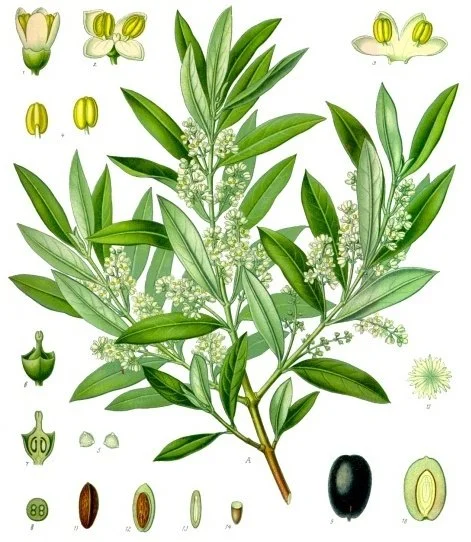
The olive, Olea europaea — the tree whose oil is this lesson's menstruum and the Mediterranean apothecary's default: blossom, leaf, and fruit on one plate, the way the tradition recorded a material before it was put to work. A study portrait; your oil is judged at the bench by cleanliness and scent, never from a picture.
Olea europaea, plate 229 from Köhler's Medizinal-Pflanzen, via Wikimedia Commons. Public domain.
Every extraction in this unit asks the same question: how do we persuade a botanical to give up what it holds? The answer is always a menstruum, the liquid medium that receives the compounds. You met the word in Lesson 19, studying oils and waxes as materials. Now oils step forward as workers.
Oil is the gentlest menstruum for three reasons. First, it is kind to delicate structures: petals and leaves that would scorch in a decoction or shrivel in strong alcohol steep calmly in warm oil. Second, it is selective in a useful way: oils readily receive the fat-soluble aromatic compounds that give botanicals their fragrance, which is why infused oils smell so strongly of their source. Third, it preserves what it receives: a well-made infused oil, kept cool and dark, holds its character for months, which made it one of the apothecary's great storage strategies long before refrigeration.
The trade is patience. Water pulls compounds quickly; alcohol pulls them aggressively. Oil pulls them slowly and politely. A solar infusion asks for two to four weeks. The apothecary accepted this bargain for centuries, because what oil lacks in speed it repays in fidelity: the finished preparation smells, looks, and behaves like a concentrated memory of the plant.
Check in: Oil is the gentlest menstruum for three reasons. Name them — and what is the trade the apothecary accepts for them?
❦ In your workbook: record the gentlest menstruum in your own way — what a menstruum is, oil's three kindnesses, and the patience it charges — copy, sketch, or note what matters.
A Brief History of Scented Oils
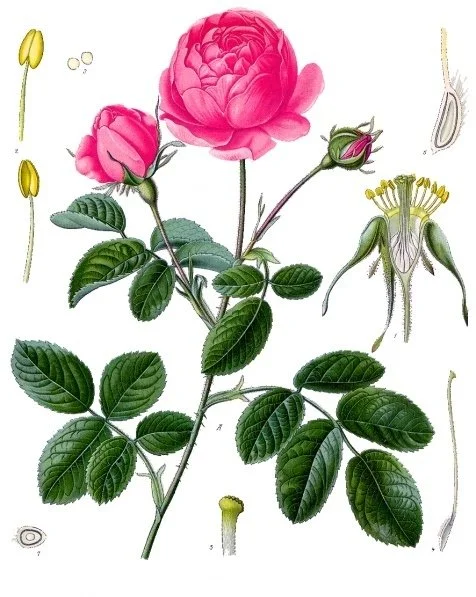
The rose, Rosa centifolia — the flower of Dioscorides' oleum rosatum, rose petals steeped in olive oil in the first century CE, by the method this lesson still uses. The old recipes sometimes called for fresh petals; the laboratory rule improves on them — dried petals only, and this plate is a study portrait of the living flower, not a picking guide.
Rosa centifolia, plate 122 from Köhler's Medizinal-Pflanzen, via Wikimedia Commons. Public domain.
Scented oils are among the oldest preparations in the laboratory record. Dioscorides, writing his De Materia Medica in the first century CE, gives recipes for infused oils including oleum rosatum, oil of roses, made by steeping rose petals in olive oil. The method he describes, petals in oil, time, straining, is the method you will use in this lesson, separated by roughly two thousand years and almost nothing else.
Olive oil dominated these recipes for a practical reason: in the Mediterranean world it was abundant, stable, and slow to turn rancid compared with many other available fats. Medieval monastic infirmaries kept shelves of infused oils for their workshops, and the recipes traveled through herbals for centuries with remarkably little change, because the method works and there was little to improve.
Two cautions from history are worth carrying into your own work. First, the old recipes sometimes call for fresh petals, and the old apothecaries sometimes paid for it with spoiled batches; you will learn the modern dried-botanicals rule below, which is one place where we improve on our predecessors. Second, Galen's famous cold cream, which you studied in Lesson 19, shows the same principle extended: oil receiving botanical character, then stiffened with wax into a finished preparation. Infusion is the first half of that story.
Check in: What method does Dioscorides describe for oleum rosatum — and what three practical qualities made olive oil dominate these recipes?
❦ In your workbook: record the history in your own way — Dioscorides and the oil of roses, olive oil's dominance, and history's two cautions — copy, sketch, or note what matters.
Warm, Solar, and Cold: Three Paces of Patience
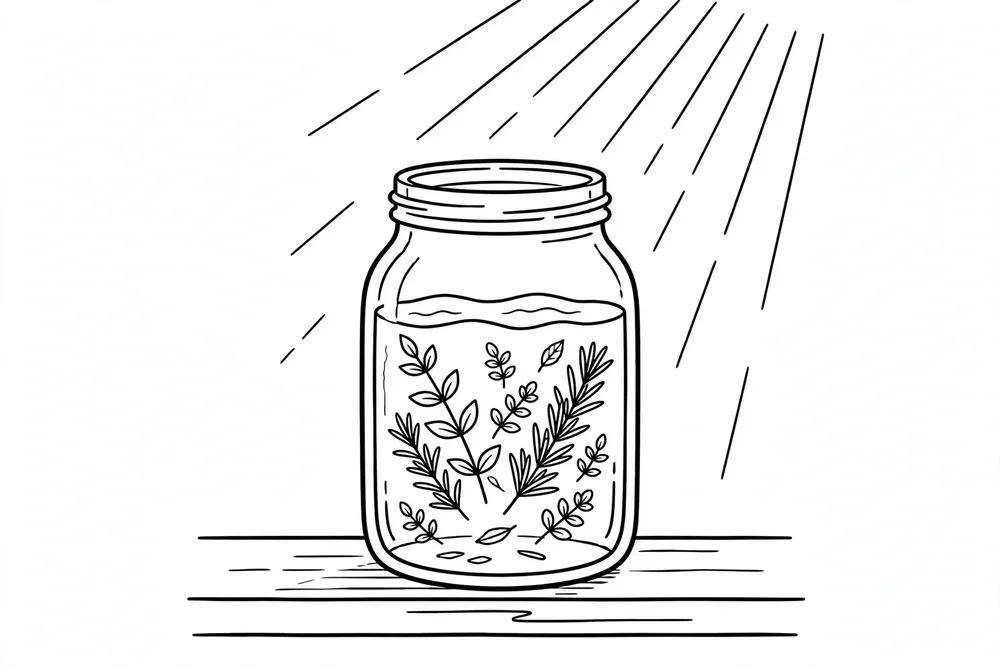
Lipid is the laboratory's family name for fats and oils, and this lesson's infusions are lipid infusions. All of them follow the same shape: prepared botanical, oil, time, straining. What differs is the pace, and pace is set by heat.
The warm infusion is the quickest. The steeping jar sits in gentle, indirect heat, classically a double boiler holding the oil well below a simmer, for one to four hours. Heat does two things at once: it sets molecules moving faster, so compounds leave the botanical more readily, and it thins the oil, lowering its viscosity so it flows into and around the material more easily. The result is an infusion in an afternoon. The cost is vigilance: too much heat scorches the botanical and ruins the batch, which is why the double boiler, never direct flame, is the rule.
The solar infusion is the traditional pace. A sealed jar of oil and botanical sits in a sunny window or warm shelf for two to four weeks, shaken gently every day or two. The sun provides mild, fluctuating warmth; time does the rest. This was the Mediterranean apothecary's standard method, and it remains the finest teacher of patience in the laboratory. Its cost is exactly that: weeks of waiting, and a jar that must be watched for any sign of trouble.
The cold infusion is the slowest and simplest: botanical and oil at room temperature, away from light, for four to six weeks. It asks nothing but a shelf and a calendar. Delicate aromatics that heat would flatten sometimes prefer it.
Muddlenook's counsel: learn the solar method first, because it teaches observation. The warm method is a tool for when time is short, not a replacement for understanding.
Check in: All three paces share one shape. What differs — and what two things does heat do at once in the warm infusion?
❦ In your workbook: record the three paces in your own way — warm at one to four hours, solar at two to four weeks, cold at four to six weeks, and Muddlenook's counsel to learn solar first — copy, sketch, or note what matters.
The Dried-Botanicals Rule
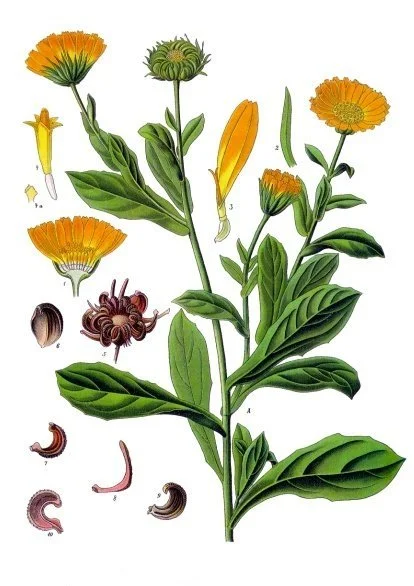
Calendula, Calendula officinalis — one of this lesson's two named botanicals, recorded whole: bloom, bud, seed head, and seed. What enters your jar is the dried petal, crisp and fragrant; the plate is a study portrait of the plant it came from, not an identification guide.
Calendula officinalis, plate 24 from Köhler's Medizinal-Pflanzen, via Wikimedia Commons. Public domain.
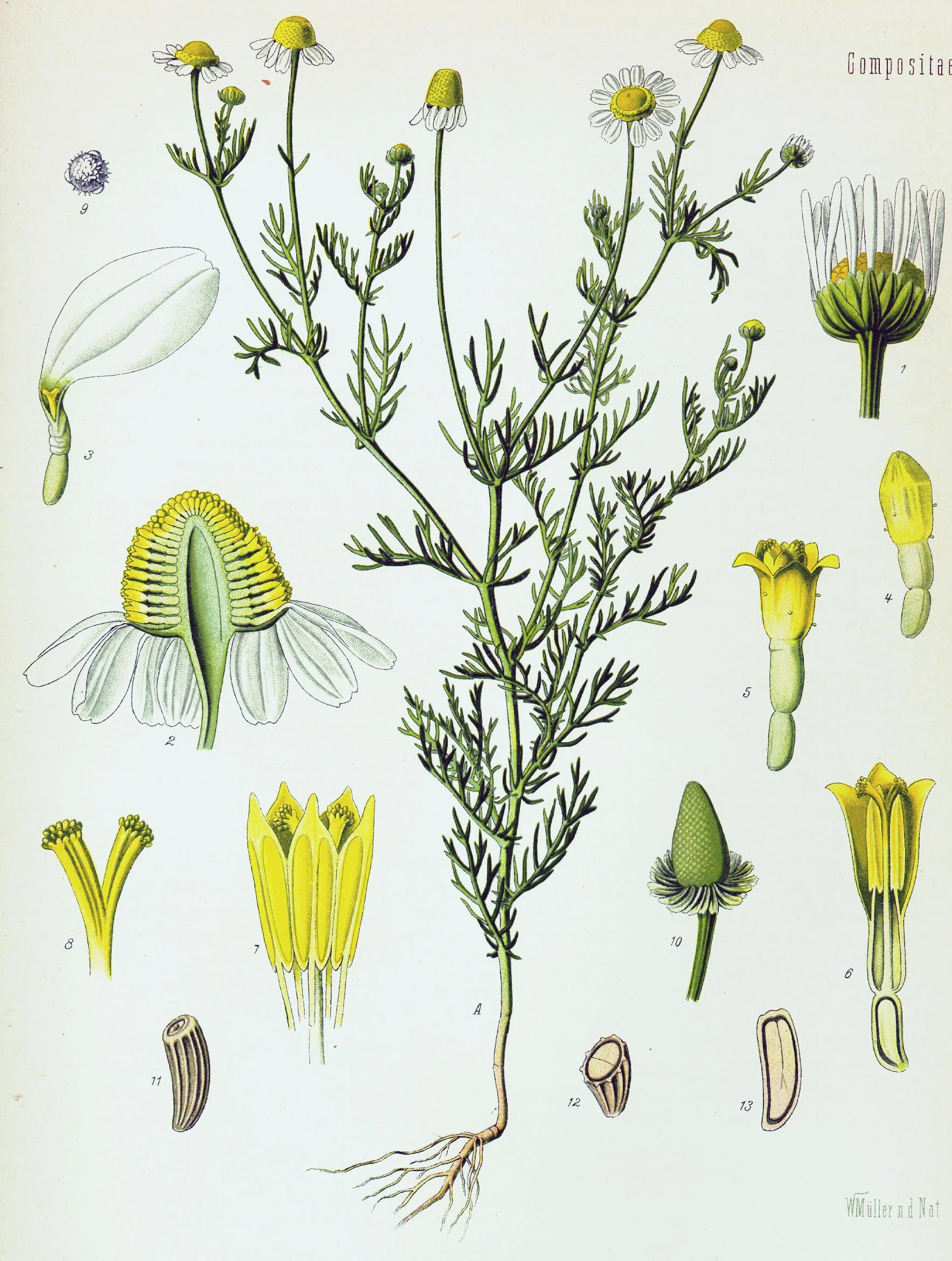
Chamomile, Matricaria recutita — the lesson's second named botanical, shown entire, root to flower head, with its parts dissected around it the way a portfolio entry is written part by part. Dried flowers only enter the oil; the plate is a study portrait, not an identification guide.
Matricaria recutita, plate 91 from Köhler's Medizinal-Pflanzen, via Wikimedia Commons. Public domain.
★ Here is the rule that outranks all others in this lesson: oil infusions are made with dried botanicals, never fresh.
The reason is a bacterium called Clostridium botulinum. Its spores are common in soil and on plant surfaces and are harmless in most circumstances. But seal fresh, moist botanical material in oil at room temperature and you create the exact conditions the spores need to grow: an anaerobic environment, low acidity, and moisture. The result can be botulinum toxin, which is colorless, odorless, and dangerous. This is the same reason food-safety authorities warn against storing fresh garlic or fresh herbs in oil at room temperature; the National Center for Home Food Preservation advises that such mixtures be refrigerated and used quickly, or made with dried herbs instead.
Dried botanicals sidestep the problem entirely: without sufficient moisture, the spores cannot grow. So the laboratory rule is absolute. Dried calendula, dried chamomile, dried rose petals: yes. Fresh-picked anything: no. If you ever see a historical recipe calling for fresh petals in oil, admire its age, then make it with dried petals and note the improvement in your archive. The old apothecaries lost batches to this; we do not have to.
One corollary: even with dried botanicals, every jar is labeled with contents and date, and every jar is inspected before use. An infused oil that smells sharp, stale, or crayon-like has turned rancid (Lesson 19) and is recorded, then discarded. The archive notes failures as carefully as successes.
Check in: State the rule, then walk the chain: what three conditions inside a sealed jar of fresh material let Clostridium botulinum grow — and what single thing do dried botanicals remove?
❦ In your workbook: record the dried-botanicals rule in your own way — the rule itself, the moisture chain, and the corollary of labels and inspection — copy, sketch, or note what matters.
A Sealed Note on the First Law
Scholars, you have now met the rule that will follow you through every extraction lesson in this unit, so let me seal it properly. Dried botanicals only in oil. Not mostly dried, not dried enough, but fully dried, low mold risk, stored in sealed containers. The apothecary's patience begins before the preparation does, in the drying room, weeks before a jar is ever filled.
When you are tempted to hurry a damp leaf into oil, remember the chain you just learned: moisture plus oil plus time, sealed from air, is an invitation you must never send. The laboratory rewards the scholar who waits. It punishes, quietly and without appeal, the scholar who does not.
— Professor Crimblebrew Muddlenook, Potions Laboratory • Master Apothecary • Head of House Meridies
Check in: The sealed note sets the dryness standard in three phrases. What are they — and where does the apothecary's patience begin?
❦ In your workbook: record the sealed note in your own way — fully dried, low mold risk, sealed containers, and the chain never to send — copy, sketch, or note what matters.
Viscosity, Heat, and Time: The Extraction Triangle
Three factors govern every infusion, and Muddlenook wants them recited like a multiplication table: ★ viscosity, heat, time.
Viscosity is a liquid's resistance to flow; you studied it as a material property in Lesson 19. Thick oil moves slowly around the botanical, so compounds migrate slowly. Thin, warmed oil moves freely. This is why the warm infusion outpaces the solar: heat thins the oil as well as exciting the molecules.
Heat accelerates everything, but it is a bargain with terms. Gentle warmth, roughly body-warm to comfortably warm, never hot, speeds extraction without damage. Excessive heat scorches botanicals, drives off the most delicate aromatics, and can push an oil toward rancidity. The double boiler exists to make overheating difficult.
Time is the factor no shortcut replaces. Given enough weeks, even a cold infusion reaches completion. Given too little time, even a warm infusion is thin and disappointing. The triangle balances: more heat means less time; less heat means more time; viscosity sets the exchange rate between them.
Your practical work in this lesson tests the triangle directly: the same botanical, the same oil, two paces. The archive entry will show which triangle you preferred and why.
Check in: Recite the triangle. What does viscosity set between heat and time — and what can excessive heat do besides scorch?
❦ In your workbook: record the extraction triangle in your own way — viscosity, heat, and time, how the three balance, and the double boiler's part in it — copy, sketch, or note what matters.
Procedure
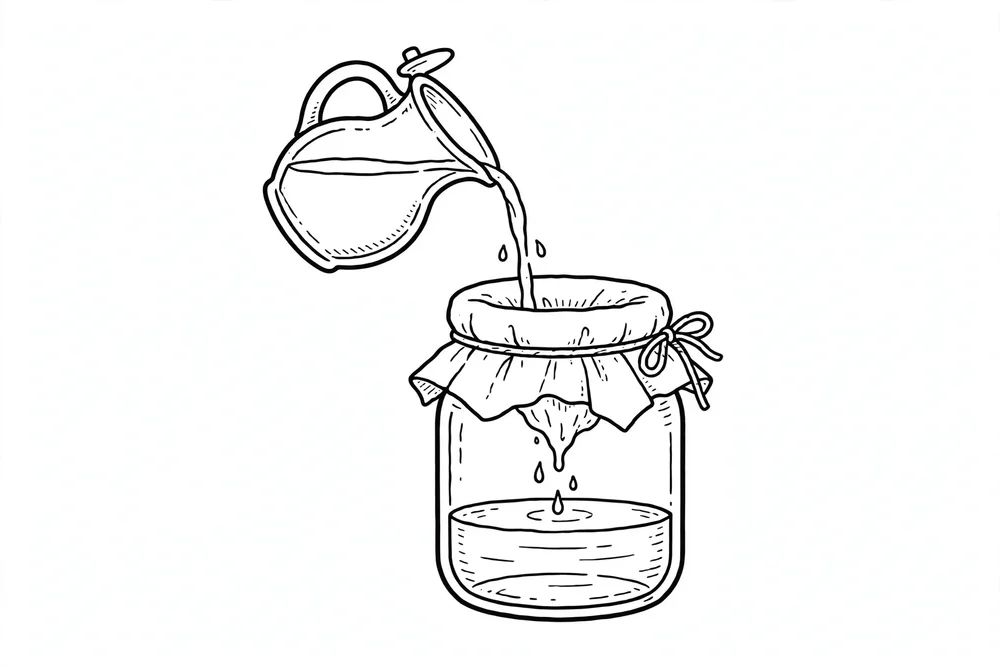
You will make two infusions of the same botanical in the same oil: one solar, one warm. They start together; they finish on different days; your ledger compares them.
Part A — The Solar Jar (begins today, finishes in 2–4 weeks)
- Inspect your dried botanical. It should be crisp, fragrant, and free of any musty smell. If in doubt, choose another specimen.
- Fill one clean, dry jar loosely, about half to two-thirds full, with the dried botanical. Do not pack it down.
- Pour olive oil over the botanical until it is completely covered with at least an inch of oil above it. No material should poke above the surface.
- Cap the jar tightly. Label it immediately: botanical name, oil, the word SOLAR, and today's date.
- Set the jar on a sunny windowsill. Record the starting appearance and smell in your ledger.
- Shake the jar gently every day or two. Inspect weekly: the oil should gradually take on the botanical's color and scent. Any off smell, cloudiness that worsens, or visible mold means the batch is discarded and recorded as a failure. (With dried botanicals and clean jars, this is rare.)
In your packet: Exercise I — The Solar Jar Log ◐ begins here. Work it now, or mark the place and take it as homework — your choice.
Part B — The Warm Bath (today, 1–2 hours, adult required)
- Fill the lower pan of your double boiler one-third full of water and bring it to a gentle simmer. An adult handles the stove.
- Combine the same botanical and the same oil in the upper bowl, in the same proportions as the solar jar.
- Set the bowl over the simmering water. The oil should become warm to the touch, roughly body-warm to comfortably warm, never hot. If you have a thermometer, hold it well below a simmer's temper; comfort, not cooking, is the target.
- Maintain gentle warmth for one to two hours, stirring occasionally. Watch constantly; this is the vigilance the lesson demands.
- Remove from heat and let cool. Label a jar WARM with today's date.
In your packet: Exercise II — The Warm Bath Record ◐ begins here. Work it now, or mark the place and take it as homework — your choice.
Straining and bottling (both infusions, when each finishes)
- Line your strainer with muslin or cheesecloth and strain the oil into a clean jar, pressing the botanical gently to release the last oil.
- Bottle the finished oil in a clean, dry container. Label with botanical, oil, method, and date.
- Compost or discard the spent botanical. Wash everything in hot, soapy water; oil residue goes to the trash, not down the drain in quantity.
Check in: The two jars start together and finish on different days. What four things stand on the solar jar's label the moment it is capped — and what three signs condemn a steeping batch to discard?
❦ In your workbook: record the procedure in your own way — the solar jar's six steps, the warm bath's five, and the straining that finishes both — copy, sketch, or note what matters.
Cleanup
- Spent botanical material goes to compost or trash.
- Wash jars, bowls, strainers, and cloths in hot, soapy water. Oil films wipe first with a paper towel, then wash.
- Wipe the work surface completely; check the floor for drips.
- Return all materials to their labeled places. The laboratory resets to order before the scholar leaves it.
Check in: Oil films are treated in two passes before washing. What are they — and what is checked on the floor?
❦ In your workbook: record the cleanup in your own way — spent material out, oil films wiped then washed, the floor checked, and every material back in its labeled place — copy, sketch, or note what matters.
Archive Entry
File in your extraction ledger, in Muddlenook's required order:
- Preparation name: e.g., "Calendula Infused Oil — Solar" and "Calendula Infused Oil — Warm."
- Date started and date finished for each.
- Materials: botanical (with dryness note), oil, jar, method.
- Observations: your comparison notes from above.
- Verdict: which pace you prefer for which materials, in one paragraph.
- Failures, if any, recorded honestly with the suspected cause.
In your packet: Exercise III — The Pace Comparison ✎ begins here, once both infusions are finished. Work it now, or mark the place and take it as homework — your choice.
Check in: The archive entry has a required order of six parts. Which part records failures — and what must stand beside a failure?
❦ In your workbook: record the archive standard in your own way — name, dates, materials with the dryness note, observations, verdict, and honest failures — copy, sketch, or note what matters.
Guided Observation: Watching Two Paces of the Same Oil
This lesson's observation is the lesson's own bench record, kept for each infusion: you watch the same botanical in the same oil at two paces, and your ledger — not your memory — carries the comparison.
Record in your extraction ledger for each infusion:
- Starting appearance and scent of the botanical and the oil.
- For the solar jar: weekly notes on color change, scent development, and clarity.
- For the warm bath: notes every 20 minutes on scent, color, and temperature behavior.
- Final comparison: color, scent strength, clarity, and yield of the two finished oils.
- Your verdict: which pace would you choose for a delicate petal, and which for a sturdy root? Why?
Consider:
- The solar jar is inspected weekly and shaken every day or two, while the warm bath is noted every 20 minutes. What does each rhythm of watching teach that the other cannot?
- Your final comparison rests on four measures — color, scent strength, clarity, and yield. Which of the four would you trust least from memory alone, and what does that say about why the ledger exists?
❦ In your workbook: record the guided observation in your own way — the starting record, the weekly and 20-minute notes, the four-measure comparison, and your verdict — copy, sketch, or note what matters.
Materials
Everything in its place, before we begin. For this lesson's two infusions you will need:
Level One — household items
- Dried botanical: dried calendula petals or dried chamomile flowers, enough to loosely fill a small jar (a small handful). Must be fully dry and crisp.
- Oil: plain olive oil, enough to cover the botanical completely with headroom (about one cup for a half-pint jar).
- Two clean, dry glass jars with lids (half-pint mason jars are ideal), plus a third small jar or bottle for the finished oil.
- Labels and a pen, or masking tape and a marker.
- A fine strainer or cheesecloth for the final straining.
- A small saucepan and a heat-safe bowl that nests in it (your double boiler), for the warm infusion.
- A sunny windowsill for the solar jar.
- Your extraction ledger or laboratory journal.
Level Two — historically closer
- A thermometer (candy or instant-read) to hold the warm infusion in its proper range.
- Amber glass bottles with tight caps for storing the finished oils away from light.
- Unbleached muslin instead of cheesecloth for straining, the traditional filter cloth.
- A dedicated infusion shelf in a warm, dark cupboard for the cold-method comparison jar, if you wish to run all three paces.
Safety Notes
- Heated oils burn, and oil holds heat and sticks to skin. Use heat-safe vessels only, handle everything with dry cloths or mitts, and keep the work area clear. Any heating step is done by or with an adult, and heated oil is never left unattended.
- The double boiler is mandatory for the warm infusion: water in the lower pan at a gentle simmer, oil and botanical in the upper bowl. No direct flame, no microwave, no improvising with a pan on a burner.
- Dried botanicals only. No fresh plant material in oil, ever: moisture plus the anaerobic oil environment can let Clostridium botulinum grow. If a material looks or feels damp, dry it fully first or choose another specimen.
- Label every jar with contents, method, and date before it leaves your hands. An unlabeled jar is a failed assignment and a safety hazard.
- Wipe oil spills promptly; oil on floors is a slip hazard. Work on a protected surface and wash hands after handling.
- Nothing in the Potions Laboratory is medicine, and no lesson gives amounts to take. Infused oils made here are archive specimens and craft materials for later lessons. They are not for eating.
Reflection Questions
Answer the following questions in your workbook.
- Why does the laboratory insist on dried botanicals for oil infusions? Explain the full chain from moisture to danger.
- Heat speeds an infusion in two distinct ways. Name both and explain each.
- Why did olive oil dominate historical infusion recipes? Give at least two reasons.
- A classmate's month-old infused oil smells sharp and stale, like old crayons. Diagnose the problem and state what should be done with the jar.
- Maceration (Lesson 23) is soaking at room temperature; this lesson's warm and solar methods add gentle heat or solar warmth. In your own words, what is the relationship between maceration and infusion?
Workbook Checklist — Lesson 26
In my workbook I have:
- ☐ defined infusion and distinguished the warm, solar, and cold lipid infusions by pace and method — one to four hours, two to four weeks, four to six weeks
- ☐ explained how heat, time, and viscosity govern the movement of compounds into oil, as the extraction triangle
- ☐ stated the dried-botanicals rule and explained the full chain behind it — moisture, an anaerobic sealed jar, and Clostridium botulinum
- ☐ prepared, labeled, and monitored a steeping jar through a full infusion cycle — the solar jar shaken, inspected weekly, strained, and bottled
- ☐ carried out the warm bath with an adult at the double boiler, with a timed record every 20 minutes, and strained, bottled, and labeled it the same day
- ☐ recorded both infused-oil preparations in my extraction ledger using the archive standard — name, dates, materials with dryness note, observations, verdict, and honest failures
☐ Lesson completed Date: ___ Signature: ___
The Professor's Closing Note
Sealed with the teal wax of Professor Crimblebrew Muddlenook, Master Apothecary of the Potions Laboratory, Head of House Meridies.
Filed today, scholars: the solar jar is still on your windowsill as you file this entry, and that is exactly as it should be. The laboratory teaches patience by requiring it. Tend your jar, shake it gently, and watch time do what heat hurries. When you strain it weeks from now, you will hold the first transformation of Unit IV in your hands, and it will smell of the patience it took.
File the warm infusion's entry today. File the solar jar's entry when it finishes. An archive that waits for its slowest jar is an honest archive.
— Professor Crimblebrew Muddlenook, Potions Laboratory • Master Apothecary • Head of House Meridies
Professor Crimblebrew Muddlenook Potions Laboratory Master Apothecary • Head of House Meridies
Due: next lesson. In good order, scholars.
Cross-Class Connections

Herbology · Unit IV, Lesson 28 — Drying Herbs the Traditional Way
Come up to the Greenhouse, oil-students, and learn the drying his first law stands on. Here we hang bundles and lay screens, we judge doneness by the crispness test and nothing else, and we keep what we dry in sealed jars, cool and dark — because a leaf that enters his oil damp carries the one invitation his laboratory must never send. Bring me your uncertain specimens before you fill a single jar, my dears, and we will test them together.
PROFESSOR BERYL FERNFOOT
Herbology Greenhouse • Master Herbalist • Head of House Oriens
Scrollwork · Unit II, Lesson 5 — Soot & Charcoal Ink
You have felt viscosity in a jar of warming oil, scholars. Now come and feel it at the nib. In my Scriptorium we mix a working carbon ink and learn what gum arabic, viscosity, and suspension do for the line — the same resistance to flow that decides how freely his menstruum moves around a botanical decides how cleanly my ink leaves the pen. The working ink lives between too thin and too thick. So, you will find, does the working oil.
PROFESSOR QUILLBERRY NOCTURNE
Scrollwork Library
Further Reading & Sources
- Dioscorides, De Materia Medica — World Digital Library — the first-century source for infused-oil recipes including oil of roses.
- National Center for Home Food Preservation: Herbs & Oils FAQ — the food-safety authority behind the dried-botanicals rule ("fresh herbs must be washed well and dried completely before storing in the oil").
- The Science History Institute: Alchemy and Extraction — history of extraction methods and laboratory apparatus.
- The Metropolitan Museum of Art: Heilbrunn Timeline — Medieval Apothecaries — the medieval workshop context for infused-oil shelves.
- Wellcome Collection: Herbals and Medicine — digitized herbals carrying infusion recipes across the centuries.
- Colonial Williamsburg: The Apothecary Shop — historical apothecary practice in the American colonies.
Browse the Potions shelf in the school Library for readable editions of these works.
LESSON 26 · INFUSED LIPIDS
Try It in the Laboratory
The lesson taught the method — the carrier, the gentle heat, the patience. Now the Experiment will build your own infused oil with you: choose your plant, your carrier, your scent, and it writes the recipe.
— Professor Crimblebrew Muddlenook, Potions Laboratory
Submit your work for this lesson using the form below.
CONTINUE IN THE POTIONS LABORATORY
← Previous · Lesson 25: The Preparation Manifest Next · Lesson 27: Hydro-Infusions →
Unit IV — Botanical Extractions Potions Laboratory — All 52 Lessons
The rest of Unit IV: Lesson 27 · Hydro-Infusions · Lesson 28 · Glycerites & Syrups · Lesson 29 · Decoctions · Lesson 30 · Herbal Acetums · Lesson 31 · Resin Fusion · Lesson 32 · Tinctures · Lesson 33 · Distillation · Lesson 34 · Extraction Ledger