

POTIONS
Unit IV · Lesson 29DECOCTIONS
Professor Crimblebrew Muddlenook
Master Apothecary • Potions
Head of House Meridies • School of Evershade
Professor's Introduction

Scholars, welcome to the hot laboratory. Until now your extractions have been patient ones: cold steeping, oil waiting, materials resting at room temperature while the menstruum — the liquid that does the extracting — did the slow work. Today we introduce fire, and with it a new discipline.
A decoction is an extraction for materials that refuse to yield any other way. Roots, bark, seeds, dried berries, mushrooms: these are the armored citizens of the botanical world, and warm water merely knocks at their gates. Heat sustained over time breaks the siege. But heat is not merely a stronger method. It is a different method, with its own rules, its own risks, and its own rewards. The apothecary who treats it like a stronger steep will learn that lesson the hard way.
Order. Observation. Record. And in this lesson, above all: respect the heat.
— Professor Crimblebrew Muddlenook, Potions Laboratory • Master Apothecary • Head of House Meridies
Potions map — the class base map, unmarked for this lesson.
Lesson Objectives
By completing this lesson, you will be able to:
- Define a decoction and explain why dense botanical materials require simmering rather than steeping
- Describe how prolonged heat exposure moves compounds from hard plant structures into a water menstruum
- Predict and manage tannin release during long simmering
- Use reduction deliberately as a concentration system
- Prepare a decoction of a dense botanical safely, and record the extraction in your archive
- Contrast decoction with infusion and maceration as three distinct extraction strategies
Reading this lesson: ★ marks the passages to remember. They return on the unit quiz and the class test. Check in questions ask the material back as you go; answer them in your workbook when you meet them.
Working this lesson: Your assignment packet is the first download on this page. Work in it as the lesson moves along, answering each exercise as its subject is taught — or read the lesson through for your notes and take the exercises as homework afterward. Both are proper ways to sit this class. Signposts in the reading tell you where each exercise belongs. Written answers are short answers in your own words; a few honest lines are worth more than a filled page.
Your Assignment Packet
This lesson's exercises live in its packet: the Lexicon Handout (every term, course terms marked ◆), Materials, Guided Practice — the Cinnamon Decoction practical, printed in full with its Cleanup and Archive Entry, so the hot work can be run from the packet at the stove — the Assignment Manual with its self-check, the Reflection Questions, and the Workbook Checklist. Download the packet before you begin and keep it beside you as you read.
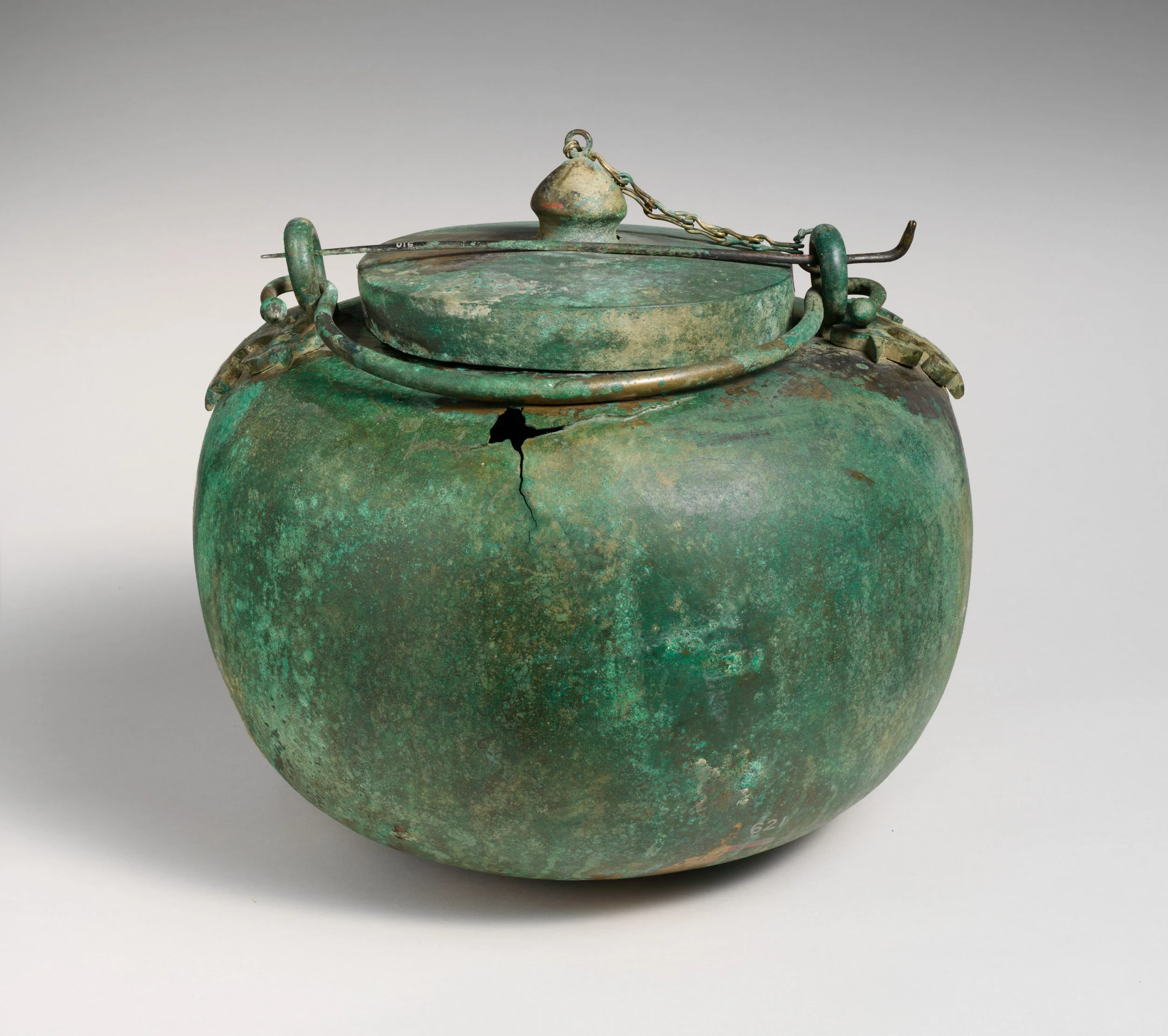
A bronze cauldron and lid of about 550 BCE — the covered vessel of the old discipline, chained lid and all. Look at its shoulder before you admire it: the crack there means this cauldron would fail this lesson's first safety rule, and no cracked vessel goes on heat in the hot laboratory. A study object, photographed as held; your working pot must be sound.
Bronze cauldron and lid, Etruscan, ca. 550 BCE, The Metropolitan Museum of Art (object 03.23.7), via the Met Open Access program. Public domain (CC0).
Safety Briefing: The Hot Laboratory
This is the first lesson of the course in which sustained heat is central to the procedure, and the safety rules tighten accordingly.
- Use a heat-safe pot or cauldron. A heavy-bottomed pot on a stove is ideal. Thin vessels scorch. Never use plastic, and never use a vessel with cracks or damaged handles.
- A younger scholar must work with an adult for every heated step. No exceptions. The adult handles the burner and the pot; the scholar observes, times, and records.
- Steam burns are real burns. Keep your face and hands back from rising steam. Tilt the lid away from you when lifting it so steam escapes on the far side.
- Never leave a simmering pot unattended. Set a timer and stay within earshot. A forgotten pot boils dry, and a dry pot on heat is a fire risk.
- Guard against boil-overs. Fill the pot no more than two-thirds full. A sudden boil-over sends scalding liquid across the stove.
- Ventilate. Simmer near a window or range hood. Aromatic botanicals fill the room, and concentrated steam irritates sensitive airways.
- Label and contain. The finished decoction is a laboratory preparation, not a beverage for the table. Label it with the material, the date, and "laboratory preparation, display and study only."
No dosage is given in this lesson and none should be attempted. The apothecary's discipline begins with knowing what a preparation is for, and our decoctions are for study of the extraction itself.
Check in: Which briefing rule governs who touches the burner — and which two rules together govern the pot's fill and its watching?
❦ In your workbook: record the hot laboratory briefing in your own way — the heat-safe pot, the adult at every heated step, steam, the never-unattended rule, the two-thirds fill, ventilation, and the label the finished preparation carries — copy, sketch, or note what matters.
In your packet: Guided Practice — the Cinnamon Decoction practical begins at the stove. Read it through here first, then run it from the packet — your choice.
What a Decoction Is
A decoction is an extraction made by simmering dense botanical material in water for a sustained period, so that heat and time together draw soluble compounds out of structures that cold or brief-hot water cannot open.
The old pharmacopeias, the official recipe books of historical pharmacy, listed decoctions under the heading Decocta with exact standards. One standard formula directed the apothecary to place fifty grams of coarsely broken material in a covered vessel, pour on a thousand measures of cold water, bring it to a boil, and simmer for fifteen minutes before cooling, pressing, and straining. That single paragraph, preserved in the old books, contains the whole discipline: cold start, covered vessel, measured duration, then pressing and straining. We follow its logic still.
The herbalist James Green stated the purpose plainly: the object of preparing decoctions is to secure, in water, the soluble principles of herbs that are hard and woody and have a close, dense texture. Steeping knocks. Simmering opens the door.
Check in: What four disciplines does the old Decocta paragraph contain, in its own summary — and whose purpose statement says what simmering does that steeping cannot?
❦ In your workbook: record what a decoction is in your own way — the sustained simmer, the Decocta standard's four disciplines, and James Green's purpose — copy, sketch, or note what matters.
Why Heat: What Prolonged Simmering Does
Plant structures are built to resist. A root's outer layers, a bark's fibers, a seed's coat: all of them evolved to protect the living tissue inside, and they do not surrender their contents to water that merely passes by.
Heat acts on these defenses in three ways at once.
First, it softens structure. Cell walls and fibrous matrices loosen as they absorb hot water, the way a dried sponge softens in a warm basin. Compounds locked inside cells begin to leak into the surrounding liquid.
Second, it accelerates movement. Heat increases the motion of water molecules, so dissolved compounds diffuse outward from the material faster. A simmer extracts in twenty minutes what cold soaking would take hours to begin.
Third, it sustains contact. A brief steep cools quickly; a simmer holds the water at extraction temperature for the full duration. Dense materials need that sustained contact. Their compounds travel a longer path out of the material than a leaf's compounds do.
★ This is why the apothecary's rule of thumb has survived for centuries: soft and delicate parts, like leaves and flowers, are steeped as infusions (Lesson 27). Hard and dense parts, like roots, bark, and seeds, are simmered as decoctions. Match the method to the material, or the material keeps its secrets.
Check in: Name heat's three actions on a dense material's defenses — and state the rule of thumb they explain.
❦ In your workbook: record why heat in your own way — structure softened, movement accelerated, contact sustained, and the rule of thumb that matches method to material — copy, sketch, or note what matters.
Tannin Release: The Long-Simmer Signature
Prolonged heat draws out a class of compounds that brief steeping barely touches: the tannins.
Tannins are water-soluble polyphenols found throughout the plant world, especially concentrated in bark, roots, unripe fruit, and tea leaves. You know them by their signature sensation: astringency, the dry, puckering, mouth-drawing feeling that makes strong tea or unripe persimmon grip the tongue. That grip happens because tannins bind to proteins, including the proteins in saliva, and precipitate them.
★ In a decoction, tannin extraction rises with both temperature and time. A ten-minute simmer releases a modest amount; a forty-minute simmer releases far more. This is not a flaw in the method. It is one of the method's most useful properties, and the apothecary reads it deliberately.
- Color deepens as tannins dissolve. Watch the liquid move from pale to amber to deep brown; the color is a rough gauge of how far extraction has traveled.
- Astringency rises. The longer the simmer, the more drying the character of the finished liquid.
- Clarity changes. Tannins can cloud a cooled decoction as they bind with other dissolved compounds and settle.
The practical consequence: extraction duration is not merely about strength. It changes the character of the preparation. A short decoction and a long decoction of the same bark are different preparations, and the laboratory journal records them as such. The apothecary decides in advance what kind of extraction the experiment requires, sets the timer accordingly, and does not drift past it.
Check in: A ten-minute simmer and a forty-minute simmer of the same bark are called different preparations. What rises with temperature and time to make them different — and which three visible gauges report it?
❦ In your workbook: record tannin release in your own way — the polyphenols and their protein grip, extraction rising with temperature and time, and the three gauges: color, astringency, clarity — copy, sketch, or note what matters.
In your packet: Exercise II — The Duration Trial (Assignment III) ⚒ begins here. Work it now, or mark the place and take it as homework — your choice.
Reduction and Concentration Systems
Simmering does something no cold extraction can do: it removes water.
As the pot simmers uncovered, water escapes as steam while the dissolved compounds stay behind. The same quantity of extracted material now occupies less liquid. This is reduction, and it is the apothecary's simplest concentration system.
Reduction serves three purposes in the laboratory:
1. Concentration. Halving the volume roughly doubles the concentration of dissolved compounds. The apothecary who needs a strong preparation reduces it.
2. Preservation. Water is what spoilage organisms need. A reduced, concentrated preparation with less free water keeps longer than a dilute one. Historical apothecaries reduced syrups and decoctions partly for this reason.
3. Observation. Reduction is visible and measurable. Marking the liquid level at the start and measuring how far it falls gives the scholar a direct, numerical record of what the heat accomplished. The journal entry writes itself: started at 500 milliliters, ended at 300, over thirty minutes of gentle simmer.
Reduction is controlled by the same variables as everything else in this lesson: heat intensity and time. A rolling boil reduces fast and risks boil-over; a bare simmer reduces slowly and steadily. The laboratory standard is the gentle simmer: the surface trembles, a few bubbles break, and the liquid level falls at a pace you can watch.
Scholars, a caution on enthusiasm: reduction concentrates everything in the pot, including the tannins and any bitter compounds. A reduced decoction — a water extraction made by simmering dense material, such as roots or bark — is stronger in every direction, not only the pleasant ones. Taste nothing from the laboratory pot, but observe the deepening color and record it. Strength is a measurement, not a goal.
— Professor Crimblebrew Muddlenook, Potions Laboratory • Master Apothecary • Head of House Meridies
Check in: Reduction serves three purposes. Name them — and name the one thing reduction never removes, which the professor's caution warns it concentrates along with everything else.
❦ In your workbook: record reduction in your own way — water leaving as steam, the three purposes, the gentle-simmer standard, and the caution that strength is a measurement, not a goal — copy, sketch, or note what matters.
Extraction Duration: Timing the Simmer
How long is long enough? The answer depends on the material's density, and the apothecary learns the ranges by heart:
- Light rhizomes and seeds: about 20 minutes.
- Dried berries and heavier seeds: about 30 minutes.
- Bark and heavy rhizome: 30 minutes to an hour.
- Dense roots: up to an hour or more.
These are guides, not laws. A cinnamon stick at twenty minutes and a burdock root at twenty minutes are at very different points in their extraction. The scholar watches the liquid, not only the clock: color, aroma, and the reduction mark all report on progress.
Two procedural rules govern duration:
★ Start cold. Place the material in cold water and bring it up to temperature together. A cold start gives the water time to penetrate the material before extraction begins in earnest, and it produces a more even extraction than dropping material into already-boiling water.
Keep it covered, mostly. A lid holds heat in and slows evaporation when you want extraction without much reduction. Remove the lid when you want reduction to proceed. The apothecary decides which the experiment needs and sets the lid accordingly. For the practical below, we simmer with the lid ajar: mostly covered, with a gap for steam to escape, so we can watch reduction happen at a measurable pace.
Check in: A burdock root and a cinnamon stick have both simmered twenty minutes. Why are they at very different points — and which two procedural rules govern the simmer either way?
❦ In your workbook: record timing the simmer in your own way — the four density ranges, guides not laws, the liquid watched beside the clock, the cold start, and the lid decided by the experiment — copy, sketch, or note what matters.
Practical: The Cinnamon Decoction and the Reduction Log
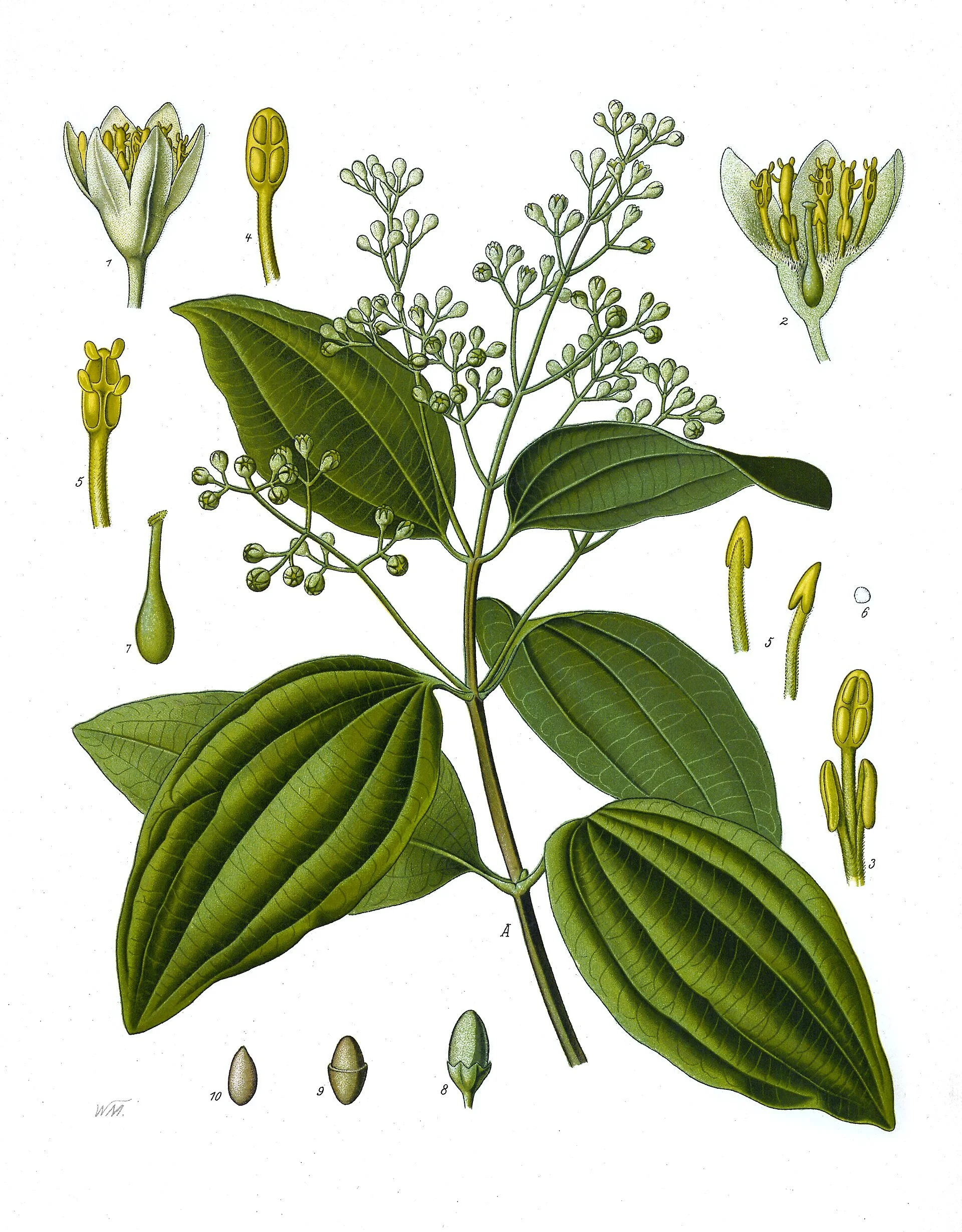
Cinnamon (Cinnamomum verum), plate 182 of Köhler's Medizinal-Pflanzen — the tree the cinnamon stick is cut from: the stick in your pot is this tree's bark, curled as it dried, broken into three or four pieces before the cold water goes on. A study portrait; the decoction begins with the bark itself, not the picture.
Franz Eugen Köhler, Köhler's Medizinal-Pflanzen (1887–1914), plate 182 (artist: Walther Otto Müller), via Wikimedia Commons. Public domain.
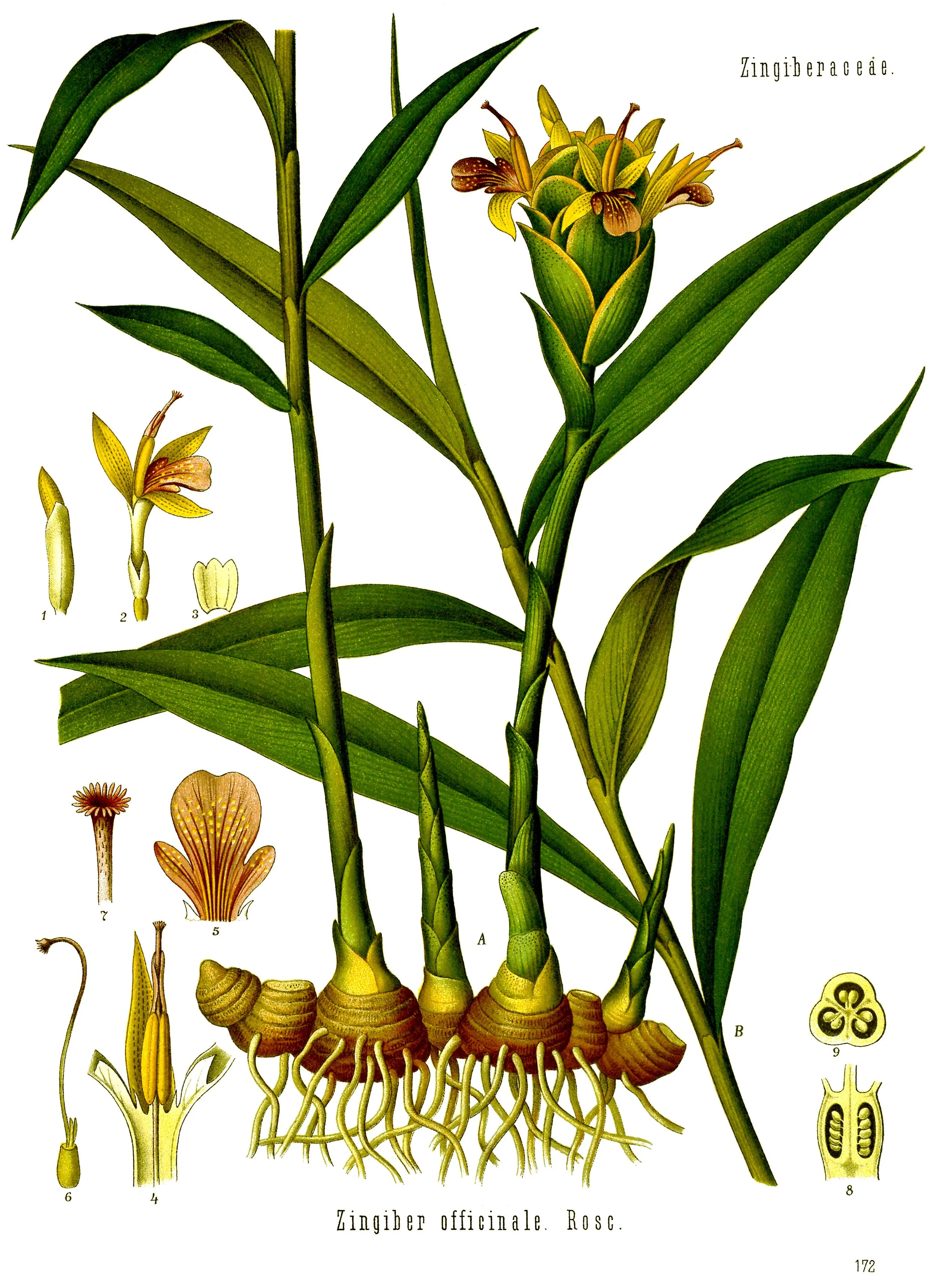
Ginger (Zingiber officinale), plate 172 of Köhler's Medizinal-Pflanzen — Exercise I's second botanical, drawn with the part the laboratory uses: the knotted rhizome at the foot, the light rhizome of the duration table, simmered here at about twenty minutes' range and logged against the cinnamon's thirty. A study portrait of the tradition.
Franz Eugen Köhler, Köhler's Medizinal-Pflanzen (1887–1914), plate 172, via Wikimedia Commons. Public domain.
Today the laboratory runs hot. You will prepare a decoction of a dense botanical and keep a timed record of what the heat accomplishes.
Procedure
- Prepare. Break the cinnamon stick into three or four pieces (Lesson 23's preparation logic: more surface, better extraction). Place the pieces in the pot. Add cold water to the two-thirds mark. With a pencil, mark the water level on a strip of paper taped to the outside of the pot, or note the level against the pot's own markings.
- Bring up. Set the pot over medium heat with the lid ajar. Bring it to a gentle simmer: the surface should tremble with occasional bubbles, never a rolling boil. Start the timer when the simmer begins. Record the start time.
- Observe at intervals. Every ten minutes, record three things: the liquid's color, the aroma rising from the pot (from a safe distance, wafting gently), and the current liquid level against your mark. Do not stir more than once or twice; let the heat work.
- Hold the course. Simmer for thirty minutes total. If the level drops faster than expected, lower the heat slightly. If evaporation stalls, the lid is too tight; widen the gap.
- Finish. At thirty minutes, remove the pot from heat. Let it cool until it is safe to handle. Strain the liquid through the strainer or cloth into the heatproof jar, pressing the bark pieces gently to release the last of the liquid. Measure the final volume.
- Compare. Set a small amount of the finished decoction beside a cup of plain hot water with a cinnamon stick merely steeped in it for five minutes. Observe the difference in color and aroma between the decocted and the merely steeped preparation. Record it.
Cleanup
Wash the pot, strainer, and jar with hot soapy water. Compost the spent bark pieces or discard them. Wipe down the stove. The laboratory returns to order before the journal is opened.
Archive Entry
File a Decoction Record in your extraction archive: material, preparation (broken to what size), water volume at start and finish, simmer duration, interval observations of color and aroma, final volume, and the comparison note against the steeped sample. This record is the template for every decoction you will make in this course.
Check in: At each ten-minute interval the Practical records three things. Name them — and name the archive record, with its eight fields, that the finished practical files.
❦ In your workbook: record the cinnamon decoction in your own way — the cold start and the level mark, the ten-minute observations, the thirty-minute hold, and the decocted-versus-steeped comparison — copy, sketch, or note what matters.
In your packet: Exercise I — The Reduction Log (Assignment II) ⚒ begins here. Work it now, or mark the place and take it as homework — your choice.
Decoction, Infusion, and Maceration: Three Strategies
Unit IV now has three named extraction strategies, and the apothecary must keep them distinct.
- Maceration (Lesson 23): soaking prepared material in a menstruum (Lesson 19) at room temperature. Time does the work. Best for materials that yield to patience and for menstrua that heat would damage, like oils.
- Infusion (Lesson 27): pouring hot water over delicate material and steeping briefly. Heat assists, but briefly. Best for leaves, flowers, and other soft structures.
- Decoction (this lesson): simmering dense material in water for a sustained period. Heat and time do the work together. Best for roots, bark, seeds, and other armored structures.
★ The three form a ladder of intensity, and the apothecary climbs it only as far as the material requires. Using a decoction where an infusion would do is not thoroughness. It is waste: wasted fuel, wasted time, and a preparation pulled past its best character. Muddlenook's rule: the gentlest method that works is the correct method.
Check in: State each strategy's working agent in the lesson's own terms — what does the work in maceration, in infusion, and in decoction — and give Muddlenook's rule for choosing among them.
❦ In your workbook: record the three strategies in your own way — maceration, infusion, decoction as a ladder of intensity, each matched to its materials, and the gentlest-method rule — copy, sketch, or note what matters.
In your packet: Exercise III — The Method Match (Assignment IV) ✎ begins here. Work it now, or mark the place and take it as homework — your choice.
Guided Observation: Reading a Simmer
This lesson's observation is the Practical read slowly: you watch one pot for thirty minutes and learn to read what the heat reports — because the reduction log is only as good as the eyes that kept it.
Work through it in order.
Mark before heat. With a pencil, mark the water level on a strip of paper taped to the outside of the pot, or note the level against the pot's own markings. Reduction can only be measured against a mark made before the simmer begins.
Read at intervals. Every ten minutes, record three things: the liquid's color, the aroma rising from the pot (from a safe distance, wafting gently), and the current liquid level against your mark.
Read the gauges together. Watch the liquid move from pale to amber to deep brown; the color is a rough gauge of how far extraction has traveled. The scholar watches the liquid, not only the clock: color, aroma, and the reduction mark all report on progress.
Compare at the end. Set a small amount of the finished decoction beside a cup of plain hot water with a cinnamon stick merely steeped in it for five minutes. Observe the difference in color and aroma between the decocted and the merely steeped preparation. Record it.
Consider:
- At which interval did your liquid's color change most — and what does the tannin section say that deepening reports?
- Your final volume against your starting mark: how much water did thirty minutes of gentle simmer remove, and what does that removal do to the concentration of what remained?
- The steeped cup stood for five minutes; the decoction simmered for thirty. What, in the difference between the two cups, did heat and time each contribute?
❦ In your workbook: record the guided observation in your own way — the mark made before heat, the three interval readings, and the final comparison of decocted against steeped — copy, sketch, or note what matters.
Materials
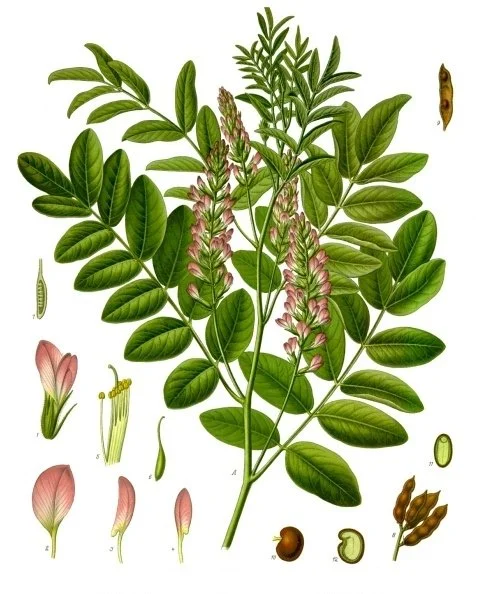
Licorice (Glycyrrhiza glabra), plate 207 of Köhler's Medizinal-Pflanzen — the living plant whose root the Level Two list buys whole and breaks to size. The plate draws leaf, flower, and pod; the laboratory's part, the root, stays underground in the picture and arrives at your bench dried. A study portrait of the tradition, not an identification guide.
Franz Eugen Köhler, Köhler's Medizinal-Pflanzen (1887–1914), plate 207, via Wikimedia Commons. Public domain.
Gather everything before the burner is lit. The hot laboratory does not forgive improvisation.
Required (Level One — household items)
- A heat-safe pot or cauldron: a saucepan with a lid, stainless steel or enameled cast iron preferred.
- The botanical: one cinnamon stick (about 7 to 8 centimeters), or 2 tablespoons of dried ginger pieces. Both are dense, familiar, and honest teachers.
- Cold water: enough to fill the pot two-thirds, plus extra for topping up.
- A timer: a kitchen timer or phone.
- A wooden spoon, a strainer or cheesecloth, and a heatproof jar for the finished preparation.
- Your laboratory journal and pencil for the reduction log.
- A trivet or heatproof mat for the hot pot.
- A strip of paper and tape for marking the water level on the pot.
Suggested (Level Two — historically closer)
- A heavy cast-iron or copper-bottomed pot with a close-fitting lid, as a working apothecary would keep.
- Bark or root purchased whole (a whole cinnamon quill, dried licorice root pieces) and broken to size yourself, as Lesson 23's preparation lesson taught.
- A sand timer or marked candle alongside the modern timer, to practice judging duration by the old measures.
- A linen cloth for straining, rather than a metal sieve.
Safety Notes
- Every heated step in this lesson must be done by or with an adult. No exceptions.
- Use only heat-safe vessels: heavy pots, wooden spoons, heatproof jars. Never plastic; never cracked or damaged vessels.
- Keep your face and hands back from rising steam. Tilt the lid away from you when lifting it.
- Never leave a simmering pot unattended. Fill the pot no more than two-thirds full to guard against boil-overs.
- Simmer near a window or range hood. Label the finished preparation with the material, the date, and 'laboratory preparation, display and study only.'
- No dosage is given in this lesson and none should be attempted. Nothing in the Potions Laboratory is medicine.
Reflection Questions
Answer the following questions in your workbook.
- Why must a decoction start with cold water rather than dropping the material into already-boiling water?
- A scholar simmers bark for ten minutes, tastes nothing, and declares the extraction "weak." What two observations should they have recorded instead, and what would those observations tell them?
- How does reduction serve preservation, and why does a reduced preparation keep longer than a dilute one?
- Your decoction boiled over at minute twelve. What went wrong, and what three corrections prevent it next time?
- Why is a decoction the wrong method for chamomile flowers, even though more heat would extract more?
Workbook Checklist — Lesson 29
In my workbook I have:
- ☐ defined a decoction and explained why dense botanical materials require simmering rather than steeping — heat and time together opening structures cold or brief-hot water cannot
- ☐ described how prolonged heat exposure moves compounds from hard plant structures into a water menstruum — structure softened, movement accelerated, contact sustained
- ☐ recorded tannin release as the long-simmer signature: extraction rising with temperature and time, read by color, astringency, and clarity
- ☐ used reduction deliberately as a concentration system — concentration, preservation, and observation — and marked a starting level so its work can be measured
- ☐ prepared a decoction of a dense botanical safely, with an adult at every heated step, and filed the Decoction Record in my extraction archive
- ☐ contrasted decoction with infusion and maceration as three distinct extraction strategies, and applied Muddlenook's rule: the gentlest method that works is the correct method
☐ Lesson completed Date: ___ Signature: ___
The Professor's Closing Note
You have now worked with fire, and the laboratory is a more serious place for it. The decoction — a water extraction made by simmering dense material, such as roots or bark — is the most forceful extraction — drawing compounds out of a material with a liquid — in the apothecary's water-based repertoire, and force demands the most discipline: measured material, cold start, watched pot, recorded reduction, orderly cleanup.
File your Decoction Record with care. It is the first hot-extraction — drawing compounds out of a material with a liquid — entry in your archive, and every extraction — drawing compounds out of a material with a liquid — that follows, from the tinctures — alcoholic preparations made by soaking a botanical in spirit — to the distillation apparatus of Lesson 33, will be read against the standard you set today.
In good order, scholars.
— Professor Crimblebrew Muddlenook, Potions Laboratory • Master Apothecary • Head of House Meridies
PROFESSOR CRIMBLEBREW MUDDLENOOK
Potions Laboratory
Master Apothecary • Head of House Meridies
Cross-Class Connections

Herbology · Unit IV, Lesson 28 — Drying Herbs the Traditional Way
Come to the Greenhouse before you light Professor Muddlenook's burner, decoction-makers. The roots and bark his pot asks for arrive dried because someone dried them well: woody herbs hung in small bundles in dark, moving air, leaves and petals spread on screens, and every jar labeled with the herb's name and the date. A poorly dried root decocts poorly — his words, and true. Bring your harvest to my benches first, pass the crispness test, and his simmer will have material worthy of it.
PROFESSOR BERYL FERNFOOT
Herbology Greenhouse • Master Herbalist • Head of House Oriens
Scrollwork · Unit II, Lesson 6 — Oak Gall Ink
Scholars of the simmering pot: the tannin your lesson reads by astringency is defined in my Scriptorium, and here you may watch it work a second trade. In this lesson we crush oak galls — among the richest tannin sources in the plant world — and meet their tannins with an iron salt, and the pale liquid darkens in the air into the ink that wrote charters, chronicles, and law. Your pot draws tannins out with heat and time. My inkwell binds them fast to the page. Come and see the other end of the extraction.
PROFESSOR QUILLBERRY NOCTURNE
Scrollwork Library

Creative Arts · Unit IV, Lesson 16 — Printmaking, Stamps & the Label Station
Your professor ends his Safety Briefing with a label, scholars, and he is right to. In my workshop we build the station where jar labels are made — stamp, ink, label stock squared, impressions racked to dry in order — and we print the run before the jars are waiting. A label is a small promise: it says the jar holds what it claims. Bring your decoction jars' names to my bench, print them clean and legible, and let the promise be kept properly.
PROFESSOR COGBRANCH TIMBERCLANK
Creative Arts Workshop
Further Reading & Sources
- The Herbal Academy: How to Make an Herbal Decoction — clear modern method guide; the infusion/decoction distinction and James Green's purpose statement.
- David Hoffmann, Medical Herbalism — the official Decocta standard formula (50 g coarsely broken drug, 1000 ml water, boil 15 minutes, covered vessel).
- The Roots of Tradition: Traditional Extraction Techniques in Plant Medicine — decoction across cultures, including TCM practice.
- Flyriver: Tea Tannins, Chemistry and Impact — tannin chemistry: temperature, time, and astringency in water extraction.
- Pekis: Tannins in Cooking — managing tannin extraction in practice; spice and tannin interplay.
Browse the Potions shelf in the school Library for readable editions of these works.
LESSON 29 · DECOCTIONS
Try It in the Laboratory
The lesson taught the simmer. The Experiment builds your own decoction or simmer pot — for a cup, or for a room — and rewrites the recipe when the purpose changes.
— Professor Crimblebrew Muddlenook, Potions Laboratory
Submit your work for this lesson using the form below.
CONTINUE IN THE POTIONS LABORATORY
← Previous · Lesson 28: Glycerites & Syrup Bases Next · Lesson 30: Herbal Acetums →
Unit IV — Botanical Extractions Potions Laboratory — All 52 Lessons
The rest of Unit IV: Lesson 26 · Infused Lipids · Lesson 27 · Hydro-Infusions · Lesson 28 · Glycerites & Syrups · Lesson 30 · Herbal Acetums · Lesson 31 · Resin Fusion · Lesson 32 · Tinctures · Lesson 33 · Distillation · Lesson 34 · Extraction Ledger