

POTIONS
Unit IV · Lesson 30HERBAL ACETUMS
Professor Crimblebrew Muddlenook
Master Apothecary • Potions
Head of House Meridies • School of Evershade
Professor's Introduction

Scholars, four lessons into our extraction studies and you have steeped botanicals in oil and in water. Today we take up the third great menstruum — the liquid that does the extracting — of the historical laboratory, and it is the sharpest of the three: vinegar.
The Romans called it acetum, and they kept it closer than you might expect. Their soldiers drank it watered down on the march. Their cooks built whole sauces on it. Their apothecaries trusted it to pull virtue from herbs and to keep those preparations sound on the shelf. One liquid, three duties. That is worth studying.
Vinegar demands one discipline above all others, and I will state it now so there is no confusion later: no metal. Not the pot, not the sieve, not the lid that touches the liquid. Glass, and glass alone, with wood or cloth to assist. You will learn exactly why before you touch a jar.
Measure twice, pour once. Let us begin.
— Professor Crimblebrew Muddlenook, Potions Laboratory • Master Apothecary • Head of House Meridies

Potions map — the class base map, unmarked for this lesson.
Lesson Objectives
By completing this lesson, you will be able to:
- Define acetum and explain the historical place of vinegar among extraction menstrua.
- Describe how acetic acid extracts botanical compounds, and which materials it favors.
- Apply the metal rule: identify reactive metals and explain why vinegar must never meet them.
- Prepare and begin a long-steep herbal acetum in glass, with a dated observation schedule.
- Strain, bottle, and label a finished acetum to laboratory standard.
Reading this lesson: ★ marks the passages to remember. They return on the unit quiz and the class test. Check in questions ask the material back as you go; answer them in your workbook when you meet them.
Working this lesson: Your assignment packet is the first download on this page. Work in it as the lesson moves along, answering each exercise as its subject is taught — or read the lesson through for your notes and take the exercises as homework afterward. Both are proper ways to sit this class. Signposts in the reading tell you where each exercise belongs. Written answers are short answers in your own words; a few honest lines are worth more than a filled page.
Your Assignment Packet
This lesson's exercises live in its packet: the Lexicon Handout (every term, course terms marked ◆), Materials, Guided Practice — the long-steep Practical, printed in full so you can work it at your own bench — the Assignment Manual with its answer key for self-checking, the Reflection Questions, and the Workbook Checklist. Download the packet before you begin and keep it beside you as you read.
About this lesson's quiz, plainly: the original packet carried a short lesson quiz (seven multiple choice and five true/false). Per the classroom model, per-lesson quizzes leave the manual and pool into the Unit IV Quiz; its questions are preserved whole in the unit quiz pool, and the ★ passages and exercises below are what it draws on.
Safety Briefing
Read every line before you touch a jar.
- Vinegar is a mild acid: keep away from eyes, rinse with water if splashed, work ventilated.
- No metal at any stage. Glass vessels; cloth straining; parchment barrier under metal lids.
- Young scholars: an adult handles large vinegar bottles and confirms jar and lid suitability.
- Label everything the moment it is filled.
- This lesson gives no amounts to ingest and makes no health claims. The preparation is a laboratory extraction study; if the family kitchen adopts the finished vinegar, that is the cook's decision, not the laboratory's.
- Discard any batch showing mold or rot; document the failure.
Check in: A scholar reaches for a brass sieve and an unlabeled jar. Which two lines of this briefing answer those two choices, word for word?
❦ In your workbook: record the safety briefing in your own way — mild acid and eyes, no metal at any stage, an adult for large bottles and jar checks, everything labeled the moment it is filled, no amounts to ingest, mold or rot discarded and documented — copy, sketch, or note what matters.
What an Acetum Is
Acetum is Latin for vinegar, and an acetum (plural aceta) is any preparation made by steeping botanicals in vinegar.
The English word vinegar comes to us from the French vin aigre, meaning sour wine, which tells you exactly what it is: wine, or cider, or malt liquor, that has soured a second time.
First, yeasts turn sugars into alcohol. Then acetic-acid bacteria turn the alcohol into acetic acid. Two fermentations, one sharp result.
Culinary vinegar is typically about 5 percent acetic acid, with the remainder mostly water. (Commercial vinegars range roughly from 3 to 7 percent.)
That modest percentage is deceptive. It is strong enough to give vinegar a pH around 2 to 3, strong enough to sting the eyes, strong enough to dissolve limestone, and strong enough to attack metal. Respect it the way you would any laboratory acid: a mild one, but a real one.
As a menstruum, vinegar has a particular character. Being mostly water with an acid edge, it excels at drawing out mineral compounds and alkaloids from botanical material.
It is a poor menstruum for resins and fixed oils, which prefer the company of oil or alcohol, as you learned in Lesson 26. Choosing a menstruum is choosing what you wish to invite out of the plant. Vinegar invites the sharp, the mineral, the water-loving.
Check in: Vinegar is made by two fermentations. What does each one turn, and into what — and what percentage of a culinary vinegar is acetic acid?
❦ In your workbook: record what an acetum is in your own way — the Latin word and the French one, the two fermentations, the 5 percent and the pH 2 to 3, and what vinegar invites out of the plant — copy, sketch, or note what matters.
A Short History of Sour Wine
Vinegar is among the oldest prepared liquids in human history.
The Babylonians were flavoring vinegars with fruit, honey, and malt thousands of years ago.
The Romans used it everywhere: the acetabulum was a small vinegar bowl set on the dining table for dipping bread between courses, and the cookery writer Apicius built recipe after recipe on a vinegar foundation.
Most telling for our purposes is posca, the drink of the Roman legions. Soldiers on the march drank water sharpened with vinegar.
It was cheap, it kept without spoiling, and it made questionable water safer and more palatable. An army that carries its vinegar with it is an army that understands preservation.
Apothecaries inherited this trust. Vinegar appeared in dispensatories across centuries as the menstruum for preparations meant to keep: herbal vinegars, oxymels, and the famous aromatic vinegars of plague legend, which we will examine shortly with the skepticism they deserve.
Check in: What was posca, who drank it, and what three practical virtues made an army carry it?
❦ In your workbook: record the history in your own way — Babylonian flavored vinegars, the acetabulum on the Roman table, Apicius, posca on the march, and the apothecaries' trust in vinegar for preparations meant to keep — copy, sketch, or note what matters.
Why Vinegar Extracts
Extraction is persuasion. The menstruum must coax compounds out of plant tissue and hold them in solution, and different menstrua persuade different compounds.
Vinegar persuades in two ways at once. First, it is mostly water, so it does everything water does: it softens dried tissue, swells cell walls, and carries water-soluble compounds into solution.
Second, its acidity changes the chemistry of the steep. Many plant alkaloids and mineral salts dissolve far more readily in acid than in neutral water. The acid loosens what water alone would leave behind.
★ This is also why vinegar preserves. Most spoilage microbes dislike acid. A preparation sitting at pH 2 to 3 is a hostile lodging for the organisms that would otherwise cloud and sour your work.
★ Vinegar is thus both the extractor and the guardian: it pulls compounds out of the herb and then stands watch over the resulting liquid. Few menstrua do double duty so neatly.
There is one more quiet virtue. Unlike alcohol, vinegar is a kitchen staple everywhere, which meant historical apothecaries could prepare aceta without special licenses, stills, or expense. The humblest menstruum is sometimes the most democratic.
Check in: Vinegar persuades in two ways at once. What does its water do, what does its acidity do — and why does the same acidity make it a preservative?
❦ In your workbook: record why vinegar extracts in your own way — water softening and carrying, acid loosening alkaloids and mineral salts, and the extractor-and-guardian double duty — copy, sketch, or note what matters.
In your packet: Exercise III — Menstruum Comparison ⚒ begins here. Work it now, or mark the place and take it as homework — your choice.
The Metal Rule
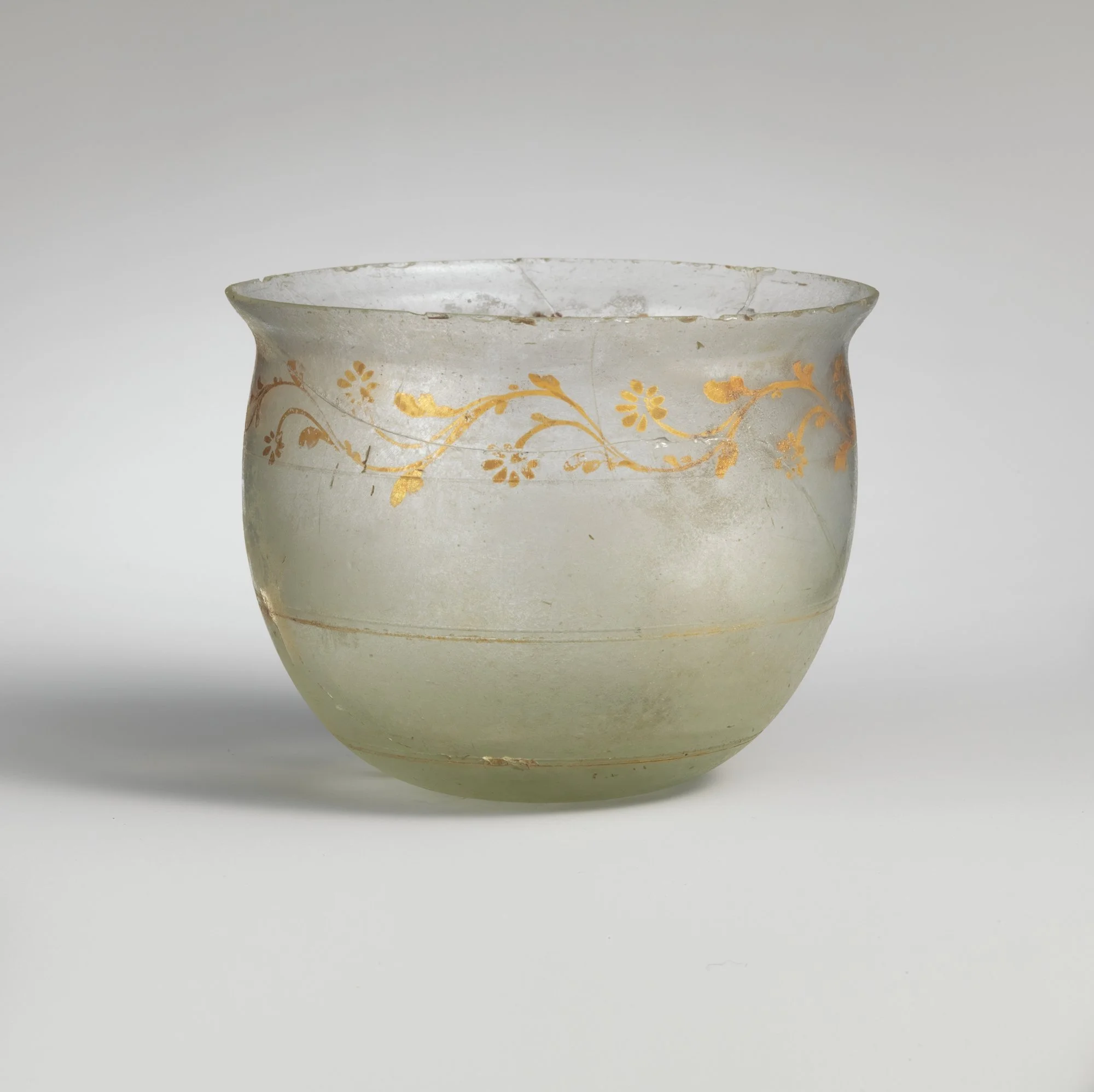
Glass, and glass alone. A glass bowl photographed at the Metropolitan Museum of Art, its painted gold vine still bright on a vessel the centuries have only chipped, never corroded. Vinegar attacks iron, copper, brass, and aluminum; it has no quarrel with glass — which is why every steeping jar, straining vessel, and storage bottle in this lesson is glass.
Glass bowl, The Metropolitan Museum of Art, via Wikimedia Commons. CC0.
Now the discipline I promised.
★ No reactive metal shall touch your acetum at any stage. Not the steeping vessel, not the strainer, not the funnel, not the lid if the liquid can reach it.
The reason is corrosion. Acids attack metals: iron rusts and pits, copper and brass develop green corrosion, aluminum dulls and pits, tin discolors.
An acetum left in contact with metal will leach metallic compounds into the liquid, stain it strange colors, and spoil both flavor and keeping quality. A brass sieve used once for straining can taint a whole batch. An iron pot is not a vessel here; it is a slow act of sabotage.
Use glass for steeping, straining receiving vessels, and storage. Stoneware or food-safe ceramic is acceptable for steeping if fully glazed and uncracked.
For lids, use glass, cork, wood, or plastic. If your only jar has a metal lid, lay a square of parchment or waxed paper over the mouth before screwing the lid down, so the liquid never touches metal. Straining is done through cloth, never through a metal sieve.
Scholars, I have seen a term's worth of careful work ruined by one brass funnel, and the scholar's face when the batch poured out green. The metal rule is not fussiness. It is the difference between an acetum and a chemistry accident. Glass is patient. Glass does not react. Be like glass.
— Professor Crimblebrew Muddlenook, Potions Laboratory • Master Apothecary • Head of House Meridies
Check in: Name the four metals the lesson names as attacked — and for each, what the acid does to it. Then state the one barrier method for a metal lid.
❦ In your workbook: record the metal rule in your own way — no reactive metal at any stage, corrosion and leaching as the reason, glass for every vessel, and the parchment barrier under a metal lid — copy, sketch, or note what matters.
In your packet: Exercise I — The Acetum Bench Card ⚒ begins here. Work it now, or mark the place and take it as homework — your choice.
Oxymel: Honey Joins the Vinegar
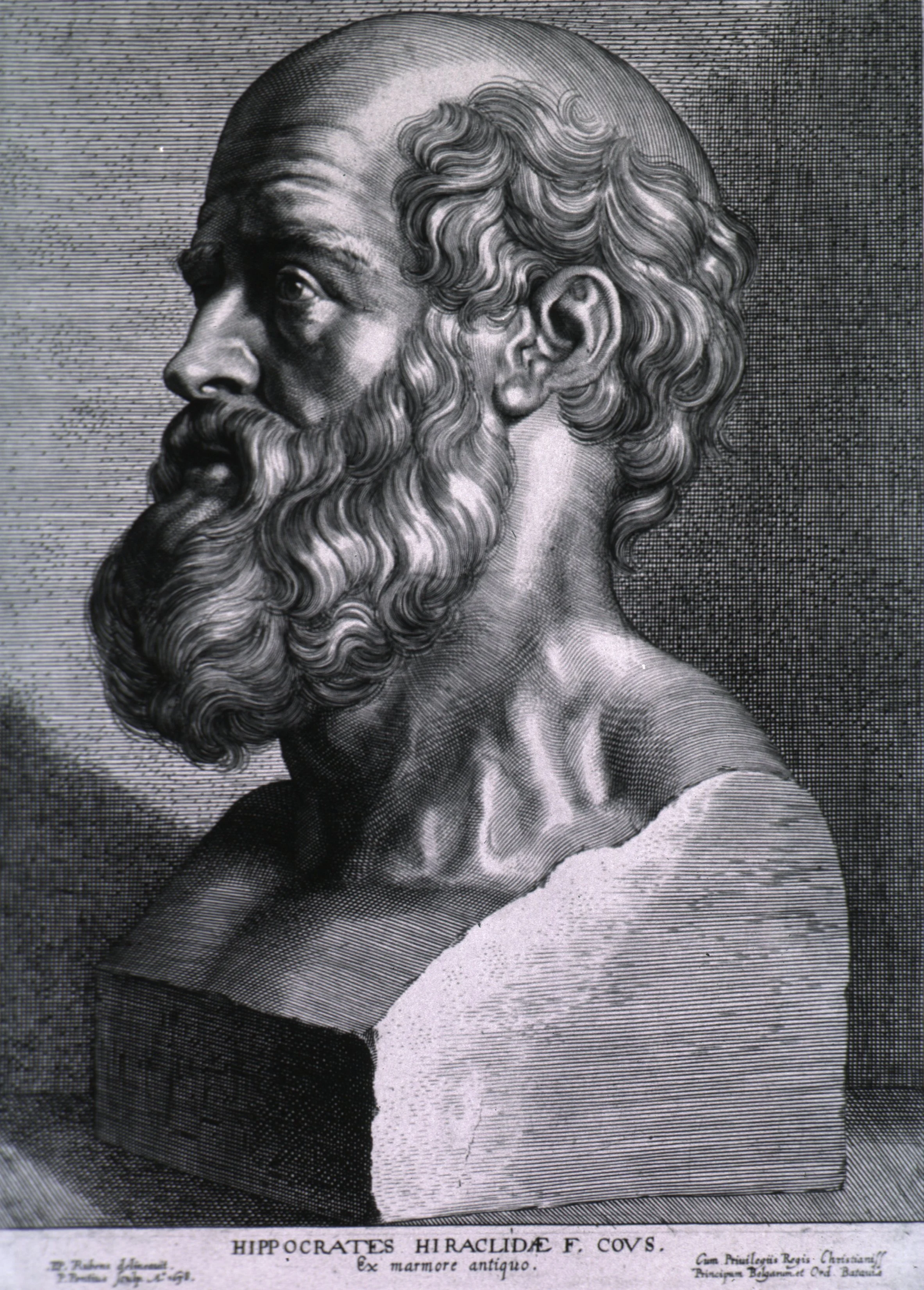
Hippocrates, who prescribed oxymels around 400 BCE and wrote of them in On Regimen in Acute Diseases — honey and vinegar, the two preservatives layered in one preparation. The engraving is a portrait, not a prescription: Pliny's formal recipe stays in the lesson's words, and no quantities hang on this page.
Engraving by Paulus Pontius after Peter Paul Rubens, 1638, via Wikimedia Commons. Public domain.
The most famous vinegar preparation of antiquity is the oxymel, from the Greek oxys (acid, sour) and meli (honey): honey and vinegar combined.
Hippocrates prescribed oxymels around 400 BCE, writing in On Regimen in Acute Diseases of their usefulness.
Pliny the Elder, never one to skip a recipe, recorded a formal oxymel preparation in his Natural History, calling for honey, old vinegar, sea salt, and rainwater, boiled and aged.
The pairing makes laboratory sense. Honey is itself resistant to spoilage and contributes its own preservative character, while its sweetness balances vinegar's sharpness.
Persian physicians developed their own celebrated version, sekanjabin, and the preparation traveled through medieval pharmacopoeias for centuries.
An oxymel is simply an acetum with honey added: same metal rule, same glass discipline, same observation habits. We study it here because it shows how apothecaries layered menstrua, combining two preservatives in one preparation.
Check in: What do the two halves of the word oxymel mean, who prescribed oxymels around 400 BCE, and what is the Persian version called?
❦ In your workbook: record the oxymel in your own way — honey and vinegar, Hippocrates and Pliny, sekanjabin, and two preservatives layered in one preparation under the same metal rule — copy, sketch, or note what matters.
The Four Thieves: A Legend, Handled Properly
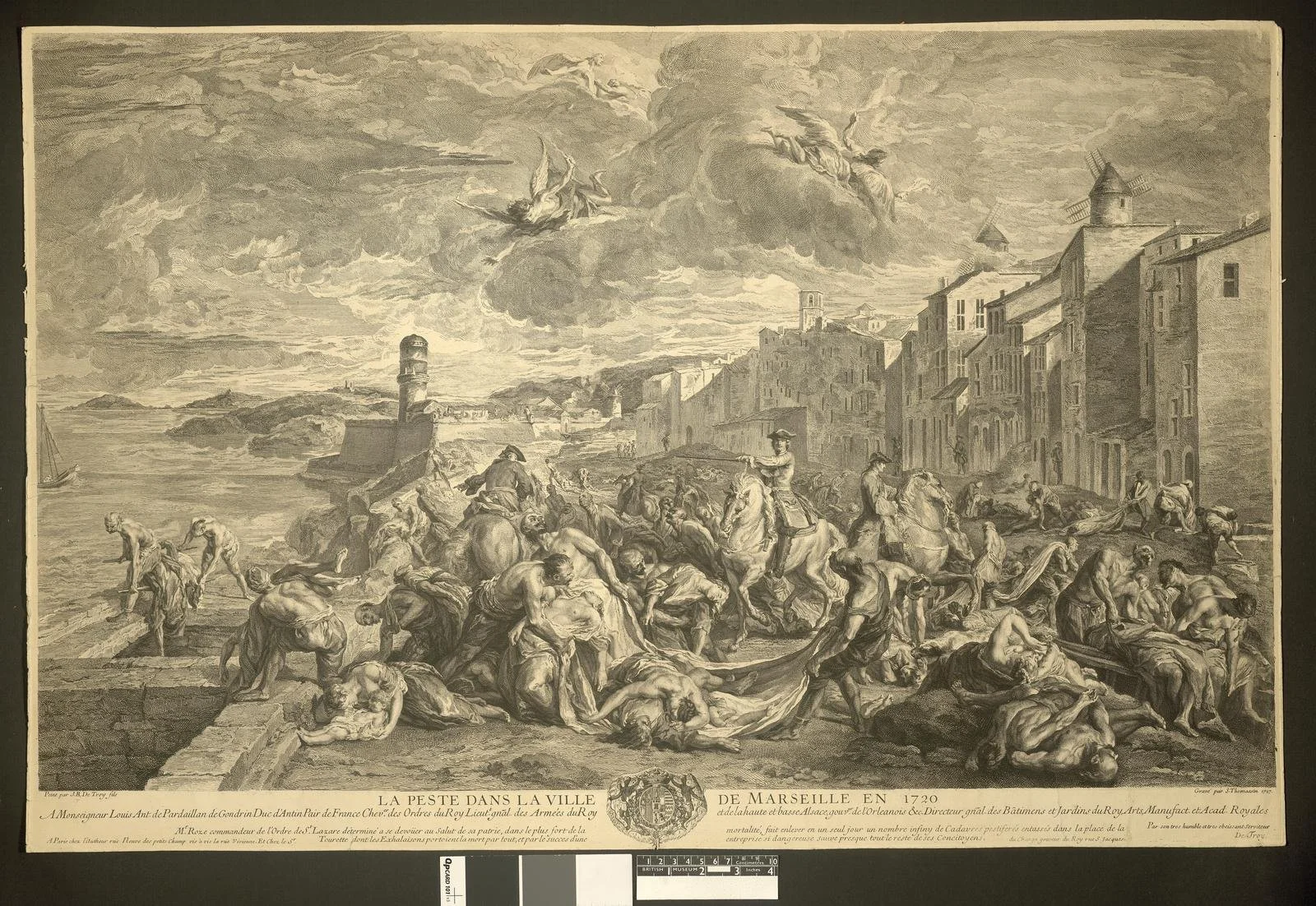
Marseille in the plague year 1720, as an engraver pictured it: the harbor, the dead, and the Chevalier Roze directing their removal. The Four Thieves tale is "often placed at Marseilles" — and this lesson files the tale under story, not history, exactly as this picture is offered: the world the legend grew in, not proof of the thieves.
Engraving by Simon Thomassin after Jean François de Troy, British Museum, via Wikimedia Commons. Public domain.
No lesson on herbal vinegars is complete without the story of the Four Thieves Vinegar, and no apothecary's archive is complete without handling it honestly.
The tale, in its usual form: during a plague outbreak, often placed at Marseilles, four thieves robbed the sick and the dead without falling ill themselves. Caught, they bargained for leniency by revealing their secret: they had dosed themselves with an aromatic herbal vinegar.
A recipe said to have been posted in Marseilles during a plague, naming wormwood, meadowsweet, marjoram, sage, cloves, and camphor among its herbs, was reportedly still displayed in a Paris museum in 1937. Aromatic "thieves vinegars" are still sold in Provence today.
Here is the honest archival note, and I want it in your journals verbatim: ★ this is a legend, not a documented history.
The city changes with the telling. The century changes with the telling. Historians treat the thieves themselves as folklore.
What is historically real is the category: aromatic herbal vinegars were genuinely prepared and sold by apothecaries in the seventeenth and eighteenth centuries, and strong-smelling preparations were genuinely carried during plague times. The legend grew around a real practice like moss around a stone.
Why does the distinction matter? Because our archive records what is true, what is probable, and what is story, and labels each. An apothecary who cannot tell legend from ledger will eventually prescribe legend. We enjoy the story. We file it under story.
Check in: In the Four Thieves tale, what two things change with the telling — and what, historically, is real underneath the legend?
❦ In your workbook: record the Four Thieves in your own way — the tale as tale, the legend filed under story in the professor's own words, and the real category of aromatic herbal vinegars it grew around — copy, sketch, or note what matters.
Practical: Beginning the Long Steep
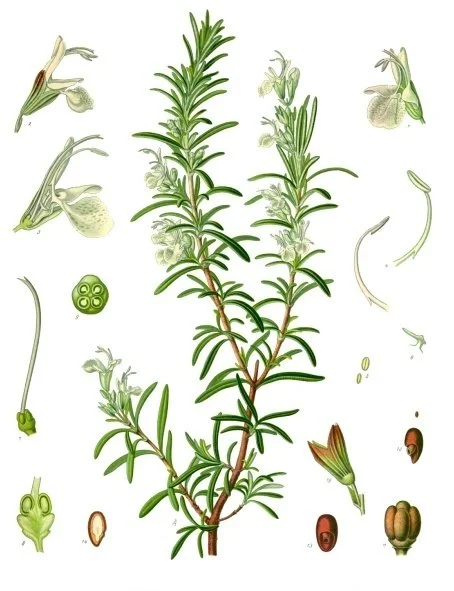
Rosemary, the Practical's first-named herb, as the nineteenth-century botanical atlases drew it: flowering stem at center, flower and seed dissected around it. A study portrait only — your herbs are judged dried, at the bench and in the archive, as Lesson 15 taught; the plate honors the plant, the journal does the judging.
Rosmarinus officinalis, plate from Köhler's Medizinal-Pflanzen, via Wikimedia Commons. Public domain.
You will now prepare an herbal acetum and observe it over the coming weeks.
This is a maceration (Lesson 23): the controlled soaking of a prepared botanical in a menstruum at room temperature. Vinegar is simply the menstruum this time.
Safety Briefing
Vinegar is a mild acid. Keep it away from your eyes; if it splashes, rinse with clean water.
Work in a ventilated area; the fumes are sharp but harmless in a normal room.
No metal at any stage: check your jar, your lid, your strainer, and your funnel before you begin.
Young scholars: an adult should handle any pouring of large vinegar bottles and should confirm your jar and lid are suitable.
Label everything the moment it is filled. Wash your hands when finished.
Mise en Place
Level One — household items:
- A clean glass jar with a non-metal lid (cork, glass, plastic, or wood). A mason jar with a plastic lid is ideal. If the lid is metal, cut a square of parchment or waxed paper larger than the mouth.
- Apple cider vinegar or white wine vinegar from the kitchen, enough to cover your herbs generously.
- Dried herbs: rosemary, thyme, sage, or lavender. Choose one, or a blend of two. About a loose handful.
- A square of clean cotton cloth or muslin for straining, and a second clean glass jar or bottle for the finished acetum.
- Paper labels and a pen. Your laboratory journal.
Level Two — historically closer:
- A glass apothecary jar or stoneware crock, fully glazed and uncracked.
- Wine vinegar rather than distilled vinegar, closer to the historical menstruum.
- Herbs from your own stores, as your potions journal records them, weighed and recorded by weight rather than handful.
Procedure
- Inspect your jar. Hold it to the light: no cracks, no chips, clean and dry. Confirm the lid contains no metal that the liquid could touch. Lay your parchment square ready if needed.
- Place your herbs in the jar. If using rosemary or thyme sprigs, bruise them lightly between your palms first to begin fragrance release. Do not grind to powder; coarse material strains cleanly.
- Pour vinegar over the herbs until they are covered by at least two finger-widths of liquid. Herbs swell as they absorb vinegar; what barely covers today will leave herbs exposed tomorrow.
- Press the herbs down with a clean wooden spoon so no material floats above the surface. Exposed herbs invite mold.
- Seal the jar. If using a metal lid, lay the parchment square over the mouth first, then screw the lid down over it.
- Label immediately: contents, date started, your name. "Rosemary acetum — started [date] — [name]."
- Set the jar where you will see it daily, out of direct sunlight, at room temperature.
Check in: Why must the vinegar cover the herbs by at least two finger-widths on day one — and why is no herb left floating above the surface?
❦ In your workbook: record the procedure in your own way — the jar inspected against the light, herbs bruised not powdered, two finger-widths of cover, nothing floating, the parchment barrier, and the label written the moment the jar is sealed — copy, sketch, or note what matters.
In your packet: Exercise II — The Long Steep ⚒ begins here. Work it now, or mark the place and take it as homework — your choice.
Observation
This is a long steep: two to four weeks. Your observation schedule:
- Daily for the first week: Gently swirl or invert the jar once a day. Note the color of the liquid, the smell when you open it briefly, and whether any herb floats exposed. Record in one line per day.
- Weekly thereafter: Check color depth, clarity, and aroma development. Note any cloudiness, any film on the surface, any off smell.
- At week two: Taste a single drop on the tip of your tongue if an adult confirms your herbs were ordinary culinary herbs from a trusted source. Note flavor, not medicine: this is organoleptic observation (Lesson 11), not dosing.
If you see fuzzy mold, or the liquid smells rotten rather than sharp, the batch has failed. Record the failure honestly, discard the contents, wash the jar thoroughly, and begin again. A failed batch, well documented, teaches more than a lucky one.
Check in: At week three your jar shows a jelly-like disc floating on the surface, and the liquid beneath smells sharp and clean. Has the batch failed? What does the lexicon call the disc, and what are the true failure signs instead?
❦ In your workbook: record the observation schedule in your own way — daily swirls and one-line records for the first week, weekly checks after, the week-two drop under its two conditions, and the failure signs that mean discard — copy, sketch, or note what matters.
Straining and Bottling
When the aroma is strong and the color deep (usually week three or four), strain:
- Line your second jar's mouth with the clean cloth, or set a cloth-lined funnel in place. Remember: no metal sieve.
- Pour the acetum through the cloth. Gather the cloth's corners and squeeze gently to press (Lesson 22) the last of the liquid from the spent herbs.
- The strained liquid is your filtrate (Lesson 22). If it is cloudy, let it settle overnight and pour the clear liquid off the sediment into a final clean bottle.
- Label the finished acetum: contents, date strained, date started. File a complete archive entry in your potions journal: herb, menstruum, ratio by eye or weight, steep length, observations, verdict.
Cleanup
Compost the spent herbs or discard them. Wash all jars, cloths, and tools in hot soapy water and dry completely before storing.
Wipe the work surface; vinegar drips are harmless but sticky. Return everything to its place. The laboratory resets to order.
❦ In your workbook: record straining and cleanup in your own way — cloth only, never a metal sieve, the filtrate settled and poured clear, the finished label carrying both dates, and the archive entry filed with its verdict — copy, sketch, or note what matters.
Guided Observation: Keeping the Long Steep
This lesson's observation is the long steep itself, kept on the lesson's own schedule: you watch one jar of herbs in vinegar change over two to four weeks, and you write what you see on the day you see it — because an acetum observed honestly, including its failures, teaches more than a lucky batch remembered kindly.
Work through it in order.
Daily for the first week. Gently swirl or invert the jar once a day. Note the color of the liquid, the smell when you open it briefly, and whether any herb floats exposed. Record in one line per day.
Weekly thereafter. Check color depth, clarity, and aroma development. Note any cloudiness, any film on the surface, any off smell.
At week two. Taste a single drop on the tip of your tongue if an adult confirms your herbs were ordinary culinary herbs from a trusted source. Note flavor, not medicine: this is organoleptic observation (Lesson 11), not dosing.
Consider:
- On which day did the color change fastest, and what was happening to the herbs in the jar at the same time?
- A film or disc appears on the surface. How do you tell the mother of vinegar from fuzzy mold — and which one ends the batch?
- Your batch fails. What does the lesson require you to record, discard, wash, and begin — and why is the documented failure worth more than a lucky success?
❦ In your workbook: record the guided observation in your own way — the daily lines, the weekly checks, the week-two note under its conditions, and your verdict on the finished steep — copy, sketch, or note what matters.
Materials
Level One — household items
- Clean glass jar with non-metal lid (or parchment square for a metal lid)
- Apple cider vinegar or white wine vinegar
- Dried rosemary, thyme, sage, or lavender
- Clean cotton cloth or muslin for straining
- Second clean glass jar or bottle
- Paper labels and pen; laboratory journal
Level Two — historically closer
- Glass apothecary jar or fully glazed stoneware crock
- Wine vinegar
- Herbs from your own stores, as your potions journal records them, weighed and recorded
Safety Notes
- Vinegar is a mild acid: keep it away from your eyes, rinse with clean water if splashed, and work in a ventilated area.
- No metal at any stage. Glass vessels only; strain through cloth, never a metal sieve; lay parchment under any metal lid so liquid never touches metal.
- Young scholars: an adult should handle large vinegar bottles and confirm your jar and lid are suitable.
- Label everything the moment it is filled.
- This lesson gives no amounts to ingest and makes no health claims. The preparation is a laboratory extraction study.
- Discard any batch showing mold or rot; document the failure in your journal.
Reflection Questions
Answer the following questions in your workbook.
- Why does the metal rule exist? Describe what actually happens when vinegar sits in an iron, copper, brass, or aluminum vessel.
- Vinegar is both the menstruum and the preservative in an acetum. Explain how one liquid performs both duties.
- The Four Thieves story is filed in this lesson under "story" rather than "history." Why does that distinction matter to an apothecary's archive?
- Compare an acetum with the infused oil of Lesson 26: which kinds of compounds does each menstruum favor, and how would you choose between them for a given herb?
- At week three you open your jar and find a jelly-like disc floating on the vinegar's surface. What is it likely to be, and what do you do?
Workbook Checklist — Lesson 30
In my workbook I have:
- ☐ defined acetum and placed vinegar among the extraction menstrua — two fermentations, about 5 percent acetic acid, pH 2 to 3
- ☐ explained how acetic acid extracts: water softening and carrying, acid loosening mineral compounds and alkaloids, and the same acidity standing guard as preservative
- ☐ applied the metal rule — named the reactive metals, stated the corrosion reason, and listed the permitted vessels and the parchment barrier for metal lids
- ☐ made my Acetum Bench Card: definition, metal rule with its reason, permitted vessels and barrier, observation schedule, and the failure signs that mean discard
- ☐ begun my long-steep herbal acetum in glass, labeled the moment it was filled, and kept the daily log for the first week and weekly notes thereafter
- ☐ strained through cloth, bottled and labeled the finished acetum with both dates, and filed the complete potions journal entry with its verdict
- ☐ built the three-column Menstruum Comparison — Oil, Water, Vinegar — every cell filled from the three lessons, with my two concluding sentences on mineral-rich herbs
☐ Lesson completed Date: ___ Signature: ___
The Professor's Closing Note
In good order, scholars: you have now worked with three menstrua: oil, water, and vinegar. Each persuades different compounds; each keeps the preparation in its own way; each demands its own discipline. The metal rule you learned today will follow you into every acidic preparation for the rest of this course. File this lesson well. Next we turn to heat, and the laboratory gets louder.
— Professor Crimblebrew Muddlenook, Potions Laboratory • Master Apothecary • Head of House Meridies
PROFESSOR CRIMBLEBREW MUDDLENOOK
Potions Laboratory
Master Apothecary • Head of House Meridies
Cross-Class Connections

Herbology · Unit IV, Lesson 28 — Drying Herbs the Traditional Way
Come up to the Greenhouse, acetum-makers, and see where your herbs were before the jar. In my drying lesson we hang, screen, and jar the harvest the traditional way, judging each herb dry and keeping it whole — because a vinegar can only invite out what the drying preserved. Professor Muddlenook's Practical begins with dried herbs, already judged; mine is the craft that judges them. Bring your bench card: the metal rule has no work in my greenhouse, but the labeling rule never rests.
PROFESSOR BERYL FERNFOOT
Herbology Greenhouse • Master Herbalist • Head of House Oriens
Scrollwork · Unit II, Lesson 6 — Oak Gall Ink
You have kept iron away from your vinegar as a matter of law. Now come to the Scriptorium and meet the ink that invites iron in on purpose. In my oak gall lesson, galls and iron salt meet in water and the mixture darkens as it oxidizes, biting into the page to become part of the sheet itself — permanence bought with corrosion, the very chemistry your metal rule refuses. Two laboratories, one acid-and-iron story, opposite disciplines. Come and compare them honestly.
PROFESSOR QUILLBERRY NOCTURNE
Scrollwork Library
Further Reading & Sources
- Ancient Honey-and-Vinegar Combo Could Actually Treat Infected Wounds — Scientific American on the 2023 Warwick oxymel study
- Oxymel, a culinary oxymoron — scholarly history with Pliny's recipe and Hippocratic citations
- Four Thieves Vinegar — the legend's many versions, filed under mythology
- History of Vinegar — Romans, posca, and the acetabulum
- Functional Properties of Vinegar — peer-reviewed review of vinegar's chemistry and history
Browse the Potions shelf in the school Library for readable editions of these works.
LESSON 30 · HERBAL ACETUMS
Try It in the Laboratory
The lesson taught the vinegar and the parchment lid. The Experiment builds your own acetum: choose your plant, choose your vinegar, and it writes the recipe — with the non-metal lid law standing.
— Professor Crimblebrew Muddlenook, Potions Laboratory
Submit your work for this lesson using the form below.
CONTINUE IN THE POTIONS LABORATORY
← Previous · Lesson 29: Decoctions Next · Lesson 31: Resin Fusion →
Unit IV — Botanical Extractions Potions Laboratory — All 52 Lessons
The rest of Unit IV: Lesson 26 · Infused Lipids · Lesson 27 · Hydro-Infusions · Lesson 28 · Glycerites & Syrups · Lesson 29 · Decoctions · Lesson 31 · Resin Fusion · Lesson 32 · Tinctures · Lesson 33 · Distillation · Lesson 34 · Extraction Ledger