POTIONS
Unit IV · Lesson 34THE EXTRACTION LEDGER
Professor Crimblebrew Muddlenook
Master Apothecary • Potions
Head of House Meridies • School of Evershade
Professor's Introduction

Sealed with the teal wax of Professor Crimblebrew Muddlenook, Master Apothecary of the Potions Laboratory, Head of House Meridies.
Scholars, stand before your shelves and look at what Unit IV has built. Six vessels, six solvents (liquids able to dissolve or draw out other materials), six transformations. The archive no longer holds merely preserved ingredients. It holds preparations with histories: the day each was started, the material that went in, the solvent — a liquid able to dissolve or draw out other materials — that received it, the observations recorded along the way. An extraction — drawing compounds out of a material with a liquid — without a record is a rumor. An extraction with a record is knowledge, and knowledge is what the ledger keeps.
Today we consolidate. We clarify what is cloudy, press what is spent, compare what we have learned, and write it all down in the form future work can use. Unit V will ask you to build finished formulations from these extractions. A formulator who cannot tell you exactly what is in each bottle is guessing, and Professor Muddlenook does not permit guessing in his laboratory.
Bring your journals. Bring every vessel. The ledger awaits.
— Professor Crimblebrew Muddlenook, Potions Laboratory • Master Apothecary • Head of House Meridies
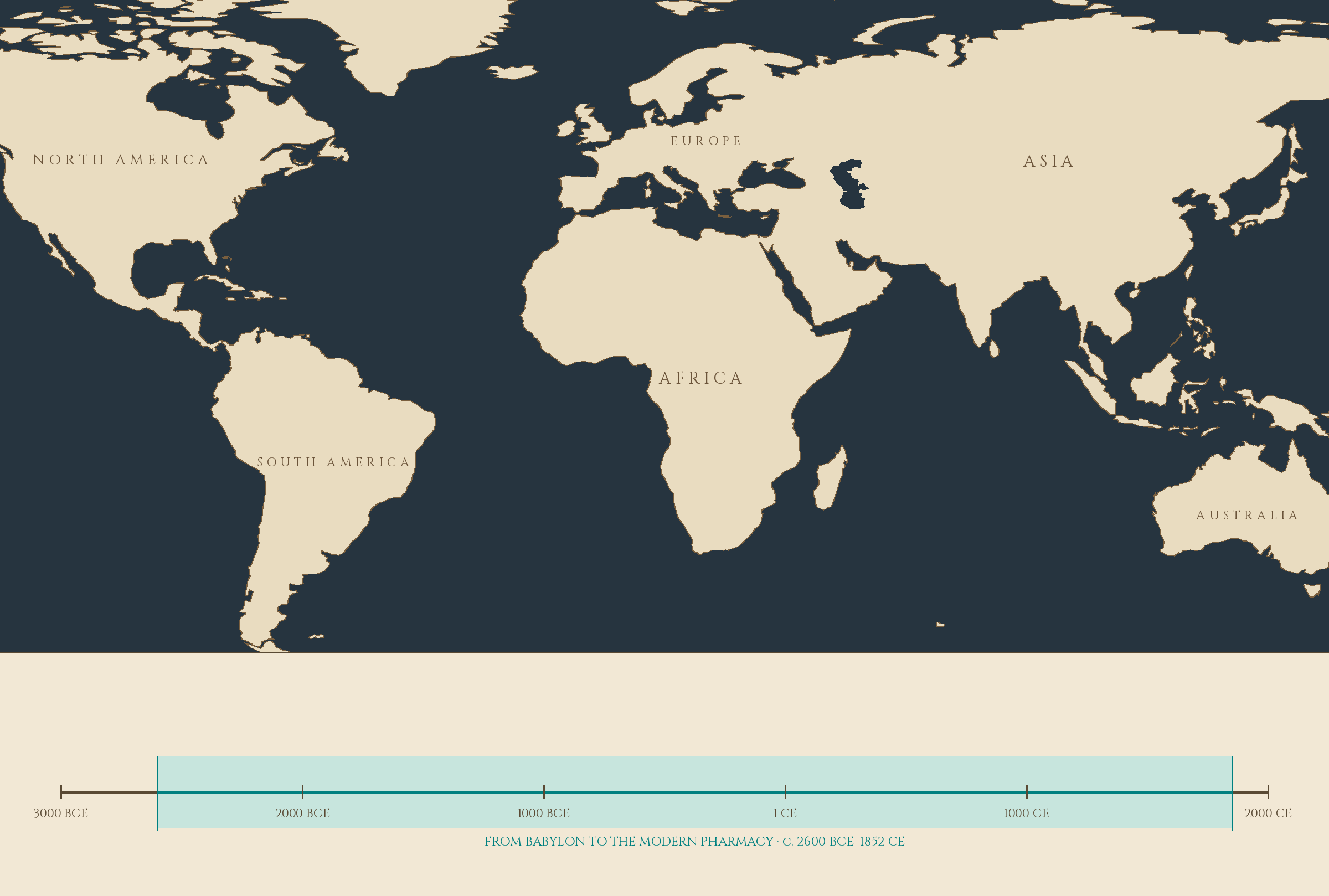
Potions map — the class base map, unmarked for this lesson.
Lesson Objectives
By completing this lesson, you will be able to:
- Assemble a complete extraction ledger recording every extraction system studied in Unit IV.
- Compare six solvent systems (oil, water, glycerin, vinegar, alcohol, steam) in a structured solvent comparison record.
- Apply clarification methods, filtration systems, and pressing techniques to finished extractions.
- Establish a long-term extraction documentation habit with stability tracking and revision notes.
- Judge your own readiness for Unit V formulation work against a clear rubric.
Reading this lesson: ★ marks the passages to remember. They set the ledger standard this lesson is assessed by, and they return in the units ahead and at the capstone. This lesson contributes no items to the Unit IV Quiz — its assessment is the ledger and audit work itself, set out in the Assignment Manual below. Check in questions ask the material back as you go; answer them in your workbook when you meet them.
Working this lesson: Your assignment packet is the first download on this page. Work in it as the lesson moves along, answering each project as its subject is taught — or read the lesson through for your notes and take the projects as homework afterward. Both are proper ways to sit this class. Signposts in the reading tell you where each project belongs. Written answers are short answers in your own words; a few honest lines are worth more than a filled page.
Your Assignment Packet
This lesson's projects live in its packet: the Lexicon Handout (every term, course terms marked ◆), Materials, Guided Practice — the Model Extraction Ledger Page, the solvent comparison table, and the four audit checklists with the self-assessment rubric, printed in full so you can work through them at your own shelves — the Assignment Manual with its self-check, the Reflection Questions, and the Workbook Checklist. Download the packet before you begin and keep it beside you as you read.
About this lesson's assessment, plainly: this lesson has no quiz, and no quiz items are taken from it for the Unit IV Quiz. The ledger work itself is the assessment: Projects I–III in the manual below — the complete extraction ledger in its eight fields, the solvent comparison record with its three judgment questions, and the long-term documentation plan — stand beside the Unit IV Quiz as the unit's practical layer. The lesson's course-◆ terms do travel to the Unit IV Quiz, where they belong to its vocabulary matching.
Safety Briefing
This lesson's safety spine is its own Unit IV Safety Consolidation, carried here word for word, because the audit is the briefing: it is spoken at the shelves, with every vessel of the unit in front of you.
Unit IV Safety Consolidation
Before the assignments, the standing safety record for everything Unit IV involved:
- Heat and steam. Heated oils and water burn. Use heat-safe vessels, monitor continuously, never leave heating unattended, and keep handles turned inward. Steam from decoctions and distillation scalds; keep faces and hands clear of rising vapor.
- Alcohol flammability. No open flame near spirits, ever. No heating alcohol over direct heat. Label and seal all spirit vessels; store away from heat sources. Adult supervision required for all alcohol work.
- Labeling. Every vessel labeled with contents and date before it leaves your hands. No mystery jars, no exceptions.
- Ventilation. Vinegar fumes, alcohol vapor, and resin smoke all require fresh air. Work near ventilation or outdoors when the lesson allows.
- Non-consumable marking. Decorative and practice preparations are marked display-only. Nothing from the laboratory is tasted, and nothing is used on the body, unless a lesson explicitly directs otherwise with full safety guidance.
- Cleanup and storage. Wash vessels promptly; dried residues are harder to remove and can harbor microbial growth. Store all preparations out of reach of young children and pets.
Check in: Which item of the safety consolidation is absolute and permanent, with no exceptions named — and which two items govern what happens to a vessel before it leaves your hands and after the work is done?
❦ In your workbook: record the safety consolidation in your own way — heat and steam, alcohol flammability, labeling, ventilation, non-consumable marking, and cleanup and storage — copy, sketch, or note what matters.
In your packet: Guided Practice — the four audit checklists begin here, and Checklist C is this consolidation turned into an audit. Work them as you reach them in the reading, or mark the place and take them as homework — your choice.
What the Extraction Ledger Is
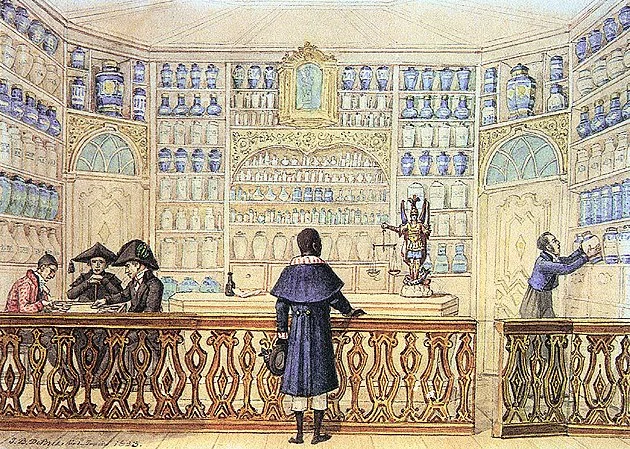
A botica in 1823, painted by Jean-Baptiste Debret: jars ranked on every wall, a balance on the counter, and not a preparation in the room that its keeper could afford to leave unrecorded. The ledger is the instrument that turns these shelves from stock into knowledge.
Jean-Baptiste Debret, Botica (1823), via Wikimedia Commons. Public domain.
Every historical apothecary kept one. Under various names, the extraction ledger, the still book, the preparation daybook, it served the same purpose: a chronological record of everything transformed in the laboratory, written so that a preparation made in March could be understood, repeated, or corrected in September.
The ledger is not a diary. It does not record feelings about the work. It records facts about the work, in a fixed format, so that entries can be compared across weeks and months. The format you will use has eight fields:
- Preparation name and date started. What it is, and when the work began.
- Material. The botanical (or mineral) used, its condition, and how it was prepared. Reference the potions journal entry.
- Menstruum. The solvent, its strength or grade, and the ratio of material to solvent.
- Method. The extraction system used: infused lipid, hydro-infusion, glycerite, decoction, acetum, resin fusion, tincture, or distillation.
- Observations. Color, fragrance, clarity, and behavior changes, dated as they occur.
- Clarification. How the finished preparation was clarified: settling, decanting, filtration, pressing, or a combination.
- Yield. The amount of finished preparation obtained, in real units.
- Storage and stability notes. Vessel, location, date, and the first scheduled re-inspection.
★ Eight fields. Every extraction. No exceptions. Muddlenook's rule is simple: if it is not in the ledger, it did not happen in this laboratory.
Check in: What eight fields does every ledger entry carry — and what is Muddlenook's rule for anything left out of it?
❦ In your workbook: record what the extraction ledger is in your own way — the still book tradition behind it, facts not feelings, and the eight fixed fields — copy, sketch, or note what matters.
The Six Solvent Systems Reviewed
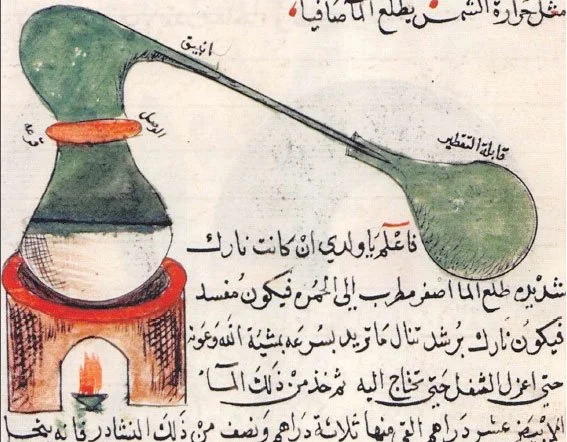
An alembic over its furnace, drawn in the Jabir ibn Hayyan manuscript tradition: flask, head, spout, and receiver — the whole steam system of the solvent table in one drawing, eight centuries and more before the lesson's stovetop still. The ledger's steam row begins here.
Alembic drawing attributed to the Jabir ibn Hayyan tradition (8th-century attribution as the Commons record titles it), via Wikimedia Commons. Public domain.
Unit IV taught six solvent families. Before you write the ledger, review them side by side, because the comparison itself is part of the consolidation. Each solvent draws different things from the same material, works at a different speed, and keeps for a different length of time.
| Solvent | Lesson | Speed | What It Favors | Keeping Quality | Key Caution |
|---|---|---|---|---|---|
| Oil (lipid) | 26 | Slow (days to weeks) | Fragrant and fat-soluble compounds | Months, if kept cool and dark | Rancidity; heated oils burn |
| Water | 27 | Fast (minutes to hours) | Readily soluble compounds, color | Days only; spoils quickly | Microbial growth; use promptly |
| Glycerin | 28 | Slow (weeks) | Gentle extraction, sweet preparations | Long; self-preserving | Viscosity slows everything |
| Vinegar (acetic) | 30 | Medium (days to weeks) | Acid-soluble compounds, minerals | Long; acidic environment preserves | Reacts with some metals and carbonates |
| Alcohol (spirit) | 32 | Medium (days to weeks) | Broadest range of compounds | Very long; the preserver's solvent | Flammable; never near open flame |
| Steam (distillation) | 33 | Hours of active work | Volatile, fragrant compounds | Long, in sealed vessels | Hot glass, steam burns, pressure |
★ Study this table until you can reproduce it from memory. The formulator's first question is always which solvent, and the answer begins here.
A note on honesty: you have not personally completed every one of these systems unless your laboratory is well stocked and your calendar generous. That is expected. The ledger records what you have done. For systems you have studied but not yet performed, the solvent comparison record (below) lets you capture the comparison without pretending to entries you have not earned. Never invent a ledger entry. An empty page is honest. A fabricated page is a lie in ink.
Check in: Which solvent keeps for days only, and which is called the preserver's solvent — and what single rule governs the rows for systems you have studied but not performed?
❦ In your workbook: record the six solvent systems in your own way — the six rows with their speeds, what each favors, its keeping quality, and its key caution — copy, sketch, or note what matters.
Clarification Methods
A finished extraction is rarely finished when the steeping ends. Most preparations leave the vessel cloudy with fine particles, and the apothecary's standard is clarity appropriate to the preparation. Unit IV's clarification methods, in the order they are applied:
Settling. Patience first. Allow the preparation to stand undisturbed so sediment falls by gravity. Days, not hours, for fine work. The first and cheapest clarification method ever devised.
Decanting. Once sediment has settled, pour the clear liquid carefully off the sediment layer. Steady hands, good light, and no shaking the vessel beforehand. Decanting is a skill; the first attempt always disturbs the sediment. The second attempt is better. By the fifth, you will pour like an apothecary.
Filtration. For what settling cannot clear, pass the preparation through a filter medium, exactly as practiced in Lesson 22. Cloth for coarse work, paper for fine work. Never force liquid through; let gravity do the pressing. A torn filter is worse than no filter, because it pretends to have filtered.
Pressing. The final recovery. After decanting and filtering, the spent material, the marc, still holds liquid in its fibers. Press it and recover what settling cannot reach. (See the next section.)
Apply methods in this order, and record which were used in the ledger's clarification field. A preparation clarified by settling alone and one clarified by settling, filtration, and pressing are different preparations with different keeping qualities. The ledger must say which.
Check in: In what order are the four clarification methods applied — and why does a torn filter count as worse than no filter at all?
❦ In your workbook: record the clarification methods in your own way — settling, decanting, filtration, pressing, in their order, and the rule that the ledger's clarification field names which were used — copy, sketch, or note what matters.
Pressing Techniques
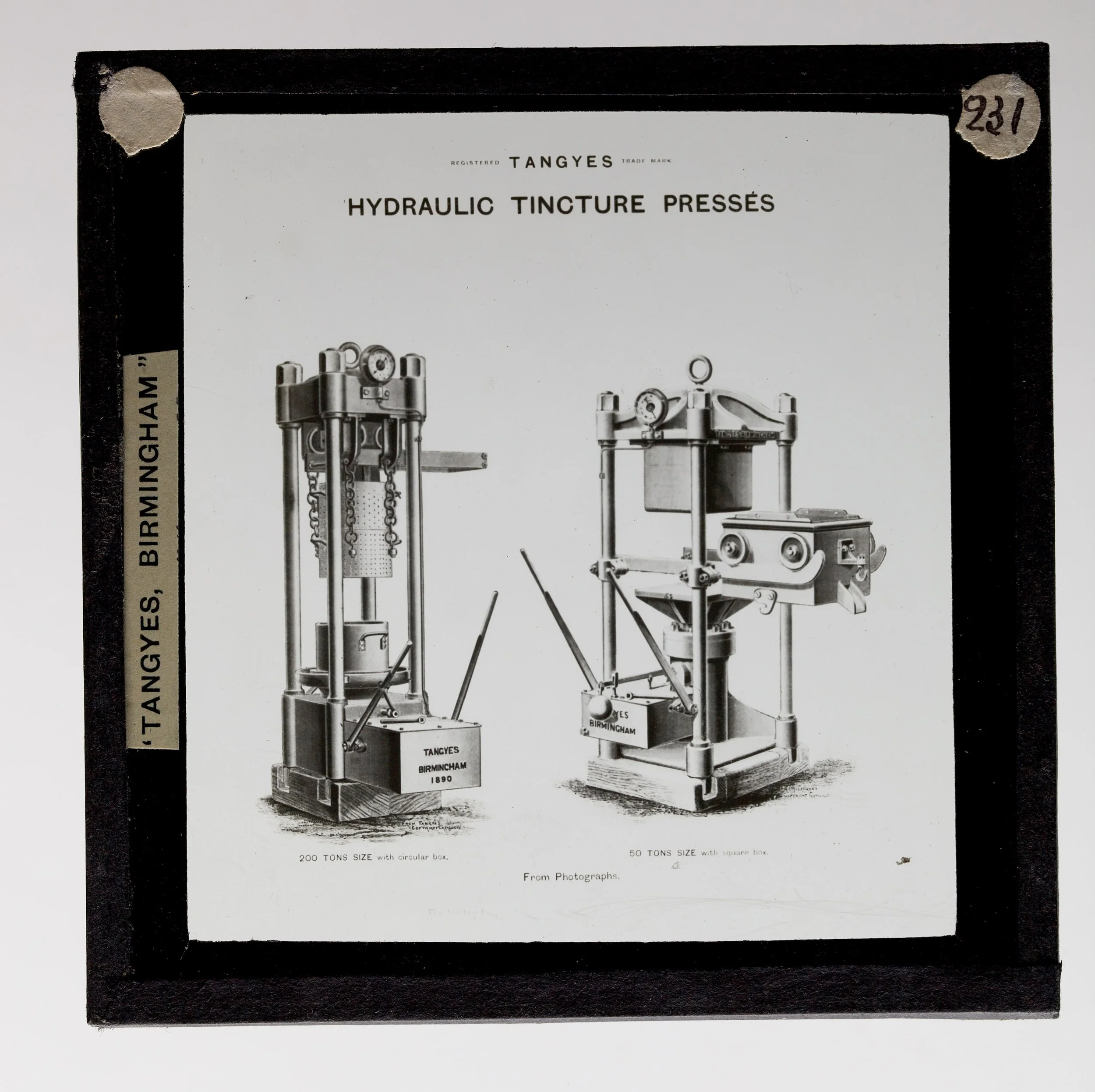
Hydraulic tincture presses from a Tangyes of Birmingham catalogue, photographed for a lantern slide of about 1910: the "large versions" the lesson's screw press descends from, built to squeeze the last fraction out of the marc by the ton. The scholar's press is a hand, two boards, or a small screw — the principle is the same, the scale is the lesson.
Lantern slide, Tangyes Ltd tincture presses (c. 1910), via Wikimedia Commons. Public domain.
Pressing is the most physical of the laboratory arts, and the most satisfying. The marc, the exhausted solid left after maceration, is gathered into cloth, and pressure squeezes out the retained liquid. What comes out is often the richest fraction of the whole extraction, because it sat longest in contact with the material.
Three pressing methods, in order of increasing force:
Hand pressing. Gather the marc into a square of clean cloth, twist the cloth closed, and squeeze with both hands over a bowl. Simple, immediate, and sufficient for soft materials. Wash the cloth immediately afterward; dried marc stains permanently.
The board press. Place the wrapped marc between two clean boards and press down with steady body weight. Greater force than hands alone, even pressure, and both hands free to hold the boards steady. Protect the work surface.
The screw press (observed, Level Two). A small press with a screw mechanism applies slow, even, powerful pressure. Historical apothecaries used large versions of these for tincture work. Students may study the mechanism and, with adult supervision, operate a small modern press if one is available. Never improvise a press from unsuitable materials. Pressure plus improvisation equals injury.
After pressing, the compacted marc is called the press cake. Record it, then compost it or discard it responsibly. The press cake has given everything it had. Thank it by writing down what it taught you, then let it go.
Scholars, a word on the alcohol work before we continue. Lesson 32's tinctures — alcoholic preparations made by soaking a botanical in spirit — used spirit as a menstruum (the liquid that does the extracting), and spirits burn. The rule is absolute and permanent: no open flame anywhere near alcohol, no heating of alcohol over direct heat, and all alcohol vessels labeled, sealed, and stored away from heat sources. The laboratory that respects fire keeps its eyebrows. Write this rule at the front of your ledger in ink, and never unwrite it.
— Professor Crimblebrew Muddlenook, Potions Laboratory • Master Apothecary • Head of House Meridies
Check in: What is the compacted marc called after pressing — and what two things does the lesson require you to do with it before you let it go?
❦ In your workbook: record pressing in your own way — the three methods in order of increasing force, the screw press as observed work under adult supervision, and the press cake recorded and released — copy, sketch, or note what matters.
The Model Extraction Ledger Page
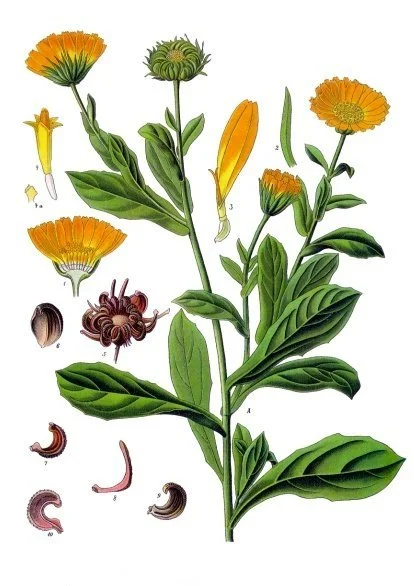
Calendula officinalis, the model entry's material, in Köhler's Medizinal-Pflanzen: flower heads in bloom and in section, and the curved seeds below. The ledger's material field asks for exactly what this plate teaches the eye to record — the plant, its part, and its condition.
Calendula officinalis plate, Köhler's Medizinal-Pflanzen, via Wikimedia Commons. Public domain.
Study this complete model entry. It records a calendula infused oil, the kind of preparation many of you made in Lesson 26. Every field is filled. Nothing is vague.
Preparation name and date started. Calendula Infused Oil. Started 14 March.
Material. Calendula officinalis, dried flower heads, fully dry and crisp. Purchased from a reputable supplier; intake inspection passed per Lesson 15 standards. Coarsely crumbled by hand before use. Potions journal entry: MB-026.
Menstruum. Olive oil, cold-pressed, food grade. Ratio: one part dried flowers to five parts oil by weight (approximately 40 grams flowers to 200 milliliters oil).
Method. Solar-infused lipid (Lesson 26). Jar placed on a sunny indoor sill, shaken gently once daily, for three weeks.
Observations. Week 1: oil taking on a pale gold tint; flowers floating. Week 2: deep gold color; distinct warm fragrance when the jar is opened. Week 3: rich amber-gold; flowers settled to the bottom; fragrance full and warm.
Clarification. Settled two days after straining. Decanted off fine sediment. Filtered once through unbleached cloth. Marc hand-pressed; press cake composted.
Yield. 165 milliliters of clear amber-gold oil.
Storage and stability notes. Stored in a clean amber glass bottle, labeled "Calendula Infused Oil, 4 April, display only, not for consumption." Kept in a cool dark cupboard. First re-inspection scheduled: 4 July (three months). Watch for: cloudiness, off fragrance, any rancid note.
★ Note what the entry does not contain: no opinions about what the oil is good for, no dosage, no instructions for use on the body. The ledger records the preparation, not prescriptions. That boundary is permanent in this laboratory.
Check in: The model entry's yield is given in what form — and what three kinds of content does the entry deliberately leave out?
❦ In your workbook: record the model ledger page in your own way — the eight fields as this one calendula oil fills them, the yield in real units, and the boundary the closing note draws — copy, sketch, or note what matters.
In your packet: Project I: Build Your Extraction Ledger ◐ begins here. Work it now, or mark the place and take it as homework — your choice.
The Solvent Comparison Record
The ledger records individual preparations. The solvent comparison record steps back and compares the systems themselves, using your own observations wherever you have them and clearly marked study notes where you do not.
Build a table with these columns: Solvent | Preparation made (or "studied") | Time required | Clarity achieved | Fragrance character | Keeping quality observed | Would repeat? Why?
Fill one row per solvent system from Unit IV. For systems you performed, use your ledger entries as the source. For systems studied but not performed, write "studied" in the preparation column and record what the lesson taught, clearly separated from personal observation. The comparison is only useful if performed and studied rows are never mixed.
Then answer, in writing, three questions:
- Which solvent system gave you the clearest finished preparation, and what clarification methods did it require?
- Which system demanded the most patience, and was the patience repaid?
- If you could keep only two solvent systems for the rest of your laboratory career, which two, and why?
These answers are the beginning of formulation judgment. Unit V will build on them directly.
Check in: How many columns and how many rows does the comparison table carry — and what one word marks a row for a system you studied but did not perform?
❦ In your workbook: record the solvent comparison record in your own way — the seven columns, one row per system, performed and studied rows never mixed, and the three judgment questions — copy, sketch, or note what matters.
In your packet: Project II: The Solvent Comparison ⚒ begins here. Work it now, or mark the place and take it as homework — your choice.
Long-Term Documentation
An extraction ledger is not finished when the preparation is bottled. The long-term documentation habit has three parts:
The re-inspection schedule. Every preparation gets a first re-inspection date written at the time of bottling: one month for water-based preparations, three months for oils and glycerites, six months for vinegars and tinctures. At each re-inspection, record color, clarity, and fragrance. Any change is data.
The stability note. If a preparation changes, write exactly what changed and when. "Oil developed a sharp fragrance at five months; discarded." That single honest sentence is worth more than a year of optimistic entries. Preparations that fail teach as much as preparations that keep. The laboratory learns from both, but only if both are written down.
The revision note. When you repeat a preparation with a change, a different ratio, a longer steep, a different clarification, record the change and the reason in a dated revision note linked to the original entry. Over time, revision notes become your personal method: the way you, specifically, make this preparation, earned through evidence.
Check in: A water-based preparation and a tincture are bottled on the same day. When is each one's first re-inspection due — and what three things are recorded at every re-inspection?
❦ In your workbook: record long-term documentation in your own way — the re-inspection schedule in its three intervals, the stability note written exactly, and the revision note linked to its original entry — copy, sketch, or note what matters.
In your packet: Project III: The Long-Term Documentation Plan ✎ begins here. Work it now, or mark the place and take it as homework — your choice.
Guided Observation: Reading the Model Ledger Page as a Working Document
This lesson's observation is desk work, done with the model ledger page open: you read a finished entry the way its keeper will read it in Unit V, and you test whether its fields are facts rather than praise — because an entry that only admires its bottle will fail at the first formulation.
Work through it in order.
Check the eight fields. Study this complete model entry. It records a calendula infused oil, the kind of preparation many of you made in Lesson 26. Every field is filled. Nothing is vague.
Test the numbers. Find, in the menstruum field, the ratio stated two ways — one part dried flowers to five parts oil by weight, and the same ratio as weighed amounts — and, in the yield field, the finished amount in real units. A field that cannot be checked cannot be repeated.
Follow the clarification in order. Settled two days after straining. Decanted off fine sediment. Filtered once through unbleached cloth. Marc hand-pressed; press cake composted. The clarification field names its methods in the order the lesson applies them: settling, decanting, filtration, pressing.
Consider:
- Which field would you challenge first, and what would you open, smell, or pour to settle it?
- The storage note schedules the first re-inspection at three months. Which rule of the re-inspection schedule sets that interval for an oil?
- What single sentence in this lesson would you write at the head of your own ledger?
❦ In your workbook: record the guided observation in your own way — the eight fields checked, the ratio and yield tested, and the clarification followed in its order — copy, sketch, or note what matters.
Materials
Everything in its place, before we begin. For this ledger lesson you will need:
Required (Level One — household items)
- Your laboratory journal and a pen: the ledger and comparison table are written records first.
- Every extraction from Unit IV: vessels, labels, and observation notes gathered in one place.
- Clean cloth, coffee filters, and a funnel: for any final clarification the audit requires.
- Amber or dark glass bottles with tight lids: for rebottling anything the audit finds poorly stored.
- Labels and a marker: for anything the audit finds unlabeled or vaguely labeled.
- A calendar: for writing in every re-inspection date.
Suggested (Level Two — historically closer)
- A bound ledger: enter your extraction records as a true still book, in ink, in the apothecary tradition.
- A small tincture press: for pressing marc with proper mechanical advantage.
- Glass stirring rods and a graduated cylinder: for measuring yields in real units.
Safety Notes
- No open flame anywhere near alcohol, ever. Write the rule at the front of your ledger in ink.
- Treat every heated vessel as hot until proven otherwise; use heat-safe handling for any rebottling near warmth.
- Ventilate the workspace; vinegar fumes and alcohol vapor require fresh air.
- Handle every bottle as if unlabeled until you have read the label: verify, then record.
- Younger students: an adult should supervise the ledger audit, especially any handling of spirit preparations.
- Mark every practice preparation display-only. Nothing from the laboratory is tasted.
Reflection Questions
Answer the following questions in your workbook.
- Why does the ledger use eight fixed fields instead of free-form notes? What is lost when entries cannot be compared?
- A classmate shows you a beautiful amber tincture but cannot tell you when it was started or what ratio was used. What is wrong with this preparation, even if it looks perfect?
- Why are performed and studied rows never mixed in the solvent comparison record?
- Your oil develops a sharp, unpleasant fragrance at five months. Walk through exactly what you record and what you do.
- How does the extraction ledger prepare you for formulation work in Unit V?
Workbook Checklist — Lesson 34
In my workbook I have:
- ☐ entered every extraction I performed during Unit IV in the eight-field ledger format, one full page per preparation, with no invented entries
- ☐ listed every system I studied but did not perform on the page titled "Systems Studied, To Be Performed," with its lesson number and one sentence on what it does
- ☐ reviewed the six solvent systems side by side and reproduced the comparison table's six rows: speed, what each favors, keeping quality, and key caution
- ☐ recorded, for every finished extraction, which clarification methods were used, in their order: settling, decanting, filtration, pressing
- ☐ recorded every press cake and its fate: pressed to recover the final fraction, then composted or discarded responsibly
- ☐ built the solvent comparison table in its seven columns and six rows, every row marked performed or studied, the two never mixed
- ☐ answered the three judgment questions in full paragraphs, including the two solvent systems I would keep, and why
- ☐ written my re-inspection schedule for every bottled preparation, set its calendar reminders, and drafted my blank stability-note and revision-note forms
- ☐ written the alcohol-safety rule at the front of my ledger in ink, and audited every vessel's label against its ledger entry
☐ Lesson completed Date: ___ Signature: ___
The Professor's Closing Note
Sealed with the teal wax of Professor Crimblebrew Muddlenook, Master Apothecary of the Potions Laboratory, Head of House Meridies.
A final word, scholars: we have reached the end of Unit IV, and I am satisfied with what this unit has built. You can receive a material and judge it. You can prepare it, extract from it six ways, clarify the result, press the last value from the marc (the spent solid left after a preparation is pressed and strained), and write it all down so that future-you, or any scholar who inherits your ledger, can follow the work exactly. That is not a small thing. That is the foundation of everything Unit V will ask of you.
Keep the ledger. Tend it the way you would tend a living thing, because in a sense it is one: it grows, it changes, and it rewards attention. I will see you in Unit V, where we finally build.
— Professor Crimblebrew Muddlenook, Potions Laboratory • Master Apothecary • Head of House Meridies
PROFESSOR CRIMBLEBREW MUDDLENOOK
Potions Laboratory
Master Apothecary • Head of House Meridies
Cross-Class Connections

Herbology · Unit IV, Lesson 28 — Drying Herbs the Traditional Way
Come up to the Greenhouse, ledger-keepers, and see where your material field begins. In my greenhouse we hang bundles, screen-dry delicate leaves, and judge by crispness when drying is done, so the harvest your laboratory receives is material whose story is already written. Bring the harvest records his ledger asks you to reference — we will make sure they are worth referencing.
Herbology · Unit V, Lesson 36 — The Materia Botanica: Building Your Herbal
Come up to the Greenhouse, ledger-keepers, and see the book your entries feed. Here every plant gets one entry in our shared Materia Botanica: my growing notes beside Professor Muddlenook's preparation notes, eight fields in a fixed order, so the calendula whose oil fills your model entry is the same plant whose life the entry records. Bring the honesty his ledger taught you — cautions written plainly, blanks left honest — and we will write the growing half together.
PROFESSOR BERYL FERNFOOT
Herbology Greenhouse • Master Herbalist • Head of House Oriens

Scrollwork · Unit II, Lesson 6 — Oak Gall Ink
You have clarified extractions in Professor Muddlenook's laboratory. Now come and clarify an ink in mine. In the Scriptorium we strain the gall infusion through cloth, let it rest overnight, and strain it once more before bottling — his settling, decanting, and filtration, wearing a scribe's apron. The methods transfer, scholars. Come and watch them change coats.
Scrollwork · Unit VI, Lesson 23 — Archive Labels & Library Systems
You have kept a ledger. Now come and keep a library. In my Scriptorium we take up the label, the list, and the shelfmark at the scale of whole collections — how a record is made findable, and why an entry that cannot be found again might as well never have been written. Your eight fields have a thousand-year pedigree, scholars. Come and meet their ancestors.
PROFESSOR QUILLBERRY NOCTURNE
Scrollwork Library

Creative Arts · Unit II, Lesson 11 — Case Binding & Archival Boxes
A ledger deserves a case built to fit it, scholars. In my workshop you will learn to case a book to measure and to build the archival box in which a great record rests: boards cut square, a case built to fit the book it houses, a box that will outlast everyone in the room. Build the practice corner first, on scrap, as always. Then bring your extraction ledger when its pages have grown into a book, and we will house it properly.
PROFESSOR COGBRANCH TIMBERCLANK
Creative Arts Workshop
Further Reading & Sources
- The Still Room: Distillation and the Early Modern Household — Science History Institute collections on distillation apparatus and household still rooms.
- Wellcome Collection: Apothecary and Pharmacy — digitized apothecary ledgers, still books, and pharmaceutical manuscripts.
- Smithsonian: Pharmaceutical and Apothecary Collections — historical laboratory equipment including presses and percolators.
- The Metropolitan Museum of Art: Heilbrunn Timeline — essays on historical scientific instruments and apothecary ware.
- Kew Gardens: Plants and People — botanical reference supporting material identification in ledger entries.
Browse the Potions shelf in the school Library for readable editions of these works.
Submit your work for this lesson using the form below.
THE UNIT IV QUIZ
POTIONS LABORATORY · UNIT IV: BOTANICAL EXTRACTIONS
Unit IV is complete: six solvent systems worked in turn — oil, water, glycerin and syrup, vinegar, resin fusion, spirit, and steam — each with its own discipline, its own record, and its own way of failing honestly. This quiz gathers the whole unit into one sitting. Take it from memory first, before you look back at your notes, because it measures what has stayed with you. If you completed the work marked ★ in your lesson packets, you have already practiced most of what it asks.
It stands beside this lesson's own Extraction Ledger — the first of its Projects, in which the unit's six solvents are compared side by side and the record is made permanent. The ledger is the unit recorded; the quiz is the unit remembered. Two different kinds of proof, both worth having.
The quiz packet is a single download. Part I gathers questions from across the unit, Part II matches the unit's vocabulary, and the answer key waits at the back for self-checking. When you have finished, score it honestly, note the result in your workbook, and revisit any lesson whose questions went wrong before you move on to Unit V.
CONTINUE IN THE POTIONS LABORATORY
← Previous · Lesson 33: Distillation & Hydrosols Next · Lesson 35: Balms, Salves & Cerates →
Unit IV — Botanical Extractions Potions Laboratory — All 52 Lessons
The rest of Unit IV: Lesson 26 · Infused Lipids · Lesson 27 · Hydro-Infusions · Lesson 28 · Glycerites & Syrups · Lesson 29 · Decoctions · Lesson 30 · Herbal Acetums · Lesson 31 · Resin Fusion · Lesson 32 · Tinctures · Lesson 33 · Distillation
From the Apothecary Cabinet
The printed companions to this lesson, from Professor Muddlenook’s shelf in the shop.