

POTIONS
Unit IV · Lesson 32TINCTURES & SPIRIT MACERATIONS
Professor Crimblebrew Muddlenook
Master Apothecary • Potions
Head of House Meridies • School of Evershade
Professor's Introduction

Sealed with the teal wax of Professor Crimblebrew Muddlenook, Master Apothecary of the Potions Laboratory, Head of House Meridies.
Aprons on, benches clear. Today we take up the most patient preparation in the laboratory, and the most dangerous liquid on our shelves.
Alcohol does two things no other menstruum can do at once. It draws out a broader range of a plant's compounds than water can reach, and it keeps what it draws. A water infusion — steeping a botanical in liquid so its soluble compounds pass into the liquid — spoils in days. An oil infusion turns in months. A well-kept tincture — an alcoholic preparation made by soaking a botanical in spirit — sits in the archive for years and still tells the truth about the day it was made. That is why the old apothecaries called spirit the preserver, and why our shelves hold more spirit jars than any other kind.
But the same spirit that preserves will burn. It burns invisibly, quickly, and without asking permission. So before we touch a single jar, you will learn the spirit's rules, and you will learn them the way you will practice them: exactly, every time, without exception.
Everything in its place, scholars. Especially the flame, which has no place here at all.
— Professor Crimblebrew Muddlenook, Potions Laboratory • Master Apothecary • Head of House Meridies

Potions map — the class base map, unmarked for this lesson.
Lesson Objectives
By the end of this lesson, you will be able to:
- Define a tincture and a spirit maceration, and explain how they differ from water and oil extractions.
- Describe why alcohol both extracts broadly and preserves, in the apothecary's terms.
- Read a spirit's strength using the American proof system and describe the historical British proof test.
- Set an extraction ratio in weight-to-volume form and complete a ratio worksheet.
- Carry out a fourteen-day maceration with an observation log, then press, strain, label, and archive the preparation.
- State and follow the laboratory's alcohol safety rules without prompting.
Reading this lesson: ★ marks the passages to remember. They return in the Unit IV Quiz and the class test, and they set the standard this laboratory works by. Check in questions ask the material back as you go; answer them in your workbook when you meet them.
Working this lesson: Your assignment packet is the first download on this page. Work in it as the lesson moves along, answering each exercise as its subject is taught — or read the lesson through for your notes and take the exercises as homework afterward. Both are proper ways to sit this class. Signposts in the reading tell you where each exercise belongs. Written answers are short answers in your own words; a few honest lines are worth more than a filled page.
Your Assignment Packet
This lesson's exercises live in its packet: the Lexicon Handout (every term, course terms marked ◆), Materials, Guided Practice — the Ratio Worksheet and the Fourteen-Day Observation Log, printed in full so you can work them at your own bench — the Assignment Manual with its self-check, the Reflection Questions, and the Workbook Checklist. Download the packet before you begin and keep it beside you as you read.
About this lesson's quiz, plainly: the original packet opened with a Lesson Quiz (Assignment I). Per the classroom model, that quiz leaves the manual and pools into the Unit IV Quiz; its questions are preserved whole in the unit quiz pool, and the exercises below keep their source words and numbering — Exercises I–III, which the original packet numbered Assignments II–IV behind the quiz.
Safety Briefing: The Spirit's Rules
Read this section twice. These rules govern every moment of this lesson, and they govern every future lesson in which alcohol appears.
Rule one: no flame. Alcohol and its vapors ignite easily, and an alcohol flame can be nearly invisible in daylight. No candles, no lighters, no gas burners, no open heating elements anywhere in the room while spirit jars are open or in use. If your workspace shares a room with a stove, the stove stays off and cold for the entire session.
Rule two: sealed jars, always. Spirit jars are kept sealed except for the brief moments of filling, agitating, or straining. Work in a ventilated room, never in a small closed space, so vapors cannot accumulate.
Rule three: adults handle the alcohol. An adult purchases the spirit, pours the spirit, and stores the spirit. Students may observe, measure the botanical, write the labels, and keep the log. If you are the adult and the student in your household, you are still bound by every other rule on this page.
Rule four: label before you pour. Every jar receives its full label before any liquid enters it: contents, date, ratio, and the words NOT FOR CONSUMPTION in letters no one could miss. An unlabeled spirit jar is a failure of laboratory order, and Professor Muddlenook treats it as seriously as a spill.
Rule five: nothing is tasted. Not a drop, not a fingertip, not "just to check." Our tinctures are study specimens. They are observed with the eyes and the nose, recorded in the log, and archived on the shelf. Tasting is not part of any exercise in this lesson, and no future lesson will ask it of you either.
Rule six: store like the archive depends on it. Finished preparations live in a cool, dark place, upright, tightly sealed, out of reach of children and pets, away from heat sources. A locked cabinet is ideal. The archive keeps its specimens; the household keeps its safety. Both at once.
Spills: ventilate, wipe with cloths, wash cloths separately, keep away from flame until the area is fully dry and aired. Eyes: flush with water and tell an adult at once. Emergency: if alcohol ignites, smother small flames with a damp cloth or a lid, never blow on them, and call an adult immediately.
Check in: Which rule governs who may pour the spirit, and which rule governs the jar before anything is poured into it — and what four things must that jar's label carry?
❦ In your workbook: record the spirit's rules in your own way — no flame, sealed jars, adults handle the alcohol, label before you pour, nothing tasted, archival storage — copy, sketch, or note what matters.
In your packet: Materials — the spirit's rules stand behind every item on the list. Read the list with the rules in mind before any jar is opened.
Why Alcohol: The Archive's Longest Memory
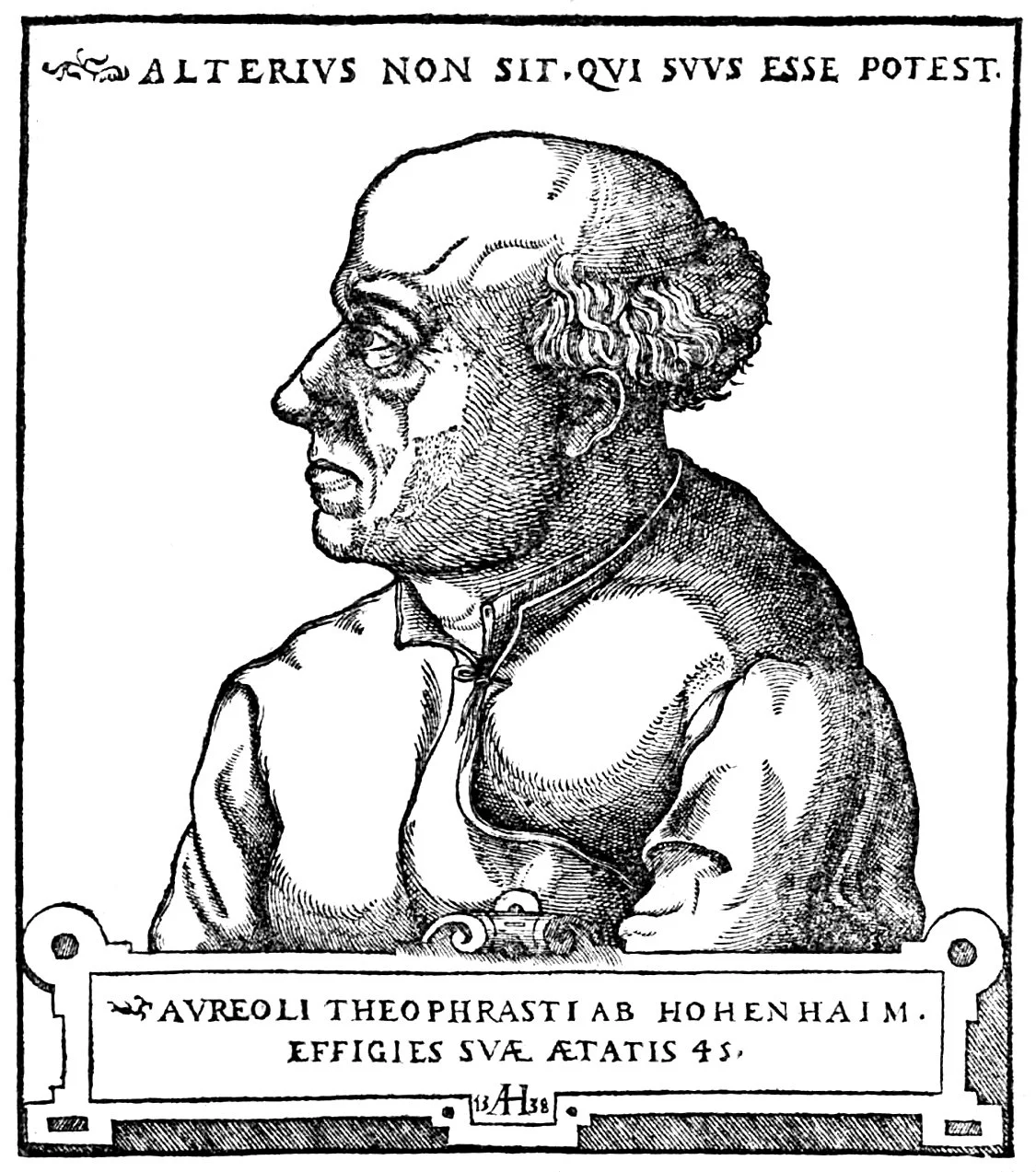
Paracelsus (1493–1541) at forty-five, in Augustin Hirschvogel's 1538 portrait: the Swiss physician who argued that medicine should be drawn out of plants by chemical preparation, and who made alcohol extraction one of his chief tools. The laboratory studies his method — and heeds his warning, for his laudanum is this lesson's clearest caution.
Augustin Hirschvogel, portrait of Paracelsus (1538), via Wikimedia Commons. Public domain.
Every extraction lesson so far has used a menstruum with a limit. Water draws out what dissolves in water and then spoils within days, because water is also what microbes drink. Oil draws out what dissolves in oil and keeps for months, but oil goes rancid in time. Vinegar and glycerin have their own strengths and their own clocks.
★ Alcohol's distinction is that it does two jobs at once. As a solvent, it reaches compounds that water cannot: the resinous, the waxy, the bitter principles that shrug off a teapot. As a preserver, it holds the preparation against the very spoilage that defeats water extracts. One liquid, two virtues. No other historical menstruum offered both, which is why the spirit shelf became the backbone of every serious apothecary archive.
The old name for distilled alcohol was spirit of wine, and the physicians who first made it central to pharmacy treated it almost as a discovery of a new element. In the 1500s, the Swiss physician Paracelsus (1493 to 1541) argued that medicine should be drawn out of plants by chemical preparation rather than merely gathered and dried, and he made alcohol extraction one of his chief tools. He is credited with reintroducing opium preparations to Western Europe in alcoholic form, the preparation later called laudanum. We mention laudanum only as history: it is the most famous tincture ever made, and also the clearest warning in our subject. A powerful extraction method in careless hands made a powerful problem. The laboratory studies the method. It does not repeat the mistake.
By the 1600s, tinctures were standard entries in the pharmacopoeias, the official books that told apothecaries exactly how each preparation should be made. The London Pharmacopoeia of 1618, the first official pharmacopoeia of the London College of Physicians, codified preparations an apothecary was expected to keep. From that century forward, any apothecary's shelves without a row of spirit jars would have looked bare to a colleague. The archive you are building joins a tradition four hundred years deep.
None of this changes what our tinctures are for. Ours are study specimens. We make them to learn extraction, ratio, timing, observation, and order. The method is historical. The discipline is present. The purpose is the archive.
Check in: What two jobs does alcohol do at once that no other historical menstruum offered together — and what is a tincture in this laboratory for?
❦ In your workbook: record why alcohol in your own way — the two jobs at once, Paracelsus and the laudanum warning, the 1618 pharmacopoeia, and the study-specimen purpose — copy, sketch, or note what matters.
The Tincture, Defined
A tincture is an alcoholic extraction of a botanical, prepared by macerating the prepared material in a spirit menstruum.
Hold that definition beside the extractions you already know. An infusion steeps in water and is used quickly. A decoction simmers in water for dense materials. An infused oil carries compounds in fat and keeps for months. A tincture steeps in spirit and keeps for years. The difference is not only the liquid. It is the archive's whole attitude toward time: the tincture is the preparation you make when you want the record to last.
You will notice the definition says "prepared material." That is Lesson 23 doing its work inside this lesson. The herb is cut or lightly bruised before it meets the spirit, because maceration can only act on surfaces it can reach. Preparation is not a separate subject from extraction. It is extraction's first half.
Check in: Four extractions stand in a row in this section — infusion, decoction, infused oil, tincture. Which liquid does each use, and how long does each keep?
❦ In your workbook: record the tincture defined in your own way — the definition itself, the four extractions and their keeping times, and preparation as extraction's first half — copy, sketch, or note what matters.
Spirit Maceration
Maceration, as Lesson 23 established it, is soaking a prepared botanical in a menstruum at room temperature so compounds pass from the material into the liquid. A spirit maceration is maceration in which the menstruum is alcohol.
Two things change when the menstruum is spirit. First, the range of extraction widens: alcohol dissolves many compounds that water leaves behind, including resinous and bitter principles, while still carrying the water-soluble ones, since spirits themselves contain water. Second, the preparation preserves itself: at sufficient strength, alcohol inhibits the microbial growth that would spoil a water extract in days. The maceration is slower than an infusion and faster than folklore suggests. The old apothecaries called this slow ripening coction: a preparation maturing under gentle conditions until its character settles. Most of the visible change happens in the first one to two weeks, which is why our observation log runs fourteen days.
The menstruum here is the spirit itself (Lesson 19 gave us the word; Unit IV gives us its fullest use). Everything you learned about menstrua in the abstract now has a bottle, a label, and a set of rules.
Check in: What two things change when the menstruum is spirit — and why does the observation log run fourteen days rather than two or twenty?
❦ In your workbook: record spirit maceration in your own way — the widened range, the self-preserving preparation, and the one-to-two-week window of visible change — copy, sketch, or note what matters.
Solvent Strength: Reading the Proof
Not all spirits are equally strong, and strength matters twice: stronger spirit extracts more broadly, and stronger spirit preserves more surely. The laboratory therefore reads strength the way it reads everything else: by a standard, written down.
★ The American system is arithmetic: proof is twice the alcohol-by-volume percentage. An 80-proof vodka is 40 percent alcohol by volume. A 100-proof spirit is 50 percent. If you can double, you can read any American label.
The historical British system was a test, not a calculation. In the days before hydrometers were common, spirit strength was judged by the gunpowder test: gunpowder was soaked in the spirit and then touched with flame. If the powder still ignited, the spirit was "at proof," strong enough to burn off and leave the powder dry enough to catch. That point corresponds to about 57.15 percent alcohol by volume, and it was called 100 degrees proof. Weaker spirit left the powder too wet to ignite: "under proof." It is a rough, dramatic, pre-instrumental method, and it tells you something about the era. When you could not measure a thing precisely, you found something it could do and watched whether it did it.
For our study preparations, standard 80-proof vodka (40 percent ABV) is the working strength. It extracts well, preserves adequately for archival study, and is the strength an adult can most readily obtain. Level Two students comparing a 100-proof spirit will observe deeper color and a more complete extraction in their notes. The comparison is the lesson. The numbers are the language.
Check in: A bottle reads 90 proof. What is its alcohol by volume — and in the British test, what did spirit that left the gunpowder too wet to ignite get called?
❦ In your workbook: record reading the proof in your own way — proof as twice the ABV, the gunpowder test and its 57.15 percent point, and 80 proof as this laboratory's working strength — copy, sketch, or note what matters.
In your packet: Exercise II — The Proof Detective ◐ begins here. Work it now, or mark the place and take it as homework — your choice.
Extraction Ratios: The Laboratory's Standard Language
Apothecaries needed a way to say "how much herb in how much spirit" that any other apothecary could reproduce. The answer is the extraction ratio, written as weight of botanical to volume of menstruum. A 1:5 ratio means one part herb by weight to five parts spirit by volume: for example, 20 grams of dried herb to 100 milliliters of spirit. A 1:10 ratio means one part herb to ten parts spirit: 20 grams to 200 milliliters.
★ Dried herbs are the standard for our work, and ratios are conventionally figured on dried weight, because fresh material varies wildly in water content. Two conventions dominate the tradition: 1:5 for most dried botanicals, 1:10 for very bulky or strongly aromatic materials where a gentler extraction is wanted. Our practical uses 1:5. Write it on the worksheet, write it on the label, and the preparation becomes reproducible: anyone reading your archive entry could build the same jar.
The ratio worksheet in your assignment packet walks through the arithmetic twice, once in grams and milliliters and once in household spoons and cups, so the standard survives whatever tools your laboratory holds.
Check in: At a 1:5 ratio, how much spirit belongs with 20 grams of dried herb — and why are ratios figured on dried weight rather than fresh?
❦ In your workbook: record extraction ratios in your own way — weight to volume, the 1:5 and 1:10 conventions and when each is wanted, and reproducibility as the ratio's purpose — copy, sketch, or note what matters.
In your packet: Guided Practice — the Ratio Worksheet walks the arithmetic twice, in grams and milliliters and in household spoons and cups. Work it here, before the jar is built.
Maceration Timing: The Long Wait
Once the jar is sealed, the work belongs to time and to your log. The standard maceration runs fourteen days in our laboratory: long enough to watch the extraction curve rise and level, short enough to complete within the unit.
Agitation is your only intervention. Once a day, pick up the sealed jar, turn it slowly end over end several times, and set it back on the shelf. Shaking brings fresh menstruum into contact with the material's surfaces, where the compounds are waiting to dissolve. Do not open the jar to stir. Opening admits air and loses spirit to evaporation, and the seal is part of the method. Agitate, observe through the glass, record, and return the jar to its cool dark shelf.
What you will see: the spirit takes color within hours, deepening day by day. Fine particles drift and settle. The herb swells slightly as it drinks. Around the second week, the deepening slows and then stops. That plateau is the extraction telling you it has given what the menstruum can take at this ratio. Record the day the color stops changing. It is one of the most informative entries your log will hold.
Scholars, a word about patience, sealed with my usual insistence. The jar does not care that you are curious. It will not hurry because you are watching, and opening it to "check" sets the work backward: air in, spirit out, dust perhaps. The whole art of maceration — soaking a prepared botanical in liquid at room temperature so its compounds pass into the liquid — is the art of leaving a thing alone correctly. Agitate daily. Observe through the glass. Write everything down. Touch nothing else. The archive rewards the scholar who can wait with a pencil in hand.
— Professor Crimblebrew Muddlenook, Potions Laboratory • Master Apothecary • Head of House Meridies
Check in: What is your only intervention during the fourteen days — and why must it be done with the jar sealed rather than open?
❦ In your workbook: record the long wait in your own way — fourteen days, daily agitation of the sealed jar, and the plateau day recorded as the log's most informative entry — copy, sketch, or note what matters.
The Procedure: Building the Tincture Jar
Step 1 — Label first. Write the full label before anything is opened: the herb's name, the spirit and its proof, the ratio, the date, and NOT FOR CONSUMPTION in large letters. Fix it to the jar. An unlabeled jar is not a preparation. It is a mystery, and mysteries do not belong on laboratory shelves.
Step 2 — Weigh the herb. The adult handles all spirit; the student weighs the dried herb. For a 1:5 ratio in a pint jar: 20 grams of dried herb (about 4 level tablespoons of leafy herb, though weight is the standard; your worksheet converts). Record the exact weight.
Step 3 — Prepare the material. Lightly bruise the herb in the mortar, just enough to break surfaces, not to powder it. Powdered material makes a cloudy preparation that is miserable to strain. Record that you bruised it and why.
Step 4 — The adult pours. 100 milliliters of spirit for 20 grams of herb at 1:5. The adult pours; the student observes and records the volume. The herb should be fully submerged with spirit to spare. If any herb floats stubbornly above the surface, note it; it will sink as it drinks.
Step 5 — Seal and initial. Lid on tight. Turn the jar once, gently, to wet all the material. Write the start date and time in the log. Place the jar on its cool, dark shelf, upright, away from heat and light.
Step 6 — Fourteen days of observation. Agitate daily. Record color, clarity, sediment, aroma at the lid (sniff the sealed jar's exterior only after agitation, never open to smell), and any change. Note the day the color plateaus.
Check in: In Step 4, who pours, who observes, and what two numbers does the pour join — and in Step 6, how may aroma be checked without breaking the seal?
❦ In your workbook: record the procedure in your own way — the six steps in their order, label first and the adult's pour, and the sealed-jar aroma rule — copy, sketch, or note what matters.
In your packet: Exercise I — The Tincture Jar ⚒ begins here, with the Ratio Worksheet in Guided Practice. Work it now, or mark the place and take it as homework — your choice.
Observation: Reading the Jar
Your log is the preparation's biography. Each daily entry holds the date, the day number, color (compare against yesterday, not against memory), clarity, sediment level, and notes. A few readings to practice:
- Rapid darkening in the first three days is normal: the most accessible compounds leave first.
- A plateau around days ten to fourteen means the menstruum has taken what it can at this ratio. It is not a failure. It is the extraction curve leveling, and it is worth a full sentence in the log.
- Cloudiness that never clears usually means the herb was powdered too fine or agitated too violently. Record it as a process note for next time.
- Any fuzzy growth or foul odor means the preparation failed: spirit too weak, jar unsealed, or material unsound. Record the failure honestly, dispose of the contents safely with an adult (pour onto soil outdoors, rinse the jar), and write what you would change. Failed preparations teach as much as successful ones when they are recorded.
Check in: Your jar's liquid has stopped deepening at day twelve. Failure, or information — and what exactly does the lesson have you write about it?
❦ In your workbook: record reading the jar in your own way — the log's five daily entries, the four readings to practice, and honest failure recording with its safe disposal — copy, sketch, or note what matters.
Pressing, Straining, and the Marc
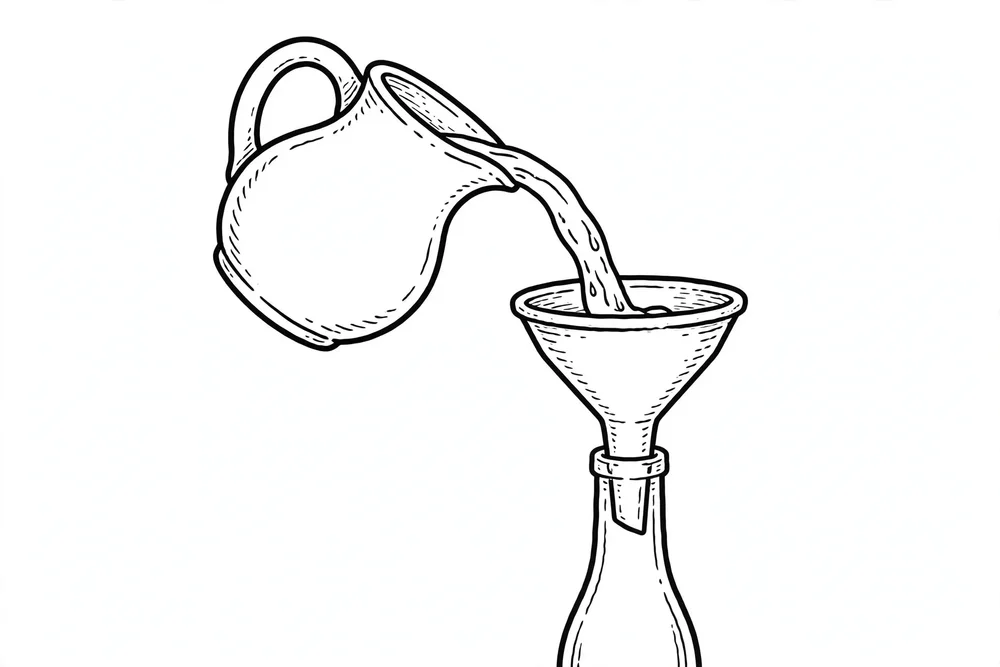
On day fourteen, the maceration ends and the separation begins. Decanting (Lesson 20) comes first: pour the liquid carefully off the settled material into your strainer lined with cheesecloth, leaving the sediment behind. Then gather the cloth around the spent herb and press it firmly, wringing out the liquid the fibers still hold. The filtrate, the clarified liquid that passes through (Lesson 22), is your tincture. The spent solid left in the cloth is the marc.
★ Press the marc well. Every drop left in the fibers is extract lost to disorder, and Muddlenook's laboratory does not lose drops to disorder. When the marc gives no more, it may be composted or discarded; its work is done, and the archive thanks it.
Funnel the filtrate into its final amber jar or bottle. It will be darker and clearer than the maceration jar's contents were. Label it completely: contents, ratio, spirit, dates of maceration, and NOT FOR CONSUMPTION. This is the specimen that joins the archive.
Check in: Name the separation in its order — what comes first, what the cloth holds, what passes through, and what each of the last two is called.
❦ In your workbook: record pressing and straining in your own way — decant, press, the filtrate and the marc, and the finished jar's complete label — copy, sketch, or note what matters.
In your packet: Exercise III — The Archival Label and Preservation Record ⚒ begins here. Work it now, or mark the place and take it as homework — your choice.
Preservation: Why the Archive Keeps
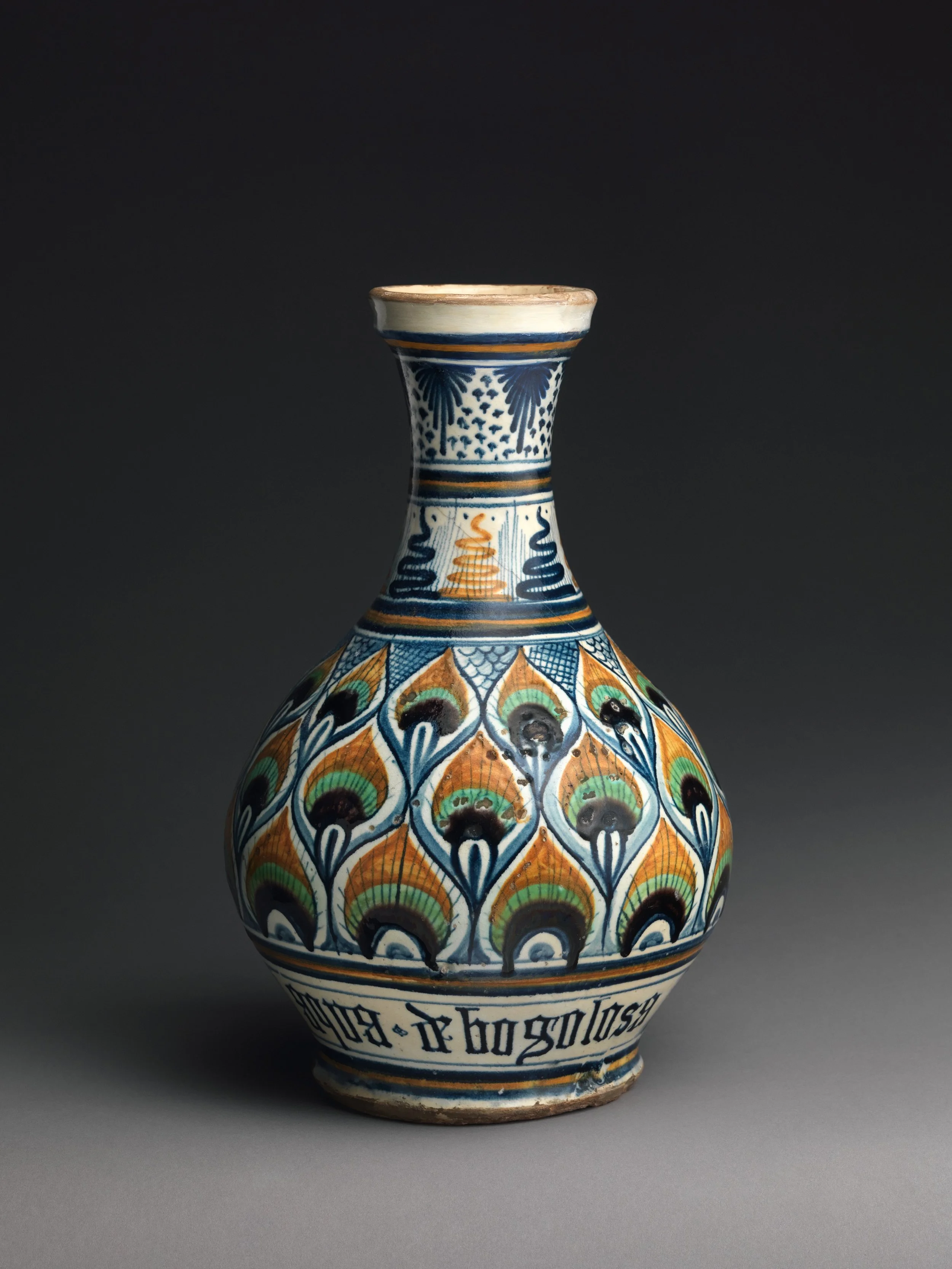
A pharmacy bottle whose maker's label is painted into its foot: a name, and only a name — bugloss water, in Gothic letters. The archive's oldest labels did exactly what Rule four asks of yours: they said what the vessel held, so no one had to guess. Your finished jar's painted band is its complete paper label — contents, ratio, spirit, dates, and NOT FOR CONSUMPTION.
Pharmacy bottle, The Metropolitan Museum of Art, via Wikimedia Commons. CC0.
A water infusion is a brief guest. A tincture is a resident. The difference is the alcohol: at sufficient strength it inhibits the microbial life that would sour a water extract within days. This is not a claim about medicine. It is a claim about shelf life, and it is why the apothecary's archive is disproportionately made of spirit jars.
Your preservation duties are simple and permanent: keep the preparation sealed, cool, dark, upright, labeled, and out of reach of children and pets. Check the seal yearly. Note any change in color or clarity in the archive entry, the same way you noted changes during maceration. A preparation that changes on the shelf is telling you something, and the archive listens for years.
Store the finished jar as the rules require: a cool dark place, a locked cabinet if your household has one, never near heat. The spirit's rules did not expire when the preparation finished. They govern the archive too.
Check in: What makes a tincture a resident where a water infusion is a brief guest — and which six conditions do your preservation duties hold, permanently?
❦ In your workbook: record preservation in your own way — alcohol as the preserving agent, the six keeping conditions, and the yearly seal check written into the archive entry — copy, sketch, or note what matters.
Cleanup
Rinse all vessels with hot soapy water; the adult handles any spirit-wet cloths, which are laundered separately and kept from flame until fully dry and aired. Return the scale, funnel, and mortar to their places. Wipe the shelf. File the observation log and the ratio worksheet in the archive entry for this lesson. Wash your hands. The laboratory is orderly again, which is its natural state.
Check in: Who handles the spirit-wet cloths, and under what two conditions are they kept before they are safe?
❦ In your workbook: record cleanup in your own way — the adult's cloths laundered separately and kept from flame, the tools returned, and the log and worksheet filed in the archive entry — copy, sketch, or note what matters.
A Note on Unit IV's Map
You now hold the middle of the unit's map. Behind you: oils that carry, waters that steep briefly, glycerin and syrups that sweeten and preserve gently, decoctions that simmer the dense, vinegars that draw with acid, and resins that melt and fuse. Ahead: the still and its waters, and at the unit's end, the Extraction Ledger where every method is compared side by side. The tincture sits at the map's center because it is the most complete single answer to the unit's question: how do we draw properties out of a material and keep them? Every other method is, in some sense, the tincture's answer given under different constraints.
Check in: Why does the tincture sit at the map's center — what is the unit's question, and in what sense is every other method its answer under different constraints?
❦ In your workbook: record the unit's map in your own way — the methods behind, the methods ahead, and the tincture at the center as the most complete single answer — copy, sketch, or note what matters.
Guided Observation: Reading the Jar Through the Glass
This lesson's observation is the fourteen-day log itself, done under the lesson's strictest discipline: the jar is never opened to look, to stir, or to smell. You read a sealed preparation the way the archive will read it — through the glass, against yesterday's entry, with a pencil in hand.
Work through it in order.
Take the daily entry whole. Each daily entry holds the date, the day number, color (compare against yesterday, not against memory), clarity, sediment level, and notes.
Read the first three days. Rapid darkening in the first three days is normal: the most accessible compounds leave first.
Read the plateau. A plateau around days ten to fourteen means the menstruum has taken what it can at this ratio. It is not a failure. It is the extraction curve leveling, and it is worth a full sentence in the log.
Read trouble honestly. Cloudiness that never clears usually means the herb was powdered too fine or agitated too violently. Any fuzzy growth or foul odor means the preparation failed: spirit too weak, jar unsealed, or material unsound.
Consider:
- The spirit takes color within hours, deepening day by day, and the herb swells slightly as it drinks. Which of these changes could you record on day one, and what would each tell you?
- Why does the lesson insist color be compared against yesterday's written entry, not against memory?
- The aroma check is made at the sealed jar's exterior only, after agitation. What does that single rule protect — the preparation, the scholar, or both?
❦ In your workbook: record the guided observation in your own way — the five daily entries, the normal readings and the trouble readings, and the plateau given its full sentence — copy, sketch, or note what matters.
Materials
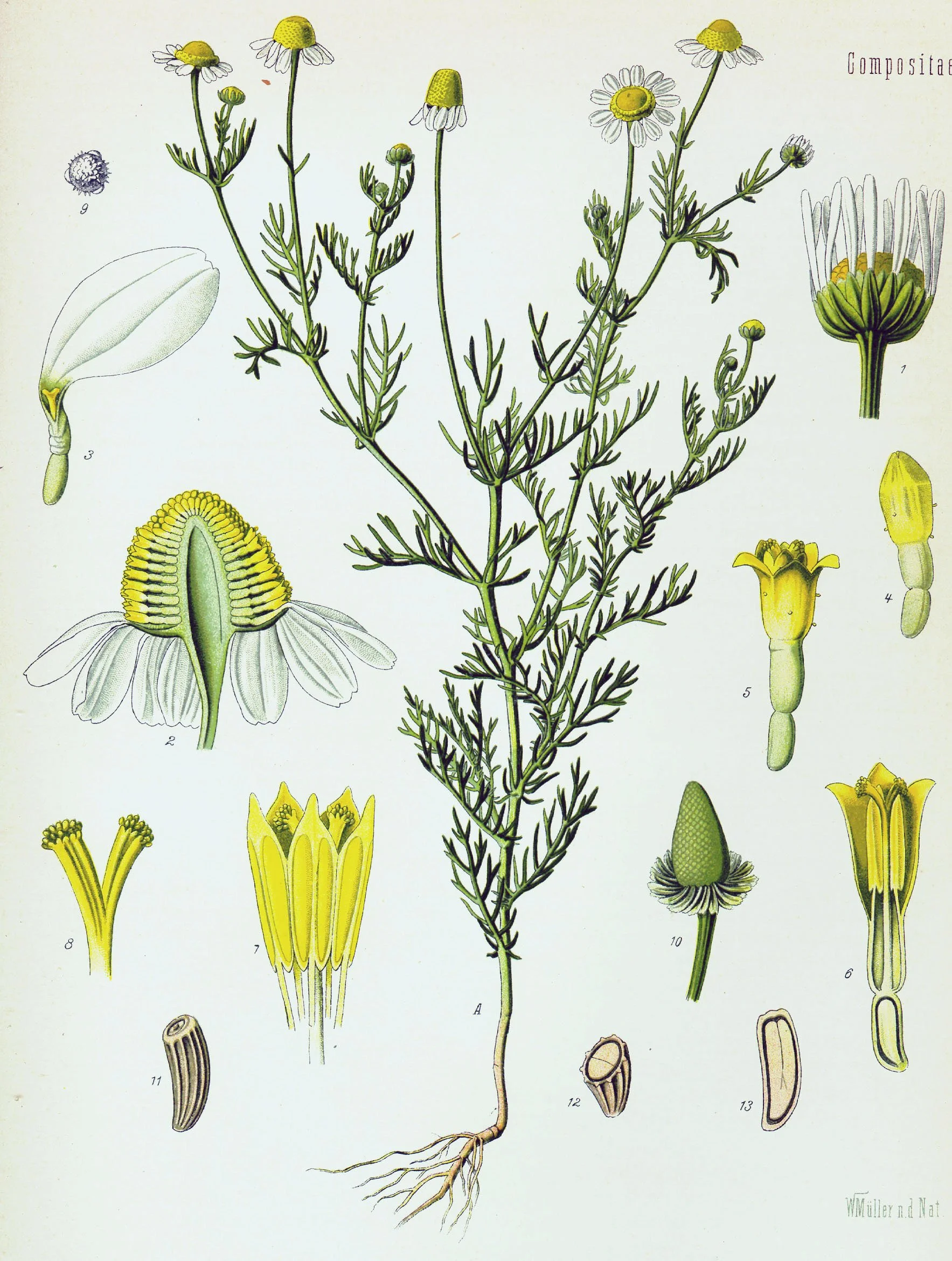
Chamomile whole, in Köhler's Medizinal-Pflanzen: flower heads, feathery leaves, and the hollow cone the sectioned head at left lays open. Dried chamomile flowers are one of this lesson's three study herbs — know the plant whole, and the handful you weigh at 1:5 is a material you can name.
Köhler's Medizinal-Pflanzen (plate 91), via Wikimedia Commons. Public domain.
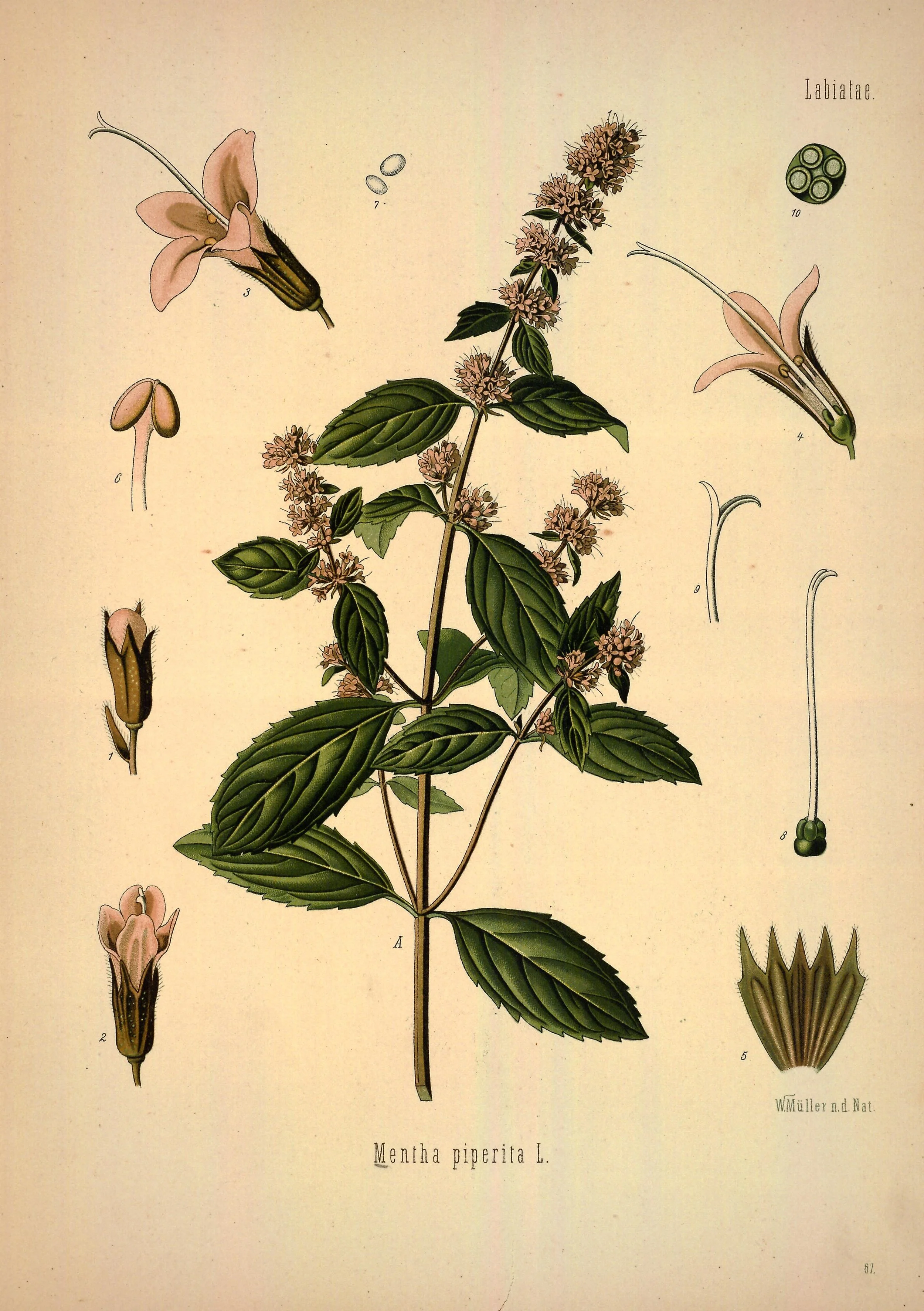
Peppermint, "Mentha piperita L.," in Köhler's Medizinal-Pflanzen (plate 67): toothed leaves in opposite pairs, flower clusters at the axils. Dried peppermint leaf is the first herb this lesson names — lightly bruised, never powdered, so the spirit can reach every surface the plate shows you.
Köhler's Medizinal-Pflanzen (plate 67, Biodiversity Heritage Library copy), via Wikimedia Commons. Public domain.
Everything in its place, before we begin. For this tincture lesson you will need:
Level One — household items
- Dried culinary herb, one small handful: dried peppermint leaf, dried chamomile flowers, or dried rosemary. Choose one. It must be a familiar kitchen herb, plainly labeled, from your own pantry.
- Plain unflavored vodka, the smallest bottle an adult can buy (80 proof / 40% ABV is the standard study strength). The adult purchases, pours, and stores it.
- One clean glass jar with a tight-fitting lid, about one pint (500 ml). No plastic: alcohol and plastic are not laboratory companions.
- A small kitchen scale that reads in grams, or measuring spoons if no scale is available (your ratio worksheet will show both methods).
- A funnel, a fine strainer or cheesecloth, and a second clean jar or amber bottle for the finished preparation.
- Paper labels and a pen, plus your laboratory journal.
- A notebook page ruled for fourteen days: the observation log.
Level Two — historically closer
- High-proof grain spirit (100 proof / 50% ABV) instead of standard vodka, for comparing extraction strength in your notes.
- An amber glass apothecary jar with a ground-glass or tight cork-style stopper, the historical vessel.
- A brass or stone mortar and pestle for lightly bruising the herb before maceration, per Lesson 21.
- Parchment-style labels, tied with string in the archival manner.
Safety Notes
- No flame anywhere near spirit work: alcohol and its vapors ignite easily, and an alcohol flame can be nearly invisible. Stoves stay off and cold for the entire session.
- An adult purchases, pours, and stores all alcohol. Students weigh the herb, write labels, and keep the log.
- Label every jar BEFORE any liquid enters it: contents, date, ratio, and NOT FOR CONSUMPTION in large letters.
- Nothing in this lesson is tasted. Not a drop. Our tinctures are study specimens: observed, recorded, and archived.
- Work in a ventilated room. Store finished preparations sealed, cool, dark, upright, and out of reach of children and pets.
Reflection Questions
Answer the following questions in your workbook.
- Why does alcohol preserve a preparation that water alone would let spoil? Answer in terms of what each liquid offers microbes.
- Explain the British gunpowder proof test in your own words. What was it actually testing, and why would a pre-instrument apothecary trust it?
- Your jar's liquid darkened steadily for ten days, then stopped changing. What does the plateau tell you about the extraction, and what would Professor Muddlenook have you record about it?
- Why press the marc instead of simply discarding the spent solids with their liquid still in them? What laboratory virtue does pressing express?
- A fellow student suggests tasting the tincture, "just one drop," to check its strength. Write Professor Muddlenook's reply, in his voice, with his reasons.
Workbook Checklist — Lesson 32
In my workbook I have:
- ☐ read the Safety Briefing twice and recorded the spirit's six rules — no flame, sealed jars, adults handle the alcohol, label before you pour, nothing tasted, archival storage — with the spill, eye, and emergency responses
- ☐ defined the tincture and the spirit maceration, and set both beside the water and oil extractions with their keeping times
- ☐ read a spirit's strength both ways — proof as twice the ABV — and explained the British gunpowder test, its 57.15 percent point, and its "under proof"
- ☐ completed the ratio worksheet: 20 grams at 1:5, 12 grams at 1:5, and the tablespoon conversion, showing my work
- ☐ built the tincture jar in the procedure's order — label first, herb weighed and bruised, the adult's pour at 1:5, the jar sealed and shelved cool and dark — or worked the workbook path with no spirit handled
- ☐ kept the fourteen-day observation log: daily sealed agitation, color against yesterday, clarity, sediment, and the plateau day given its full sentence
- ☐ decanted, pressed the marc, strained the filtrate, and transferred it to its final jar with a complete label — contents, ratio, spirit, dates, NOT FOR CONSUMPTION
- ☐ written the preservation record: the jar's place, the yearly seal check, the changes watched for, and the household's locked-storage keeper named
☐ Lesson completed Date: ___ Signature: ___
The Professor's Closing Note
Sealed with the teal wax of Professor Crimblebrew Muddlenook, Master Apothecary of the Potions Laboratory, Head of House Meridies.
Fourteen days, one jar, and a log full of honest entries. That is the whole of it, and it is not a small thing.
You have now performed the preparation that built the great apothecary archives: the same maceration, the same ratio language, the same patience, that filled the spirit shelves of four centuries. Your jar will not heal anyone and was never meant to. It will do something better suited to a scholar. It will sit on your shelf, correctly labeled, and prove that you can follow a method exactly, observe without interfering, and record without flattering.
Next we take up the still, where steam and water do the drawing and the rules get stricter. Rest your eyes, scholars. The archive is growing, and so are you.
— Professor Crimblebrew Muddlenook, Potions Laboratory • Master Apothecary • Head of House Meridies
PROFESSOR CRIMBLEBREW MUDDLENOOK
Potions Laboratory
Master Apothecary • Head of House Meridies
Cross-Class Connections

Herbology · Unit IV, Lesson 28 — Drying Herbs the Traditional Way
Come up to the Greenhouse before your herb ever meets the spirit, maceration scholars. Here we hang the bundles and spread the screens: peppermint leaf, chamomile flowers, and rosemary dried the traditional way, judged by crispness, conditioned, and stored in labeled, dated jars in a cool, dark place. Professor Muddlenook's ratios are figured on dried weight — bring me a herb truly dry, and his arithmetic will hold true in your jar.
PROFESSOR BERYL FERNFOOT
Herbology Greenhouse • Master Herbalist • Head of House Oriens
Scrollwork · Unit VI, Lesson 23 — Archive Labels & Library Systems
You label one jar before you pour, and you are right to. In my Scriptorium we label, list, and shelfmark whole collections, and the rule is the same at every scale: a thing that cannot be found and named is a thing that does not exist. Bring your archive label's care with you — contents, dates, and provenance written plainly — and we will show you the titulus, the shelfmark, and the catalog that let a library remember for centuries.
PROFESSOR QUILLBERRY NOCTURNE
Scrollwork Library

Creative Arts · Unit IV, Lesson 16 — Printmaking, Stamps & the Label Station
Your tincture deserves a label that will still be legible when the archive opens that jar in ten years, scholars. In my workshop we cut the stamp, ink the block, and run the label station in order — and one of this lesson's own assessed batches is a set of jar labels for Professor Muddlenook's stores. Design backward, print with the whole hand, rack the run to dry, and leave the station reset and ready. A label is a small promise. We make promises carefully here.
PROFESSOR COGBRANCH TIMBERCLANK
Creative Arts Workshop
Further Reading & Sources
- Paracelsus — Encyclopaedia Britannica: life and work of the Swiss physician (1493–1541) who made alcohol extraction central to pharmacy.
- Paracelsus — Wikipedia: overview of his chemical medicine, laudanum, and the reintroduction of opium preparations to Western Europe.
- Science History Institute: museum and library of the history of chemistry, including early modern pharmacy and distillation.
- Wellcome Collection: London museum and library holding one of the world's great apothecary and medical history collections.
- U.S. National Library of Medicine: historical pharmacopoeias and the history of pharmacy, including early tincture formulas as historical documents.
- Colonial Williamsburg — The Apothecary: living-history apothecary shop demonstrating 18th-century preparation methods.
Browse the Potions shelf in the school Library for readable editions of these works.
LESSON 32 · TINCTURES
Try It in the Laboratory
The lesson taught the tincture as a study specimen. Here the same method wears its kitchen clothes — vanilla, citrus, mint, coffee, cacao — real extracts for real baking, with the spirit stored like a spirit.
— Professor Crimblebrew Muddlenook, Potions Laboratory
Submit your work for this lesson using the form below.
CONTINUE IN THE POTIONS LABORATORY
← Previous · Lesson 31: Resin Fusion Next · Lesson 33: Distillation & Hydrosols →
Unit IV — Botanical Extractions Potions Laboratory — All 52 Lessons
The rest of Unit IV: Lesson 26 · Infused Lipids · Lesson 27 · Hydro-Infusions · Lesson 28 · Glycerites & Syrups · Lesson 29 · Decoctions · Lesson 30 · Herbal Acetums · Lesson 31 · Resin Fusion · Lesson 33 · Distillation · Lesson 34 · Extraction Ledger