
POTIONS
Unit IV · Lesson 27HYDRO-INFUSIONS
Professor Crimblebrew Muddlenook
Master Apothecary • Potions
Head of House Meridies • School of Evershade
Professor's Introduction

Sealed with the teal wax of Professor Crimblebrew Muddlenook, Master Apothecary of the Potions Laboratory, Head of House Meridies.
Precisely on time. Good. Lesson 26 gave us the infused oils, the slow and patient work of lipids. Today we turn to the swiftest solvent — a liquid able to dissolve or draw out other materials — in the laboratory: water.
Every extraction you will ever perform is a negotiation between a material and a menstruum. You learned the word menstruum — the liquid that does the extracting — in Lesson 19: the liquid medium that carries compounds out of a material. You learned maceration — soaking a prepared botanical in liquid at room temperature so its compounds pass into the liquid — in Lesson 23: the soaking method by which that transfer happens. Today water becomes the menstruum, steeping becomes the procedure, and the preparation you make is called an infusion (steeping a botanical in liquid so its soluble compounds pass into the liquid). Say the chain aloud until it is automatic: menstruum, method, preparation. Water, steeping, infusion. That is the grammar of everything we do from here forward.
Water was the first extraction solvent in human history, and it remains the most honest one. It hides nothing. What it takes from a plant, it shows you in color and fragrance within minutes. But water is also particular. It takes quickly from the delicate and slowly from the dense. It carries fragrance away on steam if you let it. And it punishes carelessness with bitterness. Today you will learn its terms.
Kettle, jars, and journal, scholars. Everything in its place.
— Professor Crimblebrew Muddlenook, Potions Laboratory • Master Apothecary • Head of House Meridies
Potions map — the class base map, unmarked for this lesson.
Lesson Objectives
By the end of this lesson, you will be able to:
- Use the canonical definition of infusion from Lesson 26, and distinguish it from maceration, decoction, and tincture
- Explain why delicate botanicals such as flowers and leaves extract quickly in water while dense materials such as roots and bark resist it
- Describe how temperature changes extraction speed, volatile compound retention, and tannin release
- Compare a hot infusion and a cold infusion of the same botanical, and record the differences systematically
- Prepare a simple steeped floral water, and explain how it differs from a distilled hydrosol
- Describe moisture interaction: how dried material rehydrates in water before extraction properly begins
Reading this lesson: ★ marks the passages to remember. They set the infusion standard this lesson is assessed by, and they return in the Unit IV Quiz and at the class test. Check in questions ask the material back as you go; answer them in your workbook when you meet them.
Working this lesson: Your assignment packet is the first download on this page. Work in it as the lesson moves along, answering each exercise as its subject is taught — or read the lesson through for your notes and take the exercises as homework afterward. Both are proper ways to sit this class. Signposts in the reading tell you where each exercise belongs. Written answers are short answers in your own words; a few honest lines are worth more than a filled page.
Your Assignment Packet
This lesson's exercises live in its packet: the Lexicon Handout (every term, course terms marked ◆), Materials, Guided Practice — the Two-Jar Comparison procedure, printed in full so you can work it step by step at your own bench — the Assignment Manual with its self-check, the Reflection Questions, and the Workbook Checklist. Download the packet before you begin and keep it beside you as you read.
About this lesson's quiz, plainly: the packet's Answers & Self-Check carries the genuine Lesson Quiz key from the course's own assignment packet — seven multiple-choice and five true/false questions, with their answers — together with the genuine key points for the Reflection Questions. The quiz itself is harvested for the Unit IV Quiz pool; it is not printed on this page, and no answers appear here.
Safety Briefing
Read this section completely before touching any materials. Professor Muddlenook's first rule of the laboratory is that no procedure begins until the safety briefing is understood.
Hot water and steam. This lesson uses water at or near boiling. Water at a full boil causes serious scald burns in seconds, and steam burns are worse than the water itself because steam carries more heat energy. Keep your face and hands away from the spout of a kettle and from rising steam. Pour slowly, with the vessel held steady on a flat surface. Never carry a full kettle across the room while it is steaming.
Thermal shock. Ordinary thin glass, decorative jars, and cold glassware can crack or shatter when boiling water is poured into them. This is called thermal shock, and it can throw scalding water across the bench without warning. Use only heat-safe vessels for hot infusions: a metal pot, a ceramic mug, a porcelain teapot, or laboratory borosilicate glassware. If a vessel is not marked heat-safe, do not pour boiling water into it.
Adult supervision. Any use of a kettle, stove, or microwave for heating water must be done by or with an adult. Younger scholars: an adult handles all boiling water. Your work begins when the water is safely in the jar.
Labeling. Two jars of plant material in water can look identical within an hour. Label each jar before you begin: botanical name, preparation (hot or cold), date, and time. Unlabeled jars are discarded at the end of the session. This is not punishment. It is the law of the laboratory.
A standing rule for this class. Nothing in the Potions Laboratory is ever presented as medicine, and no lesson will ever give you amounts to take. We study how materials behave, how they were used historically, and how to handle them safely. Botanicals used in the exercises must be ordinary culinary herbs from your own kitchen, confirmed by an adult. Never taste, chew, or ingest any plant material you cannot positively identify as an ordinary kitchen herb.
Check in: A jar is pretty, thin glass, and unmarked. May boiling water go into it — and what is the failure called if it does?
❦ In your workbook: record the safety briefing in your own way — the steam rule, the heat-safe vessels, the adult's part, the labels, and the standing rule that nothing here is medicine — copy, sketch, or note what matters.
Water: The First Menstruum
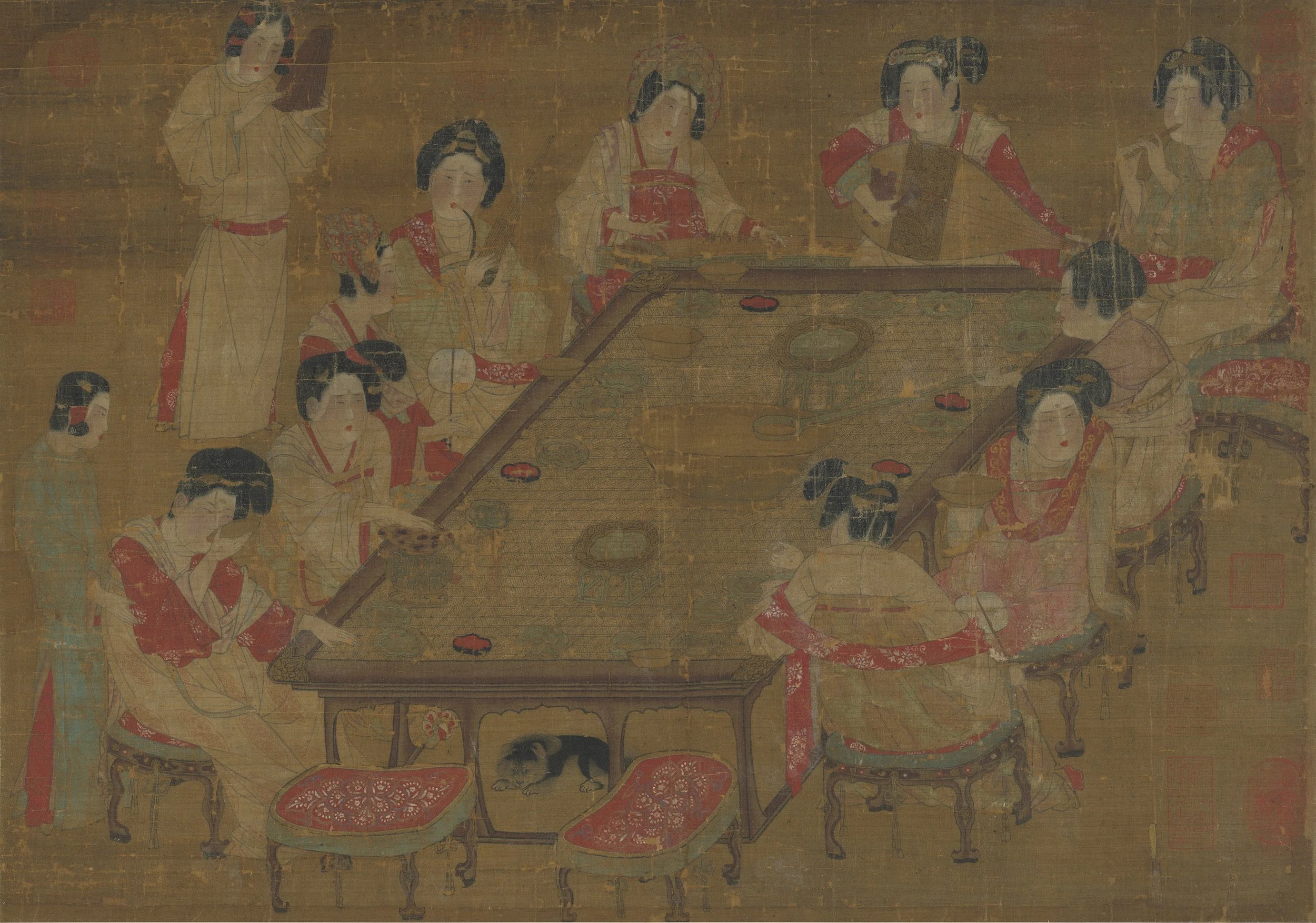
A Palace Concert, Tang dynasty: court ladies around a table, cups raised, musicians playing. By Lu Yu's century, tea in China was already a discipline of water temperature, leaf proportion, and timing — the most documented infusion tradition in the archive, and the one your two jars repeat.
A Palace Concert (宮樂圖), anonymous Tang-dynasty artist, National Palace Museum, Taipei, via Wikimedia Commons. Public domain.
Long before there were tinctures, long before alcohol was distilled for the laboratory, there was hot water poured over leaves. The earliest extraction method in human history is also the simplest: put plant material in water, wait, and strain.
The most documented tradition is tea. By the Tang dynasty in China, tea drinking was already a formalized practice, and around 760 CE the writer Lu Yu composed the Classic of Tea, a complete treatise on growing, preparing, and drinking it. That is more than twelve centuries of recorded infusion practice for a single plant, and the method at its heart is the one you will use today: heated water, leaf material, time, and a strainer.
The word tisane, used for herbal infusions, traveled through French from older roots reaching back to a Greek word for a barley drink. Apothecaries across Europe prepared tisanes of chamomile, mint, and countless other botanicals, and the household teapot and the laboratory beaker have never been far apart. When you set a jar of chamomile to steep, you are repeating one of the oldest procedures in the archive.
Water earned its place because it is the universal starting solvent. It is available everywhere, it costs nothing, it leaves no residue, and it extracts a wide range of compounds: pigments, tannins, sugars, acids, and many aromatic compounds. Its great limitation is also its honesty. Water cannot dissolve oils and waxes well, it encourages spoilage because microbes love it too, and a water preparation keeps for hours or days, not months. Every menstruum you study after this one exists partly to solve a problem water could not.
Check in: What range of compounds does water extract — and what are the two limits that every later menstruum exists partly to solve?
❦ In your workbook: record water the first menstruum in your own way — Lu Yu and the Classic of Tea, the tisane's road from a Greek barley drink, and water's honesty and its limits — copy, sketch, or note what matters.
What "Infusion" Means
Lesson 26 gave this course its canonical definition of infusion, and it stands for the whole course. Here it is again as the reference for this lesson.
Infusion
See the canonical definition in Lesson 26 (Infused Lipids). In this lesson's context, the menstruum is water: a water steep, hot or cold, with the material strained from the liquid.
Now place it in the grammar you learned in Lesson 23. Maceration is the method: soaking a prepared botanical in a menstruum at room temperature so compounds pass into the liquid. Water is one possible menstruum. When water is the menstruum and steeping is the procedure, the preparation is called an infusion. Menstruum, method, preparation. Water, steeping, infusion. When the menstruum is water, the course records the preparation under its proper name, the hydro-infusion.
Two distinctions will keep you out of trouble for the rest of the unit:
Infusion is not maceration in general. Maceration is the broad method and it applies to any menstruum. An oil maceration gives you an infused oil, which you studied in Lesson 26. A water maceration, hot or cold, gives you an infusion. Use the precise word for the precise preparation.
★ Infusion is not decoction. A decoction, which you will study in Lesson 29, is made by simmering dense materials such as roots and bark in water over sustained heat. Infusions are steeped. Decoctions are simmered. Delicate flowers and leaves get infusions. Dense roots and bark get decoctions. If you simmer chamomile flowers the way you simmer burdock root, you will destroy the very compounds you wanted and extract a harsh bitterness instead. The material dictates the method. That is one of the standing laws of this laboratory.
Check in: Water is the menstruum and steeping is the procedure. What is the preparation called — and what single change of procedure would turn the work toward a decoction instead?
❦ In your workbook: record what infusion means in your own way — the chain menstruum, method, preparation, and the two distinctions that keep the words precise — copy, sketch, or note what matters.
Extraction Speed: Why the Delicate Yield First
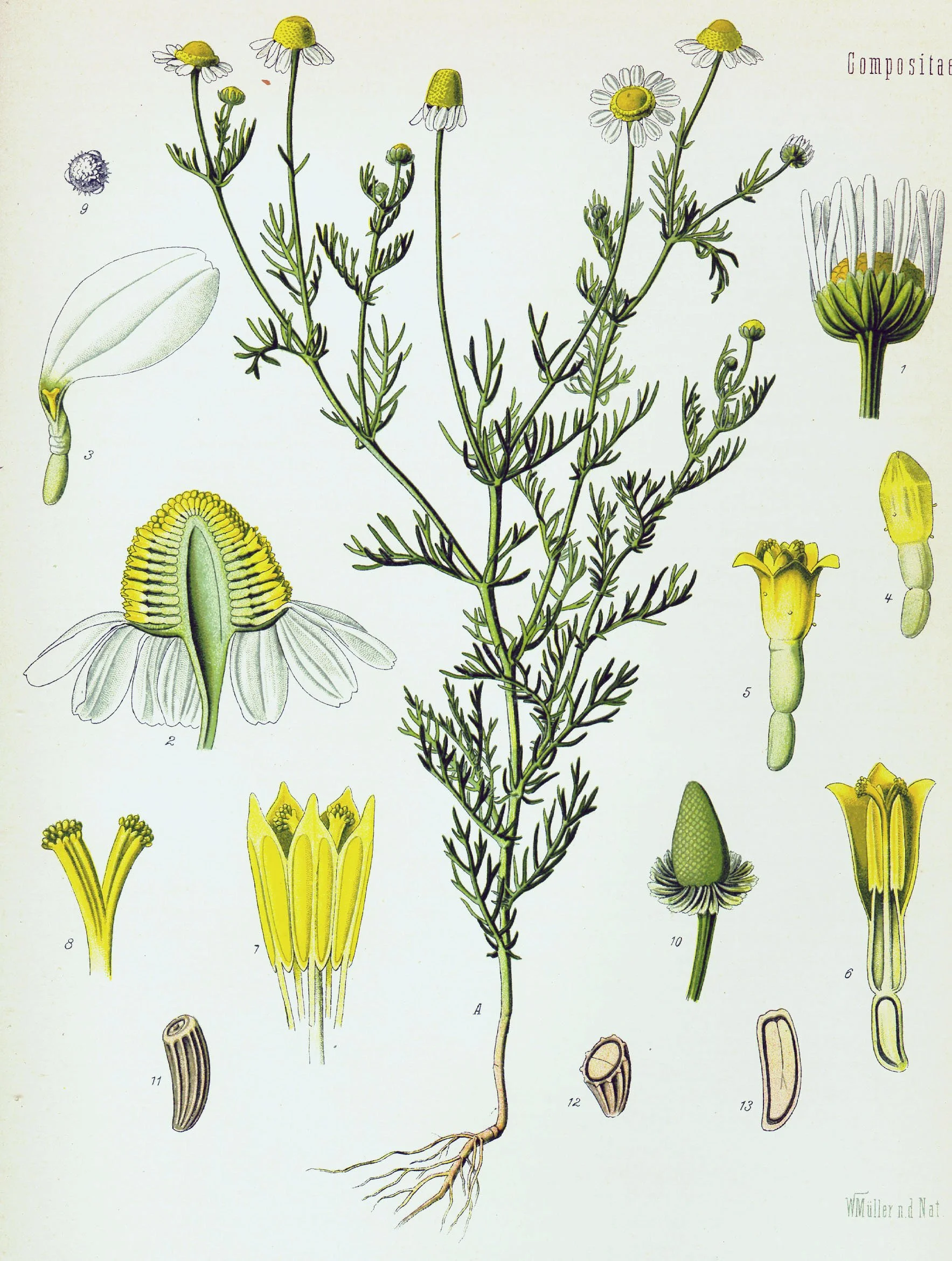
Chamomile, from Köhler's Medizinal-Pflanzen: the delicate botanical of this lesson drawn whole — thin leaves, flower heads in section, the hollow receptacle at the head's heart. Water reaches a flower like this in moments; that is extraction speed drawn before it is measured.
Matricaria recutita plate, Köhler's Medizinal-Pflanzen, via Wikimedia Commons. Public domain.
In Lesson 23 you prepared one botanical three ways: whole, crushed, and powdered, and you predicted how each would behave in extraction. Today you will see the deeper principle behind those predictions.
Extraction speed in water depends on how quickly water can reach the compounds and how quickly those compounds can travel out. Three factors govern this:
Structure. Flowers and leaves are thin, with large surface area relative to their mass and delicate cell walls. Water penetrates them almost immediately. Roots and bark are dense, with thick walls and compact tissue. Water must work its way in layer by layer. This is why a peppermint leaf gives up its character in three minutes while a cinnamon stick is still negotiating after thirty.
Compound location. In delicate botanicals, many of the interesting compounds sit near the surface: volatile compounds in tiny glands on leaves and petals, pigments in thin tissues. Water reaches them without a journey. In dense materials, the compounds are locked deeper inside, and water must travel to fetch them.
Preparation. Everything you learned about grinding in Lessons 7 and 21 applies here. Crushing or cutting a botanical increases its surface area and shortens water's journey. But there is a limit, and it matters: powder a delicate flower too finely and you will create a cloudy infusion full of sediment that no strainer fully clears. Match the preparation to the material. Delicate botanicals want a coarse hand, not a powder.
★ The practical rule: infusions are the preparation for delicate materials. Flowers, leaves, and soft aerial parts steep. Roots, bark, seeds, and resins simmer, and they belong to Lesson 29. When a material resists water, the answer is not more steeping time. It is a different preparation.
Check in: Name the three factors that govern extraction speed — and state the practical rule for a material that resists water.
❦ In your workbook: record extraction speed in your own way — structure, compound location, preparation, and the coarse hand a delicate flower wants — copy, sketch, or note what matters.
In your packet: Exercise I — The Two-Jar Comparison ⚒ begins here. Work it now, or mark the place and take it as homework — your choice.
Temperature Sensitivity
Temperature is the great lever of extraction. It changes everything, and it charges a price for every change.
Heat accelerates extraction. Warm water moves its molecules faster, penetrates plant tissue more quickly, and dissolves compounds more readily. A hot infusion reaches in minutes what a cold infusion needs hours to accomplish. This is the reason hot infusions are the default: they are fast, and the laboratory values an honest day's work done efficiently.
★ Heat drives off volatile compounds. Here is the price. The volatile compounds you studied in Lesson 16 are called volatile because they evaporate readily, and heat is evaporation's greatest ally. Pour boiling water over fresh peppermint and the first fragrant breath that rises from the cup is fragrance leaving the preparation forever. Some of it stays dissolved. Much of it rides the steam away. This is why Muddlenook insists that hot infusions be covered while they steep: the lid is not decoration. It traps the steam, lets it condense, and returns a portion of the volatile compounds to the liquid instead of surrendering them to the air.
Heat extracts tannins. Tannins, whose canonical definition lives in Scrollwork's ink lesson, are astringent plant compounds that water pulls from botanicals slowly. Gentle heat and short steeping keep them modest. Prolonged heat, boiling, or steeping for too long pulls them in quantity, and the result is the harsh, dry bitterness of an over-steeped cup. Bitterness in an infusion is almost always a temperature or time error, not a material error. The plant did nothing wrong. The procedure did.
Cold preserves but waits. A cold infusion, made with room-temperature or cool water over several hours, extracts slowly and gently. It takes far less of the volatile compounds into the air because there is little evaporation, so delicate fragrances survive that heat would have carried away. The trade is time: what heat does in five minutes, cold water does in four to twelve hours. Cold infusions also extract fewer tannins, which is why they taste smoother and less bitter.
★ The working rule of the laboratory: use the lowest temperature and the shortest time that accomplish the extraction. Delicate flowers and aromatic leaves want hot but not violent water and a brief steep. Save sustained heat for the dense materials of Lesson 29.
Check in: Heat charges two prices. What are they — and what does the laboratory's working rule tell you to use instead of more heat?
❦ In your workbook: record temperature sensitivity in your own way — heat's speed, the volatile compounds it drives off, the tannins it pulls, and cold's patient trade — copy, sketch, or note what matters.
Moisture Interaction: The Dry Leaf Drinks First
Your comparison uses a dried botanical, and dried material behaves differently from fresh in one important way: before extraction can begin in earnest, the material must rehydrate.
A dried leaf is a collapsed structure. Its cells have shrunk, its tissues have folded, and water must first enter and swell them before compounds can travel out in any quantity. Watch a spoonful of dried chamomile hit hot water: for the first minute it floats, pale and unyielding, and then it darkens, sinks, and begins to release color. That first minute is rehydration, not extraction. The preparation has barely started.
Fresh material skips this step entirely. Its tissues are already full of water, so extraction begins the moment it meets the menstruum. This is one reason fresh and dried versions of the same plant behave like different materials in the laboratory, and why your archive records must always note which one you used.
★ Two consequences follow for your procedure. First, give dried material a head start: a brief longer steep than you would give fresh, or water just off the boil so rehydration happens quickly. Second, never judge an infusion's strength in the first minute. The color you see at sixty seconds is mostly the material waking up. The honest reading comes later.
Check in: What is the first minute of a dried botanical in hot water actually doing — and why must the honest reading wait?
❦ In your workbook: record moisture interaction in your own way — the collapsed dry leaf, rehydration before extraction, and the two consequences for your timing — copy, sketch, or note what matters.
The Procedure: The Two-Jar Comparison
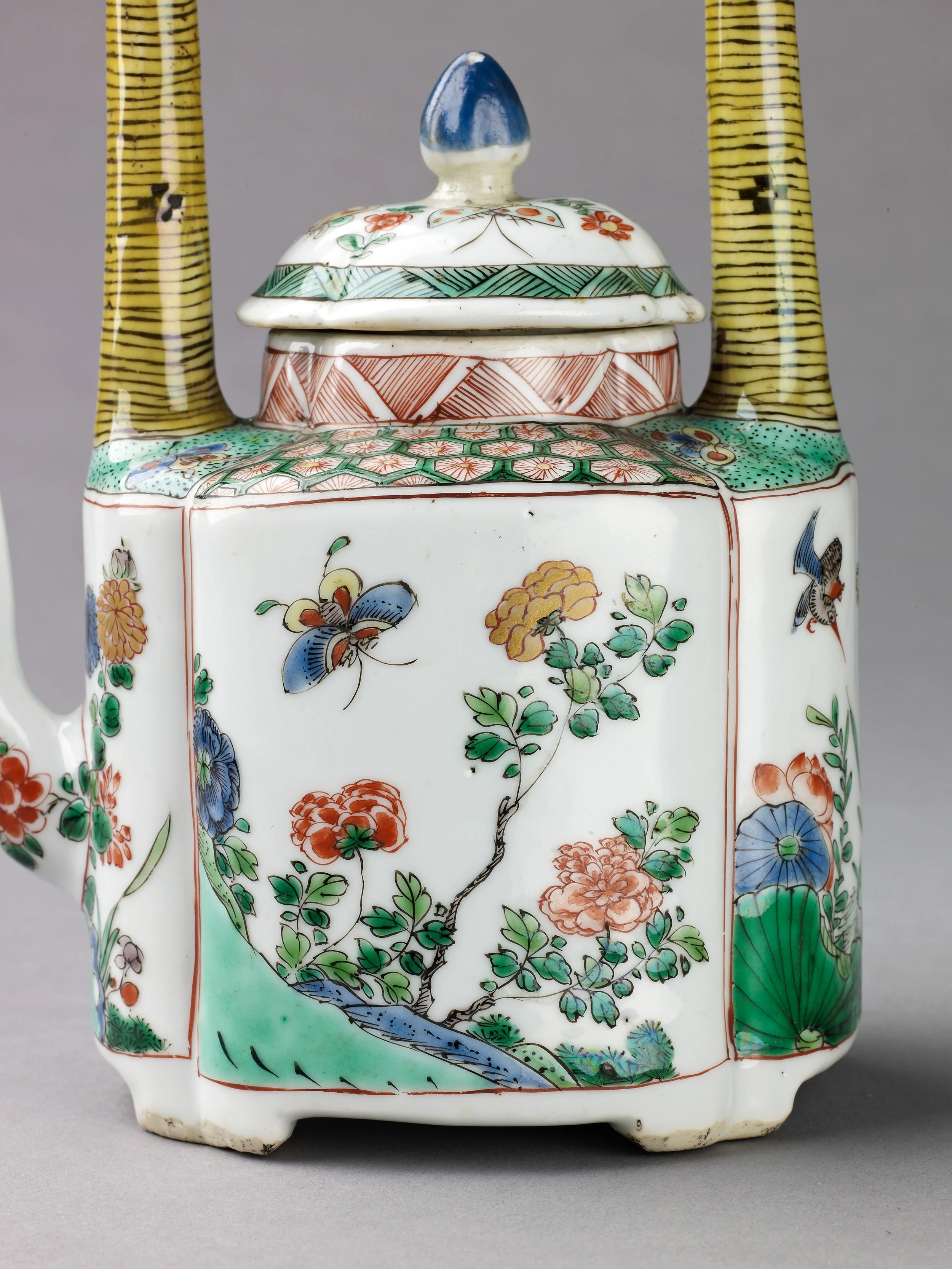
The classic infusion vessel, in porcelain: a covered pot, Kangxi period, painted with flowers and butterflies. The lesson of the lid stands on top of it — cover a hot infusion, and the steam condenses and returns a portion of the volatile compounds to the liquid instead of surrendering them to the air.
Small covered wine pot or teapot, Chinese, Qing dynasty, Kangxi period (1662–1722), The Metropolitan Museum of Art (Robert Lehman Collection, 1975; object 1975.1.1733), via Wikimedia Commons. CC0.
You will now make two infusions of the same botanical, identical in every way except temperature, and observe what temperature alone changes.
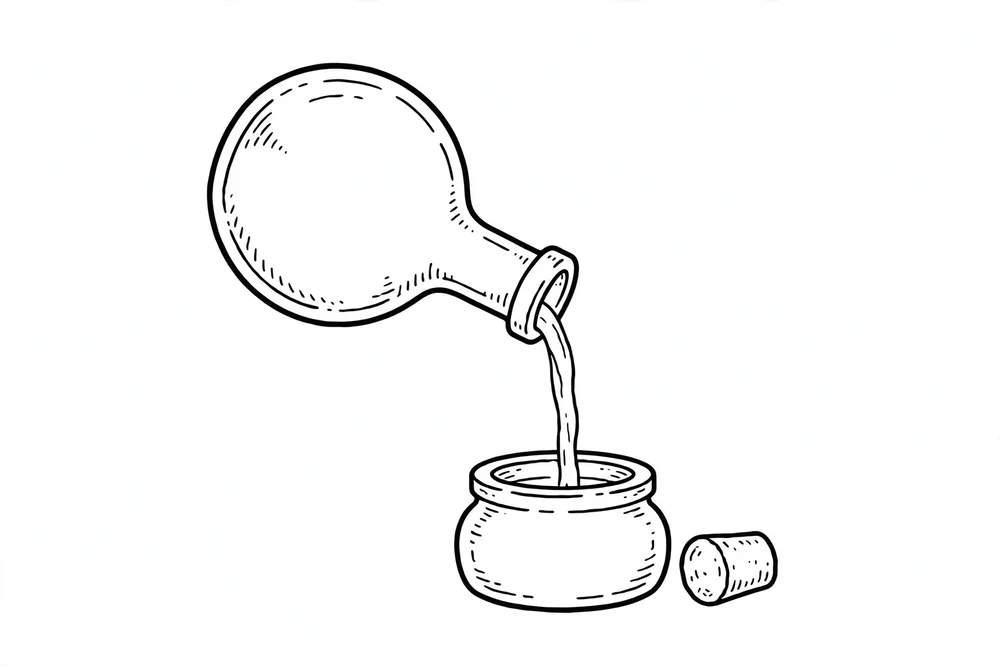
Step 1 — Label. Label your two jars before anything else: botanical name, HOT, date, time on one; botanical name, COLD, date, time on the other. Place both on the tray.
Step 2 — Portion. Place an equal spoonful of your dried botanical into each jar. Equal portions are the foundation of the comparison. If the jars do not start identical, nothing you observe later means anything.
Step 3 — The hot jar (adult required). An adult brings water to a boil, then lets it rest briefly so it is just off the boil. The adult pours the hot water over the botanical in the HOT jar, filling it. Cover the jar immediately with its lid or a saucer. Start your timer. Note the exact time in your journal.
Step 4 — The cold jar. Pour room-temperature water over the botanical in the COLD jar, filling it to the same level. Cover it as well. Note the time.
Step 5 — Observe on schedule. At 5 minutes, 15 minutes, and 30 minutes, observe both jars without opening them. Record color, clarity, and any fragrance you can detect at the lid's edge. At 30 minutes, strain a small amount of each into a clear glass and compare side by side. Record everything.
Step 6 — Extended observation (optional). Leave the cold jar covered for 4 hours or overnight in a cool place, then observe again. This is the cold infusion showing its full character.
Step 7 — Cleanup. Strain both jars through your strainer or muslin. Compost or discard the spent material. Wash the jars, the strainer, and the tray. Wipe the work surface. File your observation notes in your potions journal under this lesson's entry.
Cover the hot jar, scholars. Every wisp of steam escaping past the lid is fragrance you will never get back. The lid is the cheapest piece of laboratory equipment you own, and today it does the most work.
— Professor Crimblebrew Muddlenook, Potions Laboratory • Master Apothecary • Head of House Meridies
Check in: The two jars must start identical in everything but one thing. What is the one thing — and what makes every later observation meaningless if it is not held?
❦ In your workbook: record the Two-Jar Comparison in your own way — label first, equal portions, the covered hot jar, the three observation times, and the cleanup that files the notes — copy, sketch, or note what matters.
In your packet: Guided Practice — the Two-Jar Comparison, printed in full, begins here. Work it now, or mark the place and take it as homework — your choice.
Cleanup
Strain all remaining liquid from both jars. Compost the spent botanical material or discard it with household waste. Wash the jars, lids, strainer, measuring spoons, and tray in hot soapy water, rinse, and dry. Wipe the work surface. Return every tool to its labeled place. Check your labels one final time and file your observation sheets in your potions journal. The laboratory is not finished when the procedure ends. It is finished when it is ready for the next procedure.
Check in: When is the laboratory finished — at the end of the procedure, or at another moment the lesson names?
❦ In your workbook: record the cleanup in your own way — strain, wash in hot soapy water, return every tool to its labeled place, and file the observation sheets — copy, sketch, or note what matters.
Steeped Floral Waters
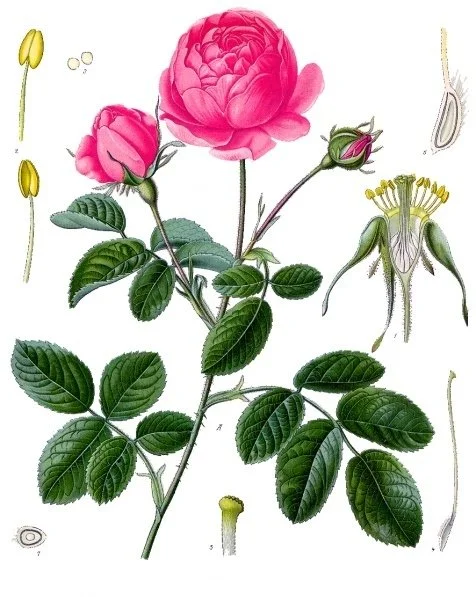
Rosa centifolia, from Köhler's Medizinal-Pflanzen: the rose of the floral waters. Steeped in hot water, covered, and strained, its petals yield this lesson's honest preparation — a steeped floral water, kept briefly, and not the distilled hydrosol that waits for Lesson 33.
Rosa centifolia plate, Köhler's Medizinal-Pflanzen, via Wikimedia Commons. Public domain.
A floral water is water that has taken up the fragrance and character of flowers. The simplest kind is made exactly as you made your hot infusion: petals steeped in hot water, covered, strained. Rose petals, chamomile flowers, and lavender buds all yield pleasant steeped floral waters, and for centuries households made them this way for scenting linens and workrooms.
★ Understand clearly what this is and what it is not. A steeped floral water is a simple infusion of flowers, and like all water preparations it keeps only briefly. It is not the same as a distilled hydrosol. A hydrosol is produced by distillation: steam passes through botanical material, carries the volatile compounds with it, and condenses into a fragrant water. That is a different apparatus, a different procedure, and a different lesson. You will study distillation and hydrosols properly in Lesson 33. Do not attempt distillation at home without the lesson's guidance and an adult's supervision. For today, the steeped floral water is the honest preparation, and it is enough.
Check in: A steeped floral water and a distilled hydrosol both carry a flower's fragrance. What procedure separates them — and what must you not attempt at home before Lesson 33?
❦ In your workbook: record steeped floral waters in your own way — petals steeped, covered, strained, kept briefly, and the bright line between steeping and distillation — copy, sketch, or note what matters.
In your packet: Exercise II — The Steeped Floral Water ⚒ begins here. Work it now, or mark the place and take it as homework — your choice.
A Note on Tea Culture
Because tea is the most studied infusion in history, a word on its manners is in order. In China, where the Classic of Tea was written some twelve centuries ago, tea preparation became a discipline of water temperature, leaf proportion, and timing, with different teas demanding different handling. Green teas, being delicate, were treated gently. Darker, denser teas took hotter water and longer steeping. The pattern should sound familiar: delicate materials steeped, dense materials given more heat and time. The apothecary and the tea master discovered the same law from opposite ends of the world. Delicacy sets the method. It always has.
Check in: The tea master and the apothecary discovered the same law. State it in the lesson's own closing words for this section.
❦ In your workbook: record the tea culture note in your own way — temperature, proportion, and timing as a discipline, and delicacy setting the method — copy, sketch, or note what matters.
Guided Observation: Reading the Two Jars
Here is what a careful comparison typically shows, and what each difference means:
Color. The hot jar colors faster and darker. Heat accelerates the movement of pigments into the water. The cold jar stays pale far longer, then deepens slowly. If your hot jar is dramatically darker at 30 minutes, you are seeing extraction speed made visible.
Fragrance. The hot jar smells stronger at first, then the fragrance fades as volatile compounds escape with the steam, especially if the jar was left uncovered. The cold jar smells fainter but the fragrance that develops is often described as fresher or greener, because fewer volatile compounds were driven off. Smell is evidence. Record it in words, not in grades.
Clarity. Both jars should be reasonably clear after straining. Cloudiness in either jar usually means the botanical was powdered too finely or agitated too roughly. Note it, and remember the lesson for next time: delicate botanicals want a coarse hand.
Taste (adult-confirmed kitchen herbs only). If an adult has confirmed your botanical is an ordinary culinary herb from your kitchen, you may taste a cooled spoonful of each for observation purposes. The hot infusion is typically stronger and may carry a bitter edge from tannins. The cold infusion is typically smoother, lighter, and less bitter. This is temperature sensitivity made tangible: the same plant, the same water, two different preparations, separated only by heat and time.
Write your conclusion in one paragraph: which preparation extracted faster, which preserved fragrance better, which showed more bitterness, and what you would choose for a delicate flower versus a sturdy leaf. File it in the archive. A comparison without a written conclusion is just two jars of brown water.
Consider:
- Which of the four readings — color, fragrance, clarity, taste — changed most between your jars, and which lesson principle explains that change?
- Your cold jar's fragrance is described as fresher or greener. What did the cold water not do, and why does that preserve the fragrance?
- Cloudiness appears in one jar only. What two causes does the lesson name, and which fits your procedure?
❦ In your workbook: record the guided observation in your own way — the four readings, what each difference means, and your one-paragraph conclusion filed in the archive — copy, sketch, or note what matters.
Materials
A meticulous laboratory begins with everything gathered before work starts. Assemble the following.
Level One — household items:
- A kettle or a heat-safe pot for boiling water (adult handles this)
- Two identical clear, heat-safe jars or mugs with lids or saucers to cover them
- One dried culinary botanical from your kitchen: chamomile flowers, peppermint leaves, lemon balm leaves, or dried rose petals. Choose one and use it for the whole comparison. An adult must confirm it is an ordinary kitchen herb.
- Measuring spoons for consistent portions
- A timer or a clock you can read easily
- A fine strainer, tea strainer, or a square of clean muslin
- A tray to contain the work area
- Your laboratory journal or potions journal pages, and a pencil
Level Two — historically closer:
- Borosilicate glass beakers (heat-safe laboratory glassware) instead of mugs
- A porcelain teapot with an infuser basket, the classic infusion vessel
- A laboratory thermometer for recording water temperature at each step
- Muslin squares and string for tying traditional infusion bundles
- Spring water rather than tap water, so mineral content does not vary between trials
From the Original Assignment Packet — Its Materials Notes, Verbatim
The original packet prints its own materials wordings beside the lesson's Mise en Place; they are carried here exactly as sourced, and the lesson's lists above govern where the two differ in phrasing:
- A kettle or a heat-safe pot for boiling water. An adult handles all boiling water in this lesson.
- Two identical clear, heat-safe jars or mugs, with lids or saucers to cover them. They must be marked heat-safe: no thin decorative glass.
- One dried culinary botanical from your kitchen: chamomile flowers, peppermint leaves, lemon balm leaves, or dried rose petals. One botanical for the whole comparison, confirmed by an adult.
- Measuring spoons for keeping the two portions exactly equal.
- A timer or a clock you can read easily for the 5, 15, and 30 minute observations.
- A fine strainer, tea strainer, or a square of clean muslin for straining.
- A tray to contain the work area, and your laboratory journal or potions journal pages, and a pencil.
- Borosilicate glass beakers: true heat-safe laboratory glassware instead of mugs.
- A porcelain teapot with an infuser basket, the classic infusion vessel.
- A laboratory thermometer for recording water temperature at each step of the comparison.
- Muslin squares and string for tying traditional infusion bundles.
- Spring water rather than tap water, so mineral content does not vary between trials.
Safety Notes
The original assignment packet's own safety notes, carried beside the briefing above:
- Water at a full boil causes serious scald burns in seconds, and steam burns are worse than the water itself. Keep your face and hands away from kettle spouts and rising steam. Pour slowly with the vessel steady on a flat surface.
- Never pour boiling water into thin, decorative, or cold glassware: thermal shock can shatter it without warning. Use only vessels marked heat-safe: a metal pot, ceramic mug, porcelain teapot, or borosilicate laboratory glass.
- An adult must handle all boiling water in this lesson. Younger scholars begin their work when the water is safely in the jar.
- Label both jars before you begin: botanical name, HOT or COLD, date, and time. Unlabeled jars are discarded at the end of the session.
- Use only ordinary culinary herbs from your own kitchen, confirmed by an adult. Never taste, chew, or ingest any plant material you cannot positively identify. Nothing in the Potions Laboratory is ever presented as medicine, and no lesson gives amounts to take.
Reflection Questions
Answer the following questions in your workbook.
- Muddlenook calls water "the most honest" menstruum. In your own words, what does he mean, and what are water's two great limitations as a menstruum?
- Explain the trade-off of heat in extraction: what does higher temperature gain for the apothecary, and what price does it charge?
- Why must dried material rehydrate before extraction properly begins, and what does this mean for how you time an infusion of dried botanicals?
- Your hot jar is darker and more bitter than your cold jar of the same herb at 30 minutes. Account for both differences using this lesson's principles.
- Why does this lesson teach steeped floral waters but defer distilled hydrosols to Lesson 33?
Workbook Checklist — Lesson 27
In my workbook I have:
- ☐ read the Safety Briefing completely before touching any materials — hot water and steam, thermal shock, adult supervision, labeling, and the standing rule
- ☐ said the chain aloud until it is automatic: menstruum, method, preparation — water, steeping, infusion
- ☐ recorded the two distinctions: infusion is not maceration in general, and an infusion is steeped where a decoction is simmered
- ☐ labeled both jars before beginning — botanical name, HOT or COLD, date, and time — and portioned the dried botanical equally
- ☐ observed both jars at 5, 15, and 30 minutes without opening them, recording color, clarity, and fragrance at each interval
- ☐ strained a small amount of each at 30 minutes, compared them side by side, and written the one-paragraph conclusion
- ☐ recorded a steeped floral water's fragrance at its four stages, and written three sentences on how it differs from a distilled hydrosol
- ☐ created my Infusion Ledger page with its ten columns and filled one complete row from the Two-Jar Comparison
☐ Lesson completed Date: ___ Signature: ___
The Professor's Closing Note
You began this unit preparing materials. Today you transformed one. That is the threshold this unit exists to cross: from keeping the archive to changing it.
Carry three sentences forward. Water is the most honest menstruum — the liquid that does the extracting — because it shows you what it takes. Temperature is the lever that changes every extraction (drawing compounds out of a material with a liquid), and it always charges a price. And the material dictates the method: delicate things steep, dense things simmer, and the apothecary's first skill is knowing which is which.
Next lesson, we leave water behind for a gentler menstruum and study the glycerites and syrups. Until then, keep your jars labeled and your lids on.
— Professor Crimblebrew Muddlenook, Potions Laboratory • Master Apothecary • Head of House Meridies
PROFESSOR CRIMBLEBREW MUDDLENOOK
Potions Laboratory
Master Apothecary • Head of House Meridies
Cross-Class Connections
Scrollwork · Unit II, Lesson 6 — Oak Gall Ink
Come into the Scriptorium, infusion-makers, and meet the tannin where it is defined. In my library the oak gall gives up its tannins to water exactly as your botanicals do — steeped, strained, and darkened by the air — and the strong black tea we brew double strength is your own hot infusion, put to a scribe's work. You have tasted what heat and time pull from a leaf. Come and write with it.
PROFESSOR QUILLBERRY NOCTURNE
Scrollwork Library

Herbology · Unit IV, Lesson 28 — Drying Herbs the Traditional Way
Before your dried leaf can drink, scholars, someone must teach it to be dry. In the Greenhouse we hang, screen, and condition the harvest — woody herbs and tender ones, each by its own method — and we label every jar with its name and drying date, because a dried herb you cannot name is a jar you cannot use. Dry them honestly with me, and Professor Muddlenook's jars will have something worth rehydrating.
Herbology · Unit V, Lesson 36 — The Materia Botanica: Building Your Herbal
Come up to the Greenhouse, infusion-makers, and see the book your archive entries are growing toward. Here every plant gets one entry in our shared Materia Botanica: my growing notes beside Professor Muddlenook's keeping notes, eight fields in a fixed order, so the material your comparison graded by color and fragrance is the same plant whose life the entry records. Bring the honesty his labels taught you — cautions written plainly, blanks left honest — and we will write the growing half together.
PROFESSOR BERYL FERNFOOT
Herbology Greenhouse • Master Herbalist • Head of House Oriens
Further Reading & Sources
- Infusion — Wikipedia — steeped water extraction, the preparation at the heart of this lesson.
- Herbal tea (tisane) — Wikipedia — the tradition of botanical infusions beyond true tea.
- Tea — Wikipedia — the history, preparation, and culture of the most documented infusion in the archive.
- Lu Yu — Wikipedia — the Tang-dynasty author of the Classic of Tea, circa 760 CE.
- The science of the perfect cup of tea — BBC Science Focus — how steeping time, water temperature, and tannin release shape the cup.
- Rose water — Wikipedia — the history and preparation of the classic floral water.
Browse the Potions shelf in the school Library for readable editions of these works.
LESSON 27 · HYDRO-INFUSIONS
Try It in the Laboratory
The lesson taught the cup and the pot. The Experiment builds your own tea blend: pick your occasion, pick your base, pick two botanicals — and it writes the recipe, with the resting-kettle rule built in.
— Professor Crimblebrew Muddlenook, Potions Laboratory
DEEP SHELF · THE LOTION CAULDRON
This Lesson Feeds a Cauldron
The infusion you learned here is the water phase of every lotion in the Lotion Cauldron — the Deep Shelf's emulsion room, which stands on this lesson, on Infused Lipids, and on the formulator's discipline of Lesson 35.
— Professor Crimblebrew Muddlenook, Potions Laboratory
Submit your work for this lesson using the form below.
CONTINUE IN THE POTIONS LABORATORY
← Previous · Lesson 26: Infused Lipids Next · Lesson 28: Glycerites & Syrup Bases →
Unit IV — Botanical Extractions Potions Laboratory — All 52 Lessons
The rest of Unit IV: Lesson 26 · Infused Lipids · Lesson 28 · Glycerites & Syrups · Lesson 29 · Decoctions · Lesson 30 · Herbal Acetums · Lesson 31 · Resin Fusion · Lesson 32 · Tinctures · Lesson 33 · Distillation · Lesson 34 · Extraction Ledger