

POTIONS
Unit III · Lesson 19OILS, WAXES & BOTANICAL BASES
Professor Crimblebrew Muddlenook
Master Apothecary • Potions
Head of House Meridies • School of Evershade
Professor's Introduction

Sealed with the teal wax of Professor Crimblebrew Muddlenook, Master Apothecary of the Potions Laboratory, Head of House Meridies.
Apprentices — order first,
Before a single petal enters a vessel, the apothecary must answer a question most beginners never think to ask: what will carry it? A botanical on its own is only a specimen. It becomes a preparation when it is joined to a medium, an oil, a wax, a fat, that gives it body, keeps it stable, and delivers it where it must go. The medium is not the background of the work. It is half the work.
This lesson is a material study, not a formulation lesson. We will not be making finished preparations today. We will be learning the ingredients of structure itself: how oils pour, how waxes firm, how fats behave, and how each one answers a different need. An apothecary who understands bases can look at any recipe, old or new, and understand why it works. An apothecary who does not is only following instructions.
Work methodically. Record everything. And keep your workspace orderly, because a tidy bench is the first laboratory instrument.
— Professor Crimblebrew Muddlenook, Potions Laboratory • Master Apothecary • Head of House Meridies

Pin: Pergamum. Timeline stop: c. 150 CE · Galen creates his cold cream at Pergamum.
Lesson Objectives
By the end of this lesson, you will be able to:
- Explain why the base medium matters as much as the botanical in any preparation.
- Compare olive oil, coconut oil, and almond oil by viscosity, absorption, and keeping behavior.
- Describe how beeswax, cocoa butter, and traditional animal fats change a preparation's structure.
- Test melting behavior with a warm water bath and absorption with a paper test.
- Match a base material to a preparation's purpose using compatibility reasoning.
- Explain rancidity and the storage habits that slow it.
Reading this lesson: ★ marks the passages to remember. They return on the unit quiz and the class test. Check in questions ask the material back as you go; answer them in your workbook when you meet them.
Working this lesson: Your assignment packet is the first download on this page. Work in it as the lesson moves along, answering each exercise as its subject is taught — or read the lesson through for your notes and take the exercises as homework afterward. Both are proper ways to sit this class. Signposts in the reading tell you where each exercise belongs. Written answers are short answers in your own words; a few honest lines are worth more than a filled page.
Your Assignment Packet
This lesson's exercises live in its packet: the Lexicon Handout (every term, course terms marked ◆), Materials, Guided Practice — the paper test and the warm water bath, worked in full — the Assignment Manual with its answer key for self-checking, the Reflection Questions, and the Workbook Checklist. Download the packet before you begin and keep it beside you as you read.
Safety Briefing
- Heated oils and melted waxes cause burns. Treat every heated vessel as hot until you have proven otherwise.
- Use heat-safe vessels only: a heat-safe pot, a ceramic ramekin, or a cauldron. Never heat oils or waxes in thin plastic.
- Never leave heating materials unattended, not for a moment. If you must leave the bench, remove the vessel from the heat first.
- All melting and heating work requires adult supervision for younger students.
- Hot wax sticks to skin. If wax contacts skin, cool it at once under running water. Do not peel hot wax away.
- Wipe up oil spills immediately. Oil on a floor is a slip hazard; oil on a bench migrates into everything.
- Keep oils and fats away from open flame. They can ignite if overheated.
- Work with ventilation when warming waxes and butters, and keep your workspace clear of clutter.
Check in: A vessel of wax is warming and you are called away from the bench. What does the briefing require — and what is the correct first response if hot wax contacts skin?
❦ In your workbook: record the safety briefing in your own way — heated vessels treated as hot, heat-safe vessels only, nothing heating left unattended, adult supervision for younger students, hot wax cooled under running water and never peeled away, spills wiped at once, oils away from open flame, and ventilation while warming — copy, sketch, or note what matters.
The Medium Comes First
Nearly two thousand years ago, the Greek physician Galen of Pergamum, practicing in the Roman world of the second century, is credited with creating what we would now call the first true skin cream.
His formula was simple: beeswax melted into olive oil, with rose water beaten in.
In France it is still called the cérat de Galien, Galen's wax, and versions of it appeared in pharmacopoeias for more than a thousand years.
It was, by every account, a difficult preparation.
Beeswax is a weak emulsifier, and the cream barely held together.
It required long, laborious mixing and tended to separate as it stood.
Yet it was state of the art for over a millennium, because Galen had grasped the essential truth of formulation: the medium determines what the preparation can be.
★ Change the wax, and you change the structure. Change the oil, and you change the behavior. The botanical provides the character; the base provides the body.
That is the subject of this lesson.
We study oils, waxes, and fats the way a mason studies stone: not for what they look like on the shelf, but for what they will do under working conditions.
Viscosity, melting behavior, absorption, stability, compatibility.
Learn these five properties for every base you meet, and you will never be at the mercy of a recipe again.
Check in: Galen's cream barely held together and tended to separate — what in the formula caused that, and what truth about formulation did Galen grasp anyway?
❦ In your workbook: record the medium coming first in your own way — Galen's cream and why it barely held, and the five properties to learn for every base — copy, sketch, or note what matters.
Oils: The Liquid Foundations
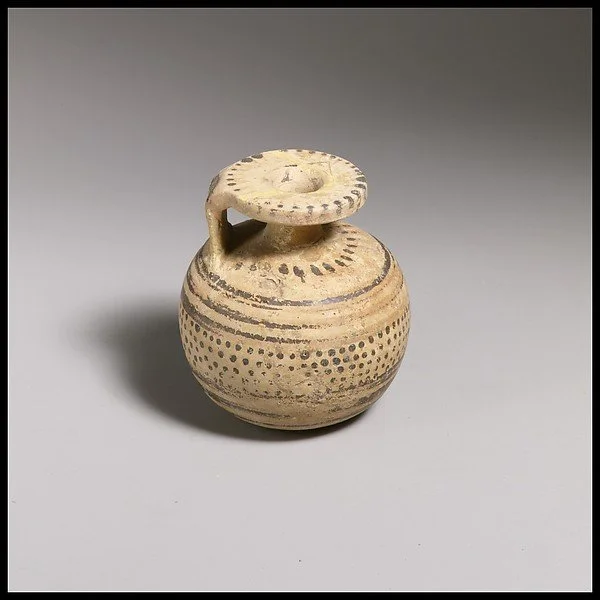
An aryballos, the small flask that carried an athlete's oil — oil was the foundation of the gymnasium, rubbed in before exercise and scraped away after. The vessel is small because the oil was precious and used drop by drop.
Aryballos, terracotta, Italic (Etruria), 6th century BCE. The Metropolitan Museum of Art, Purchase, 1896 (object 246117). Public domain (Met Open Access).
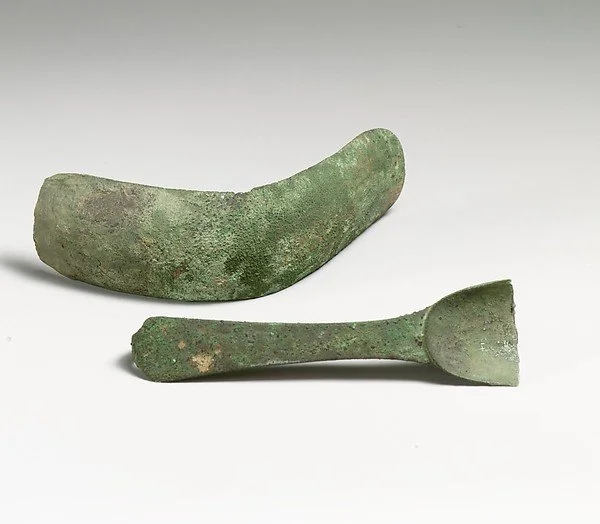
A bronze strigil, the curved blade Roman bathers used to scrape oil — and with it the day's dirt — from their skin. Oil stood in for soap entirely. This example survives in two pieces, its surface green with age.
Strigil, bronze, Cypriot, 5th century BCE. The Metropolitan Museum of Art, The Cesnola Collection, Purchased by subscription, 1874–76 (object 244349). Public domain (Met Open Access).
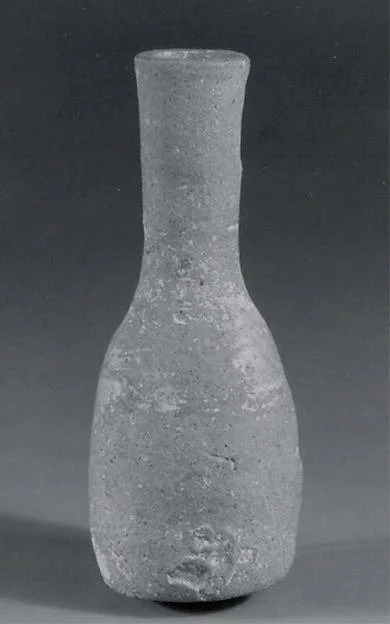
An unguentarium: the bottle an unguent traveled in. The word on the shelf and the vessel in the hand are the same word — unguentum, from unguere, to anoint.
Unguentarium, ceramic, Nabataean, ca. 1st century CE. The Metropolitan Museum of Art, Gift of the American Expedition to Petra, 1967 (object 325888). Public domain (Met Open Access).
Oil is the oldest base in the apothecary's workshop.
In the ancient Mediterranean, olive oil was not only food but the foundation of perfumery, cosmetics, and the gymnasium.
The Greeks blended scented oils for the wealthy, and athletes anointed themselves before competition.
Roman bathers rubbed oil into their skin and scraped it away with a curved blade called a strigil, oil standing in for soap entirely.
Pliny the Elder wrote that there are two liquids especially agreeable to the human body, wine within and oil without.
When a civilization builds its bathing, its athletics, and its perfumery on a single liquid, that liquid deserves your respect.
The oils you will meet most often in the laboratory are olive oil, sweet almond oil, coconut oil, and castor oil.
Each behaves differently, and the differences are what matter.
Olive oil is heavy, slow, and deeply golden.
It pours reluctantly and leaves a rich film.
It has kept longer than lighter oils in traditional use, and it was the oil of Galen's cream for good reason: it is forgiving to work with and widely available.
Sweet almond oil is lighter and paler, with a faint nutty scent.
It spreads more readily and absorbs faster than olive oil, which made it the later favorite for creams and massage preparations once it became widely traded.
Coconut oil is the shapeshifter.
At cool room temperature it is a firm white solid; warm it past about 76 degrees Fahrenheit and it melts into a thin, clear oil.
This single property teaches the whole lesson of melting behavior: the same material can be a butter in January and an oil in August, and the apothecary must know which one is in the jar.
Castor oil is the thickest of the common oils, slow as honey, nearly odorless.
Its high viscosity makes it useful where a preparation must cling rather than run.
Notice what we are doing.
We are not discussing what these oils are for.
We are discussing what they do: how they pour, how they spread, how they absorb, how they keep.
That is the apothecary's way of knowing a material, and it applies to everything on your shelves.
Sealed with the teal wax of Professor Crimblebrew Muddlenook, Master Apothecary of the Potions Laboratory, Head of House Meridies.
Orderliness is a laboratory virtue, scholars, and here is where it begins. Take four small jars and label them before you open a single bottle: OLIVE, ALMOND, COCONUT, CASTOR. Label first, pour second. Every spill I have witnessed in thirty years of teaching began with an unlabeled vessel and a confident apprentice.
— Professor Crimblebrew Muddlenook, Potions Laboratory • Master Apothecary • Head of House Meridies
Check in: Rank the four oils of this section by how they pour, slowest to fastest in your own bench words — and name the property that makes castor oil cling rather than run.
❦ In your workbook: record the liquid foundations in your own way — the four oils and what each one does: how it pours, spreads, absorbs, and keeps — copy, sketch, or note what matters.
In your packet: Exercise I — The Oil Comparison ◐ begins here. Work it now, or mark the place and take it as homework — your choice.
Waxes and Butters: The Structure Givers
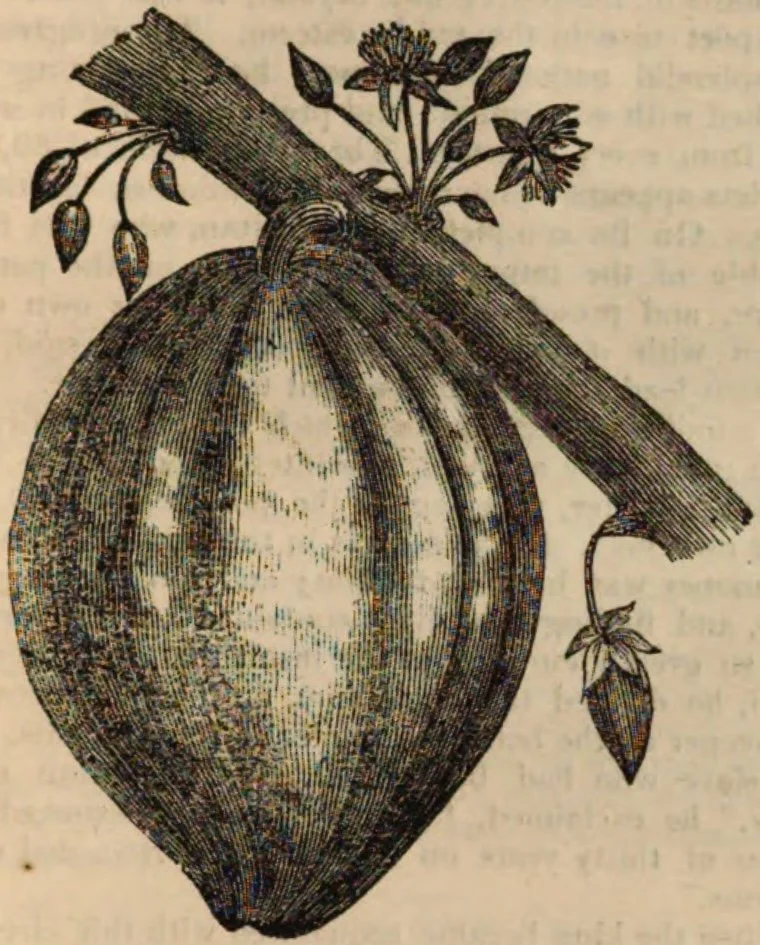
The fruit of the cacao tree, engraved for The Penny Magazine in 1834 — the bean inside this pod is pressed for cocoa butter, the fat that melts very near the temperature of the human body and yields the moment a preparation is handled.
"Fruit of the Cacao-Tree," The Penny Magazine (1834), via Wikimedia Commons. Public domain.

A portrait painted in encaustic — pigment suspended in hot beeswax — on limewood, Roman-era Egypt, 160–180 CE. The same wax this lesson melts gently for balms here carries a face across eighteen centuries: structure is not mysterious; it is measured, and wax measures out in millennia.
Portrait of a thin-faced, bearded man, encaustic on limewood, 160–180 CE. The Metropolitan Museum of Art, Rogers Fund, 1909 (object 547856). Public domain (Met Open Access).
If oils are the liquids of formulation, waxes and butters are its architecture.
They give a preparation firmness, shape, and staying power.
The most important of them in the historical workshop is beeswax.
★ Beeswax melts between about 144 and 147 degrees Fahrenheit (62 to 64 Celsius).
At room temperature it is firm; held in the hand, it softens; heated gently, it flows.
This is precisely the behavior an apothecary wants in a structuring agent: firm on the shelf, workable in the hand, fluid in the vessel.
It is why beeswax has been used to harden ointments for centuries, and why Galen chose it for his cream.
But it has limits.
Heated past about 185 degrees Fahrenheit it darkens and degrades, so the patient apothecary melts wax gently, never fiercely.
And as Galen discovered, it holds oil and water together only weakly, which is why historical creams needed such vigorous beating.
Cocoa butter, pressed from the cacao bean, melts very near the temperature of the human body, roughly 93 to 100 degrees Fahrenheit.
A preparation firmed with cocoa butter holds its shape on the shelf and yields the moment it is handled.
The old workshop prized this property.
Shea butter, from the nuts of the African shea tree, is softer, creamier, and stays workable across a wide range of room temperatures.
It entered European workshops through trade, and students of history will find it a fine example of how the apothecary's shelf has always grown through commerce.
★ The rule of waxes is simple: the more wax in a preparation, the firmer it stands.
A soft ointment, a firm balm, and a hard cerate differ from one another largely in their proportion of wax to oil.
Structure is not mysterious.
It is measured.
Check in: Why does the patient apothecary melt beeswax gently, never fiercely — and what single rule turns a soft ointment into a hard cerate?
❦ In your workbook: record the structure givers in your own way — beeswax and its two limits, cocoa butter at body temperature, shea butter's wide workable range, and the rule of waxes — copy, sketch, or note what matters.
Fats of the Old Workshop
An honest history of the apothecary's shelf must include the materials modern students may choose not to use.
For most of human history, the common bases of ointments were animal fats: tallow (rendered beef or mutton fat), lard (rendered pork fat), and lanolin (the wax-like fat washed from sheep's wool).
These were not crude choices.
Tallow and lard were abundant, inexpensive, and familiar to every household that cooked meat.
Lanolin, being a wax rather than a true fat, resists going rancid longer than most animal fats and can absorb surprising amounts of water, which made it valuable in preparations that needed to hold moisture.
Nineteenth-century recipes call for benzoated lard, lard preserved with benzoin resin, as a standard ointment base.
We study these materials because the old recipes assume them, and you cannot read a historical formula intelligently without knowing what it meant by its base.
Whether you work with them yourself is your own decision.
The laboratory respects every student's materials, provided the student respects the materials: tallow and lard go rancid faster than plant oils and must be kept cool, used fresh, and never mistaken for something they are not.
Sealed with the teal wax of Professor Crimblebrew Muddlenook, Master Apothecary of the Potions Laboratory, Head of House Meridies.
Experimentation is welcome in my laboratory, scholars, but it is never careless. If you wish to compare a traditional tallow base against a modern plant-oil base, do so side by side, in labeled vessels, with dated entries. That is how the old apothecaries learned, and it is how you will learn: not by guessing, but by observing.
— Professor Crimblebrew Muddlenook, Potions Laboratory • Master Apothecary • Head of House Meridies
Check in: Why does this laboratory study tallow, lard, and lanolin even though a modern student may choose not to use them — and what two keeping rules does the lesson set for tallow and lard?
❦ In your workbook: record the fats of the old workshop in your own way — what each fat is, why lanolin keeps and holds water, and benzoated lard as the nineteenth century's standard base — copy, sketch, or note what matters.
Compatibility: Matching Material to Purpose
Now we put the knowledge to work.
Compatibility is the apothecary's central judgment: given what a preparation must do, which base will do it?
Consider two preparations.
The first is a winter hand balm, meant to shield skin against cold wind.
It should be firm enough to stay where it is put, slow to absorb, and form a protective layer.
Olive oil alone would fail: it is too fluid, too quick to rub away.
Beeswax firmed into that olive oil would succeed: the wax gives structure, the oil gives spreadability, and together they linger.
The second is a light summer oil for the hair, meant to add sheen without heaviness.
Beeswax here would be absurd; it would leave the hair stiff and coated.
A light oil, almond or fractionated coconut, absorbs quickly and leaves little behind.
The right base is the one that matches the purpose.
★ Work through the logic every time:
- What must the preparation do? (Protect? Absorb? Linger? Spread thin?)
- What texture does that require? (Firm? Soft? Fluid?)
- Which base has the properties to produce that texture? (Wax for firmness, heavy oil for lingering, light oil for quick absorption.)
- Will it keep? (A preparation that goes rancid in a month is a failed preparation, however elegant.)
No recipe can answer these questions for you.
Only your knowledge of materials can.
Check in: Run the four questions for the winter hand balm in order. At which question does olive oil alone fail — and what answers it?
❦ In your workbook: record compatibility in your own way — the two worked preparations, winter balm and summer hair oil, and the four questions asked every time — copy, sketch, or note what matters.
In your packet: Exercise III — The Compatibility Ledger ✎ begins here. Work it now, or mark the place and take it as homework — your choice.
Rancidity: The Slow Enemy
Every oil and fat in your laboratory is slowly changing, from the day its container is opened.
The enemy is called rancidity, and it is the oxidation of the unsaturated fatty acids in the oil.
Air, light, heat, and moisture all speed it along.
The result is unmistakable: a sharp, stale, crayon-like smell where a fresh, mild scent used to be.
★ Unsaturated oils, the liquid-at-room-temperature plant oils, are the most vulnerable, because the double bonds in their fatty acid chains are where oxidation begins.
Saturated fats like coconut oil and waxes like beeswax resist longer, but nothing resists forever.
The apothecary's defenses are habits, not chemicals:
- Buy small. A giant bottle of oil that takes two years to finish will be rancid long before it is empty.
- Seal tight. Every opening admits fresh air. Close containers immediately after pouring.
- Store cool and dark. Heat doubles the speed of chemical reactions roughly with every 18 degrees Fahrenheit. A cupboard away from the stove outlasts a sunny windowsill by months.
- Date everything. Write the opening date on the label. Your nose is the final judge, but the date tells you when to start sniffing with suspicion.
- Trust the sniff test. Fresh oil smells mild and clean. Rancid oil smells sharp, stale, or like old crayons. When in doubt, discard it. A spoiled base ruins every preparation it touches.
Sealed with the teal wax of Professor Crimblebrew Muddlenook, Master Apothecary of the Potions Laboratory, Head of House Meridies.
I am a stickler for lab safety, and I am equally a stickler for lab honesty. A rancid oil does not improve with wishful thinking, and no botanical, however fine, can rescue a spoiled base. Discard it, record the loss in your ledger, and let the entry remind you to buy smaller next time. Waste recorded is tuition paid.
— Professor Crimblebrew Muddlenook, Potions Laboratory • Master Apothecary • Head of House Meridies
Check in: Name the four things that speed rancidity along, and the five habits the apothecary answers them with.
❦ In your workbook: record rancidity in your own way — oxidation at the double bonds, the four accelerants, and the five storage habits — copy, sketch, or note what matters.
The Paper Test and the Warm Spoon
Theory without handling is only half an education.
Today's practical work teaches you two of the oldest diagnostic tests in the workshop: the paper test for absorption, and the warm water bath for melting behavior.
The Paper Test. Place a drop of each oil on a sheet of plain white paper.
Label each drop.
Now watch.
A light oil like almond spreads quickly into a wide, pale circle.
Olive oil spreads more slowly into a smaller, richer stain.
Castor oil barely moves, sitting in a tight, glossy bead.
The paper is telling you exactly how each oil will behave on skin: quick to spread means quick to absorb; slow to spread means lingering and protective.
Leave the paper overnight.
In the morning, the stains will have set, and you will see the permanent record of each oil's character.
The Warm Spoon and Water Bath. Place a small piece of coconut oil, a shaving of beeswax, and a dab of butter in three separate heat-safe vessels.
Set them in a basin of warm, not hot, tap water.
Watch and record.
The coconut oil yields first, melting into clarity.
The butter follows.
The beeswax holds its shape longest, softening but not flowing until the water is genuinely hot.
You have just observed melting points in action, with no thermometer required.
The order never changes, because the materials never change.
Record both tests in your laboratory journal with dates, observations, and sketches of the paper stains.
These pages will become your personal reference, more valuable than any printed chart, because they record what your materials did in your hands.
Check in: On the paper, which oil spreads into a wide, pale circle and which sits in a tight, glossy bead — and in the warm bath, which material holds its shape longest?
❦ In your workbook: record the two tests in your own way — the three paper stains and what each predicts, and the melting order in the warm bath — copy, sketch, or note what matters.
In your packet: Exercise II — The Melting Study ◐ begins here. Work it now, or mark the place and take it as homework — your choice.
Guided Observation: The Paper Test and the Warm Water Bath
This lesson's observation is the lesson's own bench work, done slowly and recorded in full: the paper test for absorption and the warm water bath for melting behavior — two of the oldest diagnostic tests in the workshop.
Work through them in order, with the Safety Briefing's rules standing over all heating work: heat-safe vessels only, nothing heating left unattended, and adult supervision for younger students.
The Paper Test. Place a drop of each oil on a sheet of plain white paper. Label each drop. Now watch. A light oil like almond spreads quickly into a wide, pale circle. Olive oil spreads more slowly into a smaller, richer stain. Castor oil barely moves, sitting in a tight, glossy bead. Leave the paper overnight. In the morning, the stains will have set, and you will see the permanent record of each oil's character.
The Warm Spoon and Water Bath. Place a small piece of coconut oil, a shaving of beeswax, and a dab of butter in three separate heat-safe vessels. Set them in a basin of warm, not hot, tap water. Watch and record. The coconut oil yields first, melting into clarity. The butter follows. The beeswax holds its shape longest, softening but not flowing until the water is genuinely hot.
Consider:
- The paper is telling you exactly how each oil will behave on skin: quick to spread means quick to absorb; slow to spread means lingering and protective. Which of your three oils would you send to a preparation that must linger — and which to one that must vanish?
- You have just observed melting points in action, with no thermometer required. The order never changes, because the materials never change. What would a hotter bath change — the order, or only the speed?
- Record both tests in your laboratory journal with dates, observations, and sketches of the paper stains. These pages will become your personal reference, more valuable than any printed chart, because they record what your materials did in your hands.
❦ In your workbook: record the guided observation in your own way — the dated paper stains sketched, the melting order noted, and the two questions answered — copy, sketch, or note what matters.
Materials
Everything in its place, before we begin. For this material study you will need:
Required (Level One — household items)
- Three oils: olive oil, coconut oil, and one more (almond, grapeseed, or sunflower).
- Beeswax: a small piece, a candle stub of pure beeswax, or pellets if available. Butter may substitute for the melting comparison.
- Small heat-safe vessels: ceramic ramekins or small jars — a heat-safe pot or cauldron for the water bath.
- Plain white paper for the absorption test, plus a pencil for labeling.
- Basin and warm tap water for the melting study.
- Laboratory journal and pencil for dated entries and sketches.
Suggested (Level Two — historically closer)
- Castor oil and sweet almond oil added for a five-oil comparison.
- Cocoa butter and shea butter for the extended melting study.
- A double boiler setup (heat-safe bowl over simmering water) for controlled gentle melting, as the old workshops used.
Reflection Questions
Answer the following questions in your workbook.
- Galen's cold cream barely held together and tended to separate, yet it remained state of the art for over a thousand years. What does this teach about the relationship between the base and the preparation?
- Your coconut oil is a firm white solid in January and a clear liquid in August. Explain this using the concept of melting point.
- Why do unsaturated plant oils go rancid faster than waxes, and what three storage habits slow rancidity?
- A student proposes making a firm protective winter balm from olive oil alone. Will it work? Explain what is missing and what you would add.
- Why must heated wax never be left unattended, and what is the correct first response if hot wax contacts skin?
Workbook Checklist — Lesson 19
In my workbook I have:
- ☐ explained why the base medium matters as much as the botanical — the botanical provides the character; the base provides the body
- ☐ compared olive oil, coconut oil, and almond oil by viscosity, absorption, and keeping behavior, from my own pour test and paper test
- ☐ described how beeswax, cocoa butter, and the traditional animal fats change a preparation's structure
- ☐ tested melting behavior with a warm water bath and absorption with a paper test, and recorded both with dates and sketches
- ☐ matched a base material to a preparation's purpose using the four compatibility questions, in a written ledger entry
- ☐ explained rancidity — oxidation at the double bonds — and the storage habits that slow it: buy small, seal tight, store cool and dark, date everything, trust the sniff test
☐ Lesson completed Date: ___ Signature: ___
The Professor's Closing Note
Sealed with the teal wax of Professor Crimblebrew Muddlenook, Master Apothecary of the Potions Laboratory, Head of House Meridies.
You have done the foundational work of the formulator today, scholars, and done it properly: no shortcuts, no guesses, labeled vessels and dated entries throughout. In our next lesson we turn to the mineral side of the shelf, salts, clays, and earthy materials, where the logic of bases meets the logic of particles. Bring your observations with you. The workshop builds on itself, lesson by lesson, and you are building well.
— Professor Crimblebrew Muddlenook, Potions Laboratory • Master Apothecary • Head of House Meridies
Cross-Class Connections

Creative Arts · Unit I, Lesson 5 — Adhesives, Heat, Wax & Glass
Sealed with the mark of Professor Cogbranch Timberclank, Master Artisan of the Creative Arts Workshop, Head of House Occidens.
You have learned to melt beeswax gently in Professor Muddlenook's laboratory, scholars, and to respect what heat does to it past its limit. Come to my workshop and meet the same wax under the same rules: warmed in a water bath, never over direct flame, never left to smoke. Here it coats, seals, and joins — and the poured seal blank you will make is the cousin of every cerate on his shelves. Bring the patience he taught you. Wax is better at waiting than you are, and it will wait for you.
PROFESSOR COGBRANCH TIMBERCLANK
Creative Arts Workshop • Master Artisan • Head of House Occidens

Herbology · Unit IV, Lesson 28 — Drying Herbs the Traditional Way
Sealed with the mark of Professor Beryl Fernfoot, Master Herbalist of the Herbology Greenhouse, Head of House Oriens.
Before a botanical ever steeps in one of Professor Muddlenook's oils, gardeners, it must be dried and kept — and kept well, or the oil receives a spoiled gift. Come to the Greenhouse and learn the keeping: leaves dried whole so their oils stay locked inside, jars airtight and labeled and dated, stored cool and dark because light breaks down oils even in the jar. His sniff test and my crispness test are cousins. Bring me sound, dry material, and his bases will do the rest.
PROFESSOR BERYL FERNFOOT
Herbology Greenhouse • Master Herbalist • Head of House Oriens
Further Reading & Sources
- Cold cream — Wikipedia — Galen's formula, the cérat de Galien, and the cream's thousand-year history.
- Cosmetics and Skin: Cold Creams — beeswax as emulsifier and the persistence of Galen's formula through the pharmacopoeias.
- Cosmetics and Skin: Cerates — cerate preparations and their oil-and-wax construction.
- Healing, purification and holiness: How ancient Greeks, Romans and early Christians used olive oil — olive oil in ancient bathing, athletics, and ritual life.
- Beeswax — Science Madness Wiki — melting point, softening behavior, and the 85-degree discoloration limit.
- Why Do Cooking Oils Go Rancid — BotanicWeb — oxidation, unsaturated fats, and the storage habits that slow spoilage.
Browse the Potions shelf in the school Library for readable editions of these works.
Submit your work for this lesson using the form below.
CONTINUE IN THE POTIONS LABORATORY
← Previous · Lesson 18: Roots, Bark & Resins Next · Lesson 20: Salts, Clays & Mineral Materials →
Unit III — Dense Materials & Preparation Potions Laboratory — All 52 Lessons
The rest of Unit III: Lesson 18 · Roots & Bark · Lesson 20 · Salts & Clays · Lesson 21 · Grinding & Processing · Lesson 22 · Filtration · Lesson 23 · Preparing for Extraction · Lesson 24 · Master Portfolio · Lesson 25 · Preparation Manifest