

POTIONS
Unit I · Lesson 8THE SIMPLES CENSUS
Professor Crimblebrew Muddlenook
Master Apothecary • Potions
Head of House Meridies • School of Evershade
Professor's Introduction

Scholars, gather round the bench and look at what we have built.
In the lessons behind us, you have zoned your workspace, chosen and cleaned your vessels, and learned to label and seal like a professional. Your shelves are filling. And that is precisely why today is a day of reckoning, the friendly kind.
A laboratory that cannot account for its own stock is not a laboratory. It is a cupboard of mysteries, and mysteries are poor company when you reach for a jar.
Every working apothecary in history kept a reckoning of the simples: every leaf, root, salt, resin, and oil on the shelf, counted, inspected, and written down. Today you will take yours. We call it the census, and by the end of this lesson your stock will have no secrets from you.
★ There is one rule in this lesson that outranks all others, and Professor Muddlenook does not rank rules lightly. You will learn it, you will be tested on it, and you will never forget it. An unlabeled jar is an unidentified jar, and an unidentified jar is not used. Not tasted, not sniffed twice, not guessed at. Set aside, recorded, and resolved. Everything in its place, scholars, and every jar accounted for.
— Professor Crimblebrew Muddlenook, Potions Laboratory • Master Apothecary • Head of House Meridies
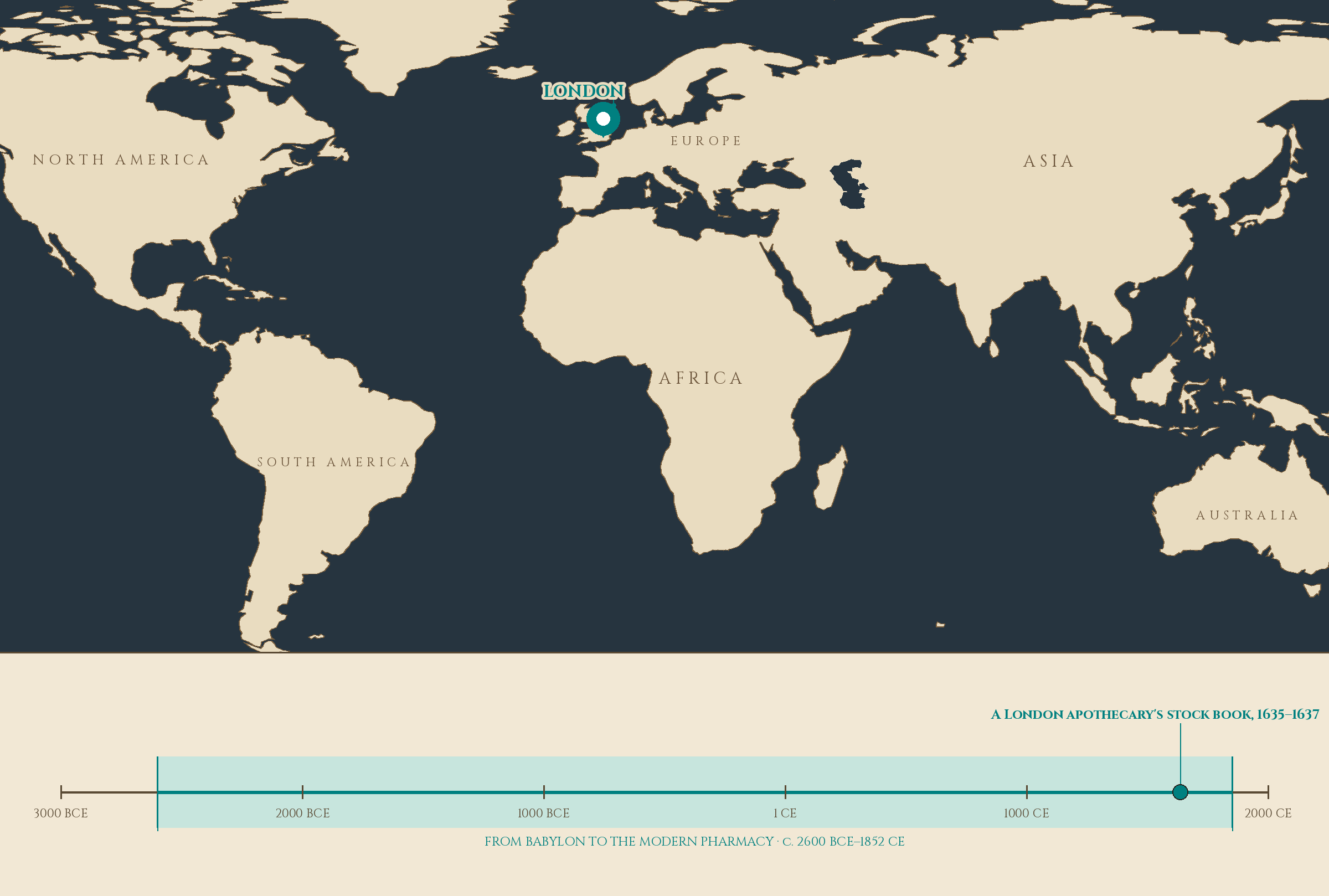
Pin: LONDON. Timeline stop: A London apothecary's stock book, 1635–1637.
Lesson Objectives
By the end of this lesson, you will be able to:
- Define simples and compounds, and explain why the distinction shaped the apothecary's trade for nearly two thousand years.
- Describe how the great apothecaries kept their stock by ledger, from Dioscorides' materia medica to the early modern stock book.
- Carry out a complete simples census of your own materials: identity, form, quantity, source and date, storage condition, and label and seal status.
- Inspect stored materials for mold, rancidity, moisture damage, and degraded labels, and apply the discard rules correctly and safely.
- Draft your first Materia Botanica entries for the botanical simples in your stock, in the shared book's own form, as coursework kept in your potions journal.
Reading this lesson: ★ marks the passages to remember. They return on the unit quiz and the class test. Check in questions ask the material back as you go; answer them in your workbook when you meet them.
Working this lesson: Your assignment packet is the first download on this page. Work in it as the lesson moves along, answering each exercise as its subject is taught — or read the lesson through for your notes and take the exercises as homework afterward. Both are proper ways to sit this class. Signposts in the reading tell you where each exercise belongs. Written answers are short answers in your own words; a few honest lines are worth more than a filled page.
Your Assignment Packet
This lesson's exercises live in its packet: the Lexicon Handout (every term, course terms marked ◆), Materials, Guided Practice, the Assignment Manual with its answer key for self-checking, the Reflection Questions, and the Workbook Checklist. Download the packet before you begin and keep it beside you as you read.
Safety Briefing
Today's work is inspection, not preparation, but inspection has its own hazards, and a meticulous scholar respects them all.
- ★ Do not taste anything to identify it. Not a pinch, not a crumb, not a drop. Identification is done by label, by ledger, and by look. An unidentified material is never tasted, and tasting is never a test method in this laboratory.
- ★ Mold means discard, never salvage. If you find fuzzy growth on a dried botanical, do not pick through it, do not shake it out, do not rescue the clean-looking part. Seal the whole container in a bag and set it aside for an adult to dispose of. Invisible threads have already spread beyond what your eyes can see.
- Spoiled materials are handled by or with an adult. Rancid oils, musty botanicals, and anything of uncertain age or origin go to the quarantine tray, and an adult handles their disposal into the household trash. Wash your hands after handling anything you have flagged.
- Glass deserves respect. A jar with a chipped rim or a cracked body is retired from service. If you must empty a damaged jar, an adult does the pouring, and shards go into a rigid container, never loose in a bag.
- Ventilate when you open old stock. Musty or dusty dried material can irritate the nose and throat. Work near an open window or with a fan moving air, and step away if you start to sneeze or cough.
- Nothing here is medicine, and no lesson gives amounts to take. Study materials are for study: observed, recorded, and displayed. The census changes nothing about that standing rule.
❦ In your workbook: record the safety briefing in your own way — no tasting, mold discarded whole, adults handle the spoiled and the sharp, air moving, hands washed — copy, sketch, or note what matters.
The Simples Tradition
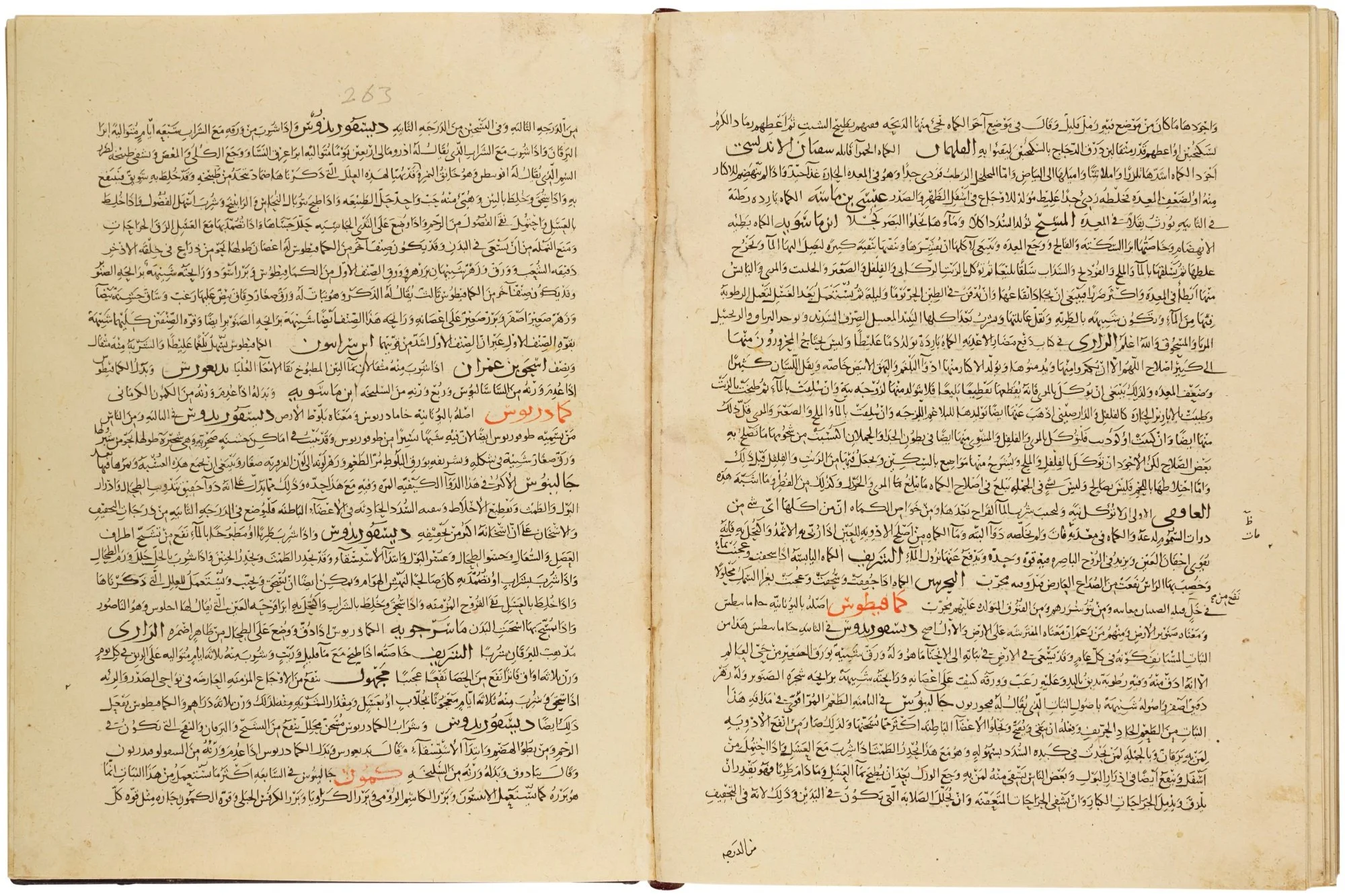
A compendium of simples: an opening of Ibn al-Baytar's Compendium on Simple Drugs and Foodstuffs (Near East, c. 1300) — hundreds of single substances, each entered on its own. A study portrait of the tradition, not an identification guide.
Ibn al-Baytar, Kitab al-jami' li-mufradat al-adwiyah wa'l-aghdhiyah (The Compendium on Simple Drugs and Foodstuffs), Near East, c. 1300, via Wikimedia Commons (photograph: Sotheby's). Public domain.
Long before anyone called this building a laboratory, the people who did our work called themselves apothecaries, and they recognized two kinds of medicines.
There were the simples: single substances, one leaf, one root, one salt, one resin, unchanged and uncombined. And there were the compounds: remedies built by joining several simples together, the mixtures and preparations that filled the shop's jars.
The distinction was not a nicety. It was the grammar of the trade.
A physician of the ancient world wrote at length on both, in separate works: the great Galen, practicing in Rome in the second century of the common era, composed a long treatise On the Powers of Simple Drugs, cataloguing what single substances could do on their own, before anyone thought of combining them.
★ To "know the simples" became the mark of a trained apothecary, the proof that a practitioner understood each ingredient alone before daring to mix.
Check in: Why did a trained apothecary have to understand each ingredient alone before combining it — what does the simples/compounds distinction actually organize?
❦ In your workbook: record the simples tradition in your own way — one substance unchanged, several joined by craft, and knowing the simples as the mark of training — copy, sketch, or note what matters.
A Ledger Older Than the Laboratory
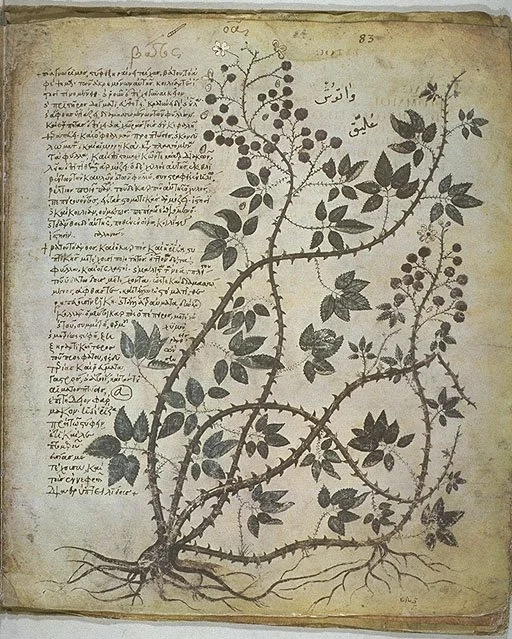
A bramble, painted full-page in the Vienna Dioscorides (c. 512 CE), the great surviving copy of De Materia Medica — Greek text at the left, Arabic notes added by a later reader at the right. A study portrait of the tradition, not an identification guide: the census names a jar by its label and ledger, never by a picture.
Vienna Dioscorides (Juliana Anicia Codex), c. 512 CE, Österreichische Nationalbibliothek, Vienna, via Wikimedia Commons. Public domain.
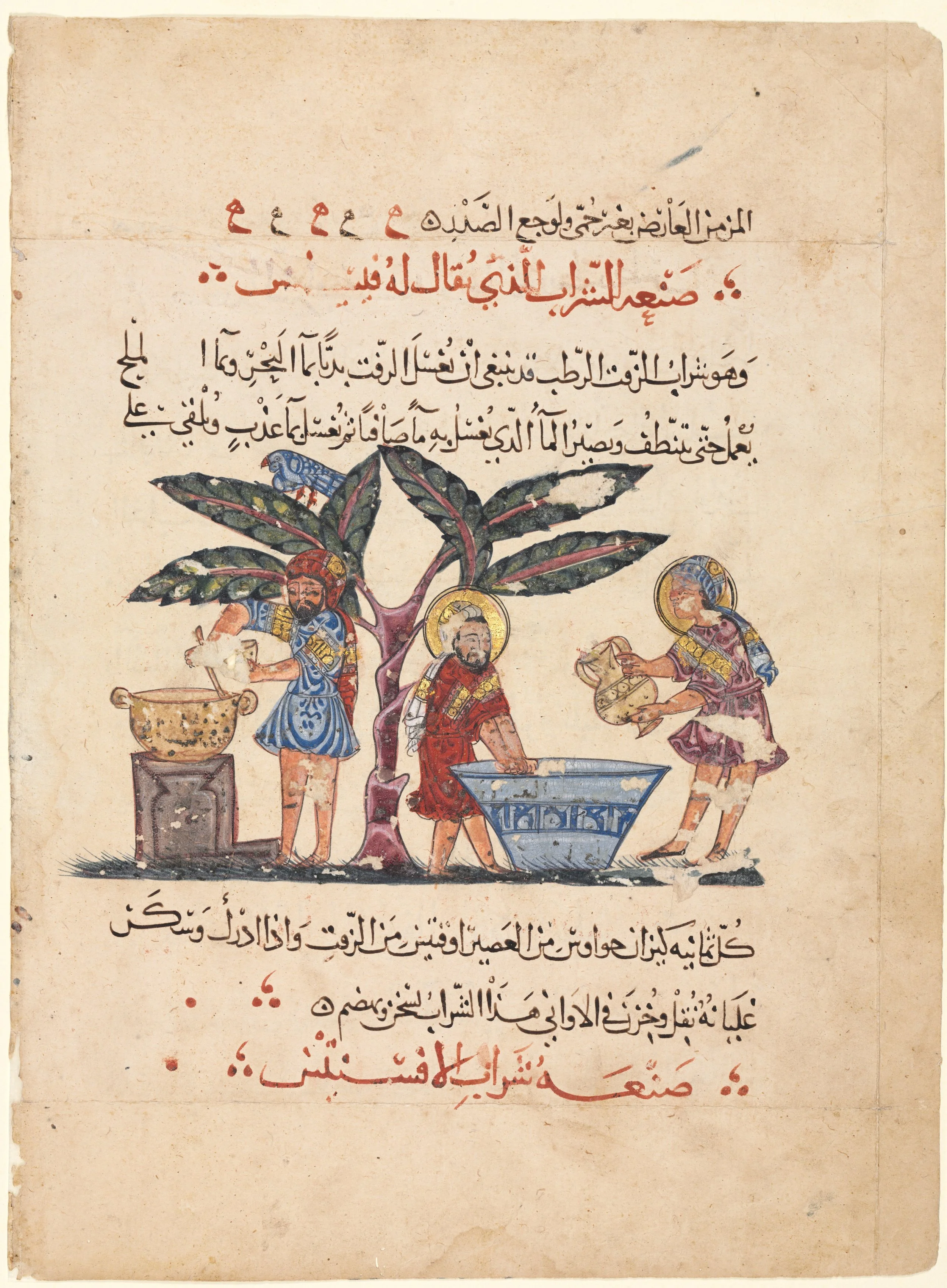
Dioscorides in Arabic: a folio from an Arabic translation of the Materia Medica (Abdallah ibn al-Fadl), its miniature showing three physicians preparing medicine — the same book, carried across languages for fifteen centuries.
Abdallah ibn al-Fadl, folio from an Arabic translation of the Materia Medica of Dioscorides, 1977.91, The Cleveland Museum of Art. CC0.
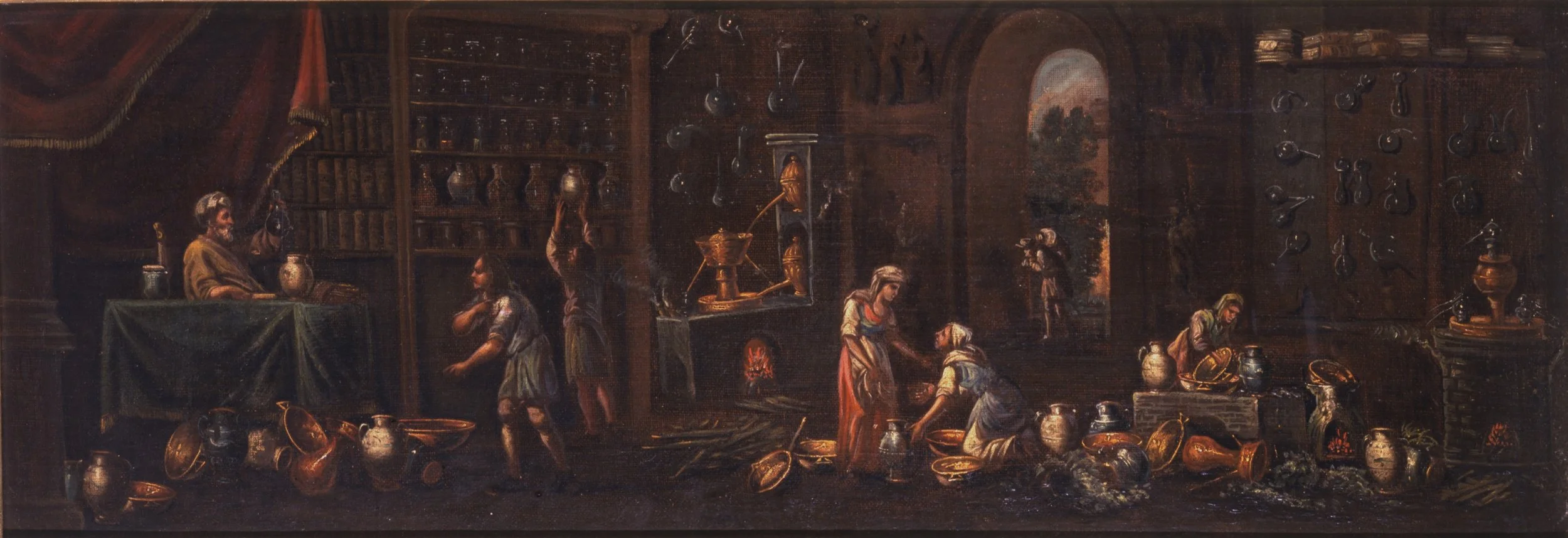
Inside an early Italian pharmacy (17th century): shelves of jars and bottles, the apothecary at his table, work going on all around — the shop whose stock book sat at the front of its records.
Unknown artist, Italian School, Early Italian Pharmacy, 17th century, via Wikimedia Commons. Public domain.
The habit of writing it all down is older than the apothecary's shop itself.
In the first century of the common era, the Greek physician Dioscorides, serving as a surgeon with the armies of the Roman emperor Nero, compiled De Materia Medica, "On Medical Material." It described about six hundred plants and the roughly one thousand medicines made from them, arranged so a reader could identify a plant in the field and then learn its preparation.
The book was copied by hand, in Greek, Latin, and Arabic, and remained the working reference of the trade for some fifteen centuries. That is not a textbook. That is a census that refused to die.
Centuries later, the shops of early modern Europe kept the same habit in humbler books. The stock book sat at the front of the apothecary's records, and at every stock-taking it was updated: what was on hand, what had spoiled, what needed reordering.
A real one survives. The Wellcome Collection in London holds an apothecary's stock book from 1635 to 1637, tentatively attributed to a London apothecary, its inventory initials scattered through its pages. When you open your ledger today, you are joining a line of record keepers nearly four hundred years unbroken, and behind them, two thousand.
The census is the oldest lesson in this course, though it comes eighth. Dioscorides took his in the field with an army at his back. The London apothecary took his behind a counter. You will take yours at your own table, and yours will be the most honest of the three, because you will write down the failures too. A census that flatters its keeper is a work of fiction. Ours will be a work of record.
— Professor Crimblebrew Muddlenook, Potions Laboratory • Master Apothecary • Head of House Meridies
❦ In your workbook: record the ledger's long line in your own way — Dioscorides in the field, the London stock book behind a counter, and your census at your own table, failures written down too — copy, sketch, or note what matters.
The Census Method
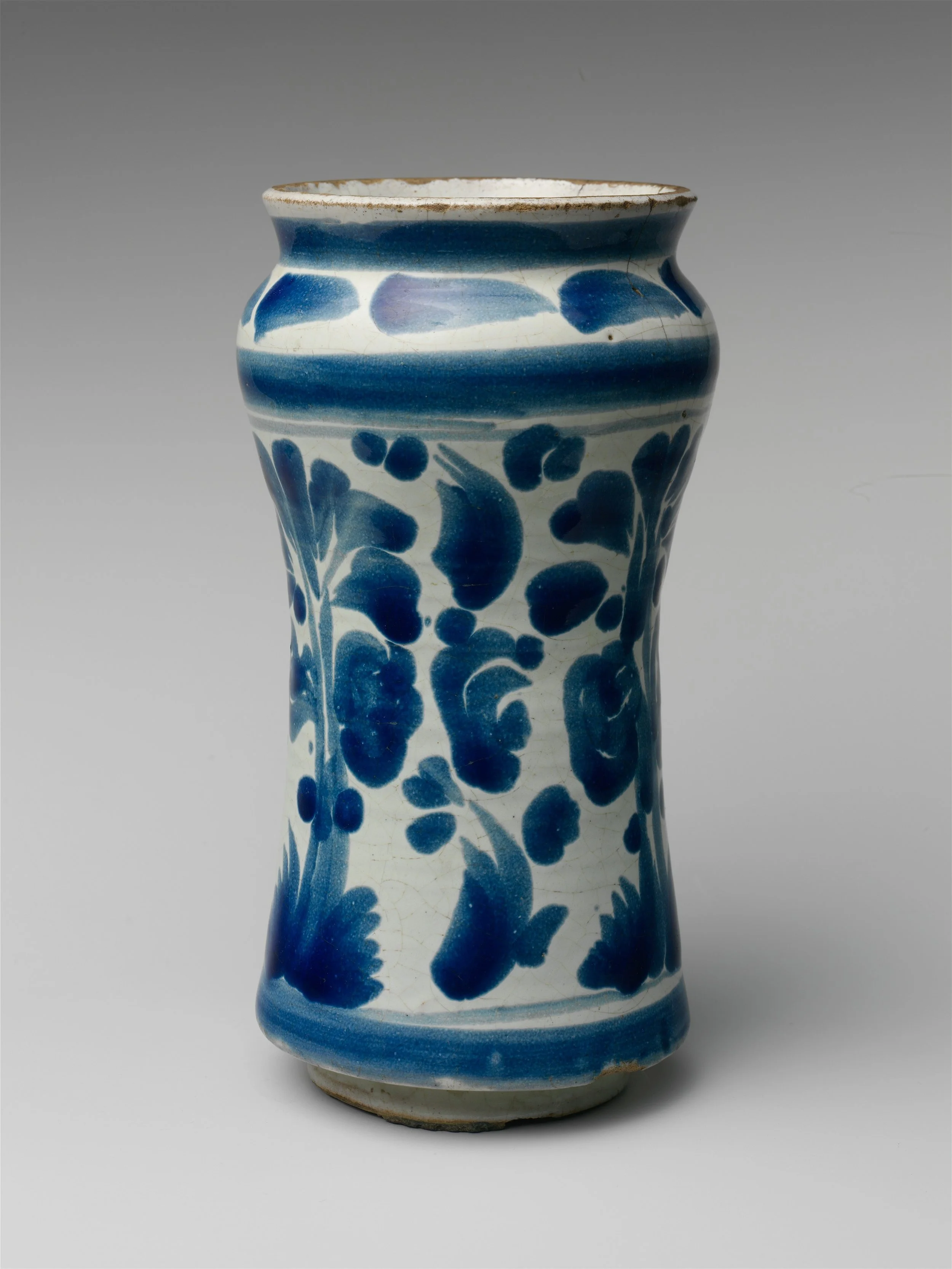
An apothecary jar (albarello), Italian maiolica — the kind of vessel a census inspects rim to foot: crackled glaze, a worn lip, its keeping written on its body. A jar like this still had to speak for itself by its label; decoration was never a name.
Apothecary jar (albarello), Italian, maiolica (tin-glazed earthenware), The Metropolitan Museum of Art, New York. CC0 (Met Open Access).
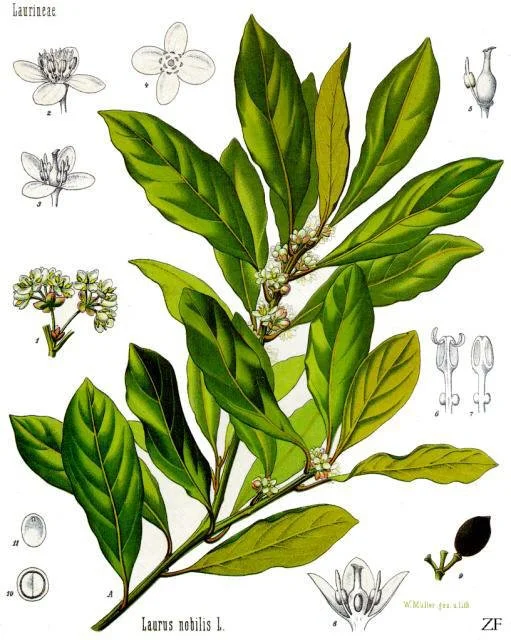
Bay laurel (Laurus nobilis), plate 86 of Köhler's Medizinal-Pflanzen — a study portrait of the plant behind the kitchen bay leaf, the lesson's own practice-entry subject. Study the portrait here; write your entry from the leaf in your hand, and let the label and ledger — never a picture alone — carry a jar's name.
Franz Eugen Köhler, Köhler's Medizinal-Pflanzen (1887–1914), plate 86 (artist: Walther Otto Müller), via Wikimedia Commons. Public domain.
★ A census is not a glance at the shelf. It is a method, and the method has six fields. For every material in your stock, you will record each of the following, in order, without skipping:
- Identity. The common name, and the scientific name where you know it. If you do not know it, write "identity unconfirmed" and flag the jar. Honesty here is the whole lesson.
- Form. Whole, cut, sifted, powdered, pressed, or prepared. The form tells you what the material is ready for and how fast it may age.
- Quantity on hand. An honest estimate in the units you use: a full jar, a half jar, a small pouch, a few spoonfuls. Precision matters less than truthfulness.
- Source and date acquired. Where it came from and when. Bought, gathered, gifted, or left over from an earlier lesson. This is the material's provenance, its personal history, and a material with no history is a material you cannot fully trust.
- Storage condition. The container, the closure, and where it lives: a sealed amber jar in a dark cupboard, a paper pouch on an open shelf. Note anything that worries you.
- Label and seal status. Is the label complete, legible, and firmly attached? Is the seal intact: wax unbroken, cork snug, lid tight, twine tied? A jar that fails this field is flagged, whatever its contents.
Work through your stock one jar at a time, in shelf order, left to right, top to bottom. Do not skip the boring jars. The boring jars are where the surprises hide.
Check in: A jar's contents look sound, but its label has faded past reading. Which census field fails it — and what happens to the jar, however good the contents look?
❦ In your workbook: record the census method in your own way — the six fields in order, one jar at a time, the boring jars included — copy, sketch, or note what matters.
The Shared Materia Botanica: Drafting in Its Form
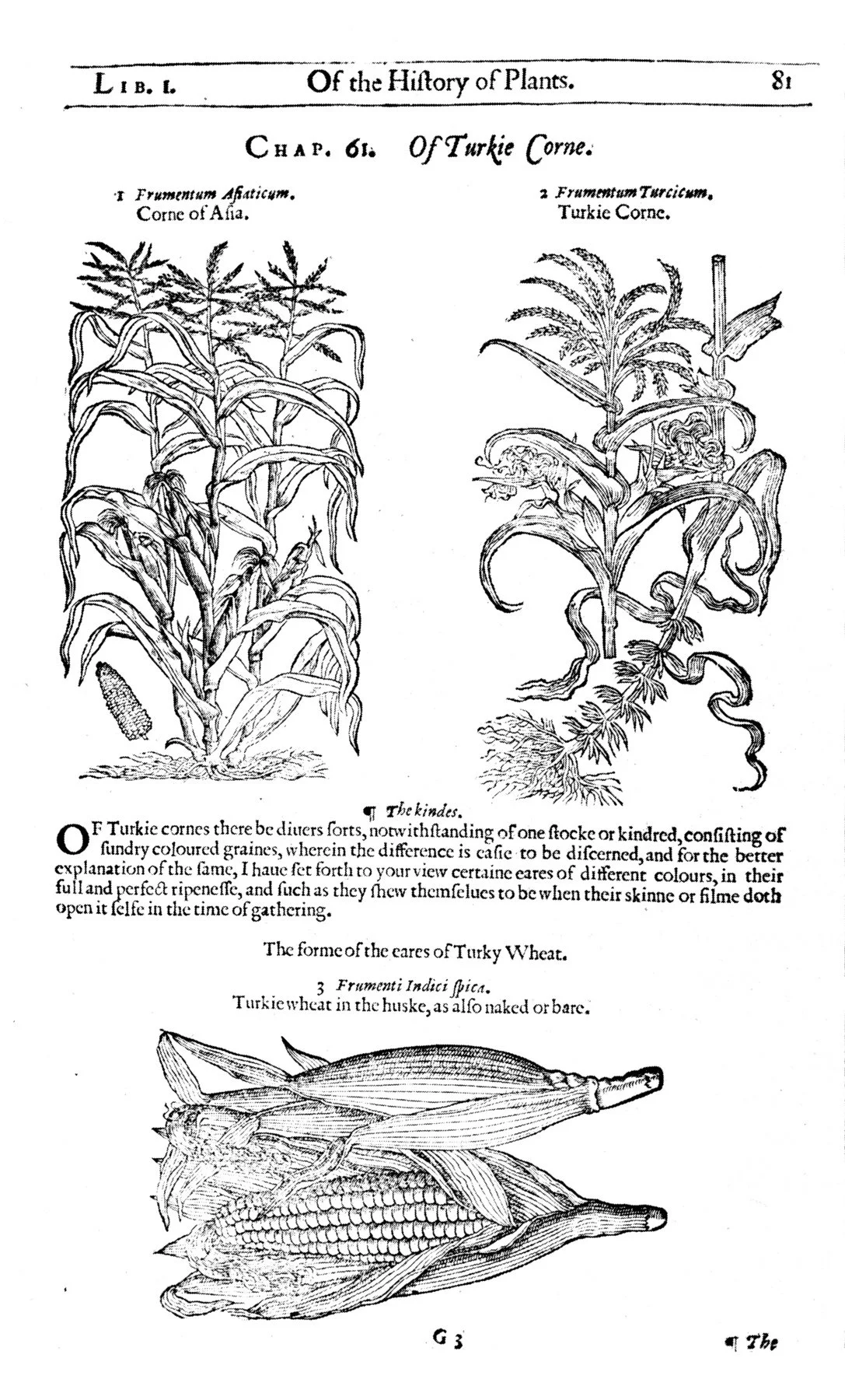
One plant at a time, kinds and form set down in order: a page of Gerard's Herball (1633 edition, "Of Turkie Corne") — the English materia medica tradition your own entry drafts follow. A study portrait of the tradition, not an identification guide.
John Gerard, The Herball, or Generall Historie of Plantes (1633 edition), p. 81, via Wikimedia Commons. Public domain.
Now we come to the second purpose of today's work, and it is the larger one.
★ This school keeps a shared reference called the Materia Botanica: one integrated entry for every plant encountered in Herbology or in Potions. It is the same materia medica tradition you just read about, rebuilt as a living school archive. Herbology owns the living plant and its cultivation: how it grows, where it thrives, what it looks like in the ground. Potions owns the post-harvest half: the dried leaf in your jar, how it was prepared, how it stores, how it behaves in the laboratory. One plant, one entry, two halves.
See the canonical definition in Lesson 17 (Consolidating the Potions Journal). Lesson 8 context note: this lesson introduces drafting entries in the shared book's form. From today forward, every botanical simple you census also begins a Materia Botanica entry draft in your potions journal: identity, source, condition, and storage notes from the Potions side of the plant's life, in the same form the shared book uses for its growing half. Kept with your census, the draft is your Potions-side record of the plant.
For each botanical simple in your stock, then, you will draft an entry on a fresh page: the plant's names, where your specimen came from, what form it is in, what condition you found it in today, and how you are storing it. These drafts are your own coursework in the shared book's form, not pages of the book itself, which is already written. Keep them in your potions journal. They will grow.
❦ In your workbook: record the shared Materia Botanica in your own way — one plant, one entry, the growing half and the keeping half — copy, sketch, or note what matters.
In your packet: Exercise III — First Materia Botanica Entries ✎ begins here. Work it now, or mark the place and take it as homework — your choice.
Procedure
Part A: Gather and Sort
Clear your table completely. Bring every laboratory material to it, grouped loosely by kind: botanicals together, minerals and salts together, oils and waxes together, preparations from earlier lessons together. Count the groups. Write the count at the top of your census spread. That number is your starting inventory, and everything that follows must account for it.
Part B: Inspect, One Jar at a Time
Take the jars in shelf order. For each one, open it, look inside, and waft gently toward your nose. Do not taste. Record the six census fields in your ledger. Then apply the inspection tests:
- Look for mold: any fuzzy or powdery growth, any webbing, any discoloration that was not there when the material was stored. Any mold means the whole container is discarded. No exceptions, no salvage.
- Smell for rancidity in oils and oil-rich materials: a sharp, stale, crayon-like odor means the oil has turned. Record it and flag it for disposal.
- Feel dried botanicals for dampness or clumping. A botanical that should be crisp and is not has taken on moisture, and moisture invites mold. Flag it.
- Read the label. Faded, smudged, peeling, or missing: flag it. A jar that cannot speak for itself cannot stay on the working shelf.
- Check the seal. Loose lids, dried-out corks, cracked wax, untied twine: flag it, and note whether resealing or retirement is the answer.
★ Any jar that fails any test goes to the quarantine tray, with its reason written on a slip tucked under it. Do not return flagged jars to the shelf.
In your packet: Exercise II — The Flag Report ✎ begins here. Work it now, or mark the place and take it as homework — your choice.
Part C: Count, Reconcile, and File
When every jar has been inspected, count your ledger rows. The count must match your starting inventory from Part A. If it does not, find the missing jar before you continue. A census that cannot account for its own rows is not finished.
For each botanical simple, draft its entry in the Materia Botanica's form on a fresh page, as described above. File the entries behind your census, in alphabetical order by common name.
❦ In your workbook: record the procedure in your own way — gather and sort, inspect one jar at a time by look, smell, feel, label, and seal, then count and reconcile — copy, sketch, or note what matters.
In your packet: Exercise I — The Full Census ◐ begins here. Work it now, or mark the place and take it as homework — your choice.
Guided Observation
Watch for the quiet signs, the ones that whisper rather than shout. A label that has faded to a ghost of itself. A cork that has shrunk a hair's breadth and now turns too freely. A dried leaf that has lost its scent entirely: not spoiled, but spent, its best days behind it. These are not failures of character. They are information, and the census exists to collect it.
Note also what is thriving. The jar whose seal held perfectly, whose contents are as crisp as the day they were stored: that jar is teaching you something about good storage, and its method deserves a line in your ledger. The census records successes with the same care as failures. Future you will want to know what worked.
❦ In your workbook: record the quiet signs in your own way — the faded label, the loosened cork, the spent leaf, and the jar that kept perfectly — copy, sketch, or note what matters.
Cleanup
The quarantine tray is dealt with now, not later.
- Spoiled or moldy materials are sealed in the discard bag. An adult carries the bag to the household trash. Record every discard in your ledger with its reason: "discarded, mold," "discarded, rancid," "discarded, label lost and identity unconfirmed." The record is the point. The trash is just the trash.
- Jars with failed labels but sound contents are relabeled today, while the material is still in front of you and its identity is fresh in your mind. Do not promise yourself you will remember. You will not.
- Jars with failed seals are resealed if the contents are sound, or retired if the jar itself is damaged.
- Wipe down the shelf or storage area before anything returns to it. Wash your hands. Return the sound, labeled, sealed stock to the shelf in order, and admire it. It is the first shelf in this course that you truly know.
❦ In your workbook: record the cleanup in your own way — discards recorded with their reasons, failed labels relabeled today, the shelf wiped before anything returns — copy, sketch, or note what matters.
Archive Entry
★ File the completed census as your archive entry: the starting inventory count, every ledger row with its six fields, the flag report with each item's disposition, and the discard record. Behind it, file your Materia Botanica entry drafts in alphabetical order.
Then, on the last line of the census, write the sentence that makes it official: "Census complete. Every jar accounted for." Sign and date it. A census without a signature is a draft. Yours is finished.
❦ In your workbook: record the archive entry in your own way — what gets filed, in what order, and the signed sentence that makes it official — copy, sketch, or note what matters.
Materials
Required (Level One — household items)
- Every material you currently keep for the laboratory, gathered onto one clean, clear table: dried botanicals, salts, clays, oils, waxes, resins, pigments, jars of anything you have already made.
- Your laboratory journal or ledger, opened to a fresh spread, and a pencil.
- Fresh adhesive labels and a marker, for relabeling anything whose label has faded, smudged, or gone missing.
- A shallow tray or box designated the quarantine tray, for anything flagged during inspection.
- A sturdy bag for discards, kept closed and out of the way until an adult disposes of it.
- A clean, dry cloth for wiping jar exteriors and shelf dust.
Suggested (Level Two — historically closer)
- A bound census ledger or archival binder with a dedicated section, so this and future censuses live as one continuous record.
- Acid-free paper for the census pages and for the first Materia Botanica entry drafts.
- Spare corks, wax, and twine for resealing any jar whose closure has failed.
- A dedicated census shelf in your storage area, cleared and wiped before the materials return to it.
Reflection Questions
Answer the following questions in your workbook.
- Why did the apothecary's trade distinguish simples from compounds, and why did "knowing the simples" mark a trained practitioner?
- Dioscorides' De Materia Medica remained in use for some fifteen centuries. What qualities of the book itself, not just its contents, made that longevity possible?
- A jar's label has faded to illegibility, but you are nearly certain you remember what is inside. Walk through exactly what the census rules require you to do, and explain why "nearly certain" is not enough.
- You find a dried botanical that smells fine and looks fine, but feels slightly soft instead of crisp. What has likely happened, what risk does it carry, and what is the correct disposition?
- The Materia Botanica is shared between Herbology and Potions, with each class owning a different half of every entry. Why does the school divide it this way instead of giving each class its own separate herbal?
Workbook Checklist — Lesson 8
In my workbook I have:
- ☐ carried the safety briefing with me through the whole census: nothing tasted, mold discarded whole, an adult handling spoiled materials and damaged glass, hands washed after flagged items
- ☐ gathered every material I keep onto one table, counted the groups, and written the starting inventory at the top of my census spread
- ☐ inspected one jar at a time in shelf order and recorded all six fields for every material, the boring jars included
- ☐ applied every inspection test — look, smell, feel, label, seal — and sent every failure to the quarantine tray with its reason on a slip
- ☐ counted my ledger rows, reconciled them against the starting inventory, and filed my flag report and discard record with their reasons
- ☐ drafted a Materia Botanica entry for every botanical simple in my stock — or one practice entry from a kitchen herb, marked as a practice entry
- ☐ signed and dated the last line of my census: "Census complete. Every jar accounted for."
☐ Lesson completed Date: ___ Signature: ___
The Professor's Closing Note
An apothecary's reputation was built on mornings like this one. Not on the grand preparations, not on the rare ingredients, but on the quiet certainty of knowing exactly what stood on the shelves. You have taken your first census. Take one at the turn of every season, and you will never again reach for a jar in doubt. In good order, scholars. The laboratory is yours.
— Professor Crimblebrew Muddlenook, Potions Laboratory • Master Apothecary • Head of House Meridies
Cross-Class Connections

Herbology · Unit V, Lesson 36 — The Materia Botanica: Building Your Herbal
Come up to the Greenhouse, census-keepers, and see the whole book your drafts belong to. Here we build the one shared Materia Botanica — one entry for each plant, the growing half from my side of the castle and the keeping half from yours — and learn the eight fields a complete entry carries. Your Lesson 8 drafts are its first pages in your hand; bring them, and let us file them where they will grow.
Herbology · Unit I, Lesson 1 — The Scholar's Familiar
Every dried leaf in your jars was once a living plant somebody watched. If you have not yet chosen a Scholar's Familiar, begin here: one living companion, chosen with care, observed daily, its life recorded in a grow ledger as honest as your census. When its harvest day comes, its entry will carry both halves in your own hand — the growing you witnessed and the keeping you performed.
Herbology · Unit IV, Lesson 28 — Drying Herbs the Traditional Way
Your census feels a dried botanical for crispness and flags the one gone soft. In the Greenhouse we learn how dryness is made and kept: bundles hung, leaves screen-dried in a single layer, the crispness test that judges when herbs are truly dry, and conditioning before they go into labeled, dated, airtight jars. Dry them well here, and your future censuses will find less to flag.
Herbology · Unit I, Lesson 4 — The Binomial Classification Matrix
The first field of your census asks for a scientific name wherever you know one — and here is where knowing one is learned. Common names change from village to village; the two-name system Linnaeus built does not. Come and learn to read and write a plant's scientific name correctly, and your Identity field will never need to say "unconfirmed" for want of the skill.
Further Reading & Sources
- Apothecary's Stock Book, 1635–1637 (MS.7646) — Wellcome Collection. A real London apothecary's inventory ledger: the stock-book tradition this lesson follows, in the original hand.
- The Herball, or Generall Historie of Plantes (1597), by John Gerard — Biodiversity Heritage Library. The great English herbal: see how a working materia medica organized its simples, plant by plant.
- Dioscorides, Pedacius (c. 40–90 CE) — Ohio State PlantFacts. A concise biography of the compiler of De Materia Medica: army surgeon, traveler, and author of the most-used botanical book in history.
- Simple and Compound Drugs in Late Renaissance Medicine — Elisabeth Moreau, PhilArchive. A scholarly chapter on how Galenic physicians understood simple drugs (single ingredients) and compound drugs (combinations): the distinction at the heart of this lesson.
Browse the Potions shelf in the school Library for readable editions of these works.
Submit your work for this lesson using the form below.
CONTINUE IN THE POTIONS LABORATORY
← Previous · Lesson 7: Grinding Next · Lesson 9: Hearth Clearance →
Unit I — Foundations of the Laboratory Potions Laboratory — All 52 Lessons
The rest of Unit I: Lesson 1 · Welcome to the Laboratory · Lesson 2 · Scriptorium & Zoning · Lesson 3 · Vessels & Glasswork · Lesson 4 · Labels & Seals · Lesson 5 · Recipe Journals · Lesson 6 · Weights & Measures · Lesson 7 · Grinding · Lesson 9 · Hearth Clearance