RUNES & ANCIENT WRITING
Unit IV · Lesson 11THE ORIGINAL TWENTY-FOUR STAVES
Elder Futhark: How the Alphabet Learned the Knife
Professor Thistleloom Webblethorn
Epigrapher • Runes & Ancient Writing
Head of House Septentrio • School of Evershade
Professor's Introduction
The trees are patient, scholars. Put down your pens. For this lesson, you will need a knife, or something that wishes it were one.
Beyond the empire's northern edge, the forest begins — and there the writing surface is a split length of wood, which forgives no curve a blade cannot cut.
Today the alphabet goes north, into the cold, and learns to survive the knife.
We cross out of the Mediterranean world entirely, into the forests and fjords of the Germanic peoples, sometime around the second century of the Common Era. The writing surface is no longer clay or papyrus or stone. It is wood. It is bone. It is antler, iron, gold. And the letters change to match, shedding every curve, every flourish, everything a blade cannot cut cleanly across the grain.
What remains is twenty-four signs of stark and startling beauty: the Elder Futhark, the oldest runic alphabet, the script this entire course is named for.
Come closer to the web, scholars. We have spent ten lessons walking toward the runes. They are here.
PROFESSOR THISTLELOOM WEBBLETHORN
Runes & Ancient Writing
Epigrapher, Head of House Septentrio
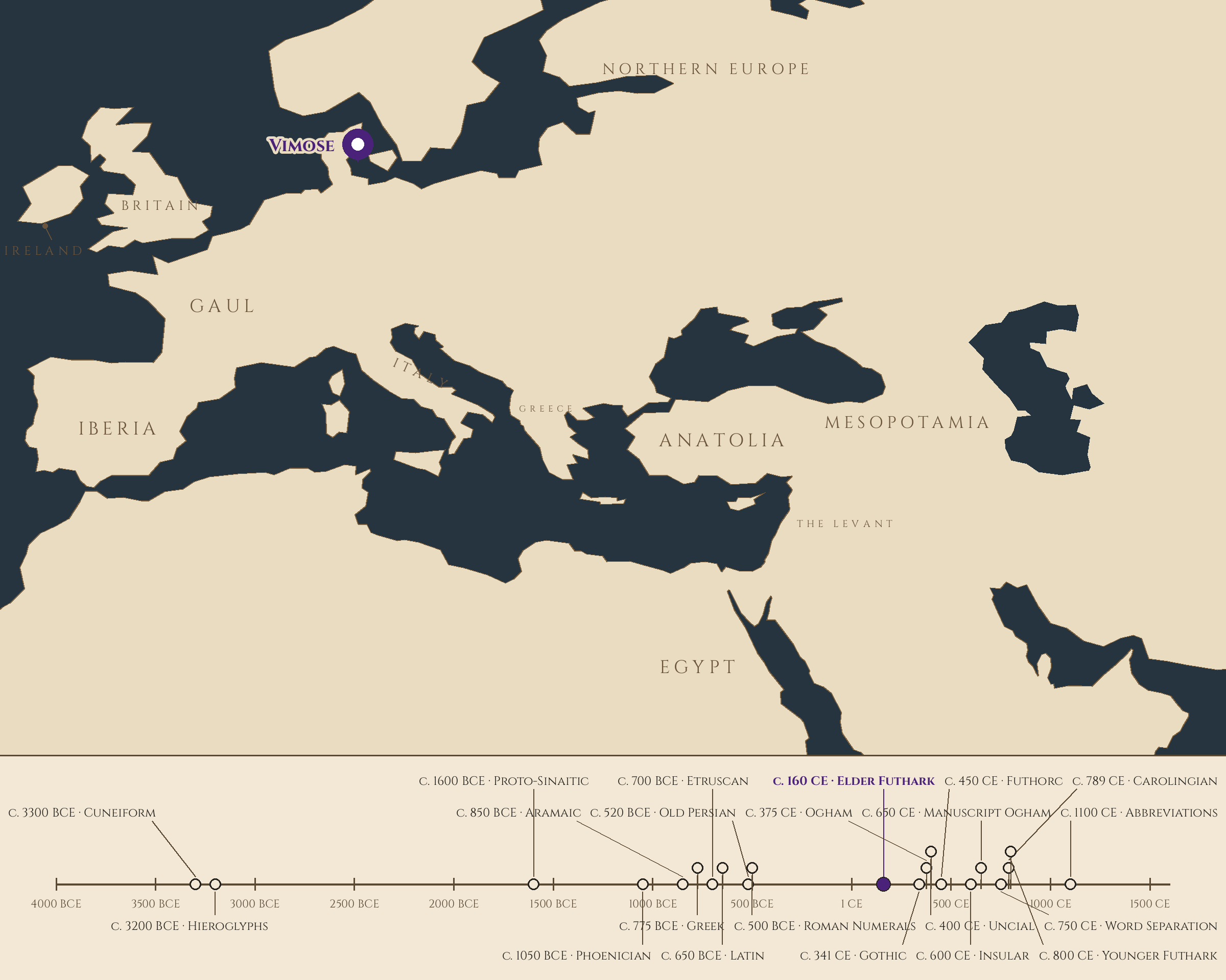
Where and when: Vimose, in Denmark, about 1,860 years ago, where a bone comb carries the oldest runes we can date. The pin is this lesson. The line beneath the map is our road: every stop a writing system, every lesson a pin.
Lesson Objectives
By the end of this lesson, students should be able to:
- Define rune, futhark, Elder Futhark, ætt, stave, Proto-Germanic, and rune poem.
- Explain why the statement "the Vikings invented runes" is wrong, and by roughly how many centuries.
- Describe the 24 runes of the Elder Futhark, their names, sounds, and meanings, organized in three ættir.
- Explain the acrophonic principle behind the rune names.
- Describe the current scholarly debate over the runes' origin (Latin versus North Italic models) without overstating either side.
- Explain how rune shapes reflect the demands of carving, with the honest caveats.
- Identify the Vimose comb and the Kylver stone and explain what each one tells us.
- Read and write simple transliterations in Elder Futhark.
- Apply the course question to a script shaped by its tools: what did the carver's knife leave out?
Reading this lesson: ★ marks the passages to remember. They return on the unit quiz and the class test. Check in questions ask the material back as you go; answer them in your workbook when you meet them.
Working this lesson: Your assignment packet is the first download on this page. Work in it as the lesson moves along, answering each assignment as its subject is taught — or read the lesson through for your notes and take the assignments as homework afterward. Both are proper ways to sit this class. Signposts in the reading tell you where each assignment belongs. Written answers are short answers in your own words; a few honest lines are worth more than a filled page.
Your Assignment Packet
This lesson's assignments live in its packet: the Lexicon Handout (every term, course terms marked ◆), Materials, Guided Practice, the Assignment Manual with its answer key for self-checking, the Reflection Questions, and the Workbook Checklist. Download the packet before you begin and keep it beside you as you read.
The Vikings Did Not Invent Runes
Let me correct the most common falsehood students bring to this lesson, and I want it stated plainly enough to survive repetition.
The Vikings did not invent runes (a rune is a letter of a runic alphabet).
★ The Elder Futhark was already old when the Viking Age began. Our earliest secure inscription, the Vimose comb (an antler comb found at Vimose, Denmark, bearing a single personal name, harja, probably the owner's or the maker's mark, and our proof that runes were already a working script in the 2nd century, six centuries before the Viking Age began), dates to around 160 CE. The Viking Age is conventionally dated from the raid on Lindisfarne in 793 CE. That is more than six hundred years, roughly the distance from Chaucer to the present day.
By the time Viking ships first crossed the North Sea, the Elder Futhark had already lived its whole life and given way to its successor.
Why does everyone get this wrong? Because the Vikings are the most famous users of runes, and fame writes its own history. The Younger Futhark, the 16-rune alphabet of the Viking Age, is carved on thousands of Swedish runestones, and those stones are spectacular. They draw the eye. But they are the grandchildren of the script we study today, not its inventors. The Elder Futhark belongs to an earlier, quieter world: the Migration Period, the centuries when Germanic peoples were moving, trading, fighting as Roman mercenaries, and encountering the alphabets of the Mediterranean world.
Hold this correction the way you would hold a carving knife: firmly, and with respect for what it can cut through. Every lesson from here on builds on it.
Check in: The Vimose comb dates to about 160 CE and the Viking Age begins in 793 CE. In your own words, why does that gap of more than six centuries settle who invented the runes?
❦ In your workbook: record that the Vikings did not invent the runes in your own way — copy, sketch, or note what matters.
Where the Letters Came From
So where did the runes come from? Here I must give you the honest answer, which is that scholars disagree, and the disagreement is interesting.
The general agreement is this: sometime around the 1st or 2nd century CE, Germanic speakers who had encountered alphabetic writing through trade, military service, and cultural contact with the Roman world created a script of their own. The invention is usually credited to a single person or a small group, people who knew the Roman alphabet and reshaped it for Germanic sounds and Germanic materials.
Beyond that, the ground softens. Two families of explanation compete, and neither has won.
The first points to the Latin alphabet itself. The historical context favors it: Germanic mercenaries served in the Roman army, Germanic traders handled Roman goods, and the shapes of many runes (ᚠ like F, ᚱ like R, ᚺ like H, ᛁ like I, ᛏ like T, ᛚ like L, ᛗ like M) look like Latin letters stripped of their curves.
The objection is that the derivation is not as clean as it should be. Too many runes resist a simple Latin parentage, and scholars keep finding shapes that fit better elsewhere.
The second points to the North Italic alphabets, the family that includes Etruscan and its Alpine relatives like Rhaetic and Lepontic. These scripts were used in the Alpine region in the last centuries BCE, exactly where Germanic speakers were in contact with literate cultures. Many rune shapes match North Italic letters with suspicious neatness: the p-rune ᛈ has a parallel in the Camunic alphabet, and the d-rune ᛞ may come from the Lepontic letter san.
A Germanic name, Harigastiz, appears on the 4th-century BCE Negau helmet in a North Etruscan alphabet, proof that Germanic speakers were handling alphabetic writing centuries before the runes existed.
★ The current scholarly mood favors what one might call an eclectic answer: most rune shapes can be accounted for by drawing on several North Italic systems, with Latin influence in the mix.
No single parent alphabet explains all twenty-four runes. The inventor, whoever they were, appears to have borrowed widely and adapted freely.
Notice what this means for our story. Every alphabet we have studied had a clear parent: Greek from Phoenician, Etruscan from Greek, Latin from Etruscan. The runes are our first script with a disputed birth certificate. That is not a failure of scholarship.
It is a sign that we are dealing with a genuine act of creation, not a simple handoff.
Someone looked at the alphabets of the south and built something new for the north.
One more date for your records. The Elder Futhark was forgotten as a readable script for centuries. It was deciphered in 1865 by the Norwegian scholar Sophus Bugge, who worked out the system from the accumulated inscriptions.
Every rune name and sound value in this lesson descends from that decipherment, refined by six generations of runologists since.
❦ In your workbook: record where the letters came from in your own way — copy, sketch, or note what matters.
Twenty-Four Runes
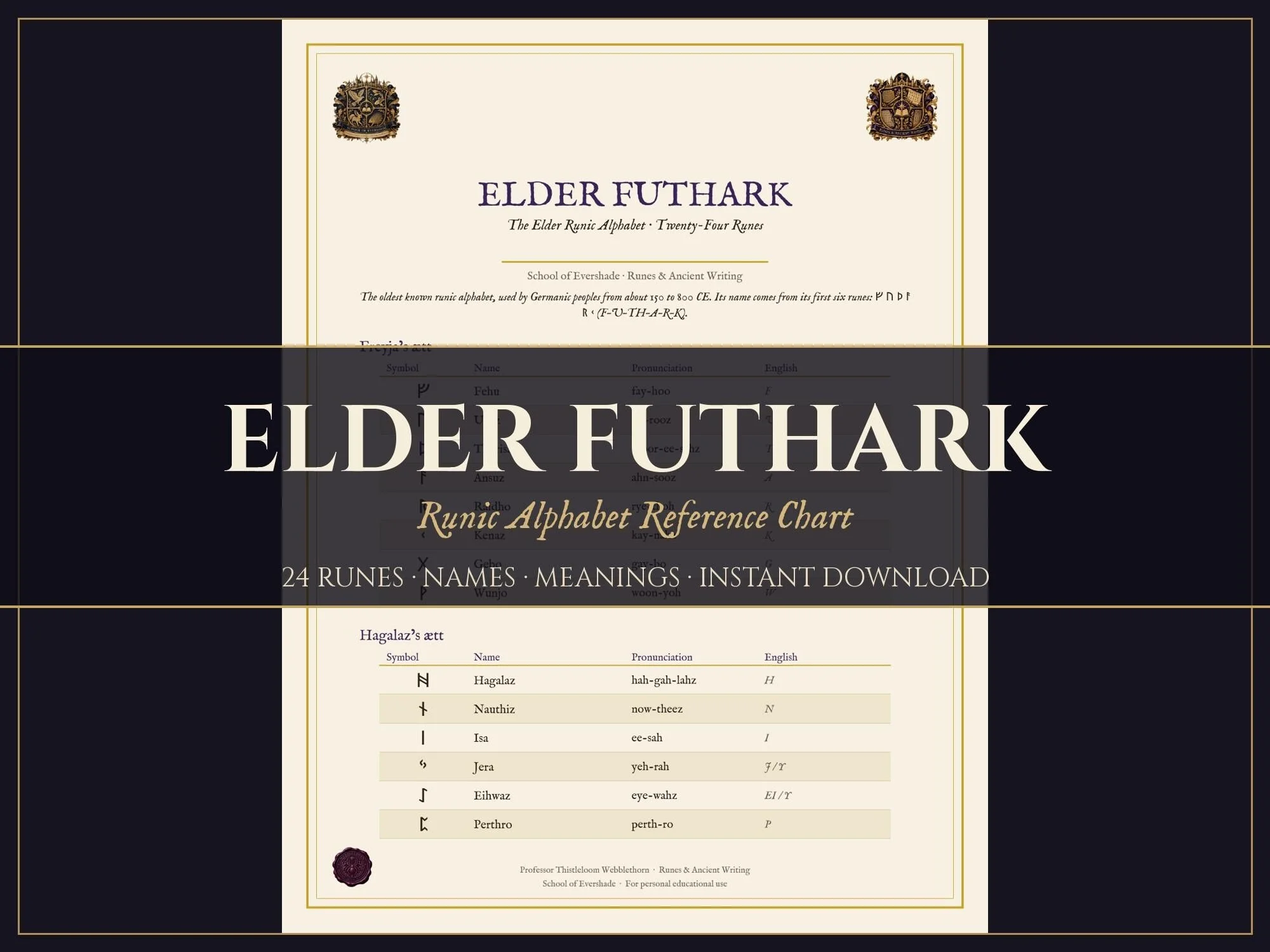
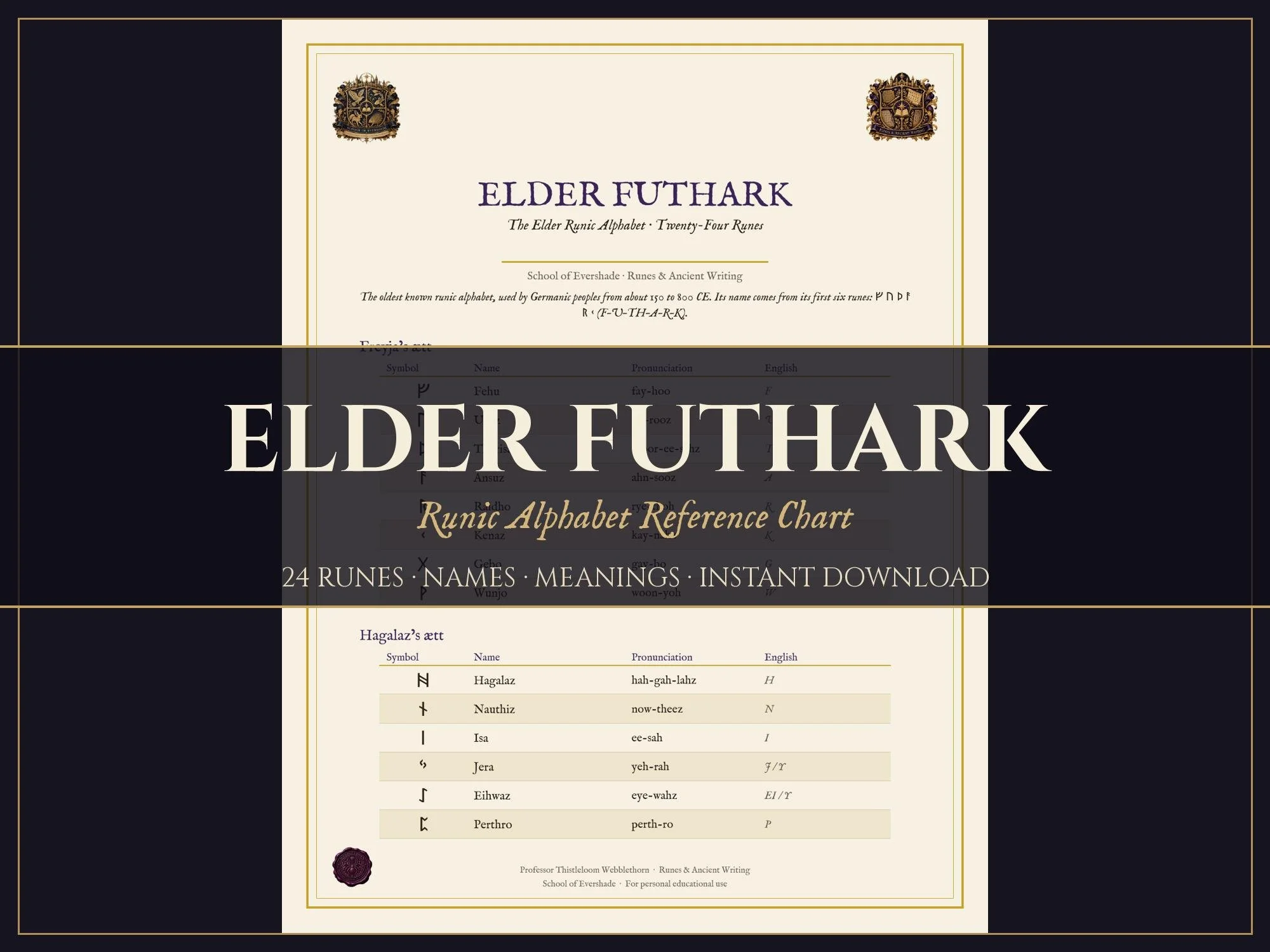
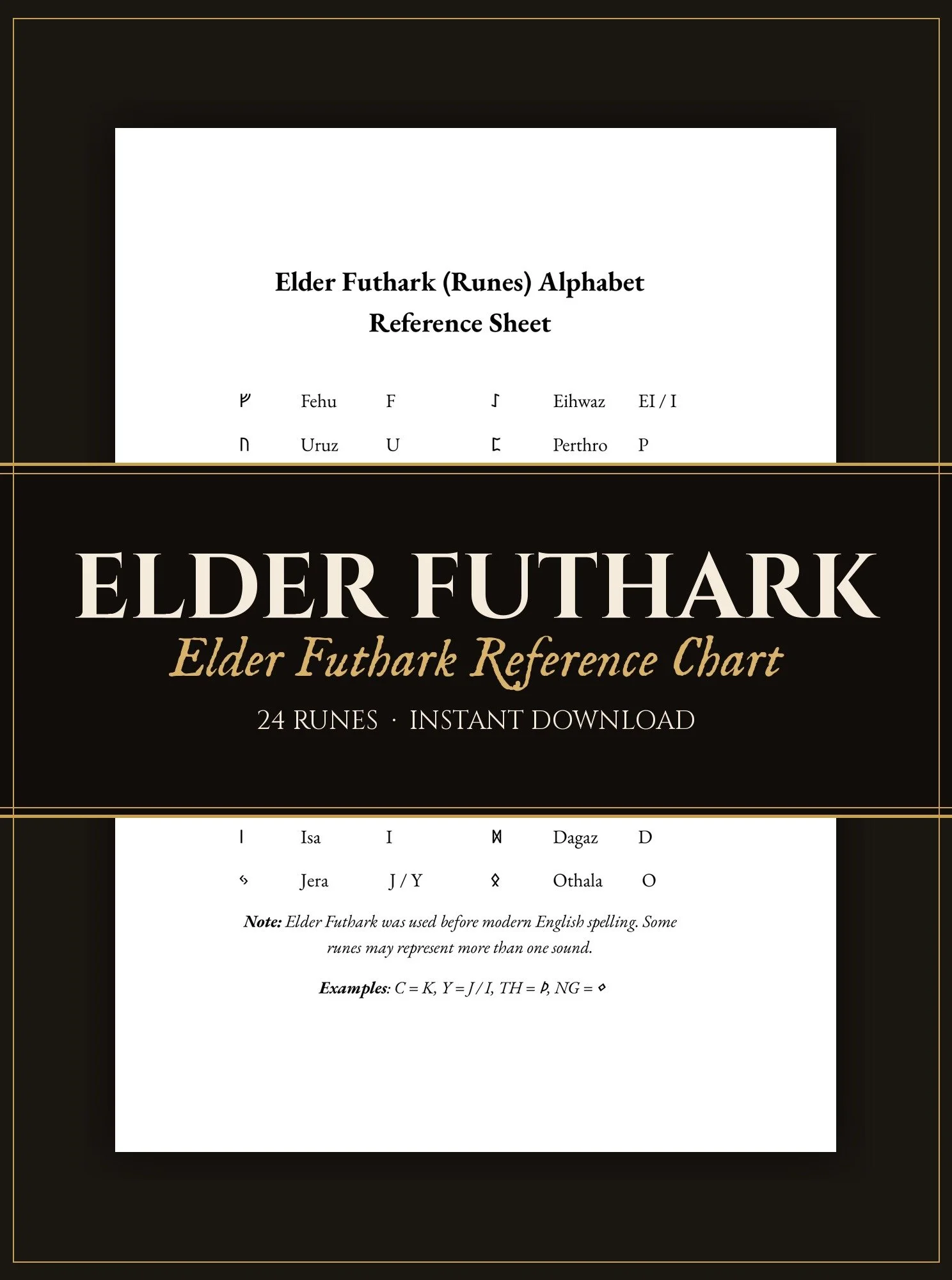
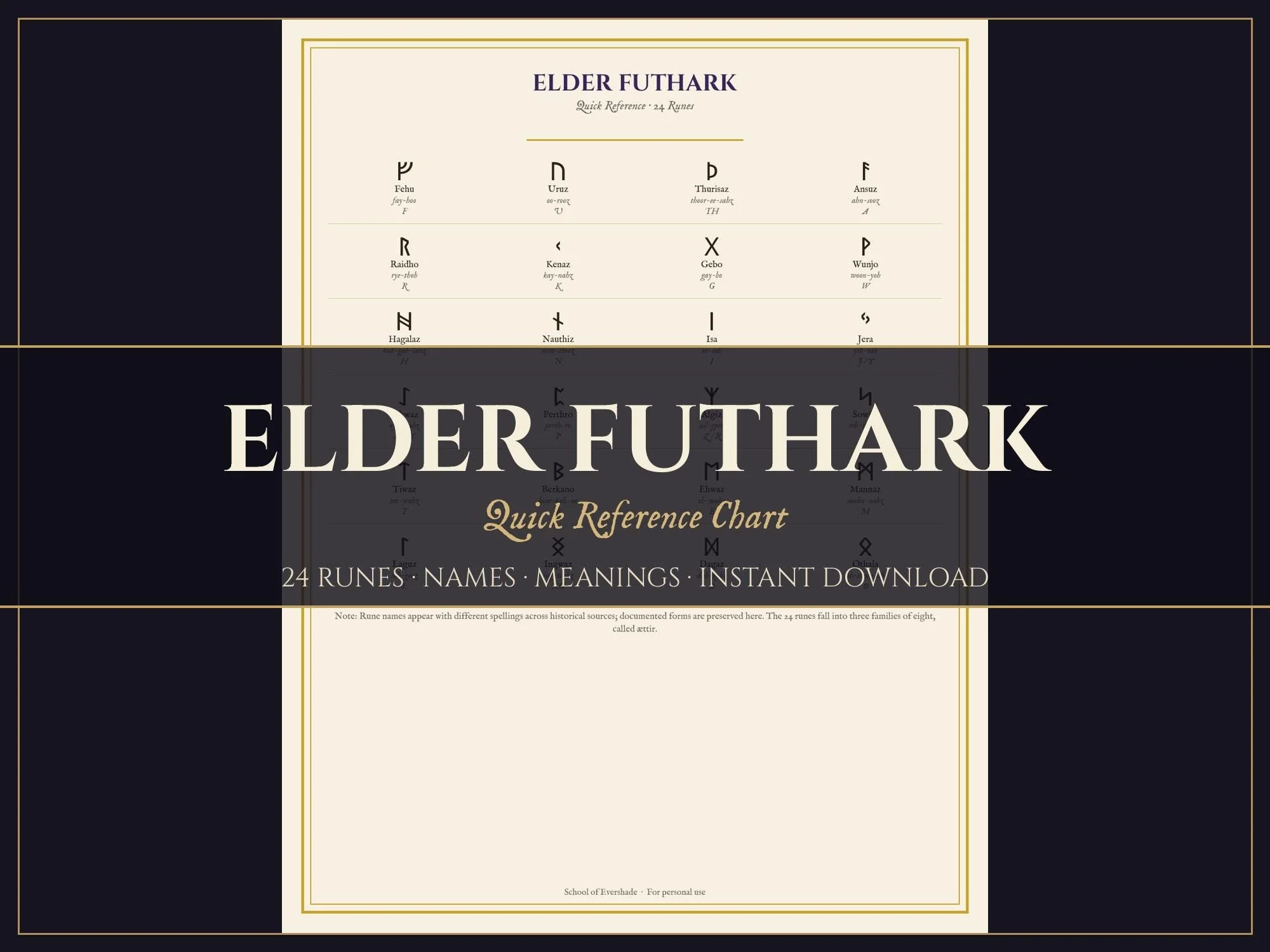
Here is the Elder Futhark in full, in the order of the Kylver stone, our earliest complete listing (around 400 CE, on the island of Gotland). The runes are grouped in their three ættir (families, of eight runes each). For each rune I give its shape, its reconstructed Proto-Germanic name (marked with an asterisk, since these are scholarly reconstructions), its meaning, and its sound.
★ Read the names aloud. Each rune's sound is the first sound of its name. That is the acrophonic principle you learned in Lesson 4, working here exactly as it worked in Sinai three thousand years earlier. Fehu begins with f and means "cattle." Uruz begins with u and means "aurochs." The system is the same; only the forest has changed.
The names themselves come down to us chiefly through the rune poems: verse catalogues in which each rune is given a short stanza describing its name. The Old English rune poem, compiled in the 8th or 9th century, preserves names for all 24 Elder Futhark runes plus five additional Anglo-Saxon ones. Later Scandinavian rune poems cover the 16 Younger Futhark runes. These poems are our main source for what the runes were called, though the names they preserve are centuries younger than the Elder Futhark itself.
A note on honesty before we begin: the meanings below are the scholarly consensus where consensus exists, and flagged where it does not. Three runes in this list carry live debates. I have marked each one, because a student who knows where the knowledge ends is better educated than one who was never told there was an edge.
First Ætt
ᚠ Fehu (fehu, "cattle, wealth"): f, as in "father." Cattle were wealth in the Germanic world, mobile and countable, and the rune carries both senses. The first rune of the futhark (the runic alphabet, named for its first six runes: f, u, th, a, r, k), and the first sound of its name.
ᚢ Uruz (ūruz, "aurochs"): u, as in "rule." The aurochs was the wild ox of Europe, enormous and dangerous, extinct since the 17th century. Strength embodied in a single syllable.
ᚦ Thurisaz (þurisaz, "giant"): th, as in "thorn" (and sometimes the voiced th of "this"). The thurs was a giant of Germanic legend, a being of raw and hostile power. Note the rune's name varies across traditions; "giant" is the best-supported reading.
ᚨ Ansuz (ansuz, "god"): a, as in "father." The ans was a god of the Germanic pantheon, one of the Æsir. The Old English rune poem calls this rune the source of all speech, which gives the letter a double dignity: divine and linguistic at once.
ᚱ Raidho (raidō, "ride, journey"): r, trilled. The journey by horseback or wagon, and by extension the road itself. A practical word for a world that moved on foot and hoof.
ᚲ Kenaz (kauną, "torch" or "ulcer"): k, always hard. Here is a small honest complication: the traditions disagree. The Old English poem gives "torch," a bright and useful thing. Other evidence points to "ulcer" or "boil," a painful one. Both readings have scholarly support. I give you the disagreement rather than hiding it, because this is what the sources actually say.
ᚷ Gebo (gebō, "gift"): g, as in "go." The simplest shape in the futhark, two strokes crossing, and one of the most human meanings. Gift-giving was the social glue of the Germanic world.
ᚹ Wunjo (wunjō, "joy"): w, as in "water." Joy, plain and unqualified. (You may see "harmony" offered as a gloss in some modern books. That is an editorial addition, not part of the reconstructed name. The rune means joy.)
Second Ætt
ᚺ Hagalaz (hagalaz, "hail"): h, as in "hand." Hail, the ice that falls from the sky and ruins crops. The rune poems dwell on its destructiveness. Weather as fate, spelled in a single stave (a rune's main vertical stroke).
ᚾ Naudiz (naudiz, "need, distress"): n, as in "night." Need in the old sense: hardship, compulsion, the pinch of necessity. The rune poem calls it the torment of the heart.
ᛁ Isaz (īsaz, "ice"): i, as in "machine." Ice, the smooth and treacherous surface. In the north, ice was a road and a trap at once.
ᛃ Jera (jēra, "year, harvest"): y, as in "year." The turning year and the harvest it brings. The rune's name is the ancestor of the English word "year." Say them together and hear fourteen centuries collapse.
ᛇ Eihwaz (īhwaz, "yew tree"): the sound value is debated among runologists; it is conventionally transliterated ï. The yew was the bow-wood of the north, tough and evergreen, and the tree of the dead in later tradition. This is our first flagged debate: the rune's exact phonetic value is uncertain, and honest books say so.
ᛈ Perthro (perþō, meaning unknown): p, as in "pen." Our second flagged debate, and the deepest one. No one knows what this rune was named for. "Dice cup" is one guess among several; others have proposed "game piece" or a connection to fruit trees. The rune poem's stanza is cryptic. When a book tells you confidently what Perthro means, it is telling you more about the book than about the rune.
ᛉ Algiz (algiz, "elk" by convention): z, the Proto-Germanic z sound. Our third flagged debate. The name "elk" is the conventional reconstruction, but specialists widely agree it is probably not the rune's true original name. The runologist Stephen Pollington has suggested the original sense may have been "protection" or "guard." I give you the conventional name with the caveat attached, which is more than most popular books do.
ᛊ Sowilo (sōwilō, "sun"): s, as in "sun." The sun, the wheel of the sky, the brightest thing in the northern world. The rune's zigzag is light made angular.
Third Ætt
ᛏ Tiwaz (tīwaz, "the god Tiw"): t, as in "tin." Tiw was the Germanic god of war and law, the namesake of Tuesday. This rune's simple arrow-shape points upward, and the god it names was invoked in oaths.
ᛒ Berkano (berkaną, "birch"): b, as in "boat." The birch, the first tree to leaf in spring, the tree of beginnings. The rune poem associates it with new growth.
ᛖ Ehwaz (ehwaz, "horse"): e, as in "bed." The horse, the noblest animal of the Germanic world, the measure of a warrior's worth. Note the rune's shape: two staves joined, like a team.
ᛗ Mannaz (mannaz, "man, human"): m, as in "man." Humanity itself, the measurer of all things. The rune looks like two figures joined at the hands.
ᛚ Laguz (laguz, "water"): l, as in "lake." Water in the general sense: lake, sea, the fluid element. In the north, water was the highway.
ᛜ Ingwaz (ingwaz, "the god Ing"): ng, as in "sing." Ing was a Germanic god associated with fertility and the earth's abundance. (Some modern books gloss this rune as "seed." That is interpretive; the name is the god's.)
ᛞ Dagaz (dagaz, "day"): d, as in "day." Daylight, the bright half of the world's turning. The rune's bowtie shape is day balanced against night.
ᛟ Othala (ōþala, "ancestral land, inheritance"): o, as in "own." The family homestead, the land passed from parent to child, the legal and emotional center of Germanic life. The last rune of the futhark, and a fitting close: the alphabet ends at home.
★ Twenty-four runes. Three families of eight. Every one of them earned its place by naming a sound of the language, and every name begins with the sound its rune spells. The system is complete, economical (a model of what this classroom calls acoustic economy: a writing system keeps only the sound distinctions its language truly needs, and no more), and beautiful, and it was carved, not written.
Check in: Pick any three runes from the chart. For each one, how does the acrophonic principle connect its name to its sound?
❦ In your workbook: record the twenty-four runes in their three ættir in your own way — copy, sketch, or note what matters.
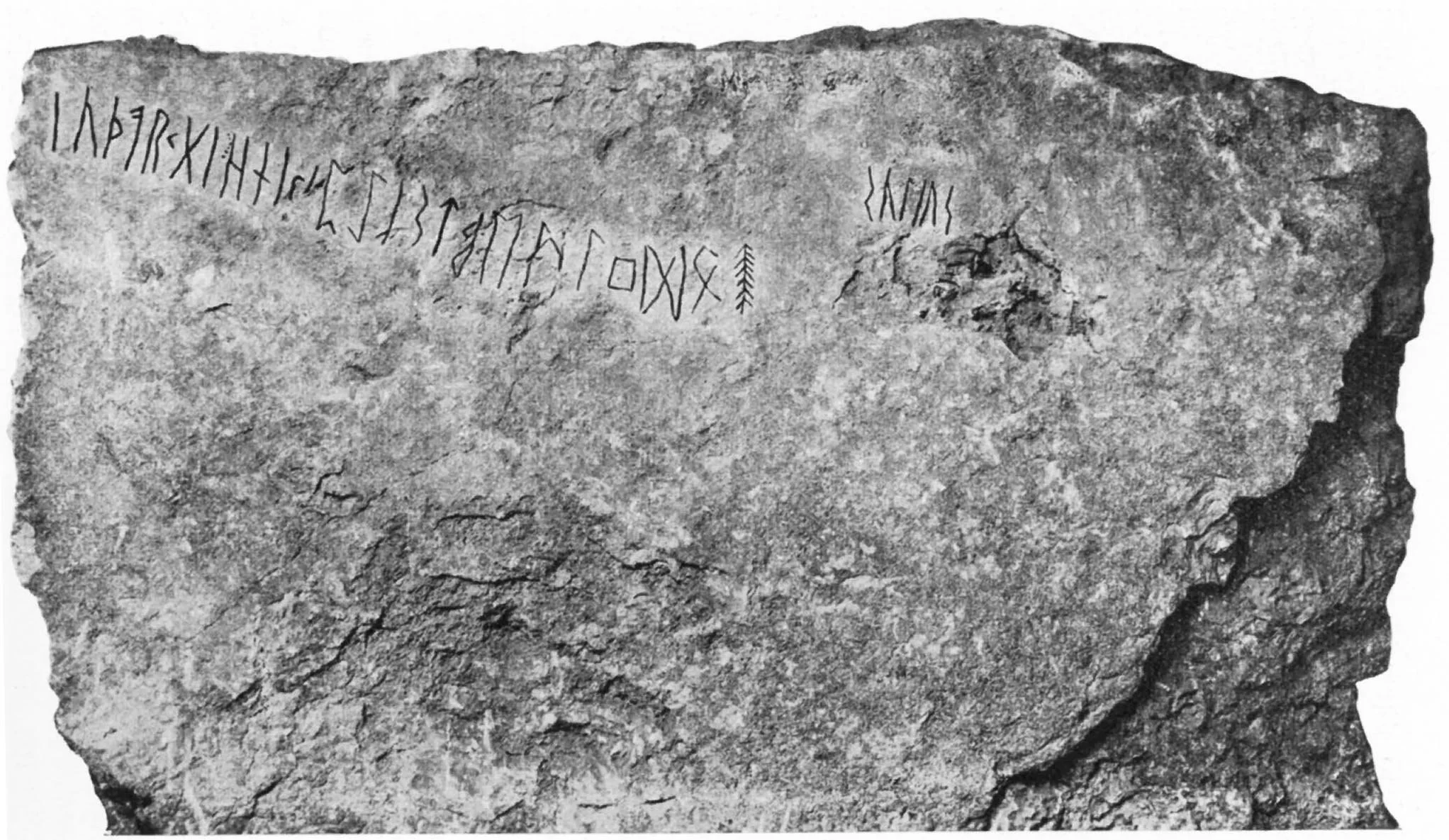
Historical example. The Kylver stone from Gotland: the whole Elder Futhark carved in a single row about 400 CE — the order this lesson follows. The runes run right to left, and the short word at the right is still not certainly read.
The Kylver stone, Gotland, Sweden, c. 400 CE. Photograph published in Sigurd Agrell, Lapptrummor och runmagi (1934). Public domain.
In your packet: Assignment I — The Rune Chart ⚒ begins here. Work it now, or mark the place and take it as homework — your choice.
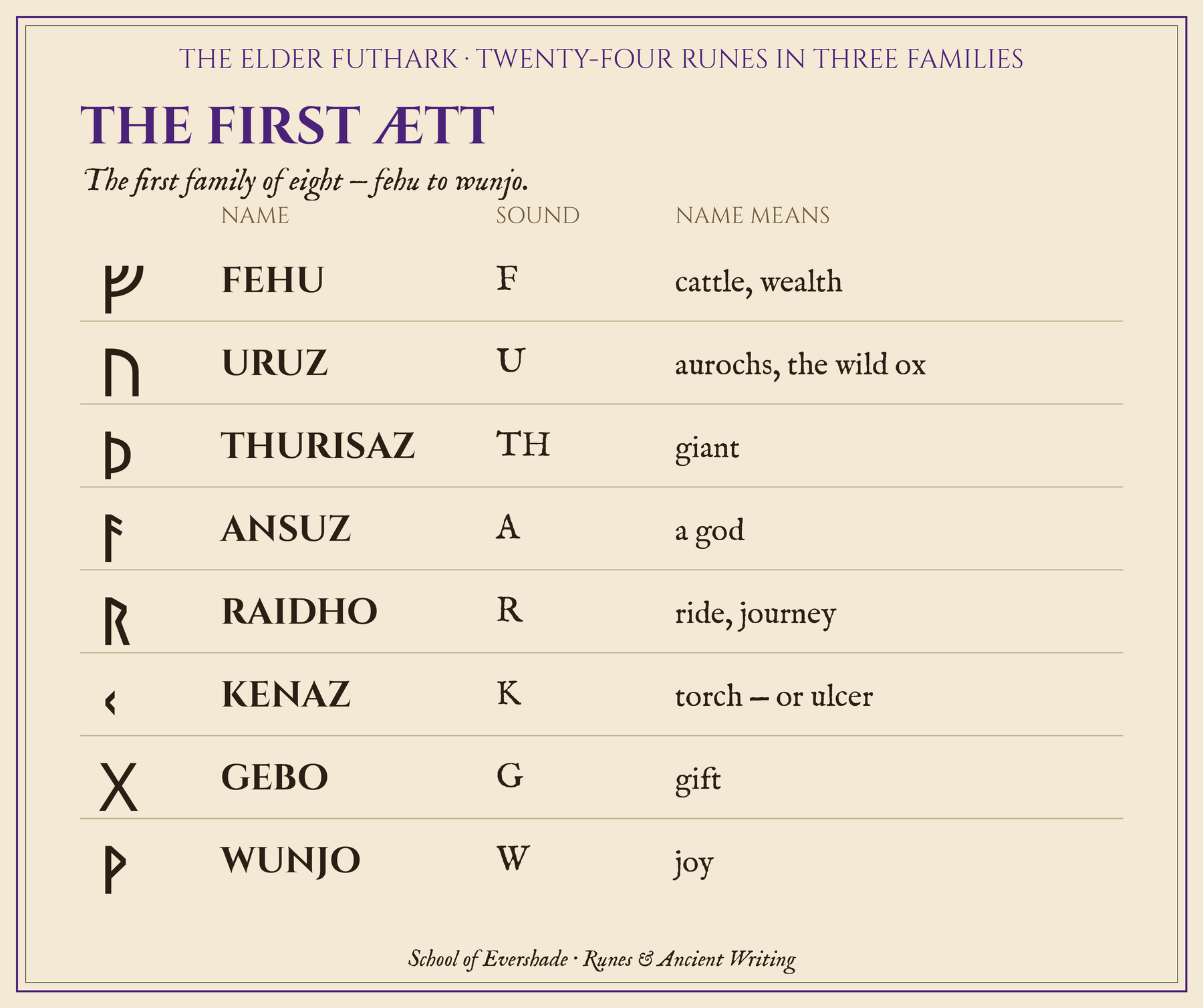
The first ætt — fehu to wunjo: each rune's name, its sound, and what the name means.
Built for Evershade.
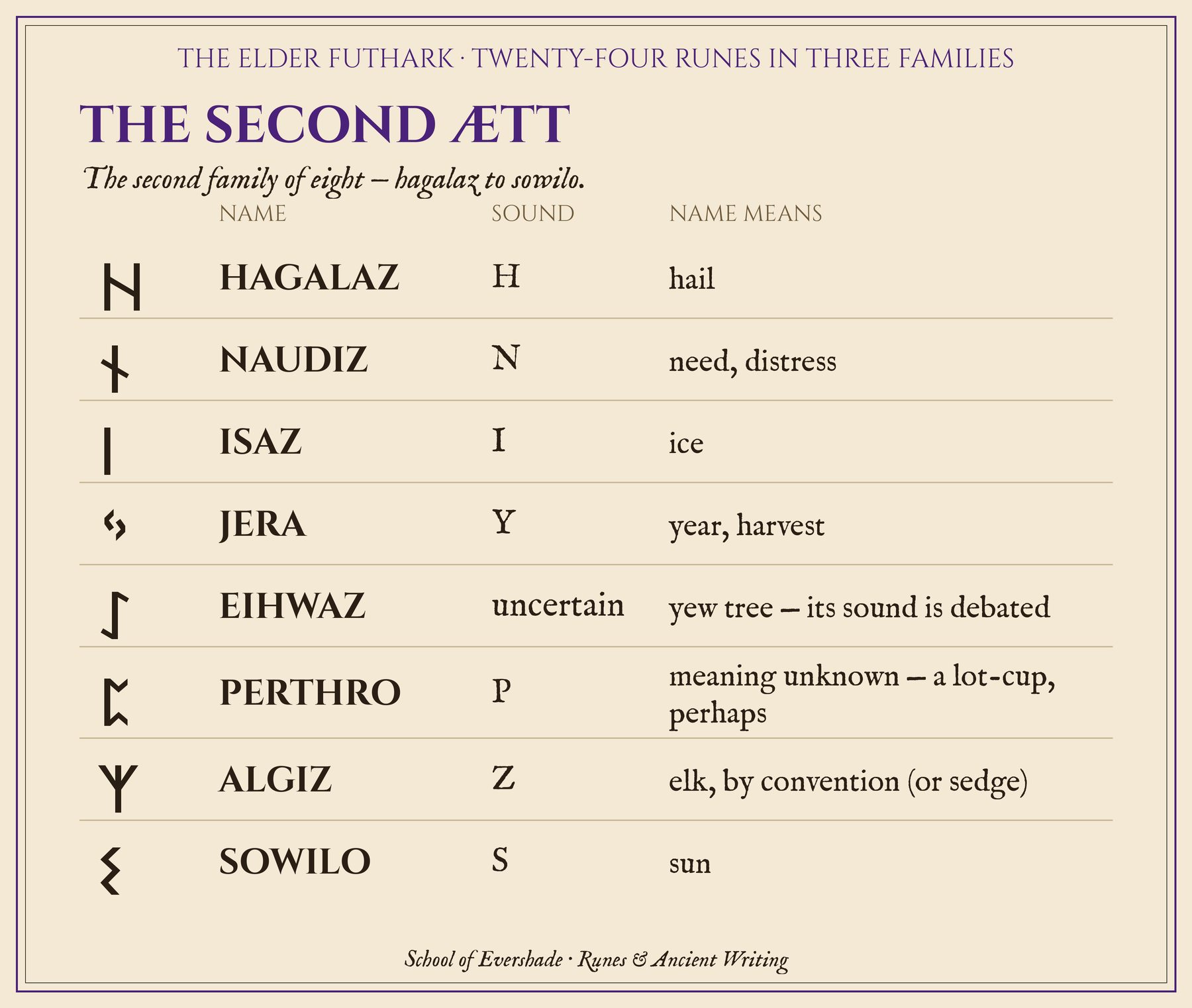
The second ætt — hagalaz to sowilo, with the lesson's honest gaps kept: eihwaz's sound is debated, and perthro's meaning is unknown.
Built for Evershade.
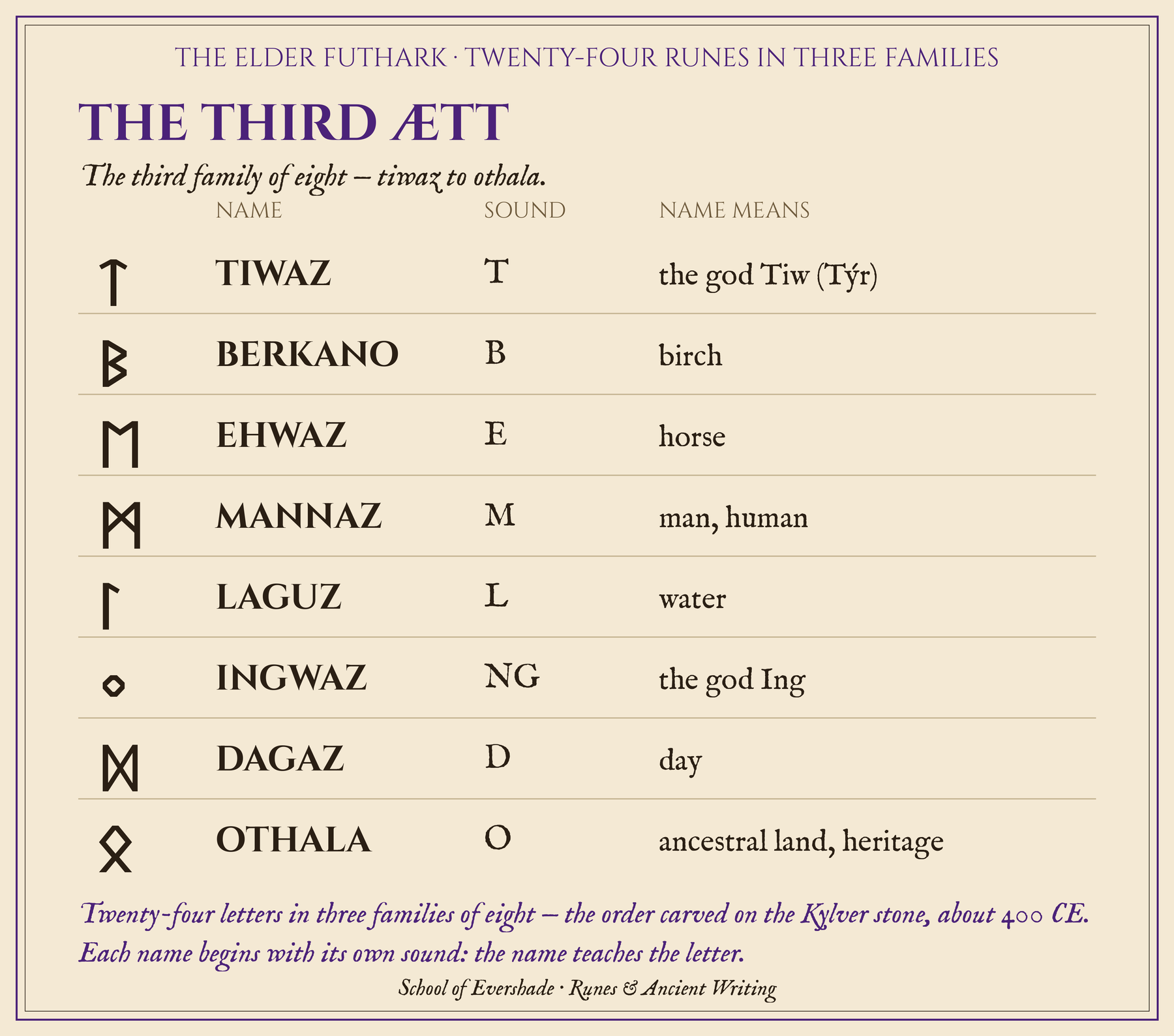
The third ætt — tiwaz to othala. Twenty-four letters in three families of eight: the whole Elder Futhark.
Built for Evershade.
Professor Webblethorn
Pause here, scholars, and consider what the knife left out.
Every alphabet we have studied was shaped by its tools. The reed pen gave Egypt its flowing birds. The chisel gave Rome its serifs. But no tool shaped its alphabet as ruthlessly as the carving knife shaped the runes. Curves are nearly impossible to cut cleanly into wood with a blade; they become wobbles. Long horizontal cuts run along the grain, where they vanish into the wood's own lines or split the stave entirely. So the runes left them out. No curves. Almost no horizontals. Only the stave and the branch, the trunk and the limb, cut across the grain where every stroke reads dark and clean.
This is our course question answered in wood: what can be left out and still be understood? The carver left out everything the knife could not do, and kept everything the language needed. Twenty-four sounds, twenty-four signs, nothing wasted, nothing missing. The alphabet did not merely survive the subtraction. It became more itself.
Run your finger along the edge of your desk, scholars, and feel the grain. The runes were designed for exactly that surface. Every letter you have just learned is a negotiation between a sound and a blade, and the blade won every argument except the ones that mattered.
PROFESSOR THISTLELOOM WEBBLETHORN
Runes & Ancient Writing
Epigrapher, Head of House Septentrio
The Carving Hand
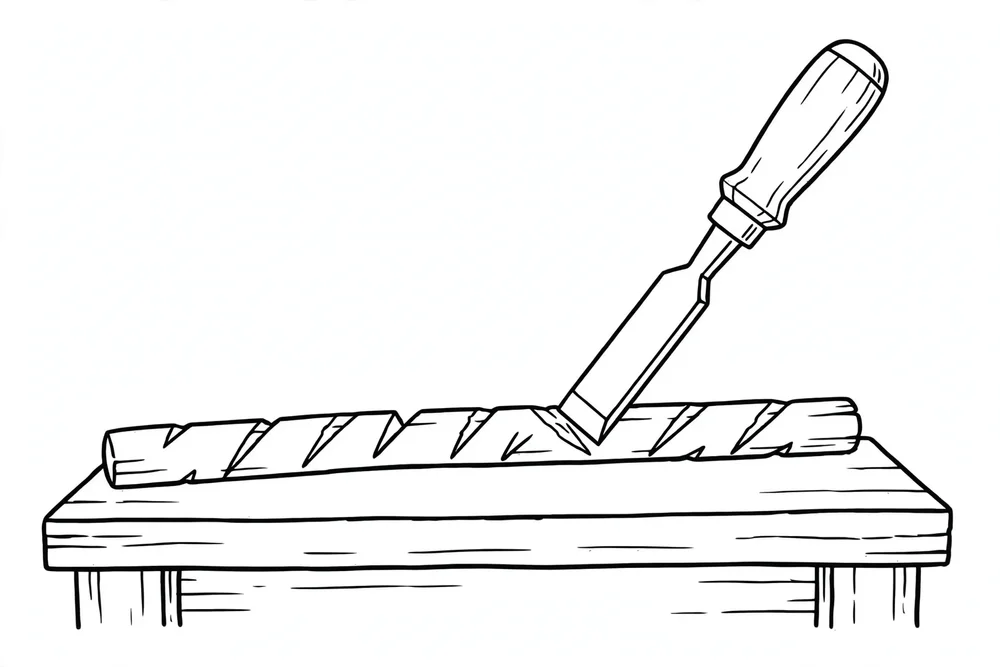
Now let us talk about the hands that cut these letters, and the materials they cut into.
The primary writing surfaces of the runic world were wood, bone, antler, and metal: iron for weapons, bronze for ornaments, gold for the bracteates, those thin stamped medallions modeled on Roman coins.
Stone came later and less often in the Elder Futhark period; the great runestones belong mostly to the Viking Age and its Younger Futhark. Clay and papyrus, the surfaces of the south, are nearly absent. The north wrote on what the north had.
The tool was the knife. A short, sharp blade, the same knife that cut food and shaped wood and served a dozen daily purposes. To carve a rune, you drew the blade toward you along the surface, cutting a V-shaped groove. The groove caught shadow and read dark against the lighter wood.
Some carvers rubbed pigment into the cuts, red ochre most often, to make the letters stand out; traces of paint survive on later runestones, and the practice was likely older.
★ The shapes of the runes reflect these demands. Vertical staves and angled branches cut cleanly across wood grain, each stroke distinct. Long horizontal strokes would run along the grain, where they blur into the wood's own lines and risk splitting the stave. So the runes avoid horizontals, or nearly so.
I say "nearly" with deliberate care, because the popular account overstates the engineering. Early inscriptions show real variation, including occasional horizontal strokes.
The e-rune ᛖ often took a shape like the Greek letter pi in the earliest period, horizontals and all, before settling into its later form. The angular character of the runes is shared with most contemporary carving alphabets, not a uniquely Germanic invention.
What we can say truthfully is this: the shapes trend strongly toward the carveable, the exceptions prove the trend was never absolute, and the overall effect is a script visibly shaped by its tool. That is honest, and it is enough.
The carving sequence was simple. The stave went down first, a single vertical cut. Then the branches, the angled strokes that distinguish one rune from another. A practiced carver could cut a short inscription quickly; the Vimose comb's single name, harja, would have taken moments.
Longer texts took longer, but the work was never the laborious monument-carving of Egypt or Rome. Runes were a handwriting, quick and personal, cut into objects people carried.
Check in: Why do the runes avoid curves and long horizontal strokes, and what is the honest caveat the lesson adds to that explanation?
❦ In your workbook: record how the knife shaped the runes in your own way — copy, sketch, or note what matters.
What the Inscriptions Say
If you expect ancient mysteries, the inscriptions will surprise you. They are, for the most part, magnificently ordinary.
Most surviving Elder Futhark inscriptions are short: a name, an ownership mark, a maker's signature, a brief phrase. Harja on the Vimose comb, probably "Harja owns this" or "Harja made this." Names on spearheads and brooches. "I, Hlewagastiz, made this" on the Golden Horns of Gallehus, among the most famous inscriptions of the period.
These are the ancient equivalents of writing your name in your coat: practical, personal, unmysterious.
The shortness has more than one cause. Carving was laborious, yes, and that set a practical limit.
But shortness was also convention and purpose: this was what the script was for. Names and ownership and brief messages were the daily business of writing, in the north as everywhere. Longer inscriptions do exist, and their existence proves the script could handle more when the occasion demanded.
This ordinariness is the point, and it corrects the second great misconception about runes. Runes were not primarily magical. They were not a secret code of wizards, not a system of fortune-telling, not the exclusive property of priests. They were letters, used by ordinary people for ordinary purposes: marking property, memorializing the dead, sending short messages, practicing the alphabet itself. (The Kylver stone's full futhark listing may be exactly that: someone practicing, or teaching, the alphabet, around the year 400.)
Magic enters the story later, and sideways. A few early inscriptions use runes in ways that look ritual: repeated rune sequences, the names of gods invoked on amulets.
The Lindholm amulet of the 3rd or 4th century strings divine names together in a way that suggests more than labeling. Scholars debate how much of this is genuine ritual use and how much is modern imagination projected backward.
★ What is certain is that the everyday, practical use came first and remained the foundation. The runes were a working alphabet that occasionally touched the sacred, not a sacred code occasionally used for writing.
This matters beyond the classroom. The modern popular image of runes, all mysticism and divination, is largely a 19th- and 20th-century invention, built on selective reading and romantic imagination. The actual inscriptions tell a humbler and more interesting story: people writing their names on their belongings, sixteen hundred years ago, in letters cut with a kitchen knife.
There is wonder enough in that without inventing more.
❦ In your workbook: record what the inscriptions say in your own way — copy, sketch, or note what matters.
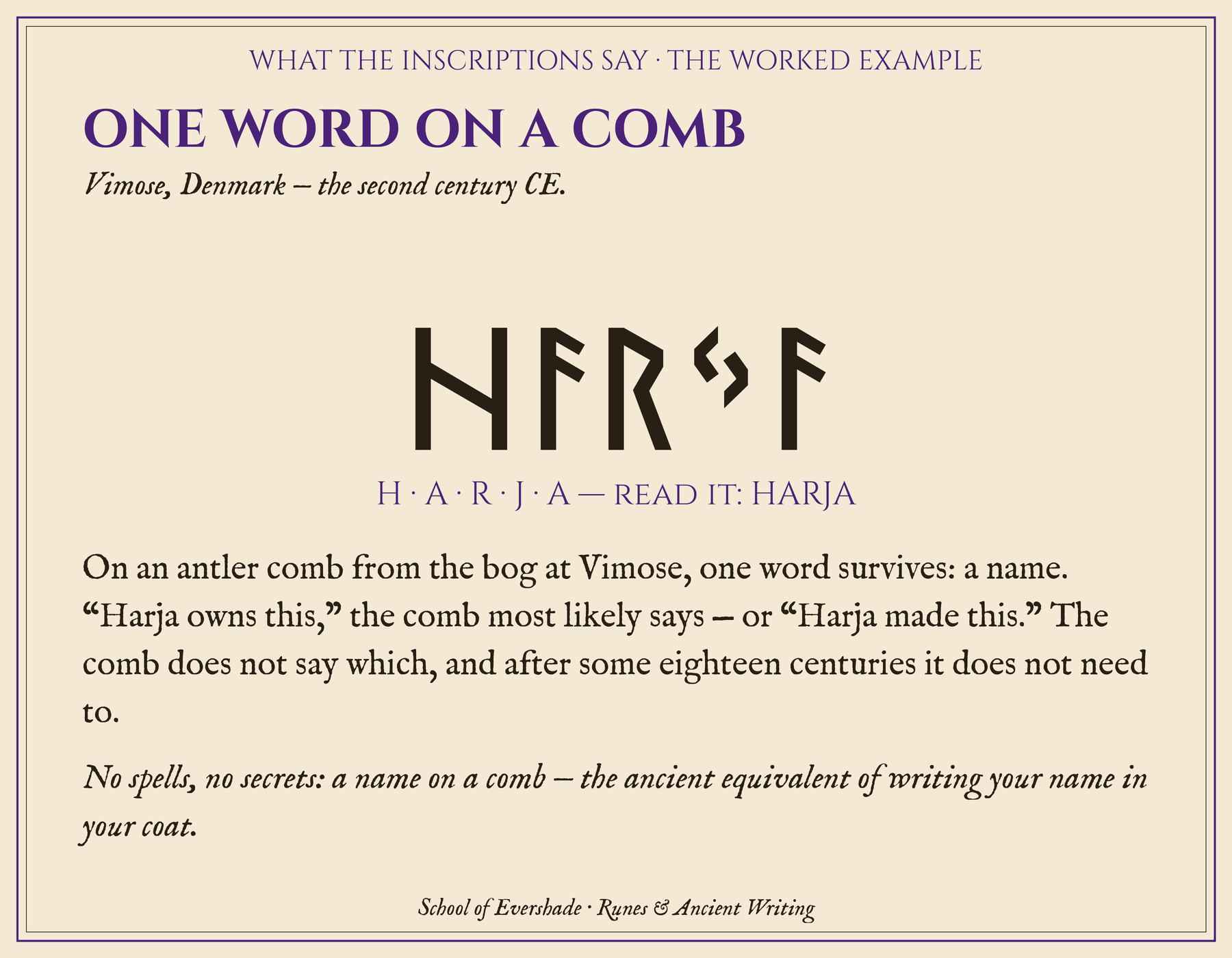
One word on a comb: harja, carved at Vimose in the second century CE — a name, an owner's mark, and among the oldest runic writing we have.
Built for Evershade.
In your packet: Assignment III — The Artifact Investigation ◐ begins here. Work it now, or mark the place and take it as homework — your choice.
Reading the Runes
A few technical matters before you take up the knife yourself.
Direction: the earliest inscriptions vary. Some run left to right, some right to left, some alternate in the boustrophedon manner you learned in Lesson 7. Reversed runes appear, the carver's equivalent of a slip of the pen.
Over the centuries, left-to-right became the settled convention, but the early period was experimental, and the experiments are visible in the surviving objects.
Word division: the Elder Futhark had no spaces between words. Carvers separated words with single dots, with small crosses, or with gaps, or sometimes not at all. You have met this before: the scriptio continua of Lesson 6, the unbroken stream of letters. The runic carver's solution was the same as the Aramaic scribe's, a dot's worth of air between words, and the reader supplied the rest.
Transliteration: when scholars print a runic inscription in our alphabet, they follow strict conventions. Each rune becomes its corresponding Latin letter, with special characters for the sounds Latin lacks: þ for the th-rune, ï for the debated eihwaz, ŋ for ingwaz. Damaged or uncertain runes go in brackets or parentheses.
These conventions let runologists across the world read the same inscription the same way, and your assignments will teach you to use them.
The corpus: roughly 350 Elder Futhark inscriptions survive, on objects scattered from the North Sea coast to the Black Sea, following the movements of Germanic peoples. It is a small body of text, and every new find matters.
The script's whole written legacy would fit in a slim volume.
Yet from those few hundred inscriptions, scholars have reconstructed a complete alphabet, a language, and a world.
❦ In your workbook: record how the runes are read and transliterated in your own way — copy, sketch, or note what matters.
In your packet: Assignment II — Transliteration Practice ⚒ begins here. Work it now, or mark the place and take it as homework — your choice.
Guided Practice — The Carver's Hand
Before the assignments, train your hand the way a Germanic carver would: with attention to the stave, and to the grain.
Exercise A — Drawing the Twenty-Four
- On paper, draw all 24 runes in their three ættir, using the chart in this lesson. Work with straight strokes only: no curves, no flourishes.
- Draw each rune as a stave first, then add the branches. Feel the carving sequence in your drawing hand.
- Label each with its reconstructed name, meaning, and sound value.
- Mark the three debated runes (eihwaz, perthro, algiz) with a small question mark. Practice the habit of marking what is uncertain.
Exercise B — The Grain Test
- Take a bar of soap, a block of modeling clay, or a piece of soft wood. These stand in for the carver's materials.
- With a blunt knife, a nail, or a wooden skewer, carve the first ætt (ᚠ ᚢ ᚦ ᚨ ᚱ ᚲ ᚷ ᚹ) into the surface. Cut away from your body, carefully and slowly, keeping your holding hand behind the blade's path.
- Now try carving a curved letter, such as S, and a long horizontal line. Observe what happens: the curve wobbles, the horizontal catches or vanishes.
- Write three to four sentences on what your hands just taught you: why do the runes look the way they do? What did the knife forbid, and what did it allow?
This exercise teaches, in your own hands, the central claim of the lesson. The shapes are not decorative choices. They are the alphabet that survives the blade.
❦ Workbook path: working on paper instead? Draw the first ætt large, stave first and branches second, then draw a curved S and a long horizontal line beside them. Beneath each, write what the knife would have done to it: where the curve wobbles, where the horizontal vanishes into the grain.
Exercise C — Transliteration
- Using the chart, transliterate your first name into Elder Futhark runes. If your name contains sounds the futhark lacks (such as modern q or the sh sound), note how you handled the gap and why.
- Transliterate the Proto-Germanic word dagaz (day) and mannaz (man) into runes, then back into Latin letters. What did the round trip teach you about the reliability of the system?
- Write the futhark opening sequence (ᚠ ᚢ ᚦ ᚨ ᚱ ᚲ) from memory, then check yourself. The carvers who practiced on the Kylver stone did exactly this exercise sixteen centuries ago.
In your packet: Assignment IV — The Knife's Alphabet Essay ✎ begins here. Work it now, or mark the place and take it as homework — your choice.
Assignment Manual
Assignment key: ✎ written work · ⚒ hands-on practical · ◐ both · ★ will be on the test · ❦ workbook path
Written answers in this manual are short answers in your own words — a few honest lines, not a filled page.
Assignment I — The Rune Chart ⚒
Objective: Demonstrate control of the 24 runes, their names, meanings, sounds, and ættir.
Instructions:
- On a fresh sheet, create a five-column chart: rune (drawn), reconstructed name, meaning, sound value, ætt (1, 2, or 3).
- Complete all 24 rows in Kylver order. For eihwaz, perthro, and algiz, add a brief note on what is debated.
- Below the chart, write one paragraph on the acrophonic principle: choose three runes and explain how each rune's sound matches the first sound of its name.
Your keepsake: this chart is your working key to every runic lesson that follows. Keep it at the front of your workbook; the Professor's Review will ask you to lay it beside your Latin alphabet.
To submit: Photograph or scan your chart. Accuracy of the shapes matters more than artistic skill; use straight strokes only.
Assignment II — Transliteration Practice ⚒
Objective: Read and write Elder Futhark transliterations using scholarly conventions.
Part A. Transliterate the following Proto-Germanic words into runes: fehu (cattle), dagaz (day), wunjō (joy), mannaz (man). Then transliterate them back into Latin letters. Note any sounds that required special characters (þ, ï, ŋ).
Part B. The Vimose comb reads harja. Write this name in runes (ᚺ ᚨ ᚱ ᛃ ᚨ). Research the Vimose find using the References below and write a half page on what a single name on a comb tells us: who owned combs, who could carve, and what literacy looked like in the 2nd century north.
Part C. Write the full 24-rune futhark from memory in three ættir, then check against the lesson chart. Mark any runes you misplaced. Reflect in two to three sentences: which ætt was hardest, and what does that suggest about how the groupings work as memory aids?
Assignment III — The Artifact Investigation ◐
Objective: Understand the Elder Futhark through its two most important objects.
Instructions:
- Research (using the References below): the Vimose comb (Denmark, ~160 CE) and the Kylver stone (Gotland, ~400 CE). For each, record the date, the place of discovery, the object type, and what the inscription says.
- The comb carries a single name; the stone carries the whole alphabet. Write a half page on what the contrast reveals: what was the script for in 160 CE versus 400 CE? Base your argument strictly on the objects and this lesson.
- The lesson claims the runes' origin is debated between Latin and North Italic models. Choose the single strongest piece of evidence for each side (from the lesson or your research) and write a half page weighing them. Which side do you find more convincing, and what would settle it?
Assignment IV — The Knife's Alphabet Essay ✎
Objective: Evaluate how tools shape writing systems.
Instructions:
Write a one-page essay addressing the following:
The runes left out curves and nearly all horizontal strokes, keeping only what a knife can cut cleanly across wood grain. First, describe concretely what was left out and what was kept, using at least three specific runes as examples. Then apply the course question: was anything important lost in the subtraction, or did the script keep everything its language needed? Finally, compare with one earlier lesson's script (your choice): which tool shaped that script, what did it leave out, and which subtraction was more severe?
Cite the lessons where your details come from.
Materials
Required (Level One — household items)
- Paper: plain white paper or a sketchbook, for rune practice and chart work.
- Pens: one standard pen for drafting, one fine-tipped marker for final rune forms. Runes are straight-stroke forms; a firm marker approximates the carved line.
- A bar of soap or modeling clay: for the carving exercise. A potato or a thick carrot also works; the point is a soft surface that records a cut.
- A blunt knife, nail, or wooden skewer: the carving tool. Always cut away from the body and work under adult supervision where appropriate. A dried-out ballpoint pen also cuts a clean line in soap.
- A ruler: for chart columns and for practicing the straight staves.
Suggested (Level Two — historically closer materials)
- A piece of soft wood: pine, basswood, or balsa, with visible grain. Carving runes into real wood with the grain running beneath your strokes is the closest approximation of the carver's experience available at home.
- A sharp pocketknife or carving knife: the historical tool. Use only with proper supervision and safety precautions; the Evershade Safety Scroll on the classroom homepage applies.
- Bone or antler pieces: craft suppliers sell bone blanks and antler tips. The Vimose comb was antler; carving a name into antler or bone connects the hand directly to the lesson's oldest artifact.
- Red ochre or earth pigment: to rub into the carved lines, as historical carvers may have done. A reddish-brown crayon rubbed across the cuts and wiped from the surface gives the effect.
Neither level requires
Purchased kits, specialty tools, or any material you cannot find locally or order inexpensively. The core lesson (drawing runes, understanding the system, carving into soap) is fully achievable with paper, pen, and a bar of soap.
Reflection Questions
Answer the following in your workbook.
- Why is the statement "the Vikings invented runes" wrong? Give the dates that prove it.
- What are the two main theories of the runes' origin, and what is the strongest evidence for each? Why do scholars currently favor an eclectic answer?
- Name the three ættir and the runes in each. Which three runes carry live scholarly debates about their names or sounds, and what is debated in each case?
- Explain the acrophonic principle using three runes of your choice.
- The runes avoid curves and horizontal strokes. Explain why, in terms of the carving knife and wood grain, and give the honest caveats.
- What do most Elder Futhark inscriptions actually say? How does this correct the popular image of runes as primarily magical?
- Apply the course question: what did the carver's knife leave out, what did it keep, and was the subtraction a loss or a refinement?
Workbook Checklist — Lesson 11
In my workbook I have:
- ☐ explained why “the Vikings invented runes” is wrong, with the dates that prove it (Vimose comb ~160 CE; Viking Age from 793 CE)
- ☐ drawn the 24 runes in their three ættir, with names, meanings, and sounds
- ☐ explained the acrophonic principle using three runes
- ☐ described the Latin and North Italic origin theories, and the eclectic answer scholars favor
- ☐ explained how the carving knife shaped the runes, with the honest caveats
- ☐ recorded what the Vimose comb and the Kylver stone each tell us
☐ Lesson completed Date: ____________ Signature: ____________
Professor's Review
And so our eleventh lesson closes in the northern forest, where a knife taught the alphabet its starkest lesson.
You can now explain why the Vikings did not invent runes and prove it with dates, describe the 24 runes of the Elder Futhark with their names, sounds, and meanings in three ættir, explain the acrophonic principle at work in the rune names, describe the Latin versus North Italic origin debate without overstating either side, explain how carving shaped the rune forms with the honest caveats, identify the Vimose comb and the Kylver stone and what each reveals, and transliterate simple words in Elder Futhark.
Keep your rune chart beside your Latin alphabet from Lesson 9. Lay them side by side and look at the family resemblance: the F in ᚠ, the R in ᚱ, the H in ᚺ, the I in ᛁ, the T in ᛏ. The southern letters are all there, dressed for winter, their curves frozen off. The alphabet traveled north and the cold changed its clothes.
Next, we watch what happens when a language outgrows its alphabet and the alphabet refuses to grow: the Younger Futhark, sixteen runes doing the work of twenty-four, the script of the Viking Age itself. The paradox of the north is about to deepen.
Practice your runes, scholars. Carve them into soap, draw them in straight strokes, speak their names aloud. I have watched alphabets cross seas and climb mountains in my years among the inscriptions, but I have never seen one change its nature as completely as the letters did when they met the knife. The web holds, even in winter. Especially in winter.
PROFESSOR THISTLELOOM WEBBLETHORN
Runes & Ancient Writing
Epigrapher, Head of House Septentrio
Cross-Class Connections
The runes' disputed origin connects directly with Scrollwork, where Professor Nocturne teaches the Latin and North Italic alphabets the runes may descend from. Students studying both classes should compare the rune shapes here with the Latin capitals: the family resemblance across the carving knife's transformation is unmistakable.
The carving craft connects with Creative Arts, where Professor Timberclank's woodworking lessons teach the same grain, the same blade, the same negotiation between hand and material. A rune carved in his workshop is a lesson in both classes at once.
The Gothic alphabet, coming in Unit V, closes a circle: two of its letters may have been derived from runes, the borrowing running in reverse. When we reach it, remember this lesson. The north gave back what it had taken.
In Other Classrooms
Scrollwork · Unit IV, Lesson 14 — Roman Capitals
Where did the runes come from? Part of the answer stands in my classroom, cut in stone. In the Library we study the Roman capitals letter by letter, their geometry, their brushwork, their chisel finish. Come and compare them with your first runes while the question is fresh; the family resemblance is the evidence.
Creative Arts · Unit VI, Lesson 23 — Wood, Grain & Safe Hand Tools

A rune is only as honest as the cut that made it, and the cut depends on the grain. In the Workshop we learn wood properly: how it grows, how it splits, and how saws, rasps, and files are handled safely and well. Come before you carve in earnest; the material will teach you if you let it.
The knife teaches, and so do we.
References & Further Reading
Wikipedia. "Elder Futhark." Comprehensive overview: the 24 runes with names and transliterations, the three ættir, the Kylver stone listing, origin theories, and the 1865 decipherment by Sophus Bugge. https://en.wikipedia.org/wiki/Elder_Futhark
Wikipedia. "Kylver Stone." The Gotland stone bearing the earliest complete listing of the Elder Futhark, around 400 CE. https://en.wikipedia.org/wiki/Kylver_Stone
Wikipedia. "Vimose." The Danish bog finds, including the comb with the earliest securely dated runic inscription, around 160 CE. https://en.wikipedia.org/wiki/Vimose
Wikipedia. "Rune Poems." The Old English and Scandinavian rune poems that preserve the rune names. https://en.wikipedia.org/wiki/Rune_poems
The National Museum of Denmark. "The Vimose Comb." Object pages for the Danish bog finds and their runic inscriptions. https://en.natmus.dk/historical-knowledge/denmark/prehistoric-period-until-1050-ad/the-early-iron-age/the-weapon-sacrifice-at-vimose/
Browse the Runes shelf in the school Library for readable editions of these works.
The oldest runes are cut at the Bench: your words in the Elder Futhark, letter by letter with the rules shown, and a template printed for the knife.
Open the BenchPROFESSOR THISTLELOOM WEBBLETHORN · RUNES CLASSROOM
Submit your work for this lesson using the form below.
CONTINUE IN RUNES & ANCIENT WRITING
← Previous · Lesson 10: Roman Numerals: How the Letters Learned to Count Next · Lesson 12: Younger Futhark: How Sixteen Runes Learned to Say Everything →
Unit IV · The Northern Staves Runes & Ancient Writing Classroom · All 21 Lessons
The rest of Unit IV: Lesson 12 · Younger Futhark · Lesson 13 · Futhorc · Lesson 14 · Ogham: Twenty Letters Along the Stone's Edge · Lesson 15 · Ogham: The Forfeda & the Manuscript Shift
From the Runes Shelf
The printed companions to this lesson, from Professor Webblethorn’s shelf in the shop.