RUNES & ANCIENT WRITING
Unit IV · Lesson 12THE VIKING COMPACTION
Younger Futhark: How Sixteen Runes Learned to Say Everything
Professor Thistleloom Webblethorn
Epigrapher • Runes & Ancient Writing
Head of House Septentrio • School of Evershade
Professor's Introduction
Fewer marks, scholars. Keep your knives out. Tonight we carve less and say more.
The Elder Futhark gave the north twenty-four runes, each one shaped to survive the knife.
Tonight the forest gives something back. The language grew richer, full of new vowels and new sound-shifts, and the alphabet answered by getting shorter. Twenty-four runes became sixteen.
The Vikings did not invent runes, as you now know, but they did something stranger: they shrank the alphabet at the exact moment their language needed more letters, and they made it work.
Come closer to the web, scholars. This is the paradox of the north, and it is the purest test our course question has ever faced: what can we leave out and still be understood?
PROFESSOR THISTLELOOM WEBBLETHORN
Runes & Ancient Writing
Epigrapher, Head of House Septentrio
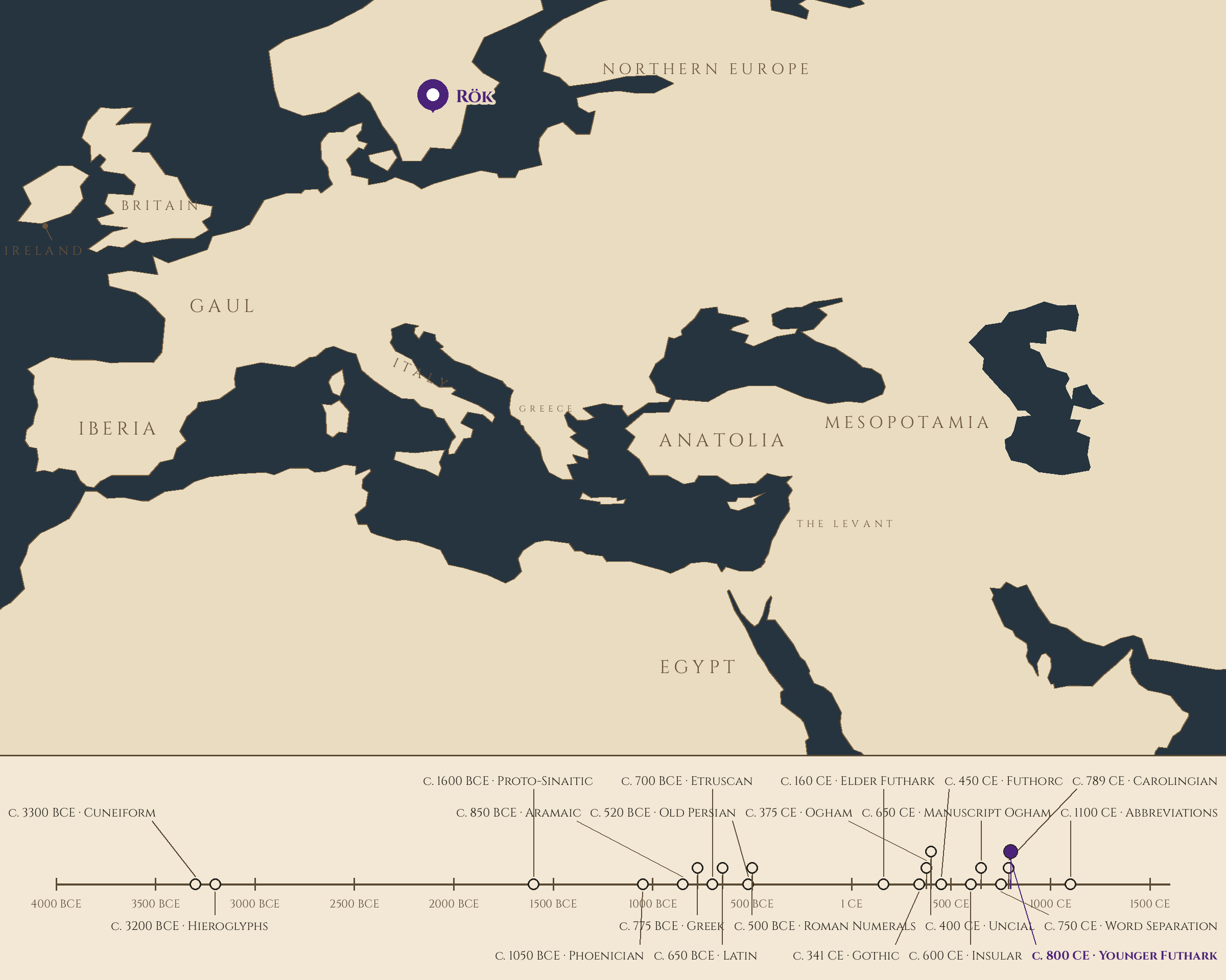
Where and when: Östergötland, in Sweden, about 1,200 years ago, where the Rök stone still stands. The pin is this lesson. The line beneath the map is our road: every stop a writing system, every lesson a pin.
Lesson Objectives
By the end of this lesson, students should be able to:
- Define Younger Futhark, Old Norse, Proto-Norse, long-branch runes, short-twig runes, polyphony, runestone, and acoustic overlap (an Evershade classroom term).
- Explain the paradox of the Younger Futhark: why the alphabet shrank from 24 to 16 runes while the language was gaining sounds.
- Describe the 16 runes of the Younger Futhark, their names, meanings, and sound values, in order.
- Distinguish long-branch (Danish) from short-twig (Swedish-Norwegian) runes and explain the current thinking on the difference.
- Explain polyphony with at least three examples of one rune covering multiple sounds.
- Describe how context-dependent reading worked and why it was sufficient.
- Identify the Rök stone and the Jelling stones and explain what each one tells us.
- Correct the claim that Viking Age runestones are found in Iceland.
- Read and write simple transliterations in Younger Futhark.
- Apply the course question to the most extreme subtraction in our story: what did sixteen runes leave out, and was it enough?
Reading this lesson: ★ marks the passages to remember. They return on the unit quiz and the class test. Check in questions ask the material back as you go; answer them in your workbook when you meet them.
Working this lesson: Your assignment packet is the first download on this page. Work in it as the lesson moves along, answering each assignment as its subject is taught — or read the lesson through for your notes and take the assignments as homework afterward. Both are proper ways to sit this class. Signposts in the reading tell you where each assignment belongs. Written answers are short answers in your own words; a few honest lines are worth more than a filled page.
Your Assignment Packet
This lesson's assignments live in its packet: the Lexicon Handout (every term, course terms marked ◆), Materials, Guided Practice, the Assignment Manual with its answer key for self-checking, the Reflection Questions, and the Workbook Checklist. Download the packet before you begin and keep it beside you as you read.
The Paradox of the North
Every alphabet we have studied grew or held steady as its language grew. The Greeks added letters for vowels their language needed. The Romans added G when their alphabet lacked it. The Anglo-Saxons, as our next lesson will show, expanded their futhark to thirty-three runes to match their sounds.
The Vikings did the opposite.
★ Between the 7th and 8th centuries, during a transitional period when the old twenty-four were visibly shedding runes, the Germanic alphabet of Scandinavia compressed itself to sixteen signs, every one of them descended from an Elder Futhark ancestor — ýr alone split its inheritance, its shape from algiz turned upside down, its name, "yew," from eihwaz. And it did so at precisely the moment the language was becoming more complex. Proto-Norse (the earlier North Germanic language) was turning into Old Norse (the North Germanic language of Viking Age Scandinavia), and the transformation was rich with new sounds. Umlaut, the fronting and rounding of vowels under the influence of neighboring sounds, created distinctions the older language had never made: new y sounds, new ø sounds, new æ sounds, a whole expanded vowel system.
The language gained sounds. The alphabet lost letters.
This is the paradox of the north, and it is worth sitting with, because it violates every intuition about how writing should work. Fewer signs for more sounds. Less alphabet for more language.
And yet it worked, for three centuries, across an entire seafaring civilization, on thousands of stones that still stand.
How? The answer is the subject of this lesson, and it has two parts. The first is polyphony: each surviving rune took on more work, covering whole families of related sounds.
The second is the reader: Old Norse speakers knew their language so thoroughly that a skeletal spelling was enough, the way you can read a sentence with half its vowels missing and never stumble. The alphabet did less. The reader did more.
And the system held.
Hold the paradox beside our course question. "What can we leave out and still be understood?" The Younger Futhark is the most extreme answer any script in our story has given. It left out a third of the alphabet, and the Vikings understood each other perfectly well.
Check in: State the paradox in one sentence of your own: what was the language doing, what was the alphabet doing, and during which centuries did the change happen?
❦ In your workbook: record the paradox of the North in your own way — copy, sketch, or note what matters.
Sixteen Runes
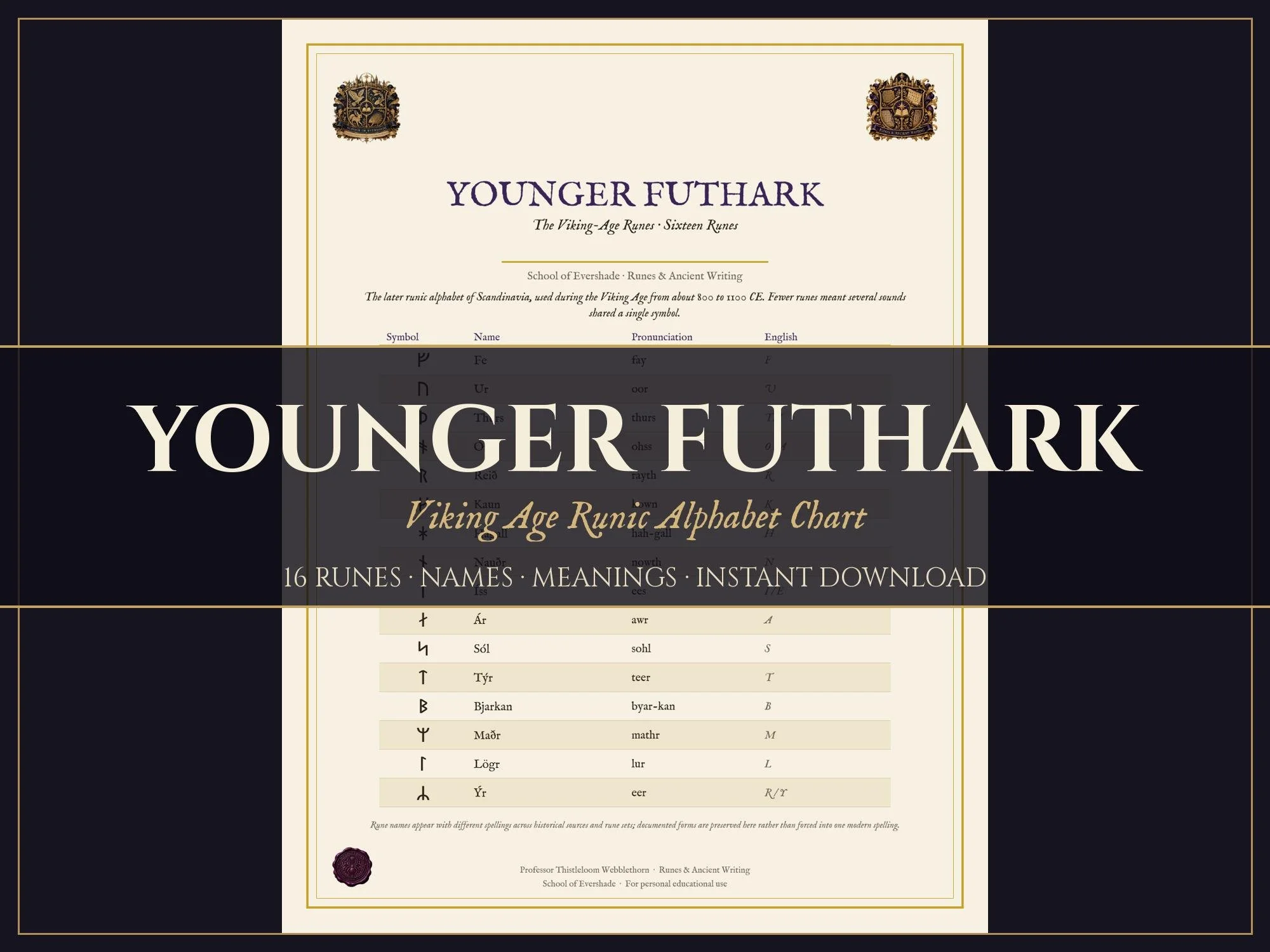
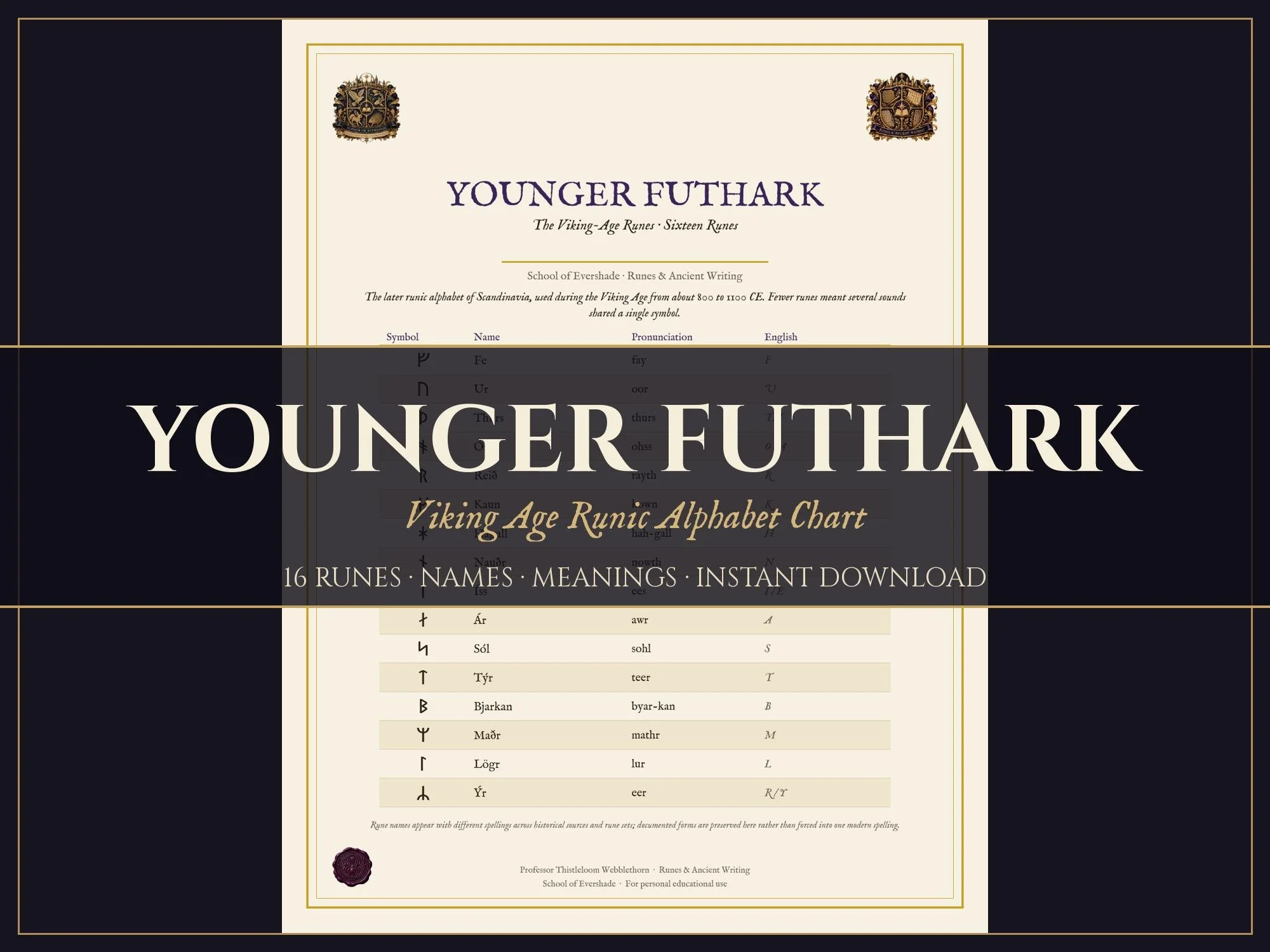
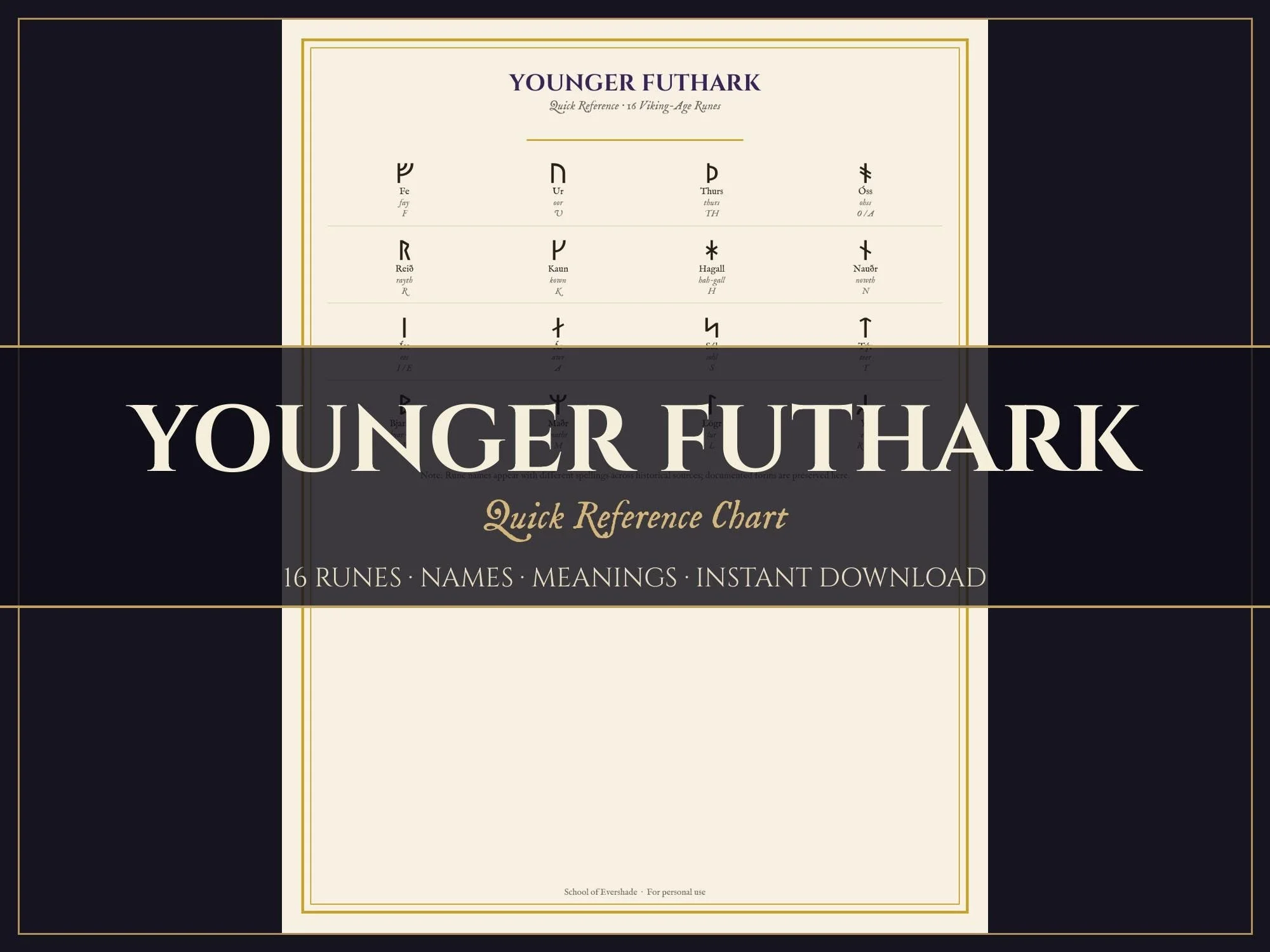
Here is the Younger Futhark in its standard order, the sequence preserved in the medieval rune poems. The sixteen do not divide into ættir in the sources, as the Elder Futhark's twenty-four did; the poems list them as a single sequence. I give each rune in its long-branch (Danish) form, with the short-twig (Swedish-Norwegian) variant noted where it differs. For each rune: its shape, its Old Norse name, its meaning from the rune poems, and the sounds it covers. The old opening sequence holds (f-u-þ), but the fourth rune's vowel has shifted: where the Elder Futhark read f-u-þ-a-r-k, the Younger reads f-u-þ-ą-r-k, and the Anglo-Saxon futhorc of our next lesson will shift it again.
Seven runes are identical in both variants. Nine take simplified short-twig forms. Learn the long-branch shapes first; the short-twig forms are the same runes with shortened strokes, and you will recognize them at a glance once the full forms are familiar.
Read the meanings with care. They come from two medieval rune poems, the Norwegian (13th century) and the Icelandic (15th century), composed centuries after the Viking Age itself, and where the two poems disagree, as on úr, I give you both. The names in this lesson are Old Norse forms from those poems, not Proto-Germanic reconstructions: by this period, Proto-Germanic had given way to Proto-Norse and then Old Norse. The poems are our best source for what the runes were called, and they are also poetry, which means they describe slantwise.
ᚠ Fé ("wealth, cattle"): f. The first rune, unchanged from the Elder Futhark's fehu. Wealth you can count, wealth that moves on hooves. The Icelandic poem calls it the source of discord among kinsmen, which tells you what the poets thought of wealth.
★ ᚢ Úr ("drizzle" / "slag"): u, o, y, ø, and sometimes w. Here is our first correction of the record. The Icelandic rune poem says úr is "cloud's weeping," the lamentation of clouds, the ruin of the hay harvest: drizzle, rain. The Norwegian poem says it is "slag from bad iron," the dross left when iron is worked. Both are poem-attested. What úr does not mean is "primal force" or "wild ox." Those are modern inventions with no basis in the poems or in runological scholarship, and they do not belong in this classroom. Note also how much work this one rune does: five vowel sounds plus the w glide, all covered by a single stave with a single branch. Polyphony begins here.
ᚦ Thurs ("giant"): þ, and the voiced ð (the th of "this"). The giant of legend, the cliff-dweller, the torture of women in the Icelandic poem's unsparing phrase. The rune covers both the voiceless and the voiced th sounds; the distinction is left to the reader. (Do not simplify this to "a D-like sound." The rune spells two th sounds, voiceless and voiced, and nothing else.)
ᚬ Óss ("god"; also "estuary, river-mouth"): ą (the nasal a), o, and sometimes æ. Short-twig form: ᚭ. The áss is one of the Æsir, the gods of the Norse pantheon; the Icelandic poem names "aged Gautr," a name of Odin. The "estuary" sense comes from the homonym óss, the river's mouth, and the poems play on both. This rune descends from the Elder Futhark's ansuz, but its vowel has shifted and narrowed: where ansuz was a broad a, óss is the rounded, nasalized vowel of Old Norse. The shift is written into the alphabet's very name: where the Elder Futhark's opening sequence read f-u-þ-a-r-k, the Younger Futhark's reads f-u-þ-ą-r-k.
ᚱ Reið ("ride, riding"): r, trilled. Unchanged in shape across both variants. The joy of horsemen, the toil of the steed, the road itself. Some things the language kept exactly as they were.
ᚴ Kaun ("sore, ulcer"): k and g. The Icelandic poem is vivid: kaun is "disease fatal to children," the painful spot, the abode of mortification. An honest correction here: the older sense "torch" belongs to the Elder Futhark and English tradition (Old English cēn), not to the Younger Futhark poems. In the Viking Age, this rune meant the wound, not the flame. And note the polyphony: one rune for both k and g, the voiced and unvoiced pair sharing a single sign. The reader's ear supplies the voicing.
ᚼ Hagall ("hail"): h. Short-twig form: ᚽ. Cold grain, the shower of sleet, the sickness of serpents in the Icelandic poem's strange phrase. Hail that ruins crops, hail as fate, the same meaning the rune carried in the Elder Futhark, now in a simplified form.
ᚾ Nauðr ("need, constraint"): n. Short-twig form: ᚿ. The grief of the bondmaid, the state of oppression, toilsome work. Need in the old hard sense. The shape simplifies in the short-twig variant, but the meaning holds steady.
ᛁ Íss ("ice"): i and e. The bark of rivers, the roof of the wave. Ice as road and roof at once. One rune for both the i and e vowels; the reader distinguishes them without thinking, the way you distinguish the two sounds of "read" without thinking.
ᛅ Ár ("plenty, good harvest"): a and æ. Short-twig form: ᛆ. The boon to men, the good summer, the thriving crops. This rune is new in function: the Elder Futhark's jēra (the y/j rune) was repurposed to write the a vowel, because Old Norse needed the a sound written and the old j sound had changed beyond recognition. A rune recycled, not invented.
ᛋ Sól ("sun"): s. Short-twig form: ᛌ. The shield of the clouds, the shining ray, the destroyer of ice. The sun poem-stanza is one of the most beautiful in the Icelandic poem, and the rune's single stave carries it.
ᛏ Týr ("Tyr"): t and d. Short-twig form: ᛐ. The one-handed god, the leavings of the wolf, the prince of temples: Tyr, who bound the wolf Fenrir and lost his hand to it. One rune for the t/d pair, voiced and unvoiced sharing the sign as k and g share kaun.
ᛒ Bjarkan ("birch"): b and p. Short-twig form: ᛓ. The leafy twig, the little tree, the fresh young shrub. The birch kept its meaning from the Elder Futhark's berkano, and took on the p sound as well: another voiced-unvoiced pair under one roof.
ᛘ Maðr ("man"): m. Short-twig form: ᛙ. The delight of man, the augmentation of the earth, the adorner of ships. Humanity, unchanged in sense, simplified in shape.
ᛚ Lögr ("water, sea"): l. Identical in both variants. The eddying stream, the broad geysir, the land of the fish. Water was the highway of the Viking world, and the rune for it needed no simplification.
★ ᛦ Ýr ("yew"): ʀ (the palatal r, a distinct Old Norse sound) and y. Short-twig form: ᛧ. The bent bow, the brittle iron, the giant of the arrow. This is the only rune in the row whose position changed: in the Elder Futhark, the z-rune algiz stood in the second ætt; in the Younger Futhark, its descendant ýr moved to the end of the sequence, the single reordering in the alphabet's history. Its name continues not the algiz name but the unrelated eihwaz, the yew: the rune kept the tree and changed everything else. Note the sound: ʀ is not our r. It was a palatal, buzzing r, a sound Old Norse distinguished and we have lost. The rune that spells it sits at the alphabet's end like a signature.
Sixteen runes. Seven identical across the variants, nine simplified in the short-twig hand. Every one of them working harder than its Elder Futhark ancestors, covering sounds singly, in pairs, in families. The alphabet shrank, and the workload grew, and the carvers never looked back.
Check in: Which rune covers both k and g? Which covers t and d, and which covers b and p? And which single rune covers five sounds?
❦ In your workbook: record the sixteen runes in your own way — copy, sketch, or note what matters.
In your packet: Assignment I — The Rune Chart ⚒ begins here. Work it now, or mark the place and take it as homework — your choice.
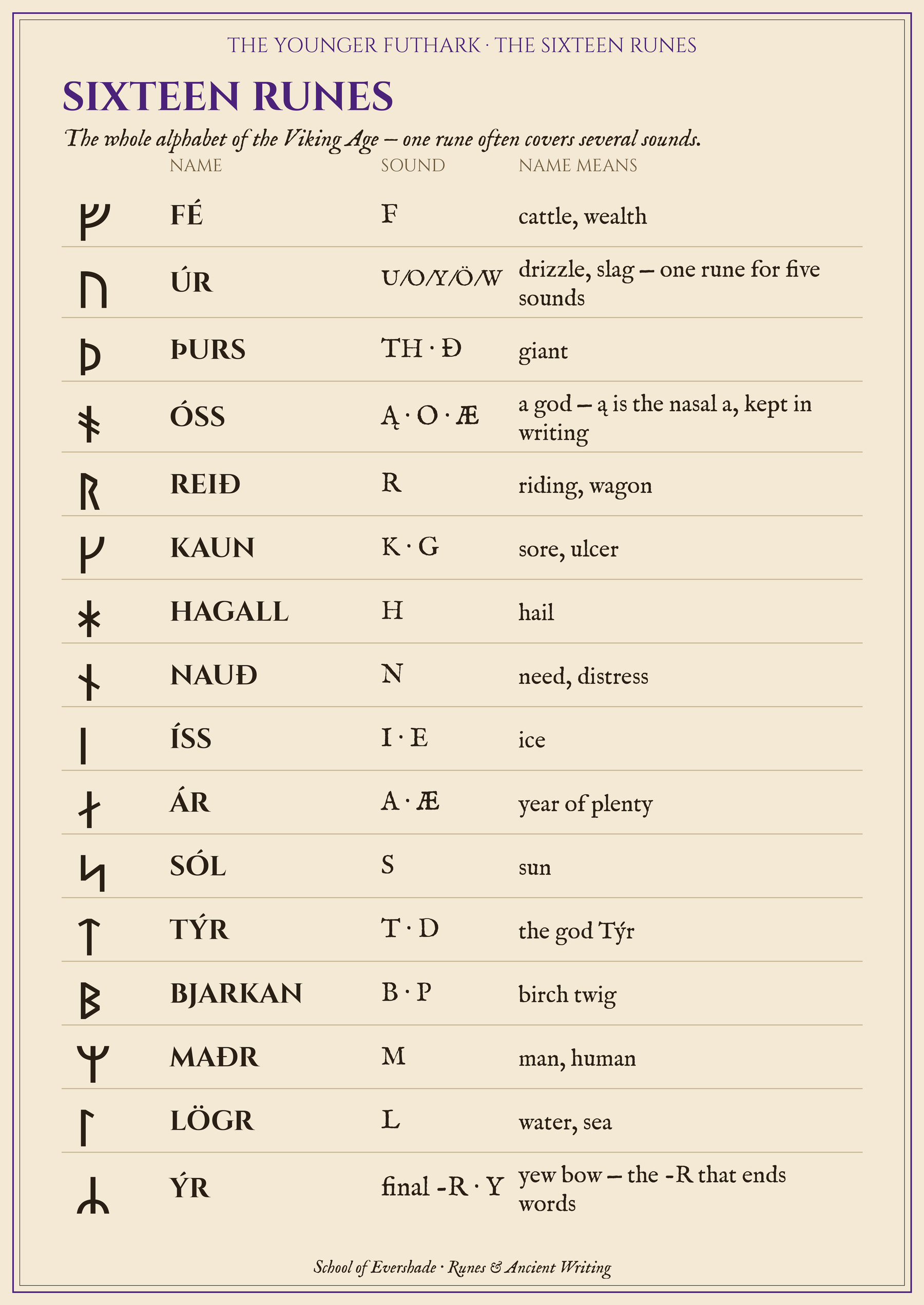
The sixteen runes of the Viking Age in their standard order — with every sound each rune is asked to cover.
Built for Evershade.
Professor Webblethorn
Pause here, scholars, and consider what sixteen runes chose to keep.
The Elder Futhark kept one rune for every sound, twenty-four signs for twenty-four sounds, each earning its place. The Younger Futhark kept sixteen signs for a language with more sounds than the old one had. It kept the pairs together: k with g, t with d, b with p, the voiced and the unvoiced under one roof, trusting the reader's ear to tell them apart. It kept the vowels it could not do without and merged the ones it could. It kept the shapes that carved fastest.
This is our course question at its most ruthless: what can be left out and still be understood? The Vikings left out eight runes. They left out the distinction between k and g, between t and d, between b and p. They left out separate signs for half the vowels. And they were understood, on thousands of stones, for three hundred years.
What they kept was the reader. Every subtraction the Younger Futhark made was a transfer, not a loss: work moved from the carver's knife to the reader's mind. The alphabet did less. The mind did more. Remember this the next time someone tells you a writing system must be complete to be useful. Completeness is a property of the partnership, not of the signs alone.
PROFESSOR THISTLELOOM WEBBLETHORN
Runes & Ancient Writing
Epigrapher, Head of House Septentrio
Two Hands, One Alphabet
The Younger Futhark comes in two regional hands, and the difference between them has been argued over for generations.
The long-branch runes are the Danish forms: ᚠ ᚢ ᚦ ᚬ ᚱ ᚴ ᚼ ᚾ ᛁ ᛅ ᛋ ᛏ ᛒ ᛘ ᛚ ᛦ. Fuller shapes, longer strokes, the careful monumental hand.
The short-twig runes are the Swedish and Norwegian forms: ᚠ ᚢ ᚦ ᚭ ᚱ ᚴ ᚽ ᚿ ᛁ ᛆ ᛌ ᛐ ᛓ ᛙ ᛚ ᛧ. Nine runes simplified, strokes shortened or dropped, the quicker hand.
The current thinking is that the difference was functional, not merely regional. The long-branch forms, with their extended strokes, suit the formal work of stone: deep cuts, deliberate spacing, inscriptions meant to stand for centuries. The short-twig forms, stripped to essentials, suit speed: messages on wood, everyday carving, the quick note rather than the monument.
Stone got the long branches. Wood got the short twigs. The same alphabet, dressed for the occasion.
This is worth pausing over, because it corrects a common assumption. We tend to imagine one alphabet, one standard, one right way to write. The Viking Age had two standard hands in simultaneous use, distinguished by purpose and material, and no one seems to have found this confusing.
The carver chose the hand the job required, the way you choose print or cursive, and the reader read both.
Later centuries would simplify further. Between the 10th and 12th centuries, in Hälsingland and elsewhere in Sweden, carvers produced the staveless runes, sometimes called Hälsinge runes: the same sixteen signs reduced almost to bare strokes, the staves themselves nearly gone. They cover the same set of sounds as the other Younger Futhark alphabets, written with a minimum of carving.
And in the medieval period, the alphabet would expand again, with dotted variants distinguishing the voiced from the unvoiced consonants, one sign per sound at last. But those are later stories. In the Viking Age proper, sixteen runes did the work, in two hands.
❦ In your workbook: record the two hands, long-branch and short-twig in your own way — copy, sketch, or note what matters.
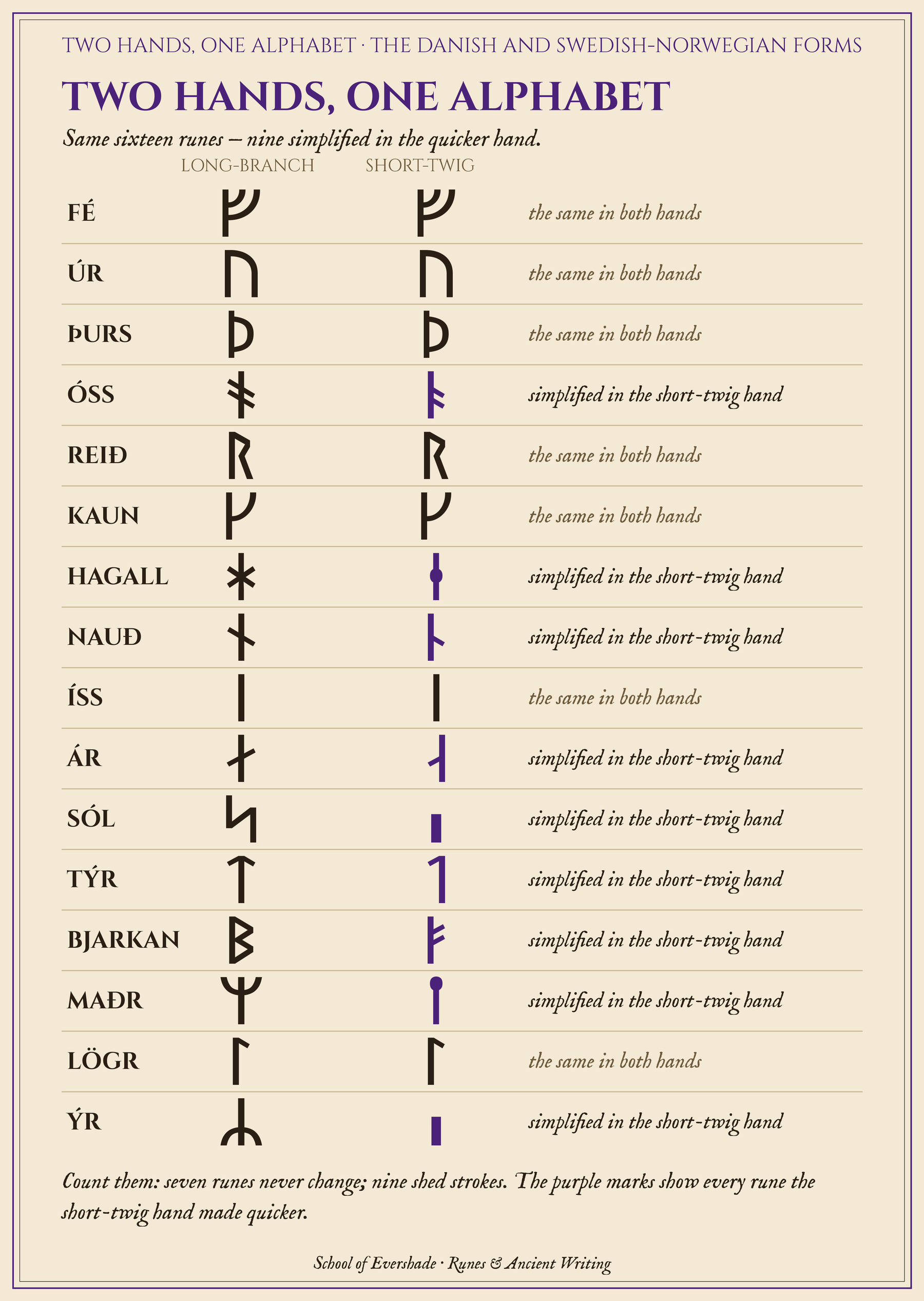
Two hands, one alphabet: the Danish long-branch forms and the quicker Swedish-Norwegian short-twig forms. Nine runes shed strokes; seven never change.
Built for Evershade.
How Sixteen Runes Say Everything
The mechanism has a name, and you have already met it in the rune list: polyphony, one sign for many sounds.
★ Consider what the reader of a runestone actually did. They saw ᚴ and knew it could be k or g. They saw ᛏ and knew it could be t or d. They saw ᚢ and knew it could be u, o, y, or ø.
How did they choose? The same way you choose when you read the English word "read": from context. The sentence tells you. The language tells you.
You never notice the work, because your knowledge of the language does it for you, instantly and invisibly.
This is what the fact of polyphony implies, and it is the deepest claim of this lesson: the Younger Futhark only works if the readers are fluent. A learner, sounding out each rune in isolation, would be lost among the ambiguities. A native speaker, reading whole words and whole sentences, never notices them. The alphabet outsourced disambiguation to the reader's competence, and the competence was there.
The voiced-unvoiced pairs are the clearest case. In Old Norse, as in English, k and g are related sounds, made in the same place in the mouth, differing only in voicing. The carvers judged that difference small enough for context to carry, and they were right: no Viking ever misread a memorial because kaun covered both sounds. The vowels are the bolder case. The u-rune's five sounds, u, o, y, ø, and the w glide, are genuinely different vowels, and the rune covers them all.
Yet the stones were read, the messages got through, the memorials spoke.
There is a modern analogy close to hand. When you text, you drop vowels, you abbreviate, you let context do the heavy lifting, and your reader understands. The Younger Futhark is the same bargain struck in stone: the writer does less, the reader does more, and the partnership holds.
Acoustic overlap, our classroom term for the condition in which a single written sign covers two or more sounds the language treats as related (the voiced and unvoiced pairs, k/g, t/d, b/p, sharing one rune each, where the Elder Futhark practiced acoustic economy, one rune per sound), names the writer's side of the bargain. Contextual fluency names the reader's. Both were required. Both were present.
One honest boundary before we move on. Polyphony has limits, and the carvers knew them. The distinctions the runes preserved, f from þ, r from l, m from n, are the ones the language could not do without.
The distinctions they merged are the ones context could reliably supply. This was not carelessness. It was judgment, applied rune by rune, across the whole system. The alphabet is a record of what its makers believed their readers could handle, and the Viking Age reader could handle a great deal.
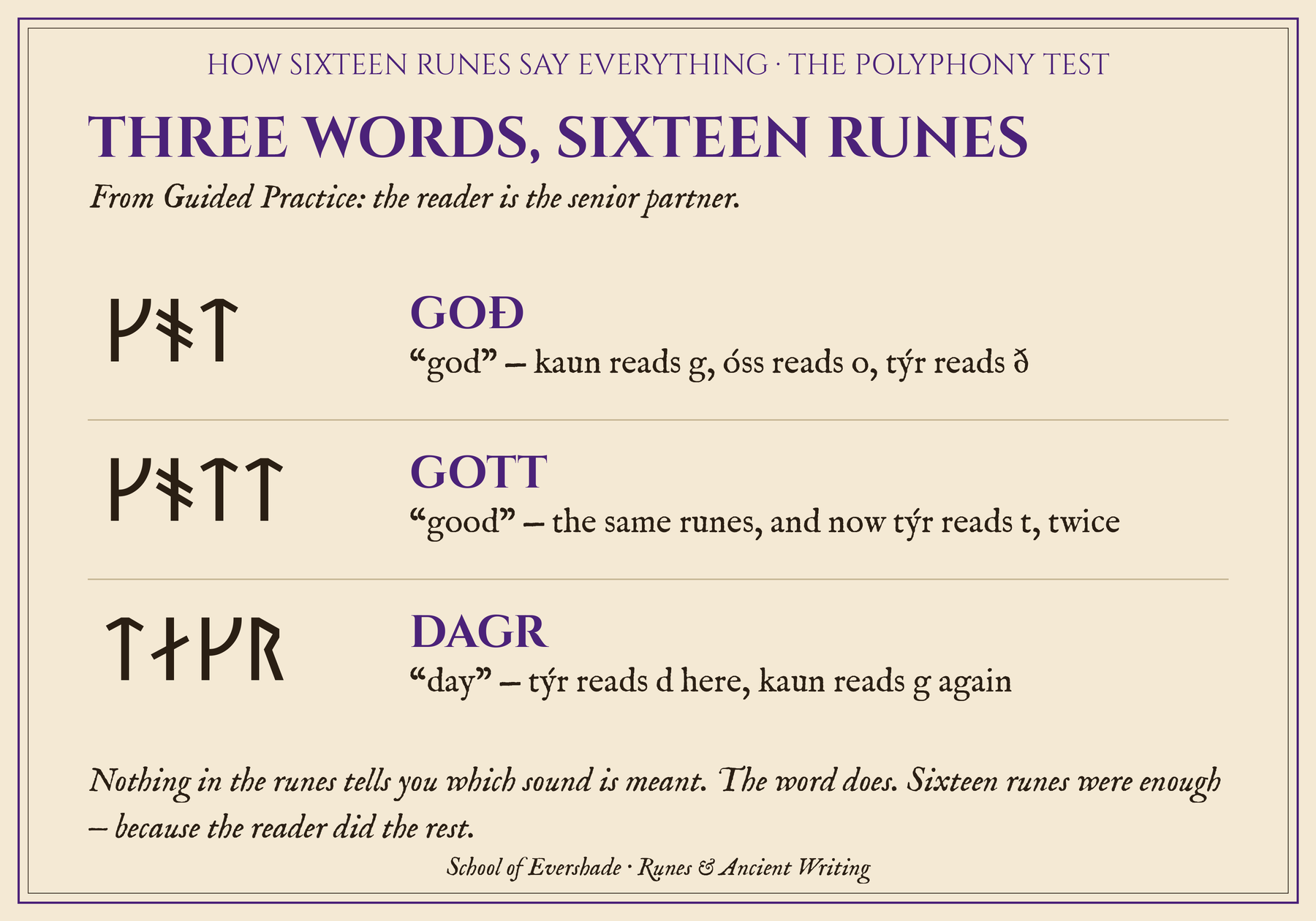
Three words, sixteen runes: goð, gott, dagr. The runes do not say which sound is meant — the reader does. That was the bargain.
Built for Evershade.
❦ In your workbook: record how sixteen runes say everything in your own way — copy, sketch, or note what matters.
The Stones That Speak
If the Elder Futhark's inscriptions were magnificently ordinary, names on combs and brooches, the Younger Futhark's great inscriptions are magnificently public. The Viking Age raised stones.
A runestone is a slab or boulder carved with runes and raised as a memorial, a marker, a statement. Most commemorate the dead: "X raised this stone in memory of Y, his father," the formula repeats across a thousand stones with the names changed.
Others record inheritance, voyages, status, bridges built, expeditions undertaken. They stood along roads, at bridges, at assembly places, where people would see them. They were public writing in a world with few other kinds.

A Note from the Headmaster
Your Headmaster again. This lesson's Vikings shrank their alphabet to sixteen runes, but in one respect nobody of standing travelled light: they carried a game. Hnefatafl, the king's board, was the game of this very world for three hundred years, and a carved board sailed into the ship burial at Gokstad around the year 890. The board is history; the rules are our best careful guess — and in the Games Room you can defend the king, or besiege him.
The distribution is worth stating precisely, because one common account gets it wrong. Viking Age runestones are concentrated in Sweden, which holds roughly 1,700 to 2,500 of them. Denmark has about 250. Norway has about 50. Viking-settled regions abroad, such as the Isle of Man, have their own.
★ What the distribution does not include is Iceland. Iceland has no Viking Age runestones at all. The island's runic inscriptions are medieval, from the 12th century onward, carved mostly on wood: everyday objects, everyday messages, like the spade from Indriðastaðir that reads "Páll had me made." Iceland wrote on wood in the Middle Ages.
It did not raise Viking Age stones.
The stones were not bare rock. Traces of paint survive on many runestones, and the practice was standard: red pigment rubbed into the carved lines, sometimes multiple colors.
The Rök stone preserves traces of words painted in different colors. The old poem Hávamál instructs the reader to "colour the runes," which suggests the painting was not decoration but part of the reading: color made the letters legible at a distance, the way ink makes print legible on the page.
A runestone in its prime was a painted monument, bright against the landscape, meant to be read by travelers on the road.
★ The great stones also carry carved decoration: serpent and ribbon bands that frame the inscription, the runes running inside the bordered channel. Here I must correct an account that has circulated without evidence. It is sometimes said that carvers laid out the decorative framework first and fitted the runes inside afterward, as if the art came before the text. No scholarly source documents this sequence.
What the evidence shows, including recent studies of carving techniques, is that carvers planned the design and the inscription together, coordinating language and form as a single composition.
The serpent and the sentence were conceived together. The art did not precede the words; they grew up side by side.
Two stones stand above the rest, and you should know them the way you know the Vimose comb and the Kylver stone.
★ The Rök stone stands in Östergötland, Sweden, raised around the year 800. It is a five-ton block of granite, eight feet tall, and it carries the longest runic inscription in existence: some 760 runes in 28 lines, covering five sides of the stone, including the top. It was raised by a chieftain named Varinn in memory of his son Vamoth.
Most of the inscription is in short-twig runes, which is why the short-twig hand is sometimes called Rök runes. But the stone is stranger than its length suggests: three rows use the old Elder Futhark, centuries out of date by 800, and parts are written in cipher runes, codes within the code. Scholars have debated its meaning since the 19th century.
It is considered the first piece of written Swedish literature, and it may be the most ambitious thing anyone ever did with sixteen runes.
The Jelling stones stand in Jelling, Denmark, from the 10th century, and they are Denmark's most famous runic monuments. The smaller was raised by King Gorm the Old in memory of his wife Thyra, and its inscription contains the first written occurrence of the name "Denmark."
★ The larger was raised by Gorm's son Harald Bluetooth, around 965, in memory of both parents, and its inscription is a political document carved in stone: Harald, it says, won all of Denmark and Norway for himself and made the Danes Christian. The stone carries one of the earliest depictions of Christ in Scandinavian art. It is sometimes called Denmark's baptismal certificate.
Between them, the two stones mark the moment a kingdom named itself and changed its gods, in the sixteen runes of the Viking Age.
Check in: A friend tells you Iceland is covered in Viking Age runestones. Correct them: where are the stones actually concentrated, and what does Iceland's real runic record look like?
❦ In your workbook: record the stones that speak in your own way — copy, sketch, or note what matters.
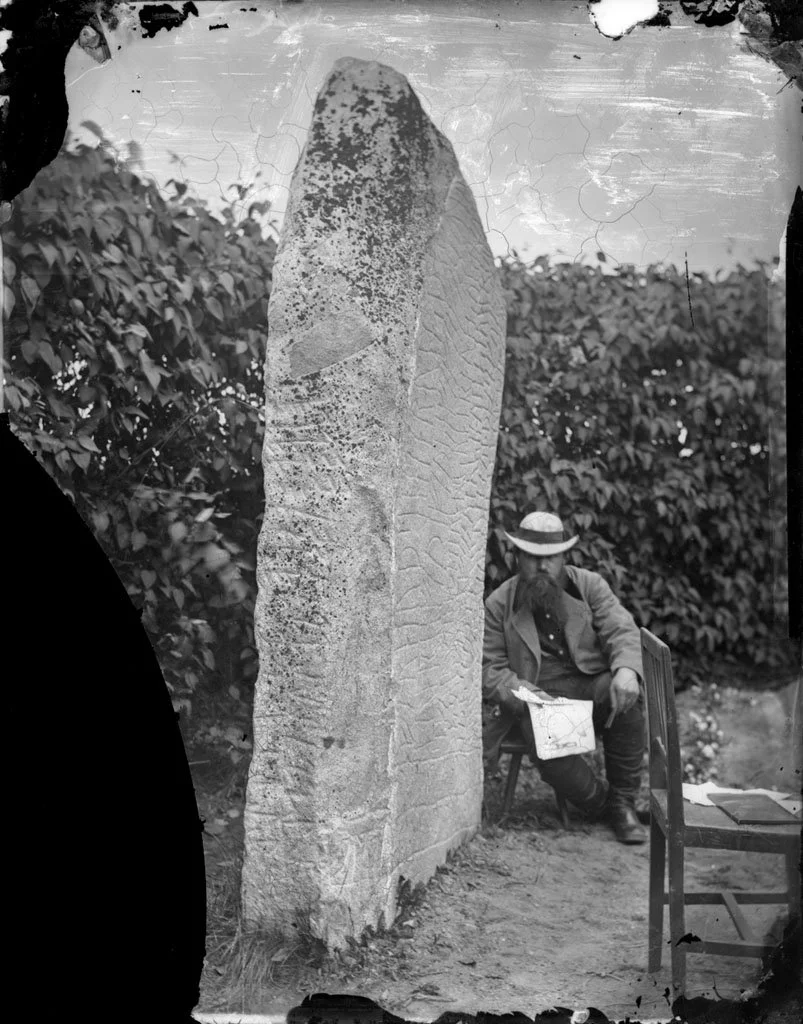
Historical example. The Rök stone: some 750 runes — the longest runic inscription in the world — carved for a dead son in the 9th century. The scholar seated beside it gives the stone its scale.
The Rök stone (Ög 136), Östergötland, Sweden. Photograph: Swedish National Heritage Board, via Flickr Commons. No known copyright restrictions.
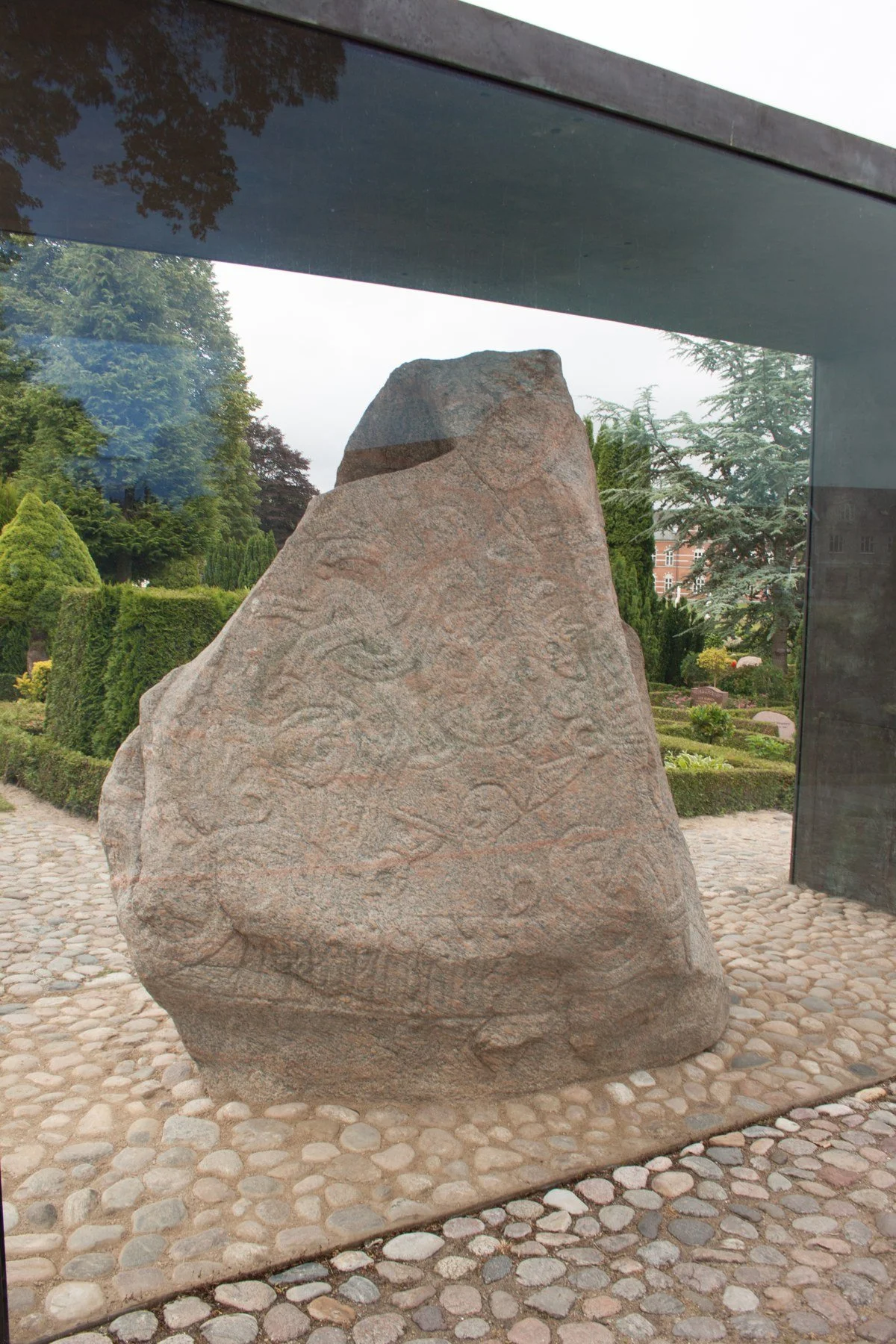
Historical example. Harald Bluetooth's great stone at Jelling, about 965 CE — “Denmark's baptismal certificate.” This face carries the great beast; the inscription on the other faces boasts of a kingdom won and a people made Christian.
The large Jelling stone, Jelling, Denmark. Photograph by Szilas, 2015. CC0.
In your packet: Assignment III — The Artifact Investigation ◐ begins here. Work it now, or mark the place and take it as homework — your choice.
Reading the Runes
A few technical matters, carried forward from last lesson with the changes the new alphabet requires.
Direction: left to right is the settled convention of the Viking Age, and the experiments of the early period are behind us. The runestones run in their serpent bands, following the carved channel, but the reading direction within the band is the familiar one.
Word division: as with the Elder Futhark, words are separated by single dots, small crosses, or gaps, or sometimes not at all. The scriptio continua you learned in Lesson 6 persists, softened by the carver's dots. On the great stones, the dividers are part of the design, worked into the rhythm of the band.
Transliteration: the scholarly conventions carry over, with the additions the new alphabet requires. The sixteen runes transliterate to their standard Latin equivalents, with ą for the nasal vowel of óss, þ and ð distinguished where the reading is certain, and ʀ for the palatal r of ýr.
Dots mark uncertain readings; brackets mark damage. The polyphony means the transliteration records the rune, not the sound: ᚴ is k even where the word had g, and the normalization to standard Old Norse spelling is a separate step, marked as such.
The corpus: where the Elder Futhark left some 350 inscriptions, the Younger Futhark left thousands. Sweden's runestones alone number in the low thousands, and the everyday inscriptions on wood, bone, and metal, the messages and ownership marks and casual carvings, add thousands more. The Viking Age is the best-documented period in the history of runic writing, not because its people wrote more, but because they wrote on stone, and stone keeps what wood surrenders.
❦ In your workbook: record how the stones are read in your own way — copy, sketch, or note what matters.
In your packet: Assignment II — Transliteration Practice ⚒ begins here. Work it now, or mark the place and take it as homework — your choice.
Guided Practice — The Reader's Hand
Before the assignments, train your hand the way a Viking Age carver would: with attention to the polyphony, and to the reader who resolves it.
Exercise A — Drawing the Sixteen
- On paper, draw all 16 runes in their long-branch forms, using the chart in this lesson. Work with straight strokes only: no curves, no flourishes.
- Below each, draw its short-twig variant where one exists (nine runes). Mark the seven that are identical in both hands.
- Label each with its Old Norse name, meaning, and the sounds it covers.
- Circle the four most polyphonic runes (úr, óss, kaun, and your own candidate for the fourth). For each, list every sound it covers. Look at what sixteen runes are being asked to do.
Exercise B — The Polyphony Test
- Write the Old Norse word goð (god) in Younger Futhark runes. You will need ᚴ for g, ᚬ for o, and ᛏ for ð. Note what just happened: two of your three runes are doing double duty, and you knew which sounds they meant without being told.
- Now write gott (good) and dagr (day) in runes. List every rune you used that covers more than one sound.
- Write three to four sentences on what your hand just taught you: when you chose ᚴ for g, what told you it meant g and not k? Was it the rune, or was it you?
This exercise teaches, in your own hand, the central claim of the lesson. The alphabet is a partnership, and you are the senior partner.
Exercise C — Transliteration with Ambiguity
- Transliterate the memorial formula "Þorstæinn ræisþi stæin þannsi æftiʀ faður sinn" (Thorstein raised this stone in memory of his father) into Younger Futhark runes, using the chart. Mark every rune that covers more than one sound.
- Now imagine you are the reader, not the writer. Cover your transliteration and read it back from the runes alone. Where did context resolve the ambiguity? Where, if anywhere, did you hesitate?
- Write two to three sentences on the experience: what does it feel like to read a script that trusts you this much?
In your packet: Assignment IV — The Subtraction Essay ✎ begins here. Work it now, or mark the place and take it as homework — your choice.
Assignment Manual
Assignment key: ✎ written work · ⚒ hands-on practical · ◐ both · ★ will be on the test · ❦ workbook path
Written answers in this manual are short answers in your own words — a few honest lines, not a filled page.
Assignment I — The Rune Chart ⚒ ★
Objective: Demonstrate control of the 16 Younger Futhark runes, their names, meanings, sounds, and both regional hands.
Instructions:
- On a fresh sheet, create a six-column chart: rune in long-branch form (drawn), rune in short-twig form (drawn, or marked "same"), Old Norse name, meaning from the rune poems, sounds covered, Elder Futhark ancestor (or "repurposed" / "moved" where applicable).
- Complete all 16 rows in the standard order. For úr, give both poem meanings. For kaun, note the torch-to-ulcer correction.
- Below the chart, write one paragraph on polyphony: choose three runes and explain, for each, which sounds share the sign and why context is sufficient to distinguish them.
Your keepsake: this chart stands beside last lesson's Elder Futhark chart for the rest of the course. Keep the pair together; the Professor's Review will ask you to lay them side by side and count what is missing.
To submit: Photograph or scan your chart. Accuracy of the shapes matters more than artistic skill; use straight strokes only.
Assignment II — Transliteration Practice ⚒ ★
Objective: Read and write Younger Futhark, navigating polyphony the way Viking Age readers did.
Part A. Transliterate the following Old Norse words into runes: fé (wealth), goð (god), dagr (day), maðr (man), sól (sun). For each word, list every rune that covers more than one sound and state which sound it represents in that word.
Part B. The Norwegian rune poem says úr is "slag from bad iron"; the Icelandic poem says it is "cloud's weeping." Write a half page on what the disagreement reveals: what does each meaning suggest about the world its poets lived in, and what does the existence of two meanings tell us about how rune names traveled?
Part C. Write the full 16-rune sequence from memory in long-branch forms, then check against the lesson chart. Mark any runes you misplaced. Reflect in two to three sentences: which runes were hardest, and does the difficulty cluster around the most polyphonic signs?
Assignment III — The Artifact Investigation ◐ ★
Objective: Understand the Younger Futhark through its two greatest monuments.
Instructions:
- Research (using the References below): the Rök stone (Östergötland, Sweden, ~800 CE) and the Jelling stones (Jelling, Denmark, 10th century). For each, record the date, the place, the raiser and the commemorated, and what the inscription says.
- The Rök stone carries about 760 runes, including Elder Futhark rows and cipher runes; the Jelling stones carry short political declarations. Write a half page on the contrast: what was the script for on each stone? Base your argument strictly on the objects and this lesson.
- The lesson corrects the claim that Iceland has Viking Age runestones. Research where Iceland's runic inscriptions actually come from (century, materials, character) and write a half page on what the Icelandic case reveals about the relationship between a writing system and the materials at hand.
Assignment IV — The Subtraction Essay ✎ ★
Objective: Evaluate the most extreme abbreviation in our story.
Instructions:
Write a one-page essay addressing the following:
The Younger Futhark left out eight runes, merged voiced and unvoiced consonants, and collapsed half the vowels into shared signs, all while Old Norse was gaining new sounds. First, describe concretely what was left out and what was kept, using at least three specific runes as examples. Then consider the mechanism that made it work: polyphony plus the fluent reader. Was the subtraction a loss, a transfer of work from carver to reader, or both? Finally, compare with the Elder Futhark of last lesson: which system would you rather learn as a beginner, which as a fluent speaker, and what does your answer reveal about who writing systems are designed for?
Cite the lessons where your details come from.
Materials
Required (Level One — household items)
- Paper: plain white paper or a sketchbook, for rune practice and chart work.
- Pens: one standard pen for drafting, one fine-tipped marker for final rune forms. Younger Futhark forms are simpler than the Elder set; a firm marker keeps the staves clean.
- A ruler: for chart columns and for comparing long-branch against short-twig stroke lengths.
Suggested (Level Two — historically closer materials)
- A piece of soft wood: pine, basswood, or balsa, with visible grain. Carve the same word in long-branch and short-twig forms side by side and feel the difference in speed.
- A sharp pocketknife or carving knife: the historical tool. Use only with proper supervision and safety precautions; the Evershade Safety Scroll on the classroom homepage applies.
- A flat stone tile or slate: the runestone experience at small scale. Unglazed ceramic tile from a hardware store takes carved lines well.
- Red ochre or earth pigment: to rub into the carved lines, as Viking Age carvers did. The painted runestone is the complete monument; the unpainted one is the sketch.
Neither level requires
Purchased kits, specialty tools, or any material you cannot find locally or order inexpensively. The core lesson (drawing runes, understanding polyphony) is fully achievable with paper and pen.
Reflection Questions
Answer the following in your workbook.
- State the paradox of the Younger Futhark in one sentence. During which centuries did the transitional compression occur, and when was the 16-rune standard in regular use?
- Name all sixteen runes in order, with their Old Norse names and meanings. Which seven are identical in both regional hands, and which nine take short-twig forms?
- Explain polyphony using three runes of your choice. For each, list the sounds the rune covers and explain why context is sufficient to distinguish them.
- What are the long-branch and short-twig runes, and what is the current thinking on why both existed? Give the regional associations.
- Correct the Iceland error: where are Viking Age runestones actually found, in what numbers, and what is the character of Iceland's real runic inscriptions?
- Identify the Rök stone and the Jelling stones: dates, raisers, commemorated, and what each inscription says or contains.
- Apply the course question: what did the Younger Futhark leave out, what did it keep, and was the subtraction a loss or a transfer?
Workbook Checklist — Lesson 12
In my workbook I have:
- ☐ stated the paradox of the Younger Futhark and dated the compression (7th–8th centuries)
- ☐ drawn all sixteen runes in order, in both hands, with names, meanings, and the sounds each covers
- ☐ explained polyphony with three runes and the sounds each one covers
- ☐ explained how context-dependent reading worked, and why it was enough for fluent readers
- ☐ corrected the Iceland claim with the real distribution of Viking Age runestones
- ☐ recorded what the Rök stone and the Jelling stones each tell us
☐ Lesson completed Date: ____________ Signature: ____________
Professor's Review
And so our twelfth lesson closes among the runestones, where sixteen runes did the work of twenty-four and never apologized for it.
You can now explain the paradox of the Younger Futhark and date its transitional centuries, describe all sixteen runes with their names, meanings, and sound values in order, distinguish the long-branch from the short-twig hand and explain the functional theory behind the difference, explain polyphony with examples and describe how context-dependent reading worked, identify the Rök stone and the Jelling stones and what each reveals, correct the Iceland error with the real distribution, and transliterate simple Old Norse words in Younger Futhark.
Keep your Younger Futhark chart beside your Elder Futhark chart from last lesson. Lay them side by side and count what is missing: eight runes gone, the ættir dissolved, the alphabet nearly a third shorter. Then read a memorial formula in the sixteen and feel how little is actually lost. The language is all there. It was never in the extra runes. It was in the reader all along.
Next, we cross the North Sea to England, where the Anglo-Saxons looked at the same twenty-four runes and made the opposite choice: not fewer signs but more, expanding to thirty-three, the longest futhark in history. The north compressed. England expanded. And the contrast will teach us what the paradox alone cannot.
Practice your sixteen, scholars. Write them in both hands, long-branch for stone and short-twig for wood, and feel the speed difference in your own wrist. I have watched alphabets grow and shrink in my years among the inscriptions, but I have never seen one trust its readers as completely as the Vikings trusted theirs. The web holds, even with sixteen threads. Especially with sixteen.
PROFESSOR THISTLELOOM WEBBLETHORN
Runes & Ancient Writing
Epigrapher, Head of House Septentrio
Cross-Class Connections
The polyphony of the Younger Futhark connects directly with Scrollwork, where Professor Nocturne teaches the medieval abbreviation systems that made the same bargain: fewer marks, more reader. Students studying both classes should compare the rune-carver's trust in context with the scribe's trust in the trained reader of contractions.
The painted runestones connect with Creative Arts, where Professor Timberclank's pigment and surface lessons teach what the carvers knew: color is not decoration on a functional object, it is part of the function. A painted rune is a legible rune.
The Jelling stones' political inscriptions will reappear in Runes Unit V, when we study how medieval scripts served power. Harald Bluetooth's declaration on stone is our clearest Viking Age case of writing as statecraft, and it will not be the last.
In Other Classrooms
Creative Arts · Unit IV, Lesson 15 — Pigments, Paints & Color Charts

Your carvers painted their stones, scholars, and the paint was not an afterthought; it was half the message. In the Workshop we grind and mull pigments and paint out labeled color charts, the way workshops have always kept their colors honest. Come and learn what the runestones wore when they were new.
The sixteen hold, and so do we.
References & Further Reading
The National Museum of Denmark. Viking Age runestones. Object pages and research on Danish runestones, including the Jelling monuments. https://en.natmus.dk/historical-knowledge/denmark/prehistoric-period-until-1050-ad/the-viking-age/
Archaeology Magazine. "The Emperor of Stones." On the Rök stone: the longest runic inscription, its ~760 runes, and the debates over its meaning. https://archaeology.org/issues/online/collection/digs-sweden-runestone/
Wikipedia. "Younger Futhark." Comprehensive overview: the 16 runes with names and transliterations, long-branch versus short-twig variants, the transitional period, and polyphony. https://en.wikipedia.org/wiki/Younger_Futhark
Wikipedia. "Rök runestone." The Östergötland stone (Ög 136), c. 800 CE: ~760 runes, Varinn's memorial to his son Vamoth, short-twig with Elder Futhark and cipher rows. https://en.wikipedia.org/wiki/R%C3%B6k_runestone
Wikipedia. "Jelling stones." The two 10th-century Danish monuments: Gorm's stone with the first written "Denmark," Harald Bluetooth's stone (~965) declaring the Christianization. https://en.wikipedia.org/wiki/Jelling_stones
Wikipedia. "Viking runestones." Distribution and typology: Sweden's ~1,700–2,500 stones, Denmark's ~250, Norway's ~50, and the absence of Viking Age runestones in Iceland. https://en.wikipedia.org/wiki/Viking_runestones
Wikipedia. "Rune poems." The Norwegian and Icelandic rune poems preserving the Younger Futhark names. https://en.wikipedia.org/wiki/Rune_poems
Browse the Runes shelf in the school Library for readable editions of these works.
Sixteen runes, several sounds to a stave. The Bench writes your name the Viking-Age way and shows every shared rune it used.
Open the BenchPROFESSOR THISTLELOOM WEBBLETHORN · RUNES CLASSROOM
Submit your work for this lesson using the form below.
CONTINUE IN RUNES & ANCIENT WRITING
← Previous · Lesson 11: Elder Futhark: How the Alphabet Learned the Knife Next · Lesson 13: Futhorc: How the Runes Grew in England →
Unit IV · The Northern Staves Runes & Ancient Writing Classroom · All 21 Lessons
The rest of Unit IV: Lesson 11 · Elder Futhark · Lesson 13 · Futhorc · Lesson 14 · Ogham: Twenty Letters Along the Stone's Edge · Lesson 15 · Ogham: The Forfeda & the Manuscript Shift
From the Runes Shelf
The printed companions to this lesson, from Professor Webblethorn’s shelf in the shop.