RUNES & ANCIENT WRITING
Unit IV · Lesson 13THE ENGLISH EXPANSION
Futhorc: How the Runes Grew in England
Professor Thistleloom Webblethorn
Epigrapher • Runes & Ancient Writing
Head of House Septentrio • School of Evershade
Professor's Introduction
Two tools tonight, scholars. Keep your knives out, but bring a quill as well. Tonight we carve and we write.
What does a people do when its language outgrows its alphabet — when new sounds arrive that no rune on the stick can write?
Tonight we cross the North Sea to England, where the Anglo-Saxons looked at the same twenty-four runes and made the opposite choice. Not fewer signs but more. Not subtraction but addition.
Where the Vikings compressed their alphabet to sixteen runes, the Anglo-Saxons expanded theirs to twenty-nine, and in the manuscripts to thirty-three: the longest runic alphabet in history.
Come closer to the web, scholars. Last lesson asked what could be left out. Tonight we ask what had to be put in.
PROFESSOR THISTLELOOM WEBBLETHORN
Runes & Ancient Writing
Epigrapher, Head of House Septentrio
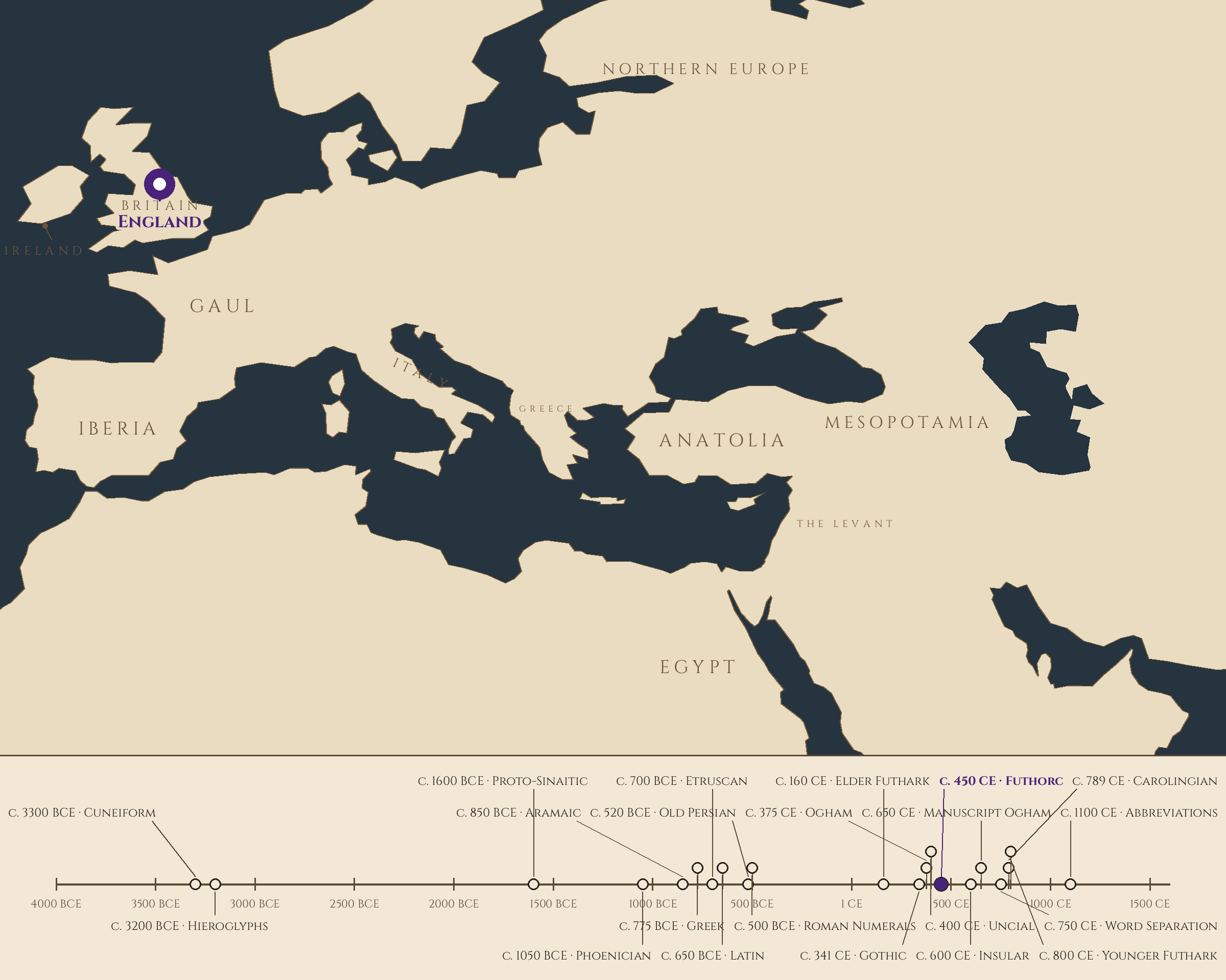
Where and when: England, about 1,300 years ago, where a whalebone box was carved with runes. The pin is this lesson. The line beneath the map is our road: every stop a writing system, every lesson a pin.
Lesson Objectives
By the end of this lesson, students should be able to:
- Define Anglo-Saxon futhorc, Old English, acoustic precision (an Evershade classroom term), thorn, wynn, and Franks Casket.
- Explain why the Anglo-Saxons expanded the runic alphabet while the Vikings compressed it.
- Describe the 29 runes of the Old English rune poem in order, with their names, meanings, and sound values.
- Identify the four additional manuscript runes and explain why they are called manuscript-only.
- Explain the ansuz split: how one Elder Futhark rune became two Anglo-Saxon runes, and why the alphabet is called futhorc rather than futhark.
- Trace thorn and wynn from runes into Old English and Middle English manuscript writing.
- Correct the "ye olde shoppe" error using the history of thorn.
- Describe the Franks Casket: its material, date, scenes, and scripts.
- Contrast Anglo-Saxon panel and border layouts with Viking serpent bands.
- Apply the course question in its inverted form: what had to be added to be understood?
Reading this lesson: ★ marks the passages to remember. They return on the unit quiz and the class test. Check in questions ask the material back as you go; answer them in your workbook when you meet them.
Working this lesson: Your assignment packet is the first download on this page. Work in it as the lesson moves along, answering each assignment as its subject is taught — or read the lesson through for your notes and take the assignments as homework afterward. Both are proper ways to sit this class. Signposts in the reading tell you where each assignment belongs. Written answers are short answers in your own words; a few honest lines are worth more than a filled page.
Your Assignment Packet
This lesson's assignments live in its packet: the Lexicon Handout (every term, course terms marked ◆), Materials, Guided Practice, the Assignment Manual with its answer key for self-checking, the Reflection Questions, and the Workbook Checklist. Download the packet before you begin and keep it beside you as you read.
The Opposite Choice
Two peoples inherited the same twenty-four runes. One shrank them to sixteen. The other grew them to thirty-three. Both were right.
Last lesson gave you the Vikings' answer: acoustic overlap, one rune covering families of sounds, the reader supplying what the carver left out. Tonight you get the Anglo-Saxons' answer: acoustic precision, a new rune for every new sound, the alphabet growing to meet the language instead of asking the language to meet it.
★ The reason is the language itself. Old English, the West Germanic tongue the Anglo-Saxons brought to Britain in the 5th century, developed a vowel system richer than anything the Elder Futhark had been designed to write.
New vowels appeared: the æ of æsc, the y of yr, the diphthongs ea and eo that English still carries in words like "earth" and the old "geolu." The old alphabet had twenty-four signs for a simpler sound system.
Faced with more sounds, the Anglo-Saxons did what the Greeks had done a thousand years earlier: they added what could not be left out.
★ The expansion happened in stages, and the sources let us watch it happen. The earliest English inscriptions use the old twenty-four with small modifications. Then the row grows to twenty-eight. Then the Old English rune poem, our great authority for the futhorc's names, order, and meanings (preserved in a manuscript whose original burned in the 1731 Cotton library fire; we have only an early printed copy), gives twenty-nine, its five stanzas past the twenty-fourth the poem's own record of the expansion.
Then the later manuscripts, where monks catalogued the runes the way they catalogued everything, extend the row to thirty-three.
Twenty-eight, twenty-nine, thirty-three: the alphabet kept growing as long as the scholars kept finding sounds to dignify with signs.
Hold this beside last lesson's sixteen. The Vikings faced new sounds and merged them under old signs. The Anglo-Saxons faced new sounds and cut new signs. Neither was careless and neither was wrong. They were answering different questions. The Vikings asked how little the carver could do. The Anglo-Saxons asked how much the alphabet could hold.
Our course question, "what can we leave out and still be understood," gets its inverted twin tonight: what must be added to be understood?
The futhorc (the Anglo-Saxon runic alphabet, named for its first six runes: f, u, th, o, r, c) is the longest answer in runic history.
Check in: Two peoples inherited the same twenty-four runes. In one sentence each: what did the Vikings do with the new sounds their language was gaining, and what did the Anglo-Saxons do with theirs?
❦ In your workbook: record the opposite choice in your own way — copy, sketch, or note what matters.
Twenty-Nine Runes
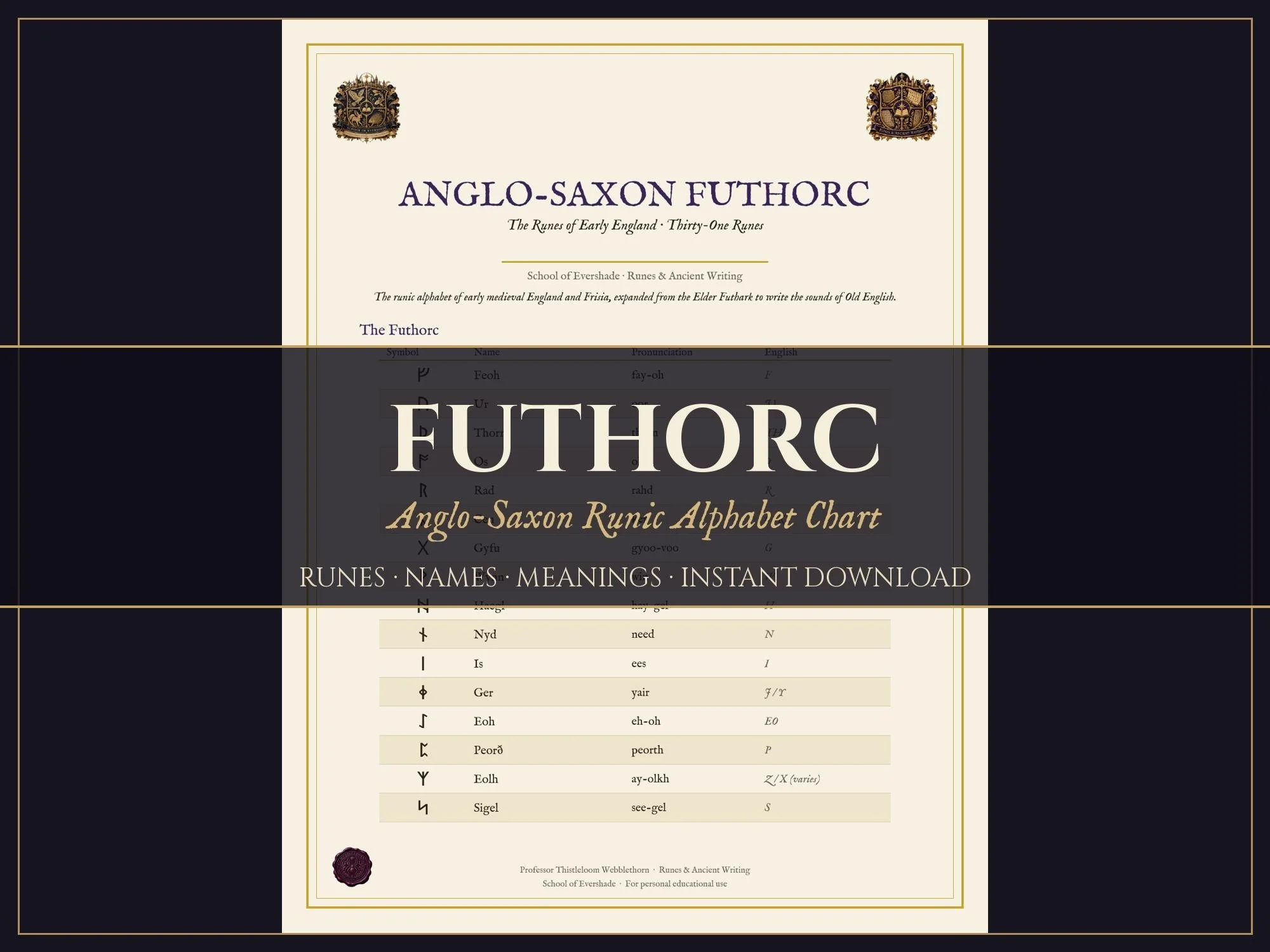
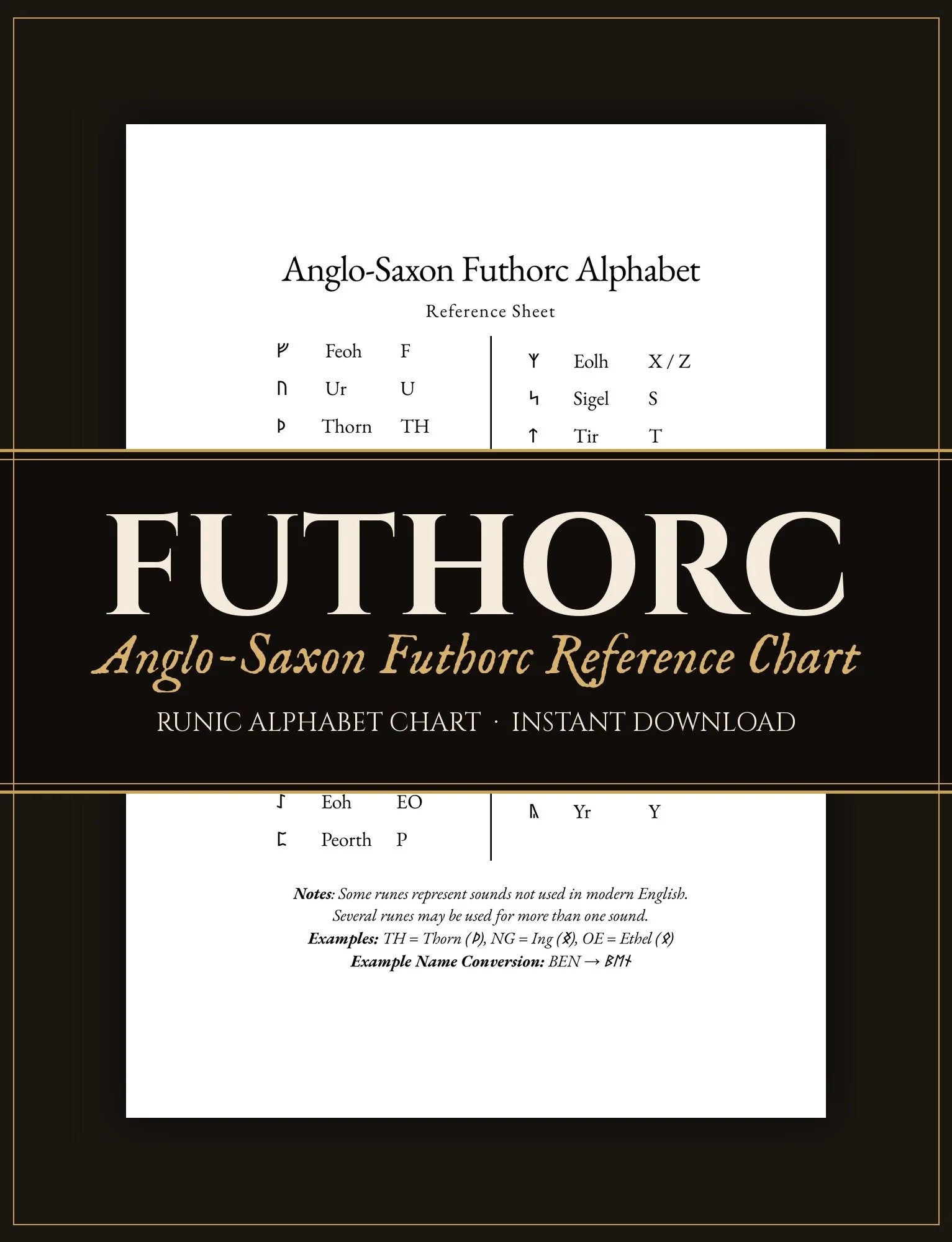
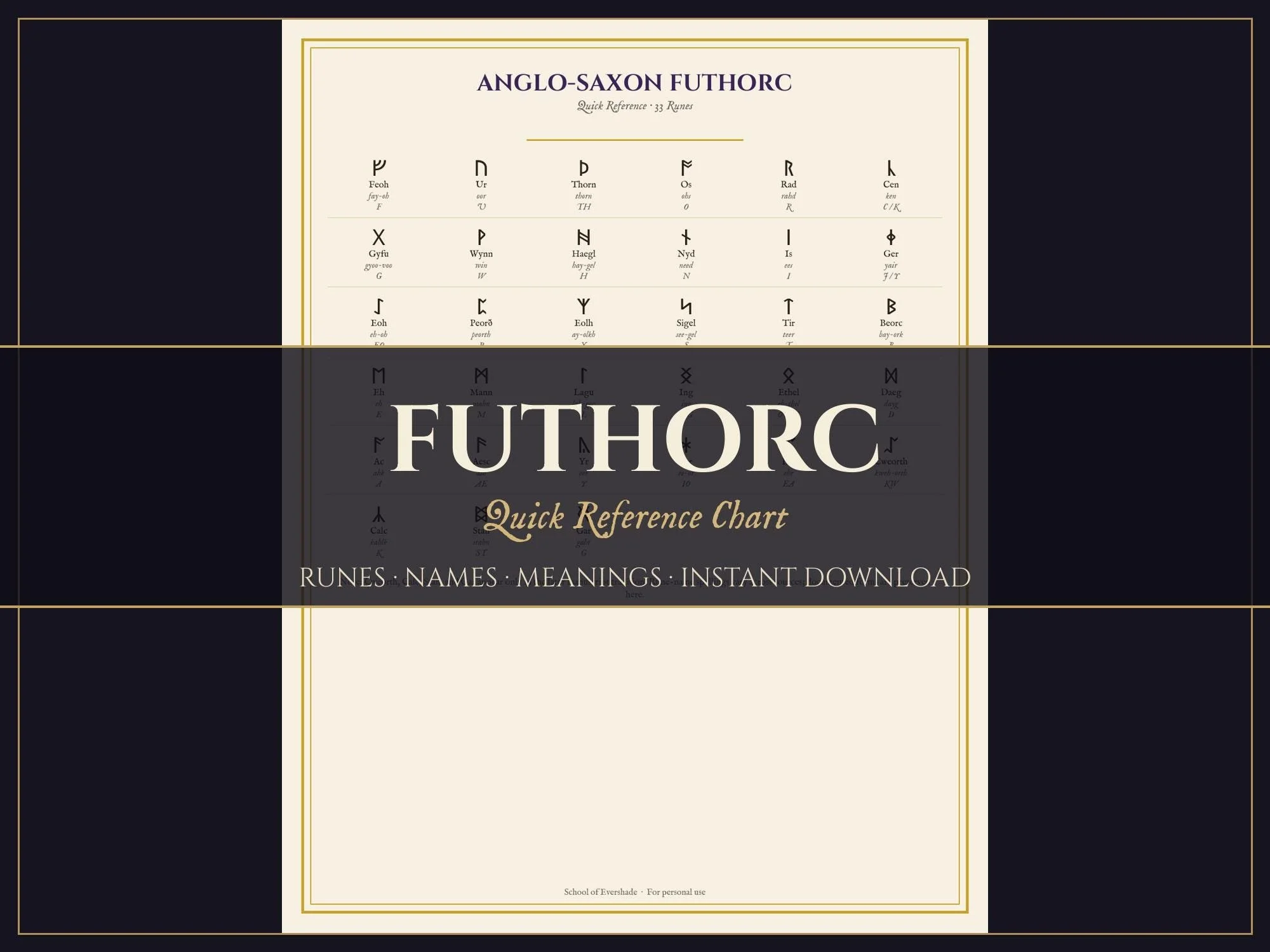
Here is the futhorc as the Old English rune poem gives it: twenty-nine runes in order, each with its shape, its Old English name, its meaning from the poem, and its sound value. The names are Old English forms from the poem itself, not Proto-Germanic reconstructions: by this period, Proto-Germanic had given way to the West Germanic dialects that became Old English.
I present the twenty-four inherited runes first, noting where names and sounds shifted from their Elder Futhark ancestors, then the five the poem itself added.
Learn the fourth rune's new vowel first, because it renames the alphabet. Where the Elder Futhark read ansuz (a), the futhorc reads os (o). F-u-th-o-r-c. Say it, and you are pronouncing the history of a sound change.
ᚠ Feoh ("wealth, cattle"): f. The first rune, unchanged in sense from fehu. Movable wealth, the cattle you can count. The poem warns that wealth is a comfort to all yet a source of strife: some things about money never change.
ᚢ Ur ("aurochs"): u. The wild ox of the Elder Futhark, kept in name and sense. Note the sound value narrowing: where the old uruz covered a broader range, the futhorc's ur is the plain u vowel, because the new runes now handle the sounds uruz used to stretch across.
ᚦ Thorn ("thorn"): þ (the th sounds). The thorn bush, sharp and defensive. This rune will outlive the alphabet. Remember its shape, because you will meet it again in English manuscripts centuries after the last rune-stone was raised.
★ ᚩ Os ("god"; also "mouth"): o. Short vowel o, the rune that renames the row. It descends from ansuz, but the vowel has rounded and the old broad a has moved elsewhere: to the new rune ac, cut specifically for it. One Elder Futhark rune has become two Anglo-Saxon runes, and the split is the whole expansion in miniature.
ᚱ Rad ("riding"): r, trilled. The joy of the horseman, the road, the journey. Unchanged in sense from raido, steady as a road should be.
ᚳ Cen ("torch"): k. From kauno, the ulcer of the Viking Age poem, back to the torch of the older English tradition. The futhorc kept the flame, not the wound. A small correction worth making: the "torch" sense belongs here, in England, not in the Younger Futhark.
ᚷ Gyfu ("gift"): g. The gift, the generosity, the honour of giving. From gebo, unchanged in the ways that matter.
ᚹ Wynn ("joy"): w. From wunjo, joy itself. Like thorn, this rune will outlive the alphabet as a manuscript letter. Joy, it turns out, was too useful to abandon.
ᚻ Hægl ("hail"): h. Cold grain, the shower of sleet. From hagalaz, the meaning steady across a thousand years of hailstorms.
ᚾ Nyð ("need, distress"): n. Constraint, hardship, the narrow place. From naudiz, the hard sense kept hard.
ᛁ Is ("ice"): i. The bark of rivers, the roof of the wave. From isa, and the ice has not melted.
ᛄ Ger ("year, harvest"): j, and the y glide. From jeran, the turning year, the good harvest. The shape has grown a crossbar in the English hand, but the turning sense remains.
ᛇ Eoh ("yew"): a vowel between i and e, conventionally given as long i (/iː/), with older diphthongal values behind it. From eihwaz, the yew tree, the tough wood of bows. I give the standard value with the poem's caution intact: the rune's exact sound shifted across the centuries, and the scholars' /iː/ is a careful reconstruction, not a recording.
ᛈ Peorð (meaning uncertain): p. Here is an honest gap, and I will not fill it with invention. The rune poem's stanza for peorð is cryptic, describing something like a game or a dice-cup or a warrior's amusement, and scholars have debated it for generations without settling the matter. The sound value, p, is secure. The meaning is lost. A writing system can outlive its own vocabulary, and this rune is the proof: we can read it perfectly and still not know what its name meant to the people who cut it.
ᛉ Eolh ("elk"): x (/ks/) in the manuscript tradition. From algiz, the old z-rune, transformed beyond recognition. The manuscript rune books give it the value of Latin x, and the inscriptions agree: it spells the x in "rex" on the coin dies of King Beonna of East Anglia, cut in the mid-8th century, and it appears on St Cuthbert's coffin. An elk that learned to say x: the strangest career of any rune in the row.
ᛋ Sigel ("sun"): s. The sun, the shield of the heavens. From sowilo, bright as ever.
ᛏ Tir ("Tir, glory"): t. The god of single combat, the star of honour. From tiwaz, the name shortened and the glory kept.
ᛒ Beorc ("birch"): b. The birch tree, the first green of spring. From berkano, the leafy twig still leafing.
ᛖ Eh ("horse"): e. The horse, the joy of the rider, the hoofed pride. From ehwaz. Note the sound: this is the short e, distinct from the new æ of æsc below. The alphabet now distinguishes what the old row merged.
ᛗ Mann ("man"): m. Humanity, the delight of kin. From mannaz, unchanged in the ways that count.
ᛚ Lagu ("water, lake"): l. The sea's expanse, the watery way. From laguz, and the water still runs.
ᛝ Ing ("Ing"): ng. The hero-god Ing, first seen among the East-Danes. From ingwaz, the divine name kept divine.
ᛞ Dæg ("day"): d. The day, the glorious light, the creator's mercy. From dagaz, dawn still dawning.
ᛟ Eðel ("homeland, estate"): œ (the rounded front vowel). From othala, the inherited land. The sound has fronted and rounded, and the rune followed it: the old o moved, and eðel moved with it.
Twenty-four inherited, every one shifted a little in name or sound or shape, the way a family changes across an ocean. (The poem preserves the three-ætt division of the Elder Futhark for these twenty-four; the five additions stand outside the old ættir, additions with no ætt to belong to, and the manuscript runes stand further outside still.) Now the five the poem added, the expansion proper:
ᚪ Ac ("oak"): a. The oak tree, the king of the forest, the feeder of swine. Cut new for the broad a vowel that os had abandoned when it rounded to o. This is the other half of the ansuz split: one old rune, two new ones, each with its own tree. The oak stands where the god used to stand.
ᚫ Æsc ("ash"): æ. The ash tree, tall and straight, the wood of spears. Cut new for the æ vowel, the sound at the front of the word "ash" itself. Old English needed this vowel written distinctly, and the carvers obliged with a tree to match.
ᚣ Yr ("bow"): y. The yew-bow, the bent wood that sends the arrow. Cut new for the y vowel, the rounded front vowel Old English had developed and the old alphabet could not write. Do not confuse it with eoh above: eoh is the yew tree, yr is the bow made from it. The language distinguished tree from weapon, and so did the alphabet.
ᛡ Ior ("eel," or a water creature): ia, io (a diphthongal value). The poem describes a river-fish that feeds on land, and "eel" is the standard scholarly guess, though the creature's exact identity is debated. What matters is the sound: Old English had developed diphthongs the old row could not spell, and ior was cut to spell one of them. A rune named for a slippery animal, doing slippery phonetic work.
ᛠ Ear ("earth, grave"): ea (diphthong). The earth itself, and specifically the grave: the poem says ear is horrible to every warrior when the corpse begins to cool and the pale earth claims its own. Cut new for the ea diphthong. The alphabet's last rune is the grave, which feels like the rune poem ending where all poems end.
Twenty-nine runes. Twenty-four inherited and shifted, five cut new. The longest rune poem, the longest row, and the monks were not finished yet.
❦ In your workbook: record the twenty-nine runes in your own way — copy, sketch, or note what matters.
In your packet: Assignment I — The Rune Chart ⚒ begins here. Work it now, or mark the place and take it as homework — your choice.
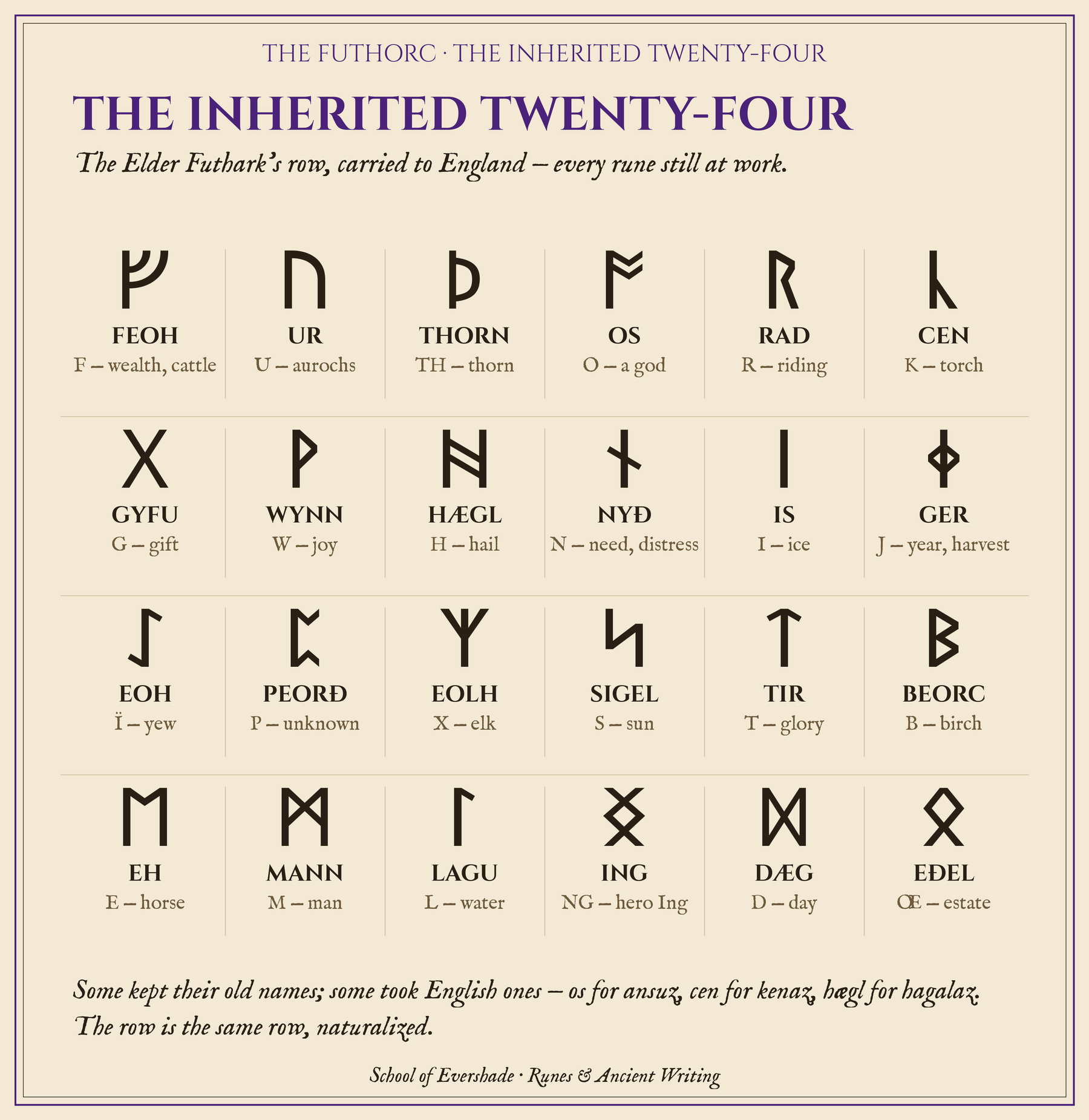
The inherited twenty-four: the Elder Futhark's row carried to England, every rune still at work under English names and English sounds.
Built for Evershade.
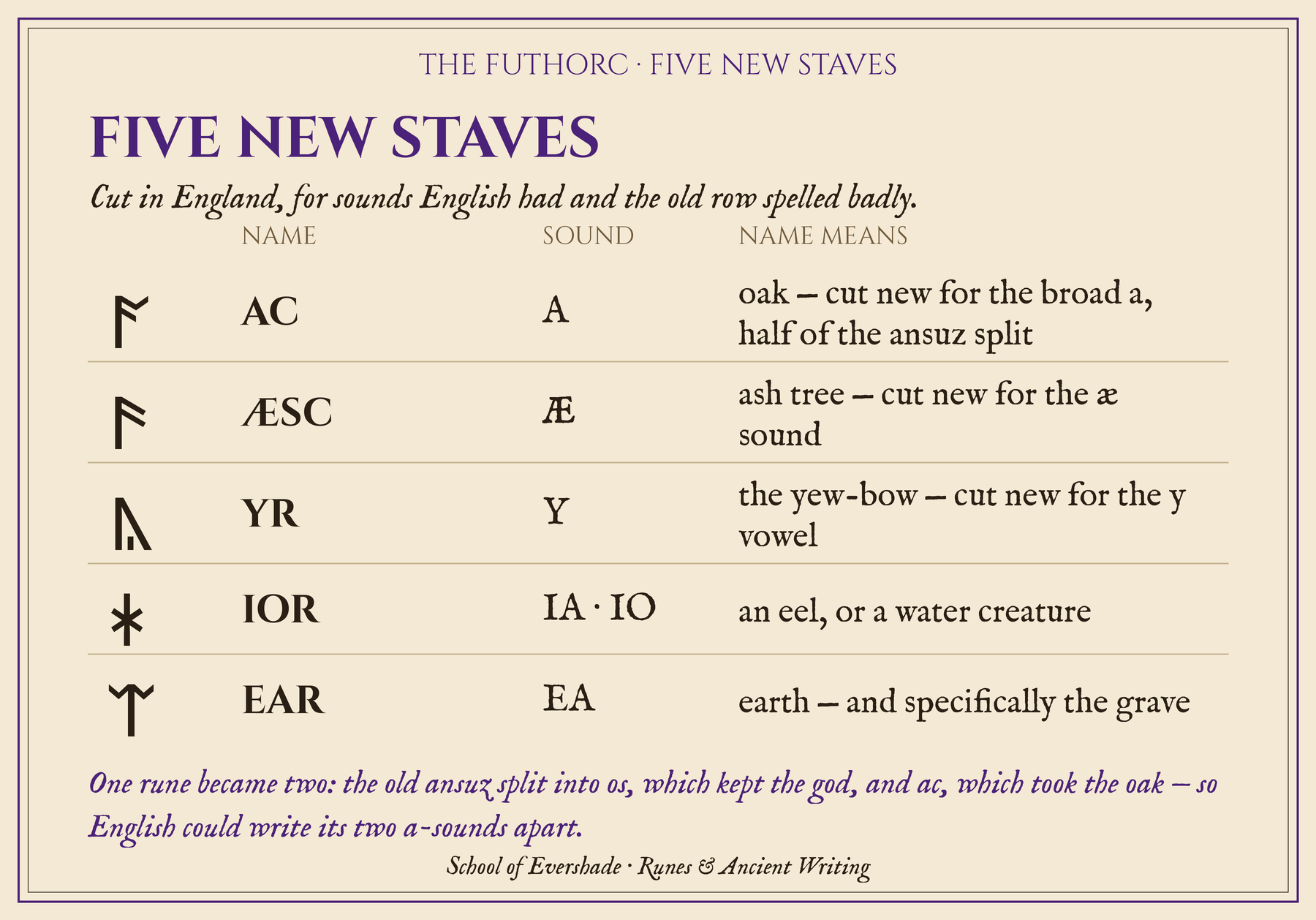
Five new staves: āc, æsc, ȳr, īor, ēar. One rune became two when ansuz split — and the row grew to twenty-nine.
Built for Evershade.
The Manuscript Runes
The rune poem gives twenty-nine. The manuscripts give thirty-three.
In the later medieval manuscripts, where English monks copied out the runic alphabets the way they copied everything worth preserving, four more runes appear past ear. They are called the manuscript runes, because they appear in no inscription ever found: no stone, no brooch, no sword, no bone carries them. They exist only on parchment, in the scholars' lists. Written there with pen rather than cut with a knife, their staves could curve and their branches flourish, as their carved ancestors never could: the same alphabet, two materials, two manners.
ᛢ Cweorð (cw): cut for the cw sound, the consonant cluster at the start of Old English cweorð-words. A rune for a syllable's beginning.
ᛣ Calc (k): cut for a distinct k value, the chalk-white rune. Its name means "chalk" or "cup," and its shape echoes the drinking vessel.
ᛥ Stan (st): cut for the st cluster, named "stone." A rune that means stone, existing only on parchment, never carved in it: the irony is the monks', not mine.
ᚸ Gar (g): cut for a distinct g value, named "spear." The last rune of the longest row.
★ Why cut runes no one carved? Because the manuscript scholars were cataloguers, not carvers. They collected sounds the way they collected saints: completely. The inscriptional alphabet, the one people actually used on objects, stopped at twenty-nine. The scholarly alphabet, the one that lived in books, ran to thirty-three.
Both are real. They are real in different ways, the way a dictionary is real differently from a conversation.
This is worth holding onto, because it corrects a quiet assumption. We imagine an alphabet as one fixed thing. The futhorc was two things at once: a working carver's row of twenty-nine and a scholar's catalogue of thirty-three. The carvers wrote what they needed. The scholars listed what they could find.
And the row kept growing as long as someone was willing to catalogue it.
Check in: The carver's row stopped at twenty-nine and the scholar's catalogue ran to thirty-three. What makes the last four runes different from every rune before them?
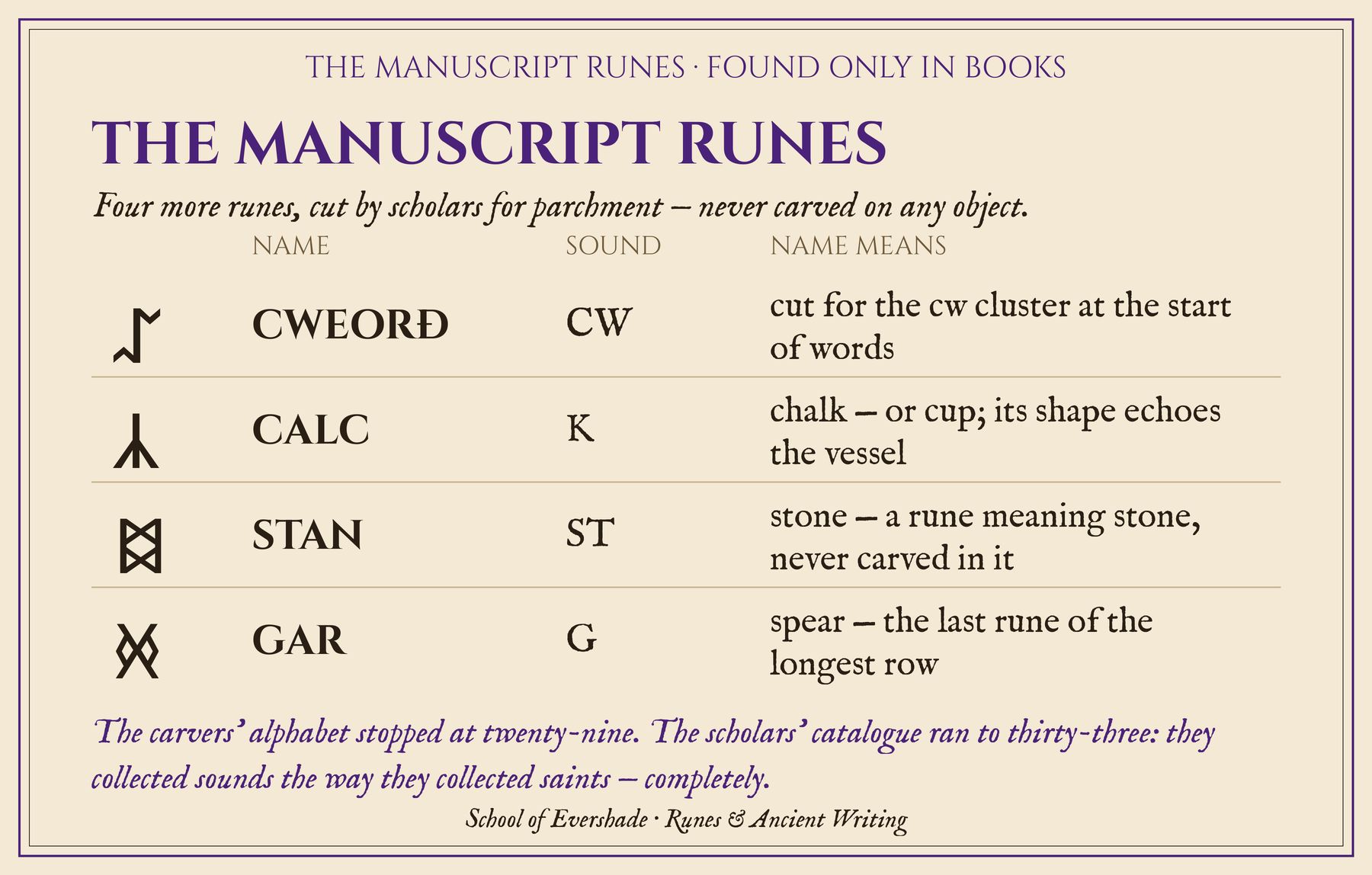
The manuscript runes: cweorð, calc, stan, gar — found only in books. The carvers stopped at twenty-nine; the scholars catalogued thirty-three.
Built for Evershade.
❦ In your workbook: record the manuscript runes in your own way — copy, sketch, or note what matters.
Professor Webblethorn
Pause here, scholars, and hold both northern answers at once.
Last lesson, the Vikings took twenty-four runes down to sixteen. They merged the sounds, trusted the reader, and let context carry what the carver left out. Acoustic overlap, we called it: one sign, many sounds, the mind doing the work.
Tonight, the Anglo-Saxons took twenty-four runes up to thirty-three. They split the sounds, cut new signs, and let the alphabet carry what the reader used to. Acoustic precision: one sound, one sign, the knife doing the work.
Same ancestors. Opposite choices. Both correct.
This is what the course question looks like from the other side. "What can we leave out and still be understood?" The Vikings answered with sixteen. But the question has a twin, and the Anglo-Saxons answered it: "What must be added?" They added the oak and the ash, the bow and the eel, the grave itself. They added until every sound had a sign, and then the scholars added four more.
Neither people was wasteful and neither was stingy. The Vikings wrote a language their readers knew by heart. The Anglo-Saxons wrote a language that was still growing new vowels under their hands. The alphabet is not a fixed treasure to be hoarded or spent. It is a tool, and you size the tool to the work. Sixteen threads or thirty-three: the web holds either way, if the spider knows what she is catching.
PROFESSOR THISTLELOOM WEBBLETHORN
Runes & Ancient Writing
Epigrapher, Head of House Septentrio
Thorn and Wynn Live On
Two runes refused to die with the alphabet. Their story is the most useful thing in this lesson, because it reaches all the way into the English you read every day.
Thorn, ᚦ, the thorn bush, survived the end of runic writing and walked straight into the manuscript tradition. Old English scribes, writing with quills on parchment in the Latin alphabet, kept thorn as the letter þ for the th sounds, because the Latin alphabet had no th and the scribes needed one.
It lived on through Middle English, appearing in Chaucer's manuscripts, in legal documents, in everyday writing, for centuries after the last rune was carved on an English stone.
Then the printers came, and thorn died its second death. The early printing presses, imported from the continent, had no þ in their type cases: the letter existed only in England, and the Dutch and German typefounders had never cut it.
Faced with English manuscripts full of þ, the printers substituted the closest shape they had: the letter y.
★ And that is why "ye olde shoppe" says ye. It was never pronounced "yee." It was always "the." Every "ye" on every mock-Tudor sign, every "ye olde" on every tea room, is a printer's workaround for a missing thorn, fossilized into decoration.
The next time you see it, read it correctly: the olde shoppe. The thorn is gone, but the pronunciation remembers it.
Wynn, ᚹ, joy, walked the same road a shorter distance. Old English scribes kept it as the manuscript letter ƿ for the /w/ sound, because the Latin alphabet's w did not yet exist: the sound was written uu, doubled-u, and wynn was the cleaner solution.
It lasted through the Old English period and into Middle English, then yielded to the doubled-u that became our modern W. Its shape survives in no modern letter, but its job does: every W you write is doing the work wynn used to do.
Two runes, two afterlives. Thorn became a ghost that haunts English spelling to this day. Wynn became a job description eventually filled by another letter.
And both prove the same point: writing systems do not end when their alphabets end. The useful signs escape, find new work, and keep going. The thorn on a shop sign is a rune, whether the sign painter knows it or not.
Check in: A tea-room sign reads “ye olde shoppe.” What letter is the y standing in for, why did the printers use it, and how should the sign actually be read?
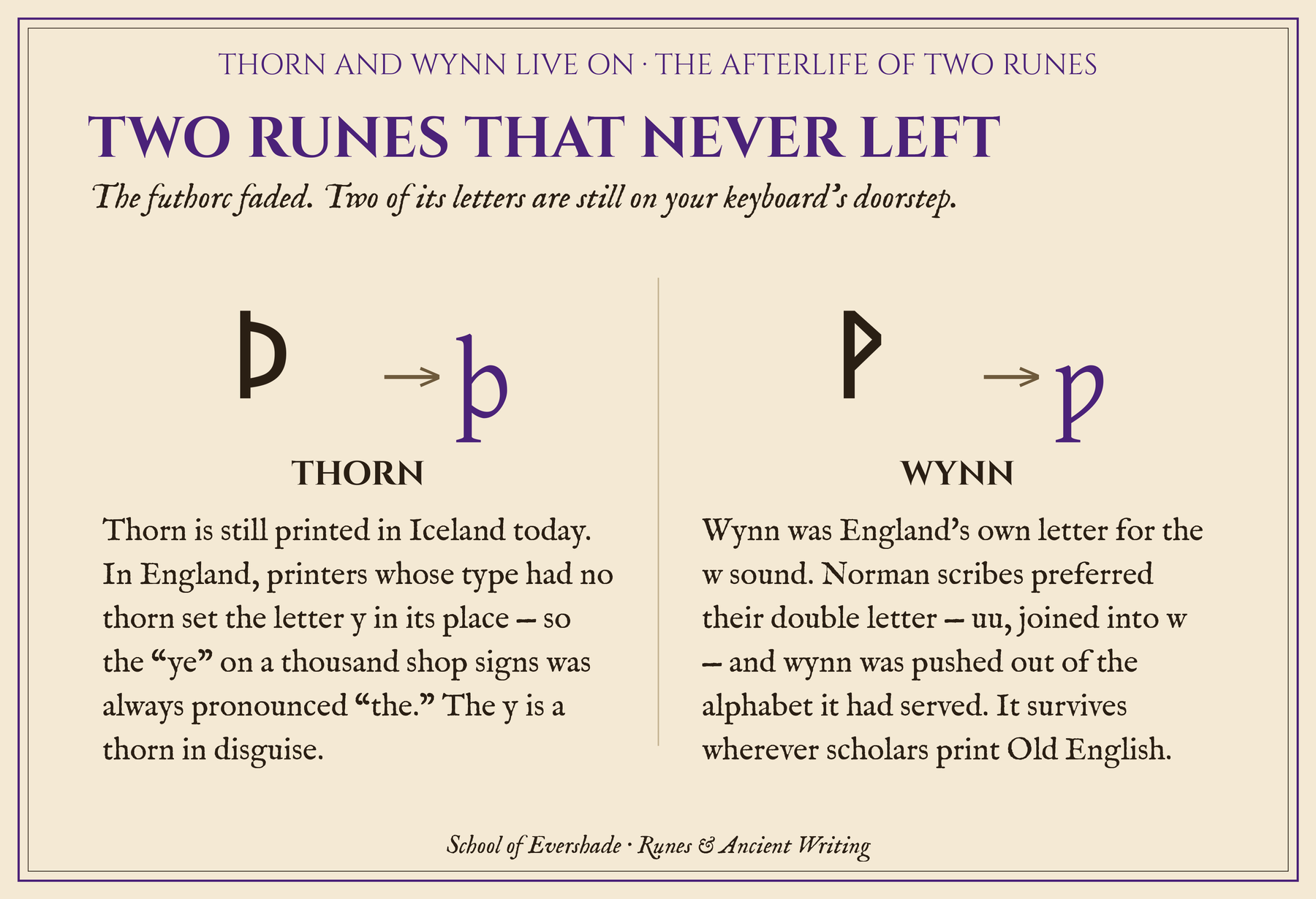
Thorn and wynn live on: þ is still printed in Iceland and hides inside every “ye olde”; ƿ served as England's w until the double-letter w replaced it.
Built for Evershade.
❦ In your workbook: record thorn and wynn, the runes that live on in your own way — copy, sketch, or note what matters.
The Whalebone Box
If the Viking Age had its great stones, Anglo-Saxon England had its great box.
The Franks Casket is a small box carved from whalebone, made in early-8th-century England, now held by the British Museum. It is named for Sir Augustus Wollaston Franks, the museum keeper who donated it in the 19th century: the box is older than its name by more than a thousand years.
What survives is most of a lidded box, its panels densely carved with scenes and ringed with inscriptions, and it is the single finest object for studying how the Anglo-Saxons thought about writing.
The scenes mix worlds the way the Anglo-Saxons mixed everything. One panel shows Weland the Smith, the lame craftsman of Germanic legend, at his forge among the bodies of the king's sons. Another shows the Adoration of the Magi, the Christian story, with the Magi named in runes.
Another shows the Roman emperor Titus in the siege of Jerusalem; another, Romulus and Remus with the she-wolf. Germanic legend, Christian story, Roman history: the box's carver moved between them without apology, the way the Anglo-Saxons themselves lived between the old gods and the new.
The inscriptions mix scripts the way the panels mix stories. The front panel's famous riddle, describing the whale whose bone became the box ("The flood cast up the fish on the cliff-bank..."), is carved in runes in Old English. Other panels use runes for Latin, encoded or cipher runes that play games with the reader, and the Insular script, the rounded manuscript hand the Irish missionaries had brought to England.
★ One object, two languages, three scripts, four traditions: the casket is a whole classroom in a box.
This is why the casket matters beyond its beauty. It shows runes not as a primitive system superseded by the Latin alphabet, but as one tool among several, chosen for the job.
The carver used runes where runes suited, Latin letters where they suited, ciphers where play suited. The futhorc was not dying in the 8th century. It was employed, deliberately, alongside everything else the culture knew about writing. The thirty-three staves were working tools, and the whalebone box is their workshop.
❦ In your workbook: record the whalebone box in your own way — copy, sketch, or note what matters.
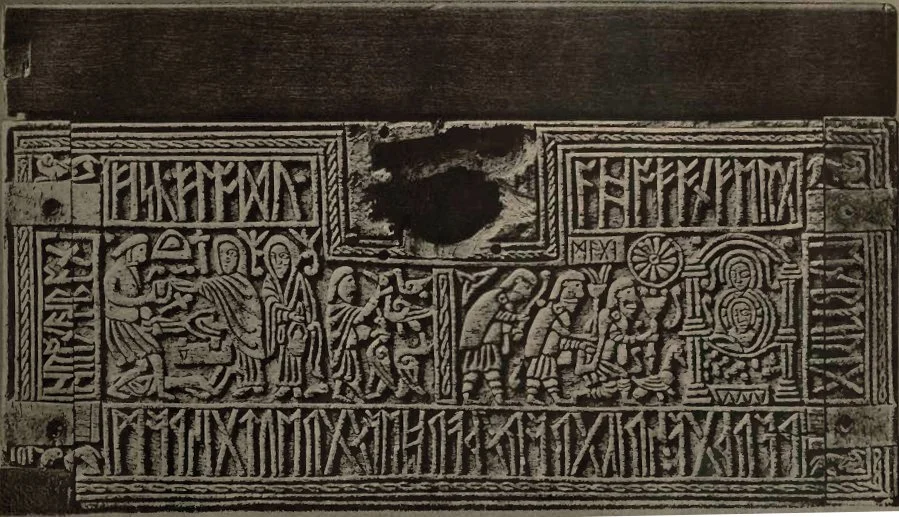
Historical example. The front of the Franks Casket: Weland at his forge and the Magi at the manger, ringed by the whalebone riddle in runes — one object, two languages, three scripts.
The Franks Casket, front panel. Photograph published in Wilhelm Viëtor, The Anglo-Saxon Runic Casket (1901). Public domain.
In your packet: Assignment III — The Artifact Investigation ◐ begins here. Work it now, or mark the place and take it as homework — your choice.
Panels, Not Serpents
The Anglo-Saxons laid out their inscriptions differently from the Vikings, and the difference tells you how each culture thought about the relationship between words and objects.
Where the Viking carver framed inscriptions in serpent and ribbon bands, the text running inside the carved channel like a road, the Anglo-Saxon carver worked in panels and borders. Inscriptions run in straight registers within rectangular frames, or along the borders of a panel, or in horizontal lines across a face.
The Ruthwell Cross, the great stone cross of Dumfriesshire, carries its runic poem in vertical columns within bordered panels. The Franks Casket rings each scene with a band of text that frames the image like a caption.
The layout is architectural: words as structure, not words as journey.
Word division follows the same practical spirit. Anglo-Saxon carvers separated words with single dots or paired points, the ancestors of our colon, punched between words as cleanly as a mason's mark.
The scriptio continua of the earlier traditions, the unbroken stream of letters you learned in Lesson 6, is here broken into readable units as a matter of course. The reader is helped, not tested: acoustic precision in the alphabet, and visual clarity on the surface.
Runes appear on stone crosses and grave markers, on jewelry and sword fittings, on whalebone and reliquaries, on manuscript pages where the monks catalogued them. The materials are the culture's whole inventory, sacred and everyday together.
And through all of them runs the same expanded row, twenty-nine in the carver's hand and thirty-three in the scholar's book, the longest alphabet the runes ever knew.
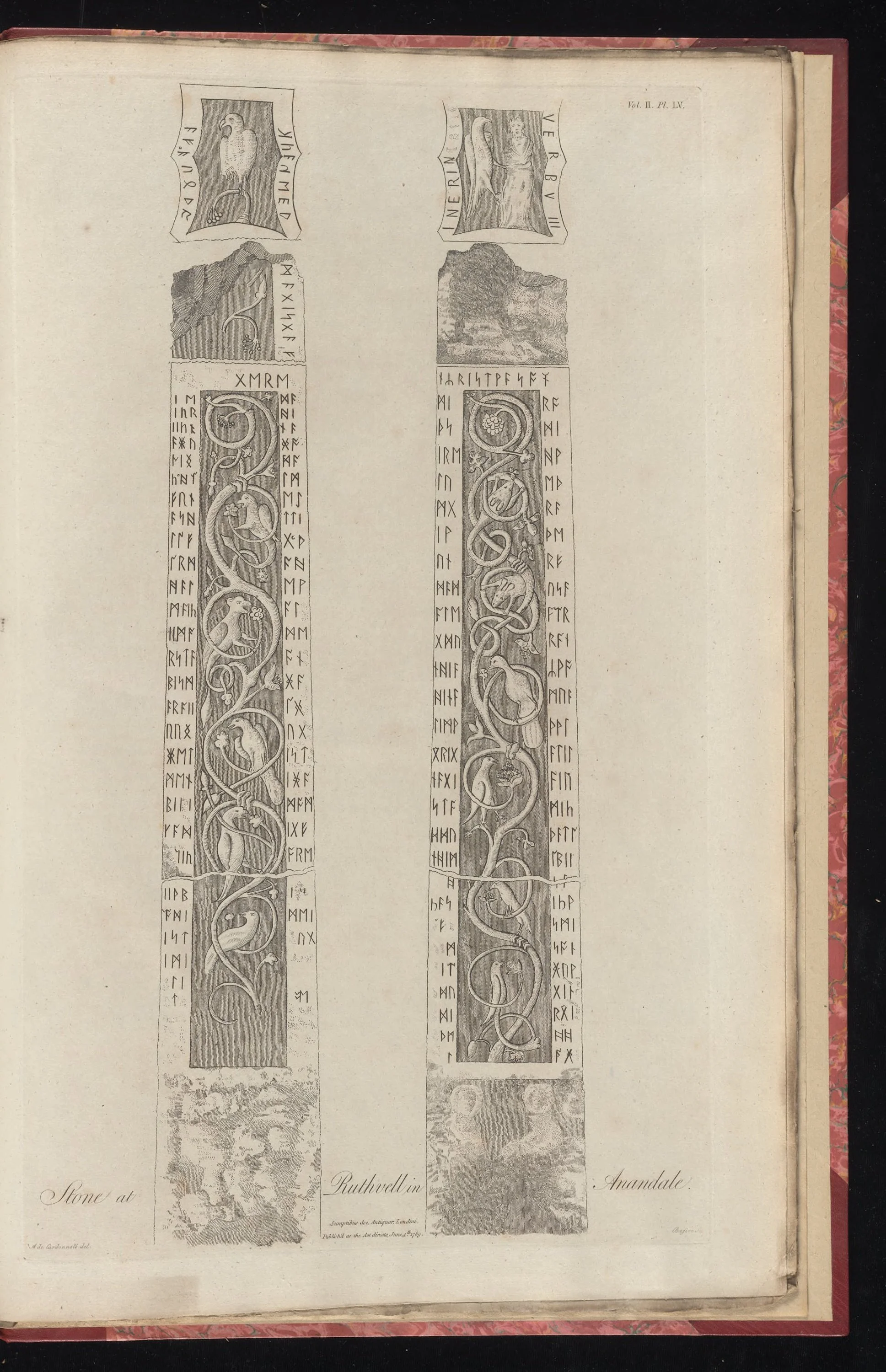
Historical example. The Ruthwell Cross as the 18th century recorded it: the runic poem runs in bordered columns beside the vine-scroll — words as structure, panels not serpents.
The Ruthwell Cross, east and west faces. Engraving by James Cole for Vetusta Monumenta, Society of Antiquaries of London (1789). Public domain.
❦ In your workbook: record panels, not serpents in your own way — copy, sketch, or note what matters.
Reading the Runes
A few technical matters, carried forward with the changes the new alphabet requires.
Direction: left to right is the settled convention, as in the Viking Age, though early Anglo-Saxon inscriptions occasionally run right to left or in boustrophedon, the old experiments not yet forgotten. By the 8th century, the direction is fixed.
Word division: dots and paired points between words, as described above. The Anglo-Saxons are the most consistent word-dividers in our story so far: the reader is given boundaries as standard practice, not as occasional courtesy.
Transliteration: the scholarly conventions carry over, with the additions the expanded alphabet requires. Thorn transliterates as þ, wynn as ƿ, æsc as æ, eðel as œ. The new vowels get their own signs in transliteration exactly as they got their own runes in the row: precision in the alphabet, precision on the page. Dots mark uncertain readings; brackets mark damage.
And where the inscription uses thorn or wynn inside otherwise Latin-alphabet text, as in the manuscripts, the transliteration keeps them: þ and ƿ are letters in their own right, not runes on loan.
The corpus: smaller than the Viking Age thousands, larger than the Elder Futhark hundreds. Roughly two hundred Anglo-Saxon runic inscriptions survive, on the full range of materials, plus the manuscript rune books that extend the row to thirty-three.
England wrote less on stone than Scandinavia did, and more on parchment than anyone: the balance of the corpus follows the balance of the culture.
❦ In your workbook: record how the futhorc is read in your own way — copy, sketch, or note what matters.
In your packet: Assignment II — Transliteration Practice ⚒ begins here. Work it now, or mark the place and take it as homework — your choice.
Guided Practice — The Adder's Hand
Before the assignments, train your hand the way an Anglo-Saxon carver would: with attention to what was added, and why.
Exercise A — Drawing the Twenty-Nine
- On paper, draw all 29 runes of the poem in order, using the chart in this lesson. Work with straight strokes only: no curves, no flourishes.
- Below each, label it with its Old English name, meaning, and sound value.
- Mark the five poem additions (ac, æsc, yr, ior, ear) with a star. For each, write one sentence on what sound the old alphabet could not write that this rune was cut to spell.
- Circle the ansuz split: os and ac side by side. Write two to three sentences on what the split reveals: one old rune became two new ones. What does that tell you about what Old English was doing to its vowels?
Exercise B — The Thorn Test
- Write the sentence "the thorn bush grows by the path" using þ for every th sound: "þe þorn bush grows by þe paþ." Read it aloud.
- Now rewrite it replacing every þ with y, as the early printers did: "ye yorn bush grows by ye pay." Read it aloud again, pronouncing the y as th.
- Write two to three sentences on what your mouth just taught you: the spelling changed, the sound did not. What does the "ye olde shoppe" error reveal about the relationship between letters and sounds?
This exercise teaches, in your own hand, why thorn mattered enough to haunt English spelling for five hundred years after its death.
Exercise C — Transliteration with New Vowels
- Transliterate the Old English word dæg (day) into futhorc runes. You will need ᛞ for d, but which rune spells the æ? Check the chart carefully: it is æsc (ᚫ), not ac (ᚪ). Write the word correctly and note what just happened: the alphabet forced you to choose between two a-like vowels, and the choice mattered. Last lesson's sixteen runes would never have asked this of you.
- Transliterate mann (man), tir (glory), and ear (earth) into runes. For each, list every rune whose sound value did not exist in the Elder Futhark.
- Write two to three sentences on the experience: what does it feel like to write in an alphabet that has a sign for every sound, after last lesson's sixteen?
In your packet: Assignment IV — The Addition Essay ✎ begins here. Work it now, or mark the place and take it as homework — your choice.
Assignment Manual
Assignment key: ✎ written work · ⚒ hands-on practical · ◐ both · ★ will be on the test · ❦ workbook path
Written answers in this manual are short answers in your own words — a few honest lines, not a filled page.
Assignment I — The Rune Chart ⚒
Objective: Demonstrate control of the 29 futhorc runes, their names, meanings, sounds, and the manuscript additions.
Instructions:
- On a fresh sheet, create a six-column chart: rune (drawn), Old English name, meaning from the rune poem, sound value, Elder Futhark ancestor (or "new" / "manuscript-only"), note on what changed.
- Complete all 29 rows in the poem's order. For peorð, note honestly that the meaning is disputed. For eolh, note the x value and the Beonna evidence.
- Below the chart, add the four manuscript runes (cweorð, calc, stan, gar) with their values, and write one paragraph on why scholars distinguish the carver's twenty-nine from the cataloguer's thirty-three.
Your keepsake: this chart completes your set of three: twenty-four behind them both, sixteen on the left, twenty-nine on the right. Keep all three together; you will compare them for the rest of the unit.
To submit: Photograph or scan your chart. Accuracy of the shapes matters more than artistic skill; use straight strokes only.
Assignment II — Transliteration Practice ⚒
Objective: Read and write the futhorc, navigating its expanded vowel system.
Part A. Transliterate the following Old English words into runes: feoh (wealth), dæg (day), mann (man), tir (glory), ear (earth). For each word, identify every rune whose sound value did not exist in the Elder Futhark and name the addition it represents.
Part B. Write the thorn sentence from Exercise B ("þe þorn bush grows by þe paþ") and then a second original sentence of at least eight words using þ for every th sound. Exchange with a partner if possible and read each other's sentences aloud, then write a half page on what the exercise reveals about how much of reading is sound and how much is shape.
Part C. The ior rune is named for an eel or water creature, the poem's river-fish that feeds on land. Research the ior stanza of the Old English rune poem (see References) and write a half page on the scholarly debate: what creature does the poem describe, and what does the uncertainty reveal about the limits of even our best sources?
Assignment III — The Artifact Investigation ◐
Objective: Understand the futhorc through its greatest object and its greatest absence.
Instructions:
- Research (using the References below): the Franks Casket (British Museum, early 8th century). Record its material, its donor-namesake, the scenes on its panels (Weland, the Magi, Titus, Romulus and Remus), and the scripts and languages of its inscriptions.
- The casket mixes Germanic legend, Christian story, and Roman history on a single object. Write a half page on what this mixing reveals about Anglo-Saxon culture's attitude toward its own past and its neighbors' presents. Base your argument strictly on the object and this lesson.
- The manuscript runes appear in no inscription ever found. Write a half page on the puzzle: if no carver ever used them, were they "real" runes? Defend your answer using the lesson's distinction between the carver's row and the scholar's catalogue.
Assignment IV — The Addition Essay ✎
Objective: Evaluate the longest alphabet in runic history against its shortest cousin.
Instructions:
Write a one-page essay addressing the following:
The Anglo-Saxon futhorc expanded from 24 runes to 33 while the Younger Futhark compressed from 24 to 16, both starting from the same Elder Futhark ancestors. First, describe concretely what each alphabet did, using at least three specific runes or sound changes as examples from each side. Then consider the mechanisms: acoustic precision (new signs for new sounds) versus acoustic overlap (old signs stretched over new sounds). Which system would you rather learn as a beginner, which as a fluent speaker, and what does your answer reveal about who writing systems are designed for? Finally, return to the course question and its twin: what was left out, what was added, and which choice served its language better?
Cite the lessons where your details come from.
Materials
Required (Level One — household items)
- Paper: plain white paper or a sketchbook, for rune practice and chart work.
- Pens: one standard pen for drafting, one fine-tipped marker for final rune forms. The futhorc's 29 runes reward a steady hand; a firm marker keeps the staves clean.
- A bar of soap or modeling clay: for the carving exercise, carried over from the last two lessons. Carve the ansuz split: os and ac side by side, and feel the difference one vowel makes.
- A blunt knife, nail, or wooden skewer: the carving tool. Always cut away from the body and work under adult supervision where appropriate.
- A ruler: for chart columns and for laying out the 29-rune sequence in order.
Suggested (Level Two — historically closer materials)
- A piece of soft wood: pine, basswood, or balsa, with visible grain. Carve the thorn sentence from Exercise B and read it back: the runes' home material.
- A sharp pocketknife or carving knife: the historical tool. Use only with proper supervision and safety precautions; the Evershade Safety Scroll on the classroom homepage applies.
- A quill and ink: for the manuscript runes. The four manuscript-only runes were never carved; write them with a quill on paper and feel why the scholars' row differs from the carvers'.
- A whalebone substitute (large flat bone, antler, or smooth shell): the Franks Casket's material at small scale. Whalebone itself is neither obtainable nor appropriate; the exercise is about carving a curved, precious surface, not the specific material.
Neither level requires
Purchased kits, specialty tools, or any material you cannot find locally or order inexpensively. The core lesson (drawing runes, understanding the expansion, writing with thorn) is fully achievable with paper, pen, and a bar of soap.
Reflection Questions
Answer the following in your workbook.
- Why is the Anglo-Saxon alphabet called futhorc rather than futhark? Explain the ansuz split and what it reveals about Old English vowels.
- State the expansion in stages: 24 to 28 to 29 to 33. What distinguishes the poem's twenty-nine from the manuscripts' thirty-three?
- Name the five runes the Old English rune poem added past the twenty-fourth, with their names, meanings, and sound values.
- Explain acoustic precision and contrast it with acoustic overlap. Which alphabet practices each, and why did each make its choice?
- Trace thorn from rune to manuscript letter to printer's workaround. Why is "ye olde shoppe" pronounced "the olde shoppe"?
- Identify the Franks Casket: material, date, namesake, scenes, and scripts. What does its mixture reveal?
- Apply the course question and its twin: what did the futhorc leave out, what did it add, and which choice served its language?
Workbook Checklist — Lesson 13
In my workbook I have:
- ☐ explained why the alphabet is called futhorc, through the ansuz split (ansuz became os and ac)
- ☐ drawn the twenty-nine poem runes in order, with names, meanings, and sounds
- ☐ named the five poem additions (ac, æsc, yr, ior, ear) and the sounds each was cut to write
- ☐ identified the four manuscript runes and explained why they are called manuscript-only
- ☐ explained acoustic precision and contrasted it with Lesson 12's acoustic overlap
- ☐ traced thorn from rune to manuscript letter to the printer's y, and wynn to the modern W
☐ Lesson completed Date: ____________ Signature: ____________
Professor's Review
And so our thirteenth lesson closes in England, where twenty-four runes became thirty-three and the alphabet grew instead of shrinking.
You can now explain why the Anglo-Saxons expanded their row while the Vikings compressed theirs, describe all twenty-nine poem runes with their names, meanings, and sounds in order, identify the four manuscript-only runes and explain the carver's row versus the scholar's catalogue, explain the ansuz split and why the alphabet is called futhorc, trace thorn and wynn from runes into English manuscript writing, correct the "ye olde shoppe" error from the history of thorn, describe the Franks Casket in its material, scenes, and scripts, and contrast Anglo-Saxon panel layouts with Viking serpent bands.
Keep your futhorc chart beside your Younger Futhark chart from last lesson. Lay them side by side: sixteen on the left, twenty-nine on the right, both descended from the same twenty-four. One trusted the reader. The other trusted the knife. Both were understood, for centuries, by the people they served.
Next, we leave the runes of wood and stone for a different kind of line-carving: Ogham, the tree-script of Ireland, written not across the surface but along its edge. The alphabet is about to turn sideways, and the stave will become something stranger than a letter.
Practice your twenty-nine, scholars. Write them with the knife on soap and with the quill on paper, and feel the two manners in your own hand: the carver's row and the scholar's catalogue, the workshop and the library. I have watched alphabets grow and shrink in my years among the inscriptions, but I have never seen one keep growing after its carvers stopped, the way the monks kept this one growing on parchment. The web holds thirty-three threads now. Count them, and marvel.
PROFESSOR THISTLELOOM WEBBLETHORN
Runes & Ancient Writing
Epigrapher, Head of House Septentrio
Cross-Class Connections
The survival of thorn and wynn into English manuscript writing connects directly with Scrollwork, where Professor Nocturne teaches the Insular script that carried them. Students studying both classes should trace þ from the rune row through the manuscript page to the printer's y: a single letter's journey across three technologies.
The Franks Casket's whalebone carving connects with Creative Arts, where Professor Timberclank's material lessons teach what the casket's maker knew: the material is part of the message. A whale's bone, carved with a whale's riddle, is the medium commenting on itself.
The manuscript rune books will reappear in Runes Unit V, when we study how medieval scholars catalogued and preserved writing systems. The monks who extended the futhorc to thirty-three were doing the same work the scriptorium scribes did for every alphabet they touched: collecting, ordering, and keeping.
In Other Classrooms
Scrollwork · Unit IV, Lesson 16 — Insular & Early Medieval Scripts
Thorn and wynn did not die with the rune rows; they moved into my books. In the Library we write the Insular scripts of the island scribes, wedge ascenders and all, the very hand that carried your runes' children into English manuscripts. Come and follow two letters across three technologies, with a pen in your hand.
Creative Arts · Unit I, Lesson 6 — The Materials Library & First Tool-Making
Whalebone, scholars. The casket's maker chose it on purpose, and choosing material on purpose is where my classroom begins. In the Workshop we keep a materials library and learn what each stuff can and cannot do, then make our first tools with that knowledge in hand. Come and learn to ask of any material what the Franks Casket asks of its readers.
The row grows, and so do we.
References & Further Reading
The British Museum. Collection online: the Franks Casket. Object pages for the early-8th-century whalebone box: scenes, inscriptions, and research. https://www.britishmuseum.org/collection/object/H_1867-0120-1
Wikipedia. "Anglo-Saxon runes." Comprehensive overview: the futhorc's expansion from 24 to 33 runes, the rune poem additions, the manuscript runes, and thorn and wynn's survival. https://en.wikipedia.org/wiki/Anglo-Saxon_runes
Wikipedia. "Franks Casket." The whalebone box: Weland, the Magi, Titus, Romulus and Remus; runes, encoded runes, and Insular script. https://en.wikipedia.org/wiki/Franks_Casket
Wikipedia. "Old English rune poem." The twenty-nine stanzas: names, meanings, and order of the futhorc. https://en.wikipedia.org/wiki/Rune_poems
Wikipedia. "Thorn (letter)." Thorn's journey from rune to manuscript letter to printer's y: the full "ye olde" story. https://en.wikipedia.org/wiki/Thorn_(letter)
Wikipedia. "Wynn." Wynn's career as the Old English manuscript letter for /w/. https://en.wikipedia.org/wiki/Wynn
Browse the Runes shelf in the school Library for readable editions of these works.
England's runes grew new letters for new sounds. The Bench writes with the Futhorc — Æsc and all — and prints your inscription for carving.
Open the BenchPROFESSOR THISTLELOOM WEBBLETHORN · RUNES CLASSROOM
Submit your work for this lesson using the form below.
CONTINUE IN RUNES & ANCIENT WRITING
← Previous · Lesson 12: Younger Futhark: How Sixteen Runes Learned to Say Everything Next · Lesson 14: Ogham: Twenty Letters Along the Stone's Edge →
Unit IV · The Northern Staves Runes & Ancient Writing Classroom · All 21 Lessons
The rest of Unit IV: Lesson 11 · Elder Futhark · Lesson 12 · Younger Futhark · Lesson 14 · Ogham: Twenty Letters Along the Stone's Edge · Lesson 15 · Ogham: The Forfeda & the Manuscript Shift
From the Runes Shelf
The printed companions to this lesson, from Professor Webblethorn’s shelf in the shop.