RUNES & ANCIENT WRITING
Unit IV · Lesson 15THE MONASTIC ADDITIONS
Ogham: The Forfeda & the Manuscript Shift
Professor Thistleloom Webblethorn
Epigrapher • Runes & Ancient Writing
Head of House Septentrio • School of Evershade
Professor's Introduction

The page, not the stone, scholars. Put down the knife tonight, and take up the quill.
Now picture that same alphabet lifted off the stone altogether, and laid down flat on vellum in a quiet room of desks and ink.
Tonight the alphabet leaves the stone and enters the book.
For two centuries, Ogham lived on the edges of standing stones, cut with knives into rock that would outlast every hand that touched it. Then the monks came with their parchment and their ink, and they did what scholars always do: they collected it, listed it, taught it, and found it incomplete.
Twenty letters had served the stone-cutters. The scholars wanted more.
So they invented five more signs, the forfeda, the "additional letters," and in doing so they changed not only the alphabet's size but its direction, its medium, and its purpose.
Come closer to the web, scholars. Last lesson the alphabet climbed. Tonight it turns sideways, lies down on the page, and learns to be read left to right like every other book in the library.
And the five new signs carry a puzzle: the values in your chart are not the values their inventors intended. Somewhere between invention and instruction, the forfeda were reinterpreted, and tonight you will learn to tell the two layers apart.
PROFESSOR THISTLELOOM WEBBLETHORN
Runes & Ancient Writing
Epigrapher, Head of House Septentrio
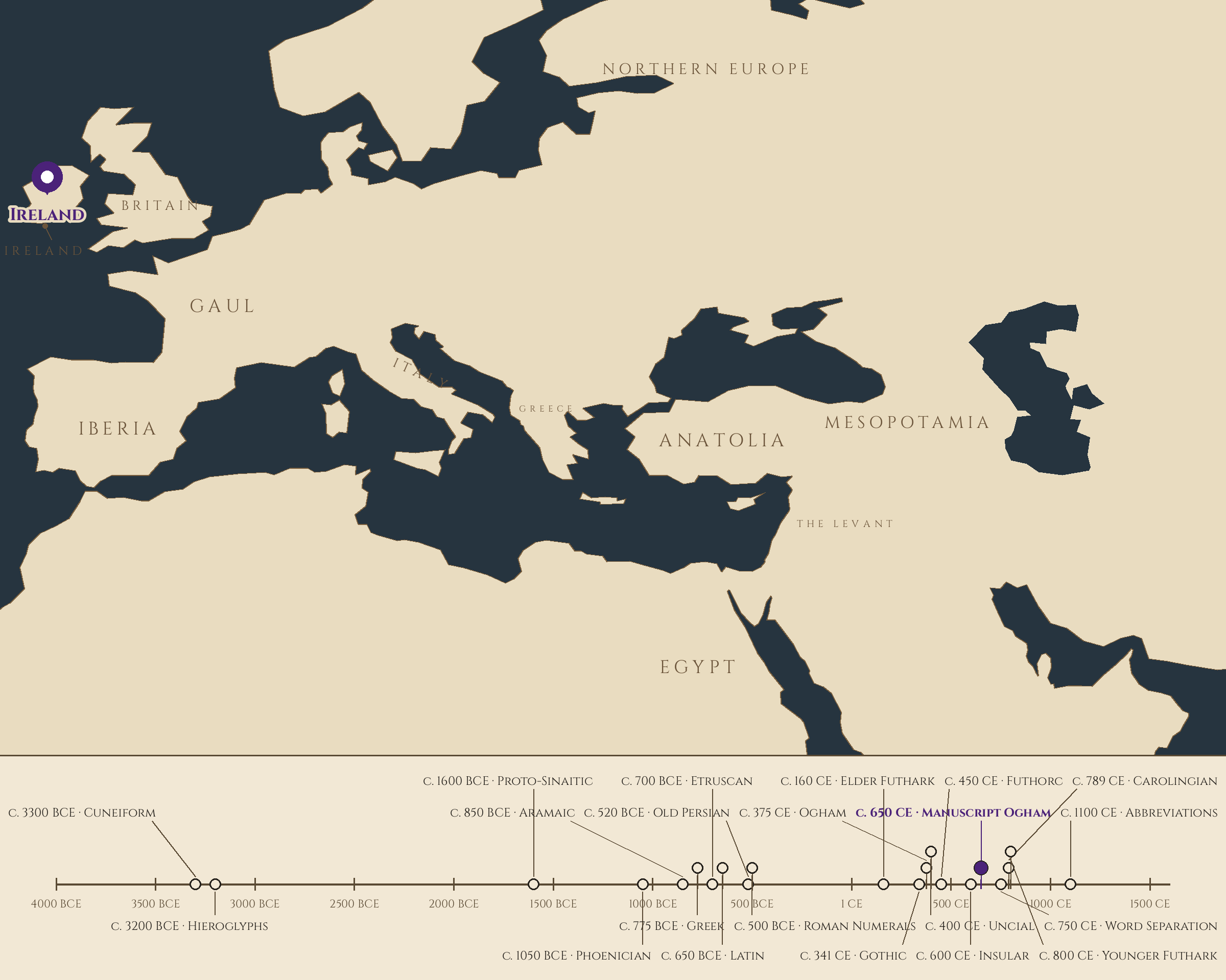
Where and when: Ireland, about 1,300 years ago, where the monks took the alphabet from stone to page. The pin is this lesson. The line beneath the map is our road: every stop a writing system, every lesson a pin.
Lesson Objectives
By the end of this lesson, students should be able to:
- Define forfeda, éabhadh, óir, uilleann, ifín, eamhancholl, manuscript Ogham, and Old Irish.
- Explain the manuscript shift: how and why Ogham moved from the vertical stone edge to the horizontal page, and what changed in the move.
- Describe the five forfeda: their shapes, names, meanings, Unicode positions, and the two layers of their sound values.
- Distinguish the forfeda's original purpose (sounds the old twenty could not write) from the later medieval reinterpretation (the diphthong series).
- Identify éabhadh as the one forfid found on stone inscriptions, spelling koi, "here," and explain what its exception proves.
- Explain why the forfeda are an expansion, not a replacement, and apply the course question in its inverted form: what had to be added to be understood?
- Correct the assumption that the diphthong values were the inventors' intent.
Reading this lesson: ★ marks the passages to remember. They return on the unit quiz and the class test. Check in questions ask the material back as you go; answer them in your workbook when you meet them.
Working this lesson: Your assignment packet is the first download on this page. Work in it as the lesson moves along, answering each assignment as its subject is taught — or read the lesson through for your notes and take the assignments as homework afterward. Both are proper ways to sit this class. Signposts in the reading tell you where each assignment belongs. Written answers are short answers in your own words; a few honest lines are worth more than a filled page.
Your Assignment Packet
This lesson's assignments live in its packet: the Lexicon Handout (every term, course terms marked ◆), Materials, Guided Practice, the Assignment Manual with its answer key for self-checking, the Reflection Questions, and the Workbook Checklist. Download the packet before you begin and keep it beside you as you read.
The Alphabet Leaves the Stone
For two hundred years, Ogham belonged to the knife and the stone. The inscriptions stood on the edges of pillars across Ireland and western Britain, read from the bottom upward, the stemline borrowed from the stone's own arris. The formula was memorial: this one lies here, son of that one. The alphabet served the dead and the land-claim, and it served them well.
Then the monasteries rose, and with them a different relationship to writing entirely.
From the 7th century onward, Irish scholars began writing manuscript Ogham — Ogham on parchment rather than on stone. The reasons were practical and scholarly at once.
★ Monks copying texts needed to discuss the alphabet, teach it, gloss it, and catalogue it. A grammatical tract explaining Ogham cannot carve its examples into the margin of a vellum page; it must draw them. And the moment the stemline is drawn rather than found, everything changes. On the stone, the edge gives you the line: vertical, fixed, borrowed from the rock. On the page, the scholar draws the line herself, and she draws it the way every other line on the page goes: horizontally, left to right.
This is the manuscript shift, and it is worth pausing over, because it looks small and it is not.
The alphabet did not merely change surfaces. It changed posture, direction, profession, and purpose.
The carver worked bottom-up on a memorial stone for passersby. The scholar worked left-to-right in a grammatical tract for students. The same twenty letters, but a different alphabet in every way that matters except the shapes themselves.
The great witness to the shift is the Auraicept na n-Éces, the "Scholars' Primer," the medieval Irish grammatical tract that preserves Ogham lore in its fullest form: letter lists, kennings, commentary, and the forfeda themselves, all laid out for teaching. Everything the carvers built is still here; the scholars simply gave it a second life. The manuscript scholars even gave the forfeda their own Bríatharogam kennings, riddles in the same style as the twenty: the tradition did not merely add letters; it added them in the traditional manner, dressing the new signs in the old poetry so they would belong.
Notice what the scholars did not do. They did not replace the twenty. They did not declare the stone system obsolete and start over.
They kept every letter, kept the aicmí, kept the kennings, and then added. Expansion, not replacement. Hold that thought, because the forfeda will test it, and the test is the point of this lesson.
Check in: When Ogham moved from the stone edge to the manuscript page, what changed besides the surface? Name the new direction, and one thing the alphabet was now used for.
❦ In your workbook: record how the alphabet leaves the stone in your own way — copy, sketch, or note what matters.
In your packet: Assignment III — The Manuscript Investigation ◐ begins here. Work it now, or mark the place and take it as homework — your choice.
Five New Signs
The scholars found the twenty insufficient. This is the simple fact underneath everything in this lesson, and it deserves to be stated plainly before the complications arrive.
The old alphabet had been designed for the sounds of an earlier Irish, carved on stones for memorial formulas.
The scholars of the Old Irish period — Old Irish being the Irish of roughly the 7th to 10th centuries, the language of the monasteries — lived in a different linguistic world: a Christian, Latin-reading Ireland where scribes encountered Latin words, foreign names, and sounds the old twenty letters had never needed to write.
★ The most telling gap was the sound P. The traditional twenty had no P at all, because the early Irish of the stones barely used it; the Latin of the manuscripts used it constantly. A scholar trying to write Ogham examples involving Latin needed a sign the carvers had never cut.
So the scholars invented five. They are the forfeda, the "additional letters," and they are worth meeting individually, because each one shows the scholar's mind at work.
ᚕ Éabhadh (U+1695): two strokes crossing the stemline like an X. The first of the five, and the only one that ever escaped back onto stone.
★ ᚖ Óir (U+1696): a diamond enclosing the stemline, the line passing through the lozenge's heart. Its name is borrowed gold, Latin aurum made Irish.
ᚗ Uilleann (U+1697): an elbow, a hook bent across the line, carrying the diphthong value UI in the later teaching tradition. The name is the Old Irish word for "elbow," and the body gives the name, as the trees gave the old names: a body-part kenning in the same spirit as the older letters' tree names, the scholars naming the new signs the way the old tradition had named the old ones.
ᚘ Ifín (U+1698): a bow-tie or hourglass pinched at the stemline, two triangles kissing, carrying the diphthong value IO (or IA in some lists) in the later teaching tradition. The sources also call it pín, and the two names' rivalry hints at the value's troubled history: McManus's analysis holds that its original value was completely changed by the medieval reinterpretation, so what the inventors meant and what the teachers taught are two different sounds wearing one shape.
★ ᚙ Eamhancholl (U+1699): a small grid, twin strokes doubling the stemline. The "twin of coll," the hazel's manufactured double, named for an old letter the way a younger sibling is named for the elder.
★ Five signs, five shapes no knife would volunteer. The X, the diamond, the elbow, the bow-tie, the grid: these are pen shapes, drawn with ink by hands accustomed to the freedom of the page.
Whether the ink caused the geometry is a step further than the evidence goes, and I will not take it; what the evidence supports is the association, and the association is suggestive enough.
The carvers cut notches. The scholars drew diagrams. The difference between those two verbs is the difference between the two halves of this lesson.
❦ In your workbook: record the five new signs in your own way — copy, sketch, or note what matters.
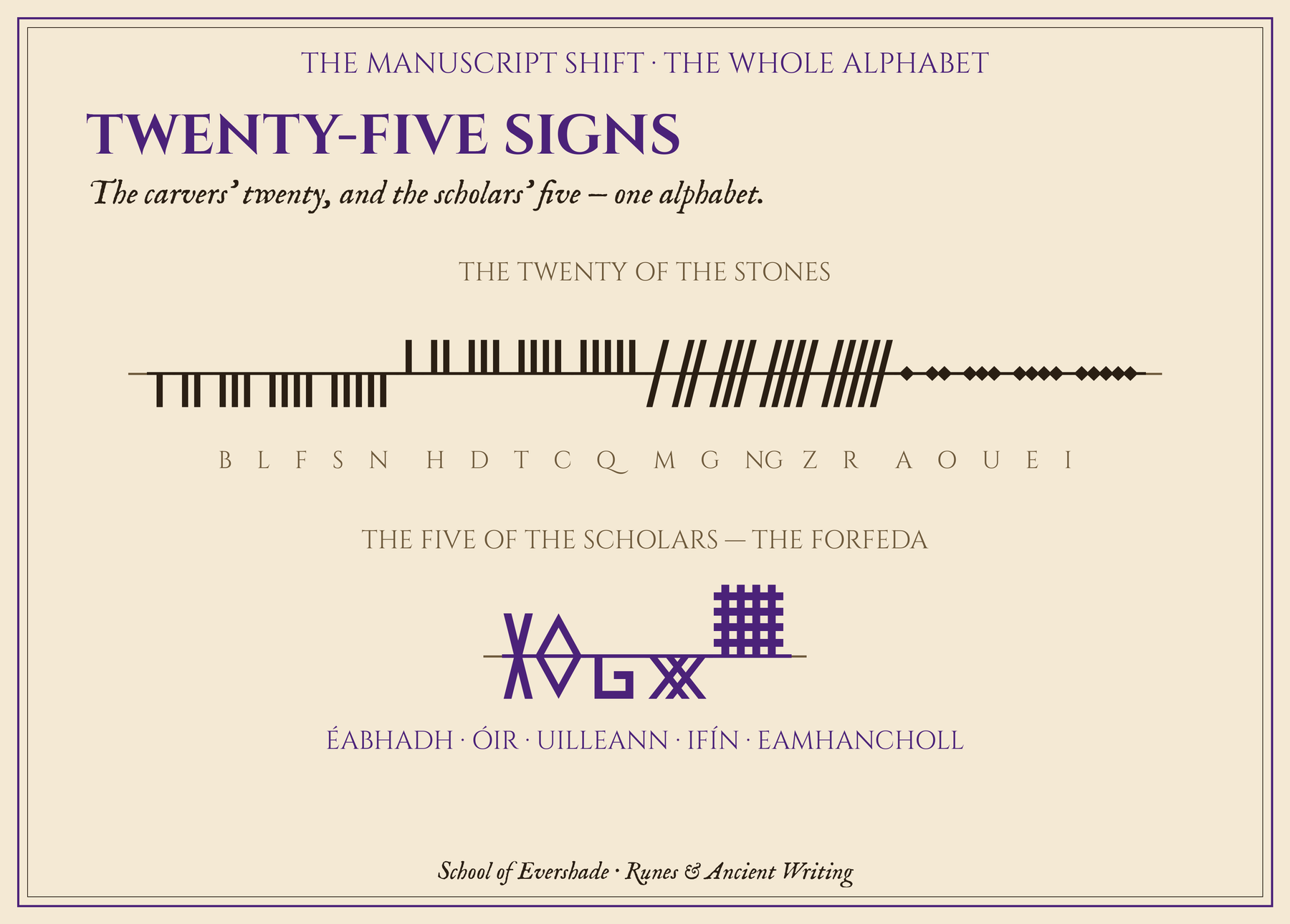
Twenty-five signs: the carvers' twenty and the scholars' five, on one stemline — expansion, not replacement.
Built for Evershade.
In your packet: Assignment I — The Forfeda Chart ⚒ begins here. Work it now, or mark the place and take it as homework — your choice.
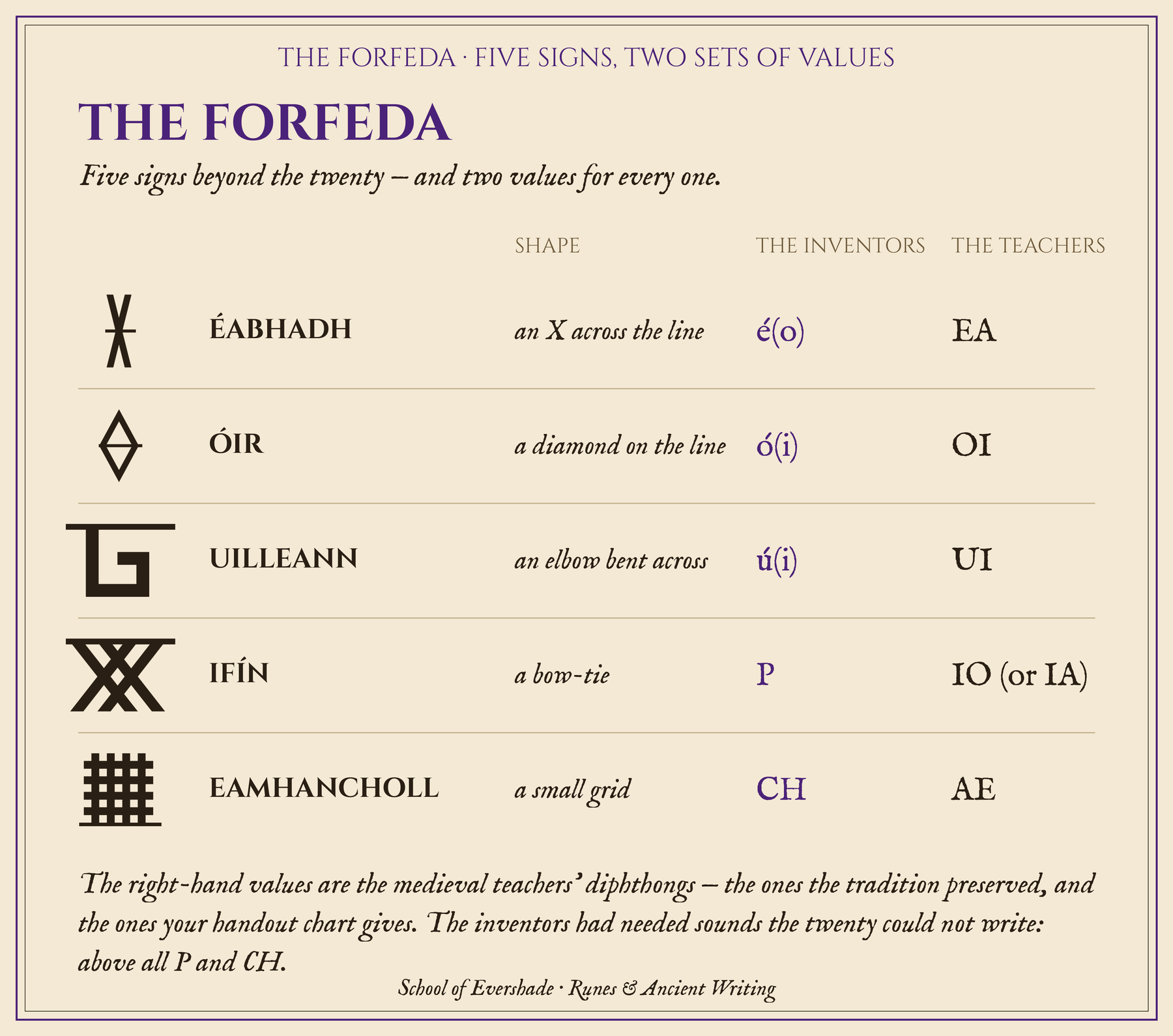
The forfeda with both value layers kept apart: the sounds the inventors needed — above all P and CH — and the diphthongs the medieval teachers later taught.
Built for Evershade.
What the New Signs Were For
Here is the correction this lesson exists to make, and I will make it carefully, because the older version of this classroom got it backwards.
The chart you will find in most summaries gives the forfeda five diphthong values: EA, OI, UI, IO (or IA), AE. It is a tidy chart, and it is not the inventors' chart. Those diphthong values are the later medieval reinterpretation, the teaching tradition's second pass over signs that were invented for something else entirely.
★ The linguist Damian McManus, whose analysis of Ogham remains the scholarly standard, reconstructed the likelier original purpose: the five forfeda were invented in the Old Irish period, several centuries after the peak of stone carving, to represent sounds the old alphabet could not write.
The proposed original values were simpler and more practical than diphthongs: sounds like é(o), ó(i), ú(i), and above all the consonants p and ch, the working gaps in the old system.
A scholar needing to spell Latin loanwords needed P the way a carpenter needs a hammer the old toolbox never held.
Then, centuries later, medieval teachers reinterpreted the signs.
They turned them into a series of diphthongs, EA through AE, "changing completely the values for pín and emancholl," as McManus puts it. The bow-tie and the grid, whatever they had originally spelled, became IO and AE in the teaching lists, and the teaching lists are what survived.
The chart in your handout gives the medieval values, because those are the values the tradition preserved; but the lesson marks them, every one, as the second layer. The inventors filled gaps. The teachers made diphthongs. Do not confuse the two, because the confusion reverses the story: it makes the forfeda look like ornaments added for completeness, when they were tools added for necessity.
This is why the "complex vowel combinations" framing of the older lesson needed correcting. It told the story backwards, as if the scholars had sat down wanting diphthongs.
They sat down wanting P. The diphthongs arrived later, the way footnotes arrive later: commentary mistaken, by the careless, for text.
Check in: A tidy chart gives the forfeda the values EA, OI, UI, IO, AE. Whose values are those, the inventors' or the teachers'? What did the inventors actually need the new signs to do?
❦ In your workbook: record what the new signs were for in your own way — copy, sketch, or note what matters.
Professor Webblethorn
Pause here, scholars, and hold the two layers apart in your mind the way you would hold two sheets of vellum.
The forfeda have a first purpose and a second meaning, and centuries stand between them. The inventors, in the Old Irish period, looked at twenty letters and found gaps: sounds the stones never needed, the Latin never stopped needing. They cut five new signs the way you would forge five new tools, each for a job the old kit could not do.
The teachers, centuries later, looked at the five signs and taught them as diphthongs. EA, OI, UI, IO, AE. Tidy, symmetrical, teachable. And wrong about the beginning, though right about the classroom.
Both layers are real. The chart is real; it is what the tradition handed down. The reconstruction is real; it is what the evidence suggests. Your work, as students of writing rather than merely readers of it, is to know which is which, and to say so aloud when others blur them.
The web has two threads here, twisted together. Learn to see the twist. That is what epigraphers do.
PROFESSOR THISTLELOOM WEBBLETHORN
Runes & Ancient Writing
Epigrapher, Head of House Septentrio
The Exception on Stone
I told you the forfeda belong to the manuscripts, and that is true with one exception, and the exception is worth more than the rule.
★ The first forfid, éabhadh (ᚕ), appears on actual stone inscriptions. Not often, and not for its medieval diphthong value: it appears with the value K, regularly spelling the word koi, "here," in the memorial formula.
"X, son of Y, here." The X that crosses the stemline, cut with a knife after all, marking the spot where someone lies.
The other four forfeda have, at most, one certain stone inscription each. For all practical purposes, they are manuscript signs: they live in the glossaries, the alphabet lists, the Auraicept's teaching pages, and nowhere else.
Éabhadh is the one that walked back out of the library and onto the stones, and it did so spelling the most stone-like word imaginable. Koi. Here. The manuscripts' sign, doing the stones' work, in the stones' own formula.
There is a lesson in the exception, and it is about honesty in scholarship. It would be tidier to say the forfeda never touched stone. Tidiness is not truth.
The truth is: one did, regularly, in one word, with a value the teaching lists never gave it. When you meet a claim as clean as "never," check the stones. The stones sometimes disagree, and when they do, the stones are worth hearing.
Check in: Which forfid appears on real stone inscriptions, in what word, and with what value, and why does that one exception matter to tidy claims?
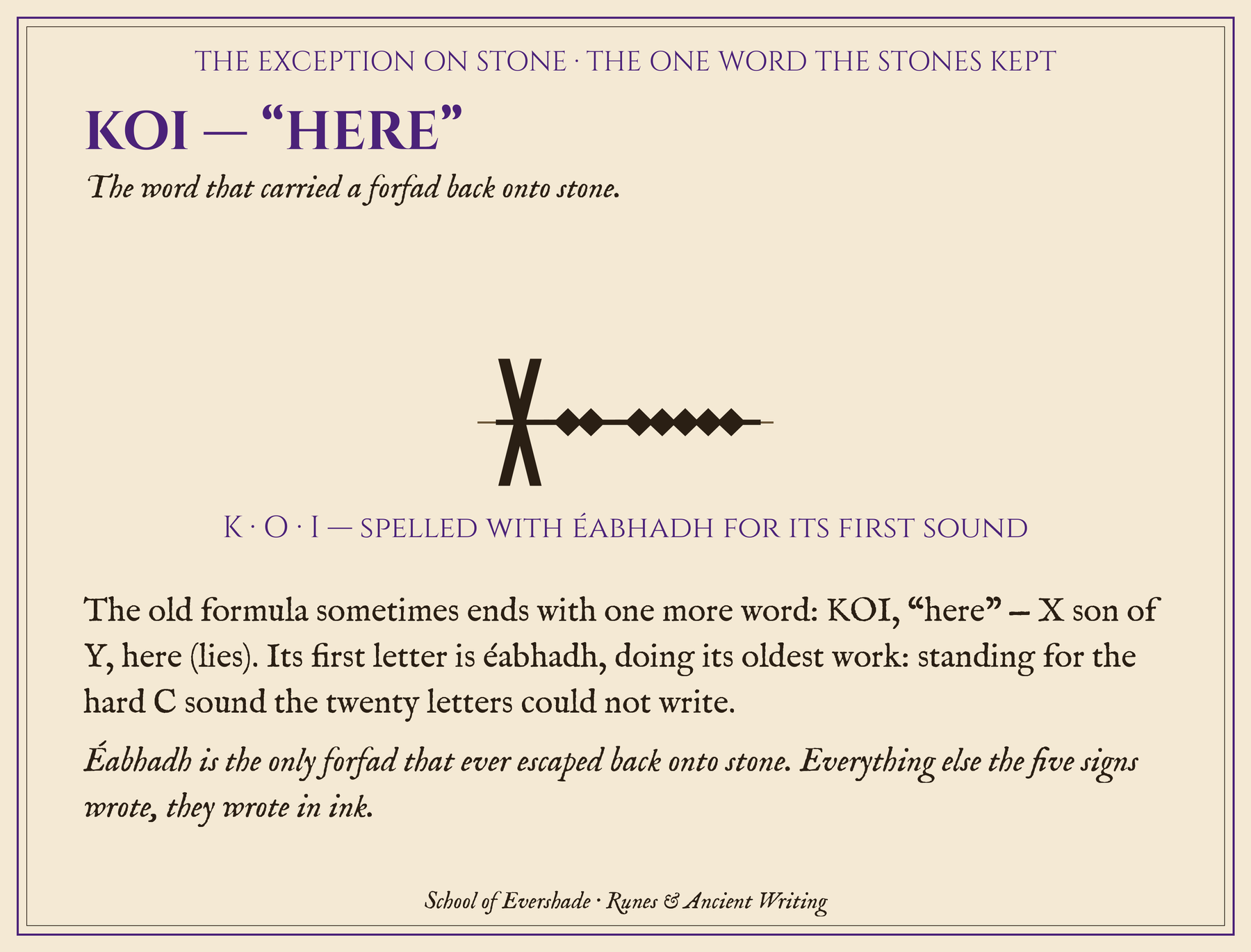
KOI — “here”: the one word that carried a forfad back onto stone. Everything else the five signs wrote, they wrote in ink.
Built for Evershade.
❦ In your workbook: record the exception on stone in your own way — copy, sketch, or note what matters.
Do Not Mistake Expansion for Replacement
The forfeda did not replace the twenty. This needs saying plainly, because students meeting an "expanded alphabet" for the first time often imagine the old one being retired, the way we imagine software updates replacing the old version.
★ Nothing was retired. Every one of the traditional twenty survived the manuscript shift intact: same shapes, same aicmí, same kennings, now lying flat on the page instead of climbing the stone. The five new signs joined them. Twenty became twenty-five, and the twenty were unchanged.
This is the same distinction the futhorc taught two lessons ago, and it is worth making a standing rule of the classroom: when scholars expand an alphabet, they are adding rooms to a house, not demolishing it. The Anglo-Saxon monks catalogued thirty-three runes without discarding the twenty-nine the carvers used. The Irish scholars drew five new Ogham signs without discarding the twenty the stones bore.
Expansion assumes the old work was good. Replacement assumes it was broken. The forfeda assume the twenty were good and the language had simply outgrown them, the way a growing foot outgrows a good shoe.
You do not blame the shoe. You get a bigger one, and you keep the old pair for the road they walked.
Apply the course question in its inverted form, the twin we met with the futhorc: what had to be added to be understood? The scholars' answer was five signs, for sounds the stones never needed and the books could not do without.
Nothing left out. Something put in. The web gains threads, and none of the old ones are cut.
❦ In your workbook: record expansion, not replacement in your own way — copy, sketch, or note what matters.
Reading the Scholars' Hand
A few technical matters for the manuscript era, carried forward with the changes the new medium requires.
Direction: left to right along a horizontal stemline, drawn on the page. The bottom-up reading of the stones is gone, rotated flat with the line itself. If you learned the stone manner last lesson, practice the turn deliberately: the same notches, a quarter-turn of the world.
Layout: the stemline is now drawn, not found. On the stone, the edge gave the line; on the page, the scholar rules it. Strokes are placed relative to the drawn line exactly as they were placed relative to the edge: to one side, to the other, across, or through. The geometry is unchanged. Only the furniture moved.
Transliteration: the scholarly conventions carry over, with the forfeda added to the sign list. Éabhadh transliterates in manuscript contexts by its taught value; in the koi inscriptions, it transliterates as K, and the context tells you which.
Where a manuscript gives a forfid, say so in your notes: the sign's address matters as much as its shape. A ᚕ on vellum and a ᚕ on stone are the same drawing and different letters, and the transliteration should know the difference.
The corpus: the forfeda live in the manuscripts, above all the Auraicept na n-Éces and the grammatical lists. The stones, with the koi exception, do not know them. When you cite a forfid, cite the manuscript: shelfmark, tract, page. The stones are the twenty's archive. The books are the twenty-five's.
❦ In your workbook: record how the scholars' hand is read in your own way — copy, sketch, or note what matters.
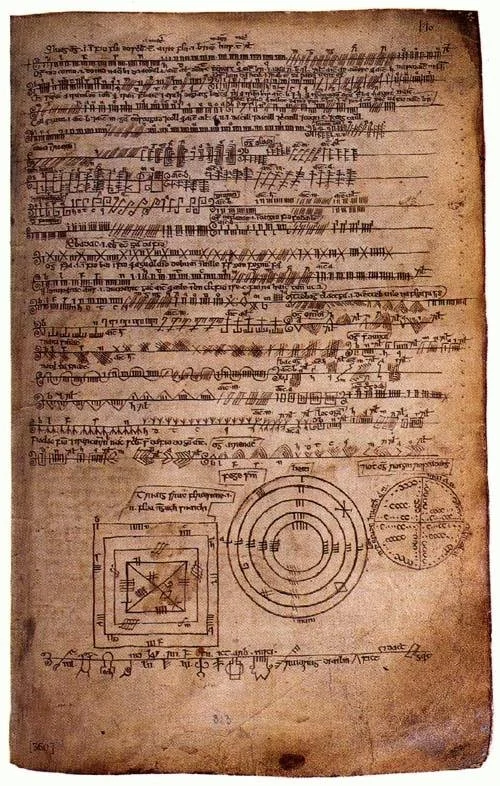
Historical example. A page of the Auraicept from the Book of Ballymote, c. 1390: Ogham scales ranked down the page, with wheel and square ogams at the foot — the scholars' garden where the forfeda grew.
Page of the Auraicept na n-Éces, Book of Ballymote (c. 1390). Public domain.
In your packet: Assignment II — Transliteration Practice ⚒ begins here. Work it now, or mark the place and take it as homework — your choice.
Guided Practice — The Scholar's Hand
Before the assignments, train your hand the way a manuscript scholar would: with attention to the new signs, and to the turn of the line.
Exercise A — Drawing the Five
- On paper, rule a horizontal stemline and draw each of the five forfeda astride it: the X of éabhadh, the diamond of óir, the elbow of uilleann, the bow-tie of ifín, the grid of eamhancholl.
- Below each, label it with its name, its Unicode position (U+1695 through U+1699), and both of its values: McManus's proposed original on the left, the medieval teaching value on the right.
- For ifín and eamhancholl, underline the pair of values and write one sentence on what "changing completely" means: the same shape, two different sounds, centuries apart. What does that tell you about how much of a letter is its shape and how much is its teaching?
- Circle éabhadh and write koi beside it. One sign, two lives: the manuscript's diphthong and the stone's K. Which life do you think the inventor imagined? There is no certain answer; the question is the exercise.
Exercise B — Edge to Page
- Take a stick, a ruler's edge, or a book's spine. Along its vertical edge, write a short Ogham inscription bottom-up in the stone manner, using only the traditional twenty (last lesson's letters): your initials, transliterated.
- Now rule a horizontal stemline on paper and write the same inscription left to right in the manuscript manner. Add one forfid to the sequence: spell a word containing a P-sound, or mark the inscription with éabhadh in the koi position, "here."
- Write two to three sentences on what the rotation changed: which manner felt faster, which felt more deliberate, and what the drawn line let you do that the found edge did not.
This exercise teaches, in your own hand, what the 7th century taught the alphabet: the medium is part of the message, and the message changed rooms.
Exercise C — The Reinterpretation Detective
- List McManus's proposed original values for the five forfeda (é(o), ó(i), ú(i), p, ch) beside the medieval teaching values (EA, OI, UI, IO/IA, AE).
- Consider the inventor's problem: a scholar in Christian Ireland, needing to write Latin words in Ogham. Which set of values looks like the answer to that problem? Write two to three sentences defending your choice with specifics: which values solve the P-gap, and which values look like a teacher's symmetrical system?
- Now consider the teacher's problem: a medieval instructor, centuries later, needing a tidy chart for students. Which set looks like the answer to that problem? Write two to three sentences on what the diphthong series offers a classroom that a grab-bag of gap-fillers does not.
You have just repeated, in minutes, the two moments this lesson keeps apart: the invention and the instruction.
In your packet: Assignment IV — The Expansion Essay ✎ begins here. Work it now, or mark the place and take it as homework — your choice.
Assignment Manual
Assignment key: ✎ written work · ⚒ hands-on practical · ◐ both · ★ will be on the test · ❦ workbook path
Written answers in this manual are short answers in your own words — a few honest lines, not a filled page.
Assignment I — The Forfeda Chart ⚒ ★
Objective: Demonstrate control of the five forfeda in both their historical layers.
Instructions:
- On a fresh sheet, create a six-column chart: sign (drawn astride a ruled stemline), name, shape description, Unicode position (U+1695-U+1699), McManus's proposed original value, medieval teaching value.
- Complete all five rows. For ifín and eamhancholl, add a note on the complete value change between the two layers.
- Below the chart, add a sixth row for éabhadh's stone life: the sign again, the word koi, the value K, and one sentence on what the exception proves about tidy claims.
Your keepsake: this chart completes your Ogham set: the carvers' twenty and the scholars' five. Keep the pair together; every later lesson in this unit reads from both.
To submit: Photograph or scan your chart. Draw the shapes with a pen, not a knife: these are scholars' signs, and the medium is part of the lesson.
Assignment II — Transliteration Practice ⚒ ★
Objective: Read and write the forfeda in both their lives, manuscript and stone.
Part A. Write the word koi ("here") in Ogham using éabhadh for the K, in the stone manner: vertical edge, bottom-up. Then write it again in the manuscript manner: horizontal stemline, left to right. Label each with its manner and note the value you gave éabhadh in each.
Part B. Transliterate the following sequence of five forfeda into their medieval teaching values: ᚕ ᚖ ᚗ ᚘ ᚙ. Then transliterate the same sequence into McManus's proposed original values. What does the side-by-side comparison reveal about the distance between invention and instruction?
Part C. The forfid óir is named from Latin aurum, "gold." Write a half page on what a Latin loanword inside an Ogham letter-name reveals about the world of the inventors: who were they, what did they read, and how far had Ireland traveled from the stone-carving centuries?
Assignment III — The Manuscript Investigation ◐ ★
Objective: Understand the forfeda through the books that kept them.
Instructions:
- Research (using the References below): the Auraicept na n-Éces ("The Scholars' Primer") and the OG(H)AM project's corpus. For the Auraicept, record what kind of text it is, what it preserves about Ogham, and its approximate date. For OG(H)AM, record what the project catalogues and the current scope of its corpus.
- The forfeda survive chiefly in manuscripts, not on stones. Write a half page on what this survival pattern reveals: what kinds of writing does parchment preserve that stone does not, and what does each medium's archive hide from us? Base your argument on the lesson and your research.
- The lesson claims the diphthong values are a later reinterpretation. Find the Forfeda article's summary of McManus's argument (see References) and write a half page assessing it: what evidence supports the gap-filling account over the diphthong account, and what would change your mind?
Assignment IV — The Expansion Essay ✎ ★
Objective: Evaluate the scholars' addition against the carvers' alphabet and its runic cousin.
Instructions:
Write a one-page essay addressing the following:
The Irish scholars added five signs to Ogham without discarding any of the twenty; two lessons ago, the Anglo-Saxon scholars catalogued thirty-three runes without discarding the carvers' twenty-nine. First, describe concretely what each tradition added, using the forfeda's two value-layers and the futhorc's manuscript runes as your examples. Then consider the shared principle: expansion without replacement. Why do scholarly cultures expand alphabets instead of replacing them, and what does the impulse reveal about how scholars relate to inherited systems? Finally, return to the course question and its twin: the forfeda answered "what had to be added?" with five signs. Was the addition worth it? Judge by the standard the inventors would have recognized: did the new signs do work the old ones could not?
Cite the lessons where your details come from.
Materials
Required (Level One — household items)
- Paper: plain white paper or a sketchbook, for sign practice and chart work.
- Pens: one standard pen for drafting, one fine-tipped marker for final forms. The forfeda are pen shapes; draw them with ink, as the scholars did.
- A ruler: for ruling the horizontal stemline and for chart columns. The drawn line is this lesson's central prop: rule it deliberately.
- A stick, dowel, or book spine: for the edge-to-page exercise. The vertical edge stands in for the stone; your initials climb it bottom-up.
- A printout of the forfeda: use the References below for standard charts of the five supplementary signs (U+1695-U+1699).
Suggested (Level Two — historically closer materials)
- Parchment or vellum paper: the scholars' surface. Writing the forfeda on animal skin with a quill approximates the manuscript experience more closely than any modern paper.
- A quill and oak gall ink: the manuscript scholar's tools. The forfeda were drawn with pens; drawing them with a quill teaches the hand what the shapes assume. (Professor Nocturne's Scrollwork lessons cover quill cutting and ink making; the Evershade Safety Scroll on the classroom homepage applies to sharp tools and staining inks.)
- A flat stone tile or slate: for the koi exercise. Carve ᚕ with an awl or nail, spelling "here" in the stone manner: the exception, in its own medium.
- A Latin primer or phrasebook: the inventors' other language. Copy a short Latin word containing P and consider, as they did, what the old twenty could not spell.
Neither level requires
Purchased kits, specialty tools, or any material you cannot find locally or order inexpensively. The core lesson (drawing the five signs, understanding the two value-layers, practicing the stemline's turn) is fully achievable with paper, pen, and a ruler.
Reflection Questions
Answer the following in your workbook.
- What does forfeda mean, and what does the etymology reveal about the word the Irish used for a letter?
- Name the five forfeda with their shapes, Unicode positions, and names' meanings where known.
- State the two layers of the forfeda's sound values: McManus's proposed originals and the medieval teaching values. Which came first, and how do we know the order?
- What is the manuscript shift? Describe what changed in medium, direction, profession, and purpose when Ogham moved from stone to page.
- Explain the koi exception: which forfid appears on stones, in what word, with what value, and what does the exception prove?
- State the expansion-not-replacement rule and apply it to both the forfeda and the futhorc's manuscript runes.
- Apply the course question's twin: what did the forfeda add, and did the addition do work the old signs could not?
Workbook Checklist — Lesson 15
In my workbook I have:
- ☐ explained what forfeda means, and what the word reveals about the Irish word for a letter
- ☐ drawn the five forfeda astride a stemline, with names, shapes, and Unicode positions
- ☐ stated both layers of the forfeda's values (McManus's proposed originals; the medieval teaching values) and which came first
- ☐ described the manuscript shift: medium, direction, profession, and purpose
- ☐ explained the koi exception and what it proves about tidy claims
- ☐ stated the expansion-not-replacement rule and applied it to the forfeda and the futhorc alike
☐ Lesson completed Date: ____________ Signature: ____________
Professor's Review
And so our fifteenth lesson closes on the scholar's page, where twenty letters became twenty-five and the alphabet learned to lie flat.
You can now define the forfeda and name all five with their shapes and both layers of their values, explain the manuscript shift in its medium, direction, profession, and purpose, distinguish the inventors' gap-filling from the teachers' diphthong series, identify éabhadh's stone exception and what it proves, state the expansion-not-replacement rule, and apply the course question's inverted twin to the scholars' addition.
Keep your forfeda chart beside your twenty-letter chart from last lesson. Lay them side by side: the carvers' twenty climbing the edge, the scholars' twenty-five lying on the page. Five new signs, and not one old sign disturbed. The house gained rooms. Nothing was demolished.
Next, we leave Ireland for the Danube, where a bishop will build an alphabet from scratch for a people with no written language at all: the Gothic alphabet, twenty-seven letters, twenty-five with sounds and two for numbers alone, drawn mostly from Greek. The alphabet is about to be invented on purpose, and that has never happened in our story before.
Practice your five, scholars. Draw them with the pen on paper, carve the koi on tile, and feel the two manners in your own hand: the scholar's diagram and the carver's notch. I have watched alphabets shrink and grow in my years among the inscriptions, but I have never seen one keep two histories inside a single shape the way éabhadh keeps its K and its EA. The web holds the twist. Learn to see it.
And scholars: when you meet a tidy chart, ask who tidied it. The diphthongs were a teacher's symmetry, not an inventor's necessity. The truth is usually less symmetrical than the lesson, and more interesting. That is true of alphabets, and it is true of most things.
PROFESSOR THISTLELOOM WEBBLETHORN
Runes & Ancient Writing
Epigrapher, Head of House Septentrio
Cross-Class Connections
The manuscript scholars who invented the forfeda were doing the same work Professor Nocturne teaches in Scrollwork: the cataloguing, glossing, and preserving instinct of the scriptorium. Students studying both classes should compare the Auraicept's Ogham lists with the manuscript rune books of Lesson 13: two scholarly cultures, same impulse, same century, same result: the alphabet kept in books by people who loved lists.
The quill-and-ink drawing of the forfeda connects with Scrollwork's materials lessons, where Professor Nocturne teaches quill cutting and oak gall ink making. The forfeda are pen shapes; the Scrollwork classroom teaches the pen. Draw them there, if you like, and feel the tools meet the signs.
The expansion-not-replacement rule will reappear in Runes Unit V, when medieval scribes adapt the Latin alphabet again and again without discarding it. The forfeda are our first clear case of scholarly expansion, and they will not be the last.
In Other Classrooms
Scrollwork · Unit II, Lesson 6 — Oak Gall Ink

The forfeda were drawn in ink, and the ink has a story of its own. In the Library we make oak gall ink and learn its chemistry: why it darkens after writing, and why it can eat the page it preserves. Come and mix the very ink your manuscript scholars trusted, and handle it with the respect it demands.
Scrollwork · Unit III, Lesson 10 — Cutting the Quill
A pen shape begins as a feather and a knife. In the Library we cut quills properly: the parts of the nib, the sequence of cuts, the centered slit, and safe practice before any real writing. Come and make the instrument that drew your forfeda, and the signs will explain themselves to your fingers.
Scrollwork · Unit VI, Lesson 23 — Archive Labels & Library Systems
Lists of alphabets, kept by people who loved lists: the Auraicept's compilers were librarians at heart. In the Library we study how manuscripts were labeled and kept: tituli, shelfmarks, chained libraries, and colophons. Come and see the scriptorium's other craft, the keeping, without which nothing you study would have survived.
The page turns, and so do we.
References & Further Reading
The OG(H)AM Project, Universities of Glasgow and Maynooth. The scholarly corpus project cataloguing pre-1850 Ogham inscriptions across all media. https://ogham.glasgow.ac.uk
McManus, Damian. A Guide to Ogam. Maynooth: An Sagart, 1991. The standard scholarly analysis of Ogham, including the forfeda's invention and reinterpretation (§5.3). The foundation beneath this lesson's two-layer account.
Wikipedia. "Forfeda." Summary of the five supplementary signs, their forms, and McManus's analysis of their original values versus the later diphthong reinterpretation. https://en.wikipedia.org/wiki/Forfeda
Wikipedia. "Ogham." Comprehensive overview: the traditional twenty, the manuscript tradition, direction and media, and the Auraicept. https://en.wikipedia.org/wiki/Ogham
Browse the Runes shelf in the school Library for readable editions of these works.
THE UNIT IV QUIZ
RUNES & ANCIENT WRITING · UNIT IV: THE NORTHERN STAVES · LESSONS 11–15
Unit IV is complete: the alphabet has gone north and learned to survive the knife, in twenty-four Elder Futhark staves, sixteen Viking runes, the expanded Anglo-Saxon row, and the Irish edge script. This quiz gathers the whole unit, all five lessons, into one sitting. Take it from memory first, before you look back at your notes, because it measures what has stayed with you. If you completed the assignments marked ★ in your lesson packets, you have already practiced most of what it asks.
The quiz packet is a single download. Part I gathers questions from every lesson in the unit, Part II matches the unit's vocabulary, and the answer key waits at the back for self-checking. When you have finished, score it honestly, note the result in your workbook, and revisit any lesson whose questions went wrong before you move on to Unit V.
Now the full twenty in their four families. The Bench draws your words on the stemline, ready for the edge of a real stone.
Open the BenchPROFESSOR THISTLELOOM WEBBLETHORN · RUNES CLASSROOM
Submit your work for this lesson using the form below.
CONTINUE IN RUNES & ANCIENT WRITING
← Previous · Lesson 14: Ogham: Twenty Letters Along the Stone's Edge Next · Lesson 16: The Gothic Alphabet: A Hybrid Script for the Goths →
Unit IV · The Northern Staves Runes & Ancient Writing Classroom · All 21 Lessons
The rest of Unit IV: Lesson 11 · Elder Futhark · Lesson 12 · Younger Futhark · Lesson 13 · Futhorc · Lesson 14 · Ogham: Twenty Letters Along the Stone's Edge
From the Runes Shelf
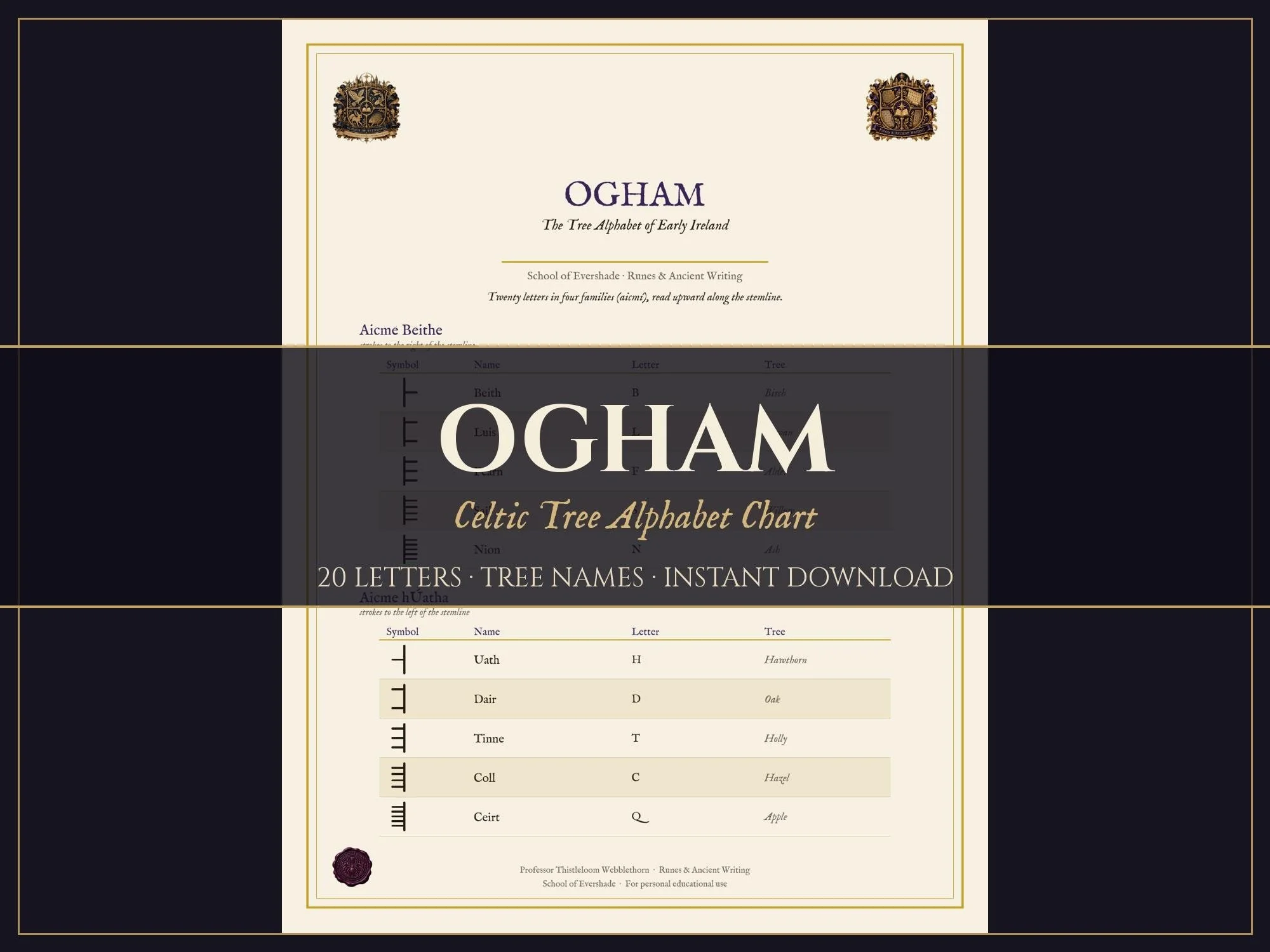
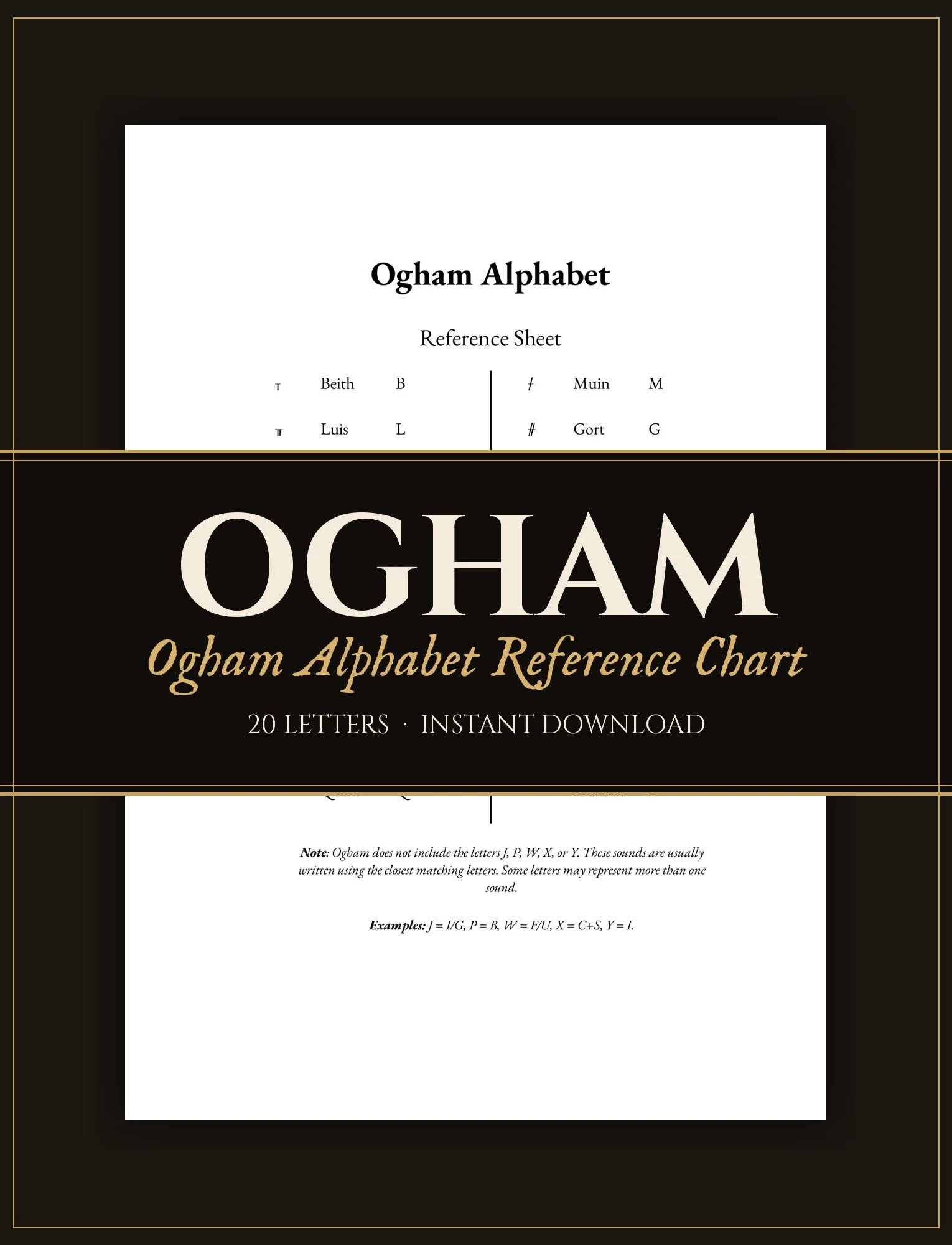
The printed companions to this lesson, from Professor Webblethorn’s shelf in the shop.