RUNES & ANCIENT WRITING
Unit 4 · Lesson 14THE CELTIC EDGE SCRIPT
Ogham: Twenty Letters Along the Stone's Edge
Professor Thistleloom Webblethorn
Epigrapher • Runes & Ancient Writing
Head of House Septentrio • School of Evershade
Professor's Introduction

To the stone's edge, scholars. Leave your knives in their sheaths tonight, but bring a straight edge. We are going to Ireland, and we are going to write along the edge of the world.
Stand beside an Irish pillar stone and run your hand down its edge: a narrow ridge of rock, too thin for any letter you have carved so far.
Tonight we meet a script that asked a stranger question than any of them. The runes asked how to carve letters into wood and stone. Ogham asked a different question: what if the letters were not carved onto the stone at all, but along its edge?
Come closer to the web, scholars. Tonight the alphabet turns sideways.
PROFESSOR THISTLELOOM WEBBLETHORN
Runes & Ancient Writing
Epigrapher, Head of House Septentrio
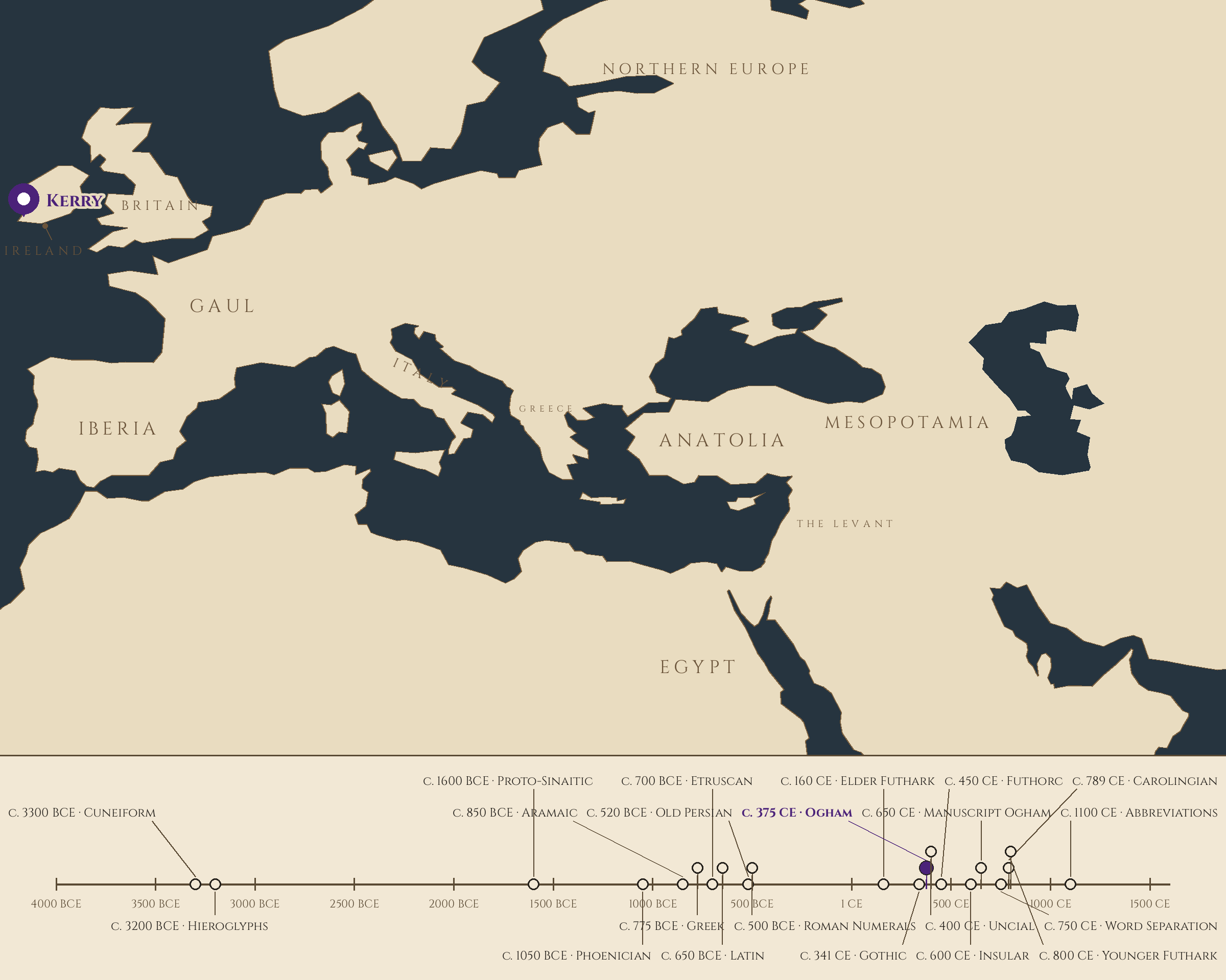
Where and when: Ireland, about 1,600 years ago, where the first Ogham pillars were raised. The pin is this lesson. The line beneath the map is our road: every stop a writing system, every lesson a pin.
Lesson Objectives
By the end of this lesson, students should be able to:
- Define Ogham, aicme, stemline, Beith-luis-nin, Bríatharogam, MAQI, and Auraicept na n-Éces.
- Describe the four aicmí: their stroke counts, their positions relative to the stemline, and their five letters each.
- Write all twenty traditional letters with their names, sound values, and stroke patterns.
- Explain how Ogham is read: bottom-up along the stone's edge, and why.
- State the MAQI formula and explain what most surviving inscriptions record.
- Correct the "Celtic tree alphabet" misconception: explain which tree names are certain, which are medieval scholarly additions, and why the distinction matters.
- Explain the two leading accounts of Ogham's invention: the medieval legend of Ogma and the scholarly case for a Latin-trained inventor.
- Apply the course question: what did Ogham leave out, and what did the omissions buy?
Reading this lesson: ★ marks the passages to remember. They return on the unit quiz and the class test. Check in questions ask the material back as you go; answer them in your workbook when you meet them.
Working this lesson: Your assignment packet is the first download on this page. Work in it as the lesson moves along, answering each assignment as its subject is taught — or read the lesson through for your notes and take the assignments as homework afterward. Both are proper ways to sit this class. Signposts in the reading tell you where each assignment belongs. Written answers are short answers in your own words; a few honest lines are worth more than a filled page.
Your Assignment Packet
This lesson's assignments live in its packet: the Lexicon Handout (every term, course terms marked ◆), Materials, Guided Practice, the Assignment Manual with its answer key for self-checking, the Reflection Questions, and the Workbook Checklist. Download the packet before you begin and keep it beside you as you read.
The Edge of the Stone
Every script we have studied so far is written on something: pressed into clay, painted on papyrus, carved across a stone face, scratched along a wooden stave. The scribe or carver takes a surface and covers it with signs. The surface is the page, and the page is flat.
Ogham begins by refusing the flat page. Its letters are not placed on a surface at all. They are hung along a line, and that line is the edge of the stone itself.
Stand an Ogham pillar in your mind. It is a rough standing stone, taller than a person, set upright in an Irish field some sixteen hundred years ago.
Now look at its left edge, the sharp vertical corner where two faces meet. That corner is the writing line: the stemline (called druim, "ridge," in Old Irish). Starting near the bottom, the carver cut short straight strokes across it: one stroke, two strokes, three, four, five, each group slanting to one side or the other of the edge, or crossing it, or notching it. Then the reader, centuries later, starts at the bottom and reads upward, turning at the top to come down the right edge if the text continues. The stone's own geometry is the ruled page.
This is the first thing to understand about Ogham, and it explains nearly everything else. A script written along an edge cannot use curves, because curves are hard to cut cleanly across a corner and hard to read at a glance. It cannot use complex interlocking shapes, because the reader's eye must travel vertically and count.
What it can use is the simplest possible mark: the straight stroke. And so the entire Ogham alphabet is built from one element, the stroke, varied in only two ways: how many (one through five) and where (four positions relative to the line).
★ Four positions times five counts gives twenty letters. The system is complete, closed, and arithmetically elegant, like a multiplication table that learned to spell.
The name of each group tells you the system thinks of itself as a family. Aicme means family or tribe in Old Irish, and the four aicmí are the four families of the alphabet: Beith, hÚath, Muin, and Ailm, each named for its first letter.
Within a family, seniority is by stroke count. Beith, with one stroke, is the eldest of its family; Nion, with five, the youngest.
The whole alphabet can be recited as four families in birth order, which is presumably how students memorized it: not as twenty arbitrary signs but as four households of five children each.
Check in: Ogham has twenty letters built from a single mark. What are the only two things that vary from letter to letter?
❦ In your workbook: record the edge of the stone in your own way — copy, sketch, or note what matters.
Four Families, Twenty Letters
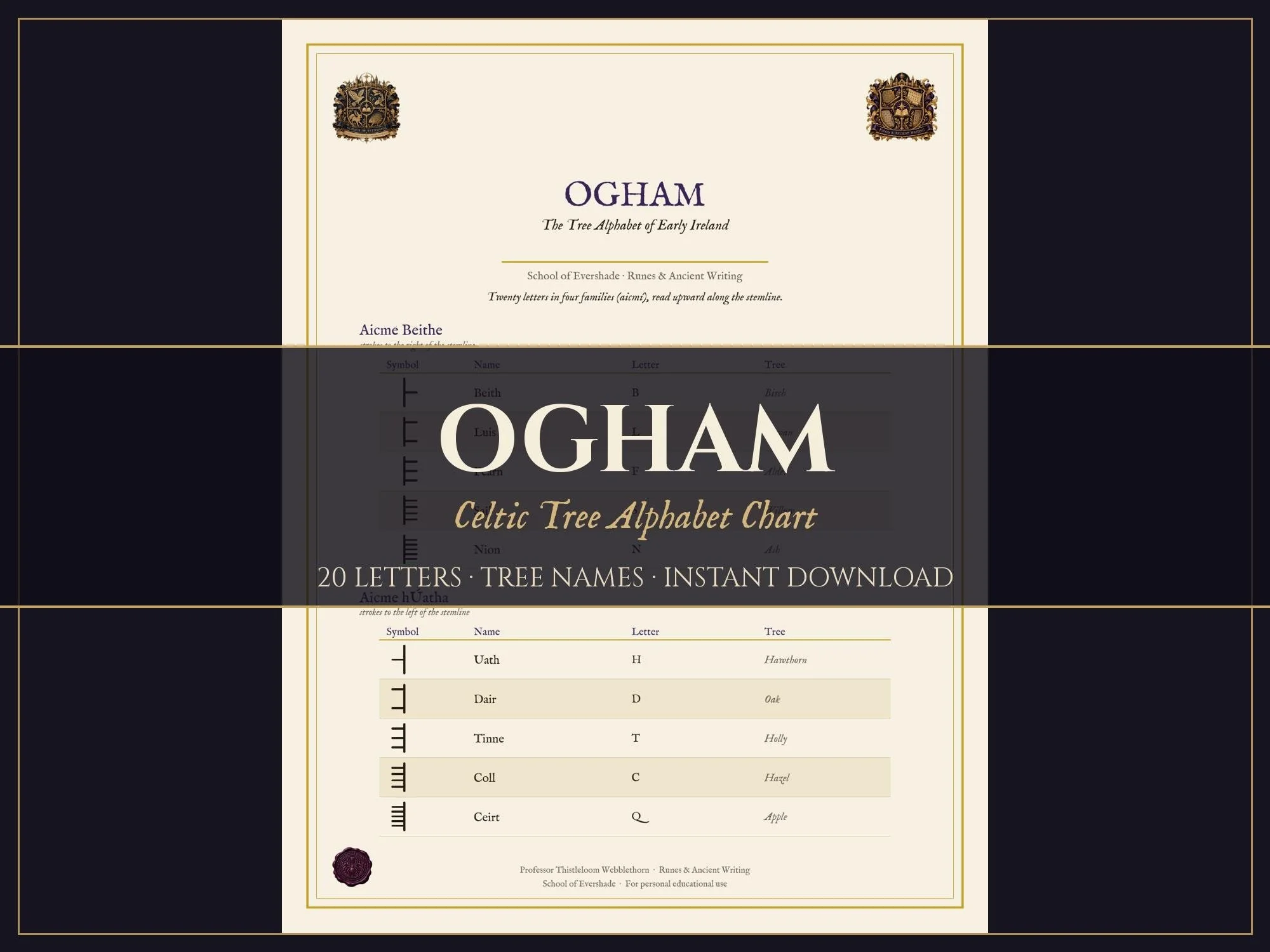
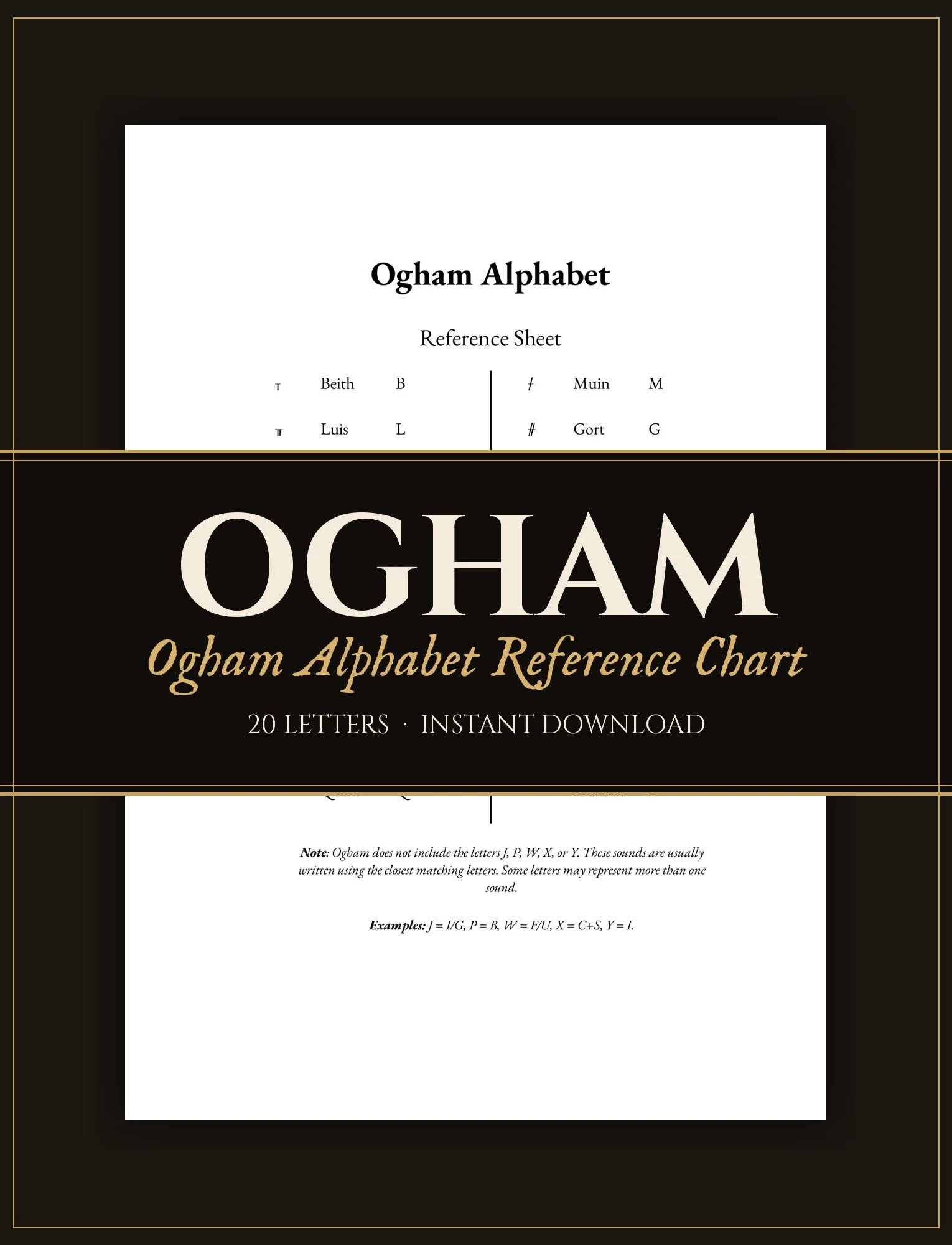
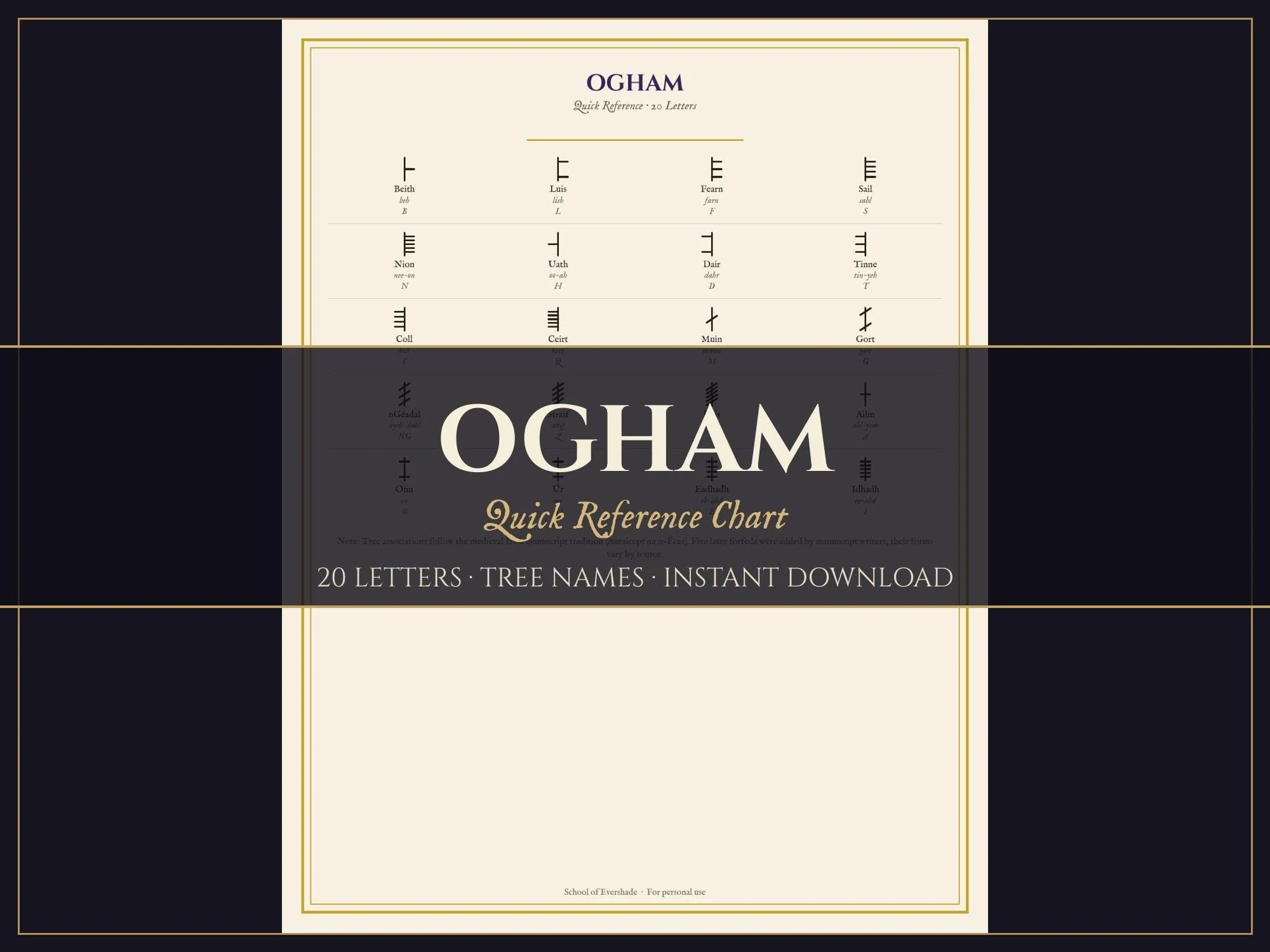
Here are the twenty traditional letters in their standard order, each with its Ogham character, its name, its sound value, its stroke pattern, and its tree or plant association with the honest hedging the scholarship requires. Read the associations as medieval teaching glosses, not as the letters' original meanings: the distinction is the point of this lesson, and we will return to it.
Aicme Beithe — strokes to the right of the stemline
ᚁ Beith (*B). One stroke. Birch, in the later tradition. The first letter of the alphabet, and the first syllable of its name.
ᚂ Luis (L). Two strokes. "Rowan" in the later glosses, but the scholarship is cautious: the original meaning of luis* is uncertain, and the rowan identification comes from the medieval tree-list tradition rather than from the inscriptions.
ᚃ Fearn (F, also V, W). Three strokes. Alder, in the later tradition.
ᚄ Sail (*S). Four strokes. Willow, in the later tradition.
ᚅ Nion (N). Five strokes. The later glosses say "ash," but modern scholars (McManus and others) judge that nin* more likely meant "fork" originally. The ash identification is the medieval scholars' work, not the carvers'.
Aicme hÚatha — strokes to the left of the stemline
ᚆ Úath (*H). One stroke. Hawthorn, in the later tradition. The name may originally have meant something like "terror" or "dread," which would make it one of the non-tree names hiding in the list.
ᚇ Dair (*D). Two strokes. Oak, in the later tradition, and one of the more secure tree identifications.
ᚈ Tinne (*T). Three strokes. "Holly" in the later glosses; some scholars suggest the original meaning may have been "ingot" or "metal bar." Hedged either way.
ᚉ Coll (C, hard K). Four strokes. Hazel, in the later tradition.
ᚊ Ceirt (Q; originally kʷ, a kw-like sound). Five strokes. Its value is Q, and the lesson is careful here because precision matters: the initial sound was the old kʷ that Latin also once had. The later glosses waver between "apple tree" and "bush"; the bush or hedge meaning is likely original (compare Welsh perth, "bush"), with "apple" a later confusion.
Aicme Muine — strokes diagonally across the stemline
ᚋ Muin (*M). One stroke crossing the line. Vine, in the later tradition.
ᚌ Gort (*G). Two strokes crossing. Ivy, in the later tradition.
ᚍ nGéadal (NG, the ng sound). Three strokes crossing. Broom, in the later tradition.
ᚎ Straif (conventionally Z). Four strokes crossing. Here the hedging matters most: the later glosses say "blackthorn," but McManus's analysis (Ériu 39, 1988) finds the probable original meaning was "sulphur." The blackthorn identification is the Tree Alphabet glossators' retrofit. The sound value is conventionally given as Z, though the original value is debated.
ᚏ Ruis (*R). Five strokes crossing. Elder, in the later tradition.
Aicme Ailme — short strokes (notches) on the stemline itself
ᚐ Ailm (*A). One notch. Pine or fir, in the later tradition.
ᚑ Onn (*O). Two notches. Furze or gorse, in the later tradition.
ᚒ Úr (*U). Three notches. Heather, in the later tradition.
ᚓ Eadhadh (*E). Four notches. The later tradition is uncertain here; some glosses suggest aspen. Hedged.
ᚔ Idhadh (*I). Five notches. Yew, in the later tradition.
★ Count them as you read: one-two-three-four-five on the right, one-two-three-four-five on the left, one-two-three-four-five across, one-two-three-four-five on the line. Twenty letters, and the last five are the vowels: A, O, U, E, I.
Notice what the Irish did that the Semitic scripts of Lessons 4 through 6 never did. They wrote the vowels down, fully and separately, the way the Greeks did in Lesson 7. An alphabet that counts its strokes can afford to be complete.
❦ In your workbook: record the four families, twenty letters in your own way — copy, sketch, or note what matters.
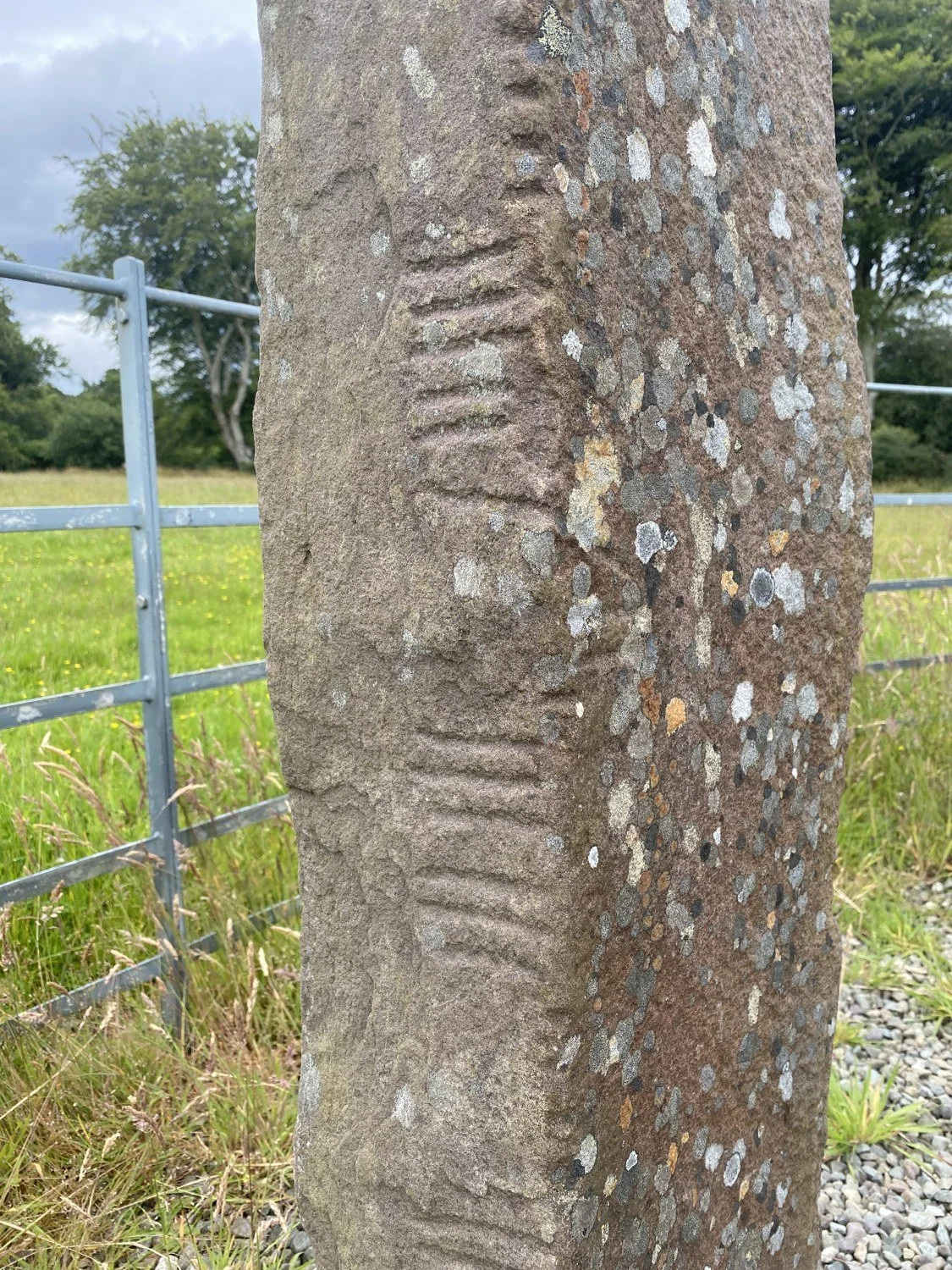
Historical example. The chart, in stone: an Ogham pillar at Dunloe, County Kerry. The letter-groups climb the corner of the rock — strokes across an edge, exactly as drawn above.
Ogham stone at Dunloe, County Kerry, Ireland. Photograph by HKath74. CC0.
In your packet: Assignment I — The Ogham Chart ⚒ begins here. Work it now, or mark the place and take it as homework — your choice.
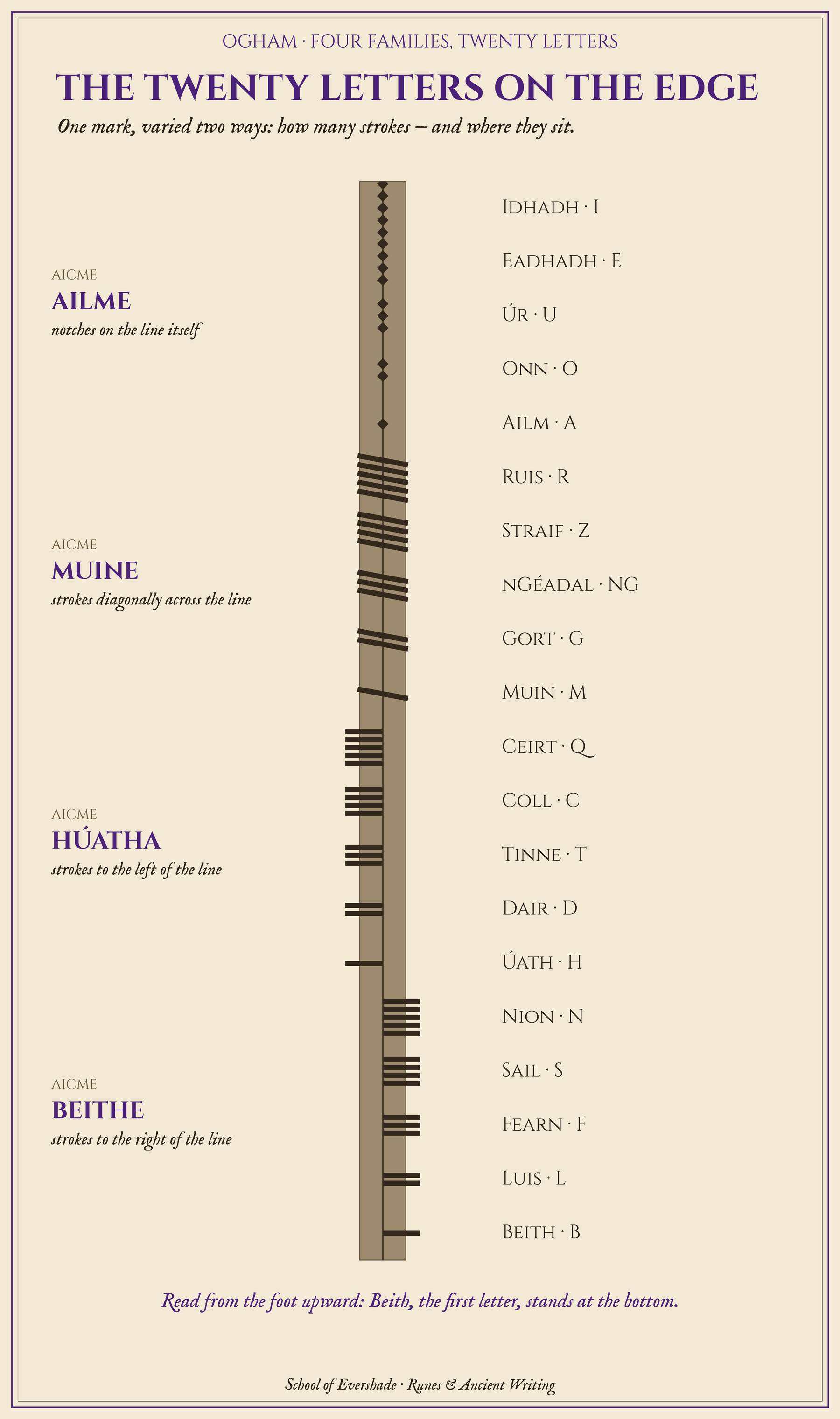
The twenty letters on the edge: four families of five. Count the strokes, mind which side of the line they sit on — that is the whole alphabet.
Built for Evershade.
Professor Webblethorn
Pause here, scholars, and look at what is not in the chart.
Every letter above is a straight line. Not one curve in the entire alphabet. The runes of the last three lessons were straight because the knife prefers straight cuts in wood grain. Ogham is straight for a different reason: it is written across a corner. Try to carve a curve across the edge of a stone with a chisel and you will learn quickly why no one did. The edge enforces the straight line the way the grain enforces it, but more strictly. The material is not just the page here. The material is the ruling.
Now count what the system leaves out. No curves. No enclosed shapes. No dots, no flourishes, no variation in stroke weight. Twenty letters from one mark, varied only in number and position. This is our course question answered with a stonecutter's severity: what can we leave out and still be understood? Ogham's answer is: everything but the count.
And yet nothing is lost. The vowels are all here. The consonants distinguish B from P's absence honestly (there is no P in the traditional twenty; the language barely needed it). The reader counts strokes the way a musician counts beats, and the stone sings the name up its own edge.
Hold the thread. Next lesson, the scholars will decide twenty letters are not enough, and the alphabet will grow again. But tonight, admire the twenty. They are the most economical alphabet we have met, and they never once leave the edge.
PROFESSOR THISTLELOOM WEBBLETHORN
Runes & Ancient Writing
Epigrapher, Head of House Septentrio
Reading Up the Edge
To read an Ogham stone, you do not stand back and take in a panel of text the way you would a Roman inscription (Lesson 9) or a runestone (Lessons 11 through 13). You walk up to the pillar, find the bottom of the left edge, and begin climbing with your eyes.
★ The text starts at the bottom left and runs upward along the arris. If it is long enough to continue, it turns at the top, crosses over, and comes down the right edge. Short texts, and most Ogham texts are short, occupy a single rising edge. The reading direction is therefore bottom-to-top, which feels backward to a modern reader and entirely natural once you have done it twice. The carver stood at the stone's foot and worked upward; the reader follows the carver's body, not the modern eye's habit.
★ What the texts say is the second surprise, after the direction. With very few exceptions, they say names. The standard formula is X MAQI Y: "X son of Y." Sometimes KOI ("here") is added, giving "X son of Y here," which is to say: here lies, or here is commemorated, or this stone marks the land of.
That is very often the entire inscription. One name, one father, one edge of stone.
This brevity has misled people into thinking Ogham was a poor or primitive script, as if the Irish could only manage names because they could only manage a little writing. The evidence points the other way.
★ The formula's dominance tells us what the stones were for: they were legal and memorial markers, announcing lineage and by extension the right to land, to burial, to remembrance.
A culture does not carve four hundred stones to practice its letters. It carves them because "son of" is the most important thing a stone can say. The script is economical because its job was economical: one lineage per pillar, cut where no one could miss it, along the edge that catches the light. Where Behistun (Lesson 3) gave us a king's autobiography carved across a cliff face, an Ogham stone gives us one line of lineage up one edge. Both are inscriptions; the difference is what each culture thought worth carving.
Some stones carry more. A few record tribal affiliation or office.
In Wales and Cornwall, a number of stones are bilingual: the same person's name in Ogham and in Latin, the Latin usually in Roman capitals (the script of Lesson 9) running horizontally while the Ogham climbs the edge. The bilingual stones are precious twice over: they let scholars check Ogham readings against Latin ones, and they show two writing cultures sharing a single monument without either surrendering its manner.
The Latin lies flat. The Ogham stands up. Neither apologizes.
Check in: You are standing at the foot of an Ogham pillar. Where do you start reading, which way do your eyes travel, and what do most of the inscriptions turn out to say?
❦ In your workbook: record reading up the edge in your own way — copy, sketch, or note what matters.
In your packet: Assignment II — Transliteration Practice ⚒ begins here. Work it now, or mark the place and take it as homework — your choice.
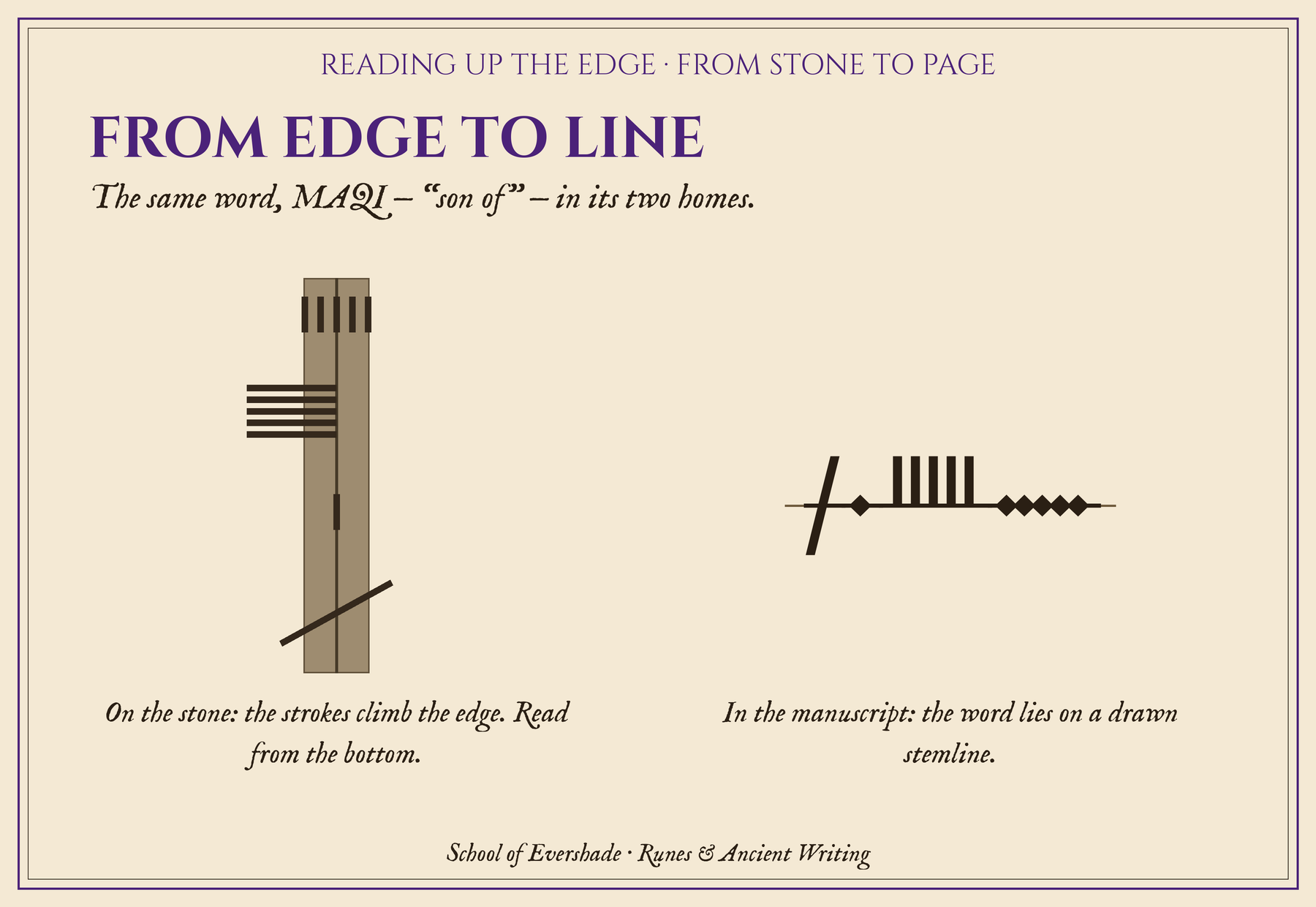
From edge to line: MAQI — “son of” — climbing the stone's corner, and lying on the manuscript's drawn stemline. The edge came first; the line is the scholars' drawing of it.
Built for Evershade.
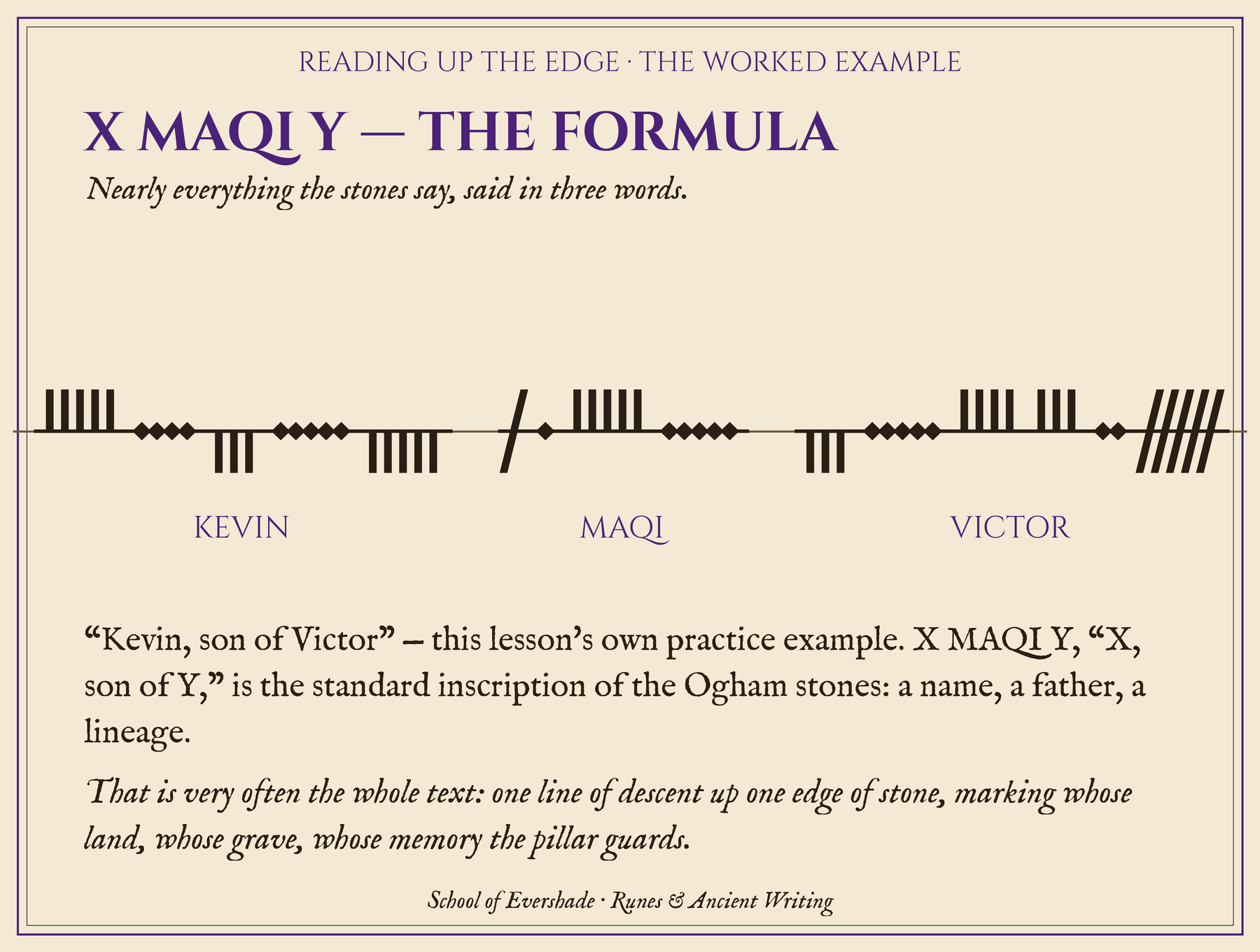
The formula worked whole: KEVIN MAQI VICTOR — “Kevin, son of Victor.” A name, a father, a lineage: nearly everything the stones say.
Built for Evershade.
In your packet: Assignment III — The Bilingual Stone ◐ begins here. Work it now, or mark the place and take it as homework — your choice.
The Tree Alphabet That Wasn't
Now we come to the misconception, and I want to name it plainly because it is everywhere: in popular books, on websites, on products, in the mouths of well-meaning enthusiasts. It is the claim that Ogham is the "Celtic tree alphabet," a druidic system in which every letter was originally named for a tree, encoding ancient nature wisdom in an arboreal code.
The truth is more interesting, and it has two parts.
The first part: the tree names are real, but they are medieval. They come from the learned tradition preserved in the Auraicept na n-Éces (the medieval Irish scholars' primer) and related manuscripts, compiled centuries after the stones were raised. Medieval Irish scholars, working in the 7th century and later, attached tree and plant names to the letters as a teaching system, aided by the Bríatharogaim (from bríatharogam, "word-ogam": a kenning, or riddling poetic phrase, attached to each letter in the medieval scholarly tradition and preserved in the Auraicept na n-Éces, with epithets such as "fairest of the flock" and "sustenance of cattle"; teaching tools and mnemonic devices, and one of the sources from which the later tree associations grew), the riddling kennings that made each letter memorable.
It was brilliant pedagogy. It was not the carvers' original design.
★ The second part: modern Celtic scholars (McManus above all, and the OG(H)AM project's researchers at Glasgow and Maynooth) have shown that only about eight of the twenty letter names are securely tree names at all. The rest were retrofitted.
Luis is not certainly rowan. Nin probably meant fork, not ash. Straif probably meant sulphur, not blackthorn. Tinne may have meant ingot.
The medieval scholars did what scholars do: they systematized, and in systematizing they smoothed over the rough originals with a beautiful, memorable, and partly invented scheme.
None of this diminishes the tree tradition. The Auraicept is a genuine medieval achievement, the Bríatharogaim are genuinely beautiful, and the tree associations have genuinely taught a thousand years of students.
But the stones came first, and the stones say names, not trees. When you see a product or a book present the tree alphabet as the original druidic system, you now know the correction: the trees were the scholars' gift to the letters, centuries after the carvers' gift of the letters themselves.
Say it kindly. The scholars were doing what we are doing now: trying to make twenty strokes memorable.
Check in: A popular book calls Ogham “the original druidic tree alphabet.” Using one letter whose name was probably not a tree at all, explain what is wrong with that claim.
❦ In your workbook: record the tree alphabet that wasn't in your own way — copy, sketch, or note what matters.
Who Invented the Strokes?
★ The medieval answer is a story, and it is a good one. The Auraicept na n-Éces credits the invention to Ogma, god of eloquence, son of Elatha, who created the script as a proof of his ingenuity. In the mythic telling, the alphabet is divine craft, and its name, Ogham, comes from its maker's name. It is the kind of origin a culture gives to something it is proud of and can no longer remember inventing.
The scholarly answer is a detective story, and it is also good. The alphabet's structure, four families of five with vowels set apart as the final family, looks like the work of someone trained in Latin grammar. The Roman grammarians organized their letters into categories (vowels, semivowels, mutes), and Ogham's designer seems to have known that tradition and built something new from its logic: not a copy of Latin letters, but a fresh system organized by a grammarian's mind.
★ The current consensus (summarized in Medieval Ireland: An Encyclopedia and supported by the Bodleian's Ogham materials) holds that Irish speakers, probably in the south of Ireland, invented the script around the 4th century CE, and that the inventor knew enough Latin grammatical thought to structure it.
Note what both accounts agree on, beneath the disagreement: somebody designed this. Ogham does not look like a script that grew by accident. Its arithmetic completeness, its vowel family, its edge-writing logic all suggest a single inventing intelligence, or a small school working to one plan, the way the Old Persian script of Lesson 3 suggested a royal design bureau.
Whether that designer was a god or a grammarian, the twenty strokes bear the mark of intention. The stones are the signature.
Scholars add one careful nuance worth knowing: phonological evidence suggests the alphabet itself may be older than the earliest surviving stones, with some (Carney, Harvey) proposing an origin as early as the 1st or 2nd century CE.
The stones begin in the 4th; the system may have been cut first in wood, which rots, leaving the stones as the survivors rather than the beginning. Remember Lesson 1: what survives is not always what was first.
❦ In your workbook: record who invented the strokes in your own way — copy, sketch, or note what matters.
Guided Practice — The Carver's Count
Before the assignments, train your eye the way an Ogham reader's eye was trained: to count, and to note position. Transliteration in this lesson means rendering Ogham strokes as Latin letters, and it is unusually straightforward: Ogham's one-to-one correspondence between sign and sound means that counting the strokes and noting their position relative to the stemline gives you the letter, so that five strokes across the line in the third aicme can only be Ruis, R.
Exercise A — Drawing the Twenty
- On paper, draw a long vertical stemline down the center of the page.
- To the right of the line, draw the five Beith-aicme letters: one stroke, two, three, four, five, slanting slightly. Label each with its name, character, and sound (ᚁ Beith B, and so on).
- To the left, draw the five hÚath-aicme letters the same way.
- Across the line, draw the five Muin-aicme letters as diagonal crossings.
- On the line itself, draw the five Ailm-aicme notches: short strokes centered on the stemline.
- Step back and count: four families, five children each, twenty letters from one mark. Write one sentence on what the system's completeness feels like in your own hand.
Exercise B — Reading Up the Edge
- Find the straight edge of a book, a box, or a table. This is your stemline.
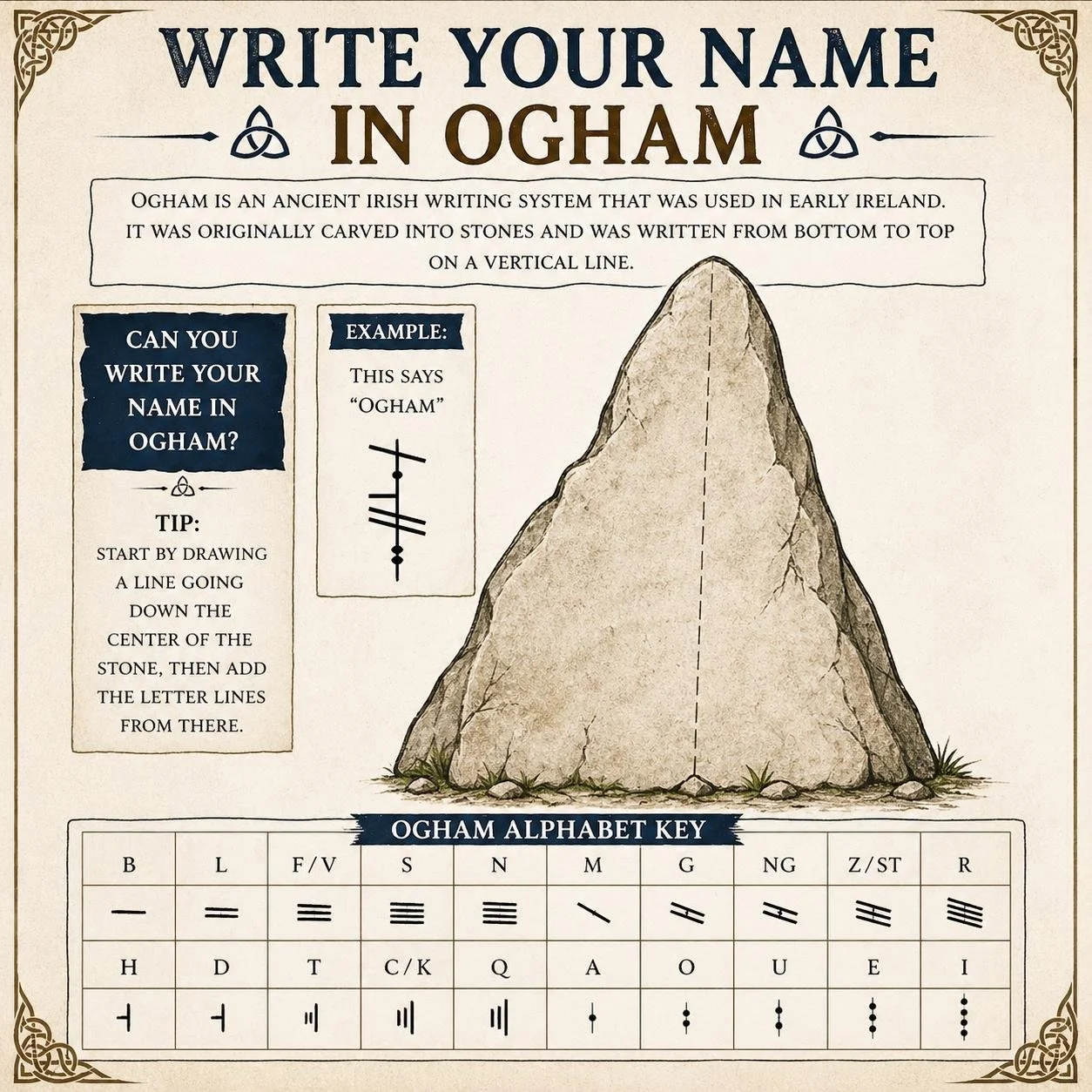
- With a pencil on paper held against the edge (or with your finger tracing in the air along it), "carve" your first name in Ogham, starting at the bottom and working up. Use the chart above for your letters.
- Now read it back, bottom to top, counting strokes and noting positions aloud: "two right, that's Luis, L; three notches, that's Úr, U..."
- Write two to three sentences on what the exercise taught you: did counting feel like reading? At what point did the strokes become letters?
Exercise C — The MAQI Formula
- Write the formula X MAQI Y using your own name and a parent's or ancestor's name, transliterated into Ogham characters (e.g., KEVIN MAQI VICTOR becomes ᚊᚓᚃᚔᚅ ᚋᚐᚊᚔ ᚃᚔᚉᚈᚑᚏ, reading bottom to top).
- Note which of your letters required the Ceirt (Q): does your name contain a sound the traditional twenty handle awkwardly? The old Irish had little use for P; what does your language ask of the alphabet that theirs did not?
- In two to three sentences, reflect on the formula's economy: one name, one father, one edge. What does it claim, and what does it leave unsaid?
In your packet: Assignment IV — The Tree Alphabet Essay ✎ begins here. Work it now, or mark the place and take it as homework — your choice.
Assignment Manual
Assignment key: ✎ written work · ⚒ hands-on practical · ◐ both · ★ will be on the test · ❦ workbook path
Written answers in this manual are short answers in your own words — a few honest lines, not a filled page.
Assignment I — The Ogham Chart ⚒ ★
Objective: Demonstrate control of all twenty traditional letters: their forms, families, sounds, and honestly hedged associations.
Instructions:
- On a fresh sheet, draw a vertical stemline. Around it, construct the full twenty-letter chart in the four aicmí, drawing each letter's strokes in correct number and position.
- Label every letter with its Ogham character, name, and sound value.
- Beside each name, write its tree or plant association exactly as hedged in the lesson ("in the later tradition," "uncertain," "likely meant X originally"). Do not present any uncertain association as certain: the hedging is part of the assignment.
- Below the chart, write one paragraph on the system's design: what does the four-by-five structure suggest about whether Ogham was invented or evolved?
Your keepsake: this chart is your reader's key to every Ogham stone. Keep it beside your futhorc chart; the Professor's Review will ask you to lay the sprawling thirty-three and the climbing twenty side by side.
To submit: Photograph or scan your chart. Accuracy of stroke count and position matters more than artistic skill.
Assignment II — Transliteration Practice ⚒ ★
Objective: Read Ogham the way its readers did: by counting strokes and noting position.
Part A. Transliterate the following Ogham sequences into Latin letters (read bottom to top; the sequences are given in reading order): ᚋᚐᚊᚔ, ᚇᚐᚔᚏ, ᚄᚐᚔᚂ. Then state the aicme and stroke count of each letter.
Part B. Write your full name in Ogham characters, arranged vertically as if along a stone edge, reading bottom to top. Mark the stemline. If your name contains sounds the traditional twenty lack (such as P, or the English th), note each gap and how you handled it.
Part C. The formula X MAQI Y KOI extends the standard inscription with "here." Compose a complete memorial inscription for a fictional person of early Ireland, in Ogham characters, and write two to three sentences on the choices you made: whose name, whose father, and what the stone claims by standing.
Assignment III — The Bilingual Stone ◐ ★
Objective: Understand Ogham through the monuments where two scripts share one stone.
Instructions:
- Research (using the References below, especially the OG(H)AM database): one bilingual Ogham-Latin inscribed stone from Wales. Record the stone's location, its Ogham text (transliterated), and its Latin text.
- Note how the two scripts divide the stone: where does the Ogham run, and where does the Latin lie? Write a half page on what the layout reveals about the relationship between the two writing cultures.
- The lesson claims the formula's dominance shows what the stones were for. Choose the single strongest detail from your chosen stone and write a half page defending or challenging that claim: does your stone confirm that Ogham was for lineage, or does it complicate the picture?
Assignment IV — The Tree Alphabet Essay ✎ ★
Objective: Practice the misconception correction this lesson is built around.
Instructions:
Write a one-page essay addressing the following:
Popular sources routinely call Ogham the "Celtic tree alphabet," presenting it as an original druidic system in which every letter was named for a tree. Using at least four specific letters from the lesson, explain what the scholarship actually shows: which tree names are secure, which are medieval additions, and what the original meanings may have been. Then consider the larger question: does the correction diminish Ogham? Argue for or against the proposition that the medieval tree tradition, even as a later scholarly invention, is itself a genuine part of the script's history worth honoring.
Cite the lessons where your details come from.
Materials
Required (Level One — household items)
- Paper: plain white paper or a sketchbook, for the Ogham chart and transliteration work.
- Pens: one standard pen for drafting, one fine-tipped marker for final letterforms. Ogham's straight strokes reward a ruler more than a flexible nib.
- A ruler or straight edge: essential, not optional. Every Ogham letter is a straight line; the ruler is the lesson's most important tool.
- A book or box with a straight edge: for Exercise B, your practice stemline. The edge of a hardcover book stood upright makes an excellent pillar.
Suggested (Level Two — historically closer materials)
- A wooden stick, branch, or lath: literary sources describe Ogham cut on wood, and wood was likely the script's first home before stone. A straight hazel or ash stick is the historically resonant writing surface.
- A sharp pocketknife or carving knife: the historical tool. Cut strokes across the stick's length the way the stone carvers cut across the pillar's edge. Use only with proper supervision and safety precautions; the Evershade Safety Scroll on the classroom homepage applies.
- A flat stone or slate tile: the monumental experience at small scale. An unglazed tile stood on edge gives the true arris to carve along.
- A candle or lamp for raking light: run a light source low across your practice edge and watch the strokes throw shadows. This is how Ogham is photographed in the field, and how its readers in low Irish sunlight would have read it.
Neither level requires
Purchased kits, specialty tools, or any material you cannot find locally or order inexpensively. The core lesson (drawing the twenty letters, understanding the aicme system, reading up the edge) is fully achievable with paper, pen, and a ruler.
Reflection Questions
Answer the following in your workbook.
- Name the four aicmí and describe each one's stroke position relative to the stemline. Which aicme holds the vowels?
- State the MAQI formula and explain what the dominance of this formula reveals about the purpose of Ogham stones.
- Explain the "Celtic tree alphabet" misconception and the correction: which tree names are secure, which are medieval additions, and what is the evidence?
- Describe how an Ogham inscription is read: where does the text start, which way does it run, and what happens at the top?
- Give the two accounts of Ogham's invention (Ogma and the grammarian) and explain what evidence supports the scholarly account.
- The traditional twenty contain no P. What does this omission suggest about the language the script was designed for?
- Apply the course question: what did Ogham leave out, and what did those omissions buy the carver and the reader?
Workbook Checklist — Lesson 14
In my workbook I have:
- ☐ named the four aicmí and described each one's stroke position relative to the stemline
- ☐ drawn all twenty letters with names, sounds, and honestly hedged associations
- ☐ explained how Ogham is read: from the bottom of the left edge, upward, and over the top
- ☐ stated the MAQI formula and what its dominance reveals about the stones' purpose
- ☐ corrected the “Celtic tree alphabet” claim, naming which tree names are secure and which are medieval additions
- ☐ given both accounts of Ogham's invention (Ogma; the Latin-trained inventor) and the evidence for the scholarly one
☐ Lesson completed Date: ____________ Signature: ____________
Professor's Review
And so our fourteenth lesson closes in Ireland, where twenty letters learned to climb the edge of a stone.
You can now describe the four aicmí with their stroke positions and counts, write all twenty traditional letters with their names, sounds, and honestly hedged associations, explain bottom-to-top edge reading and why the stemline is usually the stone's own arris, state the MAQI formula and what it reveals about the stones' purpose, correct the "Celtic tree alphabet" misconception with specific letters and scholars, give both accounts of the script's invention and the evidence for each, and apply the course question to the most economical alphabet we have met.
Keep your Ogham chart beside your futhorc chart from last lesson. Lay them side by side: thirty-three runes sprawling across wood and parchment, twenty strokes climbing a single edge. The Anglo-Saxons trusted the knife and added until every sound had a sign. The Irish trusted the count and left out everything but the stroke. Both were understood. The web holds both answers, and the spider admires them equally.
Next, the scholars take up the twenty and decide they are not enough: the forfeda, the five additional letters, and the great shift from stone edge to manuscript page. The alphabet is about to leave the field and enter the library, and the stemline will learn to lie down.
Practice your twenty, scholars. Draw them with the ruler until the counts come without thinking: one-two-three-four-five on the right, on the left, across, on the line. I have watched readers stumble over great monumental scripts and then read an Ogham pillar at a glance, because counting is older than reading and the body remembers it. The edge is waiting. Climb it.
PROFESSOR THISTLELOOM WEBBLETHORN
Runes & Ancient Writing
Epigrapher, Head of House Septentrio
Cross-Class Connections
The bilingual Ogham-Latin stones connect directly with Scrollwork, where Professor Nocturne teaches the Roman capitals that share those monuments. Students studying both classes should compare the two scripts on a single stone: the Latin lying flat in monumental capitals, the Ogham climbing the edge in strokes, each refusing the other's manner.
The MAQI formula's memorial function connects with Herbology's remembrance traditions: stones that say "son of" are doing the same work as planted memorials, marking lineage in a living landscape. Professor Fernfoot's students may consider what it means to commemorate with a stone versus a garden.
The Bríatharogaim as mnemonic teaching devices will reappear in Runes Unit V, when we study how medieval scholars preserved and transmitted writing systems. The monks who kept the word-ogams were doing the same work as the rune-book compilers of Lesson 13: collecting, ordering, and keeping.
In Other Classrooms
Scrollwork · Unit IV, Lesson 14 — Roman Capitals
On your Ogham stones the Latin lies flat and monumental while the Ogham climbs the edge. The flat half is mine to teach. In the Library we draw and cut the Roman capitals, the inscriptional hand of those same monuments. Come and write the other script on the stone, and see how differently the two refuse each other's manners.
The edge holds, and so do we.
References & Further Reading
OG(H)AM: 3D Ogham Stones Project (University of Glasgow / Maynooth University). The authoritative digital corpus of Ogham inscriptions: 3D models, readings, and scholarly commentary. https://ogham.glasgow.ac.uk
Bodleian Libraries, Oxford. "Ancient Scripts: Ogham." Introduction to the script's history, structure, and manuscript tradition. https://www.bodleian.ox.ac.uk
Wikipedia. "Ogham." Comprehensive overview: the twenty letters, the aicmí, forfeda, and scholarly debates. Cross-checked against the institutional sources above. https://en.wikipedia.org/wiki/Ogham
Wikipedia. "Auraicept na n-Éces." The Scholars' Primer: contents, date, and its account of Ogham's origins. https://en.wikipedia.org/wiki/Auraicept_na_n-%C3%89ces
Wikipedia. "Ogham inscription." The corpus: formula types, the MAQI standard, bilingual stones, and distribution. https://en.wikipedia.org/wiki/Ogham_inscription
Browse the Runes shelf in the school Library for readable editions of these works.
The Bench draws Ogham as it was cut: strokes upon a stemline, read upward from the bottom. This lesson's letters, made visible.
Open the BenchPROFESSOR THISTLELOOM WEBBLETHORN · RUNES CLASSROOM
Submit your work for this lesson using the form below.
CONTINUE IN RUNES & ANCIENT WRITING
← Previous · Lesson 13: Futhorc: How the Runes Grew in England Next · Lesson 15: Ogham: The Forfeda & the Manuscript Shift →
Unit IV · The Northern Staves Runes & Ancient Writing Classroom · All 21 Lessons
The rest of Unit IV: Lesson 11 · Elder Futhark · Lesson 12 · Younger Futhark · Lesson 13 · Futhorc · Lesson 15 · Ogham: The Forfeda & the Manuscript Shift
From the Runes Shelf
The printed companions to this lesson, from Professor Webblethorn’s shelf in the shop.