RUNES & ANCIENT WRITING
Unit V · Lesson 16THE DANUBE HYBRID
The Gothic Alphabet: A Hybrid Script for the Goths
Professor Thistleloom Webblethorn
Epigrapher • Runes & Ancient Writing
Head of House Septentrio • School of Evershade
Professor's Introduction

South we go, scholars. Tonight we leave the northern forests behind and travel south to the Danube, where a bishop built an alphabet the way a shipwright builds a vessel: out of whatever sound timbers the river brought him.
When the alphabet traveled north and became the runes, it went as a borrower, taking its letter-shapes from the older Mediterranean world.
Tonight the story comes full circle, and I want you to feel the shape of that circle. In Lesson 11, I told you that two letters of the Gothic alphabet may have been derived from runes, the borrowing running in reverse. The north had taken the alphabet from the Mediterranean world; now the Mediterranean world, or at least one bishop on its frontier, reached back north and borrowed from the runes. Keep that thread in your hand tonight. It is about to cross itself.
Come closer to the web, scholars. A bishop is about to build an alphabet out of three traditions, and he will do it for the most practical reason anyone has ever had: his people had a book to read and no letters to read it in.
PROFESSOR THISTLELOOM WEBBLETHORN
Runes & Ancient Writing
Epigrapher, Head of House Septentrio
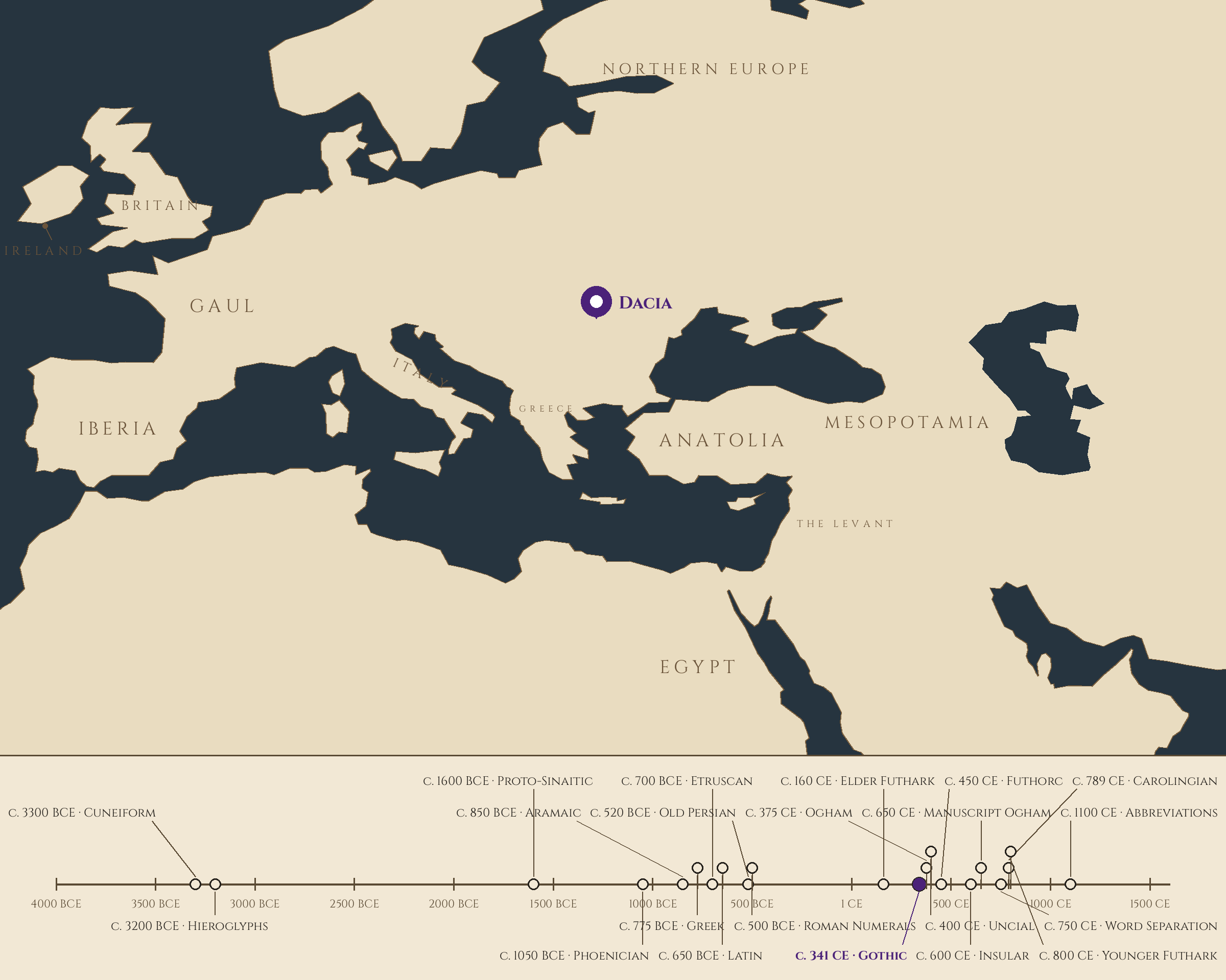
Where and when: the Danube frontier, in the 4th century CE. The pin is this lesson. The line beneath the map is our road: every stop a writing system, every lesson a pin.
Lesson Objectives
By the end of this lesson, students should be able to:
- Define Gothic alphabet, Ulfilas, Goths, hybrid script, Codex Argenteus, alphabetical numerals, and overline.
- Explain who Ulfilas was, when and where he worked, and why he created the alphabet.
- Describe the 27 Gothic letters in order, with their names, sounds, and number values, and identify the two numeral-only signs.
- Explain the hybrid construction: the Greek base, the Latin contributions, and the debated runic influence, including the two letters most often linked to runes.
- Explain why the letter names must be treated as reconstructed, and where they survive.
- Describe the Codex Argenteus: its material, date, contents, and present home.
- Read and write Gothic alphabetical numerals, including the dot and overline marking conventions.
- Correct the misconception that the "Gothic" of blackletter typography has anything to do with the Gothic alphabet.
- Apply the course question in a new form: what must be borrowed to be understood?
Reading this lesson: ★ marks the passages to remember. They return on the unit quiz and the class test. Check in questions ask the material back as you go; answer them in your workbook when you meet them.
Working this lesson: Your assignment packet is the first download on this page. Work in it as the lesson moves along, answering each assignment as its subject is taught — or read the lesson through for your notes and take the assignments as homework afterward. Both are proper ways to sit this class. Signposts in the reading tell you where each assignment belongs. Written answers are short answers in your own words; a few honest lines are worth more than a filled page.
Your Assignment Packet
This lesson's assignments live in its packet: the Lexicon Handout (every term, course terms marked ◆), Materials, Guided Practice, the Assignment Manual with its answer key for self-checking, the Reflection Questions, and the Workbook Checklist. Download the packet before you begin and keep it beside you as you read.
The Bishop of the Danube
Every alphabet in our story so far was inherited, adapted, or stumbled into. The Gothic alphabet is the first one that was designed, on purpose, by a named person, for a stated reason. That person was a bishop. That reason was a book.
His name was Ulfilas, also given as Wulfila, a name often interpreted as "Little Wolf." I hedge the translation because the Gothic form itself is not directly attested; it is reconstructed, and "Little Wolf" is the standard etymology rather than a documented fact. What is documented is the man: a bishop to the Goths (an East Germanic people, later divided into Visigoths and Ostrogoths, whose language is the earliest Germanic language preserved in extended texts), consecrated around 341 CE, who died in 382 or 383. He was of Cappadocian Greek descent, which meant he moved between worlds: he knew Greek and Latin, the languages of the empire, and Gothic, the language of the people north of the Danube frontier in the region called Dacia, the land the Goths themselves called Gutthiuda.
The Goths had no written tradition of their own sufficient to the task he set himself. There were runic inscriptions among the East Germanic peoples — short carved texts in runes, the northern letters of Lessons 11 to 13 — a few, scattered, but nothing like a literary script, and nothing suited to the project at hand: translating the Bible into Gothic.
So Ulfilas did what no one in our story had done before. He built an alphabet.
I say "traditionally credited" with care, because the scholarship does. The alphabet is attributed to Ulfilas by the historians Philostorgius, Socrates of Constantinople, and Sozomen, and the attribution has held.
★ But the Bible translation itself was plainly the work of a team, and some scholars argue the alphabet's design shows more than one hand as well. The lesson to take is not that a lone genius invented writing in a tent. It is that for the first time, alphabet-making was a deliberate project, undertaken for a deliberate purpose, by people whose names we know.
Consider what that purpose demanded. Ulfilas was not adapting a script for traders who already wrote, the way the Greeks adapted Phoenician. He was giving writing to a people who did not have it, so that they could read a sacred text in their own tongue. Nothing could be left out, because nothing existed yet.
Our course question, "what can we leave out and still be understood," meets its limit here: when your readers have no alphabet at all, the answer is nothing. You must build the whole thing. And Ulfilas built it the way a practical man builds: out of materials at hand.
❦ In your workbook: record Ulfilas and the designed alphabet in your own way — copy, sketch, or note what matters.
Twenty-Seven Letters
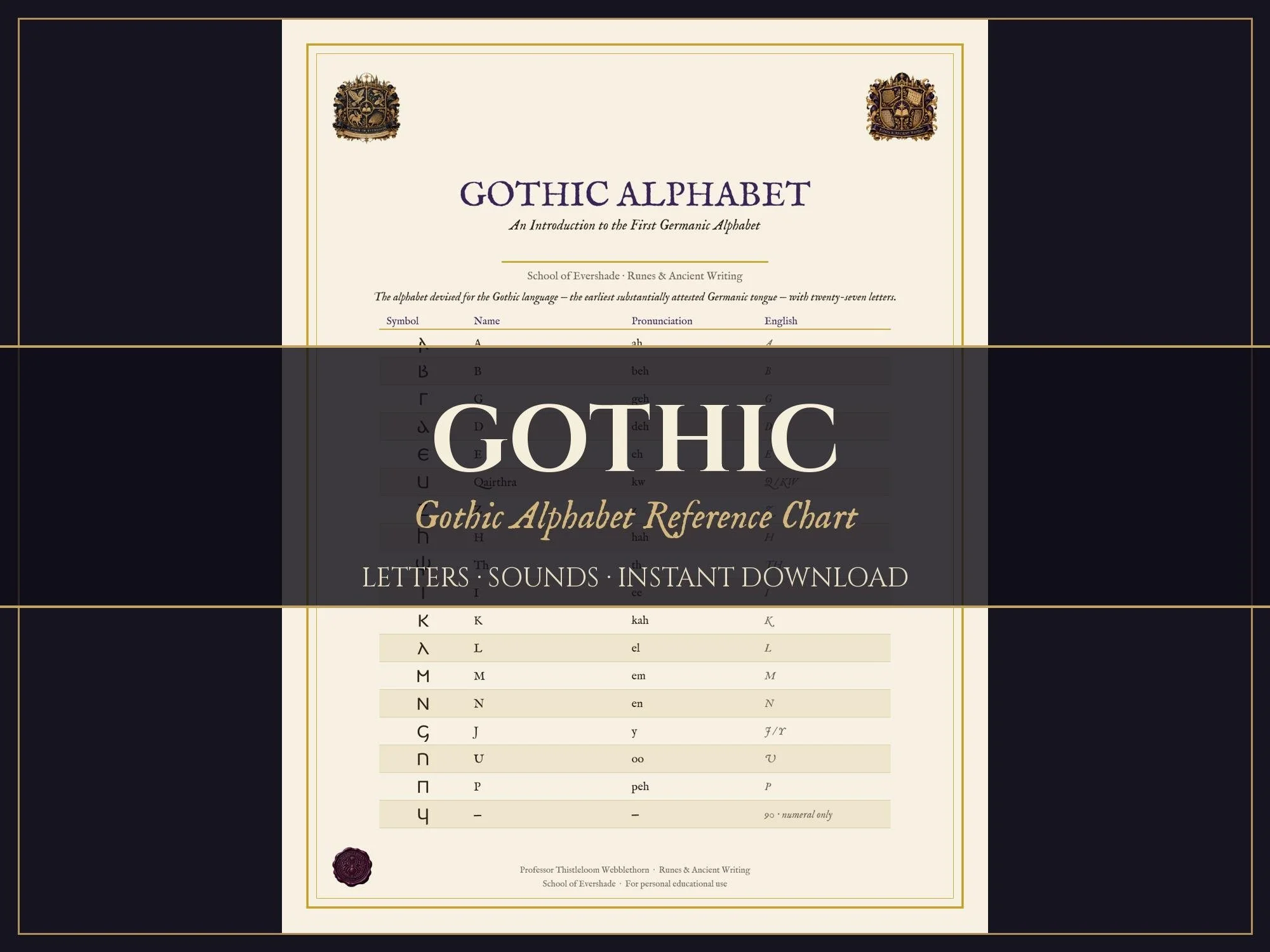
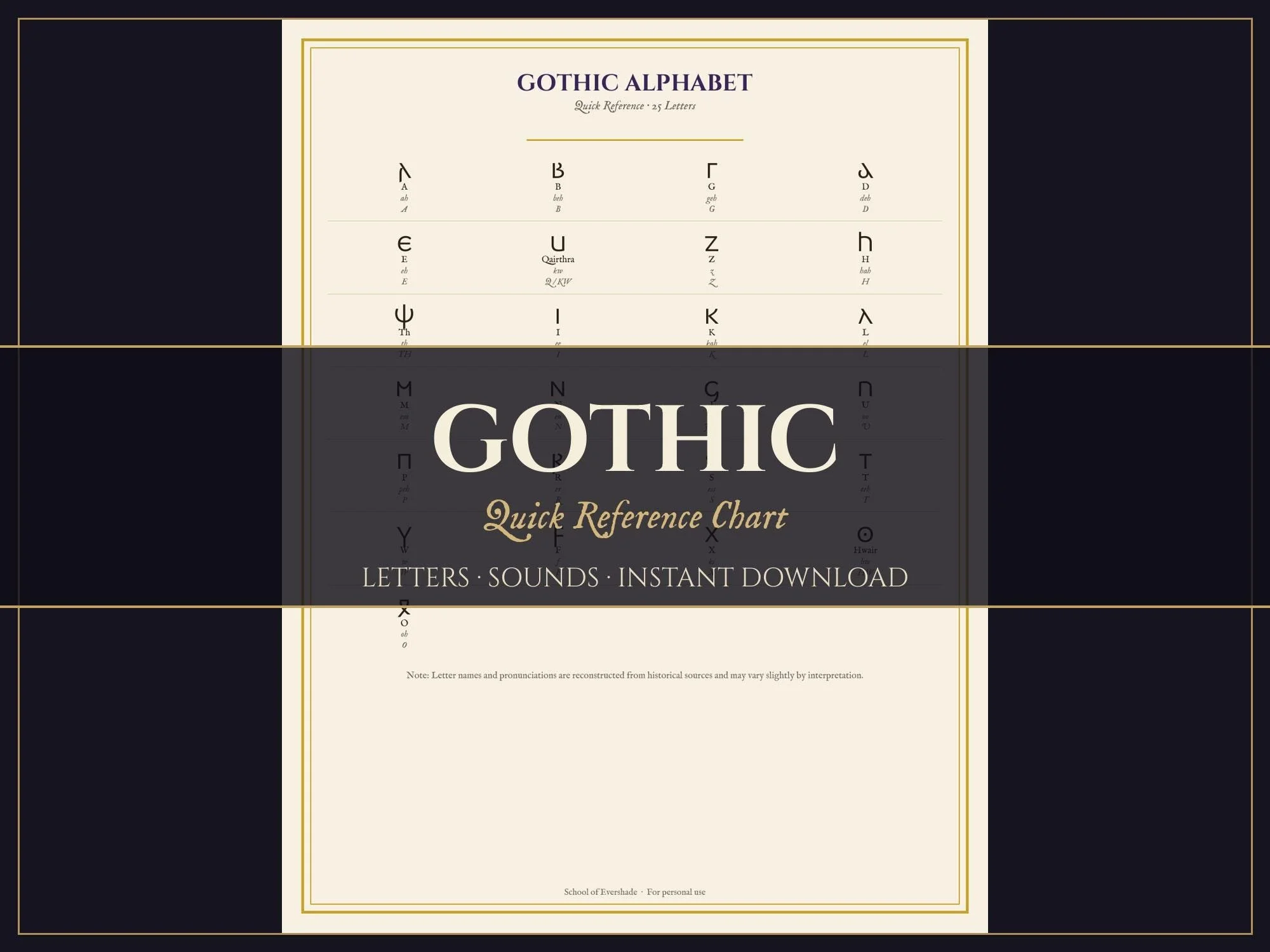
Here is the Gothic alphabet in full: twenty-seven letters in order, each with its shape, its reconstructed name, its sound value, and its number value. Read it as an engineered object. The order and the number values follow the Greek alphabet exactly, which is the clearest proof of the design's main source.
Two cautions before you read. First, the letter names come from the Codex Vindobonensis 795, a 9th-century manuscript, in corrupt form, five centuries after the alphabet was made.
Scholars have reconstructed the Gothic forms, and most follow the acrophonic principle, the name beginning with the letter's own sound, which suggests the reconstructions capture something real. But treat them as a learning framework, not as a perfectly preserved ancient chart. Second, where a name's meaning is uncertain, I say so. An honest gap is better than an invented certainty, and this alphabet has several.
𐌰 Aza (a): 1. "God" or "ash"; the meaning is uncertain. The first letter, and the name already shows the reconstruction problem: two plausible Gothic words, no way to be sure which one Ulfilas's circle used.
𐌱 Bairkan (b): 2. "Birch." From the same root as the rune name berkanan. The tree names run through this alphabet like a forest path.
𐌲 Giba (g): 3. "Gift." From the same root as gebo, the rune of generosity. Some gifts travel farther than others.
𐌳 Dags (d): 4. "Day." From the same root as dagaz. Dawn in every Germanic tongue.
𐌴 Aihvus (e): 5. "Horse" or "yew"; uncertain. The reconstruction wavers between two good Germanic words, and the scholars have not settled it.
𐌵 Qairthra (q): 6. "Millstone"? Uncertain, and the question mark is the scholarship's, not mine. This letter has no clean Greek parent; its origin is one of the alphabet's open puzzles.
𐌶 Iuja (z): 7. Meaning uncertain. A letter with a name we cannot confidently gloss: the framework creaks here, and I would rather show you the creak than hide it.
𐌷 Hagl (h): 8. "Hail." From the same root as haglaz. Cold grain, unchanged.
𐌸 Thiuth (þ, th): 9. "Good"? Uncertain. The reconstructed Gothic name þiuþ may mean "good," but one strand of scholarship suggests the original name was þaurnus, "thorn," matching the rune. The thorn hypothesis is elegant; it is also unproven. Hold both.
𐌹 Eis (i): 10. "Ice." From the same root as isaz. The ice has not melted.
𐌺 Kusma (k): 20. "Pine sap"? Uncertain. Another wobble in the reconstruction.
𐌻 Lagus (l): 30. "Sea, lake." From the same root as laguz. The water still runs.
𐌼 Manna (m): 40. "Man, human." Plain and certain.
𐌽 Nauths (n): 50. "Need." From the same root as naudiz. The hard sense kept hard.
𐌾 Jer (j): 60. "Year, harvest." From the same root as jeran. The turning year.
𐌿 Urus (u): 70. "Aurochs." From the same root as uruz. Remember this letter. We will come back to it.
𐍀 Pairthra (p): 80. Meaning uncertain. Like qairthra above, the name resists confident reconstruction.
𐍁 (no sound value): 90. The first of the two numeral-only letters, filling the slot where Greek used koppa. It has no name and no sound; it exists only to count.
𐍂 Raida (r): 100. "Wagon, ride." From the same root as raido. The road continues.
𐍃 Sauil (s): 200. "Sun." From the same root as sowilo. Bright as ever.
𐍄 Teiws (t): 300. "The god Tyr." From the same root as tiwaz. The god of single combat, still glorious.
𐍅 Winja (w): 400. "Field, pasture" or "pain"; uncertain. The reconstruction offers two meanings, and the honest presentation offers both.
𐍆 Faihu (f): 500. "Wealth, chattel." From the same root as fehu. Movable wealth, first in the row and nearly last in the values.
𐍇 Iggws (x): 600. "The god Yngvi"? Uncertain. Note the usage restriction, which is secure even where the name is not: this letter appears only in proper names and loanwords containing Greek chi, such as xristus, "Christ." It is a specialist, not a workhorse.
𐍈 Hwair (ƕ, hw): 700. "Kettle." A sound Greek had no letter for and Latin had no letter for: the voiceless hw. Ulfilas needed it, so he made it. This is the alphabet's most original invention, a letter for a Germanic sound with no Mediterranean precedent.
𐍉 Othal (o): 800. "Ancestral land." From the same root as othala. Remember this letter too.
𐍊 (no sound value): 900. The second numeral-only letter, filling the slot where Greek used sampi. Like its partner 𐍁, it counts but never sounds. It is not even attested in the Gothic Bible itself, appearing only in the later Salzburg-Vienna manuscript tradition.
★ Twenty-five letters that speak, two that only count. Notice what the names tell you even through the reconstruction haze: birch, gift, day, hail, ice, sea, man, need, harvest, sun, wealth, land. The same Germanic word-hoard that named the runes named these letters.
Ulfilas built a Greek machine and gave it Germanic names, and the names are the clearest evidence that the alphabet was made for the Goths, not merely from the Greeks.
Check in: Of the twenty-seven letters, how many actually speak — and what do the other two do instead? Where do their number slots come from?
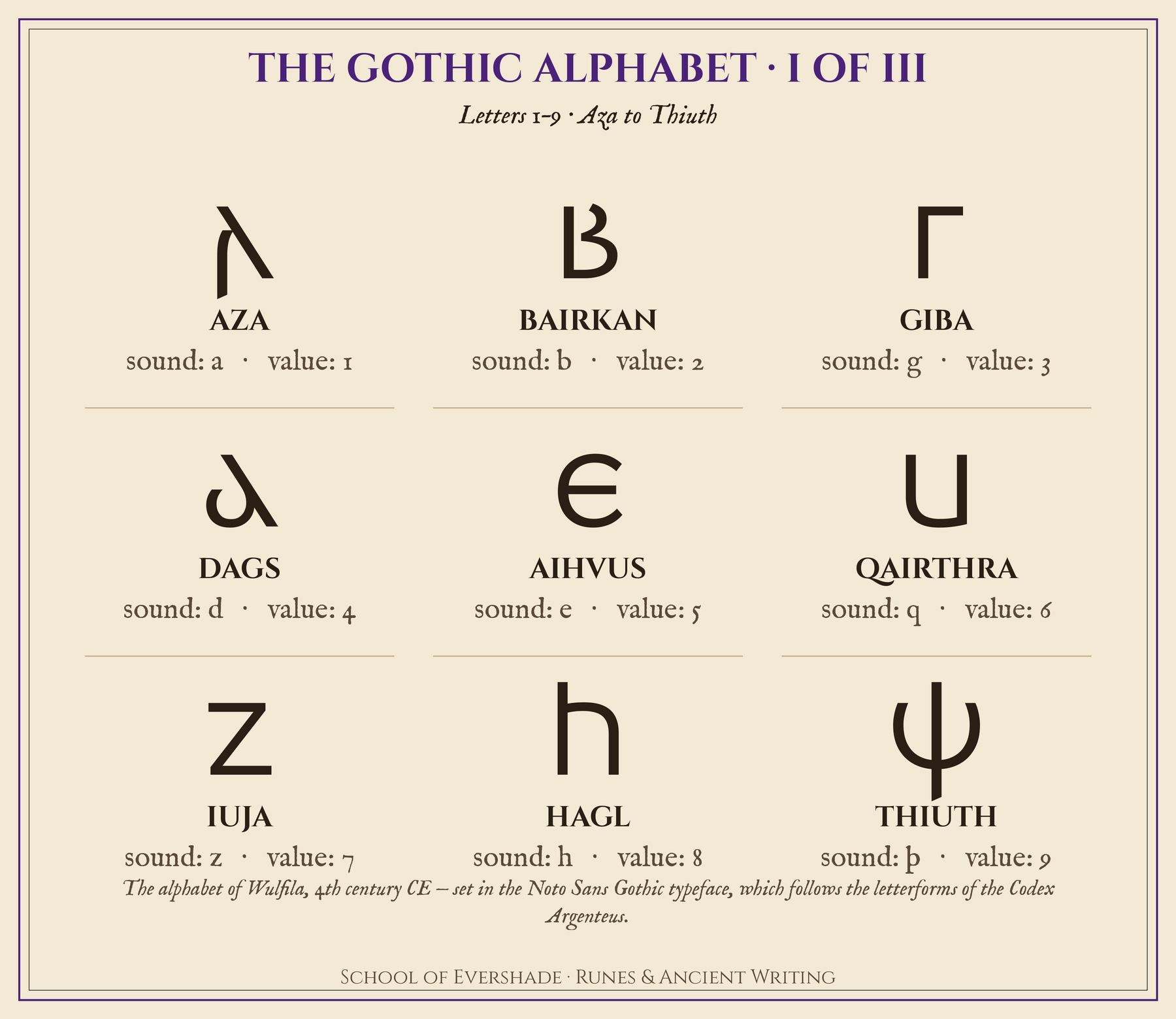
The Gothic alphabet, letters 1–9: Aza to Thiuth. Every letter with its reconstructed name, its sound, and its number value — the alphabet read as an engineered object.
Built for Evershade.
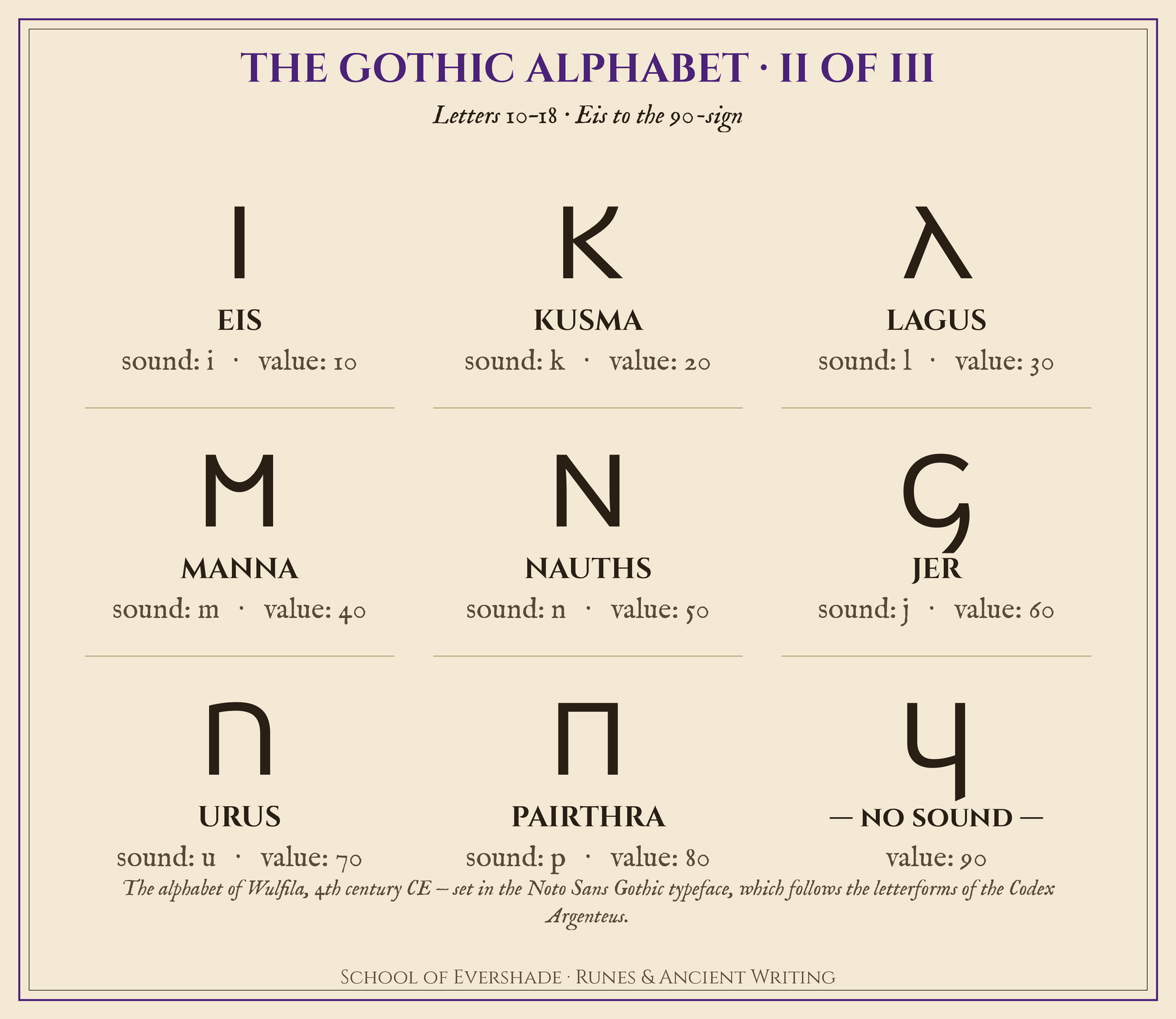
Letters 10–18: Eis to the sign for 90, the first of the two letters that count but never speak.
Built for Evershade.
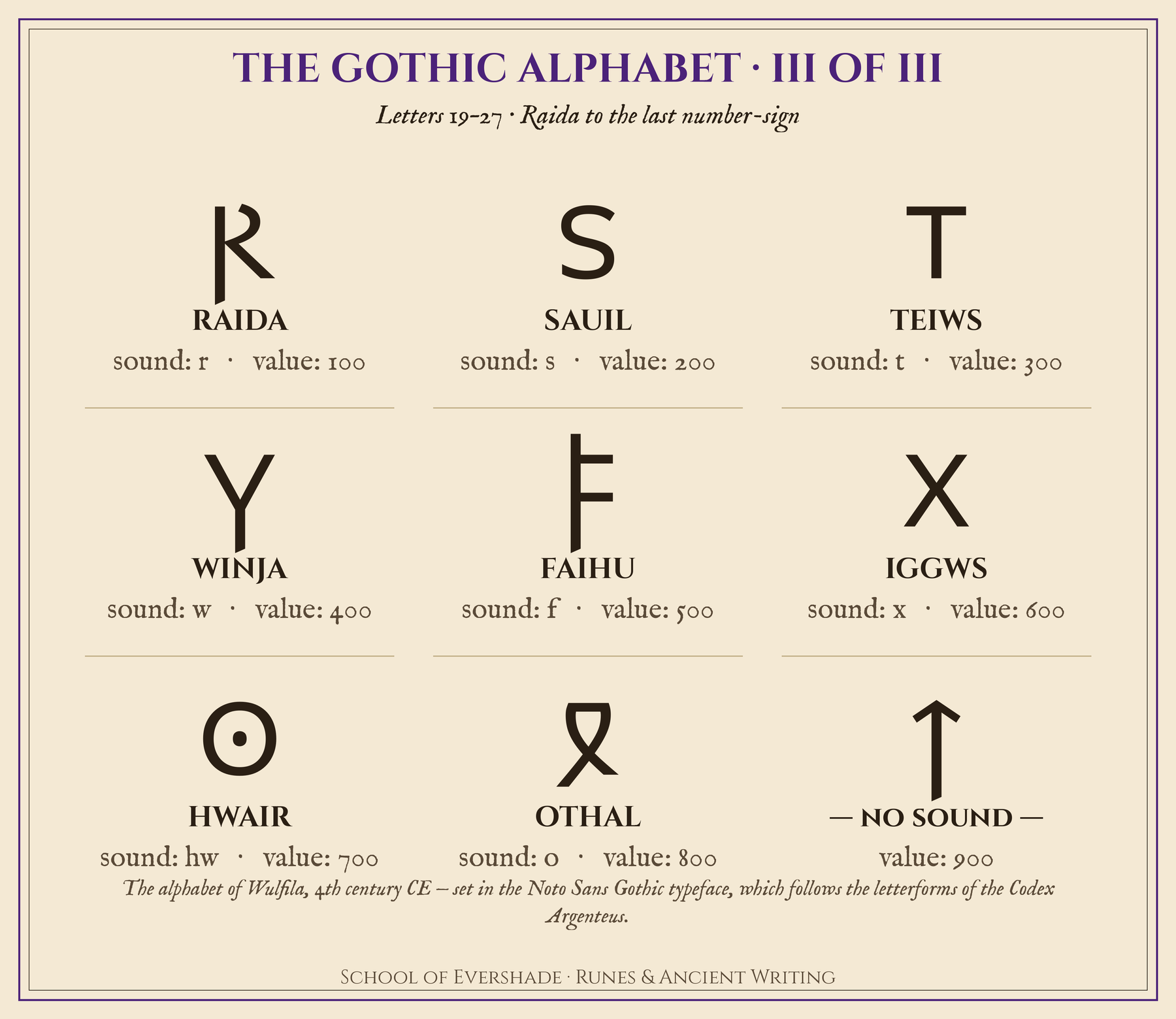
Letters 19–27: Raida to the sign for 900. Twenty-five letters that speak, two that only count.
Built for Evershade.
❦ In your workbook: record the twenty-seven Gothic letters in your own way — copy, sketch, or note what matters.
In your packet: Assignment II — Transliteration Practice ⚒ begins here. Work it now, or mark the place and take it as homework — your choice.
The Borrower's Toolkit
Now the question this lesson exists to answer: where did the pieces come from? The answer makes the Gothic alphabet a hybrid script — a writing system deliberately assembled from more than one source tradition.
★ The foundation is Greek, nearly one to one. Most Gothic letters correspond to Greek letters in form, in sound, and in number value, and the alphabetical order runs 𐌰 to 𐍉 the way the Greek runs alpha to omega. This is not resemblance; it is derivation.
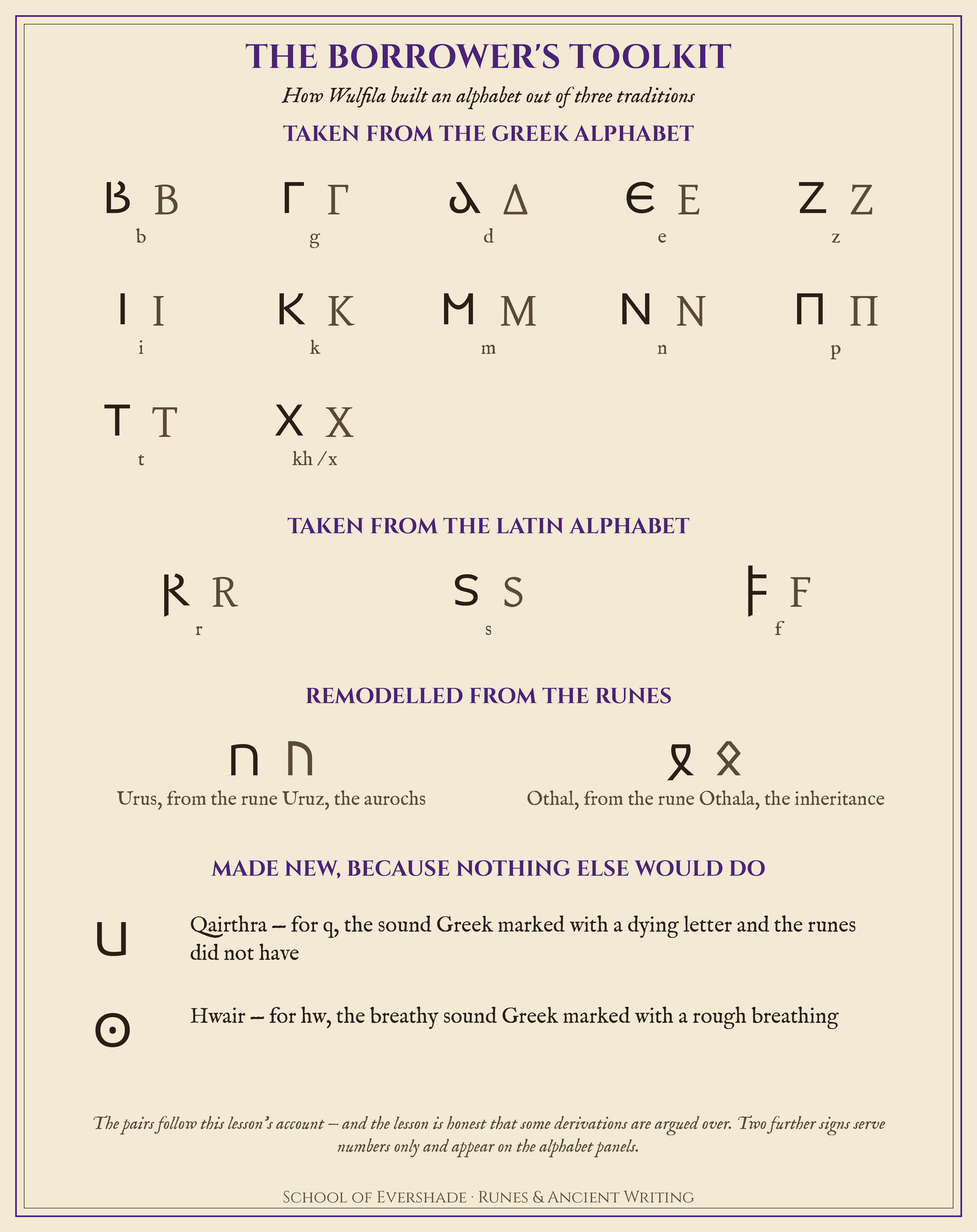
The borrower's toolkit: the Greek parents, the runes remodelled, and the letters made new — Qairthra, and Hwair for the voiceless hw no Mediterranean alphabet could write.
Built for Evershade.
Ulfilas knew Greek, the Goths lived on the edge of the Greek-speaking world, and the Greek alphabet was the obvious quarry. The number values clinch it: the Gothic letters count in the Greek order, 1 through 9, 10 through 80, 100 through 800, with the two numeral-only letters sitting exactly where Greek put koppa (90) and sampi (900). You do not get that by coincidence.
The Latin contributions are smaller but real. Three letters, 𐍂 (r), 𐍃 (s), and 𐍆 (f), appear to derive from their Latin equivalents rather than from Greek forms. Some Gothic variants of 𐍃 look like sigma and derive from Greek plainly; the standard forms look Latin. The scholarship treats this as derivation with a hedge, and so do I.
★ Then the runes. This is the delicate part, and I will give it to you exactly as the scholarship gives it: disputed, interesting, and unresolved.
Several Gothic letters have uncertain or disputed origins, and runic derivation has been proposed for some of them. The two most often named are 𐌿 (urus), whose form may derive from the rune ᚢ (uruz), and 𐍉 (othal), whose form may derive from the rune ᛟ (othala). Both have the right number values for their Greek slots (70 for omicron's position, 800 for omega's), which is why the runic proposal is about form, not function: the letters do Greek work in runic dress.
Other candidates are debated: 𐌸 (thiuth) has been argued from the φ-shaped variant of the rune ᚦ current around the alphabet's creation, and 𐌾 (jer) from the rune ᛃ. The equivalent runic letters ᚱ, ᛋ, and ᚠ may have played some role in the choice of the Latin-looking 𐍂, 𐍃, and 𐍆.
Here is the thread from Lesson 11, pulled taut. The north took the alphabet from the Mediterranean world in the age of the Elder Futhark. Four centuries later, on the Danube, the borrowing ran in reverse: a bishop building a Mediterranean-style alphabet reached for northern shapes, or at least for shapes the northern carvers would recognize.
I present this as the scholarship does, as proposal rather than fact, because the counterarguments are serious. One line of scholarship holds that Ulfilas's knowledge of runes was questionable at best, noting how few runic inscriptions the East Germanic peoples left. Another answers that it is "not implausible" that he knew and used them, and counts six supporting authors.
The honest position is the middle one: runic influence is real but minor beside the Greek foundation, and the two letters above are the strongest cases.
There is a further irony worth holding. One tradition holds that Ulfilas consciously avoided the existing runic alphabet for his project because it was heavily connected with pagan beliefs and customs, and that the Greek-based design helped integrate the Goths into the dominant Greco-Roman culture of the Black Sea region.
If that is right, then the alphabet that may borrow two shapes from the runes was built by a man who declined to borrow the runes themselves. He took the pieces, not the system. The distinction matters: influence is not adoption, and a letterform is not a tradition.
Check in: Which tradition supplied the Gothic alphabet's frame, its order, and its number values — and which two letters are most often said to wear runic shapes?
❦ In your workbook: record where the Gothic letters came from in your own way — copy, sketch, or note what matters.
Professor Webblethorn
Pause here, scholars, and look at what the bishop did with our course question.
Every lesson until now has asked what can be left out, or its twin, what must be added. The miners left out the pictures. The merchants left out the variation. The Greeks added the vowels. The Vikings left out the runes. The Anglo-Saxons added them back.
Ulfilas asked a third question: what must be borrowed? His people had no alphabet, so subtraction was meaningless and addition had nothing to work on. He surveyed three traditions, Greek, Latin, and runic, and took from each what the Gothic tongue required: the Greek frame, the Latin conveniences, the northern shapes where they fit the hand. He borrowed the way a weaver borrows thread, choosing each strand for the pattern, and the pattern was a language that had never been written down.
Notice what he did not borrow. He did not take the runic alphabet whole, though it was the script of his people's Germanic cousins. He took, at most, two shapes. A system carries its history with it, and he wanted a new history. So he built a new system out of old pieces, and the pieces do not remember where they came from unless we tell them.
Hold the thread. It has crossed the Danube now, and on the far bank there is a book written in silver.
PROFESSOR THISTLELOOM WEBBLETHORN
Runes & Ancient Writing
Epigrapher, Head of House Septentrio
The Silver Book
The Gothic Bible does not survive in Ulfilas's own hand. What survives, and what you must know, is its most famous copy: the Codex Argenteus, the Silver Book.
★ It was made in Italy in the early 6th century, some 150 years after Ulfilas died, probably for Theodoric the Great, the Ostrogothic king. It is written in silver and gold ink on purple-dyed parchment: the most luxurious materials the ancient world knew for a book, purple for emperors, precious metal for the word of God.
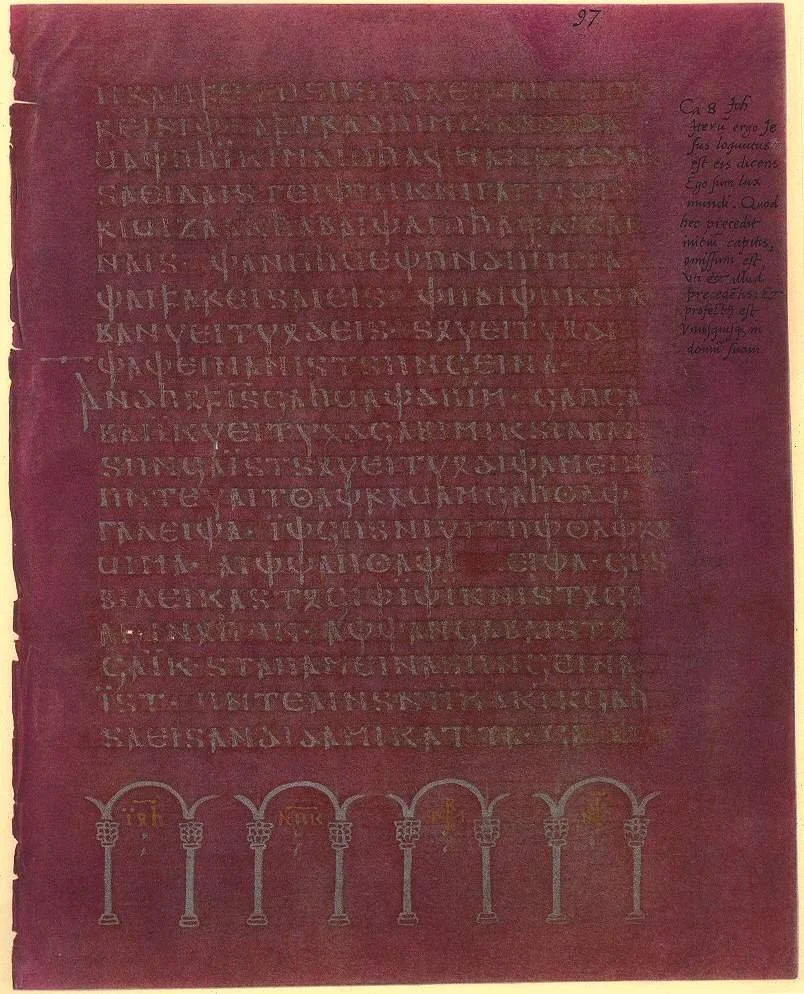
Historical example. The Silver Book itself: a page of John's Gospel in silver ink on purple parchment, the canon tables' arches at the foot of the page. The finest surviving Gothic book, now at Uppsala.
Codex Argenteus, folio with John 8 — Gothic text in silver ink on purple parchment, Uppsala University Library. Public domain, via Wikimedia Commons.
The effect, in the exhibition hall at Carolina Rediviva in Uppsala where pages are displayed today, is exactly what it was meant to be: a book that announces its own importance before a single letter is read.
★ Despite the name, it is not a complete Bible. It contains the four Gospels, the accounts of the life, death, and resurrection of Jesus, and that is all. The original codex held at least 336 pages; 187 survive, held by Uppsala University Library since 1669, when Chancellor Magnus Gabriel De la Gardie presented them as a gift — and one further leaf, discovered at Speyer in 1970, is the only survivor held elsewhere. In 2011 the codex was added to UNESCO's Memory of the World register, which is the modern world's way of saying what Theodoric's court already knew: this object matters.
The Silver Book matters to us for a second reason beyond its beauty. The Gothic Bible is the earliest extended written record of any Germanic language. Before it, Germanic survives in scattered runic inscriptions: names on combs, short memorials on stones, the Vimose comb of Lesson 11 with its single precious word. After it, we have connected prose, sentences that argue and narrate, a whole translated text.
The jump from inscription to literature happens here, in this alphabet, and the Silver Book is where you can see it.
A note on materials, because the Level Two list below will tempt you. Purple parchment dyed with murex, silver and gold ink: these were imperial luxuries, not scribe's supplies.
No student is expected to reproduce them, and the lesson does not ask it. The Level Two materials approximate the writing, not the wealth. The wealth is the point of the object, not the point of the exercise.
❦ In your workbook: record the Codex Argenteus, the Silver Book in your own way — copy, sketch, or note what matters.
In your packet: Assignment III — The Artifact Investigation ◐ begins here. Work it now, or mark the place and take it as homework — your choice.
Numbers in Dots and Lines
The Gothic letters do double duty as numbers — alphabetical numerals, letters doubling as numbers in fixed order — and the system is worth learning because it is the Greek system wearing Gothic clothes.
The values run in alphabetical order: 𐌰 through 𐌸 are 1 through 9, 𐌹 through 𐍀 are 10 through 80, 𐍂 through 𐍉 are 100 through 800. The two numeral-only letters fill the gaps the Greek system left for its own obsolete letters: 𐍁 is 90 where Greek had koppa, 𐍊 is 900 where Greek had sampi. Every value in the lesson's chart follows this order exactly, which is one more proof of the Greek foundation: Ulfilas took the numbering with the letters.
★ When letters serve as numerals, Gothic scribes marked them so the reader would not try to sound them out. There were two standard markings: the letters were written between two dots, as in •𐌹𐌱• = 12, or with an overline drawn above the sequence. The dot method and the overline both say the same thing: do not read this, count it.
Both markings are inherited from Greek scribal practice, part of the toolkit that came with the frame.
Work an example with me. To write 132, the scribe takes 𐍂 (100), 𐌻 (30), and 𐌱 (2): •𐍂𐌻𐌱•, or the same letters with an overline.
To write 355: 𐍄 (300), 𐌽 (50), 𐌴 (5): •𐍄𐌽𐌴•. The arithmetic is additive, the order is descending, and the marking tells you which game is being played. It is the same game the Greeks played, in Gothic letters.
Our course question finds its quietest answer here. The Gothic numerals left out nothing and added nothing: they are the Greek system exactly, because when the borrowed frame worked, Ulfilas kept it whole. Borrowing, done honestly, is also an answer. What must be borrowed to be understood? Sometimes everything, and then the understanding is in the using.
Check in: A scribe writes •𐌹𐌱•. Why the dots — and what number have you just read?
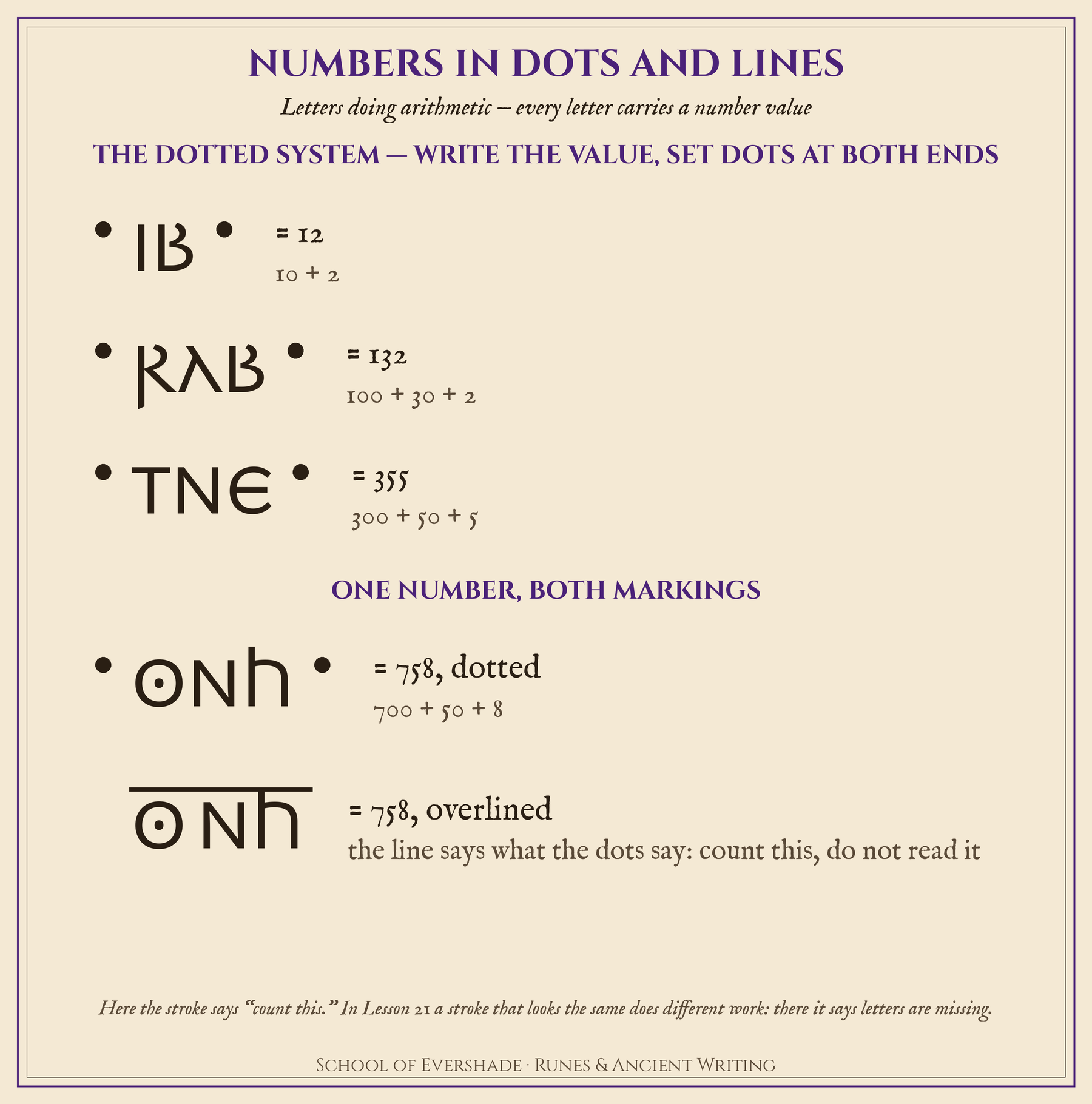
Letters that count: Gothic numerals written between dots, and under the overline that multiplies by a thousand — the same stroke Lesson 21 will meet again as the titulus.
Built for Evershade.
❦ In your workbook: record letters that are also numbers in your own way — copy, sketch, or note what matters.
Guided Practice — The Borrower's Hand
Before the assignments, train your hand the way Ulfilas's scribes would: with attention to what was taken, and from where.
Exercise A — Drawing the Twenty-Seven
- On paper, draw all 27 Gothic letters in order, using the chart in this lesson. Work slowly; these are manuscript forms, written with pen, not carved with knife.
- Below each, label it with its reconstructed name, sound value, and number value. Mark the two numeral-only letters (𐍁, 𐍊) with an asterisk.
- Circle the three Latin-looking letters (𐍂, 𐍃, 𐍆) and the two most often proposed runic borrowings (𐌿, 𐍉). For each of the five, write one sentence on what the proposal claims and how certain it is.
- Write two to three sentences on what your hand just learned: these letters were designed for pen on parchment, not knife on wood. How does that feel different from the runes of the last five lessons?
❦ Workbook path: draw the twenty-seven directly in your workbook, a row to a line, with each name and value written beneath its letter, so the full alphabet stands in your workbook as a reference page for the rest of the unit.
Exercise B — The Numeral Test
- Write the following numbers in Gothic alphabetical numerals, marking each with dots: 12, 27, 132, 355.
- Now write the same four with overlines instead of dots. (Draw the overline as a horizontal stroke above the letter sequence.)
- Decode these marked sequences back into numbers: •𐌹𐌴•, •𐍀𐌶•, •𐍅𐌺•. Check your answers: 15, 87, 420.
- Write two to three sentences on the marking: what work do the dots and the overline do for the reader? What would go wrong without them?
Exercise C — The Name Puzzle
- Choose three Gothic letters whose names are marked uncertain in this lesson (for example 𐌰 aza, 𐌵 qairthra, 𐌸 thiuth).
- For each, write down the competing reconstructions and what each would mean.
- Write a half page on the puzzle: the names survive only in a 9th-century manuscript, five centuries after the alphabet was made, in corrupt form. What can we honestly claim to know about what Ulfilas called his letters, and what must we admit we are guessing? Use the Codex Vindobonensis 795 in your answer.
In your packet: Assignment I — The Letter Chart ⚒ begins here. Work it now, or mark the place and take it as homework — your choice.
In your packet: Assignment IV — The Borrower's Essay ✎ begins here. Work it now, or mark the place and take it as homework — your choice.
Assignment Manual
Assignment key: ✎ written work · ⚒ hands-on practical · ◐ both · ★ will be on the test · ❦ workbook path
Written answers in this manual are short answers in your own words — a few honest lines, not a filled page.
Assignment I — The Letter Chart ⚒ ★
Objective: Demonstrate control of the 27 Gothic letters, their names, sounds, values, and sources.
Instructions:
- On a fresh sheet, create a six-column chart: letter (drawn), reconstructed name, sound value, number value, proposed source (Greek / Latin / debated-runic / uncertain), note on the name's certainty.
- Complete all 27 rows in order. For 𐍁 and 𐍊, write "numeral only" in the sound column and note the Greek koppa/sampi parallel.
- Below the chart, write one paragraph on the hybrid construction: which parts of the alphabet are securely Greek, which are Latin-leaning, and which are debated, and what the pattern of certainty reveals about how scholars reconstruct a designed script.
Your keepsake: this chart is your reference for the whole unit. Keep it with your Greek chart from Lesson 7; every Gothic exercise from here on leans on it.
❦ Workbook path: build the chart across two facing workbook pages instead of a loose sheet, the letter columns on the left page and the source and certainty columns on the right, so the whole hybrid lies open at once.
To submit: Photograph or scan your chart. Accuracy of the shapes matters more than artistic skill; these are pen forms, so smooth curves are correct here.
Assignment II — Transliteration Practice ⚒ ★
Objective: Read and write Gothic, navigating its Greek-based spelling.
Part A. Transliterate the following Gothic words into Gothic letters: guth (God), dags (day), manna (man), faihu (wealth, cattle), sauil (sun). For each word, name the proposed source of each Gothic letter — the Greek letter it was modeled on, or the Latin or debated runic source where the lesson gives one.
Part B. The Lord's Prayer opens in Gothic with atta unsar ("our father"): 𐌰𐍄𐍄𐌰 𐌿𐌽𐍃𐌰𐍂. Write this phrase in Gothic letters from the transliteration, then transliterate it back. What did the round trip teach you about the reliability of a designed alphabet versus an evolved one?
Part C. Write the numeral sequences for 12, 132, and 355 in Gothic letters with dot marking, then decode •𐌹𐌴•, •𐍀𐌶•, and •𐍅𐌺• back into numbers. Show your addition for each. (Answers: 15, 87, 420.)
Assignment III — The Artifact Investigation ◐ ★
Objective: Understand the Gothic alphabet through its greatest manuscript.
Instructions:
- Research (using the References below): the Codex Argenteus. Record its date, place of making, materials, contents, the king it was probably made for, how many pages survive of how many, where they are held, and the UNESCO listing.
- The codex was made about 150 years after Ulfilas died. Write a half page on what that gap reveals: what does it mean for an alphabet to outlive its maker by generations and still be copied in silver and gold? Base your argument strictly on the object and this lesson.
- The lesson warns against confusing the Gothic alphabet with "Gothic" blackletter. Research what blackletter is, when it arose, and why it borrowed the Goths' name, and write a half page explaining the confusion and correcting it for a fellow student.
Assignment IV — The Borrower's Essay ✎ ★
Objective: Evaluate a designed alphabet against the evolved ones of earlier lessons.
Instructions:
Write a one-page essay addressing the following:
Ulfilas built the Gothic alphabet deliberately from Greek, Latin, and possibly runic materials, while every earlier alphabet in our course was inherited or evolved. First, describe concretely what he took from each tradition, using at least two specific letters as examples per tradition (for the runic tradition, include the hedging: what is proposed and how certain is it). Then consider the design constraints: his readers had no written tradition, his text was a sacred translation, and his models were the scripts of empire. Finally, return to the course question in its Lesson 16 form: what must be borrowed to be understood? Was Ulfilas's borrowing a strength (each piece chosen for the job) or a risk (a system with no native roots)?
Cite the lessons where your details come from.
Materials
Required (Level One — household items)
- Paper: plain white paper or a sketchbook, for letter practice and chart work.
- Pens: one standard pen for drafting, one fine-tipped marker for final letterforms. The Gothic letters are pen forms with curves; a smooth marker suits them better than the stiff tools of the rune lessons.
- A ruler: for chart columns and for drawing clean overlines above numeral sequences.
- A printout of the Gothic alphabet: use the References below for the Unicode chart of the Gothic block.
Suggested (Level Two — historically closer materials)
- A reed pen and dark ink: the late-antique writing kit. Gothic scribes wrote with reed pens; the broad strokes of 𐌱 and 𐌸 reward the flexible nib.
- Parchment paper or vellum-style paper: the manuscript surface. Modern parchment paper from a craft store approximates the feel without the cost of real vellum.
- Purple and metallic gel pens: for the Codex Argenteus exercise. No one expects murex dye and silver ink; the exercise is about the idea of the luxury book, writing a sacred line in precious colors on dark ground.
- A straightedge and patience: for the overline. The numeral marking is a small skill; practice it until the line sits clean above the letters.
Neither level requires
Purchased kits, specialty tools, or any material you cannot find locally or order inexpensively. The core lesson (drawing letters, understanding the hybrid construction, working the numerals) is fully achievable with paper and pen. No murex dye will be harmed.
Reflection Questions
Answer the following in your workbook.
- Who was Ulfilas, when did he live, and why did he create the Gothic alphabet? Explain the "traditionally credited" hedge.
- State the alphabet's inventory: how many letters, how many with sound values, and what are the two numeral-only signs worth?
- Where do the Gothic letter names come from, and why must they be treated as reconstructed? Name the manuscript.
- Describe the hybrid construction: what is securely Greek, what leans Latin, and what is debated as runic? Name the two letters most often linked to runes.
- Identify the Codex Argenteus: date, place, materials, contents, patron, survival, present home, and UNESCO status.
- Explain the alphabetical numeral system and the two marking conventions. Decode •𐍂𐌻𐌱•.
- Apply the Lesson 16 form of the course question: what must be borrowed to be understood? Was Ulfilas's borrowing strength or risk?
Workbook Checklist — Lesson 16
In my workbook I have:
- ☐ explained who Ulfilas was, and why the alphabet is only traditionally credited to him
- ☐ described all twenty-seven Gothic letters with their names, sounds, and number values
- ☐ identified the two numeral-only letters and their Greek parallels, koppa and sampi
- ☐ explained the hybrid construction: the Greek foundation, the Latin-leaning letters, and the debated runic borrowings
- ☐ treated the letter names as reconstructions from the Codex Vindobonensis 795
- ☐ described the Codex Argenteus: its materials, date, contents, and present home
- ☐ written Gothic numerals with dot marking and with overlines, and decoded them back
☐ Lesson completed Date: ____________ Signature: ____________
Professor's Review
And so our sixteenth lesson closes on the Danube, where a bishop built an alphabet out of three traditions and gave his people their first book.
You can now explain who Ulfilas was and why the "traditionally credited" hedge matters, describe all twenty-seven Gothic letters with their names, sounds, and number values, identify the two numeral-only signs and their Greek parallels, explain the hybrid construction with its Greek foundation, Latin contributions, and debated runic borrowings, treat the reconstructed letter names with the proper caution and name their manuscript source, describe the Codex Argenteus in its materials, date, contents, and present home, read and write Gothic alphabetical numerals with dot and overline marking, and correct the blackletter confusion.
Keep your Gothic chart beside your Greek chart from Lesson 7. Lay them side by side and see the derivation: the Greek order, the Greek values, the Greek frame, and then the Germanic names, the invented hwair, the possible runic shapes. The frame is borrowed. The voice is Gothic.
Next, we enter the scriptorium proper: Roman cursive, the fast hand of wax and papyrus, and uncial, the rounded book hand that carried texts through the centuries when empires fell. The pen is about to replace the knife entirely, and writing will learn to run.
Practice your twenty-seven, scholars. Write them with the reed pen if you have one, and feel the difference from every carved lesson behind us: no resistance, no grain, only the ink deciding where the line goes. I have watched alphabets crossed and recrossed in my years among the inscriptions, but I have never seen one built so deliberately, piece by chosen piece, as the bishop built this one on the Danube. The web holds a new pattern now. Learn its threads.
PROFESSOR THISTLELOOM WEBBLETHORN
Runes & Ancient Writing
Epigrapher, Head of House Septentrio
Cross-Class Connections
The Codex Argenteus is a manuscript first and an alphabet lesson second, which connects directly with Scrollwork, where Professor Nocturne teaches the book hands of the same centuries. Students studying both classes should compare the Gothic scribes' pen work with the uncial (a rounded Latin and Greek book hand, not a Gothic one; it enters this lesson only because the Gothic alphabet's Greek models included cursive and uncial-style Greek forms) they will meet in our very next lesson: two traditions, one technology, the reed pen on prepared skin.
The purple parchment and precious-metal inks connect with Creative Arts, where Professor Timberclank's material lessons teach what the Silver Book's makers knew: the material is part of the message. A sacred text in silver on imperial purple is the medium declaring the message's worth before a word is read.
The deliberate design of the alphabet will reappear in Runes Unit V, when we study the Carolingian script reform: another moment when writing was engineered on purpose rather than evolved by accident. Ulfilas and the Carolingian reformers never met, but they asked the same question.
In Other Classrooms
Scrollwork · Unit IV, Lesson 15 — Uncial Script
A manuscript first and an alphabet second: on that we agree entirely. In the Library we write the uncial, the rounded book hand of the same centuries as your Silver Book, and study how scribes kept such pages. Come and compare the Gothic scribes' pen work with ours, reed on prepared skin, tradition against tradition.
Creative Arts · Unit I, Lesson 6 — The Materials Library & First Tool-Making

Silver on purple, scholars: the makers chose those materials to say something before a word was read. In the Workshop we begin with a materials library, learning what things are and what they mean to work with. Come and study material as message in the room where materials are the curriculum.
The bishop borrowed, and so do we.
References & Further Reading
Uppsala University Library. "Codex argenteus" (exhibition pages). The Silver Book's history, materials, and display at Carolina Rediviva; UNESCO Memory of the World listing. https://www.uu.se/en/library/visit-and-contact/exhibitions/codex-argenteus
Wikipedia. "Gothic alphabet." Comprehensive overview: the 27 letters with names, sounds, and number values; the hybrid-origin debate; the runic-influence proposals; numeral marking. https://en.wikipedia.org/wiki/Gothic_alphabet
Wikipedia. "Ulfilas." The bishop's life, mission, dates, and the "Little Wolf" name. https://en.wikipedia.org/wiki/Ulfilas
Wikipedia. "Codex Argenteus." The manuscript's making, contents, survival, and present holding. https://en.wikipedia.org/wiki/Codex_Argenteus
The Unicode Consortium. Code chart for Gothic (U+10330–U+1034F). The official chart of every Gothic letter for study and practice. https://www.unicode.org/charts/PDF/U10330.pdf
Wikipedia. "Blackletter." What "Gothic" script usually means in typography, and why it has nothing to do with the Goths. https://en.wikipedia.org/wiki/Blackletter
Browse the Runes shelf in the school Library for readable editions of these works.
Wulfila's letters stand on the Bench. Write in Gothic — with its own single letters for the KW and KS sounds, as the lesson taught.
Open the BenchPROFESSOR THISTLELOOM WEBBLETHORN · RUNES CLASSROOM
Submit your work for this lesson using the form below.
CONTINUE IN RUNES & ANCIENT WRITING
← Previous · Lesson 15: Ogham: The Forfeda & the Manuscript Shift Next · Lesson 17: Roman Cursive & Uncial: The Fast Hand and the Round Book Hand →
Unit V · The Medieval Scriptorium Runes & Ancient Writing Classroom · All 21 Lessons
The rest of Unit V: Lesson 17 · Roman Cursive & Uncial · Lesson 18 · The Insular Script · Lesson 19 · The Clear Hand · Lesson 20 · The Scriptorium Code · Lesson 21 · How Scribes Left Letters Out and Readers Put Them Back
From the Runes Shelf
The printed companions to this lesson, from Professor Webblethorn’s shelf in the shop.