RUNES & ANCIENT WRITING
Unit V · Lesson 21THE SHORTHAND ABBREVIATION MATRIX
How Scribes Left Letters Out and Readers Put Them Back
Professor Thistleloom Webblethorn
Epigrapher • Runes & Ancient Writing
Head of House Septentrio • School of Evershade
Professor's Introduction

One last sitting, scholars. Tonight we end where every scribe ended: with too little vellum, too little time, and too many words.
The scriptorium has already learned to leave things out: a whole silence, set down between one word and the next.
Tonight, the scribes go further. They leave out the letters themselves, and trust you to put them back.
Come closer to the web, scholars, for the last time in this course. The page you are about to meet is full of holes, and every hole is deliberate. Twenty-one lessons ago we asked what could be left out and still be understood. Tonight we get the final answer, written in the scribes' own shorthand: almost everything, if the reader knows the code.
PROFESSOR THISTLELOOM WEBBLETHORN
Runes & Ancient Writing
Epigrapher, Head of House Septentrio
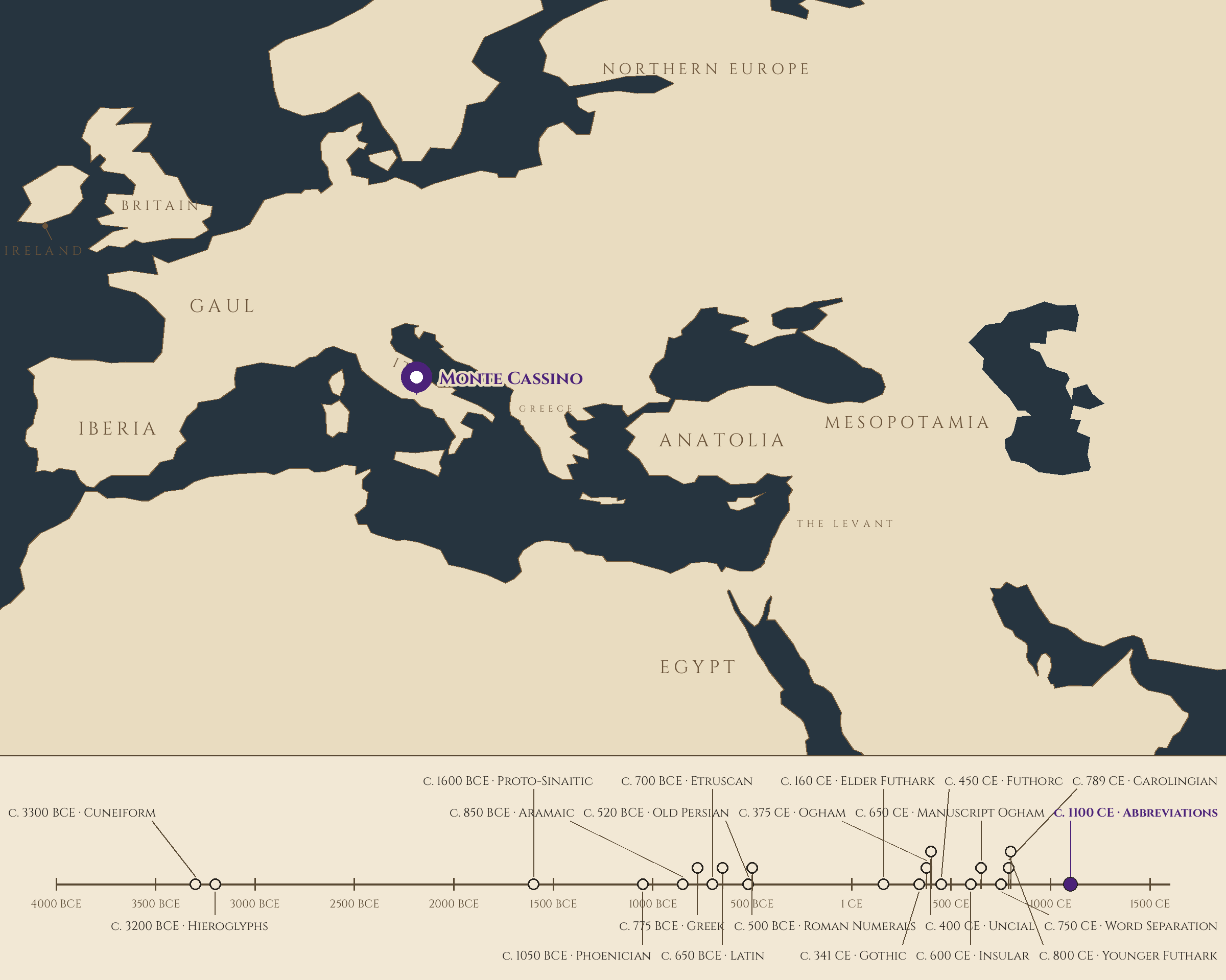
Where and when: the scriptoria of medieval Europe, in the centuries when every book was copied by hand. The pin is this lesson. The line beneath the map is our road: every stop a writing system, every lesson a pin.
Lesson Objectives
By the end of this lesson, students should be able to:
- Define abbreviation matrix (as an Evershade classroom term), vellum, parchment, scriptorium, paleography, titulus, suspension, contraction, nomina sacra, sigla, Tironian notes, ampersand, superscript, and brevigraph.
- Explain why medieval scribes abbreviated: the cost of writing materials and the speed of copying.
- Distinguish suspension from contraction, with examples of each.
- Name the abbreviation stroke by its scholarly name, the titulus, and explain why "macron" is the wrong word for it.
- Describe the nomina sacra: what they abbreviate, how they are marked, and why they are both practical and reverent.
- Identify at least four common medieval abbreviation signs and expand them.
- Trace the ampersand from the Latin word et to the modern keyboard.
- Apply the course question in its final form: what can the scribe leave out and the reader still restore?
Reading this lesson: ★ marks the passages to remember. They return on the unit quiz and the class test. Check in questions ask the material back as you go; answer them in your workbook when you meet them.
Working this lesson: Your assignment packet is the first download on this page. Work in it as the lesson moves along, answering each assignment as its subject is taught — or read the lesson through for your notes and take the assignments as homework afterward. Both are proper ways to sit this class. Signposts in the reading tell you where each assignment belongs. Written answers are short answers in your own words; a few honest lines are worth more than a filled page.
Your Assignment Packet
This lesson's assignments live in its packet: the Lexicon Handout (every term, course terms marked ◆), Materials, Guided Practice, the Assignment Manual with its answer key for self-checking, the Reflection Questions, and the Workbook Checklist. Download the packet before you begin and keep it beside you as you read.
A Classroom Name, Honestly Given
Before we meet the system, let me be honest about its name, the way Lesson 20 was honest about the Scriptorium Code.
"Abbreviation Matrix" is not a term you will find in a paleographer's glossary — paleography (also spelled palaeography) being the study of historical handwriting: the dating, placing, and reading of old scripts from their letterforms, abbreviations, and materials. Medieval scribes did not call their shorthand a matrix, and modern scholars speak of scribal abbreviations, or of Cappelli's categories, or of individual hands' practices. The name is ours: an Evershade classroom term for the whole network of compression devices working together on the medieval page. It is a useful name for a real system, not the name of one official medieval code, and I would rather you learned that now than discovered it later in a museum catalog.
★ What the name gathers is real enough. Across a thousand years of Latin manuscripts, scribes shortened words by rule and by habit: cutting endings, hollowing middles, raising letters above the line, using sigla (abbreviations formed from single letters or small groups of letters standing for whole words, the Roman habit seen at monumental scale in S.P.Q.R.), borrowing whole-word signs from a Roman shorthand system, and treating the holiest names with a reverence you can see in the ink.
No single scribe invented the network. It grew the way the scripts grew, by use, and every trained reader of the Middle Ages could read it as fluently as the letters themselves. That is what made it a system rather than a collection of tricks: writer and reader shared the code.
Hold that sharing in mind. It is the whole lesson. An abbreviation only works if the reader can restore what the writer removed, which means the matrix is really a map of what medieval readers could be trusted to know. Every missing letter is a compliment to the reader's competence. The scribes left out exactly what they believed you would put back.
❦ In your workbook: record an honestly given name in your own way — copy, sketch, or note what matters.
Why the Scribes Compressed
★ Two pressures drove the shorthand, and both were economic.
The first was the page itself. Before paper reached Europe in the 12th to 14th centuries, books were copied onto parchment or vellum (in strict usage, vellum is calfskin: a fine surface cleaned, soaked, stretched on a frame, scraped, and dried; parchment names the other skins, though medieval writers often used "parchment" for all of them; vellum was the finer and costlier of the two): animal skin, prepared sheet by sheet, at a cost measured in herds. A large Bible could consume the skins of hundreds of animals.
Every letter a scribe omitted was skin unspoiled, and the great books of the Middle Ages are full of the arithmetic of that saving. Abbreviation was not laziness. It was husbandry.
The second was the hand. Copying was slow labor, done letter by letter in lamplight, and a professional scribe's output was measured in pages per day.
Shortening the most frequent words, the little grammatical workhorses that appear on every line, multiplied a scribe's speed across a whole manuscript. The commonest words earned the shortest forms, which is exactly what you would expect from people paid by the page and judged by the book.
There is a third pressure, quieter, and it belongs to reverence rather than economy. The sacred names were shortened not only to save space but to mark them: the contraction set the holy word apart, visibly, on the page. We will meet the nomina sacra below, and they correct the assumption that abbreviation was only ever about thrift. Sometimes the missing letters were the point.
❦ In your workbook: record why the scribes compressed in your own way — copy, sketch, or note what matters.
Suspension and Contraction
The matrix runs on two engines, and the paleographer Adriano Cappelli, whose great dictionary of Latin abbreviations remains the decoder's bible, gave them the definitions the field still uses.
Suspension cuts the word short. The scribe writes the beginning and drops the ending, and the reader supplies what was left off. It is the word interrupted: the most natural shortening in any language, the one you perform every time you write "etc." without thinking.
Contraction hollows the word. The scribe keeps the first letter and the last, sometimes with more of the frame, and removes the middle. The reader fills the hollow center from knowledge of the word.
It is the bolder of the two engines, because it asks more of the reader: not the tail of a word you have already begun, but the heart of a word you must recognize from its edges.
★ Both engines ran on every page, often together, and the titulus marked their work. Learn the two motions, suspension and contraction, and you have the grammar of the whole matrix. Everything else is vocabulary.
Check in: Two engines drive the matrix: one interrupts a word, the other hollows it. Name each engine, and say which one keeps the word's first and last letters.
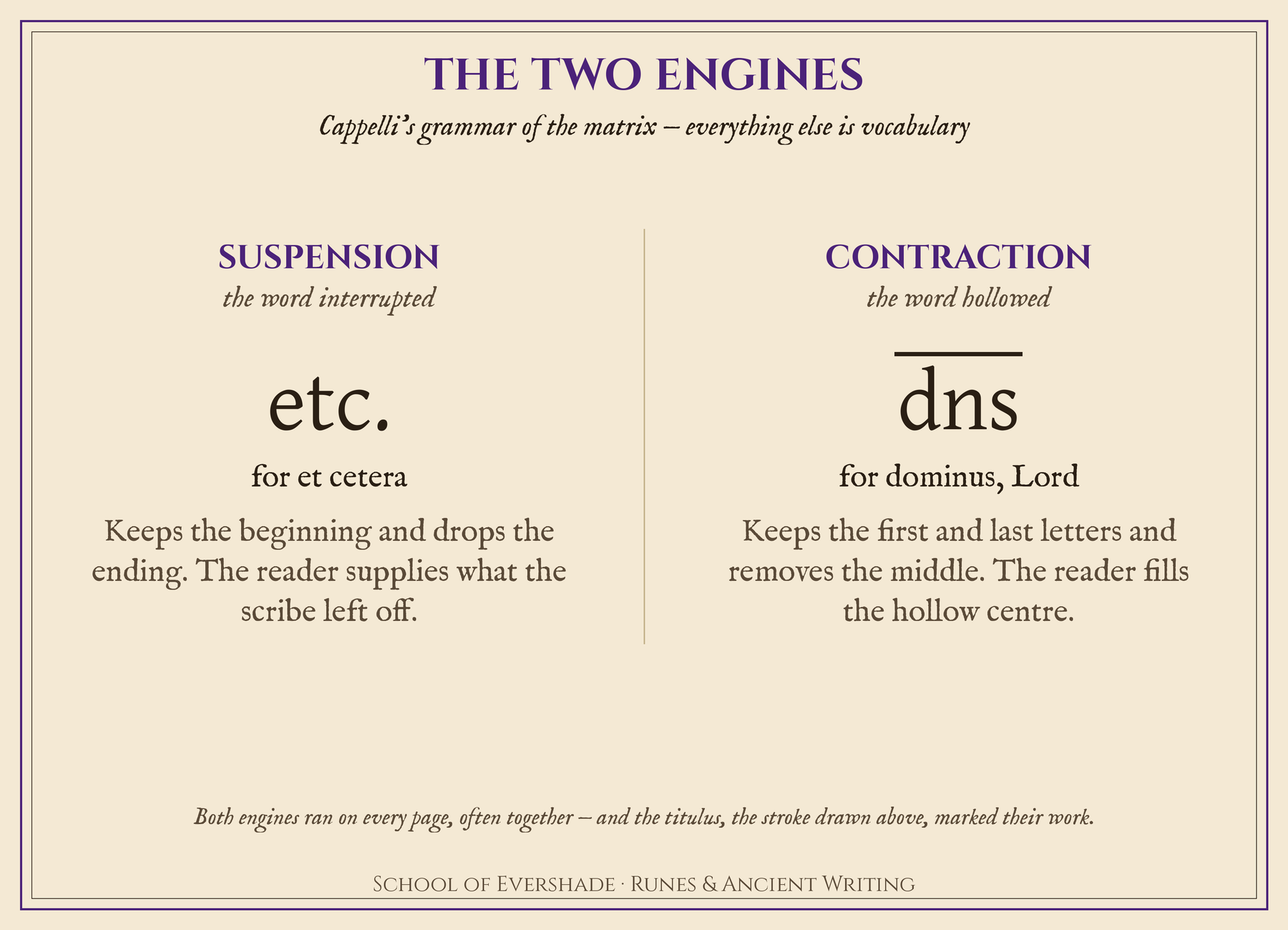
The two engines of the whole system: suspension, the word interrupted — etc. for et cetera; and contraction, the word hollowed — dn̄s for dominus, the first and last letters kept and the middle entrusted to the reader.
Built for Evershade.
❦ In your workbook: record suspension and contraction in your own way — copy, sketch, or note what matters.
The Titulus
The most common abbreviation device on the medieval page was a short horizontal stroke drawn above a letter, and its scholarly name is the titulus, plural tituli. (The stroke's shape is kin to the overline that marked Gothic numerals in Lesson 16, but its work is different: there it said "count this"; here it says "letters are missing, supply them.") Older manuals also call it the virgula or the apex.
Its most general use was to mark an omitted m or n: a vowel wearing a titulus stood for itself plus the missing nasal, and Latin is so full of m's and n's that the stroke appears on nearly every line of nearly every manuscript.
★ I am particular about the name, because the lesson you may have met elsewhere calls this stroke a macron, and that word will fail you in a museum. The macron is the vowel-length mark, the bar over the ā in a Latin grammar, doing phonetic work. The titulus is the abbreviation stroke, doing scribal work.
The two marks look alike and share nothing else, and paleographers use only one of the names for the abbreviation. Learn titulus, and you will recognize the term in every scholarly context you ever meet. Learn only "macron," and the catalogs will be speaking a language you were never taught.
Watch the stroke work and you will see the whole matrix in miniature. A single short line, doing the work of a letter, placed exactly where the reader expects it, restorable by anyone who knows the language. The scribes' smallest tool, and their most used.
Check in: A friend calls the stroke over a letter a macron. Correct them: what is the stroke's scholarly name here, and what does a macron actually mark?
❦ In your workbook: record the titulus in your own way — copy, sketch, or note what matters.
The Sacred Contractions
Now the abbreviations that were never only about economy.
★ In Christian manuscripts, the divine names and titles appear in contracted forms spanned by a titulus: the nomina sacra, the sacred names. The standard list, compiled by the scholar Bruce Metzger, holds fifteen: God, Lord, Jesus, Christ, Son, Spirit, David, Cross, Mother, Father, Israel, Savior, Man, Jerusalem, and Heaven.
Each is written as a contraction, most commonly the first and last letters of the word with the middle removed, and the titulus drawn above marks the contraction the way it marks any other. The modern term itself is scholarly, coined by Ludwig Traube in 1907, but the practice is ancient, reaching back to the earliest Christian manuscripts.
The contractions saved space and speed, like every abbreviation.
But scholarship recognizes a second dimension, and the lesson would be dishonest without it: reverence. The shortened holy names stand visibly apart on the page, marked by their tituli the way a shrine is marked by its carving. The missing letters are not merely omitted. They are offered.
This corrects the easy assumption that the matrix was pure thrift. The scribes who shortened deus and dominus were not only saving vellum. They were writing the way their faith told them these particular words deserved to be written: compressed, elevated, and instantly recognizable. The reader restored the letters, and in restoring them, performed a small act of attention. Efficiency and devotion, in the same stroke.
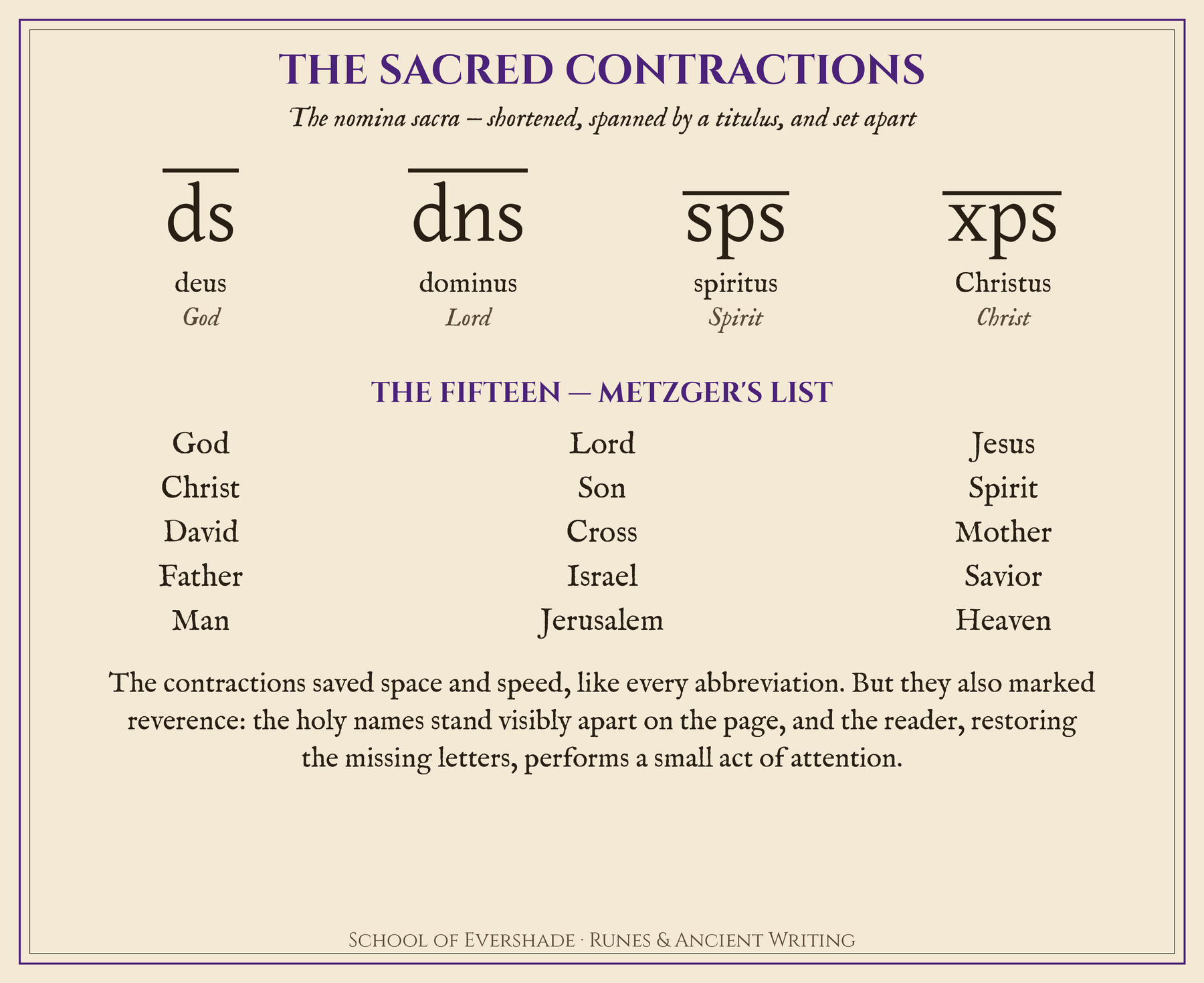
The sacred contractions: deus, dominus, spiritus, Christus, each spanned by its titulus — and Metzger's fifteen, the full company of names the scribes would not write out.
Built for Evershade.
❦ In your workbook: record the sacred contractions in your own way — copy, sketch, or note what matters.
Professor Webblethorn
Pause here, scholars, at the hinge of the whole course.
Twenty lessons have asked our question in twenty forms. What can be left out? The miners left out the pictures. The merchants left out the variation. The Greeks added the vowels, which is the question turned inside out. The Vikings left out the runes. The Anglo-Saxons added them back. The emperor standardized the hand. Last lesson, the scriptorium left out the silence between words by putting it in, the space and the stop.
Tonight the scribes leave out the letters themselves. And the readers put them back. Every time.
Do you see what that means? The whole course has been building to this page. Every subtraction we studied only worked because a reader could restore it. The miners' alphabet worked because readers knew the sounds. The Vikings' sixteen runes worked because readers knew the words. The spaces worked because readers knew where words ended. And now the abbreviations work because readers know the language so well that half a word is enough.
Writing was never only what the hand put down. It was always a partnership between the hand that left things out and the eye that put them back. The web has two ends, scholars. The spider spins it, but the silk only holds because something on the other side holds too.
One section left. The gallery of shortcuts, and then the closing of the course.
PROFESSOR THISTLELOOM WEBBLETHORN
Runes & Ancient Writing
Epigrapher, Head of House Septentrio
A Gallery of Shortcuts
Here are the matrix's most useful signs, the ones you will actually meet on manuscript pages. Learn them the way the scribes learned them: as vocabulary, after the grammar of suspension and contraction.
★ The Tironian et is the oldest shortcut in the gallery, and the only one still alive. It is a sign from the shorthand system credited to Marcus Tullius Tiro, the secretary of the Roman orator Cicero, first used to take down a speech in the Roman Senate in 63 BCE.
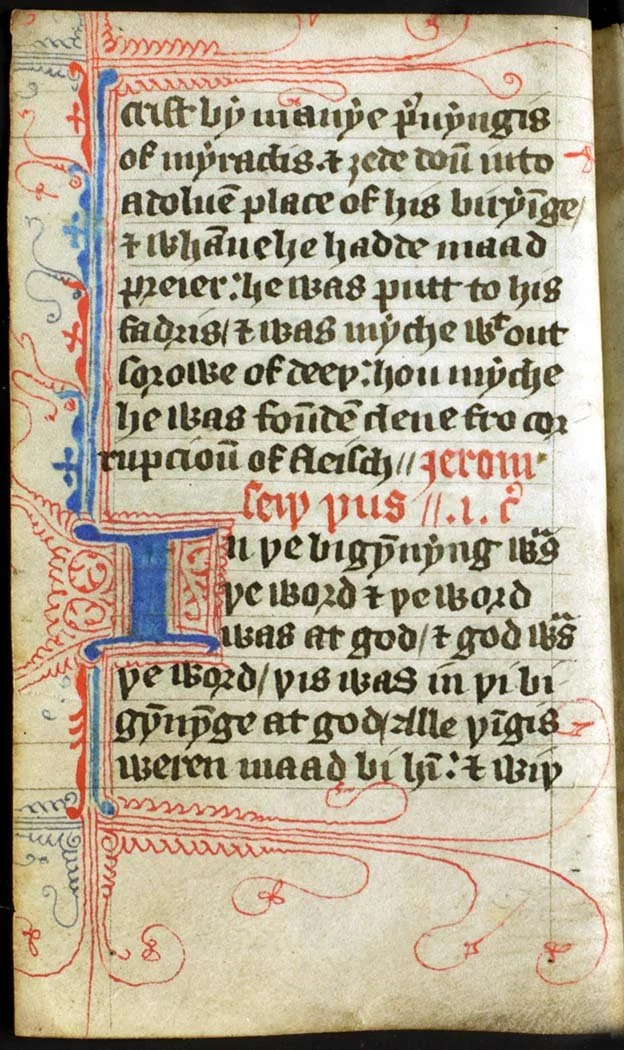
Historical example. A page of a Wycliffe Bible — John's Gospel in Middle English, 'In þe bigynnyng was þe word' — and the page is dense with the whole system: tituli, Tironian signs, raised letters. The decoder's chart below is your key.
A Wycliffe Bible page — the opening of John's Gospel in Middle English, dense with scribal abbreviations. Public domain, via Wikimedia Commons.
Tiro's system grew from a few thousand signs to some thirteen thousand in medieval monastic use, and nearly all of it is forgotten now. But the sign for et, the Latin word for "and," survived: a small mark shaped like a 7 (⁊), still printed in Ireland today, where it stands for the Irish word agus, meaning "and."
A Roman senator's secretary invented it. Irish road signs still use it. Some threads are very long.
★ The ampersand is the most famous abbreviation in the modern world, and almost nobody knows it is one. The sign & began as a scribal ligature of the Latin word et: the letters e and t written together, flowing into each other, until centuries of quick hands fused them into a single shape. The modern form is virtually identical to the Carolingian minuscule version, which means you have been looking at a medieval abbreviation every time you have typed &.
Its name tells the rest of the story: schoolchildren once recited it as the twenty-seventh letter of the alphabet, ending their ABCs with "X, Y, Z, and per se and," and the slurred phrase became "ampersand." A whole word, compressed to a single flowing mark, then promoted to the alphabet, then retired from it, and still on your keyboard.
The crossed p did the work of whole syllables. A p with a stroke through its descender stood for per; with a different flourish, for pro or prae. A q with a mark stood for -que, the little enclitic "and" that Latin tacks onto words. A sign shaped like a 9 at a word's end stood for -us or -os.
These are brevigraphs, one mark for many letters, and a trained reader expanded them without pausing, the way you expand "Dr." without pausing.
Superscript letters worked above the line. A small raised vowel could carry a whole syllable: the omitted consonant, usually r, m, or n, was understood from the raised letter's position and the word's frame. It is the matrix's quietest device, a syllable shrunk to a whisper, and once you know to look for it, you will see those floating letters everywhere in medieval manuscripts.
Old English had its own. The thorn you met in Lesson 13, the rune that became the manuscript letter þ, appears with a stroke through its ascender as an abbreviation for þæt, "that": the commonest word in the language, given the shortest form, exactly as the economics of the page would predict. The matrix was not only Latin. Every written language of the Middle Ages built its own.
Learn the gallery and you can do what the medieval reader did: meet a page full of holes and read it straight through. The holes were never empty. They were full of the reader.
Check in: The ⁊ on an Irish sign and the & on your keyboard both abbreviate the same Latin word. Which word — and how did each sign begin?
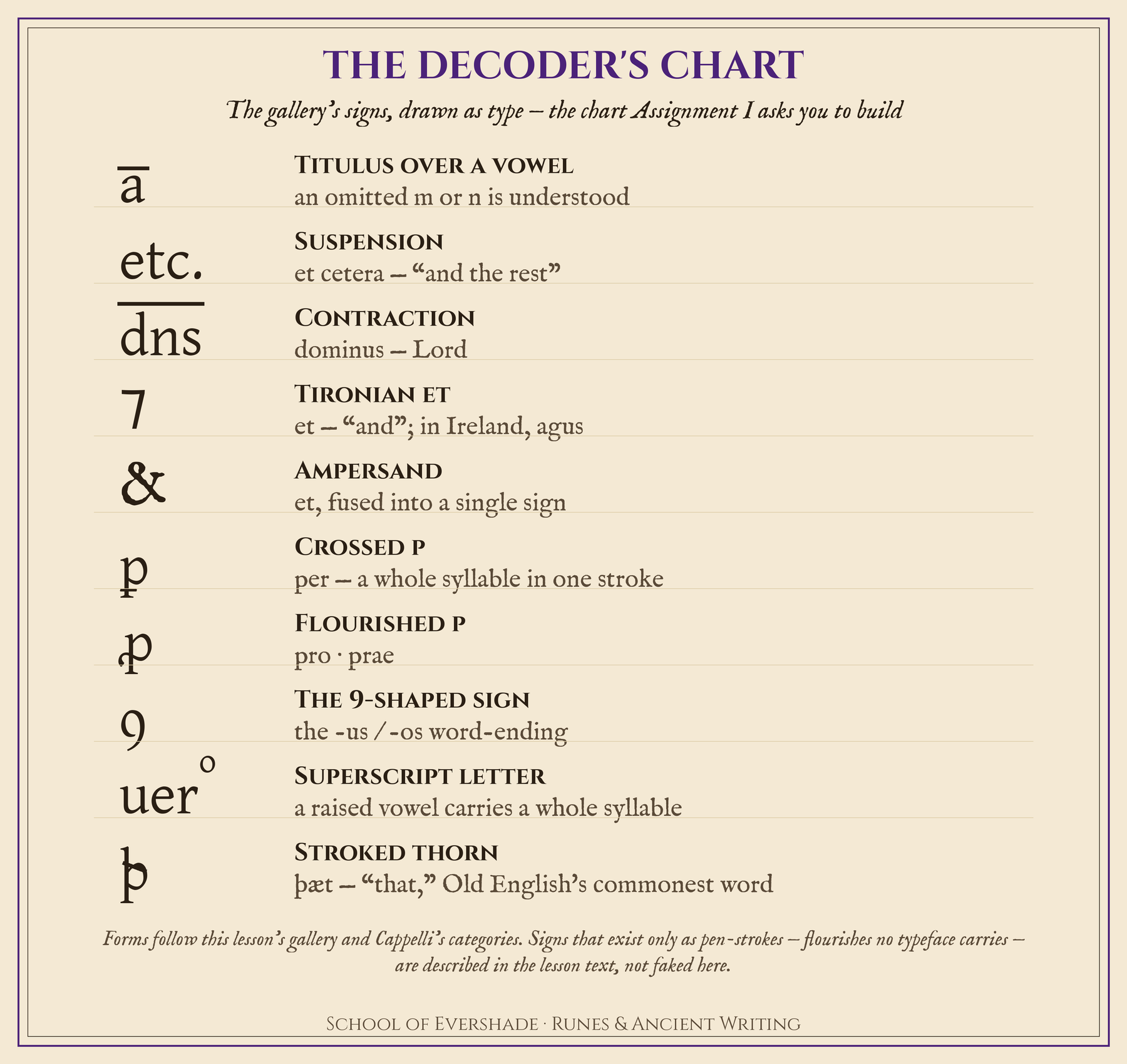
The decoder's chart: the gallery's signs drawn as type — titulus, suspension, contraction, the Tironian et, the crossed and flourished p, the 9-shaped ending, the raised vowel, the stroked thorn. Assignment I asks you to build this chart yourself.
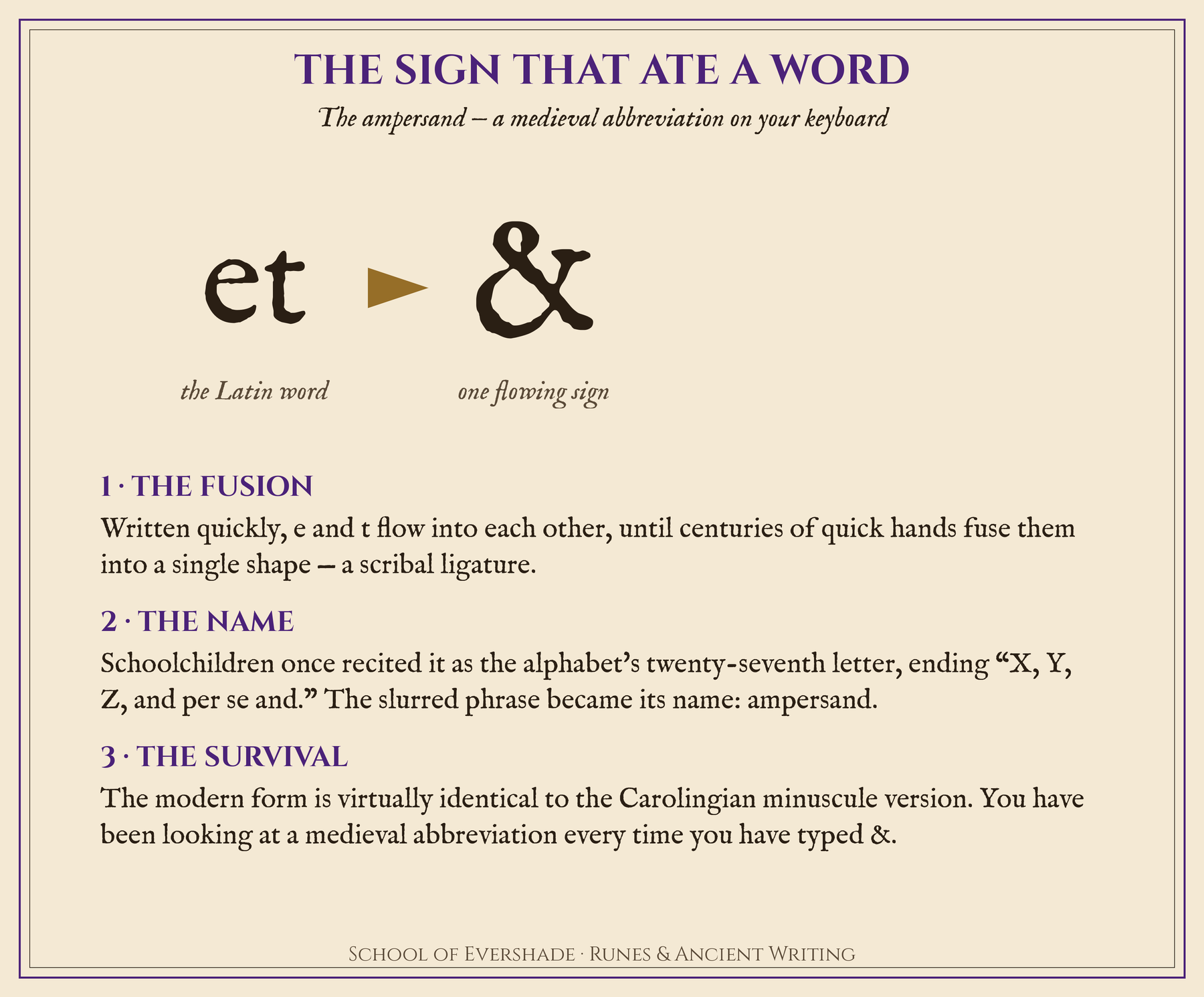
The sign that ate a word: et, written until it fused — and recited by schoolchildren as 'and per se and,' the phrase that slurred into ampersand.
Built for Evershade.
Built for Evershade.
❦ In your workbook: record a gallery of shortcuts in your own way — copy, sketch, or note what matters.
In your packet: Assignment II — Reading the Compressed Page ⚒ begins here. Work it now, or mark the place and take it as homework — your choice.
The Decoder's Dictionary
A word about how modern readers learn the code, because the matrix is only closed to those who never learned it.
In 1899 the Italian paleographer Adriano Cappelli published his Dizionario di abbreviature latine ed italiane, the dictionary of Latin and Italian abbreviations, and it remains the working reference a century later: thousands of entries, each abbreviation drawn as it appears in the manuscripts, each with its expansion.
When a modern scholar meets an unfamiliar brevigraph, Cappelli is where she looks first. The matrix that medieval readers carried in their heads, modern readers carry in Cappelli.
This is worth stating plainly, because it corrects the romance of the unreadable past. Medieval manuscripts are not mysterious because their writers were mysterious. They are compact because their writers were practical, and the compactness yields to study the way any shorthand yields to study. The scribes expected to be read. They left the code lying around in every scriptorium, in every trained reader's habits, and eventually in Cappelli's dictionary. The holes in the page were invitations, not walls.
❦ In your workbook: record the decoder's dictionary in your own way — copy, sketch, or note what matters.
In your packet: Assignment III — The Artifact Investigation ◐ begins here. Work it now, or mark the place and take it as homework — your choice.
Guided Practice — The Expander's Hand
Before the assignments, train your hand the way a medieval reader trained the eye: by restoring what the scribe removed.
Exercise A — Spotting the Engines
1. Below are five abbreviated forms in the style of the lesson. For each, name the engine: suspension or contraction. - dñs with a titulus (for dominus, Lord) - xps with a titulus (for Christus, Christ) - etc. (for et cetera) - ds with a titulus (for deus, God) - sps with a titulus (for spiritus, Spirit) 2. For each contraction, identify which letters were kept and which were removed. 3. Write two to three sentences on the pattern: which engine do the sacred names favor, and what does that choice suggest about how the scribes wanted these words to be recognized?
Exercise B — Writing with the Titulus
- Write the Latin words dominus, deus, spiritus, sanctus, and omnes in full, in clear minuscule.
- Now write each one abbreviated: contract the first three as the nomina sacra do (first and last letters with a titulus above), and mark the m or n in the last two with a titulus over the vowel.
- Exchange with a partner if possible, or set the page aside for an hour and read it fresh. How much of the abbreviation could you restore? Where did you hesitate, and what does the hesitation reveal about what the reader must already know?
This exercise teaches, in your own hand, the partnership the lesson describes: the scribe removes, the reader restores.
Exercise C — The Ampersand's Ancestors
- Write the word et five times, each time joining the e and the t a little more tightly, letting the crossbar of the t flow into the curve of the e.
- On the fifth attempt, write it as fast as you comfortably can. Compare the result with a printed &.
- Write two to three sentences on what your hand just demonstrated: how does a two-letter word become a single sign? What does the ampersand's survival tell you about which abbreviations outlive their systems?
You have just repeated, in minutes, the process that took medieval scribes centuries.
❦ Workbook path: run the five fusions of et down one workbook page, fastest last, so the whole journey from two letters to one sign stays in a single column.
In your packet: Assignment I — The Abbreviation Chart ⚒ begins here. Work it now, or mark the place and take it as homework — your choice.
In your packet: Assignment IV — The Closing Essay ✎ begins here. Work it now, or mark the place and take it as homework — your choice.
Assignment Manual
Assignment key: ✎ written work · ⚒ hands-on practical · ◐ both · ★ will be on the test · ❦ workbook path
Written answers in this manual are short answers in your own words — a few honest lines, not a filled page.
Assignment I — The Abbreviation Chart ⚒ ★
Objective: Demonstrate control of the matrix's devices, their names, and their expansions.
Instructions:
- On a fresh sheet, create a five-column chart: device or sign (drawn), scholarly name, type (suspension, contraction, brevigraph, superscript, ligature), example with expansion, note on use.
- Complete rows for: the titulus marking omitted m/n, suspension, contraction, a nomen sacrum (dñs for dominus), the Tironian et (⁊), the ampersand (&), the crossed p for per, the "9"-shaped -us ending, a superscript vowel, and the thorn abbreviation for þæt.
- Below the chart, write one paragraph on the two engines: why would a scribe choose suspension for one word and contraction for another? Use at least two examples from your chart.
Your keepsake: this chart is your decoder. Keep it with every chart you made this course; with it, a page full of holes is a page you can read.
❦ Workbook path: build the chart across two facing workbook pages instead of a loose sheet, the signs drawn large on the left page and their names, types, and expansions on the right.
To submit: Photograph or scan your chart. Accuracy of the signs matters more than artistic skill; draw the titulus as a clean horizontal stroke.
Assignment II — Reading the Compressed Page ⚒ ★
Objective: Read abbreviated Latin the way a medieval reader did.
Part A. Expand the following abbreviated forms, naming the device used in each: dñs (with titulus), xps (with titulus), ⁊ (in a Latin sentence), &c. (for et cetera), p with a stroke through the descender (for per), a word ending in the "9"-shaped sign. Check your expansions: dominus, Christus, "and," et cetera, per, -us.
Part B. Write the sentence "dominus et deus sanctus" ("the Lord and holy God") three ways: fully written out, abbreviated as a medieval scribe would write it (contract the sacred names, use ⁊ or & for et), and abbreviated a second time using suspension instead of contraction for the sacred names. Which version would a medieval reader have found most natural, and why?
Part C. The lesson states that early printers reproduced many manuscript abbreviations before standardization reduced them. Find one modern survival of manuscript abbreviation besides the ampersand (the Tironian et counts if you research its current use; otherwise consider "etc.," "viz.," or "St."). Write a half page on its history: what was abbreviated, how, and why did this particular shortcut survive when thousands died?
Assignment III — The Artifact Investigation ◐ ★
Objective: Understand the matrix through the objects that carry it.
Instructions:
- Research (using the References below): one medieval manuscript page that shows heavy abbreviation, such as a page of a Gothic Bible manuscript or a Carolingian gospel book. Describe the page: its date, script, and at least five abbreviations you can identify, with expansions.
- Find one nomen sacrum on the page or in a published description of the manuscript's practice. Record the word, its contracted form, and how the titulus marks it. Write a half page on what the sacred contraction reveals: is this abbreviation only about saving space? Use the lesson's discussion of reverence in your answer.
- The lesson claims the scribes expected to be read. Choose the single strongest piece of evidence for that claim (from the lesson or your research) and write a half page defending it against an imagined skeptic who insists medieval manuscripts were deliberately obscure.
Assignment IV — The Closing Essay ✎ ★
Objective: Close the course by judging its central question.
Instructions:
Write a one-page essay addressing the following:
The course question has been "What can we leave out and still be understood?" Tonight's lesson gives its final answer: the scribes left out letters, and the readers restored them. First, trace the question through at least three earlier lessons, naming the lesson, what was left out or added, and whether the subtraction worked. Then consider the abbreviation matrix as the ultimate case: the scribe removes letters from words the reader already knows, and the reader's knowledge completes the writing. Finally, answer the question for yourself: is writing what the hand puts down, or what the eye restores? Use at least one detail from this lesson and two from earlier lessons to support your position.
Cite the lessons where your details come from.
Materials
Required (Level One — household items)
- Paper: plain white paper or a sketchbook, for abbreviation practice and chart work.
- Pens: one standard pen for drafting, one fine-tipped marker for final forms. The titulus must be a clean horizontal stroke; a steady fine tip draws it best.
- A ruler: for chart columns and for drawing straight tituli above abbreviated words.
- A printout of common medieval abbreviations: use the References below for charts of the standard signs.
Suggested (Level Two — historically closer materials)
- A quill or quill-style dip pen and dark ink: the medieval scribe's kit. Abbreviations were designed for the quill's speed; the brevigraphs flow differently in dip ink than in ballpoint.
- Parchment paper: the manuscript surface. Modern parchment paper from a craft store approximates the prepared skin; write your abbreviations on it and feel the economy the lesson describes.
- A straightedge and a hard point: for ruling lines. Medieval pages were ruled before writing; the abbreviations sit on the same ruled lines as the full words.
- A copy of Cappelli's abbreviations: printouts from the Lexicon abbreviaturarum (available through the References) for the decoder's dictionary exercise. Working from the real reference teaches the real skill.
Neither level requires
Purchased kits, specialty tools, or any material you cannot find locally or order inexpensively. The core lesson (understanding the matrix, drawing the signs, expanding the abbreviations) is fully achievable with paper and pen.
Reflection Questions
Answer the following in your workbook.
- What is the abbreviation matrix, and why does the lesson insist on calling it a classroom term? What would a paleographer call it instead?
- State the two economic pressures that drove medieval abbreviation, and explain the parchment-before-paper timeline.
- Define suspension and contraction in Cappelli's terms, and give one example of each.
- What is the titulus, and why is "macron" the wrong name for it in a paleographic context?
- Describe the nomina sacra: how many are on Metzger's list, how are they formed and marked, and what are their two dimensions?
- Trace the ampersand from the Latin et to the modern keyboard, including the "and per se and" story.
- Apply the course question in its final form: is writing what the hand puts down, or what the eye restores? Defend your answer with details from at least three lessons.
Workbook Checklist — Lesson 21
In my workbook I have:
- ☐ explained what the abbreviation matrix is, and why the lesson calls it a classroom term
- ☐ stated the two economic pressures that drove abbreviation, and the third, quieter one
- ☐ distinguished suspension from contraction, with an example of each
- ☐ named the titulus, and explained why "macron" is the wrong word for it
- ☐ described the nomina sacra: how they are formed and marked, and their two dimensions
- ☐ expanded at least four common abbreviation signs, including the Tironian et and the ampersand
- ☐ traced the ampersand from the Latin et to the modern keyboard
☐ Lesson completed Date: ____________ Signature: ____________
Professor's Review
And so our twenty-first lesson closes, and with it the course.
You began with clay, where accountants pressed tokens into wet earth and invented writing by leaving the tokens out. You watched Egyptians draw birds that spelled sounds, Persians carve an engineered illusion into a cliff, Sinai miners steal the alphabetic principle, Phoenician merchants fix the alphabet's forms, Aramaic scribes teach those letters to run an empire, Greeks write the vowels down, Etruscans dress the letters in an Italian skin, Rome give them classical forms, and Roman numerals count an empire without a zero. You followed the alphabet north, where Germanic carvers taught it to survive the knife, Vikings shrank it to sixteen and trusted their readers, Anglo-Saxons grew it to thirty-three and trusted their knives, the Irish turned it sideways along the stone's edge, and monks kept expanding the row long after the carvers stopped. You watched a bishop build an alphabet from three traditions, the cursive hand learn speed, the Insular scribes make the book beautiful, an emperor standardize the hand, and the scriptorium learn to write silence itself: the space, the pause, the breath.
And tonight you learned the last subtraction. The scribes left out the letters, and the readers put them back.
Keep every chart you made this course, scholars, and lay them side by side one final time. The clay tokens. The wedge tablet. The hieroglyphs. The abjad. The twenty-four Greek letters, the twenty-three Latin, the runes in their three rows, the ogham along the edge, the Gothic hybrid, the uncial curves, the Caroline clarity. And now the abbreviated page, full of holes, every hole deliberate. Look at what the long story proves: writing was never the marks alone. It was always the marks plus the reader who could restore what the marks left out. The miners knew it. The Vikings knew it. The scribes of the scriptorium knew it best of all, because they tested it on every line.
Our question was "What can we leave out and still be understood?" Here is the final answer, and I want you to keep it. Leave out anything the reader can restore. That is the whole craft, from the first pressed token to the last titulus: the hand removes, the eye restores, and understanding lives in the partnership between them.
The course is complete. But the web is not finished, because no web ever is. Every inscription you will ever meet is a new arrangement of the same bargain, and you are now a reader the scribes would have trusted with their abbreviations. Read widely, scholars. Restore generously. And remember: every ancient inscription was once written by a living hand, and every living hand was writing for eyes like yours.
PROFESSOR THISTLELOOM WEBBLETHORN
Runes & Ancient Writing
Epigrapher, Head of House Septentrio
Cross-Class Connections
The abbreviation matrix is a reader's technology, which connects directly with Scrollwork, where Professor Nocturne teaches the manuscript hands that carry these abbreviations. Students studying both classes should take a Scrollwork exemplar and mark every abbreviation on the page: the two classes meet wherever a scribe shortened a word.
The economics of vellum connect with Creative Arts, where Professor Timberclank's material lessons teach what the scriptorium knew: the material is part of the message. A page that cost a calf is a page worth abbreviating, and the student who has priced parchment understands the titulus.
The nomina sacra connect with the study of history itself: the sacred contractions are primary evidence for how a community marked what it held holy, not in doctrine but in ink. Where a culture shortens a word with reverence, you are reading its values in the shape of its writing.
In Other Classrooms
Scrollwork · Unit VI, Lesson 23 — Archive Labels & Library Systems
The titulus you have been studying keeps a second home in my classroom, as the little stroke above an abbreviated word on a book's own label. In the Library we study tituli, shelfmarks, and the keeping of manuscripts, colophons included. Come and finish the course where the abbreviations live on, marking the books that carried them.
Creative Arts · Unit I, Lesson 6 — The Materials Library & First Tool-Making

A page that cost a calf is a page worth abbreviating: every workshop keeper knows that arithmetic. In the Workshop we study materials and what they cost in labor and substance, and make our first tools with that respect in hand. Come and price parchment the way the scriptorium did, by making things from honest materials yourself.
The course is complete, and so are we.
References & Further Reading
Thompson, Edward Maunde. An Introduction to Greek and Latin Palaeography, Chapter VII: "Abbreviations and Contractions — Numerals." The classic English manual's chapter on the abbreviation stroke, suspension, contraction, and the titulus under its older names. https://static1.squarespace.com/static/541a57f5e4b0fcd826cfa24f/t/5e87818e51cbbf1de3cacca8/1585938837793/Thompson+An+introduction+to+Greek+and+Latin+palaeography-+Chapter+VII+%E2%80%9CAbbreviations+and+Contractions+%E2%80%93+Numerals%29%2C.pdf
Medieval Scribal Abbreviations (classroom reference PDF). An illustrated introduction to the common signs: suspensions, contractions, brevigraphs, and superscript letters. https://vectree.io/pdf/c/medieval-scribal-abbreviations
Wikipedia. "Scribal abbreviation." Comprehensive overview: the economics of abbreviation, sigla, the Tironian notes, and the medieval expansion of the system. https://en.wikipedia.org/wiki/Scribal_abbreviation
Wikipedia. "Tironian notes." The shorthand of Cicero's secretary Tiro: the 63 BCE Senate debut, the medieval expansion, and the surviving ⁊. https://en.wikipedia.org/wiki/Tironian_notes
Wikipedia. "Ampersand." The ligature of et: the scribes' flowing et, the "and per se and" naming, and the Carolingian form that matches the modern sign. https://en.wikipedia.org/wiki/Ampersand
Browse the Runes shelf in the school Library for readable editions of these works.
THE UNIT V QUIZ
RUNES & ANCIENT WRITING · UNIT V: THE MEDIEVAL SCRIPTORIUM · LESSONS 16–21
Unit V is complete: the alphabet has served its long apprenticeship to the book, from a bishop's new script on the Danube to the scribal shorthand that closes the unit. This quiz gathers the whole unit, all six lessons, into one sitting. Take it from memory first, before you look back at your notes, because it measures what has stayed with you. If you completed the assignments marked ★ in your lesson packets, you have already practiced most of what it asks.
The quiz packet is a single download. Part I gathers questions from every lesson in the unit, Part II matches the unit's vocabulary, and the answer key waits at the back for self-checking. When you have finished, score it honestly and note the result in your workbook. One task remains after this one, and it waits just below: the Class Test.
THE CLASS TEST
RUNES & ANCIENT WRITING · ALL FIVE UNITS · LESSONS 1–21
The lessons are done, all twenty-one of them, and the thread that began with a clay token now ends in your own hand. This test covers the whole of Runes & Ancient Writing, and it measures retention: not what you can look up, but what has stayed with you now that the class is complete. Take it from memory, in one sitting if you can, before you consult your notes, and attempt every part before you turn to the answer key at the back of the packet.
The test packet is a single download. Part I gathers thirty-five questions drawn from the five unit quizzes, Part II matches vocabulary from across the class, and Part III, Reading the Scripts, asks you to read the signs themselves. When you have finished, score it honestly, note the result in your workbook, and let any question that went wrong point you back to the lesson worth rereading. Then the class is complete, and the letters are yours.
Submit your work for this lesson using the form below.
CONTINUE IN RUNES & ANCIENT WRITING
← Previous · Lesson 20: The Scriptorium Code: Word Separation and the Invention of the Pause
Unit V · The Medieval Scriptorium Runes & Ancient Writing Classroom · All 21 Lessons
The rest of Unit V: Lesson 16 · The Gothic Alphabet · Lesson 17 · Roman Cursive & Uncial · Lesson 18 · The Insular Script · Lesson 19 · The Clear Hand · Lesson 20 · The Scriptorium Code
From the Runes Shelf
The printed companions to this lesson, from Professor Webblethorn’s shelf in the shop.