
RUNES & ANCIENT WRITING
Unit V · Lesson 18THE CELTIC MANUSCRIPT TRADITION
The Insular Script: The Island Hand of Ireland and Britain
Professor Thistleloom Webblethorn
Epigrapher • Runes & Ancient Writing
Head of House Septentrio • School of Evershade
Professor's Introduction
The tide is right, scholars. Tonight we cross the sea.
Follow the book hand past the empire's edge now: salt water, wind-scoured coasts, and small monasteries where the copying never stopped.
Tonight we follow those rounded book letters to the edge of the known world, to islands the Romans barely held and never fully tamed. Ireland and Britain. There, in monasteries perched on wind-scoured coasts, monks took the Roman book hand and did something no one had asked them to do: they made it beautiful beyond all necessity, and in doing so they made it unmistakably their own.
Come closer to the web, scholars. The letters are about to grow wedge-shaped tops and shrink in stair-steps down the page, and I want you to see what happens when scribes decide that plain is not enough.
PROFESSOR THISTLELOOM WEBBLETHORN
Runes & Ancient Writing
Epigrapher, Head of House Septentrio
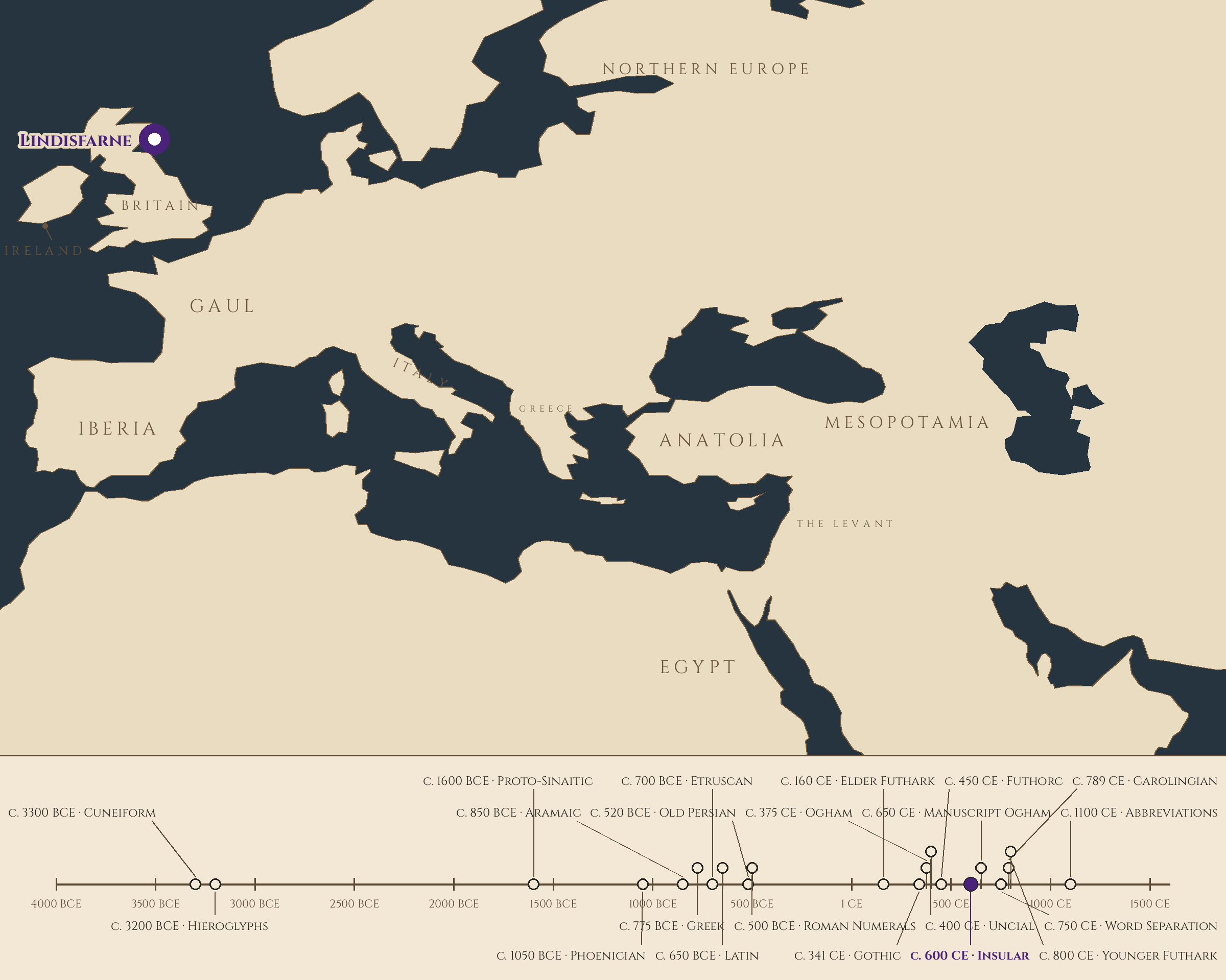
Where and when: Ireland and Britain, between about 600 and 900 CE. The pin is this lesson. The line beneath the map is our road: every stop a writing system, every lesson a pin.
Lesson Objectives
By the end of this lesson, students should be able to:
- Define Insular script, Insular half-uncial, Insular minuscule, diminuendo, and wedge-shaped ascender.
- Explain what "Insular" means and where and when the script developed (Ireland and Britain, c. 600 to 900 CE).
- Describe how Insular script grew from Roman uncial and half-uncial through Irish and Northumbrian monastic culture.
- Identify the script's distinctive letterforms and layout features: wedge-shaped ascenders, wide bows, large dotted initials, and diminuendo.
- Explain the quill pen's role in shaping the Insular hand.
- Name the five great Insular manuscripts, with their dates and present holdings: the Cathach of St Columba, the Book of Durrow, the Echternach Gospels, the Lindisfarne Gospels, and the Book of Kells.
- Explain why Insular script is a family of forms rather than one fixed alphabet, and describe Julian Brown's five grades of formality.
- Apply the course question in a new form: what must be added when the words are sacred?
Reading this lesson: ★ marks the passages to remember. They return on the unit quiz and the class test. Check in questions ask the material back as you go; answer them in your workbook when you meet them.
Working this lesson: Your assignment packet is the first download on this page. Work in it as the lesson moves along, answering each assignment as its subject is taught — or read the lesson through for your notes and take the assignments as homework afterward. Both are proper ways to sit this class. Signposts in the reading tell you where each assignment belongs. Written answers are short answers in your own words; a few honest lines are worth more than a filled page.
Your Assignment Packet
This lesson's assignments live in its packet: the Lexicon Handout (every term, course terms marked ◆), Materials, Guided Practice, the Assignment Manual with its answer key for self-checking, the Reflection Questions, and the Workbook Checklist. Download the packet before you begin and keep it beside you as you read.
The Islands That Wrote
To understand Insular script, begin with the islands, because the name is the geography. "Insular" comes from the Latin insula, meaning island. The script belongs to Ireland and Britain, the Atlantic islands at the northwestern edge of the former Roman world, and it belongs to a particular three centuries: roughly 600 to 900 CE, the age of the great Irish and Northumbrian monasteries.
Ireland had never been conquered by Rome. Christianity arrived there in the 5th century, and with it came Latin, the language of the church, and the Roman alphabet, the church's script. But Ireland received these things on its own terms. Without a Roman administration to impose standard book hands, Irish monks learned uncial and half-uncial from whatever manuscripts reached them and then developed the script in their own direction, in hundreds of monastic workshops, over generations.
The result was not a copy of Rome. It was a reinvention.
★ The monastic network that drove this was Columban. St Columba, Colum Cille in Irish (521 to 597), founded the monastery of Iona off Scotland's western coast in 563, and the houses of his federation, Durrow among them, became the great centers of book production.
Monks copied psalters, Gospels, and commentaries for use in worship and study, and as they copied, their hands changed the letters.
Meanwhile, in England, a second stream was flowing. Augustine of Canterbury arrived in 597 with the Roman mission and brought uncial script to the English church. But the north of England was evangelized from Iona: Aidan founded Lindisfarne Abbey in 635, and the Hiberno-Scottish mission carried Irish book culture into Northumbria.
At Lindisfarne and its daughter houses, the two traditions met. Irish-trained scribes and Roman-trained scribes worked side by side, and their hands influenced each other. The product of that meeting is the mature Insular script of the great Gospel books: Irish in its bones, enriched by everything the Roman books had taught.
This is worth pausing over, because it corrects a tidy assumption. Scripts do not always travel from empire to province and stay put. Here the province took the empire's letters, transformed them over two centuries of monastic copying, and then carried the transformed script back onto the continent with Irish and English missionaries.
The Echternach Gospels, made at Lindisfarne around 690, ended up in the missionary foundations of the continent. The islands exported their hand.
Check in: "Insular" names a geography before it names a style. Which islands does the script belong to, and across which three centuries did it develop?
❦ In your workbook: record the islands that wrote in your own way — copy, sketch, or note what matters.
The Hand Itself
Now look at the letters, because Insular script announces itself before you read a word.
★ The most immediate feature is the ascenders. In Insular hands, the tall letters, b, d, h, l, and their companions, rise to triangular or wedge-shaped tops. The shape is a direct product of the tool. Insular scribes wrote with quill pens, feather pens from goose or swan, not the reed pens of the Mediterranean tradition.
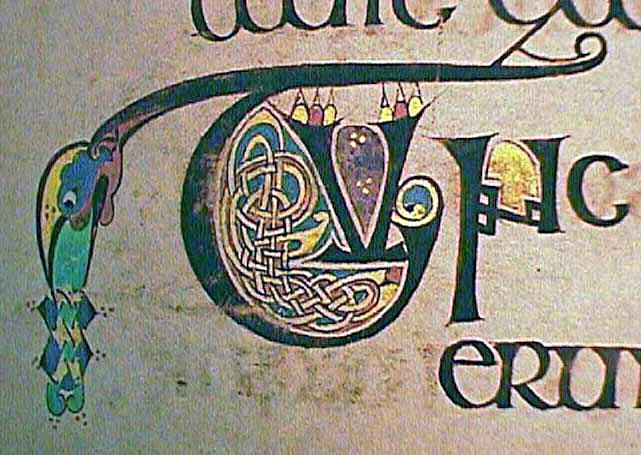
Historical example. A decorated initial from the Book of Kells (folio 74r): the TU of 'Tunc accedentes discipuli,' 'Then the disciples came,' swollen into ornament, c. 800.
Book of Kells, fol. 74r — detail: the decorated initial of 'Tunc'. Public domain, via Wikimedia Commons.
The quill's nib is flexible and broad; the scribe begins the upward stroke pressing the full width of the nib onto the vellum and lifts as the stroke climbs, and the ink trails off into a wedge. Every wedge-shaped ascender on an Insular page is a fossil of that gesture, repeated thousands of times.
The bows of the round letters are very wide. The b, d, p, and q of Insular script open into broad, generous curves, rounder and more spacious than their continental cousins. The overall impression is of a script that breathes: round, open, unhurried.
Then there is the decoration, because Insular scribes did not separate writing from ornament. Large initial letters open paragraphs and sections, and they are commonly surrounded by red ink dots, a halo of stippling that makes the letter glow on the page. The red dots are practical as well as beautiful: they mark the reader's place in a text with no chapter numbers.
★ And then the diminuendo. After a large decorated initial, the following letters do not simply return to text size. They decrease gradually, each letter a little smaller than the last, stair-stepping down the line or down the page until normal size is reached. The effect is unmistakable once you have seen it, and it is a distinctive Insular innovation, attributed in scholarship to the analysis of Carl Nordenfalk.
Its earliest Irish appearance is in the Cathach of St Columba, around the year 600. In the Book of Kells, two centuries later, diminuendo passages are among the most inventive pages in the book.
The script also loves ligatures and abbreviations. Insular scribes joined letters freely and borrowed shorthand signs from the Tironian notes, the Roman system of scribal abbreviation. A page of Insular minuscule — the smaller, faster Insular hand used for everyday monastic writing: glosses, notes, and ordinary books — can look dense to the modern eye, but every compression served the same purpose as every ornament: the words mattered, and the hand honored them.
★ One more correction before we move on, because students often arrive with it. Insular script was not one single alphabet used identically everywhere. It was a family of related forms, varying by region, monastery, and century, and by formality of purpose.
The palaeographer Julian Brown identified five grades of decreasing formality, from the grand Insular half-uncial, the "Irish majuscule" of the great Gospel books, down through the grades of minuscule to the quick cursive of everyday notes. A charter scribe and a Gospel scribe both wrote Insular script, but they did not write the same hand. Learn to see the family, not just the famous members.
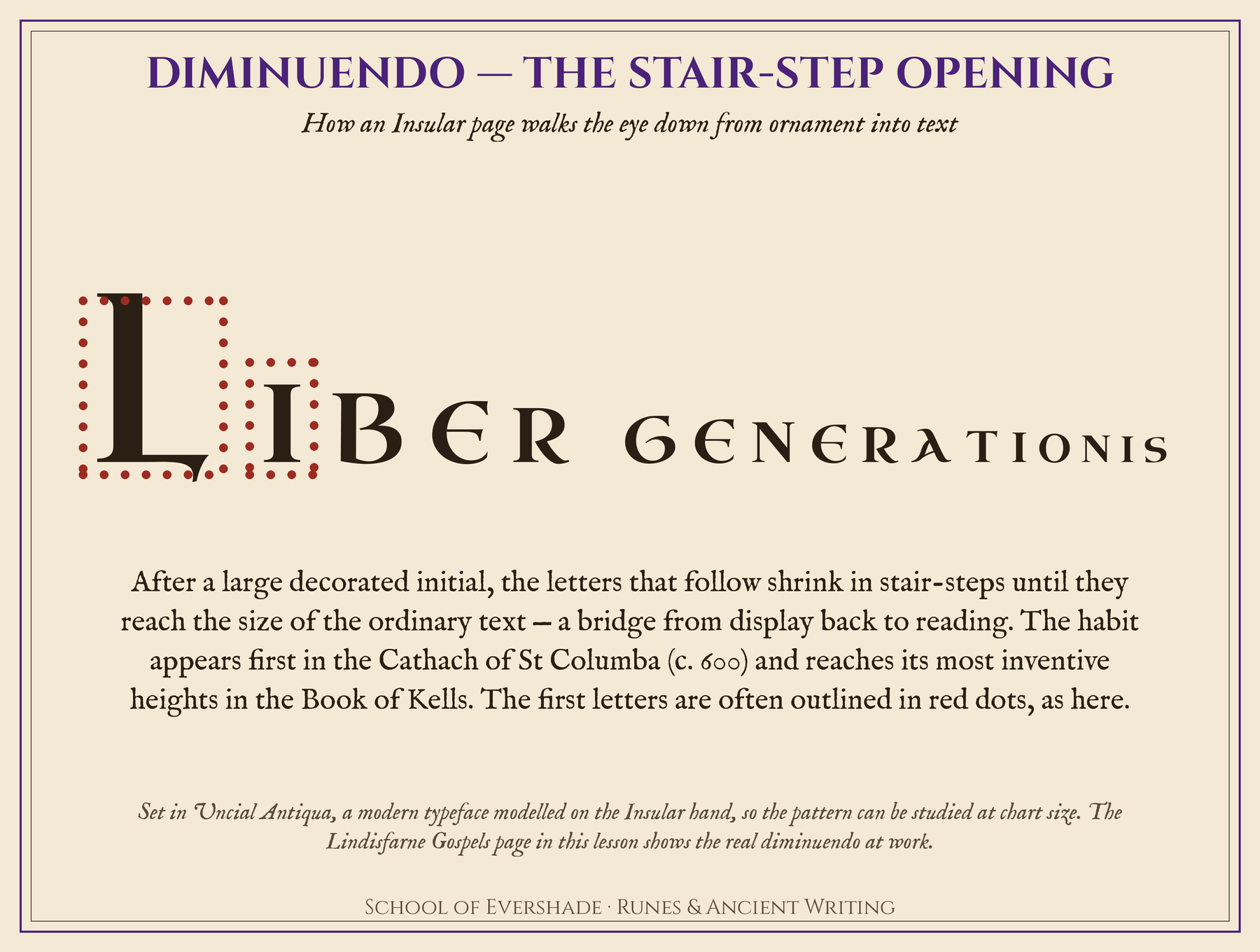
Diminuendo: after the great initial, the letters stair-step down to the size of the text — LIBER GENERATIONIS, the opening of Matthew. The Lindisfarne page below shows the real hand doing it.
Built for Evershade.
Check in: Run your eye down a column of tall letters — b, d, h, l. What shape tops them, and what gesture of what tool leaves that shape behind?
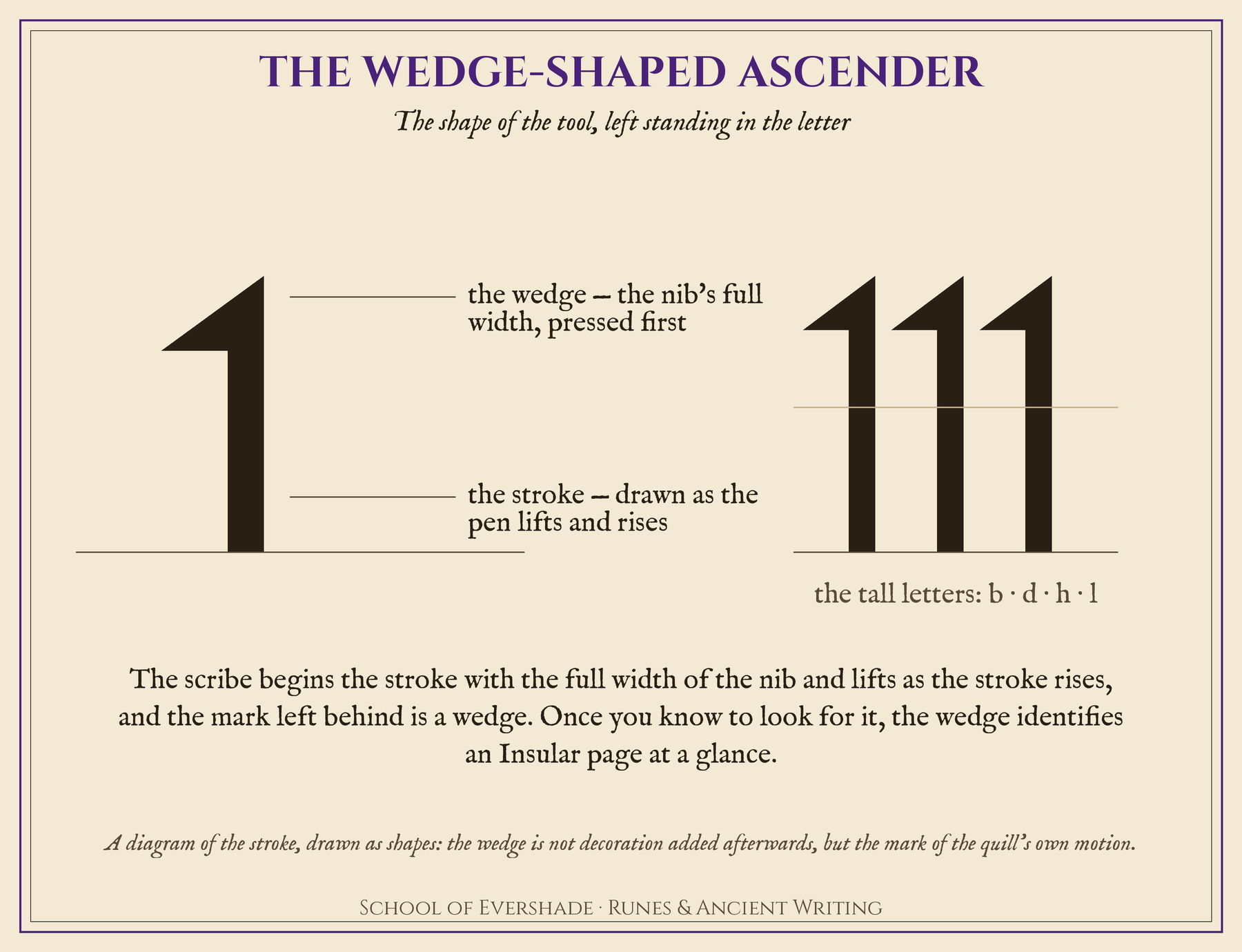
The wedge-shaped ascender: the scribe begins the stroke with the full width of the nib and lifts as the stroke rises. Learn to see the wedge, and an Insular page names itself at a glance.
Built for Evershade.
❦ In your workbook: record the Insular hand itself in your own way — copy, sketch, or note what matters.
In your packet: Assignment II — The Diminuendo Page ⚒ begins here. Work it now, or mark the place and take it as homework — your choice.
Professor Webblethorn
Pause here, scholars, and turn the course question toward the sacred.
Every lesson until now has asked what can be left out, or its twin, what must be added, or the bishop's question, what must be borrowed. The miners left out the pictures. The Greeks added the vowels. Ulfilas borrowed the frame.
The island scribes asked a fourth question: what must be added when the words are sacred? They inherited a working script. Uncial wrote perfectly well. Nothing needed fixing. And yet they changed it, deliberately, over generations: the wedge-shaped ascenders, the wide bows, the red-dotted initials, the diminuendo stair-steps. None of it was necessary for reading. All of it was necessary for reverence.
Consider what that means. Every other script in our course was shaped by necessity: by the knife, the reed, the empire, the market. Insular script was shaped by devotion. The monks had time, they had vellum, they had quills, and they had the conviction that the Gospels deserved more than a plain hand. So they gave the letters beauty the way you would dress an altar: not because the altar requires it, but because the holy deserves it.
Hold both truths together. Writing is technology, and writing is offering. The island hand is what happens when the technology becomes the offering, and the scribe's long hours become a form of prayer.
Keep the silk thread in your hand. It has crossed the sea now, and on the far shore the letters are wearing red dots like dew.
PROFESSOR THISTLELOOM WEBBLETHORN
Runes & Ancient Writing
Epigrapher, Head of House Septentrio
The Great Books
Five manuscripts carry this lesson. Know them the way you know the scripts: by name, by date, by where they rest now.
★ The oldest is the Cathach of St Columba, a psalter dated to about 600. Its name means "Battler," because later generations carried it into battle as a talisman, a holy object believed to protect its bearers. It is traditionally ascribed to St Columba himself, said to have been copied by night in haste by miraculous light, though modern scholarship doubts his authorship.
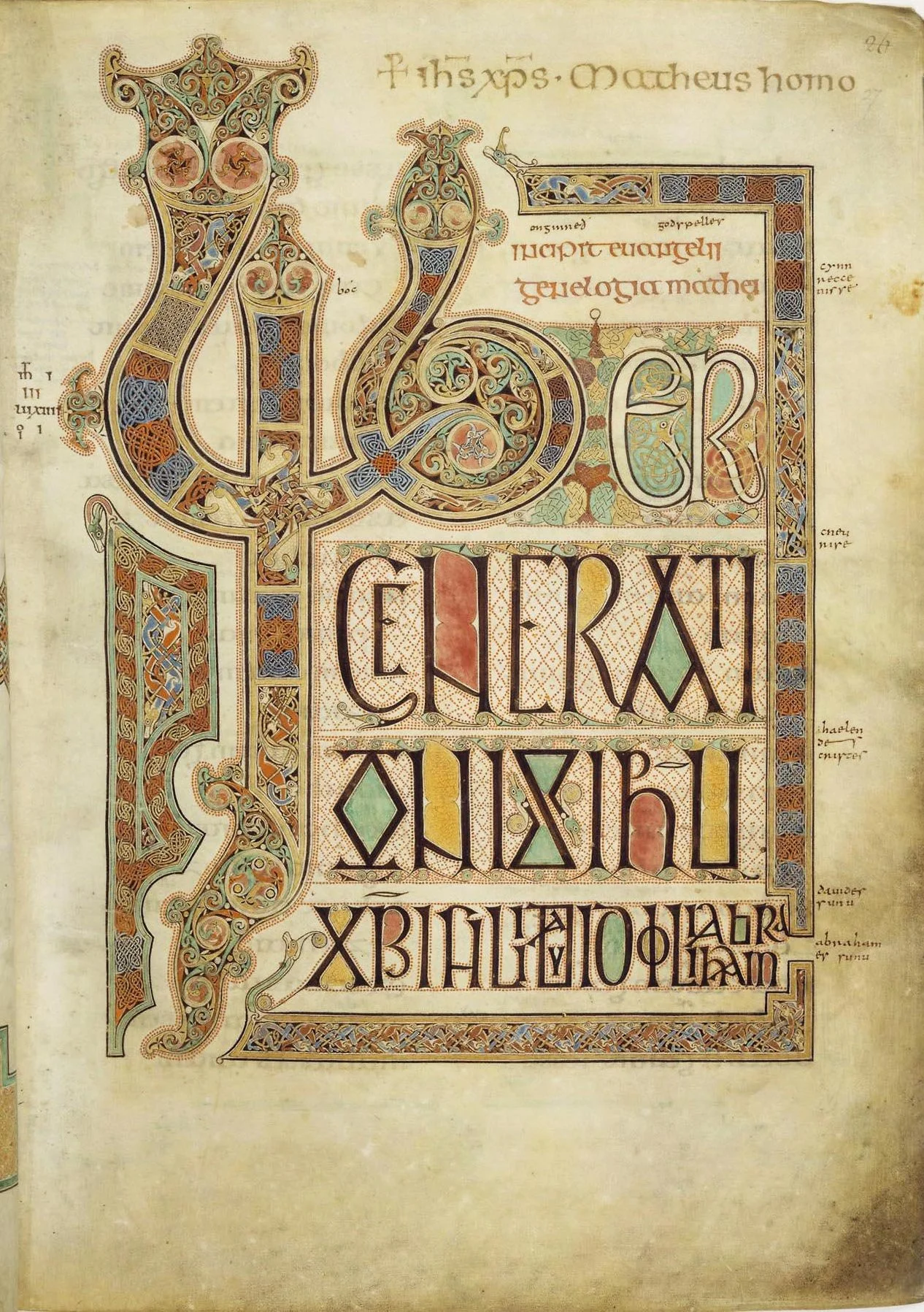
Historical example. The Lindisfarne Gospels, folio 27r: 'Liber generationis,' the opening of Matthew in the great Insular hand, the letters stepping down from the initial in diminuendo. Bishop Eadfrith's work, c. 700.
Lindisfarne Gospels (British Library, Cotton MS Nero D IV), fol. 27r — the opening of Matthew. Public domain, via Wikimedia Commons.
What is certain is the script: Insular half-uncial, and the earliest Irish diminuendo, the large initials followed by shrinking letters, already present at the tradition's dawn. It has been held by the Royal Irish Academy in Dublin since 1843.
The Book of Durrow follows in the second half of the 7th century, an illuminated Gospel book among the earliest of the great Insular Gospel manuscripts. Its carpet pages, full pages of interlaced ornament with no text at all, and its decorated initials show the Insular style already mature within a century of the Cathach. It rests at Trinity College Dublin.
The Echternach Gospels, made around 690 presumably at Lindisfarne Abbey, tell the travel story. The book was carried to the continent by the missionary movement and now rests at the Bibliothèque nationale de France (MS lat. 9389). When you look at its pages, you are looking at the island hand on foreign soil, proof that the script the monks made at home went with them abroad.
★ The Lindisfarne Gospels, made around 700 at Lindisfarne Abbey, are the work of a single scribe-artist, Eadfrith, who wrote and decorated the book. They show Insular half-uncial at its most accomplished: the wedge ascenders, the diminuendo, the interlace, the carpet pages, all in full flower. They are held by the British Library (Cotton MS Nero D IV).
★ And the Book of Kells, made around 800 in a Columban monastery of the Iona tradition, is the most famous of them all and the tradition's high point. Its decoration is the most elaborate of any Insular book: full-page illuminations, carpet pages, diminuendo passages of extraordinary inventiveness, and ornament so dense that scholars still find new details. It rests at Trinity College Dublin.
Two centuries separate the Cathach from Kells. Lay them side by side in your mind: the same half-uncial bones, the same diminuendo habit, the same wedge-shaped ascenders, but everything the later book does, it does more richly. The tradition did not stand still. It deepened.
A note on survival, because it matters for the story. These books survived because monasteries kept them, because later generations recognized their holiness and their beauty, and sometimes, as with the Cathach, because they were carried as talismans rather than read as texts.
The script lived as long as the monastic culture that made it: into the 9th century for the great books, and in England and Ireland the Insular hands persisted into the 10th century, outlasting Charlemagne's reform on the continent. The islands kept their hand long after the empire standardized its own.
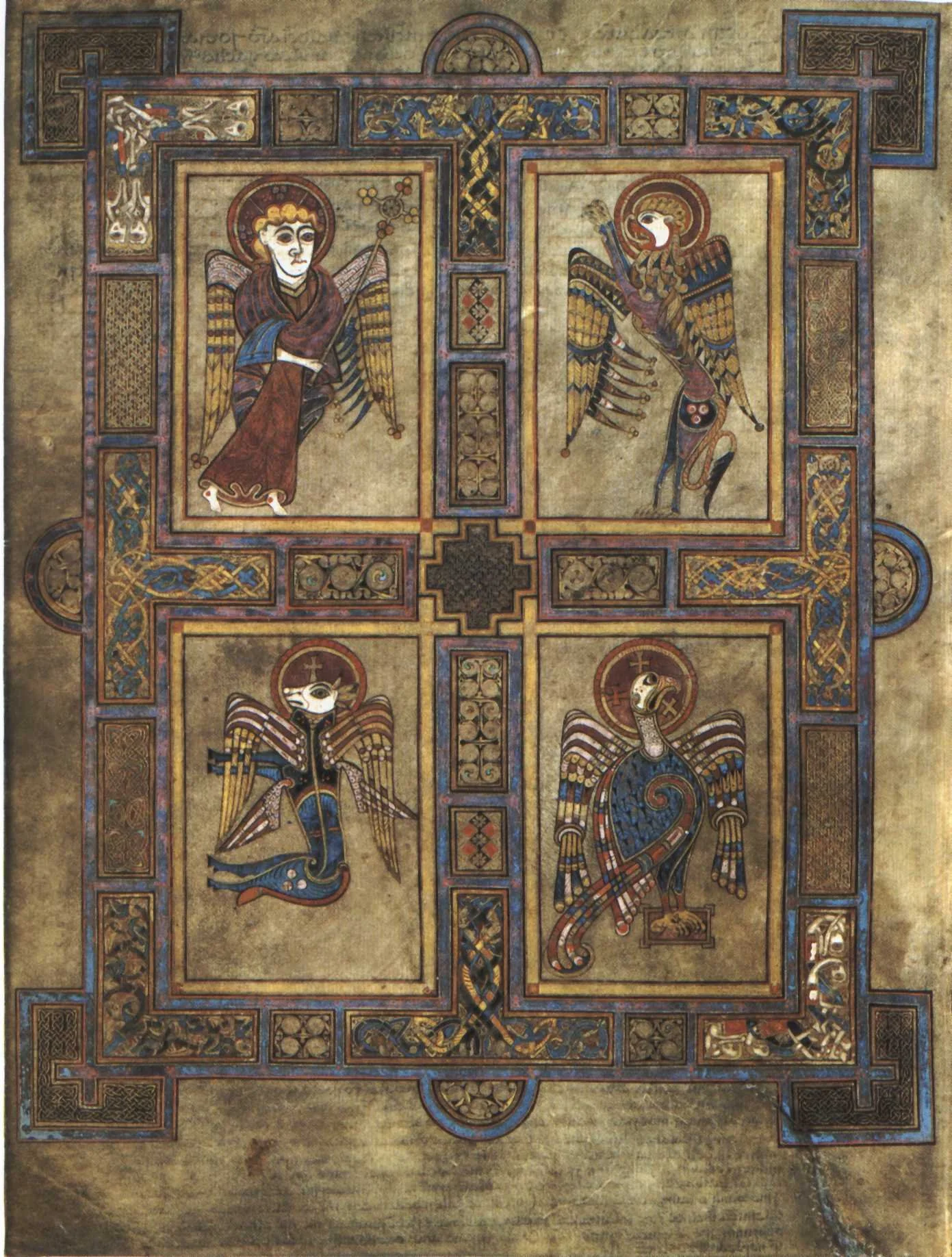
Historical example. The Book of Kells, folio 27v: the four evangelist symbols in their frame of interlace, c. 800 — the tradition's high point.
Book of Kells (Trinity College Dublin, MS 58), fol. 27v — the four evangelist symbols. Public domain, via Wikimedia Commons.
Check in: Five books carry this lesson. Which one first shows diminuendo in Ireland, and which is the tradition's high point — and where does that one rest today?
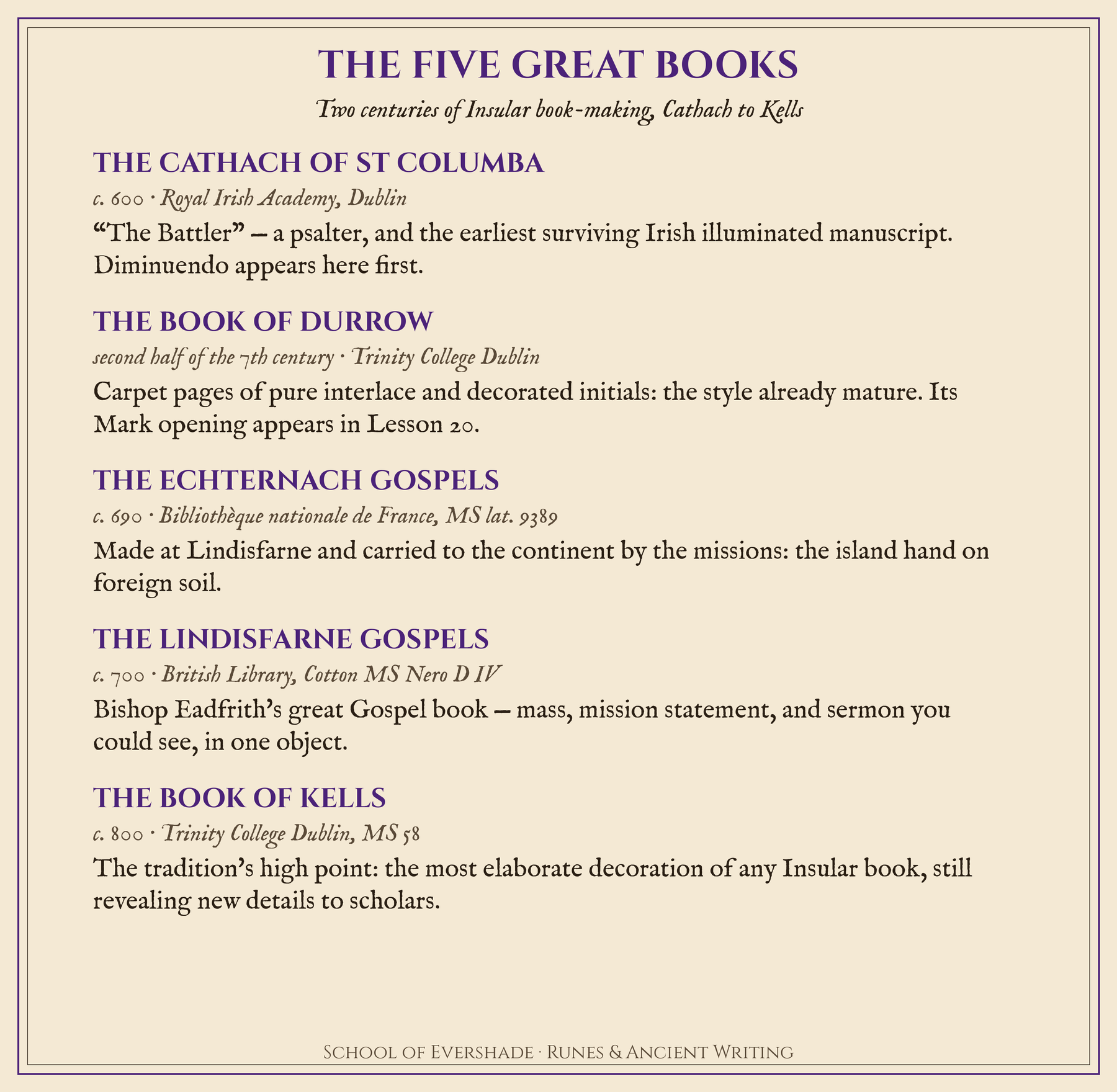
The five great books: from the Cathach of St Columba (c. 600) to the Book of Kells (c. 800) — two centuries of Insular book-making.
Built for Evershade.
❦ In your workbook: record the five great books in your own way — copy, sketch, or note what matters.
In your packet: Assignment III — The Manuscript Investigation ◐ begins here. Work it now, or mark the place and take it as homework — your choice.
A Family Across the Water
Step back now and see the whole shape of the lesson.
Insular script is the course's great regional answer. Every script we have studied was shaped by its conditions: the Mesopotamian wedge by the stylus and the clay, the runes by the knife and the wood, the Greek vowels by the demands of the language. Insular script was shaped by the monastery: by the quill, the vellum, the long hours, and the conviction that sacred words deserve a sacred hand.
It is also the course's great proof that scripts have lives. Born from Roman uncial around 600, matured in the Columban and Northumbrian houses, carried back to the continent by missionaries, persisting in the islands into the 900s, the Insular hand lived for three centuries and left the most beautiful books of the early Middle Ages.
It did not conquer. It did not standardize. It illuminated, in both senses of the word.
And it left a mark on what came after. The diminuendo habit influenced continental illumination. The Insular minuscule's abbreviations and letterforms traveled with the missionaries into Frankish scriptoria. When the Carolingian reformers of the next lesson built their new standard, they built it in a world where the island hand had already shown what a Latin script could become in devoted hands.
Our course question finds its gentlest answer here. What must be added when the words are sacred? Beauty. Time. Care. The red dots around the initial, the stair-step of shrinking letters, the wedge lifted off the quill at the top of every tall stroke. Nothing the words needed. Everything the words deserved.
❦ In your workbook: record the family across the water in your own way — copy, sketch, or note what matters.
Guided Practice — The Island Hand
Before the assignments, train your hand the way the island scribes would: with a broad nib, and with patience.
Exercise A — The Wedge Ascenders
- With a broad-nib marker or calligraphy pen, practice the tall letters b, d, h, and l. Begin each ascender pressing the full width of the nib down, then lift as the stroke rises, letting the line narrow into a wedge.
- Write a full alphabet line in this manner, keeping the bows of b, d, p, and q wide and round.
- Compare your page with an ordinary hand. Write two to three sentences on what the wedge-shaped tops do to the texture of the page: do they make it feel more formal, more rhythmic, more deliberate?
Exercise B — The Diminuendo
- Choose a word of at least six letters (for example, your own name, or the word "GOSPEL").
- Write the first letter very large, at least two inches tall, and decorate it with red dots around its outline.
- Write each following letter slightly smaller than the last, stair-stepping down until the final letter is normal text size.
- Write two to three sentences on the effect: what does the shrinking do to your eye as it moves from the ornament into the word? This is the Nordenfalk effect, twelve centuries old, working in your hand.
❦ Workbook path: work the diminuendo word down a workbook page instead of a loose sheet: the decorated initial, the red dots, and the stair-step descent all in the workbook, so the page itself keeps the record.
Exercise C — The Quill's Lesson
- If you have a feather quill (see Materials, Level Two), cut or use it as-is and write the sentence "The quick brown fox" with it. If not, use a broad-nib pen held at a flat angle, thick downstrokes and thin horizontals.
- Write the same sentence with an ordinary ballpoint.
- Write a half page comparing the two: which tool made the wedge shapes naturally, and which fought them? What does this tell you about how tools shape scripts, the lesson we have been learning since the clay tablet?
In your packet: Assignment I — The Island Letter Chart ⚒ begins here. Work it now, or mark the place and take it as homework — your choice.
In your packet: Assignment IV — The Devotion Essay ✎ begins here. Work it now, or mark the place and take it as homework — your choice.
Assignment Manual
Assignment key: ✎ written work · ⚒ hands-on practical · ◐ both · ★ will be on the test · ❦ workbook path
Written answers in this manual are short answers in your own words — a few honest lines, not a filled page.
Assignment I — The Island Letter Chart ⚒ ★
Objective: Demonstrate control of the Insular letterforms and their distinguishing features.
Instructions:
- On a fresh sheet, create a five-column chart: letter (drawn), letter name, distinctive Insular feature (wedge ascender, wide bow, descending form, etc.), continental uncial comparison (how the Roman parent looked), one sentence on what changed.
- Complete rows for at least twelve letters, including b, d, f, g, h, l, r, s, and t. For each tall letter, draw the wedge-shaped ascender; for each round letter, draw the wide bow.
- Below the chart, write one paragraph on the quill's role: which features of your chart exist because of the feather pen, and which would a reed pen have produced differently?
Your keepsake: this chart is your field guide to the island hand. Keep it beside your uncial chart from last lesson; the parent and the child belong side by side.
❦ Workbook path: build the chart across two facing workbook pages instead of a loose sheet, the letters and features on the left page and the continental comparisons on the right.
To submit: Photograph or scan your chart. The wedge shapes matter more than artistic skill; press and lift, as the lesson teaches.
Assignment II — The Diminuendo Page ⚒ ★
Objective: Practice the Insular layout arts: the decorated initial, the red dots, and the stair-step descent.
Part A. Choose a short sacred or meaningful sentence (a psalm verse, a line of poetry, or a sentence of your own choosing). Write its first letter as a large decorated initial, at least two inches tall, surrounded by red ink dots.
Part B. Write the rest of the sentence in diminuendo: each letter slightly smaller than the last until normal text size is reached, then continue at text size.
Part C. Write a half page reflecting on the exercise: the lesson claims diminuendo guides the reader's eye from ornament into text. Did it work on your own eye? What did the shrinking letters feel like to write, and what might that tell you about the scribe's intention?
❦ Workbook path: work Parts A and B directly in your workbook: the initial, the red dots, and the stair-step descent on one workbook page, with your Part C reflection written beneath it.
Assignment III — The Manuscript Investigation ◐ ★
Objective: Know the five great Insular books as physical objects with histories.
Instructions:
- Research (using the References below): the Cathach of St Columba, the Book of Durrow, the Echternach Gospels, the Lindisfarne Gospels, and the Book of Kells. For each, record the date, the place of making (as far as known), the present holding institution, and one distinctive feature.
- The Cathach was carried into battle as a talisman; the Echternach Gospels were carried to the continent by missionaries. Write a half page on what these two journeys reveal about what books were in Insular culture: not just texts, but objects with power and purpose beyond reading.
- Two centuries separate the Cathach (c. 600) from the Book of Kells (c. 800). Choose one feature (diminuendo, initials, interlace, or letterforms) and trace its development across that span using the five manuscripts. Write a half page showing the tradition deepening rather than standing still.
Assignment IV — The Devotion Essay ✎ ★
Objective: Evaluate the lesson's central claim about beauty and necessity.
Instructions:
Write a one-page essay addressing the following:
The lesson claims that Insular scribes changed a working script for no practical necessity: uncial wrote perfectly well, and the wedge ascenders, red dots, and diminuendo were added for reverence, not readability. First, lay out the evidence for this claim using at least three specific features from the lesson. Then consider the counterargument: could any of these features have served a practical purpose (legibility, navigation, scribal identity)? Finally, return to the course question in its Lesson 18 form: what must be added when the words are sacred? Is beauty a necessity of its own kind?
Cite the lessons where your details come from.
Materials
Required (Level One — household items)
- Paper: plain white paper or a sketchbook, for letter practice and chart work.
- A broad-nib marker or calligraphy pen: the wedge ascenders require a broad edge. A chisel-tip marker works; hold it flat to the writing line so vertical strokes are thick and horizontals thin.
- Red pen or marker: for the dotted initials. Any red pen will do; the lesson's halo effect needs only the color.
- A ruler: for chart columns and for measuring the diminuendo stair-steps.
- A printout of the Insular alphabet: use the References below for the National Museum of Ireland's Insular majuscule guide.
Suggested (Level Two — historically closer materials)
- A goose or turkey feather quill: the Insular writing tool. Prepared quills are sold by calligraphy suppliers; cutting your own from a found feather follows period practice but requires care and a sharp knife, so adult supervision is advised for the cutting.
- Iron gall or walnut ink: the dark manuscript inks. Walnut ink is the safer household choice; iron gall is the period ink but stains permanently.
- Vellum-style paper or parchment paper: the manuscript surface. Modern parchment paper from a craft store approximates the feel of prepared skin without the cost.
- Red ochre or vermilion-style pigment: for the dotted initials. A red gel pen is the practical substitute; the exercise is about the halo effect, not the chemistry.
Neither level requires
Purchased kits, specialty tools, or any material you cannot find locally or order inexpensively. The core lesson (drawing the wedge ascenders, practicing diminuendo, understanding the island hand) is fully achievable with paper and a broad marker. No swan will be plucked.
Reflection Questions
Answer the following in your workbook.
- What does "Insular" mean, and where and when did Insular script develop? Give the date range.
- How did Insular script grow from Roman uncial and half-uncial? Name the two streams that met in Northumbria.
- Describe three distinctive features of the Insular hand and explain how the quill pen produced each.
- What is diminuendo, whose scholarship is it attributed to, and in which manuscript does it first appear in Ireland?
- Name the five great Insular manuscripts with their approximate dates and present holdings.
- Why is Insular script better described as a family of forms than a single fixed alphabet? Name the scholar associated with the five grades.
- Apply the Lesson 18 form of the course question: what must be added when the words are sacred? Use two specific features in your answer.
Workbook Checklist — Lesson 18
In my workbook I have:
- ☐ explained what "Insular" means, and where and when the script developed
- ☐ explained how the script grew from uncial and half-uncial, and named the two streams that met in Northumbria
- ☐ described the wedge-shaped ascenders, the wide bows, the red-dotted initials, and diminuendo, and how the quill produced them
- ☐ named the five great Insular manuscripts with their dates and present holdings
- ☐ explained why Insular script is a family of forms, and named Julian Brown's five grades
☐ Lesson completed Date: ____________ Signature: ____________
Professor's Review
And so our eighteenth lesson closes on the Atlantic islands, where monks took the Roman book hand and made it beautiful beyond necessity.
You can now define Insular script and its place in time (Ireland and Britain, c. 600 to 900), explain its growth from uncial and half-uncial through the Columban monasteries and the Northumbrian meeting of traditions, identify its distinctive features (the wedge-shaped ascenders, the wide bows, the red-dotted initials, the diminuendo), explain the quill pen's shaping role, name the five great manuscripts with their dates and holdings, describe the family-of-forms reality and Julian Brown's five grades, and apply the course question in its sacred form.
Keep your Insular chart beside your uncial notes from last lesson. Lay them side by side and see the transformation: the Roman bones, the island flesh. The wedge ascenders, the wide bows, the stair-stepping letters. The parent wrote well. The child wrote beautifully.
Next, we cross to the continent, where Charlemagne's scholars will attempt what no one has attempted since Rome: a single standard hand for an empire of many scripts. The reformers will look at a thousand years of regional hands, including the island hand you now know, and they will ask the course question in its boldest form yet.
Practice your wedges, scholars. Press and lift, press and lift, until the triangle comes naturally. I have watched hands change across eighteen lessons now, from the stylus in the clay to the quill on the vellum, and I tell you truly: no hand loved its letters more than the island hand loved its own. The web holds dew tonight, and every drop is red-dotted.
PROFESSOR THISTLELOOM WEBBLETHORN
Runes & Ancient Writing
Epigrapher, Head of House Septentrio
Cross-Class Connections
The quill pen connects directly with Scrollwork, where Professor Nocturne teaches quill cutting and ink craft. Students studying both classes should cut a quill for this lesson's exercises and notice what the tool teaches the hand: the wedge ascenders of Insular script are the quill's signature, and no reed pen writes them.
The decorated initials, carpet pages, and interlace connect with Creative Arts, where Professor Timberclank's illumination lessons teach the same ornament as art. The Book of Kells is both a writing lesson and an art lesson; students who make will recognize the pattern.
The Irish monasteries' role in developing word separation will return in Runes Unit V, Lesson 20, when we study the Scriptorium Code. The same island scribes who gave Latin its most beautiful hand also gave readers the spaces between words. The hand and the spacing came from the same rooms.
In Other Classrooms
Scrollwork · Unit III, Lesson 10 — Cutting the Quill
Wedge ascenders are a quill's signature, and I can teach you to sign. In the Library we cut quills cut by cut, then write with them until the hand understands the tool. Come and cut a quill for your Insular exercises; the Book of Kells was written by hands that started exactly there.
The islands wrote, and so do we.
References & Further Reading
Wikipedia. "Insular script." Overview of the script family: origins, appearance, the diminuendo effect, wedge-shaped ascenders, Julian Brown's grades, and the spread to England and the continent. https://en.wikipedia.org/wiki/Insular_script
Wikipedia. "Cathach of St. Columba." The oldest surviving Irish illuminated manuscript (c. 600): its history, the "Battler" name, the diminuendo initials, and the quill technique described by Timothy O'Neill. https://en.wikipedia.org/wiki/Cathach_of_St._Columba
Wikipedia. "Book of Kells." The most famous Insular manuscript (c. 800, Columban monastery of the Iona tradition), held by Trinity College Dublin. https://en.wikipedia.org/wiki/Book_of_kells
Wikipedia. "Echternach Gospels." The c. 690 Lindisfarne-made Gospel book now at the Bibliothèque nationale de France, evidence of the island hand traveling to the continent. https://en.wikipedia.org/wiki/Echternach_Gospels
Royal Irish Academy. "The Cathach / The Psalter of St Columba." The holding institution's own pages on the oldest extant Irish manuscript: the Columba tradition, the 561 battle, and the manuscript's dating. https://www.ria.ie/collections/manuscripts/manuscripts-in-languages-other-than-irish/the-cathach-the-psalter-of-st-columba/
National Museum of Ireland. "Insular Majuscule" (calligraphy guide). A practical guide to writing Insular majuscule: the quill pen, the broad nib held parallel to the writing line, and the letterforms. Useful for the Guided Practice exercises. https://cms.museum.ie/getmedia/4c505ae3-9325-4e44-a6c5-123a912d1b28/Insular-Majuscule.pdf
Wikipedia. "List of Hiberno-Saxon illuminated manuscripts." The Lindisfarne Gospels (British Library, Cotton MS Nero D IV) and the wider Insular manuscript corpus with holdings. https://en.wikipedia.org/wiki/List_of_Hiberno-Saxon_illuminated_manuscripts
Browse the Runes shelf in the school Library for readable editions of these works.
Submit your work for this lesson using the form below.
CONTINUE IN RUNES & ANCIENT WRITING
← Previous · Lesson 17: Roman Cursive & Uncial: The Fast Hand and the Round Book Hand Next · Lesson 19: The Clear Hand: Carolingian Minuscule and the Standardized Empire →
Unit V · The Medieval Scriptorium Runes & Ancient Writing Classroom · All 21 Lessons
The rest of Unit V: Lesson 16 · The Gothic Alphabet · Lesson 17 · Roman Cursive & Uncial · Lesson 19 · The Clear Hand · Lesson 20 · The Scriptorium Code · Lesson 21 · How Scribes Left Letters Out and Readers Put Them Back