
RUNES & ANCIENT WRITING
Unit V · Lesson 17THE NEED FOR SPEED
Roman Cursive & Uncial: The Fast Hand and the Round Book Hand
Professor Thistleloom Webblethorn
Epigrapher • Runes & Ancient Writing
Head of House Septentrio • School of Evershade
Professor's Introduction

Ink from here on, scholars. Tonight we set down the knife and pick up the pen, and we do not pick it back up again. Everything after this lesson is ink.
Rome's great capitals were cut for stone and for distance — one letter at a time, to be read by a whole city at once.
Tonight the empire that started it all takes back the stage, and it brings two hands with it. One is fast: the cursive of wax tablets and letters, the handwriting of soldiers, bankers, and schoolchildren, the script of daily life. The other is round: uncial, the great book hand of late antiquity, the letters that carried the Bible and the classics through the centuries when the western empire fell.
Both were written with the same tool, and I will tell you now what that tool was, because most of you are picturing the wrong one. It was not the feather quill. Rome's scribes wrote with reeds.
Come closer to the web, scholars. The pen is about to replace the knife entirely, and writing is about to learn to run.
PROFESSOR THISTLELOOM WEBBLETHORN
Runes & Ancient Writing
Epigrapher, Head of House Septentrio
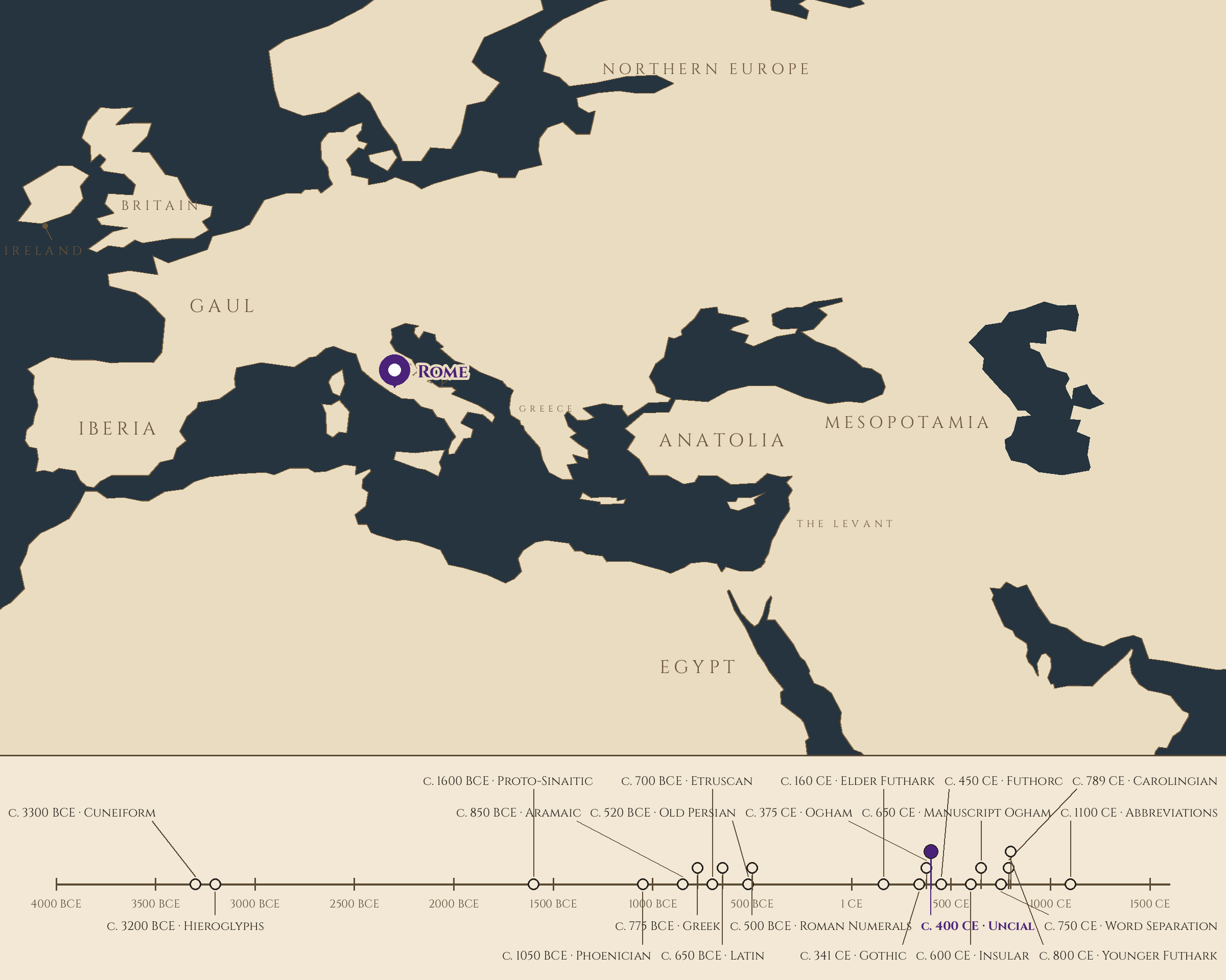
Where and when: Rome and its empire, between the 1st century BCE and the 8th century CE. The pin is this lesson. The line beneath the map is our road: every stop a writing system, every lesson a pin.
Lesson Objectives
By the end of this lesson, students should be able to:
- Define Roman cursive, uncial, half-uncial, calamus, quill, majuscule, minuscule, ductus, ligature, wax tablet, and parchment.
- Explain why Roman cursive developed, what it was written on, and why so little of it survives.
- Correct the "quills in ancient Rome" misconception: name the actual writing instrument of Roman and late-antique scribes and date the quill's arrival.
- Describe uncial: its dates, its character as a formal rounded book hand, and why "Roman capitals made round" is wrong.
- Identify the most distinctive uncial letterforms (E, M, G, D, A) in a simplified classroom chart.
- Explain scriptura continua and the several factors behind it, without ranking them.
- Describe the broad-edge pen mechanics that give uncial its roundness.
- Trace uncial's legacy: half-uncial, the Insular script to come, and the forms that fed into minuscule.
- Apply the course question in a new form: what does speed leave out, and what must the book hand keep?
Reading this lesson: ★ marks the passages to remember. They return on the unit quiz and the class test. Check in questions ask the material back as you go; answer them in your workbook when you meet them.
Working this lesson: Your assignment packet is the first download on this page. Work in it as the lesson moves along, answering each assignment as its subject is taught — or read the lesson through for your notes and take the assignments as homework afterward. Both are proper ways to sit this class. Signposts in the reading tell you where each assignment belongs. Written answers are short answers in your own words; a few honest lines are worth more than a filled page.
Your Assignment Packet
This lesson's assignments live in its packet: the Lexicon Handout (every term, course terms marked ◆), Materials, Guided Practice, the Assignment Manual with its answer key for self-checking, the Reflection Questions, and the Workbook Checklist. Download the packet before you begin and keep it beside you as you read.
The Fast Hand
Rome wrote too much for its own alphabet.
The classical capitals of Lesson 9 were magnificent and magnificent was the problem. Each letter was a small architectural project: straight lines, careful curves, serifs laid out with a brush before the chisel ever touched stone. That is the right technology for a triumphal arch. It is the wrong technology for a banker recording a hundred transactions before lunch, a soldier writing home from the frontier, or a schoolchild copying a verb table for the fifth time. Formality costs time, and daily life refused to pay it.
★ So the hand did what hands do under pressure: it economized. Strokes that could be merged were merged. The pen stopped lifting between letters, and ligatures (two or more letters joined in a single stroke, sharing parts of their forms: cursive's great economy, since the ampersand itself began as a ligature of E and T; formal uncial, by contrast, uses few) bloomed. Letters shrank, leaned, and simplified, shedding the monumental construction for forms that could be produced at speed.
This is Roman cursive, and it is the most honest script in our course, because it was never trying to be beautiful. It was trying to be finished.
Scholars divide it into two phases. Old Roman cursive runs from about the 1st century BCE to the 3rd century CE: the handwriting of Cicero's secretaries, of Pompeian bankers, of the wooden tablets at Vindolanda. New Roman cursive begins in the 3rd century and runs for centuries after: rounder, more fluid, and historically the more important of the two, because it is the ancestor of the medieval minuscule scripts (scripts with ascenders, descenders, and smaller letter bodies, the ancestors of our modern upper and lower case), the great-grandparent of the lowercase letters you are reading now.
The fast hand of the empire became, in time, the book hand of the Middle Ages. Speed won.
What did they write on? Three surfaces carried most of Roman daily writing, and their fates explain why we have so little of it.
First, the wax tablet: a wooden board spread with wax, written on with a pointed stylus, erased by warming and smoothing the wax flat again. The tablet was the Roman memo pad, used for letters, accounts, schoolwork, and legal drafts.
In Pompeii, the eruption of Vesuvius in 79 CE carbonized and preserved the archive of Lucius Caecilius Jucundus, a banker: 153 tablets recording transactions from 15 to 62 CE, the paperwork of a working life, frozen mid-errand.
★ Everywhere else, the wax was melted and reused, which is the point of a reusable surface. Wax tablets survive only where someone forgot to erase them, or where a volcano intervened.
Second, papyrus: the Egyptian plant-fiber sheet, imported in vast quantities, used for letters and documents across the empire. Papyrus rots in damp climates, which means nearly all of Rome's papyrus paperwork is gone, except what Egypt's desert preserved.
The great papyrus finds, the letters and contracts and tax receipts of Roman Egypt, survived because the climate refused to let them decay, not because anyone set out to archive them.
★ Third, wood: thin slips of alder and birch, written on in ink. At Vindolanda, a Roman fort in northern Britain near Hadrian's Wall, waterlogged ground preserved hundreds of ink-on-wood letters from around 85 to 130 CE: supply requests, duty rosters, and, most precious of all, personal letters.
One of them, Tablet 291, is a birthday invitation from Claudia Severa to her friend Sulpicia Lepidina: "I give you a warm invitation to make sure that you come to us, to make the day more enjoyable for me by your arrival." It is among the earliest known examples of Latin written by a woman's hand.
A fort on the edge of the empire, a woman's party invitation, a script in a hurry: this is cursive's true habitat.
Notice the pattern. Stone survives because stone is stubborn. Ink on wax, papyrus, and wood survives only by accident: a volcano, a desert, a bog.
The formal scripts look dominant in the record because their materials refused to die. The fast hand was probably the most-written script in the Roman world, and it is the least preserved, because its materials were designed to be reused, or simply to rot. When you read our course, remember that absence of evidence is not evidence of absence. The empire's real handwriting mostly vanished with the empire's real paper.
Our course question finds its sharpest form here. Cursive asks: what can the hand skip and still be read? The answer, worked out in millions of hurried transactions, was: a great deal. Formal construction, pen lifts, consistent forms, all sacrificed to speed, and the readers kept up. The hand learned to leave things out, and understanding survived.
Check in: Roman cursive was probably the most-written script in the Roman world. Why, then, do we have so little of it?
❦ In your workbook: record Rome's fast hand in your own way — copy, sketch, or note what matters.
In your packet: Assignment II — Transliteration and the Fast Hand ⚒ begins here. Work it now, or mark the place and take it as homework — your choice.
The Reed Pen
Now the correction I promised, because it matters more than it sounds.
Picture a Roman scribe. Most students picture a figure hunched over parchment (animal skin prepared as a writing surface: cleaned, stretched, scraped, and dried; tougher and more durable than papyrus, the dominant book material of late antiquity and the Middle Ages, its finest grade called vellum), a white feather quill in hand, scratching away. The image is vivid, familiar, and wrong by half a millennium.
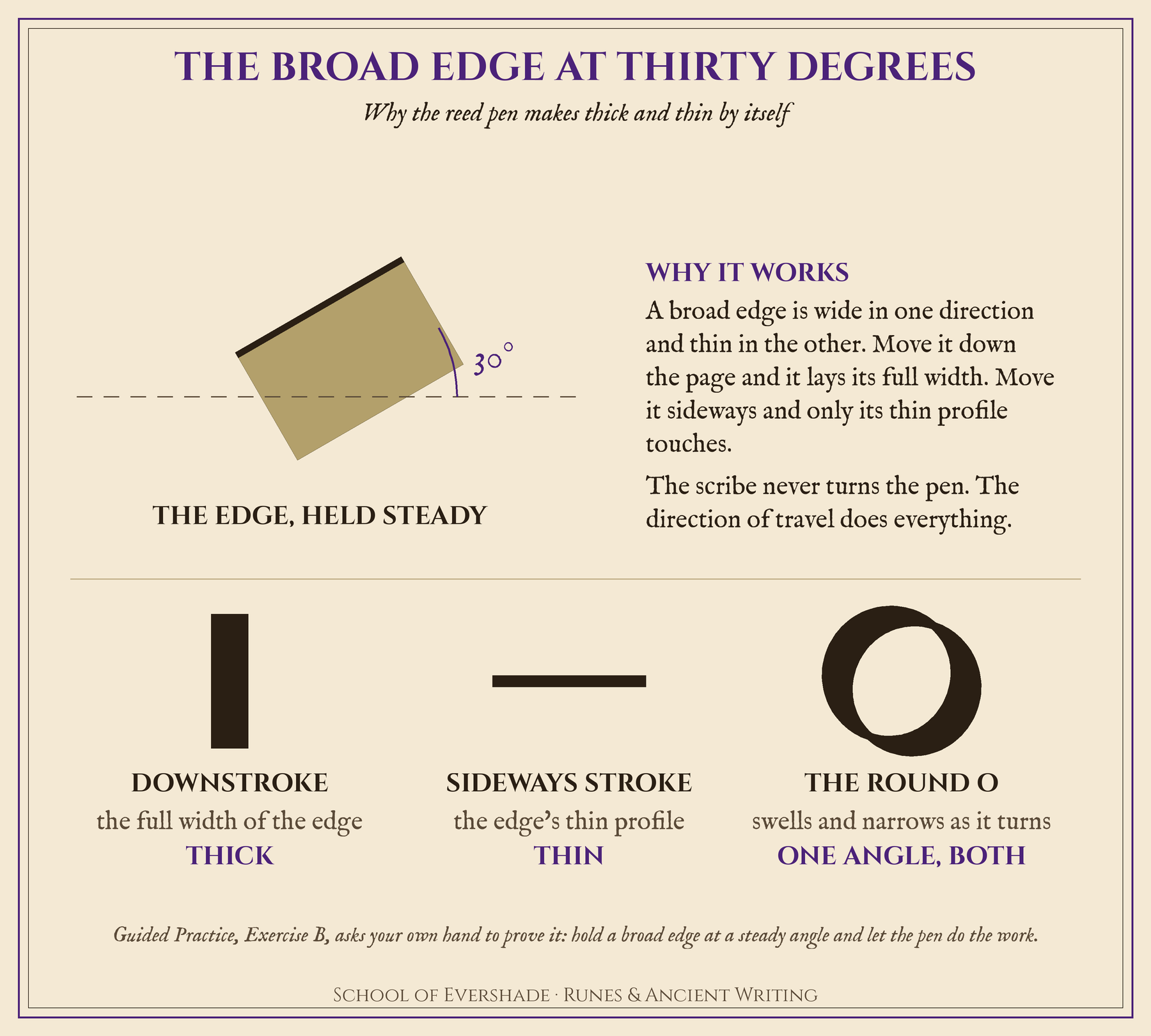
The broad edge at thirty degrees: one held angle, and the pen itself makes the thick stroke going down and the thin stroke going sideways. Guided Practice, Exercise A, asks your own hand to prove it.
Built for Evershade.
Roman scribes wrote with reeds.
★ The calamus, the reed pen, was the standard writing instrument of the ancient Mediterranean and remained standard through late antiquity. A length of reed or bamboo, cut to a point or, for book hands, to a broad angled edge. The uncial scribes of the 4th and 5th centuries, writing the great Bibles in their rounded letters, held reed pens. The cursive writers at Vindolanda held reed pens. Everyone in this lesson so far held a reed pen. The feather quill does not belong in this picture.
★ The quill arrived in the 6th century, becoming the primary instrument in the post-Roman kingdoms, and some authorities place its general adoption as late as the 7th. Either way, it came late in uncial's life: the rounded book hand was already centuries old, shaped entirely by the reed, before feathers entered the scriptorium.
The quill then replaced the reed pen gradually, especially on parchment, where its finer and more flexible point suited the smooth skin, and it went on to rule European writing for a thousand years, until the steel nib. But uncial is a reed-pen script. Every rounded arch in it was made by a cut piece of river plant.
Why does the tool matter? Because the tool is the letterform. A reed pen cut with a broad angled edge makes thick strokes in one direction and thin strokes in another, automatically, with no effort from the writer beyond holding the angle steady.
Downstrokes swell; horizontals whisper. Curves turn thick into thin and back again as the pen rounds the bend. Uncial's famous roundness, the full-bodied O, the swelling bowls, the generous curves, is not a style choice laid on top of the letters. It is what a broad-edged reed does when a trained hand keeps it moving. The mechanics are the aesthetics.
Change the pen and you change the alphabet, which is exactly what happened when the quill arrived and the hands began to change with it.
So correct the picture. The Roman scribe holds a reed, cut at an angle, dipped in carbon or iron-gall ink. The feather comes later, with the monks of the early Middle Ages, and it brings its own scripts with it. Tools have chronologies too, and this one is worth getting right, because every letterform in the next section was decided by a plant.
Check in: A scribe is copying a great Bible in the year 450. What is actually in his hand — and when does the feather quill arrive to replace it?
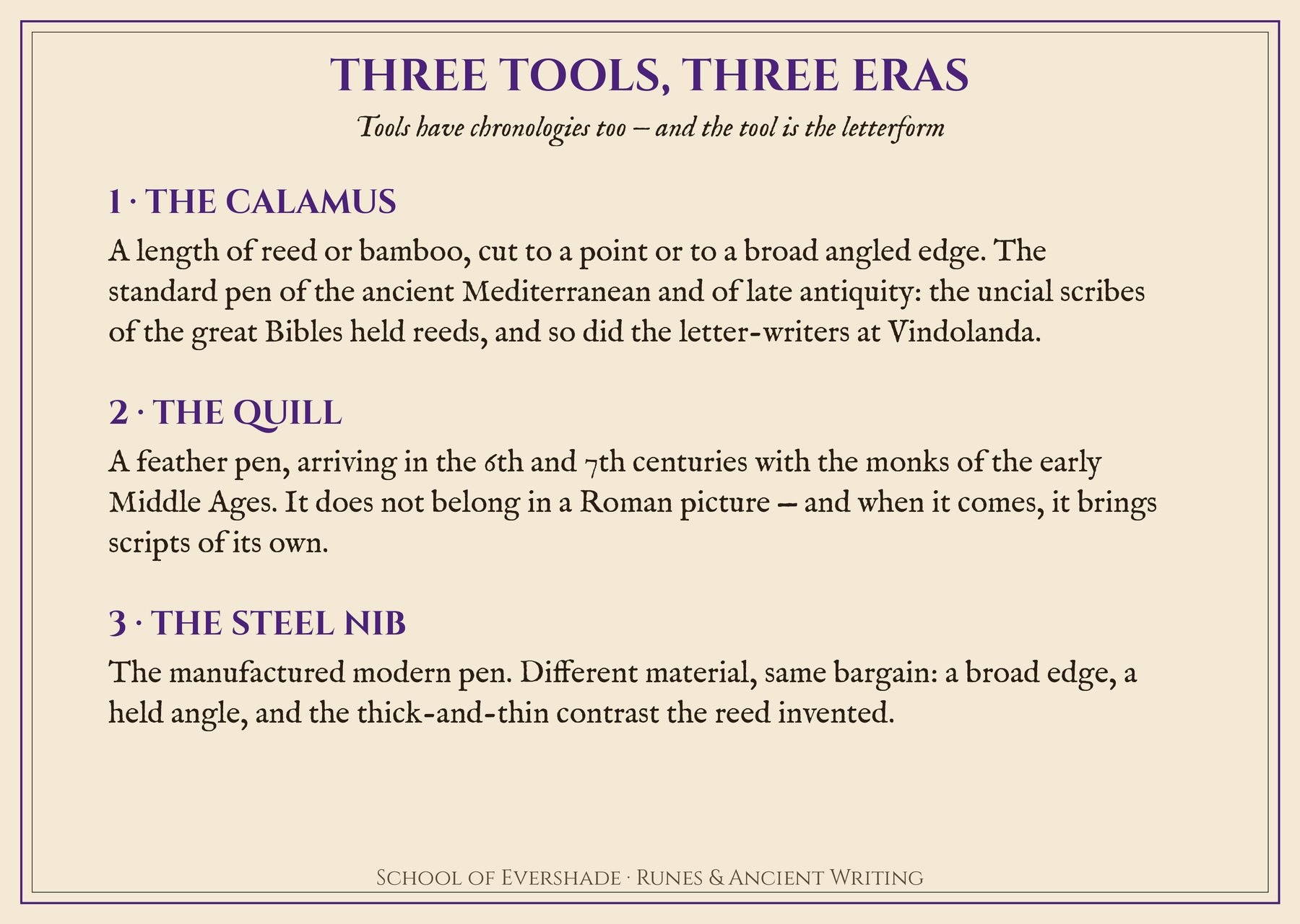
Three tools, three eras: the reed of the ancient world, the quill of the early Middle Ages, the steel nib of the manufactured pen. The uncial scribes held reeds — the quill does not belong in their picture.
Built for Evershade.
❦ In your workbook: record the reed pen in your own way — copy, sketch, or note what matters.
In your packet: Assignment IV — The Quill Myth Essay ✎ begins here. Work it now, or mark the place and take it as homework — your choice.
Professor Webblethorn
Pause here, scholars, and hold the two hands side by side.
Cursive asked what the hand could skip. The answer was almost everything: the formal strokes, the pen lifts, the consistent shapes. Speed strips writing to its minimum, and the minimum turned out to be enough.
Uncial asked the opposite question: what must be kept? The answer was roundness, clarity, and rhythm, letters large enough to be read by lamplight a century later, forms distinct enough that no tired eye would confuse them. The book hand keeps what the fast hand throws away, and it keeps it on purpose.
Both hands held the same reed. The difference was never the tool. It was the intention: one wrote for the moment, the other for the centuries. And here is the thread to carry forward. Every script we meet from now on will sit somewhere between those two poles, between the hurry and the permanence, and the whole Middle Ages is the story of scribes negotiating that distance.
The reed is in your hand now, scholars. Notice how it wants to move.
PROFESSOR THISTLELOOM WEBBLETHORN
Runes & Ancient Writing
Epigrapher, Head of House Septentrio
The Rounded Book Hand
With the fast hand understood, meet the hand that was built to last.
Uncial is the great book script of late antiquity: a formal, rounded hand used for Latin and Greek from roughly the 4th to the 8th century CE. It wrote the Latin Bible in its Vulgate translation. It wrote the Greek New Testament, including the Codex Sinaiticus, the 4th-century manuscript that preserves the oldest complete New Testament we have, written in Greek uncial on parchment and now held chiefly by the British Library. It wrote classical texts through the centuries when the western empire was coming apart.
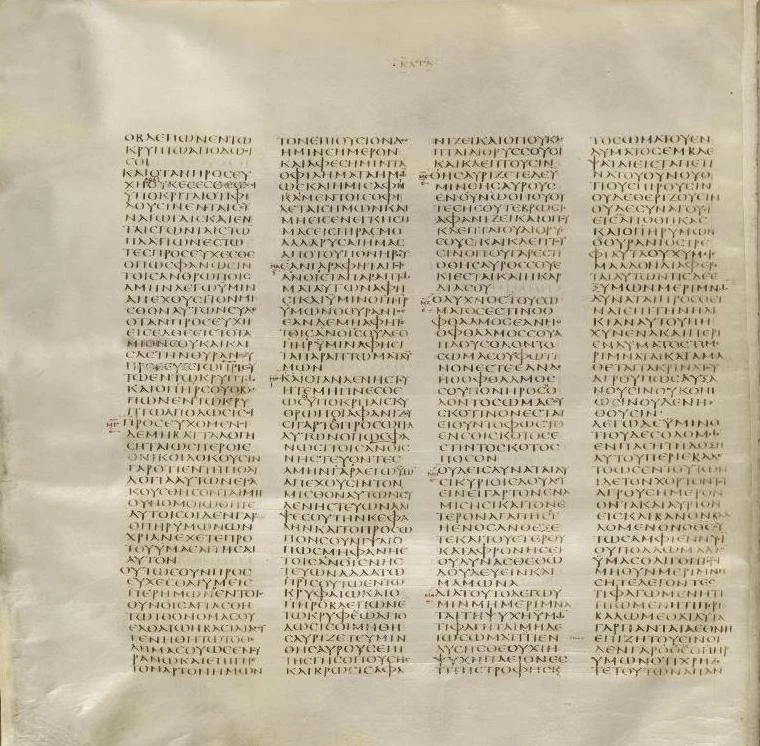
Historical example. A page of the Codex Sinaiticus — Matthew's Gospel in Greek uncial, four columns of it, written in the 4th century. Look for the sacred names shortened and spanned by a line: the nomina sacra, which Lesson 21 will decode.
Codex Sinaiticus, Matthew 6:4–32 — Greek uncial, 4th century. Public domain, via Wikimedia Commons.
When we say that literature survived the fall of Rome, we mean, in large part, that uncial scribes kept copying it.
The name is a later invention: scholars of the 1600s took it from the Latin for "inch," describing the large letters. The scribes themselves would not have recognized the word. They would have recognized the work: large, clear, rounded letters, written between two lines with few ascenders or descenders, in a script with no lowercase, what paleographers call a majuscule (large letters written between two lines, from the Latin for "somewhat greater"), one case only.
★ Now the misconception to clear at the door, because it is the natural mistake and nearly everyone makes it. Uncial is not Roman capitals made round. It is not the inscriptional alphabet with the corners sanded off. It is its own script, with its own letterforms, its own ductus (the number, order, and direction of the strokes used to form a letter: the choreography of the hand, which paleographers study because it reveals a scribe's training, speed, and tradition; cursive ductus minimizes pen lifts, while uncial ductus keeps the pen moving in continuous rounded turns), and its own logic, and several of its letters look nothing like their capital cousins.
Learn the distinctive ones, because they are the script's signature. The uncial E carries a bold horizontal stroke through its middle, like a belt, the most recognizable single letter in the hand. The uncial M is built of three rounded arches in a row, nothing like the pointed capital M. The uncial G is a rounded C with a short added stroke, as if the scribe started a C and changed plans midway.
The uncial D grows an ascender that curves back to the left, like a flag in wind. The uncial A is fully rounded, closer to a double curve than to the pointed capital. The uncial Q drops a long tail below the line; the T stands tall with a curved top bar; U and V are a single rounded form, the distinction between them not yet invented.
Read a page of uncial with these in mind and the script stops looking like decorated capitals and starts looking like what it is: a separate invention, engineered for the reed pen on parchment, for continuous reading by lamplight.
That engineering shows in the details. Uncial is bilinear: the letters sit between two lines, bodies uniform, which gives the page its calm, even texture. Words run together without spaces, in scriptura continua, the ancient practice from Lesson 6 (Roman monumental inscriptions had separated words with the interpunct, a raised dot between words, but cursive and uncial manuscripts largely abandoned it, leaving scriptura continua to do the work alone), and the reader parsed the stream by knowledge of the language.
Parchment was expensive, and fitting more text on a skin mattered; speed of copying mattered; and the scribal tradition simply did it this way. I list the factors without ranking them, because the scholarship does not rank them either, and an honest list beats a confident guess.
★ Uncial did not stand alone. It coexisted with cursive, with rustic capitals (the other Roman book hand, slimmer and more compressed), and with half-uncial, the smaller rounder hand of the 5th to 9th centuries that stands between uncial and minuscule. Half-uncial keeps the roundness but admits ascenders and descenders, and some of its letters look like early lowercase.
Remember it, because it is the hinge of our next two lessons: its Irish development becomes the Insular script of Lesson 18, and its forms feed the Carolingian minuscule of Lesson 19. Uncial is the trunk; half-uncial is the branch the future grew on.
And the future grew in another direction too. Several uncial forms passed directly into minuscule and survive in your own handwriting: the single-story a, the d with its upright ascender, the e, the m and n with their arches.
Every time you write a lowercase a, you are writing a letter whose shape was fixed by a reed pen in the 4th century. The book hand kept what the fast hand threw away, and what it kept turned out to be permanent.
Our course question, in the book hand's form: what must be kept for the text to outlive its writer? Uncial's answer was clarity, roundness, and rhythm, letters engineered to be read by strangers centuries later. The fast hand asked what could be skipped. The book hand asked what could not. Between them, they defined the scriptorium's whole economy, and every medieval scribe after them worked in the space between.
Check in: Name uncial's most recognizable letter and describe it. Why does it prove that uncial is not simply Roman capitals made round?
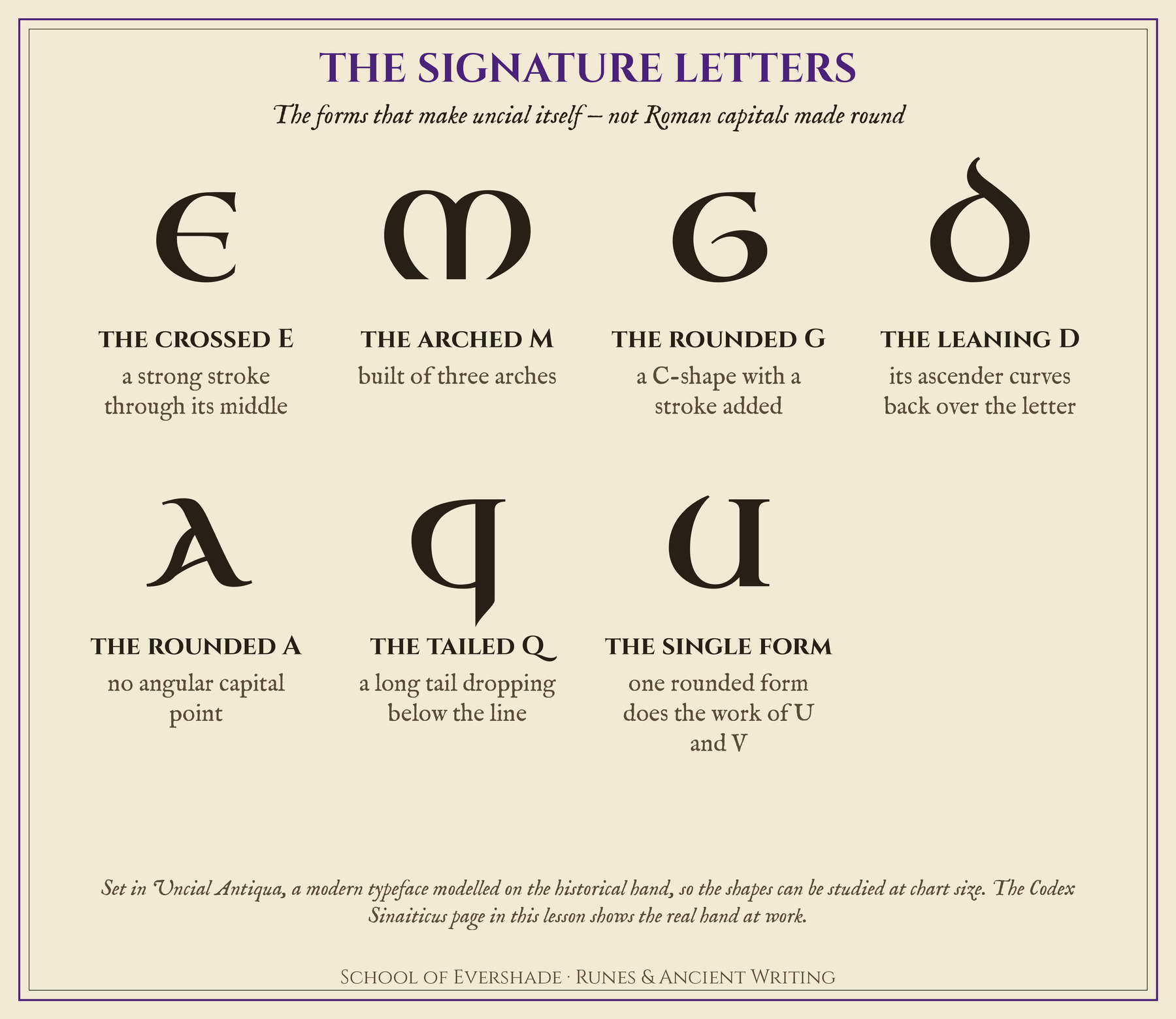
The signature letters: the crossed E, the arched M, the rounded G, the leaning D, the rounded A, the tailed Q, and the single V that does the work of U and V. Set in a modern typeface modelled on the hand; the Sinaiticus page above shows the real thing.
Built for Evershade.
❦ In your workbook: record uncial, the rounded book hand in your own way — copy, sketch, or note what matters.
Two Hands, One Pen
Step back now and look at the lesson whole, because it is really one lesson about one tool.
The reed pen made both hands. Held loosely and hurried, it produced cursive: ligatures, abbreviations, the ink-swept curve of a hand trying to finish. Held steadily at its broad angle, it produced uncial: thick downstrokes, thin horizontals, the full round O that no chisel could carve and no quill had yet imagined. Same plant, same ink, two intentions. The empire's paperwork and the empire's Bible, written with the same reed.
This is the last lesson in which the knife appears even as a memory. The runes were carved; the ogham was cut along the stone's edge; even the Gothic alphabet, a pen script, was designed by a man thinking about carvers.
From here to the end of the course, everything is ink on skin or ink on paper: Insular, Carolingian, and the shorthand systems of the scriptorium, all descendants of the two hands you met tonight. Cursive's child, the new Roman cursive, becomes minuscule. Uncial's child, half-uncial, becomes Insular. The family tree of medieval writing roots here, in the reed pen's two moods.
And the quill is coming. In the next century or two, feathers will replace reeds, and the hands will change with the tool: finer lines, different pressures, new possibilities. The scriptorium you are about to enter, in Lessons 18 through 21, is a quill world.
Remember the reed when you get there. Every curve the quill draws was first drawn by a plant, and the letters remember.
❦ In your workbook: record the two hands and the one pen in your own way — copy, sketch, or note what matters.
In your packet: Assignment III — The Artifact Investigation ◐ begins here. Work it now, or mark the place and take it as homework — your choice.
Guided Practice — The Reed-Pen Hand
Before the assignments, train your hand the way a late-antique scribe would: with attention to the tool, and to the two intentions.
Exercise A — Drawing the Uncial Alphabet
- On paper, draw the uncial forms A through Z using the simplified classroom guide in this lesson. Work slowly; these are formal book forms, not sketches. Remember the caveat: uncial varied by region and century, and this chart is a classroom composite, not a single fixed alphabet.
- Circle the five most distinctive letters (E, M, G, D, A) and, for each, write one sentence on how it differs from its Roman capital cousin.
- Below the chart, write the sentence "Claudia Severa invites Lepidina" in your uncial forms. Then write it again, faster, letting the letters lean and join. Compare the two: at what point did your book hand start becoming cursive?
Exercise B — The Broad-Edge Test
- Take a broad-tipped marker (or cut a reed or bamboo pen if you have one) and hold it at a steady angle, about 30 degrees from the horizontal. Draw a vertical line, then a horizontal line, then a circle. Observe: the vertical is thick, the horizontal thin, the circle swells and narrows as it turns.
- Write the word "uncial" with the broad edge, keeping the angle constant. Do not try to make thick and thin happen; let the pen do it.
- Now write the same word with an ordinary round-tipped pen. Compare: what did the broad edge contribute that the round tip could not? Write two to three sentences on the tool as the letterform.
❦ Workbook path: if no broad edge is available, build the contrast by hand: draw the word "uncial" large, give each downstroke two edges, and shade between them, so the workbook page shows what the broad edge would have done on its own.
Exercise C — The Continuous Stream
- Write the sentence "the quick brown fox jumps over the lazy dog" in scriptura continua: no spaces between words. Write it in your normal handwriting first, then in uncial-style rounded capitals.
- Read both versions back. Time yourself: how much slower is the unspaced version to parse? What strategies did you use (sounding out, recognizing word shapes, backtracking)?
- Write two to three sentences on the reader's labor: scriptura continua shifts work from the writer to the reader. Who benefits, and who pays?
In your packet: Assignment I — The Uncial Chart ⚒ begins here. Work it now, or mark the place and take it as homework — your choice.
Assignment Manual
Assignment key: ✎ written work · ⚒ hands-on practical · ◐ both · ★ will be on the test · ❦ workbook path
Written answers in this manual are short answers in your own words — a few honest lines, not a filled page.
Assignment I — The Uncial Chart ⚒ ★
Objective: Demonstrate control of the uncial letterforms and their distinction from Roman capitals.
Instructions:
- On a fresh sheet, create a three-column chart: letter (drawn in simplified uncial form), name, note on how it differs from the Roman capital (or "as capital" where it does not).
- Complete all 26 rows, A through Z. Mark the five signature letters (A, D, E, G, M) with an asterisk and describe each difference in a full sentence.
- Below the chart, write one paragraph on the lesson's central claim: uncial is not Roman capitals made round. Choose the two letters that prove it best and explain what each reveals about uncial as an independent invention.
Your keepsake: this chart is the unit's portrait of the book hand. Keep it beside your Roman capitals chart from Lesson 9; the comparison between them is half the lesson.
❦ Workbook path: draw the chart across two facing workbook pages instead of a loose sheet, the letters on the left page and the difference notes on the right, so each letter and its note lie open together.
To submit: Photograph or scan your chart. Roundness and the broad-edge contrast matter more than speed; these are book forms.
Assignment II — Transliteration and the Fast Hand ⚒ ★
Objective: Read uncial forms and feel the cursive economy in your own hand.
Part A. Transliterate the following into uncial-style capitals, then read them back: VIA (road), LUX (light), PAX (peace), AETERNA (eternal), SCRIBA (scribe). For E, use the crossed form; for M, the three arches. What did the distinctive letters do to your reading speed?
Part B. Write the sentence "The scribe hurries; the book endures" three times: first in careful uncial-style rounded capitals, then at normal speed, then as fast as you can without lifting the pen between words. Compare the three versions: which letters changed most under speed? Which survived intact? Write two to three sentences on what your hand just taught you about cursive's origin.
Part C. Write your own name in scriptura continua, then in spaced uncial-style capitals. Ask someone else to read both. Record which they read faster and what they stumbled on. What does the experiment reveal about who does the work in each system?
Assignment III — The Artifact Investigation ◐ ★
Objective: Understand the two hands through the objects that preserved them.
Instructions:
- Research (using the References below): the Vindolanda tablets and the Codex Sinaiticus. For each, record the date, the place of discovery, the writing surface and instrument, what the text contains, and where the objects are held today.
- One archive survived by waterlogging, the other by reverence. Write a half page on the accident of survival: what does each object's preservation story reveal about what the written record keeps and what it loses? Base your argument strictly on the objects and this lesson.
- The lesson claims the fast hand was probably the most-written script in the Roman world and the least preserved. Choose the single strongest piece of evidence for this claim (from the lesson or your research) and write a half page defending it against an imagined skeptic who insists that what survives is what mattered most.
Assignment IV — The Quill Myth Essay ✎ ★
Objective: Practice the misconception-correction skill on the lesson's central chronological claim.
Instructions:
Write a one-page essay addressing the following:
Most students picture Roman scribes with feather quills. The lesson argues this image is wrong by half a millennium. First, lay out the evidence: what did Roman and late-antique scribes actually write with, when did the quill arrive, and what are the sources for the chronology? Then consider why the misconception persists: what is it about quills, monks, and movies that fixed the wrong image? Finally, return to the lesson's deeper point: why does the tool's chronology matter to the letterforms? Use uncial's roundness and the broad-edge mechanics in your answer.
Cite the lessons where your details come from.
Materials
Required (Level One — household items)
- Paper: plain white paper or a sketchbook, for letter practice and chart work.
- Pens: one standard pen for drafting, one broad-tipped marker (chisel tip or brush tip) for the broad-edge exercises. The broad marker simulates the reed pen's thick-and-thin contrast.
- A ruler: for chart columns and for practicing the two-line discipline of bilinear uncial.
- A printout of the uncial alphabet: use the Wikipedia "Uncial script" article in the References below — its alphabet chart is the standard one to work from.
Suggested (Level Two — historically closer materials)
- A reed or bamboo pen and dark ink: the actual late-antique writing kit. Cut the nib at an angle for the broad edge; the uncial forms will begin to make themselves.
- Papyrus paper: the Roman everyday surface. Write a cursive-style letter on it and feel why the fast hand suited the fiber.
- A wax tablet or modeling clay with a stylus: the reusable notepad. Write a note, smooth it flat, write another. The lesson's point about survival becomes physical.
- Parchment paper: the book surface. Write uncial forms on it with the broad edge and feel the glide the lesson describes.
Neither level requires
Purchased kits, specialty tools, or any material you cannot find locally or order inexpensively. The core lesson (drawing uncial forms, understanding the two hands, practicing the broad edge, reading continuous script) is fully achievable with paper and a broad marker. No feathers will be plucked early.
Reflection Questions
Answer the following in your workbook.
- Why did Roman cursive develop? Name its three main writing surfaces and explain the preservation asymmetry: why is the most-written script the least preserved?
- What did Roman and late-antique scribes actually write with? When did the quill arrive, and why does the chronology matter to uncial's letterforms? Correct the misconception in your own words.
- Define uncial: its dates, its character as a book hand, and why "Roman capitals made round" is wrong. Name three of its most distinctive letterforms and describe each.
- What is scriptura continua? List the factors behind it without ranking them, and explain why the lesson refuses to rank them.
- Identify the Vindolanda tablets and the Codex Sinaiticus: date, surface, contents, and preservation story for each.
- What is half-uncial, and why does it matter for Lessons 18 and 19?
- Apply the lesson's form of the course question: what does speed leave out, and what must the book hand keep? Where does each medieval script to come sit between those poles?
Workbook Checklist — Lesson 17
In my workbook I have:
- ☐ explained why Roman cursive developed, and named its three main writing surfaces
- ☐ explained why the most-written script of the Roman world is the least preserved
- ☐ corrected the quill misconception: the calamus, and the quill's arrival in the 6th to 7th centuries
- ☐ described uncial: its dates, its bilinear majuscule character, and at least three signature letterforms
- ☐ explained scriptura continua and listed the factors behind it without ranking them
- ☐ described half-uncial and why it matters for Lessons 18 and 19
- ☐ identified the Vindolanda tablets and the Codex Sinaiticus, with their preservation stories
☐ Lesson completed Date: ____________ Signature: ____________
Professor's Review
And so our seventeenth lesson closes in the scriptorium, where the reed pen wrote in two moods and the knife was set down for good.
You can now explain why Roman cursive developed and name its three surfaces with their fates, correct the quill misconception with the true chronology and explain why the tool shapes the letter, define uncial with its dates and its character and refute the "capitals made round" error with specific letterforms, describe the broad-edge mechanics that make uncial round, explain scriptura continua and its several unranked factors, identify the Vindolanda tablets and the Codex Sinaiticus with their preservation stories, and trace uncial's legacy through half-uncial toward the Insular and Carolingian scripts to come.
Keep your uncial chart beside your Roman capitals from Lesson 9. Lay them side by side and see the independence: the crossed E, the arched M, the tailed Q, none of them derivable from the inscriptional forms by mere rounding. The book hand was an invention, not a decoration.
Next, we cross the sea to Ireland, where half-uncial put down roots in a monastic culture and grew into something entirely its own: the Insular script, with its wedge-shaped ascenders and its decorated initials. The round hand is about to learn a northern accent.
Practice your uncials, scholars. Write them with the broad edge if you have one, and feel the reed decide the letter: thick where it descends, thin where it travels, round where it turns. I have watched hands hurry and hands endure in my years among the inscriptions, and the reed served them both without complaint. The web holds two new patterns now, the hurried and the lasting. Learn them both.
PROFESSOR THISTLELOOM WEBBLETHORN
Runes & Ancient Writing
Epigrapher, Head of House Septentrio
Cross-Class Connections
The two hands of this lesson connect directly with Scrollwork, where Professor Nocturne teaches the book hands of the same centuries from the scribe's side of the desk. Students studying both classes should compare uncial's broad-edge roundness with the Roman capitals of Lesson 9: the family resemblance is real, and so is the independence.
The reed pen itself connects with Creative Arts, where Professor Timberclank's tool-making lessons teach what every scribe knew: the instrument is the first decision. Students who cut their own reed pen will understand uncial's letterforms from the inside, the way no chart can teach.
Half-uncial's Irish future will reappear in Runes Unit V, in our very next lesson on the Insular script: the branch the future grew on, grown strange and beautiful on a northern island.
In Other Classrooms
Scrollwork · Unit IV, Lesson 15 — Uncial Script
Two hands in your lesson, and both of them live in my classroom. In the Library we write uncial and its descendants from the scribe's side of the desk, broad edge, round letter, steady rhythm. Come and take up the pen your Roman scribes used, and let your hand learn what your eye has been studying.
Creative Arts · Unit I, Lesson 6 — The Materials Library & First Tool-Making

Every scribe's first decision was the instrument, and instrument-making is workshop work. In the Workshop we learn our materials and make our first tools, reed among them, with care and with safe hands. Come and make the pen before you judge the letterforms it writes; a tool you made yourself teaches differently.
The pen runs, and so do we.
References & Further Reading
The Vindolanda Trust. "Vindolanda Tablets." The ink-on-wood letters from Roman Britain, including Claudia Severa's birthday invitation, with images and translations. https://www.vindolanda.com
The British Library. "Codex Sinaiticus." The 4th-century Greek uncial Bible: history, images, and the story of its discovery and digitization. https://www.bl.uk
Wikipedia. "Roman cursive." Old and New Roman cursive, media, and the script's development into minuscule. https://en.wikipedia.org/wiki/Roman_cursive
Wikipedia. "Uncial script." The rounded book hand: dates, characteristics, Greek and Latin use, and the half-uncial relationship. https://en.wikipedia.org/wiki/Uncial_script
Wikipedia. "Half-uncial script." The smaller book hand between uncial and minuscule, and its Insular and Carolingian descendants. https://en.wikipedia.org/wiki/Half-uncial_script
Wikipedia. "Quill." The feather pen's history, including its rise as the primary instrument in the 6th century. https://en.wikipedia.org/wiki/Quill
The Grolier Club / Rare Book School. "Letterforms" exhibition. The chronology of writing instruments, noting feather pens at "perhaps the 7th century CE." https://grolierclub.omeka.net/exhibits/show/rare-book-school/letterforms
Wikipedia. "Scriptura continua." Word division (or its absence) in ancient manuscripts. https://en.wikipedia.org/wiki/Scriptio_continua
Browse the Runes shelf in the school Library for readable editions of these works.
Submit your work for this lesson using the form below.
CONTINUE IN RUNES & ANCIENT WRITING
← Previous · Lesson 16: The Gothic Alphabet: A Hybrid Script for the Goths Next · Lesson 18: The Insular Script: The Island Hand of Ireland and Britain →
Unit V · The Medieval Scriptorium Runes & Ancient Writing Classroom · All 21 Lessons
The rest of Unit V: Lesson 16 · The Gothic Alphabet · Lesson 18 · The Insular Script · Lesson 19 · The Clear Hand · Lesson 20 · The Scriptorium Code · Lesson 21 · How Scribes Left Letters Out and Readers Put Them Back