
RUNES & ANCIENT WRITING
Unit V · Lesson 19THE BIRTH OF LOWERCASE
The Clear Hand: Carolingian Minuscule and the Standardized Empire
Professor Thistleloom Webblethorn
Epigrapher • Runes & Ancient Writing
Head of House Septentrio • School of Evershade
Professor's Introduction

Lamplight, scholars. Tonight we leave the carved north behind entirely and enter the lamplit scriptorium, where the pen has won and the great question is no longer what to carve but how to make every copy legible to every reader.
The Insular scribes made the book hand beautiful beyond all necessity — and every house made it beautiful in its own way.
Tonight, an emperor who could barely write ordered his whole realm to write clearly.
Come closer to the web, scholars. The most familiar letters you will ever read, the lowercase alphabet beneath your eyes at this very moment, were standardized in the lamplight we are about to enter. You have been reading this lesson's subject all your life without knowing its name.
PROFESSOR THISTLELOOM WEBBLETHORN
Runes & Ancient Writing
Epigrapher, Head of House Septentrio
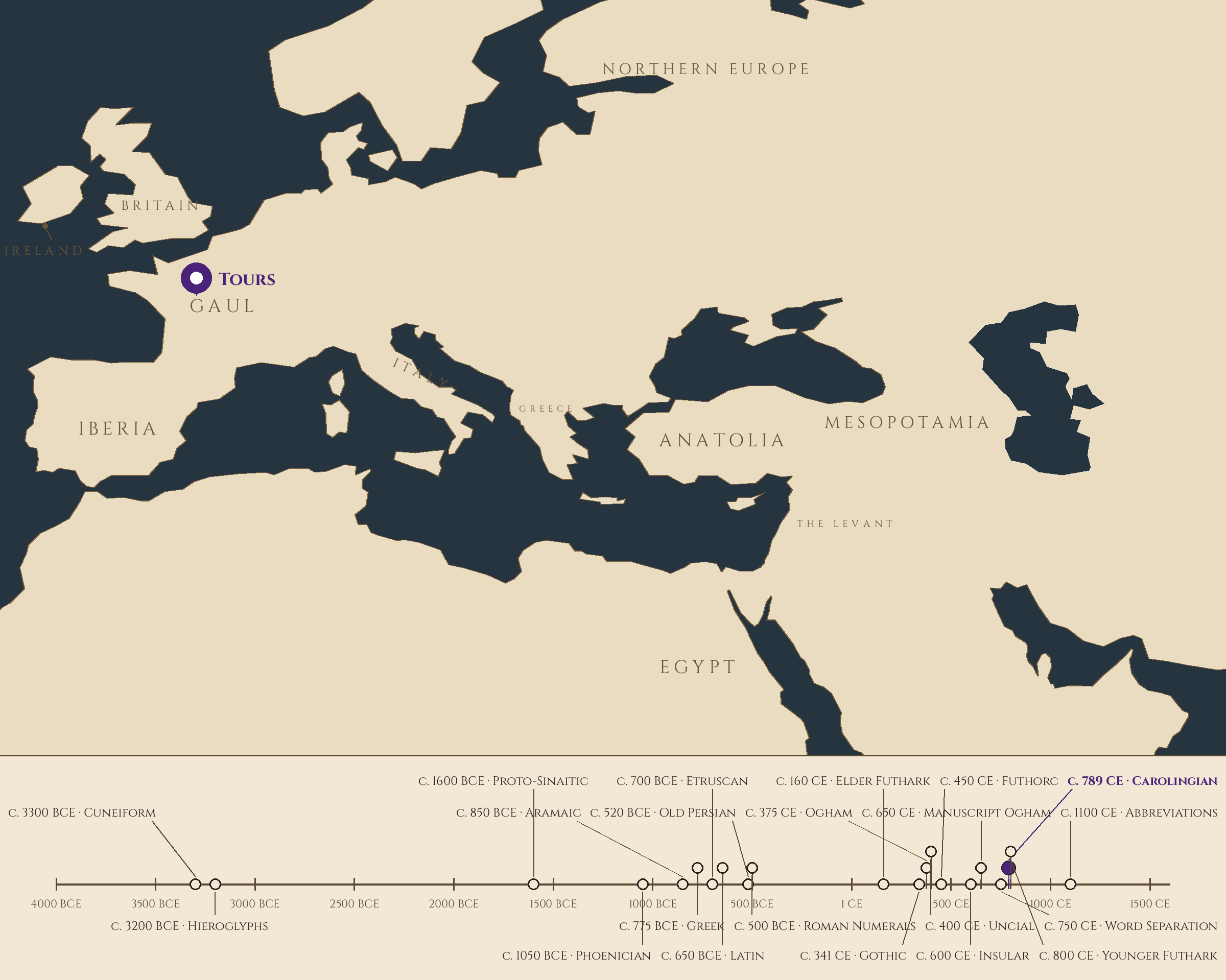
Where and when: the Frankish empire of Charlemagne, in the late 8th and 9th centuries. The pin is this lesson. The line beneath the map is our road: every stop a writing system, every lesson a pin.
Lesson Objectives
By the end of this lesson, students should be able to:
- Define Carolingian minuscule, Carolingian Renaissance, Charlemagne, Alcuin, Corbie, Tours, minuscule, majuscule, tittle, ascender, descender, humanist script, and litterae antiquae.
- Explain the problem the reform solved: fragmented regional scripts and corrupted texts across Charlemagne's empire.
- Correct the "Alcuin invented it" story: describe his real role at Tours and the script's earlier development at centers such as Corbie.
- Describe the anatomy's signature features: clear separated letters, ascenders and descenders, word separation, the long s, the tittle-less i, and the later development of j, u, and w.
- Name three regional scripts that survived the reform and where they survived.
- Explain the humanists' mistake: why Renaissance scholars believed Carolingian manuscripts were ancient Roman, what they called the script, and what modern form descends from it.
- Apply the course question in a new form: what must be standardized to be understood?
Reading this lesson: ★ marks the passages to remember. They return on the unit quiz and the class test. Check in questions ask the material back as you go; answer them in your workbook when you meet them.
Working this lesson: Your assignment packet is the first download on this page. Work in it as the lesson moves along, answering each assignment as its subject is taught — or read the lesson through for your notes and take the assignments as homework afterward. Both are proper ways to sit this class. Signposts in the reading tell you where each assignment belongs. Written answers are short answers in your own words; a few honest lines are worth more than a filled page.
Your Assignment Packet
This lesson's assignments live in its packet: the Lexicon Handout (every term, course terms marked ◆), Materials, Guided Practice, the Assignment Manual with its answer key for self-checking, the Reflection Questions, and the Workbook Checklist. Download the packet before you begin and keep it beside you as you read.
The Emperor Who Could Not Write
Every reform in our story so far was made by writers. This one was ordered by a man who could barely write, and I want you to sit with that paradox, because it explains everything about what happened next.
Charlemagne, King of the Franks from 768 and Emperor from his coronation in 800, ruled a realm that stretched across much of western Europe. An empire that size runs on writing: laws must be recorded, taxes accounted, bishops instructed, and the Bible itself copied correctly in every monastery.
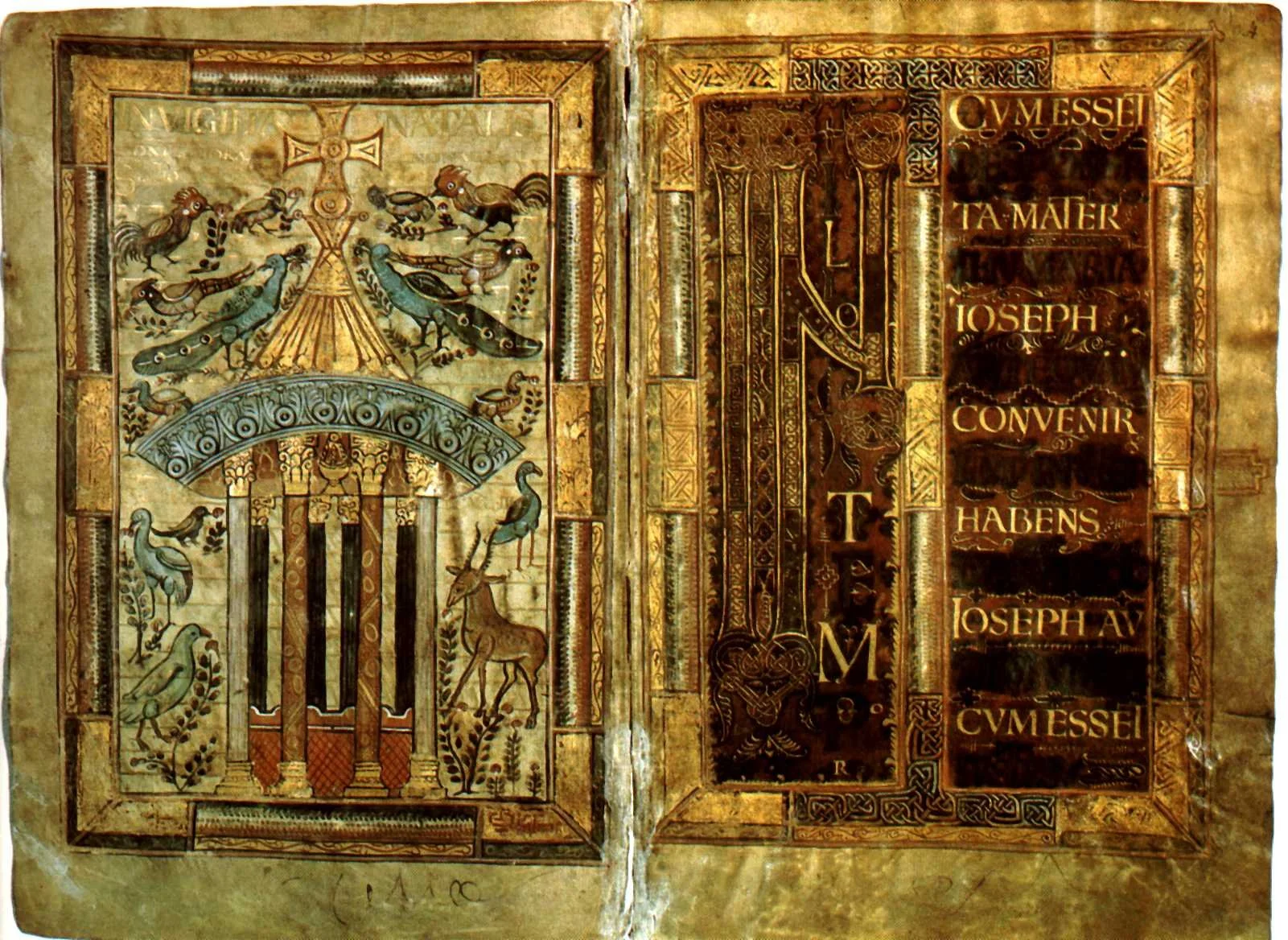
Historical example. The Godescalc Evangelistary, opened at folios 3v–4r: the Fountain of Life faces the opening of Matthew, its first words 'IN TEMPORE' in gold capitals on purple. Commissioned by Charlemagne and Hildegard; written by the scribe Godescalc, 781–783.
Godescalc Evangelistary (Paris, Bibliothèque nationale, Nouv. acq. lat. 1203), opening folios 3v–4r, 781–783. Public domain, via Wikimedia Commons.
But the writing of Charlemagne's empire was a mess. Centuries after Rome's fall, Latin book hands had fragmented into regional scripts, each legible in its own valley and puzzling in the next. Texts copied and recopied by untrained hands had accumulated errors the way a much-copied letter accumulates smudges.
An empire cannot remain unified if its records cannot be read, and Charlemagne grasped this with the clarity of a man who understood infrastructure.
★ Here is the part the heroic portraits leave out. His biographer Einhard, who knew him, reports that Charlemagne tried to learn to write and kept writing tablets under his pillow, practicing in his spare hours. He began late in life, Einhard says, and his efforts met with ill success.
Read that again and let it correct an assumption: the great reformer of handwriting was not a great hand. He was a great commissioner. He understood that writing mattered more than he could perform it himself, and he built the institutions that would perform it for him.
Those institutions are what historians call the Carolingian Renaissance (the revival of learning, education, and manuscript culture under Charlemagne and his successors, roughly the late 8th through the 9th century): not a rebirth of art in the later sense, but a program. The palace school at Aachen, where scholars gathered from across Europe. Monasteries and cathedral schools ordered to teach. The Admonitio generalis of 789, a capitulary instructing bishops and abbots to establish schools and to see that texts were correctly copied.
And at the center of the program's daily work, the scriptorium: the writing room where the empire's books were made, corrected, and multiplied.
★ The program needed an instrument. A reader trained at Aachen had to be able to read a book copied at Tours. A bishop in Italy had to read a capitulary written in Francia. The regional hands, each beautiful in its own way, could not do this work. The empire needed one clear hand, teachable, repeatable, and legible everywhere. So the reformers made one.
Check in: The great reformer of handwriting could barely write himself. What did Charlemagne build, if not skill — and what instrument did his program need?
❦ In your workbook: record the emperor who could not write in your own way — copy, sketch, or note what matters.
In your packet: Assignment III — The Artifact Investigation ◐ begins here. Work it now, or mark the place and take it as homework — your choice.
A Standard Is Born
Carolingian minuscule emerged in the Frankish scriptoria of the late 8th century and was standardized in the early 9th: a clear, rounded minuscule with open letterforms, straight ascenders and descenders, separated words, simple punctuation, and few ligatures. It is the most successful writing reform in Latin history, and you are reading its descendant now.
I must correct the story the way the scholarship corrects it, because the simple version is wrong in an instructive way. The simple version puts Alcuin of York at the center: the English scholar invited to organize learning at the Carolingian court, leading the palace school at Aachen from 782 to 796, becoming abbot of Saint-Martin at Tours in 796, and there inventing the new script.
★ The scholarship is explicit that this overstates his role. Latin paleography of the 8th century leaves little room for a single origin, and no proof has been found of Alcuin's direct involvement in creating the script.
Carolingian minuscule was already in use before he arrived in Francia. The script's basis is traced to centers like Corbie — the abbey in northern Francia whose scriptorium was one of the great writing centers of the early Middle Ages — where scribes had been developing the clear minuscule forms on their own.
What Alcuin did was real and important, and the corrected story honors it better than the myth. At Tours he encouraged the new script, standardized its forms, and turned his scriptorium into a production center: the great Tours Bibles of the early 9th century, complete pandect Bibles written in the reformed hand, carried the standard across the empire the way a printed edition carries a text today.
He was responsible for copying and preserving the script while restoring the purity of its form. The reform had no single inventor. It had workshops, and Alcuin's was the most famous.
Hold that correction beside the emperor who could not write. Neither the commissioner nor the famous schoolmaster made the letters with his own hand, quite. The letters were made by scribes in rooms like Corbie's, and the reformers' genius was to recognize the good hand when they saw it, standardize it, and teach it everywhere. Standardization, not invention, was the achievement. That distinction is the whole lesson.
❦ In your workbook: record a standard is born in your own way — copy, sketch, or note what matters.
Anatomy of the Clear Hand
Now look at the hand itself, because its clarity was engineered, feature by feature, and each feature answers a reader's need.
The foundation is the minuscule form (a form Caroline scribes built from the uncial and half-uncial book hands, straightening and regularizing the letterforms and proportions they borrowed, and systematizing the ascenders and descenders half-uncial had introduced): smaller, rounded letters with ascenders rising above the line and descenders dropping below it, as opposed to the uniform capitals of majuscule. The ascenders (the parts of letters that rise above the main body of the line) of b, d, h, and l rise straight and upright, often with a slight thickening at the top, like a palisade. The descenders (the parts that drop below the main body of the line) of p and q drop straight and controlled.
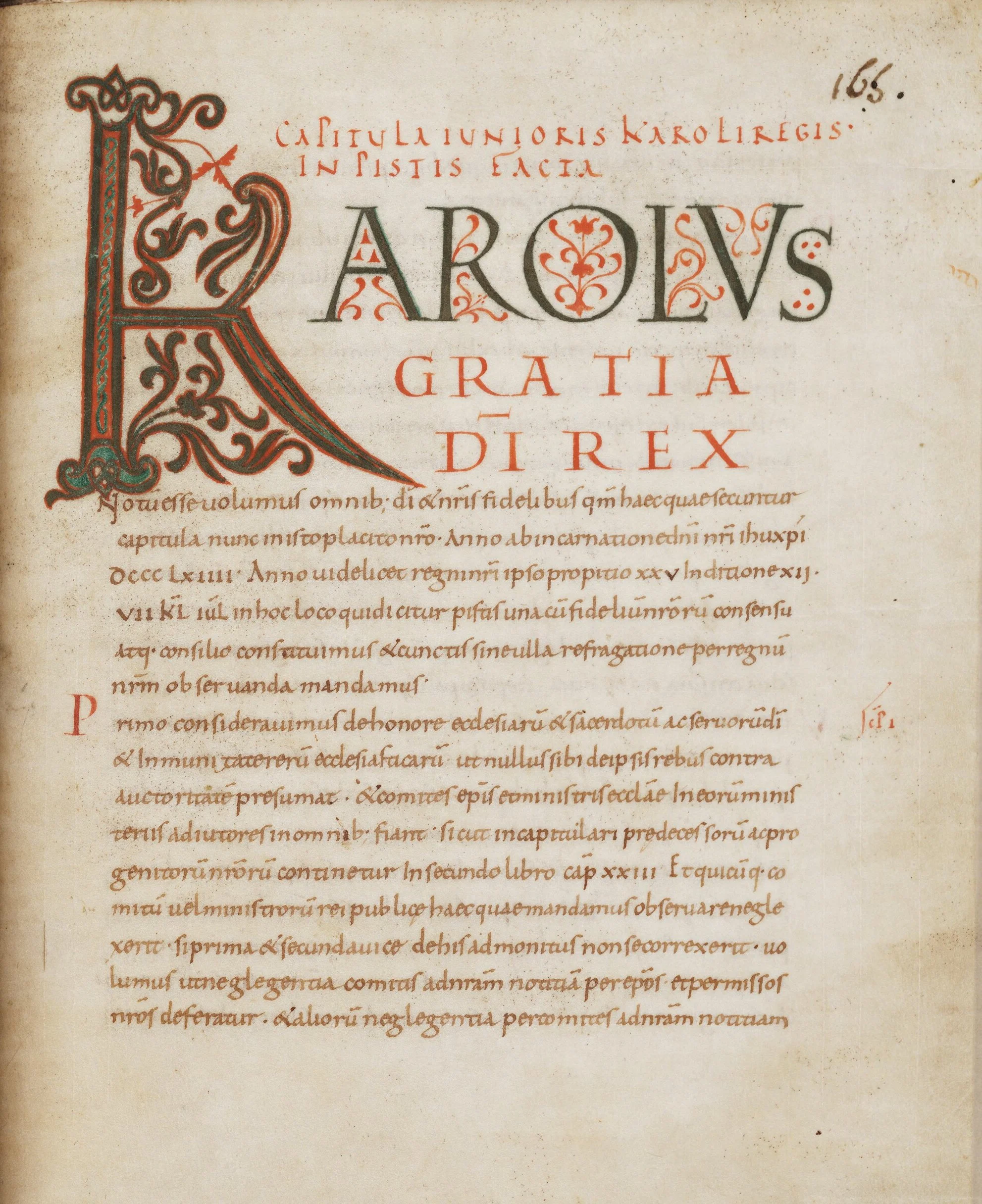
Historical example. A 9th-century capitulary page: 'KAROLVS GRATIA DI REX' — Charles, by the grace of God king — in display capitals, and below it the clear hand itself: separated words, even lines, a page built to be read.
Carolingian capitulary page, 9th century — Beinecke Rare Book and Manuscript Library, Yale University, MS 413, fol. 165. Public domain, via Wikimedia Commons.
The bodies of the letters sit on the line in open, generous curves. Nothing touches that should not touch. The page has texture but no tangle, and the eye moves along the line the way a hand moves along a smooth rail.
The signature letters reward close looking. The a is typically open and single-chambered in early hands. The e carries its horizontal tongue with confidence. The g has a flat top and a closed lower loop, the ancestor of the form you know. The t finishes with a distinctive curved top.
The d usually rises with a straight, upright ascender. The r stands straight and unadorned. The long s, a tall narrow form, appears at the beginning and middle of words, while the round s closes them: the same letter wearing two shapes according to position, a habit that survived into early printing.
★ Two absences define the hand as much as its presences. Words are separated by spaces, replacing the scriptio continua, the unbroken stream of letters, that Roman and early medieval books had used. And the i carries no dot: the tittle (the small stroke or dot over the letter i, from a word meaning a tiny mark) appears only from about the 11th century, often as a small dash at first, gradually becoming the dot students expect. A Carolingian page's undotted i is not an error. It is the hand before the dot was invented.
Three familiar letters are missing in their modern forms, and their absence is a lesson in how slowly alphabets settle.
The letters j, u, and w developed as distinct forms later: i and j were not treated as separate letters until the 16th and 17th centuries, u and v had been used interchangeably since Roman times, and w grew out of doubled u shapes in the medieval period. The Carolingian scribe wrote with the alphabet as it was, not as it would become, and the page is complete without them.
I add one caution, because the classroom loves a tidy chart and the scriptoria were not tidy. Hands varied by region, by house, and by scribe: Corbie's Caroline is not Tours's in every detail, and no single exemplar captures all of it. The standard was a direction, not a mold.
What united the hands was legibility itself: the shared commitment that any trained reader could read any book. That was the reform's real letterform, and it is invisible on the page because it is the page.
Check in: Look at the letter i on a Carolingian page. What is missing from it, and roughly when does the missing mark arrive?
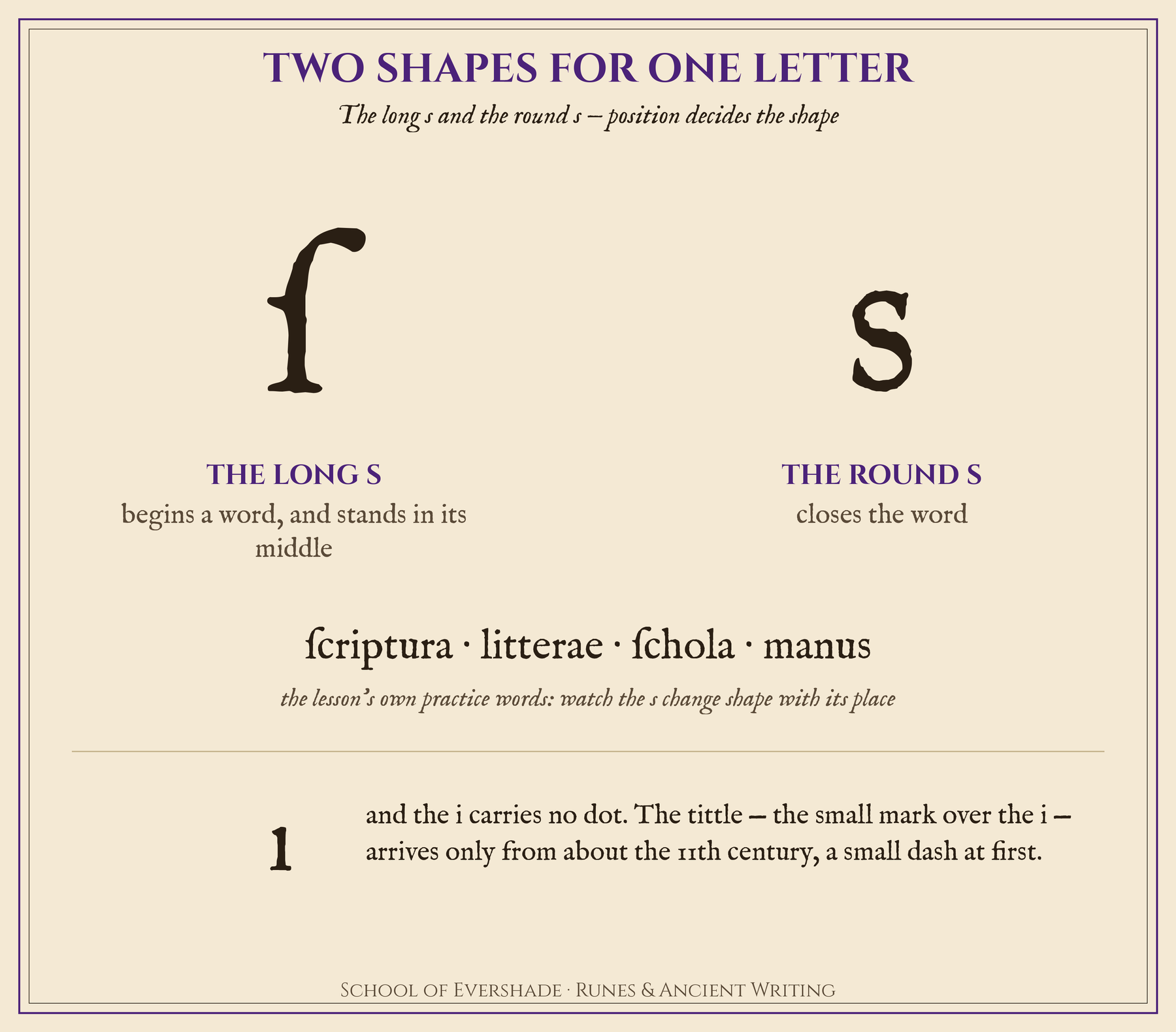
Two shapes for one letter: the long s begins a word and stands in its middle, the round s closes it — and the i carries no dot. The tittle, its small mark, is still centuries away.
Built for Evershade.
❦ In your workbook: record the anatomy of the clear hand in your own way — copy, sketch, or note what matters.
In your packet: Assignment II — Reading the Clear Hand ⚒ begins here. Work it now, or mark the place and take it as homework — your choice.
The Spread and the Survivors
The standard spread the way standards spread: through institutions. Monasteries adopted it for their scriptoria. Cathedral schools taught it. Royal scriptoria used it for capitularies and correspondence. Administrative centers copied in it.
Within a generation, the clear hand was the working script of the Carolingian world, and the thousands of surviving manuscripts, over 7,000 from the 8th and 9th centuries alone, are the reform's census: the standard worked, and the books prove it.
★ But the spread was not a conquest, and the lesson must not imply one. The reform spread a standard; it did not erase the regions. England and Ireland kept their Insular hands until ecclesiastical reforms in the middle of the 10th century, a century and a half of beautiful independence.
In Spain, a traditionalist Visigothic hand survived into the 12th century. In southern Italy, in the lands of the Lombard duchy of Benevento, a Beneventan minuscule lasted through the 13th century. Scripts coexisted. The empire had one clear hand for its common business, and the regions kept their own for their own.
This coexistence is worth pausing over, because it corrects the tidy story reforms like to tell about themselves. Standardization did not mean uniformity everywhere at once. It meant that wherever the empire's business was done, the writing could be read. The Insular scribe of the 9th century and the Beneventan scribe of the 12th were not failures of the reform. They were reminders that writing belongs to its community first, and that a standard is a bridge, not a bulldozer.
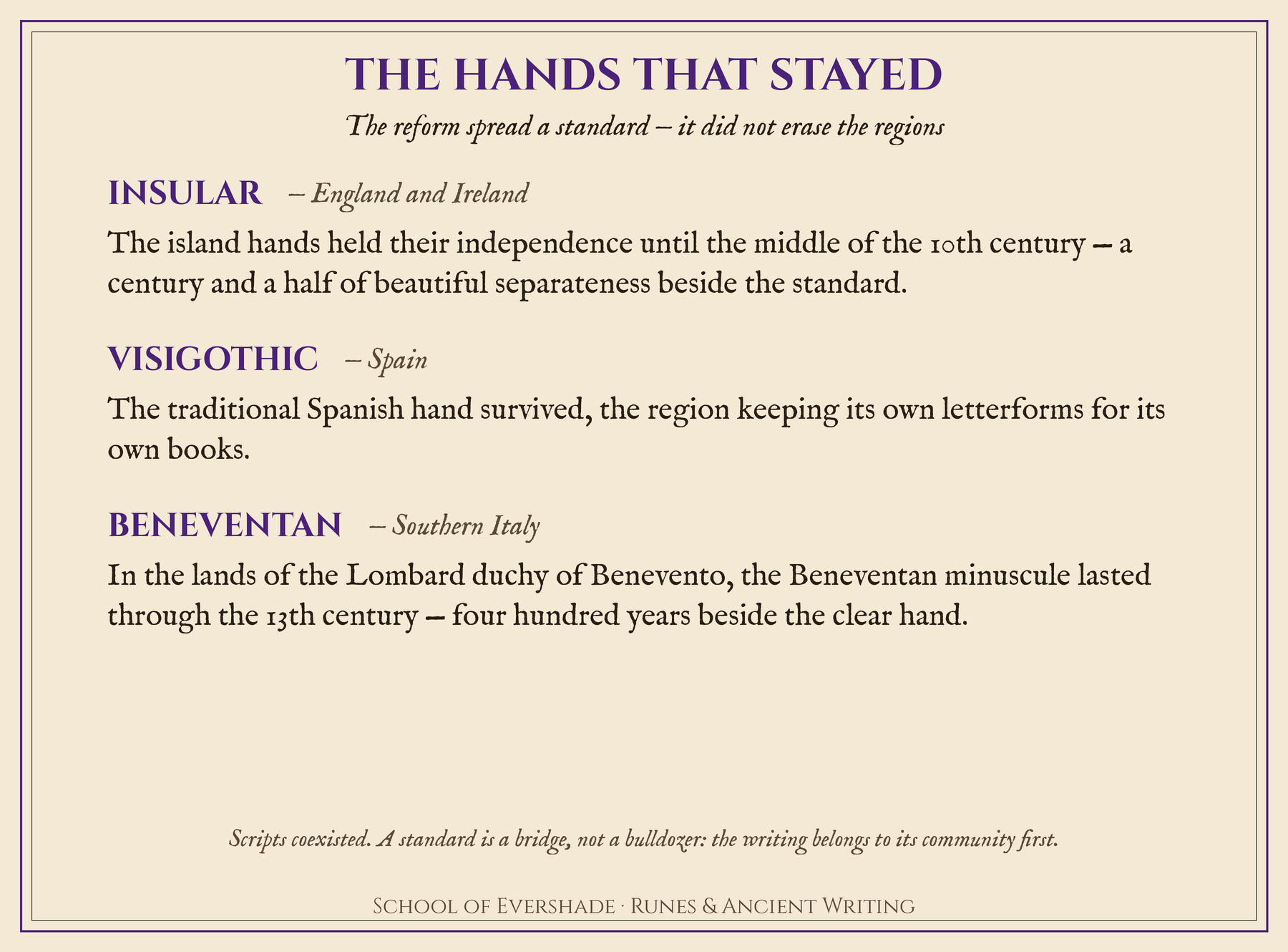
The hands that stayed: Insular in the islands until the middle of the 10th century, Visigothic in Spain, Beneventan in southern Italy through the 13th. The reform spread a standard; it did not erase the regions.
Built for Evershade.
❦ In your workbook: record the spread and the survivors in your own way — copy, sketch, or note what matters.
Professor Webblethorn
Pause here, scholars, and turn the course question into its Lesson 19 form.
Every lesson has asked what can be left out, or what must be added, or what must be borrowed. The miners left out the pictures. The Greeks added the vowels. The bishop borrowed the frame. Tonight the question is: what must be made the same?
The reformers looked at a continent of beautiful, mutually puzzling hands and decided that beauty was not enough. A book copied at Tours had to be readable at Aachen. A law written in Francia had to be readable in Italy. So they standardized the ascenders, the spacing, the letterforms themselves, until any trained reader could read any book. They made the writing the same so the reading could be certain.
Notice what they did not standardize away. The words stayed Latin. The texts stayed the monasteries' own. The standard covered the hand, not the mind. And the regions kept their scripts beside it for centuries, which tells you the reformers understood something: a standard is a meeting place, not a cage.
Hold the thread. It has become a rule now, a straight ruled line, and on that line the next thousand years of European writing will be written. Including the letters you are reading at this moment.
PROFESSOR THISTLELOOM WEBBLETHORN
Runes & Ancient Writing
Epigrapher, Head of House Septentrio
The Humanists' Mistake
Six centuries after the reform, the clear hand performed its strangest trick: it fooled the Renaissance.
The humanists of 14th- and 15th-century Italy went looking for the ancient world in its manuscripts, and they found books written in a clear, classical-looking minuscule. They concluded, reasonably and wrongly, that they were looking at the handwriting of ancient Rome. They called it the litterae antiquae, the ancient letters, and they revived it as their own book hand: humanist script, the elegant minuscule of the Italian Renaissance.
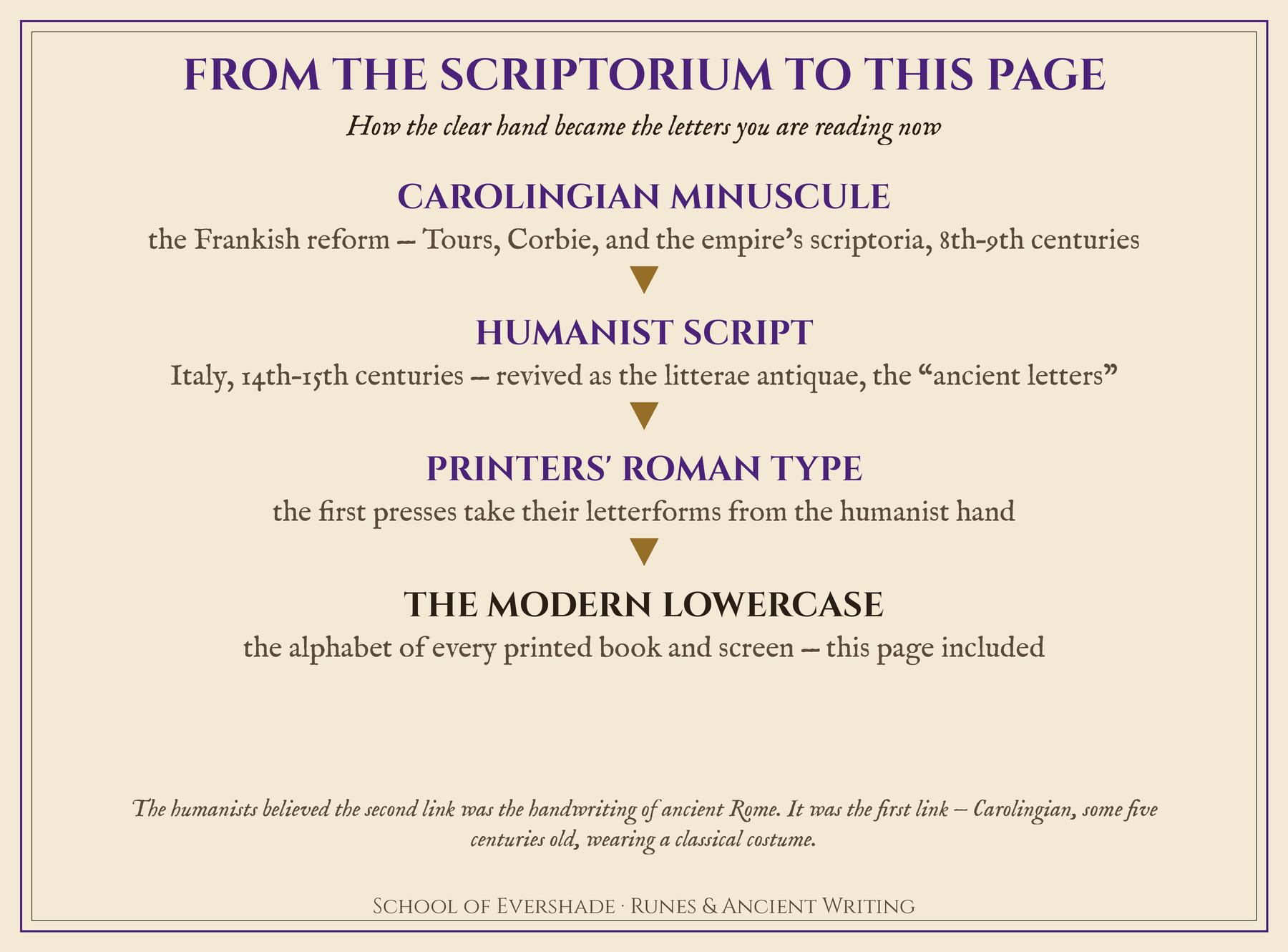
From the scriptorium to this page: Carolingian minuscule, copied by the humanists as the 'ancient letters,' copied again by the first printers — the lowercase alphabet you are reading now.
Built for Evershade.
★ It was not ancient. It was Carolingian, some five centuries old when the humanists found it, the medieval reform wearing a classical costume so convincing that the best scholars of the age could not see the seams.
The mistake is understandable the moment you look: Caroline minuscule's clarity, its open forms, its regular rhythm, all read as "classical" to eyes trained on Roman capitals. The humanists saw what they wanted to see, and what they wanted was Rome.
The mistake became the foundation of everything you are reading. Early printers, seeking typefaces for the new press, modeled their roman type on humanist hands: the clear minuscule the humanists had revived from the Carolingians they had mistaken for Romans.
Every lowercase letter in every printed book, every screen, every page of this lesson, descends from that chain: Carolingian minuscule, to humanist script, to printer's type, to the letters beneath your eyes.
So here is the lesson's final correction, and it is a delicious one. The most "classical" looking writing in European history is medieval. The letters that feel most Roman are Carolingian. And the alphabet you learned as a child, the plain lowercase of the modern world, is the great-grandchild of an emperor's standardization program, filtered through a Renaissance misunderstanding. The web does love its ironies. This one took six hundred years to land.
Check in: The humanists believed Carolingian books were ancient Roman. What did they call the script — and what everyday thing did their mistake give us?
❦ In your workbook: record the humanists' mistake in your own way — copy, sketch, or note what matters.
Guided Practice — The Standardizer's Hand
Before the assignments, train your hand the way a Caroline scribe would: with attention to clarity, spacing, and the even rhythm of the line.
Exercise A — Drawing the Clear Hand
- On paper, draw the Caroline minuscule alphabet in lowercase, using the chart in this lesson or a printout from the References. Work slowly; these are pen forms, written with the whole arm, not the fingers alone.
- Mark every ascender (b, d, f, h, k, l) with a light dot above it and every descender (p, q, the long s, g) with a light dot below. Look at the palisade you have drawn: the page's skeleton.
- Write the long s at the start of three words and the round s at the end of three words. Write three i's with no dot. Notice how strange the undotted i looks to modern eyes, and how quickly the strangeness fades.
- Write two to three sentences on what your hand just learned: what does the even texture of the Caroline line feel like compared with the scripts of earlier lessons?
Exercise B — The Legibility Test
- Copy the Latin sentence "scriptura clara omnibus legibilis est" (clear writing is legible to all) twice. First, write it cramped and continuous, in the manner of scriptio continua, with no word spaces. Then write it again in the Caroline manner: separated words, open letters, even rhythm.
- Time yourself reading each version aloud, or ask someone else to read them. Record which was faster and where the reader stumbled.
- Write two to three sentences on the result: what work do the spaces do? What did the reform buy with that empty air between words?
Exercise C — The Standardization Test
- Write the same short sentence three times, each in a deliberately different personal style: tall and narrow, short and wide, heavily slanted.
- Now write it a fourth time in your best imitation of the Caroline standard: upright, open, even.
- Show all four to another person and ask which is easiest to read. Write two to three sentences on what the test reveals: what does a standard gain, and what does it ask the writer to give up?
You have just repeated, in minutes, the experiment the Carolingian reformers ran across an empire.
❦ Workbook path: run all four versions of the sentence on one workbook page, one beneath another, so the comparison the reformers made across an empire stays in a single view.
In your packet: Assignment I — The Letter Chart ⚒ begins here. Work it now, or mark the place and take it as homework — your choice.
In your packet: Assignment IV — The Standardizer's Essay ✎ begins here. Work it now, or mark the place and take it as homework — your choice.
Assignment Manual
Assignment key: ✎ written work · ⚒ hands-on practical · ◐ both · ★ will be on the test · ❦ workbook path
Written answers in this manual are short answers in your own words — a few honest lines, not a filled page.
Assignment I — The Letter Chart ⚒ ★
Objective: Demonstrate control of the Caroline minuscule letterforms and their anatomy.
Instructions:
- On a fresh sheet, create a five-column chart: letter (drawn), name, ascender/descender/body (mark which), distinctive feature, comparison note (how it differs from the Roman capital or uncial form, where relevant).
- Complete all rows for the Caroline lowercase alphabet. Mark the long s and round s as two forms of one letter, and note the undotted i.
- Below the chart, write one paragraph on the anatomy's purpose: how do the ascenders, descenders, open bodies, and word separation serve the reform's goal that any trained reader could read any book?
Your keepsake: this chart is your portrait of the standard hand. Keep it beside your Insular chart from last lesson and your uncial chart from the lesson before, the three hands in a row.
❦ Workbook path: draw the chart across two facing workbook pages instead of a loose sheet, the letters on the left page and the anatomy notes on the right, so form and purpose stay in one view.
To submit: Photograph or scan your chart. Evenness of texture matters more than artistic skill; these are working pen forms.
Assignment II — Reading the Clear Hand ⚒ ★
Objective: Read Caroline conventions the way a 9th-century reader would.
Part A. Transliterate the following Latin words as a Caroline scribe would write them, using the long s initially and medially and the round s finally, with no dot on the i: scriptura, imperium, litterae, schola, manus. Then write each word a second time in modern lowercase. What changed, and what stayed the same?
Part B. The Godescalc Evangelistary's dedication tells us the book was made for Charlemagne and Hildegard. Write the Latin phrase "Karolus rex et Hildigarda regina" (King Charles and Queen Hildegard) in Caroline-style minuscule with word separation. Then write it in scriptio continua with no spaces. Which would a reader in Italy have found easier, and why does the answer matter to the reform?
Part C. Identify the anachronisms: a classmate submits Caroline practice containing a dotted i, a distinct letter j, and a w. List the three errors and explain, for each, when the form actually developed and why it does not belong on a 9th-century page.
Assignment III — The Artifact Investigation ◐ ★
Objective: Understand the reform through its earliest luxury product.
Instructions:
- Research (using the References below): the Godescalc Evangelistary. Record its date, the scribe who wrote it, the patrons it was made for, its materials and decoration, where it is held, and what its script shows about the early Caroline hand.
- The Evangelistary was made around 781 to 783, at the very beginning of the reform. Write a half page on what that earliness reveals: what does it mean that one of the first books in the new hand was a luxury gospel book for the emperor himself? Base your argument strictly on the object and this lesson.
- The lesson claims the reform had no single inventor. Choose the single strongest piece of evidence for that claim (from the lesson or your research) and write a half page defending it against an imagined skeptic who insists Alcuin invented the script alone at Aachen.
Assignment IV — The Standardizer's Essay ✎ ★
Objective: Evaluate standardization as an answer to the course question.
Instructions:
Write a one-page essay addressing the following:
The Carolingian reformers standardized the hand so that any trained reader could read any book, and the standard succeeded beyond any earlier reform in our course. First, describe concretely what was standardized (letterforms, spacing, punctuation, training), using at least three specific features from the lesson. Then consider the cost: regional scripts survived for centuries beside the standard, which suggests something was worth keeping. Finally, return to the course question in its Lesson 19 form: what must be standardized to be understood? Was the Caroline standard a gain, a loss, or both, and for whom?
Cite the lessons where your details come from.
Materials
Required (Level One — household items)
- Paper: plain white paper or a sketchbook, for letter practice and chart work.
- Pens: one standard pen for drafting, one fine-tipped marker for final letterforms. Caroline minuscule rewards a pen with a clear, even line; the fine tip approximates the quill's controlled stroke.
- A ruler: for chart columns and for ruling the faint baselines Caroline scribes used to keep the line even.
- A printout of the Caroline minuscule alphabet: use the References below for standard charts of the hand.
Suggested (Level Two — historically closer materials)
- A quill or quill-style dip pen and dark ink: the Carolingian writing kit. Unlike the reed pens of earlier lessons, the medieval scribe wrote with a feather quill, and the Caroline hand's fine hairlines and controlled shading belong to the quill. Professor Nocturne's Scrollwork lessons teach quill cutting for students who want the full craft.
- Parchment paper: the manuscript surface. Modern parchment paper from a craft store approximates the feel of the prepared skin without the cost.
- A straightedge and a hard point: for ruling lines. Caroline scribes ruled their pages before writing; a blunted stylus or empty ballpoint drawn firmly makes the guide lines.
- A second pen with a broader nib: for the majuscule initials. Caroline pages pair minuscule text with larger display capitals; two nib widths teach the hierarchy.
Neither level requires
Purchased kits, specialty tools, or any material you cannot find locally or order inexpensively. The core lesson (drawing the minuscule, understanding the reform, working the legibility exercises) is fully achievable with paper and pen.
Reflection Questions
Answer the following in your workbook.
- Who was Charlemagne, what problem did the script reform solve, and what does Einhard report about the emperor's own writing?
- What was Alcuin's actual role in the reform, and what does the scholarship say about the "single inventor" story? Name the other center where the script was developing.
- Describe the anatomy of Carolingian minuscule: ascenders, descenders, word separation, and three distinctive letterforms or conventions.
- Name three regional scripts that survived the reform, and say where each survived and for roughly how long.
- What is the difference between minuscule and majuscule? What is a tittle, and when did it become a consistent dot?
- Explain the humanists' mistake: what did Renaissance scholars believe Carolingian manuscripts were, what did they call the script, and what modern form descends from it?
- Apply the Lesson 19 form of the course question: what must be standardized to be understood? Was the Caroline standard a gain, a loss, or both?
Workbook Checklist — Lesson 19
In my workbook I have:
- ☐ explained who Charlemagne was, the problem the reform solved, and what Einhard reports about the emperor's own writing
- ☐ told Alcuin's real role, and named Corbie as a center where the script was already developing
- ☐ described the Caroline anatomy: ascenders, descenders, open bodies, word separation, the long s, and the undotted i
- ☐ dated the later arrivals: the tittle, and the distinct letters j, u, and w
- ☐ named three regional scripts that survived the reform, and where each survived
- ☐ explained the humanists' mistake, the name litterae antiquae, and the chain from Carolingian minuscule to modern lowercase
☐ Lesson completed Date: ____________ Signature: ____________
Professor's Review
And so our nineteenth lesson closes in the lamplit scriptorium, where an emperor's program made one clear hand out of many, and the hand outlived the empire by a thousand years.
You can now explain who Charlemagne was and why his program needed a standard script, correct the Alcuin invention story with the scholarship's actual account, describe the Caroline anatomy's signature features and name what the tittle-less i and the long s reveal, name the regional scripts that survived beside the standard and where, explain minuscule and majuscule and the tittle's late arrival, tell the humanists' mistake and trace the chain from Caroline to humanist script to printer's type to the page before you, and apply the course question in its newest form.
Keep your Caroline chart beside your Insular one from last lesson, and your uncial from the lesson before. Lay all three side by side and see the reform: the Insular beauty, the uncial roundness, and then the Caroline clarity, each letter doing exactly one job, the words standing apart like guests at a well-set table. The standard did not kill the beauty. It gave the beauty a grammar.
Next, we take up the two quietest technologies on the page: the space between words and the marks that shape a sentence. The Scriptorium Code begins, and you will learn that silence on the page, the pause, the breath, was invented too.
Practice your minuscule, scholars. Write it with the quill if you have one, and feel the difference from every lesson behind us: the pen does exactly what the trained hand asks, and the trained hand has learned one standard. I have watched writing cross deserts and seas in my years among the inscriptions, but I have never seen it do what it did in Charlemagne's scriptoria: agree with itself, across a continent, on the shape of every letter. The web holds a new pattern now. Learn its threads.
PROFESSOR THISTLELOOM WEBBLETHORN
Runes & Ancient Writing
Epigrapher, Head of House Septentrio
Cross-Class Connections
The quill is the Carolingian scribe's instrument, which connects directly with Scrollwork, where Professor Nocturne teaches quill cutting and the pen craft of the same centuries. Students studying both classes should cut a quill and write the Caroline minuscule with it: the hand and the tool were made for each other, and the lesson lands differently in the fingers than on the page.
The pairing of minuscule text with majuscule display initials connects with Creative Arts, where Professor Timberclank's material lessons teach hierarchy in the made object. A Caroline page's large initial and even text block are design decisions, and the scribes who made them were designers.
The standardization story will deepen in Runes Unit V, in our final two lessons: the Scriptorium Code takes up word separation and punctuation, the very technologies Caroline scribes systematized, and the abbreviation matrix shows what the standard still left out. The reform continues.
In Other Classrooms
Scrollwork · Unit III, Lesson 10 — Cutting the Quill

The Caroline hand and the quill were made for each other, and the making is taught in my room. In the Library we cut quills and practice the pen craft of the very centuries you are studying. Come and write your minuscule with an instrument you prepared yourself; Charlemagne's reform began at desks like ours.
The emperor standardized, and so do we.
References & Further Reading
Wikipedia. "Carolingian minuscule." Comprehensive overview: the reform, the letterforms, the spread, the surviving manuscripts, and the Alcuin scholarship. https://en.wikipedia.org/wiki/Carolingian_minuscule
Wikipedia. "Alcuin." The scholar's life, the palace school, the abbacy at Tours, and the corrected account of his role. https://en.wikipedia.org/wiki/Alcuin
Wikipedia. "Carolingian Renaissance." The educational program: schools, correct texts, and the manuscript culture of the reform. https://en.wikipedia.org/wiki/Carolingian_Renaissance
Wikipedia. "Humanist script." The Renaissance revival, the litterae antiquae mistake, and the path to printer's type. https://en.wikipedia.org/wiki/Humanist_script
Wikipedia. "Godescalc Evangelistary." The luxury gospel book of 781 to 783, among the earliest Caroline manuscripts, made for Charlemagne and Hildegard. https://en.wikipedia.org/wiki/Godescalc_Evangelistary
Browse the Runes shelf in the school Library for readable editions of these works.
Submit your work for this lesson using the form below.
CONTINUE IN RUNES & ANCIENT WRITING
← Previous · Lesson 18: The Insular Script: The Island Hand of Ireland and Britain Next · Lesson 20: The Scriptorium Code: Word Separation and the Invention of the Pause →
Unit V · The Medieval Scriptorium Runes & Ancient Writing Classroom · All 21 Lessons
The rest of Unit V: Lesson 16 · The Gothic Alphabet · Lesson 17 · Roman Cursive & Uncial · Lesson 18 · The Insular Script · Lesson 20 · The Scriptorium Code · Lesson 21 · How Scribes Left Letters Out and Readers Put Them Back