
RUNES & ANCIENT WRITING
Unit V · Lesson 20SPACING & PUNCTUATION
The Scriptorium Code: Word Separation and the Invention of the Pause
Professor Thistleloom Webblethorn
Epigrapher • Runes & Ancient Writing
Head of House Septentrio • School of Evershade
Professor's Introduction

Look closer, scholars. Tonight we study the most-used technologies on the page, and the ones you have never noticed.
What if the most important invention on the page is the place where nothing is written at all?
Tonight we take up the two quietest technologies on the page: the space between words and the marks that shape a sentence.
Consider what you are doing at this very moment. Your eyes move across this line, and the words arrive already separated, already paced, the sentences already broken at their joints by small marks you read without reading.
None of that was inevitable. For most of writing's history, words ran together in an unbroken stream, sentences had no visible ends, and the pauses lived entirely in the reader's voice. The silence on the page, the pause, the breath between words, was invented too, and it was invented by people who noticed that the voice was doing work the eye could do instead.
Come closer to the web, scholars. Tonight we learn to see the empty air.
PROFESSOR THISTLELOOM WEBBLETHORN
Runes & Ancient Writing
Epigrapher, Head of House Septentrio
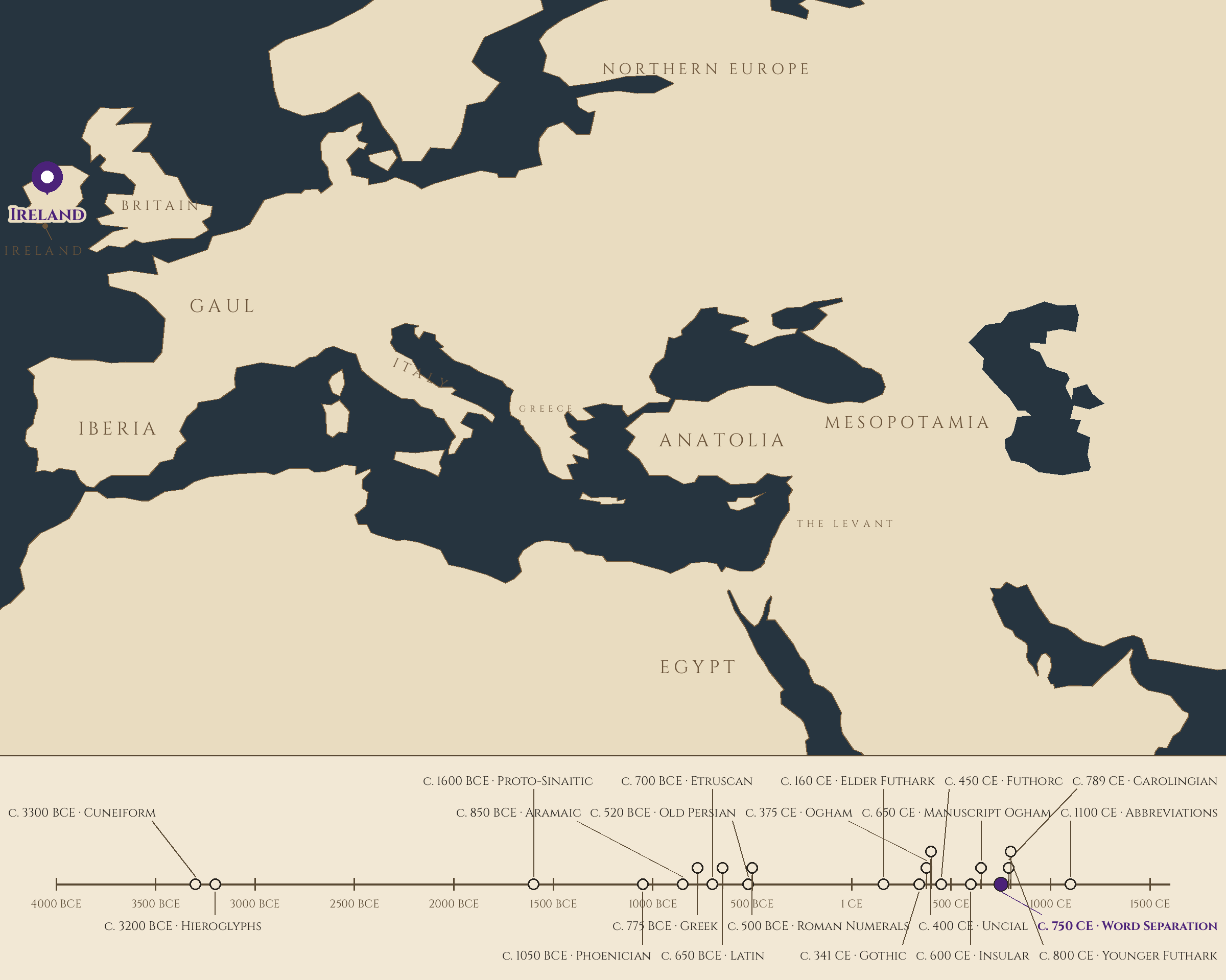
Where and when: the scriptoria of Ireland and Europe, between the 7th and 10th centuries. The pin is this lesson. The line beneath the map is our road: every stop a writing system, every lesson a pin.
Lesson Objectives
By the end of this lesson, students should be able to:
- Define Scriptorium Code (an Evershade classroom term), distinctio, subdistinctio, media distinctio, litterae notabiliores, word separation, silent reading, per cola et commata, and praelectio.
- Describe scriptura continua and explain why ancient readers could navigate text without word spaces.
- Explain the three-height dot system: what each position marked, where it came from (Aristophanes of Byzantium through Donatus), and how it survives in modern punctuation.
- Explain the Irish origin of word separation (7th and 8th centuries) and its slow spread to the continent (late 10th century).
- Tell the Augustine-and-Ambrose story and explain what it reveals about silent reading in antiquity.
- Describe litterae notabiliores and Jerome's per cola et commata layout as early visual reading aids.
- Apply the course question in a new form: what must be added to be understood?
Reading this lesson: ★ marks the passages to remember. They return on the unit quiz and the class test. Check in questions ask the material back as you go; answer them in your workbook when you meet them.
Working this lesson: Your assignment packet is the first download on this page. Work in it as the lesson moves along, answering each assignment as its subject is taught — or read the lesson through for your notes and take the assignments as homework afterward. Both are proper ways to sit this class. Signposts in the reading tell you where each assignment belongs. Written answers are short answers in your own words; a few honest lines are worth more than a filled page.
Your Assignment Packet
This lesson's assignments live in its packet: the Lexicon Handout (every term, course terms marked ◆), Materials, Guided Practice, the Assignment Manual with its answer key for self-checking, the Reflection Questions, and the Workbook Checklist. Download the packet before you begin and keep it beside you as you read.
The Unbroken Stream
★ Open any Roman book, if you could, and this is what you would see: letters running on without break, no spaces between words, no marks at the ends of sentences, the whole text one continuous ribbon. Scriptura continua, the continuous writing. (Roman stone inscriptions had once used the interpunct, a raised dot between words, but the book hand abandoned even that, and the medieval page would have to reinvent word division from nothing.) A Latin sentence that you would write as arma virumque cano appeared as ARMAVIRVMQVECANO, and the reader's job was to find the words inside the stream.
This looks impossible until you understand how ancient reading worked, because ancient reading was not silent. It was voiced, always. The reader sounded the letters aloud, or at least murmured them, and the words emerged the way a melody emerges from notes: the ear did the parsing the eye could not.
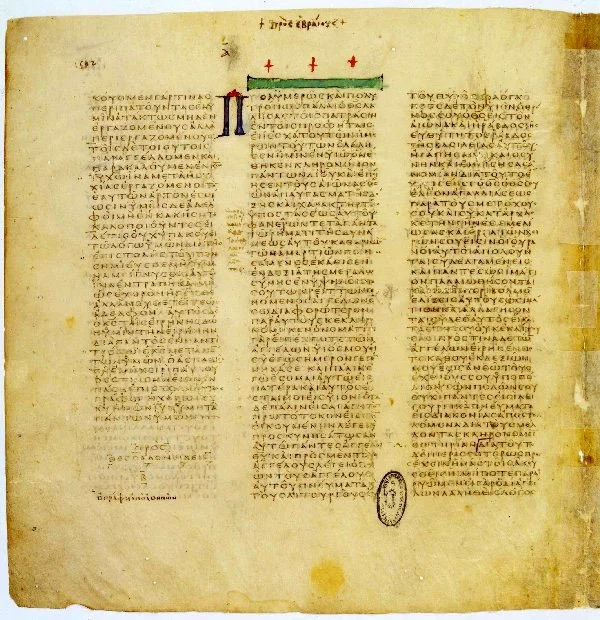
Historical example. The Codex Vaticanus, 4th century: Greek uncial in the unbroken stream — no spaces, no capitals, almost no punctuation. Assignment III will set this page against an Insular one.
Codex Vaticanus (Vatican Library, Cod. Vat. gr. 1209) — 2 Thessalonians 3 and Hebrews 1 in Greek uncial. Public domain, via Wikimedia Commons.
Scholars call this praelectio, the spoken recitation, and it was not a beginner's crutch. It was how the most learned men of antiquity read. Saint Augustine, writing in the 4th century, describes the standard practice without thinking it needs explaining: to understand a passage, you read it aloud.
The stream had logic, once you accept the voice as part of the system. Latin is a heavily inflected language: word endings tell you the grammar, and a trained reader knows the vocabulary. Sounding the letters gives the ear a sequence of familiar words, and the endings sort out who did what to whom.
It is slow by our standards, and it is laborious, and it worked for a thousand years, because every reader was trained the same way and no one knew there was an alternative.
But notice the cost, because the cost is the lesson. In a continuous stream, the page gives the reader nothing but the letters. Every boundary, every pause, every breath must be supplied from the reader's own knowledge: knowledge of the language, knowledge of the text, sometimes knowledge gained by reading the passage aloud three times before understanding it once. The page is a script for the voice, not a map for the eye.
And that means reading is always performance, always effort, always dependent on training most people never received.
The question the scriptoria would eventually ask is the one you should hold now: what if the page did some of that work instead?
❦ In your workbook: record the unbroken stream in your own way — copy, sketch, or note what matters.
In your packet: Assignment II — Punctuating the Stream ⚒ begins here. Work it now, or mark the place and take it as homework — your choice.
The Three Heights
Long before the Irish invented the space, the Greeks invented the pause, or at least its mark.
In the 3rd century BCE, Aristophanes of Byzantium, the great librarian of Alexandria, devised a system of three dots, distinguished by height. A dot placed high marked the fullest pause, the end of a complete thought. A dot at mid-height marked a middle pause, a clause ending but the sense continuing. A dot placed low marked the slightest pause, the briefest division. Three heights, three breaths: the sentence mapped in the vertical space beside the letters.
The system traveled into Latin through the grammarians. Aelius Donatus, the 4th-century Roman teacher whose Ars maior taught generations of schoolboys their grammar, included a section De distinctionibus, on the pauses, setting out the three positions with Latin names.
The high dot became the distinctio: the strong pause, the full stop. The low dot became the subdistinctio: the slight pause, the catch of breath. The middle dot, completing the set, was the media distinctio: the medium pause between the two.
Read those names aloud and hear what they became. The distinctio is the ancestor of our period, the full stop that ends the thought. The subdistinctio is the ancestor of our comma, the small pause that does not end anything. The media distinctio has no single modern child, but its work survives in the colon and the semicolon, the middle pauses of the modern page.
When you end a sentence with a dot, you are placing a distinctio, twenty-three centuries after a librarian in Alexandria first put the high dot where the thought comes to rest.
★ Two cautions, because the classroom loves a straight line and history rarely draws one. First, the three dots were a grammarian's system, taught in schools and used by careful scribes, not a universal practice: most ancient books kept their unbroken stream, dots or no dots.
Second, the dots marked pauses for the voice, not boundaries for the eye. They told the reader where to breathe during praelectio. The page was still a script for performance. The eye's independence was still centuries away.
Check in: Three dots, three heights, three pauses. Which dot ends the thought, and which only catches the breath — and whose system was it before Donatus carried it into Latin?
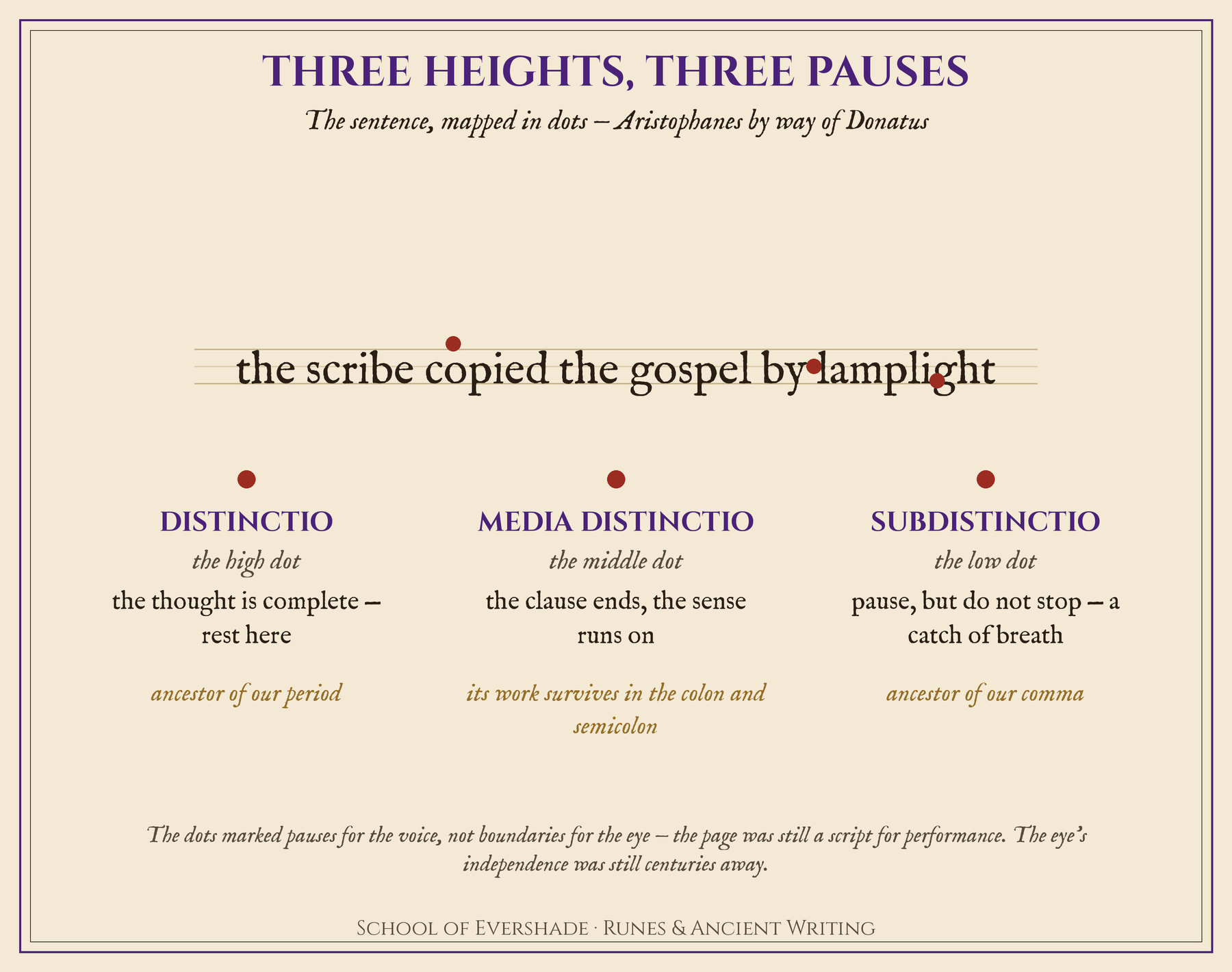
Three heights, three pauses: Aristophanes' one system for the whole of punctuation — the high dot, ancestor of our period; the low dot, ancestor of our comma; the middle dot, whose work the colon and semicolon share today.
Built for Evershade.
❦ In your workbook: record the three heights in your own way — copy, sketch, or note what matters.
In your packet: Assignment I — The Pause Map ⚒ begins here. Work it now, or mark the place and take it as homework — your choice.
Professor Webblethorn
Pause here, scholars, and turn the course question inside out once more.
Every lesson has asked what can be left out and still be understood. The miners left out the pictures. The merchants left out the variation. The Vikings left out the runes. The emperor standardized what could not be left out.
Tonight the question inverts, because the ancients had already done the leaving out. They left out the spaces. They left out the pauses. They wrote the stream and trusted the voice to find the words, the breath to find the joints. And the voice did, for a thousand years, at the cost of every reader's labor.
So tonight we ask the twin question: what must be put in? What must the page supply, so the eye can read what the voice used to carry? The dots at three heights. The space between words. The enlarged letter that says a new thought begins. Each one is a small silence placed on the page, doing work the reader's voice used to do.
Hold both questions together as we go on. What can be left out, and what must be put in. The whole history of the readable page is the negotiation between those two, and it is still being negotiated every time a scribe, or a printer, or you, decides where the breath goes.
PROFESSOR THISTLELOOM WEBBLETHORN
Runes & Ancient Writing
Epigrapher, Head of House Septentrio
The Irish Invention
The space between words was invented in Ireland.
★ That sentence deserves to sit alone, because it is one of the most consequential facts in the history of reading, and almost no one outside the scholarship knows it. The separation of words, the empty air your eyes are using at this moment, originated in manuscripts copied by Irish scribes in the 7th and 8th centuries, and it spread to the European continent only in the late 10th century. The scholar who established this is Paul Saenger, whose Space Between Words traced the practice across the manuscript record. Before the Irish, the Latin West wrote the stream. After them, slowly, it wrote the words apart.
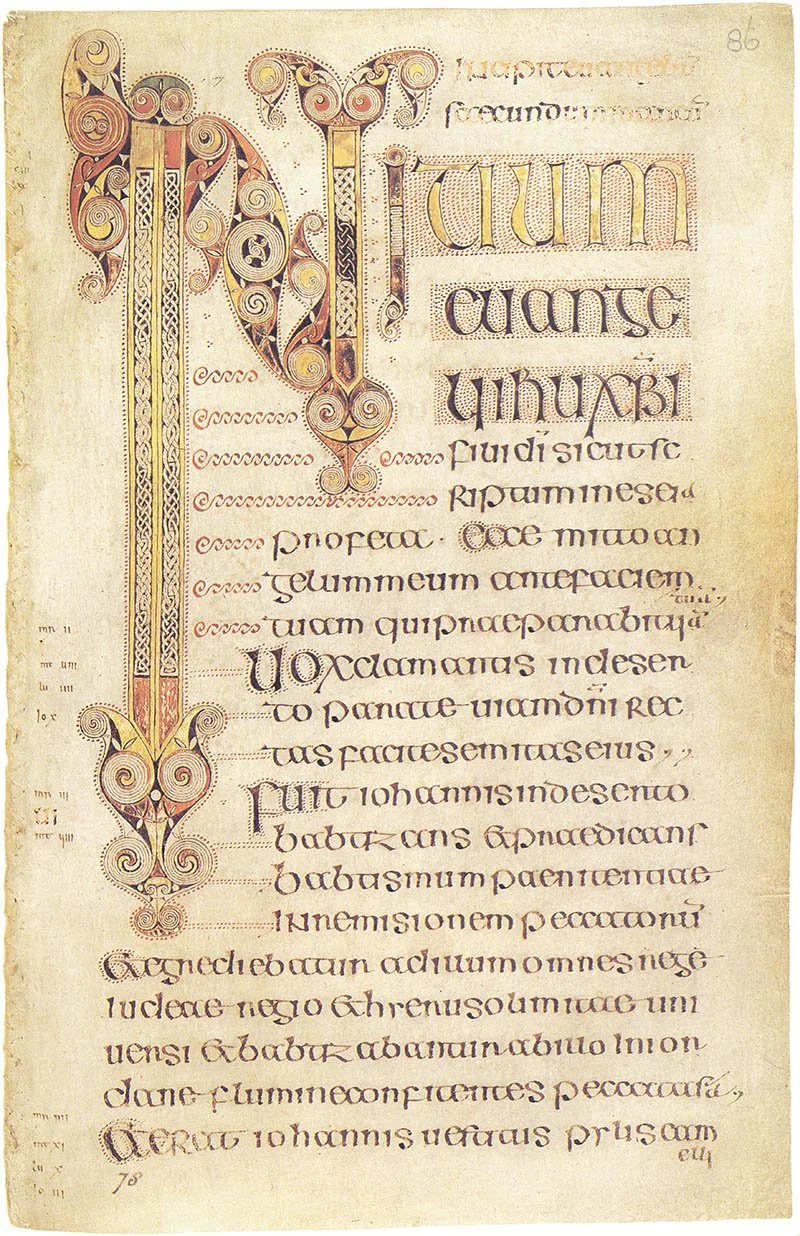
Historical example. The Book of Durrow, folio 86r — the opening of Mark, second half of the 7th century. The spaces between the words are the invention: the Irish gift to everyone who has read since.
Book of Durrow (Trinity College Dublin, MS 57), fol. 86r — the opening of Mark. Public domain, via Wikimedia Commons.
Why Ireland, and why then? The Irish were copying Latin, but Latin was not their language. An Irish monk sounding out a Latin gospel faced the stream without a native speaker's instincts: the endings did not sort themselves in his ear the way they did in a Roman's.
So the Irish scribes did what practical readers do: they marked the boundaries. At first the separations were partial and inconsistent, some words spaced, some still joined, the page in transition. But the direction was set, and the Anglo-Saxon monasteries, in close contact with the Irish, took up the practice.
The islands that had given Latin its most beautiful hand, the Insular script of Lesson 18, now gave it its most useful silence.
The continent was slow to follow (the Carolingian reform's scribes were the great adopters, who systematized word separation and made it the imperial standard), and the slowness matters. Word separation did not sweep Europe in a generation. It crept, house by house, across two centuries, reaching general continental use only in the late 10th century.
Some pages from the transitional centuries show partial spacing, the scribe separating some words and not others, the old habit and the new one sharing the page. The modern page was not invented in a single afternoon. It was negotiated, scribe by scribe, across two hundred years.
And with the spaces came a new kind of reading. When the eye can find the words without the voice, the voice can fall silent. The spaces did not merely make reading easier. They made a new reading possible: the private, silent, eye-only reading that you are doing now. The Irish monks, marking word boundaries so they could parse a foreign tongue, accidentally freed every future reader from the need to perform the text aloud.
The most private act of the modern mind, reading silently to oneself, began as a foreign student's study aid.
Check in: Who invented the space between words, and why did it happen there and then? What new kind of reading did the spaces make possible?
❦ In your workbook: record the Irish invention in your own way — copy, sketch, or note what matters.
In your packet: Assignment III — The Manuscript Investigation ◐ begins here. Work it now, or mark the place and take it as homework — your choice.
The Astonished Saint
There is a story that makes the old world vivid in a single scene, and I want you to carry it.
★ In the 380s, Augustine, not yet a saint, went to visit Ambrose, the bishop of Milan, one of the most famous men of the age. He found him reading. And Augustine was astonished, not by what Ambrose read, but by how. Here is what Augustine wrote, in his Confessions: Ambrose's eyes scanned the page, and his heart sought out the meaning, but his voice was silent and his tongue was still.
Read that again and feel its strangeness to its author. Augustine had to explain what he saw, which means his readers would not have pictured it on their own. A great bishop, reading a book, making no sound: in the 4th century, this was remarkable enough to record.
Everyone else read aloud. The voice was the instrument of comprehension, and a silent reader was a marvel, like a musician playing with unmoving hands.
Augustine even speculates about why Ambrose did it: to spare his voice, which tired easily, or to avoid being interrupted by visitors with questions, since a reading man invites conversation and a silent one can pretend not to hear.
The speculations are charming, and they miss the larger point, which Augustine could not have seen.
Ambrose was reading the future. Six centuries before the Irish spaces, a thousand years before silent reading became normal, one bishop's tired voice stumbled into the posture every one of you holds right now: eyes moving, tongue still, the mind taking the words without the mouth.
Keep that image beside the Irish monks. The monks gave the eye its boundaries. Ambrose showed what the eye could do with them, centuries early, alone in Milan, while Augustine watched and wondered.
Check in: What exactly did Augustine see Ambrose doing, and why did the sight need explaining to his readers?
❦ In your workbook: record the astonished saint in your own way — copy, sketch, or note what matters.
Capitals That Speak
The dots and the spaces were not the only silences. The scribes had other ways to tell the eye where it was.
★ Among the earliest was the enlarged letter. In biblical manuscripts of the Vulgate era, scribes began placing litterae notabiliores, "more notable letters," enlarged initials at the beginnings of sentences or verses. A sentence that the stream would have run straight through now opened with a letter standing taller than its neighbors, and the eye learned to read the height as a boundary. It is a capital letter doing the work of a full stop before the full stop existed: the shape of the letter, not a mark beside it, telling the reader that a new thought has begun.
★ Jerome, translating the Bible into Latin in the late 4th century, went further. In parts of his Vulgate, he arranged the text per cola et commata, "by clauses and phrases": each sense-unit on its own short line, the page broken where the voice should break. Read it and you can hear the reading: the line ends, the breath comes, the next line begins. It is punctuation by layout, the page itself telling the voice where to pause, centuries before the comma took over the job.
Notice what all of these have in common. The distinctio told the voice where to rest. The space told the eye where the word ends. The enlarged letter told the eye where the thought begins. The sense-line told the voice where to breathe.
Every one of them is a transfer: work moving from the reader's performance onto the page itself. The page was learning to do what the voice had always done, and with each transfer, reading became a little less like performing and a little more like seeing.
★ This is the Scriptorium Code as it stood at the end of our story's first volume: not a rulebook, never written down as a system, but a set of practices grown in the copying rooms. Dots at three heights. Spaces between words. Letters standing taller at the joints. Lines broken at the breath.
None of them official. All of them, together, the invention of the readable page.
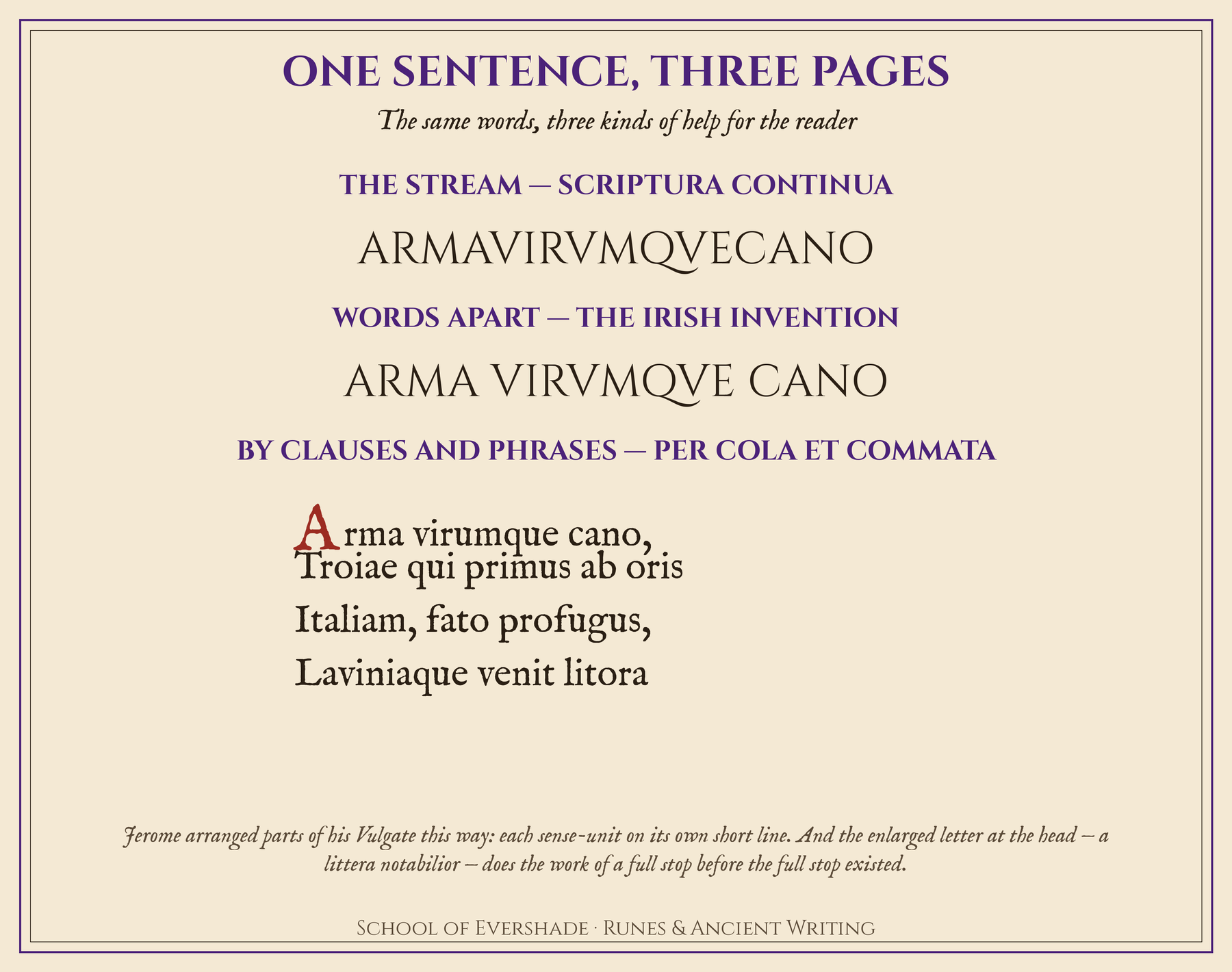
One sentence, three pages: the stream unbroken; the stream with its words set apart; and Jerome's layout, per cola et commata, each sense-unit on its own short line beneath an enlarged letter.
Built for Evershade.
❦ In your workbook: record capitals that speak in your own way — copy, sketch, or note what matters.
Guided Practice — The Punctuator's Hand
Before the assignments, train your hand the way a medieval punctuator would: with attention to the pause, the boundary, and the breath.
Exercise A — The Three Heights
- Write the sentence "the scribe copied the gospel by lamplight" three times, each ending with a dot at a different height: high (top of the letters), middle, and low (baseline).
- Read each version aloud, pausing for the length the dot's height suggests: longest for high, briefest for low. Feel the difference in your own breath.
- Write two to three sentences on what your voice just learned: what does the dot's height tell the reader that a single modern period cannot?
❦ Workbook path: rule the guide lines faintly across a workbook page and write the three versions there, one beneath another, so the three heights can be compared at a glance.
Exercise B — The Stream Divided
- Write the following in scriptura continua, all capitals, no spaces: ARMAMIRVMQVECANOLEGIBVSETINTELLEGENTIBVSET (for arma mirumque cano legibus et intellegentibus et, a practice line).
- Now write it again with Irish-style word separation, spacing each word: ARMA MIRVMQVE CANO LEGIBVS ET INTELLEGENTIBVS ET.
- Time yourself, or have someone else time you, reading each version aloud. Record which was faster and where the continuous version snagged.
- Write two to three sentences on the result: what work did the spaces do that your voice had been doing alone?
Exercise C — The Sense-Line
- Take any paragraph of English prose (a few sentences from a book).
- Rewrite it per cola et commata: break each sentence into short sense-lines, one clause or phrase per line, the way Jerome arranged his text.
- Read your version aloud, pausing at each line break. Then read the original paragraph aloud normally.
- Write two to three sentences on the comparison: what did the line breaks do to your breathing, and what does that reveal about punctuation as stage direction for the voice?
In your packet: Assignment IV — The Silence Essay ✎ begins here. Work it now, or mark the place and take it as homework — your choice.
Assignment Manual
Assignment key: ✎ written work · ⚒ hands-on practical · ◐ both · ★ will be on the test · ❦ workbook path
Written answers in this manual are short answers in your own words — a few honest lines, not a filled page.
Assignment I — The Pause Map ⚒ ★
Objective: Demonstrate control of the three-height dot system by punctuating a continuous text.
Instructions:
- On a fresh sheet, write the following Latin line in scriptura continua (all capitals, no spaces): LITTERAENOTABILIORESSCRIBEBANTVRINMARGINE (for litterae notabiliores scribebantur in margine).
- Below it, write the line again with Irish-style word separation.
- Below that, write it a third time, adding dots at the three heights: place a subdistinctio (low dot) after LITTERAE, a media distinctio (mid dot) after NOTABILIORES, and a distinctio (high dot) at the end. Label each dot with its name.
- Write one paragraph explaining what each mark tells the reader, and why the three heights give the voice more instruction than a single modern period.
Your keepsake: this pause map is the Scriptorium Code on one page. Keep it beside your Caroline chart from last lesson; the hand and its silences belong together.
❦ Workbook path: work the three versions of the line across a workbook spread instead of a loose sheet, the continuous stream at the top, the separated line beneath it, and the dotted line at the foot, so the whole invention stands in one view.
To submit: Photograph or scan your page. Clarity of the dot heights matters more than artistic skill; exaggerate the heights so each is unmistakable.
Assignment II — Punctuating the Stream ⚒ ★
Objective: Feel, in English, what the dot system did for Latin.
Part A. Take the following unpunctuated sentence: "the monks copied the gospels by lamplight and the words ran together without pause or breath". Punctuate it three times, once using only high dots (full stops), once using only low dots (slight pauses), and once using all three heights. Read each version aloud. Which is most readable, and what does the answer reveal about why three pauses beat one?
Part B. Write a half page on the ambiguity the dots resolve: choose any sentence where a pause in the wrong place changes the meaning (the classic "let us eat grandmother" family), punctuate it with the three-height system, and explain which dot goes where and why.
Part C. The lesson claims the distinctio is the ancestor of our period and the subdistinctio the ancestor of our comma. Write a half page evaluating that claim: what is genuinely continuous between the ancient dots and the modern marks, and what is different (consider who the marks served: the voice or the eye)?
Assignment III — The Manuscript Investigation ◐ ★
Objective: Understand the readable page through two manuscripts, one without spaces and one with.
Instructions:
- Research (using the References below): the Codex Vaticanus (4th century, Greek Bible, Vatican Library) and the Book of Kells (c. 800, Trinity College Dublin). For each, record the date, the holding institution, the script, and the state of word separation: is the text written in continuous script, or are words separated?
- The Vaticanus predates the Irish invention by three centuries; the Kells was made in the Irish tradition that invented the spaces. Write a half page comparing what a reader faces on each page: where does the parsing work happen, in the voice or on the page?
- The lesson claims silent reading became normal only after the page supplied what the voice had carried. Choose the single strongest piece of evidence for that claim (from the lesson or your research) and write a half page defending it against an imagined skeptic who insists people always read silently.
Assignment IV — The Silence Essay ✎ ★
Objective: Evaluate the invention of the readable page against the course question.
Instructions:
Write a one-page essay addressing the following:
For most of writing's history, the page supplied only the letters, and the reader's voice supplied the words, the pauses, and the breath. The Scriptorium Code reversed that: dots at three heights, spaces between words, enlarged initials, sense-lines. First, describe concretely what was added to the page, using at least three specific practices from the lesson. Then consider what was lost: praelectio, the shared voiced reading, the reader's trained memory doing the parsing. Finally, return to the course question in its Lesson 20 form: what must be added to be understood? Was the readable page a pure gain, or did something valuable go quiet when the voice did?
Cite the lessons where your details come from.
Materials
Required (Level One — household items)
- Paper: plain white paper or a sketchbook, for the dot-height exercises and the pause map.
- Pens: one standard dark pen for the text, and one red or colored pen for the dots and marks. The color separation teaches the eye what the scribe's marks do: text in one color, punctuation in another.
- A ruler: for ruling the three heights. Draw two faint horizontal guide lines, one at the top of the letters and one at mid-height, so the high, middle, and low dots land where Donatus put them.
- A printout of a continuous-script passage: use the References below, or copy the practice line from Exercise B. The exercise needs a real stream to divide.
Suggested (Level Two — historically closer materials)
- A quill or quill-style dip pen and dark ink: the scriptorium writing kit. Dots made with a quill have the weight the system needs: a pressed dot for the distinctio, a touched dot for the subdistinctio.
- Parchment paper: the manuscript surface. Modern parchment paper from a craft store approximates the prepared skin the Irish monks wrote on.
- A Latin psalm text: the monks' own practice material. The psalms were copied, read, and sung daily; punctuating a psalm verse is the closest a student comes to the scriptorium's daily work.
- Red ink or paint: for the litterae notabiliores. Medieval rubrication used red for the notable letters; one red initial on your page teaches the hierarchy the color enforced.
Neither level requires
Purchased kits, specialty tools, or any material you cannot find locally or order inexpensively. The core lesson (the three dot heights, the word separation exercise, the sense-line practice) is fully achievable with paper and two pens.
Reflection Questions
Answer the following in your workbook.
- What is scriptura continua, and why could ancient readers navigate it? What is praelectio?
- Describe the three-height dot system: name each dot, its height, and the pause it marked. Where did the system originate, and who carried it into Latin?
- Where and when did word separation originate, and how long did it take to reach the continent? What made silent reading possible?
- Tell the Augustine-and-Ambrose story. What did Augustine see, and why did it astonish him?
- What are litterae notabiliores? What is per cola et commata, and whose work does it describe?
- What is the "Scriptorium Code," and why does the lesson insist it was never one official system?
- Apply the Lesson 20 form of the course question: what must be added to be understood? Was the readable page a pure gain?
Workbook Checklist — Lesson 20
In my workbook I have:
- ☐ described scriptura continua and explained how voiced reading, praelectio, navigated it
- ☐ named the three dots, their heights, and the pauses they marked, and traced the system from Aristophanes of Byzantium through Donatus
- ☐ explained the Irish origin of word separation and its slow spread to the continent
- ☐ told the Augustine-and-Ambrose story and what it reveals about silent reading
- ☐ described litterae notabiliores and Jerome's per cola et commata
- ☐ explained what the Scriptorium Code is, and why it was never one official system
☐ Lesson completed Date: ____________ Signature: ____________
Professor's Review
And so our twentieth lesson closes in the scriptorium, where the scribes taught the page to do the voice's work, and the voice fell silent.
You can now describe scriptura continua and explain the voiced reading culture that navigated it, name the three dots of the height system and trace them from Aristophanes of Byzantium through Donatus, explain the Irish origin of word separation and its two-century journey to the continent, tell the story of Augustine watching Ambrose read in silence and say what it reveals, describe litterae notabiliores and Jerome's per cola et commata as early visual reading aids, and apply the course question in its newest form.
Keep your pause map beside your Caroline chart from last lesson. Lay them side by side: the clear hand, and then the silences inside it, the dots at three heights, the spaces between the words, the tall letters at the joints. The hand gave the letters their shapes. The code gave the page its breathing.
Next, our final lesson: the Scriptorium Code's last invention, the shorthand that compressed language itself. The scribes who spaced the words also shortened them, and you will learn the abbreviation matrix: the titulus, the sacred names, and the economy of the crowded page.
Practice your three heights, scholars. Write them with the quill if you have one, and feel the dots land where Donatus put them: high for the full rest, low for the catch of breath, middle for the pause between. I have watched writing learn many things in my years among the inscriptions, but I have never seen it learn anything stranger than silence. The web holds a new pattern now. Learn its threads.
PROFESSOR THISTLELOOM WEBBLETHORN
Runes & Ancient Writing
Epigrapher, Head of House Septentrio
Cross-Class Connections
The transfer of work from the voice to the page connects directly with Scrollwork, where Professor Nocturne teaches the same centuries' pen craft. Students studying both classes should copy a psalm verse twice, once in continuous script and once with Irish spacing and the three dots: the hand learns what the lesson teaches, that punctuation is choreography for the breath.
The per cola et commata layout connects with Creative Arts, where Professor Timberclank's design lessons teach the line break as a visual instrument. Jerome's sense-lines are layout doing the work of punctuation, and the students who arrange text on a page will recognize the technique.
The abbreviation systems of our final lesson are already visible on the spaced page: the Runes Unit V finale takes up the titulus and the sacred names, the code's last economy. The spaces made room for the eye; the abbreviations will make room on the crowded page.
In Other Classrooms
Scrollwork · Unit IV, Lesson 13 — Spacing & Rhythm

Punctuation is choreography for the breath, and spacing is its stage. In the Library we study how the page learned to breathe: baselines, word spaces, leading, and the cadence that makes reading effortless. Come and rule a page with us, and your spaced psalm verse will show you why the Irish invention conquered the world.
The page learned to breathe, and so do we.
References & Further Reading
Paul Saenger. Space Between Words: The Origins of Silent Reading (Stanford University Press). The scholarship establishing the Irish origin of word separation (7th and 8th centuries) and its late-10th-century spread to the continent. https://www.sup.org/books/history/space-between-words
Wikipedia. "Punctuation." The three-height system from Aristophanes of Byzantium through Donatus: distinctio, media distinctio, subdistinctio; litterae notabiliores. https://en.wikipedia.org/wiki/Punctuation
HMML School. Lexicon entry: "media distinctio." The mid-height dot for the middle pause, completing the three-height system. https://hmmlschool.org/lexicon/14621/
Augustine. Confessions, Book 6, Chapter 3 (New Advent). Augustine's account of finding Ambrose reading silently: eyes scanning, voice and tongue still. https://www.newadvent.org/fathers/110106.htm
Wikipedia. "Codex Vaticanus." The 4th-century Greek Bible in continuous script: the unspaced page the lesson's investigation compares. https://en.wikipedia.org/wiki/Codex_Vaticanus
Wikipedia. "Book of Kells." The c. 800 Irish gospel book in the spacing tradition: Trinity College Dublin. https://en.wikipedia.org/wiki/Book_of_Kells
Browse the Runes shelf in the school Library for readable editions of these works.
Submit your work for this lesson using the form below.
CONTINUE IN RUNES & ANCIENT WRITING
← Previous · Lesson 19: The Clear Hand: Carolingian Minuscule and the Standardized Empire Next · Lesson 21: How Scribes Left Letters Out and Readers Put Them Back →
Unit V · The Medieval Scriptorium Runes & Ancient Writing Classroom · All 21 Lessons
The rest of Unit V: Lesson 16 · The Gothic Alphabet · Lesson 17 · Roman Cursive & Uncial · Lesson 18 · The Insular Script · Lesson 19 · The Clear Hand · Lesson 21 · How Scribes Left Letters Out and Readers Put Them Back