

Creative Arts
Unit VI, Lesson 24Counting Boards & Thinking Tools
Professor Cogbranch Timberclank
Master Artisan, Head of House Occidens
The Creative Arts Workshop • School of Evershade
Professor's Introduction

Set up your bench, scholars. Today the wood we shape is shaped for thinking.
Before there were numerals on paper, there were pebbles on lines. Those pebbles were calculus in Latin, a small pebble, and the words calculate and calculus still carry the pebble inside them; Greek had its own pebble word, khalix, for the same work. For most of human history, arithmetic was not written down at all; it was done, physically, on a board, with counters moved by hand, and the written figures, when they existed, merely recorded the answer the board had already found. A counter is any small movable piece used in reckoning: pebbles, beans, bone or wooden discs, or metal jetons. What the counter is made of matters less than where it sits. The board was the computer. The scholar's hands were its machinery. And the boards were made by woodworkers: ruled, grooved, framed, and built to be used daily for lifetimes.
This lesson builds the counting board of wood and pebbles, and two humbler members of the same family, the tally stick and the demonstration board. A counting board is a flat board ruled with lines, on which counters are placed and moved to perform arithmetic; a pebble's place on the board is its worth, which is place value made visible. A tally is a stick notched to record a number or a debt, each notch cut to a size or depth standing for an amount; a split tally was cut down its length so debtor and creditor each held half, and the halves' notches had to match to be honored. The history runs deep and strange: a marble board from Salamis older than Rome, the chequered cloth that gave England's treasury its name, and the split tally sticks whose burning, in 1834, set fire to Parliament itself. There is no better story in the whole course for teaching why records outlast the buildings that house them, or why a maker should build the record-keeping tool as carefully as the record.
Level One scholars will build a ruled board on a prepared plank with painted or penciled lines. Level Two scholars will groove the lines into the wood, in the older manner. Both will work sums with pebbles until the layout is second nature, which is the only way a thinking tool becomes one.
PROFESSOR COGBRANCH TIMBERCLANK
Creative Arts Workshop
Master Artisan, Head of House Occidens
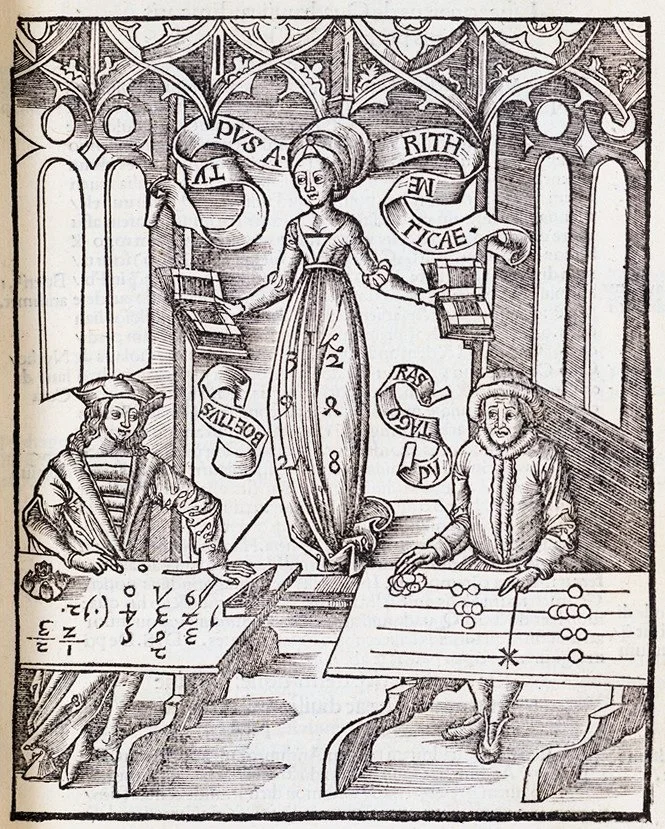
The famous 1503 woodcut from Reisch's *Margarita Philosophica* — two reckoners side by side, one working a counting board with counters on lines, the other with written numerals, while Arithmetic looks on.
Woodcut from Gregor Reisch, Margarita Philosophica (1503). Public domain, via Wikimedia Commons.
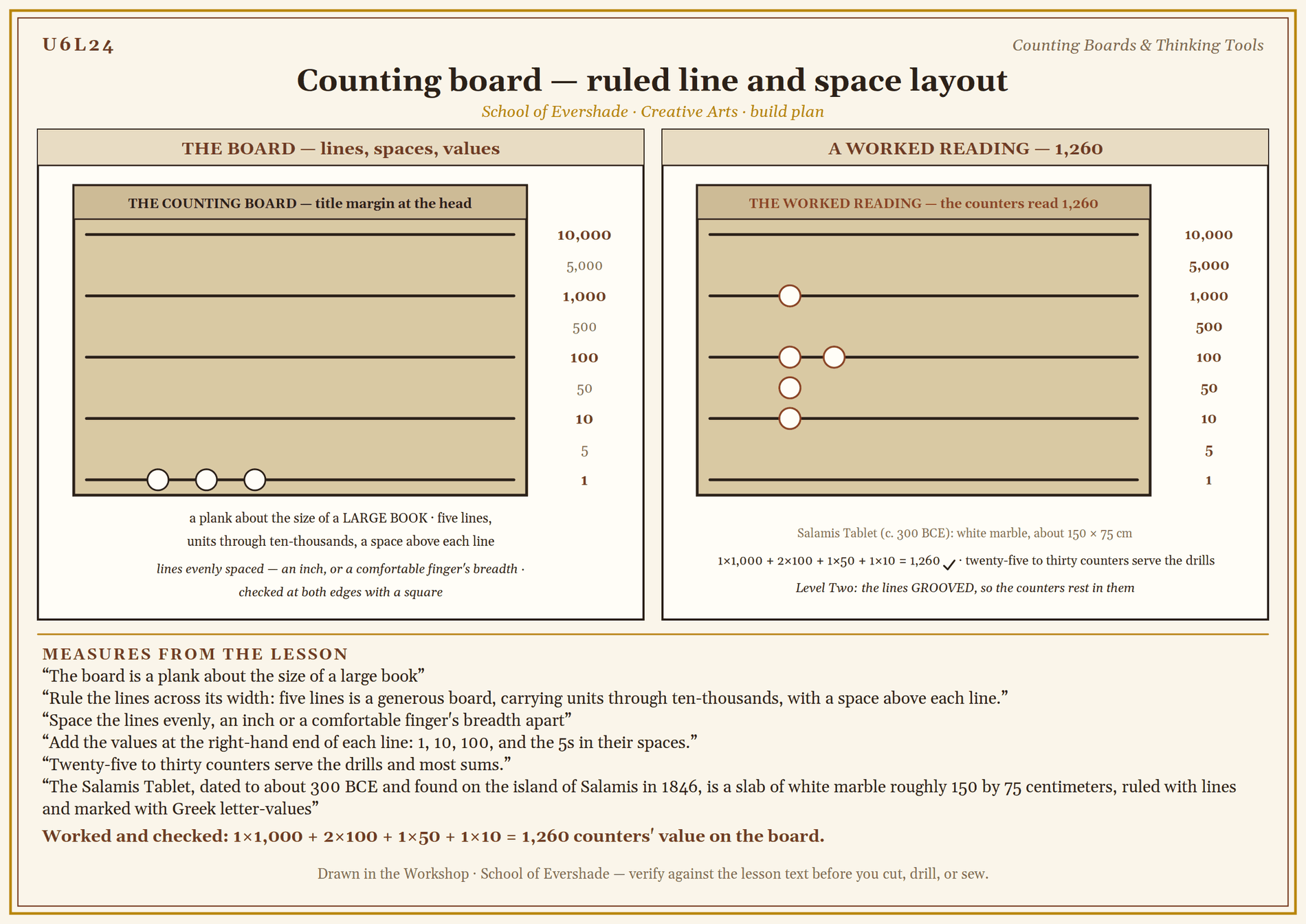
Counting board — ruled line and space layout
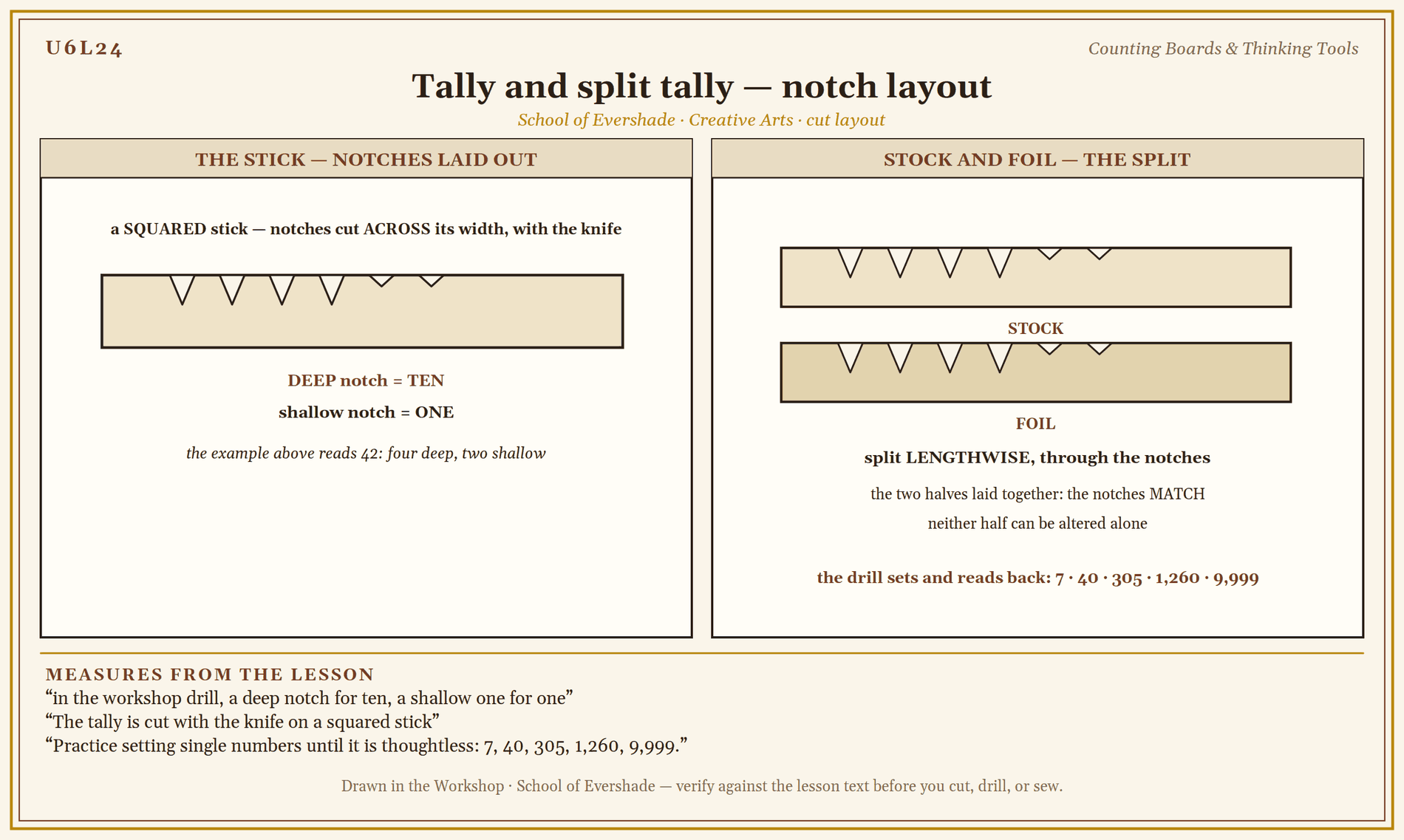
Tally and split tally — notch layout
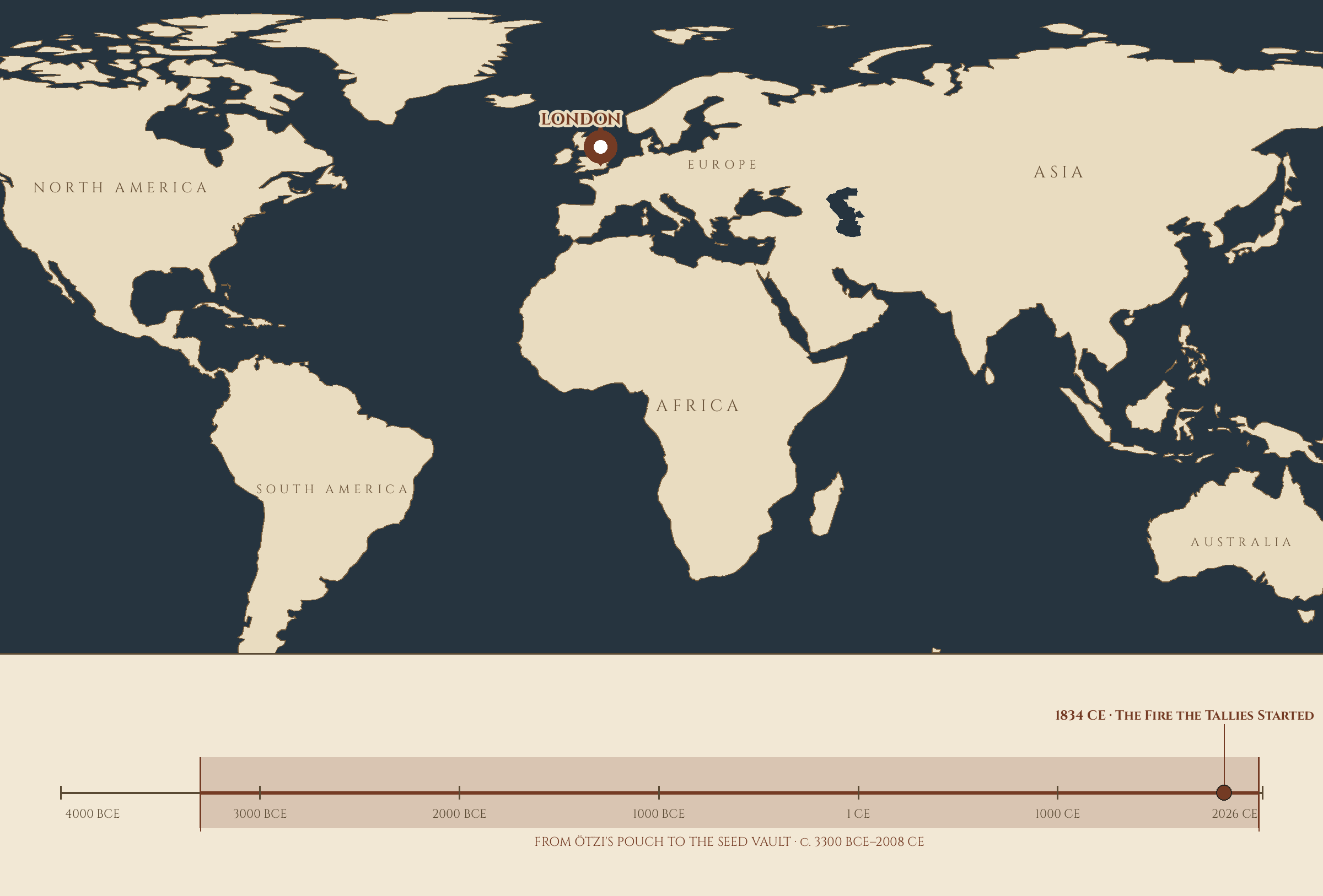
Where and when: London — 1834 CE, the fire the tallies started.
Lesson Objectives
By the end of this lesson, students should be able to:
- Explain how place value works on a counting board: lines for units, tens, hundreds, and the spaces between for fives.
- Work addition and subtraction on the board with pebbles, and record the final answer in figures.
- Cut and read a simple tally, and explain how a split tally served as a receipt both parties could trust.
- Tell the story of the Exchequer tallies and the fire of 1834 accurately.
- Lay out a practice board grid to measure and build a finished counting board that is square, true, and legible.
- Survey the abacus family, Salamis tablet, Roman hand abacus, suanpan, and soroban, and say what each shares with the board.
Your Assignment Packet
This lesson's assignments live in its packet: the Lexicon Handout (every term, course terms marked ◆), the Assignment Manual, and the Reflection Questions. Download the packet before you begin and keep it beside you as you read — work from it as each subject is taught, or take the assignments as homework afterward.
Sticks That Remembered
The tally is the oldest record in this lesson and perhaps the oldest in the school. Notched sticks and bones, scored to keep count, were used by ancient peoples across the world; a notch is a number that cannot be argued with, because it can be counted again by anyone. Where the tally grew clever was in the split. A stick was notched across its width with cuts sized to the amounts, then split lengthwise through the notches. The creditor kept the larger half, called the stock, and the debtor kept the foil. Neither could alter the record afterward, because any new notch would appear on one half only, and the fraud would show the moment the halves were laid together. It is a receipt, a contract, and a lock, made of one stick and a sharp knife.
England's Exchequer ran on these sticks for centuries. The Exchequer was the English royal treasury, named for the chequered cloth, like a counting board's grid, on which royal accounts were reckoned with counters in the medieval court; the word checkerboard and the word exchequer are cousins. From the twelfth century, payments into the royal treasury were recorded on tallies, and the system outlasted the medieval world that invented it by hundreds of years: the tallies were abolished only in 1826. By then the treasury vaults held an accumulation the clerks estimated at two cartloads of old sticks. In October 1834, the Clerk of the Works decided to be rid of them in the furnaces beneath the House of Lords. The furnaces overheated, the flues caught, and on the night of 16 October 1834 the old Palace of Westminster burned down in the most famous fire in London between 1666 and the Blitz. The artist Turner painted it. The rebuilt Parliament that stands today is, among other things, a monument to the danger of destroying records carelessly. Every scholar who keeps a workbook should feel a small chill at this story. Paper burns. Notches, at least, burned expensively.
The Board and Its Lines
The counting board works on the idea every scholar already uses in written arithmetic, made physical. Lines are ruled across the board. A pebble on the first line is worth one; on the second, ten; on the third, a hundred; and so on, each line ten times the one below. The spaces between the lines are worth five of the line below: a pebble in the space above the units line is five, in the next space fifty. To set a number, you lay its pebbles out. To add, you lay the second number's pebbles beside the first and then simplify, trading ten pebbles on a line for one on the line above, two in a space for one above it, exactly as carrying works on paper, except your hands do it and can see it.
The oldest surviving board is marble. The Salamis Tablet, dated to about 300 BCE (the fourth century BCE; it may be Babylonian-made) and found on the island of Salamis in 1846, is a slab of white marble roughly 150 by 75 centimeters, ruled with lines and marked with Greek letter-values, now in the Epigraphical Museum in Athens. It was first taken for a gaming board, and the mistake is instructive: games and reckoning shared boards for centuries, because both are pebbles moved by rules on lines. Medieval and Renaissance merchants reckoned on such boards and on chequered cloths, and the cloth is the board's most famous descendant, since the royal accountants' chequered table gave the Exchequer its name. German reckoner Adam Ries, whose books taught arithmetic to the German-speaking world in the 1500s, still taught the board alongside written figures, and his name survives in a German saying that a sum done "after Adam Ries" is a sum done right.
Beads on Rods: The Abacus Line
The abacus is the counting board with its pebbles captured. Loose counters are free but easily disturbed; beads on rods cannot be knocked out of place, and they travel. The Roman hand abacus, small enough for a palm, set beads sliding in grooves in a bronze plate, with columns for units, tens, and hundreds and special columns for fractions of the Roman pound and ounce, a pocket calculator of the empire. China's suanpan carries two beads above its dividing bar, each worth five, and five below, each worth one, an arrangement that also serves hexadecimal weights in the old markets. Japan's soroban refined the suanpan to one bead above and four below, the minimum that place value needs, and trained operators work it at a speed that has beaten an electric calculator in a famous contest. Survey depth is enough for this workshop: what matters to the maker is that all four instruments, tablet, board, hand abacus, and frame abacus, are one idea in four materials, and that the wooden one is ours to build.
A Sealed Note from Professor Timberclank
This lesson's tools are Lesson 23's tools, and the saw's rules have not changed because the project is small.
The counting board is built from one plank, and it is tempting to hold it in the hand and saw it there, because it fits. It fits in the clamp too. Clamp it. Keep both hands behind the cut line, let the saw travel without pressure, and stop the moment a cut binds or jumps. We stop, we make it safe, then we begin again. The board will wait. A board is patient by nature; that is rather the point of it.
One more rule, of records rather than blades: the grid is laid out in pencil and checked against the measure twice before any groove is cut. A board with a crooked line teaches crooked arithmetic, and it will do it faithfully for years. Measure the thinking tool as carefully as the thought.
PROFESSOR COGBRANCH TIMBERCLANK
Creative Arts Workshop
Master Artisan, Head of House Occidens
Technique: Building the Board
Layout. The board is a plank about the size of a large book, surfaced smooth by Lesson 23's methods. Rule the lines across its width: five lines is a generous board, carrying units through ten-thousands, with a space above each line. Space the lines evenly, an inch or a comfortable finger's breadth apart, and check the spacing at both edges with the square; parallel lines that converge will misplace pebbles and tempers. Leave a margin at the head of the board for its title and the scholar's mark.
The lines themselves. Level One: draw the lines in pencil, check them, then go over them in ink or paint with a straightedge, thin and dark. Add the values at the right-hand end of each line: 1, 10, 100, and the 5s in their spaces. Level Two: cut the lines as shallow grooves with the knife or a small saw against the straightedge, then darken the grooves with ink rubbed in and wiped off the surface. A groove has the older virtue: a pebble resting in it stays where it was put, as the Salamis counters stayed in theirs.
The counters. Choose pebbles, beans, or cut discs that sit flat and do not roll. A jeton is a purpose-made counter, often of metal, struck like a coin but spent only on the board; merchants and reckoners across Europe carried sets of them for three hundred years. Twenty-five to thirty counters serve the drills and most sums. Keep them in a pouch from Lesson 13 or a small box from Lesson 26 to come; a thinking tool whose pieces scatter teaches only tidiness, and that only by failure.
Working a sum. Set the first number: pebbles on lines and in spaces, none where a ten-trade would simplify. Set the second number's pebbles beside them. Then simplify from the bottom: ten on a line become one on the line above; five pebbles on a line plus one in its space above, gathered, make one on the line above, and two space-pebbles make one on the line above. Read the answer off the board and write it in figures. The written figure is the record; the board is where the answer was earned.
Tally and demonstration boards. The tally is cut with the knife on a squared stick, an adult present, with each notch's meaning agreed before the first cut: in the workshop drill, a deep notch for ten, a shallow one for one. The demonstration board is the counting board's tall cousin: a board ruled with large squares and a ledger of columns, made to hang or stand where a group can work on it together, the direct ancestor of every classroom grid.
Practice Practical: The Practice Board
This drill is checked for accuracy, not speed. The grid is practiced on scrap first.
- Lay out the practice grid. On the scrap board, measure and rule five lines with their spaces, values marked, checking spacing at both edges with the square. If a line is off parallel, find out why before ruling the next.
- Set numbers. Practice setting single numbers until it is thoughtless: 7, 40, 305, 1,260, 9,999. Have a partner read each back from the board. A number that cannot be read back is set wrong, and the board, not the reader, is corrected first.
- Work sums. Add pairs of numbers on the board, simplifying with the ten-trades, and write each answer in figures. Check two of the sums by written arithmetic. They must agree; where they do not, redo the board sum slowly and find the trade that was missed.
- Cut the practice tally. On the scrap stick, agree the notch values, then record the count of something real: the counters in the pouch, the pages of a workbook, the days since term began. Cut a matching split record if your Level allows, and test that the halves agree.
- Build the finished board. Rule or groove the finished plank by the practiced layout, title it, and set one sum on it to prove it. Counters in their pouch or box, beside the board.
- Record and put away. Keep the practice grid and tally with the board, labeled with the date. Note in your workbook the largest sum you worked and the trade you missed most often. Bench clear, tools away.
When the layout is second nature and the pebbles move before the doubt does, your hands have learned what this lesson is for.
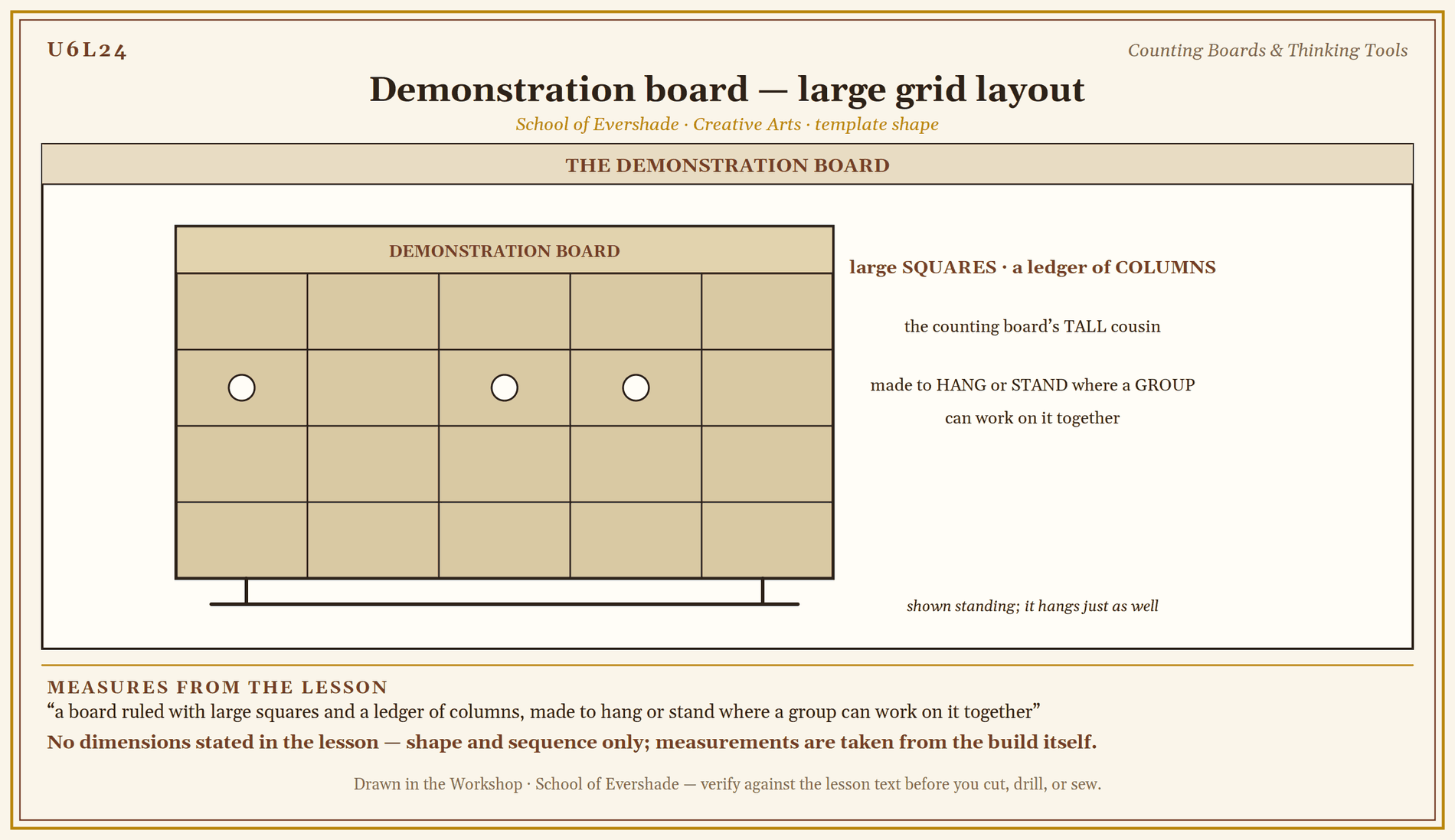
Demonstration board — large grid layout
Assignment Manual
Assignment key: ✎ written work · ⚒ hands-on practical · ◐ both
Assignment I ⚒ — The Practice Practical
Complete the drill in this lesson: a practice grid laid out to measure, numbers set and read back, sums worked and checked, a practice tally cut, and the finished counting board built and proven with one sum. Your board, grid, and tally are the record of the drill.
Assignment II ✎ — The Fire the Tallies Started
Using the lesson and the sources below, write a short account of the split tally system and the fire of 1834. Include: how a split tally prevented forgery, why the Exchequer kept the system so long, and what actually caused the palace to burn.
Assignment III ◐ — Reckon a Day in Pebbles
Keep one day's small counts on your board and tally instead of in figures: pages read, stairs climbed, letters written, or another count your household agrees on. Record the totals at day's end, photograph or sketch the board set with its final number, and write a short piece on what reckoning by hand showed you that written figures usually hide.
Materials
Level One (household)
- One plank or board offcut, roughly book-sized, smoothed; or a piece of stiff board or plywood with a finished face
- Pencil, ruler, and square for layout; ink, paint pen, or fine marker for the lines
- Pebbles, beans, buttons, or cut wooden discs: 25 to 30 counters, kept in a small pouch or box
- A squared stick or dowel length for the practice tally, and a craft knife used with an adult present
- Scrap board for the practice grid, before the finished plank is touched
Level Two (historical)
Everything in Level One, plus:
- A knife or small saw and straightedge for grooved lines, darkened with rubbed ink
- Wooden counters cut and sanded from dowel, or counters of bone-style substitute material
- A hazel or willow rod for the split tally trial, split lengthwise with care and an adult present
- Hardwood for the finished board, worthy of daily use
Both levels teach the same craft. Level One rules its board in ink on a prepared plank; Level Two grooves the lines in the older manner. Either scholar's board, worked until the sums come easily, is the deliverable of the lesson.
Reflection Questions
Answer the following questions in your workbook.
- When a board sum and a written sum disagreed, where was the error, and how did the board help you find it?
- Why could neither party to a split tally cheat the other? What modern records work on the same principle?
- The Exchequer kept tally sticks into the 1800s, long after paper accounts existed. What does a record-keeping tool have to do well to survive that long?
- Adam Ries taught the board and written figures side by side. What does each method teach that the other does not?
- The Salamis Tablet was mistaken for a game board. Why do games and arithmetic keep borrowing each other's equipment?
Professor's Review
A board, a stick, and a pouch of pebbles. It does not look like much, and it ran the treasuries of kingdoms.
You know now what your figures are standing on. Every written sum you do from this term onward is a counting board with the pebbles taken away, and on the days the figures misbehave, you have a tool that lets your hands find the error your eyes walked past. Keep the board where you work. A thinking tool kept in a drawer is furniture.
Next lesson builds for the other classrooms: drying racks and screens for the Greenhouse harvest, and the bench furniture the Potions Laboratory keeps asking this workshop for.
PROFESSOR COGBRANCH TIMBERCLANK
Creative Arts Workshop
Master Artisan, Head of House Occidens
Cross-Class Connections

Runes · Unit III, Lesson 10 — The Tally Matrix
In my classroom, scholars, number was kept before numerals were common: notches cut in sticks, counters set on ruled lines, the tally’s record read at sight. My lesson studies tallies and reckoning as a writing system — how notches and counters record number before numerals, and how the tally’s record was read. The counting board built in this workshop is that lesson’s working instrument: build it here, and carry it there, and I will teach you the matrix in which board reckoning and tally marks were read together.
PROFESSOR THISTLELOOM WEBBLETHORN
Runes & Ancient Writing
Further Reading & Sources
UK Parliament. "Tally Sticks." The official account: tallies as receipts for government income from the Middle Ages, abolition in 1826, and the burning of the two accumulated cartloads that caused the fire of 16 October 1834.
Swetz, Frank J., and Victor J. Katz. "Mathematical Treasures: English Tally Sticks." MAA Convergence. The split stick explained, stock and foil, with the Exchequer's history from the twelfth century and examples preserved in the Chapel of the Pyx.
Wikipedia. "Counting board." The board's lines and five-spaces, its counters, the Salamis Tablet, and Adam Ries's teaching of board reckoning.
Kidwell, Peggy Aldrich (Smithsonian). "Mathematical Treasure: Modern Chinese Abacus." MAA Convergence. Calculi and khalix, the counting board's long use by merchants, and the Chinese abacus's two-and-five bead arrangement.
Print source, unlinked: Ifrah, Georges. The Universal History of Numbers. The long survey of tallying and board reckoning across cultures; the workshop copy lives in the Materials Library.
Student-friendly starting points for exploring this lesson's world. All links verified October 2026.
- Wikipedia. "Salamis Tablet." The marble board itself: its size, its discovery on Salamis in 1846, its first life mistaken for a gaming board, and its home in the Epigraphical Museum, Athens.
- UK Parliament, the fire of Westminster collection pages. The same official history as the reference above, with the wider story of the 1834 fire and the rebuilding that followed.
- MAA Convergence, Mathematical Treasures. Photographs and discussion of surviving English tally sticks, including the 1296 sticks from the Chapel of the Pyx.
Submit your work for this lesson using the form below.
CONTINUE IN THE CREATIVE ARTS WORKSHOP
← Previous · Lesson 23: Wood, Grain & Safe Hand Tools Next · Lesson 25: Drying Racks, Screens & Bench Furniture →
Unit VI · Wood & Furniture Creative Arts Workshop · All 39 Lessons
Bookstore Shelf The Library · Creative Arts Shelf Course Supplies
The rest of Unit VI: Lesson 23 · Wood, Grain & Safe Hand Tools · Lesson 25 · Drying Racks, Screens & Bench Furniture · Lesson 26 · Shelves, Boxes & Storage That Lasts